

IEC 61000-2-11:1999
(Main)Electromagnetic compatibility (EMC) - Part 2-11: Environment - Classification of HEMP environments
General Information
- Abstract
The purpose of this publication is to help specify the immunity requirements of an item (e.g. equipment or subsystem) containing electrical or electronic parts to ensure that it will operate during and/or after exposure to a high-altitude electromagnetic pulse (HEMP) waveform. It provides basic guidance for the selection of immunity test levels for any component, device, equipment, subsystem or system which contains electrical circuits that may be disturbed by electromagnetic signals.
- Status
- Published
- Publication Date
- 28-Oct-1999
- Technical Committee
- SC 77C - High power transient phenomena
- Current Stage
- PPUB - Publication issued
- Start Date
- 29-Oct-1999
- Completion Date
- 30-Nov-1999
Overview
IEC 61000-2-11:1999 addresses electromagnetic compatibility (EMC) in relation to high-altitude electromagnetic pulse (HEMP) environments. Published by the International Electrotechnical Commission (IEC), this standard provides a framework for classifying HEMP environments and guides the specification of immunity requirements for electrical and electronic systems. The aim is to ensure reliable operation of devices during or after exposure to HEMP waveforms by providing clear criteria for the selection of immunity test levels. This document is a key reference for professionals responsible for product immunity standards and for organizations concerned with EMC risk assessment and mitigation.
Key Topics
HEMP Environment Classification:
The standard outlines a systematic approach to identify and classify the electromagnetic environments resulting from high-altitude electromagnetic pulses. It distinguishes between early-time (fast), intermediate-time (medium), and late-time (slow) HEMP effects.Immunity Requirements:
IEC 61000-2-11 guides users in specifying the immunity levels necessary for various equipment, subsystems, or full systems containing electrical circuits that may be disrupted by electromagnetic signals. It emphasizes the evaluation of both radiated and conducted disturbances.Protection Concepts:
Six core protection concepts are described, assisting in translating external HEMP exposure into internal EMC requirements. This links the external threat environment to the expected conditions inside protected areas or installations.Selection of Immunity Test Levels:
The standard gives foundational guidance for selecting practical immunity test levels, enabling manufacturers and EMC engineers to develop consistent test protocols that address relevant threat scenarios.Terminology and Definitions:
Essential EMC and HEMP-related terms are precisely defined, aligning with the International Electrotechnical Vocabulary for clarity and uniformity across industries.
Applications
Product Development & Certification:
Manufacturers of critical infrastructure electronics, industrial control equipment, and other sensitive systems use IEC 61000-2-11 to design products capable of withstanding HEMP events, supporting compliance in regulated markets.Risk Assessments:
The classification framework supports engineers and EMC consultants in performing environmental risk assessments for installations exposed to high-altitude nuclear events or similar threats.Test Planning:
EMC test laboratories rely on guidance from this standard to establish appropriate test conditions and immunity benchmarks for electrical products intended for use in HEMP-prone environments.Infrastructure Protection:
Operators of power grids, communication networks, and essential services deploy this standard as part of their EMC strategy to evaluate vulnerability and to define necessary protective measures.
Related Standards
IEC 61000-2-11 is part of a family of EMC standards. Key related documents include:
- IEC 61000-2-9:
Focuses on the description of the HEMP environment with particular attention to radiated disturbances. - IEC 61000-2-10:
Addresses conducted disturbances in HEMP environments. - IEC 61000-5-3/TR:
Offers detailed guidance on HEMP protection concepts, including installation and mitigation strategies. - IEC 60050-161:
The International Electrotechnical Vocabulary, providing definitions and terminology for electromagnetic compatibility.
Practical Value
IEC 61000-2-11:1999 is essential for organizations tasked with developing, evaluating, or safeguarding electronic systems against electromagnetic threats. Through its environment classification, clear definitions, and test level selection guidelines, it supports robust design, compliance, and resiliency for electrical equipment used in sensitive or mission-critical applications. For professionals in EMC, electrical engineering, and product certification, adherence to this standard strengthens operational reliability and ensures alignment with international best practices in electromagnetic compatibility and HEMP protection.
Get Certified
Connect with accredited certification bodies for this standard

ANCE
Mexican certification and testing association.

Intertek Slovenia
Intertek testing, inspection, and certification services in Slovenia.

LNE (Laboratoire National de Métrologie et d'Essais)
French national laboratory for metrology and testing.
Sponsored listings
Frequently Asked Questions
IEC 61000-2-11:1999 is a standard published by the International Electrotechnical Commission (IEC). Its full title is "Electromagnetic compatibility (EMC) - Part 2-11: Environment - Classification of HEMP environments". This standard covers: The purpose of this publication is to help specify the immunity requirements of an item (e.g. equipment or subsystem) containing electrical or electronic parts to ensure that it will operate during and/or after exposure to a high-altitude electromagnetic pulse (HEMP) waveform. It provides basic guidance for the selection of immunity test levels for any component, device, equipment, subsystem or system which contains electrical circuits that may be disturbed by electromagnetic signals.
The purpose of this publication is to help specify the immunity requirements of an item (e.g. equipment or subsystem) containing electrical or electronic parts to ensure that it will operate during and/or after exposure to a high-altitude electromagnetic pulse (HEMP) waveform. It provides basic guidance for the selection of immunity test levels for any component, device, equipment, subsystem or system which contains electrical circuits that may be disturbed by electromagnetic signals.
IEC 61000-2-11:1999 is classified under the following ICS (International Classification for Standards) categories: 33.100.01 - Electromagnetic compatibility in general. The ICS classification helps identify the subject area and facilitates finding related standards.
IEC 61000-2-11:1999 is available in PDF format for immediate download after purchase. The document can be added to your cart and obtained through the secure checkout process. Digital delivery ensures instant access to the complete standard document.
Standards Content (Sample)
NORME CEI
INTERNATIONALE IEC
61000-2-11
INTERNATIONAL
Première édition
STANDARD
First edition
1999-10
PUBLICATION FONDAMENTALE EN CEM
BASIC EMC PUBLICATION
Compatibilité électromagnétique (CEM) –
Partie 2-11: Environnement – Classification de
l'environnement IEMN-HA
Electromagnetic compatibility (EMC) –
Part 2-11: Environment – Classification of
HEMP environments
Numéro de référence
Reference number
CEI/IEC 61000-2-11:1999
Numéros des publications Numbering
Depuis le 1er janvier 1997, les publications de la CEI As from 1 January 1997 all IEC publications are
sont numérotées à partir de 60000. issued with a designation in the 60000 series.
Publications consolidées Consolidated publications
Les versions consolidées de certaines publications de Consolidated versions of some IEC publications
la CEI incorporant les amendements sont disponibles. including amendments are available. For example,
Par exemple, les numéros d’édition 1.0, 1.1 et 1.2 edition numbers 1.0, 1.1 and 1.2 refer, respectively, to
indiquent respectivement la publication de base, la the base publication, the base publication incor-
publication de base incorporant l’amendement 1, et la porating amendment 1 and the base publication
publication de base incorporant les amendements 1 incorporating amendments 1 and 2.
et 2.
Validité de la présente publication Validity of this publication
Le contenu technique des publications de la CEI est The technical content of IEC publications is kept
constamment revu par la CEI afin qu'il reflète l'état under constant review by the IEC, thus ensuring that
actuel de la technique. the content reflects current technology.
Des renseignements relatifs à la date de reconfir- Information relating to the date of the reconfirmation
mation de la publication sont disponibles dans le of the publication is available in the IEC catalogue.
Catalogue de la CEI.
Les renseignements relatifs à des questions à l’étude et Information on the subjects under consideration and
des travaux en cours entrepris par le comité technique work in progress undertaken by the technical
qui a établi cette publication, ainsi que la liste des committee which has prepared this publication, as well
publications établies, se trouvent dans les documents ci- as the list of publications issued, is to be found at the
dessous: following IEC sources:
• «Site web» de la CEI* • IEC web site*
• Catalogue des publications de la CEI • Catalogue of IEC publications
Publié annuellement et mis à jour Published yearly with regular updates
régulièrement
(Catalogue en ligne)* (On-line catalogue)*
• Bulletin de la CEI • IEC Bulletin
Disponible à la fois au «site web» de la CEI* Available both at the IEC web site* and
et comme périodique imprimé as a printed periodical
Terminologie, symboles graphiques Terminology, graphical and letter
et littéraux symbols
En ce qui concerne la terminologie générale, le lecteur For general terminology, readers are referred to
se reportera à la CEI 60050: Vocabulaire Electro- IEC 60050: International Electrotechnical Vocabulary
technique International (VEI). (IEV).
Pour les symboles graphiques, les symboles littéraux For graphical symbols, and letter symbols and signs
et les signes d'usage général approuvés par la CEI, le approved by the IEC for general use, readers are
lecteur consultera la CEI 60027: Symboles littéraux à referred to publications IEC 60027: Letter symbols to
utiliser en électrotechnique, la CEI 60417: Symboles be used in electrical technology, IEC 60417: Graphical
graphiques utilisables sur le matériel. Index, relevé et symbols for use on equipment. Index, survey and
compilation des feuilles individuelles, et la CEI 60617: compilation of the single sheets and IEC 60617:
Symboles graphiques pour schémas. Graphical symbols for diagrams.
* Voir adresse «site web» sur la page de titre. * See web site address on title page.
NORME CEI
INTERNATIONALE IEC
61000-2-11
INTERNATIONAL
Première édition
STANDARD
First edition
1999-10
PUBLICATION FONDAMENTALE EN CEM
BASIC EMC PUBLICATION
Compatibilité électromagnétique (CEM) –
Partie 2-11: Environnement – Classification de
l'environnement IEMN-HA
Electromagnetic compatibility (EMC) –
Part 2-11: Environment – Classification of
HEMP environments
IEC 1999 Droits de reproduction réservés Copyright - all rights reserved
Aucune partie de cette publication ne peut être reproduite ni No part of this publication may be reproduced or utilized in
utilisée sous quelque forme que ce soit et par aucun procédé, any form or by any means, electronic or mechanical,
électronique ou mécanique, y compris la photo-copie et les including photocopying and microfilm, without permission in
microfilms, sans l'accord écrit de l'éditeur. writing from the publisher.
International Electrotechnical Commission 3, rue de Varembé Geneva, Switzerland
Telefax: +41 22 919 0300 e-mail: inmail@iec.ch IEC web site http://www.iec.ch
CODE PRIX
Commission Electrotechnique Internationale
P
PRICE CODE
International Electrotechnical Commission
Pour prix, voir catalogue en vigueur
For price, see current catalogue
–
2 – 61000-2-11 © CEI:1999
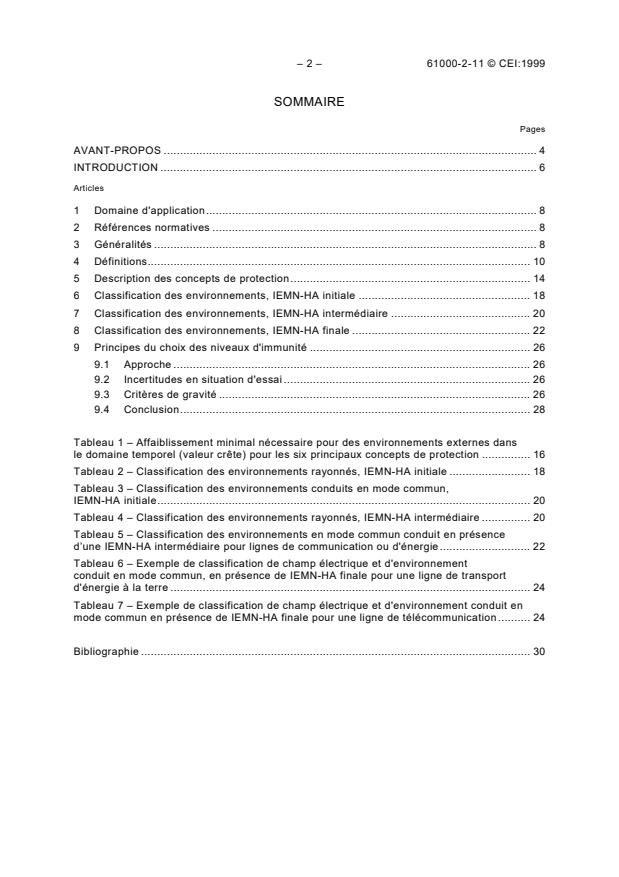
SOMMAIRE
Pages
AVANT-PROPOS . 4
INTRODUCTION .6
Articles
1 Domaine d'application. 8
2 Références normatives . 8
3 Généralités . 8
4 Définitions. 10
5 Description des concepts de protection. 14
6 Classification des environnements, IEMN-HA initiale . 18
7 Classification des environnements, IEMN-HA intermédiaire . 20
8 Classification des environnements, IEMN-HA finale . 22
9 Principes du choix des niveaux d'immunité . 26
9.1 Approche . 26
9.2 Incertitudes en situation d'essai . 26
9.3 Critères de gravité . 26
9.4 Conclusion. 28
Tableau 1 – Affaiblissement minimal nécessaire pour des environnements externes dans
le domaine temporel (valeur crête) pour les six principaux concepts de protection . 16
Tableau 2 – Classification des environnements rayonnés, IEMN-HA initiale . 18
Tableau 3 – Classification des environnements conduits en mode commun,
IEMN-HA initiale. 20
Tableau 4 – Classification des environnements rayonnés, IEMN-HA intermédiaire . 20
Tableau 5 – Classification des environnements en mode commun conduit en présence
d’une IEMN-HA intermédiaire pour lignes de communication ou d'énergie. 22
Tableau 6 – Exemple de classification de champ électrique et d'environnement
conduit en mode commun, en présence de IEMN-HA finale pour une ligne de transport
d'énergie à la terre . 24
Tableau 7 – Exemple de classification de champ électrique et d'environnement conduit en
mode commun en présence de IEMN-HA finale pour une ligne de télécommunication . 24
Bibliographie . 30
61000-2-11 © IEC:1999 – 3 –
CONTENTS
Page
FOREWORD . 5
INTRODUCTION .7
Clause
1 Scope . 9
2 Normative references . 9
3 General. 9
4 Definitions. 11
5 Description of protection concepts. 15
6 Classification of environments, early-time HEMP . 19
7 Classification of environments, intermediate-time HEMP. 21
8 Classification of environments, late-time HEMP . 23
9 Principles of the selection of immunity levels . 27
9.1 Approach . 27
9.2 Test uncertainties . 27
9.3 Criticality criteria . 27
9.4 Conclusion. 29
Table 1 – Minimum required attenuation of peak time domain external environments for
the six principal protection concepts . 17
Table 2 – Classification of radiated early-time HEMP environments. 19
Table 3 – Classification of conducted common-mode early-time HEMP environments. 21
Table 4 – Classification of radiated intermediate-time HEMP environments . 21
Table 5 – Classification of conducted common-mode intermediate-time HEMP environments
for power or communications lines . 23
Table 6 – Classification example of electric field and conducted common-mode late-time
HEMP environment for a grounded power transmission line . 25
Table 7 – Classification example of electric field and conducted common-mode late-time
HEMP environment for a telecommunication line. 25
Bibliography . 31
–
4 – 61000-2-11 © CEI:1999
COMMISSION ÉLECTROTECHNIQUE INTERNATIONALE
–––––––––––––
COMPATIBILITÉ ÉLECTROMAGNÉTIQUE (CEM) –
Partie 2-11: Environnement – Classification
de l'environnement IEMN-HA
AVANT-PROPOS
1) La CEI (Commission Électrotechnique Internationale) est une organisation mondiale de normalisation
composée de l'ensemble des comités électrotechniques nationaux (Comités nationaux de la CEI). La CEI a
pour objet de favoriser la coopération internationale pour toutes les questions de normalisation dans les
domaines de l'électricité et de l'électronique. A cet effet, la CEI, entre autres activités, publie des Normes
internationales. Leur élaboration est confiée à des comités d'études, aux travaux desquels tout Comité national
intéressé par le sujet traité peut participer. Les organisations internationales, gouvernementales et non
gouvernementales, en liaison avec la CEI, participent également aux travaux. La CEI collabore étroitement
avec l'Organisation Internationale de Normalisation (ISO), selon des conditions fixées par accord entre les
deux organisations.
2) Les décisions ou accords officiels de la CEI concernant les questions techniques représentent, dans la mesure
du possible, un accord international sur les sujets étudiés, étant donné que les Comités nationaux intéressés
sont représentés dans chaque comité d’études.
3) Les documents produits se présentent sous la forme de recommandations internationales. Ils sont publiés
comme normes, spécifications techniques, rapports techniques ou guides et agréés comme tels par les
Comités nationaux.
4) Dans le but d'encourager l'unification internationale, les Comités nationaux de la CEI s'engagent à appliquer de
façon transparente, dans toute la mesure possible, les Normes internationales de la CEI dans leurs normes
nationales et régionales. Toute divergence entre la norme de la CEI et la norme nationale ou régionale
correspondante doit être indiquée en termes clairs dans cette dernière.
5) La CEI n’a fixé aucune procédure concernant le marquage comme indication d’approbation et sa responsabilité
n’est pas engagée quand un matériel est déclaré conforme à l’une de ses normes.
6) L’attention est attirée sur le fait que certains des éléments de la présente Norme internationale peuvent faire
l’objet de droits de propriété intellectuelle ou de droits analogues. La CEI ne saurait être tenue pour
responsable de ne pas avoir identifié de tels droits de propriété et de ne pas avoir signalé leur existence.
La Norme internationale CEI 61000-2-11 a été établie par le sous-comité 77C: Phénomènes
transitoires de forte intensité, du comité d'études 77 de la CEI: Compatibilité
électromagnétique.
Elle a le statut de publication fondamentale en CEM en accord avec le Guide 107 de la CEI.
Le texte de cette norme est issu des documents suivants:
FDIS Rapport de vote
77C/77/FDIS 77C/83/RVD
Le rapport de vote indiqué dans le tableau ci-dessus donne toute information sur le vote ayant
abouti à l'approbation de cette norme.
Cette publication a été rédigée selon les Directives ISO/CEI, Partie 3.
Le comité a décidé que cette publication reste valable jusqu’en 2006. A cette date, selon
décision préalable du comité, la publication sera
reconduite;
supprimée;
remplacée par une édition révisée, ou
amendée.
61000-2-11 © IEC:1999 – 5 –
INTERNATIONAL ELECTROTECHNICAL COMMISSION
––––––––––––
ELECTROMAGNETIC COMPATIBILITY (EMC) –
Part 2-11: Environment – Classification of HEMP environments
FOREWORD
1) The IEC (International Electrotechnical Commission) is a worldwide organization for standardization comprising
all national electrotechnical committees (IEC National Committees). The object of the IEC is to promote
international co-operation on all questions concerning standardization in the electrical and electronic fields. To
this end and in addition to other activities, the IEC publishes International Standards. Their preparation is
entrusted to technical committees; any IEC National Committee interested in the subject dealt with may
participate in this preparatory work. International, governmental and non-governmental organizations liaising
with the IEC also participate in this preparation. The IEC collaborates closely with the International Organization
for Standardization (ISO) in accordance with conditions determined by agreement between the two
organizations.
2) The formal decisions or agreements of the IEC on technical matters express, as nearly as possible, an
international consensus of opinion on the relevant subjects since each technical committee has representation
from all interested National Committees.
3) The documents produced have the form of recommendations for international use and are published in the form
of standards, technical specifications, technical reports or guides and they are accepted by the National
Committees in that sense.
4) In order to promote international unification, IEC National Committees undertake to apply IEC International
Standards transparently to the maximum extent possible in their national and regional standards. Any
divergence between the IEC Standard and the corresponding national or regional standard shall be clearly
indicated in the latter.
5) The IEC provides no marking procedure to indicate its approval and cannot be rendered responsible for any
equipment declared to be in conformity with one of its standards.
6) Attention is drawn to the possibility that some of the elements of this International Standard may be the subject
of patent rights. The IEC shall not be held responsible for identifying any or all such patent rights.
International Standard IEC 61000-2-11 has been prepared by subcommittee 77C: High power
transient phenomena, of IEC technical committee 77: Electromagnetic compatibility.
It has the status of a Basic EMC publication in accordance with IEC Guide 107.
The text of this standard is based on the following documents:
FDIS Report on voting
77C/77/FDIS 77C/83/RVD
Full information on the voting for the approval of this standard can be found in the report on
voting indicated in the above table.
This publication has been drafted in accordance with the ISO/IEC Directives, Part 3.
The committee has decided that this publication remains valid until 2006. At this date, in
accordance with the committee’s decision, the publication will be
reconfirmed;
withdrawn;
replaced by a revised edition, or
amended.
–
6 – 61000-2-11 © CEI:1999
INTRODUCTION
La CEI 61000 est publiée sous la forme de plusieurs parties séparées conformément à la
structure suivante:
Partie 1: Généralités
Considérations générales (introduction, principes fondamentaux)
Définitions, terminologie
Partie 2: Environnement
Description de l’environnement
Classification de l’environnement
Niveaux de compatibilité
Partie 3: Limites
Limites d’émission
Limites d’immunité (dans la mesure où ces limites ne relèvent pas des comités de
produits)
Partie 4: Techniques d’essai et de mesure
Techniques de mesure
Techniques d’essai
Partie 5: Guides d’installation et d’atténuation
Guides d’installation
Méthodes et dispositifs d’atténuation
Partie 6: Normes génériques
Partie 9: Divers
Chaque partie est à son tour subdivisée en plusieurs parties publiées soit comme normes
internationales, soit comme rapports techniques, dont certaines ont déjà été publiées en tant
que sections. D’autres seront publiées avec le numéro de la partie suivi d’un tiret et d’un
second chiffre identifiant la subdivision.
61000-2-11 © IEC:1999 – 7 –
INTRODUCTION
IEC 61000 is published in separate parts according to the following structure:
Part 1: General
General considerations (introduction, fundamental principles)
Definitions, terminology
Part 2: Environment
Description of the environment
Classification of the environment
Compatibility levels
Part 3: Limits
Emission limits
Immunity limits (in so far as they do not fall under responsibility of product committees)
Part 4: Testing and measurement techniques
Measurement techniques
Testing techniques
Part 5: Installation and mitigation guidelines
Installation guidelines
Mitigation methods and devices
Part 6: Generic standards
Part 9: Miscellaneous
Each part is further subdivided into several parts published either as International Standards or
technical reports, some of which have already been published as sections. Others will be
published with the part number followed by a dash and a second number identifying the
subdivision.
–
8 – 61000-2-11 © CEI:1999
COMPATIBILITÉ ÉLECTROMAGNÉTIQUE (CEM) –
Partie 2-11: Environnement – Classification
de l'environnement IEMN-HA
1 Domaine d'application
La présente partie de la CEI 61000 s'applique à la classification des environnements
électromagnétiques IEM à haute altitude (IEMN-HA). Elle a pour objet d'aider à la
spécification des prescriptions d'immunité d'un objet (par exemple appareil ou sous-système)
contenant des parties électriques ou électroniques pour assurer qu'il fonctionnera pendant
et/ou après une exposition à une onde IEMN-HA. Cette partie est essentiellement destinée
aux personnes responsables de la rédaction des normes produits concernant l'immunité et/ou
autres normes d'immunité. Elle fournit un guide fondamental pour le choix des niveaux d'essai
d'immunité pour tout composant, dispositif, appareil, sous-système ou système qui contient
des circuits électriques qui peuvent être perturbés par des signaux électromagnétiques.
2 Références normatives
Les documents normatifs suivants contiennent des dispositions qui, par suite de la référence
qui en est faite, constituent des dispositions valables pour la présente partie de la CEI 61000.
Pour les références datées, les amendements ultérieurs ou les révisions de ces publications
ne s’appliquent pas. Toutefois, les parties prenantes aux accords fondés sur la présente
partie de la CEI 61000 sont invitées à rechercher la possibilité d’appliquer les éditions les
plus récentes des normes indiquées ci-après. Pour les références non datées, la dernière
édition du document normatif en référence s’applique. Les membres de la CEI et de l’ISO
possèdent le registre des Normes internationales en vigueur.
Vocabulaire Electrotechnique International (VEI) – Chapitre 161:
CEI 60050(161):1990,
Compatibilité électromagnétique
CEI 61000-2-9: Compatibilité électromagnétique (CEM) – Partie 2: Environnement –
Section 9: Description de l'environnement IEMN-HA – Perturbations rayonnées. Publication
fondamentale en CEM
CEI 61000-2-10: Compatibilité électromagnétique (CEM) – Partie 2-10: Environnement –
Description de l'environnement IEMN-HA - Perturbations conduites
. Publication fondamentale
en CEM
CEI 61000-5-3/TR: Compatibilité électromagnétique (CEM) – Partie 5-3: Guides d’installation
et d’atténuation – Concepts de protection IEMN-HA. Publication fondamentale en CEM
3 Généralités
Une explosion nucléaire à haute altitude (supérieure à 30 km) engendre trois types
d'impulsions électromagnétiques observées à la surface de la terre:
IEMN-HA initiale (rapide);
IEMN-HA intermédiaire (moyenne);
IEMN-HA finale (lente).
61000-2-11 © IEC:1999 – 9 –
ELECTROMAGNETIC COMPATIBILITY (EMC) –
Part 2-11: Environment – Classification of HEMP environments
1 Scope
This part of IEC 61000 is applicable to the classification of high-altitude EMP (HEMP)
electromagnetic environments. Its purpose is to help specify the immunity requirements of an
item (e.g. equipment or subsystem) containing electrical or electronic parts to ensure that it will
operate during and/or after exposure to a HEMP waveform. This part is primarily intended for
those who are responsible for writing product immunity standards and/or other immunity
standards. It provides basic guidance for the selection of immunity test levels for any
component, device, equipment, subsystem or system which contains electrical circuits that may
be disturbed by electromagnetic signals.
2 Normative references
The following normative documents contain provisions which, through reference in this text,
constitute provisions of this part of IEC 61000. For dated references, subsequent amendments
to, or revisions of, any of these publications do not apply. However, parties to agreements
based on this part of IEC 61000 are encouraged to investigate the possibility of applying the
most recent editions of the normative documents indicated below. For undated references, the
latest edition of the normative document referred to applies. Members of IEC and ISO maintain
registers of currently valid International Standards.
IEC 60050(161):1990, International Electrotechnical Vocabulary (IEV) – Chapter 161:
Electromagnetic compatibility
IEC 61000-2-9: Electromagnetic compatibility (EMC) – Part 2: Environment – Section 9:
Description of HEMP environment – Radiated disturbance. Basic EMC publication
IEC 61000-2-10: Electromagnetic compatibility (EMC) – Part 2-10: Environment – Description
of HEMP environment – Conducted disturbance. Basic EMC publication
IEC 61000-5-3/TR: Electromagnetic compatibility (EMC) – Part 5-3: Installation and mitigation
guidelines – HEMP protection concepts. Basic EMC publication
3 General
A high-altitude (above 30 km) nuclear burst produces three types of electromagnetic pulses
which are observed on the earth's surface:
early-time HEMP (fast);
intermediate-time HEMP (medium);
late-time HEMP (slow).
–
10 – 61000-2-11 © CEI:1999
Dans le passé, on s'est surtout intéressé à l'impulsion IEMN-HA initiale précédemment
appelée simplement onde IEMN-HA. Nous utiliserons ici indifféremment les termes IEM à
1)
haute altitude ou IEMN-HA pour désigner les trois types d'impulsions. Le terme IEMN
désigne de nombreuses catégories d'impulsions nucléaires IEM y compris celles qui sont
2)
produites par des explosions en surface (SREMP) ou sur des systèmes spatiaux
3)
(SGEMP) .
La classification de l'environnement IEMN-HA présentée dans cette norme repose sur la
description de l'environnement électromagnétique rencontré à des emplacements typiques au
sein d'un système ou d'une installation. Cette approche est appropriée car l'environnement
IEMN-HA est généré dans les couches supérieures de l'atmosphère et il est décrit à l'origine
comme un environnement électromagnétique externe (à la fois rayonné et conduit; voir les
CEI 61000-2-9 et CEI 61000-2-10). Pour les composants, les dispositifs, les appareils, les
sous-systèmes ou les systèmes situés à l'intérieur d'une installation, les environnements
conduits et rayonnés à leurs emplacements sont déterminés par l'importance de la protection
fournie par les blindages électromagnétiques et/ou les points d'entrée conducteurs (PdE)
présents dans l'installation ou l'enceinte.
4 Définitions
Pour les besoins de la présente partie de la CEI 61000, les définitions suivantes s'appliquent.
NOTE Pour avoir une terminologie complète relative à la CEM, se reporter à la CEI 60050(161). Lorsque cela est
applicable, les références au Vocabulaire Electrotechnique International (VEI) sont indiquées.
4.1
affaiblissement
réduction d'amplitude (suite à une absorption et une diffusion) d'un champ électrique ou
magnétique, d'un courant ou d'une tension; généralement exprimé en décibels
4.2
tension en mode commun
tension moyenne apparaissant entre tous les conducteurs dans un câble et une référence
spécifiée, généralement la terre ou la masse [VEI 161-04-09, modifiée]
4.3
point d'entrée conducteur
conducteur pénétrant
fil électrique, câble ou autre objet conducteur, tel qu'une tige métallique, qui traverse une
barrière électromagnétique
4.4
tension en mode différentiel
tension différentielle
tension entre deux conducteurs donnés d'un ensemble de conducteurs [VEI 161-04-08]
4.5
barrière électromagnétique
surface close d'un point de vue topologique réalisée pour limiter l'entrée de champs
électromagnétiques et de transitoires conduits. La barrière est constituée par le traitement de
la surface du blindage et des points d'entrée et elle enveloppe le volume protégé
––––––––––
1)
IEMN: Impulsion Electromagnétique Nucléaire
2)
SREMP: Source Region EMP (impulsion électromagnétique nucléaire de la région source)
3)
SGEMP: Système Generated EMP (impulsion électromagnétique nucléaire générée par le système)
61000-2-11 © IEC:1999 – 11 –
Historically, most interest has been focused on the early-time HEMP which was previously
referred to as simply HEMP. Here we will use the term high-altitude EMP or HEMP to include
1)
all three types of waveforms. The term NEMP covers many categories of nuclear EMPs
2)
including those produced by surface bursts (SREMP) or created on space systems
3)
(SGEMP) .
The classification of the HEMP environment presented in this standard is based on the
description of the electromagnetic environment prevailing at typical locations within a system or
installation. This approach is appropriate because the HEMP environment is generated in the
upper atmosphere and is initially described as an external electromagnetic environment (both
radiated and conducted; see IEC 61000-2-9 and IEC 61000-2-10). For components, devices,
equipment, subsystems or systems located within an installation, the conducted and radiated
environments incident at their locations are determined by the amount of protection provided by
EM shields and/or conductive point of entry (PoE) elements present in the installation or
enclosure.
4 Definitions
For the purposes of this part of IEC 61000, the following definitions apply.
NOTE – For a complete terminology relating to EMC, see IEC 60050(161). Where applicable below, references to
the International Electrotechnical Vocabulary (IEV) are indicated.
4.1
attenuation
reduction in magnitude (as a result of absorption and scattering) of an electric or magnetic field
or a current or voltage; usually expressed in decibels
4.2
common mode voltage
mean voltage appearing between all of the conductors in a cable and a specified reference,
usually earth or frame [IEV 161-04-09, modified]
4.3
conductive point-of-entry
conductive port-of-entry
penetrating conductor
electrical wire, cable or other conductive object, such as a metal rod, which passes through an
electromagnetic barrier
4.4
differential mode voltage
symmetrical voltage
voltage between any two of a specified set of active conductors [IEV 161-04-08]
4.5
electromagnetic barrier
topologically closed surface made to limit EM fields and conducted transients from entering the
enclosed space. The barrier consists of the shield surface and points-of-entry treatments and
encloses the protected volume
––––––––––
1)
NEMP: Nuclear Electromagnetic Pulse
2)
SREMP: Source Region EMP
3)
SGEMP: System Generated EMP
–
12 – 61000-2-11 © CEI:1999
4.6
compatibilité électromagnétique, CEM (abréviation)
aptitude d'un appareil ou d'un système à fonctionner dans son environnement électromagnétique
de façon satisfaisante et sans produire lui-même des perturbations électromagnétiques
intolérables pour tout ce qui se trouve dans cet environnement [VEI 161-01-07]
4.7
niveau de compatibilité (électromagnétique)
niveau maximal spécifié des perturbations électromagnétiques auquel on peut s'attendre que
soit soumis un dispositif, un appareil ou un système fonctionnant dans des conditions
particulières
NOTE En pratique, le niveau de compatibilité électromagnétique n'est pas un maximum mais peut être dépassé
avec une faible probabilité. [VEI 161-03-10]
4.8
perturbation électromagnétique
phénomène électromagnétique susceptible de créer des troubles de fonctionnement d'un
dispositif, d'un appareil ou d'un système [VEI 161-01-05, modifiée]
4.9
brouillage électromagnétique
trouble apporté au fonctionnement d'un dispositif, d'une voie de transmission ou d'un système
par une perturbation électromagnétique
NOTE Par perturbation et brouillage, on entend respectivement la cause et l'effet. [VEI 161-01-06 modifiée]
4.10
écran (électromagnétique)
boîtier électriquement continu pour une installation, une zone ou un composant utilisé pour
affaiblir les champs électriques et magnétiques incidents à la fois par absorption et par
réflexion
4.11
susceptibilité (électromagnétique)
inaptitude d'un dispositif, d'un appareil ou d'un système à fonctionner sans dégradation en
présence d'une perturbation électromagnétique
NOTE La susceptibilité est un manque d'immunité. [VEI 161-01-21]
4.12
immunité (à une perturbation)
aptitude d'un dispositif, d'un appareil ou d'un système à fonctionner sans dégradation en
présence d'une perturbation électromagnétique [VEI 161-01-20]
4.13
niveau d'immunité
niveau maximal d'une perturbation électromagnétique de forme donnée agissant sur un
dispositif, un appareil ou un système particulier, pour lequel celui-ci demeure capable de
fonctionner avec la qualité voulue [VEI 161-03-14]
4.14
I
sc
courant de court-circuit
61000-2-11 © IEC:1999 – 13 –
4.6
electromagnetic compatibility, EMC (abbreviation)
ability of an equipment or system to function satisfactorily in its electromagnetic environment
without introducing intolerable electromagnetic disturbances to anything in that environment
[IEV 161-01-07]
4.7
(electromagnetic) compatibility level
specified maximum electromagnetic disturbance level expected to be impressed on a device,
equipment or system operated in particular conditions
NOTE In practice the electromagnetic compatibility level is not an absolute maximum level but may be exceeded
by a small probability. [IEV 161-03-10]
4.8
electromagnetic disturbance
any electromagnetic phenomenon which may degrade the performance of a device, equipment
or system [IEV 161-01-05, modified]
4.9
electromagnetic interference
degradation of the performance of a device, transmission channel or system caused by an
electromagnetic disturbance
NOTE Disturbance and interference are respectively cause and effect. [IEV 161-01-06, modified]
4.10
(electromagnetic) shield
electrically continuous housing for a facility, area, or component used to attenuate incident
electric and magnetic fields by both absorption and reflection
4.11
(electromagnetic) susceptibility
inability of a device, equipment or system to perform without degradation in the presence of an
electromagnetic disturbance
NOTE Susceptibility is a lack of immunity. [IEV 161-01-21]
4.12
immunity (to a disturbance)
ability of a device, equipment or system to perform without degradation in the presence of an
electromagnetic disturbance [IEV 161-01-20]
4.13
immunity level
maximum level of a given electromagnetic disturbance incident on a particular device,
equipment or system for which it remains capable of operating at a required degree of
performance [IEV 161-03-14]
4.14
I
sc
short-circuit current
–
14 – 61000-2-11 © CEI:1999
4.15
point d'entrée (PdE)
emplacement physique (point) dans une barrière électromagnétique par lequel l'énergie
électromagnétique peut entrer dans un volume topologique ou en sortir sauf en présence d'un
dispositif de protection adéquate du PdE. Un PdE est plus qu'un simple point géométrique.
Les PdE sont classés en PdE d'ouverture ou PdE conducteurs en fonction du type de
pénétration. Ils sont également classés en PdE architecturaux, mécaniques, structurels ou
électriques selon le cadre architectural dans lequel on les rencontre le plus fréquemment.
4.16
lignes d'énergie
lignes provenant du secteur (tension alternative ou continue)
4.17
Q
facteur de qualité ou facteur d'amortissement d'une onde
4.18
efficacité de blindage
mesure de la réduction ou de l'affaiblissement de la puissance du champ électromagnétique
dans un point de l'espace causé par l'installation d'un blindage entre la source et ce point.
Mesure exprimée en général en décibels (dB)
4.19
transitoire
se dit d'un phénomène ou d'une grandeur qui varie entre deux régimes établis consécutifs
dans un intervalle de temps relativement court à l'échelle des temps considérée [VEI 161-02-01]
NOTE Une transitoire peut être une impulsion unidirectionnelle de l'une ou l'autre des polarités ou une onde
oscillatoire amortie dont la première crête apparaît dans l'une ou l'autre des polarités.
4.20
V
oc
tension de circuit ouvert
4.21
tension de choc (progressive)
onde de tension transitoire se propageant le long d'une ligne ou d'un circuit et comportant une
montée rapide de la tension suivie d'une décroissance plus lente de celle-ci [VEI 161-08-11]
NOTE Les paramètres temporels d'une tension de choc sont définis comme suit:
– temps de montée entre 10 % et 90 % de la valeur de crête (10 %/90 % temps de montée) selon le [VEI 161-02-05]; et
– durée à 50 % de la valeur de crête entre croissance et décroissance de l'onde (durée 50 %/50 %).
4.22
Z
s
impédance de source; en d'autres termes, l'impédance d'un générateur qui peut reproduire la
tension de circuit ouvert et le courant de court- circuit désirés à une borne définie
5 Description des concepts de protection
Pour la classification de l'environnement IEMN-HA, on définit ci-dessous six concepts de
protection principaux (voir la CEI 61000-5-3 pour plus d'informations). Les environnements
extérieurs et les concepts de protection se combinent pour donner les niveaux
d'environnement intérieurs qui sont appropriés pour les appareils ou les sous-systèmes
placés à l'intérieur de ces zones de protection. Ces concepts sont décrits comme suit:
61000-2-11 © IEC:1999 – 15 –
4.15
point-of-entry (PoE)
port-of-entry (PoE)
physical location (point/port) on an electromagnetic barrier, where EM energy may enter or exit
a topological volume, unless an adequate PoE protective device is provided. A PoE is not
limited to a geometrical point. PoEs are classified as aperture PoEs or conductive PoEs
according to the type of penetration. They are also classified as architectural, mechanical,
structural or electrical PoEs according to the architectural engineering discipline in which they
are usually encountered.
4.16
power lines
lines originating from the power supply (alternating or direct voltage)
4.17
Q
quality or damping factor of a waveform
4.18
shielding effectiveness
measure of the reduction or attenuation in the electromagnetic field strength at a point in space
caused by the insertion of a shield between the source and that point; usually expressed in
decibels (dB)
4.19
transient
pertaining to or designating a phenomenon or a quantity which varies between two
consecutive steady states during a time interval short compared with the time-scale of interest
[IEV 161-02-01]
NOTE A transient can be a unidirectional impulse of either polarity or a damped oscillatory wave with the first peak
occurring in either polarity.
4.20
V
oc
open-circuit voltage
4.21
voltage surge
transient voltage wave propagating along a line or a circuit and characterized by a rapid
increase followed by a slower decrease of the voltage [IEV 161-08-11]
NOTE The time parameters of a voltage surge are defined as follows:
– the rise time between 10 % and 90 % of the peak value (10 %/90 % rise time) according to [IEV 161-02-05]; and
– the duration at 50 % of the peak value between increase and decrease of the wave (50 %/50 % duration).
4.22
Z
s
source impedance; alternatively, the impedance of a generator that can reproduce the desired
open-circuit voltage and short-circuit current at a defined terminal
5 Description of protection concepts
For the purposes of this HEMP environment classification, six major protection concepts are
defined below (see IEC 61000-5-3 for additional details). The external environments and the
protection concepts result in internal environment levels which are appropriate for equipment or
subsystems that are placed within these protection zones. The concepts are described as:
–
16 – 61000-2-11 © CEI:1999
Concept 1: Bâtiments ou structures non enterrés en bois, en briques ou en béton équipés de
fenêtres et de portes de grande taille sans barres nervurées ou autre blindage réel. L'absence
ou la présence d'une protection contre les effets conduits de la foudre (protection contre les
surtensions sans filtrage) définissent les sous-concepts 1A et 1B, respectivement.
Concept 2: Bâtiments ou structures non enterrés en béton avec barres nervurées ou
bâtiments ou structures en briques ou en béton enterrés. L'absence ou la présence d'une
protection contre les effets conduits de la foudre (protection contre les surtensions sans
filtrage) définissent les sous-concepts 2A et 2B, respectivement.
Concept 3: Enceinte blindée avec efficacité de blindage RF minimale. Boîtier d'appareil
typique avec petites ouvertures. Protection nominale contre la pénétration de surtensions
dues à la foudre et de perturbations électromagnétiques conduites (filtrage).
Concept 4
: Enceinte blindée avec efficacité de blindage RF modeste et bonne masse au
niveau de l'ensemble des PdE. Protection nominale contre la pénétration de surtensions dues
à la foudre et de perturbations électromagnétiques conduites (filtrage).
Concept 5: Enceinte blindée avec bonne efficacité de blindage RF et protection des PdE
(surtensions et filtrage).
Concept 6: Enceinte blindée avec efficacité de blindage RF de grande qualité et protection
des PdE (surtensions et filtrage).
Les niveaux d'affaiblissement du champ électromagnétique décrits ci-dessous dans le
tableau 1 doivent être évalués à des fréquences comprises entre 100 kHz et 30 MHz pour
les concepts 1 et 2, et à des fréquences comprises entre 1 MHz et 200 MHz pour les
4)
concepts 3 à 6, en utilisant les méthodes décrites dans la CEI 61000-4-23 [2] .
Tableau 1 – Affaiblissement minimal nécessaire pour des environnements externes
dans le domaine temporel (valeur crête) pour les six principaux concepts de protection
Affaiblissement minimal
Concept dB
Champ électrique Champ magnétique Courant conduit
0 0 0
1A
0 0 20
1B
20 20 0
2A
20 20 20
2B
20 20 40
40 40 40
60 60 60
80 80 80
NOTE Les plages d'évaluation de fréquence pour les champs E et H sont comprises
entre 100 kHz et 30 MHz pour les concepts 1 et 2 et entre 1 MHz et 200 MHz pour les
concepts 3 à 6.
––––––––––
4)
Les chiffres entre crochets renvoient à la Bibliographie.
61000-2-11 © IEC:1999 – 17 –
Concept 1: Above-ground wooden, brick or concrete block building or structure with large
windows and doors without rebar or other explicit shielding. Lack or presence of conducted
lightning protection (overvoltage protection without filtering) defines subconcepts 1A and 1B,
respectively.
Concept 2: Above-ground concrete building or structure with rebar or buried brick or concrete
building or structure. Lack or presence of conducted lightning protection (overvoltage
protection without filtering) defines subconcepts 2A and 2B, respectively.
Concept 3: Shielded enclosure with minimal RF shielding effectiveness. Typical equipment box
with small apertures. Nominal lightning overvoltage and EMI conducted penetration protection
(filtering).
Concept 4: Shielded enclosure with modest RF shielding effectiveness and good bonding at all
PoEs. Nominal lightning overvoltage and EMI conducted penetration protection (filtering).
Concept 5: Shielded enclosure with good RF shielding effectiveness and PoE protection
(overvoltage and filtering).
Concept 6: Shielded enclosure with high-quality RF shielding and PoE protection (overvoltage
and filtering).
The EM field attenuation levels described below in table 1 are to be evaluated at frequencies
between 100 kHz and 30 MHz for concepts 1 and 2 and at frequencies between 1 MHz and
4)
200 MHz for concepts 3 to 6 using the methods described in IEC 61000-4-23 [2] .
Table 1 – Minimum required attenuation of peak time domain external environments
for the six principal protection concepts
Minimum attenuation
Concept dB
Electric field Magnetic field Conducted current
0 0 0
1A
0 0 20
1B
20 20 0
2A
20 20 20
2B
20 20 40
40 40 40
60 60 60
80 80 80
NOTE Frequency evaluation ranges for E and H fields are 100 kHz to 30 MHz for
concepts 1 and 2, and 1 MHz to 200 MHz for concepts 3-6.
––––––––––
4)
Figures in square brackets refer to the Bibliography.
–
18 – 61000-2-11 © CEI:1999
6 Classification des environnements, IEMN-HA initiale
Dans cet article, deux tableaux décrivent les environnements rayonnés et conduits en
présence d’une IEMN-HA initiale (t < 1 μs) attendus à l'intérieur d'installations ou d'enceintes
protégées selon les concepts définis précédemment. Les tableaux 2 et 3 indiquent le numéro
du concept de protection dans la première colonne et
...