

IEC 61666:1997
(Main)Industrial systems, installations and equipment and industrial products - Identification of terminals within a system
General Information
- Abstract
Provides rules for the designation of terminals of objects within a system for use in the electrotechnical and related areas. Applicable to all technical areas.
- Status
- Published
- Publication Date
- 22-May-1997
- Current Stage
- DELPUB - Deleted Publication
- Start Date
- 19-Aug-2010
- Completion Date
- 28-Aug-2026
Overview
IEC 61666:1997 is an international standard established by the International Electrotechnical Commission (IEC) that sets out guidelines for the identification of terminals within industrial systems, installations, equipment, and industrial products. Although primarily developed for electrotechnical and related fields, the standard is versatile and applicable across diverse technical domains. It provides a unified approach to designate terminals-points where connections are made-ensuring clarity, consistency, and interoperability in complex systems.
Key objectives of IEC 61666 include facilitating effective communication among engineers, improving documentation accuracy, and supporting maintenance and safety processes. By standardizing terminal identification, this document aids in streamlining design, manufacturing, installation, and troubleshooting activities across industries.
Key Topics
Scope of Application
IEC 61666 applies to terminals associated with various types of technical systems, potentially involving different or combined technologies. Its universal principles allow adaptation beyond purely electrotechnical objects, encompassing industrial products in general.Terminal Designation Principles
The standard details rules for terminal designation linked to the nature of:- The product itself
- The function served by the terminal
- The physical location of the terminal within the system
Alphanumeric and Symbolic Identification
The guidelines advocate consistent use of alphanumeric codes and approved graphical symbols to represent terminals, drawing from accompanying IEC publications such as IEC 60027 (letter symbols), IEC 60417 (graphical symbols for equipment), and IEC 60617 (graphical symbols for diagrams).System Documentation Integration
IEC 61666 emphasizes proper integration of terminal identifiers into system documentation, including diagrams, connection tables, and lists, to support clear design and operational references. This is aligned with related documentation standards IEC 61082 series.Classification and Examples
Annexes within the standard provide terminal classification schemes and practical examples to aid implementation and comprehension.
Applications
IEC 61666 plays a crucial role in various industrial contexts where terminal identification is essential for system integrity and safety:
Electrical Panels and Switchgear
Enables accurate marking of wiring points in control panels and electrical distribution equipment, facilitating straightforward installation and servicing.Automation and Control Systems
Assists in designating inputs, outputs, and interconnections within automated industrial systems, ensuring functional clarity.Manufacturing and Maintenance
Simplifies the identification of terminals during production and facilitates consistent troubleshooting during maintenance operations.Multi-Technology Systems
Supports hybrid systems combining electrical, electronic, and other technologies by providing universal identification principles adaptable across technical boundaries.Standardization and Compliance
Assists manufacturers and system integrators in meeting international compliance requirements, thus easing market access.
Related Standards
IEC 61666 complements several IEC standards related to documentation and terminal designation, enhancing its applicability and coherence within international electrotechnical norms:
- IEC 60445:1988 – Identification of equipment terminals and terminations, includes alphanumeric systems for terminal designation.
- IEC 60757:1983 – Color codes for designation, supporting clear visual identification of terminals and conductors.
- IEC 61082 Series (Part 1, 2, 3) – Preparation of electrotechnical documentation, including function-oriented diagrams and connection lists.
- IEC 61346-1:1996 – Structuring principles and reference designations for industrial systems, installations, and products.
The standard also references graphical symbol standards like IEC 60027, IEC 60417, and IEC 60617 to ensure unified visual representation of terminal markings.
Keywords: IEC 61666, terminal identification, electrotechnical standards, terminal designation, industrial systems, electrical terminals, IEC standards, industrial equipment, terminal marking, system documentation, alphanumeric terminal codes, industrial installations, IEC 60445, IEC 60757, IEC 61082, terminal classification
Relations
- Effective Date
- 05-Sep-2023
Frequently Asked Questions
IEC 61666:1997 is a standard published by the International Electrotechnical Commission (IEC). Its full title is "Industrial systems, installations and equipment and industrial products - Identification of terminals within a system". This standard covers: Provides rules for the designation of terminals of objects within a system for use in the electrotechnical and related areas. Applicable to all technical areas.
Provides rules for the designation of terminals of objects within a system for use in the electrotechnical and related areas. Applicable to all technical areas.
IEC 61666:1997 is classified under the following ICS (International Classification for Standards) categories: 01.080.30 - Graphical symbols for use on mechanical engineering and construction drawings, diagrams, plans, maps and in relevant technical product documentation. The ICS classification helps identify the subject area and facilitates finding related standards.
IEC 61666:1997 has the following relationships with other standards: It is inter standard links to IEC 61666:2010. Understanding these relationships helps ensure you are using the most current and applicable version of the standard.
IEC 61666:1997 is available in PDF format for immediate download after purchase. The document can be added to your cart and obtained through the secure checkout process. Digital delivery ensures instant access to the complete standard document.
Standards Content (Sample)
NORME
CEI
INTERNATIONALE
IEC
INTERNATIONAL
Première édition
STANDARD
First edition
1997-05
Systèmes industriels, installations et appareils,
et produits industriels – Identification des bornes
dans le cadre d’un système
Industrial systems, installations and equipment
and industrial products – Identification of terminals
within a system
Numéro de référence
Reference number
CEI/IEC 61666: 1997
Validité de la présente publication Validity of this publication
Le contenu technique des publications de la CEI est The technical content of IEC publications is kept under
constamment revu par la CEI afin qu'il reflète l'état constant review by the IEC, thus ensuring that the
actuel de la technique. content reflects current technology.
Des renseignements relatifs à la date de Information relating to the date of the reconfirmation
reconfirmation de la publication sont disponibles of the publication is available from the IEC Central
auprès du Bureau Central de la CEI. Office.
Les renseignements relatifs à ces révisions, à Information on the revision work, the issue of revised
l'établissement des éditions révisées et aux editions and amendments may be obtained from IEC
amendements peuvent être obtenus auprès des National Committees and from the following IEC
Comités nationaux de la CEI et dans les documents sources:
ci-dessous:
• Bulletin de la CEI • IEC Bulletin
• Annuaire de la CEI • IEC Yearbook
Publié annuellement Published yearly
• Catalogue des publications de la CEI • Catalogue of IEC publications
Publié annuellement et mis à jour régulièrement Published yearly with regular updates
Terminologie Terminology
En ce qui concerne la terminologie générale, le lecteur For general terminology, readers are referred to
se reportera à la CEI 60050: Vocabulaire IEC 60050: International Electrotechnical Vocabulary
Electrotechnique International (VEI), qui se présente (IEV), which is issued in the form of separate chapters
sous forme de chapitres séparés traitant chacun d'un each dealing with a specific field. Full details of the
sujet défini. Des détails complets sur le VEI peuvent IEV will be supplied on request. See also the IEC
être obtenus sur demande. Voir également le Multilingual Dictionary.
dictionnaire multilingue de la CEI.
Les termes et définitions figurant dans la présente The terms and definitions contained in the present
publication ont été soit tirés du VEI, soit publi-cation have either been taken from the IEV or
spécifiquement approuvés aux fins de cette have been specifically approved for the purpose of this
publication.
publication.
Symboles graphiques et littéraux Graphical and letter symbols
Pour les symboles graphiques, les symboles littéraux For graphical symbols, and letter symbols and signs
et les signes d'usage général approuvés par la CEI, le approved by the IEC for general use, readers are
lecteur consultera: referred to publications:
– la CEI 60027: Symboles littéraux à utiliser en – IEC 60027: Letter symbols to be used in electrical
électrotechnique; technology;
– la CEI 60417: Symboles graphiques utilisables sur – IEC 60417: Graphical symbols for use on
le matériel. Index, relevé et compilation des feuilles equipment. Index, survey and compilation of the
individuelles; single sheets;
– la CEI 60617: Symboles graphiques pour schémas; – IEC 60617: Graphical symbols for diagrams;
et pour les appareils électromédicaux, and for medical electrical equipment,
– la CEI 60878: Symboles graphiques pour – IEC 60878: Graphical symbols for electromedical
équipements électriques en pratique médicale. equipment in medical practice.
Les symboles et signes contenus dans la présente The symbols and signs contained in the present
publication ont été soit tirés de la CEI 60027, de la publication have either been taken from IEC 60027,
CEI 60417, de la CEI 60617 et/ou de la CEI 60878, IEC 60417, IEC 60617 and/or IEC 60878, or have
soit spécifiquement approuvés aux fins de cette been specifically approved for the purpose of this
publication. publication.
Publications de la CEI établies par le IEC publications prepared by the same
même comité d'études technical committee
The attention of readers is drawn to the end pages of
L'attention du lecteur est attirée sur les listes figurant
à la fin de cette publication, qui énumèrent les this publication which list the IEC publications issued
publications de la CEI préparées par le comité by the technical committee which has prepared the
d'études qui a établi la présente publication. present publication.
NORME
CEI
INTERNATIONALE
IEC
INTERNATIONAL
Première édition
STANDARD
First edition
1997-05
Systèmes industriels, installations et appareils,
et produits industriels – Identification des bornes
dans le cadre d’un système
Industrial systems, installations and equipment
and industrial products – Identification of terminals
within a system
IEC 1997 Droits de reproduction réservés Copyright - all rights reserved
Aucune partie de cette publication ne peut être reproduite ni No part of this publication may be reproduced or utilized in
utilisée sous quelque forme que ce soit et par aucun any form or by any means, electronic or mechanical,
procédé, électronique ou mécanique, y compris la photo- including photocopying and microfilm, without permission in
copie et les microfilms, sans l'accord écrit de l'éditeur. writing from the publisher.
International Electrotechnical Commission 3, rue de Varembé Geneva, Switzerland
Telefax: +41 22 919 0300 e-mail: inmail@iec.ch IEC web site http: //www.iec.ch
CODE PRIX
Commission Electrotechnique Internationale
PRICE CODE M
International Electrotechnical Commission
Pour prix, voir catalogue en vigueur
For price, see current catalogue
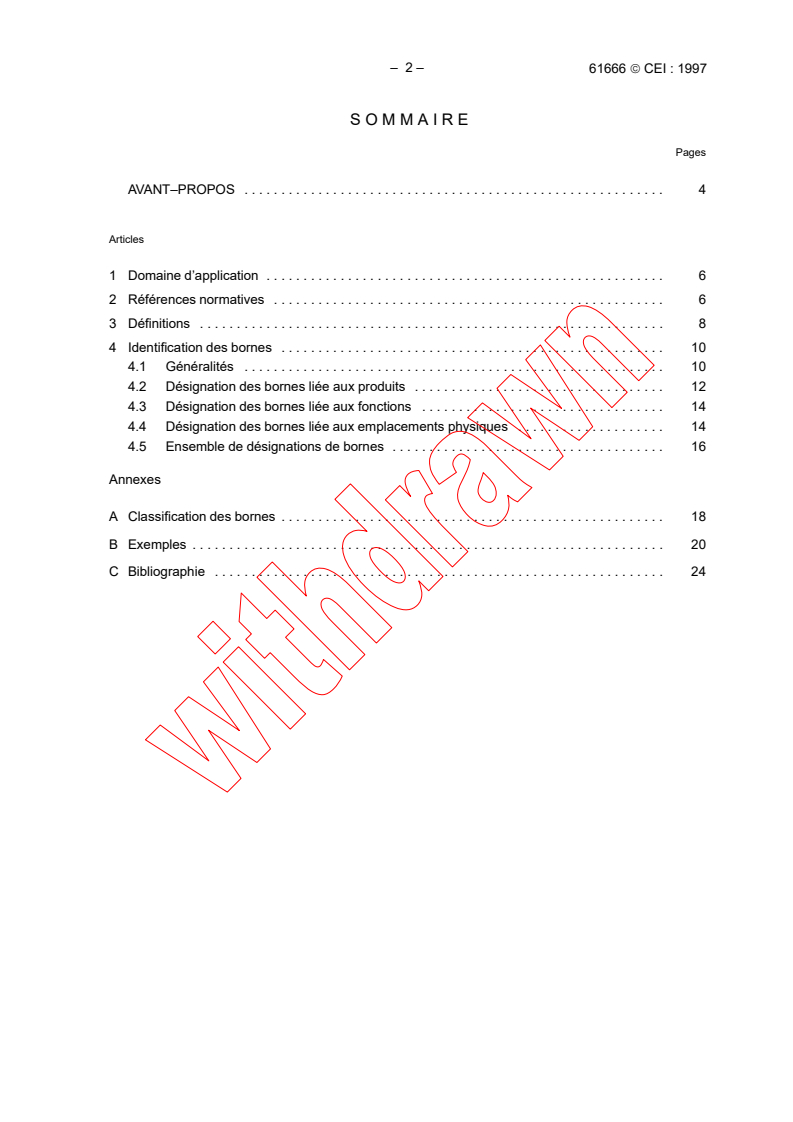
– 2 –
61666 CEI : 1997
S O M M A I R E
Pages
AVANT–PROPOS . . . . . . . . . . . . . . . . . . . . . . . . . . . . . . . . . . . . . . . . . . . . . . . . . . . . . . . . . 4
Articles
1 Domaine d’application . . . . . . . . . . . . . . . . . . . . . . . . . . . . . . . . . . . . . . . . . . . . . . . . . . . . . . 6
2 Références normatives . . . . . . . . . . . . . . . . . . . . . . . . . . . . . . . . . . . . . . . . . . . . . . . . . . . . . 6
3 Définitions . . . . . . . . . . . . . . . . . . . . . . . . . . . . . . . . . . . . . . . . . . . . . . . . . . . . . . . . . . . . . . . 8
4 Identification des bornes . . . . . . . . . . . . . . . . . . . . . . . . . . . . . . . . . . . . . . . . . . . . . . . . . . . . 10
4.1 Généralités . . . . . . . . . . . . . . . . . . . . . . . . . . . . . . . . . . . . . . . . . . . . . . . . . . . . . . . . . 10
4.2 Désignation des bornes liée aux produits . . . . . . . . . . . . . . . . . . . . . . . . . . . . . . . . . . 12
4.3 Désignation des bornes liée aux fonctions . . . . . . . . . . . . . . . . . . . . . . . . . . . . . . . . . 14
4.4 Désignation des bornes liée aux emplacements physiques . . . . . . . . . . . . . . . . . . . . 14
4.5 Ensemble de désignations de bornes . . . . . . . . . . . . . . . . . . . . . . . . . . . . . . . . . . . . . 16
Annexes
A Classification des bornes . . . . . . . . . . . . . . . . . . . . . . . . . . . . . . . . . . . . . . . . . . . . . . . . . . . . 18
B Exemples . . . . . . . . . . . . . . . . . . . . . . . . . . . . . . . . . . . . . . . . . . . . . . . . . . . . . . . . . . . . . . . . 20
C Bibliographie . . . . . . . . . . . . . . . . . . . . . . . . . . . . . . . . . . . . . . . . . . . . . . . . . . . . . . . . . . . . . 24
– 3 –
61666 IEC : 1997
C O N T E N T S
Page
FOREWORD . . . . . . . . . . . . . . . . . . . . . . . . . . . . . . . . . . . . . . . . . . . . . . . . . . . . . . . . . . . . . 5
Clause
1 Scope . . . . . . . . . . . . . . . . . . . . . . . . . . . . . . . . . . . . . . . . . . . . . . . . . . . . . . . . . . . . . . . . . . . 7
2 Normative references . . . . . . . . . . . . . . . . . . . . . . . . . . . . . . . . . . . . . . . . . . . . . . . . . . . . . . . 7
3 Definitions . . . . . . . . . . . . . . . . . . . . . . . . . . . . . . . . . . . . . . . . . . . . . . . . . . . . . . . . . . . . . . . 9
4 Identification of terminals . . . . . . . . . . . . . . . . . . . . . . . . . . . . . . . . . . . . . . . . . . . . . . . . . . . . 11
4.1 General . . . . . . . . . . . . . . . . . . . . . . . . . . . . . . . . . . . . . . . . . . . . . . . . . . . . . . . . . . . . 11
4.2 Designation of terminals with respect to products . . . . . . . . . . . . . . . . . . . . . . . . . . . . 13
4.3 Designation of terminals with respect to functions . . . . . . . . . . . . . . . . . . . . . . . . . . . . 15
4.4 Designation of terminals with respect to physical locations . . . . . . . . . . . . . . . . . . . . . 15
4.5 Terminal designation set . . . . . . . . . . . . . . . . . . . . . . . . . . . . . . . . . . . . . . . . . . . . . . . 17
Annexes
A Classification of terminals . . . . . . . . . . . . . . . . . . . . . . . . . . . . . . . . . . . . . . . . . . . . . . . . . . . 19
B Examples . . . . . . . . . . . . . . . . . . . . . . . . . . . . . . . . . . . . . . . . . . . . . . . . . . . . . . . . . . . . . . . . 21
C Bibliography . . . . . . . . . . . . . . . . . . . . . . . . . . . . . . . . . . . . . . . . . . . . . . . . . . . . . . . . . . . . . 25
– 4 –
61666 CEI : 1997
COMMISSION ELECTROTECHNIQUE INTERNATIONALE
–––––––––––––––––––––––––––––
SYSTÈMES INDUSTRIELS, INSTALLATIONS ET APPAREILS, ET PRODUITS INDUSTRIELS –
IDENTIFICATION DES BORNES DANS LE CADRE D’UN SYSTÈME
AVANT-PROPOS
1) La CEI (Commission Electrotechnique Internationale) est une organisation mondiale de normalisation composée de l’ensemble
des comités électrotechniques nationaux (Comités nationaux de la CEI). La CEI a pour objet de favoriser la coopération
internationale pour toutes les questions de normalisation dans les domaines de l’électricité et de l’électronique. A cet effet, la
CEI, entre autres activités, publie des Normes internationales. Leur élaboration est confiée à des comités d’études, aux travaux
desquels tout Comité national intéressé par le sujet traité peut participer. Les organisations internationales, gouvernementales
et non gouvernementales, en liaison avec la CEI participent également aux travaux. La CEI collabore étroitement avec
l’Organisation Internationale de Normalisation (ISO), selon des conditions fixées par accord entre les deux organisations.
2) Les décisions ou accords officiels de la CEI concernant des questions techniques, représentent, dans la mesure du possible, un
accord international sur les sujets étudiés, étant donné que les Comités nationaux intéressés sont représentés dans chaque
comité d’études.
3) Les documents produits se présentent sous la forme de recommandations internationales; ils sont publiés comme normes,
rapports techniques ou guides et agréés comme tels par les Comités nationaux.
4) Dans le but d’encourager l’unification internationale, les Comités nationaux de la CEI s’engangent à appliquer façon
transparente, dans toute la mesure possible, les Normes internationales de la CEI dans leurs normes nationales et régionales.
Toute divergence entre la norme de la CEI et la norme nationale ou régionale correspondante doit être indiquée en termes clairs
dans cette dernière.
5) La CEI n’a fixé aucune procédure concernant le marquage comme indication d’approbation et sa responsabilité n’est pas
engagée quand un matériel est déclaré conforme à l’une de ses normes.
6) L’attention est attirée sur le fait que certains des éléments de la présente Norme internationale peuvent faire l’objet de droits de
propriété intellectuelle ou de droits analogues. La CEI ne saurait être tenue pour responsable de ne pas avoir identifié de tels
droits de proprieété et de ne pas avoir signalé leur existence.
La norme internationale CEI 61666 a été établie par le sous-comité 3B : Documentation, du comité
d’études 3 de la CEI : Documentation et symboles graphiques.
Le texte de la présente norme est basé sur les documents suivants :
FDIS Rapport de vote
3B/182/FDIS 3B/204/RVD
Le rapport de vote indiqué dans le tableau ci-dessus donne toute information sur le vote ayant abouti à
l’approbation de cette norme.
Les Annexes A, B et C sont données uniquement à titre d’information.
– 5 –
61666 IEC : 1997
INTERNATIONAL ELECTROTECHNICAL COMMISSION
INDUSTRIAL SYSTEMS, INSTALLATIONS AND EQUIPMENT AND INDUSTRIAL PRODUCTS –
IDENTIFICATION OF TERMINALS WITHIN A SYSTEM
FOREWORD
1) The IEC (International Electrotechnical Commission) is a worldwide organization for standardization comprising all national
electrotechnical committees (IEC National Committees). The object of the IEC is to promote international cooperation on all
questions concerning standardization in the electrical and electronic field. To this end and in addition to other activities, the IEC
publishes International Standards. Their preparation is entrusted to technical committees; any IEC National Committee
interested in the subject dealt with may participate in this preparatory work. International, governmental and non-governmental
organizations liaising with the IEC also participate in this preparation. The IEC collaborates closely with the International
Organization for Standardization (ISO) in accordance with conditions determined by agreement between the two organizations.
2) The formal decisions or agreement of the IEC on technical matters, express as nearly as possible an International consensus of
opinion on the relevant subjects since each technical committee has representations from all interested National Committees.
3) The documents produced have the form of recommendations for international use and are published in the form of standards,
technical reports or guides and they are accepted by the National Committees in that state.
4) In order to promote international unification, IEC National Committees undertake to apply IEC International Standards
transparently to the maximum extent possible in their national or regional standards. Any divergence between the IEC Standard
and the corresponding national or regional standard shall be clearly indicated in the latter.
5) The IEC provides no marking procedure to indicate its approval and cannot be rendered responsible for any equipment
declared to be in conformity with one of its standards.
6) Attention is drawn to the possibility that some of the elements of this International Standard may be the subject of patent rights.
IEC shall not be held responsible for identifying any or all such patent rights.
International Standard IEC 61666 has been prepared by sub-committee 3B: Documentation, of IEC
technical committee No. 3: Documentation and graphical symbols.
The text of this standard is based on the following documents:
FDIS Report on voting
3B/182/FDIS 3B/204/RVD
Full information on the voting for the approval of this standard can be found in the report on voting
indicated in the above table.
Annexes A, B and C are for information only.
– 6 –
61666 CEI : 1997
COMMISSION ELECTROTECHNIQUE INTERNATIONALE
–––––––––––––––––––––––––––––
SYSTÈMES INDUSTRIELS, INSTALLATIONS ET APPAREILS, ET PRODUITS INDUSTRIELS –
IDENTIFICATION DES BORNES DANS LE CADRE D’UN SYSTÈME
1 Domaine d’application
La présente Norme Internationale contient les règles destinées à désigner les bornes d’objets à l’intérieur
d’un système.
Les principes établis sont initialement destinés à être utilisés dans le domaine de l‘électrotechnique et
dans les domaines associés, mais ils sont généraux et applicables à tout les domaines techniques. Ils
peuvent être appliqués à des systèmes reposant sur des techniques différentes ou combinant plusieurs
techniques.
2 Références normatives
Les documents normatifs suivants contiennent des dispositions qui, par suite de la référence qui y est
faite, constituent des dispositions valables pour la présente Norme internationale. Au moment de la
publication, les éditions indiquées étaient en vigueur. Tout document normatif est sujet à révision et les
parties prenantes des accords fondés sur la présente Norme internationale sont invitées à rechercher la
possibilité d’appliquer les éditions les plus récentes des document normatifs indiqués ci-après. Les
membres de la CEI et de l’ISO possèdent le registre des Normes internationales en vigueur.
CEI 60445 : 1988, Identification des bornes de matériels et des extrémités de certains conducteurs
désignés et règles générales pour un système alphanumérique
CEI 60757 : 1983, Codes de désignation de couleurs
CEI 61082-1 : 1991, Etablissement des documents utilisés en électrotechnique
Partie 1 : Prescriptions générales
CEI 61082-2 : 1993, Etablissement des documents utilisés en électrotechnique
Partie 2 : Schémas adaptés à la fonction
CEI 61082-3 : 1993, Etablissement des documents utilisés en électrotechnique
Partie 3 : Schémas, tableaux et listes des connexions
CEI 61346-1 : 1996, Systèmes industriels, installations et appareils, et produits industriels -
Principes de structuration et désignation de référence
Partie 1 : Règles de base
– 7 –
61666 IEC : 1997
INTERNATIONAL ELECTROTECHNICAL COMMISSION
INDUSTRIAL SYSTEMS, INSTALLATIONS AND EQUIPMENT AND INDUSTRIAL PRODUCTS –
IDENTIFICATION OF TERMINALS WITHIN A SYSTEM
1 Scope
This International Standard provides rules for the designation of terminals of objects within a system.
The principles laid down are primarily intended for use in the electrotechnical and related areas, but are
general and applicable to all technical areas. They can be used for systems based on different
technologies or for systems combining several technologies.
2 Normative references
The following normative documents contain provisions which, through reference in this text, constitute
provisions of this International Standard. At the time of publication, the editions indicated were valid. All
normative documents are subject to revision, and parties to agreements based on this International
Standard are encouraged to investigate the possibility of applying the most recent editions of the
normative documents indicated below. Members of IEC and ISO maintain registers of currently valid
International Standards.
IEC 60445: 1988, Identification of equipment terminals and of terminations of certain designated
conductors, including general rules of an alphanumeric system
IEC 60757: 1983, Codes for designation of colours
IEC 61082-1: 1991, Preparation of documents used in electrotechnology
Part 1: General requirements
IEC 61082-2: 1993, Preparation of documents used in electrotechnology
Part 2: Function-oriented diagrams
IEC 61082-3: 1993, Preparation of documents used in electrotechnology
Part 3: Connection diagrams, tables, and lists
IEC 61346-1: 1996, Industrial systems, installations and equipment and industrial products -
Structuring principles and reference designations
Part 1: Basic rules
– 8 –
61666 CEI : 1997
3 Définitions
Pour les besoins de la présente Norme Internationale, les définitions suivantes sont applicables.
3.1 objet : Entité considérée dans le processus de conception, d’ingénierie, de réalisation, de
fonctionnement, de maintenance et de démolition. [CEI 61346-1: 1996, 3.1]
NOTES
1 L’entité peut faire référence à un objet abstrait ou physique ou à un ensemble d’informations qui lui sont associées.
2 En fonction de son usage, un objet peut être vu de différentes façons, appelées aspects.
3.2 système : Ensemble d’objets liés entre eux. [CEI 61346-1: 1996, 3.2]
NOTES
1 Exemples de système : système de commande, système d’alimentation en eau, système stéréo, ordinateur.
2 Lorsqu’un système fait partie d’un autre système, il peut être considéré comme un objet.
3.3 aspect : Manière spécifique de choisir les informations concernant un système ou un objet d’un
système ou de les décrire. [CEI 61346-1: 1996, 3.3]
NOTE - Ces différentes manières peuvent être :
- ce que le système ou l’objet fait (point de vue de la fonction);
- la façon dont le système ou l’objet est construit (point de vue du produit);
- l’endroit où le système ou l’objet est situé (point de vue de l’emplacement).
3.4 fonction : Usage lié à un objet. [CEI 61346-1: 1996, 3.4]
3.5 produit : Résultat recherché ou réalisé d’un travail, ou d’un processus naturel ou artificiel.
[CEI 61346-1: 1996, 3.5]
NOTES
1 Un produit possède généralement un numéro de pièce, un numéro de commande, un numéro de type et/ou un nom.
2 Un système technique ou une installation industrielle peuvent être considérés comme un des produits.
3.6 désignation de référence : Identificateur d’un objet spécifique en fonction du système dont cet
object est un élément constituant, basé sur un ou plusieurs aspects de ce système.
[CEI 61346-1:1996, 3.6]
3.7 borne : Point d’accès à un objet destiné à établir une connexion avec un réseau externe.
NOTES
1 La connexion peut faire référence à :
a) une interface physique entre conducteurs et/ou contacts, ou systèmes de canalisation et/ou de conduits pour
fournir en trajet aux flux de signaux, d’énergie ou de matière.
b) une association de nature fonctionelle établie entre des éléments logiques, des modules logiels etc pour transporter
des informations.
2 Les réseaux externes sont susceptibles d‘être de nature différente et donc de faire l’objet d’une classification.
La ISO/IEC 11714-3 fournit de telles classifications. Voir aussi l’annexe A.
3.8 désignation de borne : Identificateur d’une borne en fonction de l’objet auquel elle appartient, en
liaison avec un aspect de l’objet.
3.9 ensemble de désignations de borne : Ensemble de désignations de borne, chaque désignation
identifiant la même borne à partir de différents aspects de l’objet.
– 9 –
61666 IEC : 1997
3 Definitions
For the purpose of this International Standard, the following definitions apply.
3.1 object: Entity treated in the process of design, engineering, realization, operation, maintenance and
demolition. [IEC 61346-1: 1996, 3.1]
NOTES
1 The entity may refer to an abstract or physical object or to a set of information associated with it.
2 Depending on purpose an object may be viewed in different ways, called aspects.
3.2 system: Set of interrelated objects. [IEC 61346-1: 1996, 3.2]
NOTES
1 Examples of a system: a drive system, a water supply system, a stereo system, a computer.
2 When a system is a part of another system, it may be considered as an object.
3.3 aspect: Specific way of selecting information on or describing a system or an object of a system.
[IEC 61346-1: 1996, 3.3]
NOTE - Such ways may be:
- what the system or object is doing (function viewpoint);
- how the system or object is constructed (product viewpoint);
- where the system or object is located (location viewpoint).
3.4 function: Purpose related to an object. [IEC 61346-1: 1996, 3.4]
3.5 product: Intended or accomplished result of labour or of a natural or artificial process.
[IEC 61346-1: 1996, 3.5]
NOTES
1 A product usually has a part number, order number, type designation, and/or a name.
2 A technical system or plant can be considered as a product.
3.6 reference designation: Identifier of a specific object with respect to the system of which it is a
constituent, based on one or more aspects of that system. [IEC 61346-1: 1996, 3.6]
3.7 terminal: Point of access to an object intended for connection to an external network.
NOTES
1 The connection may refer to:
a) a physical interface between conductors and/or contacts, or piping and/or duct systems to provide a signal, energy or
material flow path;
b) an association of functional nature established between logical elements, software modules, etc. for conveying
information.
2 The external networks may be of different nature and accordingly they may be classified. ISO/IEC 11714-3 provides such
classifications. See also Annex A.
3.8 terminal designation: Identifier of a terminal with respect to the object to which it belongs, related to
one aspect of the object.
3.9 terminal designation set: Set of terminal designations, each identifying the same terminal from
different aspects of the object.
– 10 –
61666 CEI : 1997
4 Identification des bornes
4.1 Généralités
Un certain nombre de bornes peut être associé à un objet . Les bornes peuvent être fournies pour faciliter
les connexions avec différents réseaux, par exemple avec un réseau électrique, un réseau de fonctions
logiques, un réseau logique à l’intérieur d’un logiciel, etc. Pour permettre de décrire de façon non
ambiguë un tel réseau, chaque borne utilisée doit être identifiée de façon unique en fonction de l’objet
lui-même ainsi que du système auquel l’objet appartient.
Une identification de borne dans le cadre d’un système doit être non ambiguë. L’identificateur
non-ambigu doit être constitué par
- une désignation de borne qui identifie de façon unique la borne en fonction de l’objet concerné ;
précédée de
- ”:” (deux points) ; précédée de
- une désignation de référence qui décrit explicitement l’objet concerné.
La figure 1 donne l’identificateur non ambigu d’une borne.
Désignation de référence : Désignation de borne
Figure 1 - Identification d’une borne dans le cadre d’un sysème
La désignation de référence doit être formée conformément aux règles données dans la CEI 61346-1.
Les ”:” (deux points) doivent être représentés si la désignation de référence (ou des éléments de celle-ci)
et la désignation de borne sont présentées proches l’une de l’autre, mais peuvent être omis si une
confusion n’est pas vraisemblable, par exemple dans les représentations sous forme de tableaux.
Le désignation de borne doit être formée conformément aux paragraphes 4.2, 4.3 ou 4.4.
Les identifications de bornes doivent être présentées, dans la documentation, en conformité avec les
CE
...