

IEC TR 61734:2006
(Main)Application of symbols for binary logic and analogue elements
General Information
- Abstract
Contains conventions, helpful when applying IEC 60617 to symbols for catalogues of real devices, and shows preferable choices where alternative techniques are provided in the standard. It also helps to create symbols having as consistent an appearance as possible, not depending on the originator, while still accurately representing the function.
- Status
- Published
- Publication Date
- 16-Jul-2006
- Current Stage
- PPUB - Publication issued
- Start Date
- 17-Jul-2006
- Completion Date
- 15-Oct-2006

Overview
IEC TR 61734:2006, titled Application of symbols for binary logic and analogue elements, is a technical report published by the International Electrotechnical Commission (IEC). It provides comprehensive guidelines and conventions for applying IEC 60617 symbols to catalogues of real devices that feature binary logic and analogue components. The document aims to promote consistency and clarity in the graphical representation of these elements across various applications, regardless of the symbol originator. By following this standard, designers and engineers can ensure accurate functional representation while maintaining a uniform visual appearance.
This report consolidates useful conventions for symbol-making, including preferable choices when multiple techniques exist within IEC 60617. It covers symbolic representations of logic gates, analogue elements, power supplies, internal connections, and specialized symbols such as those for hysteresis and amplification.
Key Topics
- Common Conventions for Symbols: Guidelines on how to uniformly depict symbols for white-box and gray-box representations, including terminals, power-supply designations, and negation symbols.
- Representation of Inputs and Outputs: Detailed arrangements for inputs, outputs, and internal bus connections to enhance readability and accuracy.
- Embedded and Composite Symbols: Instructions on how to use nested symbols and illustrate relationships within complex elements.
- Device-Specific Symbols: Standardized symbols for memory devices like ROM, PROM, and EPROM, as well as specialized signaling methods like scan-test functions.
- Power and Control Designations: Symbolizing power-down states, common control blocks, and reference voltages, including adjustable variants.
- Design Order and Structure: The recommended ordering of operators, symbol boundaries, external designations, and qualification markings.
- Dynamic and Fixed-Mode Inputs: Clarifications concerning signal types such as dynamic inputs, fixed logic levels, and three-state outputs.
- Special Features: Symbols for hysteresis effects, amplification combined with logic elements, and bidirectional port qualifiers.
Applications
IEC TR 61734:2006 is valuable for professionals involved in electronic design, documentation, and device cataloguing, such as:
- Electrical and Electronics Engineers: To ensure consistent and clear symbol usage in circuit diagrams and technical documentation.
- Technical Illustrators and CAD Designers: For creating symbols that comply with international standards, making device schematics universally understandable.
- Manufacturers of Binary and Analogue Devices: To standardize presentation in product catalogues, improving customer comprehension and reducing errors.
- Standards Organizations and Committees: For developing or updating related normative documents corresponding to graphical representation of logic and analogue elements.
- Educational Institutions: As teaching material for electronics courses emphasizing international symbol conventions.
Using IEC TR 61734 helps harmonize the appearance and function of symbols describing complex logic and analogue components in electronic systems, improving communication between designers, manufacturers, and end-users worldwide.
Related Standards
- IEC 60617 – Graphical Symbols for Diagrams: The foundational standard defining a broad set of graphical symbols including logic and analogue components used in IEC TR 61734.
- IEC 60034 – Rotating Electrical Machines: Although distinct, it follows the IEC’s publication numbering and structure conventions referenced in IEC TR 61734.
- ISO/IEC Directives: Governing development and numbering of international standards ensuring coherence in technical documentation practices.
- Other IEC Technical Reports and Specifications: That cover circuit design, device testing, and symbolic representation across electrical and electronic domains.
By adhering to IEC TR 61734:2006, users ensure their binary logic and analogue element symbols are consistent, accurate, and internationally recognized, thereby facilitating clear communication and interoperability within the electronics industry.
Frequently Asked Questions
IEC TR 61734:2006 is a technical report published by the International Electrotechnical Commission (IEC). Its full title is "Application of symbols for binary logic and analogue elements". This standard covers: Contains conventions, helpful when applying IEC 60617 to symbols for catalogues of real devices, and shows preferable choices where alternative techniques are provided in the standard. It also helps to create symbols having as consistent an appearance as possible, not depending on the originator, while still accurately representing the function.
Contains conventions, helpful when applying IEC 60617 to symbols for catalogues of real devices, and shows preferable choices where alternative techniques are provided in the standard. It also helps to create symbols having as consistent an appearance as possible, not depending on the originator, while still accurately representing the function.
IEC TR 61734:2006 is classified under the following ICS (International Classification for Standards) categories: 01.080.30 - Graphical symbols for use on mechanical engineering and construction drawings, diagrams, plans, maps and in relevant technical product documentation. The ICS classification helps identify the subject area and facilitates finding related standards.
IEC TR 61734:2006 is available in PDF format for immediate download after purchase. The document can be added to your cart and obtained through the secure checkout process. Digital delivery ensures instant access to the complete standard document.
Standards Content (Sample)
RAPPORT CEI
TECHNIQUE
IEC
TR 61734
TECHNICAL
Deuxième édition
REPORT
Second edition
2006-07
Application des symboles pour éléments
logiques binaires et analogiques
Application of symbols for binary logic
and analogue elements
Numéro de référence
Reference number
CEI/IEC/TR 61734:2006
Numérotation des publications Publication numbering
Depuis le 1er janvier 1997, les publications de la CEI As from 1 January 1997 all IEC publications are
sont numérotées à partir de 60000. Ainsi, la CEI 34-1 issued with a designation in the 60000 series. For
devient la CEI 60034-1. example, IEC 34-1 is now referred to as IEC 60034-1.
Editions consolidées Consolidated editions
Les versions consolidées de certaines publications de la The IEC is now publishing consolidated versions of its
CEI incorporant les amendements sont disponibles. Par publications. For example, edition numbers 1.0, 1.1
exemple, les numéros d’édition 1.0, 1.1 et 1.2 indiquent and 1.2 refer, respectively, to the base publication,
respectivement la publication de base, la publication de the base publication incorporating amendment 1 and
base incorporant l’amendement 1, et la publication de the base publication incorporating amendments 1
base incorporant les amendements 1 et 2. and 2.
Informations supplémentaires Further information on IEC publications
sur les publications de la CEI
Le contenu technique des publications de la CEI est The technical content of IEC publications is kept
constamment revu par la CEI afin qu'il reflète l'état under constant review by the IEC, thus ensuring that
actuel de la technique. Des renseignements relatifs à the content reflects current technology. Information
cette publication, y compris sa validité, sont dispo- relating to this publication, including its validity, is
nibles dans le Catalogue des publications de la CEI available in the IEC Catalogue of publications
(voir ci-dessous) en plus des nouvelles éditions, (see below) in addition to new editions, amendments
amendements et corrigenda. Des informations sur les and corrigenda. Information on the subjects under
sujets à l’étude et l’avancement des travaux entrepris consideration and work in progress undertaken by the
par le comité d’études qui a élaboré cette publication, technical committee which has prepared this
ainsi que la liste des publications parues, sont publication, as well as the list of publications issued,
également disponibles par l’intermédiaire de: is also available from the following:
• Site web de la CEI (www.iec.ch) • IEC Web Site (www.iec.ch)
• Catalogue des publications de la CEI • Catalogue of IEC publications
Le catalogue en ligne sur le site web de la CEI The on-line catalogue on the IEC web site
(www.iec.ch/searchpub) vous permet de faire des (www.iec.ch/searchpub) enables you to search by a
recherches en utilisant de nombreux critères, variety of criteria including text searches,
comprenant des recherches textuelles, par comité technical committees and date of publication. On-
d’études ou date de publication. Des informations en line information is also available on recently
ligne sont également disponibles sur les nouvelles issued publications, withdrawn and replaced
publications, les publications remplacées ou retirées, publications, as well as corrigenda.
ainsi que sur les corrigenda.
• IEC Just Published • IEC Just Published
Ce résumé des dernières publications parues This summary of recently issued publications
(www.iec.ch/online_news/justpub) est aussi dispo- (www.iec.ch/online_news/justpub) is also available
nible par courrier électronique. Veuillez prendre by email. Please contact the Customer Service
contact avec le Service client (voir ci-dessous) Centre (see below) for further information.
pour plus d’informations.
• Service clients • Customer Service Centre
Si vous avez des questions au sujet de cette If you have any questions regarding this
publication ou avez besoin de renseignements publication or need further assistance, please
supplémentaires, prenez contact avec le Service contact the Customer Service Centre:
clients:
Email: custserv@iec.ch Email: custserv@iec.ch
Tél: +41 22 919 02 11 Tel: +41 22 919 02 11
Fax: +41 22 919 03 00 Fax: +41 22 919 03 00
.
RAPPORT CEI
TECHNIQUE
IEC
TR 61734
TECHNICAL
Deuxième édition
REPORT
Second edition
2006-07
Application des symboles pour éléments
logiques binaires et analogiques
Application of symbols for binary logic
and analogue elements
IEC 2006 Droits de reproduction réservés Copyright - all rights reserved
Aucune partie de cette publication ne peut être reproduite ni No part of this publication may be reproduced or utilized in any
utilisée sous quelque forme que ce soit et par aucun procédé, form or by any means, electronic or mechanical, including
électronique ou mécanique, y compris la photocopie et les photocopying and microfilm, without permission in writing from
microfilms, sans l'accord écrit de l'éditeur. the publisher.
International Electrotechnical Commission, 3, rue de Varembé, PO Box 131, CH-1211 Geneva 20, Switzerland
Telephone: +41 22 919 02 11 Telefax: +41 22 919 03 00 E-mail: inmail@iec.ch Web: www.iec.ch
CODE PRIX
R
Commission Electrotechnique Internationale
PRICE CODE
International Electrotechnical Commission
МеждународнаяЭлектротехническаяКомиссия
Pour prix, voir catalogue en vigueur
For price, see current catalogue
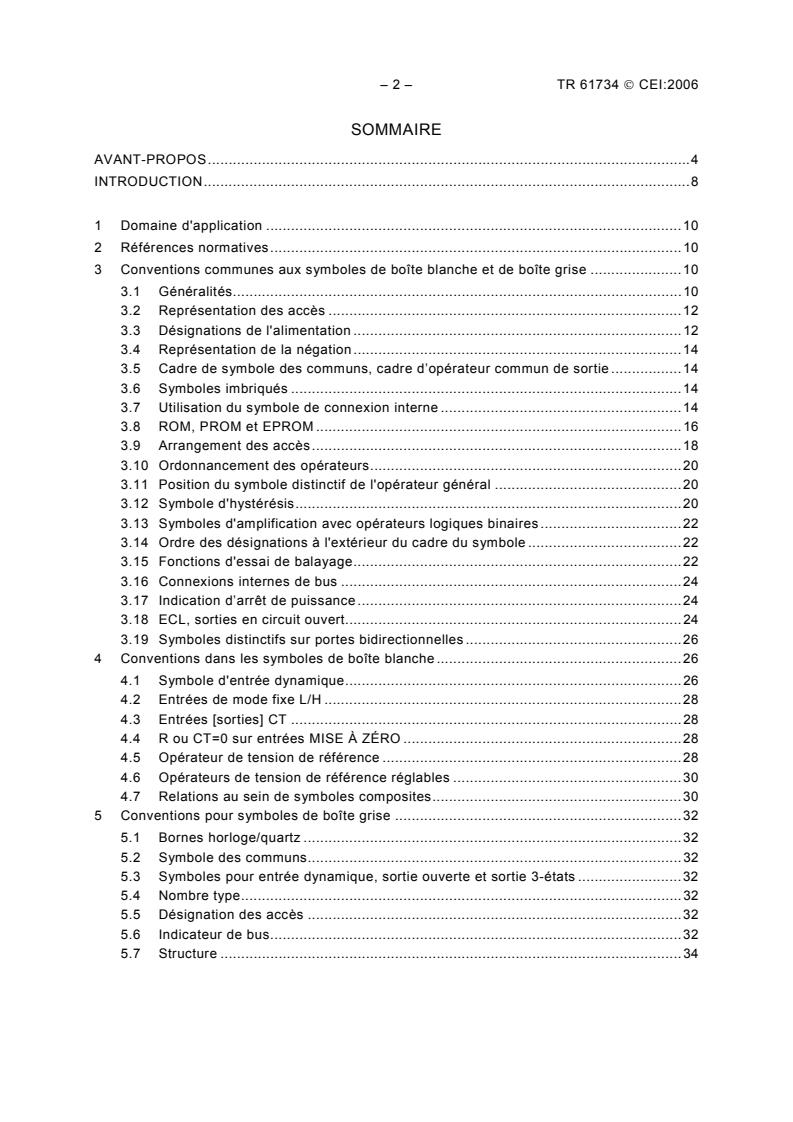
– 2 – TR 61734 CEI:2006
SOMMAIRE
AVANT-PROPOS.4
INTRODUCTION.8
1 Domaine d'application .10
2 Références normatives.10
3 Conventions communes aux symboles de boîte blanche et de boîte grise .10
3.1 Généralités.10
3.2 Représentation des accès .12
3.3 Désignations de l'alimentation .12
3.4 Représentation de la négation.14
3.5 Cadre de symbole des communs, cadre d’opérateur commun de sortie .14
3.6 Symboles imbriqués .14
3.7 Utilisation du symbole de connexion interne .14
3.8 ROM, PROM et EPROM .16
3.9 Arrangement des accès.18
3.10 Ordonnancement des opérateurs.20
3.11 Position du symbole distinctif de l'opérateur général .20
3.12 Symbole d'hystérésis.20
3.13 Symboles d'amplification avec opérateurs logiques binaires .22
3.14 Ordre des désignations à l'extérieur du cadre du symbole .22
3.15 Fonctions d'essai de balayage.22
3.16 Connexions internes de bus .24
3.17 Indication d’arrêt de puissance.24
3.18 ECL, sorties en circuit ouvert.24
3.19 Symboles distinctifs sur portes bidirectionnelles .26
4 Conventions dans les symboles de boîte blanche.26
4.1 Symbole d'entrée dynamique.26
4.2 Entrées de mode fixe L/H .28
4.3 Entrées [sorties] CT .28
4.4 R ou CT=0 sur entrées MISE À ZÉRO .28
4.5 Opérateur de tension de référence .28
4.6 Opérateurs de tension de référence réglables .30
4.7 Relations au sein de symboles composites.30
5 Conventions pour symboles de boîte grise .32
5.1 Bornes horloge/quartz .32
5.2 Symbole des communs.32
5.3 Symboles pour entrée dynamique, sortie ouverte et sortie 3-états .32
5.4 Nombre type.32
5.5 Désignation des accès .32
5.6 Indicateur de bus.32
5.7 Structure .34
TR 61734 IEC:2006 – 3 –
CONTENTS
FOREWORD.5
INTRODUCTION.9
1 Scope.11
2 Normative references .11
3 Conventions common to white-box and gray-box symbols .11
3.1 General .11
3.2 Representation of terminals.13
3.3 Power-supply designations.13
3.4 Representation of negation.15
3.5 Common control block, common output element.15
3.6 Embedded symbols .15
3.7 Use of the internal-connection symbol .15
3.8 ROMs, PROMs and EPROMs .17
3.9 Order of inputs and outputs .19
3.10 Order of elements .21
3.11 Position of the general qualifying symbol.21
3.12 Symbol for hysteresis .21
3.13 Amplification symbol with binary logic elements.23
3.14 Order of designations outside the symbol outline.23
3.15 Scan-test functions.23
3.16 Bus internal connections .25
3.17 Indication of power-down.25
3.18 ECL, open-circuit outputs .25
3.19 Qualifying symbols on bi-directional ports.27
4 Conventions in white-box symbols .27
4.1 Dynamic-input symbol .27
4.2 L/H fixed-mode inputs .29
4.3 CT- inputs [CT-outputs] .29
4.4 R or CT=0 on RESET inputs.29
4.5 Reference voltage element.29
4.6 Adjustable reference voltage elements .31
4.7 Relationships within composite symbols .31
5 Conventions for gray-box symbols .33
5.1 Clock/crystal terminals .33
5.2 Common control block .33
5.3 Symbols for dynamic input, open-circuit output and 3-state output.33
5.4 Type number .33
5.5 Input and output designation .33
5.6 Bus indicator .33
5.7 Structure .35
– 4 – TR 61734 CEI:2006
COMMISSION ÉLECTROTECHNIQUE INTERNATIONALE
____________
APPLICATION DES SYMBOLES POUR ÉLÉMENTS
LOGIQUES BINAIRES ET ANALOGIQUES
AVANT-PROPOS
1) La Commission Electrotechnique Internationale (CEI) est une organisation mondiale de normalisation
composée de l'ensemble des comités électrotechniques nationaux (Comités nationaux de la CEI). La CEI a
pour objet de favoriser la coopération internationale pour toutes les questions de normalisation dans les
domaines de l'électricité et de l'électronique. A cet effet, la CEI – entre autres activités – publie des Normes
internationales, des Spécifications techniques, des Rapports techniques, des Spécifications accessibles au
public (PAS) et des Guides (ci-après dénommés "Publication(s) de la CEI"). Leur élaboration est confiée à des
comités d'études, aux travaux desquels tout Comité national intéressé par le sujet traité peut participer. Les
organisations internationales, gouvernementales et non gouvernementales, en liaison avec la CEI, participent
également aux travaux. La CEI collabore étroitement avec l'Organisation Internationale de Normalisation (ISO),
selon des conditions fixées par accord entre les deux organisations.
2) Les décisions ou accords officiels de la CEI concernant les questions techniques représentent, dans la mesure
du possible, un accord international sur les sujets étudiés, étant donné que les Comités nationaux de la CEI
intéressés sont représentés dans chaque comité d’études.
3) Les Publications de la CEI se présentent sous la forme de recommandations internationales et sont agréées
comme telles par les Comités nationaux de la CEI. Tous les efforts raisonnables sont entrepris afin que la CEI
s'assure de l'exactitude du contenu technique de ses publications; la CEI ne peut pas être tenue responsable
de l'éventuelle mauvaise utilisation ou interprétation qui en est faite par un quelconque utilisateur final.
4) Dans le but d'encourager l'uniformité internationale, les Comités nationaux de la CEI s'engagent, dans toute la
mesure possible, à appliquer de façon transparente les Publications de la CEI dans leurs publications
nationales et régionales. Toutes divergences entre toutes Publications de la CEI et toutes publications
nationales ou régionales correspondantes doivent être indiquées en termes clairs dans ces dernières.
5) La CEI n’a prévu aucune procédure de marquage valant indication d’approbation et n'engage pas sa
responsabilité pour les équipements déclarés conformes à une de ses Publications.
6) Tous les utilisateurs doivent s'assurer qu'ils sont en possession de la dernière édition de cette publication.
7) Aucune responsabilité ne doit être imputée à la CEI, à ses administrateurs, employés, auxiliaires ou
mandataires, y compris ses experts particuliers et les membres de ses comités d'études et des Comités
nationaux de la CEI, pour tout préjudice causé en cas de dommages corporels et matériels, ou de tout autre
dommage de quelque nature que ce soit, directe ou indirecte, ou pour supporter les coûts (y compris les frais
de justice) et les dépenses découlant de la publication ou de l'utilisation de cette Publication de la CEI ou de
toute autre Publication de la CEI, ou au crédit qui lui est accordé.
8) L'attention est attirée sur les références normatives citées dans cette publication. L'utilisation de publications
référencées est obligatoire pour une application correcte de la présente publication.
9) L’attention est attirée sur le fait que certains des éléments de la présente Publication de la CEI peuvent faire
l’objet de droits de propriété intellectuelle ou de droits analogues. La CEI ne saurait être tenue pour
responsable de ne pas avoir identifié de tels droits de propriété et de ne pas avoir signalé leur existence.
La tâche principale des comités d’études de la CEI est l’élaboration des Normes
internationales. Toutefois, un comité d’études peut proposer la publication d’un rapport
technique lorsqu’il a réuni des données de nature différente de celles qui sont normalement
publiées comme Normes internationales, cela pouvant comprendre, par exemple, des
informations sur l’état de la technique.
La CEI 61734, qui est un rapport technique, a été établie par le comité d’études 3 de la CEI:
Structures d’informations, documentation et symboles graphiques.
Cette deuxième édition annule et remplace la première édition parue en 1997. Elle a été, en
qualité rédactionelle, mise à jour en ce qui concerne la mise en référence:
− Snnnnn se rapporte à un symbole; et
− Annnnn à une note d'application dans la CEI 60617.
Le contenu technique du rapport est inchangé.
TR 61734 IEC:2006 – 5 –
INTERNATIONAL ELECTROTECHNICAL COMMISSION
____________
APPLICATION OF SYMBOLS FOR
BINARY LOGIC AND ANALOGUE ELEMENTS
FOREWORD
1) The International Electrotechnical Commission (IEC) is a worldwide organization for standardization comprising
all national electrotechnical committees (IEC National Committees). The object of IEC is to promote
international co-operation on all questions concerning standardization in the electrical and electronic fields. To
this end and in addition to other activities, IEC publishes International Standards, Technical Specifications,
Technical Reports, Publicly Available Specifications (PAS) and Guides (hereafter referred to as "IEC
Publication(s)"). Their preparation is entrusted to technical committees; any IEC National Committee interested
in the subject dealt with may participate in this preparatory work. International, governmental and non-
governmental organizations liaising with the IEC also participate in this preparation. IEC collaborates closely
with the International Organization for Standardization (ISO) in accordance with conditions determined by
agreement between the two organizations.
2) The formal decisions or agreements of IEC on technical matters express, as nearly as possible, an international
consensus of opinion on the relevant subjects since each technical committee has representation from all
interested IEC National Committees.
3) IEC Publications have the form of recommendations for international use and are accepted by IEC National
Committees in that sense. While all reasonable efforts are made to ensure that the technical content of IEC
Publications is accurate, IEC cannot be held responsible for the way in which they are used or for any
misinterpretation by any end user.
4) In order to promote international uniformity, IEC National Committees undertake to apply IEC Publications
transparently to the maximum extent possible in their national and regional publications. Any divergence
between any IEC Publication and the corresponding national or regional publication shall be clearly indicated in
the latter.
5) IEC provides no marking procedure to indicate its approval and cannot be rendered responsible for any
equipment declared to be in conformity with an IEC Publication.
6) All users should ensure that they have the latest edition of this publication.
7) No liability shall attach to IEC or its directors, employees, servants or agents including individual experts and
members of its technical committees and IEC National Committees for any personal injury, property damage or
other damage of any nature whatsoever, whether direct or indirect, or for costs (including legal fees) and
expenses arising out of the publication, use of, or reliance upon, this IEC Publication or any other IEC
Publications.
8) Attention is drawn to the normative references cited in this publication. Use of the referenced publications is
indispensable for the correct application of this publication.
9) Attention is drawn to the possibility that some of the elements of this IEC Publication may be the subject of
patent rights. IEC shall not be held responsible for identifying any or all such patent rights.
The main task of IEC technical committees is to prepare International Standards. However, a
technical committee may propose the publication of a technical report when it has collected
data of a different kind from that which is normally published as an International Standard, for
example "state of the art".
IEC 61734, which is a technical report, was prepared by IEC technical committee 3:
Information structures, documentation and graphical symbols.
This second edition cancels and replaces the first edition published in 1997. It has been
editorially revised with regard to the referencing:
− Snnnnn refers to a symbol; and
− Annnnn to an application note in IEC 60617.
The technical content of the report is unchanged.
– 6 – TR 61734 CEI:2006
Le texte de ce rapport technique est issu des documents suivants:
Projet d’enquête Rapport de vote
3/800/DTR 3/803/RVC
Le rapport de vote indiqué dans le tableau ci-dessus donne toute information sur le vote ayant
abouti à l'approbation de ce rapport technique.
Cette publication a été rédigée selon les Directives ISO/CEI, Partie 2.
Le comité a décidé que le contenu de cette publication ne sera pas modifié avant la date de
maintenance indiquée sur le site web de la CEI sous "http://webstore.iec.ch" dans les
données relatives à la publication recherchée. A cette date, la publication sera
− reconduite,
− supprimée,
− remplacée par une édition révisée, ou
− amendée.
TR 61734 IEC:2006 – 7 –
The text of this technical report is based on the following documents:
Enquiry draft Report on voting
3/800/DTR 3/803/RVC
Full information on the voting for the approval of this technical report can be found in the
report on voting indicated in the above table.
This publication has been drafted in accordance with the ISO/IEC Directives, Part 2.
The committee has decided that the contents of this publication will remain unchanged until
the maintenance result date indicated on the IEC web site under "http://webstore.iec.ch" in
the data related to the specific publication. At this date, the publication will be
− reconfirmed,
− withdrawn,
− replaced by a revised edition, or
− amended.
– 8 – TR 61734 CEI:2006
INTRODUCTION
Les anciennes CEI 60617-12 et CEI 60617-13 ont établi des règles pour la construction des
symboles graphiques qui représentent les fonctions de la logique binaire et les fonctions
analogues, respectivement. Chaque norme fournissait des manières alternatives de
représenter des fonctions, à employer selon les circonstances.
Un groupe de travail avec des membres des Pays Bas, de Suède et du Royaume Uni a
développé la première édition de ce rapport technique. Il contenait des conventions, utiles
dans l’application de la CEI 60617-12 et la CEI 60617-13 aux symboles pour des catalogues
de dispositifs réels, et a montrait quels choix le groupe de travail avait fait là où des
techniques alternatives étaient fournies.
L'intention était d'aider à créer des symboles ayant un aspect aussi cohérent que possible, ne
dépendant pas du créateur, tout en représentant toujours exactement la fonction.
Après l'intégration du contenu des anciennes CEI 60617-12 et CEI 60617-13 dans la base de
données de la CEI 60617:
− la CEI 60617-12 et la CEI 60617-13 ont été retirées comme publications séparées;
− la numérotation des symboles a été changée; et
− les pièces textuelles ont été converties en notes d'application.
NOTE Il est encore possible de rechercher le contenu informatif des anciennes publications au moyen de la vue
"de la publication précédente" de la CEI 60617, toutefois sous une forme légèrement restructurée.
TR 61734 IEC:2006 – 9 –
INTRODUCTION
The former IEC 60617-12 and IEC 60617-13 established rules for the construction of
graphical symbols that represent binary logic and analogue functions, respectively. Each
standard provided alternative ways of representing functions, to be used as circumstances
dictate.
A working group with members from the Netherlands, Sweden and the UK developed the first
edition of this Technical Report. It contained conventions, helpful when applying
IEC 60617-12 and IEC 60617-13 to symbols for catalogues of real devices, and showed which
choices the working group had made where alternative techniques were provided.
The intent was to help to create symbols having as consistent an appearance as possible, not
depending on the originator, while still accurately representing the function.
Following the integration of the content of the former IEC 60617-12 and IEC 60617-13 into the
IEC 60617 database:
− IEC 60617-12 and IEC 60617-13 were withdrawn as separate publications;
− the symbol numbering was changed; and
− the textual parts were converted into application notes.
NOTE It is still possible to retrieve the information content of the former publications by means of the “earlier
publication” view of the IEC 60617, however in a slightly restructured form.
– 10 – TR 61734 CEI:2006
APPLICATION DES SYMBOLES POUR ÉLÉMENTS
LOGIQUES BINAIRES ET ANALOGIQUES
1 Domaine d'application
La CEI 60617 établit des règles pour la construction des symboles graphiques qui
représentent des fonctions de la logique binaire et les fonctions analogues. La norme fournit
des manières alternatives de représenter des fonctions, à employer selon les circonstances.
Le présent rapport technique contient des conventions, utiles dans l’application de la
CEI 60617 aux symboles pour des catalogues des dispositifs réels, et montre les choix
préférables là où des techniques alternatives sont fournies dans la norme. Elle aide
également à créer des symboles ayant un aspect aussi cohérent que possible, ne dépendant
pas du créateur, tout en représentant toujours exactement la fonction.
2 Références normatives
Les documents de référence suivants sont indispensables pour l'application du présent
document. Pour les références datées, seule l'édition citée s'applique. Pour les références
non datées, la dernière édition du document de référence s'applique (y compris les éventuels
amendements).
CEI 60617, Symboles graphiques pour schémas
CEI 61352, Mnémoniques et symboles pour circuits intégrés
IEEE 1149.1, Standard Test Access Port and Boundary-Scan Architecture
3 Conventions communes aux symboles de boîte blanche et de boîte grise
Dans les symboles de boîte blanche, le comportement fonctionnel d'un opérateur est
entièrement décrit à l'aide de moyens normalisés.
Dans les symboles de boîte grise, le comportement fonctionnel d'un opérateur est décrit (en
partie) par d'autres moyens (voir la note d’application A0037 du symbole S01731 de la
CEI 60617).
Une collection des mnémoniques et symboles préférés pour l'usage en tant que symboles
généraux et étiquettes de qualification d'entrée ou de sortie est fournie dans la CEI 61352.
3.1 Généralités
En ce qui concerne les normes de symboles graphiques pour opérateurs numériques et
analogiques, il est possible que, selon la symbolisation établie, le même opérateur soit
représenté de différentes façons. Dans le but de donner aux symboles décrivant des fonctions
similaires un format cohérent, il est nécessaire de restreindre ces différentes représentations.
Lorsque des choix sont autorisés dans la CEI 60617, l’un d’entre eux est donné comme
préféré dans le présent rapport.
TR 61734 IEC:2006 – 11 –
APPLICATION OF SYMBOLS FOR
BINARY LOGIC AND ANALOGUE ELEMENTS
1 Scope
IEC 60617 establishes rules for the construction of graphical symbols that represent binary
logic and analogue functions, respectively. The standard provides alternative ways of
representing functions, to be used as circumstances dictate.
This Technical Report contains conventions, helpful when applying IEC 60617 to symbols for
catalogues of real devices, and shows preferable choices where alternative techniques are
provided in the standard. It also helps to create symbols having as consistent an appearance
as possible, not depending on the originator, while still accurately representing the function.
2 Normative references
The following referenced documents are indispensable for the application of this document.
For dated references, only the edition cited applies. For undated references, the latest edition
of the referenced document (including any amendments) applies.
IEC 60617, Graphical symbols for diagrams
IEC 61352, Mnemonics and symbols for integrated circuits
IEEE 1149.1, Standard Test Access Port and Boundary-Scan Architecture
3 Conventions common to white-box and gray-box symbols
In white-box symbols, the functional behaviour of an element is fully described by
standardized means.
In gray-box symbols, the functional behaviour is (partly) described by other means (see
symbol S01731 application note A00037 of IEC 60617).
A collection of preferred mnemonics and symbols for use as general qualifying symbols and
input or output labels is provided in IEC 61352.
3.1 General
In the field of graphical-symbol standards for binary logic and analogue elements, it is
possible that, through the established symbolization, the same element may be represented in
different ways. In order to give symbols depicting similar functions a consistent format, it is
necessary to restrict the number of different forms. Where alternatives are allowed in
IEC 60617, one is given as preferred in this report.
– 12 – TR 61734 CEI:2006
Le présent rapport vise à donner aux symboles une valeur cohérente dans les catalogues et
manuels de données. Il n'est pas destiné à limiter la liberté requise pour obtenir une
représentation plus appropriée sur un schéma des circuits, par exemple en permutant des
bornes ou accès.
3.2 Représentation des accès
3.2.1 Accès non connectés intérieurement (NC)
Les accès qui ne doivent pas être connectés et les accès qu'il n'est pas nécessaire de
connecter ne décrivent pas des fonctions et, en conséquence, ne sont pas représentés sur un
cadre de symbole.
3.2.2 Accès connectés à des tensions d'alimentation
Normalement, il n'est pas nécessaire de représenter les accès connectés à des tensions
d'alimentation pour décrire des fonctions sur un schéma; c’est pourquoi ces accès ne sont
normalement pas représentés sur un cadre du symbole, mais il convient de les représenter
d'une autre manière, par exemple dans un tableau.
Néanmoins, dans certains cas, il est utile de représenter, dans le symbole, les accès
connectés à des tensions d'alimentation, par exemple
− dans le cas de l'entrée à un régulateur de tension (symbole S01797) ou d’un
convertisseur tension (symbole S01795);
− lorsqu'un réseau extérieur est nécessaire;
− lorsque, dans une configuration «maître esclave» de plusieurs dispositifs, le maître fournit
de la puissance à l'esclave, les bornes d'alimentation de l'esclave sont représentées.
3.3 Désignations de l'alimentation
Plusieurs dispositifs sont en mesure de fonctionner à l'intérieur d'une vaste gamme de
tensions d'alimentation, par exemple de 5 V à 15 V. Dans ces cas-là, pour éviter la confusion,
la valeur nominale attribuée n'est pas représentée dans le symbole.
En outre, en ne représentant pas la valeur nominale attribuée, les dispositifs ayant la même
fonction mais des tensions d'alimentation différentes peuvent avoir le même symbole.
Lorsque différentes désignations de l'alimentation doivent être représentées, on utilise la
représentation suivante:
Les connexions «masse» sont désignées 0 V et utilisent la même technique, par exemple
0 V [1A].
TR 61734 IEC:2006 – 13 –
This report aims at a consistent appearance of symbols in catalogues and data handbooks. It
does not intend to limit the freedom required to arrive at a more appropriate representation on
a circuit diagram, for example by swapping terminals.
3.2 Representation of terminals
3.2.1 NC terminals
Terminals, which must not be connected, and terminals, which need not be connected, do not
depict functions and are therefore not shown at a symbol outline.
3.2.2 Supply terminals
Normally, it is not necessary to represent supply terminals to depict functions on a diagram;
therefore they are normally not shown at the symbol outline but they should be handled in
another way, for example in a table.
Nevertheless, in some cases it is advantageous to show the supply terminals in the symbol,
for example
− in the case of the input to a voltage regulator (symbol S01797), or a voltage converter
(symbol S01795);
− when an external network is needed;
− when in a "master-slave" configuration of several devices, the master provides power to
the slave; the supply terminals of the slave are shown.
3.3 Power-supply designations
Many devices can operate within a wide range of supply voltages, for example 5 V to 15 V. In
those cases, to avoid confusion, the nominal signed value is not shown in the symbol.
Moreover, by not showing the nominal signed value, devices with the same function, but
different supply voltages, can share the same symbol.
When different power supply designations have to be shown, the following representation is
used:
"Ground" connections are designated 0 V and use the same technique, for example 0 V [1A].
– 14 – TR 61734 CEI:2006
3.4 Représentation de la négation
Lorsque l'on utilise le symbole de négation logique (symbole S01466 ou S01497 de la
CEI 60617), les tracés de connexion et les encadrements de séparation des opérateurs ne
dépassent pas le cercle.
3.5 Cadre de symbole des communs, cadre d’opérateur commun de sortie
Si un cadre de symbole des communs est nécessaire (symbole S01464 de la CEI 69617), il
figure au-dessus du cadre d'opérateur, étant donné que tous les exemples dans la CEI 60617
sont représentés de cette façon. Dans les symboles existants pour les dispositifs, c'est
également la manière de représentation la plus usuelle.
Pour les mêmes raisons, si un cadre d‘opérateur commun (symbole S01465 de la CEI 60617 )
de sortie est nécessaire, c'est-à-dire si un symbole distinctif général pour la fonction est
nécessaire en liaison avec une sortie commune, ce cadre d'opérateur commun de sortie
figure au-dessous du cadre d'opérateur concerné.
En plus de son utilisation évidente d'après la CEI 60617 (note d’application A00271 de la
CEI 60617 ), le symbole des communs est également utilisé dans des mémoires de 1 bit,
RAMs/PROMs.
La représentation d'un dispositif allant jusqu‘à 1 bit avec un cadre de symbole des communs
convient particulièrement lorsque des RAMs/PROMs allant jusqu‘à 1 bit sont combinées sur
un schéma des circuits avec des dispositifs similaires allant jusqu'à plusieurs bits.
3.6 Symboles imbriqués
Il convient que les symboles imbriqués représentés dans le symbole des communs ne
dépassent pas le collet, sauf pour l‘imbrication d'un symbole des communs dans un autre
symbole des communs.
lllustration
3.7 Utilisation du symbole de connexion interne
Le symbole de connexion interne (symbole S01475 de la CEI 60617 ) est utilisé pour
symboliser une connexion entre des opérateurs dont les cadres sont combinés, même si un
symbole distinctif est représenté sur un des côtés ou sur les deux côtés du tracé commun,
étant donné que, dans de nombreux cas, une confusion est probable lorsque la connexion
interne n’est pas représentée.
TR 61734 IEC:2006 – 15 –
3.4 Representation of negation
When the symbol for logic negation (symbol S01466 or S01497 of IEC 60617) is used,
connecting lines and element boundaries do not extend through the circle.
3.5 Common control block, common output element
If a common control block (symbol S01464 of IEC 60617) is necessary, it is shown at the top
of an outline, as all examples in IEC 60617 are shown in this way. In existing symbols for
devices, this is also the most usual way of representation.
For the same reasons, if a common output element (symbol S01465 of IEC 60617) is
necessary, i.e. if a general qualifying symbol for the function is needed in connection with a
common output, this common output element is shown at the bottom of the outline
concerned.
Beyond its use evident from IEC 60617 (application note A00271 of IEC 60617) the common
control block is also used in 1-bit-wide RAMs/PROMs.
Representation of a 1-bit-wide device with a common control block is particularly appropriate
when 1-bit-wide RAMs/PROMs are combined on a circuit diagram with similar multibit-wide
devices.
3.6 Embedded symbols
Embedded symbols in the common control block should not extend into the "neck" area,
except when embedding a common control block in another common control block.
Illustration
3.7 Use of the internal-connection symbol
The internal-connection symbol (symbol S01475 of IEC 60617) is used to symbolize a
connection between elements whose outlines are combined, even if a qualifying symbol is
shown at one or both sides of the common line, because in many cases confusion is likely
when the internal connection is not shown.
– 16 – TR 61734 CEI:2006
3.8 ROM, PROM et EPROM
Les symboles pour PROM et EPROM décrivent au moins le mode READ. Des symboles
décrivant les deux modes READ et WRITE sont parfois ajoutés.
− Lorsque seul le mode READ est représenté par le symbole, ROM est utilisé comme
symbole distinctif général.
− Le groupement de marquages défini dans la note d’application A00217 de la CEI 60617
est utilisé comme sorties de ROM.
Illustration
CEI 60617 CEI 60617
S01712 S01711
− Les indications de propriétés telles que l’effaçage par lumière ultraviolette [UV] ne sont
pas représentées dans le symbole.
− Pour représenter l'effet des tensions de programmation avec des niveaux de tension
autres que le niveau normal logique, on utilise la représentation suivante:
− Des informations supplémentaires, telles que RD, WR, ne sont pas données sur les
entrées EN- et C- dans des cas tels que celui représenté ci-dessus.
TR 61734 IEC:2006 – 17 –
3.8 ROMs, PROMs and EPROMs
Symbols for PROMs and EPROMs at least depict the READ mode. Symbols depicting both
READ and WRITE mode are sometimes added.
− When only the READ mode is depicted by the symbol, ROM is used as the general
qualifying symbol.
− Label grouping as defined in application note A00217 of IEC 60617 is used at outputs of
ROMs.
Illustration
IEC 60617 IEC 60617
S01712 S01711
− Indications of properties like erasable by ultraviolet light [UV] are not shown in the symbol.
− To depict the effect of programming voltages with voltage levels other than the normal
logic levels, the following representation is used:
– Supplementary information, like RD or WR, is not given on the EN- and C-inputs in cases
like the one shown above.
– 18 – TR 61734 CEI:2006
3.9 Arrangement des accès
L'ordre dans lequel les accès sont représentés dans un symbole dépend de la façon dont les
accès individuels agissent réciproquement à l'intérieur d'une fonction ou d'un dispositif
particulier, et avec d'autres fonctions ou dispositifs comparables. Toutefois, il est préférable
d'avoir à sa disposition un agencement recommandé de marquages des accès dans les cas
où, pour un dispositif particulier, le concepteur d'un symbole a la liberté de choisir l'ordre, par
exemple lorsqu'un symbole doit être représenté dans un catalogue de symboles, ou sur une
feuille de données représentant le dispositif seul. L'utilisation d'un ordre recommandé permet
de donner aux symboles un format cohérent et d‘éviter un très grand nombre de symboles
décrivant des fonctions similaires.
Pour obtenir un tel ordre, la procédure suivante est utilisée.
− Les accès sont disposés en groupes fonctionnels. Un groupe fonctionnel peut être, par
exemple, l'entrée principale pour une fonction du dispositif, avec ses entrées
influençantes. Exemples d'entrées principales: entrée de décalage dans un registre à
décalage, entrée de comptage dans un dispositif de comptage, entrée C dans un
opérateur bistable cadencé.
− Egalement, dans des dispositifs qui sont destinés à être connectés en cascade, tels que
les dispositifs de comptage, les accès correspondants, par exemple entrée retenue, sortie
retenue, sont disposés alignés dans le symbole. Cela donne la possibilité de connexions
rectilignes lorsque les symboles sont appliqués sur un schéma des circuits.
− A l'intérieur d'un groupe fonctionnel, toutes les entrées sont représentées de telle façon
que les repérages correspondants figurent dans l'ordre suivant, de haut en bas (ou de
gauche à droite, selon l'orientation du symbole):
− S,J,A, →, ←,+, –, D,C,M,G,N,V,X,Z, T, K, R, EN.
− Cet ordre émane de la pratique courante, par exemple si l'on regarde un opérateur
bistable JK qui a été complété par une entrée S et une entrée R, on a l'ordre S, J, C,
K, R.
− Pour les opérateurs analogiques, on utilise l'ordre suivant:
− U, I, ADJ, CPN, +, –.
− Lorsqu’il existe des sorties [entré
...