

IEC TS 63336:2024
(Main)Commissioning of VSC HVDC systems
General Information
- Abstract
IEC TS 63336:2024, which is a technical specification, applies to the commissioning of voltage-sourced converter (VSC) high voltage direct current (HVDC) systems which consist of two converter stations and the connecting HVDC transmission line.
The tests are generally applied to all HVDC configurations and could require addition or deletion to match the given solution.
This document provides guidance on the planning of commissioning activities. The commissioning described in this document is implemented through on-site testing on the whole system functionality, including testing on the subsystem and system. This document provides the scope, procedures and acceptance criteria of the tests.
Factory system tests, on-site equipment tests, electrode tests, and trial operation are not included in this document.
- Status
- Published
- Publication Date
- 15-Jul-2024
- Technical Committee
- TC 115 - High Voltage Direct Current (HVDC) transmission for DC voltages above 100 kV
- Drafting Committee
- WG 13 - TC 115/WG 13
- Current Stage
- PPUB - Publication issued
- Start Date
- 16-Jul-2024
- Completion Date
- 24-May-2024
Overview
IEC TS 63336:2024 - Commissioning of VSC HVDC systems is a technical specification from the IEC that defines guidance for on‑site commissioning of voltage‑sourced converter (VSC) high‑voltage direct‑current (HVDC) systems. The scope covers an HVDC transmission solution composed of two converter stations and the connecting HVDC transmission line. It focuses on planning and executing on‑site tests that verify subsystem and whole‑system functionality, and it provides test scopes, procedures and acceptance criteria for commissioning activities. Note: factory system tests, routine on‑site equipment tests, earth electrode tests, and trial operation are explicitly excluded.
Key topics and technical requirements
- Commissioning process and stages: structured guidance for pre‑commissioning, subsystem testing, system testing, high‑voltage energisation, converter‑station tests and transmission tests.
- Test classification and objectives: clear description of test types (subsystem vs system), sequence and test purposes.
- Subsystem test areas: power/control/communication cabling, main circuit equipment, AC protections and interlocks, SCADA/remote interfaces, auxiliary systems (cooling, auxiliary power, fire protection, HVAC), transmission monitoring and electrode monitoring.
- High‑voltage energisation procedures: staged energisation of AC switchyards, filters, interface transformers and blocked converters with preconditions and acceptance criteria.
- Converter station commissioning: first deblock actions, protective action verification, reactive and active power control testing, control‑mode changes and step‑response verification.
- Transmission tests: energisation of the HVDC transmission line, first power transfer, protective actions, active/reactive power control, power reversal and dynamic step responses.
- Acceptance criteria and test documentation: emphasis on objective pass/fail criteria, required preconditions and documented test procedures for safe, repeatable commissioning.
Applications and who uses this standard
IEC TS 63336:2024 is intended for organizations involved in planning and executing commissioning of VSC HVDC projects, including:
- Transmission system operators (TSOs) and utilities
- Project owners and asset managers
- Engineering, procurement and construction (EPC) contractors
- HVDC equipment manufacturers and system integrators
- Commissioning engineers, test teams and third‑party testing laboratories
- Regulators and safety assessors requiring documented commissioning evidence
Benefits include safer, more efficient commissioning, reduced project risk, consistent test coverage across converter stations and transmission lines, and clearer technical acceptance criteria.
Related standards
Refer to other IEC standards and industry documents covering HVDC system design, protection, control and electrical testing for complementary requirements (standards on HVDC technology, control/protection interfaces, and high‑voltage testing). For project compliance, use IEC TS 63336:2024 alongside applicable national and utility specifications.
Keywords: IEC TS 63336:2024, VSC HVDC commissioning, HVDC systems, commissioning tests, converter station, HVDC transmission line.
Get Certified
Connect with accredited certification bodies for this standard

IMQ S.p.A. (Certification)
Italian electrical product certification.

SLG Prüf- und Zertifizierungs GmbH
German testing and certification body.

UL Solutions
Global safety science company with testing, inspection and certification.
Sponsored listings
Frequently Asked Questions
IEC TS 63336:2024 is a technical specification published by the International Electrotechnical Commission (IEC). Its full title is "Commissioning of VSC HVDC systems". This standard covers: IEC TS 63336:2024, which is a technical specification, applies to the commissioning of voltage-sourced converter (VSC) high voltage direct current (HVDC) systems which consist of two converter stations and the connecting HVDC transmission line. The tests are generally applied to all HVDC configurations and could require addition or deletion to match the given solution. This document provides guidance on the planning of commissioning activities. The commissioning described in this document is implemented through on-site testing on the whole system functionality, including testing on the subsystem and system. This document provides the scope, procedures and acceptance criteria of the tests. Factory system tests, on-site equipment tests, electrode tests, and trial operation are not included in this document.
IEC TS 63336:2024, which is a technical specification, applies to the commissioning of voltage-sourced converter (VSC) high voltage direct current (HVDC) systems which consist of two converter stations and the connecting HVDC transmission line. The tests are generally applied to all HVDC configurations and could require addition or deletion to match the given solution. This document provides guidance on the planning of commissioning activities. The commissioning described in this document is implemented through on-site testing on the whole system functionality, including testing on the subsystem and system. This document provides the scope, procedures and acceptance criteria of the tests. Factory system tests, on-site equipment tests, electrode tests, and trial operation are not included in this document.
IEC TS 63336:2024 is classified under the following ICS (International Classification for Standards) categories: 29.200 - Rectifiers. Convertors. Stabilized power supply; 29.240.01 - Power transmission and distribution networks in general. The ICS classification helps identify the subject area and facilitates finding related standards.
IEC TS 63336:2024 is available in PDF format for immediate download after purchase. The document can be added to your cart and obtained through the secure checkout process. Digital delivery ensures instant access to the complete standard document.
Standards Content (Sample)
IEC TS 63336 ®
Edition 1.0 2024-07
TECHNICAL
SPECIFICATION
Commissioning of VSC HVDC systems
All rights reserved. Unless otherwise specified, no part of this publication may be reproduced or utilized in any form
or by any means, electronic or mechanical, including photocopying and microfilm, without permission in writing from
either IEC or IEC's member National Committee in the country of the requester. If you have any questions about IEC
copyright or have an enquiry about obtaining additional rights to this publication, please contact the address below or
your local IEC member National Committee for further information.
IEC Secretariat Tel.: +41 22 919 02 11
3, rue de Varembé info@iec.ch
CH-1211 Geneva 20 www.iec.ch
Switzerland
About the IEC
The International Electrotechnical Commission (IEC) is the leading global organization that prepares and publishes
International Standards for all electrical, electronic and related technologies.
About IEC publications
The technical content of IEC publications is kept under constant review by the IEC. Please make sure that you have the
latest edition, a corrigendum or an amendment might have been published.
IEC publications search - webstore.iec.ch/advsearchform IEC Products & Services Portal - products.iec.ch
The advanced search enables to find IEC publications by a Discover our powerful search engine and read freely all the
variety of criteria (reference number, text, technical publications previews, graphical symbols and the glossary.
committee, …). It also gives information on projects, replaced With a subscription you will always have access to up to date
and withdrawn publications. content tailored to your needs.
IEC Just Published - webstore.iec.ch/justpublished
Electropedia - www.electropedia.org
Stay up to date on all new IEC publications. Just Published
The world's leading online dictionary on electrotechnology,
details all new publications released. Available online and once
containing more than 22 500 terminological entries in English
a month by email.
and French, with equivalent terms in 25 additional languages.
Also known as the International Electrotechnical Vocabulary
IEC Customer Service Centre - webstore.iec.ch/csc
(IEV) online.
If you wish to give us your feedback on this publication or need
further assistance, please contact the Customer Service
Centre: sales@iec.ch.
IEC TS 63336 ®
Edition 1.0 2024-07
TECHNICAL
SPECIFICATION
Commissioning of VSC HVDC systems
INTERNATIONAL
ELECTROTECHNICAL
COMMISSION
ICS 29.200; 29.240.01 ISBN 978-2-8322-8923-5
– 2 – IEC TS 63336:2024 © IEC 2024
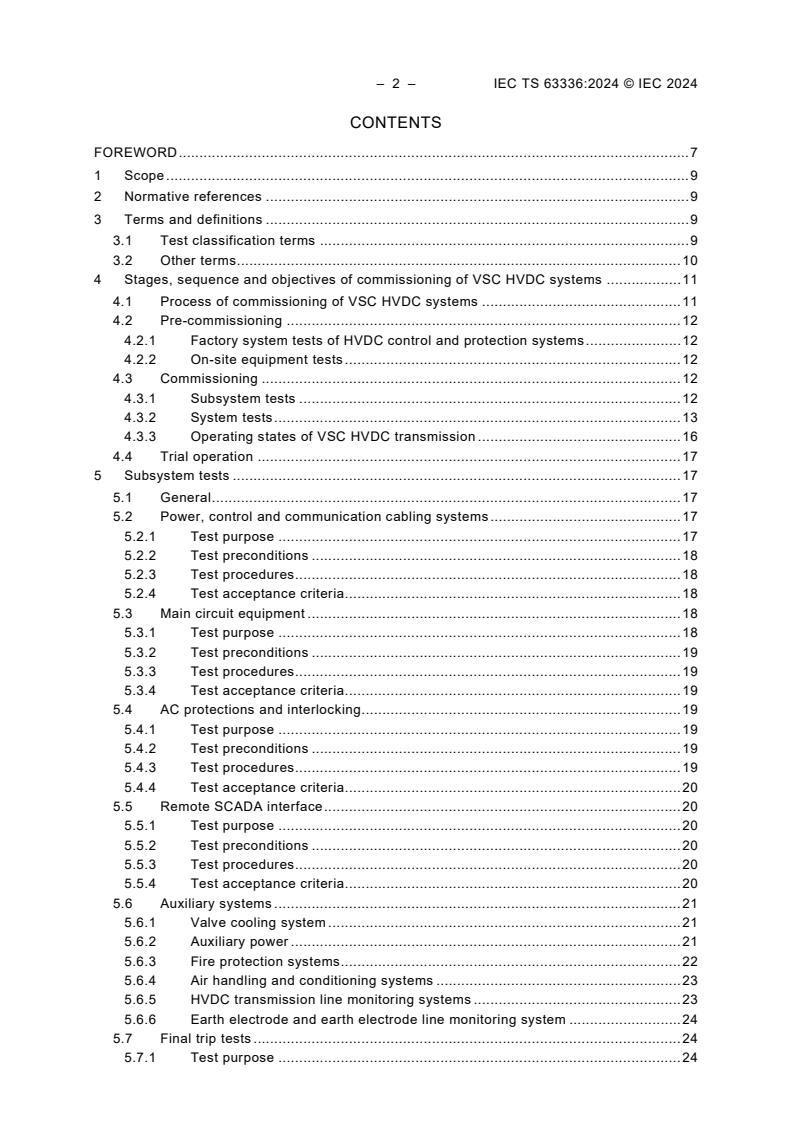
CONTENTS
FOREWORD . 7
1 Scope . 9
2 Normative references . 9
3 Terms and definitions . 9
3.1 Test classification terms . 9
3.2 Other terms . 10
4 Stages, sequence and objectives of commissioning of VSC HVDC systems . 11
4.1 Process of commissioning of VSC HVDC systems . 11
4.2 Pre-commissioning . 12
4.2.1 Factory system tests of HVDC control and protection systems . 12
4.2.2 On-site equipment tests . 12
4.3 Commissioning . 12
4.3.1 Subsystem tests . 12
4.3.2 System tests . 13
4.3.3 Operating states of VSC HVDC transmission . 16
4.4 Trial operation . 17
5 Subsystem tests . 17
5.1 General . 17
5.2 Power, control and communication cabling systems . 17
5.2.1 Test purpose . 17
5.2.2 Test preconditions . 18
5.2.3 Test procedures . 18
5.2.4 Test acceptance criteria. 18
5.3 Main circuit equipment . 18
5.3.1 Test purpose . 18
5.3.2 Test preconditions . 19
5.3.3 Test procedures . 19
5.3.4 Test acceptance criteria. 19
5.4 AC protections and interlocking . 19
5.4.1 Test purpose . 19
5.4.2 Test preconditions . 19
5.4.3 Test procedures . 19
5.4.4 Test acceptance criteria. 20
5.5 Remote SCADA interface . 20
5.5.1 Test purpose . 20
5.5.2 Test preconditions . 20
5.5.3 Test procedures . 20
5.5.4 Test acceptance criteria. 20
5.6 Auxiliary systems . 21
5.6.1 Valve cooling system . 21
5.6.2 Auxiliary power . 21
5.6.3 Fire protection systems . 22
5.6.4 Air handling and conditioning systems . 23
5.6.5 HVDC transmission line monitoring systems . 23
5.6.6 Earth electrode and earth electrode line monitoring system . 24
5.7 Final trip tests . 24
5.7.1 Test purpose . 24
5.7.2 Test preconditions . 25
5.7.3 Test procedures . 25
5.7.4 Test acceptance criteria. 25
6 High voltage energisation . 25
6.1 General . 25
6.2 AC switchyard energisation . 25
6.2.1 Test purpose . 25
6.2.2 Test preconditions . 26
6.2.3 Test procedures . 26
6.2.4 Test acceptance criteria. 26
6.3 AC filter energisation (if applicable) . 26
6.3.1 Test purpose . 26
6.3.2 Test preconditions . 26
6.3.3 Test procedures . 26
6.3.4 Test acceptance criteria. 27
6.4 Interface transformer energisation . 27
6.4.1 Test purpose . 27
6.4.2 Test preconditions . 27
6.4.3 Test procedures . 27
6.4.4 Test acceptance criteria. 28
6.5 Blocked converter energisation . 28
6.5.1 Test purpose . 28
6.5.2 Test preconditions . 28
6.5.3 Test procedures . 28
6.5.4 Test acceptance criteria. 28
6.6 Energisation from DC side (if applicable) . 29
6.6.1 Test purpose . 29
6.6.2 Test preconditions . 29
6.6.3 Test procedures . 29
6.6.4 Test acceptance criteria. 29
7 Converter station tests . 30
7.1 General . 30
7.2 First deblock . 30
7.2.1 Test purpose . 30
7.2.2 Test preconditions . 30
7.2.3 Test procedures . 30
7.2.4 Test acceptance criteria. 31
7.3 Protective actions . 31
7.3.1 Test purpose . 31
7.3.2 Test preconditions . 31
7.3.3 Test procedures . 32
7.3.4 Test acceptance criteria. 32
7.4 Reactive power control . 32
7.4.1 Test purpose . 32
7.4.2 Test preconditions . 32
7.4.3 Test procedures . 32
7.4.4 Test acceptance criteria. 33
7.5 Change of RPC control modes . 33
7.5.1 Test purpose . 33
– 4 – IEC TS 63336:2024 © IEC 2024
7.5.2 Test preconditions . 33
7.5.3 Test procedures . 33
7.5.4 Test acceptance criteria. 34
7.6 Step responses . 34
7.6.1 Test purpose . 34
7.6.2 Test preconditions . 34
7.6.3 Test procedures . 34
7.6.4 Test acceptance criteria. 35
8 Transmission tests. 35
8.1 General . 35
8.2 Energisation of HVDC transmission line . 36
8.2.1 Test purpose . 36
8.2.2 Test preconditions . 36
8.2.3 Test procedures . 36
8.2.4 Test acceptance criteria. 36
8.3 First power transmission . 36
8.3.1 Test purpose . 36
8.3.2 Test preconditions . 37
8.3.3 Test procedures . 37
8.3.4 Test acceptance criteria. 37
8.4 Protective actions . 37
8.4.1 Test purpose . 37
8.4.2 Test preconditions . 37
8.4.3 Test procedures . 38
8.4.4 Test acceptance criteria. 38
8.5 Active power control . 38
8.5.1 Test purpose . 38
8.5.2 Test preconditions . 38
8.5.3 Test procedures . 38
8.5.4 Test acceptance criteria. 39
8.6 Reactive power control . 39
8.6.1 Test purpose . 39
8.6.2 Test preconditions . 39
8.6.3 Test procedures . 39
8.6.4 Test acceptance criteria. 39
8.7 Power reversal . 40
8.7.1 Test purpose . 40
8.7.2 Test preconditions . 40
8.7.3 Test procedures . 40
8.7.4 Test acceptance criteria. 40
8.8 Step responses . 40
8.8.1 Test purpose . 40
8.8.2 Test preconditions . 41
8.8.3 Test procedures . 41
8.8.4 Test acceptance criteria. 41
8.9 High power transmission . 41
8.9.1 Test purpose . 41
8.9.2 Test preconditions . 42
8.9.3 Test procedures . 42
8.9.4 Test acceptance criteria. 42
8.10 Changes of DC configuration in bipole scheme . 42
8.10.1 Test purpose . 42
8.10.2 Test preconditions . 43
8.10.3 Test procedures . 43
8.10.4 Test acceptance criteria. 43
8.11 Heat run test (including overload) . 43
8.11.1 Test purpose . 43
8.11.2 Test preconditions . 44
8.11.3 Test procedures . 44
8.11.4 Test acceptance criteria. 45
8.12 Control system changeovers . 45
8.12.1 Test purpose . 45
8.12.2 Test preconditions . 45
8.12.3 Test procedures . 46
8.12.4 Test acceptance criteria. 46
8.13 Change of control location . 46
8.13.1 Test purpose . 46
8.13.2 Test preconditions . 46
8.13.3 Test procedures . 47
8.13.4 Test acceptance criteria. 47
8.14 Loss of auxiliary power supplies . 48
8.14.1 Test purpose . 48
8.14.2 Test preconditions . 48
8.14.3 Test procedures . 48
8.14.4 Test acceptance criteria. 49
8.15 Loss of telecommunication . 49
8.15.1 Test purpose . 49
8.15.2 Test preconditions . 49
8.15.3 Test procedures . 49
8.15.4 Test acceptance criteria. 49
8.16 Black start (if applicable). 50
8.16.1 Test purpose . 50
8.16.2 Test preconditions . 50
8.16.3 Test procedures . 50
8.16.4 Test acceptance criteria. 51
9 Power quality and interference tests . 51
9.1 General . 51
9.2 AC and DC harmonic measurements . 51
9.2.1 Test purpose . 51
9.2.2 Test preconditions . 51
9.2.3 Test procedures . 52
9.2.4 Test acceptance criteria. 52
9.3 Audible noise . 53
9.3.1 Test purpose . 53
9.3.2 Test preconditions . 53
9.3.3 Test procedures . 53
9.3.4 Test acceptance criteria. 54
9.4 High frequency interference measurements . 54
– 6 – IEC TS 63336:2024 © IEC 2024
9.4.1 Test purpose . 54
9.4.2 Test preconditions . 54
9.4.3 Test procedures . 54
9.4.4 Test acceptance criteria. 55
10 AC/DC network interaction tests . 55
10.1 Test purpose . 55
10.2 Preconditions . 55
10.3 Transmission network switching and staged faults . 55
10.4 Special protection schemes . 56
10.5 Test of AC network and control interactions . 56
10.6 Interactions with other HVDC systems or FACTS devices . 56
11 Commissioning plan and documentation of on-site tests . 57
11.1 General . 57
11.2 Commissioning planning . 57
11.3 Site test outline . 57
11.4 Test plan . 58
11.5 Test schedule . 58
11.6 Test procedures . 59
11.7 Test records . 59
11.8 Final report . 60
Bibliography . 61
Figure 1 – Overview diagram of commissioning process of VSC HVDC systems . 11
Figure 2 – VSC HVDC systems and designations. 12
Figure 3 – Scope of system tests . 14
Table 1 – Structure of system tests . 15
Table 2 – Subsystem tests of main circuit equipment . 18
Table 3 – Control location combinations. 47
INTERNATIONAL ELECTROTECHNICAL COMMISSION
____________
COMMISSIONING OF VSC HVDC SYSTEMS
FOREWORD
1) The International Electrotechnical Commission (IEC) is a worldwide organization for standardization comprising
all national electrotechnical committees (IEC National Committees). The object of IEC is to promote international
co-operation on all questions concerning standardization in the electrical and electronic fields. To this end and
in addition to other activities, IEC publishes International Standards, Technical Specifications, Technical Reports,
Publicly Available Specifications (PAS) and Guides (hereafter referred to as “IEC Publication(s)”). Their
preparation is entrusted to technical committees; any IEC National Committee interested in the subject dealt with
may participate in this preparatory work. International, governmental and non-governmental organizations liaising
with the IEC also participate in this preparation. IEC collaborates closely with the International Organization for
Standardization (ISO) in accordance with conditions determined by agreement between the two organizations.
2) The formal decisions or agreements of IEC on technical matters express, as nearly as possible, an international
consensus of opinion on the relevant subjects since each technical committee has representation from all
interested IEC National Committees.
3) IEC Publications have the form of recommendations for international use and are accepted by IEC National
Committees in that sense. While all reasonable efforts are made to ensure that the technical content of IEC
Publications is accurate, IEC cannot be held responsible for the way in which they are used or for any
misinterpretation by any end user.
4) In order to promote international uniformity, IEC National Committees undertake to apply IEC Publications
transparently to the maximum extent possible in their national and regional publications. Any divergence between
any IEC Publication and the corresponding national or regional publication shall be clearly indicated in the latter.
5) IEC itself does not provide any attestation of conformity. Independent certification bodies provide conformity
assessment services and, in some areas, access to IEC marks of conformity. IEC is not responsible for any
services carried out by independent certification bodies.
6) All users should ensure that they have the latest edition of this publication.
7) No liability shall attach to IEC or its directors, employees, servants or agents including individual experts and
members of its technical committees and IEC National Committees for any personal injury, property damage or
other damage of any nature whatsoever, whether direct or indirect, or for costs (including legal fees) and
expenses arising out of the publication, use of, or reliance upon, this IEC Publication or any other IEC
Publications.
8) Attention is drawn to the Normative references cited in this publication. Use of the referenced publications is
indispensable for the correct application of this publication.
9) IEC draws attention to the possibility that the implementation of this document may involve the use of (a)
patent(s). IEC takes no position concerning the evidence, validity or applicability of any claimed patent rights in
respect thereof. As of the date of publication of this document, IEC had not received notice of (a) patent(s), which
may be required to implement this document. However, implementers are cautioned that this may not represent
the latest information, which may be obtained from the patent database available at https://patents.iec.ch. IEC
shall not be held responsible for identifying any or all such patent rights.
IEC TS 63336 has been prepared by WG 13: Commissioning of VSC HVDC systems, of IEC
technical committee 115: High voltage direct current (HVDC) transmission for DC voltages
above 100 kV. It is a Technical Specification.
The text of this Technical Specification is based on the following documents:
Draft Report on voting
115/360/DTS 115/367/RVDTS
Full information on the voting for its approval can be found in the report on voting indicated in
the above table.
The language used for the development of this Technical Specification is English.
– 8 – IEC TS 63336:2024 © IEC 2024
This document was drafted in accordance with ISO/IEC Directives, Part 2, and developed in
accordance with ISO/IEC Directives, Part 1 and ISO/IEC Directives, IEC Supplement, available
at www.iec.ch/members_experts/refdocs. The main document types developed by IEC are
described in greater detail at www.iec.ch/publications.
The committee has decided that the contents of this document will remain unchanged until the
stability date indicated on the IEC website under webstore.iec.ch in the data related to the
specific document. At this date, the document will be
• reconfirmed,
• withdrawn, or
• revised.
COMMISSIONING OF VSC HVDC SYSTEMS
1 Scope
This document, which is a technical specification, applies to the commissioning of voltage-
sourced converter (VSC) high voltage direct current (HVDC) systems which consist of two
converter stations and the connecting HVDC transmission line.
The tests are generally applied to all HVDC configurations and could require addition or deletion
to match the given solution.
This document provides guidance on the planning of commissioning activities. The
commissioning described in this document is implemented through on-site testing on the whole
system functionality, including testing on the subsystem and system. This document provides
the scope, procedures and acceptance criteria of the tests.
Factory system tests, on-site equipment tests, electrode tests, and trial operation are not
included in this document.
2 Normative references
The following documents are referred to in the text in such a way that some or all of their content
constitutes requirements of this document. For dated references, only the edition cited applies.
For undated references, the latest edition of the referenced document (including any
amendments) applies.
IEC 60633:2019, High-voltage direct current (HVDC) transmission – Vocabulary
IEC 62747:2014, Terminology for voltage-sourced converters (VSC) for high-voltage direct
current (HVDC) systems
IEC 62747:2014/AMD1:2019
3 Terms and definitions
For the purposes of this document, the terms and definitions given in IEC 62747 and IEC 60633
as well as the following apply.
3.1 Test classification terms
3.1.1
factory system tests
FST
tests which are performed in a factory of HVDC control and protection equipment to verify the
main functions and performances as well as the interface with VSC valve, optical measuring
devices, etc.
Note 1 to entry: It is also referred to as a functional/dynamic performance test (FPT/DPT).
3.1.2
on-site equipment tests
electrical and mechanical tests which are performed on-site on a single equipment to verify that
no equipment damage has occurred during transport and site assembly, and that installation
has been correctly performed
– 10 – IEC TS 63336:2024 © IEC 2024
3.1.3
subsystem tests
tests which are performed on-site to prove the correct interconnection and functioning of all
individual items of equipment within a functional group (or subsystem) and that these items
operate and interact correctly
3.1.4
system tests
tests verifying functions and performances of HVDC system as a whole as well as the interaction
with adjacent AC systems on-site
3.1.5
converter station tests
tests verifying functions and performances of the converter unit disconnected from the HVDC
transmission line on-site
Note 1 to entry: These are also referred to as STATCOM mode tests.
3.1.6
transmission tests
tests verifying functions and performances of HVDC system when transmitting power between
both converter stations on-site
Note 1 to entry: These are also referred to as end-to-end tests.
3.1.7
point of common coupling
PCC
point of interconnection of the HVDC converter station to the adjacent AC system
[SOURCE: IEC 62747:2014, 9.25]
3.2 Other terms
3.2.1
PQ characteristic
capability of active and reactive power of a VSC HVDC converter unit, which is normally a
closed and irregular region with active and reactive power in a two-axis graphical representation
3.2.2
Qac control
reactive power control mode of VSC converter to control the exchange of reactive power to a
specified value
3.2.3
Uac control
reactive power control mode of VSC converter to control the AC bus voltage to a specified value
3.2.4
dynamic performance study
DPS
off-line investigation of the dynamic behaviour of various fault scenarios within the specified
boundaries of AC system
Note 1 to entry: The result of the DPS should be the optimum set of control and protection parameters to achieve
the best overall dynamic behaviour for the specific HVDC.
3.3
human machine interface
HMI
interface for a human operator to operate, monitor and maintain an HVDC locally at site or from
the remote
Note 1 to entry: An HMI typically consists of a monitor, a keyboard and a mouse.
4 Stages, sequence and objectives of commissioning of VSC HVDC systems
4.1 Process of commissioning of VSC HVDC systems
During the commissioning and testing of an HVDC project, the HVDC equipment is verified in
groups and in conjunction with the control and protection systems. Usually, this process can be
divided into four major parts: factory tests, on-site equipment tests, subsystem tests and system
tests as shown in Figure 1.
Figure 1 – Overview diagram of commissioning process of VSC HVDC systems
The structure and sequence of the VSC commissioning process require an understanding of
the overall VSC HVDC system structure and a definition of various components within this
structure. Figure 2 shows an example of two parallel VSC HVDC systems along with graphical
designations used in this document.
– 12 – IEC TS 63336:2024 © IEC 2024
Figure 2 – VSC HVDC systems and designations
4.2 Pre-commissioning
4.2.1 Factory system tests of HVDC control and protection systems
Factory system tests cover the verification of internal connections within and in between the
control cabinets and the functional verification of the software and are performed in the factory
prior to the control and protection equipment being sent to site.
During the factory system tests, the complete control and protection systems are tested.
External stand-alone equipment, such as external protection relays, are typically excluded.
Where other external interfaces are present, the tests should be performed as completely as
possible, to determine with as much confidence as is practical that the control and protection
systems will operate correctly in terms of the expected input and output signals. Such external
interfaces include auxiliary power systems, converter cooling systems, fire protection systems,
etc.
Finding and correcting hardware and software errors in the control and protection systems is
an important function of factory system tests. Such faults are easier to find and rectify in the
factory than during on-site commissioning. Correcting such faults reduces the probability of
disturbing the power system during the commissioning tests.
4.2.2 On-site equipment tests
On-site equipment tests are electrical and mechanical tests on a single installed item of
equipment or plant. The primary purpose of these tests is to ensure, to the extent possible, that
no equipment damage has occurred during transport and site assembly, and that the installation
has been correctly performed.
The equipment supplier may in some cases specify particular checks and inspections that can
help verify the equipment integrity.
4.3 Commissioning
4.3.1 Subsystem tests
A subsystem includes groups of main circuit equipment, associated measurement systems,
control and protection systems, and/or auxiliary systems.
The objective of this stage is to validate the correct integration of subsystem components. This
is done by verifying the signals and readings, control functions such as switching sequences
and interlocking functions. Those parts which are completely tested in FST do not need to be
verified again.
Subsystem tests are generally performed per functional group and consequently all equipment
and elements within that functional group must be ready for test before that particular
subsystem test can commence. All subsystem tests shall be completed before the system tests
commence for any individual pole within a converter station.
Subsystems to be tested for a VSC converter station comprise the following key elements:
a) Power, control and communication cabling systems.
b) Main circuit equipment.
c) AC protections and interlocking.
d) Remote SCADA interface.
e) Auxiliary systems.
f) Final trip tests.
4.3.2 System tests
System tests cover the start-up and test of the complete HVDC System in operation. System
tests are required to prove that the functions and performances of the HVDC system meet
technical requirements when connected to the AC network. The structure of the system tests
will follow the structure of the HVDC system, starting from the smallest, least complex,
operational unit, and end with the total system in operation.
System tests are comprised of the following commissioning and testing activities:
a) High voltage energisation.
b) Converter station tests.
c) Transmission tests.
d) Power quality and interference tests.
e) AC/DC network interaction tests.
The first three elements are undertaken sequentially. The last two elements are scheduled
during appropriate times during the performance of the converter station tests and transmission
tests.
The scope and flow of system tests are shown in Figure 3.
Before system tests commence with the energisation tests at the converter unit level, the
following preconditions shall be satisfied:
f) All equipment tests are completed and passed.
g) All subsystem tests are completed and passed.
h) The results and outcomes of the factory tests are reviewed and accepted.
i) All necessary control and protection systems and auxiliary systems are verified, operational
and confirm
...