

IEC 62986:2017
(Main)Plugs, socket-outlets and couplers with arcuate contacts
General Information
- Abstract
IEC 62986:2017(E) sets the general and dimensional interchangeability requirements for plugs, socket-outlets, connectors and appliance inlets with arcuate contacts of standardized configurations (hereinafter referred to as accessories), with a rated operating voltage not exceeding 600 V AC at a frequency of 50 Hz and 60 Hz and with rated currents of 20 A and 30 A, primarily intended for commercial use indoors, in conditions where the presence of water is negligible.
- Status
- Published
- Publication Date
- 27-Sep-2017
- Technical Committee
- SC 23H - Plugs, Socket-outlets and Couplers for industrial and similar applications, and for Electric Vehicles
- Drafting Committee
- PT 62986 - TC 23/SC 23H/PT 62986
- Current Stage
- PPUB - Publication issued
- Start Date
- 28-Sep-2017
- Completion Date
- 03-Nov-2017
Overview
IEC 62986:2017 is an International Electrotechnical Commission standard that defines the general and dimensional interchangeability requirements for plugs, socket‑outlets, connectors and appliance inlets with arcuate contacts. It applies to accessories with rated operating voltages up to 600 V AC (50/60 Hz) and rated currents of 20 A and 30 A, primarily intended for commercial indoor use where water presence is negligible. The standard includes standard sheets for a wide range of connector configurations and voltage/current combinations.
Key topics and technical requirements
IEC 62986:2017 covers the full product lifecycle from design to verification, including:
- Dimensions and interchangeability - standard sheets specifying pin arrangements and dimensional requirements for various voltage/current configurations.
- Standard ratings and classification - rated voltages, currents and intended purposes (two‑pole to four‑pole arrangements).
- Marking and identification - required markings for safe use and correct matching of accessories.
- Protection against electric shock and earthing provisions - construction and earthing requirements to reduce user risk.
- Terminals and terminations - allowable conductor sizes, terminal types (screw, pillar, stud, etc.), torque values and mechanical tests.
- Mechanical strength and durability - impact tests, flexing and cable‑anchorage tests, plug blade retention and tensile tests.
- Electrical performance tests - insulation resistance, dielectric strength, breaking capacity, normal operation and temperature‑rise tests.
- Short‑circuit current withstand - conditional test procedures and acceptance criteria.
- Materials and aging - resistance to heat, fire, tracking, corrosion and resistance to ageing of rubber/thermoplastics.
- Electromagnetic compatibility (EMC) - basic emission and immunity considerations for connectors.
- Test apparatus and procedures - detailed test circuits, figures and tabulated test conditions.
Practical applications and who uses this standard
IEC 62986 is used by:
- Manufacturers of plugs, socket‑outlets, couplers and appliance inlets to design compliant, interchangeable commercial connectors.
- Test laboratories and certification bodies for type testing and compliance verification.
- Product designers and OEMs specifying connectors for commercial equipment and installations.
- Procurement, safety engineers and facility managers who require standardized connector interfaces for reliable power distribution in indoor commercial settings.
- Standards writers and regulatory authorities when referencing connector safety and dimensional interchangeability.
By following IEC 62986, stakeholders ensure compatibility, safety and consistent performance across commercial electrical accessories.
Related information
For implementation, obtain the full IEC 62986:2017 publication (including standard sheets and test figures) from the IEC webstore and verify any amendments or corrigenda. Also consult the IEC catalogue for related connector and appliance‑inlet standards to ensure full system compliance.
Get Certified
Connect with accredited certification bodies for this standard

IMQ S.p.A. (Certification)
Italian electrical product certification.

SLG Prüf- und Zertifizierungs GmbH
German testing and certification body.

UL Solutions
Global safety science company with testing, inspection and certification.
Sponsored listings
Frequently Asked Questions
IEC 62986:2017 is a standard published by the International Electrotechnical Commission (IEC). Its full title is "Plugs, socket-outlets and couplers with arcuate contacts". This standard covers: IEC 62986:2017(E) sets the general and dimensional interchangeability requirements for plugs, socket-outlets, connectors and appliance inlets with arcuate contacts of standardized configurations (hereinafter referred to as accessories), with a rated operating voltage not exceeding 600 V AC at a frequency of 50 Hz and 60 Hz and with rated currents of 20 A and 30 A, primarily intended for commercial use indoors, in conditions where the presence of water is negligible.
IEC 62986:2017(E) sets the general and dimensional interchangeability requirements for plugs, socket-outlets, connectors and appliance inlets with arcuate contacts of standardized configurations (hereinafter referred to as accessories), with a rated operating voltage not exceeding 600 V AC at a frequency of 50 Hz and 60 Hz and with rated currents of 20 A and 30 A, primarily intended for commercial use indoors, in conditions where the presence of water is negligible.
IEC 62986:2017 is classified under the following ICS (International Classification for Standards) categories: 29.120.20 - Connecting devices. The ICS classification helps identify the subject area and facilitates finding related standards.
IEC 62986:2017 is available in PDF format for immediate download after purchase. The document can be added to your cart and obtained through the secure checkout process. Digital delivery ensures instant access to the complete standard document.
Standards Content (Sample)
IEC 62986 ®
Edition 1.0 2017-09
INTERNATIONAL
STANDARD
Plugs, socket-outlets and couplers with arcuate contacts
All rights reserved. Unless otherwise specified, no part of this publication may be reproduced or utilized in any form
or by any means, electronic or mechanical, including photocopying and microfilm, without permission in writing from
either IEC or IEC's member National Committee in the country of the requester. If you have any questions about IEC
copyright or have an enquiry about obtaining additional rights to this publication, please contact the address below or
your local IEC member National Committee for further information.
IEC Central Office Tel.: +41 22 919 02 11
3, rue de Varembé Fax: +41 22 919 03 00
CH-1211 Geneva 20 info@iec.ch
Switzerland www.iec.ch
About the IEC
The International Electrotechnical Commission (IEC) is the leading global organization that prepares and publishes
International Standards for all electrical, electronic and related technologies.
About IEC publications
The technical content of IEC publications is kept under constant review by the IEC. Please make sure that you have the
latest edition, a corrigenda or an amendment might have been published.
IEC Catalogue - webstore.iec.ch/catalogue Electropedia - www.electropedia.org
The stand-alone application for consulting the entire The world's leading online dictionary of electronic and
bibliographical information on IEC International Standards, electrical terms containing 20 000 terms and definitions in
Technical Specifications, Technical Reports and other English and French, with equivalent terms in 16 additional
documents. Available for PC, Mac OS, Android Tablets and languages. Also known as the International Electrotechnical
iPad. Vocabulary (IEV) online.
IEC publications search - www.iec.ch/searchpub IEC Glossary - std.iec.ch/glossary
The advanced search enables to find IEC publications by a 65 000 electrotechnical terminology entries in English and
variety of criteria (reference number, text, technical French extracted from the Terms and Definitions clause of
committee,…). It also gives information on projects, replaced IEC publications issued since 2002. Some entries have been
and withdrawn publications. collected from earlier publications of IEC TC 37, 77, 86 and
CISPR.
IEC Just Published - webstore.iec.ch/justpublished
Stay up to date on all new IEC publications. Just Published IEC Customer Service Centre - webstore.iec.ch/csc
details all new publications released. Available online and If you wish to give us your feedback on this publication or
also once a month by email. need further assistance, please contact the Customer Service
Centre: csc@iec.ch.
IEC 62986 ®
Edition 1.0 2017-09
INTERNATIONAL
STANDARD
Plugs, socket-outlets and couplers with arcuate contacts
INTERNATIONAL
ELECTROTECHNICAL
COMMISSION
ICS 29.120.20 ISBN 978-2-8322-4870-6
– 2 – IEC 62986:2017 © IEC 2017
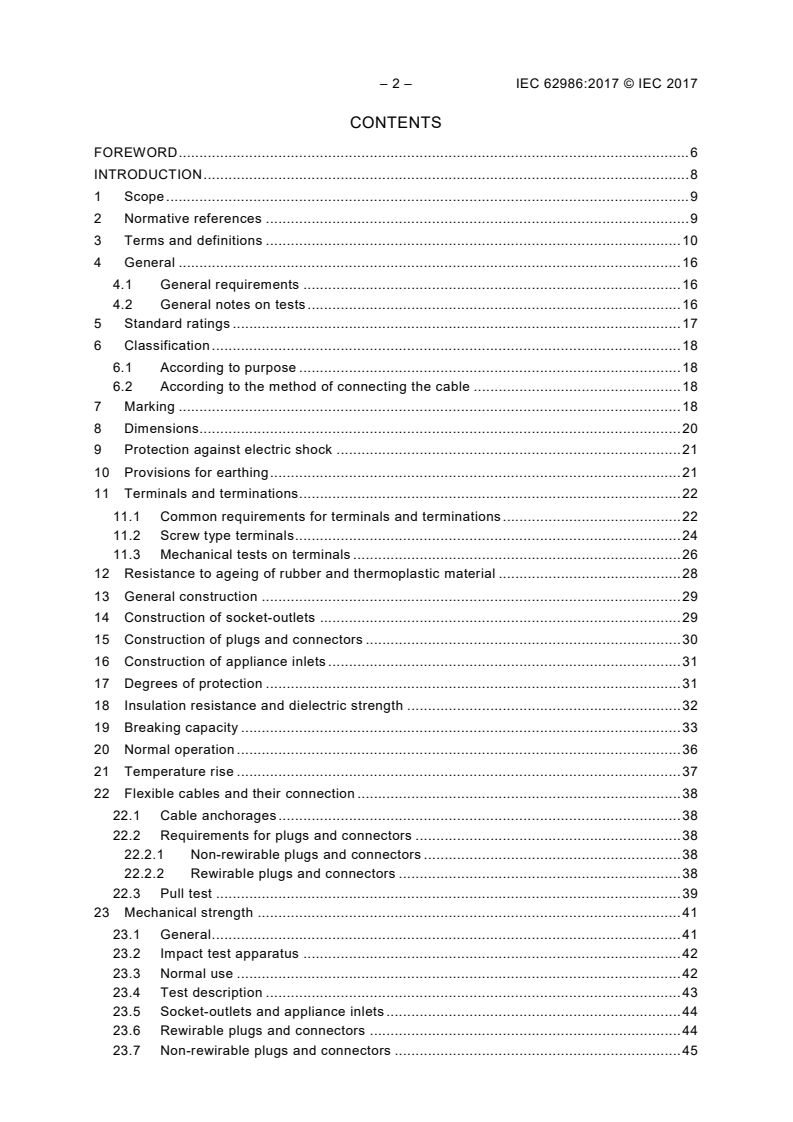
CONTENTS
FOREWORD . 6
INTRODUCTION . 8
1 Scope . 9
2 Normative references . 9
3 Terms and definitions . 10
4 General . 16
4.1 General requirements . 16
4.2 General notes on tests . 16
5 Standard ratings . 17
6 Classification . 18
6.1 According to purpose . 18
6.2 According to the method of connecting the cable . 18
7 Marking . 18
8 Dimensions. 20
9 Protection against electric shock . 21
10 Provisions for earthing . 21
11 Terminals and terminations . 22
11.1 Common requirements for terminals and terminations . 22
11.2 Screw type terminals . 24
11.3 Mechanical tests on terminals . 26
12 Resistance to ageing of rubber and thermoplastic material . 28
13 General construction . 29
14 Construction of socket-outlets . 29
15 Construction of plugs and connectors . 30
16 Construction of appliance inlets . 31
17 Degrees of protection . 31
18 Insulation resistance and dielectric strength . 32
19 Breaking capacity . 33
20 Normal operation . 36
21 Temperature rise . 37
22 Flexible cables and their connection . 38
22.1 Cable anchorages . 38
22.2 Requirements for plugs and connectors . 38
22.2.1 Non-rewirable plugs and connectors . 38
22.2.2 Rewirable plugs and connectors . 38
22.3 Pull test . 39
23 Mechanical strength . 41
23.1 General . 41
23.2 Impact test apparatus . 42
23.3 Normal use . 42
23.4 Test description . 43
23.5 Socket-outlets and appliance inlets . 44
23.6 Rewirable plugs and connectors . 44
23.7 Non-rewirable plugs and connectors . 45
23.8 Accessories with screwed glands . 46
23.9 Plugs . 46
23.9.1 General . 46
23.9.2 Perpendicular stress test . 47
23.9.3 Axial stress test . 47
23.9.4 Tensile strength test . 48
23.9.5 Blade retention (compression) test . 48
24 Screws, current-carrying parts and connections . 48
25 Creepage distances, clearances and distances through sealing compound . 50
26 Resistance to heat . 51
27 Resistance to fire and to tracking. 52
28 Corrosion and resistance to rusting . 54
29 Conditional short-circuit current withstand test . 55
29.1 Short-circuit current . 55
29.2 Ratings and test conditions . 55
29.3 Test circuit . 55
29.4 Calibration . 58
29.5 Test procedure . 58
29.6 Behaviour of the equipment under test . 58
29.7 Acceptance conditions . 59
30 Electromagnetic compatibility . 59
30.1 Immunity . 59
30.2 Emission . 59
STANDARD SHEETS . 60
STANDARD SHEET L5-20 125 V, 20 A, two-pole three-wire . 62
STANDARD SHEET L5-30 125 V, 30 A, two-pole three-wire . 63
STANDARD SHEET L25-30 240 V, 30 A, two-pole three-wire . 64
STANDARD SHEET L6-20 250 V, 20 A, two-pole three-wire . 65
STANDARD SHEET L6-30 250 V, 30 A, two-pole three-wire . 66
STANDARD SHEET L7-20 277 V, 20 A, two-pole three-wire . 67
STANDARD SHEET L7-30 277 V, 30 A, two-pole three-wire . 68
STANDARD SHEET L24-20 347 V, 20 A, two-pole three-wire . 69
STANDARD SHEET L8-20 480 V, 20 A, two-pole three-wire . 70
STANDARD SHEET L8-30 480 V, 30 A, two-pole three-wire . 71
STANDARD SHEET L9-20 600 V, 20 A, two-pole three-wire . 72
STANDARD SHEET L9-30 600 V, 30 A, two-pole three-wire . 73
STANDARD SHEET L14-20 125/250 V, 20 A, three-pole four-wire . 74
STANDARD SHEET L14-30 125/250 V, 30 A, three-pole four-wire . 75
STANDARD SHEET L15-20 250 V, 20 A, three-pole four-wire . 76
STANDARD SHEET L15-30 250 V, 30 A, three-pole four-wire . 77
STANDARD SHEET L16-20 480 V, 20 A, three-pole four-wire . 78
STANDARD SHEET L16-30 480 V, 30 A, three-pole four-wire . 79
STANDARD SHEET L17-30 600 V, 30 A, three-pole four-wire . 80
STANDARD SHEET L21-20 120/208 V, 20 A, four-pole five-wire . 81
STANDARD SHEET L21-30 120/208 V, 30 A, four-pole five-wire . 82
– 4 – IEC 62986:2017 © IEC 2017
STANDARD SHEET L26-30 240/415 V, 30 A, four-pole five-wire . 83
STANDARD SHEET L22-20 277/480 V, 20 A, four-pole five-wire . 84
STANDARD SHEET L22-30 277/480 V, 30 A, four-pole five-wire . 85
STANDARD SHEET L23-20 347/600 V, 20 A, four-pole five-wire . 86
STANDARD SHEET L23-30 347/600 V, 30 A, four-pole five-wire . 87
Bibliography . 88
Figure 1 – Diagram showing the uses of the accessories . 11
Figure 2 – Pillar terminals . 14
Figure 3 – Screw terminals . 14
Figure 4 – Stud terminals . 14
Figure 5 – Saddle terminals . 15
Figure 6 – Mantle terminals. 15
Figure 7 – Gauges for testing insertability of round unprepared conductors having the
maximum specified cross-section . 25
Figure 8 – Flexing test arrangement . 27
Figure 9 – Circuit diagrams for breaking capacity and normal operation tests . 35
Figure 10 – Apparatus for testing the cable anchorage . 40
Figure 11 – Impact test apparatus – Pendulum assembly . 43
Figure 12 – Arrangement for mechanical strength test for plugs and connectors . 45
Figure 13 – Apparatus for flexing test . 46
Figure 14 – Arrangement for contact blade strength tests for plugs . 47
Figure 15 – Ball-pressure apparatus . 52
Figure 16 – Arrangement and dimensions of the electrodes for the tracking test . 54
Figure 17 – Diagram of the test circuit for the verification of short-circuit current
withstand of a two-pole equipment on a single-phase AC . 56
Figure 18 – Diagram of the test circuit for the verification of short-circuit current
withstand of a three-pole equipment . 57
Figure 19 – Diagram of the test circuit for the verification of short-circuit current
withstand of a four-pole equipment . 58
Table 1 – Standard ratings . 17
Table 2 – Voltage colour code. 20
Table 3 – Size for connectable conductors . 22
Table 4 – Flexing under mechanical load testing for copper conductors . 27
Table 5 – Pulling force . 28
Table 6 – Voltage for dielectric strength test . 33
Table 7 – Breaking capacity . 35
Table 8 – Normal operation . 37
Table 9 – Test current and nominal cross-sectional area. 37
Table 10 – Cable type . 38
Table 11 – Metric cables . 40
Table 12 – AWG cables . 41
Table 13 – Pulling force and torque test values . 41
Table 14 – Impact force . 45
Table 15 – Test force for glands . 46
Table 16 – Torque values for terminal screws . 49
Table 17 – Distances through sealing compound . 51
Table 18 – Standard sheets . 60
– 6 – IEC 62986:2017 © IEC 2017
INTERNATIONAL ELECTROTECHNICAL COMMISSION
____________
PLUGS, SOCKET-OUTLETS AND COUPLERS WITH
ARCUATE CONTACTS
FOREWORD
1) The International Electrotechnical Commission (IEC) is a worldwide organization for standardization comprising
all national electrotechnical committees (IEC National Committees). The object of IEC is to promote
international co-operation on all questions concerning standardization in the electrical and electronic fields. To
this end and in addition to other activities, IEC publishes International Standards, Technical Specifications,
Technical Reports, Publicly Available Specifications (PAS) and Guides (hereafter referred to as “IEC
Publication(s)”). Their preparation is entrusted to technical committees; any IEC National Committee interested
in the subject dealt with may participate in this preparatory work. International, governmental and non-
governmental organizations liaising with the IEC also participate in this preparation. IEC collaborates closely
with the International Organization for Standardization (ISO) in accordance with conditions determined by
agreement between the two organizations.
2) The formal decisions or agreements of IEC on technical matters express, as nearly as possible, an international
consensus of opinion on the relevant subjects since each technical committee has representation from all
interested IEC National Committees.
3) IEC Publications have the form of recommendations for international use and are accepted by IEC National
Committees in that sense. While all reasonable efforts are made to ensure that the technical content of IEC
Publications is accurate, IEC cannot be held responsible for the way in which they are used or for any
misinterpretation by any end user.
4) In order to promote international uniformity, IEC National Committees undertake to apply IEC Publications
transparently to the maximum extent possible in their national and regional publications. Any divergence
between any IEC Publication and the corresponding national or regional publication shall be clearly indicated in
the latter.
5) IEC itself does not provide any attestation of conformity. Independent certification bodies provide conformity
assessment services and, in some areas, access to IEC marks of conformity. IEC is not responsible for any
services carried out by independent certification bodies.
6) All users should ensure that they have the latest edition of this publication.
7) No liability shall attach to IEC or its directors, employees, servants or agents including individual experts and
members of its technical committees and IEC National Committees for any personal injury, property damage or
other damage of any nature whatsoever, whether direct or indirect, or for costs (including legal fees) and
expenses arising out of the publication, use of, or reliance upon, this IEC Publication or any other IEC
Publications.
8) Attention is drawn to the Normative references cited in this publication. Use of the referenced publications is
indispensable for the correct application of this publication.
9) Attention is drawn to the possibility that some of the elements of this IEC Publication may be the subject of
patent rights. IEC shall not be held responsible for identifying any or all such patent rights.
International Standard IEC 62986 has been prepared by subcommittee 23H: Plugs, socket-
outlets and couplers for industrial and similar applications, and for electric vehicles, of IEC
technical committee 23: Electrical accessories.
The text of this International Standard is based on the following documents:
FDIS Report on voting
23H/386/FDIS 23H/387/RVD
Full information on the voting for the approval of this International Standard can be found in
the report on voting indicated in the above table.
This document has been drafted in accordance with the ISO/IEC Directives, Part 2.
In this standard, the following print types are used:
– requirements: in roman type;
– conformity statements: in italic type;
– notes: in small roman type.
The committee has decided that the contents of this document will remain unchanged until the
stability date indicated on the IEC website under "http://webstore.iec.ch" in the data related to
the specific document. At this date, the document will be
• reconfirmed,
• withdrawn,
• replaced by a revised edition, or
• amended.
A bilingual version of this publication may be issued at a later date.
– 8 – IEC 62986:2017 © IEC 2017
INTRODUCTION
The object of this document is to provide for a safe, compact and practical IEC system of
standardized plugs and socket-outlets with arcuate contacts. It contains performance and
dimensional requirements taking into account essential differences in the infrastructures and
installation rules throughout the world.
PLUGS, SOCKET-OUTLETS AND COUPLERS WITH
ARCUATE CONTACTS
1 Scope
This document sets the general and dimensional interchangeability requirements for plugs,
socket-outlets, connectors and appliance inlets with arcuate contacts of standardized
configurations (hereinafter referred to as accessories), with a rated operating voltage not
exceeding 600 V AC at a frequency of 50 Hz and 60 Hz and with rated currents of 20 A and
30 A, primarily intended for commercial use indoors, in conditions where the presence of
water is negligible.
This document applies to accessories for use when the ambient temperature is normally
within the range of –25 °C to +40 °C. These accessories are intended to be connected to
cables of copper or copper alloy only.
Interchangeability requirements are defined for IP20 accessories.
NOTE The conditions of use indoors are based on the limitations given by IEC 60364-5-51:2005, Table 51A, AD1.
Socket-outlets or appliance inlets incorporated in or fixed to electrical equipment are within
the scope of this document.
2 Normative references
The following documents are referred to in the text in such a way that some or all of their
content constitutes requirements of this document. For dated references, only the edition
cited applies. For undated references, the latest edition of the referenced document (including
any amendments) applies.
IEC 60227 (all parts), Polyvinyl chloride insulated cables of rated voltages up to and including
450/750 V
IEC 60228:2004, Conductors of insulated cables
IEC 60245-4, Rubber insulated cables – Rated voltages up to and including 450/750 V –
Part 4: Cords and flexible cables
IEC 60269-1, Low-voltage fuses – Part 1: General requirements
IEC 60269-2, Low-voltage fuses – Part 2: Supplementary requirements for fuses for use by
authorized persons (fuses mainly for industrial application) – Examples of standardized
systems of fuses A to K
IEC 60309-1:1999, Plugs, socket-outlets and couplers for industrial purposes – Part 1:
General requirements
IEC 60309-1:1999/AMD1:2005
IEC 60309-1:1999/AMD2:2012
IEC 60417, Graphical symbols for use on equipment (available at http://www.graphical-
symbols.info/equipment)
IEC 60529, Degrees of protection provided by enclosures (IP Code)
– 10 – IEC 62986:2017 © IEC 2017
IEC 60664-1:2007, Insulation coordination for equipment within low-voltage systems – Part 1:
Principles, requirements and tests
ISO 1456, Metallic and other inorganic coatings – Electrodeposited coatings of nickel, nickel
plus chromium, copper plus nickel and of copper plus nickel plus chromium
ISO 2081, Metallic and other inorganic coatings – Electroplated coatings of zinc with
supplementary treatments on iron or steel
ISO 2093, Electroplated coatings of tin – Specification and test methods
NMX-J-436-ANCE-2014/CSA C22.2 No.49-14/ANSI/UL 62, Flexible Cords and Cables
UL 1581, Reference Standard for Electrical Wires, Cables and Flexible Cords
3 Terms and definitions
For the purposes of this document, the following terms and definitions apply.
NOTE The application of accessories is shown in Figure 1.
ISO and IEC maintain terminological databases for use in standardization at the following
addresses:
• IEC Electropedia: available at http://www.electropedia.org/
• ISO Online browsing platform: available at http://www.iso.org/obp
Socket-outlet
Plug
Flexible
cable
Plug and socket-outlet
Plug Connector
Cable coupler
Appliance
inlet Appliance
Connector
Flexible
cable
Appliance coupler
IEC
Figure 1 – Diagram showing the uses of the accessories
3.1
plug and socket-outlet
means enabling the connection at will of a flexible cable to fixed wiring. It consists of two
parts:
[SOURCE: IEC 60309-1:1999, 2.1]
3.1.1
socket-outlet
part intended to be installed with the fixed wiring or incorporated in equipment. A socket-outlet
may also be incorporated in the output circuit of an isolating transformer
[SOURCE: IEC 60309-1:1999, 2.1.1]
– 12 – IEC 62986:2017 © IEC 2017
3.1.2
plug
part integral with or intended to be attached directly to one flexible cable connected to the
equipment or to a connector
[SOURCE: IEC 60309-1:1999, 2.1.2]
3.2
cable coupler
means enabling the connection at will of two flexible cables. It consists of two parts:
[SOURCE: IEC 60309-1:1999, 2.2]
3.2.1
connector
part integral with or intended to be attached to one flexible cable connected to the supply
Note 1 to entry: In general, a connector has the same contact arrangement as a socket-outlet.
[SOURCE: IEC 60309-1:1999, 2.2.1]
3.2.2
plug
part integral with or intended to be attached to one flexible cable connected to the equipment
or to a connector
Note 1 to entry: The plug of a cable coupler is identical to the plug of a "plug and socket-outlet".
[SOURCE: IEC 60309-1:1999, 2.2.2]
3.3
appliance coupler
means enabling the connection at will of a flexible cable to the equipment. It consists of two
parts:
[SOURCE: IEC 60309-1:1999, 2.3]
3.3.1
connector
part integral with, or intended to be attached to, one flexible cable connected to the supply
Note 1 to entry: In general, the connector of an appliance coupler is identical to the connector of a cable coupler.
[SOURCE: IEC 60309-1:1999, 2.3.1]
3.3.2
appliance inlet
part incorporated in, or fixed to, the equipment or intended to be fixed to it
Note 1 to entry: In general, an appliance inlet has the same contact arrangement as a plug.
[SOURCE: IEC 60309-1:1999, 2.3.2]
3.4
rewirable plug or connector
accessory so constructed that the flexible cable can be replaced
[SOURCE: IEC 60309-1:1999, 2.4]
3.5
non-rewirable plug or connector
accessory so constructed that the flexible cable cannot be separated from the accessory
without making it permanently useless
[SOURCE: IEC 60309-1:1999, 2.5]
3.6
rated current
current assigned to the accessory by the manufacturer
[SOURCE: IEC 60309-1:1999, 2.11]
3.7
rated operating voltage
nominal voltage of the supply for which the accessory is intended to be used
[SOURCE: IEC 60309-1:1999, 2.13]
3.8
basic insulation
insulation necessary for the proper functioning of the accessory and for basic protection
against electric shock
[SOURCE: IEC 60309-1:1999, 2.14]
3.9
supplementary insulation (protective insulation)
independent insulation provided in addition to the basic insulation, in order to ensure
protection against electric shock in the event of a failure of the basic insulation
[SOURCE: IEC 60309-1:1999, 2.15]
3.10
double insulation
insulation comprising both basic insulation and supplementary insulation
[SOURCE: IEC 60309-1:1999, 2.16]
3.11
reinforced insulation
improved basic insulation with such mechanical and electrical qualities that it provides the
same degree of protection against electric shock as double insulation
[SOURCE: IEC 60309-1:1999, 2.17]
3.12
terminal
conductive part provided for the connection of a conductor to an accessory
[SOURCE: IEC 60309-1:1999, 2.18]
3.12.1
pillar terminal
terminal in which the conductor is inserted into a hole or cavity, where it is clamped under the
shank of the screw or screws. The clamping pressure may be applied directly by the shank of
– 14 – IEC 62986:2017 © IEC 2017
the screw or through an intermediate clamping member to which pressure is applied by the
shank of the screw
SEE: Figure 2.
[SOURCE: IEC 60309-1:1999, 2.18.1]
IEC
Figure 2 – Pillar terminals
3.12.2
screw terminal
terminal in which the conductor is clamped under the head of the screw. The clamping
pressure may be applied directly by the head of the screw or through an intermediate part,
such as a washer, clamping plate or anti-spread device
SEE: Figure 3.
[SOURCE: IEC 60309-1:1999, 2.18.2]
IEC
Figure 3 – Screw terminals
3.12.3
stud terminal
terminal in which the conductor is clamped under a nut. The clamping pressure may be
applied directly by a suitably shaped nut or through an intermediate part, such as a washer,
clamping plate or anti-spread device
SEE: Figure 4.
[SOURCE: IEC 60309-1:1999, 2.18.3]
IEC
Figure 4 – Stud terminals
3.12.4
saddle terminal
terminal in which the conductor is clamped under a saddle by means of two or more screws or
nuts
SEE: Figure 5.
[SOURCE: IEC 60309-1:1999, 2.18.4]
IEC
Figure 5 – Saddle terminals
3.12.5
mantle terminal
terminal in which the conductor is clamped against the base of a slot in a threaded stud by
means of a nut. The conductor is clamped against the base of the slot by a suitably shaped
washer under the nut, by a central peg if the nut is a cap nut, or by equally effective means
for transmitting the pressure from the nut to the conductor within the slot
SEE: Figure 6.
[SOURCE: IEC 60309-1:1999, 2.18.6]
IEC
Figure 6 – Mantle terminals
3.13
clamping unit
part of a terminal necessary for the clamping and the electrical connection of the conductor
[SOURCE: IEC 60309-1:1999, 2.19]
3.14
conditional short-circuit current
prospective current that an accessory, protected by a specified short-circuit protective device,
can satisfactorily withstand for the total operating time of that device under specified
conditions of use and behaviour
Note 1 to entry: This definition differs from IEC 60050-441:2000, 441-17-20 by broadening the concept of current-
limiting device into a short-circuit protective device, the function of which is not only to limit the current.
[SOURCE: IEC 60309-1:1999, 2.20]
– 16 – IEC 62986:2017 © IEC 2017
3.15
lid
means to ensure the degree of protection on a socket-outlet or a connector
[SOURCE: IEC 60309-1:1999, 2.22]
4 General
4.1 General requirements
Accessories shall be so designed and constructed that in normal use their performance is
reliable and without danger to the user or surroundings.
Combinations of plugs, socket-outlets, appliance inlets and connectors that are intended for
use together shall comply with the requirements of this document and the relevant standard
sheet.
In general, compliance is checked by carrying out all the tests specified.
4.2 General notes on tests
4.2.1 Tests according to this document are type tests. If a part of an accessory has
previously passed tests for a given degree of severity, the relevant type tests shall not be
repeated if the severity is not greater. When a part or a component is incorporated in a device
or accessory according to this document, and if this part or component meets an appropriate
IEC standard, then no further test(s) or requirement(s) shall be required for this part or
component, unless it is being used in a way significantly different from the intent of its own
standard.
4.2.2 Unless otherwise specified, the samples are tested as delivered and under normal
conditions of use, at an ambient temperature of (20 ± 5) °C; the tests are made at rated
frequency.
4.2.3 Unless otherwise specified, the tests are carried out in the order of the clauses of
this document.
4.2.4 Three samples are subjected to all the tests, except if necessary for the tests of
11.1.4 and Clause 29 where, for each subclause, one new set of samples is tested.
4.2.5 Accessories are deemed to comply with this document if no sample fails in the
complete series of appropriate tests. If one sample fails in a test, that test and those
preceding which may have influenced the test result are repeated on another set of three
samples, all of which shall then pass the repeated tests.
In general, it will only be necessary to repeat the test which caused the failure, unless the
sample fails in one of the tests of Clauses 20 and 21, in which case the tests are repeated
from that of Clause 19 onwards.
The applicant may submit, together with the first set of samples, the additional set which may
be necessary should one sample fail. The testing station will then, without further request, test
the additional samples and will reject only if a further failure occurs. If the additional set of
samples is not submitted at the same time, the failure of one sample will entail a rejection.
4.2.6 When the tests are carried out with conductors, they shall be copper or copper alloy
of the type as declared in the manufacturer’s instructions and comply with the appropriate
documents listed below:
Metric conductors (mm ):
IEC 60227 (all parts)
IEC 60228:2004 [Clause 3, solid (class 1), stranded (class 2), flexible (class 5)]
IEC 60245-4
AWG conductors:
NMX-J-436-ANCE-2014/CSA C22.2 No.49-14/ANSI/UL 62
UL 1581
5 Standard ratings
Ratings are specified in Table 1:
Table 1 – Standard ratings
Rated operating Rated Number of Type Standard
voltage current contacts sheet
V A
125 1P+N+ L5-20
250 L6-20
2P+
277 L7-20
1P+N+
347 1P+N+ L24-20
480 2P+ L8-20
600 L9-20
2P+
125/250 2P+N+ L14-20
250 4 3P+ L15-20
480 3P+ L16-20
120/208 L21-20
3P+N+
277/480 5 3P+N+ L22-20
347/600 3P+N+ L23-20
125 1P+N+ L5-30
240 L25-30
2P+
250 2P+ L6-30
277 1P+N+ L7-30
480 L8-30
1P+N+
600 L9-30
2P+
125/250 2P+N+ L14-30
250 4 3P+ L15-30
480 L16-30
3P+
120/208 L21-30
3P+N+
277/480 5 3P+N+ L22-30
347/600 3P+N+ L23-20
– 18 – IEC 62986:2017 © IEC 2017
6 Classification
6.1 According to purpose
Accessories are classified according to purpose:
– plugs;
– socket-outlets;
– connectors;
– appliance inlets.
6.2 According to the method of connecting the cable
Accessories are classified according to the method of connecting the cable:
– rewirable plugs and connectors;
– non-rewirable plugs and connectors.
7 Marking
7.1 Accessories shall be marked with:
– rated current in amperes according to Table 1;
– rated operating voltage(s) in volts according to Table 1;
– symbol for nature of supply;
– either the name or trade mark of the manufacturer or of the responsible vendor;
– type reference, which may be a catalogue number;
– an indication that the plug/connector has to be rotated to be locked.
Compliance is checked by inspection.
7.2 When symbols are used, they shall be as follows:
A . amperes
V . volts
IEC 60417-5032 (2002-10) or AC . alternating current
IEC 60417-5019 (2006-08) (preferred) or . earth
Compliance is checked by inspection.
7.3 For socket-outlets and appliance inlets, the marking for rated current, nature of supply
and either the name or trade mark of the manufacturer or the responsible vendor shall be on
the main part, on the outside of the enclosure, or on the lid, if any, if the latter cannot be
removed without the aid of a tool.
Except for flush-type socket-outlets and appliance inlets, these markings shall be easily
discernible when the accessory is mounted and wired as in normal use, if necessary after it
has been removed from the enclosure.
The marking for rated operating voltage and type reference shall be on a place which is
visible after installation of the accessory, on the outside of enclosure or on the lid, if any, if
the latter cannot be removed without the aid of a tool.
With the exception of the type reference, these markings shall be easily discernible when the
accessory is mounted and wired as in normal use.
NOTE The term "main part" of a socket-outlet or an appliance inlet means the part carrying the contacts.
The type reference may be marked on the main part.
Compliance is checked by inspection.
The marking for rated current, nature of supply, rated operating voltage and the name or trade
mark of the manufacturer or the responsible vendor, may be repeated on the lid, if any.
7.4 For plugs and connectors, the marking specified in 7.1 shall be easily discernible when
the accessory is wired ready for use.
NOTE The term "ready for use" does not imply that the plug or connector is in engagement with its
complementary accessory.
Compliance is checked by inspection.
7.5 For rewireable accessories, the contacts shall be indicated by:
– for the phases, the symbols L1, L2, L3, or 1, 2, 3 or X, Y, Z,
– for neutral, if any, the letter N. The letter W, the colour white or silver may be used;
– for earth, if any, the symbol IEC 60417-5019 (2006-08) (preferred) or . The letters G,
GR, or the colour green may be used.
These symbols shall be placed close to the relevant terminals; they shall not be placed on
removable screws, washers or other removable parts.
Compliance is checked by inspection.
7.6 Marking shall be indelible and easily legible.
Compliance is checked by inspection and by the following test:
After the humidity treatment of Clause 17, the marking is rubbed vigorously by hand for 15 s
with a piece of cloth soaked in water and again for 15 s with a piece of cloth soaked with
petroleum spirit.
Special attention is paid to the marking of the name or trade mark of the manufacturer or the
responsible vendor and to that of the nature of supply, if any.
NOTE A special test for checking the indelibility of these markings is under consideration.
– 20 – IEC 62986:2017 © IEC 2017
7.7 If, in addition to the marking specified, the rated operating voltage is indicated by
means of a colour, the colour code shall be as shown in Table 2. An indicating colour, if
different from that of the enclosure, shall be used only if it can be easily distinguished.
Table 2 – Voltage colour code
Rated operating voltage Colour
V
125 Yellow
250 Blue
125/250 Orange
277 Grey
480 Red
600 Black
7.8 For terminals, the connection and disconnection procedures shall, if necessary, be
indicated on the accessory, on the smallest package unit or on the manufacturer’s
documentation.
7.9 Manufacturers shall specify in an instruction sheet supplied with the accessory, the
range and type of flexible cables to be connected, which shall include the nominal size for
each current rating according to Table 10.
7.10 For plugs and connectors, the accessory shall be marked with instructions to indicate
how the accessory is to be connected or removed. The term “Turn and pull” or an equivalent
wording or symbol shall appear on a surface that will be visible after the accessory is
completely assembled and installed in the intended manner, but not on a face or other surface
that will be obscured when the accessory is mated with another.
8 Dimensions
8.1 Accessories shall comply with the appropriate standard sheets as specified in Table 1.
Compliance is checked by measurement.
8.2 It shall not be possible to engage plugs or connectors with socket-outlets or appliance
inlets having different ratings, or having contact combinations allowing improper connection.
In add
...