

IEC 61512-2:2001
(Main)Batch control - Part 2: Data structures and guidelines for languages
- Abstract
This part of this standard on batch control defines data models that describe batch control as applied in the process industries, data structures for facilitating communications within and between batch control implementations and language guidelines for representing recipes. Refer to Annex A for an explanation of the UML notation that is used in this part of this standard. Refer to Annex B for a summary of all of the SQL definitions from clause 5.
- Status
- Published
- Publication Date
- 14-Nov-2001
- Technical Committee
- SC 65F - Smart manufacturing and enterprise applications
- Drafting Committee
- MT 61512 - Batch control systems
- Current Stage
- PPUB - Publication issued - 60 Publication
- Start Date
- 15-Nov-2001
- Due Date
- 31-Dec-2001
- Completion Date
- 31-Dec-2001


Overview
IEC 61512-2:2001 is an international standard developed by the International Electrotechnical Commission (IEC) that focuses on batch control systems in process industries. Specifically, Part 2 addresses standardized data structures and language guidelines for representing batch control recipes. This standard facilitates consistent communication and interoperability between different batch control implementations by defining clear data models and exchange formats. It supports the effective design, programming, and management of batch processes in industries such as pharmaceuticals, chemicals, and food production.
This standard complements the broader IEC 61512 series on batch control systems by emphasizing the structure and semantics needed for recipe management and communication. It assists industrial automation engineers, control system developers, and process operators to optimize batch production through standardized data frameworks.
Key Topics
Data Models for Batch Control
IEC 61512-2 defines comprehensive data models that describe the structure of batch control recipes, production planning, equipment, and production information. These models ensure uniform representation and understanding of batch processes.Recipe Entity and Structure
The standard outlines detailed entities and hierarchical structures used for recipe definition. This includes components such as recipe entities, building blocks, equipment requirements, and recipe parameters, all designed for accurate procedural control.Communication via Relational Tables
To facilitate data exchange within and between batch control systems, the standard specifies relational table schemas and integrity constraints. These tables support the transfer of recipe data, equipment descriptions, scheduling information, and production histories.Language Guidelines for Recipes
The standard provides language guidelines to represent recipes effectively, supporting procedural clarity and exception handling within batch operations. This enables consistent recipe programming and execution language use.Inclusion of UML and SQL Notation
IEC 61512-2 uses UML (Unified Modeling Language) diagrams to describe the data models visually and includes a summary of SQL definitions for relational table formats. These tools aid in the clear communication and implementation of the standard.Production Planning and Scheduling Model
The standard addresses models for planning and scheduling production batches, integrating these with recipe and equipment data to optimize manufacturing workflows.
Applications
Process Industries Batch Automation
Organizations in chemical, pharmaceutical, food and beverage, and specialty materials industries utilize IEC 61512-2 to implement robust batch control systems that improve production efficiency, quality, and traceability.Recipe Management Systems
Software developers implement the standardized data structures and language rules to develop recipe management and execution software compliant with IEC 61512-2. This ensures cross-platform compatibility and ease of recipe exchange.Control System Integration
Automation vendors and system integrators use the relational table schemas to enable seamless data exchange among distributed control systems (DCS), batch controllers, and enterprise resource planning (ERP) systems.Equipment Modeling and Specification
Manufacturers and users of process equipment benefit from standardized equipment data models to facilitate integration with batch control software and support lifecycle management.Production Scheduling and Information Management
By following the standard’s guidelines, production planners can coordinate batch schedules more effectively and leverage consistent data reporting for operations monitoring.Quality Compliance and Traceability
Consistent batch recipe and control data structures support regulatory compliance, enabling detailed recording and reporting of manufacturing steps for quality assurance audits.
Related Standards
IEC 61512-1 – Batch Control - Part 1: Models and Terminology
Provides foundational models and definitions underpinning batch control systems, which IEC 61512-2 builds upon for recipe and data structure specifications.ISA-88 (ANSI/ISA-88) – Batch Control Standard
This widely recognized standard harmonizes with IEC 61512-2 by defining batch control models and language, often used alongside IEC standards in process automation.IEC 61131 Series – Programmable Controllers
Provides standards for programmable controller languages which are referenced when implementing batch control procedures as per IEC 61512-2 guidelines.ISO/IEC 19501 UML Standards
Utilized by IEC 61512-2 for visual modeling of data structures through Unified Modeling Language diagrams.SQL Standards
The relational table and data exchange components of IEC 61512-2 align with standard SQL specifications for database interoperability.
By adopting IEC 61512-2:2001, industries gain a structured approach to batch control data modeling and recipe language design that enhances communication, system integration, and operational efficiency across the manufacturing lifecycle. This standard remains critical for organizations aiming to optimize batch process automation and data consistency globally.
Get Certified
Connect with accredited certification bodies for this standard

BSI Group
BSI (British Standards Institution) is the business standards company that helps organizations make excellence a habit.

NYCE
Mexican standards and certification body.
Sponsored listings
Frequently Asked Questions
IEC 61512-2:2001 is a standard published by the International Electrotechnical Commission (IEC). Its full title is "Batch control - Part 2: Data structures and guidelines for languages". This standard covers: This part of this standard on batch control defines data models that describe batch control as applied in the process industries, data structures for facilitating communications within and between batch control implementations and language guidelines for representing recipes. Refer to Annex A for an explanation of the UML notation that is used in this part of this standard. Refer to Annex B for a summary of all of the SQL definitions from clause 5.
This part of this standard on batch control defines data models that describe batch control as applied in the process industries, data structures for facilitating communications within and between batch control implementations and language guidelines for representing recipes. Refer to Annex A for an explanation of the UML notation that is used in this part of this standard. Refer to Annex B for a summary of all of the SQL definitions from clause 5.
IEC 61512-2:2001 is classified under the following ICS (International Classification for Standards) categories: 35.240.50 - IT applications in industry. The ICS classification helps identify the subject area and facilitates finding related standards.
IEC 61512-2:2001 is available in PDF format for immediate download after purchase. The document can be added to your cart and obtained through the secure checkout process. Digital delivery ensures instant access to the complete standard document.
Standards Content (Sample)
NORME CEI
INTERNATIONALE IEC
61512-2
INTERNATIONAL
Première édition
STANDARD
First edition
2001-11
Contrôle-commande des processus
de fabrication par lots (batch) –
Partie 2:
Structures de données et règles générales
relatives aux langages
Batch control –
Part 2:
Data structures and guidelines for languages
Numéro de référence
Reference number
CEI/IEC 61512-2:2001
Numérotation des publications Publication numbering
Depuis le 1er janvier 1997, les publications de la CEI As from 1 January 1997 all IEC publications are
sont numérotées à partir de 60000. Ainsi, la CEI 34-1 issued with a designation in the 60000 series. For
devient la CEI 60034-1. example, IEC 34-1 is now referred to as IEC 60034-1.
Editions consolidées Consolidated editions
Les versions consolidées de certaines publications de la The IEC is now publishing consolidated versions of its
CEI incorporant les amendements sont disponibles. Par publications. For example, edition numbers 1.0, 1.1
exemple, les numéros d’édition 1.0, 1.1 et 1.2 indiquent and 1.2 refer, respectively, to the base publication,
respectivement la publication de base, la publication de the base publication incorporating amendment 1 and
base incorporant l’amendement 1, et la publication de the base publication incorporating amendments 1
base incorporant les amendements 1 et 2. and 2.
Informations supplémentaires Further information on IEC publications
sur les publications de la CEI
Le contenu technique des publications de la CEI est The technical content of IEC publications is kept
constamment revu par la CEI afin qu'il reflète l'état under constant review by the IEC, thus ensuring that
actuel de la technique. Des renseignements relatifs à the content reflects current technology. Information
cette publication, y compris sa validité, sont dispo- relating to this publication, including its validity, is
nibles dans le Catalogue des publications de la CEI available in the IEC Catalogue of publications
(voir ci-dessous) en plus des nouvelles éditions, (see below) in addition to new editions, amendments
amendements et corrigenda. Des informations sur les and corrigenda. Information on the subjects under
sujets à l’étude et l’avancement des travaux entrepris consideration and work in progress undertaken by the
par le comité d’études qui a élaboré cette publication, technical committee which has prepared this
ainsi que la liste des publications parues, sont publication, as well as the list of publications issued,
également disponibles par l’intermédiaire de: is also available from the following:
• Site web de la CEI (www.iec.ch) • IEC Web Site (www.iec.ch)
• Catalogue des publications de la CEI • Catalogue of IEC publications
Le catalogue en ligne sur le site web de la CEI The on-line catalogue on the IEC web site
(www.iec.ch/catlg-f.htm) vous permet de faire des (www.iec.ch/catlg-e.htm) enables you to search
recherches en utilisant de nombreux critères, by a variety of criteria including text searches,
comprenant des recherches textuelles, par comité technical committees and date of publication. On-
d’études ou date de publication. Des informations line information is also available on recently
en ligne sont également disponibles sur les issued publications, withdrawn and replaced
nouvelles publications, les publications rempla- publications, as well as corrigenda.
cées ou retirées, ainsi que sur les corrigenda.
• IEC Just Published
• IEC Just Published
Ce résumé des dernières publications parues
This summary of recently issued publications
(www.iec.ch/JP.htm) est aussi disponible par
(www.iec.ch/JP.htm) is also available by email.
courrier électronique. Veuillez prendre contact
Please contact the Customer Service Centre (see
avec le Service client (voir ci-dessous) pour plus
below) for further information.
d’informations.
• Service clients
• Customer Service Centre
Si vous avez des questions au sujet de cette
If you have any questions regarding this
publication ou avez besoin de renseignements
publication or need further assistance, please
supplémentaires, prenez contact avec le Service
contact the Customer Service Centre:
clients:
Email: custserv@iec.ch
Email: custserv@iec.ch
Tél: +41 22 919 02 11
Tel: +41 22 919 02 11
Fax: +41 22 919 03 00
Fax: +41 22 919 03 00
.
NORME CEI
INTERNATIONALE IEC
61512-2
INTERNATIONAL
Première édition
STANDARD
First edition
2001-11
Contrôle-commande des processus
de fabrication par lots (batch) –
Partie 2:
Structures de données et règles générales
relatives aux langages
Batch control –
Part 2:
Data structures and guidelines for languages
IEC 2001 Droits de reproduction réservés Copyright - all rights reserved
Aucune partie de cette publication ne peut être reproduite ni No part of this publication may be reproduced or utilized in
utilisée sous quelque forme que ce soit et par aucun procédé, any form or by any means, electronic or mechanical,
électronique ou mécanique, y compris la photocopie et les including photocopying and microfilm, without permission in
microfilms, sans l'accord écrit de l'éditeur. writing from the publisher.
International Electrotechnical Commission 3, rue de Varembé Geneva, Switzerland
Telefax: +41 22 919 0300 e-mail: inmail@iec.ch IEC web site http://www.iec.ch
CODE PRIX
Commission Electrotechnique Internationale
XD
PRICE CODE
International Electrotechnical Commission
Pour prix, voir catalogue en vigueur
For price, see current catalogue
– 2 – 61512-2 CEI:2001
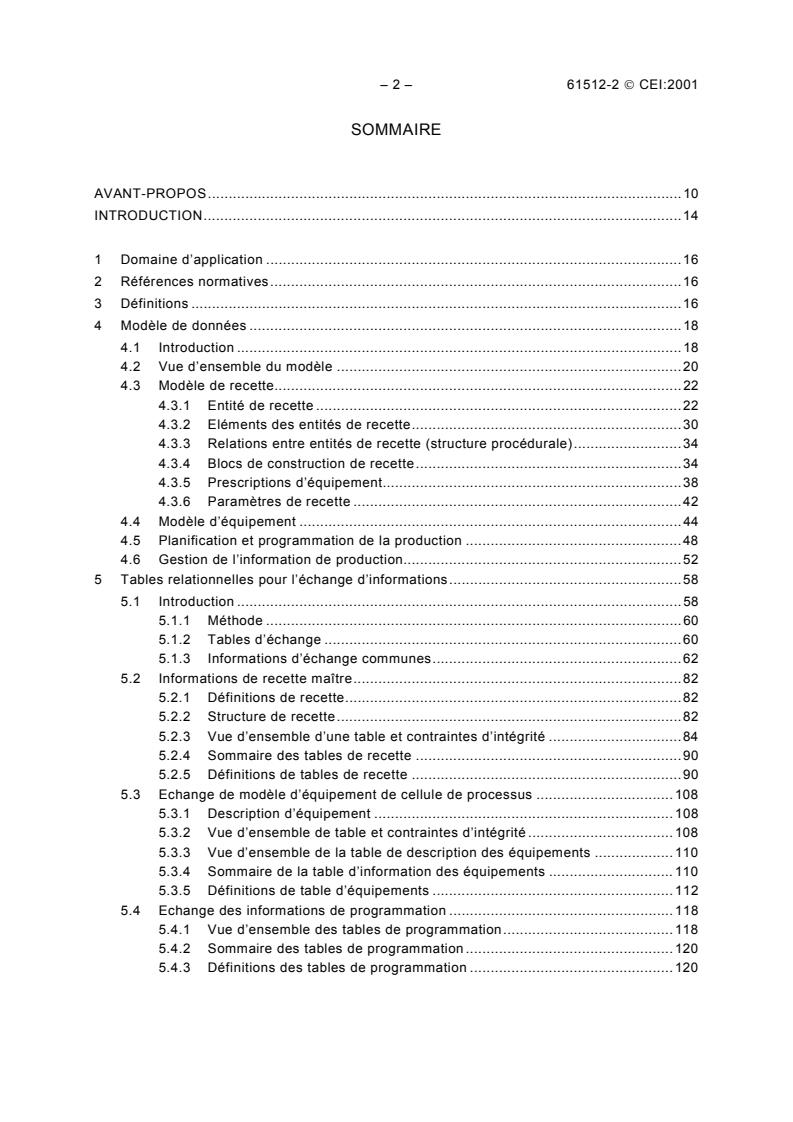
SOMMAIRE
AVANT-PROPOS.10
INTRODUCTION.14
1 Domaine d’application .16
2 Références normatives.16
3 Définitions .16
4 Modèle de données .18
4.1 Introduction .18
4.2 Vue d’ensemble du modèle .20
4.3 Modèle de recette.22
4.3.1 Entité de recette .22
4.3.2 Eléments des entités de recette.30
4.3.3 Relations entre entités de recette (structure procédurale).34
4.3.4 Blocs de construction de recette.34
4.3.5 Prescriptions d’équipement.38
4.3.6 Paramètres de recette .42
4.4 Modèle d’équipement .44
4.5 Planification et programmation de la production .48
4.6 Gestion de l’information de production.52
5 Tables relationnelles pour l’échange d’informations.58
5.1 Introduction .58
5.1.1 Méthode .60
5.1.2 Tables d’échange .60
5.1.3 Informations d’échange communes.62
5.2 Informations de recette maître.82
5.2.1 Définitions de recette.82
5.2.2 Structure de recette.82
5.2.3 Vue d’ensemble d’une table et contraintes d’intégrité .84
5.2.4 Sommaire des tables de recette .90
5.2.5 Définitions de tables de recette .90
5.3 Echange de modèle d’équipement de cellule de processus .108
5.3.1 Description d’équipement .108
5.3.2 Vue d’ensemble de table et contraintes d’intégrité .108
5.3.3 Vue d’ensemble de la table de description des équipements .110
5.3.4 Sommaire de la table d’information des équipements .110
5.3.5 Définitions de table d’équipements .112
5.4 Echange des informations de programmation .118
5.4.1 Vue d’ensemble des tables de programmation.118
5.4.2 Sommaire des tables de programmation .120
5.4.3 Définitions des tables de programmation .120
61512-2 IEC:2001 – 3 –
CONTENTS
FOREWORD.11
INTRODUCTION.15
1 Scope.17
2 Normative references .17
3 Definitions .17
4 Data model.19
4.1 Introduction .19
4.2 Overview model.21
4.3 Recipe model .23
4.3.1 Recipe entity .23
4.3.2 Parts of recipe entities.31
4.3.3 Recipe entity relation (procedural structure) .35
4.3.4 Recipe building blocks.35
4.3.5 Equipment requirements.39
4.3.6 Recipe parameters .43
4.4 Equipment model .45
4.5 Production planning and scheduling .49
4.6 Production information management .53
5 Relational tables for information exchange .59
5.1.1 Method .61
5.1.2 Exchange tables .61
5.1.3 Common exchange information.63
5.2 Master recipe information .83
5.2.1 Recipe definitions .83
5.2.2 Recipe structure .83
5.2.3 Table overview and integrity constraints .85
5.2.4 Recipe table summary .91
5.2.5 Recipe table definitions .91
5.3 Process cell equipment model exchange .109
5.3.1 Equipment description .109
5.3.2 Table overview and integrity constraints .109
5.3.3 Equipment description table overview.111
5.3.4 Equipment information table summary .111
5.3.5 Equipment table definitions.113
5.4 Schedule information exchange.119
5.4.1 Schedule table overview.119
5.4.2 Schedule table summary .121
5.4.3 Schedule table definitions.121
– 4 – 61512-2 CEI:2001
5.5 Echange d’informations de production .124
5.5.1 Informations de recette de contrôle.126
5.5.2 Informations d’équipement.126
5.5.3 Historique du batch.126
5.6 Domaines de table d’échange .132
6 Diagrammes fonctionnels de procédures .134
6.1 Notation de diagramme fonctionnel de procédure .136
6.1.1 Symboles .136
6.1.2 Initialisation de procédures et de procédures d’unité .158
6.1.3 Informations non procédurales de la recette maître .162
6.2 Représentation de la recette de contrôle .164
6.3 Traitement des exceptions.164
Annexe A (normative) Technique de modélisation des données .166
Annexe B (normative) Liste de définitions SQL .170
Annexe C (informative) Abréviations .194
Annexe D (informative) Règles de langage .196
Annexe E (informative) Exemples de traitement de diagrammes fonctionnels
de procédures.200
Figure 1 – Vue d’ensemble du modèle .20
Figure 2 – Entités recette.24
Figure 3 – Eléments de l’entité de recette .32
Figure 4 – Blocs de construction de recette .34
Figure 5 – Principe des blocs de construction .38
Figure 6 – Prescriptions d’équipement de l’entité recette .40
Figure 7 – Modèle du paramètre .42
Figure 8 – Structure de l’équipement .44
Figure 9 – Relations entre entités d’équipement .46
Figure 10 – Classes d’équipements .48
Figure 11 – Programme de batch .50
Figure 12 – Information de production.54
Figure 13 – Transfert de données par des tables d’échange .60
Figure 14 – Tables d’échange des informations communes.62
Figure 15 – Les éléments de recette imbriqués constituent la recette.84
Figure 16 – Relations entre les tables d’échange.86
Figure 17 – Rapport entre les entrées des tables.88
Figure 18 – Tables d’échange d’information d’équipement .108
Figure 19 – Structure du programme.118
Figure 21 – Symboles des éléments procéduraux de la recette.136
Figure 22 – Eléments procéduraux qui encapsulent des éléments procéduraux de
recette d’un niveau inférieur.138
Figure 23 – Symbole de début .138
61512-2 IEC:2001 – 5 –
5.5 Production information exchange.125
5.5.1 Control recipe information.127
5.5.2 Equipment information.127
5.5.3 Batch history .127
5.6 Exchange table domains .133
6 Procedure function charts.135
6.1 Procedure function chart notation.137
6.1.1 Symbols .137
6.1.2 Procedure and unit procedure initiation .159
6.1.3 Non-procedural master recipe information .163
6.2 Control recipe depiction.165
6.3 Exception handling .165
Annex A (normative) Data modelling technique.167
Annex B (normative) SQL definition listing .171
Annex C (informative) Abbreviations .195
Annex D (informative) Language guidelines .197
Annex E (informative) Procedure function chart processing examples.201
Figure 1 – Overview model .21
Figure 2 – Recipe entities .25
Figure 3 – Parts of recipe entities .33
Figure 4 – Recipe building block .35
Figure 5 – Building block concept .39
Figure 6 – Recipe entity equipment requirements .41
Figure 7 – Parameter model.43
Figure 8 – Equipment structure .45
Figure 9 – Equipment entity relations.47
Figure 10 – Equipment classes .49
Figure 11 – Batch schedule .51
Figure 12 – Production information .55
Figure 13 – Data transfer using exchange tables .61
Figure 14 – Common information exchange tables.63
Figure 15 – Nested recipe elements make up a recipe .85
Figure 16 – Exchange table relationships.87
Figure 17 – How entries relate in the tables .89
Figure 18 – Equipment information exchange tables . 109
Figure 19 – Schedule structure . 119
Figure 20 – Batch history . 127
Figure 21 – Recipe procedural element symbols . 137
Figure 22 – Procedural elements that encapsulate lower-level recipe procedural elements . 139
Figure 23 – Begin symbol . 139
– 6 – 61512-2 CEI:2001
Figure 24 – Symbole de fin .140
Figure 25 – Symbole d’allocation .140
Figure 26 – Exemples de synchronisation d’éléments .142
Figure 27 – Transition implicite .142
Figure 28 – Transition explicite .144
Figure 29 – Début de sélection de séquences.146
Figure 30 – Fin de sélection de séquences .146
Figure 31 – Début de séquences simultanées .148
Figure 32 – Fin de séquences simultanées .148
Figure 33 – Diagramme valide de sélection de séquences .150
Figure 34 – Diagramme valide de séquences simultanées .152
Figure 35 – Bouclage avec éléments procéduraux de recette explicites .154
Figure 36 – Diagramme fonctionnel de procédure invalide .156
Figure 37 – Représentation de la procédure et initialisation des procédures d’unité.158
Figure 38 – Liaisons relatives entre les entités procédurales .160
Figure 39 – Liaisons relatives entre les entités procédurales – Variante 1.162
Table 1 – Entité recette.24
Table 2 – Sous-classes – vue d’ensemble .26
Table 3 – Recette .26
Table 4 – Composant de recette .28
Table 5 – Bloc de construction de recette .28
Table 6 – Entité de recette générale .28
Table 7 – Entité de recette de site .28
Table 8 – Entité de recette maître.30
Table 9 – Entité de recette de contrôle .30
Table 10 – Paramètre .32
Table 11 – Prescription d’équipement .32
Table 12 – Autres informations .34
Table 13 – Elément structurel procédural.34
Table 14 – Elément procédural d’équipement .36
Table 15 – Entité d’équipement.40
Table 16 – Propriété d’équipement .40
Table 17 – Type de propriété d’équipement .42
Table 18 – Relation d’équipement.46
Table 19 – Classe d’équipement .48
Table 20 – Entrée de programme de batch .50
Table 21 – Paramètre de programme.50
Table 22 – Relation de programmation.52
Table 23 – Information de production.54
Table 24 – Information spécifique au batch.54
Table 25 – Historique du batch .54
61512-2 IEC:2001 – 7 –
Figure 24 – End symbol . 141
Figure 25 – Allocation symbol . 141
Figure 26 – Element synchronization examples. 143
Figure 27 – Implicit transition. 143
Figure 28 – Explicit transition. 145
Figure 29 – Beginning of sequence selection . 147
Figure 30 – End of sequence selection . 147
Figure 31 – Beginning of simultaneous sequences. 149
Figure 32 – End of simultaneous sequences . 149
Figure 33 – Valid sequence selection diagram . 151
Figure 34 – Valid simultaneous sequence diagram . 153
Figure 35 – Looping with explicit recipe procedural elements. 155
Figure 36 – Invalid procedure function chart . 157
Figure 37 – Depiction of procedure and unit procedure initiation . 159
Figure 38 – Relative relationship of procedural entities . 161
Figure 39 – Relative relationship of procedural entities – Alternate 1 . 163
Table 1 – Recipe entity .25
Table 2 – Subclasses – overview .27
Table 3 – Recipe.27
Table 4 – Recipe component.29
Table 5 – Recipe building block .29
Table 6 – General recipe entity .29
Table 7 – Site recipe entity .29
Table 8 – Master recipe entity.31
Table 9 – Control recipe entity .31
Table 10 – Parameter . 33
Table 11 – Equipment requirement .33
Table 12 – Other information .35
Table 13 – Procedural structural element.35
Table 14 – Equipment procedural element .37
Table 15 – Equipment entity .41
Table 16 – Equipment property .41
Table 17 – Equipment property type.43
Table 18 – Equipment relation .47
Table 19 – Equipment class .49
Table 20 – Batch schedule entry.51
Table 21 – Schedule parameter .51
Table 22 – Schedule relation .53
Table 23 – Production information .55
Table 24 – Batch specific information.55
Table 25 – Batch history .55
– 8 – 61512-2 CEI:2001
Table 26 – Information commune .56
Table 27 – Entité procédurale exécutée .58
Table 28 – Rapport de batch.58
Table 29 – BXT_Exchange.62
Table 30 – Contenus de la table BXT_Exchange.64
Table 31 – BXT_EnumerationSet .64
Table 32 – Enumérations standards.64
Table 33 – Enumeration_BXT .68
Table 34 – Enumérations standards.68
Table 35 – Tables d’échange de recette .90
Table 36 – BXT_MRecipeElement.92
Table 37 – BXT_MRecipeStep .94
Table 38 – BXT_MRecipeTransition .96
Table 39 – BXT_MRecipeLink.98
Table 40 – BXT_MRecipeElementParameter. 100
Table 41 – Sous-paramètres standards. 102
Table 42 – BXT_MRecipeStepParameter . 102
Table 43 – BXT_MRecipeOtherInformation . 104
Table 44 – BXT_MRecipeElementEquip. 106
Table 45 – BXT_MRecipeStepEquip . 106
Table 46 – Tables d’échange d’information d’équipement . 110
Table 47 – BXT_EquipElement . 112
Table 48 – BXT_EquipLink. 112
Table 49 – BXT_EquipInclude. 114
Table 50 – BXT_EquipProperty. 114
Table 51 – BXT_EquipInterface . 116
Table 52 – BXT_EquipInterfaceDefinition. 116
Table 53 – BXT_EquipInterfaceParameter . 116
Table 54 – Tables d’échange d’information de programmation. 120
Table 55 – BXT_ScheduleEntry . 120
Table 56 – BXT_ScheduleEquip. 122
Table 57 – BXT_ScheduleProperty . 124
Table 58 – BXT_ScheduleParameter . 124
Table 59 – BXT_HistoryElement . 128
Table 60 – BXT_HistoryLog . 130
Table 61 – Domaines de table d’échange. 132
Table A.1 – Notation UML. 166
Table A.2 – Notation ERD. 168
61512-2 IEC:2001 – 9 –
Table 26 – Common information .57
Table 27 – Executed procedural entity .59
Table 28 – Batch report .59
Table 29 – BXT_Exchange.63
Table 30 – BXT_Exchange table contents.65
Table 31 – BXT_EnumerationSet .65
Table 32 – Standard enumeration sets.65
Table 33 – BXT_Enumeration .69
Table 34 – Standard enumerations .69
Table 35 – Recipe exchange tables .91
Table 36 – BXT_MRecipeElement.93
Table 37 – BXT_MRecipeStep .95
Table 38 – BXT_MRecipeTransition .97
Table 39 – BXT_MRecipeLink.99
Table 40 – BXT_MRecipeElementParameter. 101
Table 41 – Standard sub-parameters . 103
Table 42 – BXT_MRecipeStepParameter . 103
Table 43 – BXT_MRecipeOtherInformation . 105
Table 44 – BXT_MRecipeElementEquip. 107
Table 45 – BXT_MRecipeStepEquip . 107
Table 46 – Equipment information exchange tables . 111
Table 47 – BXT_EquipElement . 113
Table 48 – BXT_EquipLink. 113
Table 49 – BXT_EquipInclude. 115
Table 50 – BXT_EquipProperty. 115
Table 51 – BXT_EquipInterface . 117
Table 52 – BXT_EquipInterfaceDefinition. 117
Table 53 – BXT_EquipInterfaceParameter . 117
Table 54 – Schedule information exchange tables . 121
Table 55 – BXT_ScheduleEntry . 121
Table 56 – BXT_ScheduleEquip. 123
Table 57 – BXT_ScheduleProperty . 125
Table 58 – BXT_ScheduleParameter . 125
Table 59 – BXT_HistoryElement . 129
Table 60 – BXT_HistoryLog . 131
Table 61 – Exchange table domains . 133
Table A.1 – UML notation . 167
Table A.2 – ERD notation . 169
– 10 – 61512-2 CEI:2001
COMMISSION ÉLECTROTECHNIQUE INTERNATIONALE
____________
CONTRÔLE-COMMANDE DES PROCESSUS DE FABRICATION
PAR LOTS (BATCH) –
Partie 2: Structures de données et règles générales
relatives aux langages
AVANT-PROPOS
1) La CEI (Commission Electrotechnique Internationale) est une organisation mondiale de normalisation
composée de l’ensemble des comités électrotechniques nationaux (Comités nationaux de la CEI). La CEI a
pour objet de favoriser la coopération internationale pour toutes les questions de normalisation dans les
domaines de l’électricité et de l’électronique. A cet effet, la CEI, entre autres activités, publie des Normes
internationales. Leur élaboration est confiée à des comités d’études, aux travaux desquels tout Comité national
intéressé par le sujet traité peut participer. Les organisations internationales, gouvernementales et non
gouvernementales, en liaison avec la CEI, participent également aux travaux. La CEI collabore étroitement
avec l’Organisation Internationale de Normalisation (ISO) selon les conditions fixées par accord entre les deux
organisations.
2) Les décisions ou accords officiels de la CEI concernant les questions techniques représentent, dans la mesure
du possible, un accord international sur les sujets étudiés, étant donné que les Comités nationaux intéressés
sont représentés dans chaque comité d’études.
3) Les documents prod
...