

IEC 63278-4:2026
(Main)Asset Administration Shell for industrial applications - Part 4:Applications of Asset Administration Shell
- Abstract
IEC 63278-4:2026 assumes an application perspective of the Asset Administration Shell to develop a common understanding on how to use an Asset Administration Shell.
This document defines how the Asset Administration Shell can be used in the context of the related entities and how to represent assets using the Asset Administration Shell.
Due to the more detailed description compared to IEC 63278-1, additional requirements, recommendations, and permissions for the AAS are stated towards application of the AAS in selected scenarios.
- Status
- Published
- Publication Date
- 16-Sep-2026
- Technical Committee
- TC 65 - Industrial-process measurement, control and automation
- Drafting Committee
- WG 24 - TC 65/WG 24
- Current Stage
- PPUB - Publication issued
- Start Date
- 17-Sep-2026
- Completion Date
- 23-Oct-2026
Buy Documents
iec63278-4{ed1.0}en - Asset Administration Shell for industrial applications - Part 4:Applications of Asset Administration Shell
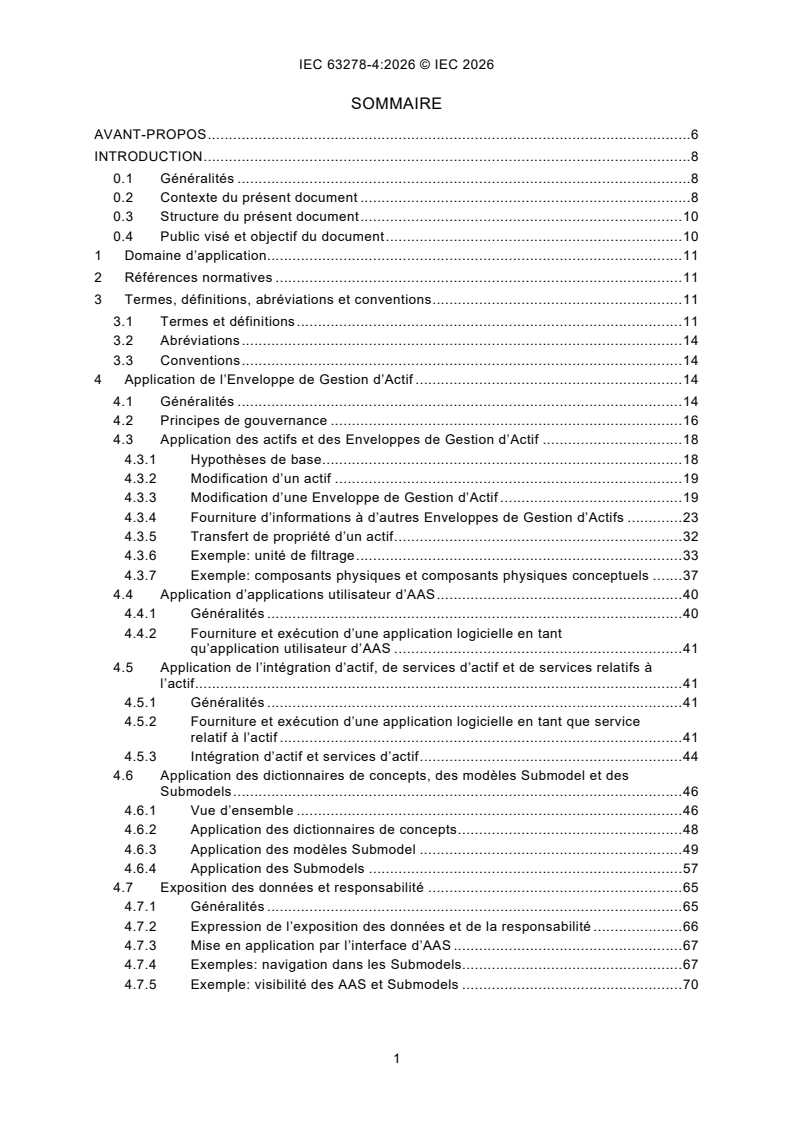
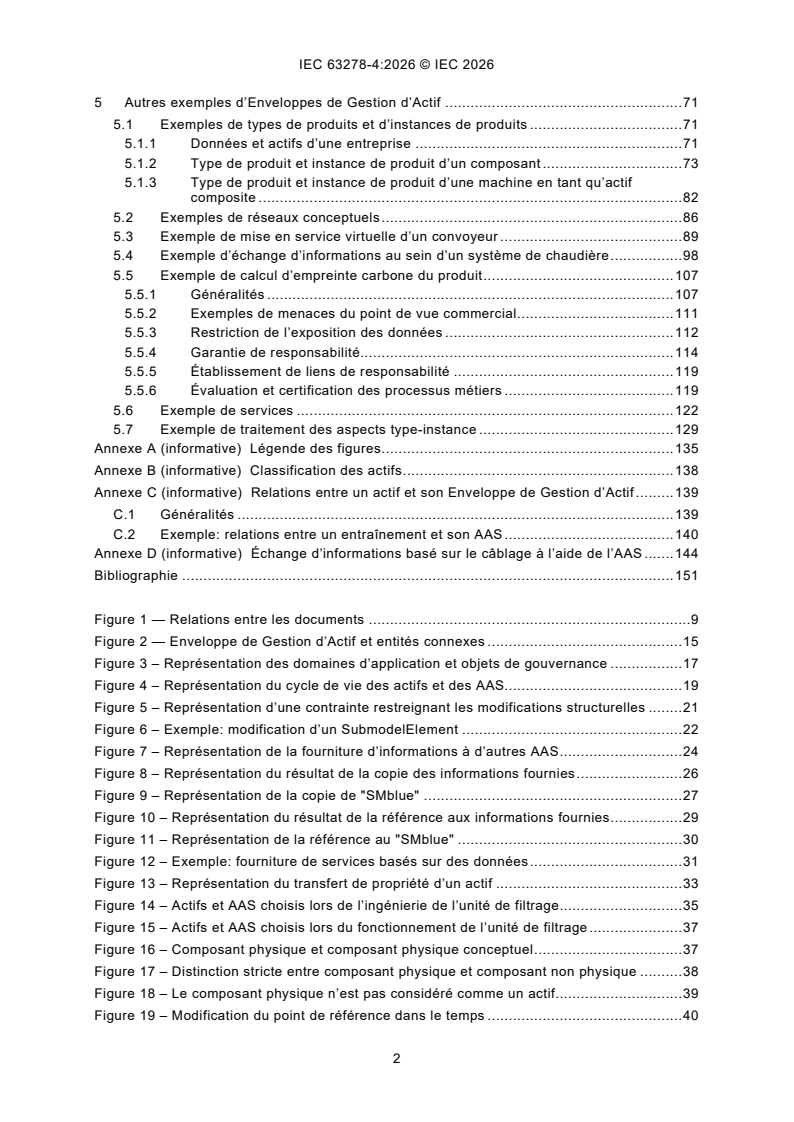
iec63278-4{ed1.0}fr - Enveloppe de Gestion d’Actif pour applications industrielles - Partie 4: Applications d’Enveloppe de Gestion d’Actif
IEC 63278-4:2026 is an IEC International Standard for industrial applications of the Asset Administration Shell (AAS). It explains how an AAS is used to represent assets and related entities, and how applications, services, Submodels, and data exchange fit together. It is written for engineers, software developers, asset owners, and AAS responsible who need a common way to apply the AAS in industrial systems.
What does IEC 63278-4:2026 specify?
IEC 63278-4:2026 specifies the application view of the AAS. It defines how an AAS can be used in the context of related entities and how assets are represented with the AAS, while keeping the same core concepts as IEC 63278-1 and adding more detail for selected scenarios.
The document is organized around Clause 4, which develops the application model and the governing roles, and Clause 5, which gives worked examples. Annexes A to D support the figures, asset classification, the relation between an asset and its AAS, and wiring-based information exchange.
| Annex | What it covers |
|---|---|
| Annex A | Legend for the figures and graphical symbols used for AAS, Submodels, SubmodelElements, and related entities |
| Annex B | Classification of assets |
| Annex C | Relations between an asset and its AAS, including the drive example |
| Annex D | Information exchange based on wiring using the AAS, with a boiler-system example |
Clause 5 is example-driven and does not add requirements. The document also sits in a series that separates concept, design, and implementation views; this part stays at the application/concept level.
What are the key requirements of IEC 63278-4:2026?
Governance, roles, and access control
Clause 4.2 sets out the governance roles around the AAS. An AAS responsible creates and governs the AAS, a concept repository owner governs concept entries, a Submodel template owner governs Submodel templates, and an asset owner governs asset integration and access to asset services.
In practice, this means the standard links technical access to organizational responsibility. The AAS interface is used to enforce authorized access and the defined governance rules, so the reader has to decide who may read, explore, or execute what.
How assets and AASs change over time
Clause 4.3 distinguishes changes to the asset from changes to the AAS. It separates changes to SubmodelElement values from changes to Submodel structure, because those two kinds of change have different effects on consistency and interoperability.
The clause also covers copying information to another AAS versus referencing information from another AAS. That matters in practice because a reader must choose between local duplication and remote linkage when sharing data or services across AASs.
Ownership transfer and asset representation choices
Clause 4.3.5 covers transfer of ownership of an asset, and Clauses 4.3.6 and 4.3.7 illustrate asset representation choices with examples such as a filter unit and physical versus conceptual physical components. These examples show that the same industrial situation can be modeled with different AAS structures depending on what is treated as an asset, an AAS, or a conceptual component.
For implementation planning, this means the same system can be represented at different levels of abstraction. A reader should use the examples to decide which entities are treated as assets and which are represented inside the AAS.
Applications, services, and integration
Clause 4.4 describes AAS user applications, which are software applications that access an AAS through its interface or interfaces. Clause 4.5 distinguishes asset integration, asset services, and asset-related services.
The practical point is that not every function sits in the same place. A service may be provided by the asset itself or by external software, and asset integration is the software layer that makes asset services reachable.
Concept dictionaries, Submodel templates, and Submodels
Clause 4.6 explains how concept dictionaries, Submodel templates, and Submodels are used together. Concept dictionaries organize concept entries, Submodel templates provide reusable structure guidance, and Submodels apply those templates or operate without them when needed.
This matters because the standard supports controlled reuse and consistent naming across systems. A reader can use the clause to decide how to structure reusable engineering content, when to modify a template, and how much freedom a Submodel has from its template.
Exposing data and assigning responsibility
Clause 4.7 covers data exposure and responsibility. It describes how the AAS interface is used to express what information is exposed, how responsibility is attached to that exposure, and how navigation between Submodels works.
In practice, this is where access control and accountability meet modeling. The reader has to define which Submodels are visible, which actions are allowed, and which organization or person is responsible for the exposed information.
What terms does IEC 63278-4:2026 define?
- Asset Administration Shell (AAS) - a standardized digital representation of an asset.
- responsable d’AAS - a human or organization interested in an asset and governing an AAS.
- interface d’AAS - the shared boundary that gives uniform access to AAS information and services.
- application utilisateur d’AAS - a software application that accesses an AAS through its interface or interfaces for human use or automatic processing.
- intégration d’actif - the software service needed to access asset services.
- service d’actif - a service provided by the asset itself.
- service relatif à l’actif - a service outside the asset that supports the asset context.
- Submodel - a model for representing one aspect of an asset.
Who uses IEC 63278-4:2026?
IEC 63278-4:2026 is used by people and organizations that want to apply the AAS in industrial environments. It is relevant for industrial automation, smart manufacturing, and process-related engineering where assets, software, and data must work together.
Typical users include asset owners, AAS responsible, concept repository owners, and Submodel template owners who need to govern data exposure and reuse. Software developers use it to build AAS user applications, integration services, and tools that create or consume Submodels.
System integrators, machine and plant engineers, and control engineers use it when modeling PLC, HMI, P&ID, edge devices, production systems, and services. Quality and management roles can use it to understand who is responsible for data, which information may be exposed, and how ownership or access changes over time.
Which standards are used with IEC 63278-4:2026?
- IEC 63278-1:2023 - defines the AAS structure and core requirements that this part complements.
- IEC 62832-1:2020 - provides digital factory principles and the base terms and definitions used in this part.
- IEC 63278-2 - the series part on the information meta model, referenced in the document context.
- IEC 63278-3 - the series part on security provisions for AAS.
- IEC 63278-5 - the series part on interfaces.
- IEC TS 63283-2:2025 - provides the smart-manufacturing use-case basis used in the production-service example.
- IEC 60050-741:2020, IEC 61360-1:2017, ISO/IEC 20924:2024, and IEC TR 62390:2005 - source documents for several terms and definitions used in the standard.
What does the IEC 63278-4:2026 document contain?
IEC 63278-4:2026 contains the governance model for AAS application, the lifecycle of asset and AAS changes, and the modeling choices for sharing information, services, and templates. It also contains a large set of figures that show how AASs relate to assets, applications, service functions, and related entities.
Clause 5 adds worked examples for filter units, virtual commissioning of a conveyor, information exchange in a boiler system, product carbon footprint, service modeling, and type-instance handling. Table 1 collects examples of security considerations for data exposure and responsibility, and the annexes add supporting material such as asset classification, asset-AAS relations, and wiring-based exchange.
Annex C is especially practical for readers because it maps the relation between an asset and its AAS and gives a drive example with command and status behavior. Annex D shows how P&ID, sequence, and HMI engineering can be connected to AAS-based information exchange.
Buy Documents
iec63278-4{ed1.0}en - Asset Administration Shell for industrial applications - Part 4:Applications of Asset Administration Shell
iec63278-4{ed1.0}fr - Enveloppe de Gestion d’Actif pour applications industrielles - Partie 4: Applications d’Enveloppe de Gestion d’Actif
Get Certified
Connect with accredited certification bodies for this standard

BSI Group
BSI (British Standards Institution) is the business standards company that helps organizations make excellence a habit.

DVS-ZERT GmbH
German welding certification society.
CARES (UK Certification Authority for Reinforcing Steels)
UK certification for reinforcing steels and construction.
Sponsored listings
Frequently Asked Questions
IEC 63278-4:2026 is a standard published by the International Electrotechnical Commission (IEC). Its full title is "Asset Administration Shell for industrial applications - Part 4:Applications of Asset Administration Shell". This standard covers: IEC 63278-4:2026 assumes an application perspective of the Asset Administration Shell to develop a common understanding on how to use an Asset Administration Shell. This document defines how the Asset Administration Shell can be used in the context of the related entities and how to represent assets using the Asset Administration Shell. Due to the more detailed description compared to IEC 63278-1, additional requirements, recommendations, and permissions for the AAS are stated towards application of the AAS in selected scenarios.
IEC 63278-4:2026 assumes an application perspective of the Asset Administration Shell to develop a common understanding on how to use an Asset Administration Shell. This document defines how the Asset Administration Shell can be used in the context of the related entities and how to represent assets using the Asset Administration Shell. Due to the more detailed description compared to IEC 63278-1, additional requirements, recommendations, and permissions for the AAS are stated towards application of the AAS in selected scenarios.
IEC 63278-4:2026 is classified under the following ICS (International Classification for Standards) categories: 25.040.01 - Industrial automation systems in general; 35.240.50 - IT applications in industry. The ICS classification helps identify the subject area and facilitates finding related standards.
IEC 63278-4:2026 is available in PDF format for immediate download after purchase. The document can be added to your cart and obtained through the secure checkout process. Digital delivery ensures instant access to the complete standard document.
Standards Content (Sample)
IEC 63278-4 ®
Edition 1.0 2026-09
INTERNATIONAL
STANDARD
Asset Administration Shell for industrial applications -
Part 4:Applications of Asset Administration Shell
ICS 25.040.01; 35.240.50 ISBN 978-2-8327-1512-3
All rights reserved. Unless otherwise specified, no part of this publication may be reproduced or utilized in any form or
by any means, electronic or mechanical, including photocopying and microfilm, without permission in writing from either
IEC or IEC's member National Committee in the country of the requester. If you have any questions about IEC copyright
or have an enquiry about obtaining additional rights to this publication, please contact the address below or your local
IEC member National Committee for further information.
IEC Secretariat Tel.: +41 22 919 02 11
3, rue de Varembé info@iec.ch
CH-1211 Geneva 20 www.iec.ch
Switzerland
About the IEC
The International Electrotechnical Commission (IEC) is the leading global organization that prepares and publishes
International Standards for all electrical, electronic and related technologies.
About IEC publications
The technical content of IEC publications is kept under constant review by the IEC. Please make sure that you have the
latest edition, a corrigendum or an amendment might have been published.
IEC publications search - IEC Products & Services Portal - products.iec.ch
webstore.iec.ch/advsearchform Discover our powerful search engine and read freely all the
publications previews, graphical symbols and the glossary.
The advanced search enables to find IEC publications by a
variety of criteria (reference number, text, technical With a subscription you will always have access to up to date
committee, …). It also gives information on projects, content tailored to your needs.
replaced and withdrawn publications.
Electropedia - www.electropedia.org
The world's leading online dictionary on electrotechnology,
IEC Just Published - webstore.iec.ch/justpublished
Stay up to date on all new IEC publications. Just Published containing more than 22 500 terminological entries in English
details all new publications released. Available online and and French, with equivalent terms in 25 additional languages.
once a month by email. Also known as the International Electrotechnical Vocabulary
(IEV) online.
IEC Customer Service Centre - webstore.iec.ch/csc
If you wish to give us your feedback on this publication or
need further assistance, please contact the Customer
Service Centre: sales@iec.ch.
CONTENTS
FOREWORD. 5
INTRODUCTION . 7
0.1 General . 7
0.2 Context of this document . 7
0.3 Structure of this document . 8
0.4 Intended audience and purpose of the document . 8
1 Scope . 9
2 Normative references . 9
3 Terms, definitions, abbreviated terms, and conventions . 9
3.1 Terms and definitions . 9
3.2 Abbreviated terms . 12
3.3 Conventions . 12
4 Application of the Asset Administration Shell . 12
4.1 General . 12
4.2 Governance principles . 13
4.3 Application of assets and Asset Administration Shells . 14
4.3.1 Basic assumptions . 14
4.3.2 Modification of an asset . 15
4.3.3 Modification of an Asset Administration Shell . 15
4.3.4 Providing information to other Asset Administration Shells . 17
4.3.5 Transfer of ownership of an asset . 23
4.3.6 Example: filter unit . 23
4.3.7 Example: physical components and physical components in mind . 25
4.4 Application of AAS user applications . 27
4.4.1 General . 27
4.4.2 Providing and executing a software application as AAS user application . 27
4.5 Application of asset integration, asset services, and asset related services . 27
4.5.1 General . 27
4.5.2 Providing and executing a software application as asset related service . 28
4.5.3 Asset integration and asset services . 29
4.6 Application of concept repositories, Submodel templates and Submodels . 30
4.6.1 Overview . 30
4.6.2 Application of concept repositories . 31
4.6.3 Application of Submodel templates . 32
4.6.4 Application of Submodels . 35
4.7 Data exposure and accountability . 39
4.7.1 General . 39
4.7.2 Expressing data exposure and accountability . 40
4.7.3 Enforcement by AAS interface . 41
4.7.4 Examples: browsing of Submodels . 41
4.7.5 Example: visibility of AASs and Submodels . 42
5 Further examples for Asset Administration Shells . 43
5.1 Examples for product types and product instances . 43
5.1.1 Data and assets of a company . 43
5.1.2 Product type and product instance of a component . 43
5.1.3 Product type and product instance of a machine as composite asset . 48
5.2 Example conceptual networks . 50
5.3 Example virtual commissioning of a conveyor . 51
5.4 Example information exchange within a boiler system . 55
5.5 Example CFP calculation . 60
5.5.1 General . 60
5.5.2 Examples for threats from a business perspective . 62
5.5.3 Restricting data exposure . 63
5.5.4 Ensuring accountability . 64
5.5.5 Establish accountable bindings. 66
5.5.6 Evaluation and certification of business processes . 66
5.6 Example services . 68
5.7 Example addressing type-instance aspects . 71
Annex A (informative) Legend to the figures . 75
Annex B (informative) Classification of assets . 77
Annex C (informative) Relationships between an asset and its Asset Administration
Shell . 78
C.1 General . 78
C.2 Example: relationships between a drive and its AAS . 78
Annex D (informative) Information exchange based on hard wiring using the AAS . 81
Bibliography . 85
Figure 1 – Relationships between the documents . 7
Figure 2 – Asset Administration Shell and related entities . 12
Figure 3 – Illustration of governance scopes and subjects. 14
Figure 4 – Illustration of life cycle of assets and AASs . 15
Figure 5 – Illustration of a constraint restricting structural changes . 16
Figure 6 – Example: modification of a SubmodelElement . 17
Figure 7 – Illustration of providing information to other AASs . 18
Figure 8 – Illustration of result of copying provided information . 19
Figure 9 – Illustration of copying "SMblue" . 20
Figure 10 – Illustration of result of referencing provided information . 21
Figure 11 – Illustration of referencing "SMblue" . 22
Figure 12 – Example: provision of data-based services . 22
Figure 13 – Illustration of transfer of ownership of an asset . 23
Figure 14 – Selected assets and AASs during engineering of the filter unit . 24
Figure 15 – Selected assets and AASs during operation of the filter unit . 25
Figure 16 – Physical component and physical component in mind . 25
Figure 17 – Strict distinction between physical and non-physical component . 26
Figure 18 – Physical component is not considered as an asset . 26
Figure 19 – Change of reference point over time . 27
Figure 20 – Providing and executing a software application as asset related service . 28
Figure 21 – Illustration of sequence of calls . 28
Figure 22 – Internal structure of asset integration . 29
Figure 23 – Example governance of asset services . 30
Figure 24 – Value chain of using concept repositories, Submodel templates and
Submodels . 30
Figure 25 – Modifying a concept repository entry . 31
Figure 26 – Example structuring concept repositories . 31
Figure 27 – Modifying a Submodel template because of a modification of the concept
repository . 33
Figure 28 – Submodel template replicating the structure of the concept repository . 33
Figure 29 – Submodel template with independent structure . 34
Figure 30 – Submodel template with structure formation by concept repository . 34
Figure 31 – Extension of concept repository . 34
Figure 32 – Additional element integrated in Submodel template . 35
Figure 33 – Inconsistent modelling . 35
Figure 34 – Creation of a Submodel guided by a Submodel template . 36
Figure 35 – Creation of a Submodel not guided by a Submodel template . 36
Figure 36 – Detaching a Submodel from the guidance of a Submodel template . 37
Figure 37 – Modifying a Submodel under the guidance of a Submodel template . 38
Figure 38 – Modifying a Submodel based on the modification of a Submodel template . 38
Figure 39 – Detaching a Submodel because of a modification of a Submodel template . 39
Figure 40 – Illustration of browsing between two AASs . 41
Figure 41 – Illustration of indirect browsing . 42
Figure 42 – Illustration of refusing exploration and access . 42
Figure 43 – Illustration of visibility of AASs and Submodels . 43
Figure 44 – Examples for data, assets and relationships between data and assets . 43
Figure 45 – Illustration of considered assets . 44
Figure 46 – Illustration of life cycle of asset "valve type" . 44
Figure 47 – Illustration of life cycle of asset "valve xxx" . 44
Figure 48 – Illustration of considered assets in the context of RAMI4.0 . 45
Figure 49 – Illustration of life cycle of considered assets in the course of time . 45
Figure 50 – Illustration of life cycle of an AAS associated to asset "valve type" . 46
Figure 51 – Illustration of life cycle of an AAS associated to asset "valve xxx" . 46
Figure 52 – Illustration of two AASs associated to the asset "valve type" . 47
Figure 53 – Illustration of two AASs associated to the asset "valve xxx" . 47
Figure 54 – Illustration of life cycle of considered product types . 48
Figure 55 – Illustration of the AASs of the considered product types . 49
Figure 56 – Illustration of life cycle of considered product instances . 49
Figure 57 – Illustration of AASs of the considered product instances . 50
Figure 58 – Example conceptual networks . 51
Figure 59 – Business view on virtual commissioning . 52
Figure 60 – Technical roles interacting in virtual commissioning . 52
Figure 61 – Example of modelling in virtual commissioning based on AAS (option 1) . 53
Figure 62 – Example of modelling in virtual commissioning based on AAS (option 2) . 54
Figure 63 – Example of modelling in virtual commissioning based on AAS (option 3) . 54
Figure 64 – Example of modelling in virtual commissioning based on AAS (option 4) . 55
Figure 65 – Business view on information exchange within a boiler system . 55
Figure 66 – Technical roles interacting in information exchange within a boiler system . 56
Figure 67 – Example of modelling for information exchange within a boiler system
based on AAS . 57
Figure 68 – Using AAS for modelling information exchange based on hard wiring . 58
Figure 69 – Example for a mapping of the AAS modelling to an implementation . 59
Figure 70 – Using AAS for modelling information exchange based on logical
communication . 59
Figure 71 – Considered assets and their relationships, see [13] . 60
Figure 72 – Overall supply chain of control cabinet . 61
Figure 73 – Considered AASs including AAS responsibles and selected Submodels . 61
Figure 74 – Selected relationships between the AASs of the control cabinet supplier . 62
Figure 75 – Example for restricting data exposure . 63
Figure 76 – Business view of ensuring accountability considerations . 64
Figure 77 – Implementation based on specific concept repository entries . 65
Figure 78 – Implementation based on a specific attribute . 66
Figure 79 – Business view of evaluation and certification of business processes . 67
Figure 80 – Example for evaluation and certification of business processes . 68
Figure 81 – Technical perspective of "Manufacturing of Individualized Products"
(extract) . 68
Figure 82 – Example of modelling a production resource . 69
Figure 83 – Option 1a: service as AAS user application, access to production
resources via AAS interface . 69
Figure 84 – Option 1b: service as AAS user application, access to production
resources via Submodel ps_structure of the production system . 70
Figure 85 – Option 2: service as asset related service of production order . 70
Figure 86 – Option 3: service as asset related service of production system . 71
Figure 87 – Option 4: service as asset service of production system . 71
Figure 88 – Business view: offering of function blocks . 71
Figure 89 – Asset view . 72
Figure 90 – Asset Administration Shell view . 73
Figure 91 – Example for an asset seen as instance asset and type asset . 73
Figure 92 – Guidance by Submodel templates . 74
Figure A.1 – Graphical elements illustrating AASs, related entities and their
relationships . 75
Figure C.1 – Relationships between digital object and physical object according to [12] . 78
Figure C.2 – Relationships between a drive and its AAS according to [12] . 79
Figure C.3 – Updating SubmodelElements "status" and "command" . 80
Figure D.1 – Example components and tools needed for configuring a boiler system . 81
Figure D.2 – Example for creating engineering artefacts of a boiler system . 82
Figure D.3 – Example of P&ID diagram of a boiler system created with a P&ID tool . 82
Figure D.4 – Example of visualization of a sequence program . 83
Figure D.5 – Example of HMI diagram for a boiler system created with an HMI
configuration tool . 83
Table 1 – Examples for security considerations regarding data exposure and
accountability . 62
INTERNATIONAL ELECTROTECHNICAL COMMISSION
____________
Asset Administration Shell for industrial applications -
Part 4: Applications of Asset Administration Shell
FOREWORD
1) The International Electrotechnical Commission (IEC) is a worldwide organization for standardization comprising
all national electrotechnical committees (IEC National Committees). The object of IEC is to promote international
co-operation on all questions concerning standardization in the electrical and electronic fields. To this end and
in addition to other activities, IEC publishes International Standards, Technical Specifications, Technical Reports,
Publicly Available Specifications (PAS) and Guides (hereafter referred to as "IEC Publication(s)"). Their
preparation is entrusted to technical committees; any IEC National Committee interested in the subject dealt with
may participate in this preparatory work. International, governmental and non-governmental organizations liaising
with the IEC also participate in this preparation. IEC collaborates closely with the International Organization for
Standardization (ISO) in accordance with conditions determined by agreement between the two organizations.
2) The formal decisions or agreements of IEC on technical matters express, as nearly as possible, an international
consensus of opinion on the relevant subjects since each technical committee has representation from all
interested IEC National Committees.
3) IEC Publications have the form of recommendations for international use and are accepted by IEC National
Committees in that sense. While all reasonable efforts are made to ensure that the technical content of IEC
Publications is accurate, IEC cannot be held responsible for the way in which they are used or for any
misinterpretation by any end user.
4) In order to promote international uniformity, IEC National Committees undertake to apply IEC Publications
transparently to the maximum extent possible in their national and regional publications. Any divergence between
any IEC Publication and the corresponding national or regional publication shall be clearly indicated in the latter.
5) IEC itself does not provide any attestation of conformity. Independent certification bodies provide conformity
assessment services and, in some areas, access to IEC marks of conformity. IEC is not responsible for any
services carried out by independent certification bodies.
6) All users should ensure that they have the latest edition of this publication.
7) No liability shall attach to IEC or its directors, employees, servants or agents including individual experts and
members of its technical committees and IEC National Committees for any personal injury, property damage or
other damage of any nature whatsoever, whether direct or indirect, or for costs (including legal fees) and
expenses arising out of the publication, use of, or reliance upon, this IEC Publication or any other IEC
Publications.
8) Attention is drawn to the Normative references cited in this publication. Use of the referenced publications is
indispensable for the correct application of this publication.
9) IEC draws attention to the possibility that the implementation of this document may involve the use of (a)
patent(s). IEC takes no position concerning the evidence, validity or applicability of any claimed patent rights in
respect thereof. As of the date of publication of this document, IEC had not received notice of (a) patent(s), which
may be required to implement this document. However, implementers are cautioned that this may not represent
the latest information, which may be obtained from the patent database available at https://patents.iec.ch. IEC
shall not be held responsible for identifying any or all such patent rights.
IEC 63278-4 has been prepared by IEC technical committee 65: Industrial-process
measurement, control and automation. It is an International Standard.
The text of this International Standard is based on the following documents:
Draft Report on voting
65/1206/FDIS 65/1246/RVD
Full information on the voting for its approval can be found in the report on voting indicated in
the above table.
The language used for the development of this International Standard is English.
This document was drafted in accordance with ISO/IEC Directives, Part 2, and developed in
accordance with ISO/IEC Directives, Part 1 and ISO/IEC Directives, IEC Supplement, available
at www.iec.ch/members_experts/refdocs. The main document types developed by IEC are
described in greater detail at www.iec.ch/publications.
A list of all parts in the IEC 63278 series, published under the general title Asset Administration
Shell for industrial applications, can be found on the IEC website.
The committee has decided that the contents of this document will remain unchanged until the
stability date indicated on the IEC website under webstore.iec.ch in the data related to the
specific document. At this date, the document will be
– reconfirmed,
– withdrawn, or
– revised.
INTRODUCTION
0.1 General
The Asset Administration Shell (AAS) is seen as one interoperable manifestation of a digital
twin in manufacturing industries. IEC 63278-1 describes the conceptual framework for the AAS,
the structure of the AAS and requirements associated with the AAS and related entities.
This document complements IEC 63278-1 by describing in a systematic way applications of the
AAS.
0.2 Context of this document
The current work foresees parts covering the following topics:
– Asset Administration Shell structure (IEC 63278-1);
1 2
– Information meta model (IEC 63278-2 [1] );
– Security provisions for Asset Administration Shells (IEC 63278-3 [2]);
– Applications of AAS (this document);
– Interfaces (IEC 63278-5 [3]).
Figure 1 illustrates the relationships between the documents currently being worked on.
Figure 1 – Relationships between the documents
___________
Under preparation. Stage at the date of publication: IEC/CDV 63278-2:2026.
Numbers in square brackets refer to the Bibliography.
Under preparation. Stage at the date of publication: IEC/CD 63278-3:2026.
Under preparation. Stage at the date of publication: IEC/CD 63278-5:2026.
IEC 63278-1 and IEC 63278-4 both address a concept view, whereas IEC 63278-2,
IEC 63278-3, and IEC 63278-5 address a design view. An implementation is distinguished from
the concept and design. Currently the implementation view is not addressed by the IEC 63278
series.
In this document, an application perspective is always taken. This document considers selected
Smart Manufacturing use cases, see [4], and refines aspects of these use cases, but other input
was also considered. However, the terms and concepts introduced in IEC 63278-1 are used.
IEC 63278-4 does not introduce concepts which are not considered in IEC 63278-1.
NOTE IEC 63278-2 introduces concepts which are not introduced in IEC 63278-1 (e.g., qualifier, semanticID of
Submodels), but such concepts are not in the scope of IEC 63278-4.
Nevertheless, IEC 63278-4 details and explains requirements, recommendations, and
permissions that are not described precisely enough in IEC 63278-1. These requirements,
recommendations, and permissions are not regarding the AAS itself, but the application of the
AAS in the context of the related entities.
0.3 Structure of this document
Clause 4 of this document introduces additional actors in form of humans or organizations and
describes how these actors interact with the AAS and the related entities by stating
requirements, recommendations, and permissions. Clause 4 also describes examples about
possible modelling and procedures using the AAS following the statements. This completes
IEC 63278-1 regarding an application of the AAS. The claim is that these descriptions are
complete regarding the level of detail considered.
Clause 5 describes – in addition to Clause 4 – selected examples about possible modelling and
procedures using the AAS. It is the responsibility of a human or organization to determine how
to apply the concepts provided by the AAS regarding their own objectives. In this respect, these
examples neither claim to be complete nor to provide guidance about good practices. Clause 5
does not state any requirement.
0.4 Intended audience and purpose of the document
This document addresses humans or organizations that want to use the concepts provided by
the AAS. This concerns how the AAS can be used in the context of the related entities and how
to represent assets using the AAS.
Additionally, this document provides a framework to better understand the context of the AAS
and thus lays a basis for further parts of the IEC 63278 series. This also concerns software
developers, who want to provide software that supports AASs, be it to provide AASs or to use
AASs.
1 Scope
The Asset Administration Shell is a standardized digital representation of an asset. The Asset
Administration Shell gives uniform access to information of an asset and services of or related
to an asset.
The purpose of the Asset Administration Shell is to enable two or more software applications to
exchange information and to mutually use the information that has been exchanged in a trusted
and secure manner.
This document assumes an application perspective of the Asset Administration Shell to develop
a common understanding on how to use an Asset Administration Shell.
This document defines how the Asset Administration Shell can be used in the context of the
related entities and how to represent assets using the Asset Administration Shell.
Due to the more detailed description compared to IEC 63278-1, additional requirements,
recommendations, and permissions for the AAS are stated towards application of the AAS in
selected scenarios.
2 Normative references
The following documents are referred to in the text in such a way that some or all of their content
constitutes requirements of this document. For dated references, only the edition cited applies.
For undated references, the latest edition of the referenced document (including any
amendments) applies.
IEC 63278-1:2023, Asset Administration Shell for industrial applications - Part 1: Asset
Administration Shell structure
IEC 62832-1:2020, Industrial-process measurement, control and automation - Digital factory
framework - Part 1: General principles
3 Terms, definitions, abbreviated terms, and conventions
3.1 Terms and definitions
For the purposes of this document, the terms and definitions given in IEC 62832-1 and the
following apply.
ISO and IEC maintain terminology databases for use in standardization at the following
addresses:
– IEC Electropedia: available at https://www.electropedia.org/
– ISO Online browsing platform: available at https://www.iso.org/obp
3.1.1
asset
physical or non-physical entity that has value to a human or an organization
Note 1 to entry: A physical asset can provide asset services.
[SOURCE: IEC 60050-741:2020, 741-01-04, modified – "digital entity" has been replaced by
"non-physical entity", "an individual, an organization or a government" has been replaced by "a
human or an organization".]
3.1.2
Asset Administration Shell
AAS
standardized digital representation of an asset
3.1.3
AAS interface
interface of an AAS giving uniform access to information and services
Note 1 to entry: The two entities according to interface are an AAS user application (i.e., a software application)
and an AAS (i.e., a representation).
3.1.4
AAS responsible
human or organization having interest in an asset and governing an Asset Administration Shell
3.1.5
AAS user application
software application which accesses an AAS via its AAS interface(s) for usage by humans or
for automatic processing
3.1.6
AAS user application operator
human or organization operating an AAS user application
3.1.7
asset integration
software service needed to access asset services
3.1.8
asset owner
human or organization owning an asset
3.1.9
asset service
service that is provided by the considered asset
3.1.10
asset related service
service that is not provided by the considered asset, but by software service outside of the
considered asset
3.1.11
concept
unit of knowledge created by a unique combination of characteristics
[SOURCE: IEC 61360-1:2017, 3.1.8]
3.1.12
concept repository
collection of entries that allows lookup by concept identifier and where relationships between
entries can be described
[SOURCE: IEC 62832-1:2020, 3.1.5, modified – "concept dictionary" has been changed to
"concept repository", Note 1 to entry has been deleted, "and where relationships between
entries can be described" has been added.]
3.1.13
concept repository entry
description of a concept containing, at a minimum, an unambiguous concept identifier, a
preferred name, and a description
[SOURCE: IEC 62832-1:2020, 3.1.6]
3.1.14
concept repository owner
human or organization owning a concept repository
3.1.15
entity
anything (physical or non-physical) having a distinct existence
[SOURCE: ISO/IEC 20924:2024, 3.1.17]
3.1.16
interface
shared boundary between two entities defined by functional characteristics, signal
characteristics, or other characteristics as appropriate
3.1.17
meta information
information used to describe an entity
3.1.18
service
distinct part of the functionality that is provided by an entity through interfaces
[SOURCE: IEC 60050-741:2020, 741-01-28]
3.1.19
software application
software functional element specific to the solution of a problem in industrial-process
measurement and control
Note 1 to entry: A software application requires a computing infrastructure to be deployed and executed.
[SOURCE: IEC TR 62390:2005, 3.1.2, modified − software was added to the term, program was
deleted form the term, Note has been replaced.]
3.1.20
software service
software functional element that provides the functionality through interfaces
Note 1 to entry: A software service requires a computing infrastructure to be deployed and executed.
3.1.21
Submodel
representation of an aspect of an asset
3.1.22
SubmodelElement
element of a Submodel
3.1.23
Submodel template
template for the representation of an aspect of an asset
3.1.24
Submodel template element
element of a Submodel template
3.1.25
Submodel template owner
human or organization owning a set of Submodel templates
3.2 Abbreviated terms
AAS Asset Administration Shell
CFP carbon footprint of product
HMI human machine interface
IT information technology
OPC UA open platforms communications - unified architecture
P&ID process and instrumentation diagram
PLC programmable logic controller
3.3 Conventions
Annex A describes the interpretation of the graphical elements of figures illustrating AASs.
4 Application of the Asset Administration Shell
4.1 General
The application of the Asset Administration Shell described in this clause is based on Figure 2,
which shows the Asset Administration Shell and related entities. This clause defines how the
Asset Administration Shell can be used in the context of the related entities and how to
represent assets using the Asset Administration Shell.
Figure 2 – Asset Administration Shell and related entities
IEC 63278-1 shall guide the applications of the Asset Administration Shell. Therefore, Figure 2
is an extension of IEC 63278-1:2023, Figure 4. A distinction is made between entities assumed
by humans or organizations indicated in green and entities assumed by technical systems
indicated in purple. To complete Figure 2, further entities were added in addition to the AAS
responsible, which are assumed by humans or organizations.
Figures in this document use a uniform design and colour code, which is explained in Annex A.
4.2 Governance principles
Governance principles for the AAS delineate the power and options for action of the entities
assumed by humans or organizations. They also set rules and guidelines for the interactions,
and they define, guide, and provide for enforcement of these interactions.
In detail, this means for the entities assumed by humans or organizations, see also Figure 3:
– An AAS responsible creates and governs an AAS to be accessed by AAS user applications
but has the interest to govern the application of the AAS. The concept to support the
governance of an AAS responsible is described in 4.7. The AAS Interface ensures that only
authorized users are allowed to interact with the AAS and enforces access control according
to the governance rules defined by the AAS Responsible.
– A concept repository owner owns concept repository entries of a concept repository to be
accessed and explored, but not modified, by other entities, but has the interest to grant and
restrict the access and exploration for the entities. In the context of the AAS, the concept to
support governance of a concept repository owner is described in 4.7, but the enforcement
is not considered in the IEC 63278 series.
NOTE Concept repositories can also be accessed and explored by entities not related to AASs, for example,
the usage of concept repositories by traditional procurement systems.
– A Submodel template owner owns Submodel templates to be accessed and explored, but
not modified, by AAS user applications via the AAS interface(s), but has the interest to grant
and restrict access and exploration for AAS user applications. In the context of the AAS, the
concept to support governance of a Submodel template owner is described in 4.7, but the
enforcement is not considered in the IEC 63278 series.
– An asset owner owns an asset and governs the asset integration. The asset owner has an
interest to grant and restrict the access to and execution of asset services. The asset
integration serves that the asset owner can pursue this interest. The concept to support
governance of an asset owner is described in 4.7.
– An AAS user application operator operates an AAS user application being of interest in a
higher-level context. The AAS user application operator has an interest that AAS user
applications can use information and services provided by the AAS and the related entities
via the AAS interface. The AAS responsible aligns the own interests regarding to data
exposure with the interests of the AAS user application operator. On this basis, the AAS
responsible defines data exposure regarding the AAS user application. The AAS user
application operator – and the developer of the AAS user application – shall be aware that
this usage can be restricted by the other entities.
Figure 3 illustrates the governance scopes and subjects.
Figure 3 – Illustration of governance scopes and subjects
4.3 Application of assets and Asset Administration Shells
4.3.1 Basic assumptions
IEC 63278-1:2023, 4.3 describes that assets and AAS have a life cycle, where according to
IEC TR 63283-1 [9], a life cycle is set of distinguishable phases and steps within phases that
an entity goes through from its creation ("start of life") until it ceases to exist ("end of life").
According to IEC 63278-1:2023, the following provisions shall apply throughout the entire life
cycle:
– An AAS shall always be associated to an asset.
NOTE 1 An implementation can introduce an object implementing an AAS. This object can exist without an
associated asset.
– If the asset does not exist anymore because there is no organization which has interest in
the asset, the AAS shall also not exist anymore.
– An AAS shall be associated to exactly one asset.
– The asset associated to an AAS shall not change.
NOTE 2 The asset itself can change, see 4.3.2.
– An AAS shall always have an AAS responsible who has interest in the associated asset and
who creates and governs the AAS.
– An AAS shall have exactly one AAS responsible who has interest in the associated asset
and who creates and governs the AAS.
Based on these provisions, the "start of life" of an AAS is not earlier than the "start of life" of
the associated asset and the "end of life" of an AAS is not later than the "end of life" of the
associated asset, see Figure 4 for illustration. Start of life and end of life of an asset are defined
by the asset owner, start of life and end of life of an AAS are defined by the AAS responsible.
EXAMPLE The start of life of an asset can be defined as the ideation or the definition of the asset. The end of life
of an asset can be defined if all traces of the existence of the asset are destroyed.
Figure 4 – Illustration of life cycle of assets and AASs
4.3.2 Modification of an asset
The modification of an asset can have various causes and can occur in different ways. This can,
for example, depend on how assets are classified, see Annex B. IEC 63278-4 does not make
any specifications on this but makes a clear distinction between the asset and a representation
of the asset.
NOTE An AAS as a digital represen
...
IEC 63278-4 ®
Edition 1.0 2026-09
NORME
INTERNATIONALE
Enveloppe de Gestion d’Actif pour applications industrielles -
Partie 4: Applications d’Enveloppe de Gestion d’Actif
ICS 25.040.01; 35.240.50 ISBN 978-2-8327-1512-3
Droits de reproduction réservés. Sauf indication contraire, aucune partie de cette publication ne peut être reproduite ni
utilisée sous quelque forme que ce soit et par aucun procédé, électronique ou mécanique, y compris la photocopie et
les microfilms, sans l'accord écrit de l'IEC ou du Comité national de l'IEC du pays du demandeur. Si vous avez des
questions sur le copyright de l'IEC ou si vous désirez obtenir des droits supplémentaires sur cette publication, utilisez
les coordonnées ci-après ou contactez le Comité national de l'IEC de votre pays de résidence.
IEC Secretariat Tel.: +41 22 919 02 11
3, rue de Varembé info@iec.ch
CH-1211 Geneva 20 www.iec.ch
Switzerland
A propos de l'IEC
La Commission Electrotechnique Internationale (IEC) est la première organisation mondiale qui élabore et publie des
Normes internationales pour tout ce qui a trait à l'électricité, à l'électronique et aux technologies apparentées.
A propos des publications IEC
Le contenu technique des publications IEC est constamment revu. Veuillez vous assurer que vous possédez l’édition la
plus récente, un corrigendum ou amendement peut avoir été publié.
Recherche de publications IEC - IEC Products & Services Portal - products.iec.ch
webstore.iec.ch/advsearchform Découvrez notre puissant moteur de recherche et consultez
La recherche avancée permet de trouver des publications gratuitement tous les aperçus des publications, symboles
IEC en utilisant différents critères (numéro de référence, graphiques et le glossaire. Avec un abonnement, vous aurez
texte, comité d’études, …). Elle donne aussi des toujours accès à un contenu à jour adapté à vos besoins.
informations sur les projets et les publications remplacées
ou retirées. Electropedia - www.electropedia.org
Le premier dictionnaire d'électrotechnologie en ligne au
IEC Just Published - webstore.iec.ch/justpublished monde, avec plus de 22 500 articles terminologiques en
Restez informé sur les nouvelles publications IEC. Just anglais et en français, ainsi que les termes équivalents
Published détaille les nouvelles publications parues. dans 25 langues additionnelles. Egalement appelé
Disponible en ligne et une fois par mois par email. Vocabulaire Electrotechnique International (IEV) en ligne.
Service Clients - webstore.iec.ch/csc
Si vous désirez nous donner des commentaires sur cette
publication ou si vous avez des questions contactez-
nous: sales@iec.ch.
SOMMAIRE
AVANT-PROPOS . 6
INTRODUCTION . 8
0.1 Généralités . 8
0.2 Contexte du présent document . 8
0.3 Structure du présent document . 10
0.4 Public visé et objectif du document . 10
1 Domaine d’application. 11
2 Références normatives . 11
3 Termes, définitions, abréviations et conventions . 11
3.1 Termes et définitions . 11
3.2 Abréviations . 14
3.3 Conventions . 14
4 Application de l’Enveloppe de Gestion d’Actif . 14
4.1 Généralités . 14
4.2 Principes de gouvernance . 16
4.3 Application des actifs et des Enveloppes de Gestion d’Actif . 18
4.3.1 Hypothèses de base . 18
4.3.2 Modification d’un actif . 19
4.3.3 Modification d’une Enveloppe de Gestion d’Actif . 19
4.3.4 Fourniture d’informations à d’autres Enveloppes de Gestion d’Actifs . 23
4.3.5 Transfert de propriété d’un actif . 32
4.3.6 Exemple: unité de filtrage . 33
4.3.7 Exemple: composants physiques et composants physiques conceptuels . 37
4.4 Application d’applications utilisateur d’AAS . 40
4.4.1 Généralités . 40
4.4.2 Fourniture et exécution d’une application logicielle en tant
qu’application utilisateur d’AAS . 41
4.5 Application de l’intégration d’actif, de services d’actif et de services relatifs à
l’actif . 41
4.5.1 Généralités . 41
4.5.2 Fourniture et exécution d’une application logicielle en tant que service
relatif à l’actif . 41
4.5.3 Intégration d’actif et services d’actif . 44
4.6 Application des dictionnaires de concepts, des modèles Submodel et des
Submodels . 46
4.6.1 Vue d’ensemble . 46
4.6.2 Application des dictionnaires de concepts . 48
4.6.3 Application des modèles Submodel . 49
4.6.4 Application des Submodels . 57
4.7 Exposition des données et responsabilité . 65
4.7.1 Généralités . 65
4.7.2 Expression de l’exposition des données et de la responsabilité . 66
4.7.3 Mise en application par l’interface d’AAS . 67
4.7.4 Exemples: navigation dans les Submodels. 67
4.7.5 Exemple: visibilité des AAS et Submodels . 70
5 Autres exemples d’Enveloppes de Gestion d’Actif . 71
5.1 Exemples de types de produits et d’instances de produits . 71
5.1.1 Données et actifs d’une entreprise . 71
5.1.2 Type de produit et instance de produit d’un composant . 73
5.1.3 Type de produit et instance de produit d’une machine en tant qu’actif
composite . 82
5.2 Exemples de réseaux conceptuels . 86
5.3 Exemple de mise en service virtuelle d’un convoyeur . 89
5.4 Exemple d’échange d’informations au sein d’un système de chaudière . 98
5.5 Exemple de calcul d’empreinte carbone du produit . 107
5.5.1 Généralités . 107
5.5.2 Exemples de menaces du point de vue commercial . 111
5.5.3 Restriction de l’exposition des données . 112
5.5.4 Garantie de responsabilité . 114
5.5.5 Établissement de liens de responsabilité . 119
5.5.6 Évaluation et certification des processus métiers . 119
5.6 Exemple de services . 122
5.7 Exemple de traitement des aspects type-instance . 129
Annexe A (informative) Légende des figures . 135
Annexe B (informative) Classification des actifs . 138
Annexe C (informative) Relations entre un actif et son Enveloppe de Gestion d’Actif . 139
C.1 Généralités . 139
C.2 Exemple: relations entre un entraînement et son AAS . 140
Annexe D (informative) Échange d’informations basé sur le câblage à l’aide de l’AAS . 144
Bibliographie . 151
Figure 1 — Relations entre les documents . 9
Figure 2 — Enveloppe de Gestion d’Actif et entités connexes . 15
Figure 3 – Représentation des domaines d’application et objets de gouvernance . 17
Figure 4 – Représentation du cycle de vie des actifs et des AAS . 19
Figure 5 – Représentation d’une contrainte restreignant les modifications structurelles . 21
Figure 6 – Exemple: modification d’un SubmodelElement . 22
Figure 7 – Représentation de la fourniture d’informations à d’autres AAS . 24
Figure 8 – Représentation du résultat de la copie des informations fournies . 26
Figure 9 – Représentation de la copie de "SMblue" . 27
Figure 10 – Représentation du résultat de la référence aux informations fournies . 29
Figure 11 – Représentation de la référence au "SMblue" . 30
Figure 12 – Exemple: fourniture de services basés sur des données . 31
Figure 13 – Représentation du transfert de propriété d’un actif . 33
Figure 14 – Actifs et AAS choisis lors de l’ingénierie de l’unité de filtrage . 35
Figure 15 – Actifs et AAS choisis lors du fonctionnement de l’unité de filtrage . 37
Figure 16 – Composant physique et composant physique conceptuel . 37
Figure 17 – Distinction stricte entre composant physique et composant non physique . 38
Figure 18 – Le composant physique n’est pas considéré comme un actif . 39
Figure 19 – Modification du point de référence dans le temps . 40
Figure 20 – Fourniture et exécution d’une application logicielle en tant que service
relatif à l’actif . 42
Figure 21 – Représentation de la séquence d’appels . 43
Figure 22 – Structure interne de l’intégration d’actif . 45
Figure 23 – Exemple de gouvernance des services d’actif . 46
Figure 24 – Chaîne de valeur de l’utilisation des dictionnaires de concepts, des
modèles Submodel et des Submodels . 47
Figure 25 – Modification d’une entrée de dictionnaire de concepts . 48
Figure 26 – Exemple de structuration des dictionnaires de concepts . 49
Figure 27 – Modification d'un modèle Submodel en raison d'une modification du
dictionnaire de concepts . 51
Figure 28 – Modèle Submodel répliquant la structure du dictionnaire de concepts . 52
Figure 29 – Modèle Submodel à structure indépendante . 53
Figure 30 – Modèle Submodel avec formation de structure par le dictionnaire de
concepts . 54
Figure 31 – Extension du dictionnaire de concepts . 55
Figure 32 – Élément supplémentaire intégré dans le modèle Submodel . 56
Figure 33 – Modélisation incohérente . 57
Figure 34 – Création d’un Submodel guidé par un modèle Submodel . 58
Figure 35 – Création d’un Submodel non guidé par un modèle Submodel . 60
Figure 36 – Détachement d’un Submodel des recommandations d’un modèle Submodel . 61
Figure 37 – Modification d’un Submodel selon les recommandations d’un modèle
Submodel . 62
Figure 38 – Modification d’un Submodel en fonction de la modification d’un modèle
Submodel . 63
Figure 39 – Détachement d’un Submodel en raison d’une modification d’un modèle
Submodel . 64
Figure 40 – Représentation de la navigation entre deux AAS . 68
Figure 41 – Représentation de la navigation indirecte . 69
Figure 42 – Représentation du refus d’exploration et d’accès . 70
Figure 43 – Représentation de la visibilité des AAS et Submodels . 71
Figure 44 – Exemples de données, d’actifs et de relations entre les données et les
actifs . 72
Figure 45 – Représentation des actifs envisagés . 73
Figure 46 – Représentation du cycle de vie de l’actif "type de vanne". 74
Figure 47 – Représentation du cycle de vie de l’actif "vanne xxx" . 74
Figure 48 – Représentation des actifs envisagés dans le cadre de RAMI 4.0 . 75
Figure 49 – Représentation du cycle de vie des actifs envisagés au fil du temps . 76
Figure 50 – Représentation du cycle de vie d’une AAS associée à l’actif "type de
vanne" . 78
Figure 51 – Représentation du cycle de vie d’une AAS associée à l’actif "vanne xxx" . 79
Figure 52 – Représentation de deux AAS associées à l’actif "type de vanne" . 80
Figure 53 – Représentation de deux AAS associées à l’actif "vanne xxx" . 81
Figure 54 – Représentation du cycle de vie des types de produits envisagés . 82
Figure 55 – Représentation des AAS des types de produits envisagés . 84
Figure 56 – Représentation du cycle de vie des instances de produits envisagées . 84
Figure 57 – Représentation des AAS des instances de produits envisagées . 86
Figure 58 – Exemples de réseaux conceptuels . 88
Figure 59 – Vue métier d’une mise en service virtuelle . 89
Figure 60 – Rôles techniques interagissant lors de la mise en service virtuelle . 90
Figure 61 – Exemple de modélisation de la mise en service virtuelle basée sur l’AAS
(option 1) . 93
Figure 62 – Exemple de modélisation de la mise en service virtuelle basée sur l’AAS
(option 2) . 95
Figure 63 – Exemple de modélisation de la mise en service virtuelle basée sur l’AAS
(option 3) . 96
Figure 64 – Exemple de modélisation de la mise en service virtuelle basée sur l’AAS
(option 4) . 98
Figure 65 – Vue métier de l’échange d’informations au sein d’un système de chaudière . 99
Figure 66 – Rôles techniques interagissant lors de l’échange d’informations au sein
d’un système de chaudière . 100
Figure 67 – Exemple de modélisation pour l’échange d’informations au sein d’un
système de chaudière basé sur l’AAS . 102
Figure 68 – Utilisation de l’AAS pour modéliser un échange d’informations basé sur
câblage . 104
Figure 69 – Exemple de transposition de la modélisation de l’AAS pour une mise en
œuvre. 105
Figure 70 – Utilisation de l’AAS pour modéliser un échange d’informations basé sur
des communications logiques . 107
Figure 71 – Actifs envisagés et leurs relations, voir [13] . 108
Figure 72 — Chaîne d’approvisionnement globale de l’armoire de commande . 109
Figure 73 — AAS envisagées, y compris les responsables d’AAS et les Submodels
choisis . 110
Figure 74 — Relations choisies entre les AAS du fournisseur de l’armoire de
commande . 111
Figure 75 — Exemple de restriction de l’exposition des données . 114
Figure 76 – Vue métier des considérations de garantie de responsabilité . 115
Figure 77 — Mise en œuvre à partir des entrées spécifiques du dictionnaire de
concepts . 117
Figure 78 — Mise en œuvre basée sur un attribut spécifique . 118
Figure 79 – Vue métier de l’évaluation et de la certification des processus métiers . 119
Figure 80 — Exemple d’évaluation et de certification des processus métiers . 121
Figure 81 — Perspective technique de "Fabrication de produits individualisés" (extrait) . 122
Figure 82 – Exemple de modélisation d’une ressource de production . 123
Figure 83 – Option 1a: service en tant qu’application utilisateur d’AAS, accès aux
ressources de production par l’intermédiaire de l’interface d’AAS . 124
Figure 84 — Option 1b: service en tant qu’application utilisateur d’AAS, accès aux
ressources de production par l’intermédiaire d’un Submodel ps_structure du système
de production . 125
Figure 85 — Option 2: service en tant que service relatif à l’actif de l’ordre de
production . 127
Figure 86 — Option 3: service en tant que service relatif à l’actif du système de
production . 128
Figure 87 — Option 4: service en tant que service d’actif du système de production . 129
Figure 88 — Vue métier: offre de blocs fonctionnels . 129
Figure 89 — Vue de l’actif . 130
Figure 90 – Vue de l’Enveloppe de Gestion d’Actif . 132
Figure 91 – Exemple pour un actif considéré comme un actif d’instance et un actif de
type 132
Figure 92 — Recommandations par modèles Submodel . 134
Figure A.1 – Éléments graphiques illustrant les AAS, les entités connexes et leurs
relations . 136
Figure C.1 – Relations entre objet numérique et objet physique conformément à [12] . 139
Figure C.2 – Relations entre un entraînement et son AAS conformément à [12] . 141
Figure C.3 – Mise à jour des SubmodelElements "status" et "command" . 143
Figure D.1 – Exemple de composants et d’outils nécessaires à la configuration d’un
système de chaudière . 145
Figure D.2 – Exemple de création d’artefacts techniques pour un système de
chaudière . 145
Figure D.3 – Exemple de diagramme P&ID d’un système de chaudière créé avec un
outil P&ID . 146
Figure D.4 – Exemple de visualisation d’un programme de séquences . 148
Figure D.5 – Exemple de schéma IHM pour un système de chaudière créé avec un
outil de configuration d’IHM . 149
Tableau 1 – Exemples de considérations de sécurité concernant l’exposition des
données et la responsabilité . 112
COMMISSION ÉLECTROTECHNIQUE INTERNATIONALE
____________
Enveloppe de Gestion d’Actif pour applications industrielles -
Partie 4: Applications d’Enveloppe de Gestion d’Actif
AVANT-PROPOS
1) La Commission Électrotechnique Internationale (IEC) est une organisation mondiale de normalisation composée
de l’ensemble des comités électrotechniques nationaux (Comités nationaux de l’IEC). L’IEC a pour objet
de favoriser la coopération internationale pour toutes les questions de normalisation dans les domaines
de l’électricité et de l’électronique. À cet effet, l’IEC – entre autres activités – publie des Normes internationales,
des Spécifications techniques, des Rapports techniques, des Spécifications accessibles au public (PAS) et
des Guides (ci-après dénommés "Publication(s) de l’IEC"). Leur élaboration est confiée à des comités d’études,
aux travaux desquels tout Comité national intéressé par le sujet traité peut participer. Les organisations
internationales, gouvernementales et non gouvernementales, en liaison avec l’IEC, participent également
aux travaux. L’IEC collabore étroitement avec l’Organisation Internationale de Normalisation (ISO),
selon des conditions fixées par accord entre les deux organisations.
2) Les décisions ou accords officiels de l’IEC concernant les questions techniques représentent, dans la mesure
du possible, un accord international sur les sujets étudiés, étant donné que les Comités nationaux de l’IEC
intéressés sont représentés dans chaque comité d’études.
3) Les Publications de l’IEC se présentent sous la forme de recommandations internationales et sont agréées
comme telles par les Comités nationaux de l’IEC. Tous les efforts raisonnables sont entrepris afin que l’IEC
s’assure de l’exactitude du contenu technique de ses publications; l’IEC ne peut pas être tenue responsable
de l’éventuelle mauvaise utilisation ou interprétation qui en est faite par un quelconque utilisateur final.
4) Dans le but d’encourager l’uniformité internationale, les Comités nationaux de l’IEC s’engagent,
dans toute la mesure possible, à appliquer de façon transparente les Publications de l’IEC dans leurs publications
nationales et régionales. Toutes divergences entre toutes Publications de l’IEC et toutes publications nationales
ou régionales correspondantes doivent être indiquées en termes clairs dans ces dernières.
5) L’IEC elle-même ne fournit aucune attestation de conformité. Des organismes de certification indépendants
fournissent des services d’évaluation de conformité et, dans certains secteurs, accèdent aux marques
de conformité de l’IEC. L’IEC n’est responsable d’aucun des services effectués par les organismes de certification
indépendants.
6) Tous les utilisateurs doivent s’assurer qu’ils sont en possession de la dernière édition de cette publication.
7) Aucune responsabilité ne doit être imputée à l’IEC, à ses administrateurs, employés, auxiliaires ou mandataires,
y compris ses experts particuliers et les membres de ses comités d’études et des Comités nationaux de l’IEC,
pour tout préjudice causé en cas de dommages corporels et matériels, ou de tout autre dommage de quelque
nature que ce soit, directe ou indirecte, ou pour supporter les coûts (y compris les frais de justice) et les dépenses
découlant de la publication ou de l’utilisation de cette Publication de l’IEC ou de toute autre Publication de l’IEC,
ou au crédit qui lui est accordé.
8) L’attention est attirée sur les références normatives citées dans cette publication. L’utilisation de publications
référencées est obligatoire pour une application correcte de la présente publication.
9) L’IEC attire l’attention sur le fait que la mise en application du présent document peut entraîner l’utilisation d’un ou
de plusieurs brevets. L’IEC ne prend pas position quant à la preuve, à la validité et à l’applicabilité de tout droit
de brevet revendiqué à cet égard. À la date de publication du présent document, l’IEC n’avait pas reçu notification
qu’un ou plusieurs brevets pouvaient être nécessaires à sa mise en application. Toutefois, il y a lieu d’avertir
les responsables de la mise en application du présent document que des informations plus récentes
sont susceptibles de figurer dans la base de données de brevets, disponible à l’adresse https://patents.iec.ch.
L’IEC ne saurait être tenue pour responsable de ne pas avoir identifié de tels droits de brevet.
L’IEC 63278-4 a été établie par le comité d’études 65 de l’IEC: Mesure, commande et
automation dans les processus industriels Il s’agit d’une Norme internationale.
Le texte de cette Norme internationale est issu des documents suivants:
Projet Rapport de vote
65/1206/FDIS 65/1246/RVD
Le rapport de vote indiqué dans le tableau ci-dessus donne toute information sur le vote ayant
abouti à son approbation.
La langue employée pour l’élaboration de cette Norme internationale est l’anglais.
Ce document a été rédigé selon les Directives ISO/IEC, Partie 2, il a été développé
selon les Directives ISO/IEC, Partie 1 et les Directives ISO/IEC, Supplément IEC, disponibles
sous www.iec.ch/members_experts/refdocs. Les principaux types de documents développés
par l’IEC sont décrits plus en détail sous www.iec.ch/publications.
Une liste de toutes les parties de la série IEC 63278, publiées sous le titre général Enveloppe
de Gestion D’Actif pour applications industrielles, peut être consultée sur le site web de l’IEC.
Le comité a décidé que le contenu de ce document ne sera pas modifié avant la date de stabilité
indiquée sur le site web de l’IEC sous webstore.iec.ch dans les données relatives au document
recherché. À cette date, le document sera
– reconduit,
– supprimé, ou
– révisé.
INTRODUCTION
0.1 Généralités
L’Enveloppe de Gestion d’Actif (AAS, de l’anglais Asset Administration Shell) est considérée
comme une représentation interopérable d’un jumeau numérique dans les industries
de fabrication. L’IEC 63278-1 décrit le cadre conceptuel de l’AAS, la structure de l’AAS et
les exigences associées à l’AAS et aux entités connexes.
Le présent document complète l’IEC 63278-1 en décrivant de manière systématique
les applications de l’AAS.
0.2 Contexte du présent document
Les travaux actuels prévoient des parties couvrant les sujets suivants:
– structure de l’Enveloppe de Gestion d’Actif (IEC 63278-1);
1 2
– métamodèle d’information (IEC 63278-2) [1] ;
– dispositions de sécurité pour les Enveloppes de Gestion d’Actif (IEC 63278-3 [2]);
– applications d’AAS (le présent document);
– interfaces (IEC 63278-5 [3]).
La Figure 1 représente les relations entre les documents en cours d’élaboration.
Anglais Français
Part x Partie X
structure structure
___________
En cours d’élaboration. Stade au moment de la publication: IEC/CDV 63278-2:2026.
Les chiffres entre crochets renvoient à la Bibliographie.
En cours d’élaboration. Stade au moment de la publication: IEC/CD 63278-3:2026.
En cours d’élaboration. Stade au moment de la publication: IEC/CD 63278-5:2026.
defines définit
details & explains détaille & explique
applications applications
concept concept
design conception
implementation mise en œuvre
guides guide
implements met en œuvre
metamodel métamodèle
requires exige
supports prend en charge
security sécurité
interface interface
Asset Administration Shell Enveloppe de Gestion d’Actif
Submodel(s) Submodel(s)
AAS interface(s) interface(s) d’AAS
AAS user application(s) application(s) utilisateur d’AAS
concept repositories dictionnaires de concepts
AAS responsible responsable d’AAS
asset integration (optional) intégration d’actif (facultative)
asset service(s) (optional) service(s) d’actif (facultatif)
asset related service(s) (optional) service(s) relatif(s) à l’actif (facultatif)
references fait référence à
guides guide
uses utilise
accesses accède à
integrates intègre
provides fournit
has interest in est intéressé par
asset actif
Submodel template(s) (including Submodel template modèle(s) Submodel (y compris les éléments du
elements) modèle Submodel)
Figure 1 — Relations entre les documents
L'IEC 63278-1 et l'IEC 63278-4 adoptent toutes deux un point de vue conceptuel,
tandis que l'IEC 63278-2, l'IEC 63278-3 et l'IEC 63278-5 adoptent le point de vue
de la conception. La mise en œuvre est distinguée du concept et de la conception.
Pour le moment, le point de vue de la mise en œuvre n’est pas couvert par la série IEC 63278.
Dans le présent document, la perspective de l'application est toujours prise en compte.
Le présent document tient compte des cas d’utilisation de fabrication intelligente choisis
(voir [4]) et en affine certains aspects, mais d’autres contributions ont également été prises en
compte. En revanche, les termes et concepts introduits dans l’IEC 63278-1 sont utilisés.
L’IEC 63278-4 n’introduit pas de concepts autres que ceux présentés dans l’IEC 63278-1.
NOTE L’IEC 63278-2 introduit, pour sa part, des concepts qui ne sont pas présentés dans l’IEC 63278-1
(par exemple le qualificatif, l’identifiant sémantique des Submodels), mais ces concepts n’entrent pas
dans le domaine d’application de l’IEC 63278-4.
Néanmoins, l’IEC 63278-4 détaille et explique les exigences, les recommandations et
les autorisations qui ne sont pas décrites avec suffisamment de précision dans l’IEC 63278-1.
Ces exigences, recommandations et autorisations ne concernent pas l’AAS à proprement parler,
mais son application dans le contexte des entités connexes.
0.3 Structure du présent document
L’Article 4 du présent document introduit des acteurs supplémentaires sous forme d’humains
ou d’organisations et décrit la manière dont ces acteurs interagissent avec l’AAS et les entités
connexes en formulant des exigences, des recommandations et des autorisations. L’Article 4
décrit également des exemples de modélisation et de procédures possibles utilisant l’AAS,
en suivant ces formulations. Il complète l’IEC 63278-1 concernant une application de l’AAS.
L’affirmation est que ces descriptions sont exhaustives en ce qui concerne le niveau de détail
envisagé.
L’Article 5 décrit, en complément de l’Article 4, des exemples choisis de modélisation et
de procédures possibles utilisant l’AAS. Il appartient à un humain ou une organisation
de déterminer comment appliquer les concepts fournis par l’AAS en fonction de ses propres
objectifs. À cet égard, ces exemples ne prétendent ni être exhaustifs ni constituer
des recommandations de bonnes pratiques. L’Article 5 n’énonce aucune exigence.
0.4 Public visé et objectif du document
Le présent document couvre les humains ou organisations qui souhaitent utiliser les concepts
fournis par l’AAS. Il s’agit de savoir comment l’AAS peut être utilisée dans le contexte
des entités connexes et comment représenter les actifs à l’aide de l’AAS.
En outre, le présent document fournit un cadre permettant de mieux comprendre le contexte
de l’AAS et jette ainsi les bases d’autres parties de la série IEC 63278. Cela concerne
également les développeurs de logiciels, qui souhaitent fournir des logiciels prenant en charge
les AAS, que ce soit pour fournir des AAS ou pour les utiliser.
1 Domaine d’application
L’Enveloppe de Gestion d’Actif est une représentation numérique normalisée d’un actif.
Elle donne un accès uniforme aux informations d’un actif et aux services d’un actif ou relatifs
à un actif.
L’objectif de l’Enveloppe de Gestion d’Actif est de permettre à deux applications logicielles ou
plus d’échanger des informations et d’utiliser mutuellement les informations qui ont été
échangées de manière sûre et fiable.
Le présent document part d’une perspective d’application de l’Enveloppe de Gestion d’Actif
pour développer une compréhension commune de la manière d’utiliser une Enveloppe
de Gestion d’Actif.
Il définit comment l’Enveloppe de Gestion d’Actif peut être utilisée dans le contexte des entités
connexes et comment représenter les actifs à l’aide de l’Enveloppe de Gestion d’Actif.
Dans la mesure où le présent document offre une description plus détaillée que l’IEC 63278-1,
des exigences, des recommandations et des autorisations supplémentaires pour l’AAS
sont énoncées, ciblant des applications de l’AAS dans des scénarios choisis.
2 Références normatives
Les documents suivants sont cités dans le texte de sorte qu’ils constituent, pour tout ou partie
de leur contenu, des exigences du présent document. Pour les références datées,
seule l’édition citée s’applique. Pour les références non datées, la dernière édition du document
de référence s’applique (y compris les éventuels amendements).
IEC 63278-1:2023, Enveloppe de Gestion d’Actif pour applications industrielles - Partie 1:
Structure de l’Enveloppe de Gestion d’Actif.
IEC 62832-1:2020, Mesure, commande et automation dans les processus industriels - Cadre
de l’usine numérique (Digital Factory) - Partie 1: Principes généraux
3 Termes, définitions, abréviations et conventions
3.1 Termes et définitions
Pour les besoins du présent document, les termes et les définitions de l’IEC 62832-1
ainsi que les suivants s’appliquent.
L'ISO et l'IEC tiennent à jour des bases de données terminologiques destinées à être utilisées
en normalisation, consultables aux adresses suivantes:
– IEC Electropedia: disponible à l’adresse https://www.electropedia.org/
– ISO Online browsing platform: disponible à l’adresse https://www.iso.org/obp
3.1.1
actif
entité physique ou non qui a une valeur pour un humain ou une organisation
Note 1 à l’article: Un actif physique peut fournir des services d’actif.
[SOURCE: IEC 60050-741:2020, 741-01-04, modifié – L’expression "entité physique ou entité
numérique" a été remplacée par "entité physique ou non", l’expression "un particulier,
une organisation ou un gouvernement" a été remplacée par "un humain ou une organisation".]
3.1.2
Enveloppe de Gestion d’Actif
AAS
représentation numérique normalisée d’un actif
Note 1 à l’article: L’abréviation "AAS" est dérivée du terme anglais développé correspondant
"Asset Administration Shell".
3.1.3
interface d’AAS
interface d’une AAS donnant un accès uniforme aux informations et aux services
Note 1 à l’article: Les deux entités impliquées dans l’interface sont une application utilisateur d’AAS (c’est-à-dire
une application logicielle) et une AAS (c’est-à-dire une représentation).
3.1.4
responsable d’AAS
humain ou organisation intéressés par un actif et régissant une Enveloppe de Gestion d’Actif
3.1.5
application utilisateur d’AAS
application logicielle qui accède à une AAS par l’intermédiaire de son ou ses interfaces d’AAS,
destinée à être utilisée par des humains ou à être soumise à un traitement automatique
3.1.6
opérateur d’application utilisateur d’AAS
humain ou organisation exploitant une application utilisateur d’AAS
3.1.7
intégration d’actif
service logiciel nécessaire pour accéder aux services d’actifs
3.1.8
propriétaire d’actif
humain ou organisation propriétaire d’un actif
3.1.9
service d’actif
service fourni par l’actif considéré
3.1.10
service relatif à l’actif
service qui n’est pas fourni par l’actif envisagé, mais par un service logiciel externe à l’actif
envisagé
3.1.11
concept
unité de connaissance créée par une combinaison unique de caractéristiques
[SOURCE: IEC 61360-1:2017, 3.1.8]
3.1.12
dictionnaire de concepts
ensemble d’entrées permettant de faire une recherche par identificateur de concept et
où la relation entre les entrées peut être décrite
[SOURCE: IEC 62832-1:2020, 3.1.5, modifié – L'expression "ensemble d’entrées
de dictionnaire de concepts" a été remplacée par "ensemble d’entrées"; l'expression "et
où la relation entre les entrées peut être décrite" a été ajoutée; la Note 1 à l'article
a été supprimée.]
3.1.13
entrée du dictionnaire de concepts
définition d’un concept contenant au moins un identificateur de concept, un nom préférentiel et
une description sans équivoque
[SOURCE: IEC 62832-1:2020, 3.1.6]
3.1.14
propriétaire du dictionnaire de concepts
humain ou organisation propriétaire d’un dictionnaire de concepts
3.1.15
entité
chose (physique ou abstraite) ayant une existence spécifique
[SOURCE: ISO/IEC 20924:2024, 3.1.17]
3.1.16
interface
frontière partagée entre deux entités définie par des caractéristiques fonctionnelles,
des caractéristiques de signal, ou d’autres caractéristiques appropriées
3.1.17
méta-information
information utilisée pour décrire une entité
3.1.18
service
partie spécifique de la fonctionnalité qui est fournie par une entité par l’intermédiaire
d’interfaces
[SOURCE: IEC 60050-741:2020, 741-01-28]
3.1.19
application logicielle
élément fonctionnel logiciel qui est spécifique à la solution d’un problème de mesure et
de commande dans les processus industriels
Note 1 à l’article: Pour être déployée et exécutée, une application logicielle exige une infrastructure informatique.
[SOURCE: IEC TR 62390:2005, 3.1.2, modifié − Le qualificatif "logiciel" a été ajouté au terme
et le mot "programme" en a été supprimé; la Note à l’article a été remplacée par une nouvelle
Note à l’article.]
3.1.20
service logiciel
élément fonctionnel logiciel qui fournit la fonctionnalité par l’intermédiaire d’interfaces
Note 1 à l’article: Pour être déployé et exécuté, un service logiciel exige une infrastructure informatique.
3.1.21
Submodel
représentation d’un aspect d’un actif
3.1.22
SubmodelElement
élément d’un Submodel
3.1.23
modèle Submodel
modèle pour la représentation d’un aspect d’un actif
3.1.24
élément de modèle Submodel
élément d’un modèle Submodel
3.1.25
propriétaire de modèle Submodel
humain ou organisation propriétaire d’un ensemble de modèles Submodel
3.2 Abréviations
AAS Asset Administration Shell (Enveloppe de Gestion d’Actif)
ECP Empreinte carbone du produit
IHM Interface homme-machine
TI Technologies de l’information
OPC UA Open Platforms Communications - Unified Architecture (Architecture
unifiée de communication entre plates-formes ouvertes)
P&ID Process and Instrumentation Diagram (Schéma de processus et
d’instrumentation)
PLC Programmable Logic Controller (Automate programmable)
3.3 Conventions
L’Annexe A décrit l’interprétation des éléments graphiques des figures illustrant les AAS.
4 Application de l’Enveloppe de Gestion d’Actif
4.1 Généralités
L’application de l’Enveloppe de Gestion d’Actif décrite dans le présent article est basée
sur la Figure 2, qui représente l’Envelopp
...