

IEC 60695-1-14:2026
(Main)Fire hazard testing - Part 1-14: Guidance on the different levels of power and energy related to the probability of ignition and fire in low voltage electrotechnical products
- Abstract
IEC 60695-1-14:2026 provides guidance about the levels of power and energy that could cause ignition and fire in a low voltage electrotechnical product. It can be used by Product Committees to determine what fire hazard safeguards can be used, based on the electrical energy that could be dissipated as heat.
This document deals with products used in normal atmospheres commonly available in the home and does not deal with special locations such as those in explosive atmospheres. It is intended as guidance to IEC committees, and is intended be used with respect to their individual applications.
This basic safety publication, focusing on safety guidance, is primarily intended for use by TCs in the preparation of safety publications in accordance with the principles laid down in IEC GUIDE 104 and ISO/IEC Guide 51.
This first edition cancels and replaces the first edition of IEC TS 60695-1-14 published in 2017.
This edition constitutes a technical revision. This edition includes the following significant technical changes with respect to the previous edition:
a) Conversion from a Technical Specification to an International Standard;
b) Improved clarification on when the classification of Figure 1 (power/time limits) and Figure
2 (time limits) can be used;
c) Updated normative references.
- Status
- Published
- Publication Date
- 12-Oct-2026
- Technical Committee
- TC 89 - Fire hazard testing
- Current Stage
- PPUB - Publication issued - 60 Publication
- Start Date
- 13-Oct-2026
- Due Date
- 30-Oct-2026
- Completion Date
- 30-Oct-2026
Buy Documents
iec60695-1-14{ed1.0}en - Fire hazard testing - Part 1-14: Guidance on the different levels of power and energy related to the probability of ignition and fire in low voltage electrotechnical products
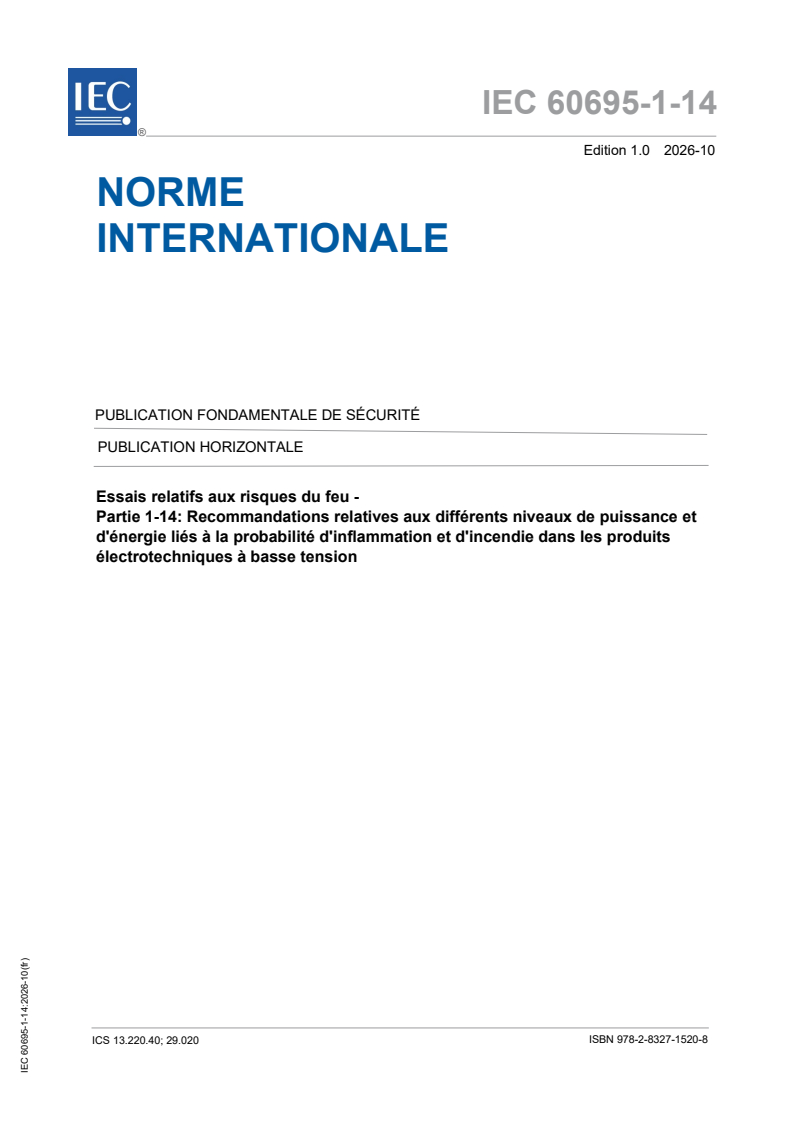
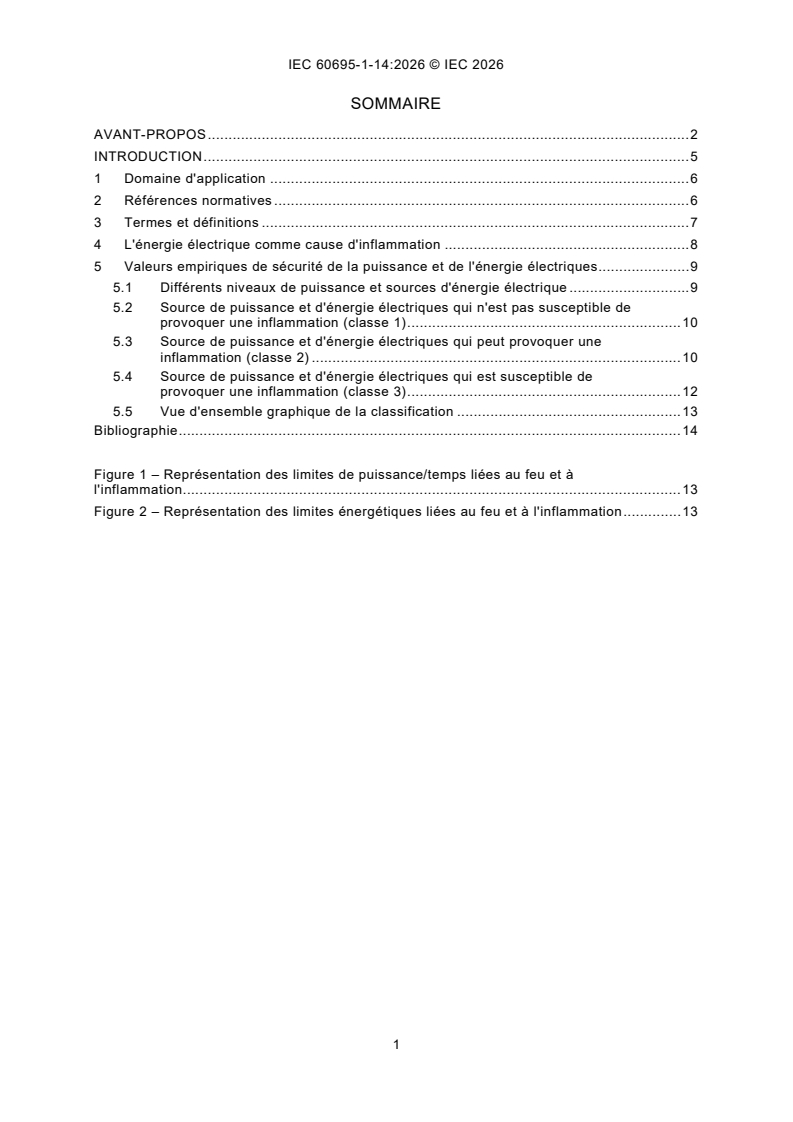
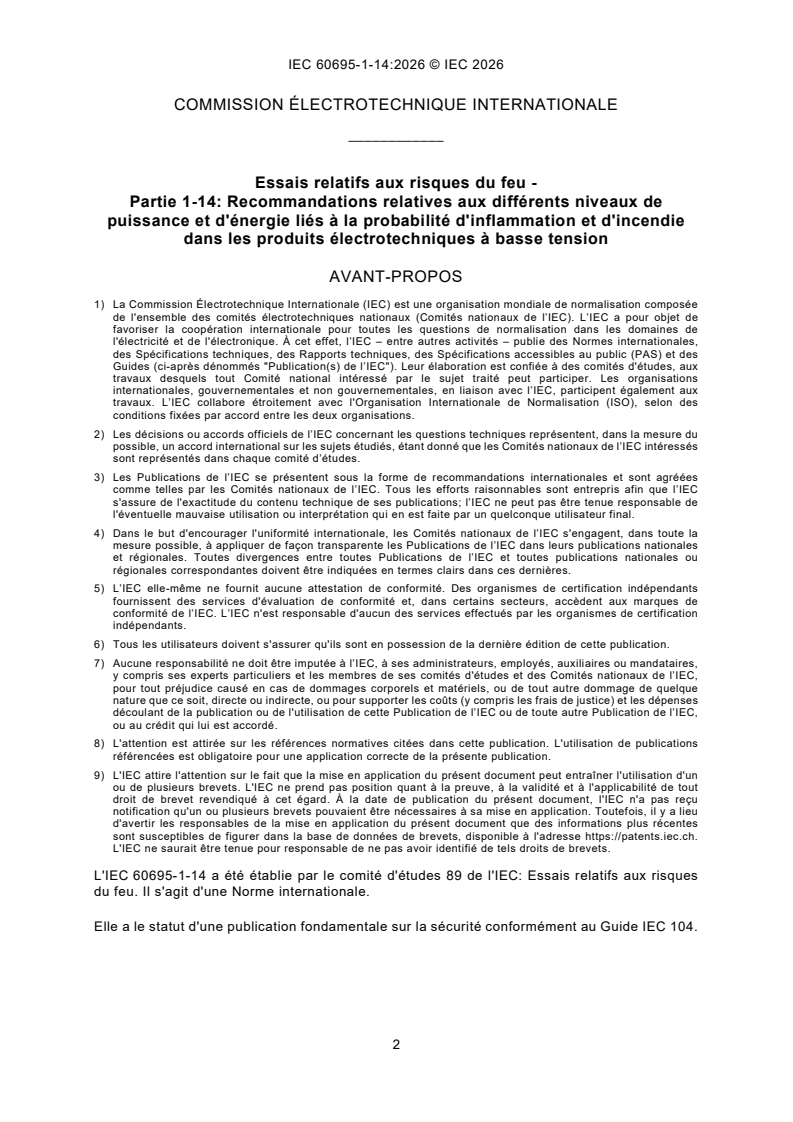
iec60695-1-14{ed1.0}fr - Essais relatifs aux risques du feu - Partie 1-14: Recommandations relatives aux différents niveaux de puissance et d'énergie liés a la probabilité d'inflammation et d'incendie dans les produits électrotechniques a basse tension
IEC 60695-1-14:2026 is an International Electrotechnical Commission (IEC) guidance standard for fire hazard testing in low voltage electrotechnical products. It explains how levels of power and energy relate to the probability of ignition and fire, and it is aimed mainly at product committees and technical committees (TCs) preparing safety publications.
What does IEC 60695-1-14:2026 specify?
IEC 60695-1-14:2026 gives guidance on power and energy levels that may cause ignition or fire in low voltage electrotechnical products used in normal atmospheres, such as domestic environments. It is intended for committee use in individual applications, especially when deciding what fire hazard safeguards to apply.
The document is organized into:
- Clause 1 - scope
- Clause 2 - normative references
- Clause 3 - terms and definitions
- Clause 4 - electrical energy as a cause of ignition
- Clause 5 - empirical safety values for electrical power and energy
- Figures 1 and 2 - graphical views of the classification
- Bibliography
What are the key requirements of IEC 60695-1-14:2026?
IEC 60695-1-14:2026 is a guidance document, so its main practical value is the classification method it offers to product committees. The key decision is whether a circuit, subassembly, or complete product falls into class 1, class 2, or class 3, and what fire hazard safeguards are then appropriate.
Electrical energy as an ignition source
Clause 4 explains that electrical energy in a fault can become heat through arcing or resistive heating. In practice, this matters because committees need to judge not just normal operation, but also likely fault conditions and how heat can reach combustible materials.
Class 1 - not likely to cause ignition
Clause 5.2 describes class 1 as a source that is not expected to have enough electrical energy to cause ignition in most circumstances. The practical indication given is a permanent power level below 15 W, and generally no fire hazard safeguard is needed.
Class 2 - ignition may occur
Clause 5.3 describes class 2 as a source that may cause ignition in some circumstances, so fire hazard safeguards should be used. The document links this class to a maximum of 100 W of permanent power, with protection measures typically based on isolation and/or fire-resistant materials.
Class 3 - ignition and fire are likely in fault conditions
Clause 5.4 describes class 3 as a source with power above 100 W lasting more than 5 s. In practice, this means ignition is considered probable under fault conditions, and a second fire hazard safeguard is needed to prevent fire spread, for example an enclosure or separation from nearby combustible materials.
Power/time and energy representations
Clause 5.5 shows two ways to view the classification. Figure 1 uses power/time limits, while Figure 2 uses energy limits and illustrates regions around 45 J and 500 J. This helps committees choose the method that best fits the product and the test setup.
Application to product types
Clause 5.4 also ties the classification to common supply situations. Type A plug-in equipment is treated as below the 4 000 W regime, while type B plug-in equipment and permanently connected equipment are below that regime only when the product of nominal voltage and rated overcurrent protection is less than 4 000. That matters when deciding whether a product can be treated as low-power in a domestic or office supply system.
What terms does IEC 60695-1-14:2026 define?
- Fire hazard - a physical object or condition that can lead to undesirable fire consequences.
- Fire hazard safeguard - a part, system, or instruction intended to reduce ignition or fire spread.
- Ignition - the start of combustion.
- Low voltage equipment - electrical equipment with supply or output voltage not exceeding 1 000 V AC or 1 500 V DC.
- Permanently connected equipment - equipment that can only be connected or disconnected from the supply using a tool.
- Type A plug-in equipment - equipment connected through domestic or similar plugs, sockets, or non-industrial connectors.
- Type B plug-in equipment - equipment connected through industrial plugs, sockets, or connectors.
- Potential fire source - a location where electrical energy can cause ignition.
Who uses IEC 60695-1-14:2026?
IEC 60695-1-14:2026 is primarily for IEC technical committees and product committees writing safety publications. It is used when they need to decide whether a product needs fire hazard safeguards and how to classify electrical power or energy in low voltage electrotechnical products.
What changed in IEC 60695-1-14:2026 from the previous edition?
IEC 60695-1-14:2026 cancels and replaces the 2017 IEC TS 60695-1-14. The stated technical changes are:
- conversion from a Technical Specification to an International Standard
- improved clarification of when the Figure 1 and Figure 2 classifications can be used
- updated normative references
Which standards are used with IEC 60695-1-14:2026?
IEC 60695-1-14:2026 is used together with IEC 60695-1-10 and IEC 60695-1-11, and the introduction also points to IEC 60695-1-12 for fire risk evaluation methods. Its normative references include IEC 60335-1, IEC 60695-4, IEC 60695-11-10, IEC 62368-1, and ISO 13943. These provide the surrounding safety vocabulary, product safety context, and related fire test terminology.
What does the IEC 60695-1-14:2026 document contain?
IEC 60695-1-14:2026 contains a conceptual explanation of why electrical energy can lead to ignition, including discussion of arcing and resistive heating. It also includes DC and AC energy formulas, one worked numerical example, and a classification framework based on power and energy levels.
The document’s most useful technical content is the class-based guidance in Clause 5 and the two summary figures. Those figures support committee work on product safety publications, test interpretation, and decisions about fire hazard safeguards, rather than giving a standalone product test method.
Relations
- Effective Date
- 15-Mar-2024
Buy Documents
iec60695-1-14{ed1.0}en - Fire hazard testing - Part 1-14: Guidance on the different levels of power and energy related to the probability of ignition and fire in low voltage electrotechnical products
iec60695-1-14{ed1.0}fr - Essais relatifs aux risques du feu - Partie 1-14: Recommandations relatives aux différents niveaux de puissance et d'énergie liés a la probabilité d'inflammation et d'incendie dans les produits électrotechniques a basse tension
Get Certified
Connect with accredited certification bodies for this standard

IMQ S.p.A. (Certification)
Italian electrical product certification.

SLG Prüf- und Zertifizierungs GmbH
German testing and certification body.

UL Solutions
Global safety science company with testing, inspection and certification.
Sponsored listings
Frequently Asked Questions
IEC 60695-1-14:2026 is a standard published by the International Electrotechnical Commission (IEC). Its full title is "Fire hazard testing - Part 1-14: Guidance on the different levels of power and energy related to the probability of ignition and fire in low voltage electrotechnical products". This standard covers: IEC 60695-1-14:2026 provides guidance about the levels of power and energy that could cause ignition and fire in a low voltage electrotechnical product. It can be used by Product Committees to determine what fire hazard safeguards can be used, based on the electrical energy that could be dissipated as heat. This document deals with products used in normal atmospheres commonly available in the home and does not deal with special locations such as those in explosive atmospheres. It is intended as guidance to IEC committees, and is intended be used with respect to their individual applications. This basic safety publication, focusing on safety guidance, is primarily intended for use by TCs in the preparation of safety publications in accordance with the principles laid down in IEC GUIDE 104 and ISO/IEC Guide 51. This first edition cancels and replaces the first edition of IEC TS 60695-1-14 published in 2017. This edition constitutes a technical revision. This edition includes the following significant technical changes with respect to the previous edition: a) Conversion from a Technical Specification to an International Standard; b) Improved clarification on when the classification of Figure 1 (power/time limits) and Figure 2 (time limits) can be used; c) Updated normative references.
IEC 60695-1-14:2026 provides guidance about the levels of power and energy that could cause ignition and fire in a low voltage electrotechnical product. It can be used by Product Committees to determine what fire hazard safeguards can be used, based on the electrical energy that could be dissipated as heat. This document deals with products used in normal atmospheres commonly available in the home and does not deal with special locations such as those in explosive atmospheres. It is intended as guidance to IEC committees, and is intended be used with respect to their individual applications. This basic safety publication, focusing on safety guidance, is primarily intended for use by TCs in the preparation of safety publications in accordance with the principles laid down in IEC GUIDE 104 and ISO/IEC Guide 51. This first edition cancels and replaces the first edition of IEC TS 60695-1-14 published in 2017. This edition constitutes a technical revision. This edition includes the following significant technical changes with respect to the previous edition: a) Conversion from a Technical Specification to an International Standard; b) Improved clarification on when the classification of Figure 1 (power/time limits) and Figure 2 (time limits) can be used; c) Updated normative references.
IEC 60695-1-14:2026 is classified under the following ICS (International Classification for Standards) categories: 13.220.40 - Ignitability and burning behaviour of materials and products; 29.020 - Electrical engineering in general. The ICS classification helps identify the subject area and facilitates finding related standards.
IEC 60695-1-14:2026 has the following relationships with other standards: It is inter standard links to IEC TS 60695-1-14:2017. Understanding these relationships helps ensure you are using the most current and applicable version of the standard.
IEC 60695-1-14:2026 is available in PDF format for immediate download after purchase. The document can be added to your cart and obtained through the secure checkout process. Digital delivery ensures instant access to the complete standard document.
Standards Content (Sample)
Contents
- 1 Scope
- 2 Normative references
- 3 Terms and definitions
- 3.1 fire hazard
- 3.2 fire hazard safeguard
- 3.3 ignition
- 3.4 low voltage equipment
- 3.5 permanently connected equipment
- 3.6 pluggable equipment type A
- 3.7 pluggable equipment type B
- 3.8 potential ignition source
- 4 Electrical energy as a cause of ignition
- 5 Empirical safety values of electrical power and energy
- 5.1 Different levels of power and electrical energy sources
- 5.2 Electrical power and energy source that is unlikely to cause ignition (Class 1)
- 5.3 Electrical power and energy source that may cause ignition (Class 2)
- 5.4 Electrical power and energy source that is likely to cause ignition (Class 3)
- 5.5 Graphical overview of the classification
- Bibliography
INTRODUCTION In the design of any electrotechnical product the risk of fire and the potential hazards associated with fire need to be considered. In this respect the objective of component, circuit and equipment design, as well as the choice of materials, is to reduce the risk of fire to a tolerable level even in the event of reasonably foreseeable (mis)use, malfunction or failure. IEC 60695-1-10 [1], IEC 60695-1-11 [2] and IEC 60695-1-12 [3] provide guidance on how this is to be accomplished.
Fires involving electrotechnical products can be initiated from external non-electrical sources. Considerations of this nature are dealt with in an overall fire hazard assessment. The aim of the IEC 60695 (all parts) [4] series of standards is to save lives and property by reducing the number of fires or reducing the consequences of the fire. This can be accomplished by trying to:
- prevent ignition caused by an electrically energised component part and, in the event of ignition, to confine any resulting fire within the bounds of the enclosure of the electrotechnical product;
- minimize flame spread beyond the product’s enclosure and to minimize the harmful effects of fire effluents including heat, smoke, and toxic or corrosive combustion products. This document provides guidance to Product Committees on the power levels and amounts of energy that are likely to cause ignition and fire. It also provides guidance to Product Committees on the fire hazard safeguards that might be necessary to protect against the probability of ignition.
The probability of fire is highly dependent on the specific fire scenario within the electrotechnical product itself. Therefore, Product Committees are ultimately responsible for deciding what fire hazard safeguards are appropriate for their products.
This document was created due to a need for guidance on electrical energy levels in relation to ignition and fire. The preparation of this document is based on electrical energy levels developed by IEC/TC 108, responsible for safety of audio, video and ICT equipment.
1 Scope
This part of IEC 60695 provides guidance about the levels of power and energy that could cause ignition and fire in a low voltage electrotechnical product. It can be used by Product Committees to determine what fire hazard safeguards can be used, based on the electrical energy that could be dissipated as heat.
This document deals with products used in normal atmospheres commonly available in the home and does not deal with special locations such as those in explosive atmospheres. It is intended as guidance to IEC committees, and is intended be used with respect to their individual applications.
This basic safety publication, focusing on safety guidance, is primarily intended for use by TCs in the preparation of safety publications in accordance with the principles laid down in IEC GUIDE 104 [5] and ISO/IEC Guide 51 [6].
One of the responsibilities of a technical committee is, wherever applicable, to make use of basic safety publications in the preparation of its publications. The requirements, test methods or test conditions of this basic safety publication will not apply unless specifically referred to or included in the relevant publications.
2 Normative references
The following documents are referred to in the text in such a way that some or all of their content constitutes requirements of this document. For dated references, only the edition cited applies. For undated references, the latest edition of the referenced document (including any amendments) applies.
IEC 60335-1:2020, Household and similar electrical appliances - Safety - Part 1: General requirements IEC 60695-1-10, Fire hazard testing - Part 1-10: Guidance for assessing the fire hazard of electrotechnical products - General guidelines IEC 60695-1-11, Fire hazard testing - Part 1-11: Guidance for assessing the fire hazard of electrotechnical products - Fire hazard assessment IEC 60695-4:2021, Fire hazard testing - Part 4: Terminology concerning fire tests for electrotechnical products IEC 60695-11-10:2013, Fire hazard testing - Part 11-10: Test flames - 50 W horizontal and vertical flame test methods IEC 62368-1:2023, Audio/video, information and communication technology equipment - Part 1: Safety requirements ISO 13943:2017, Fire safety - Vocabulary
3 Terms and definitions
For the purposes of this document, the terms and definitions given in IEC 60695-4:2021 and ISO 13943:2017 (some of which are reproduced below) and the following apply.
ISO and IEC maintain terminological databases for use in standardization at the following addresses:
- IEC Electropedia: available at http://www.electropedia.org/
- ISO Online browsing platform: available at http://www.iso.org/obp
3.1 fire hazard
physical object or condition with a potential for an undesirable consequence from fire [SOURCE: ISO 13943:2017 [7], 3.131]
3.2 fire hazard safeguard
part or system or instruction specifically provided to reduce the likelihood of ignition (3.3) or spread of fire Note 1 to entry: A fire hazard safeguard (3.2) is often also called a protection method. Note 2 to entry: Examples include current limiters, distances to or from ignition (3.3) sources, materials with flame retardant properties.
3.3 ignition
initiation of combustion [SOURCE: ISO 13943:2017 [7], 3.217]
3.4 low voltage equipment
set of electrical devices or electrical equipment necessary to perform a specific task such as generation, transmission, distribution, utilisation of electric energy and with a supply or output voltage not exceeding 1 000 V for alternating current and 1 500 V for direct current Note 1 to entry: Examples of low voltage equipment are electric power generator, electrical switchgear and controlgear assemblies, electrical wiring systems, air conditioning units. [SOURCE: IEC GUIDE 116 [8], 3.1]
3.5 permanently connected equipment
equipment that can only be electrically connected to or disconnected from the mains by the use of a tool [SOURCE: IEC 62368-1:2023 [9], 3.3.3.6]
3.6 pluggable equipment type A
equipment that is intended for connection to the mains via a non-industrial plug and socketoutlet or via a non-industrial appliance coupler, or both Note 1 to entry: Examples are plugs and socket-outlets covered by standards such as IEC TR 60083 [10] and IEC 60320-1 [11].
[SOURCE: IEC 62368-1:2023 [9], 3.3.3.7]
3.7 pluggable equipment type B
equipment that is intended for connection to the mains via an industrial plug and socket-outlet or via an industrial appliance coupler, or both Note 1 to entry: Examples are plugs and socket-outlets covered by standards such as EN IEC 60309-1 [12]. [SOURCE: IEC 62368-1:2023 [9], 3.3.3.8]
3.8 potential ignition source
location where electrical energy can cause ignition (3.3) [SOURCE: IEC 62368-1:2023 [9], 3.3.9.1]
4 Electrical energy as a cause of ignition
If a fault occurs, the energy used in a low voltage electrotechnical product may be converted to heat. This could be due to arcing or due to resistive heating. An arc is a high-temperature luminous electric discharge across a gap. Temperatures within an arc can be in the range of several thousand degrees depending on circumstances including current, voltage drop, and the materials involved. In spite of the very high temperatures in an arc path, arcs might not be effective ignition sources for many fuel materials. In most cases, the arcing is so brief and localized that solid fuels cannot be ignited or can be difficult to ignite. However, fuels with a high surface-area-to-mass ratio can be ignited when in contact with the arc.
In the case of resistive heating, the thermal energy, E, produced by in a direct current circuit is given by Formula (1).
...
Contents
- 1 Domaine d'application
- 2 Références normatives
- 3 Termes et définitions
- 3.1 danger d'incendie
- 3.2 protection contre le danger d'incendie
- 3.3 inflammation
- 3.4 équipement à basse tension
- 3.5 équipement relié en permanence
- 3.6 équipement enfichable de type A
- 3.7 équipement enfichable de type B
- 3.8 source potentielle d'incendie
- 4 L'énergie électrique comme cause d'inflammation
- 5 Valeurs empiriques de sécurité de la puissance et de l'énergie électriques
- 5.1 Différents niveaux de puissance et sources d'énergie électrique
- 5.2 Source de puissance et d'énergie électriques qui n'est pas susceptible de
- 5.3 Source de puissance et d'énergie électriques qui peut provoquer une
- 5.4 Source de puissance et d'énergie électriques qui est susceptible de provoquer
- 5.5 Vue d'ensemble graphique de la classification
- Bibliographie
INTRODUCTION Lors de la conception d'un quelconque produit électrotechnique, il est nécessaire de prendre en considération le risque d'incendie et les dangers potentiels associés au feu. À cet égard, la conception des composants, circuits et équipements ainsi que le choix des matériaux ont pour objectif de réduire le risque d'incendie à un niveau tolérable en cas d'utilisation (de mauvaise utilisation) raisonnablement prévisible, de dysfonctionnement ou de défaillance. L'IEC 60695-1-10 [1], l'IEC 60695-1-11 [2] et l'IEC 60695-1-12 [3] fournissent des recommandations sur les méthodes de réalisation correspondantes. Les feux qui impliquent des produits électrotechniques peuvent être déclenchés par des sources externes non électriques. Ces éléments sont pris en considération dans le cadre de l'appréciation globale du danger d'incendie.
L'objectif de la série de normes IEC 60695 est de sauver des vies et des biens en réduisant le nombre d'incendies ou en réduisant les conséquences de l'incendie. Cela peut être réalisé en tentant de:
- prévenir l'inflammation causée par un composant sous tension électrique et, en cas d'inflammation, de confiner tout incendie résultant dans les limites de l'enveloppe du produit électrotechnique;
- réduire le plus possible la propagation des flammes en dehors de l'enveloppe du produit et de réduire le plus possible les effets nuisibles des effluents du feu, notamment la chaleur, la fumée et les produits de combustion toxiques ou corrosifs.
Le présent document fournit des recommandations aux Comités de produits en ce qui concerne les niveaux de puissance et les quantités d'énergie susceptibles de provoquer une inflammation et un incendie. Il fournit également des recommandations aux Comités de produits en ce qui concerne les protections contre le danger d'incendie qui peuvent être nécessaires pour prévenir la probabilité d'inflammation.
La probabilité d'incendie dépend fortement du scénario d'incendie spécifique à l'intérieur du produit électrotechnique lui-même. Par conséquent, les Comités de produits ont la responsabilité finale de décider quelles protections contre le danger d'incendie sont appropriées pour leurs produits.
Le présent document a été créé en raison d'une nécessité de recommandations concernant les niveaux d'énergie électrique liés à l'inflammation et à l'incendie. L'élaboration du présent document repose sur les niveaux d'énergie électrique établis par le CE 108 de l'IEC, responsable de la sécurité des équipements audio, vidéo et des TIC.
1 Domaine d'application
La présente partie de l'IEC 60695 fournit des recommandations concernant les niveaux de puissance et d'énergie qui peuvent provoquer une inflammation et un incendie dans un produit électrotechnique à basse tension. Elle peut être utilisée par les Comités de produits pour déterminer quelles protections contre le danger d'incendie peuvent être utilisées, en fonction de l'énergie électrique susceptible d'être dissipée sous forme de chaleur. Le présent document traite des produits utilisés dans les atmosphères normales communément rencontrées dans les habitations et ne traite pas des emplacements spéciaux tels que ceux dans les atmosphères explosives. Il est destiné à servir de guide aux comités de l'IEC et est prévu pour être utilisé dans le respect de leurs applications particulières. La présente publication fondamentale de sécurité qui porte sur des recommandations de sécurité est principalement destinée à être utilisée par les comités d'études dans le cadre de l'élaboration de publications de sécurité conformément aux principes établis dans le Guide 104 de l'IEC [5] et le Guide 51 de l'ISO/IEC [6].
L'une des responsabilités d'un comité d'études consiste, le cas échéant, à utiliser les publications fondamentales de sécurité dans le cadre de l'élaboration de ses publications. Les exigences, les méthodes ou les conditions d'essai de la présente publication fondamentale de sécurité s'appliqueront seulement si elles servent spécifiquement de référence ou sont intégrées dans les publications correspondantes.
2 Références normatives
Les documents suivants sont cités dans le texte de sorte qu'ils constituent, pour tout ou partie de leur contenu, des exigences du présent document. Pour les références datées, seule l'édition citée s'applique. Pour les références non datées, la dernière édition du document de référence s'applique (y compris les éventuels amendements).
IEC 60335-1:2020, Appareils électrodomestiques et analogues - Sécurité - Partie 1: Exigences générales IEC 60695-1-10, Essais relatifs aux risques du feu - Partie 1-10: Lignes directrices pour l’évaluation des risques du feu des produits électrotechniques - Lignes directrices générales IEC 60695-1-11, Essais relatifs aux risques du feu - Partie 1-11: Lignes directrices pour l’évaluation du danger du feu des produits électrotechniques - Évaluation du danger du feu IEC 60695-4:2021, Essais relatifs aux risques du feu - Partie 4: Terminologie relative aux essais au feu pour les produits électrotechniques IEC 60695-11-10:2013, Essais relatifs aux risques du feu - Partie 11-10: Flammes d’essai - Méthodes d’essai horizontal et vertical à la flamme de 50 W IEC 62368-1:2023, Équipements des technologies de l'audio/vidéo, de l'information et de la communication - Partie 1: Exigences de sécurité ISO 13943:2017, Sécurité au feu - Vocabulaire
3 Termes et définitions
Pour les besoins du présent document, les termes et définitions de l'IEC 60695-4:2021 et de l'ISO 13943-2017 (certains étant repris ci-dessous) ainsi que les suivants s'appliquent. L'ISO et l'IEC tiennent à jour des bases de données terminologiques destinées à être utilisées en normalisation, consultables aux adresses suivantes:
- IEC Electropedia: disponible à l'adresse http://www.electropedia.org/
- ISO Online browsing platform: disponible à l'adresse http://www.iso.org/obp
3.1 danger d'incendie
objet physique ou condition susceptible d'entraîner des conséquences non souhaitables causées par un incendie [SOURCE: ISO 13943:2017 [7], 3.131]
3.2 protection contre le danger d'incendie
partie ou système ou instruction spécifiquement prévu(e) pour réduire la probabilité d'inflammation ou de propagation du feu Note 1 à l'article: Une protection contre le danger d'incendie est souvent aussi appelée méthode de protection. Note 2 à l'article: Les limiteurs de courant, les distances par rapport aux sources d'inflammation, les matériaux avec des propriétés ignifuges en sont des exemples.
3.3 inflammation
amorçage de la combustion [SOURCE: ISO 13943:2017 [7], 3.217]
3.4 équipement à basse tension
ensemble de dispositifs ou d'équipements électriques nécessaires à la réalisation d'une tâche spécifique telle que la production, le transport, la distribution, l'utilisation de l'énergie électrique et dont la tension d'alimentation ou de sortie ne dépasse pas 1 000 V pour le courant alternatif et 1 500 V pour le courant continu Note 1 à l'article: Les générateurs électriques, les ensembles d'appareillage électrique, les systèmes de câblage électrique, les unités de climatisation sont des exemples d'équipements à basse tension. [SOURCE: GUIDE 116 de l'IEC [8],3.1]
3.5 équipement relié en permanence
équipement pouvant uniquement être connecté électriquement au ou déconnecté électriquement du réseau d'alimentation à l'aide d'un outil [SOURCE: IEC 62368-1:2023 [9], 3.3.3.6]
3.6 équipement enfichable de type A
équipement prévu pour être raccordé au réseau d'alimentation par une fiche et un socle de prise de courant non industriels ou par un connecteur non industriel ou les deux Note 1 à l'article: Des exemples sont les fiches et les socles de prises de courant couverts par des normes comme l'IEC TR 60083 [10] et l'IEC 60320-1 [11].
[SOURCE: IEC 62368-1:2023 [9], 3.3.3.7]
3.7 équipement enfichable de type B
équipement prévu pour être raccordé au réseau d'alimentation par une fiche et un socle de prise de courant industriels ou par un connecteur industriel ou les deux Note 1 à l'article: Des exemples sont les fiches et les socles de prises de courant couverts par des normes comme l'EN IEC 60309-1 [11].
[SOURCE: IEC 62368-1:2023 [9], 3.3.3.8]
3.8 source potentielle d'incendie
emplacement dans lequel une énergie électrique peut provoquer une inflammation [SOURCE: IEC 62368-1:2023 [9], 3.3.9.1]
4 L'énergie électrique comme cause d'inflammation
En cas de défaut, l'énergie utilisée dans un produit électrotechnique à basse tension peut être convertie en chaleur. Cela peut être dû à un arc ou à un échauffement résistif. Un arc est une décharge électrique lumineuse à haute température à travers un espace. Les températures à l'intérieur d'un arc peuvent être de l'ordre de plusieurs milliers de degrés en fonction des circonstances, notamment du courant, de la chute de tension et des matériaux impliqués. Malgré les très hautes températures sur la trajectoire d'un arc, les arcs peuvent ne pas être des sources d'inflammation efficaces pour de nombreux matériaux combustibles. Dans la plupart des cas, l'arc est si bref et localisé que les combustibles solides ne peuvent pas s'enflammer ou peuvent être difficiles à enflammer. Toutefois, les combustibles qui présentent un rapport surface/masse élevé peuvent s'enflammer au contact de l'arc. Dans le cas d'un échauffement résistif, l'énergie thermique, E, produite par un circuit à courant continu, est donnée par la Formule (1).
E= Pt×= I×V×t (1)
où P est la puissance (énergie par unité de temps) t est le temps I est le courant qui traverse la résistance V est la chute de tension à travers la résistance Par exemple, si V = 12 V et I = 2 A, et si le courant circule pendant 5 s, alors P = 24 W et E = 120 J.
...