


IEC 61400-23:2014
(Main)Wind turbines - Part 23: Full-scale structural testing of rotor blades
Wind turbines - Part 23: Full-scale structural testing of rotor blades
IEC 61400-23:2014 defines the requirements for full-scale structural testing of wind turbine blades and for the interpretation and evaluation of achieved test results. The standard focuses on aspects of testing related to an evaluation of the integrity of the blade, for use by manufacturers and third party investigators. The following tests are considered in this standard:
- static load tests;
- fatigue tests;
- static load tests after fatigue tests;
- tests determining other blade properties. The purpose of the tests is to confirm to an acceptable level of probability that the whole population of a blade type fulfils the design assumptions.
Eoliennes - Partie 23: Essais en vraie grandeur des structures des pales de rotor
l'IEC 61400-23:2014 définit les exigences concernant les essais en vraie grandeur des structures des pales d'éolienne, ainsi que l'interprétation et l'évaluation des résultats d'essai obtenus. La norme cible les aspects des essais liés à une évaluation de l'intégrité des pales, et s'adresse aux fabricants et aux chercheurs tiers. La présente norme prend en considération les essais suivants:
- essais de charge statique;
- essais de fatigue;
- essais de charge statique après essais de fatigue;
- essais déterminant d'autres propriétés des pales.
General Information
- Status
- Published
- Publication Date
- 07-Apr-2014
- Technical Committee
- TC 88 - Wind energy generation systems
- Drafting Committee
- MT 23 - TC 88/MT 23
- Current Stage
- PPUB - Publication issued
- Start Date
- 08-Apr-2014
- Completion Date
- 30-Jun-2014
Relations
- Effective Date
- 05-Sep-2023
Overview - IEC 61400-23:2014 (Full‑scale structural testing of rotor blades)
IEC 61400-23:2014 specifies requirements for full‑scale structural testing of wind turbine rotor blades and for the interpretation and evaluation of the test results. The standard is intended to confirm, to an acceptable probability, that a blade type meets the original design assumptions. It covers planning, execution, instrumentation, load formulation and reporting for full‑scale static load tests, fatigue tests, static tests after fatigue, and other blade property tests.
Key technical topics and requirements
- Test scope and objectives: Defines the purpose of each test (integrity verification, limit state assessment, degradation detection) and expected outcomes.
- Test programmes and plans: Requirements for documented test programmes including blade description, loads/conditions, instrumentation and expected results.
- Load formulation and load factors: Guidance on deriving test target loads from design loads, partial safety factors and test load factors to represent blade‑to‑blade variation and environmental uncertainty.
- Static load testing: Procedures for applying static bending/torsion loads, strain and deflection measurement, load introduction considerations.
- Fatigue testing: Requirements for fatigue spectra, number of load cycles, sequence considerations and post‑fatigue evaluations.
- Tests after fatigue: Procedures for static tests following fatigue exposure to detect permanent deformation or loss of stiffness.
- Other blade property tests: Measurement of blade mass, centre of gravity, natural frequencies and optional properties.
- Instrumentation, calibration and uncertainties: Requirements for sensor calibration, measurement uncertainty assessment and environmental monitoring.
- Test fixtures and stands: Criteria for root fixture design and test stand behaviour to ensure representative load introduction.
- Result evaluation and reporting: Classification of outcomes (catastrophic failure, permanent deformation, superficial damage), failure evaluation and detailed test reporting.
Practical applications and users
Who uses IEC 61400-23:
- Blade manufacturers - for design validation, product development and quality assurance.
- Certification bodies and test laboratories - to demonstrate compliance with structural requirements during type certification.
- Third‑party investigators and consultants - for root‑cause analysis, warranty disputes and failure investigations.
- Design and R&D teams - to validate finite element models and refine load assumptions.
Why it matters:
- Provides a harmonized, traceable approach to demonstrate structural integrity of rotor blades.
- Supports certification, reduces uncertainty in service life estimates and informs manufacturing/process changes.
Related standards
- IEC 61400 series (other parts cover design requirements, turbine testing and certification). Consult the relevant IEC 61400 parts for complementary design, performance and safety requirements.
Keywords: IEC 61400-23, full‑scale structural testing, rotor blades, wind turbines, static load tests, fatigue tests, blade testing, test plans, instrumentation, load factors, blade certification.
IEC 61400-23:2014 - Wind turbines - Part 23: Full-scale structural testing of rotor blades Released:4/8/2014 Isbn:9782832215067
IEC 61400-23:2014 - Wind turbines - Part 23: Full-scale structural testing of rotor blades
Frequently Asked Questions
IEC 61400-23:2014 is a standard published by the International Electrotechnical Commission (IEC). Its full title is "Wind turbines - Part 23: Full-scale structural testing of rotor blades". This standard covers: IEC 61400-23:2014 defines the requirements for full-scale structural testing of wind turbine blades and for the interpretation and evaluation of achieved test results. The standard focuses on aspects of testing related to an evaluation of the integrity of the blade, for use by manufacturers and third party investigators. The following tests are considered in this standard: - static load tests; - fatigue tests; - static load tests after fatigue tests; - tests determining other blade properties. The purpose of the tests is to confirm to an acceptable level of probability that the whole population of a blade type fulfils the design assumptions.
IEC 61400-23:2014 defines the requirements for full-scale structural testing of wind turbine blades and for the interpretation and evaluation of achieved test results. The standard focuses on aspects of testing related to an evaluation of the integrity of the blade, for use by manufacturers and third party investigators. The following tests are considered in this standard: - static load tests; - fatigue tests; - static load tests after fatigue tests; - tests determining other blade properties. The purpose of the tests is to confirm to an acceptable level of probability that the whole population of a blade type fulfils the design assumptions.
IEC 61400-23:2014 is classified under the following ICS (International Classification for Standards) categories: 27.180 - Wind turbine energy systems. The ICS classification helps identify the subject area and facilitates finding related standards.
IEC 61400-23:2014 has the following relationships with other standards: It is inter standard links to IEC TS 61400-23:2001. Understanding these relationships helps ensure you are using the most current and applicable version of the standard.
You can purchase IEC 61400-23:2014 directly from iTeh Standards. The document is available in PDF format and is delivered instantly after payment. Add the standard to your cart and complete the secure checkout process. iTeh Standards is an authorized distributor of IEC standards.
Standards Content (Sample)
IEC 61400-23 ®
Edition 1.0 2014-04
INTERNATIONAL
STANDARD
colour
inside
Wind turbines –
Part 23: Full-scale structural testing of rotor blades
All rights reserved. Unless otherwise specified, no part of this publication may be reproduced or utilized in any form
or by any means, electronic or mechanical, including photocopying and microfilm, without permission in writing from
either IEC or IEC's member National Committee in the country of the requester. If you have any questions about IEC
copyright or have an enquiry about obtaining additional rights to this publication, please contact the address below or
your local IEC member National Committee for further information.
IEC Central Office Tel.: +41 22 919 02 11
3, rue de Varembé Fax: +41 22 919 03 00
CH-1211 Geneva 20 info@iec.ch
Switzerland www.iec.ch
About the IEC
The International Electrotechnical Commission (IEC) is the leading global organization that prepares and publishes
International Standards for all electrical, electronic and related technologies.
About IEC publications
The technical content of IEC publications is kept under constant review by the IEC. Please make sure that you have the
latest edition, a corrigenda or an amendment might have been published.
IEC Catalogue - webstore.iec.ch/catalogue Electropedia - www.electropedia.org
The stand-alone application for consulting the entire The world's leading online dictionary of electronic and
bibliographical information on IEC International Standards, electrical terms containing more than 30 000 terms and
Technical Specifications, Technical Reports and other definitions in English and French, with equivalent terms in 14
documents. Available for PC, Mac OS, Android Tablets and additional languages. Also known as the International
iPad. Electrotechnical Vocabulary (IEV) online.
IEC publications search - www.iec.ch/searchpub IEC Glossary - std.iec.ch/glossary
The advanced search enables to find IEC publications by a More than 55 000 electrotechnical terminology entries in
variety of criteria (reference number, text, technical English and French extracted from the Terms and Definitions
committee,…). It also gives information on projects, replaced clause of IEC publications issued since 2002. Some entries
and withdrawn publications. have been collected from earlier publications of IEC TC 37,
77, 86 and CISPR.
IEC Just Published - webstore.iec.ch/justpublished
Stay up to date on all new IEC publications. Just Published IEC Customer Service Centre - webstore.iec.ch/csc
details all new publications released. Available online and If you wish to give us your feedback on this publication or
also once a month by email. need further assistance, please contact the Customer Service
Centre: csc@iec.ch.
IEC 61400-23 ®
Edition 1.0 2014-04
INTERNATIONAL
STANDARD
colour
inside
Wind turbines –
Part 23: Full-scale structural testing of rotor blades
INTERNATIONAL
ELECTROTECHNICAL
COMMISSION
PRICE CODE
X
ICS 27.180 ISBN 978-2-8322-1506-7
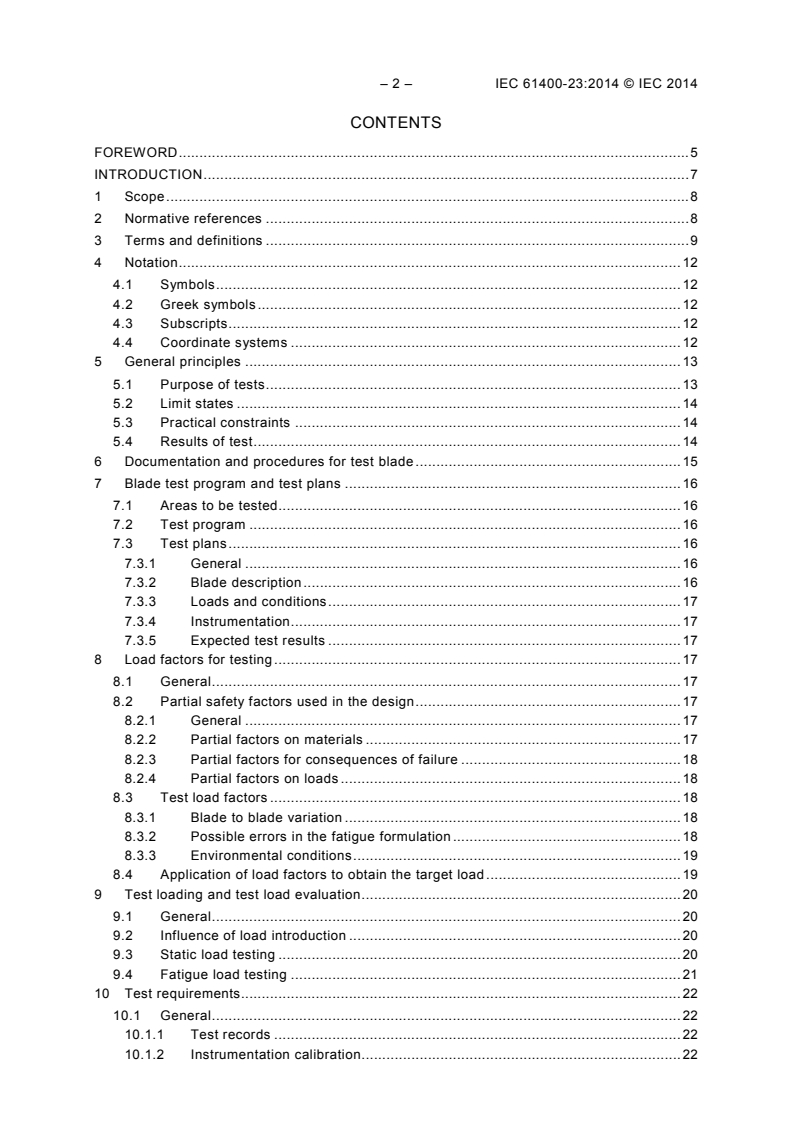
– 2 – IEC 61400-23:2014 © IEC 2014
CONTENTS
FOREWORD . 5
INTRODUCTION . 7
1 Scope . 8
2 Normative references . 8
3 Terms and definitions . 9
4 Notation . 12
4.1 Symbols . 12
4.2 Greek symbols . 12
4.3 Subscripts . 12
4.4 Coordinate systems . 12
5 General principles . 13
5.1 Purpose of tests . 13
5.2 Limit states . 14
5.3 Practical constraints . 14
5.4 Results of test . 14
6 Documentation and procedures for test blade . 15
7 Blade test program and test plans . 16
7.1 Areas to be tested . 16
7.2 Test program . 16
7.3 Test plans . 16
7.3.1 General . 16
7.3.2 Blade description . 16
7.3.3 Loads and conditions . 17
7.3.4 Instrumentation . 17
7.3.5 Expected test results . 17
8 Load factors for testing . 17
8.1 General . 17
8.2 Partial safety factors used in the design . 17
8.2.1 General . 17
8.2.2 Partial factors on materials . 17
8.2.3 Partial factors for consequences of failure . 18
8.2.4 Partial factors on loads . 18
8.3 Test load factors . 18
8.3.1 Blade to blade variation . 18
8.3.2 Possible errors in the fatigue formulation . 18
8.3.3 Environmental conditions . 19
8.4 Application of load factors to obtain the target load . 19
9 Test loading and test load evaluation . 20
9.1 General . 20
9.2 Influence of load introduction . 20
9.3 Static load testing . 20
9.4 Fatigue load testing . 21
10 Test requirements. 22
10.1 General . 22
10.1.1 Test records . 22
10.1.2 Instrumentation calibration. 22
10.1.3 Measurement uncertainties . 22
10.1.4 Root fixture and test stand requirements . 22
10.1.5 Environmental conditions monitoring . 22
10.1.6 Deterministic corrections . 23
10.2 Static test . 23
10.2.1 General . 23
10.2.2 Static load test. 23
10.2.3 Strain measurement . 24
10.2.4 Deflection measurement . 24
10.3 Fatigue test . 24
10.4 Other blade property tests . 24
10.4.1 Blade mass and center of gravity . 24
10.4.2 Natural frequencies . 25
10.4.3 Optional blade property tests . 25
11 Test results evaluation. 25
11.1 General . 25
11.2 Catastrophic failure . 25
11.3 Permanent deformation, loss of stiffness or change in other blade properties . 26
11.4 Superficial damage . 26
11.5 Failure evaluation . 26
12 Reporting . 26
12.1 General . 26
12.2 Test report content. 27
12.3 Evaluation of test in relation to design requirements . 27
Annex A (informative) Guidelines for the necessity of renewed static and fatigue
testing . 28
Annex B (informative) Areas to be tested . 29
Annex C (informative) Effects of large deflections and load direction . 30
Annex D (informative) Formulation of test load . 31
D.1 Static target load. 31
D.2 Fatigue target load . 31
D.3 Sequential single-axial, single location . 34
D.4 Multi axial single location . 34
Annex E (informative) Differences between design and test load conditions . 36
E.1 General . 36
E.2 Load introduction . 36
E.3 Bending moments and shear . 36
E.4 Flapwise and lead-lag combinations . 36
E.5 Radial loads . 37
E.6 Torsion loads . 37
E.7 Environmental conditions . 37
E.8 Fatigue load spectrum and sequence . 37
Annex F (informative) Determination of number of load cycles for fatigue tests . 38
F.1 General . 38
F.2 Background . 38
F.3 The approach used . 38
Bibliography . 43
– 4 – IEC 61400-23:2014 © IEC 2014
Figure 1 – Chordwise (flatwise, edgewise) coordinate system . 13
Figure 2 – Rotor (flapwise, lead-lag) coordinate system . 13
Figure C.1 – Applied loads effects due to blade deformation and angulation . 30
Figure D.1 – Polar plot of the load envelope from a typical blade . 31
Figure D.2 – Design FSF . 33
Figure D.3 – Area where design FSF is smaller than 1,4 (critical area) . 33
Figure D.4 – rFSF and critical areas, sequential single-axial test . 34
Figure D.5 – rFSF and critical area, multi axial test . 35
Figure E.1 – Difference of moment distribution for target and actual test load . 36
Figure F.1 – Simplified Goodman diagram . 39
Figure F.2 – Test load factor γ for different number of load cycles in the test . 42
ef
Table 1 – Recommended values for γ for different number of load cycles . 18
ef
Table A.1 – Examples of situations typically requiring or not requiring renewed testing . 28
Table F.1 – Recommended values for γ for different number of load cycles . 38
ef
Table F.2 – Expanded recommended values for γ for different number of load cycles . 41
ef
INTERNATIONAL ELECTROTECHNICAL COMMISSION
____________
WIND TURBINES –
Part 23: Full-scale structural testing of rotor blades
FOREWORD
1) The International Electrotechnical Commission (IEC) is a worldwide organization for standardization comprising
all national electrotechnical committees (IEC National Committees). The object of IEC is to promote
international co-operation on all questions concerning standardization in the electrical and electronic fields. To
this end and in addition to other activities, IEC publishes International Standards, Technical Specifications,
Technical Reports, Publicly Available Specifications (PAS) and Guides (hereafter referred to as “IEC
Publication(s)”). Their preparation is entrusted to technical committees; any IEC National Committee interested
in the subject dealt with may participate in this preparatory work. International, governmental and non-
governmental organizations liaising with the IEC also participate in this preparation. IEC collaborates closely
with the International Organization for Standardization (ISO) in accordance with conditions determined by
agreement between the two organizations.
2) The formal decisions or agreements of IEC on technical matters express, as nearly as possible, an international
consensus of opinion on the relevant subjects since each technical committee has representation from all
interested IEC National Committees.
3) IEC Publications have the form of recommendations for international use and are accepted by IEC National
Committees in that sense. While all reasonable efforts are made to ensure that the technical content of IEC
Publications is accurate, IEC cannot be held responsible for the way in which they are used or for any
misinterpretation by any end user.
4) In order to promote international uniformity, IEC National Committees undertake to apply IEC Publications
transparently to the maximum extent possible in their national and regional publications. Any divergence
between any IEC Publication and the corresponding national or regional publication shall be clearly indicated in
the latter.
5) IEC itself does not provide any attestation of conformity. Independent certification bodies provide conformity
assessment services and, in some areas, access to IEC marks of conformity. IEC is not responsible for any
services carried out by independent certification bodies.
6) All users should ensure that they have the latest edition of this publication.
7) No liability shall attach to IEC or its directors, employees, servants or agents including individual experts and
members of its technical committees and IEC National Committees for any personal injury, property damage or
other damage of any nature whatsoever, whether direct or indirect, or for costs (including legal fees) and
expenses arising out of the publication, use of, or reliance upon, this IEC Publication or any other IEC
Publications.
8) Attention is drawn to the Normative references cited in this publication. Use of the referenced publications is
indispensable for the correct application of this publication.
9) Attention is drawn to the possibility that some of the elements of this IEC Publication may be the subject of
patent rights. IEC shall not be held responsible for identifying any or all such patent rights.
International Standard IEC 61400-23 has been prepared by IEC technical committee 88: Wind
turbines.
This first edition cancels and replaces IEC TS 61400-23, published in 2001. It constitutes a
technical revision.
This edition includes the following significant technical changes with respect to
IEC TS 61400-23:
a) description of load based testing only;
b) condensation to describe the general principles and demands.
– 6 – IEC 61400-23:2014 © IEC 2014
The text of this standard is based on the following documents:
CDV Report on voting
88/420/CDV 88/448/RVC
Full information on the voting for the approval of this standard can be found in the report on
voting indicated in the above table.
This publication has been drafted in accordance with the ISO/IEC Directives, Part 2.
A list of all parts in the IEC 61400 series, published under the general title Wind turbines, can
be found on the IEC website.
The committee has decided that the contents of this publication will remain unchanged until
the stability date indicated on the IEC web site under "http://webstore.iec.ch" in the data
related to the specific publication. At this date, the publication will be
• reconfirmed,
• withdrawn,
• replaced by a revised edition, or
• amended.
A bilingual version of this publication may be issued at a later date.
IMPORTANT – The 'colour inside' logo on the cover page of this publication indicates
that it contains colours which are considered to be useful for the correct
understanding of its contents. Users should therefore print this document using a
colour printer.
INTRODUCTION
The blades of a wind turbine rotor are generally regarded as one of the most critical
components of the wind turbine system. In this standard, the demands for full-scale structural
testing related to certification are defined as well as the interpretation and evaluation of test
results.
Specific testing methods or set-ups for testing are not demanded or included as full-scale
blade testing methods historically have developed independently in different countries and
laboratories.
Furthermore, demands for tests determining blade properties are included in this standard in
order to validate some vital design assumptions used as inputs for the design load
calculations.
Any of the requirements of this standard may be altered if it can be suitably demonstrated that
the safety of the system is not compromised.
The standard is based on IEC TS 61400-23 published in 2001. Compared to the TS, this
standard only describes load based testing and is condensed to describe the general
principles and demands.
– 8 – IEC 61400-23:2014 © IEC 2014
WIND TURBINES –
Part 23: Full-scale structural testing of rotor blades
1 Scope
This part of IEC 61400 defines the requirements for full-scale structural testing of wind turbine
blades and for the interpretation and evaluation of achieved test results. The standard
focuses on aspects of testing related to an evaluation of the integrity of the blade, for use by
manufacturers and third party investigators.
The following tests are considered in this standard:
• static load tests;
• fatigue tests;
• static load tests after fatigue tests;
• tests determining other blade properties.
The purpose of the tests is to confirm to an acceptable level of probability that the whole
population of a blade type fulfils the design assumptions.
It is assumed that the data required to define the parameters of the tests are available and
based on the standard for design requirements for wind turbines such as IEC 61400-1 or
equivalent. Design loads and blade material data are considered starting points for
establishing and evaluating the test loads. The evaluation of the design loads with respect to
the actual loads on the wind turbines is outside the scope of this standard.
At the time this standard was written, full-scale tests were carried out on blades of horizontal
axis wind turbines. The blades were mostly made of fibre reinforced plastics and wood/epoxy.
However, most principles would be applicable to any wind turbine configuration, size and
material.
2 Normative references
The following documents, in whole or in part, are normatively referenced in this document and
are indispensable for its application. For dated references, only the edition cited applies. For
undated references, the latest edition of the referenced document (including any
amendments) applies.
IEC 60050-415:1999, International Electrotechnical Vocabulary – Part 415: Wind turbine
generator systems
IEC 61400-1:2005, Wind turbines – Part 1: Design requirements
ISO/IEC 17025:2005, General requirements for the competence of testing and calibration
laboratories
ISO 2394:1998, General principles on reliability for structures
3 Terms and definitions
For the purposes of this document, the terms and definitions related to wind turbines or wind
energy given in IEC 60050-415 and the following apply.
3.1
actuator
device that can be controlled to apply a constant or varying force and displacement
3.2
blade root
that part of the rotor blade that is connected to the hub of the rotor
3.3
blade subsystem
integrated set of items that accomplishes a defined objective or function within the blade (e.g.,
lightning protection subsystem, aerodynamic braking subsystem, monitoring subsystem,
aerodynamic control subsystem, etc.)
3.4
buckling
instability characterized by a non-linear increase in out of plane deflection with a change in
local compressive load
3.5
chord
length of a reference straight line that joins the leading and trailing edges of a blade aerofoil
cross-section at a given spanwise location
3.6
constant amplitude loading
during a fatigue test, the application of load cycles with a constant amplitude and mean value
3.7
creep
time-dependant increase in strain under a sustained load
3.8
design loads
loads the blade is designed to withstand, including appropriate partial safety factors
3.9
edgewise
direction that is parallel to the local chord
SEE: 4.4.
3.10
elastic axis
the line, lengthwise of the blade, along which transverse loads are applied in order to produce
bending only, with no torsion at any section
Note 1 to entry: Strictly speaking, no such line exists except for a few conditions of loading. Usually the elastic
axis is assumed to be the line that passes through the elastic center of every section. This definition is not
applicable for blades with bend-twist coupling.
3.11
fatigue formulation
methodology by which the fatigue life is estimated
– 10 – IEC 61400-23:2014 © IEC 2014
3.12
fatigue test
test in which a cyclic load of constant or varying amplitude is applied to the test specimen
3.13
fixture
component or device to introduce loads or to support the test specimen
3.14
flapwise
direction that is perpendicular to the surface swept by the undeformed rotor blade axis
SEE: 4.4.
3.15
flatwise
direction that is perpendicular to the local chord, and spanwise blade axis
SEE: 4.4.
3.16
full-scale test
test carried out on the actual blade or part thereof
3.17
inboard
towards the blade root
3.18
lead-lag
direction that is parallel to the plane of the swept surface and perpendicular to the longitudinal
axis of the undeformed rotor blade
SEE 4.4.
3.19
load envelope
collection of maximum design loads in all directions and spanwise positions
3.20
natural frequency
eigen frequency
frequency at which a structure will vibrate when perturbed and allowed to vibrate freely
3.21
partial safety factors
factors that are applied to loads and material strengths to account for uncertainties in the
representative (characteristic) values
3.22
prebend
blade curvature in the flapwise plane in the unloaded condition
3.23
R-value
ratio between minimum and maximum value during a load cycle
3.24
S-N formulation
method used to describe the stress and/or strain (S) vs. cycle (N) characteristics of a
material, component or structure
3.25
spanwise
direction parallel to the longitudinal axis of a rotor blade
3.26
static test
test with an application of a single load cycle without introducing dynamic effects
3.27
stiffness
ratio of change of force to the corresponding change in displacement of an elastic body
3.28
strain
ratio of the elongation (or shear displacement) of a material subjected to stress to the original
length of the material
3.29
sweep
blade curvature in the lead-lag plane in the unloaded condition
3.30
tare loads
gravitational or other loads that are inherent to the test set-up
3.31
target load
load that is developed from the design load and is the ideal test load
3.32
test load
forces applied during a test
3.33
tested area
region of the test object that experiences the intended loading
3.34
twist
spanwise variation in angle of the chord lines of blade cross-sections
3.35
variable amplitude loading
application of load cycles of non-constant mean and/or cyclic range
3.36
whiffle tree
device for distributing a single load source over multiple points on a test specimen
– 12 – IEC 61400-23:2014 © IEC 2014
4 Notation
4.1 Symbols
C conversion factors for material strength
D theoretical damage
F load
F flatwise shear force (chordwise co-ordinates)
a
F edgewise shear force (chordwise co-ordinates)
b
F spanwise (tensile) force (chordwise co-ordinates)
c
F flapwise shear force (rotor co-ordinate system)
x
lead-lag shear force (rotor co-ordinate system)
F
y
F spanwise (tensile) force (rotor co-ordinate system)
z
edgewise bending moment (chordwise co-ordinates)
M
a
M flatwise bending moment (chordwise co-ordinates)
b
M blade torsion moment (chordwise co-ordinates)
c
M lead-lag bending moment (rotor co-ordinate system)
x
M flapwise bending moment (rotor co-ordinate system)
y
M blade torsion moment (rotor co-ordinate system)
z
N cycle
S strain or stress
4.2 Greek symbols
γ partial factor or test load factor
σ applied stress or strain
4.3 Subscripts
design design loading conditions
df design load: fatigue
du design load: static
ef uncertainty in fatigue formulation of test load
f load
lf environmental effects: fatigue
lu environmental effects: static
m material
n consequence of failure
nf consequence of failure: fatigue
nu consequence of failure: static
sf blade to blade variation: fatigue test load
su blade to blade variation: static test load
target target loading conditions
test test loading conditions
4.4 Coordinate systems
Two different coordinate systems may be used for reference during structural testing. The
first, shown in Figure 1, references the local blade chord directions. The second, shown in
Figure 2, references the global rotor plane directions.
Loads are along and perpendicular
y
to the local blade chord directions
M Edgewise bending moment
x
a
M Flatwise bending moment
b
M Torsion moment
c
Deformed
F Flatwise shear force
blade axis
z a
F Edgewise shear force
b
Undeformed
F
F Axial force
b c
blade axis
1 Torsion angle
M
b 2 Flapwise translation
3 Lead-lag translation
F
a
M
M
a
c
3 F
c
IEC 1040/14
Figure 1 – Chordwise (flatwise, edgewise) coordinate system
y
Loads are along the rotor plane
reference directions
x
M Lead-lag bending moment
x
M Flapwise bending moment
y
Deformed
M Torsion moment
z
z blade axis
F Flapwise shear force
x
Undeformed
F Lead-lag shear force
y
blade axis
F Spanwise force
z
F
y
1 Flapwise translation
M
y
2 Lead-lag translation
F
x
M
x
M
z
F
IEC 1041/14
z
Figure 2 – Rotor (flapwise, lead-lag) coordinate system
5 General principles
5.1 Purpose of tests
The fundamental purpose of a wind turbine blade test is to demonstrate to a reasonable level
of certainty that a blade type, when manufactured according to a certain set of specifications,
has the prescribed reliability with reference to specific limit states, or, more precisely, to verify
that the specified limit states are not reached and the blades therefore possess the load
carrying capability and service life provided for in the design.
– 14 – IEC 61400-23:2014 © IEC 2014
Additionally, tests determining blade properties have to be performed in order to validate
some vital design assumptions used as inputs for the design load calculations. It has to be
pointed out that the required blade property tests do not cover all design assumptions.
Normally, the full-scale tests dealt within this standard are tests on a limited number of
samples; only one or two blades of a given design are tested, so no statistical distribution of
production blade load carrying capability can be obtained. Although the tests do give
information valid for the blade type, they cannot replace either a rigorous design process or
the quality system for series blade production. Furthermore, the tests described in this
standard are not intended to be used for the testing of mechanism function nor to establish
basic material strength or fatigue design data for blades and/or components.
5.2 Limit states
To establish and evaluate the test load, a certain amount of information about the design shall
be known. Usually the blades are designed according to some standard or code of practice
such as IEC 61400-1 that uses the principles of ISO 2394 defining the limit states and partial
coefficients, which have to be applied to obtain the corresponding design values. A limit state
is a state of the structure and the loads acting upon it, beyond which the structure no longer
satisfies the design requirements. The partial coefficients reflect uncertainties and are chosen
– at least in principle – in order to keep the probability of a limit state being reached below a
certain value prescribed for the structure. According to this, a blade should pass the test if the
limit state is not reached when the blade is exposed to the test load, representative of the
design load.
The basis for establishing the test loads is the entire envelope of blade design loads, derived
according to IEC 61400-1 or equivalent. The representative test load can be higher than the
design load to account for other influences, for example, environmental effects, test
uncertainties, and variations in production (see Clause 8).
The determination of the actual margins to the limit states might be desirable because such
margins can provide a measure of the actual safety obtained for the resistance of the test
blade. However, interpretation of such values is not straightforward and probabilistic methods
have to be applied. In this standard, only the ultimate limit state and fatigue are dealt with.
5.3 Practical constraints
The practical execution of the tests is subject to many constraints of a technical and economic
character. Some of the most important are listed below:
• the distributed load on the blade can be simulated only approximately;
• the time available for testing is generally one year or less;
• only one or a few blades can be tested;
• certain failures are difficult to detect.
The test will be a compromise because these constraints have to be dealt with in such a way
that the final test results can be used for evaluation of the defined limit states.
As regards the interpretation of the results, it should be borne in mind that the blade used for
testing will normally be one of the first blades from series production which will be subject to
evolutionary modifications. Even minor modifications could compromise the validity of the
tests (see Annex A).
5.4 Results of test
The design loads form the basis of the test loading. According to the design calculation, the
blade shall be able to survive the design loading. In these design calculations, a number of
assumptions are implicitly being made:
• the stresses or strains are calculated accurately or conservatively estimated;
• the classifications of strength and fatigue resistance of all relevant materials and details
are estimated accurately or conservatively;
• the strength and fatigue formulations used to calculate the strength are accurate or
conservative;
• the production is according to the design.
In a full-scale test used as final design verification, the validity of the assumptions mentioned
above are checked simultaneously. When a blade fails during testing, at least one of these
assumptions has been violated, although without further analysis it might not be clear what
caused this unexpected failure.
If no damage to the blade has occurred during the test and the blade structure and the test
loading has been evaluated correctly, this gives a strong indication that the blade design will
fulfil its requirements. It should be noted that the blade property tests make it possible to
check some of the main design assumptions used for the design calculations.
6 Documentation and procedures for test blade
The blade manufacturer shall record traceable documentary evidence for the design and
construction of the test blade. The records should cover:
• unique identification;
• relevant drawings and specifications;
• lamination plans and work instructions;
• listing of manufacturer, type and identification number for all important materials used;
• supplier’s certificate and blade manufactures laboratory acceptance report for all important
materials used;
• curing history thermographs for thermosetting resins and adhesives at critical locations;
• differential scanning calorimetry or other control of curing;
• manufacturing quality record sheets signed by responsible person;
• weight and balance report detailing total mass and centre of gravity. This report shall
include information about any loose items fitted during weighing e.g., root joint elements
and damper fluids;
• relevant reports on manufacturing deviations.
Repairs shall also be documented. The records should cover the above list. Repairs may be:
• representative examples for repair procedures for manufacturing defects and in-service
damage that are qualified with the test blade;
• repairs performed due to damage caused by test loads higher than the target loads (see
9.3 and 9.4).
Special blade modifications can be present for test purposes. During the fatigue tests the
loads may have to be magnified to complete the test within an acceptable time-frame. In some
cases, the required magnification of the fatigue loads may lead to failure of areas not
considered to be tested. In these cases, special blade modifications can be considered.
Modification might also be due to load introduction reinforcements. All special blade
modifications shall be documented.
– 16 – IEC 61400-23:2014 © IEC 2014
7 Blade test program and test plans
7.1 Areas to be tested
No single test can load the whole blade optimally. All critical areas should be loaded at a
minimum to the target loads. These areas are discussed in Annex B. Lead-lag and flap tests
may be sufficient – but that shall be evaluated (see Annex D).
7.2 Test program
The test program for a blade type shall be composed of at least the following tests in this
order:
• mass, centre of gravity and natural frequencies (see 10.4.1 and 10.4.2);
• static tests (see 9.3 and 10.2);
• fatigue load tests (see 9.4 and 10.3);
• post fatigue static tests.
Testing of other blade properties could be of interest (see 10.4.3).
All tests in a given direction and in a given area of a blade shall be performed on the same
blade part. The flap and lead-lag sequence of testing may be performed on two separate
blades. However, if an area of the blade is critical due to the combination of flap and lead-lag
loading, then the entire test sequence shall be performed on one blade.
The test program shall include blade inspection (see Clause 11).
7.3 Test plans
7.3.1 General
Test plans shall be established for all the individual tests in the blade test program. The test
plans shall include a blade description, specification of loads, conditions and the
instrumentation to be applied in the test.
7.3.2 Blade description
The blade description in the test plan shall be sufficient to ensure that the blade will fit the
test stand and avoid unintended overloading during storage, handling, lifting, mounting and
testing in the laboratory.
The following information shall be supplied:
• blade geometry (preferably in form of a drawing):
– blade length;
– chord and twist distribution;
– pre-bend or sweep;
• mass and center of gravity;
• blade surface condition;
• blade mounting details:
– bolt pattern (including tolerances) and interface dimension;
– bolt size, type and grade;
– bolt clamping length;
– bolt pretension or torque procedure;
• lifting and handling procedures;
• maximum expected deflections under load;
• profile geometry at load introduction points.
Additional information (such as mounting structure stiffness) may be required depending on
the test specifics.
7.3.3 Loads and conditions
The test plan shall include the target loads, test loads, application methods and sequence of
the tests to be conducted. Environmental conditions that may affect the execution of the tests
shall also be given in the test plan (see 8.3.3).
7.3.4 Instrumentation
The position and orientation of load cells, strain gauges, deflection transducers and other
sensors shall be specified in the test plan.
7.3.5 Expected test results
It is recommended that predictions (deflections, strains, etc.) are provided corresponding to
all sensor measurements to enable and assist planning, evaluation and quality control.
8 Load factors for testing
8.1 General
In testing, various load factors have to be taken into account. Those arising from the design
are discussed in 8.2. Apart from these, additional test load factors have to be applied to
account for effects introduced by the test methodology. These test load factors are discussed
in 8.3.
8.2 Partial safety factors used in the design
8.2.1 General
In the design calculations, partial safety factors (or coefficients) have to be included.
According to IEC 61400-1, these include:
γ : partial material factors;
m
γ : partial factors for consequences of failure;
n
γ : partial load factors.
f
In the design calculation, all three partial safety factors (γ , γ and γ ) have to be applied. The
m n f
product of these partial factors is an important figure for the overall safety level of the design.
For the test load, only γ and γ will affect the test load for reasons given in the following
f n
subclauses.
8.2.2 Partial factors on materials
Material data are normally based on tests of coupons produced and tested under laboratory
conditions.
Material conversion factors take into account specific differences between the conditions of
the material in the structure and the conditions for which the strength and fatigue formulation
were derived. Examples of these conversion factors are factors for size effects, humidity,
aging and temperature. These will be applied implicitly using the appropriate strength and
fatigue formulation during the evaluation.
– 18 – IEC 61400-23:2014 © IEC 2014
γ , is applied in the design to account for uncertainties in the
The partial factor for materials,
m
conversion factors and the possibility of unfavorable deviations of the material properties from
the characteristic values. The test loads should not be increased by this partial factor (γ )
m
because the material in the blade being tested is the actual mate
...
IEC 61400-23 ®
Edition 1.0 2014-04
INTERNATIONAL
STANDARD
NORME
INTERNATIONALE
colour
inside
Wind turbines –
Part 23: Full-scale structural testing of rotor blades
Éoliennes –
Partie 23: Essais en vraie grandeur des structures des pales de rotor
All rights reserved. Unless otherwise specified, no part of this publication may be reproduced or utilized in any form
or by any means, electronic or mechanical, including photocopying and microfilm, without permission in writing from
either IEC or IEC's member National Committee in the country of the requester. If you have any questions about IEC
copyright or have an enquiry about obtaining additional rights to this publication, please contact the address below or
your local IEC member National Committee for further information.
Droits de reproduction réservés. Sauf indication contraire, aucune partie de cette publication ne peut être reproduite
ni utilisée sous quelque forme que ce soit et par aucun procédé, électronique ou mécanique, y compris la photocopie
et les microfilms, sans l'accord écrit de l'IEC ou du Comité national de l'IEC du pays du demandeur. Si vous avez des
questions sur le copyright de l'IEC ou si vous désirez obtenir des droits supplémentaires sur cette publication, utilisez
les coordonnées ci-après ou contactez le Comité national de l'IEC de votre pays de résidence.
IEC Central Office Tel.: +41 22 919 02 11
3, rue de Varembé Fax: +41 22 919 03 00
CH-1211 Geneva 20 info@iec.ch
Switzerland www.iec.ch
About the IEC
The International Electrotechnical Commission (IEC) is the leading global organization that prepares and publishes
International Standards for all electrical, electronic and related technologies.
About IEC publications
The technical content of IEC publications is kept under constant review by the IEC. Please make sure that you have the
latest edition, a corrigenda or an amendment might have been published.
IEC Catalogue - webstore.iec.ch/catalogue Electropedia - www.electropedia.org
The stand-alone application for consulting the entire The world's leading online dictionary of electronic and
bibliographical information on IEC International Standards, electrical terms containing 20 000 terms and definitions in
Technical Specifications, Technical Reports and other English and French, with equivalent terms in 16 additional
documents. Available for PC, Mac OS, Android Tablets and languages. Also known as the International Electrotechnical
iPad. Vocabulary (IEV) online.
IEC publications search - www.iec.ch/searchpub IEC Glossary - std.iec.ch/glossary
The advanced search enables to find IEC publications by a 65 000 electrotechnical terminology entries in English and
variety of criteria (reference number, text, technical French extracted from the Terms and Definitions clause of
committee,…). It also gives information on projects, replaced IEC publications issued since 2002. Some entries have been
and withdrawn publications. collected from earlier publications of IEC TC 37, 77, 86 and
CISPR.
IEC Just Published - webstore.iec.ch/justpublished
Stay up to date on all new IEC publications. Just Published IEC Customer Service Centre - webstore.iec.ch/csc
details all new publications released. Available online and If you wish to give us your feedback on this publication or
also once a month by email. need further assistance, please contact the Customer Service
Centre: csc@iec.ch.
A propos de l'IEC
La Commission Electrotechnique Internationale (IEC) est la première organisation mondiale qui élabore et publie des
Normes internationales pour tout ce qui a trait à l'électricité, à l'électronique et aux technologies apparentées.
A propos des publications IEC
Le contenu technique des publications IEC est constamment revu. Veuillez vous assurer que vous possédez l’édition la
plus récente, un corrigendum ou amendement peut avoir été publié.
Catalogue IEC - webstore.iec.ch/catalogue Electropedia - www.electropedia.org
Application autonome pour consulter tous les renseignements
Le premier dictionnaire en ligne de termes électroniques et
bibliographiques sur les Normes internationales,
électriques. Il contient 20 000 termes et définitions en anglais
Spécifications techniques, Rapports techniques et autres
et en français, ainsi que les termes équivalents dans 16
documents de l'IEC. Disponible pour PC, Mac OS, tablettes
langues additionnelles. Egalement appelé Vocabulaire
Android et iPad.
Electrotechnique International (IEV) en ligne.
Recherche de publications IEC - www.iec.ch/searchpub
Glossaire IEC - std.iec.ch/glossary
La recherche avancée permet de trouver des publications IEC 65 000 entrées terminologiques électrotechniques, en anglais
en utilisant différents critères (numéro de référence, texte, et en français, extraites des articles Termes et Définitions des
comité d’études,…). Elle donne aussi des informations sur les publications IEC parues depuis 2002. Plus certaines entrées
projets et les publications remplacées ou retirées. antérieures extraites des publications des CE 37, 77, 86 et
CISPR de l'IEC.
IEC Just Published - webstore.iec.ch/justpublished
Service Clients - webstore.iec.ch/csc
Restez informé sur les nouvelles publications IEC. Just
Published détaille les nouvelles publications parues. Si vous désirez nous donner des commentaires sur cette
Disponible en ligne et aussi une fois par mois par email. publication ou si vous avez des questions contactez-nous:
csc@iec.ch.
IEC 61400-23 ®
Edition 1.0 2014-04
INTERNATIONAL
STANDARD
NORME
INTERNATIONALE
colour
inside
Wind turbines –
Part 23: Full-scale structural testing of rotor blades
Éoliennes –
Partie 23: Essais en vraie grandeur des structures des pales de rotor
INTERNATIONAL
ELECTROTECHNICAL
COMMISSION
COMMISSION
ELECTROTECHNIQUE
INTERNATIONALE
ICS 27.180 ISBN 978-2-8322-4924-6
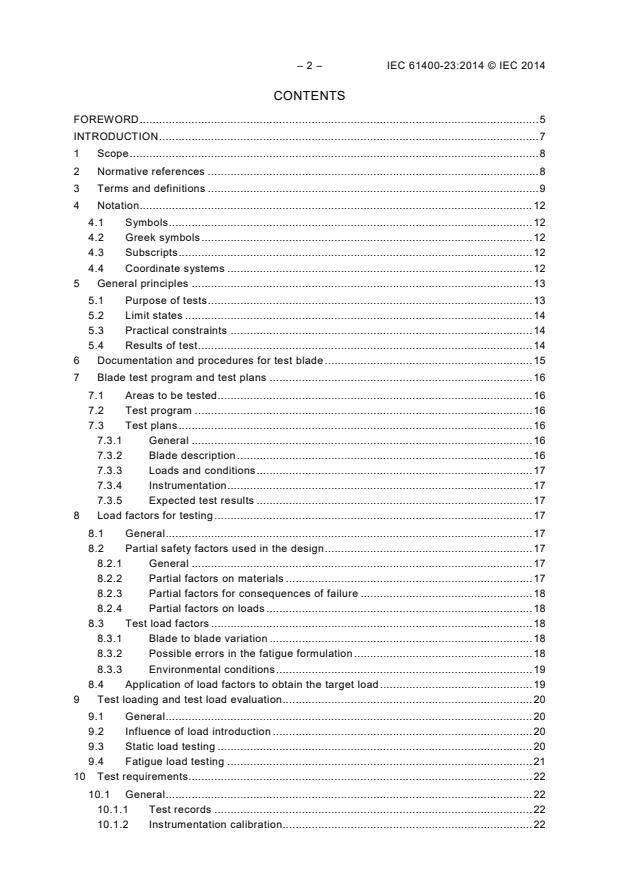
– 2 – IEC 61400-23:2014 © IEC 2014
CONTENTS
FOREWORD . 5
INTRODUCTION . 7
1 Scope . 8
2 Normative references . 8
3 Terms and definitions . 9
4 Notation . 12
4.1 Symbols . 12
4.2 Greek symbols . 12
4.3 Subscripts . 12
4.4 Coordinate systems . 12
5 General principles . 13
5.1 Purpose of tests . 13
5.2 Limit states . 14
5.3 Practical constraints . 14
5.4 Results of test . 14
6 Documentation and procedures for test blade . 15
7 Blade test program and test plans . 16
7.1 Areas to be tested . 16
7.2 Test program . 16
7.3 Test plans . 16
7.3.1 General . 16
7.3.2 Blade description . 16
7.3.3 Loads and conditions . 17
7.3.4 Instrumentation . 17
7.3.5 Expected test results . 17
8 Load factors for testing . 17
8.1 General . 17
8.2 Partial safety factors used in the design . 17
8.2.1 General . 17
8.2.2 Partial factors on materials . 17
8.2.3 Partial factors for consequences of failure . 18
8.2.4 Partial factors on loads . 18
8.3 Test load factors . 18
8.3.1 Blade to blade variation . 18
8.3.2 Possible errors in the fatigue formulation . 18
8.3.3 Environmental conditions . 19
8.4 Application of load factors to obtain the target load . 19
9 Test loading and test load evaluation . 20
9.1 General . 20
9.2 Influence of load introduction . 20
9.3 Static load testing . 20
9.4 Fatigue load testing . 21
10 Test requirements. 22
10.1 General . 22
10.1.1 Test records . 22
10.1.2 Instrumentation calibration. 22
10.1.3 Measurement uncertainties . 22
10.1.4 Root fixture and test stand requirements . 22
10.1.5 Environmental conditions monitoring . 22
10.1.6 Deterministic corrections . 23
10.2 Static test . 23
10.2.1 General . 23
10.2.2 Static load test. 23
10.2.3 Strain measurement . 24
10.2.4 Deflection measurement . 24
10.3 Fatigue test . 24
10.4 Other blade property tests . 24
10.4.1 Blade mass and center of gravity . 24
10.4.2 Natural frequencies . 25
10.4.3 Optional blade property tests . 25
11 Test results evaluation. 25
11.1 General . 25
11.2 Catastrophic failure . 25
11.3 Permanent deformation, loss of stiffness or change in other blade properties . 26
11.4 Superficial damage . 26
11.5 Failure evaluation . 26
12 Reporting . 26
12.1 General . 26
12.2 Test report content. 27
12.3 Evaluation of test in relation to design requirements . 27
Annex A (informative) Guidelines for the necessity of renewed static and fatigue
testing . 28
Annex B (informative) Areas to be tested . 29
Annex C (informative) Effects of large deflections and load direction . 30
Annex D (informative) Formulation of test load . 31
D.1 Static target load. 31
D.2 Fatigue target load . 31
D.3 Sequential single-axial, single location . 34
D.4 Multi axial single location . 34
Annex E (informative) Differences between design and test load conditions . 36
E.1 General . 36
E.2 Load introduction . 36
E.3 Bending moments and shear . 36
E.4 Flapwise and lead-lag combinations . 36
E.5 Radial loads . 37
E.6 Torsion loads . 37
E.7 Environmental conditions . 37
E.8 Fatigue load spectrum and sequence . 37
Annex F (informative) Determination of number of load cycles for fatigue tests . 38
F.1 General . 38
F.2 Background . 38
F.3 The approach used . 38
Bibliography . 43
– 4 – IEC 61400-23:2014 © IEC 2014
Figure 1 – Chordwise (flatwise, edgewise) coordinate system . 13
Figure 2 – Rotor (flapwise, lead-lag) coordinate system . 13
Figure C.1 – Applied loads effects due to blade deformation and angulation . 30
Figure D.1 – Polar plot of the load envelope from a typical blade . 31
Figure D.2 – Design FSF . 33
Figure D.3 – Area where design FSF is smaller than 1,4 (critical area) . 33
Figure D.4 – rFSF and critical areas, sequential single-axial test . 34
Figure D.5 – rFSF and critical area, multi axial test . 35
Figure E.1 – Difference of moment distribution for target and actual test load . 36
Figure F.1 – Simplified Goodman diagram . 39
Figure F.2 – Test load factor γ for different number of load cycles in the test . 42
ef
Table 1 – Recommended values for γ for different number of load cycles . 18
ef
Table A.1 – Examples of situations typically requiring or not requiring renewed testing . 28
Table F.1 – Recommended values for γ for different number of load cycles . 38
ef
Table F.2 – Expanded recommended values for γ for different number of load cycles . 41
ef
INTERNATIONAL ELECTROTECHNICAL COMMISSION
____________
WIND TURBINES –
Part 23: Full-scale structural testing of rotor blades
FOREWORD
1) The International Electrotechnical Commission (IEC) is a worldwide organization for standardization comprising
all national electrotechnical committees (IEC National Committees). The object of IEC is to promote
international co-operation on all questions concerning standardization in the electrical and electronic fields. To
this end and in addition to other activities, IEC publishes International Standards, Technical Specifications,
Technical Reports, Publicly Available Specifications (PAS) and Guides (hereafter referred to as “IEC
Publication(s)”). Their preparation is entrusted to technical committees; any IEC National Committee interested
in the subject dealt with may participate in this preparatory work. International, governmental and non-
governmental organizations liaising with the IEC also participate in this preparation. IEC collaborates closely
with the International Organization for Standardization (ISO) in accordance with conditions determined by
agreement between the two organizations.
2) The formal decisions or agreements of IEC on technical matters express, as nearly as possible, an international
consensus of opinion on the relevant subjects since each technical committee has representation from all
interested IEC National Committees.
3) IEC Publications have the form of recommendations for international use and are accepted by IEC National
Committees in that sense. While all reasonable efforts are made to ensure that the technical content of IEC
Publications is accurate, IEC cannot be held responsible for the way in which they are used or for any
misinterpretation by any end user.
4) In order to promote international uniformity, IEC National Committees undertake to apply IEC Publications
transparently to the maximum extent possible in their national and regional publications. Any divergence
between any IEC Publication and the corresponding national or regional publication shall be clearly indicated in
the latter.
5) IEC itself does not provide any attestation of conformity. Independent certification bodies provide conformity
assessment services and, in some areas, access to IEC marks of conformity. IEC is not responsible for any
services carried out by independent certification bodies.
6) All users should ensure that they have the latest edition of this publication.
7) No liability shall attach to IEC or its directors, employees, servants or agents including individual experts and
members of its technical committees and IEC National Committees for any personal injury, property damage or
other damage of any nature whatsoever, whether direct or indirect, or for costs (including legal fees) and
expenses arising out of the publication, use of, or reliance upon, this IEC Publication or any other IEC
Publications.
8) Attention is drawn to the Normative references cited in this publication. Use of the referenced publications is
indispensable for the correct application of this publication.
9) Attention is drawn to the possibility that some of the elements of this IEC Publication may be the subject of
patent rights. IEC shall not be held responsible for identifying any or all such patent rights.
International Standard IEC 61400-23 has been prepared by IEC technical committee 88: Wind
turbines.
This bilingual version (2019-01) corresponds to the monolingual English version, published in
2014-04.
This first edition cancels and replaces IEC TS 61400-23, published in 2001. It constitutes a
technical revision.
This edition includes the following significant technical changes with respect to
IEC TS 61400-23:
a) description of load based testing only;
b) condensation to describe the general principles and demands.
– 6 – IEC 61400-23:2014 © IEC 2014
The text of this standard is based on the following documents:
CDV Report on voting
88/420/CDV 88/448/RVC
Full information on the voting for the approval of this standard can be found in the report on
voting indicated in the above table.
The French version of this standard has not been voted upon.
This publication has been drafted in accordance with the ISO/IEC Directives, Part 2.
A list of all parts in the IEC 61400 series, published under the general title Wind turbines, can
be found on the IEC website.
The committee has decided that the contents of this publication will remain unchanged until
the stability date indicated on the IEC web site under "http://webstore.iec.ch" in the data
related to the specific publication. At this date, the publication will be
• reconfirmed,
• withdrawn,
• replaced by a revised edition, or
• amended.
IMPORTANT – The 'colour inside' logo on the cover page of this publication indicates
that it contains colours which are considered to be useful for the correct
understanding of its contents. Users should therefore print this document using a
colour printer.
INTRODUCTION
The blades of a wind turbine rotor are generally regarded as one of the most critical
components of the wind turbine system. In this standard, the demands for full-scale structural
testing related to certification are defined as well as the interpretation and evaluation of test
results.
Specific testing methods or set-ups for testing are not demanded or included as full-scale
blade testing methods historically have developed independently in different countries and
laboratories.
Furthermore, demands for tests determining blade properties are included in this standard in
order to validate some vital design assumptions used as inputs for the design load
calculations.
Any of the requirements of this standard may be altered if it can be suitably demonstrated that
the safety of the system is not compromised.
The standard is based on IEC TS 61400-23 published in 2001. Compared to the TS, this
standard only describes load based testing and is condensed to describe the general
principles and demands.
– 8 – IEC 61400-23:2014 © IEC 2014
WIND TURBINES –
Part 23: Full-scale structural testing of rotor blades
1 Scope
This part of IEC 61400 defines the requirements for full-scale structural testing of wind turbine
blades and for the interpretation and evaluation of achieved test results. The standard
focuses on aspects of testing related to an evaluation of the integrity of the blade, for use by
manufacturers and third party investigators.
The following tests are considered in this standard:
• static load tests;
• fatigue tests;
• static load tests after fatigue tests;
• tests determining other blade properties.
The purpose of the tests is to confirm to an acceptable level of probability that the whole
population of a blade type fulfils the design assumptions.
It is assumed that the data required to define the parameters of the tests are available and
based on the standard for design requirements for wind turbines such as IEC 61400-1 or
equivalent. Design loads and blade material data are considered starting points for
establishing and evaluating the test loads. The evaluation of the design loads with respect to
the actual loads on the wind turbines is outside the scope of this standard.
At the time this standard was written, full-scale tests were carried out on blades of horizontal
axis wind turbines. The blades were mostly made of fibre reinforced plastics and wood/epoxy.
However, most principles would be applicable to any wind turbine configuration, size and
material.
2 Normative references
The following documents, in whole or in part, are normatively referenced in this document and
are indispensable for its application. For dated references, only the edition cited applies. For
undated references, the latest edition of the referenced document (including any
amendments) applies.
IEC 60050-415:1999, International Electrotechnical Vocabulary – Part 415: Wind turbine
generator systems
IEC 61400-1:2005, Wind turbines – Part 1: Design requirements
ISO/IEC 17025:2005, General requirements for the competence of testing and calibration
laboratories
ISO 2394:1998, General principles on reliability for structures
3 Terms and definitions
For the purposes of this document, the terms and definitions related to wind turbines or wind
energy given in IEC 60050-415 and the following apply.
3.1
actuator
device that can be controlled to apply a constant or varying force and displacement
3.2
blade root
that part of the rotor blade that is connected to the hub of the rotor
3.3
blade subsystem
integrated set of items that accomplishes a defined objective or function within the blade (e.g.,
lightning protection subsystem, aerodynamic braking subsystem, monitoring subsystem,
aerodynamic control subsystem, etc.)
3.4
buckling
instability characterized by a non-linear increase in out of plane deflection with a change in
local compressive load
3.5
chord
length of a reference straight line that joins the leading and trailing edges of a blade aerofoil
cross-section at a given spanwise location
3.6
constant amplitude loading
during a fatigue test, the application of load cycles with a constant amplitude and mean value
3.7
creep
time-dependant increase in strain under a sustained load
3.8
design loads
loads the blade is designed to withstand, including appropriate partial safety factors
3.9
edgewise
direction that is parallel to the local chord
SEE: 4.4.
3.10
elastic axis
the line, lengthwise of the blade, along which transverse loads are applied in order to produce
bending only, with no torsion at any section
Note 1 to entry: Strictly speaking, no such line exists except for a few conditions of loading. Usually the elastic
axis is assumed to be the line that passes through the elastic center of every section. This definition is not
applicable for blades with bend-twist coupling.
3.11
fatigue formulation
methodology by which the fatigue life is estimated
– 10 – IEC 61400-23:2014 © IEC 2014
3.12
fatigue test
test in which a cyclic load of constant or varying amplitude is applied to the test specimen
3.13
fixture
component or device to introduce loads or to support the test specimen
3.14
flapwise
direction that is perpendicular to the surface swept by the undeformed rotor blade axis
SEE: 4.4.
3.15
flatwise
direction that is perpendicular to the local chord, and spanwise blade axis
SEE: 4.4.
3.16
full-scale test
test carried out on the actual blade or part thereof
3.17
inboard
towards the blade root
3.18
lead-lag
direction that is parallel to the plane of the swept surface and perpendicular to the longitudinal
axis of the undeformed rotor blade
SEE 4.4.
3.19
load envelope
collection of maximum design loads in all directions and spanwise positions
3.20
natural frequency
eigen frequency
frequency at which a structure will vibrate when perturbed and allowed to vibrate freely
3.21
partial safety factors
factors that are applied to loads and material strengths to account for uncertainties in the
representative (characteristic) values
3.22
prebend
blade curvature in the flapwise plane in the unloaded condition
3.23
R-value
ratio between minimum and maximum value during a load cycle
3.24
S-N formulation
method used to describe the stress and/or strain (S) vs. cycle (N) characteristics of a material,
component or structure
3.25
spanwise
direction parallel to the longitudinal axis of a rotor blade
3.26
static test
test with an application of a single load cycle without introducing dynamic effects
3.27
stiffness
ratio of change of force to the corresponding change in displacement of an elastic body
3.28
strain
ratio of the elongation (or shear displacement) of a material subjected to stress to the original
length of the material
3.29
sweep
blade curvature in the lead-lag plane in the unloaded condition
3.30
tare loads
gravitational or other loads that are inherent to the test set-up
3.31
target load
load that is developed from the design load and is the ideal test load
3.32
test load
forces applied during a test
3.33
tested area
region of the test object that experiences the intended loading
3.34
twist
spanwise variation in angle of the chord lines of blade cross-sections
3.35
variable amplitude loading
application of load cycles of non-constant mean and/or cyclic range
3.36
whiffle tree
device for distributing a single load source over multiple points on a test specimen
– 12 – IEC 61400-23:2014 © IEC 2014
4 Notation
4.1 Symbols
C conversion factors for material strength
D theoretical damage
F load
F flatwise shear force (chordwise co-ordinates)
a
F edgewise shear force (chordwise co-ordinates)
b
F spanwise (tensile) force (chordwise co-ordinates)
c
F flapwise shear force (rotor co-ordinate system)
x
F lead-lag shear force (rotor co-ordinate system)
y
F spanwise (tensile) force (rotor co-ordinate system)
z
M edgewise bending moment (chordwise co-ordinates)
a
M flatwise bending moment (chordwise co-ordinates)
b
M blade torsion moment (chordwise co-ordinates)
c
M lead-lag bending moment (rotor co-ordinate system)
x
M flapwise bending moment (rotor co-ordinate system)
y
M blade torsion moment (rotor co-ordinate system)
z
N cycle
S strain or stress
4.2 Greek symbols
γ partial factor or test load factor
σ applied stress or strain
4.3 Subscripts
design design loading conditions
df design load: fatigue
du design load: static
ef uncertainty in fatigue formulation of test load
f load
lf environmental effects: fatigue
lu environmental effects: static
m material
n consequence of failure
nf consequence of failure: fatigue
nu consequence of failure: static
sf blade to blade variation: fatigue test load
su blade to blade variation: static test load
target target loading conditions
test test loading conditions
4.4 Coordinate systems
Two different coordinate systems may be used for reference during structural testing. The first,
shown in Figure 1, references the local blade chord directions. The second, shown in Figure
2, references the global rotor plane directions.
Loads are along and perpendicular
y
to the local blade chord directions
M Edgewise bending moment
x a
M Flatwise bending moment
b
M Torsion moment
c
Deformed
F Flatwise shear force
blade axis a
z
F Edgewise shear force
b
Undeformed
F
F Axial force
b c
blade axis
1 Torsion angle
M
b
2 Flapwise translation
3 Lead-lag translation
F
a
M
M
a
c
3 F
c
IEC
Figure 1 – Chordwise (flatwise, edgewise) coordinate system
y
Loads are along the rotor plane
reference directions
x
M Lead-lag bending moment
x
M Flapwise bending moment
y
Deformed
M Torsion moment
z
z blade axis
F Flapwise shear force
x
Undeformed
F Lead-lag shear force
y
blade axis
F Spanwise force
z
F
y
1 Flapwise translation
M
y
2 Lead-lag translation
F
x
M
x
M
z
F
z
IEC
Figure 2 – Rotor (flapwise, lead-lag) coordinate system
5 General principles
5.1 Purpose of tests
The fundamental purpose of a wind turbine blade test is to demonstrate to a reasonable level
of certainty that a blade type, when manufactured according to a certain set of specifications,
has the prescribed reliability with reference to specific limit states, or, more precisely, to verify
that the specified limit states are not reached and the blades therefore possess the load
carrying capability and service life provided for in the design.
– 14 – IEC 61400-23:2014 © IEC 2014
Additionally, tests determining blade properties have to be performed in order to validate
some vital design assumptions used as inputs for the design load calculations. It has to be
pointed out that the required blade property tests do not cover all design assumptions.
Normally, the full-scale tests dealt within this standard are tests on a limited number of
samples; only one or two blades of a given design are tested, so no statistical distribution of
production blade load carrying capability can be obtained. Although the tests do give
information valid for the blade type, they cannot replace either a rigorous design process or
the quality system for series blade production. Furthermore, the tests described in this
standard are not intended to be used for the testing of mechanism function nor to establish
basic material strength or fatigue design data for blades and/or components.
5.2 Limit states
To establish and evaluate the test load, a certain amount of information about the design shall
be known. Usually the blades are designed according to some standard or code of practice
such as IEC 61400-1 that uses the principles of ISO 2394 defining the limit states and partial
coefficients, which have to be applied to obtain the corresponding design values. A limit state
is a state of the structure and the loads acting upon it, beyond which the structure no longer
satisfies the design requirements. The partial coefficients reflect uncertainties and are chosen
– at least in principle – in order to keep the probability of a limit state being reached below a
certain value prescribed for the structure. According to this, a blade should pass the test if the
limit state is not reached when the blade is exposed to the test load, representative of the
design load.
The basis for establishing the test loads is the entire envelope of blade design loads, derived
according to IEC 61400-1 or equivalent. The representative test load can be higher than the
design load to account for other influences, for example, environmental effects, test
uncertainties, and variations in production (see Clause 8).
The determination of the actual margins to the limit states might be desirable because such
margins can provide a measure of the actual safety obtained for the resistance of the test
blade. However, interpretation of such values is not straightforward and probabilistic methods
have to be applied. In this standard, only the ultimate limit state and fatigue are dealt with.
5.3 Practical constraints
The practical execution of the tests is subject to many constraints of a technical and economic
character. Some of the most important are listed below:
• the distributed load on the blade can be simulated only approximately;
• the time available for testing is generally one year or less;
• only one or a few blades can be tested;
• certain failures are difficult to detect.
The test will be a compromise because these constraints have to be dealt with in such a way
that the final test results can be used for evaluation of the defined limit states.
As regards the interpretation of the results, it should be borne in mind that the blade used for
testing will normally be one of the first blades from series production which will be subject to
evolutionary modifications. Even minor modifications could compromise the validity of the
tests (see Annex A).
5.4 Results of test
The design loads form the basis of the test loading. According to the design calculation, the
blade shall be able to survive the design loading. In these design calculations, a number of
assumptions are implicitly being made:
• the stresses or strains are calculated accurately or conservatively estimated;
• the classifications of strength and fatigue resistance of all relevant materials and details
are estimated accurately or conservatively;
• the strength and fatigue formulations used to calculate the strength are accurate or
conservative;
• the production is according to the design.
In a full-scale test used as final design verification, the validity of the assumptions mentioned
above are checked simultaneously. When a blade fails during testing, at least one of these
assumptions has been violated, although without further analysis it might not be clear what
caused this unexpected failure.
If no damage to the blade has occurred during the test and the blade structure and the test
loading has been evaluated correctly, this gives a strong indication that the blade design will
fulfil its requirements. It should be noted that the blade property tests make it possible to
check some of the main design assumptions used for the design calculations.
6 Documentation and procedures for test blade
The blade manufacturer shall record traceable documentary evidence for the design and
construction of the test blade. The records should cover:
• unique identification;
• relevant drawings and specifications;
• lamination plans and work instructions;
• listing of manufacturer, type and identification number for all important materials used;
• supplier’s certificate and blade manufactures laboratory acceptance report for all important
materials used;
• curing history thermographs for thermosetting resins and adhesives at critical locations;
• differential scanning calorimetry or other control of curing;
• manufacturing quality record sheets signed by responsible person;
• weight and balance report detailing total mass and centre of gravity. This report shall
include information about any loose items fitted during weighing e.g., root joint elements
and damper fluids;
• relevant reports on manufacturing deviations.
Repairs shall also be documented. The records should cover the above list. Repairs may be:
• representative examples for repair procedures for manufacturing defects and in-service
damage that are qualified with the test blade;
• repairs performed due to damage caused by test loads higher than the target loads (see
9.3 and 9.4).
Special blade modifications can be present for test purposes. During the fatigue tests the
loads may have to be magnified to complete the test within an acceptable time-frame. In some
cases, the required magnification of the fatigue loads may lead to failure of areas not
considered to be tested. In these cases, special blade modifications can be considered.
Modification might also be due to load introduction reinforcements. All special blade
modifications shall be documented.
– 16 – IEC 61400-23:2014 © IEC 2014
7 Blade test program and test plans
7.1 Areas to be tested
No single test can load the whole blade optimally. All critical areas should be loaded at a
minimum to the target loads. These areas are discussed in Annex B. Lead-lag and flap tests
may be sufficient – but that shall be evaluated (see Annex D).
7.2 Test program
The test program for a blade type shall be composed of at least the following tests in this
order:
• mass, centre of gravity and natural frequencies (see 10.4.1 and 10.4.2);
• static tests (see 9.3 and 10.2);
• fatigue load tests (see 9.4 and 10.3);
• post fatigue static tests.
Testing of other blade properties could be of interest (see 10.4.3).
All tests in a given direction and in a given area of a blade shall be performed on the same
blade part. The flap and lead-lag sequence of testing may be performed on two separate
blades. However, if an area of the blade is critical due to the combination of flap and lead-lag
loading, then the entire test sequence shall be performed on one blade.
The test program shall include blade inspection (see Clause 11).
7.3 Test plans
7.3.1 General
Test plans shall be established for all the individual tests in the blade test program. The test
plans shall include a blade description, specification of loads, conditions and the
instrumentation to be applied in the test.
7.3.2 Blade description
The blade description in the test plan shall be sufficient to ensure that the blade will fit the
test stand and avoid unintended overloading during storage, handling, lifting, mounting and
testing in the laboratory.
The following information shall be supplied:
• blade geometry (preferably in form of a drawing):
– blade length;
– chord and twist distribution;
– pre-bend or sweep;
• mass and center of gravity;
• blade surface condition;
• blade mounting details:
– bolt
...
IEC 61400-23:2014 is a standard that outlines the requirements for conducting full-scale structural testing on wind turbine blades. The purpose of these tests is to assess the integrity of the blades and ensure they meet design requirements. The standard covers various types of tests including static load tests, fatigue tests, static load tests after fatigue tests, and tests for determining other blade properties. The goal of these tests is to ensure that a whole population of blades of a specific type satisfies the design assumptions with an acceptable level of probability. The standard is intended for use by manufacturers and third-party investigators.
IEC 61400-23:2014は、風力タービンのローターブレードのフルスケール構造試験およびその試験結果の解釈と評価の要件を定義しています。この規格は、製造業者や第三者の調査機関が使用するために、ブレードの完全性の評価に関連する試験の側面に焦点を当てています。この規格では、以下の試験が考慮されています: - 静的荷重試験 - 疲労試験 - 疲労試験後の静的荷重試験 - その他のブレード特性を決定する試験 これらの試験の目的は、特定のブレード型の全てのブレードが設計の前提条件を適切な確率水準で満たしていることを確認することです。この規格は、製造業者と第三者の調査機関が利用することを目的としています。
IEC 61400-23:2014은 풀스케일 구조 시험과 이를 통한 결과 해석과 평가에 대한 요구사항을 정의하는 기준으로, 풀스케일 구조 시험을 위한 제작업체와 제3자 조사원들에게 관련 정보를 제공합니다. 이 기준에서는 다음과 같은 시험들이 고려됩니다: - 정적하중 시험 - 피로 시험 - 피로 시험 이후 정적하중 시험 - 다른 날개 특성을 결정하는 시험 이러한 시험들의 목적은 특정 유형의 날개가 설계 가정을 수용 가능한 수준으로 충족하는지에 대한 확률을 확인하는 것입니다.
Questions, Comments and Discussion
Ask us and Technical Secretary will try to provide an answer. You can facilitate discussion about the standard in here.
Loading comments...