

IEC 62477-1:2012
(Main)Safety requirements for power electronic converter systems and equipment - Part 1: General
General Information
- Abstract
IEC 62477-1:2012 applies to Power Electronic Converter Systems (PECS) and equipment, their components for electronic power conversion and electronic power switching, including the means for their control, protection, monitoring and measurement, such as with the main purpose of converting electric power, with rated system voltages not exceeding 1 000 V a.c. or 1 500 V d.c. This document may also be used as a reference standard for product committees producing product standards for:
- adjustable speed electric power drive systems (PDS);
- standalone uninterruptible power systems (UPS);
- low voltage stabilized d.c. power supplies.
For PECS for which no product standard exists, this standard provides minimum requirements for safety aspects. This part of IEC 62477 has the status of a group safety publication in accordance with IEC Guide 104 for power electronic converter systems and equipment for solar, wind, tidal, wave, fuel cell or similar energy sources. According to IEC Guide 104, one of the responsibilities of technical committees is, wherever applicable, to make use of basic safety publications and/or group safety publications in the preparation of their product standards. This International Standard:
- establishes a common terminology for safety aspects relating to PECS and equipment;
- establishes minimum requirements for the coordination of safety aspects of interrelated parts within a PECS;
- establishes a common basis for minimum safety requirements for the PEC portion of products that contain PEC;
- specifies requirements to reduce risks of fire, electric shock, thermal, energy and mechanical hazards, during use and operation and, where specifically stated, during service and maintenance;
- specifies minimum requirements to reduce risks with respect to pluggable and permanently connected equipment, whether it consists of a system of interconnected units or independent units, subject to installing, operating and maintaining the equipment in the manner prescribed by the manufacturer.
This International Standard does not cover:
- telecommunications apparatus other than power supplies to such apparatus;
- functional safety aspects as covered by e.g. IEC 61508;
- electrical equipment and systems for railways applications and electric vehicles.
- Status
- Published
- Publication Date
- 27-Jul-2016
- Technical Committee
- TC 22 - Power electronic systems and equipment
- Drafting Committee
- MT 9 - TC 22/MT 9
- Current Stage
- DELPUB - Deleted Publication
- Start Date
- 20-May-2022
- Completion Date
- 28-Aug-2026
Buy Documents
IEC 62477-1:2012 - Safety requirements for power electronic converter systems and equipment - Part 1: General Released:7/24/2012

IEC 62477-1:2012+AMD1:2016 CSV - Safety requirements for power electronic converter systems and equipment - Part 1: General Released:7/28/2016
Overview
IEC 62477-1:2012 is an international standard published by the International Electrotechnical Commission (IEC) that defines the safety requirements for power electronic converter systems (PECS) and equipment. Part 1 of this standard focuses on the general safety aspects applicable to PECS designed for converting electric power, with system voltages up to 1,000 V AC or 1,500 V DC. This standard applies to power electronic components, power switching devices, and their control, protection, monitoring, and measurement means.
As a group safety publication, IEC 62477-1 sets minimum safety requirements and establishes a common terminology for PECS safety. It supports product committees by providing a reference framework for product standards related to adjustable speed drives, uninterruptible power supplies (UPS), and low-voltage stabilized DC power supplies.
Key Topics
IEC 62477-1:2012 addresses a comprehensive range of safety topics, including:
- Protection Against Hazards: Covers fire, electric shock, thermal, mechanical, and energy hazards during normal use, maintenance, and servicing.
- Fault and Abnormal Conditions: Specifies how PECS must withstand short circuits, overloads, and fault conditions without compromising safety.
- Electric Shock Protection: Details requirements for basic and fault protection, insulation levels, and enhanced protective measures to mitigate electrical shock risks.
- Fire and Thermal Safety: Establishes temperature limits, fire enclosure specifications, and requirements for circuits and components presenting fire hazards.
- Mechanical Safety: Includes provisions for enclosures, handles, and stability tests, especially for liquid-cooled PECS.
- Environmental Considerations: Covers protection against environmental stresses, sonic pressure hazards, and wiring and connection safety.
- Testing and Verification: Defines rigorous test procedures such as visual inspections, mechanical and electrical tests, fault simulation, and environmental resistance evaluations.
- Information and Marking: Specifies manufacturer requirements for labels, handling instructions, installation guidance, and maintenance-related information to ensure safe operation.
Applications
IEC 62477-1:2012 is highly relevant for manufacturers, designers, and testing agencies involved with the following:
- Adjustable Speed Electric Power Drive Systems (PDS): Ensuring safe converter operation when controlling motor speeds.
- Standalone Uninterruptible Power Supplies (UPS): Defining safety parameters critical to backup power electronics.
- Low Voltage DC Power Supplies: Setting minimum safety requirements for power conversion devices.
- Renewable Energy Systems: Serving as a group safety publication for solar, wind, tidal, wave, and fuel cell energy converters.
- Custom or Emerging PECS Designs: Providing foundational safety criteria when no dedicated product standards exist.
By adhering to IEC 62477-1, manufacturers can achieve compliance with recognized international safety benchmarks, contributing to product reliability, user protection, and global market acceptance.
Related Standards
IEC 62477-1 is part of a broader framework of standards concerning electrical safety and electronic power conversion, including:
- IEC 61508: Covers functional safety of electrical/electronic/programmable electronic safety-related systems, complementing but distinct from the safety scope of IEC 62477-1.
- Product-specific PECS standards: Various IEC product committees use IEC 62477-1 as a foundational reference when developing standards for adjustable speed drives, UPS, and stabilized power supplies.
- IEC Guide 104: Provides guidance on the preparation of group safety publications like IEC 62477-1 for power electronic converter systems.
- Electrical Equipment for Transportation: Separate standards cover railway applications and electric vehicles, which are excluded from the scope of IEC 62477-1.
Practical Value
Implementing the safety requirements of IEC 62477-1 ensures that power electronic converter systems:
- Mitigate risks of electric shock, thermal and fire hazards effectively.
- Withstand fault and abnormal conditions without compromising safety.
- Are compatible with protective devices such as residual current-operated protective devices (RCDs).
- Are equipped with clear manufacturer information to support safe installation, operation, and maintenance.
- Comply with internationally recognized safety norms, facilitating regulatory approvals and global market entry.
IEC 62477-1 thus serves as a critical standard for powering safe, reliable, and sustainable power electronic conversion solutions in diverse industrial and energy applications.
Relations
- Effective Date
- 05-Sep-2023
- Referred By
EN ISO 19085-1:2021 - Woodworking machines - Safety - Part 1: Common requirements (ISO 19085-1:2021) - Effective Date
- 25-Aug-2026
- Effective Date
- 05-Sep-2023
- Effective Date
- 05-Sep-2023
Buy Documents
IEC 62477-1:2012 - Safety requirements for power electronic converter systems and equipment - Part 1: General Released:7/24/2012
IEC 62477-1:2012+AMD1:2016 CSV - Safety requirements for power electronic converter systems and equipment - Part 1: General Released:7/28/2016
Get Certified
Connect with accredited certification bodies for this standard

IMQ S.p.A. (Certification)
Italian electrical product certification.

SLG Prüf- und Zertifizierungs GmbH
German testing and certification body.

UL Solutions
Global safety science company with testing, inspection and certification.
Sponsored listings
Frequently Asked Questions
IEC 62477-1:2012 is a standard published by the International Electrotechnical Commission (IEC). Its full title is "Safety requirements for power electronic converter systems and equipment - Part 1: General". This standard covers: IEC 62477-1:2012 applies to Power Electronic Converter Systems (PECS) and equipment, their components for electronic power conversion and electronic power switching, including the means for their control, protection, monitoring and measurement, such as with the main purpose of converting electric power, with rated system voltages not exceeding 1 000 V a.c. or 1 500 V d.c. This document may also be used as a reference standard for product committees producing product standards for: - adjustable speed electric power drive systems (PDS); - standalone uninterruptible power systems (UPS); - low voltage stabilized d.c. power supplies. For PECS for which no product standard exists, this standard provides minimum requirements for safety aspects. This part of IEC 62477 has the status of a group safety publication in accordance with IEC Guide 104 for power electronic converter systems and equipment for solar, wind, tidal, wave, fuel cell or similar energy sources. According to IEC Guide 104, one of the responsibilities of technical committees is, wherever applicable, to make use of basic safety publications and/or group safety publications in the preparation of their product standards. This International Standard: - establishes a common terminology for safety aspects relating to PECS and equipment; - establishes minimum requirements for the coordination of safety aspects of interrelated parts within a PECS; - establishes a common basis for minimum safety requirements for the PEC portion of products that contain PEC; - specifies requirements to reduce risks of fire, electric shock, thermal, energy and mechanical hazards, during use and operation and, where specifically stated, during service and maintenance; - specifies minimum requirements to reduce risks with respect to pluggable and permanently connected equipment, whether it consists of a system of interconnected units or independent units, subject to installing, operating and maintaining the equipment in the manner prescribed by the manufacturer. This International Standard does not cover: - telecommunications apparatus other than power supplies to such apparatus; - functional safety aspects as covered by e.g. IEC 61508; - electrical equipment and systems for railways applications and electric vehicles.
IEC 62477-1:2012 applies to Power Electronic Converter Systems (PECS) and equipment, their components for electronic power conversion and electronic power switching, including the means for their control, protection, monitoring and measurement, such as with the main purpose of converting electric power, with rated system voltages not exceeding 1 000 V a.c. or 1 500 V d.c. This document may also be used as a reference standard for product committees producing product standards for: - adjustable speed electric power drive systems (PDS); - standalone uninterruptible power systems (UPS); - low voltage stabilized d.c. power supplies. For PECS for which no product standard exists, this standard provides minimum requirements for safety aspects. This part of IEC 62477 has the status of a group safety publication in accordance with IEC Guide 104 for power electronic converter systems and equipment for solar, wind, tidal, wave, fuel cell or similar energy sources. According to IEC Guide 104, one of the responsibilities of technical committees is, wherever applicable, to make use of basic safety publications and/or group safety publications in the preparation of their product standards. This International Standard: - establishes a common terminology for safety aspects relating to PECS and equipment; - establishes minimum requirements for the coordination of safety aspects of interrelated parts within a PECS; - establishes a common basis for minimum safety requirements for the PEC portion of products that contain PEC; - specifies requirements to reduce risks of fire, electric shock, thermal, energy and mechanical hazards, during use and operation and, where specifically stated, during service and maintenance; - specifies minimum requirements to reduce risks with respect to pluggable and permanently connected equipment, whether it consists of a system of interconnected units or independent units, subject to installing, operating and maintaining the equipment in the manner prescribed by the manufacturer. This International Standard does not cover: - telecommunications apparatus other than power supplies to such apparatus; - functional safety aspects as covered by e.g. IEC 61508; - electrical equipment and systems for railways applications and electric vehicles.
IEC 62477-1:2012 is classified under the following ICS (International Classification for Standards) categories: 29.200 - Rectifiers. Convertors. Stabilized power supply. The ICS classification helps identify the subject area and facilitates finding related standards.
IEC 62477-1:2012 has the following relationships with other standards: It is inter standard links to IEC 62103:2003, EN ISO 19085-1:2021, IEC 62477-1:2012/AMD1:2016, IEC 62477-1:2022. Understanding these relationships helps ensure you are using the most current and applicable version of the standard.
IEC 62477-1:2012 is available in PDF format for immediate download after purchase. The document can be added to your cart and obtained through the secure checkout process. Digital delivery ensures instant access to the complete standard document.
Standards Content (Sample)
IEC 62477-1 ®
Edition 1.0 2012-07
INTERNATIONAL
STANDARD
NORME
INTERNATIONALE
colour
inside
GROUP SAFETY PUBLICATION
PUBLICATION GROUPÉE DE SÉCURITÉ
Safety requirements for power electronic converter systems and equipment –
Part 1: General
Exigences de sécurité applicables aux systèmes et matériels électroniques
de conversion de puissance –
Partie 1: Généralités
All rights reserved. Unless otherwise specified, no part of this publication may be reproduced or utilized in any form
or by any means, electronic or mechanical, including photocopying and microfilm, without permission in writing from
either IEC or IEC's member National Committee in the country of the requester.
If you have any questions about IEC copyright or have an enquiry about obtaining additional rights to this publication,
please contact the address below or your local IEC member National Committee for further information.
Droits de reproduction réservés. Sauf indication contraire, aucune partie de cette publication ne peut être reproduite ni
utilisée sous quelque forme que ce soit et par aucun procédé, électronique ou mécanique, y compris la photocopie et les
microfilms, sans l'accord écrit de la CEI ou du Comité national de la CEI du pays du demandeur.
Si vous avez des questions sur le copyright de la CEI ou si vous désirez obtenir des droits supplémentaires sur cette
publication, utilisez les coordonnées ci-après ou contactez le Comité national de la CEI de votre pays de résidence.
IEC Central Office Tel.: +41 22 919 02 11
3, rue de Varembé Fax: +41 22 919 03 00
CH-1211 Geneva 20 info@iec.ch
Switzerland www.iec.ch
About the IEC
The International Electrotechnical Commission (IEC) is the leading global organization that prepares and publishes
International Standards for all electrical, electronic and related technologies.
About IEC publications
The technical content of IEC publications is kept under constant review by the IEC. Please make sure that you have the
latest edition, a corrigenda or an amendment might have been published.
Useful links:
IEC publications search - www.iec.ch/searchpub Electropedia - www.electropedia.org
The advanced search enables you to find IEC publications The world's leading online dictionary of electronic and
by a variety of criteria (reference number, text, technical electrical terms containing more than 30 000 terms and
committee,…). definitions in English and French, with equivalent terms in
It also gives information on projects, replaced and additional languages. Also known as the International
withdrawn publications. Electrotechnical Vocabulary (IEV) on-line.
IEC Just Published - webstore.iec.ch/justpublished Customer Service Centre - webstore.iec.ch/csc
Stay up to date on all new IEC publications. Just Published If you wish to give us your feedback on this publication
details all new publications released. Available on-line and or need further assistance, please contact the
also once a month by email. Customer Service Centre: csc@iec.ch.
A propos de la CEI
La Commission Electrotechnique Internationale (CEI) est la première organisation mondiale qui élabore et publie des
Normes internationales pour tout ce qui a trait à l'électricité, à l'électronique et aux technologies apparentées.
A propos des publications CEI
Le contenu technique des publications de la CEI est constamment revu. Veuillez vous assurer que vous possédez
l’édition la plus récente, un corrigendum ou amendement peut avoir été publié.
Liens utiles:
Recherche de publications CEI - www.iec.ch/searchpub Electropedia - www.electropedia.org
La recherche avancée vous permet de trouver des Le premier dictionnaire en ligne au monde de termes
publications CEI en utilisant différents critères (numéro de électroniques et électriques. Il contient plus de 30 000
référence, texte, comité d’études,…). termes et définitions en anglais et en français, ainsi que
Elle donne aussi des informations sur les projets et les les termes équivalents dans les langues additionnelles.
publications remplacées ou retirées. Egalement appelé Vocabulaire Electrotechnique
International (VEI) en ligne.
Just Published CEI - webstore.iec.ch/justpublished
Service Clients - webstore.iec.ch/csc
Restez informé sur les nouvelles publications de la CEI.
Just Published détaille les nouvelles publications parues. Si vous désirez nous donner des commentaires sur
Disponible en ligne et aussi une fois par mois par email. cette publication ou si vous avez des questions
contactez-nous: csc@iec.ch.
IEC 62477-1 ®
Edition 1.0 2012-07
INTERNATIONAL
STANDARD
NORME
INTERNATIONALE
colour
inside
GROUP SAFETY PUBLICATION
PUBLICATION GROUPÉE DE SÉCURITÉ
Safety requirements for power electronic converter systems and equipment –
Part 1: General
Exigences de sécurité applicables aux systèmes et matériels électroniques
de conversion de puissance –
Partie 1: Généralités
INTERNATIONAL
ELECTROTECHNICAL
COMMISSION
COMMISSION
ELECTROTECHNIQUE
PRICE CODE
INTERNATIONALE
XH
CODE PRIX
ICS 29.200 ISBN 978-2-83220-194-7
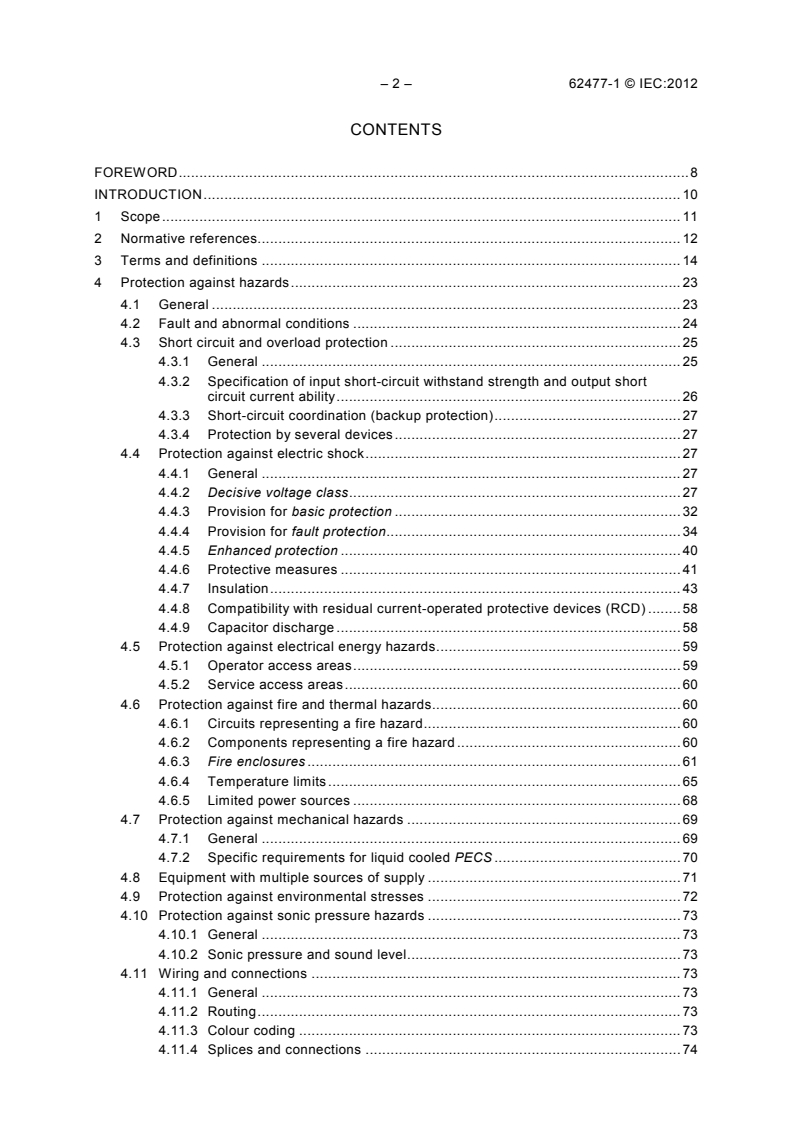
– 2 – 62477-1 © IEC:2012
CONTENTS
FOREWORD . 8
INTRODUCTION . 10
1 Scope . 11
2 Normative references. 12
3 Terms and definitions . 14
4 Protection against hazards . 23
4.1 General . 23
4.2 Fault and abnormal conditions . 24
4.3 Short circuit and overload protection . 25
4.3.1 General . 25
4.3.2 Specification of input short-circuit withstand strength and output short
circuit current ability . 26
4.3.3 Short-circuit coordination (backup protection) . 27
4.3.4 Protection by several devices . 27
4.4 Protection against electric shock . 27
4.4.1 General . 27
4.4.2 Decisive voltage class . 27
4.4.3 Provision for basic protection . 32
4.4.4 Provision for fault protection . 34
4.4.5 Enhanced protection . 40
4.4.6 Protective measures . 41
4.4.7 Insulation . 43
4.4.8 Compatibility with residual current-operated protective devices (RCD) . 58
4.4.9 Capacitor discharge . 58
4.5 Protection against electrical energy hazards . 59
4.5.1 Operator access areas . 59
4.5.2 Service access areas . 60
4.6 Protection against fire and thermal hazards . 60
4.6.1 Circuits representing a fire hazard . 60
4.6.2 Components representing a fire hazard . 60
4.6.3 Fire enclosures . 61
4.6.4 Temperature limits . 65
4.6.5 Limited power sources . 68
4.7 Protection against mechanical hazards . 69
4.7.1 General . 69
4.7.2 Specific requirements for liquid cooled PECS . 70
4.8 Equipment with multiple sources of supply . 71
4.9 Protection against environmental stresses . 72
4.10 Protection against sonic pressure hazards . 73
4.10.1 General . 73
4.10.2 Sonic pressure and sound level . 73
4.11 Wiring and connections . 73
4.11.1 General . 73
4.11.2 Routing . 73
4.11.3 Colour coding . 73
4.11.4 Splices and connections . 74
62477-1 © IEC:2012 – 3 –
4.11.5 Accessible connections . 74
4.11.6 Interconnections between parts of the PECS . 74
4.11.7 Supply connections . 75
4.11.8 Terminals . 75
4.12 Enclosures . 76
4.12.1 General . 76
4.12.2 Handles and manual controls . 76
4.12.3 Cast metal . 77
4.12.4 Sheet metal . 77
4.12.5 Stability test for enclosure . 80
5 Test requirements . 81
5.1 General . 81
5.1.1 Test objectives and classification . 81
5.1.2 Selection of test samples . 81
5.1.3 Sequence of tests . 81
5.1.4 Earthing conditions . 81
5.1.5 General conditions for tests . 81
5.1.6 Compliance . 82
5.1.7 Test overview . 83
5.2 Test specifications . 84
5.2.1 Visual inspections (type test, sample test and routine test) . 84
5.2.2 Mechanical tests . 84
5.2.3 Electrical tests . 88
5.2.4 Abnormal operation and simulated faults tests. 102
5.2.5 Material tests . 106
5.2.6 Environmental tests (type tests) . 110
5.2.7 Hydrostatic pressure test (type test and routine test) . 115
6 Information and marking requirements . 115
6.1 General . 115
6.2 Information for selection . 117
6.3 Information for installation and commissioning . 118
6.3.1 General . 118
6.3.2 Mechanical considerations . 118
6.3.3 Environment . 118
6.3.4 Handling and mounting . 118
6.3.5 Enclosure temperature . 118
6.3.6 Connections. 119
6.3.7 Protection requirements . 119
6.3.8 Commissioning . 121
6.4 Information for use . 121
6.4.1 General . 121
6.4.2 Adjustment . 121
6.4.3 Labels, signs and signals . 121
6.5 Information for maintenance . 123
6.5.1 General . 123
6.5.2 Capacitor discharge . 124
6.5.3 Auto restart/bypass connection . 124
6.5.4 Other hazards . 124
6.5.5 Equipment with multiple sources of supply . 124
– 4 – 62477-1 © IEC:2012
Annex A (normative) Additional information for protection against electric shock . 125
Annex B (informative) Considerations for the reduction of the pollution degree . 145
Annex C (informative) Symbols referred to in IEC 62477-1 . 146
Annex D (normative) Evaluation of clearance and creepage distances . 147
Annex E (informative) Altitude correction for clearances . 155
Annex F (normative) Clearance and creepage distance determination for frequencies
greater than 30 kHz . 156
Annex G (informative) Cross-sections of round conductors . 162
Annex H (informative) Guidelines for RCD compatibility . 163
Annex I (informative) Examples of overvoltage category reduction . 167
Annex J (informative) Burn thresholds for touchable surfaces . 174
Annex K (informative) Table of electrochemical potentials . 177
Annex L (informative) Measuring instrument for touch current measurements . 178
Annex M (informative) Test probes for determining access . 179
Bibliography . 182
Figure 1 – Touch time-d.c. peak voltage zones of ventricular fibrillation in dry skin
condition . 30
Figure 2 – Touch time- d.c. peak voltage zones of ventricular fibrillation in water-wet
skin condition . 31
Figure 3 – Touch time- d.c. peak voltage zones of ventricular fibrillation in saltwater-wet
skin condition . 31
Figure 4 – Example of a PECS assembly and its associated protective equipotential
bonding . 36
Figure 5 – Example of a PECS assembly and its associated protective equipotential
bonding . 37
Figure 6 – Fire enclosure bottom openings below an unenclosed or partially enclosed
fire-hazardous component . 63
Figure 7 – Fire enclosure baffle construction . 64
Figure 8 – Supported and unsupported enclosure parts . 78
Figure 9 – Impact test using a steel ball . 86
Figure 10 – Voltage test procedures . 93
Figure 11 – Protective equipotential bonding impedance test for separate unit with
power fed from the PECS with protection for the power cable . 99
Figure 12 – Protective equipotential bonding impedance test for sub-assembly with
accessible parts and with power fed from the PECS . 100
Figure 13 – Circuit for high-current arcing test . 107
Figure 14 – Test fixture for hot-wire ignition test . 108
Figure A.1 – Protection by DVC As with protective separation . 125
Figure A.2 – Protection by means of protective impedance . 126
Figure A.3 – Protection by using limited voltages . 127
Figure A.4 – Touch time- d.c. voltage zones for dry skin condition . 130
Figure A.5 – Touch time- d.c. voltage zones for water-wet skin condition . 130
Figure A.6 – Touch time- d.c. voltage for saltwater-wet skin condition . 131
Figure A.7 – Touch time- d.c. voltage zones of dry skin condition . 132
Figure A.8 – Touch time- d.c. voltage zones of water-wet skin condition . 132
62477-1 © IEC:2012 – 5 –
Figure A.9 – Touch time- d.c. voltage zones of saltwater-wet skin condition . 133
Figure A.10 – Touch time- d.c. voltage zones of dry skin condition . 134
Figure A.11 – Touch time- d.c. voltage zones of water-wet skin condition . 134
Figure A.12 – Touch time- a.c. voltage zones for dry skin condition . 135
Figure A.13 – Touch time- a.c. voltage zones of water-wet skin condition . 136
Figure A.14 – Touch time- a.c. voltage of saltwater-wet skin condition . 136
Figure A.15 – Touch time- a.c. voltage zones of dry skin condition . 137
Figure A.16 – Touch time- a.c. voltage zones of water-wet skin condition . 138
Figure A.17 – Touch time- a.c. voltage zones of saltwater-wet skin condition . 138
Figure A.18 – Touch time- a.c. voltage zones of dry skin condition . 139
Figure A.19 – Touch time- a.c. voltage zones of water-wet skin condition . 140
Figure A.20 – Typical waveform for a.c. working voltage . 141
Figure A.21 – Typical waveform for d.c. working voltage . 141
Figure A.22 – Typical waveform for pulsating working voltage . 142
Figure F.1 – Diagram for dimensioning of clearances . 157
Figure F.2 – Diagram for dimensioning of creepage distances . 159
Figure F.3 – Permissible field strength for dimensioning of solid insulation according to
Equation (1) . 161
Figure H.1 – Flow chart leading to selection of the RCD type upstream of a PECS . 163
Figure H.2 – Fault current waveforms in connections with power electronic converter
devices . 165
Figure I.1 – Basic insulation evaluation for circuits connected to the origin of the
installation mains supply . 167
Figure I.2 – Basic insulation evaluation for circuits connected to the mains supply . 168
Figure I.3 – Basic insulation evaluation for single and three phase equipment not
permanently connected to the mains supply . 168
Figure I.4 – Basic insulation evaluation for circuits connected to the origin of the
installation mains supply where internal SPDs are used . 168
Figure I.5 – Basic insulation evaluation for circuits connected to the mains supply where
internal SPDs are used . 169
Figure I.6 – Example of protective separation evaluation for circuits connected to the
mains supply where internal SPDs are used . 169
Figure I.7 – Example of protective separation evaluation for circuits connected to the
mains supply where internal SPDs are used . 170
Figure I.8 –Example of protective separation evaluation for circuits connected to the
mains supply where internal SPDs are used . 170
Figure I.9 – Basic insulation evaluation for circuits not connected directly to the mains
supply . 170
Figure I.10 – Basic insulation evaluation for circuits not connected directly to the supply
mains . 171
Figure I.11 – Functional insulation evaluation within circuits affected by external
transients . 171
Figure I.12 – Basic insulation evaluation for circuits both connected and not connected
directly to the mains supply . 172
Figure I.13 – Insulation evaluation for accessible circuit of DVC A . 172
Figure I.14 – PEC with mains and non-mains supply without galvanic separation . 173
– 6 – 62477-1 © IEC:2012
Figure I.15 – Transformer (basic) isolated PEC inverter with SPD and transformer to
reduce impulse voltage for functional and basic insulation. . 173
Figure J.1 – Burn threshold spread when the skin is in contact with a hot smooth
surface made of bare (uncoated) metal . 174
Figure J.2 – Rise in the burn threshold spread from Figure J.1 for metals which are
coated by shellac varnish of a thickness of 50 µm, 100 µm and 150 µm . 175
Figure J.3 – Rise in the burn threshold spread from Figure J.1 for metals coated with
the specific materials . 175
Figure J.4 – Burn threshold spread when the skin is in contact with a hot smooth
surface made of ceramics, glass and stone materials . 176
Figure J.5 – Burn threshold spread when the skin is in contact with a hot smooth
surface made of plastics . 176
Figure K.1 – Electrochemical potentials (V) . 177
Figure L.1 – Measuring instrument . 178
Figure M.1 – Sphere 50 mm probe (IPXXA) . 179
Figure M.2 – Jointed test finger (IPXXB) . 180
Figure M.3 – Test rod 2,5 mm (IP3X) . 181
Table 1 – Alphabetical list of terms . 15
Table 2 – Selection of DVC for touch voltage to protect against ventricular fibrillation . 28
Table 3 – Selection of body contact area . 29
Table 4 – Selection of humidity condition of the skin . 29
Table 5 – Steady state voltage limits for the decisive voltage classes . 29
Table 6 – Protection requirements for circuit under consideration . 32
a
Table 7 – PE conductor cross-section . 38
Table 8 – Definitions of pollution degrees . 43
Table 9 – Impulse withstand voltage and temporary overvoltage versus system voltage . 46
Table 10 – Clearance distances for functional, basic or supplementary insulation . 51
Table 11 – Creepage distances (in millimetres) . 53
Table 12 – Generic materials for the direct support of uninsulated live parts . 55
Table 13 – Permitted openings in fire enclosure bottoms . 64
Table 14 – Maximum measured total temperatures for internal materials and
components . 66
Table 15 – Maximum measured temperatures for accessible parts of the PECS . 68
Table 16 – Limits for sources without an overcurrent protective device . 69
Table 17 – Limits for power sources with an overcurrent protective device . 69
Table 18 – Environmental service conditions . 72
Table 19 – Wire bending space from terminals to enclosure . 76
Table 20 – Thickness of sheet metal for enclosures: carbon steel or stainless steel . 79
Table 21 – Thickness of sheet metal for enclosures: aluminium, copper or brass . 80
Table 22 – Test overview . 83
Table 23 – Pull values for handles and manual control securement . 88
Table 24 – Impulse voltage test . 89
Table 25 – Impulse test voltage . 90
Table 26 – AC or d.c. test voltage for circuits connected directly to mains supply . 91
62477-1 © IEC:2012 – 7 –
Table 27 – A.c. or d.c. test voltage for circuits connected to non-mains supply without
temporary overvoltages . 92
Table 28 – Partial discharge test . 95
Table 29 – Test duration for protective equipotential bonding test . 101
Table 30 – Environmental tests . 111
Table 31 – Dry heat test (steady state) . 112
Table 32 – Damp heat test (steady state) . 113
Table 33 – Vibration test . 114
Table 34 – Salt mist test . 114
Table 35 – Dust and sand test . 115
Table 36 – Information requirements . 116
Table A.1 – Selection of touch voltage sets to protect against ventricular fibrillation . 128
Table A.2 – Selection of touch voltage sets to protect against muscular reaction . 129
Table A.3 – Selection of touch voltage sets to protect against startle reaction . 129
Table A.4 – Examples for protection against electrical shock . 144
Table C.1 – Symbols used . 146
Table D.1 – Width of grooves by pollution degree . 147
Table E.1 – Correction factor for clearances at altitudes between 2 000 m and 20 000 m . 155
Table E.2 – Test voltages for verifying clearances at different altitudes . 155
Table F.1 – Minimum values of clearances in air at atmospheric pressure for
inhomogeneous field conditions (Table 1 of IEC 60664-4:2005) . 158
Table F.2 – Multiplication factors for clearances in air at atmospheric pressure for
approximately homogeneous field conditions . 158
Table F.3 – Minimum values of creepage distances for different frequency ranges
(Table 2 of IEC 60664-4:2005) . 160
Table G.1 – Standard cross-sections of round conductors . 162
– 8 – 62477-1 © IEC:2012
INTERNATIONAL ELECTROTECHNICAL COMMISSION
____________
SAFETY REQUIREMENTS FOR POWER ELECTRONIC
CONVERTER SYSTEMS AND EQUIPMENT –
Part 1: General
FOREWORD
1) The International Electrotechnical Commission (IEC) is a worldwide organization for standardization comprising
all national electrotechnical committees (IEC National Committees). The object of IEC is to promote
international co-operation on all questions concerning standardization in the electrical and electronic fields. To
this end and in addition to other activities, IEC publishes International Standards, Technical Specifications,
Technical Reports, Publicly Available Specifications (PAS) and Guides (hereafter referred to as “IEC
Publication(s)”). Their preparation is entrusted to technical committees; any IEC National Committee interested
in the subject dealt with may participate in this preparatory work. International, governmental and non-
governmental organizations liaising with the IEC also participate in this preparation. IEC collaborates closely
with the International Organization for Standardization (ISO) in accordance with conditions determined by
agreement between the two organizations.
2) The formal decisions or agreements of IEC on technical matters express, as nearly as possible, an international
consensus of opinion on the relevant subjects since each technical committee has representation from all
interested IEC National Committees.
3) IEC Publications have the form of recommendations for international use and are accepted by IEC National
Committees in that sense. While all reasonable efforts are made to ensure that the technical content of IEC
Publications is accurate, IEC cannot be held responsible for the way in which they are used or for any
misinterpretation by any end user.
4) In order to promote international uniformity, IEC National Committees undertake to apply IEC Publications
transparently to the maximum extent possible in their national and regional publications. Any divergence
between any IEC Publication and the corresponding national or regional publication shall be clearly indicated in
the latter.
5) IEC itself does not provide any attestation of conformity. Independent certification bodies provide conformity
assessment services and, in some areas, access to IEC marks of conformity. IEC is not responsible for any
services carried out by independent certification bodies.
6) All users should ensure that they have the latest edition of this publication.
7) No liability shall attach to IEC or its directors, employees, servants or agents including individual experts and
members of its technical committees and IEC National Committees for any personal injury, property damage or
other damage of any nature whatsoever, whether direct or indirect, or for costs (including legal fees) and
expenses arising out of the publication, use of, or reliance upon, this IEC Publication or any other IEC
Publications.
8) Attention is drawn to the Normative references cited in this publication. Use of the referenced publications is
indispensable for the correct application of this publication.
9) Attention is drawn to the possibility that some of the elements of this IEC Publication may be the subject of
patent rights. IEC shall not be held responsible for identifying any or all such patent rights.
International Standard IEC 62477-1 has been prepared by IEC technical committee 22: Power
electronic systems and equipment.
It has the status of a group safety publication in accordance with IEC Guide 104.
The text of this standard is based on the following documents:
FDIS Report on voting
22/200/FDIS 22/204/RVD
Full information on the voting for the approval of this standard can be found in the report on
voting indicated in the above table.
This publication has been drafted in accordance with the ISO/IEC Directives, Part 2.
62477-1 © IEC:2012 – 9 –
A list of all the parts in the IEC 62477 series, published under the general title Safety
requirements for power electronic convertor systems and equipment can be found on the IEC
website.
In this standard, terms in italic are defined in Clause 3.
The committee has decided that the contents of this publication will remain unchanged until the
stability date indicated on the IEC website under "http://webstore.iec.ch" in the data related to
the specific publication. At this date, the publication will be
• reconfirmed,
• withdrawn,
• replaced by a revised edition, or
• amended.
IMPORTANT – The “colour inside” logo on the cover page of this publication indicates
that it contains colours which are considered to be useful for the correct understanding
of its contents. Users should therefore print this publication using a colour printer.
– 10 – 62477-1 © IEC:2012
INTRODUCTION
This International Standard relates to products that include power electronic converters, with a
rated system voltage not exceeding 1 000 V a.c. or 1 500 V d.c. It specifies requirements to
reduce risks of fire, electric shock, thermal, energy and mechanical hazards, except functional
safety as defined in IEC 61508. The objectives of this document are to establish a common
terminology and basis for the safety requirements of products that contain power electronic
converters across several IEC technical committees.
This standard has been developed with the intention:
• to be used as a reference document for product committees inside TC 22 in the
development of product standards for power electronic converter systems and
equipment;
• to replace IEC 62103 as a product family standard providing minimum requirements for
safety aspects of power electronic converter systems and equipment in apparatus for
which no product standard exists; and
NOTE The scope of IEC 62103 contains reliability aspects, which are not covered by this standard.
• to be used as a reference document for product committees outside TC 22 in the
development of product standards of power electronic converter systems and
equipment intended renewable energy sources. TC 82, TC 88, TC 105 and TC 114, in
particular, have been identified as relevant technical committees at the time of
publication.
Technical committees using this document should carefully consider the relevance of each
paragraph in this document for the product under consideration and reference, add, replace or
modify requirement as relevant. Product specific topics not covered by this document are in the
responsibility of the technical committees using this document as reference document.
This group safety standard will not take precedence on any product specific standard according
to IEC Guide 104. IEC Guide 104 provides information about the responsibility of product
committees to use group safety standards for the development of their own product standards.
62477-1 © IEC:2012 – 11 –
SAFETY REQUIREMENTS FOR POWER ELECTRONIC
CONVERTER SYSTEMS AND EQUIPMENT –
Part 1: General
1 Scope
This part of IEC 62477 applies to Power Electronic Converter Systems (PECS) and equipment,
their components for electronic power conversion and electronic power switching, including the
means for their control, protection, monitoring and measurement, such as with the main
purpose of converting electric power, with rated system voltages not exceeding 1 000 V a.c. or
1 500 V d.c.
This document may also be used as a reference standard for product committees producing
product standards for:
• adjustable speed electric power drive systems (PDS);
• standalone uninterruptible power systems (UPS);
• low voltage stabilized d.c. power supplies.
For PECS for which no product standard exists, this standard provides minimum requirements
for safety aspects.
This part of IEC 62477 has the status of a group safety publication in accordance with IEC
Guide 104 for power electronic converter systems and equipment for solar, wind, tidal, wave,
fuel cell or similar energy sources.
According to IEC Guide 104, one of the responsibilities of technical committees is, wherever
applicable, to make use of basic safety publications and/or group safety publications in the
preparation of their product standards.
This International Standard:
• establishes a common terminology for safety aspects relating to PECS and equipment;
• establishes minimum requirements for the coordination of safety aspects of interrelated
parts within a PECS;
• establishes a common basis for minimum safety requirements for the PEC portion of
products that contain PEC;
• specifies requirements to reduce risks of fire, electric shock, thermal, energy and
mechanical hazards, during use and operation and, where specifically stated, during
service and maintenance;
• specifies minimum requirements to reduce risks with respect to pluggable and
permanently connected equipment, whether it consists of a system of interconnected
units or independent units, subject to installing, operating and maintaining the
equipment in the manner prescribed by the manufacturer.
This International Standard does not cover:
• telecommunications apparatus other than power supplies to such apparatus;
• functional safety aspects as covered by e.g. IEC 61508;
• electrical equipment and systems for railways applications and electric vehicles.
– 12 – 62477-1 © IEC:2012
2 Normati
...
IEC 62477-1 ®
Edition 1.1 2016-07
CONSOLIDATED VERSION
INTERNATIONAL
STANDARD
NORME
INTERNATIONALE
colour
inside
GROUP SAFETY PUBLICATION
PUBLICATION GROUPÉE DE SÉCURITÉ
Safety requirements for power electronic converter systems and equipment –
Part 1: General
Exigences de sécurité applicables aux systèmes et matériels électroniques de
conversion de puissance –
Partie 1: Généralités
All rights reserved. Unless otherwise specified, no part of this publication may be reproduced or utilized in any form
or by any means, electronic or mechanical, including photocopying and microfilm, without permission in writing from
either IEC or IEC's member National Committee in the country of the requester. If you have any questions about IEC
copyright or have an enquiry about obtaining additional rights to this publication, please contact the address below or
your local IEC member National Committee for further information.
Droits de reproduction réservés. Sauf indication contraire, aucune partie de cette publication ne peut être reproduite
ni utilisée sous quelque forme que ce soit et par aucun procédé, électronique ou mécanique, y compris la photocopie
et les microfilms, sans l'accord écrit de l'IEC ou du Comité national de l'IEC du pays du demandeur. Si vous avez des
questions sur le copyright de l'IEC ou si vous désirez obtenir des droits supplémentaires sur cette publication, utilisez
les coordonnées ci-après ou contactez le Comité national de l'IEC de votre pays de résidence.
IEC Central Office Tel.: +41 22 919 02 11
3, rue de Varembé Fax: +41 22 919 03 00
CH-1211 Geneva 20 info@iec.ch
Switzerland www.iec.ch
About the IEC
The International Electrotechnical Commission (IEC) is the leading global organization that prepares and publishes
International Standards for all electrical, electronic and related technologies.
About IEC publications
The technical content of IEC publications is kept under constant review by the IEC. Please make sure that you have the
latest edition, a corrigenda or an amendment might have been published.
IEC Catalogue - webstore.iec.ch/catalogue Electropedia - www.electropedia.org
The stand-alone application for consulting the entire The world's leading online dictionary of electronic and
bibliographical information on IEC International Standards, electrical terms containing 20 000 terms and definitions in
Technical Specifications, Technical Reports and other English and French, with equivalent terms in 15 additional
documents. Available for PC, Mac OS, Android Tablets and languages. Also known as the International Electrotechnical
iPad. Vocabulary (IEV) online.
IEC publications search - www.iec.ch/searchpub IEC Glossary - std.iec.ch/glossary
The advanced search enables to find IEC publications by a 65 000 electrotechnical terminology entries in English and
variety of criteria (reference number, text, technical French extracted from the Terms and Definitions clause of
committee,…). It also gives information on projects, replaced IEC publications issued since 2002. Some entries have been
and withdrawn publications. collected from earlier publications of IEC TC 37, 77, 86 and
CISPR.
IEC Just Published - webstore.iec.ch/justpublished
Stay up to date on all new IEC publications. Just Published IEC Customer Service Centre - webstore.iec.ch/csc
details all new publications released. Available online and If you wish to give us your feedback on this publication or
also once a month by email. need further assistance, please contact the Customer Service
Centre: csc@iec.ch.
A propos de l'IEC
La Commission Electrotechnique Internationale (IEC) est la première organisation mondiale qui élabore et publie des
Normes internationales pour tout ce qui a trait à l'électricité, à l'électronique et aux technologies apparentées.
A propos des publications IEC
Le contenu technique des publications IEC est constamment revu. Veuillez vous assurer que vous possédez l’édition la
plus récente, un corrigendum ou amendement peut avoir été publié.
Catalogue IEC - webstore.iec.ch/catalogue Electropedia - www.electropedia.org
Application autonome pour consulter tous les renseignements
Le premier dictionnaire en ligne de termes électroniques et
bibliographiques sur les Normes internationales,
électriques. Il contient 20 000 termes et définitions en anglais
Spécifications techniques, Rapports techniques et autres
et en français, ainsi que les termes équivalents dans 15
documents de l'IEC. Disponible pour PC, Mac OS, tablettes
langues additionnelles. Egalement appelé Vocabulaire
Android et iPad.
Electrotechnique International (IEV) en ligne.
Recherche de publications IEC - www.iec.ch/searchpub
Glossaire IEC - std.iec.ch/glossary
La recherche avancée permet de trouver des publications IEC
65 000 entrées terminologiques électrotechniques, en anglais
en utilisant différents critères (numéro de référence, texte,
et en français, extraites des articles Termes et Définitions des
comité d’études,…). Elle donne aussi des informations sur les
publications IEC parues depuis 2002. Plus certaines entrées
projets et les publications remplacées ou retirées.
antérieures extraites des publications des CE 37, 77, 86 et
CISPR de l'IEC.
IEC Just Published - webstore.iec.ch/justpublished
Restez informé sur les nouvelles publications IEC. Just Service Clients - webstore.iec.ch/csc
Published détaille les nouvelles publications parues. Si vous désirez nous donner des commentaires sur cette
Disponible en ligne et aussi une fois par mois par email. publication ou si vous avez des questions contactez-nous:
csc@iec.ch.
IEC 62477-1 ®
Edition 1.1 2016-07
CONSOLIDATED VERSION
INTERNATIONAL
STANDARD
NORME
INTERNATIONALE
colour
inside
GROUP SAFETY PUBLICATION
PUBLICATION GROUPÉE DE SÉCURITÉ
Safety requirements for power electronic converter systems and equipment –
Part 1: General
Exigences de sécurité applicables aux systèmes et matériels électroniques de
conversion de puissance –
Partie 1: Généralités
INTERNATIONAL
ELECTROTECHNICAL
COMMISSION
COMMISSION
ELECTROTECHNIQUE
INTERNATIONALE
ICS 29.200 ISBN 978-2-8322-3546-1
IEC 62477-1 ®
Edition 1.1 2016-07
CONSOLIDATED VERSION
REDLINE VERSION
VERSION REDLINE
colour
inside
GROUP SAFETY PUBLICATION
PUBLICATION GROUPÉE DE SÉCURITÉ
Safety requirements for power electronic converter systems and equipment –
Part 1: General
Exigences de sécurité applicables aux systèmes et matériels électroniques de
conversion de puissance –
Partie 1: Généralités
– 2 – IEC 62477-1:2012+AMD1:2016 CSV
© IEC 2016
CONTENTS
FOREWORD . 8
INTRODUCTION . 10
1 Scope . 11
2 Normative references . 12
3 Terms and definitions . 14
4 Protection against hazards . 24
4.1 General . 24
4.2 Fault and abnormal conditions . 25
4.3 Short circuit and overload protection . 26
4.3.1 General . 26
4.3.2 Specification of input short-circuit withstand strength and output
short circuit current ability . 27
4.3.3 Short-circuit coordination (backup protection) . 29
4.3.4 Protection by several devices . 29
4.3.5 Input ports short time withstand current, I . 29
cw
4.4 Protection against electric shock . 29
4.4.1 General . 29
4.4.2 Decisive voltage class . 30
4.4.3 Provision for basic protection . 35
4.4.4 Provision for fault protection . 37
4.4.5 Enhanced protection . 43
4.4.6 Protective measures . 44
4.4.7 Insulation . 46
4.4.8 Compatibility with residual current-operated protective devices
(RCD) . 61
4.4.9 Capacitor discharge . 62
4.5 Protection against electrical energy hazards . 62
4.5.1 Operator access areas . 62
4.5.2 Service access areas . 63
4.6 Protection against fire and thermal hazards . 63
4.6.1 Circuits representing a fire hazard . 63
4.6.2 Components representing a fire hazard . 63
4.6.3 Fire enclosures . 64
4.6.4 Temperature limits . 68
4.6.5 Limited power sources . 71
4.7 Protection against mechanical hazards . 72
4.7.1 General . 72
4.7.2 Specific requirements for liquid cooled PECS . 73
4.8 Equipment with multiple sources of supply . 74
4.9 Protection against environmental stresses . 75
4.10 Protection against sonic pressure hazards . 76
4.10.1 General . 76
4.10.2 Sonic pressure and sound level . 76
4.11 Wiring and connections . 76
4.11.1 General . 76
4.11.2 Routing . 76
© IEC 2016
4.11.3 Colour coding . 77
4.11.4 Splices and connections . 77
4.11.5 Accessible connections . 77
4.11.6 Interconnections between parts of the PECS . 77
4.11.7 Supply connections . 78
4.11.8 Terminals . 78
4.12 Enclosures . 79
4.12.1 General . 79
4.12.2 Handles and manual controls . 80
4.12.3 Cast metal . 80
4.12.4 Sheet metal . 80
4.12.5 Stability test for enclosure . 83
5 Test requirements . 84
5.1 General . 84
5.1.1 Test objectives and classification . 84
5.1.2 Selection of test samples . 84
5.1.3 Sequence of tests . 84
5.1.4 Earthing conditions . 84
5.1.5 General conditions for tests . 84
5.1.6 Compliance . 85
5.1.7 Test overview . 86
5.2 Test specifications . 87
5.2.1 Visual inspections (type test, sample test and routine test) . 87
5.2.2 Mechanical tests . 87
5.2.3 Electrical tests . 91
5.2.4 Abnormal operation and simulated faults tests . 105
5.2.5 Material tests . 111
5.2.6 Environmental tests (type tests) . 115
5.2.7 Hydrostatic pressure test (type test and routine test) . 120
6 Information and marking requirements . 120
6.1 General . 120
6.2 Information for selection . 122
6.3 Information for installation and commissioning . 123
6.3.1 General . 123
6.3.2 Mechanical considerations . 123
6.3.3 Environment . 123
6.3.4 Handling and mounting . 123
6.3.5 Enclosure temperature . 123
6.3.6 Connections . 124
6.3.7 Protection requirements . 124
6.3.8 Commissioning . 126
6.4 Information for use . 126
6.4.1 General . 126
6.4.2 Adjustment . 126
6.4.3 Labels, signs and signals . 126
6.5 Information for maintenance . 128
6.5.1 General . 128
6.5.2 Capacitor discharge . 129
– 4 – IEC 62477-1:2012+AMD1:2016 CSV
© IEC 2016
6.5.3 Auto restart/bypass connection . 129
6.5.4 Other hazards . 129
6.5.5 Equipment with multiple sources of supply . 129
Annex A (normative) Additional information for protection against electric shock . 130
Annex B (informative) Considerations for the reduction of the pollution degree . 150
Annex C (informative) Symbols referred to in IEC 62477-1 . 151
Annex D (normative) Evaluation of clearance and creepage distances . 152
Annex E (informative) Altitude correction for clearances . 160
Annex F (normative) Clearance and creepage distance determination for frequencies
greater than 30 kHz . 161
Annex G (informative) Cross-sections of round conductors . 167
Annex H (informative) Guidelines for RCD compatibility . 168
Annex I (informative) Examples of overvoltage category reduction . 172
Annex J (informative) Burn thresholds for touchable surfaces . 179
Annex K (informative) Table of electrochemical potentials . 182
Annex L (informative) Measuring instrument for touch current measurements . 183
Annex M (informative) Test probes for determining access . 184
Annex N (informative) Guidance regarding short-circuit current . 187
Bibliography . 200
Figure 1 – Touch time - d.c. peak voltage zones of ventricular fibrillation in dry skin
condition . 33
Figure 2 – Touch time - d.c. peak voltage zones of ventricular fibrillation in water-wet
skin condition . 33
Figure 3 – Touch time - d.c. peak voltage zones of ventricular fibrillation in saltwater-
wet skin condition . 34
Figure 4 – Example of a PECS assembly and its associated protective equipotential
bonding . 39
Figure 5 – Example of a PECS assembly and its associated protective equipotential
bonding . 40
Figure 6 – Fire enclosure bottom openings below an unenclosed or partially enclosed
fire-hazardous component . 66
Figure 7 – Fire enclosure baffle construction . 67
Figure 8 – Supported and unsupported enclosure parts . 81
Figure 9 – Impact test using a steel ball . 89
Figure 10 – Voltage test procedures . 96
Figure 11 – Protective equipotential bonding impedance test for separate unit with
power fed from the PECS with protection for the power cable . 102
Figure 12 – Protective equipotential bonding impedance test for sub-assembly with
accessible parts and with power fed from the PECS . 103
Figure 13 – Circuit for high-current arcing test . 112
Figure 14 – Test fixture for hot-wire ignition test . 113
Figure A.1 – Protection by DVC As with protective separation . 130
Figure A.2 – Protection by means of protective impedance . 131
Figure A.3 – Protection by using limited voltages . 132
Figure A.4 – Touch time- d.c. voltage zones for dry skin condition . 135
© IEC 2016
Figure A.5 – Touch time- d.c. voltage zones for water-wet skin condition . 135
Figure A.6 – Touch time- d.c. voltage for saltwater-wet skin condition . 136
Figure A.7 – Touch time- d.c. voltage zones of dry skin condition . 137
Figure A.8 – Touch time- d.c. voltage zones of water-wet skin condition . 137
Figure A.9 – Touch time- d.c. voltage zones of saltwater-wet skin condition . 138
Figure A.10 – Touch time- d.c. voltage zones of dry skin condition . 139
Figure A.11 – Touch time- d.c. voltage zones of water-wet skin condition . 139
Figure A.12 – Touch time- a.c. voltage zones for dry skin condition . 140
Figure A.13 – Touch time- a.c. voltage zones of water-wet skin condition . 141
Figure A.14 – Touch time- a.c. voltage of saltwater-wet skin condition . 141
Figure A.15 – Touch time- a.c. voltage zones of dry skin condition . 142
Figure A.16 – Touch time- a.c. voltage zones of water-wet skin condition . 143
Figure A.17 – Touch time- a.c. voltage zones of saltwater-wet skin condition . 143
Figure A.18 – Touch time- a.c. voltage zones of dry skin condition . 144
Figure A.19 – Touch time- a.c. voltage zones of water-wet skin condition . 145
Figure A.20 – Typical waveform for a.c. working voltage . 146
Figure A.21 – Typical waveform for d.c. working voltage . 146
Figure A.22 – Typical waveform for pulsating working voltage . 147
Figure F.1 – Diagram for dimensioning of clearances . 162
Figure F.2 – Diagram for dimensioning of creepage distances . 164
Figure H.1 – Flow chart leading to selection of the RCD type upstream of a PECS . 168
Figure H.2 – Fault current waveforms in connections with power electronic converter
devices . 170
Figure F.3 – Permissible field strength for dimensioning of solid insulation according
to Equation (1) . 166
Figure I.1 – Basic insulation evaluation for circuits connected to the origin of the
installation mains supply . 172
Figure I.2 – Basic insulation evaluation for circuits connected to the mains supply . 173
Figure I.3 – Basic insulation evaluation for single and three phase equipment not
permanently connected to the mains supply . 173
Figure I.4 – Basic insulation evaluation for circuits connected to the origin of the
installation mains supply where internal SPDs are used . 173
Figure I.5 – Basic insulation evaluation for circuits connected to the mains supply
where internal SPDs are used . 174
Figure I.6 – Example of protective separation evaluation for circuits connected to the
mains supply where internal SPDs are used . 174
Figure I.7 – Example of protective separation evaluation for circuits connected to the
mains supply where internal SPDs are used . 175
Figure I.8 –Example of protective separation evaluation for circuits connected to the
mains supply where internal SPDs are used . 175
Figure I.9 – Basic insulation evaluation for circuits not connected directly to the mains
supply . 175
Figure I.10 – Basic insulation evaluation for circuits not connected directly to the
supply mains . 176
Figure I.11 – Functional insulation evaluation within circuits affected by external
transients . 176
– 6 – IEC 62477-1:2012+AMD1:2016 CSV
© IEC 2016
Figure I.12 – Basic insulation evaluation for circuits both connected and not connected
directly to the mains supply . 177
Figure I.13 – Insulation evaluation for accessible circuit of DVC A . 177
Figure I.14 – PEC with mains and non-mains supply without galvanic separation . 178
Figure I.15 – Transformer (basic) isolated PEC inverter with SPD and transformer to
reduce impulse voltage for functional and basic insulation. . 178
Figure J.1 – Burn threshold spread when the skin is in contact with a hot smooth
surface made of bare (uncoated) metal . 179
Figure J.2 – Rise in the burn threshold spread from Figure J.1 for metals which are
coated by shellac varnish of a thickness of 50 µm, 100 µm and 150 µm . 180
Figure J.3 – Rise in the burn threshold spread from Figure J.1 for metals coated with
the specific materials . 180
Figure J.4 – Burn threshold spread when the skin is in contact with a hot smooth
surface made of ceramics, glass and stone materials . 181
Figure J.5 – Burn threshold spread when the skin is in contact with a hot smooth
surface made of plastics . 181
Figure K.1 – Electrochemical potentials (V) . 182
Figure L.1 – Measuring instrument . 183
Figure M.1 – Sphere 50 mm probe (IPXXA) . 184
Figure M.2 – Jointed test finger (IPXXB) . 185
Figure M.3 – Test rod 2,5 mm (IP3X) . 186
Figure N.1 – Example of short-circuit current curve under specification of I . 189
cc
Figure N.2 – Example of tripping characteristic of a circuit breaker . 190
Figure N.3 – Example of tripping characteristic of a current-limiting fuse . 190
Figure N.4 – Example of short-circuit current curve under specification of I . 191
cw
Figure N.5 – Two PECS with different specifications . 192
Figure N.6 – One PECS with different specification for each input mains supply port . 194
Figure N.7 – Flowchart for classification of I or I . 197
cc cw
Table 1 – Alphabetical list of terms . 15
Table 2 – Selection of DVC for touch voltage to protect against ventricular fibrillation . 31
Table 3 – Selection of body contact area . 31
Table 4 – Selection of humidity condition of the skin . 31
Table 5 – Steady state voltage limits for the decisive voltage classes . 32
Table 6 – Protection requirements for circuit under consideration . 35
a
Table 7 – PE conductor cross-section . 41
Table 8 – Definitions of pollution degrees . 47
Table 9 – Impulse withstand voltage and temporary overvoltage versus system voltage . 49
Table 10 – Clearance distances for functional, basic or supplementary insulation . 54
Table 11 – Creepage distances (in millimetres) . 56
Table 12 – Generic materials for the direct support of uninsulated live parts . 58
Table 13 – Permitted openings in fire enclosure bottoms . 67
Table 14 – Maximum measured total temperatures for internal materials and
components . 69
Table 15 – Maximum measured temperatures for accessible parts of the PECS . 71
© IEC 2016
Table 16 – Limits for sources without an overcurrent protective device . 72
Table 17 – Limits for power sources with an overcurrent protective device . 72
Table 18 – Environmental service conditions . 75
Table 19 – Wire bending space from terminals to enclosure . 79
Table 20 – Thickness of sheet metal for enclosures: carbon steel or stainless steel . 82
Table 21 – Thickness of sheet metal for enclosures: aluminium, copper or brass . 83
Table 22 – Test overview . 86
Table 23 – Pull values for handles and manual control securement . 91
Table 24 – Impulse voltage test . 92
Table 25 – Impulse test voltage . 93
Table 26 – AC or d.c. test voltage for circuits connected directly to mains supply . 94
Table 27 – A.c. or d.c. test voltage for circuits connected to non-mains supply without
temporary overvoltages . 95
Table 28 – Partial discharge test . 98
Table 29 – Test duration for protective equipotential bonding test . 104
Table 30 – Environmental tests . 116
Table 31 – Dry heat test (steady state) . 117
Table 32 – Damp heat test (steady state) . 118
Table 33 – Vibration test . 119
Table 34 – Salt mist test . 119
Table 35 – Dust and sand test . 120
Table 36 – Information requirements . 121
Table 37 – A.c. short time withstand current test, minimum PECS requirements . 111
Table A.1 – Selection of touch voltage sets to protect against ventricular fibrillation . 133
Table A.2 – Selection of touch voltage sets to protect against muscular reaction . 134
Table A.3 – Selection of touch voltage sets to protect against startle reaction. 134
Table A.4 – Examples for protection against electrical shock . 149
Table C.1 – Symbols used . 151
Table D.1 – Width of grooves by pollution degree . 152
Table E.1 – Correction factor for clearances at altitudes between 2 000 m and
20 000 m . 160
Table E.2 – Test voltages for verifying clearances at different altitudes . 160
Table F.1 – Minimum values of clearances in air at atmospheric pressure for
inhomogeneous field conditions (Table 1 of IEC 60664-4:2005) . 163
Table F.2 – Multiplication factors for clearances in air at atmospheric pressure for
approximately homogeneous field conditions . 163
Table F.3 – Minimum values of creepage distances for different frequency ranges
(Table 2 of IEC 60664-4:2005) . 165
Table G.1 – Standard cross-sections of round conductors . 167
– 8 – IEC 62477-1:2012+AMD1:2016 CSV
© IEC 2016
INTERNATIONAL ELECTROTECHNICAL COMMISSION
____________
SAFETY REQUIREMENTS FOR POWER ELECTRONIC
CONVERTER SYSTEMS AND EQUIPMENT –
Part 1: General
FOREWORD
1) The International Electrotechnical Commission (IEC) is a worldwide organization for standardization comprising
all national electrotechnical committees (IEC National Committees). The object of IEC is to promote
international co-operation on all questions concerning standardization in the electrical and electronic fields. To
this end and in addition to other activities, IEC publishes International Standards, Technical Specifications,
Technical Reports, Publicly Available Specifications (PAS) and Guides (hereafter referred to as “IEC
Publication(s)”). Their preparation is entrusted to technical committees; any IEC National Committee interested
in the subject dealt with may participate in this preparatory work. International, governmental and non-
governmental organizations liaising with the IEC also participate in this preparation. IEC collaborates closely
with the International Organization for Standardization (ISO) in accordance with conditions determined by
agreement between the two organizations.
2) The formal decisions or agreements of IEC on technical matters express, as nearly as possible, an
international consensus of opinion on the relevant subjects since each technical committee has representation
from all interested IEC National Committees.
3) IEC Publications have the form of recommendations for international use and are accepted by IEC National
Committees in that sense. While all reasonable efforts are made to ensure that the technical content of IEC
Publications is accurate, IEC cannot be held responsible for the way in which they are used or for any
misinterpretation by any end user.
4) In order to promote international uniformity, IEC National Committees undertake to apply IEC Publications
transparently to the maximum extent possible in their national and regional publications. Any divergence
between any IEC Publication and the corresponding national or regional publication shall be clearly indicated in
the latter.
5) IEC itself does not provide any attestation of conformity. Independent certification bodies provide conformity
assessment services and, in some areas, access to IEC marks of conformity. IEC is not responsible for any
services carried out by independent certification bodies.
6) All users should ensure that they have the latest edition of this publication.
7) No liability shall attach to IEC or its directors, employees, servants or agents including individual experts and
members of its technical committees and IEC National Committees for any personal injury, property damage or
other damage of any nature whatsoever, whether direct or indirect, or for costs (including legal fees) and
expenses arising out of the publication, use of, or reliance upon, this IEC Publication or any other IEC
Publications.
8) Attention is drawn to the Normative references cited in this publication. Use of the referenced publications is
indispensable for the correct application of this publication.
9) Attention is drawn to the possibility that some of the elements of this IEC Publication may be the subject of
patent rights. IEC shall not be held responsible for identifying any or all such patent rights.
This consolidated version of the official IEC Standard and its amendment has been prepared
for user convenience.
IEC 62477-1 edition 1.1 contains the first edition (2012-07) [documents 22/200/FDIS and 22/204/
RVD] and its amendment 1 (2016-07) [documents 22/270A/FDIS and 22/274/RVD].
In this Redline version, a vertical line in the margin shows where the technical content is
modified by amendment 1. Additions are in green text, deletions are in strikethrough red text.
A separate Final version with all changes accepted is available in this publication.
© IEC 2016
International Standard IEC 62477-1 has been prepared by IEC technical committee 22:
Power electronic systems and equipment.
It has the status of a group safety publication in accordance with IEC Guide 104.
This publication has been drafted in accordance with the ISO/IEC Directives, Part 2.
A list of all the parts in the IEC 62477 series, published under the general title Safety
requirements for power electronic convertor systems and equipment can be found on the IEC
website.
In this standard, terms in italic are defined in Clause 3.
The committee has decided that the contents of the base publication and its amendment will
remain unchanged until the stability date indicated on the IEC web site under
"http://webstore.iec.ch" in the data related to the specific publication. At this date, the
publication will be
• reconfirmed,
• withdrawn,
• replaced by a revised edition, or
• amended.
IMPORTANT – The 'colour inside' logo on the cover page of this publication indicates
that it contains colours which are considered to be useful for the correct
understanding of its contents. Users should therefore print this document using a
colour printer.
– 10 – IEC 62477-1:2012+AMD1:2016 CSV
© IEC 2016
INTRODUCTION
This International Standard relates to products that include power electronic converters, with
a rated system voltage not exceeding 1 000 V a.c. or 1 500 V d.c. It specifies requirements to
reduce risks of fire, electric shock, thermal, energy and mechanical hazards, except
functional safety as defined in IEC 61508. The objectives of this document are to establish a
common terminology and basis for the safety requirements of products that contain power
electronic converters across several IEC technical committees.
This standard has been developed with the intention:
• to be used as a reference document for product committees inside TC 22 in the
development of product standards for power electronic converter systems and
equipment;
• to replace IEC 62103 as a product family standard providing minimum requirements
for safety aspects of power electronic converter systems and equipment in apparatus
for which no product standard exists; and
NOTE The scope of IEC 62103 contains reliability aspects, which are not covered by this standard.
• to be used as a reference document for product committees outside TC 22 in the
development of product standards of power electronic converter systems and
equipment intended renewable energy sources. TC 82, TC 88, TC 105 and TC 114, in
particular, have been identified as relevant technical committees at the time of
publication.
Tech
...