

IEC 60335-2-102:2026
(Main)Household and similar electrical appliances - Safety - Part 2-102: Particular requirements for gas, oil and solid-fuel burning appliances having electrical connections
- Abstract
IEC 60335-2-102:2026 deals with the safety of gas, oil and solid-fuel burning appliances having electrical connections, for household and similar purposes, their rated voltage being not more than 250 V for single-phase appliances and 480 V for other appliances including direct current (DC) supplied appliances and battery-operated appliances. This standard covers the electrical safety and some other safety aspects of these appliances. All safety aspects are covered when the appliance also complies with the relevant standard for the fuel-burning appliance. If the appliance incorporates electric heating sources, safety aspects concerning these electric sources are covered when the appliance also complies with a relevant part 2 of IEC 60335. Appliances not intended for normal household use but which nevertheless can be a source of danger to the public, such as appliances intended to be used by laypersons in shops, in light industry and on farms, are within the scope of this standard.
Examples of appliances within the scope of this standard are:
- central heating boilers;
- commercial catering equipment;
- cooking appliances;
- laundry and cleaning appliances;
- room heaters;
- warm air heaters;
- water heaters.
As far as is practicable, this standard deals with the common hazards presented by appliances that are encountered by all persons in and around the home. However, in general, it does not take into account:
- persons (including children) whose physical, sensory or mental capabilities; or lack of experience and knowledge prevents them from using the appliance safely without supervision or instruction;
- children playing with the appliance.
Attention is drawn to the fact that:
- for appliances intended to be used in vehicles or on board ships or aircraft, additional requirements can be necessary;
- in many countries, additional requirements are specified by the national health authorities, the national authorities responsible for the protection of labour and similar authorities.
This standard does not apply to:
- appliances intended exclusively for industrial purposes;
- appliances intended to be used in locations where special conditions prevail, such as the presence of a corrosive or explosive atmosphere (dust, vapour or gas).
This third edition cancels and replaces the second edition published in 2017. This edition constitutes a technical revision.
This edition includes the following significant technical changes with respect to the previous edition:
- alignment with IEC 60335-1:2020;
- conversion of some Notes to normative text (Clause 1, 8.101, 11.8, 15.101, 16.3);
- clarification of the requirement for moisture resistance (15.101);
- addition of external accessible surface temperature limits for appliances with electric heat sources where there is no relevant IEC 60335 part 2 standard (3.6.102, 3.6.103, 7.12.1, 11.3, 11.8, Table 102, Figure 102);
- application of test probe 19 for parts no more than 850 mm from the floor (7.12.1, 8.1.1, 8.1.3, 20.2);
- addition of requirements for appliances intended for installation in areas with restricted access (3.8.103, 7.12.1, 8.1.1, 11.8, Table 102, 20.2, 22.106);
- limitation of the application of test probes and external accessible surface temperatures for parts of appliances above 850 mm, 1,8 m or 2,3 m after installation (7.12.1, Table 102, 20.2);
- addition of requirements for parts made of particle foam material (3.8.104, 21.2, 22.104, 22.105, 22.106, 30.1, 30.1.101, Figures 103 and 104);
- clarification of requirements for controls and software to align with requirements for fuel control standards and fuel burning appliance standards (19.11.2, 19.11.3, 19.13, 22.46, 24.1, Annex AA, Annex BB).
This part 2 is to be used in conjunction with the latest edition of IEC 60335-1 and its amendments unless that edition precludes it; in that case, the latest edition that does not preclude it is used. It was established on the basis of the sixth edition (20
- Status
- Published
- Publication Date
- 11-Nov-2026
- Technical Committee
- TC 61 - Safety of household and similar electrical appliances
- Drafting Committee
- MT 37 - TC 61/MT 37
- Current Stage
- PPUB - Publication issued
- Start Date
- 12-Nov-2026
- Completion Date
- 04-Dec-2026
Buy Documents
IEC 60335-2-102:2026 - Household and similar electrical appliances - Safety - Part 2-102: Particular requirements for gas, oil and solid-fuel burning appliances having electrical connections
REDLINE IEC 60335-2-102:2026 CMV - Household and similar electrical appliances - Safety - Part 2-102: Particular requirements for gas, oil and solid-fuel burning appliances having electrical connections
IEC 60335-2-102:2026 EXV - Household and similar electrical appliances - Safety - Part 2-102: Particular requirements for gas, oil and solid-fuel burning appliances having electrical connections
IEC 60335-2-102:2026 is an IEC International Standard for the safety of gas, oil and solid-fuel burning appliances with electrical connections. It gives particular requirements for household and similar appliances in this family, including appliances used by laypersons in shops, light industry and farms, so manufacturers, test laboratories and certification teams can assess electrical safety and related hazards in a common way.
What does IEC 60335-2-102:2026 specify?
IEC 60335-2-102:2026 specifies safety requirements for gas, oil and solid-fuel burning appliances with electrical connections, for household and similar purposes, within the stated voltage limits. It focuses on electrical safety and selected other safety aspects, and it is used together with the relevant fuel-burning appliance standard and, where relevant, the applicable part 2 of IEC 60335 for electric heating sources.
IEC 60335-2-102:2026 is organized as a Part 2 document that supplements and modifies IEC 60335-1. The clauses run from Scope through Radiation, toxicity and similar hazards, and the additional material is identified with numbering from 101.
| Annex | What it covers |
|---|---|
| Annex B | Battery-operated appliances, separable batteries and detachable batteries for battery-operated appliances |
| Annex AA | Examples of standards for non-electric appliances |
| Annex BB | Examples of standards for fuel safety and control devices |
The scope includes appliances intended for normal household use and also appliances that may be used by laypersons in shops, light industry and farms. It excludes appliances intended exclusively for industrial purposes and appliances for special conditions such as corrosive or explosive atmospheres.
What are the key requirements of IEC 60335-2-102:2026?
IEC 60335-2-102:2026 adds several requirements that matter directly to design, installation, testing and certification. The most important points are the handling of ignition circuits, heating surfaces, moisture exposure, abnormal operation, controls and the construction of parts that can affect safety.
Installation instructions, Clause 7.12.1 - IEC 60335-2-102:2026 requires instructions to state the minimum installation height for parts located above the floor at the heights covered by the standard, and it adds a warning for appliances installed in areas with restricted access. In practice, installers need clear height and access information so the appliance is placed where the required protection applies.
Access to live parts, Clause 8 - IEC 60335-2-102:2026 gives special treatment to spark-ignition circuits. Clause 8.101 sets limits for when those circuits may remain accessible, and the document changes how test probes are applied to nearby parts. In practice, designers must control the layout of ignition wiring, electrodes and enclosures so live parts are not reachable under the specified conditions.
Heating and surface temperature, Clause 11 and Table 102 - IEC 60335-2-102:2026 adds a temperature-measurement probe for flat accessible surfaces on appliances with electric heating sources when no relevant IEC 60335 part 2 exists, and Table 102 sets maximum temperature rises for accessible external surfaces by material type and installation height. This matters because the appliance must stay within defined surface temperature limits where users can touch or place items on it.
Moisture resistance, Clause 15 - IEC 60335-2-102:2026 adds spill tests for cooking ranges, hobs and similar appliances, including checks around burners, controls, ovens, grills, drip trays and lids. Clause 15.101 extends spill resistance to flat horizontal surfaces where a vessel can be placed. In practice, this means the appliance has to keep its insulation and clearances intact after realistic liquid spills.
Leakage current and electric strength, Clauses 13 and 16 - IEC 60335-2-102:2026 sets a leakage-current limit after operation and adds a specific electric-strength test for spark-ignition circuits. This is important because it checks that the appliance remains electrically safe after heating and under insulation stress.
Abnormal operation, Clause 19 - IEC 60335-2-102:2026 adds tests for reversed polarity and neutral-to-protective-conductor connection, and it expands the fault conditions for fuel controls and protective electronic circuits. The appliance must reach a safe shut-down or lock-out condition, or continue to operate only where the relevant fuel-burning appliance standard allows it. This matters because the appliance must fail safely when faults occur.
Construction and component safety, Clause 22 and Clause 24 - IEC 60335-2-102:2026 requires spark-ignition parts to be secured against loosening, adds polarity-detection requirements in some cases, and requires fuel safety and control devices to comply with relevant component standards. It also limits interchangeability of appliance outlets and plug connectors where that could create a hazard. In practice, the control chain and connection interfaces must be designed so they cannot create a hidden safety risk.
Materials and heat/fire resistance, Clauses 21 and 30 - IEC 60335-2-102:2026 adds requirements for particle foam material, including its use as insulation or enclosure material, and it adapts the ball pressure test for certain external parts made of expanded polypropylene or expanded polystyrene. This matters because foam parts must keep their mechanical and insulating properties under heat and load.
What terms does IEC 60335-2-102:2026 define?
- spark-ignition circuit - An electrical circuit that produces sparks to ignite gaseous or liquid fuel.
- functional surface - A surface that is intentionally heated by an internal heat source because it has to be hot for the appliance to do its intended job.
- lock-out - A shut-down state that requires a manual action before the appliance can restart.
- shut-down - A control de-energization caused by a limiting device or a fault, stopping the flow of gaseous or liquid fuel.
- area with restricted access - A location that trained persons may enter, but laypersons and children are not considered trained persons.
- particle foam material - A closed-cell thermoplastic foam made from particles such as beads with an expanding agent, with the density limit stated in the standard.
Who uses IEC 60335-2-102:2026?
IEC 60335-2-102:2026 is used by appliance manufacturers, safety engineers, test laboratories, certification bodies and quality managers working on fuel-burning appliances with electrical connections. It is relevant to central heating boilers, commercial catering equipment, cooking appliances, laundry and cleaning appliances, room heaters, warm air heaters and water heaters.
Design teams use it to set enclosure clearances, ignition circuit layout, controls and software behavior. Test and certification teams use it to plan type tests for leakage current, moisture resistance, surface temperature, abnormal operation and construction features. Buyers and specifiers use it to compare whether an appliance family fits the required safety regime and installation context.
What changed in IEC 60335-2-102:2026 from the previous edition?
IEC 60335-2-102:2026 replaces the second edition published in 2017 and is described as a technical revision. The standard states these significant changes relative to the previous edition:
- alignment with IEC 60335-1:2020;
- conversion of some Notes into normative text;
- clarification of the moisture-resistance requirement;
- addition of external accessible surface temperature limits for appliances with electric heat sources where no relevant IEC 60335 part 2 exists;
- application of test probe 19 for parts no more than 850 mm from the floor;
- added requirements for appliances intended for installation in areas with restricted access;
- limits on probe application and surface-temperature checks for parts above 850 mm, 1.8 m or 2.3 m after installation;
- added requirements for parts made of particle foam material;
- clarification of controls and software requirements to align with fuel control standards and fuel-burning appliance standards.
Which standards are used with IEC 60335-2-102:2026?
IEC 60335-2-102:2026 is used with the latest edition of IEC 60335-1, which provides the general safety framework that this Part 2 modifies and supplements. The standard also names these documents as normative references:
- IEC 60584-1 - supplies thermocouple EMF specifications and tolerances for the temperature-measurement probe.
- IEC 60695-10-2:2014 - provides the ball pressure test method used for heat and fire testing, with adaptations for particle foam material.
- IEC 61558-2-3 - covers ignition transformers for gas and oil burners.
- ISO 3808 - provides requirements for unscreened high-voltage ignition cables.
The standard also points readers to related product standards for the fuel-burning appliance itself, and to the relevant IEC 60335 part 2 standard when electric heating sources are part of the appliance.
What does the IEC 60335-2-102:2026 document contain?
IEC 60335-2-102:2026 contains detailed test conditions, acceptance criteria and construction rules rather than only general safety principles. It includes Table 101 for accessible spark-ignition circuit limits, Table 102 for maximum temperature rises of accessible external surfaces, and Figures 101 to 104 for the ignition pulse waveform, the temperature-measuring probe and the particle-foam ball pressure test setup.
The document also contains adapted procedures for spill testing, electric-strength testing, abnormal-operation fault application, and ageing of ignition-circuit insulation. Annex B adapts battery-related provisions, while Annex AA and Annex BB give example companion standards for non-electric appliances and fuel safety and control devices.
Relations
- Effective Date
- 07-Nov-2025
Buy Documents
IEC 60335-2-102:2026 - Household and similar electrical appliances - Safety - Part 2-102: Particular requirements for gas, oil and solid-fuel burning appliances having electrical connections
REDLINE IEC 60335-2-102:2026 CMV - Household and similar electrical appliances - Safety - Part 2-102: Particular requirements for gas, oil and solid-fuel burning appliances having electrical connections
IEC 60335-2-102:2026 EXV - Household and similar electrical appliances - Safety - Part 2-102: Particular requirements for gas, oil and solid-fuel burning appliances having electrical connections
Get Certified
Connect with accredited certification bodies for this standard

CIS Institut d.o.o.
Personal Protective Equipment (PPE) certification body. Notified Body NB-2890 for EU Regulation 2016/425 PPE.

Kiwa BDA Testing
Building and construction product certification.
Kmetijski inštitut Slovenije
Agricultural Institute of Slovenia. Soil testing, plant health, agricultural product analysis.
Sponsored listings
Frequently Asked Questions
IEC 60335-2-102:2026 is a standard published by the International Electrotechnical Commission (IEC). Its full title is "Household and similar electrical appliances - Safety - Part 2-102: Particular requirements for gas, oil and solid-fuel burning appliances having electrical connections". This standard covers: IEC 60335-2-102:2026 deals with the safety of gas, oil and solid-fuel burning appliances having electrical connections, for household and similar purposes, their rated voltage being not more than 250 V for single-phase appliances and 480 V for other appliances including direct current (DC) supplied appliances and battery-operated appliances. This standard covers the electrical safety and some other safety aspects of these appliances. All safety aspects are covered when the appliance also complies with the relevant standard for the fuel-burning appliance. If the appliance incorporates electric heating sources, safety aspects concerning these electric sources are covered when the appliance also complies with a relevant part 2 of IEC 60335. Appliances not intended for normal household use but which nevertheless can be a source of danger to the public, such as appliances intended to be used by laypersons in shops, in light industry and on farms, are within the scope of this standard. Examples of appliances within the scope of this standard are: - central heating boilers; - commercial catering equipment; - cooking appliances; - laundry and cleaning appliances; - room heaters; - warm air heaters; - water heaters. As far as is practicable, this standard deals with the common hazards presented by appliances that are encountered by all persons in and around the home. However, in general, it does not take into account: - persons (including children) whose physical, sensory or mental capabilities; or lack of experience and knowledge prevents them from using the appliance safely without supervision or instruction; - children playing with the appliance. Attention is drawn to the fact that: - for appliances intended to be used in vehicles or on board ships or aircraft, additional requirements can be necessary; - in many countries, additional requirements are specified by the national health authorities, the national authorities responsible for the protection of labour and similar authorities. This standard does not apply to: - appliances intended exclusively for industrial purposes; - appliances intended to be used in locations where special conditions prevail, such as the presence of a corrosive or explosive atmosphere (dust, vapour or gas). This third edition cancels and replaces the second edition published in 2017. This edition constitutes a technical revision. This edition includes the following significant technical changes with respect to the previous edition: - alignment with IEC 60335-1:2020; - conversion of some Notes to normative text (Clause 1, 8.101, 11.8, 15.101, 16.3); - clarification of the requirement for moisture resistance (15.101); - addition of external accessible surface temperature limits for appliances with electric heat sources where there is no relevant IEC 60335 part 2 standard (3.6.102, 3.6.103, 7.12.1, 11.3, 11.8, Table 102, Figure 102); - application of test probe 19 for parts no more than 850 mm from the floor (7.12.1, 8.1.1, 8.1.3, 20.2); - addition of requirements for appliances intended for installation in areas with restricted access (3.8.103, 7.12.1, 8.1.1, 11.8, Table 102, 20.2, 22.106); - limitation of the application of test probes and external accessible surface temperatures for parts of appliances above 850 mm, 1,8 m or 2,3 m after installation (7.12.1, Table 102, 20.2); - addition of requirements for parts made of particle foam material (3.8.104, 21.2, 22.104, 22.105, 22.106, 30.1, 30.1.101, Figures 103 and 104); - clarification of requirements for controls and software to align with requirements for fuel control standards and fuel burning appliance standards (19.11.2, 19.11.3, 19.13, 22.46, 24.1, Annex AA, Annex BB). This part 2 is to be used in conjunction with the latest edition of IEC 60335-1 and its amendments unless that edition precludes it; in that case, the latest edition that does not preclude it is used. It was established on the basis of the sixth edition (20
IEC 60335-2-102:2026 deals with the safety of gas, oil and solid-fuel burning appliances having electrical connections, for household and similar purposes, their rated voltage being not more than 250 V for single-phase appliances and 480 V for other appliances including direct current (DC) supplied appliances and battery-operated appliances. This standard covers the electrical safety and some other safety aspects of these appliances. All safety aspects are covered when the appliance also complies with the relevant standard for the fuel-burning appliance. If the appliance incorporates electric heating sources, safety aspects concerning these electric sources are covered when the appliance also complies with a relevant part 2 of IEC 60335. Appliances not intended for normal household use but which nevertheless can be a source of danger to the public, such as appliances intended to be used by laypersons in shops, in light industry and on farms, are within the scope of this standard. Examples of appliances within the scope of this standard are: - central heating boilers; - commercial catering equipment; - cooking appliances; - laundry and cleaning appliances; - room heaters; - warm air heaters; - water heaters. As far as is practicable, this standard deals with the common hazards presented by appliances that are encountered by all persons in and around the home. However, in general, it does not take into account: - persons (including children) whose physical, sensory or mental capabilities; or lack of experience and knowledge prevents them from using the appliance safely without supervision or instruction; - children playing with the appliance. Attention is drawn to the fact that: - for appliances intended to be used in vehicles or on board ships or aircraft, additional requirements can be necessary; - in many countries, additional requirements are specified by the national health authorities, the national authorities responsible for the protection of labour and similar authorities. This standard does not apply to: - appliances intended exclusively for industrial purposes; - appliances intended to be used in locations where special conditions prevail, such as the presence of a corrosive or explosive atmosphere (dust, vapour or gas). This third edition cancels and replaces the second edition published in 2017. This edition constitutes a technical revision. This edition includes the following significant technical changes with respect to the previous edition: - alignment with IEC 60335-1:2020; - conversion of some Notes to normative text (Clause 1, 8.101, 11.8, 15.101, 16.3); - clarification of the requirement for moisture resistance (15.101); - addition of external accessible surface temperature limits for appliances with electric heat sources where there is no relevant IEC 60335 part 2 standard (3.6.102, 3.6.103, 7.12.1, 11.3, 11.8, Table 102, Figure 102); - application of test probe 19 for parts no more than 850 mm from the floor (7.12.1, 8.1.1, 8.1.3, 20.2); - addition of requirements for appliances intended for installation in areas with restricted access (3.8.103, 7.12.1, 8.1.1, 11.8, Table 102, 20.2, 22.106); - limitation of the application of test probes and external accessible surface temperatures for parts of appliances above 850 mm, 1,8 m or 2,3 m after installation (7.12.1, Table 102, 20.2); - addition of requirements for parts made of particle foam material (3.8.104, 21.2, 22.104, 22.105, 22.106, 30.1, 30.1.101, Figures 103 and 104); - clarification of requirements for controls and software to align with requirements for fuel control standards and fuel burning appliance standards (19.11.2, 19.11.3, 19.13, 22.46, 24.1, Annex AA, Annex BB). This part 2 is to be used in conjunction with the latest edition of IEC 60335-1 and its amendments unless that edition precludes it; in that case, the latest edition that does not preclude it is used. It was established on the basis of the sixth edition (20
IEC 60335-2-102:2026 is classified under the following ICS (International Classification for Standards) categories: 13.120 - Domestic safety; 97.100.20 - Gas heaters; 97.100.30 - Solid fuel heaters. The ICS classification helps identify the subject area and facilitates finding related standards.
IEC 60335-2-102:2026 has the following relationships with other standards: It is inter standard links to IEC 60335-2-102:2017. Understanding these relationships helps ensure you are using the most current and applicable version of the standard.
IEC 60335-2-102:2026 is available in PDF format for immediate download after purchase. The document can be added to your cart and obtained through the secure checkout process. Digital delivery ensures instant access to the complete standard document.
Standards Content (Sample)
IEC 60335-2-102 ®
Edition 3.0 2026-11
INTERNATIONAL
STANDARD
Household and similar electrical appliances - Safety -
Part 2-102: Particular requirements for gas, oil and solid-fuel burning appliances
having electrical connections
ICS 97.100.20; 97.100.30; 13.120 ISBN 978-2-8327-1591-8
All rights reserved. Unless otherwise specified, no part of this publication may be reproduced or utilized in any form or
by any means, electronic or mechanical, including photocopying and microfilm, without permission in writing from either
IEC or IEC's member National Committee in the country of the requester. If you have any questions about IEC copyright
or have an enquiry about obtaining additional rights to this publication, please contact the address below or your local
IEC member National Committee for further information.
IEC Secretariat Tel.: +41 22 919 02 11
3, rue de Varembé info@iec.ch
CH-1211 Geneva 20 www.iec.ch
Switzerland
About the IEC
The International Electrotechnical Commission (IEC) is the leading global organization that prepares and publishes
International Standards for all electrical, electronic and related technologies.
About IEC publications
The technical content of IEC publications is kept under constant review by the IEC. Please make sure that you have the
latest edition, a corrigendum or an amendment might have been published.
IEC publications search - IEC Products & Services Portal - products.iec.ch
webstore.iec.ch/advsearchform Discover our powerful search engine and read freely all the
The advanced search enables to find IEC publications by a publications previews, graphical symbols and the glossary.
variety of criteria (reference number, text, technical With a subscription you will always have access to up to date
committee, …). It also gives information on projects, content tailored to your needs.
replaced and withdrawn publications.
Electropedia - www.electropedia.org
The world's leading online dictionary on electrotechnology,
IEC Just Published - webstore.iec.ch/justpublished
Stay up to date on all new IEC publications. Just Published containing more than 22 500 terminological entries in English
details all new publications released. Available online and and French, with equivalent terms in 25 additional languages.
once a month by email. Also known as the International Electrotechnical Vocabulary
(IEV) online.
IEC Customer Service Centre - webstore.iec.ch/csc
If you wish to give us your feedback on this publication or
need further assistance, please contact the Customer
Service Centre: sales@iec.ch.
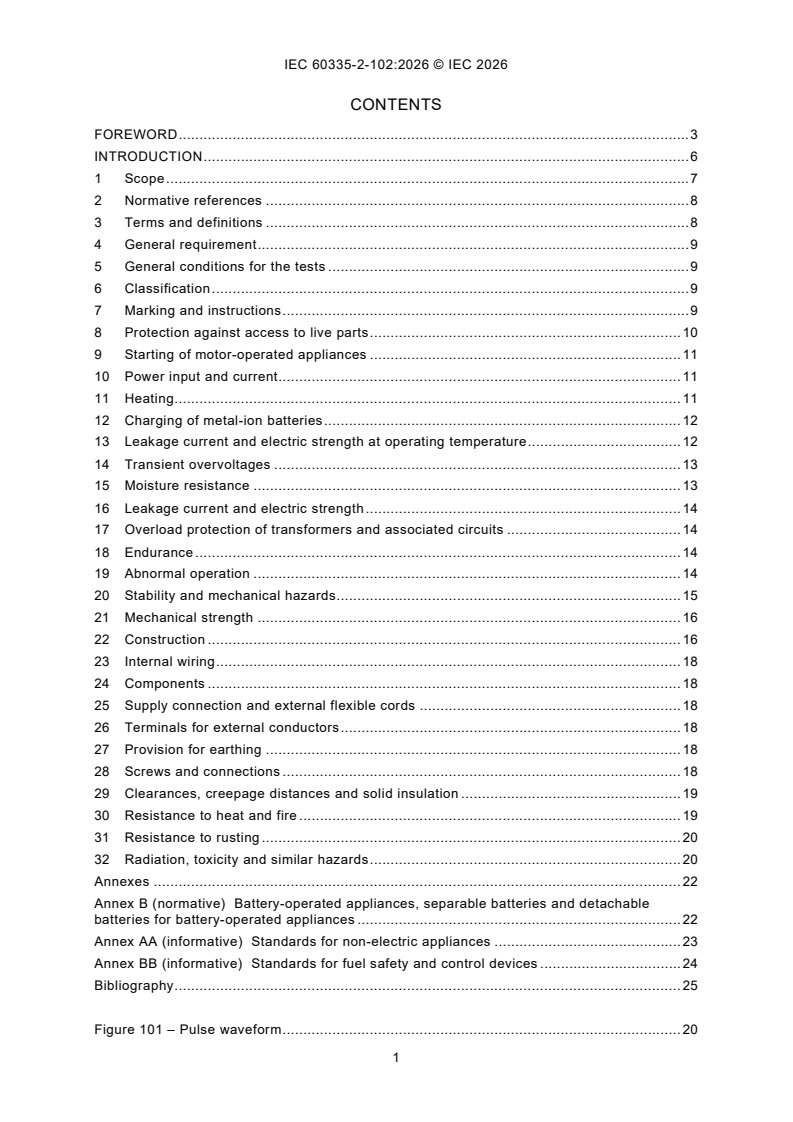
CONTENTS
FOREWORD . 3
INTRODUCTION . 6
1 Scope . 7
2 Normative references . 8
3 Terms and definitions . 8
4 General requirement . 9
5 General conditions for the tests . 9
6 Classification . 9
7 Marking and instructions . 9
8 Protection against access to live parts . 10
9 Starting of motor-operated appliances . 11
10 Power input and current . 11
11 Heating . 11
12 Charging of metal-ion batteries . 12
13 Leakage current and electric strength at operating temperature . 12
14 Transient overvoltages . 13
15 Moisture resistance . 13
16 Leakage current and electric strength . 14
17 Overload protection of transformers and associated circuits . 14
18 Endurance . 14
19 Abnormal operation . 14
20 Stability and mechanical hazards . 15
21 Mechanical strength . 16
22 Construction . 16
23 Internal wiring . 18
24 Components . 18
25 Supply connection and external flexible cords . 18
26 Terminals for external conductors . 18
27 Provision for earthing . 18
28 Screws and connections . 18
29 Clearances, creepage distances and solid insulation . 19
30 Resistance to heat and fire . 19
31 Resistance to rusting . 20
32 Radiation, toxicity and similar hazards . 20
Annexes . 22
Annex B (normative) Battery-operated appliances, separable batteries and detachable
batteries for battery-operated appliances . 22
Annex AA (informative) Standards for non-electric appliances . 23
Annex BB (informative) Standards for fuel safety and control devices . 24
Bibliography . 25
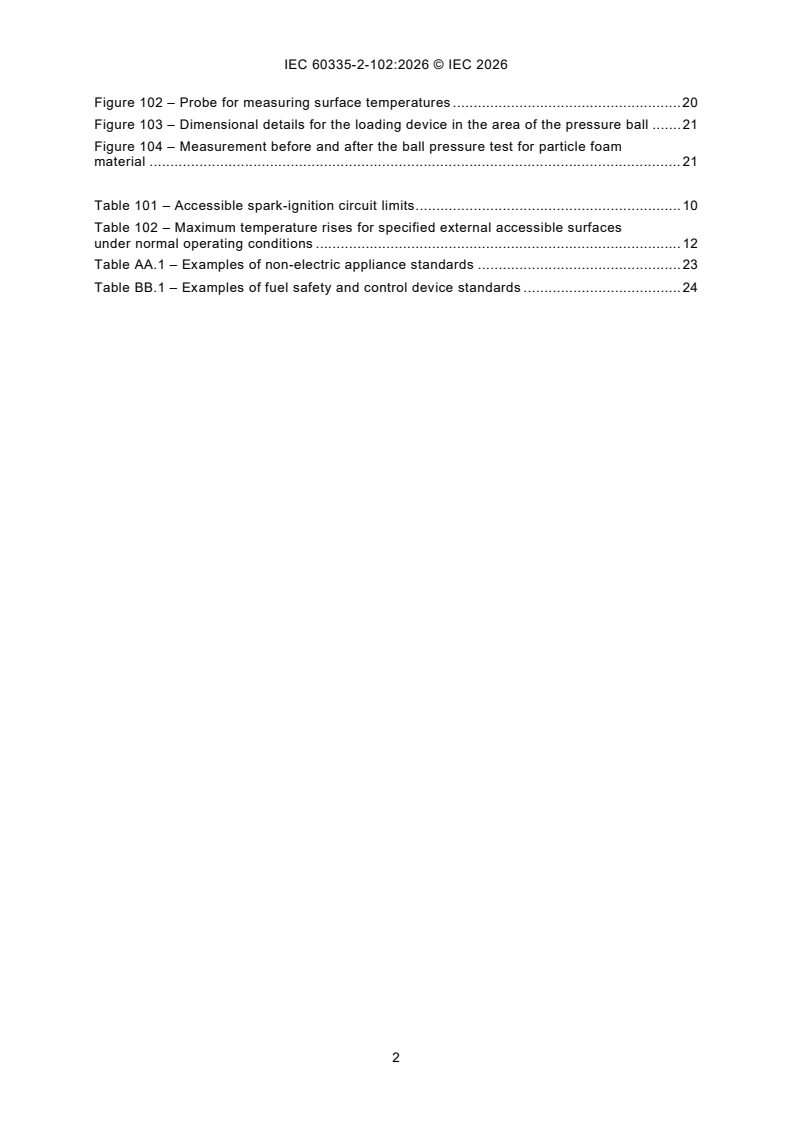
Figure 101 – Pulse waveform . 20
Figure 102 – Probe for measuring surface temperatures . 20
Figure 103 – Dimensional details for the loading device in the area of the pressure ball . 21
Figure 104 – Measurement before and after the ball pressure test for particle foam
material . 21
Table 101 – Accessible spark-ignition circuit limits . 10
Table 102 – Maximum temperature rises for specified external accessible surfaces
under normal operating conditions . 12
Table AA.1 – Examples of non-electric appliance standards . 23
Table BB.1 – Examples of fuel safety and control device standards . 24
INTERNATIONAL ELECTROTECHNICAL COMMISSION
____________
Household and similar electrical appliances - Safety -
Part 2-102: Particular requirements for gas, oil and solid-fuel
burning appliances having electrical connections
FOREWORD
1) The International Electrotechnical Commission (IEC) is a worldwide organization for standardization comprising
all national electrotechnical committees (IEC National Committees). The object of IEC is to promote international
co-operation on all questions concerning standardization in the electrical and electronic fields. To this end and
in addition to other activities, IEC publishes International Standards, Technical Specifications, Technical Reports,
Publicly Available Specifications (PAS) and Guides (hereafter referred to as “IEC Publication(s)”). Their
preparation is entrusted to technical committees; any IEC National Committee interested in the subject dealt with
may participate in this preparatory work. International, governmental and non-governmental organizations liaising
with the IEC also participate in this preparation. IEC collaborates closely with the International Organization for
Standardization (ISO) in accordance with conditions determined by agreement between the two organizations.
2) The formal decisions or agreements of IEC on technical matters express, as nearly as possible, an international
consensus of opinion on the relevant subjects since each technical committee has representation from all
interested IEC National Committees.
3) IEC Publications have the form of recommendations for international use and are accepted by IEC National
Committees in that sense. While all reasonable efforts are made to ensure that the technical content of IEC
Publications is accurate, IEC cannot be held responsible for the way in which they are used or for any
misinterpretation by any end user.
4) In order to promote international uniformity, IEC National Committees undertake to apply IEC Publications
transparently to the maximum extent possible in their national and regional publications. Any divergence between
any IEC Publication and the corresponding national or regional publication shall be clearly indicated in the latter.
5) IEC itself does not provide any attestation of conformity. Independent certification bodies provide conformity
assessment services and, in some areas, access to IEC marks of conformity. IEC is not responsible for any
services carried out by independent certification bodies.
6) All users should ensure that they have the latest edition of this publication.
7) No liability shall attach to IEC or its directors, employees, servants or agents including individual experts and
members of its technical committees and IEC National Committees for any personal injury, property damage or
other damage of any nature whatsoever, whether direct or indirect, or for costs (including legal fees) and
expenses arising out of the publication, use of, or reliance upon, this IEC Publication or any other IEC
Publications.
8) Attention is drawn to the Normative references cited in this publication. Use of the referenced publications is
indispensable for the correct application of this publication.
9) IEC draws attention to the possibility that the implementation of this document may involve the use of (a)
patent(s). IEC takes no position concerning the evidence, validity or applicability of any claimed patent rights in
respect thereof. As of the date of publication of this document, IEC had not received notice of (a) patent(s), which
may be required to implement this document. However, implementers are cautioned that this may not represent
the latest information, which may be obtained from the patent database available at https://patents.iec.ch. IEC
shall not be held responsible for identifying any or all such patent rights.
IEC 60335-2-102 has been prepared by IEC technical committee 61: Safety of household and
similar electrical appliances. It is an International Standard.
This third edition cancels and replaces the second edition published in 2017. This edition
constitutes a technical revision.
This edition includes the following significant technical changes with respect to the previous
edition:
– alignment with IEC 60335-1:2020;
– conversion of some Notes to normative text (Clause 1, 8.101, 11.8, 15.101, 16.3);
– clarification of the requirement for moisture resistance (15.101);
– addition of external accessible surface temperature limits for appliances with electric heat
sources where there is no relevant IEC 60335 part 2 standard (3.6.102, 3.6.103, 7.12.1,
11.3, 11.8, Table 102, Figure 102);
– application of test probe 19 for parts no more than 850 mm from the floor (7.12.1, 8.1.1,
8.1.3, 20.2);
– addition of requirements for appliances intended for installation in areas with restricted
access (3.8.103, 7.12.1, 8.1.1, 11.8, Table 102, 20.2, 22.106);
– limitation of the application of test probes and external accessible surface temperatures for
parts of appliances above 850 mm, 1,8 m or 2,3 m after installation (7.12.1, Table 102,
20.2);
– addition of requirements for parts made of particle foam material (3.8.104, 21.2, 22.104,
22.105, 22.106, 30.1, 30.1.101, Figures 103 and 104);
– clarification of requirements for controls and software to align with requirements for fuel
control standards and fuel burning appliance standards (19.11.2, 19.11.3, 19.13, 22.46,
24.1, Annex AA, Annex BB).
The text of this International Standard is based on the following documents:
Draft Report on voting
61/7655/FDIS 61/7694/RVD
Full information on the voting for its approval can be found in the report on voting indicated in
the above table.
The language used for the development of this International Standard is English.
This document was drafted in accordance with ISO/IEC Directives, Part 2, and developed in
accordance with ISO/IEC Directives, Part 1 and ISO/IEC Directives, IEC Supplement, available
at www.iec.ch/members_experts/refdocs. The main document types developed by IEC are
described in greater detail at www.iec.ch/publications.
This part 2 is to be used in conjunction with the latest edition of IEC 60335-1 and its
amendments unless that edition precludes it; in that case, the latest edition that does not
preclude it is used. It was established on the basis of the sixth edition (2020) of that standard.
NOTE 1 When "Part 1" is mentioned in this standard, it refers to IEC 60335-1.
This part 2 supplements or modifies the corresponding clauses in IEC 60335-1, so as to convert
that publication into the IEC standard: Particular requirements for gas, oil and solid-fuel burning
appliances having electrical connections.
When a particular subclause of Part 1 is not mentioned in this part 2, that subclause applies as
far as is reasonable. When this standard states "addition", "modification" or "replacement", the
relevant text in Part 1 is to be adapted accordingly.
NOTE 2 The following numbering system is used:
– subclauses, tables and figures that are numbered starting from 101 are additional to those in Part 1;
– unless notes are in a new subclause or involve notes in Part 1, they are numbered starting from 101, including
those in a replaced clause or subclause;
– additional annexes are lettered AA, BB, etc.
NOTE 3 The following print types are used:
– requirements: in roman type;
– test specifications: in italic type;
– notes: in small roman type.
Words in bold in the text are defined in Clause 3. When a definition concerns an adjective, the adjective and the
associated noun are also in bold.
NOTE 4 The attention of National Committees is drawn to the fact that equipment manufacturers and testing
organizations can need a transitional period following publication of a new, amended or revised IEC publication in
which to make products in accordance with the new requirements and to equip themselves for conducting new or
revised tests.
It is the recommendation of the committee that the content of this publication be adopted for implementation nationally
not earlier than 12 months or later than 36 months from the date of publication.
A list of all parts of the IEC 60335 series, under the general title: Household and similar
electrical appliances - Safety, can be found on the IEC website.
The committee has decided that the contents of this document will remain unchanged until the
stability date indicated on the IEC website under webstore.iec.ch in the data related to the
specific document. At this date, the document will be
– reconfirmed,
– withdrawn, or
– revised.
INTRODUCTION
It has been assumed in the drafting of this International Standard that the execution of its
provisions is entrusted to appropriately qualified and experienced persons.
Guidance documents concerning the application of the safety requirements for appliances can
be accessed via TC 61 supporting documents on the IEC website
https://www.iec.ch/tc61/supportingdocuments
This information is given for the convenience of users of this International Standard and does
not constitute a replacement for the normative text in this standard.
This standard recognizes the internationally accepted level of protection against hazards such
as electrical, mechanical, thermal, fire and radiation of appliances when operated as in normal
use taking into account the manufacturer's instructions. It also covers abnormal situations that
can be expected in practice and takes into account the way in which electromagnetic
phenomena can affect the safe operation of appliances.
This standard takes into account the requirements of IEC 60364 as far as possible so that there
is compatibility with the wiring rules when the appliance is connected to the supply mains.
However, national wiring rules can differ.
If an appliance within the scope of this standard also incorporates functions that are covered
by another part 2 of IEC 60335, the relevant part 2 is applied to each function separately, as
far as is reasonable. If applicable, the influence of one function on the other is taken into
account.
When a part 2 standard does not include additional requirements to cover hazards dealt with in
Part 1, Part 1 applies.
NOTE 1 This means that the technical committees responsible for the part 2 standards have determined that it is
not necessary to specify particular requirements for the appliance in question over and above the general
requirements.
This standard is a product family standard dealing with the safety of appliances and takes
precedence over horizontal and generic standards covering the same subject.
NOTE 2 Horizontal publications, basic safety publications and group safety publications covering a hazard are not
applicable since they have been taken into consideration when developing the general and particular requirements
for the IEC 60335 series of standards.
An appliance that complies with the text of this standard will not necessarily be considered to
comply with the safety principles of the standard if, when examined and tested, it is found to
have other features that impair the level of safety covered by these requirements.
An appliance employing materials or having forms of construction differing from those detailed
in the requirements of this standard may be examined and tested according to the intent of the
requirements and, if found to be substantially equivalent, may be considered to comply with the
standard.
NOTE 3 Standards dealing with non-safety aspects of household appliances are:
– IEC standards published by TC 59 concerning methods of measuring performance;
– CISPR 11, CISPR 14-1 and relevant IEC 61000-3 series standards concerning electromagnetic emissions;
– CISPR 14-2 concerning electromagnetic immunity;
– IEC standards published by TC 111 concerning environmental matters.
1 Scope
This clause of Part 1 is replaced by the following.
This part of IEC 60335 deals with the safety of gas, oil and solid-fuel burning appliances having
electrical connections, for household and similar purposes, their rated voltage being not more
than 250 V for single-phase appliances and 480 V for other appliances including direct current
(DC) supplied appliances and battery-operated appliances.
This standard covers the electrical safety and some other safety aspects of these appliances.
All safety aspects are covered when the appliance also complies with the relevant standard for
the fuel-burning appliance. If the appliance incorporates electric heating sources, safety
aspects concerning these electric sources are covered when the appliance also complies with
a relevant part 2 of IEC 60335.
Appliances not intended for normal household use but which nevertheless can be a source of
danger to the public, such as appliances intended to be used by laypersons in shops, in light
industry and on farms, are within the scope of this standard.
Examples of appliances within the scope of this standard are:
– central heating boilers;
– commercial catering equipment;
– cooking appliances;
– laundry and cleaning appliances;
– room heaters;
– warm air heaters;
– water heaters.
As far as is practicable, this standard deals with the common hazards presented by appliances
that are encountered by all persons in and around the home. However, in general, it does not
take into account:
– persons (including children) whose
• physical, sensory or mental capabilities; or
• lack of experience and knowledge
prevents them from using the appliance safely without supervision or instruction;
– children playing with the appliance.
Attention is drawn to the fact that:
– for appliances intended to be used in vehicles or on board ships or aircraft, additional
requirements can be necessary;
– in many countries, additional requirements are specified by the national health authorities,
the national authorities responsible for the protection of labour and similar authorities.
This standard does not apply to:
– appliances intended exclusively for industrial purposes;
– appliances intended to be used in locations where special conditions prevail, such as the
presence of a corrosive or explosive atmosphere (dust, vapour or gas).
2 Normative references
This clause of Part 1 is applicable except as follows.
Addition:
IEC 60584-1, Thermocouples - Part 1: EMF specifications and tolerances
IEC 60695-10-2:2014, Fire hazard testing - Part 10-2: Abnormal heat - Ball pressure test
method
IEC 61558-2-3, Safety of transformers, reactors, power supply units and combinations thereof -
Part 2-3: Particular requirements and tests for ignition transformers for gas and oil burners
ISO 3808, Road vehicles - Unscreened high-voltage ignition cables - General specifications,
test methods and requirements
3 Terms and definitions
This clause of Part 1 is applicable except as follows.
3.6 Definitions relating to parts of an appliance
3.6.101
spark-ignition circuit
electrical circuit for producing sparks which ignite gaseous or liquid fuel
3.6.102
functional surface
surface that is intentionally heated by an internal heat source and has to be hot to carry out the
function for which the appliance is intended
Note 1 to entry: An example is the heated sheath of a tubular heating element.
3.8 Definitions relating to miscellaneous matters
3.8.101
lock-out
shut-down requiring a manual operation to restart the appliance
3.8.102
shut-down
de-energization of a control resulting from the action of a limiting device or detection of a fault
in the control system, thus stopping the flow of gaseous or liquid fuel
3.8.103
area with restricted access
location with restricted access by trained persons
Note 1 to entry: Examples are rooms for central heating devices with a locked door, or construction areas.
Note 2 to entry: Laypersons and children are not considered to be trained persons.
3.8.104
particle foam material
closed cell material with a density not more than 250 kg/m moulded from thermoplastic
particles (e.g. beads) with expanding agent
Note 1 to entry: Measurement of density can be made according to ISO 845.
4 General requirement
This clause of Part 1 is applicable.
5 General conditions for the tests
This clause of Part 1 is applicable except as follows.
5.2 Addition:
A separate appliance may be used for the tests carried out on the fuel-burning appliance, in
accordance with its relevant standard.
The tests of this standard may be carried out in conjunction with the tests of another part 2, if
applicable.
5.3 Addition:
If a test has been carried out in accordance with the fuel-burning appliance standard, it is not
repeated.
5.4 Addition:
When the appliance incorporates electric heating sources, the tests are carried out with all parts
of the appliance in operation, as allowed by the construction.
5.101 Appliances are supplied as specified for motor-operated appliances.
6 Classification
This clause of Part 1 is applicable.
7 Marking and instructions
This clause of Part 1 is applicable except as follows.
7.12.1 Addition:
The installation instructions shall indicate the minimum height of installation of parts intended
to be installed above 850 mm, 1,8 m or 2,3 m above the floor in accordance with 8.1.1,
Table 102 or 20.2.
For appliances intended for installation in areas with restricted access, the instruction shall
include the substance of the following:
WARNING: This appliance shall be installed in an area with access for trained persons only.
Access for laypersons and children is forbidden.
8 Protection against access to live parts
This clause of Part 1 is applicable except as follows.
8.1 Addition:
The requirement does not apply to accessible parts of spark-ignition circuits.
8.1.1 Addition:
For parts of appliances situated not more than 850 mm above the floor after installation or in
normal use, in addition to the use of test probe 18, test probe 19 of IEC 61032 is also applied
wherever test probe 18 is used and with the same test conditions used for test probe 18.
For appliances intended for installation in areas with restricted access, test probe 18 and test
probe 19 are not applied.
8.1.3 Addition:
Test probe 19 of IEC 61032 is not applied.
8.101 Parts of the spark-ignition circuits shall not be accessible parts if the limits in
Table 101 are exceeded, unless they are piezoelectric igniters.
Table 101 – Accessible spark-ignition circuit limits
Interval between pulses Pulse duration
t d
d ≤ 0,1 ms 0,1 ms < d ≤ 100 ms d > 100 ms
a
t < 40 ms V ≤ 10 kV and I ≤ 0,7 mA V ≤ 10 kV and I ≤ 0,7 mA
o o
40 ms ≤ t < 250 ms 45 µC/pulse V ≤ 10 kV and I ≤ 0,7 mA V ≤ 10 kV and I ≤ 0,7 mA
o o
a
(only applicable if d < t)
t ≥ 250 ms 100 µC/pulse 100 µC/pulse V ≤ 10 kV and I ≤ 0,7 mA
o
NOTE 1 For the pulse duration (d) and the interval between pulses (t), see also Figure 101.
NOTE 2 V is the no-load voltage of the ignition circuit. V and I are peak values.
o o
a
If t < 40 ms and d > 100 ms or if 40 ms ≤ t < 250 ms and d > 100 ms when d < t, then parts of the spark-
ignition circuits shall not be accessible.
Compliance is checked by inspection, by applying test probe B of IEC 61032 as described
in 8.1.1 and by the following test.
The spark-ignition circuit is operated and the pulse duration
...
IEC 60335-2-102 ®
Edition 3.0 2026-11
INTERNATIONAL
STANDARD
COMMENTED VERSION
Household and similar electrical appliances - Safety -
Part 2-102: Particular requirements for gas, oil and solid-fuel burning appliances
having electrical connections
ICS 97.100.20; 97.100.30; 13.120 ISBN 978-2-8327-1620-5
All rights reserved. Unless otherwise specified, no part of this publication may be reproduced or utilized in any form or
by any means, electronic or mechanical, including photocopying and microfilm, without permission in writing from either
IEC or IEC's member National Committee in the country of the requester. If you have any questions about IEC copyright
or have an enquiry about obtaining additional rights to this publication, please contact the address below or your local
IEC member National Committee for further information.
IEC Secretariat Tel.: +41 22 919 02 11
3, rue de Varembé info@iec.ch
CH-1211 Geneva 20 www.iec.ch
Switzerland
About the IEC
The International Electrotechnical Commission (IEC) is the leading global organization that prepares and publishes
International Standards for all electrical, electronic and related technologies.
About IEC publications
The technical content of IEC publications is kept under constant review by the IEC. Please make sure that you have the
latest edition, a corrigendum or an amendment might have been published.
IEC publications search - IEC Products & Services Portal - products.iec.ch
webstore.iec.ch/advsearchform Discover our powerful search engine and read freely all the
The advanced search enables to find IEC publications by a publications previews, graphical symbols and the glossary.
variety of criteria (reference number, text, technical With a subscription you will always have access to up to date
committee, …). It also gives information on projects, content tailored to your needs.
replaced and withdrawn publications.
Electropedia - www.electropedia.org
The world's leading online dictionary on electrotechnology,
IEC Just Published - webstore.iec.ch/justpublished
Stay up to date on all new IEC publications. Just Published containing more than 22 500 terminological entries in English
details all new publications released. Available online and and French, with equivalent terms in 25 additional languages.
once a month by email. Also known as the International Electrotechnical Vocabulary
(IEV) online.
IEC Customer Service Centre - webstore.iec.ch/csc
If you wish to give us your feedback on this publication or
need further assistance, please contact the Customer
Service Centre: sales@iec.ch.
CONTENTS
FOREWORD . 3
INTRODUCTION . 6
1 Scope . 7
2 Normative references . 8
3 Terms and definitions . 8
4 General requirement . 9
5 General conditions for the tests . 9
6 Classification . 9
7 Marking and instructions . 9
8 Protection against access to live parts . 10
9 Starting of motor-operated appliances . 11
10 Power input and current . 11
11 Heating . 11
12 Void Charging of metal-ion batteries . 12
13 Leakage current and electric strength at operating temperature . 12
14 Transient overvoltages . 13
15 Moisture resistance . 13
16 Leakage current and electric strength . 14
17 Overload protection of transformers and associated circuits . 14
18 Endurance . 14
19 Abnormal operation . 14
20 Stability and mechanical hazards . 16
21 Mechanical strength . 16
22 Construction . 16
23 Internal wiring . 18
24 Components . 18
25 Supply connection and external flexible cords . 18
26 Terminals for external conductors . 18
27 Provision for earthing . 18
28 Screws and connections . 19
29 Clearances, creepage distances and solid insulation . 19
30 Resistance to heat and fire . 19
31 Resistance to rusting . 20
32 Radiation, toxicity and similar hazards . 20
Annexes . 22
Annex B (normative) Battery-operated appliances, separable batteries and detachable
batteries for battery-operated appliances . 22
Annex AA (informative) Standards for non-electric appliances . 23
Annex BB (informative) Standards for fuel safety and control devices . 24
Bibliography . 25
Figure 101 – Pulse waveform . 20
Figure 102 – Probe for measuring surface temperatures . 20
Figure 103 – Dimensional details for the loading device in the area of the pressure ball . 21
Figure 104 – Measurement before and after the ball pressure test for particle foam
material . 21
Table 101 – Accessible spark-ignition circuit limits . 10
Table 102 – Maximum temperature rises for specified external accessible surfaces
under normal operating conditions . 12
Table AA.1 – Examples of non-electric appliance standards . 23
Table BB.1 – Examples of fuel safety and control device standards . 24
INTERNATIONAL ELECTROTECHNICAL COMMISSION
____________
Household and similar electrical appliances - Safety -
Part 2-102: Particular requirements for gas, oil and solid-fuel
burning appliances having electrical connections
FOREWORD
1) The International Electrotechnical Commission (IEC) is a worldwide organization for standardization comprising
all national electrotechnical committees (IEC National Committees). The object of IEC is to promote international
co-operation on all questions concerning standardization in the electrical and electronic fields. To this end and
in addition to other activities, IEC publishes International Standards, Technical Specifications, Technical Reports,
Publicly Available Specifications (PAS) and Guides (hereafter referred to as “IEC Publication(s)”). Their
preparation is entrusted to technical committees; any IEC National Committee interested in the subject dealt with
may participate in this preparatory work. International, governmental and non-governmental organizations liaising
with the IEC also participate in this preparation. IEC collaborates closely with the International Organization for
Standardization (ISO) in accordance with conditions determined by agreement between the two organizations.
2) The formal decisions or agreements of IEC on technical matters express, as nearly as possible, an international
consensus of opinion on the relevant subjects since each technical committee has representation from all
interested IEC National Committees.
3) IEC Publications have the form of recommendations for international use and are accepted by IEC National
Committees in that sense. While all reasonable efforts are made to ensure that the technical content of IEC
Publications is accurate, IEC cannot be held responsible for the way in which they are used or for any
misinterpretation by any end user.
4) In order to promote international uniformity, IEC National Committees undertake to apply IEC Publications
transparently to the maximum extent possible in their national and regional publications. Any divergence between
any IEC Publication and the corresponding national or regional publication shall be clearly indicated in the latter.
5) IEC itself does not provide any attestation of conformity. Independent certification bodies provide conformity
assessment services and, in some areas, access to IEC marks of conformity. IEC is not responsible for any
services carried out by independent certification bodies.
6) All users should ensure that they have the latest edition of this publication.
7) No liability shall attach to IEC or its directors, employees, servants or agents including individual experts and
members of its technical committees and IEC National Committees for any personal injury, property damage or
other damage of any nature whatsoever, whether direct or indirect, or for costs (including legal fees) and
expenses arising out of the publication, use of, or reliance upon, this IEC Publication or any other IEC
Publications.
8) Attention is drawn to the Normative references cited in this publication. Use of the referenced publications is
indispensable for the correct application of this publication.
9) IEC draws attention to the possibility that the implementation of this document may involve the use of (a)
patent(s). IEC takes no position concerning the evidence, validity or applicability of any claimed patent rights in
respect thereof. As of the date of publication of this document, IEC had not received notice of (a) patent(s), which
may be required to implement this document. However, implementers are cautioned that this may not represent
the latest information, which may be obtained from the patent database available at https://patents.iec.ch. IEC
shall not be held responsible for identifying any or all such patent rights.
This commented version (CMV) of the official standard IEC 60335-2-102:2026 edition 3.0 allows
the user to identify the changes made to the previous IEC 60335-2-102:2017 edition 2.0.
Furthermore, comments from IEC TC 61 experts are provided to explain the reasons of the most
relevant changes, or to clarify any part of the content.
A vertical bar appears in the margin wherever a change has been made. Additions are shown
in green text, and deletions in red text with strikethrough. Hover over the comment icons to
display pop-up notes containing the comments, which are also available in the margin of the
publication.
This publication contains the CMV and the official standard.
IEC 60335-2-102 has been prepared by IEC technical committee 61: Safety of household and
similar electrical appliances. It is an International Standard.
This third edition cancels and replaces the second edition published in 2017. This edition
constitutes a technical revision.
This edition includes the following significant technical changes with respect to the previous
edition:
– alignment with IEC 60335-1:2020;
– conversion of some Notes to normative text (Clause 1, 8.101, 11.8, 15.101, 16.3);
– clarification of the requirement for moisture resistance (15.101);
– addition of external accessible surface temperature limits for appliances with electric heat
sources where there is no relevant IEC 60335 part 2 standard (3.6.102, 3.6.103, 7.12.1,
11.3, 11.8, Table 102, Figure 102);
– application of test probe 19 for parts no more than 850 mm from the floor (7.12.1, 8.1.1,
8.1.3, 20.2);
– addition of requirements for appliances intended for installation in areas with restricted
access (3.8.103, 7.12.1, 8.1.1, 11.8, Table 102, 20.2, 22.106);
– limitation of the application of test probes and external accessible surface temperatures for
parts of appliances above 850 mm, 1,8 m or 2,3 m after installation (7.12.1, Table 102,
20.2);
– addition of requirements for parts made of particle foam material (3.8.104, 21.2, 22.104,
22.105, 22.106, 30.1, 30.1.101, Figures 103 and 104);
– clarification of requirements for controls and software to align with requirements for fuel
control standards and fuel burning appliance standards (19.11.2, 19.11.3, 19.13, 22.46,
24.1, Annex AA, Annex BB).
The text of this International Standard is based on the following documents:
Draft Report on voting
61/7655/FDIS 61/7694/RVD
Full information on the voting for its approval can be found in the report on voting indicated in
the above table.
The language used for the development of this International Standard is English.
This document was drafted in accordance with ISO/IEC Directives, Part 2, and developed in
accordance with ISO/IEC Directives, Part 1 and ISO/IEC Directives, IEC Supplement, available
at www.iec.ch/members_experts/refdocs. The main document types developed by IEC are
described in greater detail at www.iec.ch/publications.
This part 2 is to be used in conjunction with the latest edition of IEC 60335-1 and its
amendments unless that edition precludes it; in that case, the latest edition that does not
preclude it is used. It was established on the basis of the sixth edition (2020) of that standard.
NOTE 1 When "Part 1" is mentioned in this standard, it refers to IEC 60335-1.
This part 2 supplements or modifies the corresponding clauses in IEC 60335-1, so as to convert
that publication into the IEC standard: Particular requirements for gas, oil and solid-fuel burning
appliances having electrical connections.
When a particular subclause of Part 1 is not mentioned in this part 2, that subclause applies as
far as is reasonable. When this standard states "addition", "modification" or "replacement", the
relevant text in Part 1 is to be adapted accordingly.
NOTE 2 The following numbering system is used:
– subclauses, tables and figures that are numbered starting from 101 are additional to those in Part 1;
– unless notes are in a new subclause or involve notes in Part 1, they are numbered starting from 101, including
those in a replaced clause or subclause;
– additional annexes are lettered AA, BB, etc.
NOTE 3 The following print types are used:
– requirements: in roman type;
– test specifications: in italic type;
– notes: in small roman type.
Words in bold in the text are defined in Clause 3. When a definition concerns an adjective, the adjective and the
associated noun are also in bold.
NOTE 4 The attention of National Committees is drawn to the fact that equipment manufacturers and testing
organizations can need a transitional period following publication of a new, amended or revised IEC publication in
which to make products in accordance with the new requirements and to equip themselves for conducting new or
revised tests.
It is the recommendation of the committee that the content of this publication be adopted for implementation nationally
not earlier than 12 months or later than 36 months from the date of publication.
A list of all parts of the IEC 60335 series, under the general title: Household and similar
electrical appliances - Safety, can be found on the IEC website.
The committee has decided that the contents of this document will remain unchanged until the
stability date indicated on the IEC website under webstore.iec.ch in the data related to the
specific document. At this date, the document will be
– reconfirmed,
– withdrawn, or
– revised.
INTRODUCTION
It has been assumed in the drafting of this International Standard that the execution of its
provisions is entrusted to appropriately qualified and experienced persons.
Guidance documents concerning the application of the safety requirements for appliances can
be accessed via TC 61 supporting documents on the IEC website
https://www.iec.ch/tc61/supportingdocuments
This information is given for the convenience of users of this International Standard and does
not constitute a replacement for the normative text in this standard.
This standard recognizes the internationally accepted level of protection against hazards such
as electrical, mechanical, thermal, fire and radiation of appliances when operated as in normal
use taking into account the manufacturer's instructions. It also covers abnormal situations that
can be expected in practice and takes into account the way in which electromagnetic
phenomena can affect the safe operation of appliances.
This standard takes into account the requirements of IEC 60364 as far as possible so that there
is compatibility with the wiring rules when the appliance is connected to the supply mains.
However, national wiring rules may can differ.
If an appliance within the scope of this standard also incorporates functions that are covered
by another part 2 of IEC 60335, the relevant part 2 is applied to each function separately, as
far as is reasonable. If applicable, the influence of one function on the other is taken into
account.
When a part 2 standard does not include additional requirements to cover hazards dealt with in
Part 1, Part 1 applies.
NOTE 1 This means that the technical committees responsible for the part 2 standards have determined that it is
not necessary to specify particular requirements for the appliance in question over and above the general
requirements.
This standard is a product family standard dealing with the safety of appliances and takes
precedence over horizontal and generic standards covering the same subject.
NOTE 2 Horizontal and generic standards Horizontal publications, basic safety publications and group safety
publications covering a hazard are not applicable since they have been taken into consideration when developing
the general and particular requirements for the IEC 60335 series of standards. For example, in the case of
temperature requirements for surfaces on many appliances, generic standards, such as ISO 13732-1 for hot surfaces,
are not applicable in addition to Part 1 or part 2 standards.
An appliance that complies with the text of this standard will not necessarily be considered to
comply with the safety principles of the standard if, when examined and tested, it is found to
have other features that impair the level of safety covered by these requirements.
An appliance employing materials or having forms of construction differing from those detailed
in the requirements of this standard may be examined and tested according to the intent of the
requirements and, if found to be substantially equivalent, may be considered to comply with the
standard.
NOTE 3 Standards dealing with non-safety aspects of household appliances are:
– IEC standards published by TC 59 concerning methods of measuring performance;
– CISPR 11, CISPR 14-1 and relevant IEC 61000-3 series standards concerning electromagnetic emissions;
– CISPR 14-2 concerning electromagnetic immunity;
– IEC standards published by TC 111 concerning environmental matters.
1 Scope
This clause of Part 1 is replaced by the following.
This part of IEC 60335 deals with the safety of gas, oil and solid-fuel burning appliances having
electrical connections, for household and similar purposes, their rated voltage being not more
than 250 V for single-phase appliances and 480 V for other appliances including direct current
(DC) supplied appliances and battery-operated appliances.
This standard covers the electrical safety and some other safety aspects of these appliances.
All safety aspects are covered when the appliance also complies with the relevant standard for
the fuel-burning appliance. If the appliance incorporates electric heating sources, safety
aspects concerning these electric sources are covered when the appliance also complies with
a relevant part 2 of IEC 60335.
Appliances not intended for normal household use but which nevertheless can be a source of
danger to the public, such as appliances intended to be used by laypersons in shops, in light
industry and on farms, are within the scope of this standard.
NOTE 101 Examples of appliances within the scope of this standard are:
– central heating boilers;
– commercial catering equipment;
– cooking appliances;
– laundry and cleaning appliances;
– room heaters;
– warm air heaters;
– water heaters.
Appliances not intended for normal household use but which nevertheless may be a source of
danger to the public, such as appliances intended to be used by laymen in shops, in light
industry and on farms, are within the scope of this standard.
This standard deals with the reasonably foreseeable hazards presented by appliances that are
encountered by all persons.
As far as is practicable, this standard deals with the common hazards presented by appliances
that are encountered by all persons in and around the home. However, in general, it does not
take into account:
– persons (including children) whose
• physical, sensory or mental capabilities; or
• lack of experience and knowledge
prevents them from using the appliance safely without supervision or instruction;
– children playing with the appliance.
NOTE 102 Attention is drawn to the fact that:
– for appliances intended to be used in vehicles or on board ships or aircraft, additional
requirements may can be necessary;
– in many countries, additional requirements are specified by the national health authorities,
the national authorities responsible for the protection of labour and similar authorities.
NOTE 103 This standard does not apply to:
– appliances intended exclusively for industrial purposes;
– appliances intended to be used in locations where special conditions prevail, such as the
presence of a corrosive or explosive atmosphere (dust, vapour or gas).
2 Normative references
This clause of Part 1 is applicable except as follows.
Addition:
IEC 60584-1, Thermocouples - Part 1: EMF specifications and tolerances
IEC 60695-10-2:2014, Fire hazard testing - Part 10-2: Abnormal heat - Ball pressure test
method
IEC 61558-2-3, Safety of transformers, reactors, power supply units and combinations thereof -
Part 2-3: Particular requirements and tests for ignition transformers for gas and oil burners
ISO 3808, Road vehicles - Unscreened high-voltage ignition cables - General specifications,
test methods and requirements
3 Terms and definitions
This clause of Part 1 is applicable except as follows.
3.6 Definitions relating to parts of an appliance
3.56.101
spark-ignition circuit
electrical circuit for producing sparks which ignite gaseous or liquid fuel
3.6.102
functional surface
surface that is intentionally heated by an internal heat source and has to be hot to carry out the
function for which the appliance is intended
Note 1 to entry: An example is the heated sheath of a tubular heating element.
3.8 Definitions relating to miscellaneous matters
3.8.101
lock-out
shut-down requiring a manual operation to restart the appliance
3.8.102
shut-down
de-energization of a control resulting from the action of a limiting device or detection of a fault
in the control system, thus stopping the flow of gaseous or liquid fuel
3.8.103
area with restricted access
location with restricted access by trained persons
Note 1 to entry: Examples are rooms for central heating devices with a locked door, or construction areas.
Note 2 to entry: Laypersons and children are not considered to be trained persons.
3.8.104
particle foam material
closed cell material with a density not more than 250 kg/m moulded from thermoplastic
particles (e.g. beads) with expanding agent
Note 1 to entry: Measurement of density can be made according to ISO 845.
4 General requirement
This clause of Part 1 is applicable.
5 General conditions for the tests
This clause of Part 1 is applicable except as follows.
5.2 Addition:
A separate appliance may be used for the tests carried out on the fuel-burning appliance, in
accordance with its relevant standard.
The tests of this standard may be carried out in conjunction with the tests of another part 2, if
applicable.
5.3 Addition:
If a test has been carried out in accordance with the fuel-burning appliance standard, it is not
repeated.
5.4 Addition:
When the appliance incorporates electric heating sources, the tests are carried out with all parts
of the appliance in operation, as allowed by the construction.
5.101 Appliances are supplied as specified for motor-operated appliances.
6 Classification
This clause of Part 1 is applicable.
7 Marking and instructions
This clause of Part 1 is applicable except as follows.
7.12.1 Addition:
The installation instructions shall indicate the minimum height of installation of parts intended
to be installed above 850 mm, 1,8 m or 2,3 m above the floor in accordance with 8.1.1,
Table 102 or 20.2.
For appliances intended for installation in areas with restricted access, the instruction shall
include the substance of the following:
WARNING: This appliance shall be installed in an area with access for trained persons only.
Access for laypersons and children is forbidden.
8 Protection against access to live parts
This clause of Part 1 is applicable except as follows.
8.1 Addition:
The requirement does not apply to accessible parts of spark-ignition circuits.
8.1.1 Addition:
For parts of appliances situated not more than 850 mm above the floor after installation or in
normal use, in addition to the use of test probe 18, test probe 19 of IEC 61032 is also applied
wherever test probe 18 is used and with the same test conditions used for test probe 18 .
For appliances intended for installation in areas with restricted access, test probe 18 and test
probe 19 are not applied.
8.1.3 Addition:
Test probe 19 of IEC 61032 is not applied.
8.101 Parts of the spark-ignition circuits shall not be accessible parts if the limits in
Table 101 are exceeded, unless they are piezoelectric igniters.
Table 101 – Accessible spark-ignition circuit limits
Interval between pulses Pulse duration
t d
d ≤ 0,1 ms 0,1 ms < d ≤ 100 ms d > 100 ms
a
t < 40 ms V ≤ 10 kV and I ≤ 0,7 mA V ≤ 10 kV and I ≤ 0,7 mA
o o
40 ms ≤ t < 250 ms 45 µC/pulse V ≤ 10 kV and I ≤ 0,7 mA V ≤ 10 kV and I ≤ 0,7 mA
o o
a
(only applicable if d < t)
t ≥ 250 ms 100 µC/pulse 100 µC/pulse V ≤ 10 kV and I ≤ 0,7 mA
o
NOTE 1 For the pulse duration (d) and the interval between pulses (t), see also Figure 101.
NOTE 2 V is the no-load voltage of the ignition circuit. V and I are peak values.
o o
a
If t < 40 ms and d > 100 ms or if 40 ms ≤ t < 250 ms and d > 100 ms when d < t, then parts of the spark-
ignition circuits shall not be accessible.
Compliance is checked by inspection, by applying test probe B of IEC 61032 as described
in 8.1.1 and by the following test.
The spark-ignition circuit is operated and the pulse duration measured across the spark gap
until it has reduced to 10 % of its peak value, as shown in Figure 101.
A resistor having a nominal non-inductive resistance of 2 000 Ω is connected across the spark
gap and the voltage measured. The current flowing through the resistor is calculated from the
voltage measured across it.
The quantity of electricity in the discharge is calculated from the current and duration of the
pulse by calculating the sum of all areas recorded on the voltage/time graph without taking
voltage polarity into account.
NOTE The quantity of electricity is calculated from the sum of all areas recorded on the voltage/time graph without
taking voltage polarity into account.
9 Starting of motor-operated appliances
This clause of Part 1 is not applicable.
10 Power input and current
This clause of Part 1 is applicable.
11 Heating
This clause of Part 1 is applicable except as follows.
11.3 Addition:
For appliances having electric heating sources where no part 2 of IEC 60335 exists, where the
external accessible surfaces are suitably flat and access permits, then the test probe of
Figure 102 is used to measure the temperature rises of external accessible surfaces specified
in Table 102. The probe is applied with a force of 4 N ± 1 N to the surface in such a way that
the best possible contact between the probe and the surface is ensured. The measurement is
performed after a contact period of 30 s.
The probe may be held in place using a laboratory stand clamp or similar device. Any measuring
instrument giving the same results as the probe may be used.
11.8 Addition:
For appliances having no electric heating sources, the temperature rises of the walls of the test
corner, and the temperature rises of the surfaces of handles, knobs, grips and similar parts, are
not measured and Table 102 is not applicable.
The temperature rise limits for common parts of appliances having electric and fuel-burning
heating sources are specified in the relevant part 2.
NOTE 101 Examples of common parts are components in the control panel of a combined gas and electric cooking
range.
For appliances having electric and fuel-burning heating sources, the temperature rise limits for
common parts of the appliance, such as parts in the control panel of a combined gas and electric
cooking range, are specified in the relevant part 2 of IEC 60335 and the relevant product
standard for the fuel-burning appliance.
For appliances having electric heating sources where no part 2 of IEC 60335 exists, the
temperature rises shall not exceed the values shown in Table 102. If the accessible surface
is protected by a guard, the temperature rise limits in Table 102 apply to the guard. However,
if the guard is a detachable guard the temperature rise limits in Table 102, also apply to parts
of the surface protected by the guard.
Table 102 – Maximum temperature rises for specified external accessible surfaces
under normal operating conditions
a
Temperature rise of accessible external surface
Surface
K
Parts situated not more Parts situated more Appliances intended for
than 850 mm above the than 850 mm above the installation in areas
floor after installation floor and not more than with restricted access
2,3 m above the floor
after installation
Bare metal 38 42 48
b
42 49 59
Coated metal
Glass and ceramic 51 56 65
Plastic and plastic 58 62 74
c, d
coating > 0,4 mm
NOTE The temperature rise limits of handles, knobs, grips, keyboards, keypads and similar parts are specified
in Table 3.
a
Temperature rises are not measured on:
– surfaces that are inaccessible to a 75 mm diameter probe having a hemispherical end after installation or
placing according to the instructions, unless they are protected by a detachable guard;
– functional surfaces and surfaces within 25 mm of them;
– the water supply fittings, pipes, hoses and pressure relief valves;
– flue gas systems and surfaces within 25 mm of them;
– burner flange, flame sighting hole and surfaces within 25 mm of them;
– surfaces of gas hob that are within 25 mm below the level of the hob surface or are above the hob surface;
– small parts such as gas oven vents, hinges and trim where the width of the accessible surface is less
than 10 mm;
– surfaces within 10 mm of the edge of a gas oven door or vents.
b
Metal is considered coated when a coating having a minimum thickness of 90 μm made of enamel, powder or
non-substantially plastic coating is used.
c
The temperature rise limit of plastic also applies for plastic material having a metal finish of thickness less
than 0,1 mm.
d
When the thickness of the plastic coating does not exceed 0,4 mm, the temperature rise limits of coated metal
for underlying metal apply or the temperature rise limits for glass or ceramic material for underlying glass or
ceramic material apply.
12 Void Charging of metal-ion batteries
This clause of Part 1 is applicable.
13 Leakage current and electric strength at operating temperature
This clause of Part 1 is applicable except as follows.
13.2 Modification:
The limit for stationary class I motor-operated appliances is applicable.
Replace the eighth paragraph with the following:
After the appliance has been operated for a duration as specified in 11.7, the leakage current
shall not exceed 3,5 mA.
14 Transient overvoltages
This clause of Part 1 is applicable.
15 Moisture resistance
This clause of Part 1 is applicable except as follows.
15.2 Addition:
For cooking ranges, hobs and similar appliances, compliance is checked by the following tests.
Cooking ranges and hobs are positioned so that the hob surface is horizontal, detachable
burner heads being in position. A vessel having a diameter approximately 220 mm is
completely filled with water containing approximately 1 % NaCl the spillage solution and
positioned centrally over the burner. A further quantity of 0,5 l of the solution is poured steadily
into the vessel over a period of 15 s.
This test is made for each burner separately, after removing any residual solution from the
appliance.
If controls are mounted below the hob surface, 0,5 l of the saline spillage solution is poured
steadily over the top of the hob near the controls over a period of 15 s. If they are mounted in
the hob surface, the solution is poured over the controls.
For burners incorporating a temperature sensor, switch or ignition device, 0,02 l of the saline
spillage solution is poured over the burner so that it flows over the device.
For ovens or grills, 0,5 l of the saline spillage solution is poured over the floor of the oven or
grilling compartment.
For appliances having a drip tray or similar receptacle, the receptacle is filled with the saline
spillage solution. A further quantity of the solution, equal to 0,01 l per 100 cm of the area of
the top surface of the receptacle, is poured onto the receptacle through openings in the hob
surface. However, the total quantity of solution shall not exceed 3 l.
For hobs provided with a lid, 0,5 l of the saline spillage solution is poured uniformly over the
closed lid. When the solution has run off, the surface is dried and a further 0,125 l of the solution
is poured steadily from a height of approximately 50 mm onto the centre of the lid over a period
of 15 s. The lid is then opened as in normal use.
15.101 Appliances, other than those classified at least IPX4, having flat, horizontal external
surfaces measuring 75 mm × 75 mm or greater at a height not exceeding 2 m above the floor
after the appliance is installed according to the instructions, on which a vessel, such as a cup
or jug, can be placed, shall not have their electrical insulation affected by spillage of liquid.
Surfaces that are subjected to the test of 15.2 are not tested in 15.101.
NOTE The intent is to identify surfaces on which a vessel, such as a cup or jug, can be placed and are subject to
spillage.
Compliance is checked by the following test using 0,25 l of the spillage solution specified in
15.2.
The solution is rapidly poured as quickly as possible over the identified surface over flat,
horizontal external surfaces measuring 75 mm × 75 mm or greater that are at a height not
exceeding 2 m above the floor after the appliance is installed according to the instructions .
The appliance shall then withstand the electric strength test of 16.3 and inspection shall show
that there is no trace of water on insulation that could can result in a reduction of clearances
or creepage distances below the values specified in Clause 29.
The test is repeated for each identified surface, the appliance being dried between each test.
16 Leakage current and electric strength
This clause of Part 1 is applicable except as follows.
16.2 Modification:
The limit for stationary class I motor-operated appliances is applicable.
Replace the fourth paragraph with the following:
The leakage current shall not exceed 3,5 mA.
16.3 Addition:
The no-load peak voltage of spark-ignition circuits is measured with the spark electrode
removed. The peak voltage applied between the spark-ignition circuit and metal foil covering
the insulation is 1,5 times this value. During the test, it is necessary to prevent a flashing over
by insulating the spark gap.
NOTE 101 It could be necessary to insulate the spark gap to prevent it flashing over during the test.
17 Overload protection of transformers and associated circuits
This clause of Part 1 is applicable.
18 Endurance
This clause of Part 1 is not applicable.
19 Abnormal operation
This clause of Part 1 is applicable except as follows.
19.4 Addition:
The test is repeated with the supply neutral conductor connected to the protective conductor,
however any controls are not short-circuited.
This test is repeated with the polarity of the supply to the appliance reversed and with the
neutral conductor connected to the protective conductor.
The additional tests are not carried out on appliances where an all-pole disconnection is used
to disconnect all fuel valves.
19.11.2 Addition:
Mechanical blocking of the fuel valves is not taken into account. However, the mechanical or
electrical blocking of the acting member (power switching device or relay-contact) of the fuel
control is considered as a possible fault.
In each case, the test is also ended if a shut-down is performed.
Tests are not repeated for electronic circuits if they are covered by evaluation of the relevant
fuel control standard.
NOTE 101 See informative Annex BB for examples of the relevant fuel control standards.
19.11.3 Modification:
Add the following at the end of the second paragraph:
In addition to the fault conditions of 19.11.2, short-circuit of any relay contacts shall be
incorporated in the protective electronic circuit either before the appliance is started or at
any point in time after the appliance is started so that the most unfavourable conditions of the
test are applied. This fault condition is not applicable to controls that comply with
IEC 60730-1:2022, Table 14, footnote i for class B control function, used in a function where
Table R.1 is applicable, or for class C control function, used in a function where Table R.2 is
applicable.
Addition:
Tests are not repeated for protective electronic circuits if they are covered by evaluation to
the relevant fuel control standard.
NOTE 101 Examples of acceptable fuel control standards are given in informative Annex BB.
19.11.4 Addition:
The tests of 19.11.4.1 to 19.11.4.7 are also carried out under normal operation, the appliance
being supplied at rated voltage.
19.13 Modification:
Add the following to the end of the eighth paragraph:
Safety extra-low voltage connectors that require a tool to make a connection and are for a
special purpose are excluded from this requirement.
NOTE 101 Examples of safety extra low voltage outlets or connectors for a special purpose are outlets and
connectors for external temperature sensors, or for the connection between the appliance and external accessories.
Addition:
During and after the tests of 19.11.4, the appliance shall have reached a lock-out condition,
unless it continues to operate normally even after a shut-down reach either a shut-down
condition or a lock-out condition or shall continue to operate normally, unless otherwise
allowed by the relevant standard for the fuel-burning appliance.
NOTE 102 See informative Annex AA for examples of the relevant fuel-burning appliance standards.
20 Stability and mechanical hazards
This clause of Part 1 is applicable except as follows.
20.1 Not applicable.
20.2 Addition:
For parts of appliances situated not more than 850 mm above the floor after installation or in
normal use, in addition to the use of test probe 18, test probe 19 of IEC 61032 is also applied
wherever test probe 18 is used and with the same test conditions used for test probe 18 . During
the tests with test probe 19, the appliance shall be fully assembled as in normal use and, for
ovens, with the door closed.
Test probe 18 is not applicable to parts that according to the instructions are intended to be
installed more than 1,8 m above the floor.
For appliances for installation in areas with restricted access, test probe 18 and test probe
19 are not applied.
21 Mechanical strength
This clause of Part 1 is applicable except as follows.
21.1 ModificationAddition:
The blows are only applied to enclosures of live parts and enclosu
...
IEC 60335-2-102 ®
Edition 3.0 2026-11
INTERNATIONAL
STANDARD
EXTENDED VERSION
This full version of IEC 60335-2-102:2026 includes the content of the references made
to IEC 60335-1:2020+AMD1:2025.
Household and similar electrical appliances - Safety -
Part 2-102: Particular requirements for gas, oil and solid-fuel burning appliances
having electrical connections
ICS 97.100.20; 97.100.30; 13.120 ISBN 978-2-8327-1621-2
All rights reserved. Unless otherwise specified, no part of this publication may be reproduced or utilized in any form or
by any means, electronic or mechanical, including photocopying and microfilm, without permission in writing from either
IEC or IEC's member National Committee in the country of the requester. If you have any questions about IEC copyright
or have an enquiry about obtaining additional rights to this publication, please contact the address below or your local
IEC member National Committee for further information.
IEC Secretariat Tel.: +41 22 919 02 11
3, rue de Varembé info@iec.ch
CH-1211 Geneva 20 www.iec.ch
Switzerland
About the IEC
The International Electrotechnical Commission (IEC) is the leading global organization that prepares and publishes
International Standards for all electrical, electronic and related technologies.
About IEC publications
The technical content of IEC publications is kept under constant review by the IEC. Please make sure that you have the
latest edition, a corrigendum or an amendment might have been published.
IEC publications search - IEC Products & Services Portal - products.iec.ch
webstore.iec.ch/advsearchform Discover our powerful search engine and read freely all the
The advanced search enables to find IEC publications by a publications previews, graphical symbols and the glossary.
variety of criteria (reference number, text, technical With a subscription you will always have access to up to date
committee, …). It also gives information on projects, content tailored to your needs.
replaced and withdrawn publications.
Electropedia - www.electropedia.org
The world's leading online dictionary on electrotechnology,
IEC Just Published - webstore.iec.ch/justpublished
Stay up to date on all new IEC publications. Just Published containing more than 22 500 terminological entries in English
details all new publications released. Available online and and French, with equivalent terms in 25 additional languages.
once a month by email. Also known as the International Electrotechnical Vocabulary
(IEV) online.
IEC Customer Service Centre - webstore.iec.ch/csc
If you wish to give us your feedback on this publication or
need further assistance, please contact the Customer
Service Centre: sales@iec.ch.
INTERNATIONAL ELECTROTECHNICAL COMMISSION
____________
IEC 60335-1
Edition 6.0 2020-09
HOUSEHOLD AND SIMILAR ELECTRICAL APPLIANCES – SAFETY –
Part 1: General requirements
I N T E R P R E T A T I O N S H E E T 1
This interpretation sheet has been prepared by IEC technical committee 61: Safety of household
and similar electrical appliances.
The text of this Interpretation Sheet is based on the following documents:
Draft Report on voting
61/5999/DISH 61/6009/RVDISH
Full information on the voting for its approval can be found in the report on voting indicated in
the above table.
___________
INTRODUCTION
Edition 6 of IEC 60335-1:2020 defines and introduces requirements for a detachable power
supply part of an appliance. In the document, 24.2 prohibits the use of a power supply in
a flexible cord.
QUESTION:
Does Subclause 24.2 prohibit the use of a detachable power supply part?
ANSWER
No, a "detachable power supply part" is a defined term and is not captured by the term
"power supply" as used in Subclause 24.2.
NOTE A detachable power supply part is captured by the defined term when the output of the power supply
part is detachable from the class III construction part of the appliance at:
– the power supply part, or
– the class III construction part of the appliance.
However, the supply cord (if any) does not have to be detachable from the detachable power supply part.
IEC 60335-1:2020-09/ISH1:2021-11(en)
INTERNATIONAL ELECTROTECHNICAL COMMISSION
____________
IEC 60335-1
Edition 6.0 2020-09
Household and similar electrical appliances - Safety -
Part 1: General requirements
I N T E R P R E T A T I O N S H E E T 2
This interpretation sheet has been prepared by IEC technical committee 61: Safety of household
and similar electrical appliances.
The text of this interpretation sheet is based on the following documents:
DISH Report on voting
61/7436/DISH 61/7464/RVDISH
Full information on the voting for the approval of this interpretation sheet can be found in the
report on voting indicated in the above table.
___________
TC 61 interpretation sheet on: Mechanical shock and vibration testing on large metal -ion
batteries of IEC 60335-1:2020
INTRODUCTION
Currently the standard mentions:
B.24.1 The relevant standards for non-acid based electrolyte cells employed in batteries
are IEC 62133-1:2017 for nickel systems and IEC 62133-2:2017 for lithium systems.
NOTE The requirement for cells does not extend to the battery itself.
A battery that uses metal-ion chemistry shall additionally be subjected to the tests of
Subclauses 7.3.8.1 (vibration) and 7.3.8.2 (mechanical shock) of IEC 62133-2:2017.
When Annex B was written for the IEC 60335-1 edition 6, the batteries foreseen were for
portable applications and rather lightweight. The IEC 62133-2:2017 standard referred to is
applicable to portable lithium batteries only.
IEC 60335-1:2020-09/ISH2:2025-08(en-fr)
For non-portable and/or large batteries (mass > 12 kg), the tests of IEC 62133-2 for mechanical
shock and vibration are not suitable.
QUESTION:
What test sequence for mechanical shock and vibration can be followed for large batteries?
ANSWER:
For practical reasons, IEC 60335-1 should follow the same differentiation as the UN 38.3
transport test or IEC 62281 standard (Safety of primary and secondary lithium cells and
batteries during transport).
For larger batteries with a mass exceeding 12 kg, Subclauses 6.4.3 (Test T-3: Vibration) and
6.4.4 (Test T-4: Shock) of IEC 62281:2019, including AMD1:2021 and AMD2:2023, may be
applied.
NOTE 1 The tests are technically identical to Test T.3 and Test T.4 of the UN manual of tests and criteria, section
38.3 rev.8 (2023).
NOTE 2 In accordance with Table 5 of IEC 62281:2019, testing is carried out on the battery without packaging.
CONTENTS
FOREWORD . 5
INTRODUCTION to IEC 60335-1:2020+AMD1:2025 . 8
INTRODUCTION IEC 60335-2-102:2026 . 10
1 Scope . 11
2 Normative references . 12
3 Terms and definitions . 17
4 General requirement . 30
5 General conditions for the tests . 30
6 Classification . 34
7 Marking and instructions . 35
8 Protection against access to live parts . 43
9 Starting of motor-operated appliances . 46
10 Power input and current . 47
11 Heating . 49
12 Charging of metal-ion batteries . 55
13 Leakage current and electric strength at operating temperature . 57
14 Transient overvoltages . 59
15 Moisture resistance . 60
16 Leakage current and electric strength . 64
17 Overload protection of transformers and associated circuits . 65
18 Endurance . 66
19 Abnormal operation . 66
20 Stability and mechanical hazards . 77
21 Mechanical strength . 78
22 Construction . 80
23 Internal wiring . 95
24 Components . 97
25 Supply connection and external flexible cords . 102
26 Terminals for external conductors . 110
27 Provision for earthing . 113
28 Screws and connections . 114
29 Clearances, creepage distances and solid insulation . 117
30 Resistance to heat and fire . 126
31 Resistance to rusting . 132
32 Radiation, toxicity and similar hazards . 132
Annex A (informative) Routine tests . 147
Annex B (normative) Battery-operated appliances, separable batteries and detachable
batteries for battery-operated appliances . 149
Annex C (normative) Ageing test on motors . 173
Annex D (normative) Thermal motor protectors . 174
Annex E (normative) Needle-flame test . 175
Annex F (normative) Capacitors . 176
Annex G (normative) Safety isolating transformers . 178
Annex H (normative) Switches . 179
Annex I (normative) Motors having basic insulation that is inadequate for the rated
voltage of the appliance . 181
Annex J (normative) Coated printed circuit boards . 183
Annex K (informative) Overvoltage categories . 184
Annex L (informative) Guidance for the measurement of clearances and creepage
distances . 185
Annex M (informative) Pollution degree . 188
Annex N (normative) Proof tracking test . 189
Annex O (informative) Selection and sequence of the tests of Clause 30 . 190
Annex P (informative) Guidance for the application of this standard to appliances
used in tropical climates . 195
Annex Q (informative) Sequence of tests for the evaluation of electronic circuits . 197
Annex R (normative) Software evaluation . 200
Annex S (informative) Guidance for the application of this standard on measurement
of power input and current based on the requirements of 10.1 and 10.2 concerning the
representative period . 215
Annex T (normative) UV-C radiation effect on non-metallic materials . 216
Annex U (normative) Appliances intended for remote communication through public
networks . 219
Annex AA (informative) Standards for non-electric appliances . 224
Annex BB (informative) Standards for fuel safety and control devices . 225
Bibliography . 226
Figure 1 – Circuit diagram for leakage current measurement at operating temperature
for single-phase connection of class II appliances and for parts of class ll construction . 133
Figure 2 – Circuit diagram for leakage current measurement at operating temperature
for single-phase connection of other than class II appliances or parts of class ll
construction . 134
Figure 3 – Circuit diagram for leakage current measurement at operating temperature
for three-phase with neutral class II appliances and for parts of class ll construction . 135
Figure 4 – Circuit diagram for leakage current measurement at operating temperature
for three-phase with neutral appliances other than those of class II or parts of class ll
construction . 136
Figure 5 – Small part . 137
Figure 6 – Example of an electronic circuit with low-power points . 137
Figure 7 – Test finger nail . 138
Figure 8 – Flexing test apparatus . 139
Figure 9 – Constructions of cord anchorages . 140
Figure 10 – An example of parts of an earthing terminal . 141
Figure 11 – Examples of clearances . 142
Figure 12 – Example of the placement of the cylinder . 143
Figure 13 – Small parts cylinder . 144
Figure 14 – Example of a specified operating region of a lithium-ion cell during
charging . 145
Figure 101 – Pulse waveform . 145
Figure 102 – Probe for measuring surface temperatures . 146
Figure 103 – Dimensional details for the loading device in the area of the pressure ball . 146
Figure 104 – Measurement before and after the ball pressure test for particle foam
material . 146
Figure B.1 – Examples of battery-operated appliance constructions and application of
normative Annex B (1 of 2) . 170
Figure B.2 – Examples of correct polarity connection marking representing three
batteries . 172
Figure I.1 – Simulation of faults . 182
Figure L.2 – Sequence for the determination of creepage distances . 187
Figure L.3 – Measurement of clearances . 187
Figure O.1 – Tests for resistance to heat . 190
Figure O.2 – Selection and sequence of tests for resistance to fire in hand-held
appliances . 191
Figure O.3 – Selection and sequence of tests for resistance to fire in attended
appliances . 191
Figure O.4 – Selection and sequence of tests for resistance to fire in unattended
appliances . 192
Figure O.5 – Some applications of the term "within a distance of 3 mm" . 194
Figure Q.1 – Flowchart outlining the sequence of tests for the evaluation of electronic
circuits (1 of 2) . 198
Figure R.1 – Examples of software separation . 211
Figure S.1 – Flowchart giving guidance on measurement of power input and current
concerning the representative period . 215
Table 101 – Accessible spark-ignition circuit limits . 46
Table 1 – Power input deviation . 47
Table 2 – Current deviation . 48
Table 3 – Maximum normal temperature rises . 51
Table 102 – Maximum temperature rises for specified external accessible surfaces
under normal operating conditions . 55
Table 4 – Voltage for electric strength test . 59
Table 5 – Characteristics of high-voltage sources . 59
Table 6 – Impulse test voltage . 60
Table 7 – Test voltages. 65
Table 8 – Maximum winding temperature . 69
Table 9 – Maximum abnormal temperature rise . 75
Table 20 – Halogen-free cord sets and cords . 100
Table 10 – Dimensions of cables and conduits . 103
Table 11 – Minimum cross-sectional area of conductors . 105
Table 12 – Pull force and torque . 107
Table 13 – Nominal cross-sectional area of conductors . 112
Table 14 – Torque for testing screws and nuts . 116
Table 15 – Rated impulse voltage . 118
Table 16 – Minimum clearances . 119
Table 17 – Minimum creepage distances for basic insulation . 123
Table 18 – Minimum creepage distances for functional insulation . 124
Table 19 – Minimum thickness for accessible parts of reinforced insulation consisting
of a single layer . 126
Table A.1 – Test voltages . 148
Table B.1 – Artificial source characteristics . 151
Table B.2 – Total area of openings for metal-ion cells . 160
Table B.3 – Volume of air injected at 2 070 kPa . 160
Table C.1 – Test conditions . 173
Table R.1 – General fault/error conditions . 202
Table R.2 – Specific fault/error conditions . 204
Table R.3 – Semi-formal methods . 210
Table R.4 – Software architecture specification . 210
Table R.8 – Principles of software partitioning . 211
Table R.5 – Module design specification . 212
Table R.6 – Design and coding standards . 212
Table R.7 – Software safety validation . 213
Table T.1 – Minimum property retention limits after UV-C exposure . 217
Table U.1 – Acceptable measures against unauthorised access and transmission
fault/error modes . 221
Table AA.1 – Examples of non-electric appliance standards . 224
Table BB.1 – Examples of fuel safety and control device standards . 225
INTERNATIONAL ELECTROTECHNICAL COMMISSION
____________
Household and similar electrical appliances - Safety -
Part 2-102: Particular requirements for gas, oil and solid-fuel
burning appliances having electrical connections
FOREWORD
1) The International Electrotechnical Commission (IEC) is a worldwide organization for standardization comprising
all national electrotechnical committees (IEC National Committees). The object of IEC is to promote international
co-operation on all questions concerning standardization in the electrical and electronic fields. To this end and
in addition to other activities, IEC publishes International Standards, Technical Specifications, Technical Reports,
Publicly Available Specifications (PAS) and Guides (hereafter referred to as “IEC Publication(s)”). Their
preparation is entrusted to technical committees; any IEC National Committee interested in the subject dealt with
may participate in this preparatory work. International, governmental and non-governmental organizations liaising
with the IEC also participate in this preparation. IEC collaborates closely with the International Organization for
Standardization (ISO) in accordance with conditions determined by agreement between the two organizations.
2) The formal decisions or agreements of IEC on technical matters express, as nearly as possible, an international
consensus of opinion on the relevant subjects since each technical committee has representation from all
interested IEC National Committees.
3) IEC Publications have the form of recommendations for international use and are accepted by IEC National
Committees in that sense. While all reasonable efforts are made to ensure that the technical content of IEC
Publications is accurate, IEC cannot be held responsible for the way in which they are used or for any
misinterpretation by any end user.
4) In order to promote international uniformity, IEC National Committees undertake to apply IEC Publications
transparently to the maximum extent possible in their national and regional publications. Any divergence between
any IEC Publication and the corresponding national or regional publication shall be clearly indicated in the latter.
5) IEC itself does not provide any attestation of conformity. Independent certification bodies provide conformity
assessment services and, in some areas, access to IEC marks of conformity. IEC is not responsible for any
services carried out by independent certification bodies.
6) All users should ensure that they have the latest edition of this publication.
7) No liability shall attach to IEC or its directors, employees, servants or agents including individual experts and
members of its technical committees and IEC National Committees for any personal injury, property damage or
other damage of any nature whatsoever, whether direct or indirect, or for costs (including legal fees) and
expenses arising out of the publication, use of, or reliance upon, this IEC Publication or any other IEC Publications.
8) Attention is drawn to the Normative references cited in this publication. Use of the referenced publications is
indispensable for the correct application of this publication.
9) IEC draws attention to the possibility that the implementation of this document may involve the use of (a) patent(s).
IEC takes no position concerning the evidence, validity or applicability of any claimed patent rights in respect
thereof. As of the date of publication of this document, IEC had not received notice of (a) patent(s), which may
be required to implement this document. However, implementers are cautioned that this may not represent the
latest information, which may be obtained from the patent database available at https://patents.iec.ch. IEC shall
not be held responsible for identifying any or all such patent rights.
This extended version (EXV) of the official IEC Standard provides the user with the full content
of the Standard.
made to IEC 60335-1:2020+AMD1:2025.
The specific content of IEC 60335-2-102:2026 is displayed on a blue background.
IEC 60335-2-102 has been prepared by IEC technical committee 61: Safety of household and
similar electrical appliances. It is an International Standard.
This third edition cancels and replaces the second edition published in 2017. This edition
constitutes a technical revision.
This edition includes the following significant technical changes with respect to the previous
edition:
– alignment with IEC 60335-1:2020;
– conversion of some Notes to normative text (Clause 1, 8.101, 11.8, 15.101, 16.3);
– clarification of the requirement for moisture resistance (15.101);
– addition of external accessible surface temperature limits for appliances with electric heat
sources where there is no relevant IEC 60335 part 2 standard (3.6.102, 3.6.103, 7.12.1,
11.3, 11.8, Table 102, Figure 102);
– application of test probe 19 for parts no more than 850 mm from the floor (7.12.1, 8.1.1,
8.1.3, 20.2);
– addition of requirements for appliances intended for installation in areas with restricted
access (3.8.103, 7.12.1, 8.1.1, 11.8, Table 102, 20.2, 22.106);
– limitation of the application of test probes and external accessible surface temperatures for
parts of appliances above 850 mm, 1,8 m or 2,3 m after installation (7.12.1, Table 102, 20.2);
– addition of requirements for parts made of particle foam material (3.8.104, 21.2, 22.104,
22.105, 22.106, 30.1, 30.1.101, Figures 103 and 104);
– clarification of requirements for controls and software to align with requirements for fuel
control standards and fuel burning appliance standards (19.11.2, 19.11.3, 19.13, 22.46, 24.1,
Annex AA, Annex BB).
The text of this International Standard is based on the following documents:
Draft Report on voting
61/7655/FDIS 61/7694/RVD
Full information on the voting for its approval can be found in the report on voting indicated in
the above table.
The language used for the development of this International Standard is English.
This document was drafted in accordance with ISO/IEC Directives, Part 2, and developed in
accordance with ISO/IEC Directives, Part 1 and ISO/IEC Directives, IEC Supplement, available
at www.iec.ch/members_experts/refdocs. The main document types developed by IEC are
described in greater detail at www.iec.ch/publications.
This part 2 is to be used in conjunction with the latest edition of IEC 60335-1 and its
amendments unless that edition precludes it; in that case, the latest edition that does not
preclude it is used. It was established on the basis of the sixth edition (2020) of that standard.
NOTE 1 When "Part 1" is mentioned in this standard, it refers to IEC 60335-1.
This part 2 supplements or modifies the corresponding clauses in IEC 60335-1, so as to convert
that publication into the IEC standard: Particular requirements for gas, oil and solid-fuel burning
appliances having electrical connections.
When a particular subclause of Part 1 is not mentioned in this part 2, that subclause applies as
far as is reasonable. When this standard states "addition", "modification" or "replacement", the
relevant text in Part 1 is to be adapted accordingly.
NOTE 2 The following numbering system is used:
– subclauses, tables and figures that are numbered starting from 101 are additional to those in Part 1;
– unless notes are in a new subclause or involve notes in Part 1, they are numbered starting from 101, including
those in a replaced clause or subclause;
– additional annexes are lettered AA, BB, etc.
NOTE 3 The following print types are used:
– requirements: in roman type;
– test specifications: in italic type;
– notes: in small roman type.
Words in bold in the text are defined in Clause 3. When a definition concerns an adjective, the adjective and the
associated noun are also in bold.
NOTE 4 The attention of National Committees is drawn to the fact that equipment manufacturers and testing
organizations can need a transitional period following publication of a new, amended or revised IEC publication in
which to make products in accordance with the new requirements and to equip themselves for conducting new or
revised tests.
It is the recommendation of the committee that the content of this publication be adopted for implementation nationally
not earlier than 12 months or later than 36 months from the date of publication.
A list of all parts of the IEC 60335 series, under the general title: Household and similar
electrical appliances - Safety, can be found on the IEC website.
The committee has decided that the contents of this document will remain unchanged until the
stability date indicated on the IEC website under webstore.iec.ch in the data related to the
specific document. At this date, the document will be
– reconfirmed,
– withdrawn, or
– revised.
INTRODUCTION to IEC 60335-1:2020+AMD1:2025
It has been assumed in the drafting of this International Standard that the execution of its
provisions is entrusted to appropriately qualified and experienced persons.
Guidance documents concerning the application of the safety requirements for appliances can
be accessed via TC 61 supporting documents on the IEC website –
www.iec.ch/tc61/supportingdocuments
This information is given for the convenience of users of this International Standard and does
not constitute a replacement for the normative text in this standard.
This standard recognizes the internationally accepted level of protection against hazards such
as electrical, mechanical, thermal, fire and radiation of appliances when operated as in normal
use taking into account the manufacturer's instructions. It also covers abnormal situations that
can be expected in practice and takes into account the way in which electromagnetic
phenomena can affect the safe operation of appliances.
This standard takes into account the requirements of IEC 60364 as far as possible so that there
is compatibility with the wiring rules when the appliance is connected to the supply mains.
However, national wiring rules may differ.
If the functions of an appliance are covered by different parts 2 of IEC 60335, the relevant part 2
is applied to each function separately, as far as is reasonable. If applicable, the influence of
one function on the other is taken into account.
Throughout this publication, when "part 2" is mentioned, it refers to the relevant part of
IEC 60335.
When a part 2 standard does not include additional requirements to cover hazards dealt with in
Part 1, Part 1 applies.
NOTE 1 This means that the technical committees responsible for the part 2 standards have determined that it is
not necessary to specify particular requirements for the appliance in question over and above the general
requirements.
This standard is a product family standard dealing with the safety of appliances and takes
precedence over horizontal and generic standards covering the same subject.
NOTE 2 Horizontal publications, basic safety publications and group safety publications covering a hazard are not
applicable since they have been taken into consideration when developing the general and particular requirements
for the IEC 60335 series of standards.
Individual countries may wish to consider the application of this standard, as far as is
reasonable, to appliances not mentioned in a part 2, and to appliances designed on new
principles. In this case, consideration should be given to defining normal operation, specifying
the classification of the appliance according to Clause 6 and specifying whether the appliance
is operated attended or unattended. Consideration should also be given to particular categories
of likely users and to related specific risks such as access to live parts, hot surfaces or
hazardous moving parts.
An appliance that complies with the text of this standard will not necessarily be considered to
comply with the safety principles of this standard if, when examined and tested, it is found to
have other features which impair the level of safety covered by these requirements.
An appliance employing materials or having forms of construction differing from those detailed
in the requirements of this standard may be examined and tested according to the intent of the
requirements and, if found to be substantially equivalent, may be considered to comply with this
standard.
NOTE 3 Standards dealing with non-safety aspects of household appliances are:
– IEC standards published by TC 59 concerning methods of measuring performance;
– CISPR 11, CISPR 14-1 and relevant IEC 61000-3 series standards concerning electromagnetic emissions;
– CISPR 14-2 concerning electromagnetic immunity;
– IEC standards published by TC 111 concerning environmental matters.
INTRODUCTION IEC 60335-2-102:2026
It has been assumed in the drafting of this International Standard that the execution of its
provisions is entrusted to appropriately qualified and experienced persons.
Guidance documents concerning the application of the safety requirements for appliances can
be accessed via TC 61 supporting documents on the IEC website
https://www.iec.ch/tc61/supportingdocuments
This information is given for the convenience of users of this International Standard and does
not constitute a replacement for the normative text in this standard.
This standard recognizes the internationally accepted level of protection against hazards such
as electrical, mechanical, thermal, fire and radiation of appliances when operated as in normal
use taking into account the manufacturer's instructions. It also covers abnormal situations that
can be expected in practice and takes into account the way in which electromagnetic
phenomena can affect the safe operation of appliances.
This standard takes into account the requirements of IEC 60364 as far as possible so that there
is compatibility with the wiring rules when the appliance is connected to the supply mains.
However, national wiring rules can differ.
If an appliance within the scope of this standard also incorporates functions that are covered
by another part 2 of IEC 60335, the relevant part 2 is applied to each function separately, as
far as is reasonable. If applicable, the influence of one function on the other is taken into
account.
When a part 2 standard does not include additional requirements to cover hazards dealt with in
Part 1, Part 1 applies.
NOTE 1 This means that the technical committees responsible for the part 2 standards have determined that it is
not necessary to specify particular requirements for the appliance in question over and above the general
requirements.
This standard is a product family standard dealing with the safety of appliances and takes
precedence over horizontal and generic standards covering the same subject.
NOTE 2 Horizontal publications, basic safety publications and group safety publications covering a hazard are not
applicable since they have been taken into consideration when developing the general and particular requirements
for the IEC 60335 series of standards.
An appliance that complies with the text of this standard will not necessarily be considered to
comply with the safety principles of the standard if, when examined and tested, it is found to
have other features that impair the level of safety covered by these requirements.
An appliance employing materials or having forms of construction differing from those detailed
in the requirements of this standard may be examined and tested according to the intent of the
requirements and, if found to be substantially equivalent, may be considered to comply with the
standard.
NOTE 3 Standards dealing with non-safety aspects of household appliances are:
– IEC standards published by TC 59 concerning methods of measuring performance;
– CISPR 11, CISPR 14-1 and relevant IEC 61000-3 series standards concerning electromagnetic emissions;
– CISPR 14-2 concerning electromagnetic immunity;
– IEC standards published by TC 111 concerning environmental matters.
1 Scope
This part of IEC 60335 deals with the safety of gas, oil and solid-fuel burning appliances having
electrical connections, for household and similar purposes, their rated voltage being not more
than 250 V for single-phase appliances and 480 V for other appliances including direct current
(DC) supplied appliances and battery-operated appliances.
This standard covers the electrical safety and some other safety aspects of these appliances.
All safety aspects are covered when the appliance also complies with the relevant standard for
the fuel-burning appliance. If the appliance incorporates electric heating sources, safety
aspects concerning these electric sources are covered when the appliance also complies with
a relevant part 2 of IEC 60335.
Appliances not intended for normal household use but which nevertheless can be a source of
danger to the public, such as appliances intended to be used by laypersons in shops, in light
industry and on farms, are within the scope of this standard.
Examples of appliances within the scope of this standard are:
– central heating boilers;
– commercial catering equipment;
– cooking appliances;
– laundry and cleaning appliances;
– room heaters;
– warm air heaters;
– water heaters.
As far as is practicable, this standard deals with the common hazards presented by appliances
that are encountered by all persons in and around the home. However, in general, it does not
take into account:
– persons (including children) whose
• physical, sensory or mental capabilities; or
• lack of experience and knowledge
prevents them from using the appliance safely without supervision or instruction;
– children playing with the appliance.
Attention is drawn to the fact that:
– for appliances intended to be used in vehicles or on board ships or aircraft, additional
requirements can be necessary;
– in many countries, additional requirements are specified by the national health authorities,
the national authorities responsible for the protection of labour and similar authorities.
This standard does not apply to:
– appliances intended exclusively for industrial purposes;
– appliances intended to be used in locations where special conditions prevail, such as the
presence of a corrosive or explosive atmosphere (dust, vapour or gas).
2 Normative refe
...