


IEC 61000-4-13:2002
(Main)Electromagnetic compatibility (EMC) - Part 4-13: Testing and measurement techniques - Harmonics and interharmonics including mains signalling at a.c. power port, low frequency immunity tests
General Information
- Abstract
Defines the immunity test methods and range of recommended basic test levels for electrical and electronic equipment with rated current up to 16 A per phase at disturbance frequencies up to and including 2 kHz (for 50 Hz mains) and 2,4 kHz (for 60 Hz mains) for harmonics and interharmonics on low voltage power networks. Establishes a common reference for evaluating the functional immunity of electrical and electronic equipment when subjected to harmonics and inter-harmonics and mains signalling frequencies. The test method documented in this part of IEC 61000 describes a consistent method to assess the immunity of an equipment or system against a defined phenomenon.
- Status
- Published
- Publication Date
- 13-Dec-2015
- Technical Committee
- SC 77A - EMC - Low frequency phenomena
- Drafting Committee
- WG 6 - TC 77/SC 77A/WG 6
- Current Stage
- PPUB - Publication issued
- Start Date
- 27-Mar-2002
- Completion Date
- 15-May-2002
Buy Documents
IEC 61000-4-13:2002 - Electromagnetic compatibility (EMC) - Part 4-13: Testing and measurement techniques - Harmonics and interharmonics including mains signalling at a.c. power port, low frequency immunity tests Released:3/27/2002
IEC 61000-4-13:2002+AMD1:2009 CSV - Electromagnetic compatibility (EMC) - Part 4-13: Testing and measurement techniques - Harmonics and interharmonics including mains signalling at a.c. power port, low frequency immunity tests Released:7/30/2009

IEC 61000-4-13:2002+AMD1:2009+AMD2:2015 CSV - Electromagnetic compatibility (EMC) - Part 4-13: Testing and measurement techniques - Harmonics and interharmonics includingmains signalling at a.c. power port, low frequency immunity tests Released:12/14/2015
Overview
The IEC 61000-4-13:2002 standard, titled Electromagnetic Compatibility (EMC) - Part 4-13: Testing and Measurement Techniques - Harmonics and Interharmonics Including Mains Signalling at a.c. Power Port, Low Frequency Immunity Tests, is a critical guideline published by the International Electrotechnical Commission (IEC). This international standard defines the immunity test methods and recommends fundamental test levels for electrical and electronic equipment subjected to harmonic and interharmonic disturbances on low voltage power networks.
Specifically, IEC 61000-4-13 addresses devices with rated currents up to 16 A per phase and disturbance frequencies up to 2 kHz for 50 Hz mains, and 2.4 kHz for 60 Hz mains. It establishes a consistent testing methodology to evaluate the functional immunity of equipment when exposed to complex low frequency phenomena such as harmonics, interharmonics, and mains signalling frequencies.
Key Topics
Scope and Application
- Applicable to electrical and electronic equipment connected to standard low voltage AC power networks.
- Focuses on immunity testing against harmonic and interharmonic currents including those generated by mains signalling.
- Does not cover equipment connected to specialized AC networks like 16 2/3 Hz or 400 Hz.
- Excludes verification of electrical components’ reliability and long-term thermal effects (>15 minutes).
Test Methods and Levels
- Specifies test procedures and instrumentation required to simulate harmonic and interharmonic disturbances at the power port.
- Defines recommended basic test levels for both harmonics and interharmonics to ensure equipment resilience.
- Includes detailed guidelines on test setup, application, and evaluation criteria.
Instrumentation and Equipment Setup
- Describes the characteristics of test signal generators and verification methods.
- Provides a framework for the impedance networks and resonance points relevant during testing.
Performance Evaluation
- Details systematic procedures for evaluating test results.
- Requires comprehensive test reporting to ensure traceability and reproducibility.
Normative and Informative Annexes
- Annexes provide additional information on impedance networks, resonance phenomena, and electromagnetic environment classes.
Applications
IEC 61000-4-13 serves as a foundational standard for manufacturers, testers, and regulatory bodies involved in ensuring electromagnetic compatibility of electrical and electronic products. Its practical applications include:
Product Development and Certification Manufacturers use this standard to verify and improve the immunity of household appliances, industrial equipment, and electronic devices connected to low voltage power systems.
Quality Assurance in EMC Testing Laboratories Testing facilities adopt IEC 61000-4-13 procedures to conduct reproducible low frequency immunity tests, assuring compliance with global EMC requirements.
Regulatory Compliance and Market Access Product committees and regulatory authorities reference this standard to define immunity criteria, facilitating international market acceptance of electrical products.
Electromagnetic Environment Analysis The standard assists in identifying and mitigating disturbances caused by harmonics and interharmonics on power distribution networks.
Related Standards
IEC 61000-4-13 is part of the IEC 61000 series addressing electromagnetic compatibility, specifically within Part 4 dedicated to testing and measurement techniques. Related key standards include:
- IEC 61000-4-7: General guide on testing and measurement techniques for harmonics and interharmonics in power systems.
- IEC 61000-4-8: Power frequency magnetic field immunity tests.
- IEC 61000-4-30: Power quality measurement methods.
- IEC 61000-6-x series: Generic standards covering immunity requirements for residential, commercial, and industrial environments.
These complementary standards collectively support comprehensive EMC evaluation, improving product robustness to electromagnetic disturbances and promoting a harmonized approach worldwide.
By adhering to the protocols set out in IEC 61000-4-13:2002, organizations achieve efficient, reliable testing of equipment immunity against harmonic and interharmonic disturbances, ensuring better performance and compliance in increasingly complex electromagnetic environments. This standard is indispensable for maintaining the integrity of electrical systems amidst evolving power quality challenges.
Relations
- Effective Date
- 05-Sep-2023
- Effective Date
- 05-Sep-2023
Buy Documents
IEC 61000-4-13:2002 - Electromagnetic compatibility (EMC) - Part 4-13: Testing and measurement techniques - Harmonics and interharmonics including mains signalling at a.c. power port, low frequency immunity tests Released:3/27/2002
IEC 61000-4-13:2002+AMD1:2009 CSV - Electromagnetic compatibility (EMC) - Part 4-13: Testing and measurement techniques - Harmonics and interharmonics including mains signalling at a.c. power port, low frequency immunity tests Released:7/30/2009
IEC 61000-4-13:2002+AMD1:2009+AMD2:2015 CSV - Electromagnetic compatibility (EMC) - Part 4-13: Testing and measurement techniques - Harmonics and interharmonics includingmains signalling at a.c. power port, low frequency immunity tests Released:12/14/2015
Get Certified
Connect with accredited certification bodies for this standard

ANCE
Mexican certification and testing association.

Intertek Slovenia
Intertek testing, inspection, and certification services in Slovenia.

LNE (Laboratoire National de Métrologie et d'Essais)
French national laboratory for metrology and testing.
Sponsored listings
Frequently Asked Questions
IEC 61000-4-13:2002 is a standard published by the International Electrotechnical Commission (IEC). Its full title is "Electromagnetic compatibility (EMC) - Part 4-13: Testing and measurement techniques - Harmonics and interharmonics including mains signalling at a.c. power port, low frequency immunity tests". This standard covers: Defines the immunity test methods and range of recommended basic test levels for electrical and electronic equipment with rated current up to 16 A per phase at disturbance frequencies up to and including 2 kHz (for 50 Hz mains) and 2,4 kHz (for 60 Hz mains) for harmonics and interharmonics on low voltage power networks. Establishes a common reference for evaluating the functional immunity of electrical and electronic equipment when subjected to harmonics and inter-harmonics and mains signalling frequencies. The test method documented in this part of IEC 61000 describes a consistent method to assess the immunity of an equipment or system against a defined phenomenon.
Defines the immunity test methods and range of recommended basic test levels for electrical and electronic equipment with rated current up to 16 A per phase at disturbance frequencies up to and including 2 kHz (for 50 Hz mains) and 2,4 kHz (for 60 Hz mains) for harmonics and interharmonics on low voltage power networks. Establishes a common reference for evaluating the functional immunity of electrical and electronic equipment when subjected to harmonics and inter-harmonics and mains signalling frequencies. The test method documented in this part of IEC 61000 describes a consistent method to assess the immunity of an equipment or system against a defined phenomenon.
IEC 61000-4-13:2002 is classified under the following ICS (International Classification for Standards) categories: 33.100.20 - Immunity. The ICS classification helps identify the subject area and facilitates finding related standards.
IEC 61000-4-13:2002 has the following relationships with other standards: It is inter standard links to IEC 61000-4-13:2002/AMD1:2009, IEC 61000-4-13:2002/AMD2:2015. Understanding these relationships helps ensure you are using the most current and applicable version of the standard.
IEC 61000-4-13:2002 is available in PDF format for immediate download after purchase. The document can be added to your cart and obtained through the secure checkout process. Digital delivery ensures instant access to the complete standard document.
Standards Content (Sample)
NORME CEI
INTERNATIONALE IEC
61000-4-13
INTERNATIONAL
Première édition
STANDARD
First edition
2002-03
PUBLICATION FONDAMENTALE EN CEM
BASIC EMC PUBLICATION
Compatibilité électromagnétique (CEM) –
Partie 4-13:
Techniques d'essai et de mesure –
Essais d'immunité basse fréquence
aux harmoniques et inter-harmoniques
incluant les signaux transmis sur le réseau
électrique alternatif
Electromagnetic compatibility (EMC) –
Part 4-13:
Testing and measurement techniques –
Harmonics and interharmonics including
mains signalling at a.c. power port,
low frequency immunity tests
Numéro de référence
Reference number
CEI/IEC 61000-4-13:2002
Numérotation des publications Publication numbering
Depuis le 1er janvier 1997, les publications de la CEI As from 1 January 1997 all IEC publications are
sont numérotées à partir de 60000. Ainsi, la CEI 34-1 issued with a designation in the 60000 series. For
devient la CEI 60034-1. example, IEC 34-1 is now referred to as IEC 60034-1.
Editions consolidées Consolidated editions
Les versions consolidées de certaines publications de la The IEC is now publishing consolidated versions of its
CEI incorporant les amendements sont disponibles. Par publications. For example, edition numbers 1.0, 1.1
exemple, les numéros d’édition 1.0, 1.1 et 1.2 indiquent and 1.2 refer, respectively, to the base publication,
respectivement la publication de base, la publication de the base publication incorporating amendment 1 and
base incorporant l’amendement 1, et la publication de the base publication incorporating amendments 1
base incorporant les amendements 1 et 2. and 2.
Informations supplémentaires Further information on IEC publications
sur les publications de la CEI
Le contenu technique des publications de la CEI est The technical content of IEC publications is kept
constamment revu par la CEI afin qu'il reflète l'état under constant review by the IEC, thus ensuring that
actuel de la technique. Des renseignements relatifs à the content reflects current technology. Information
cette publication, y compris sa validité, sont dispo- relating to this publication, including its validity, is
nibles dans le Catalogue des publications de la CEI available in the IEC Catalogue of publications
(voir ci-dessous) en plus des nouvelles éditions, (see below) in addition to new editions, amendments
amendements et corrigenda. Des informations sur les and corrigenda. Information on the subjects under
sujets à l’étude et l’avancement des travaux entrepris consideration and work in progress undertaken by the
par le comité d’études qui a élaboré cette publication, technical committee which has prepared this
ainsi que la liste des publications parues, sont publication, as well as the list of publications issued,
également disponibles par l’intermédiaire de: is also available from the following:
• Site web de la CEI (www.iec.ch) • IEC Web Site (www.iec.ch)
• Catalogue des publications de la CEI • Catalogue of IEC publications
Le catalogue en ligne sur le site web de la CEI The on-line catalogue on the IEC web site
(www.iec.ch/catlg-f.htm) vous permet de faire des (www.iec.ch/catlg-e.htm) enables you to search
recherches en utilisant de nombreux critères, by a variety of criteria including text searches,
comprenant des recherches textuelles, par comité technical committees and date of publication. On-
d’études ou date de publication. Des informations line information is also available on recently
en ligne sont également disponibles sur les issued publications, withdrawn and replaced
nouvelles publications, les publications rempla- publications, as well as corrigenda.
cées ou retirées, ainsi que sur les corrigenda.
• IEC Just Published
• IEC Just Published
Ce résumé des dernières publications parues
This summary of recently issued publications
(www.iec.ch/JP.htm) est aussi disponible par
(www.iec.ch/JP.htm) is also available by email.
courrier électronique. Veuillez prendre contact
Please contact the Customer Service Centre (see
avec le Service client (voir ci-dessous) pour plus
below) for further information.
d’informations.
• Service clients
• Customer Service Centre
Si vous avez des questions au sujet de cette
If you have any questions regarding this
publication ou avez besoin de renseignements
publication or need further assistance, please
supplémentaires, prenez contact avec le Service
contact the Customer Service Centre:
clients:
Email: custserv@iec.ch
Email: custserv@iec.ch
Tél: +41 22 919 02 11
Tel: +41 22 919 02 11
Fax: +41 22 919 03 00
Fax: +41 22 919 03 00
.
NORME CEI
INTERNATIONALE IEC
61000-4-13
INTERNATIONAL
Première édition
STANDARD
First edition
2002-03
PUBLICATION FONDAMENTALE EN CEM
BASIC EMC PUBLICATION
Compatibilité électromagnétique (CEM) –
Partie 4-13:
Techniques d'essai et de mesure –
Essais d'immunité basse fréquence
aux harmoniques et inter-harmoniques
incluant les signaux transmis sur le réseau
électrique alternatif
Electromagnetic compatibility (EMC) –
Part 4-13:
Testing and measurement techniques –
Harmonics and interharmonics including
mains signalling at a.c. power port,
low frequency immunity tests
IEC 2002 Droits de reproduction réservés Copyright - all rights reserved
Aucune partie de cette publication ne peut être reproduite ni No part of this publication may be reproduced or utilized in any
utilisée sous quelque forme que ce soit et par aucun procédé, form or by any means, electronic or mechanical, including
électronique ou mécanique, y compris la photocopie et les photocopying and microfilm, without permission in writing from
microfilms, sans l'accord écrit de l'éditeur. the publisher.
International Electrotechnical Commission, 3, rue de Varembé, PO Box 131, CH-1211 Geneva 20, Switzerland
Telephone: +41 22 919 02 11 Telefax: +41 22 919 03 00 E-mail: inmail@iec.ch Web: www.iec.ch
CODE PRIX
U
PRICE CODE
Commission Electrotechnique Internationale
International Electrotechnical Commission
Международная Электротехническая Комиссия
Pour prix, voir catalogue en vigueur
For price, see current catalogue
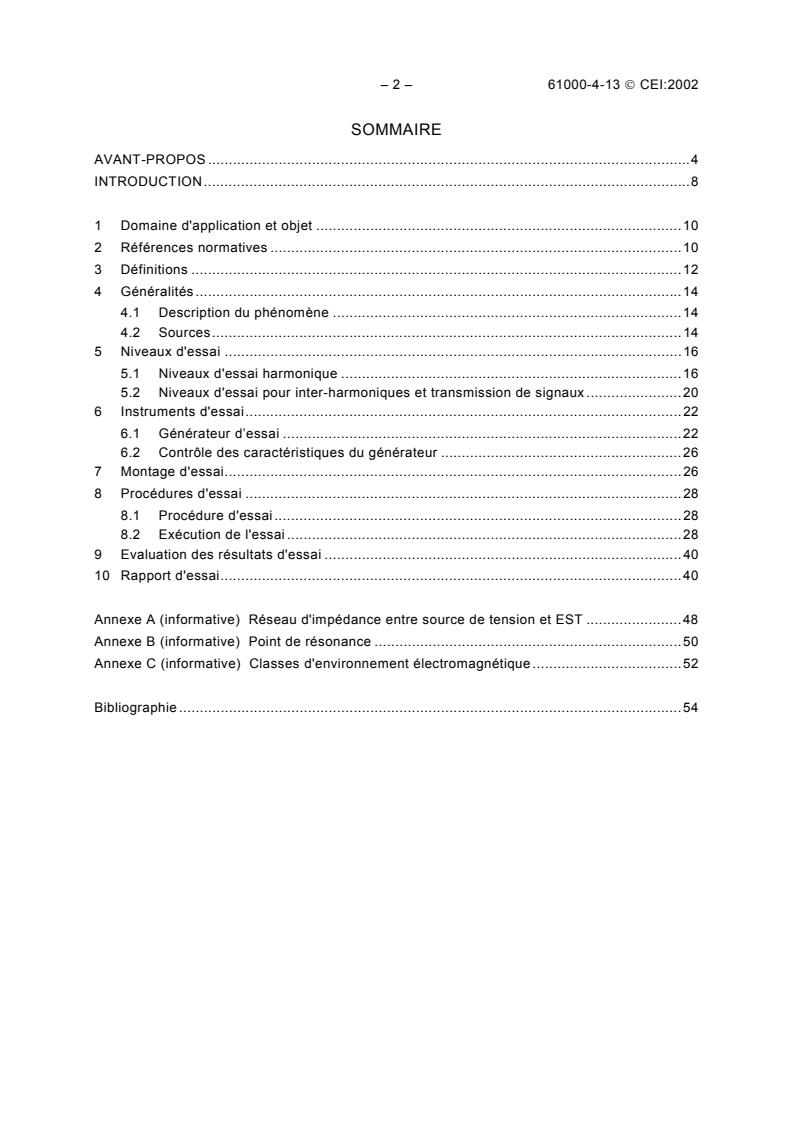
– 2 – 61000-4-13 CEI:2002
SOMMAIRE
AVANT-PROPOS .4
INTRODUCTION.8
1 Domaine d'application et objet .10
2 Références normatives .10
3 Définitions .12
4 Généralités.14
4.1 Description du phénomène .14
4.2 Sources.14
5 Niveaux d'essai .16
5.1 Niveaux d'essai harmonique .16
5.2 Niveaux d'essai pour inter-harmoniques et transmission de signaux .20
6 Instruments d'essai.22
6.1 Générateur d’essai .22
6.2 Contrôle des caractéristiques du générateur .26
7 Montage d'essai.26
8 Procédures d'essai .28
8.1 Procédure d'essai.28
8.2 Exécution de l'essai .28
9 Evaluation des résultats d'essai .40
10 Rapport d'essai.40
Annexe A (informative) Réseau d'impédance entre source de tension et EST .48
Annexe B (informative) Point de résonance .50
Annexe C (informative) Classes d'environnement électromagnétique.52
Bibliographie .54
61000-4-13 © IEC:2002 – 3 –
CONTENTS
FOREWORD.5
lNTRODUCTlON .9
1 Scope and object .11
2 Normative references.11
3 Definitions .13
4 General .15
4.1 Description of the phenomenon.15
4.2 Sources.15
5 Test levels .17
5.1 Harmonics test levels.17
5.2 Test levels for interharmonics and mains signalling.21
6 Test instrumentation .23
6.1 Test generator .23
6.2 Verification of the characteristics of the generator .27
7 Test set up .27
8 Test procedures.29
8.1 Test procedure .29
8.2 Application of the test .29
9 Evaluation of test results.41
10 Test report.41
Annex A (informative) Impedance network between voltage source and EUT .49
Annex B (informative) Resonance point .51
Annex C (informative) Electromagnetic environment classes .53
Bibliography .55
– 4 – 61000-4-13 CEI:2002
COMMISSION ÉLECTROTECHNIQUE INTERNATIONALE
____________
COMPATIBILITÉ ÉLECTROMAGNÉTIQUE (CEM) –
Partie 4-13: Techniques d'essai et de mesure –
Essais d'immunité basse fréquence aux harmoniques
et inter-harmoniques incluant les signaux transmis
sur le réseau électrique alternatif
AVANT-PROPOS
1) La CEI (Commission Électrotechnique Internationale) est une organisation mondiale de normalisation composée
de l'ensemble des comités électrotechniques nationaux (Comités nationaux de la CEI). La CEI a pour objet de
favoriser la coopération internationale pour toutes les questions de normalisation dans les domaines de
l'électricité et de l'électronique. A cet effet, la CEI, entre autres activités, publie des Normes internationales.
Leur élaboration est confiée à des comités d'études, aux travaux desquels tout Comité national intéressé par le
sujet traité peut participer. Les organisations internationales, gouvernementales et non gouvernementales, en
liaison avec la CEI, participent également aux travaux. La CEI collabore étroitement avec l'Organisation
Internationale de Normalisation (ISO), selon des conditions fixées par accord entre les deux organisations.
2) Les décisions ou accords officiels de la CEI concernant les questions techniques représentent, dans la mesure
du possible, un accord international sur les sujets étudiés, étant donné que les Comités nationaux intéressés
sont représentés dans chaque comité d’études.
3) Les documents produits se présentent sous la forme de recommandations internationales. Ils sont publiés
comme normes, spécifications techniques, rapports techniques ou guides et agréés comme tels par les Comités
nationaux.
4) Dans le but d'encourager l'unification internationale, les Comités nationaux de la CEI s'engagent à appliquer de
façon transparente, dans toute la mesure possible, les Normes internationales de la CEI dans leurs normes
nationales et régionales. Toute divergence entre la norme de la CEI et la norme nationale ou régionale
correspondante doit être indiquée en termes clairs dans cette dernière.
5) La CEI n’a fixé aucune procédure concernant le marquage comme indication d’approbation et sa responsabilité
n’est pas engagée quand un matériel est déclaré conforme à l’une de ses normes.
6) L’attention est attirée sur le fait que certains des éléments de la présente Norme internationale peuvent faire
l’objet de droits de propriété intellectuelle ou de droits analogues. La CEI ne saurait être tenue pour
responsable de ne pas avoir identifié de tels droits de propriété et de ne pas avoir signalé leur existence
La Norme internationale CEI 61000-4-13 a été établie par le sous-comité 77A: Phénomènes
basse fréquence, du comité d’études 77 de la CEI: Compatibilité électromagnétique.
Cette norme a le statut de publication fondamentale en CEM conformément au guide107 de la
CEI.
Le texte de la présente norme est issu des documents suivants:
FDIS Rapport de vote
77A/368/FDIS 77A/377/RVD
Le rapport de vote indiqué dans le tableau ci-dessus donne toute information sur le vote ayant
abouti à l'approbation de cette norme.
Cette publication a été rédigée selon les Directives ISO/CEI, Partie 3.
Les annexes A, B et C sont données uniquement à titre d’information.
61000-4-13 © IEC:2002 – 5 –
INTERNATIONAL ELECTROTECHNICAL COMMISSION
____________
ELECTROMAGNETIC COMPATIBILITY (EMC) –
Part 4-13 : Testing and measurement techniques –
Harmonics and interharmonics including mains signalling at
a.c. power port, low frequency immunity tests
FOREWORD
1) The IEC (International Electrotechnical Commission) is a worldwide organization for standardization comprising
all national electrotechnical committees (IEC National Committees). The object of the IEC is to promote
international co-operation on all questions concerning standardization in the electrical and electronic fields. To
this end and in addition to other activities, the IEC publishes International Standards. Their preparation is
entrusted to technical committees; any IEC National Committee interested in the subject dealt with may
participate in this preparatory work. International, governmental and non-governmental organizations liaising
with the IEC also participate in this preparation. The IEC collaborates closely with the International Organization
for Standardization (ISO) in accordance with conditions determined by agreement between the two
organizations.
2) The formal decisions or agreements of the IEC on technical matters express, as nearly as possible, an
international consensus of opinion on the relevant subjects since each technical committee has representation
from all interested National Committees.
3) The documents produced have the form of recommendations for international use and are published in the form
of standards, technical specifications, technical reports or guides and they are accepted by the National
Committees in that sense.
4) In order to promote international unification, IEC National Committees undertake to apply IEC International
Standards transparently to the maximum extent possible in their national and regional standards. Any
divergence between the IEC Standard and the corresponding national or regional standard shall be clearly
indicated in the latter.
5) The IEC provides no marking procedure to indicate its approval and cannot be rendered responsible for any
equipment declared to be in conformity with one of its standards.
6) Attention is drawn to the possibility that some of the elements of this International Standard may be the subject
of patent rights. The IEC shall not be held responsible for identifying any or all such patent rights.
International Standard IEC 61000-4-13 has been prepared by subcommittee 77A: Low
frequency phenomena, of IEC technical committee 77: Electromagnetic compatibility.
This standard has the status of a basic EMC publication in accordance with lEC Guide 107.
The text of this standard is based on the following documents:
FDIS Report on voting
77A/368/FDIS 77A/377/RVD
Full information on the voting for the approval of this standard can be found in the report on
voting indicated in the above table.
This publication has been drafted in accordance with the ISO/IEC Directives, Part 3.
Annexes A, B, and C, are for information only.
– 6 – 61000-4-13 CEI:2002
Le comité a décidé que le contenu de cette publication ne sera pas modifié avant 2008. A cette
date, la publication sera:
• reconduite;
• supprimée;
• remplacée par une édition révisée, ou
• amendée.
61000-4-13 © IEC:2002 – 7 –
The committee has decided that the contents of this publication will remain unchanged until
2008. At this date, the publication will be
• reconfirmed;
• withdrawn;
• replaced by a revised edition, or
• amended.
– 8 – 61000-4-13 CEI:2002
INTRODUCTION
La CEI 61000 est publiée sous forme de plusieurs parties séparées, conformément à la
structure suivante:
Partie 1: Généralités
Considérations générales (introduction, principes fondamentaux)
Définitions, terminologie
Partie 2: Environnement
Description de l'environnement
Classification de l'environnement
Niveaux de compatibilité
Partie 3: Limites
Limites d'émissions
Limites d'immunité (dans la mesure où elles ne relèvent pas des comités de produits)
Partie 4: Techniques d'essai et de mesure
Techniques de mesure
Techniques d'essai
Partie 5: Directives d'installation et d'atténuation
Guides d'installation
Méthodes et dispositifs d'atténuation
Partie 6: Normes génériques
Partie 9: Divers
Chaque partie est à son tour subdivisée en plusieurs parties, publiées soit comme Normes
internationales, soit comme spécifications techniques ou rapports techniques, dont certaines
ont déjà été publiées en tant que sections. D’autres seront publiées sous le numéro de la
partie, suivi d’un tiret et complété d’un second chiffre identifiant la subdivision (exemple:
61000-6-1).
La présente partie constitue une publication fondamentale en CEM traitant des prescriptions
d'immunité aux harmoniques et inter-harmoniques et les procédures d’essai y relatives, y
compris les signaux transmis sur le réseau électrique alternatif.
61000-4-13 © IEC:2002 – 9 –
lNTRODUCTlON
IEC 61000 is published in separate parts according to the following structure :
Part 1: General
General considerations (introduction, fundamental principles)
Definitions, terminology
Part 2: Environment
Description of the environment
Classification of the environment
Compatibility levels
Part 3: Limits
Emission limits
Immunity limits (in so far as they do not fall under the responsibility of the product
committees)
Part 4: Testing and measurement techniques
Measurement techniques
Testing techniques
Part 5: Installation and mitigation guidelines
Installation guidelines
Mitigation methods and devices
Part 6: Generic Standards
Part 9: Miscellaneous
Each part is further subdivided into several parts, published either as International Standards
or as technical specifications or technical reports, some of which have already been published
as sections. Others will be published with the part number followed by a dash and a second
number identifying the subdivision (example: 61000-6-1).
This part is an EMC basic standard which gives immunity requirements and test procedures
related to harmonics and interharmonics including mains signalling at a.c. power port.
– 10 – 61000-4-13 CEI:2002
COMPATIBILITÉ ÉLECTROMAGNÉTIQUE (CEM) –
Partie 4-13: Techniques d'essai et de mesure –
Essais d'immunité basse fréquence aux harmoniques
et inter-harmoniques incluant les signaux transmis
sur le réseau électrique alternatif
1 Domaine d'application et objet
La présente partie de la CEI 61000 définit les méthodes d'essai d'immunité ainsi que la gamme
des niveaux d'essais fondamentaux recommandés pour les matériels électriques et électro-
niques dont le courant assigné d’entrée est inférieur à 16 A par phase, à des fréquences de
perturbation allant jusqu'à et y compris 2 kHz (pour réseau 50 Hz) et 2,4 kHz (pour réseau
60 Hz) pour des harmoniques et inter-harmoniques sur réseaux d’alimentation basse tension.
Elle ne s'applique pas aux matériels électriques et électroniques connectés aux réseaux
électriques alternatifs de fréquence 16 2/3 Hz ou 400 Hz. Les essais pour ces réseaux seront
traités dans des normes à venir.
Le but de cette norme est d'établir une référence commune pour l'évaluation de l'immunité
fonctionnelle des matériels électriques et électroniques soumis aux harmoniques et inter-
harmoniques et aux fréquences des signaux transmis sur le réseau. La méthode d’essai
décrite dans cette partie de la CEI 61000 décrit une méthode robuste pour estimer l’immunité
d’un matériel ou d’un système à un phénomène prédéfini. Comme décrit dans le Guide 107 de
la CEI, ce document est une publication fondamentale en CEM destinée à l’usage des comités
de produit de la CEI. Comme également mentionné dans le Guide 107, les comités de produit
sont responsables du choix d’utilisation ou non de cette norme d’essai d’immunité; et si
utilisées, ils sont responsables de la définition des niveaux d’essai appropriés et des critères
de performance. Le TC 77 et ses sous-comités sont prêts à coopérer avec les comités de
produit pour l’évaluation de la pertinence des tests particuliers d’immunité pour leurs produits.
Le contrôle de fiabilité des composants électriques (comme les condensateurs, les filtres, etc.)
ne rentre pas dans le cadre de la présente norme. Les effets thermiques longue durée
(supérieurs à 15 min) ne sont pas traités dans la présente norme.
Les niveaux proposés correspondent généralement aux environnements résidentiels,
commerciaux, et de l’industrie légère. Pour des environnements propres à l’industrie lourde, il
est de la responsabilité des comités de produits de définir les niveaux requis via la classe X. Ils
ont également la possibilité de définir des formes d'ondes plus complexes pour leurs propres
besoins. Toutefois, il est à noter que les formes d'ondes simples proposées ont été
principalement observées sur plusieurs réseaux (en général courbe plate pour les systèmes
monophasés) et également sur les réseaux industriels (en général courbe d'oscillation pour
systèmes triphasés).
2 Références normatives
Les documents de référence suivants sont indispensables pour l'application du présent
document. Pour les références datées, seule l'édition citée s'applique. Pour les références non
datées, la dernière édition du document de référence s'applique (y compris les éventuels
amendements).
CEI 60050(161), Vocabulaire électrotechnique international (VEI) – Chapitre 161 – Compa-
tibilité électromagnétique
61000-4-13 © IEC:2002 – 11 –
ELECTROMAGNETIC COMPATIBILITY (EMC) –
Part 4-13: Testing and measurement techniques –
Harmonics and interharmonics including mains signalling at
a.c. power port, low frequency immunity tests
1 Scope and object
This part of IEC 61000 defines the immunity test methods and range of recommended basic
test levels for electrical and electronic equipment with rated current up to 16 A per phase at
disturbance frequencies up to and including 2 kHz (for 50 Hz mains) and 2,4 kHz (for 60 Hz
mains) for harmonics and interharmonics on low voltage power networks.
It does not apply to electrical and electronic equipment connected to 16 2/3 Hz , or to 400 Hz
a.c. networks. Tests for these networks will be covered by future standards.
The object of this standard is to establish a common reference for evaluating the functional
immunity of electrical and electronic equipment when subjected to harmonics and inter-
harmonics and mains signalling frequencies. The test method documented in this part of IEC
61000 describes a consistent method to assess the immunity of an equipment or system
against a defined phenomenon. As described in IEC guide 107, this is a basic EMC publication
for use by product committees of the IEC. As also stated in Guide 107, the IEC product
committees are responsible for determining whether this immunity test standard should be
applied or not, and if applied, they are responsible for determining the appropriate test levels
and performance criteria. TC 77 and its sub-committees are prepared to co-operate with
product committees in the evaluation of the value of particular immunity tests for their products.
The verification of the reliability of electrical components (for example capacitors, filters, etc.)
is not in the scope of the present standard. Long term thermal effects (greater than 15 min) are
not considered in this standard.
The levels proposed are more adapted for residential, commercial and light industry
environments. For heavy industrial environments the product committees are responsible for
the definition of a class X with the necessary levels. They have also the possibility of defining
more complex waveforms for their own need. Nevertheless, the simple waveforms proposed
have been mainly observed on several networks (flat curve more often for single phase
system) and also on industrial networks (overswing curve more for three phase systems).
2 Normative references
The following referenced documents are indispensable for the application of this document. For
dated references, only the edition cited applies. For undated references, the latest edition of
the referenced document (including any amendments) applies.
IEC 60050(161), International Electrotechnical Vocabulary (IEV) – Chapter 161: Electro-
magnetic compatibility
– 12 – 61000-4-13 CEI:2002
CEI 61000-2-2, Compatibilité électromagnétique (CEM) – Partie 2-2: Environnement – Niveaux
de compatibilité pour les perturbations conduites basse fréquence et la transmission de
signaux sur les réseaux publics d'alimentation à basse tension
CEI 61000-3-2, Compatibilité électromagnétique (CEM) – Partie 3-2: Limites – Limites pour les
émissions de courant harmonique (courant appelé par les appareils ≤ 16 A par phase)
CEI 61000-4-7, Compatibilité Électromagnétique (CEM) – Partie 4-7: Techniques d’essai et de
mesure – Guide général relatif aux mesures d’harmoniques et d’inter-harmoniques, ainsi qu’à
l’appareillage de mesure, applicable aux réseaux d’alimentation et aux appareils qui y sont
raccordés
3 Définitions
Pour les besoins de la présente partie de la CEI 61000, les définitions de la CEI 60050(161)
ainsi que les suivantes s'appliquent:
3.1
immunité
aptitude d'un dispositif, d'un appareil ou d'un système à fonctionner sans dégradation en
présence d'une perturbation électromagnétique
[VEI 161-01-20]
3.2
composante harmonique; harmonique
composante d'un rang supérieur à 1 du développement en série de Fourier d'une grandeur
périodique
[VEI 161-02-18]
3.3
composante fondamentale; fondamental
composante de rang 1 du développement en série de Fourier d'une grandeur périodique
[VEI 161-02-17]
3.4
forme d'onde courbe plate
forme d'onde suivant une fonction temporelle dans laquelle chaque demi-onde se compose de
trois parties:
partie 1: démarre à zéro en suivant une fonction purement sinusoïdale jusqu'à la valeur spécifiée;
partie 2: est une valeur constante;
partie 3: suit une fonction purement sinusoïdale jusqu'à la valeur zéro
3.5
forme d'onde d’oscillation
forme d'onde composée de valeurs discrètes de l'harmonique fondamentale, les 3ème et 5ème
harmoniques avec déphasage spécifié
3.6
f
fréquence fondamentale
3.7
fréquence de transmission de signaux
fréquences d'un signal entre les harmoniques pour le contrôle et la communication
61000-4-13 © IEC:2002 – 13 –
IEC 61000-2-2, Electromagnetic compatibility (EMC) – Part 2-2: Environment – Compatibility
levels for low-frequency conducted disturbances and signalling in public low-voltage power
supply systems
IEC 61000-3-2, Electromagnetic compatibility (EMC) – Part 3-2: Limits – Limits for harmonic
current emissions (equipment input current ≤ 16 A per phase)
IEC 61000-4-7, Electromagnetic compatibility (EMC) – Part 4-7: Testing and measurement
techniques – General guide on harmonics and interharmonics measurements and
instrumentation, for power supply systems and equipment connected thereto
3 Definitions
For the purposes of this part of IEC 61000, the following definitions and terms apply as well as
the definitions of IEC 60050(161):
3.1
immunity
ability of a device, equipment or system to perform without degradation in the presence of an
electromagnetic disturbance
[IEV 161-01-20]
3.2
harmonic (component)
component of order greater than 1 of the Fourier series of a periodic quantity
[IEV 161-02-18]
3.3
fundamental (component)
component of order 1 of the Fourier series of a periodic quantity
[IEV 161-02-17]
3.4
flat curve waveshape
waveform that follows a time related function in which each half-wave consists of three parts:
Part 1: starts from zero and follows a pure sine function up to the specified value;
Part 2: is a constant value;
Part 3: follows a pure sine function down to zero
3.5
overswing waveshape
rd th
waveform which consists of discrete values of the fundamental harmonic, the 3 and the 5
harmonics with the specified phase shift
3.6
f1
fundamental frequency
3.7
mains signalling frequencies
signal frequencies between harmonics for control and communication
– 14 – 61000-4-13 CEI:2002
3.8
EST
équipement soumis aux essais (équipement sous test)
4 Généralités
4.1 Description du phénomène
4.1.1 Harmoniques
Les harmoniques sont des tensions et courants sinusoïdaux dont les fréquences sont des
multiples entiers de la fréquence à laquelle le système d'alimentation fonctionne.
Les perturbations harmoniques sont généralement provoquées par des matériels à
caractéristique de tension – courant non linéaire ou par commutation périodique et synchro-
nisée de charges. De tels matériels peuvent être considérés comme des sources de courants
harmoniques.
Les courants harmoniques provenant des diverses sources provoquent des chutes de tension
harmoniques au travers de l'impédance du réseau.
Une capacité de câble, une inductance de ligne et la connexion de condensateurs de
correction de facteur de puissance peuvent entraîner une résonance parallèle ou série dans le
réseau et provoquer une amplification de la tension harmonique même en un point éloigné de
la charge perturbante. Les formes d’ondes proposées sont le résultat de l’addition de différents
rangs d’harmoniques d’une ou plusieurs sources d’harmoniques.
4.1.2 Inter-harmoniques
Entre les tensions et courants harmoniques à la fréquence du réseau, on peut observer
d'autres fréquences qui ne sont pas des multiples entiers du fondamental. Elles peuvent se
présenter comme des fréquences discrètes ou comme un spectre à large bande. L’addition
des diverses sources d’inter-harmoniques est peu probable et n’est prise pas en compte dans
cette norme.
4.1.3 Transmission de signaux (télécommande centralisée)
Fréquences d'un signal allant de 110 Hz à 3 kHz utilisées dans les réseaux ou dans des parties
de ceux-ci pour véhiculer des informations d'un point d'émission vers un ou plusieurs points de
réception.
Dans le cadre de cette norme, la gamme de fréquences est limitée à 2 kHz/50 Hz
(2,4 kHz/60 Hz).
4.2 Sources
4.2.1 Harmoniques
Les courants harmoniques sont générés, dans une faible mesure, par des matériels de
production, de transmission et de distribution, et dans une large mesure par des charges
industrielles et résidentielles. Parfois, seules quelques sources génèrent des courants
harmoniques importants dans un réseau ; le niveau harmonique individuel de la majorité des
autres matériels est bas, cependant ceux-ci peuvent représenter une contribution relativement
élevée à la distorsion harmonique en tension, au moins pour les rangs harmoniques bas du fait
de leur addition.
Des courants harmoniques importants dans un réseau peuvent être générés par des charges
non linéaires, par exemple:
61000-4-13 © IEC:2002 – 15 –
3.8
EUT
equipment under test
4 General
4.1 Description of the phenomenon
4.1.1 Harmonics
Harmonics are sinusoidal voltages and currents with frequencies that are integer multiples of
the frequency at which the supply system operates.
Harmonic disturbances are generally caused by equipment with non-linear voltage – current
characteristics or by periodic and line-synchronised switching of loads. Such equipment may be
regarded as sources of harmonic currents.
The harmonic currents from the different sources produce harmonic voltage drops across the
impedance of the network.
As a result of cable capacitance, line inductance and the connection of power factor correction
capacitors, parallel or series resonance may occur in the network and cause a harmonic
voltage amplification even at a remote point from the distorting load. The waveforms proposed
are the result of the summation of different harmonic orders of one or several harmonic
sources.
4.1.2 Interharmonics
Between the harmonics of the power frequency voltage and current, further frequencies can be
observed which are not an integer multiple of the fundamental. They can appear as discrete
frequencies or as a wide-band spectrum. Summation of different interharmonic sources is not
likely and is not taken into account in this standard.
4.1.3 Mains signalling (ripple control)
Signal frequencies ranging from 110 Hz to 3 kHz used in networks or parts of them in order to
transfer information from a sending point to one or more receiving points.
For the scope of this standard, the frequency range is limited to 2 kHz/50 Hz (2,4 kHz/60 Hz).
4.2 Sources
4.2.1 Harmonics
Harmonic currents are generated to a small extent by generation, transmission and distribution
equipment and to a greater extent by industrial and residential loads. Sometimes, there are
only a few sources generating significant harmonic currents in a network; the individual
harmonic level of the majority of the other devices is low, nevertheless these may make a
relatively high contribution to the harmonic voltage distortion, at least for low order harmonics
due to their summation.
Significant harmonic currents in a network can be generated by non-linear loads, for example:
– 16 – 61000-4-13 CEI:2002
– les redresseurs commandés ou non commandés, notamment avec lissage capacitif
(comme ceux utilisés en télévision, les convertisseurs statiques directs ou indirects et les
lampes à ballast intégré), car ces harmoniques sont approximativement en phase tout en
provenant de diverses sources et il n'y a qu’une faible compensation dans le réseau;
– matériels avec réglage de phase, certains types d'ordinateurs et matériels à alimentation
sans interruption.
Les sources peuvent produire des harmoniques à un niveau constant ou variable suivant la
méthode de fonctionnement.
4.2.2 Inter-harmoniques
Les sources d'inter-harmoniques peuvent être trouvées dans les réseaux basse tension ainsi
que dans les réseaux moyenne et haute tension. Les inter-harmoniques produites dans les
réseaux moyenne/haute tension se transmettent aux réseaux basse tension qu'ils alimentent,
et réciproquement.
Les sources principales sont les convertisseurs statiques directs et indirects, les machines de
soudage et les fours à arc.
4.2.3 Transmission de signaux (télécommande centralisée)
Les sources des fréquences de transmission de signaux couvertes par cette norme sont les
émetteurs fonctionnant principalement dans la gamme de fréquences allant de 110 Hz à 2 kHz
(2,4 kHz) et permettant au gestionnaire du réseau de contrôler les matériels sur le réseau
d'alimentation (éclairage public, tarifs pour les compteurs, etc.). L'énergie de l'émetteur est
couplée au réseau en haute, moyenne ou basse tension. Les émetteurs fonctionnent avec des
signaux en tout ou rien et en général pour une courte période uniquement. Les fréquences
utilisées se trouvent généralement entre deux harmoniques.
5 Niveaux d'essai
Le niveau d'essai est la tension harmonique spécifiée en tant que pourcentage de la tension
fondamentale. Les tensions données dans cette norme ont comme base la tension nominale
du réseau d’alimentation (U fondamentale).
Il est essentiel que la tension efficace des formes d'onde résultantes reste à la valeur nominale
pendant l'exécution de ces essais en réglant les valeurs de tensions du fondamental et des
harmoniques conformément aux pourcentages indiqués dans les tableaux correspondants (par
exemple 230 V efficace, 120 V efficace).
5.1 Niveaux d'essai harmonique
La gamme préférentielle de niveaux d'essai pour harmoniques individuelles est indiquée dans
les tableaux 1 à 3.
Les tensions harmoniques à un niveau d'essai de 3 % et plus, jusqu'à la 9ème harmonique,
doivent être appliquées avec un déphasage de 0° et de 180° par rapport au passage par le
zéro positif du fondamental. Les tensions harmoniques à un niveau d'essai inférieur à 3 %
doivent être appliquées sans déphasage par rapport au passage par le zéro positif du
fondamental.
Pour les niveaux de compatibilité, se référer à la CEI 61000-2-2 utilisant un facteur k. Les
niveaux d’immunité doivent être supérieurs (par exemple 1,5 fois additionnellement).
Voir 8.2.5 pour l'application de l'essai à un EST polyphasé.
61000-4-13 © IEC:2002 – 17 –
– controlled and uncontrolled rectifiers, especially with capacitive smoothing (for example
used in television, indirect and direct static frequency converters, and self-ballasted lamps),
because these harmonics are in approximately the same phase from different sources and
there is only poor compensation in the network;
– phase controlled equipment, some types of computers and UPS equipment.
Sources may produce harmonics at a constant or varying level, depending on the method of
operation.
4.2.2 Interharmonics
Sources of interharmonics can be found in low-voltage networks as well as in medium-voltage
and high voltage networks. The interharmonics produced in the medium-voltage/high voltage
networks flow in the low-voltage networks they supply and vice versa.
The main sources are indirect and direct static frequency converters, welding machines and
arc furnaces.
4.2.3 Mains signalling (ripple control)
Sources of mains signalling frequencies covered by this standard are transmitters operating
mostly in the 110 Hz to 2 kHz (2,4 kHz) frequency range in order for the public supplier to
control equipment in the supply network (public lighting, tariffs for meters, etc.). The transmitter
energy is coupled into the system on HV, MV, or LV level. The transmitters operate with
interrupted signals, and normally for a short time only. The frequencies used lie normally in
between the harmonics.
5 Test levels
The test level is the harmonic voltage specified as a percentage of the fundamental voltage.
The voltages given in this standard have the nominal power supply network voltage (U
fundamental) as a basis.
It is essential that the r.m.s. voltage of the resultant waveforms remain at the nominal value
during the application of these tests by adjusting the voltage values of fundamental and
harmonics according to the percentages indicated in the corresponding tables (for example
230 V r.m.s., 120 V r.m.s.).
5.1 Harmonics test levels
The preferential range of test levels for individual harmonics are given in tables 1 to 3.
Harmonic voltages at a test level of 3 % and higher, up to the 9th harmonic, shall be applied
using a phase shift of both 0° and 180° with respect to the positive zero-crossing of the
fundamental. Harmonic voltages at a test level of less than 3 % shall be applied using no
phase-shift with respect to the positive zero-crossing of the fundamental.
For compatibility levels see IEC 61000-2-2 using factor k. Immunity levels have to be higher
(for example times 1,5 additionally).
The application of the test to a multiphase EUT is given in 8.2.5.
– 18 – 61000-4-13 CEI:2002
Tableau 1 – Harmoniques impairs non multiples de 3
h Classe 1 Classe 2 Classe 3 Classe X
Niveaux d'essai % U Niveaux d'essai % U Niveaux d'essai % U Niveaux d'essai % U
1 1 1 1
5 4,5 9 12 Ouvert
7 4,5 7,5 10 Ouvert
4,5 5 7 Ouvert
13 4 4,5 7 Ouvert
17 3 3 6 Ouvert
19 2 2 6 Ouvert
23 2 2 6 Ouvert
25 2 2 6 Ouvert
29 1,5 1,5 5 Ouvert
31 1,5 1,5 3 Ouvert
35 1,5 1,5 3 Ouvert
37 1,5 1,5 3 Ouvert
NOTE 1 Les classes 1, 2 et 3 sont définies à l'annexe C.
NOTE 2 Les niveaux indiqués pour la classe X sont ouverts. Ces niveaux doivent être définis par les comités de
produits. Toutefois, pour les matériels alimentés par les systèmes publics d'alimentation basse tension, les valeurs
ne doivent pas être inférieures à celles de la classe 2.
Tableau 2 – Harmoniques impairs multiples de 3
h Classe 1 Classe 2 Classe 3 Classe X
Niveaux d'essai % U Niveaux d'essai % U Niveaux d'essai % U Niveaux d'essai % U
1 1 1 1
3 4,5 8 9 Ouvert
2 2,5 4 Ouvert
15 Aucun essai Aucun essai 3 Ouvert
21 Aucun essai Aucun essai 2 Ouvert
27 Aucun essai Aucun essai 2 Ouvert
33 Aucun essai Aucun essai 2 Ouvert
39 Aucun essai Aucun essai 2 Ouvert
NOTE 1 Les classes 1, 2 et 3 sont définies à l'annexe C.
NOTE 2 Les niveaux donnés pour la classe X sont ouverts. Ces niveaux doivent être définis par les comités de
produits. Toutefois, pour les matériels alimentés par les systèmes publics d'alimentation basse tension, les valeurs
ne doivent pas être inférieures à celles de la classe 2.
61000-4-13 © IEC:2002 – 19 –
Table 1 – Odd harmonics non-multiple of 3 harmonics
h Class 1 Class 2 Class 3 Class X
Test levels % U Test levels % U Test levels % U Test levels % U
1 1 1 1
5 4,5 9 12 Open
7 4,5 7,5 10 Open
4,5 5 7 Open
13 4 4,5 7 Open
17 3 3 6 Open
19 2 2 6 Open
23 2 2 6 Open
25 2 2 6 Open
29 1,5 1,5 5 Open
31 1,5 1,5 3 Open
35 1,5 1,5 3 Open
37 1,5 1,5 3 Open
NOTE 1 Classes 1, 2, and 3 are defined in annex C.
NOTE 2 The levels given for class X are open. These levels shall be defined by the product committees. However,
for equipment supplied by low voltage public supply systems, the values shall not be lower than those of class 2
...
IEC 61000-4-13 ®
Edition 1.1 2009-07
INTERNATIONAL
STANDARD
NORME
INTERNATIONALE
colour
inside
BASIC EMC PUBLICATION
PUBLICATION FONDAMENTALE EN CEM
Electromagnetic compatibility (EMC) –
Part 4-13: Testing and measurement techniques – Harmonics and
interharmonics including mains signalling at a.c. power port, low frequency
immunity tests
Compatibilité électromagnétique (CEM) –
Partie 4-13: Techniques d’essai et de mesure – Essais d’immunité basse
fréquence aux harmoniques et inter-harmoniques incluant les signaux transmis
sur le réseau électrique alternatif
All rights reserved. Unless otherwise specified, no part of this publication may be reproduced or utilized in any form or by
any means, electronic or mechanical, including photocopying and microfilm, without permission in writing from either IEC or
IEC's member National Committee in the country of the requester.
If you have any questions about IEC copyright or have an enquiry about obtaining additional rights to this publication,
please contact the address below or your local IEC member National Committee for further information.
Droits de reproduction réservés. Sauf indication contraire, aucune partie de cette publication ne peut être reproduite
ni utilisée sous quelque forme que ce soit et par aucun procédé, électronique ou mécanique, y compris la photocopie
et les microfilms, sans l'accord écrit de la CEI ou du Comité national de la CEI du pays du demandeur.
Si vous avez des questions sur le copyright de la CEI ou si vous désirez obtenir des droits supplémentaires sur cette
publication, utilisez les coordonnées ci-après ou contactez le Comité national de la CEI de votre pays de résidence.
IEC Central Office
3, rue de Varembé
CH-1211 Geneva 20
Switzerland
Email: inmail@iec.ch
Web: www.iec.ch
About the IEC
The International Electrotechnical Commission (IEC) is the leading global organization that prepares and publishes
International Standards for all electrical, electronic and related technologies.
About IEC publications
The technical content of IEC publications is kept under constant review by the IEC. Please make sure that you have the
latest edition, a corrigenda or an amendment might have been published.
ƒ Catalogue of IEC publications: www.iec.ch/searchpub
The IEC on-line Catalogue enables you to search by a variety of criteria (reference number, text, technical committee,…).
It also gives information on projects, withdrawn and replaced publications.
ƒ IEC Just Published: www.iec.ch/online_news/justpub
Stay up to date on all new IEC publications. Just Published details twice a month all new publications released. Available
on-line and also by email.
ƒ Electropedia: www.electropedia.org
The world's leading online dictionary of electronic and electrical terms containing more than 20 000 terms and definitions
in English and French, with equivalent terms in additional languages. Also known as the International Electrotechnical
Vocabulary online.
ƒ Customer Service Centre: www.iec.ch/webstore/custserv
If you wish to give us your feedback on this publication or need further assistance, please visit the Customer Service
Centre FAQ or contact us:
Email: csc@iec.ch
Tel.: +41 22 919 02 11
Fax: +41 22 919 03 00
A propos de la CEI
La Commission Electrotechnique Internationale (CEI) est la première organisation mondiale qui élabore et publie des
normes internationales pour tout ce qui a trait à l'électricité, à l'électronique et aux technologies apparentées.
A propos des publications CEI
Le contenu technique des publications de la CEI est constamment revu. Veuillez vous assurer que vous possédez
l’édition la plus récente, un corrigendum ou amendement peut avoir été publié.
ƒ Catalogue des publications de la CEI: www.iec.ch/searchpub/cur_fut-f.htm
Le Catalogue en-ligne de la CEI vous permet d’effectuer des recherches en utilisant différents critères (numéro de référence,
texte, comité d’études,…). Il donne aussi des informations sur les projets et les publications retirées ou remplacées.
ƒ Just Published CEI: www.iec.ch/online_news/justpub
Restez informé sur les nouvelles publications de la CEI. Just Published détaille deux fois par mois les nouvelles
publications parues. Disponible en-ligne et aussi par email.
ƒ Electropedia: www.electropedia.org
Le premier dictionnaire en ligne au monde de termes électroniques et électriques. Il contient plus de 20 000 termes et
définitions en anglais et en français, ainsi que les termes équivalents dans les langues additionnelles. Egalement appelé
Vocabulaire Electrotechnique International en ligne.
ƒ Service Clients: www.iec.ch/webstore/custserv/custserv_entry-f.htm
Si vous désirez nous donner des commentaires sur cette publication ou si vous avez des questions, visitez le FAQ du
Service clients ou contactez-nous:
Email: csc@iec.ch
Tél.: +41 22 919 02 11
Fax: +41 22 919 03 00
IEC 61000-4-13 ®
Edition 1.1 2009-07
INTERNATIONAL
STANDARD
NORME
INTERNATIONALE
colour
inside
BASIC EMC PUBLICATION
PUBLICATION FONDAMENTALE EN CEM
Electromagnetic compatibility (EMC) –
Part 4-13: Testing and measurement techniques – Harmonics and
interharmonics including mains signalling at a.c. power port, low frequency
immunity tests
Compatibilité électromagnétique (CEM) –
Partie 4-13: Techniques d’essai et de mesure – Essais d’immunité basse
fréquence aux harmoniques et inter-harmoniques incluant les signaux transmis
sur le réseau électrique alternatif
INTERNATIONAL
ELECTROTECHNICAL
COMMISSION
COMMISSION
ELECTROTECHNIQUE
PRICE CODE
INTERNATIONALE
CL
CODE PRIX
ICS 33.100.20 ISBN 978-2-88910-380-5
– 2 – 61000-4-13 © IEC:2002+A1:2009
CONTENTS
FOREWORD.4
lNTRODUCTlON .6
1 Scope and object .7
2 Normative references.7
3 Definitions.8
4 General.9
4.1 Description of the phenomenon.9
4.2 Sources.9
5 Test levels.10
5.1 Harmonics test levels.10
5.2 Test levels for interharmonics and mains signalling.12
6 Test instrumentation .13
6.1 Test generator.13
6.2 Verification of the characteristics of the generator .15
7 Test set up .15
8 Test procedures.16
8.1 Test procedure.16
8.2 Application of the test .16
9 Evaluation of test results.21
10 Test report.22
Annex A (informative) Impedance network between voltage source and EUT .27
Annex B (informative) Resonance point .28
Annex C (informative) Electromagnetic environment classes .29
Bibliography .30
Figure 1 – Test flowcharts .18
Figure 2 – An example of a test set-up for single phase.23
Figure 3 – An example of a test set-up for three phases .23
Figure 4 – Test sequences for individual harmonics.24
Figure 5 – An example of the sweep in frequency test (for example class 1 equipment
from Table 9) .24
Figure 6 – Flat curve waveshape .25
Figure 7 – Over swing waveshape .26
Table 1 – Odd harmonics non-multiple of 3 harmonics.11
Table 2 – Odd harmonics multiple of 3 harmonics.11
Table 3 – Even harmonics .12
Table 4 – Frequencies between harmonic frequencies.12
Table 4a – Frequencies between harmonic frequencies (for 50 Hz mains) .12
Table 4b – Frequencies between harmonic frequencies (for 60 Hz mains) .12
61000-4-13 © IEC:2002+A1:2009 – 3 –
Table 5 – Characteristics of the test generator.14
Table 6 – Maximum harmonic voltage distortion .15
Table 7 – Time related function, "flat curve".19
Table 8 – Harmonic combination, "over swing" .19
Table 9 – Sweep in frequency test levels .20
Table 10 – Frequency step sizes for interharmonics and Meister curve .20
Table 11 – Meister curve test levels .21
– 4 – 61000-4-13 © IEC:2002+A1:2009
INTERNATIONAL ELECTROTECHNICAL COMMISSION
____________
ELECTROMAGNETIC COMPATIBILITY (EMC) –
Part 4-13 : Testing and measurement techniques –
Harmonics and interharmonics including mains signalling at
a.c. power port, low frequency immunity tests
FOREWORD
1) The International Electrotechnical Commission (IEC) is a worldwide organization for standardization comprising
all national electrotechnical committees (IEC National Committees). The object of IEC is to promote
international co-operation on all questions concerning standardization in the electrical and electronic fields. To
this end and in addition to other activities, IEC publishes International Standards, Technical Specifications,
Technical Reports, Publicly Available Specifications (PAS) and Guides (hereafter referred to as “IEC
Publication(s)”). Their preparation is entrusted to technical committees; any IEC National Committee interested
in the subject dealt with may participate in this preparatory work. International, governmental and non-
governmental organizations liaising with the IEC also participate in this preparation. IEC collaborates closely
with the International Organization for Standardization (ISO) in accordance with conditions determined by
agreement between the two organizations.
2) The formal decisions or agreements of IEC on technical matters express, as nearly as possible, an international
consensus of opinion on the relevant subjects since each technical committee has representation from all
interested IEC National Committees.
3) IEC Publications have the form of recommendations for international use and are accepted by IEC National
Committees in that sense. While all reasonable efforts are made to ensure that the technical content of IEC
Publications is accurate, IEC cannot be held responsible for the way in which they are used or for any
misinterpretation by any end user.
4) In order to promote international uniformity, IEC National Committees undertake to apply IEC Publications
transparently to the maximum extent possible in their national and regional publications. Any divergence
between any IEC Publication and the corresponding national or regional publication shall be clearly indicated in
the latter.
5) IEC provides no marking procedure to indicate its approval and cannot be rendered responsible for any
equipment declared to be in conformity with an IEC Publication.
6) All users should ensure that they have the latest edition of this publication.
7) No liability shall attach to IEC or its directors, employees, servants or agents including individual experts and
members of its technical committees and IEC National Committees for any personal injury, property damage or
other damage of any nature whatsoever, whether direct or indirect, or for costs (including legal fees) and
expenses arising out of the publication, use of, or reliance upon, this IEC Publication or any other IEC
Publications.
8) Attention is drawn to the Normative references cited in this publication. Use of the referenced publications is
indispensable for the correct application of this publication.
9) Attention is drawn to the possibility that some of the elements of this IEC Publication may be the subject of
patent rights. IEC shall not be held responsible for identifying any or all such patent rights.
International Standard IEC 61000-4-13 has been prepared by subcommittee 77A: Low
frequency phenomena, of IEC technical committee 77: Electromagnetic compatibility.
This consolidated version of IEC 61000-4-13 consists of the first edition (2002) [documents
77A/368/FDIS and 77A/377/RVD] and its amendment 1 (2009) [documents 77A/668/CDV and
77A/684/RVC].
The technical content is therefore identical to the base edition and its amendment and has
been prepared for user convenience.
It bears the edition number 1.1.
A vertical line in the margin shows where the base publication has been modified by
amendment 1.
61000-4-13 © IEC:2002+A1:2009 – 5 –
This standard has the status of a basic EMC publication in accordance with lEC Guide 107.
Annexes A, B, and C, are for information only.
The committee has decided that the contents of the base publication and its amendments will
remain unchanged until the maintenance result date indicated on the IEC web site under
"http://webstore.iec.ch" in the data related to the specific publication. At this date,
the publication will be
• reconfirmed,
• withdrawn,
• replaced by a revised edition, or
• amended.
IMPORTANT – The “colour inside” logo on the cover page of this publication indicates
that it contains colours which are considered to be useful for the correct understanding
of its contents. Users should therefore print this publication using a colour printer.
– 6 – 61000-4-13 © IEC:2002+A1:2009
lNTRODUCTlON
IEC 61000 is published in separate parts according to the following structure :
Part 1: General
General considerations (introduction, fundamental principles)
Definitions, terminology
Part 2: Environment
Description of the environment
Classification of the environment
Compatibility levels
Part 3: Limits
Emission limits
Immunity limits (in so far as they do not fall under the responsibility of the product
committees)
Part 4: Testing and measurement techniques
Measurement techniques
Testing techniques
Part 5: Installation and mitigation guidelines
Installation guidelines
Mitigation methods and devices
Part 6: Generic Standards
Part 9: Miscellaneous
Each part is further subdivided into several parts, published either as International Standards
or as technical specifications or technical reports, some of which have already been published
as sections. Others will be published with the part number followed by a dash and a second
number identifying the subdivision (example: 61000-6-1).
This part is an EMC basic standard which gives immunity requirements and test procedures
related to harmonics and interharmonics including mains signalling at a.c. power port.
61000-4-13 © IEC:2002+A1:2009 – 7 –
ELECTROMAGNETIC COMPATIBILITY (EMC) –
Part 4-13: Testing and measurement techniques –
Harmonics and interharmonics including mains signalling at
a.c. power port, low frequency immunity tests
1 Scope and object
This part of IEC 61000 defines the immunity test methods and range of recommended basic
test levels for electrical and electronic equipment with rated current up to 16 A per phase at
disturbance frequencies up to and including 2 kHz (for 50 Hz mains) and 2,4 kHz (for 60 Hz
mains) for harmonics and interharmonics on low voltage power networks.
It does not apply to electrical and electronic equipment connected to 16 2/3 Hz , or to 400 Hz
a.c. networks. Tests for these networks will be covered by future standards.
The object of this standard is to establish a common reference for evaluating the functional
immunity of electrical and electronic equipment when subjected to harmonics and inter-
harmonics and mains signalling frequencies. The test method documented in this part of IEC
61000 describes a consistent method to assess the immunity of an equipment or system
against a defined phenomenon. As described in IEC Guide 107, this is a basic EMC publication
for use by product committees of the IEC. As also stated in Guide 107, the IEC product
committees are responsible for determining whether this immunity test standard should be
applied or not, and if applied, they are responsible for determining the appropriate test levels
and performance criteria. TC 77 and its sub-committees are prepared to co-operate with
product committees in the evaluation of the value of particular immunity tests for their products.
The verification of the reliability of electrical components (for example capacitors, filters, etc.)
is not in the scope of the present standard. Long term thermal effects (greater than 15 min) are
not considered in this standard.
The levels proposed are more adapted for residential, commercial and light industry
environments. For heavy industrial environments the product committees are responsible for
the definition of a class X with the necessary levels. They have also the possibility of defining
more complex waveforms for their own need. Nevertheless, the simple waveforms proposed
have been mainly observed on several networks (flat curve more often for single phase
system) and also on industrial networks (overswing curve more for three phase systems).
2 Normative references
The following referenced documents are indispensable for the application of this document. For
dated references, only the edition cited applies. For undated references, the latest edition of
the referenced document (including any amendments) applies.
IEC 60050(161), International Electrotechnical Vocabulary (IEV) – Chapter 161: Electro-
magnetic compatibility
IEC 61000-2-2, Electromagnetic compatibility (EMC) – Part 2-2: Environment – Compatibility
levels for low-frequency conducted disturbances and signalling in public low-voltage power
supply systems
– 8 – 61000-4-13 © IEC:2002+A1:2009
IEC 61000-3-2, Electromagnetic compatibility (EMC) – Part 3-2: Limits – Limits for harmonic
current emissions (equipment input current ≤ 16 A per phase)
IEC 61000-4-7, Electromagnetic compatibility (EMC) – Part 4-7: Testing and measurement
techniques – General guide on harmonics and interharmonics measurements and
instrumentation, for power supply systems and equipment connected thereto
3 Definitions
For the purposes of this part of IEC 61000, the following definitions and terms apply as well as
the definitions of IEC 60050(161):
3.1
immunity
ability of a device, equipment or system to perform without degradation in the presence of an
electromagnetic disturbance
[IEV 161-01-20]
3.2
harmonic (component)
component of order greater than 1 of the Fourier series of a periodic quantity
[IEV 161-02-18]
3.3
fundamental (component)
component of order 1 of the Fourier series of a periodic quantity
[IEV 161-02-17]
3.4
flat curve waveshape
waveform that follows a time related function in which each half-wave consists of three parts:
Part 1: starts from zero and follows a pure sine function up to the specified value;
Part 2: is a constant value;
Part 3: follows a pure sine function down to zero
3.5
overswing waveshape
rd th
and the 5
waveform which consists of discrete values of the fundamental harmonic, the 3
harmonics with the specified phase shift
3.6
f1
fundamental frequency
3.7
mains signalling frequencies
signal frequencies between harmonics for control and communication
3.8
EUT
equipment under test
61000-4-13 © IEC:2002+A1:2009 – 9 –
4 General
4.1 Description of the phenomenon
4.1.1 Harmonics
Harmonics are sinusoidal voltages and currents with frequencies that are integer multiples of
the frequency at which the supply system operates.
Harmonic disturbances are generally caused by equipment with non-linear voltage – current
characteristics or by periodic and line-synchronised switching of loads. Such equipment may be
regarded as sources of harmonic currents.
The harmonic currents from the different sources produce harmonic voltage drops across the
impedance of the network.
As a result of cable capacitance, line inductance and the connection of power factor correction
capacitors, parallel or series resonance may occur in the network and cause a harmonic
voltage amplification even at a remote point from the distorting load. The waveforms proposed
are the result of the summation of different harmonic orders of one or several harmonic
sources.
4.1.2 Interharmonics
Between the harmonics of the power frequency voltage and current, further frequencies can be
observed which are not an integer multiple of the fundamental. They can appear as discrete
frequencies or as a wide-band spectrum. Summation of different interharmonic sources is not
likely and is not taken into account in this standard.
4.1.3 Mains signalling (ripple control)
Signal frequencies ranging from 110 Hz to 3 kHz used in networks or parts of them in order to
transfer information from a sending point to one or more receiving points.
For the scope of this standard, the frequency range is limited to 2 kHz/50 Hz (2,4 kHz/60 Hz).
4.2 Sources
4.2.1 Harmonics
Harmonic currents are generated to a small extent by generation, transmission and distribution
equipment and to a greater extent by industrial and residential loads. Sometimes, there are
only a few sources generating significant harmonic currents in a network; the individual
harmonic level of the majority of the other devices is low, nevertheless these may make a
relatively high contribution to the harmonic voltage distortion, at least for low order harmonics
due to their summation.
Significant harmonic currents in a network can be generated by non-linear loads, for example:
– controlled and uncontrolled rectifiers, especially with capacitive smoothing (for example
used in television, indirect and direct static frequency converters, and self-ballasted lamps),
because these harmonics are in approximately the same phase from different sources and
there is only poor compensation in the network;
– phase controlled equipment, some types of computers and UPS equipment.
Sources may produce harmonics at a constant or varying level, depending on the method of
operation.
– 10 – 61000-4-13 © IEC:2002+A1:2009
4.2.2 Interharmonics
Sources of interharmonics can be found in low-voltage networks as well as in medium-voltage
and high voltage networks. The interharmonics produced in the medium-voltage/high voltage
networks flow in the low-voltage networks they supply and vice versa.
The main sources are indirect and direct static frequency converters, welding machines and
arc furnaces.
4.2.3 Mains signalling (ripple control)
Sources of mains signalling frequencies covered by this standard are transmitters operating
mostly in the 110 Hz to 2 kHz (2,4 kHz) frequency range in order for the public supplier to
control equipment in the supply network (public lighting, tariffs for meters, etc.). The transmitter
energy is coupled into the system on HV, MV, or LV level. The transmitters operate with
interrupted signals, and normally for a short time only. The frequencies used lie normally in
between the harmonics.
5 Test levels
The test level is the harmonic voltage specified as a percentage of the fundamental voltage.
The voltages given in this standard have the nominal power supply network voltage (U
fundamental) as a basis.
It is essential that the r.m.s. voltage of the resultant waveforms remain at the nominal value
during the application of these tests by adjusting the voltage values of fundamental and
harmonics according to the percentages indicated in the corresponding tables (for example
230 V r.m.s., 120 V r.m.s.).
5.1 Harmonics test levels
The preferential range of test levels for individual harmonics are given in tables 1 to 3.
Harmonic voltages at a test level of 3 % and higher, up to the 9th harmonic, shall be applied
using a phase shift of both 0° and 180° with respect to the positive zero-crossing of the
fundamental. Harmonic voltages at a test level of less than 3 % shall be applied using no
phase-shift with respect to the positive zero-crossing of the fundamental.
For compatibility levels see IEC 61000-2-2 using factor k. Immunity levels have to be higher
(for example times 1,5 additionally).
The application of the test to a multiphase EUT is given in 8.2.5.
61000-4-13 © IEC:2002+A1:2009 – 11 –
Table 1 – Odd harmonics non-multiple of 3 harmonics
h Class 1 Class 2 Class 3 Class X
Test levels % U Test levels % U Test levels % U Test levels % U
1 1 1 1
5 4,5 9 12 Open
7 4,5 7,5 10 Open
11 4,5 5 7 Open
13 4 4,5 7 Open
17 3 3 6 Open
19 2 2 6 Open
23 2 2 6 Open
25 2 2 6 Open
29 1,5 1,5 5 Open
31 1,5 1,5 3 Open
35 1,5 1,5 3 Open
37 1,5 1,5 3 Open
NOTE 1 Classes 1, 2, and 3 are defined in annex C.
NOTE 2 The levels given for class X are open. These levels shall be defined by the product committees. However,
for equipment supplied by low voltage public supply systems, the values shall not be lower than those of class 2.
Table 2 – Odd harmonics multiple of 3 harmonics
h Class 1 Class 2 Class 3 Class X
Test levels % U Test levels % U Test levels % U Test levels % U
1 1 1 1
3 4,5 8 9 Open
9 2 2,5 4 Open
15 No test No test 3 Open
21 No test No test 2 Open
27 No test No test 2 Open
33 No test No test 2 Open
39 No test No test 2 Open
NOTE 1 Classes 1, 2, and 3 are defined in annex C.
NOTE 2 The levels given for class X are open. These levels shall be defined by the product committees. However,
for equipment supplied by low voltage public supply systems the values shall not be lower than those of class 2.
– 12 – 61000-4-13 © IEC:2002+A1:2009
Table 3 – Even harmonics
h Class 1 Class 2 Class 3 Class X
Test levels % U Test levels % U Test levels % U Test levels % U
1 1 1 1
2 3 3 5 Open
4 1,5 1,5 2 Open
6 No test No test 1,5 Open
8 No test No test 1,5 Open
10 No test No test 1,5 Open
12-40 No test No test 1,5 Open
NOTE 1 Classes 1, 2, and 3 are defined in annex C.
NOTE 2 The levels given for class X are open. These levels shall be defined by the product committees. However,
for equipment supplied by low voltage public supply systems the values shall not be lower than those of class 2.
5.2 Test levels for interharmonics and mains signalling
The preferential ranges of test levels are given in tables 4a and 4b.
Table 4 – Frequencies between harmonic frequencies
Table 4a – Frequencies between harmonic frequencies (for 50 Hz mains)
Frequency range Class 1 Class 2 Class 3 Class X
Hz Test levels % U Test levels % U Test levels % U Test levels % U
1 1 1 1
16 – 100 no test 2,5 4 Open
100 – 500 no test 5 9 Open
500 – 750 no test 3,5 5 Open
750 – 1 000 no test 2 3 Open
1 000 – 2 000 no test 1,5 2 Open
NOTE 1 Classes 1, 2, and 3 are defined in annex C.
NOTE 2 The levels for class X are open. These levels shall be defined by the product committees.
Table 4b – Frequencies between harmonic frequencies (for 60 Hz mains)
Frequency range Class 1 Class 2 Class 3 Class X
Hz Test levels % U Test levels % U Test levels % U Test levels % U
1 1 1 1
20 – 120 no test 2,5 4 Open
120 – 600 no test 5 7,5 Open
600 – 900 no test 3,5 5 Open
900 – 1200 no test 2 3 Open
1200 – 2400 no test 1,5 2 Open
NOTE 1 Classes1, 2, and 3 are defined in annex C.
NOTE 2 The levels given for class X are open. These levels shall be defined by the product committees.
61000-4-13 © IEC:2002+A1:2009 – 13 –
Immunity test levels for interharmonics above 100 Hz are based on the mains signalling levels
or by the Meister curve levels defined in 8.2.4 depending on the class of equipment being
tested. Mains signalling levels are in the range of 2 % to 6 % of U . Discrete interharmonic
frequencies have a level of about 0,5 % of the fundamental frequency voltage U (in absence
of resonance). In class 3 for industrial networks, these levels can be considerably higher.
6 Test instrumentation
6.1 Test generator
The test generator shall have the ability to generate a signal with a 50 Hz or 60 Hz fundamental
frequency and to superimpose the required frequencies (harmonics and frequencies between
the harmonics).
The test generator shall have sufficient filtering such that the harmonic and interharmonic
disturbances do not influence any auxiliary equipment which may be used to perform the test.
The test levels according to tables 1 to 4 shall be applied at the terminals of the EUT
connected as in normal conditions (single or three phase) and operating as specified in the
relevant product standard.
The test generator shall have the following specifications:
– 14 – 61000-4-13 © IEC:2002+A1:2009
Table 5 – Characteristics of the test generator
Output current per phase at rated voltage Necessary to fulfil the requirements at the operating
EUT (see note 1)
Fundamental voltage:
- Magnitude U Nominal mains voltage ± 2 % single phase
Nominal mains voltage ± 2 % three phase
- Frequency 50 Hz ± 0,5 % or 60 Hz ± 0,5 %
- Angle between phases 120° ± 1,5° (star connection)
Preselectable individual harmonics: See note 2
- Order 2 to 40
- Magnitude U
h
z Range 0 % to 14 % U
z Accuracy The larger of ± 5,0 % U or 0,1 % U
h
- Phase angle ϕ
h
0°; 180° (see also note 6)
z h = 2 to 9
z Accuracy of zero phase crossing displacement ± 2° of the fundamental
with respect to fundamental
See note 3
Combination of harmonics:
Frequencies between the harmonics: See note 2
- Magnitude
z Range 0 % to 10 % U
z Accuracy The larger of ± 5,0 % U or 0,1 % U
h
- Frequency
z Range
0,33 × f to 40 × f
1 1
z Steps for adjusting
f = (0,33 to 2) × f = 0,1 × f
1 1
f = (2 to 20) × f = 0,2 × f
1 1
f > 20 × f = 0,5 × f
1 1
z Maximum error of adjusted value ± 0,5 % f
Output impedance See note 4
External impedance network See note 5
NOTE 1 The generator equipment shall provide an output which is sufficient to test the EUT or to a maximum rated
input current of 16 A r.m.s. per phase. Other values may be given by the product standard or product specification.
NOTE 2 The generator shall provide control inputs for selection of magnitude, frequency, phase-angle, and
sequence type of the superimposed voltage.
NOTE 3 The generator equipment shall provide the option to superimpose more than one voltage in each phase.
NOTE 4 No output impedance is defined since the internal voltage source has to be controlled so that the voltage
drop across the internal impedance is compensated and the set values are met at the terminals of the EUT. The
connections shall be as short as possible.
NOTE 5 An external series impedance network may be used, but only to find possible resonance excited by
harmonics. The IEC 60725 impedance network is suggested. Annex A is included in this standard for guidance.
NOTE 6 ϕ is the phase difference between the positive zero crossing of the fundamental voltage and the positive
h
zero crossing of the harmonics voltage expressed in degrees of the harmonics frequency.
61000-4-13 © IEC:2002+A1:2009 – 15 –
6.2 Verification of the characteristics of the generator
The generator output characteristics shall be verified at the terminals of the source prior to the
test. For this purpose, the terminal voltage shall be monitored by a harmonic analyser
according to IEC 61000-4-7, accuracy class A, and the superimposed values shall be stored
and/or printed. An oscilloscope may be used in addition for a rough overview.
The maximum harmonic voltage distortion of the generator shall be in accordance with
IEC 61000-3-2 (when no harmonic/inter-harmonic is selected). The maximum distortion limits
while delivering power to the EUT are given in table 6.
Table 6 – Maximum harmonic voltage distortion
Harmonic number % of U
3 0,9
5 0,4
7 0,3
9 0,2
2 to 10 (even harmonics) 0,2
11-40 0,1
The peak value of the test voltage shall be within 1,40 and 1,42 times its rms value and shall
be reached within 87° to 93° after the zero crossing. The maximum output voltage change
between no load and rated current of an EUT shall be ±2 % of the nominal voltage.
The characteristics of the generator specified in 6.1 lead to generators with low internal
impedance. To simplify the procedure, the verification of the characteristics of the generator in
accordance with 6.2 shall be performed in the absence of an external impedance network.
7 Test set up
In addition to the test generator, the following test equipment may be needed for the immunity
test:
– analyser for harmonics and interharmonics according to IEC 61000-4-7 for the verification
of the test voltage at the terminals of the EUT;
– control unit to provide the sequence of the selected superimposed voltages during a test;
– printer or plotter for the documentation of the test voltage sequence;
– oscilloscope for monitoring the supply voltage on the EUT.
Some of these items may be combined in one unit.
Examples of test arrangements are given:
– in figure 2 for a single phase EUT;
– in figure 3 for a three phase EUT.
– 16 – 61000-4-13 © IEC:2002+A1:2009
8 Test procedures
8.1 Test procedure
8.1.1 Climatic conditions
Unless otherwise specified by the committee responsible for the generic or product standard,
the climatic conditions in the laboratory shall be within any limits specified for the operation of
the EUT and the test equipment by their respective manufacturers.
Tests shall not be performed if the relative humidity is so high as to cause condensation on the
EUT or the test equipment.
NOTE Where it is considered that there is sufficient evidence to demonstrate that the effects of the phenomenon
covered by this standard are influenced by climatic conditions, this should be brought to the attention of the
committee responsible for this standard.
8.1.2 Test plan
Before starting the test of a given equipment, a test plan shall be prepared.
It is recommended that the test plan comprises of the following items:
– the description of the EUT;
– information on possible connections (plugs, terminals, etc.) corresponding cables and
peripherals;
– input power port of equipment to be tested;
– representative operational modes of the EUT for the test;
– type of tests/test levels;
– performance criteria under test conditions as specified by the standard or manufacturer;
– description of the test set up.
If the auxiliary equipment is not available for the EUT, it may be simulated.
For each test, any degradation of performance must be recorded. The monitoring equipment
should be capable of displaying the status of the operational mode of the EUT during and after
the tests. After each group of tests a relevant check will be performed.
8.2 Application of the test
Figures 1a and 1b have been added to give guidance on how to optimise test time with a high
confidence of test performance. The test levels in the «harmonic combinations» test and the
«sweep in frequencies» test exceed the test levels of the «individual harmonics» test.
61000-4-13 © IEC:2002+A1:2009 – 17 –
Start - Class 1/2:
Determine appropriate test
configuration
Perform 8.2.1 Test
"harmonic combination"
Any functional
No Class 2 required? Yes
anomalies?
No
Perform 8.2.2 Test Perform 8.2.4 Test
"sweep in frequencies" "Meister curve"
Any functional Any functional
anomalies? anomalies?
Yes
Yes No
No
Perform 8.2.3 Test
"individual harmonics/
interharmonics"
Yes
Test completed Any functional Test completed
Yes No
FAIL - Record results anomalies? PASS - Record results
IEC 668/09
Figure 1a – Test flowchart class 1 and class 2
– 18 – 61000-4-13 © IEC:2002+A1:2009
Start - Class 3:
Determine appropriate test
configuration
Perform test 8.2.1
"harmonic combination"
Any functional Perform test 8.2.2
No
anomalies? "sweep in frequencies"
Any functional
Yes
anomalies?
No
Perform test 8.2.3
Yes
"individual harmonics/
interharmonics"
Test completed Any functional Test completed
Yes No
FAIL - record results anomalies? PASS - record results
IEC 669/09
Figure 1b – Test flowchart class 3
Figure 1 – Test flowcharts
61000-4-13 © IEC:2002+A1:2009 – 19 –
8.2.1 Harmonic combination test flat curve and over swing
The two harmonic combination tests to be carried out are flat curve and over swing. The EUT
shall be tested for each harmonic combination, according to Tables 7 and 8 for 2 min. The
time-domain waveforms are shown in Figures 6 and 7 for the flat curve and over swing tests
respectively.
Flat curve: the voltage follows a time related function in which each half-wave consists of three
parts. See Figure 6.
– Part 1 starts from zero, it follows a pure sine function up to 95% of the peak value for Class
1, 90 % of the peak value for Class 2 and up to 80 % for Class 3.
– Part 2 is a constant voltage.
– Part 3 is equivalent to Part 1 (following a pure sine function).
The r.m.s. value of the resultant waveform shall be maintained at nominal voltage during the
application of this test. This means that the sinusoidal part of the waveform has to be
increased in amplitude by the factor K shown in Table 7.
y
Table 7 – Time related function, "flat curve"
Voltage
Function
Ratio
Voltage (Parts 1 and 3) Function (Part 2) Voltage (Part 2) Class
(Parts 1 and 3)
K
y
1,013 3 1
0 ≤ |sin(ωt)| ≤ 0,95 u = U × K × √2 × sin(ωt) 0,95 ≤ |sin(ωt)| ≤ 1 u = ±0,95 × U × K × √2
1 1 1 1
0 ≤ |sin(ωt)| ≤ 0,9 1,037 9 u = U × K × √2 × sin(ωt) 0,9 ≤ |sin(ωt)| ≤ 1 u = ±0,9 × U × K × √2 2
1 2 1 2
1,111 7 3
0 ≤ |sin(ωt)| ≤ 0,8 u = U × K × √2 × sin(ωt) 0,8 ≤ |sin(ωt)| ≤ 1 u = ±0,8 × U × K × √2
1 3 1 3
X X
0 ≤ |sin(ωt)| ≤ X u = U × K × √2 × sin(ωt) X ≤ |sin(ωt)| ≤ 1 u = ±X × U × K × √2
1 x 1 x
NOTE 1 Classes 1, 2, and 3 are defined in Annex C.
NOTE 2 The levels given for class X are open. The level must be defined by the product committees. However, for
equipment for use in public supply systems the values must not be lower than those of class 2.
NOTE 3 Maximum deviation: Δu = ±(0,01 × U × √2 + 0,005 × u).
rd
Over swing: Over swing is generated by adding a discrete value of the 3 harmonic and also of
th
the 5 harmonic both with a corresponding phase relationship.
Table 8 – Harmonic combination, "over swing"
h 3 5 Class
% of U 4 % / 180° 3 % / 0° 1
% of U 6 % / 180° 4 % / 0° 2
% of U 8 % / 180° 5 % / 0° 3
% of U X / 180° X / 0° X
NOTE 1 Classes 1, 2, and 3 are defined in Annex C.
NOTE 2 The levels given for class X are open. Thee level has to be defined by the product committees. However,
for equipment for use in public supply systems, the values must not be lower than those of class 2.
– 20 – 61000-4-13 © IEC:2002+A1:2009
8.2.2 Test method "Sweep in frequencies"
The equipment set-up for sweep frequency tests are shown in Figures 2 and 3. The amplitude
of the sweep frequencies depends on the frequency range (see Table 9 and Figure 5). The
sweep (analogue) or step rate (digital) should be such that the time taken per decade is no less
than 5 min, as shown in Figure 5. The frequency sweep will dwell at frequencies where
performance anomalies are detected. At each dwell point, the test time should be at least
120 s.
NOTE Anomalies can also be caused by resonances. Further details are described in Annex B.
Table 9 – Sweep in frequency test levels
Frequency range Frequency step Class 1 Class 2 Class 3 Class X
f Δf Test levels % U Test levels % U Test levels % U Test levels % U
1 1 1 1
2 3 4,5 Open
0,33 × f to 2 × f 0,1 × f
1 1 1
5 9 14 Open
2 × f to 10 × f 0,2 × f
1 1 1
4 4,5 9 Open
10 × f to 20 × f 0,2 × f
1 1 1
2 2 6 Open
20 × f to 30 × f 0,5 × f
1 1 1
2 2 4 Open
30 × f to 40 × f 0,5 × f
1 1 1
NOTE 1 Classes 1, 2, and 3 are defined in annex C.
NOTE 2 The levels given for class X are open. These levels shall be defined by the product committees. However, for
equipment for use in public supply systems the values shall not be lower than those of class 2.
8.2.3 Individual harmonics and interharmonics with a specified test level sequence
In the frequency range 2 × f to 40 × f , single sinusoidal voltages with magnitude according to
1 1
tables 1 to 3 shall be superimposed on the fundamental voltage U . Each frequency shall be
applied for 5 s with a one second interval to the next one (see figure 4) whereas the r.m.s.
value of the resultant voltage shall be kept constant during the duration of the whole test.
For the interharmonics test, in the frequency ranges shown in tables 4a and 4b, the frequency
step sizes are dictated in table 10. Each step point shall be applied for 5 s with a one second
interval to the next one whereas the r.m.s. value of the resultant waveform shall be kept
constant during the duration of the whole test.
Table 10 – Frequency step sizes for interharmonics and Meister curve
Frequency range Frequency step
f
Δ f
0,33 × f to 2 × f
...
IEC 61000-4-13 ®
Edition 1.2 2015-12
CONSOLIDATED VERSION
INTERNATIONAL
STANDARD
NORME
INTERNATIONALE
colour
inside
BASIC EMC PUBLICATION
PUBLICATION FONDAMENTALE EN CEM
Electromagnetic compatibility (EMC) –
Part 4-13: Testing and measurement techniques – Harmonics and
interharmonics including mains signalling at a.c. power port, low frequency
immunity tests
Compatibilité électromagnétique (CEM) –
Partie 4-13: Techniques d’essai et de mesure – Essais d’immunité basse
fréquence aux harmoniques et inter-harmoniques incluant les signaux transmis
sur le réseau électrique alternatif
All rights reserved. Unless otherwise specified, no part of this publication may be reproduced or utilized in any form
or by any means, electronic or mechanical, including photocopying and microfilm, without permission in writing from
either IEC or IEC's member National Committee in the country of the requester. If you have any questions about IEC
copyright or have an enquiry about obtaining additional rights to this publication, please contact the address below or
your local IEC member National Committee for further information.
Droits de reproduction réservés. Sauf indication contraire, aucune partie de cette publication ne peut être reproduite
ni utilisée sous quelque forme que ce soit et par aucun procédé, électronique ou mécanique, y compris la photocopie
et les microfilms, sans l'accord écrit de l'IEC ou du Comité national de l'IEC du pays du demandeur. Si vous avez des
questions sur le copyright de l'IEC ou si vous désirez obtenir des droits supplémentaires sur cette publication, utilisez
les coordonnées ci-après ou contactez le Comité national de l'IEC de votre pays de résidence.
IEC Central Office Tel.: +41 22 919 02 11
3, rue de Varembé Fax: +41 22 919 03 00
CH-1211 Geneva 20 info@iec.ch
Switzerland www.iec.ch
About the IEC
The International Electrotechnical Commission (IEC) is the leading global organization that prepares and publishes
International Standards for all electrical, electronic and related technologies.
About IEC publications
The technical content of IEC publications is kept under constant review by the IEC. Please make sure that you have the
latest edition, a corrigenda or an amendment might have been published.
IEC Catalogue - webstore.iec.ch/catalogue Electropedia - www.electropedia.org
The stand-alone application for consulting the entire The world's leading online dictionary of electronic and
bibliographical information on IEC International Standards, electrical terms containing more than 30 000 terms and
Technical Specifications, Technical Reports and other definitions in English and French, with equivalent terms in 15
documents. Available for PC, Mac OS, Android Tablets and additional languages. Also known as the International
iPad. Electrotechnical Vocabulary (IEV) online.
IEC publications search - www.iec.ch/searchpub IEC Glossary - std.iec.ch/glossary
The advanced search enables to find IEC publications by a More than 60 000 electrotechnical terminology entries in
variety of criteria (reference number, text, technical English and French extracted from the Terms and Definitions
committee,…). It also gives information on projects, replaced clause of IEC publications issued since 2002. Some entries
and withdrawn publications. have been collected from earlier publications of IEC TC 37,
77, 86 and CISPR.
IEC Just Published - webstore.iec.ch/justpublished
Stay up to date on all new IEC publications. Just Published IEC Customer Service Centre - webstore.iec.ch/csc
details all new publications released. Available online and If you wish to give us your feedback on this publication or
also once a month by email. need further assistance, please contact the Customer Service
Centre: csc@iec.ch.
A propos de l'IEC
La Commission Electrotechnique Internationale (IEC) est la première organisation mondiale qui élabore et publie des
Normes internationales pour tout ce qui a trait à l'électricité, à l'électronique et aux technologies apparentées.
A propos des publications IEC
Le contenu technique des publications IEC est constamment revu. Veuillez vous assurer que vous possédez l’édition la
plus récente, un corrigendum ou amendement peut avoir été publié.
Catalogue IEC - webstore.iec.ch/catalogue Electropedia - www.electropedia.org
Application autonome pour consulter tous les renseignements
Le premier dictionnaire en ligne de termes électroniques et
bibliographiques sur les Normes internationales,
électriques. Il contient plus de 30 000 termes et définitions en
Spécifications techniques, Rapports techniques et autres
anglais et en français, ainsi que les termes équivalents dans
documents de l'IEC. Disponible pour PC, Mac OS, tablettes
15 langues additionnelles. Egalement appelé Vocabulaire
Android et iPad.
Electrotechnique International (IEV) en ligne.
Recherche de publications IEC - www.iec.ch/searchpub
Glossaire IEC - std.iec.ch/glossary
La recherche avancée permet de trouver des publications IEC Plus de 60 000 entrées terminologiques électrotechniques, en
en utilisant différents critères (numéro de référence, texte, anglais et en français, extraites des articles Termes et
comité d’études,…). Elle donne aussi des informations sur les Définitions des publications IEC parues depuis 2002. Plus
projets et les publications remplacées ou retirées. certaines entrées antérieures extraites des publications des
CE 37, 77, 86 et CISPR de l'IEC.
IEC Just Published - webstore.iec.ch/justpublished
Service Clients - webstore.iec.ch/csc
Restez informé sur les nouvelles publications IEC. Just
Published détaille les nouvelles publications parues. Si vous désirez nous donner des commentaires sur cette
Disponible en ligne et aussi une fois par mois par email. publication ou si vous avez des questions contactez-nous:
csc@iec.ch.
IEC 61000-4-13 ®
Edition 1.2 2015-12
CONSOLIDATED VERSION
INTERNATIONAL
STANDARD
NORME
INTERNATIONALE
colour
inside
BASIC EMC PUBLICATION
PUBLICATION FONDAMENTALE EN CEM
Electromagnetic compatibility (EMC) –
Part 4-13: Testing and measurement techniques – Harmonics and
interharmonics including mains signalling at a.c. power port, low frequency
immunity tests
Compatibilité électromagnétique (CEM) –
Partie 4-13: Techniques d’essai et de mesure – Essais d’immunité basse
fréquence aux harmoniques et inter-harmoniques incluant les signaux transmis
sur le réseau électrique alternatif
INTERNATIONAL
ELECTROTECHNICAL
COMMISSION
COMMISSION
ELECTROTECHNIQUE
INTERNATIONALE
ICS 33.100.20 ISBN 978-2-8322-3081-7
IEC 61000-4-13 ®
Edition 1.2 2015-12
CONSOLIDATED VERSION
REDLINE VERSION
VERSION REDLINE
colour
inside
BASIC EMC PUBLICATION
PUBLICATION FONDAMENTALE EN CEM
Electromagnetic compatibility (EMC) –
Part 4-13: Testing and measurement techniques – Harmonics and
interharmonics including mains signalling at a.c. power port, low frequency
immunity tests
Compatibilité électromagnétique (CEM) –
Partie 4-13: Techniques d’essai et de mesure – Essais d’immunité basse
fréquence aux harmoniques et inter-harmoniques incluant les signaux transmis
sur le réseau électrique alternatif
– 2 – IEC 61000-4-13:2002+AMD1:2009
+AMD2:2015 CSV © IEC 2015
CONTENTS
FO REW O RD . 3
lNTRODUCTlON . 5
1 Scope and object . 6
2 Normative re f e r enc es . 6
3 Definitions . 7
4 General . 8
4.1 Description of the phenomenon . 8
4.2 Sourc es . 9
5 Test levels . 10
5.1 Harmonics test levels. 10
5.2 Test levels for interharmonics and mains signalling . 12
6 Test instrumentation . 13
6.1 Test generator . 13
6.2 Verification of the characteristics of the generator . 15
7 Test set up . 15
8 Test procedures . 16
8.1 Test procedure . 16
8.2 Application of the test . 16
9 Evaluation of test results . 24
10 Test report . 24
Annex A (informative) Impedance network between voltage source and EUT . 30
Annex B (informative) Resonance point . 31
Annex C (informative) Electromagnetic environment classes . 32
Bibliography . 33
+AMD2:2015 CSV © IEC 2015
INTERNATIONAL ELECTROTECHNICAL COMMISSION
____________
ELECTROMAGNETIC COMPATIBILITY (EMC) –
Part 4-13 : Testing and measurement techniques –
Harmonics and interharmonics including mains signalling at
a.c. power port, low frequency immunity tests
FOREWORD
1) The International Electrotechnical Commission (IEC) is a worldwide organization for standardization comprising
all national electrotechnical committees (IEC National Committees). The object of IEC is to promote
international co-operation on all questions concerning standardization in the electrical and electronic fields. To
this end and in addition to other activities, IEC publishes International Standards, Technical Specifications,
Technical Reports, Publicly Available Specifications (PAS) and Guides (hereafter referred to as “IEC
Publication(s)”). Their preparation is entrusted to technical committees; any IEC National Committee interested
in the subject dealt with may participate in this preparatory work. International, governmental and non-
governmental organizations liaising with the IEC also participate in this preparation. IEC collaborates closely
with the International Organization for Standardization (ISO) in accordance with conditions determined by
agreement between the two organizations.
2) The formal decisions or agreements of IEC on technical matters express, as nearly as possible, an international
consensus of opinion on the relevant subjects since each technical committee has representation from all
interested IEC National Committees.
3) IEC Publications have the form of recommendations for international use and are accepted by IEC National
Committees in that sense. While all reasonable efforts are made to ensure that the technical content of IEC
Publications is accurate, IEC cannot be held responsible for the way in which they are used or for any
misinterpretation by any end user.
4) In order to promote international uniformity, IEC National Committees undertake to apply IEC Publications
transparently to the maximum extent possible in their national and regional publications. Any divergence
between any IEC Publication and the corresponding national or regional publication shall be clearly indicated in
the latter.
5) IEC itself does not provide any attestation of conformity. Independent certification bodies provide conformity
assessment services and, in some areas, access to IEC marks of conformity. IEC is not responsible for any
services carried out by independent certification bodies.
6) All users should ensure that they have the latest edition of this publication.
7) No liability shall attach to IEC or its directors, employees, servants or agents including individual experts and
members of its technical committees and IEC National Committees for any personal injury, property damage or
other damage of any nature whatsoever, whether direct or indirect, or for costs (including legal fees) and
expenses arising out of the publication, use of, or reliance upon, this IEC Publication or any other IEC
Publications.
8) Attention is drawn to the Normative references cited in this publication. Use of the referenced publications is
indispensable for the correct application of this publication.
9) Attention is drawn to the possibility that some of the elements of this IEC Publication may be the subject of
patent rights. IEC shall not be held responsible for identifying any or all such patent rights.
This consolidated version of the official IEC Standard and its amendments has been
prepared for user convenience.
IEC 61000-4-13 edition 1.2 contains the first edition (2002-03) [documents 77A/368/FDIS
and 77A/377/RVD], its amendment 1 (2009-05) [documents 77A/668/CDV and 77A/684/
RVC] and its amendment 2 (2015-12) [documents 77A/904/FDIS and 77A/916/RVD].
In this Redline version, a vertical line in the margin shows where the technical content is
modified by amendments 1 and 2. Additions are in green text, deletions are in
strikethrough red text. A separate Final version with all changes accepted is available in
this publication.
– 4 – IEC 61000-4-13:2002+AMD1:2009
+AMD2:2015 CSV © IEC 2015
International Standard IEC 61000-4-13 has been prepared by subcommittee 77A: Low
frequency phenomena, of IEC technical committee 77: Electromagnetic compatibility.
This standard has the status of a basic EMC publication in accordance with lEC Guide 107.
This publication has been drafted in accordance with the ISO/IEC Directives, Part 3.
Annexes A, B, and C, are for information only.
The committee has decided that the contents of the base publication and its amendments will
remain unchanged until the stability date indicated on the IEC web site
under "http://webstore.iec.ch" in the data related to the specific publication. At this
date, the publication will be
• reconfirmed,
• withdrawn,
• replaced by a revised edition, or
• amended.
IMPORTANT – The 'colour inside' logo on the cover page of this publication indicates
that it contains colours which are considered to be useful for the correct understanding
of its contents. Users should therefore print this document using a colour printer.
+AMD2:2015 CSV © IEC 2015
lNTRODUCTlON
IEC 61000 is published in separate parts according to the following structure :
Part 1: General
General considerations (introduction, fundamental principles)
Definitions, terminology
Part 2: Environment
Description of the environment
Classification of the environment
Compatibility levels
Part 3: Limits
Emission limits
Immunity limits (in so far as they do not fall under the responsibility of the product
committees)
Part 4: Testing and measurement techniques
Measurement techniques
Testing techniques
Part 5: Installation and mitigation guidelines
Installation guidelines
Mitigation methods and devices
Part 6: Generic Standards
Part 9: Miscellaneous
Each part is further subdivided into several parts, published either as International Standards
or as technical specifications or technical reports, some of which have already been published
as sections. Others will be published with the part number followed by a dash and a second
number identifying the subdivision (example: 61000-6-1).
This part is an EMC basic standard which gives immunity requirements and test procedures
related to harmonics and interharmonics including mains signalling at a.c. power port.
– 6 – IEC 61000-4-13:2002+AMD1:2009
+AMD2:2015 CSV © IEC 2015
ELECTROMAGNETIC COMPATIBILITY (EMC) –
Part 4-13: Testing and measurement techniques –
Harmonics and interharmonics including mains signalling at
a.c. power port, low frequency immunity tests
1 Scope and object
This part of IEC 61000 defines the immunity test methods and range of recommended basic
test levels for electrical and electronic equipment with rated current up to 16 A per phase at
disturbance frequencies up to and including 2 kHz (for 50 Hz mains) and 2,4 kHz (for 60 Hz
mains) for harmonics and interharmonics on low voltage power networks.
It does not apply to electrical and electronic equipment connected to 16 2/3 Hz , or to 400 Hz
a.c. networks. Tests for these networks will be covered by future standards.
The object of this standard is to establish a common reference for evaluating the functional
immunity of electrical and electronic equipment when subjected to harmonics and inter-
harmonics and mains signalling frequencies. The test method documented in this part of IEC
61000 describes a consistent method to assess the immunity of an equipment or system
against a defined phenomenon. As described in IEC guide 107, this is a basic EMC publication
for use by product committees of the IEC. As also stated in Guide 107, the IEC product
committees are responsible for determining whether this immunity test standard should be
applied or not, and if applied, they are responsible for determining the appropriate test levels
and performance criteria. TC 77 and its sub-committees are prepared to co-operate with
product committees in the evaluation of the value of particular immunity tests for their products.
The verification of the reliability of electrical components (for example capacitors, filters, etc.)
is not in the scope of the present standard. Long term thermal effects (greater than 15 min) are
not considered in this standard.
The levels proposed are more adapted for residential, commercial and light industry
environments. For heavy industrial environments the product committees are responsible for
the definition of a class X with the necessary levels. They have also the possibility of defining
more complex waveforms for their own need. Nevertheless, the simple waveforms proposed
have been mainly observed on several networks (flat curve more often for single phase
system) and also on industrial networks (overswing curve more for three phase systems).
2 Normative references
The following referenced documents are indispensable for the application of this document. For
dated references, only the edition cited applies. For undated references, the latest edition of
the referenced document (including any amendments) applies.
IEC 60050(161), International Electrotechnical Vocabulary (IEV) – Chapter 161: Electro-
magnetic compatibility
IEC 61000-2-2, Electromagnetic compatibility (EMC) – Part 2-2: Environment – Compatibility
levels for low-frequency conducted disturbances and signalling in public low-voltage power
supply systems
IEC 61000-3-2, Electromagnetic compatibility (EMC) – Part 3-2: Limits – Limits for harmonic
current emissions (equipment input current ≤ 16 A per phase)
+AMD2:2015 CSV © IEC 2015
IEC 61000-4-7, Electromagnetic compatibility (EMC) – Part 4-7: Testing and measurement
techniques – General guide on harmonics and interharmonics measurements and
instrumentation, for power supply systems and equipment connected thereto
3 Definitions
For the purposes of this part of IEC 61000, the following definitions and terms apply as well as
the definitions of IEC 60050(161):
3.1
immunity
ability of a device, equipment or system to perform without degradation in the presence of an
electromagnetic disturbance
[IEV 161-01-20]
3.2
harmonic (component)
component of order greater than 1 of the Fourier series of a periodic quantity
[IEV 161-02-18]
3.3
fundamental (component)
component of order 1 of the Fourier series of a periodic quantity
[IEV 161-02-17]
3.4
flat curve waveshape
waveform that follows a time related function in which each half-wave consists of three parts:
Part 1: starts from zero and follows a pure sine function up to the specified value;
Part 2: is a constant value;
Part 3: follows a pure sine function down to zero
3.5
overswing waveshape
rd th
waveform which consists of discrete values of the fundamental harmonic, the 3 and the 5
harmonics with the specified phase shift
3.6
f1
fundamental frequency
3.7
mains signalling frequencies
signal frequencies between harmonics for control and communication
3.8
EUT
equipment under test
– 8 – IEC 61000-4-13:2002+AMD1:2009
+AMD2:2015 CSV © IEC 2015
4 General
4.1 Description of the phenomenon
4.1.1 Harmonics
Harmonics are sinusoidal voltages and currents with frequencies that are integer multiples of
the frequency at which the supply system operates.
Harmonic disturbances are generally caused by equipment with non-linear voltage – current
characteristics or by periodic and line-synchronised switching of loads. Such equipment may be
regarded as sources of harmonic currents.
The harmonic currents from the different sources produce harmonic voltage drops across the
impedance of the network.
As a result of cable capacitance, line inductance and the connection of power factor correction
capacitors, parallel or series resonance may occur in the network and cause a harmonic
voltage amplification even at a remote point from the distorting load. The waveforms proposed
are the result of the summation of different harmonic orders of one or several harmonic
sources.
4.1.2 Interharmonics
Between the harmonics of the power frequency voltage and current, further frequencies can be
observed which are not an integer multiple of the fundamental. They can appear as discrete
frequencies or as a wide-band spectrum. Summation of different interharmonic sources is not
likely and is not taken into account in this standard.
4.1.3 Mains signalling (ripple control)
Signal frequencies ranging from 110 100 Hz to 3 kHz used in networks or parts of them in
order to transfer information from a sending point to one or more receiving points.
For the scope of this standard, the frequency range is limited to 2 kHz/50 Hz 2,4 kHz (2,4
kHz/60 Hz).
For the Meister curve, see Figure 8.
+AMD2:2015 CSV © IEC 2015
1,5
0,1
0,1 0,5 1 3 10
Frequency (kHz)
IEC
NOTE The figure is taken from IEC 61000-2-2:2007, Figure 3.
Figure 8 – Meister curve for ripple
control systems in public networks (100 Hz to 3 000 Hz)
4.2 Sources
4.2.1 Harmonics
Harmonic currents are generated to a small extent by generation, transmission and distribution
equipment and to a greater extent by industrial and residential loads. Sometimes, there are
only a few sources generating significant harmonic currents in a network; the individual
harmonic level of the majority of the other devices is low, nevertheless these may make a
relatively high contribution to the harmonic voltage distortion, at least for low order harmonics
due to their summation.
Significant harmonic currents in a network can be generated by non-linear loads, for example:
– controlled and uncontrolled rectifiers, especially with capacitive smoothing (for example
used in television, indirect and direct static frequency converters, and self-ballasted lamps),
because these harmonics are in approximately the same phase from different sources and
there is only poor compensation in the network;
– phase controlled equipment, some types of computers and UPS equipment.
Sources may produce harmonics at a constant or varying level, depending on the method of
operation.
4.2.2 Interharmonics
Sources of interharmonics can be found in low-voltage networks as well as in medium-voltage
and high voltage networks. The interharmonics produced in the medium-voltage/high voltage
networks flow in the low-voltage networks they supply and vice versa.
The main sources are indirect and direct static frequency converters, welding machines and
arc furnaces.
Signal level: U /U (%)
s n
– 10 – IEC 61000-4-13:2002+AMD1:2009
+AMD2:2015 CSV © IEC 2015
4.2.3 Mains signalling (ripple control)
Sources of mains signalling frequencies covered by this standard are transmitters operating
mostly in the 110 100 Hz to 2 2,4 kHz (2,4 kHz) frequency range in order for the public supplier
to control equipment in the supply network (public lighting, tariffs for meters, etc.). The
transmitter energy is coupled into the system on HV, MV, or LV level. The transmitters operate
with interrupted signals, and normally for a short time only. The frequencies used lie normally
in between the harmonics.
5 Test levels
The test level is the harmonic voltage specified as a percentage of the fundamental voltage.
The voltages given in this standard have the nominal power supply network voltage (U
fundamental) as a basis.
It is essential that the r.m.s. voltage of the resultant waveforms remain at the nominal value
during the application of these tests by adjusting the voltage values of fundamental and
harmonics according to the percentages indicated in the corresponding tables (for example
230 V r.m.s., 120 V r.m.s.).
5.1 Harmonics test levels
The preferential range of test levels for individual harmonics are given in tables 1 to 3.
Harmonic voltages at a test level of 3 % and higher, up to the 9th harmonic, shall be applied
using a phase shift of both 0° and 180° with respect to the positive zero-crossing of the
fundamental. Harmonic voltages at a test level of less than 3 % shall be applied using no
phase-shift with respect to the positive zero-crossing of the fundamental.
For compatibility levels see IEC 61000-2-2 using factor k. Immunity levels have to be higher
(for example times 1,5 additionally).
The application of the test to a multiphase EUT is given in 8.2.5.
+AMD2:2015 CSV © IEC 2015
Table 1 – Odd harmonics non-multiple of 3 harmonics
h Class 1 Class 2 Class 3 Class X
Test levels % U Test levels % U Test levels % U Test levels % U
1 1 1 1
5 4,5 9 12 Open
7 4,5 7,5 10 Open
11 4,5 5 7 Open
Open
13 4 4,5 7
17 3 3 6 Open
19 2 2 6 Open
23 2 2 6 Open
6 Open
25 2 2
29 1,5 1,5 5 Open
31 1,5 1,5 3 Open
35 1,5 1,5 3 Open
1,5 3 Open
37 1,5
NOTE 1 Classes 1, 2, and 3 are defined in annex C.
NOTE 2 The levels given for class X are open. These levels shall be defined by the product committees. However,
for equipment supplied by low voltage public supply systems, the values shall not be lower than those of class 2.
Table 2 – Odd harmonics multiple of 3 harmonics
h Class 1 Class 2 Class 3 Class X
Test levels % U Test levels % U Test levels % U Test levels % U
1 1 1 1
3 4,5 8 9 Open
9 2 2,5 4 Open
15 No test No test 3 Open
21 No test No test 2 Open
27 No test No test 2 Open
33 No test No test 2 Open
39 No test No test 2 Open
NOTE 1 Classes 1, 2, and 3 are defined in annex C.
NOTE 2 The levels given for class X are open. These levels shall be defined by the product committees. However,
for equipment supplied by low voltage public supply systems the values shall not be lower than those of class 2.
– 12 – IEC 61000-4-13:2002+AMD1:2009
+AMD2:2015 CSV © IEC 2015
Table 3 – Even harmonics
h Class 1 Class 2 Class 3 Class X
Test levels % U Test levels % U Test levels % U Test levels % U
1 1 1 1
2 3 3 5 Open
4 1,5 1,5 2 Open
6 No test No test 1,5 Open
8 No test No test 1,5 Open
10 No test No test 1,5 Open
12-40 No test No test 1,5 Open
NOTE 1 Classes 1, 2, and 3 are defined in annex C.
NOTE 2 The levels given for class X are open. These levels shall be defined by the product committees. However,
for equipment supplied by low voltage public supply systems the values shall not be lower than those of class 2.
5.2 Test levels for interharmonics and mains signalling
The preferential ranges of test levels are given in tables 4a and 4b.
Table 4 – Frequencies between harmonic frequencies
Table 4a – Frequencies between harmonic frequencies (for 50 Hz mains)
Frequency range Class 1 Class 2 Class 3 Class X
Hz Test levels % U Test levels % U Test levels % U Test levels % U
1 1 1 1
16 – 100 no test 2,5 4 Open
100 – 500 no test 5 9 Open
3,5 5 Open
500 – 750 no test
750 – 1 000 no test 2 3 Open
1 000 – 2 000 no test 1,5 2 Open
NOTE 1 Classes 1, 2, and 3 are defined in annex C.
NOTE 2 The levels for class X are open. These levels shall be defined by the product committees.
Table 4b – Frequencies between harmonic frequencies (for 60 Hz mains)
Frequency range Class 1 Class 2 Class 3 Class X
Hz
Test levels % U Test levels % U Test levels % U Test levels % U
1 1 1 1
20 – 120 no test 2,5 4 Open
120 – 600 no test 5 7,5 Open
600 – 900 no test 3,5 5 Open
900 – 1200 no test 2 3 Open
1,5 2 Open
1200 – 2400 no test
NOTE 1 Classes1, 2, and 3 are defined in annex C.
NOTE 2 The levels given for class X are open. These levels shall be defined by the product committees.
+AMD2:2015 CSV © IEC 2015
Immunity test levels for interharmonics above 100 Hz are covered by based on the mains
signalling levels and optionally by or the Meister curve levels defined in 8.2.4 depending on the
class of equipment being tested. Mains signalling levels are in the range of 2 % to 6 % of U
1.
Discrete interharmonic frequencies have a level of about 0,5 % of the fundamental frequency
voltage U (in absence of resonance). In class 3 for industrial networks, these levels can be
considerably higher.
6 Test instrumentation
6.1 Test generator
The test generator shall have the ability to generate a signal with a 50 Hz or 60 Hz fundamental
frequency and to superimpose the required frequencies (harmonics and frequencies between
the harmonics).
The test generator shall have sufficient filtering such that the harmonic and interharmonic
disturbances do not influence any auxiliary equipment which may be used to perform the test.
The test levels according to tables 1 to 4 shall be applied at the terminals of the EUT
connected as in normal conditions (single or three phase) and operating as specified in the
relevant product standard.
The test generator shall have the following specifications:
– 14 – IEC 61000-4-13:2002+AMD1:2009
+AMD2:2015 CSV © IEC 2015
Table 5 – Characteristics of the test generator
Output current per phase at rated voltage Necessary to fulfil the requirements at the operating
EUT (see note 1)
Fundamental voltage:
- Magnitude U Nominal mains voltage ± 2 % single phase
Nominal mains voltage ± 2 % three phase
- Frequency 50 Hz ± 0,5 % or 60 Hz ± 0,5 %
- Angle between phases 120° ± 1,5° (star connection)
Preselectable individual harmonics: See note 2
- Order 2 to 40
- Magnitude U
h
Range 0 % to 14 % U
Accuracy The larger of ± 5,0 % U or 0,1 % U
h
- Phase angle ϕ
h
0°; 180° (see also note 6)
h = 2 to 9
Accuracy of zero phase crossing displacement ± 2° of the fundamental
with respect to fundamental
See note 3
Combination of harmonics:
Frequencies between the harmonics: See note 2
- Magnitude
Range 0 % to 10 % U
Accuracy The larger of ± 5,0 % U or 0,1 % U
h
- Frequency
Range
0,33 × f to 40 × f
1 1
Steps for adjusting
f = (0,33 to 2) × f = 0,1 × f
1 1
f = (2 to 20) × f = 0,2 × f
1 1
f > 20 × f = 0,5 × f
1 1
Maximum error of adjusted value ± 0,5 % f
Output impedance See note 4
External impedance network See note 5
NOTE 1 The generator equipment shall provide an output which is sufficient to test the EUT or to a maximum rated
input current of 16 A r.m.s. per phase. Other values may be given by the product standard or product specification.
NOTE 2 The generator shall provide control inputs for selection of magnitude, frequency, phase-angle, and
sequence type of the superimposed voltage.
NOTE 3 The generator equipment shall provide the option to superimpose more than one voltage in each phase.
NOTE 4 No output impedance is defined since the internal voltage source has to be controlled so that the voltage
drop across the internal impedance is compensated and the set values are met at the terminals of the EUT. The
connections shall be as short as possible.
NOTE 5 An external series impedance network may be used, but only to find possible resonance excited by
harmonics. The IEC 60725 impedance network is suggested. Annex A is included in this standard for guidance.
NOTE 6 ϕ is the phase difference between the positive zero crossing of the fundamental voltage and the positive
h
zero crossing of the harmonics voltage expressed in degrees of the harmonics frequency.
+AMD2:2015 CSV © IEC 2015
6.2 Verification of the characteristics of the generator
The generator output characteristics shall be verified at the terminals of the source prior to the
test. For this purpose, the terminal voltage shall be monitored by a harmonic analyser
according to IEC 61000-4-7, accuracy class A, and the superimposed values shall be stored
and/or printed. An oscilloscope may be used in addition for a rough overview.
The maximum harmonic voltage distortion of the generator shall be in accordance with
IEC 61000-3-2 (when no harmonic/inter-harmonic is selected). The maximum distortion limits
while delivering power to the EUT are given in table 6.
Table 6 – Maximum harmonic voltage distortion
Harmonic number % of U
3 0,9
5 0,4
7 0,3
9 0,2
2 to 10 (even harmonics) 0,2
11-40 0,1
The peak value of the test voltage shall be within 1,40 and 1,42 times its rms value and shall
be reached within 87° to 93° after the zero crossing. The maximum output voltage change
between no load and rated current of an EUT shall be ±2 % of the nominal voltage.
The characteristics of the generator specified in 6.1 lead to generators with low internal
impedance. To simplify the procedure, the verification of the characteristics of the generator in
accordance with 6.2 shall be performed in the absence of an external impedance network.
7 Test set up
In addition to the test generator, the following test equipment may be needed for the immunity
test:
– analyser for harmonics and interharmonics according to IEC 61000-4-7 for the verification
of the test voltage at the terminals of the EUT;
– control unit to provide the sequence of the selected superimposed voltages during a test;
– printer or plotter for the documentation of the test voltage sequence;
– oscilloscope for monitoring the supply voltage on the EUT.
Some of these items may be combined in one unit.
Examples of test arrangements are given:
– in figure 2 for a single phase EUT;
– in figure 3 for a three phase EUT.
– 16 – IEC 61000-4-13:2002+AMD1:2009
+AMD2:2015 CSV © IEC 2015
8 Test procedures
8.1 Test procedure
8.1.1 Climatic conditions
Unless otherwise specified by the committee responsible for the generic or product standard,
the climatic conditions in the laboratory shall be within any limits specified for the operation of
the EUT and the test equipment by their respective manufacturers.
Tests shall not be performed if the relative humidity is so high as to cause condensation on the
EUT or the test equipment.
NOTE Where it is considered that there is sufficient evidence to demonstrate that the effects of the phenomenon
covered by this standard are influenced by climatic conditions, this should be brought to the attention of the
committee responsible for this standard.
8.1.2 Test plan
Before starting the test of a given equipment, a test plan shall be prepared.
It is recommended that the test plan comprises of the following items:
– the description of the EUT;
– information on possible connections (plugs, terminals, etc.) corresponding cables and
peripherals;
– input power port of equipment to be tested;
– representative operational modes of the EUT for the test;
– type of tests/test levels;
– performance criteria under test conditions as specified by the standard or manufacturer;
– description of the test set up.
If the auxiliary equipment is not available for the EUT, it may be simulated.
For each test, any degradation of performance must be recorded. The monitoring equipment
should be capable of displaying the status of the operational mode of the EUT during and after
the tests. After each group of tests a relevant check will be performed.
8.2 Application of the test
Figures 1a and 1b have been added to give guidance on how to optimise test time with a high
confidence of test performance. The test levels in the «harmonic combinations» test and the
«sweep in frequencies» test exceed the test levels of the «individual harmonics» test. For class
1 and 2, where the Meister curve is not applied, the immunity test for inter-harmonics is
applicable.
+AMD2:2015 CSV © IEC 2015
Start - Class 1/2:
Determine appropriate test
configuration
Perform 8.2.1 Test
"Harmonic combination"
Any functional
No Class 2 required? Yes 'Meister curve' required?
anomalies?
Yes
No No
Perform 8.2.2 Test Perform 8.2.4 Test
"Sweep in Frequency" "Meister curve"
Any functional Any functional
anomalies? anomalies?
Yes
Yes No
No
Perform 8.2.3 Test
"Individual Harmonics/
Interharmonics"
Yes
Test completed Any functional Test completed
Yes No
FAIL - Record results anomalies? PASS - Record results
IEC 816/02
– 18 – IEC 61000-4-13:2002+AMD1:2009
+AMD2:2015 CSV © IEC 2015
Start - Class 1/2:
Determine appropriate test
configuration
Perform 8.2.1 test
"Harmonic combination"
Meister curve
Any functional
No Class 2 required ? Yes
required ?
anomalies ?
Yes
No
No
Perform 8.2.2 test
Perform 8.2.4 test
"Sweep in frequencies"
"Meister curve"
Any functional
Any functional
No
anomalies ?
anomalies ?
Yes
Yes No
Perform 8.2.3 test
"Individual harmonics/
interharmonics"
Yes
Any functional
Test completed Test completed
Yes No
anomalies ?
FAIL - Record results PASS - Record results
IEC
Figure 1a – Test flowchart class 1 and class 2
+AMD2:2015 CSV © IEC 2015
Start - class 3:
Determine appropriate
configuration
Perform test 8.2.1
"harmonic combination"
Any functional Perform test 8.2.2
No
anomalies? "sweep in frequency"
Any functional
Yes
anomalies?
'Meister curve' required?
Yes
Yes
No
Perform test 8.2.4
"Meister curve"
Perform test 8.2.3
"individual harmonics/
Any functional interharmonics"
Yes
anomalies?
No
No
Perform test 8.2.3
Only table 1 "Odd non-
multiple of 3 harmonics
Test completed Any functional Test completed
Yes No
FAIL - record results anomalies? PASS - record results
IEC 817/02
– 20 – IEC 61000-4-13:2002+AMD1:2009
+AMD2:2015 CSV © IEC 2015
Start - Class 3:
Determine appropriate test
configuration
Perform test 8.2.1
"harmonic combination"
Any functional Perform test 8.2.2
No
anomalies? "sweep in frequencies"
Any functional
Yes
anomalies?
No
Perform test 8.2.3
Yes
"individual harmonics/
interharmonics"
Test completed Any functional Test completed
Yes No
FAIL - record results anomalies? PASS - record results
IEC 669/09
Figure 1b – Test flowchart class 3
Figure 1 – Test flowcharts
+AMD2:2015 CSV © IEC 2015
8.2.1 Harmonic combination test flat curve and over swing
The two harmonic combination tests to be carried out are flat curve and over swing. The EUT
shall be tested for each harmonic combination, according to Tables 7 and 8 for 2 min. The
time-domain waveforms are shown in Figures 6 and 7 for the flat curve and over swing tests
respectively.
Flat curve: the voltage follows a time related function in which each half-wave consists of three
parts. See Figure 6.
– Part 1 starts from zero, it follows a pure sine function up to 95% of the peak value for Class
1, 90 % of the peak value for Class 2 and up to 80 % for Class 3.
– Part 2 is a constant voltage.
– Part 3 is equivalent to Part 1 (following a pure sine function).
The rms value of the resultant waveform shall be maintained at nominal voltage during the
application of this test. This means that the sinusoidal part of the waveform has to be
increased in amplitude by the factor K shown in Table 7.
y
Table 7 – Time related function, "flat curve"
Function (parts 1 Voltage Voltage (parts 1 and 3) Function (part 2) Voltage (part 2) Class
and 3) Ratio
K
y
1,013 3 1
0 ≤ |sin(ωt)| ≤ 0,95 u = U × K × √2 × sin(ωt) 0,95 ≤ |sin(ωt)| ≤ 1
u = ±0,95 × U × K × √2
1 1
1,037 9 2
0 ≤ |sin(ωt)| ≤ 0,9 u = U × K × √2 × sin(ωt) 0,9 ≤ |sin(ωt)| ≤ 1
u = ±0,9 × U × K × √2
1 2
1,111 7 3
0 ≤ |sin(ωt)| ≤ 0,8 u = U × K × √2 × sin(ωt) 0,8 ≤ |sin(ωt)| ≤ 1
u = ±0,8 × U × K × √2
1 3
0 ≤ |sin(ωt)| ≤ X X u = U × K × √2 × sin(ωt) X ≤ |sin(ωt)| ≤ 1 X
u = ±X × U × K × √2
1 x
x
NOTE 1 Classes 1, 2, and 3 are defined in Annex C.
NOTE 2 The levels given for class X are open. These levels shall must be defined by the product committees.
However, for equipment for use in public supply systems the values shall must not be lower than those of class 2.
NOTE 3 Maximum deviation : Δu = ±(0,01 × U × √2 + 0,005 × u).
rd
Over swing: Over swing is generated by adding a discrete value of the 3 harmonic and also of
th
the 5 harmonic both with a corresponding phase relationship.
Table 8 – Harmonic combination, "over swing"
h 3 5 Class
% of U 4 % / 180° 3 % / 0° 1
% of U 6 % / 180° 4 % / 0° 2
% of U 8 % / 180° 5 % / 0° 3
% of U X / 180° X / 0° X
NOTE 1 Classes 1, 2, and 3 are defined in Annex C.
NOTE 2 The levels given for class X are open. These levels shall has to be defined by the product committees.
However, for equipment for use in public supply systems, the values shall must not be lower than those of class 2.
...