


ISO/IEC 14762:2009
(Main)Information technology - Functional safety requirements for home and building electronic systems (HBES)
Information technology - Functional safety requirements for home and building electronic systems (HBES)
ISO/IEC 14762:2009(E) specifies the general functional safety requirements for HBES following the principles of the basic standard for functional safety IEC 61508. This International Standard sets the requirements for functional safety for Home and Building Electronic Systems (HBES) products and systems, a multi-application bus system where the functions are decentralised, distributed and linked through a common communication process. The requirements may also apply to the distributed functions of any equipment connected in a home or building control system if no specific functional safety standard exists for this equipment or system. This International Standard only addresses HBES products. HBES and HES products in this International Standard are for non-safety related applications.
General Information
- Status
- Published
- Publication Date
- 27-Jan-2009
- Technical Committee
- ISO/IEC JTC 1/SC 25 - Interconnection of information technology equipment
- Current Stage
- PPUB - Publication issued
- Start Date
- 28-Jan-2009
- Completion Date
- 31-Mar-2009
Relations
- Effective Date
- 28-Jun-2024
Overview
ISO/IEC 14762:2009 defines general functional safety requirements for Home and Building Electronic Systems (HBES). Following the principles of IEC 61508, it addresses decentralized, distributed multi-application bus systems where functions are linked by a common communication process. The standard targets HBES products (non-safety-related applications) and the distributed functions of connected equipment where no specific functional safety standard exists. ISO/IEC 14762 is a product-family standard intended to be used together with relevant device-specific product standards.
Key topics and technical requirements
ISO/IEC 14762 organizes functional safety requirements around the HBES product life cycle and risk analysis. Major topics include:
- Risk analysis and Derivation of Requirements - methods to identify hazardous events and derive mitigations in line with IEC 61508 principles.
- Requirements for functional safety - measures for product design and behavior covering:
- Power feeding and safe restart after power restoration.
- Product marking, instructions and construction to avoid wrong connections.
- Environmental design (temperature range, resistance to heat/fire propagation, mechanical stress).
- Lifetime and maintenance considerations.
- Reasonably foreseeable misuse and protection against accidental software/parameter changes.
- Software and communication: development process expectations, integrity checks, traffic load limitation, and robust handling of received messages.
- Remote operations: recommendations for local and remote control, access restriction and management.
- Supportive guidance and examples in informative annexes:
- Annex A: example method for determination of safety integrity levels (SILs) and ALARP/tolerable risk concepts.
- Annex B/C: hazard examples and sample non-safety HBES applications.
Applications and practical value
ISO/IEC 14762 is practical for:
- Designing and validating HBES devices (lighting, HVAC controls, building automation nodes) to reduce functional hazards.
- Specifying product requirements in new or revised HBES product standards.
- Guiding firmware/software developers on communication robustness, configuration integrity and safe restart behavior.
- Supporting system integrators and installers in assessing installation-related risks and configuration controls.
Benefits include clearer allocation of safety requirements, improved interoperability of distributed systems, and guidance on countermeasures for inadvertent operations and disturbed communications.
Who should use this standard
- Standards committees writing HBES or HES product standards
- HBES product manufacturers and design engineers
- Building automation designers, system integrators and installation professionals
- Safety engineers and certification bodies evaluating compliance
Related standards
- IEC 61508 (functional safety basic standard)
- ISO/IEC 14543-2-1 (HES architecture)
- ISO 9000 series (quality management)
- EN 50090 (HBES system overview)
Keywords: ISO/IEC 14762, HBES, functional safety, IEC 61508, home and building electronic systems, risk analysis, safety integrity levels.
Get Certified
Connect with accredited certification bodies for this standard

BSI Group
BSI (British Standards Institution) is the business standards company that helps organizations make excellence a habit.

NYCE
Mexican standards and certification body.
Sponsored listings
Frequently Asked Questions
ISO/IEC 14762:2009 is a standard published by the International Electrotechnical Commission (IEC). Its full title is "Information technology - Functional safety requirements for home and building electronic systems (HBES)". This standard covers: ISO/IEC 14762:2009(E) specifies the general functional safety requirements for HBES following the principles of the basic standard for functional safety IEC 61508. This International Standard sets the requirements for functional safety for Home and Building Electronic Systems (HBES) products and systems, a multi-application bus system where the functions are decentralised, distributed and linked through a common communication process. The requirements may also apply to the distributed functions of any equipment connected in a home or building control system if no specific functional safety standard exists for this equipment or system. This International Standard only addresses HBES products. HBES and HES products in this International Standard are for non-safety related applications.
ISO/IEC 14762:2009(E) specifies the general functional safety requirements for HBES following the principles of the basic standard for functional safety IEC 61508. This International Standard sets the requirements for functional safety for Home and Building Electronic Systems (HBES) products and systems, a multi-application bus system where the functions are decentralised, distributed and linked through a common communication process. The requirements may also apply to the distributed functions of any equipment connected in a home or building control system if no specific functional safety standard exists for this equipment or system. This International Standard only addresses HBES products. HBES and HES products in this International Standard are for non-safety related applications.
ISO/IEC 14762:2009 is classified under the following ICS (International Classification for Standards) categories: 35.200 - Interface and interconnection equipment. The ICS classification helps identify the subject area and facilitates finding related standards.
ISO/IEC 14762:2009 has the following relationships with other standards: It is inter standard links to ISO/IEC TR 14762:2001. Understanding these relationships helps ensure you are using the most current and applicable version of the standard.
ISO/IEC 14762:2009 is available in PDF format for immediate download after purchase. The document can be added to your cart and obtained through the secure checkout process. Digital delivery ensures instant access to the complete standard document.
Standards Content (Sample)
ISO/IEC 14762
Edition 1.0 2009-01
INTERNATIONAL
STANDARD
Information technology – Functional safety requirements for
home and building electronic systems (HBES)
All rights reserved. Unless otherwise specified, no part of this publication may be reproduced or utilized in any form
or by any means, electronic or mechanical, including photocopying and microfilm, without permission in writing from
either IEC or IEC's member National Committee in the country of the requester.
If you have any questions about ISO/IEC copyright or have an enquiry about obtaining additional rights to this
publication, please contact the address below or your local IEC member National Committee for further information.
IEC Central Office
3, rue de Varembé
CH-1211 Geneva 20
Switzerland
Email: inmail@iec.ch
Web: www.iec.ch
About the IEC
The International Electrotechnical Commission (IEC) is the leading global organization that prepares and publishes
International Standards for all electrical, electronic and related technologies.
About IEC publications
The technical content of IEC publications is kept under constant review by the IEC. Please make sure that you have the
latest edition, a corrigenda or an amendment might have been published.
ƒ Catalogue of IEC publications: www.iec.ch/searchpub
The IEC on-line Catalogue enables you to search by a variety of criteria (reference number, text, technical committee,…).
It also gives information on projects, withdrawn and replaced publications.
ƒ IEC Just Published: www.iec.ch/online_news/justpub
Stay up to date on all new IEC publications. Just Published details twice a month all new publications released. Available
on-line and also by email.
ƒ Electropedia: www.electropedia.org
The world's leading online dictionary of electronic and electrical terms containing more than 20 000 terms and definitions
in English and French, with equivalent terms in additional languages. Also known as the International Electrotechnical
Vocabulary online.
ƒ Customer Service Centre: www.iec.ch/webstore/custserv
If you wish to give us your feedback on this publication or need further assistance, please visit the Customer Service
Centre FAQ or contact us:
Email: csc@iec.ch
Tel.: +41 22 919 02 11
Fax: +41 22 919 03 00
ISO/IEC 14762
Edition 1.0 2009-01
INTERNATIONAL
STANDARD
Information technology – Functional safety requirements for
home and building electronic systems (HBES)
INTERNATIONAL
ELECTROTECHNICAL
COMMISSION
PRICE CODE
M
ICS 35.200 ISBN 978-2-88910-827-5
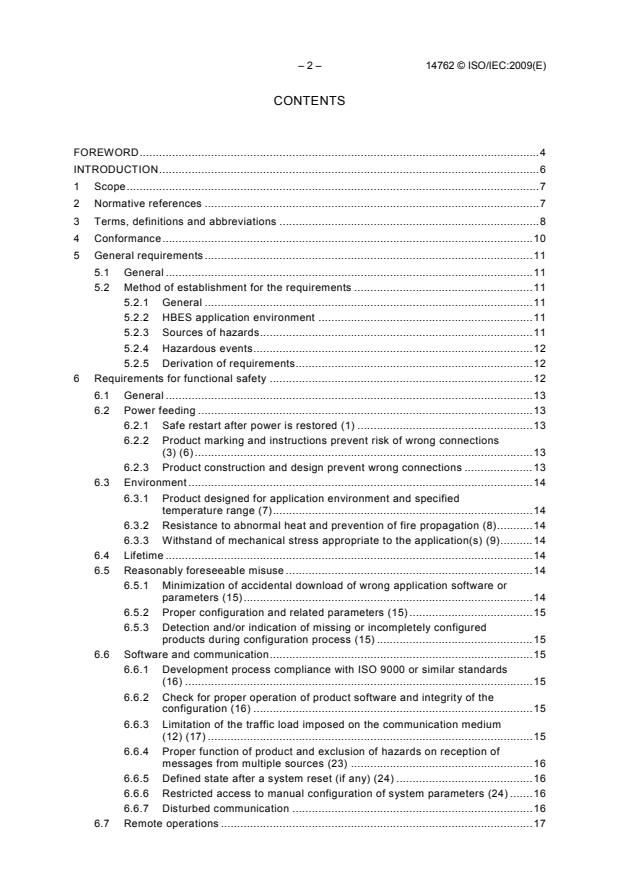
– 2 – 14762 © ISO/IEC:2009(E)
CONTENTS
FOREWORD.4
INTRODUCTION.6
1 Scope.7
2 Normative references .7
3 Terms, definitions and abbreviations .8
4 Conformance.10
5 General requirements .11
5.1 General .11
5.2 Method of establishment for the requirements .11
5.2.1 General .11
5.2.2 HBES application environment .11
5.2.3 Sources of hazards.11
5.2.4 Hazardous events.12
5.2.5 Derivation of requirements.12
6 Requirements for functional safety .12
6.1 General .13
6.2 Power feeding .13
6.2.1 Safe restart after power is restored (1) .13
6.2.2 Product marking and instructions prevent risk of wrong connections
(3) (6) .13
6.2.3 Product construction and design prevent wrong connections .13
6.3 Environment .14
6.3.1 Product designed for application environment and specified
temperature range (7).14
6.3.2 Resistance to abnormal heat and prevention of fire propagation (8).14
6.3.3 Withstand of mechanical stress appropriate to the application(s) (9).14
6.4 Lifetime .14
6.5 Reasonably foreseeable misuse .14
6.5.1 Minimization of accidental download of wrong application software or
parameters (15).14
6.5.2 Proper configuration and related parameters (15) .15
6.5.3 Detection and/or indication of missing or incompletely configured
products during configuration process (15) .15
6.6 Software and communication.15
6.6.1 Development process compliance with ISO 9000 or similar standards
(16) .15
6.6.2 Check for proper operation of product software and integrity of the
configuration (16) .
6.6.3 Limitation of the traffic load imposed on the communication medium
(12) (17) .15
6.6.4 Proper function of product and exclusion of hazards on reception of
messages from multiple sources (23) .16
6.6.5 Defined state after a system reset (if any) (24) .16
6.6.6 Restricted access to manual configuration of system parameters (24) .16
6.6.7 Disturbed communication .16
6.7 Remote operations .17
14762 © ISO/IEC:2009(E) – 3 –
6.7.1 General recommendations.17
6.7.2 Within a single building or in its immediate vicinity.17
6.7.3 From outside the building .18
6.7.4 Management.18
Annex A (informative) Example of a method for the determination of safety integrity
levels .20
A.1 General .20
A.2 Terms and definitions .20
A.3 As low as reasonably practicable (ALARP) and tolerable risk concepts .21
Annex B (informative) Hazards and development of necessary functional safety
requirements .22
Annex C (informative) Some examples of non safety related HBES applications .28
C.1 General .28
C.2 Example 1: Oven .28
C.3 Example 2: Devices presenting a high potential risk of hazard.28
C.4 Example 3: Mains plugs, socket outlets and circuits .29
C.5 Example 4: Water temperature adjustment .29
Bibliography.30
Figure A.1 – Risk reduction – General concept .20
Table 1 – Requirements for avoiding inadvertent operations and possible ways to
achieve them .19
Table A.1 – Example of risk classification of accidents .21
Table A.2 – Interpretation of risk classes .21
Table B.1 – Safety requirements and risk reduction .22
– 4 – 14762 © ISO/IEC:2009(E)
INFORMATION TECHNOLOGY –
FUNCTIONAL SAFETY REQUIREMENTS FOR
HOME AND BUILDING ELECTRONIC SYSTEMS (HBES)
FOREWORD
1) ISO (International Organization for Standardization) and IEC (International Electrotechnical Commission) form the
specialized system for worldwide standardization. National bodies that are members of ISO or IEC participate in
the development of International Standards. Their preparation is entrusted to technical committees; any ISO and
IEC member body interested in the subject dealt with may participate in this preparatory work. International
governmental and non-governmental organizations liaising with ISO and IEC also participate in this preparation.
2) In the field of information technology, ISO and IEC have established a joint technical committee, ISO/IEC JTC 1.
Draft International Standards adopted by the joint technical committee are circulated to national bodies for voting.
Publication as an International Standard requires approval by at least 75 % of the national bodies casting a vote.
3) The formal decisions or agreements of IEC and ISO on technical matters express, as nearly as possible, an
international consensus of opinion on the relevant subjects since each technical committee has representation
from all interested IEC and ISO member bodies.
4) IEC, ISO and ISO/IEC publications have the form of recommendations for international use and are accepted
by IEC and ISO member bodies in that sense. While all reasonable efforts are made to ensure that the
technical content of IEC, ISO and ISO/IEC publications is accurate, IEC or ISO cannot be held responsible for
the way in which they are used or for any misinterpretation by any end user.
5) In order to promote international uniformity, IEC and ISO member bodies undertake to apply IEC, ISO and
ISO/IEC publications transparently to the maximum extent possible in their national and regional publications.
Any divergence between any ISO/IEC publication and the corresponding national or regional publication
should be clearly indicated in the latter.
6) ISO and IEC provide no marking procedure to indicate their approval and cannot be rendered responsible for
any equipment declared to be in conformity with an ISO/IEC publication.
7) All users should ensure that they have the latest edition of this publication.
8) No liability shall attach to IEC or ISO or its directors, employees, servants or agents including individual experts
and members of their technical committees and IEC or ISO member bodies for any personal injury, property
damage or other damage of any nature whatsoever, whether direct or indirect, or for costs (including legal fees)
and expenses arising out of the publication of, use of, or reliance upon, this ISO/IEC publication or any other IEC,
ISO or ISO/IEC publications.
9) Attention is drawn to the normative references cited in this publication. Use of the referenced publications is
indispensable for the correct application of this publication.
10) Attention is drawn to the possibility that some of the elements of this International Standard may be the subject of
patent rights. ISO and IEC shall not be held responsible for identifying any or all such patent rights.
ISO/IEC 14762 has been prepared by subcommittee 25: Interconnection of information
technology equipment, of ISO/IEC joint technical committee 1: Information technology.
This International Standard cancels and replaces ISO/IEC TR 14762, published in 2001, and
constitutes a technical revision.
The main changes with respect to the Technical Report are the following:
While the Technical Report lists reasons for harms and some possible counter measures this
International Standard extends the list of hazards and specifies specific measures to counter
them.
This International Standard applies to all physical media, however, additional aspects of
wireless and powerline features covered in ISO/IEC 24767 are not repeated.
14762 © ISO/IEC:2009(E) – 5 –
This standard has the status of a product family standard and may be used as a normative
reference in a dedicated product standard for the safety of home and building electronic
systems. It is not intended to be used as a stand-alone publication.
This International Standard has been approved by vote of the member bodies, and the voting
results may be obtained from the address given on the second title page.
This publication has been drafted in accordance with the ISO/IEC Directives, Part 2.
– 6 – 14762 © ISO/IEC:2009(E)
INTRODUCTION
Home and Building Electronic System (HBES) products integrated in a HBES should be safe
for the use in intended applications.
This International Standard specifies the general functional safety requirements for HBES
following the principles of the basic standard for functional safety, IEC 61508.
This International Standard identifies functional safety issues related to products and their
installation. The requirements are based on a risk analysis in accordance with IEC 61508.
The intention of this International Standard is to allocate, as far as possible, all safety
requirements for HBES products in their life cycle.
This International Standard only addresses HBES products.
This International Standard is addressed to committees that develop or modify HBES product/system
standards, or, where no suitable HBES product standards addressing functional safety exist, to
product manufacturers.
HBES and HES products in this International Standard are for non-safety related applications.
For related standards, see the IEC website.
14762 © ISO/IEC:2009(E) – 7 –
INFORMATION TECHNOLOGY –
FUNCTIONAL SAFETY REQUIREMENTS FOR
HOME AND BUILDING ELECTRONIC SYSTEMS (HBES)
1 Scope
ISO/IEC 14762 sets the requirements for functional safety for Home and Building Electronic
Systems (HBES) products and systems, a multi-application bus system where the functions
are decentralised, distributed and linked through a common communication process. The
requirements may also apply to the distributed functions of any equipment connected in a
home or building control system if no specific functional safety standard exists for this
equipment or system.
The functional safety requirements of this International Standard apply together with the
relevant product standards for a device if any.
This International Standard does not provide functional safety requirements for safety-related
systems.
2 Normative references
The following referenced documents are indispensable for the application of this document.
For dated references, only the edition cited applies. For undated references, the latest edition
of the referenced document (including any amendments) applies.
The provisions of the referenced specifications other than ISO/IEC, IEC, ISO and ITU
documents, as identified in this clause, are valid within the context of this International
Standard. The reference to such a specification within this International Standard does not
give it any further status within ISO or IEC. In particular, it does not give the referenced
specification the status of an International Standard.
ISO/IEC 14543-2-1, Information technology – Home electronic systems (HES) architecture –
Part 2-1: Introduction and device modularity
ISO/IEC Guide 51, Safety aspects – Guidelines for their inclusion in standards
IEC 61508 (all parts), Functional safety of electrical/electronic/programmable electronic
safety-related systems
IEC 61508-1:1998, Functional safety of electrical/electronic/programmable electronic safety-
related systems – Part 1: General requirements
IEC 61508-4:1998, Functional safety of electrical/electronic/programmable electronic safety-
related systems – Part 4: Definitions and abbreviations; including its corrigendum 1 from April
IEC 61508-5:1998, Functional safety of electrical/electronic/programmable electronic safety-
related systems – Part 5: Examples of methods for the determination of safety integrity levels;
including its corrigendum 1 from April 1999
IEC 61709:1996, Electronic components – Reliability – Reference conditions for failure rates
and stress models for conversion
ISO 9000 series, Quality management systems
– 8 – 14762 © ISO/IEC:2009(E)
EN 50090-2-2, Home and Building Electronic Systems (HBES) – Part 2-2: System
overview – General technical requirements
3 Terms, definitions and abbreviations
For the purposes of this document, the following terms and definitions apply.
3.1.1
architecture
specific configuration of hardware and software elements in a system
[IEC 61508-4, definition 3.3.5]
3.1.2
authentication
means for certifying that the entity sending a message is what or who it purports to be and
confirmation that the message is identical to that which was sent
3.1.3
authorization
mechanism to ensure that the entity or person accessing information, functions or services
has the authority to do so
3.1.4
disturbed communication
where for any reason a message being communicated is incomplete, truncated, contains
errors or has the correct format but delivers information which is outside the range of
expected parameters for such a message
3.1.5
functional safety
freedom from unacceptable risk of harm due to the operation of an HBES, including that
resulting from
a) normal operation,
b) reasonably foreseeable misuse,
c) failure,
d) temporary disturbances
NOTE 1 See definition 3.1.9 of IEC 61508-4. Part of the overall safety relating to the EUC (equipment under
control) and the EUC control system which depends on the correct functioning of the electrical/electronic/
programmable electronic (E/E/PE) safety related systems, other technology safety related systems and external
risk reduction facilities.
NOTE 2 Definition of IEC TR3 61000-2-1 and IEC TS 61000-1-2 are taken into account.
3.1.6
hamming distance
numbers of bits in which two binary codes differ
3.1.7
harm
physical injury or damage to the health of people either directly or indirectly as a result of
damage to property or to the environment
[IEC 61508-4, definition 3.1.1]
3.1.8
hazard
potential source of harm
[ISO/IEC Guide 51, definition 3.5]
14762 © ISO/IEC:2009(E) – 9 –
NOTE The term includes danger to persons arising within a short time scale (for example, fire and explosion) and
also those that have a long-term effect on a person’s health (for example, release of a toxic substance).
[IEC 61508-4, definition 3.1.2]
3.1.9
hazardous event
situation which results in harm on normal operation or abnormal condition
NOTE Definition of IEC 61508-4, 3.1.3 and 3.1.4; circumstance in which a person is exposed to hazard(s) which
results in harm.
3.1.10
home and building electronic systems
HBES
multi-application bus system where the functions are decentrally distributed and linked
through a common communication process
NOTE 1 HBES is used in homes and buildings including their surroundings. Functions of the system are for
example switching, open loop controlling, closed loop controlling, monitoring and supervising.
NOTE 2 When an HBES is used in a home, it is often referred to as HES (home electronic system).
3.1.11
HBES product
devices such as hardware, firmware, their associated software and of configuration tools,
intended to be used in an HBES
NOTE HBES products when used in a home are often referred to as HES products.
3.1.12
product
devices such as hardware, firmware, their associated software and configuration tools
3.1.13
product documentation
manufacturer's installation and operations’ literature which accompanies the product;
the product information contained in the manufacturer's catalogue and other product
marketing material-information;
the description, definitions, product literature and usage as presented in electronic format on
the manufacturer's (or supplier's) website on the World Wide Web/Internet
3.1.14
safety related system
designated system that both implements the required safety functions necessary to achieve or
maintain a safe state for the EUC and is intended to achieve on its own or with other E/E/PE
safety related systems, other technology safety-related systems or external risk reduction
facilities, the necessary safety integrity for the required safety functions
NOTE 1 The term refers to those systems, designated as safety-related systems, that are intended to achieve,
together with the external risk reduction facilities (see IEC 61508-4,, definition 3.4.3), the necessary risk reduction
in order to meet the required tolerable risk (see IEC 61508-4,, definition 3.1.6). See also Annex A of IEC 61508-5.
NOTE 2 The safety-related systems are designed to prevent the EUC from going into a dangerous state by taking
appropriate action on receipt of commands. The failure of a safety-related system would be included in the events
leading to the determined hazard or hazards. Although there may be other systems having safety functions, it is the
safety-related systems that have been designated to achieve, in their own right, the required tolerable risk. Safety-
related systems can broadly be divided into safety-related control systems and safety-related protection systems,
and have two modes of operation (IEC 61508-4, definition 3.5.12).
NOTE 3 Safety-related systems may be an integral part of the EUC control system or may interface with the EUC
by sensors and/or actuators. That is, the required safety integrity level may be achieved by implementing the safety
– 10 – 14762 © ISO/IEC:2009(E)
functions in the EUC control system (and possibly by additional separate and independent systems as well) or the
safety functions may be implemented by separate and independent systems dedicated to safety.
NOTE 4 A safety-related system may
a) be designed to prevent the hazardous event (i.e. if the safety-related systems perform their safety functions
then no hazardous event arises),
b) be designed to mitigate the effects of the hazardous event, thereby reducing the risk by reducing the
consequences,
c) be designed to achieve a combination of a) and b).
NOTE 5 A person can be part of a safety-related system (IEC 61508-4, definition 3.3.1). For example, a person could receive
information from a programmable electronic device and perform a safety action based on this information or perform a safety
action through a programmable electronic device.
NOTE 6 The term includes all the hardware, software and supporting services (for example, power supplies)
necessary to carry out the specified safety function (sensors, other input devices, final elements (actuators) and
other output devices are therefore included in the safety-related system).
NOTE 7 A safety-related system may be based on a wide range of technologies including electrical, electronic,
programmable electronic, hydraulic and pneumatic technologies.
[IEC 61508-4, definition 3.4.1]
3.1.15
risk
combination of the probability of occurrence of harm and the severity of that harm
[ISO/IEC Guide 51, definition 3.2]
[IEC 61508-4, definition 3.1.5]
NOTE For risk classes, see A nne x A .
3.1.16
reasonably foreseeable misuse
use of a product, process or service under conditions or for purposes not intended by the
supplier, but which may happen, induced by the product, process or service in combination
with, or as result of, common human behaviour
[IEC 61508-4, definition 3.1.11]
3.1.17
safety function
function to be implemented by an E/E/PE safety related system, other technology safety-
related systems or external risk reduction facilities, which is intended to achieve and maintain
a safe state for the EUC, in respect of a specific hazardous event (see IEC 61508-4, definition
3.1.4)
[IEC 61508-4, definition 3.5.1]
3.2 Abbreviations
ALARP As Low As Reasonably Practicable
EUC Equipment Under Control
HBES Home and Building Electronic Systems
HES Home Electronic Systems
4 Conformance
Development and deployment of a product that conforms to this standard shall be analysed
for possible risks in accordance with Clause 5.
Products that conform to this standard shall meet the requirements specified in Clause 6.
14762 © ISO/IEC:2009(E) – 11 –
5 General requirements
5.1 General
Functional safety of a system relies upon both the performance of the network and upon the
performance of the connected HBES products.
a) Failure of either the network or any other part of HBES system shall not cause the system,
the products or the controlled equipment to become unsafe.
b) Whilst in operation, individual HBES products shall not rely solely upon the system for
their safe operation.
c) While in operation, the systems interaction of any product(s) with any other product(s)
shall not result in unsafe operation of the system.
5.2 Method of establishment for the requirements
5.2.1 General
The functional safety requirements were specified according to the life-cycle used in
ISO/IEC 61508-1:
a) concept phase of products;
b) application environment;
c) identification of hazards and hazard events;
d) hazard and risk analysis, risk reduction measures;
e) realization of risk reduction measures;
f) validation;
g) maintenance;
h) installation and commissioning;
i) decommissioning.
The product technical committees and/or developers shall take the requirements of this
International Standard into account in the product safety requirements, but it is not necessary
to go into the ISO/IC 61508-1 process itself.
5.2.2 HBES application environment
The HBES application environment is taken into account.
5.2.3 Sources of hazards
The following sources of hazards have been considered:
a) material and construction;
b) reliability;
c) normal operation;
d) unintentional interaction with other products;
e) interaction with other HBES products;
f) abnormal conditions;
g) foreseeable misuse, including the download of unauthorised and malicious code;
NOTE This includes unintentional software modifications.
h) life time;
i) environment.
– 12 – 14762 © ISO/IEC:2009(E)
5.2.4 Hazardous events
The following hazardous events have been taken into account for the analysis (the bus and
mains have been considered):
(1) power failure;
(2) short circuit of bus line;
(3) overvoltage on the bus line;
(4) overvoltage on the mains;
(5) insulation damage (temperature, surge, mechanical);
(6) wrong connection;
(7) over temperature;
(8) fire;
(9) mechanical shock, vibration;
(10) corrosion;
(11) electromagnetic disturbance;
(12) disturbed communication;
(13) pollution;
(14) end of life time of a component/products;
(15) reasonably foreseeable misuse;
(16) software failure;
(17) overload;
(18) loss of reliability;
(19) breakdown of material (mechanically);
(20) inappropriate design/construction;
(21) switching of damaged equipment and subsystems;
(22) remote control;
(23) command from two sources to one product (e.g. actuator);
(24) system failures.
5.2.5 Derivation of requirements
The risk analysis has been carried out for each of the hazard events; see A n nex B. T h e
likelihood of the event has been estimated and the risk class has been taken into account
according to the method of An ne x A.
In all cases where the evaluated risk classes indicate an unacceptable risk, risk reduction
measures are requested as well as the level of risk reduction effect and its validation. Some
risk reduction measures are proposed and what is usually covered by the relevant product
standard is also indicated. If manufacturers intend to develop HBES products/systems which
exhibit hazardous events not covered by 5.2.4 the risk analysis shall be carried out according
to IEC 61508.
6 Requirements for functional safety
NOTE Reference to the hazardous events of 5.2.4 are given within brackets ( ).
14762 © ISO/IEC:2009(E) – 13 –
6.1 General
Analysis according to ISO/IEC 61508-1 indicates that functional safety depends upon both the
design and manufacture of products and upon the appropriate use of the products in
installations.
Subclauses 6. 2 t o 6.7 contain requirements for HBES products and for the provision of
information necessary for the proper installation, operation and maintenance of these
products.
Compliance requirements are given for the products as necessary, and verification of the
provision of the necessary information.
All referenced product tests are type tests.
The basis and reasons of the following requirements are shown in the A nnex B.
6.2 Power feeding
6.2.1 Safe restart after power is restored (1)
In case of power failure the products shall restart safely when power is restored.
Safe restart can be performed by
• storing the status information and usage the information for rebuilding the functionality
after power on,
• switching to a defined state of the product depending on the application of the products,
• calculation of the safe state based on the information available from the system (from a
controller, if any, and/or from each product),
• maintaining a sufficient power reserve (by providing an appropriate buffer time either in
the product and/or in the power supply unit) to enable connected products to assume a
safe state.
6.2.2 Product marking and instructions prevent risk of wrong connections (3) (6)
Marking and instructions of the products shall be designed to prevent the risk of wrong
connections.
Products shall be marked in a legible and durable manner.
Compliance shall be checked by inspection of the product documentation and if appropriate
according to the test of legible and durable markings in the relevant product standard.
6.2.3 Product construction and design prevent wrong connections
The construction and design of a product shall prevent wrong connections.
This may be supported by appropriate grouping of connections. (6)
Compliance shall be checked by inspection of the product.
– 14 – 14762 © ISO/IEC:2009(E)
6.3 Environment
6.3.1 Product designed for application environment and specified temperature range
(7)
Products shall be designed for the working temperature appropriate to their maximum rated
voltages needed for the application environment and shall work properly in the specified
temperature range.
Compliance shall be checked by testing the product according to the relevant product
standard and if this does not exist to EN 50090-2-2 and the relevant basic safety standards.
6.3.2 Resistance to abnormal heat and prevention of fire propagation (8)
The products and components shall be designed for resistance to abnormal heat and shall not
propagate fire.
Compliance shall be checked by testing the product according to the relevant product
standard and if this does not exist to the relevant basic safety standards.
6.3.3 Withstand of mechanical stress appropriate to the application(s) (9)
The products shall be designed to withstand the mechanical stress appropriate to the
application(s).
Compliance shall be checked by testing the product according to the relevant product
standard and if this does not exist to EN 50090-2-2 and the relevant basic safety standards.
6.4 Lifetime
The products shall be designed for a defined useful lifetime according to 5.2 of
IEC 61709:1996, and Annex A or defined number of switching cycles under normal condition.
The datasheet shall give instructions for maintenance if required to reach the specified
lifetime. (14)
Compliance shall be checked by inspection of the documentation.
6.5 Reasonably foreseeable misuse
6.5.1 Minimization of accidental download of wrong application software or
parameters (15)
The risk of accidental download of the wrong application software or parameters into the
products shall be minimised.
The following measures may apply:
• design of the configuration tool;
• identification of products and comparison of their profiles by the network management;
• password;
• authentication;
• product documentation;
• training of installers/operators.
Compliance shall be checked by product test and/or inspection of the product documentation.
14762 © ISO/IEC:2009(E) – 15 –
6.5.2 Proper configuration and related parameters (15)
Proper configuration and related parameters shall be ensured.
The following measures may apply:
• specification of parameter ranges;
• limited configuration possibilities for the end-user;
• access to configuration only for skilled persons (see ISO/IEC 14543-2-1);
• consistency check by tools or by the installer;
• check of conformity with configuration.
Compliance shall be checked by check of conformity of existing with planed (intended)
configuration.
6.5.3 Detection and/or indication of missing or incompletely configured products
during configuration process (15)
Measures shall be provided for the detection and/or indication of missing or incompletely
configured products during the configuration process.
The following measures may apply:
• design of the configuration tool;
• formal installation procedures.
Compliance shall be checked by product test or inspection of the product documentation.
6.6 Software and communication
6.6.1 Development process compliance with ISO 9000 or similar standards (16)
The software development process shall comply with ISO 9000 or similar standards.
Compliance shall be checked by inspection of the process documentation or of the
corresponding certificates.
6.6.2 Check for proper operation of product software and integrity of the configuration
(16)
Measures shall be provided to check for the proper operation of the product software and the
integrity of the configuration. If abnormal operation is detected, the product shall restore the
correct values or shall go to a defined state.
Compliance shall be checked by inspection of the product software design documentation.
6.6.3 Limitation of the traffic load imposed on the communication medium (12) (17)
Measures, if required by the application, shall be provided inside the products to limit the
traffic load imposed on the communication medium.
The following measures may apply:
• limitation of cyclic transmission;
• limitation of the number of messages per time unit per product;
• limitation of polling cycles.
Compliance shall be checked by inspection of the product documentation and, if possible, by
product testing.
– 16 – 14762 © ISO/IEC:2009(E)
6.6.4 Proper function of product and exclusion of hazards on reception of messages
from multiple sources (23)
The reception of messages from several sources shall not disturb the proper function of the
product and shall not cause hazards.
The following measures may apply:
• check source address in case there is a hierarchy of the sources;
• apply the rule: first in, first out;
• apply the rule: last message wins;
• secure the process by finalising before new messages may change the behaviour;
• secure the process by stopping and restarting the process;
• secure the process by disabling and enabling the process.
Compliance shall be checked by inspection of the product documentation and, if possible, by
product testing.
6.6.5 Defined state after a system reset (if any) (24)
The products shall respond to a system reset (if any) by going to a defined state.
Compliance shall be checked by inspection of the product documentation and, if possible, by
product testing.
6.6.6 Restricted access to manual configuration of system parameters (24)
It shall be possible to restrict access to the manual configuration of system parameters.
The following measures or exceptions may apply:
• use of a tool (hardware or software);
• use of password and/or authentication;
• ensure that unauthorised access is not possible;
• combination or sequence of actions;
• concealed means for configuration;
• except where manual configuration is explicitly detailed in its instruction manual (also the
case for automatic configuration).
Compliance shall be checked by inspection of the product documentation and, if possible, by
product testing.
6.6.7 Disturbed communication
6.6.7.1 Safe operation of a product independent of operation of other products in the
system or application (12)
The safe operation of a product shall be independent of the operation of other products in the
system or application.
The following measures may apply:
• cyclic transmission;
• range checking of received variables.
Compliance shall be checked by inspection of the results of the product test or by inspection
of the product documentation.
14762 © ISO/IEC:2009(E) – 17 –
6.6.7.2 Identification of disturbed messages and measures to ensure safe operation (11)
(12)
Measures for the identification of disturbed messages shall be provided. In case of detection
of disturbed messages, measures shall be taken to ensure safe operation. The hamming
distance shall be not lower than 2.
The following measures may apply:
• the message may be rejected or corrected by the receiving product;
• the message may be repeated by the sender.
Compliance shall be checked by inspection of the results of the product test or by inspection
of the product documentation.
6.6.7.3 Prevention of falsely triggered messages
Sending of wrong but formally correct messages shall be prevented.
Compliance is checked by the relevant EMC test of EN 50090-2-2. (11) (12)
6.6.7.4 Indication and repetition of lost messages (12) (17)
Measures to enable message losses to be indicated or to cause messages to be repeated in
the event of loss shall be provided.
The following measures may apply:
• communication acknowledge mechanisms or an application acknowledge mechanism;
• feedback status indication or visible effects;
• appropriate systematic repeat in case of unidirectional products.
Compliance shall be checked by inspection of the results of the product test or by inspection
of the product documentation.
6.7 Remote operations
6.7.1 General recommendations
Remote control inside a room is covered by the previous requirements.
Socket outlets under remote control should be marked in such a way that they are visibly
differentiated for the user, or they should be of specific construction to exclude the use of
normal plugs designed for use in sockets not remotely controlled. (22)
6.7.2 Within a single building or in its immediate vicinity
Products or the subsystem connected to the product which may cause harm, intended for
remote control within a single building or in its immediate vicinity, shall have provisions for
local means of operation or local means to enable/disable the remote operation.
The following measures may apply:
• local means of operation on the potentially harmful products;
• local means of operation adjacent the potentially harmful products;
• communication inputs supporting local operation.
Compliance shall be checked by inspection of the product or of the product documentation.
– 18 – 14762 © ISO/IEC:2009(E)
6.7.3 From outside the building
6.7.3.1 Provision for local means to explicitly enable the remote operation from
outside the building
Products or a subsystem which may cause harm and are intended for remote control from
outside the building shall have provision for local means to explicitly enable the remote
operation.
The following measures may apply:
• local means of enabling operation on the potentially harmful products;
• local means of operation enabling adjacent the potentially harmful products;
• communication inputs supporting local enabling operation;
• local means to disable the gateway or other remote access product.
Compliance shall be checked by inspection of the product or of the product documentation.
6.7.3.2 Authorization or authentication of remote control from outside the building (22)
Mechanism shall be provided for the authorization or authentication of remote control from
Table 1). (22) This may apply at system (fire wall or gateway) or
outside the building (see also
at product level.
Authorization may be
• password authorization or authentication,
• access through a dedicated line.
Compliance shall be checked by inspection of the product or of the product documentation.
6.7.4 Management
6.7.4.1 Authorization or authentication of remote management including configuration
and download from outside the building (22)
Mechanism shall be provided for the authorization or authentication of remote management
including configuration and download from outside the building (see also Table 1). This may
apply at system (fire wall or gateway) or at product level. (22)
Authorization may be
• password authorization or authentication,
• access through a dedicated line.
Compliance shall be checked by inspection of the product or of the product documentation.
6.7.4.2 Consistency between the actual network and its remote image (22)
Measures to guarantee consistency between the actual network and its remote image shall be
provided. (22)
The following measures may apply:
• procedure to ensure a single authoritative copy of the system database;
• mechanisms to validate the remote system database against the actual network;
• self documentation feature in the system (centrally or distributed).
Compliance shall be checked by inspection of the product or of the product documentation.
...
Questions, Comments and Discussion
Ask us and Technical Secretary will try to provide an answer. You can facilitate discussion about the standard in here.
Loading comments...