

IEC 61362:2024
(Main)Guidelines to specification of hydraulic turbine governing systems
General Information
- Abstract
IEC 61362:2024 includes relevant technical data necessary to describe hydraulic turbine governing systems and to define their performance. It is aimed at unifying and thus facilitating the selection of relevant parameters in bidding specifications and technical bids. It will also serve as a basis for setting up technical guarantees. The scope of this standard is restricted to the turbine governing level. Additionally some remarks about the control loops of the plant level and about primary and secondary frequency control (see also Annex B) are made for better understanding without making a claim to be complete. Important topics covered are:
- speed, power, water level, opening and flow (discharge) control for reaction and impulse-type turbines including double regulated machines;
- means of providing actuating energy;
- safety devices for emergency shutdown.
To facilitate the setting up of specifications, this guide also includes data sheets, which are to be filled out by the customer and the supplier in the various stages of the project and the contract. Acceptance tests, specific test procedures and guarantees are outside the scope of the guide; those topics are covered by IEC 60308. This third edition cancels and replaces the second edition published in 2012. This edition includes the following significant technical changes with respect to the previous edition: adoption of parts of IEC 60308:2005 which deal with specification matters; introduction of several new technical topics; and overall editorial revision.
Keywords: Hydraulic turbine, Hydraulic turbine governing systems.
- Status
- Published
- Publication Date
- 16-Sep-2024
- Technical Committee
- TC 4 - Hydraulic turbines
- Drafting Committee
- WG 14 - TC 4/WG 14
- Current Stage
- PPUB - Publication issued
- Start Date
- 17-Sep-2024
- Completion Date
- 20-Sep-2024
Overview
IEC 61362:2024 is the latest international standard providing comprehensive guidelines for the specification of hydraulic turbine governing systems. Published by the International Electrotechnical Commission (IEC), this third edition supersedes the 2012 version, incorporating updated technical data, new control topics, and parts of IEC 60308 related to specification matters. The standard primarily focuses on the turbine governing level which is critical for ensuring optimal turbine performance, reliability, and safety. It aims to unify the selection of parameters for use in bidding specifications and technical offers, while also serving as a foundation for establishing technical guarantees.
This standard covers essential aspects such as speed, power, water level, opening, and flow control for both reaction and impulse turbines, including double regulated machines. It also addresses the methods of actuating energy supply and describes safety devices geared toward emergency shutdowns. IEC 61362:2024 assists stakeholders in developing consistent and efficient turbine control system specifications.
Key Topics
Governing System Structure: Detailed explanations on main control functions covering speed, power output, water level, and flow (discharge) control. The standard explains configurations of combined controllers including parallel and series structures, as well as advanced functions like feedforward control and surge feedback.
Control Techniques: Introduction of new technical topics related to control concepts including pump-turbine controls for conventional and variable speed applications, manual control, linearization, and bumpless control mode transitions to avoid operational disturbances.
Functional Performance: Guidance on performance criteria including modeling and digital simulations of water passages, turbines, and generators. It emphasizes the use of hardware-in-the-loop simulations and personnel training to ensure trustworthy system evaluation.
Instrumentation: Comprehensive information on instrumentation related to rotational speed, power output, water levels, actuator positions, and signal transmission to optimize feedback and control accuracy.
Safety Devices: Coverage of critical safety mechanisms such as quick and emergency shutdown systems, overspeed protection, tripping strategies, and interlocks designed to protect hydraulic turbines under fault or emergency conditions.
Actuating Energy Supply: Discusses systems with and without accumulators, including pressure tanks, piston and bladder accumulators, pumps, and auxiliary equipment. It also highlights recommendations for hydraulic fluid selection ensuring reliable actuation energy provision.
Operational Transitions: Recommendations for start-up procedures, synchronization, normal shutdown, and sudden load rejection, addressing smooth control transitions to safeguard turbine operation.
Supplementary Equipment: Measures and equipment for reducing pressure variations, surge control, lowering speed rise, and joint control techniques.
Applications
IEC 61362:2024 is an essential resource for engineers, designers, manufacturers, and operators involved in:
- Designing hydraulic turbine governing systems for both new installations and upgrades.
- Preparing consistent technical specifications and bids for turbine control system procurement.
- Establishing technical guarantees and acceptance criteria in contracts.
- Implementing control solutions for hydropower plants, including reaction and impulse turbines, as well as pump-turbine applications.
- Enhancing the safety and reliability of hydraulic turbine operations through appropriate emergency shutdown and safety device configurations.
- Supporting the training and simulation of control personnel using recommended simulation techniques.
- Facilitating integration with plant-level control systems and frequency control mechanisms at power grid interface points.
Related Standards
IEC 60308 – Hydraulic turbine, pump turbine, and governor testing: This standard complements IEC 61362 by covering testing procedures, acceptance tests, and performance guarantees omitted here.
IEC 60034 – Rotating electrical machines: Relevant for aspects involving generator control integrated with turbine governing.
IEC 61850 – Communication networks and systems in substations: Useful for data communication between turbine governors and plant control systems.
IEC 61131 – Programmable controllers: Applies to digital control systems employed in governing system automation.
Keywords
Hydraulic turbine, turbine governing systems, speed control, power output control, flow control, emergency shutdown, actuating energy, safety devices, hydraulic turbine specification, pump-turbine control, IEC standards, turbine control systems.
By following IEC 61362:2024, organizations can ensure standardized, safe, and effective control of hydraulic turbines to maximize operational performance, compliance, and grid stability.
Relations
- Effective Date
- 05-Sep-2023
Get Certified
Connect with accredited certification bodies for this standard

DNV
DNV is an independent assurance and risk management provider.

Lloyd's Register
Lloyd's Register is a global professional services organisation specialising in engineering and technology.
DNV Energy Systems
Energy and renewable energy certification.
Sponsored listings
Frequently Asked Questions
IEC 61362:2024 is a standard published by the International Electrotechnical Commission (IEC). Its full title is "Guidelines to specification of hydraulic turbine governing systems". This standard covers: IEC 61362:2024 includes relevant technical data necessary to describe hydraulic turbine governing systems and to define their performance. It is aimed at unifying and thus facilitating the selection of relevant parameters in bidding specifications and technical bids. It will also serve as a basis for setting up technical guarantees. The scope of this standard is restricted to the turbine governing level. Additionally some remarks about the control loops of the plant level and about primary and secondary frequency control (see also Annex B) are made for better understanding without making a claim to be complete. Important topics covered are: - speed, power, water level, opening and flow (discharge) control for reaction and impulse-type turbines including double regulated machines; - means of providing actuating energy; - safety devices for emergency shutdown. To facilitate the setting up of specifications, this guide also includes data sheets, which are to be filled out by the customer and the supplier in the various stages of the project and the contract. Acceptance tests, specific test procedures and guarantees are outside the scope of the guide; those topics are covered by IEC 60308. This third edition cancels and replaces the second edition published in 2012. This edition includes the following significant technical changes with respect to the previous edition: adoption of parts of IEC 60308:2005 which deal with specification matters; introduction of several new technical topics; and overall editorial revision. Keywords: Hydraulic turbine, Hydraulic turbine governing systems.
IEC 61362:2024 includes relevant technical data necessary to describe hydraulic turbine governing systems and to define their performance. It is aimed at unifying and thus facilitating the selection of relevant parameters in bidding specifications and technical bids. It will also serve as a basis for setting up technical guarantees. The scope of this standard is restricted to the turbine governing level. Additionally some remarks about the control loops of the plant level and about primary and secondary frequency control (see also Annex B) are made for better understanding without making a claim to be complete. Important topics covered are: - speed, power, water level, opening and flow (discharge) control for reaction and impulse-type turbines including double regulated machines; - means of providing actuating energy; - safety devices for emergency shutdown. To facilitate the setting up of specifications, this guide also includes data sheets, which are to be filled out by the customer and the supplier in the various stages of the project and the contract. Acceptance tests, specific test procedures and guarantees are outside the scope of the guide; those topics are covered by IEC 60308. This third edition cancels and replaces the second edition published in 2012. This edition includes the following significant technical changes with respect to the previous edition: adoption of parts of IEC 60308:2005 which deal with specification matters; introduction of several new technical topics; and overall editorial revision. Keywords: Hydraulic turbine, Hydraulic turbine governing systems.
IEC 61362:2024 is classified under the following ICS (International Classification for Standards) categories: 27.140 - Hydraulic energy engineering. The ICS classification helps identify the subject area and facilitates finding related standards.
IEC 61362:2024 has the following relationships with other standards: It is inter standard links to IEC 61362:2012. Understanding these relationships helps ensure you are using the most current and applicable version of the standard.
IEC 61362:2024 is available in PDF format for immediate download after purchase. The document can be added to your cart and obtained through the secure checkout process. Digital delivery ensures instant access to the complete standard document.
Standards Content (Sample)
IEC 61362 ®
Edition 3.0 2024-09
INTERNATIONAL
STANDARD
NORME
INTERNATIONALE
Guidelines to specification of hydraulic turbine governing systems
Lignes directrices pour la spécification des systèmes de régulation des turbines
hydrauliques
All rights reserved. Unless otherwise specified, no part of this publication may be reproduced or utilized in any form
or by any means, electronic or mechanical, including photocopying and microfilm, without permission in writing from
either IEC or IEC's member National Committee in the country of the requester. If you have any questions about IEC
copyright or have an enquiry about obtaining additional rights to this publication, please contact the address below or
your local IEC member National Committee for further information.
Droits de reproduction réservés. Sauf indication contraire, aucune partie de cette publication ne peut être reproduite ni
utilisée sous quelque forme que ce soit et par aucun procédé, électronique ou mécanique, y compris la photocopie et
les microfilms, sans l'accord écrit de l'IEC ou du Comité national de l'IEC du pays du demandeur. Si vous avez des
questions sur le copyright de l'IEC ou si vous désirez obtenir des droits supplémentaires sur cette publication, utilisez
les coordonnées ci-après ou contactez le Comité national de l'IEC de votre pays de résidence.
IEC Secretariat Tel.: +41 22 919 02 11
3, rue de Varembé info@iec.ch
CH-1211 Geneva 20 www.iec.ch
Switzerland
About the IEC
The International Electrotechnical Commission (IEC) is the leading global organization that prepares and publishes
International Standards for all electrical, electronic and related technologies.
About IEC publications
The technical content of IEC publications is kept under constant review by the IEC. Please make sure that you have the
latest edition, a corrigendum or an amendment might have been published.
IEC publications search - webstore.iec.ch/advsearchform IEC Products & Services Portal - products.iec.ch
The advanced search enables to find IEC publications by a Discover our powerful search engine and read freely all the
variety of criteria (reference number, text, technical publications previews, graphical symbols and the glossary.
committee, …). It also gives information on projects, replaced With a subscription you will always have access to up to date
and withdrawn publications. content tailored to your needs.
IEC Just Published - webstore.iec.ch/justpublished
Electropedia - www.electropedia.org
Stay up to date on all new IEC publications. Just Published
The world's leading online dictionary on electrotechnology,
details all new publications released. Available online and once
containing more than 22 500 terminological entries in English
a month by email.
and French, with equivalent terms in 25 additional languages.
Also known as the International Electrotechnical Vocabulary
IEC Customer Service Centre - webstore.iec.ch/csc
(IEV) online.
If you wish to give us your feedback on this publication or need
further assistance, please contact the Customer Service
Centre: sales@iec.ch.
A propos de l'IEC
La Commission Electrotechnique Internationale (IEC) est la première organisation mondiale qui élabore et publie des
Normes internationales pour tout ce qui a trait à l'électricité, à l'électronique et aux technologies apparentées.
A propos des publications IEC
Le contenu technique des publications IEC est constamment revu. Veuillez vous assurer que vous possédez l’édition la
plus récente, un corrigendum ou amendement peut avoir été publié.
Recherche de publications IEC - IEC Products & Services Portal - products.iec.ch
webstore.iec.ch/advsearchform Découvrez notre puissant moteur de recherche et consultez
La recherche avancée permet de trouver des publications IEC gratuitement tous les aperçus des publications, symboles
en utilisant différents critères (numéro de référence, texte, graphiques et le glossaire. Avec un abonnement, vous aurez
comité d’études, …). Elle donne aussi des informations sur les toujours accès à un contenu à jour adapté à vos besoins.
projets et les publications remplacées ou retirées.
Electropedia - www.electropedia.org
IEC Just Published - webstore.iec.ch/justpublished
Le premier dictionnaire d'électrotechnologie en ligne au monde,
Restez informé sur les nouvelles publications IEC. Just
avec plus de 22 500 articles terminologiques en anglais et en
Published détaille les nouvelles publications parues.
français, ainsi que les termes équivalents dans 25 langues
Disponible en ligne et une fois par mois par email.
additionnelles. Egalement appelé Vocabulaire
Electrotechnique International (IEV) en ligne.
Service Clients - webstore.iec.ch/csc
Si vous désirez nous donner des commentaires sur cette
publication ou si vous avez des questions contactez-nous:
sales@iec.ch.
IEC 61362 ®
Edition 3.0 2024-09
INTERNATIONAL
STANDARD
NORME
INTERNATIONALE
Guidelines to specification of hydraulic turbine governing systems
Lignes directrices pour la spécification des systèmes de régulation des turbines
hydrauliques
INTERNATIONAL
ELECTROTECHNICAL
COMMISSION
COMMISSION
ELECTROTECHNIQUE
INTERNATIONALE
ICS 27.140 ISBN 978-2-8322-9577-9
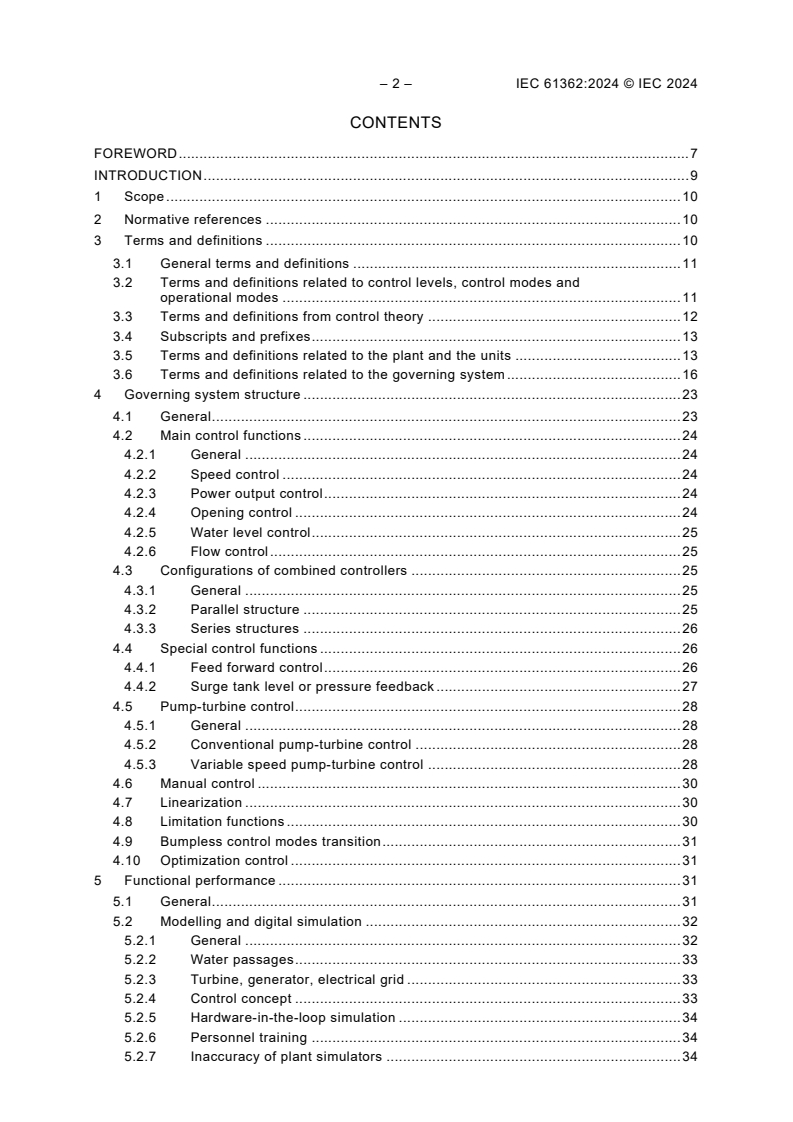
– 2 – IEC 61362:2024 © IEC 2024
CONTENTS
FOREWORD . 7
INTRODUCTION . 9
1 Scope . 10
2 Normative references . 10
3 Terms and definitions . 10
3.1 General terms and definitions . 11
3.2 Terms and definitions related to control levels, control modes and
operational modes . 11
3.3 Terms and definitions from control theory . 12
3.4 Subscripts and prefixes . 13
3.5 Terms and definitions related to the plant and the units . 13
3.6 Terms and definitions related to the governing system . 16
4 Governing system structure . 23
4.1 General . 23
4.2 Main control functions . 24
4.2.1 General . 24
4.2.2 Speed control . 24
4.2.3 Power output control . 24
4.2.4 Opening control . 24
4.2.5 Water level control . 25
4.2.6 Flow control . 25
4.3 Configurations of combined controllers . 25
4.3.1 General . 25
4.3.2 Parallel structure . 25
4.3.3 Series structures . 26
4.4 Special control functions . 26
4.4.1 Feed forward control . 26
4.4.2 Surge tank level or pressure feedback . 27
4.5 Pump-turbine control . 28
4.5.1 General . 28
4.5.2 Conventional pump-turbine control . 28
4.5.3 Variable speed pump-turbine control . 28
4.6 Manual control . 30
4.7 Linearization . 30
4.8 Limitation functions . 30
4.9 Bumpless control modes transition . 31
4.10 Optimization control . 31
5 Functional performance . 31
5.1 General . 31
5.2 Modelling and digital simulation . 32
5.2.1 General . 32
5.2.2 Water passages . 33
5.2.3 Turbine, generator, electrical grid . 33
5.2.4 Control concept . 33
5.2.5 Hardware-in-the-loop simulation . 34
5.2.6 Personnel training . 34
5.2.7 Inaccuracy of plant simulators . 34
5.3 Characteristic parameters for PID-controllers . 35
5.3.1 General . 35
5.3.2 Permanent droop . 35
5.3.3 Proportional action coefficient K , integral action time T , and derivative
P I
action time T . 35
D
5.3.4 Tuning of turbine governing systems . 36
5.4 Other parameters of the governing systems . 37
5.4.1 Command signal adjustments for controlled variables (speed, power
output, etc.) and load limiter . 37
5.4.2 Governor insensitivity i /2 . 37
x
5.4.3 Dynamic characteristics of servo-positioner . 37
5.4.4 Parameters of servo-positioner . 39
5.4.5 Servo-positioner non-linearity by kinematics . 40
6 Servo positioner configurations . 40
6.1 Servo-positioners . 40
6.2 Configurations of servo-positioners . 41
6.3 Multiple actuator control . 41
6.3.1 General . 41
6.3.2 Parallel structure . 42
6.3.3 Series structure . 42
6.3.4 Individual control . 42
6.4 Dual regulation of turbines with controllable guide vane and runner blade
angles . 43
6.5 Dual control of turbines with needles and deflectors . 43
6.6 Other relationships . 43
7 Instrumentation . 43
7.1 General . 43
7.2 Rotational speed . 44
7.3 Power output . 44
7.4 Water level . 44
7.5 Actuator position (stroke) . 44
7.6 Signal transmission from electronic transmitters . 44
8 Safety functions and devices . 44
8.1 General . 44
8.2 Quick shutdown and emergency shutdown . 44
8.2.1 General . 44
8.2.2 Tripping actions . 45
8.2.3 Servomotor shutdown initiating devices . 45
8.2.4 Tripping criteria . 45
8.2.5 Tripping strategies . 45
8.3 Overspeed protection device . 45
8.4 Interlocks . 45
9 Provision of actuating energy. 46
9.1 General . 46
9.2 System with an accumulator . 46
9.2.1 Pressure tank (air-oil accumulator) . 46
9.2.2 Piston accumulators . 48
9.2.3 Bladder accumulators . 48
– 4 – IEC 61362:2024 © IEC 2024
9.2.4 Other systems . 48
9.2.5 Pumps for accumulator systems . 48
9.2.6 Oil sump tanks . 49
9.2.7 Auxiliary equipment . 49
9.2.8 Provision of pressurized gas . 49
9.3 Systems without accumulator . 50
9.3.1 Constant flow systems . 50
9.3.2 Variable flow systems . 50
9.4 Direct electric positioner . 51
9.5 Recommendation for hydraulic fluid selection . 51
10 Operational transitions. 51
10.1 Start-up and synchronization. 51
10.2 Normal shutdown . 52
10.3 Sudden load rejection . 52
10.4 Other operational transitions . 53
11 Supplementary equipment . 53
11.1 Measures to reduce pressure variations . 53
11.2 Surge control . 53
11.3 Equipment and measures to lower the speed rise . 54
11.4 Joint control . 54
11.5 Braking . 54
11.6 Synchronous condenser mode of operation . 54
12 Considerations for the electronic governor . 55
12.1 Equipment requirements . 55
12.2 Power supply recommendations . 55
13 How to apply the recommendations . 55
Annex A (normative) Simplified differential equations and transfer functions of
idealized PID-control functions . 68
Annex B (informative) Grid frequency control . 70
B.1 General . 70
B.2 Power equilibrium and grid frequency . 70
B.2.1 Power equilibrium . 70
B.2.2 Grid frequency . 70
B.3 Primary frequency control . 70
B.3.1 Primary frequency control performed by generating units . 70
B.3.2 Droop of a generating unit . 71
B.4 Secondary frequency control . 72
Annex C (informative) Role of governing systems for stability in interconnected grid
operation . 73
C.1 General . 73
C.2 Stability of the unit with respect to the water hydraulic system . 73
C.3 Stability of the unit with respect to the electrical power system . 73
C.3.1 General . 73
C.3.2 Power oscillations due to the electrical power system . 74
C.3.3 Power oscillations due to pressure fluctuations in hydraulic machines . 74
C.3.4 Conclusion . 75
Annex D (informative) Quick shutdown and emergency shutdown . 76
D.1 General . 76
D.2 Alternative example I . 76
D.2.1 General . 76
D.2.2 Quick shutdown . 76
D.2.3 Emergency shutdown. 77
D.2.4 Summary table and combined tripping cases . 78
D.3 Alternative example II . 79
Bibliography . 80
Figure 1 – Turbine control transmission ratio . 15
Figure 2 – Controlled system self-regulation factor . 15
Figure 3 – Controlled variable range . 17
Figure 4 – Permanent droop . 17
Figure 5 – Proportional action coefficient and integral action time . 18
Figure 6 – Derivative time constant . 19
Figure 7 – Dead band . 20
Figure 8 – Minimum servomotor opening/closing time . 20
Figure 9 – Time constants of the servomotor/servo-valve combination . 21
Figure 10 – Servo-positioner inaccuracy . 22
Figure 11 – Governing system dead time . 23
Figure 12 – Governing system with speed and power output control functions in
parallel . 26
Figure 13 – Governing system with speed control function and water level control
function in parallel . 26
Figure 14 – Governing system with power output and speed control functions in series . 26
Figure 15 – Schematic diagram of a turbine governing system with feed forward . 27
Figure 16 – Schematic diagram of a turbine governing system with an additional
pressure feedback compensation control function . 28
Figure 17 – Governor function in conventional pump mode . 28
Figure 18 – Governor function of variable speed pumped storage systems in pump
mode . 29
Figure 19 – Governor function of variable speed pumped storage systems in turbine
mode with power output based control . 29
Figure 20 – Governor function of variable speed pumped storage systems in turbine
mode with rotating speed based control . 29
Figure 21 – Servo-positioner control loop – simplified dynamic model with P-controllers . 38
Figure 22 – Servo-positioner control loop – simplified dynamic model . 38
Figure 23 – Time step response and frequency response of the output of the servo-
positioner . 39
Figure 24 – Servo-positioner block diagram . 41
Figure 25 – Parallel structure with defined functional relation and an additional signal
superimposition . 42
Figure 26 – Series structure with defined functional relation and additional signal
superimposition . 42
Figure 27 – Structure with different set-points for each servo-positioner . 42
Figure 28 – Pressure tank content and pressure ranges . 46
Figure 29 – Open-circuit system . 50
Figure 30 – Start-up speed curve up to synchronization . 52
– 6 – IEC 61362:2024 © IEC 2024
Figure 31 – Load rejection . 53
Figure A.1 – Idealized PID in pure parallel structure . 68
Figure A.2 – Idealized PID alternative representation . 68
Figure B.1 – Example of principle schematic functional diagram of a unit with a turbine
governing system using an idealized PID control function with a frequency-power
droop . 71
Figure B.2 – Behaviour of two units with different governor permanent droop values . 72
Table 1 – Unit and plant categories . 55
Table D.1 – Alternative I – Summary of cases for quick shut-down and emergency
shut-down . 78
Table D.2 – Alternative II – Summary of cases for quick shut-down and emergency
shut-down . 79
INTERNATIONAL ELECTROTECHNICAL COMMISSION
____________
GUIDELINES TO SPECIFICATION OF
HYDRAULIC TURBINE GOVERNING SYSTEMS
FOREWORD
1) The International Electrotechnical Commission (IEC) is a worldwide organization for standardization comprising
all national electrotechnical committees (IEC National Committees). The object of IEC is to promote international
co-operation on all questions concerning standardization in the electrical and electronic fields. To this end and
in addition to other activities, IEC publishes International Standards, Technical Specifications, Technical Reports,
Publicly Available Specifications (PAS) and Guides (hereafter referred to as “IEC Publication(s)”). Their
preparation is entrusted to technical committees; any IEC National Committee interested in the subject dealt with
may participate in this preparatory work. International, governmental and non-governmental organizations liaising
with the IEC also participate in this preparation. IEC collaborates closely with the International Organization for
Standardization (ISO) in accordance with conditions determined by agreement between the two organizations.
2) The formal decisions or agreements of IEC on technical matters express, as nearly as possible, an international
consensus of opinion on the relevant subjects since each technical committee has representation from all
interested IEC National Committees.
3) IEC Publications have the form of recommendations for international use and are accepted by IEC National
Committees in that sense. While all reasonable efforts are made to ensure that the technical content of IEC
Publications is accurate, IEC cannot be held responsible for the way in which they are used or for any
misinterpretation by any end user.
4) In order to promote international uniformity, IEC National Committees undertake to apply IEC Publications
transparently to the maximum extent possible in their national and regional publications. Any divergence between
any IEC Publication and the corresponding national or regional publication shall be clearly indicated in the latter.
5) IEC itself does not provide any attestation of conformity. Independent certification bodies provide conformity
assessment services and, in some areas, access to IEC marks of conformity. IEC is not responsible for any
services carried out by independent certification bodies.
6) All users should ensure that they have the latest edition of this publication.
7) No liability shall attach to IEC or its directors, employees, servants or agents including individual experts and
members of its technical committees and IEC National Committees for any personal injury, property damage or
other damage of any nature whatsoever, whether direct or indirect, or for costs (including legal fees) and
expenses arising out of the publication, use of, or reliance upon, this IEC Publication or any other IEC
Publications.
8) Attention is drawn to the Normative references cited in this publication. Use of the referenced publications is
indispensable for the correct application of this publication.
9) IEC draws attention to the possibility that the implementation of this document may involve the use of (a)
patent(s). IEC takes no position concerning the evidence, validity or applicability of any claimed patent rights in
respect thereof. As of the date of publication of this document, IEC had not received notice of (a) patent(s), which
may be required to implement this document. However, implementers are cautioned that this may not represent
the latest information, which may be obtained from the patent database available at https://patents.iec.ch. IEC
shall not be held responsible for identifying any or all such patent rights.
IEC 61362 has been prepared by IEC technical committee 4: Hydraulic turbines. It is an
International Standard.
This third edition cancels and replaces the second edition published in 2012. This edition
constitutes a technical revision.
This edition includes the following significant technical changes with respect to the previous
edition:
a) adoption of parts of IEC 60308:2005 which deal with specification matters;
b) introduction of several new technical topics;
c) overall editorial revision.
– 8 – IEC 61362:2024 © IEC 2024
The text of this document is based on the following documents:
Draft Report on voting
4/500/FDIS 4/509/RVD
Full information on the voting for its approval can be found in the report on voting indicated in
the above table.
The language used for the development of this International Standard is English.
This document was drafted in accordance with ISO/IEC Directives, Part 2, and developed in
accordance with ISO/IEC Directives, Part 1 and ISO/IEC Directives, IEC Supplement, available
at www.iec.ch/members_experts/refdocs. The main document types developed by IEC are
described in greater detail at www.iec.ch/publications.
The committee has decided that the contents of this document will remain unchanged until the
stability date indicated on the IEC website under webstore.iec.ch in the data related to the
specific document. At this date, the document will be
• reconfirmed,
• withdrawn, or
• revised.
IMPORTANT – The "colour inside" logo on the cover page of this document indicates
that it contains colours which are considered to be useful for the correct understanding
of its contents. Users should therefore print this document using a colour printer.
INTRODUCTION
While a standard for the testing of hydraulic turbine governing systems had been existing for a
very long time (IEC 60308 published in 1970) , guidelines for the specification of hydraulic
turbine governing systems were missing until 1998. The need for such guidelines became more
and more urgent with the fast development and the new possibilities especially of the digital
components of the governor.
While the first edition was written more or less as a supplement to the already existing guide
for testing, the objective of the second edition was to be the leading guide with respect to turbine
governing systems.
The second edition of this document took into account the experience with the guide until 2012
as well as the progress in the state of the art of the underlying technologies.
This third edition was developed together with the third edition of the standard for the testing of
hydraulic turbine governing systems (IEC 60308) in order to harmonize their contents and their
publishing dates.
Furthermore, the standards are kept open for state of the art by introducing new topics and
harmonizing the structure as well as the terms and definitions for both standards.
___________
IEC 60308:1970, International code for testing of speed governing systems for hydraulic turbines. This publication
was withdrawn and replaced with IEC 60308:2005.
– 10 – IEC 61362:2024 © IEC 2024
GUIDELINES TO SPECIFICATION OF
HYDRAULIC TURBINE GOVERNING SYSTEMS
1 Scope
This document includes relevant technical data used to describe hydraulic turbine governing
systems and to define their performance. It is aimed at unifying and thus facilitating the selection
of relevant parameters in bidding specifications and technical bids. It serves also as a basis for
setting up technical guarantees.
The scope of this document is restricted to the turbine governing level. Additionally some
remarks about the control loops of the plant level and about interactions with the electrical grid
in case of primary and secondary frequency control (see also Annex B and Annex C) are made
for better understanding without making a claim to be complete.
Important topics covered by the guidelines are:
– speed, power, water level, opening and flow (discharge) control for reaction and impulse-
type turbines including double regulated machines;
– means of providing actuating energy;
– safety devices for emergency shutdown, etc.
To facilitate the setting up of specifications, these guidelines also include data sheets, which
are filled out by the customer and the supplier in the various stages of the project and the
contract.
Acceptance tests and specific test procedures are outside the scope of this document; those
topics are covered by IEC 60308.
2 Normative references
The following documents are referred to in the text in such a way that some or all of their content
constitutes requirements of this document. For dated references, only the edition cited applies.
For undated references, the latest edition of the referenced document (including any
amendments) applies.
IEC 60308, Hydraulic turbines – Testing of control systems
IEC 61131-2, Industrial-process measurement and control – Programmable controllers – Part 2:
Equipment requirements and tests
3 Terms and definitions
For the purposes of this document, the following terms and definitions apply.
ISO and IEC maintain terminology databases for use in standardization at the following
addresses:
• IEC Electropedia: available at https://www.electropedia.org/
• ISO Online browsing platform: available at https://www.iso.org/obp
3.1 General terms and definitions
3.1.1
turbine governing system
technical equipment governing the opening (guide vane, runner blade, needle, deflector
position) of hydraulic turbines
Note 1 to entry: At the present state of the art, the turbine governing system consists of an oil hydraulic and an
electronic part, the "oil hydraulic governor" and the "electronic governor" and an interface between both, the
electro/hydraulic converter.
3.1.2
controlled system
system controlled by the actuators of the governing system consisting of the hydraulic turbine,
its water supply and discharge passages, the generator with voltage regulator and the electric
power grid to which it is connected
3.2 Terms and definitions related to control levels, control modes and operational
modes
3.2.1
control levels
3.2.1.1
turbine governing level
control functions directly related to the governing system of a single turbine
Note 1 to entry: The following control modes are related to the turbine governing level:
– speed control;
– power output control;
– water level control;
– opening control;
– flow control (the term flow used in this document has the same meaning as the term discharge).
3.2.1.2
unit control level
control functions directly related to the overall control of a single unit (turbine, generator, unit
auxiliaries) including turbine governing, voltage regulation, start-stop-sequencing etc.
3.2.1.3
plant control level
control functions related to the overall control of a whole plant including the control of several
units
Note 1 to entry: In automatic unit and plant control operation, the turbine governing system gets its modes and set-
points from the unit and plant control level.
3.2.1.4
grid control level
control functions related to the overall control of the grid as a whole
Note 1 to entry: If applicable the turbine governing system participates either by primary or by secondary frequency
control, or both (see Annex B).
3.2.2
control modes at the turbine governing level
3.2.2.1
speed control
mode of the governing system dealing with the control of the speed of the turbine
– 12 – IEC 61362:2024 © IEC 2024
3.2.2.2
power output control
mode of the governing system dealing with the control of the power output of the generator
3.2.2.3
water level control
mode of the governing system dealing with the control of the water level of the headwater
reservoir
3.2.2.4
opening control
mode of the governing system dealing with the control of the position of the main actuator(s) of
the turbine
3.2.2.5
flow control
mode of the governing system dealing with the control of the flow through the turbine
3.2.3
main operation modes
3.2.3.1
no-load operation
mode of the governing system when the unit is not connected to a grid
3.2.3.2
island operation
operation of a generating unit that is interconnected with a relatively small number of other
generating units
Note 1 to entry: Such a small number can occur after inadvertent tripping of circuit breakers that interconnect the
island with a large interconnected power system.
3.2.3.3
isolated operation
specific case of islanded operation consisting of a single generating unit
3.2.3.4
grid operation
mode of the governing system when the unit is connected to a stable grid
3.3 Terms and definitions from control theory
3.3.1
differential equation
equation describing the dynamic system behaviour in the time-domain, as shown in Annex A
3.3.2
transient response
system response (output) to a step change of the input
3.3.3
frequency response
for a linear time-variant system with a sinusoidal input variable in steady-state the ratio of the
phasor of the output variable to the phasor of the corresponding input variable, represented as
a function of the angular frequency ω
Note 1 to entry: The frequency response coincides with the transfer function taken on the imaginary axis of the
complex plane.
3.3.4
transfer function
for a linear time-invariant system the ratio of the Laplace transformation of an output variable
to the Laplace transform of the corresponding input variable, with all initial values equal to zero
Note 1 to entry: The Laplace operator s is the complex variable of Laplace transform, only used for transfer functions
in the frequency domain.
3.4 Subscripts and prefixes
Sub- Subscript/prefix Definition Symbol Unit
clause related to
3.4.1 rated subscript indicating the rated operation point of the system r –
3.4.2 maximum subscript indicating maximum or minimum values of any max. –
minimum term min.
3.4.3 deviation Prefix indicating the deviation of any value from a defined ∆ –
value (in case of linearization the defined value is the
steady-state value)
3.4.4 wicket gate subscript associating a quantity to wicket gate (guide vane) ga –
position
3.4.5 runner subscript associating a quantity to runner blade position ru –
3.4.6 needle subscript associating a quantity to needle position ne –
3.4.7 deflector subscript associating a quantity to deflector position de –
3.4.8 main inlet valve subscript associating a quantity to main inlet valve miv -
3.5 Terms and definitions related to the plant and the units
Sub- Term Definition Symbol Unit
clause
–1
3.5.1 specific specific energy of hydraulic water available between the
...