

ISO 22002-4:2025
(Main)Prerequisite programmes on food safety — Part 4: Food packaging manufacturing
General Information
- Abstract
This document specifies, in conjunction with ISO 22002-100, requirements for establishing, implementing and maintaining prerequisite programmes (PRPs) to control food safety hazards in the manufacture of food and feed packaging. This document is applicable to all organizations, regardless of size or complexity. This document does not apply to other parts of the food supply chain. Exclusions to requirements can be supported by a sufficient justification that ensures that the exclusion does not adversely impact food safety.
- Status
- Published
- Publication Date
- 28-Jul-2025
- Technical Committee
- ISO/TC 34/SC 17 - Management systems for food safety
- Drafting Committee
- ISO/TC 34/SC 17 - Management systems for food safety
- Current Stage
- 6060 - International Standard published
- Start Date
- 29-Jul-2025
- Due Date
- 27-Jul-2026
- Completion Date
- 29-Jul-2025
Buy Documents
ISO 22002-4:2025 - Prerequisite programmes on food safety — Part 4: Food packaging manufacturing Released:7/29/2025
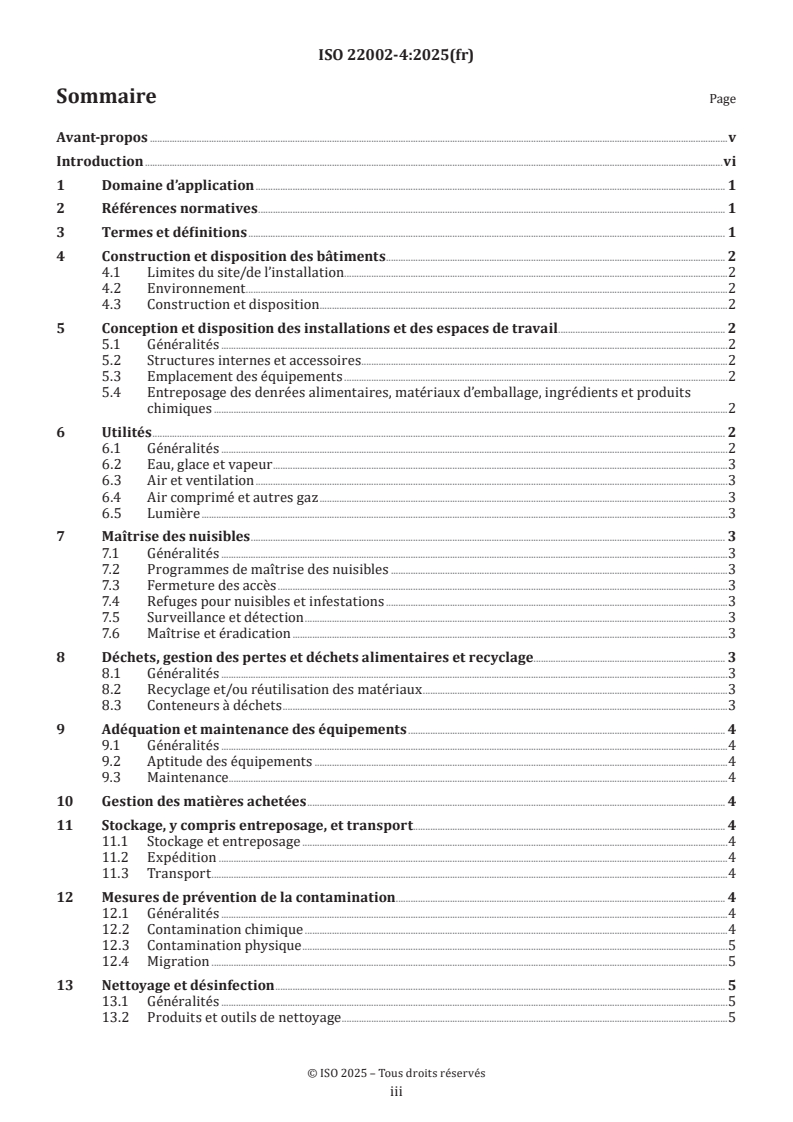
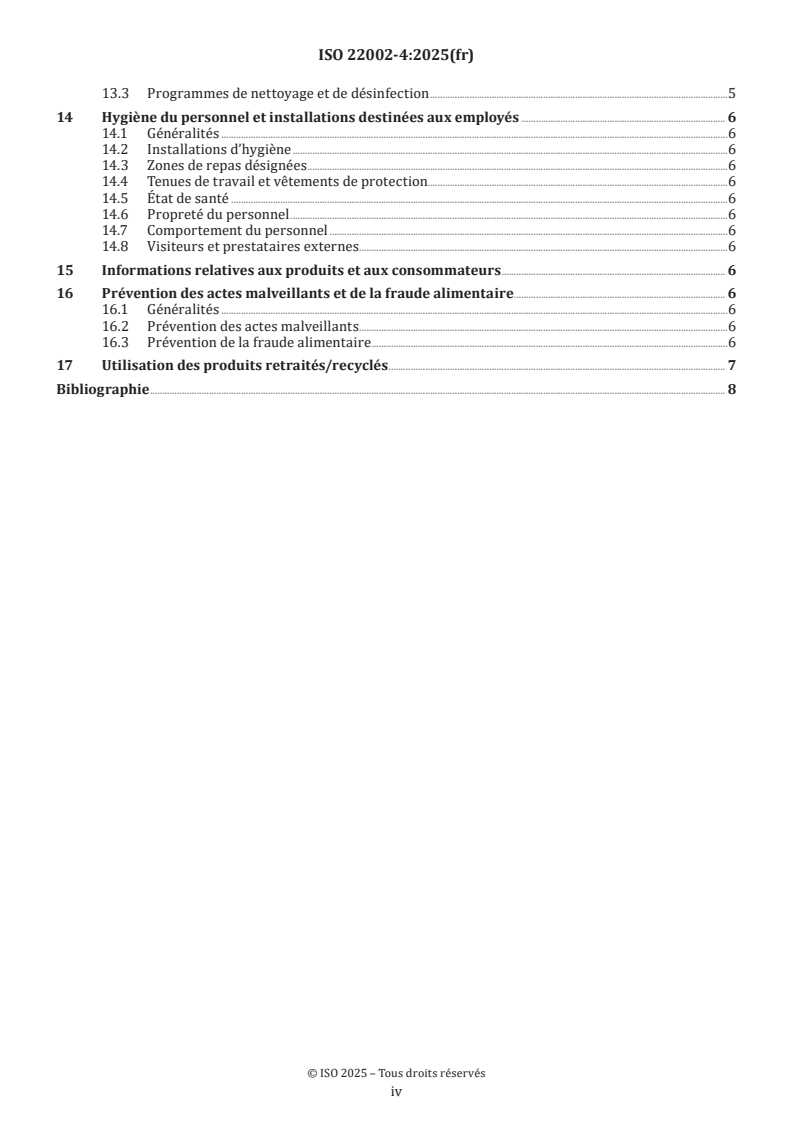
ISO 22002-4:2025 - Programmes prérequis pour la sécurité des denrées alimentaires — Partie 4: Fabrication des emballages destinés aux denrées alimentaires Released:7/29/2025
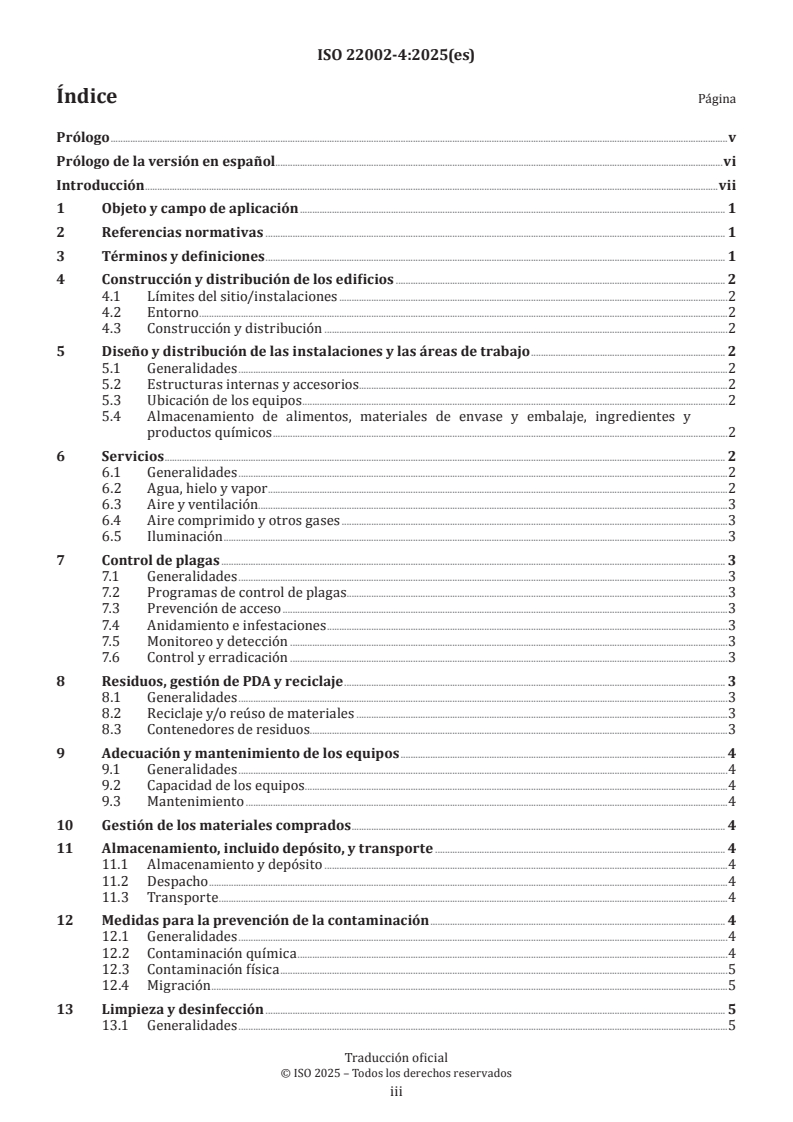
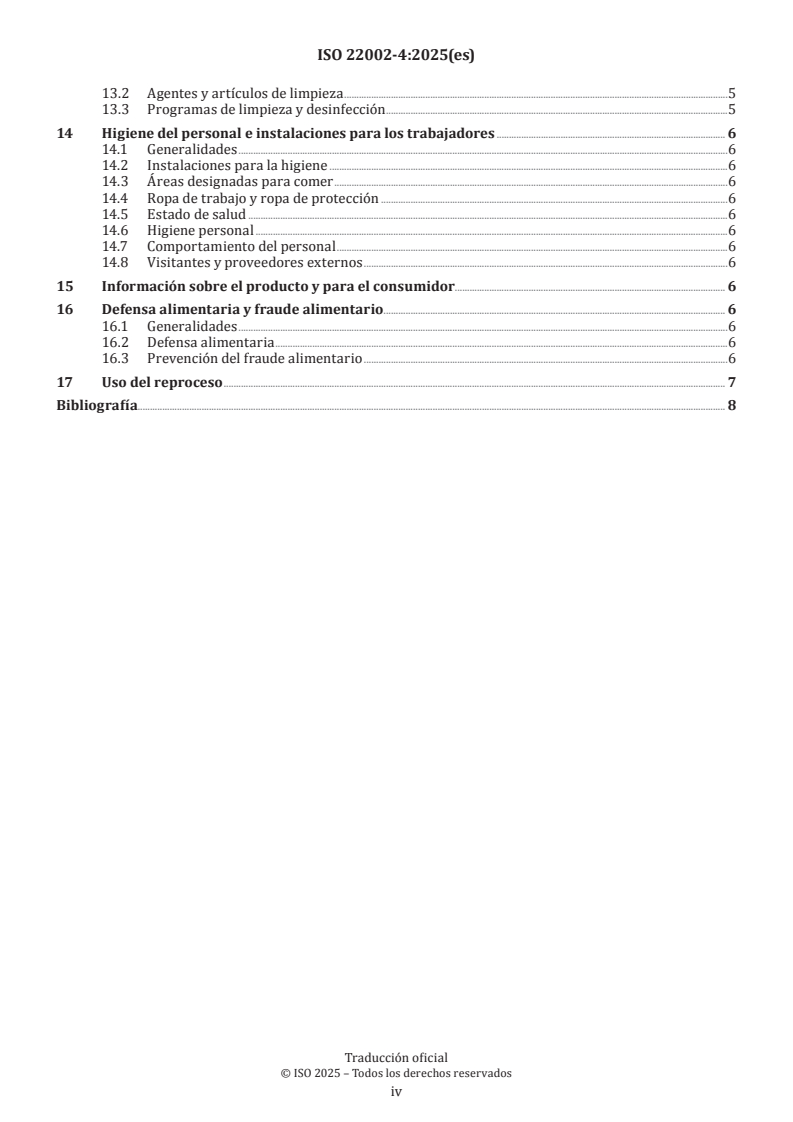
ISO 22002-4:2025 - Prerequisite programmes on food safety — Part 4: Food packaging manufacturing
ISO 22002-4:2025 - Prerequisite programmes on food safety — Part 4: Food packaging manufacturing
Overview
ISO 22002-4:2025 - Prerequisite programmes on food safety, Part 4: Food packaging manufacturing specifies requirements for establishing, implementing and maintaining prerequisite programmes (PRPs) to control food safety hazards in the manufacture of food and feed packaging. Published in 2025, this first edition is intended to be used together with ISO 22000 and ISO 22002-100. It applies to all organisations involved in food packaging manufacturing, regardless of size or complexity, and allows justified exclusions that do not adversely impact food safety.
Keywords: ISO 22002-4:2025, food packaging manufacturing, PRPs, food safety, packaging compliance
Key topics
The standard provides detailed PRP requirements covering the entire packaging manufacturing environment. Major subjects include:
- Site and building controls
- Boundaries, environment, construction and layout of buildings
- Facility and workspace design
- Internal structures, equipment location, storage of packaging materials
- Utilities
- Water, steam, air and ventilation, compressed gases, lighting
- Pest control
- Prevention, monitoring, eradication and documentation
- Waste management
- Waste, food loss & waste (FLW), recycling and reuse controls
- Equipment
- Suitability, capability and maintenance of machinery and tools
- Purchased materials
- Controls for suppliers and incoming materials used in packaging
- Storage, warehousing and transport
- In-plant storage, dispatch and transport considerations
- Contamination prevention
- Measures to prevent chemical, physical contamination and migration
- Cleaning and disinfection
- Programmes, agents, tools and validation of cleaning activities
- Personnel hygiene
- Facilities, workwear, health status, behaviour, visitors
- Product and consumer information
- Labelling and traceability considerations for packaging
- Food defence and food fraud
- Measures to protect integrity of packaging supply and prevent fraud
- Rework usage
- Controls for acceptable reuse of packaging materials
Applications
ISO 22002-4:2025 is practical for:
- Packaging manufacturers (rigid, flexible, paper, glass, metal, coatings)
- Quality, EHS and food safety managers integrating PRPs into an FSMS
- Suppliers and procurement teams assessing packaging safety risks
- Auditors and certification bodies evaluating conformance to ISO 22000-based systems
- Regulatory and compliance teams seeking harmonised PRP expectations
Practical use cases include developing documented PRPs, designing facility controls, supplier qualification, audit preparation, and reducing contamination and migration risks in food-contact packaging.
Related standards
- ISO 22000 - Food safety management systems - requirements
- ISO 22002-100 - PRPs for the food, feed and packaging supply chain (required companion)
- This edition replaces ISO/TS 22002-4:2013 and aligns packaging-specific PRPs with modern FSMS practices.
For organisations manufacturing food-contact packaging, ISO 22002-4:2025 provides a focused, auditable framework to reduce food safety hazards and support compliance with ISO 22000-based management systems.
Relations
- Revises
ISO/TS 22002-4:2013 - Prerequisite programmes on food safety — Part 4: Food packaging manufacturing - Effective Date
- 06-Jun-2022
Buy Documents
ISO 22002-4:2025 - Prerequisite programmes on food safety — Part 4: Food packaging manufacturing Released:7/29/2025
ISO 22002-4:2025 - Programmes prérequis pour la sécurité des denrées alimentaires — Partie 4: Fabrication des emballages destinés aux denrées alimentaires Released:7/29/2025
ISO 22002-4:2025 - Prerequisite programmes on food safety — Part 4: Food packaging manufacturing
ISO 22002-4:2025 - Prerequisite programmes on food safety — Part 4: Food packaging manufacturing
Get Certified
Connect with accredited certification bodies for this standard

BSI Group
BSI (British Standards Institution) is the business standards company that helps organizations make excellence a habit.

Bureau Veritas
Bureau Veritas is a world leader in laboratory testing, inspection and certification services.

DNV
DNV is an independent assurance and risk management provider.
Sponsored listings
Frequently Asked Questions
ISO 22002-4:2025 is a standard published by the International Organization for Standardization (ISO). Its full title is "Prerequisite programmes on food safety — Part 4: Food packaging manufacturing". This standard covers: This document specifies, in conjunction with ISO 22002-100, requirements for establishing, implementing and maintaining prerequisite programmes (PRPs) to control food safety hazards in the manufacture of food and feed packaging. This document is applicable to all organizations, regardless of size or complexity. This document does not apply to other parts of the food supply chain. Exclusions to requirements can be supported by a sufficient justification that ensures that the exclusion does not adversely impact food safety.
This document specifies, in conjunction with ISO 22002-100, requirements for establishing, implementing and maintaining prerequisite programmes (PRPs) to control food safety hazards in the manufacture of food and feed packaging. This document is applicable to all organizations, regardless of size or complexity. This document does not apply to other parts of the food supply chain. Exclusions to requirements can be supported by a sufficient justification that ensures that the exclusion does not adversely impact food safety.
ISO 22002-4:2025 is classified under the following ICS (International Classification for Standards) categories: 67.020 - Processes in the food industry. The ICS classification helps identify the subject area and facilitates finding related standards.
ISO 22002-4:2025 has the following relationships with other standards: It is inter standard links to ISO/TS 22002-4:2013. Understanding these relationships helps ensure you are using the most current and applicable version of the standard.
ISO 22002-4:2025 is available in PDF format for immediate download after purchase. The document can be added to your cart and obtained through the secure checkout process. Digital delivery ensures instant access to the complete standard document.
Standards Content (Sample)
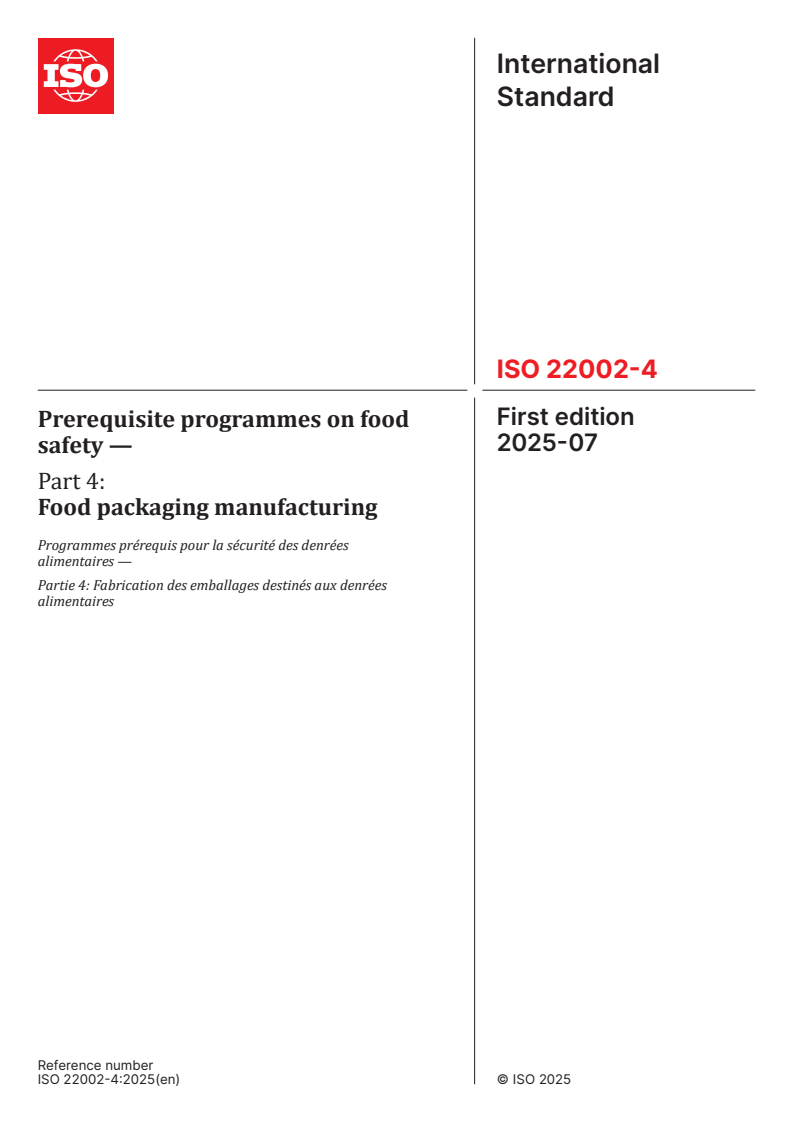
International
Standard
ISO 22002-4
First edition
Prerequisite programmes on food
2025-07
safety —
Part 4:
Food packaging manufacturing
Programmes prérequis pour la sécurité des denrées
alimentaires —
Partie 4: Fabrication des emballages destinés aux denrées
alimentaires
Reference number
© ISO 2025
All rights reserved. Unless otherwise specified, or required in the context of its implementation, no part of this publication may
be reproduced or utilized otherwise in any form or by any means, electronic or mechanical, including photocopying, or posting on
the internet or an intranet, without prior written permission. Permission can be requested from either ISO at the address below
or ISO’s member body in the country of the requester.
ISO copyright office
CP 401 • Ch. de Blandonnet 8
CH-1214 Vernier, Geneva
Phone: +41 22 749 01 11
Email: copyright@iso.org
Website: www.iso.org
Published in Switzerland
ii
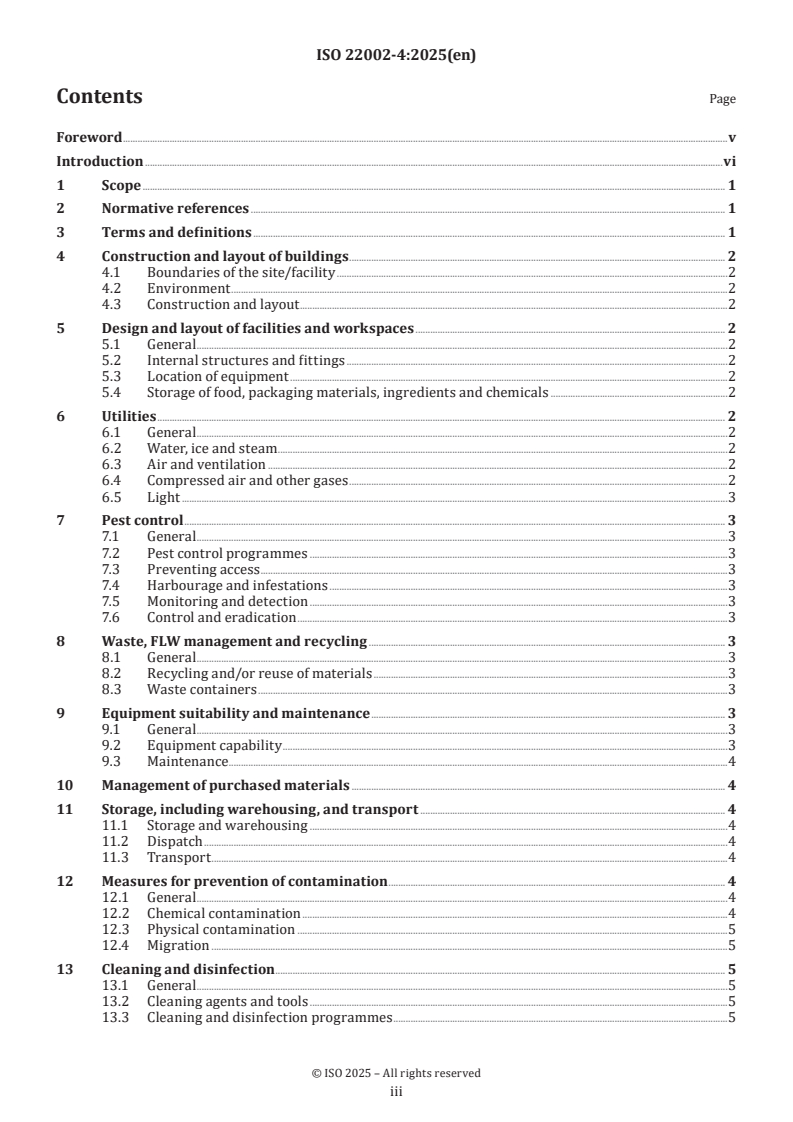
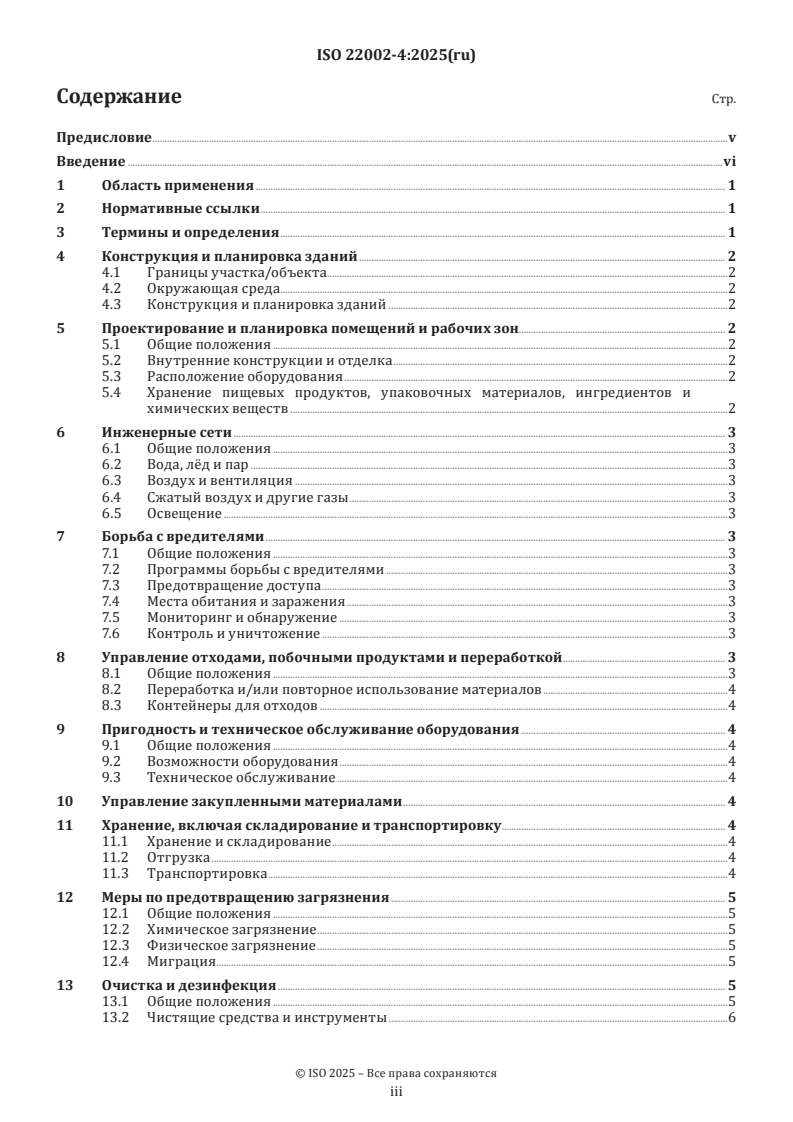
Contents Page
Foreword .v
Introduction .vi
1 Scope . 1
2 Normative references . 1
3 Terms and definitions . 1
4 Construction and layout of buildings . 2
4.1 Boundaries of the site/facility .2
4.2 Environment .2
4.3 Construction and layout .2
5 Design and layout of facilities and workspaces . 2
5.1 General .2
5.2 Internal structures and fittings .2
5.3 Location of equipment .2
5.4 Storage of food, packaging materials, ingredients and chemicals .2
6 Utilities . 2
6.1 General .2
6.2 Water, ice and steam .2
6.3 Air and ventilation .2
6.4 Compressed air and other gases .2
6.5 Light .3
7 Pest control . 3
7.1 General .3
7.2 Pest control programmes .3
7.3 Preventing access .3
7.4 Harbourage and infestations .3
7.5 Monitoring and detection .3
7.6 Control and eradication .3
8 Waste, FLW management and recycling . 3
8.1 General .3
8.2 Recycling and/or reuse of materials .3
8.3 Waste containers .3
9 Equipment suitability and maintenance . 3
9.1 General .3
9.2 Equipment capability .3
9.3 Maintenance .4
10 Management of purchased materials . 4
11 Storage, including warehousing, and transport . 4
11.1 Storage and warehousing .4
11.2 Dispatch .4
11.3 Transport .4
12 Measures for prevention of contamination . 4
12.1 General .4
12.2 Chemical contamination .4
12.3 Physical contamination .5
12.4 Migration .5
13 Cleaning and disinfection . 5
13.1 General .5
13.2 Cleaning agents and tools .5
13.3 Cleaning and disinfection programmes .5
iii
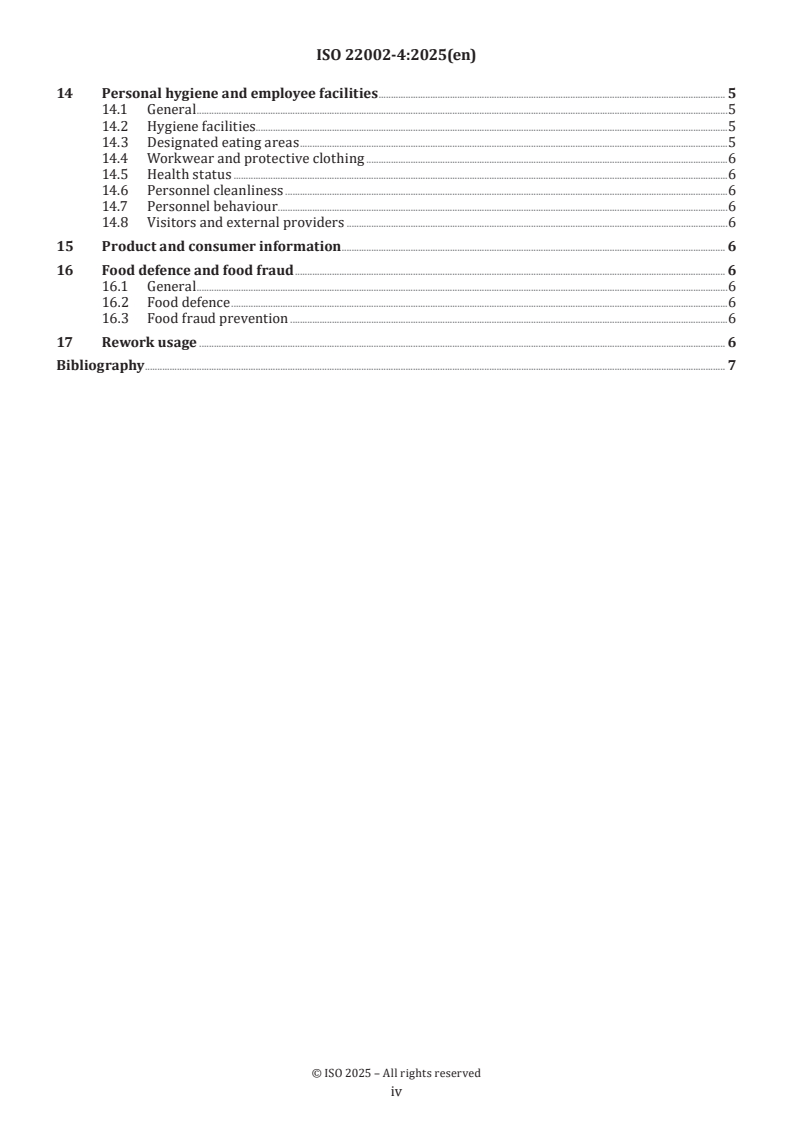
14 Personal hygiene and employee facilities . 5
14.1 General .5
14.2 Hygiene facilities.5
14.3 Designated eating areas .5
14.4 Workwear and protective clothing .6
14.5 Health status .6
14.6 Personnel cleanliness .6
14.7 Personnel behaviour . . .6
14.8 Visitors and external providers .6
15 Product and consumer information . 6
16 Food defence and food fraud . 6
16.1 General .6
16.2 Food defence .6
16.3 Food fraud prevention .
...
Norme
internationale
ISO 22002-4
Première édition
Programmes prérequis
2025-07
pour la sécurité des denrées
alimentaires —
Partie 4:
Fabrication des emballages destinés
aux denrées alimentaires
Prerequisite programmes on food safety —
Part 4: Food packaging manufacturing
Numéro de référence
DOCUMENT PROTÉGÉ PAR COPYRIGHT
© ISO 2025
Tous droits réservés. Sauf prescription différente ou nécessité dans le contexte de sa mise en œuvre, aucune partie de cette
publication ne peut être reproduite ni utilisée sous quelque forme que ce soit et par aucun procédé, électronique ou mécanique,
y compris la photocopie, ou la diffusion sur l’internet ou sur un intranet, sans autorisation écrite préalable. Une autorisation peut
être demandée à l’ISO à l’adresse ci-après ou au comité membre de l’ISO dans le pays du demandeur.
ISO copyright office
Case postale 401 • Ch. de Blandonnet 8
CH-1214 Vernier, Genève
Tél.: +41 22 749 01 11
E-mail: copyright@iso.org
Web: www.iso.org
Publié en Suisse
ii
Sommaire Page
Avant-propos .v
Introduction .vi
1 Domaine d’application . 1
2 Références normatives . 1
3 Termes et définitions . 1
4 Construction et disposition des bâtiments . 2
4.1 Limites du site/de l’installation .2
4.2 Environnement .2
4.3 Construction et disposition .2
5 Conception et disposition des installations et des espaces de travail . 2
5.1 Généralités .2
5.2 Structures internes et accessoires .2
5.3 Emplacement des équipements .2
5.4 Entreposage des denrées alimentaires, matériaux d’emballage, ingrédients et produits
chimiques .2
6 Utilités . 2
6.1 Généralités .2
6.2 Eau, glace et vapeur .3
6.3 Air et ventilation .3
6.4 Air comprimé et autres gaz .3
6.5 Lumière .3
7 Maîtrise des nuisibles . 3
7.1 Généralités .3
7.2 Programmes de maîtrise des nuisibles .3
7.3 Fermeture des accès .3
7.4 Refuges pour nuisibles et infestations .3
7.5 Surveillance et détection .3
7.6 Maîtrise et éradication .3
8 Déchets, gestion des pertes et déchets alimentaires et recyclage. 3
8.1 Généralités .3
8.2 Recyclage et/ou réutilisation des matériaux .3
8.3 Conteneurs à déchets .3
9 Adéquation et maintenance des équipements . 4
9.1 Généralités .4
9.2 Aptitude des équipements .4
9.3 Maintenance .4
10 Gestion des matières achetées . 4
11 Stockage, y compris entreposage, et transport . 4
11.1 Stockage et entreposage .4
11.2 Expédition .4
11.3 Transport .4
12 Mesures de prévention de la contamination . 4
12.1 Généralités .4
12.2 Contamination chimique .4
12.3 Contamination physique .5
12.4 Migration .5
13 Nettoyage et désinfection . 5
13.1 Généralités .5
13.2 Produits et outils de nettoyage .5
iii
13.3 Programmes de nettoyage et de désinfection .5
14 Hygiène du personnel et installations destinées aux employés . 6
14.1 Généralités .6
14.2 Installations d’hygiène .6
14.3 Zones de repas désignées .6
14.4 Tenues de travail et vêtements de protection . .6
14.5 État de santé .6
14.6 Propreté du personnel .6
14.7 Comportement du personnel .6
14.8 Visiteurs et prestataires externes .6
15 Informations relatives aux produits et aux consommateurs . 6
16 Prévention des actes malveillants et de la fraude alimentaire . 6
16.1 Généralités .6
16.2 Prévention des actes malveillants .6
16.3 Prévention de la fraude alimentaire . .6
17 Utilisation des produits retraités/recyclés . 7
Bibliographie . 8
iv
Avant-propos
L’ISO (Organisation internationale de normalisation) est une fédération mondiale d’organismes nationaux
de normalisation (comités membres de l’ISO). L’élaboration des Normes internationales est en général
confiée aux comités techniques de l’ISO. Chaque comité membre intéressé par une étude a le droit de faire
partie du comité technique créé à cet effet. Les organisations internationales, gouvernementales et non
gouvernementales, en liaison avec l’ISO participent également aux travaux. L’ISO collabore étroitement avec
la Commission électrotechnique internationale (IEC) en ce qui concerne la normalisation électrotechnique.
Les procédures utilisées pour élaborer le présent document et celles destinées à sa mise à jour sont
décrites dans les Directives ISO/IEC, Partie 1. Il convient, en particulier, de prendre note des différents
critères d’approbation requis pour les différents types de documents ISO. Le présent document a
été rédigé conformément aux règles de rédaction données dans les Directives ISO/IEC, Partie 2 (voir
www.iso.org/directives).
L’ISO attire l’attention sur le fait que la mise en application du présent document peut entraîner l’utilisation
d’un ou de plusieurs brevets. L’ISO ne prend pas position quant à la preuve, à la validité et à l’applicabilité de
tout droit de brevet revendiqué à cet égard. À la date de publication du présent document, l’ISO n’avait pas
reçu notification qu’u
...
Norma Internacional
ISO 22002-4
Primera edición
Programas de prerrequisitos para
2025-07
la inocuidad de los alimentos —
Parte 4:
Manufactura de envases y embalajes
para alimentos
Prerequisite programmes on food safety —
Part 4: Food packaging manufacturing
Publicado por la Secretaría Central de ISO en Ginebra, Suiza,
como traducción oficial en español avalada por el Translation
Management Group, que ha certificado la conformidad en
relación con las versiones inglesa y francesa.
Número de referencia
DOCUMENTO PROTEGIDO POR COPYRIGHT
© ISO 2025
Todos los derechos reservados. Salvo que se especifique de otra manera o se requiera en el contexto de su implementación, no
puede reproducirse ni utilizarse ninguna parte de esta publicación bajo ninguna forma y por ningún medio, electrónico o mecánico,
incluidos el fotocopiado, o la publicación en Internet o una Intranet, sin la autorización previa por escrito. La autorización puede
solicitarse a ISO en la siguiente dirección o al organismo miembro de ISO en el país del solicitante.
ISO copyright office
CP 401 • Ch. de Blandonnet 8
CH-1214 Vernier, Geneva
Phone: +41 22 749 01 11
Email: copyright@iso.org
Website: www.iso.org
Publicado en Suiza
Versión en español publicada en 2026
Traducción oficial
ii
Índice Página
Prólogo .v
Prólogo de la versión en español.vi
Introducción .vii
1 Objeto y campo de aplicación . 1
2 Referencias normativas . 1
3 Términos y definiciones . 1
4 Construcción y distribución de los edificios . 2
4.1 Límites del sitio/instalaciones .2
4.2 Entorno .2
4.3 Construcción y distribución .2
5 Diseño y distribución de las instalaciones y las áreas de trabajo . 2
5.1 Generalidades .2
5.2 Estructuras internas y accesorios .2
5.3 Ubicación de los equipos .2
5.4 Almacenamiento de alimentos, materiales de envase y embalaje, ingredientes y
productos químicos .2
6 Servicios . 2
6.1 Generalidades .2
6.2 Agua, hielo y vapor .2
6.3 Aire y ventilación .3
6.4 Aire comprimido y otros gases .3
6.5 Iluminación .3
7 Control de plagas . 3
7.1 Generalidades .3
7.2 Programas de control de plagas.3
7.3 Prevención de acceso .3
7.4 Anidamiento e infestaciones .3
7.5 Monitoreo y detección .3
7.6 Control y erradicación .3
8 Residuos, gestión de PDA y reciclaje . 3
8.1 Generalidades .3
8.2 Reciclaje y/o reúso de materiales .3
8.3 Contenedores de residuos.3
9 Adecuación y mantenimiento de los equipos . 4
9.1 Generalidades .4
9.2 Capacidad de los equipos .4
9.3 Mantenimiento .4
10 Gestión de los materiales comprados . 4
11 Almacenamiento, incluido depósito, y transporte . 4
11.1 Almacenamiento y depósito .4
11.2 Despacho .4
11.3 Transporte .4
12 Medidas para la prevención de la contaminación . 4
12.1 Generalidades .4
12.2 Contaminación química .4
12.3 Contaminación física .5
12.4 Migración .5
13 Limpieza y desinfección . 5
13.1 Generalidades .5
Traducción oficial
iii
13.2 Agentes y artículos de limpieza .5
13.3 Programas de limpieza y desinfección .5
14 Higiene del personal e instalaciones para los trabajadores . 6
14.1 Generalidades .6
14.2 Instalaciones para la higiene .6
14.3 Áreas designadas para comer .6
14.4 Ropa de trabajo y ropa de protección .6
14.5 Estado de salud .6
14.6 Higiene personal .6
14.7 Comportamiento del personal .6
14.8 Visitantes y proveedores externos .6
15 Información sobre el producto y para el consumidor . 6
16 Defensa alimentaria y fraude alimentario . 6
16.1 Generalidades .6
16.2 Defensa alimentaria .6
16.3 Prevención del fraude alimentario .6
17 Uso del reproceso . 7
Bibliografía. 8
Traducción oficial
iv
Prólogo
ISO (Organización Internacional de Normalización) es una federación mundial de organismos nacionales
de normalización (organismos miembros de ISO). El trabajo de elaboración de las Normas Internacionales
se lleva a cabo normalmente a través de los comités técnicos de ISO. Cada organismo miembro interesado
en una materia para la cual se haya establecido un comité técnico, tiene el derecho de estar representado
en dicho comité. Las organizaciones internacionales, gubernamentales y no gubernamentales, vinculadas
con ISO, también participan en el trabajo. ISO colabora estrechamente con la Comisión Electrotécnica
Internacional (IEC) en todos los temas de normalización electrotécnica.
En la Parte 1 de las Directivas ISO/IEC se describen los procedimientos utilizados para desarrollar este
documento y aquellos previstos para su mantenimiento posterior. En particular debería tomarse nota de los
diferentes criterios de aprobación necesarios para los distintos tipos de documentos ISO. Este documento
ha sido redactado de acuerdo con las reglas editoriales de la Parte 2 de las Directivas ISO/IEC (véase
www.iso.org/directives).
ISO llama la atención sobre la posibilidad de que la imple
...
Международный
стандарт
ISO 22002-4
Первое издание
Программы обязательных
2025-07
предварительных мероприятий
по безопасности пищевой
продукции —
Часть 4:
Производство упаковки для
пищевой продукции
Prerequisite programmes on food safety —
Part 4: Food packaging manufacturing
Ссылочный номер
ДОКУМЕНТ ЗАЩИЩЕН АВТОРСКИМ ПРАВОМ
© ISO 2025
Все права сохраняются. Если не указано иное и не требуется в контексте внедрения, никакую часть настоящей
публикации нельзя копировать или использовать в какой-либо форме или каким-либо электронным или механическим
способом, включая фотокопирование, или размещение в сети интернет или интранет, без предварительного
письменного согласия ISO. Запрос о разрешении может быть направлен по адресу, приведенному ниже, или в комитет –
член ISO в стране запрашивающей стороны.
ISO copyright office
CP 401 • Ch. de Blandonnet 8
CH-1214 Vernier, Geneva
Телефон: +41 22 749 01 11
Email: copyright@iso.org
Веб-сайт: www.iso.org
Опубликовано в Швейцарии
© ISO 2025 – Все права сохраняются
ii
Содержание Стр.
Предисловие .v
Введение .vi
1 Область применения .1
2 Нормативные ссылки .1
3 Термины и определения .1
4 Конструкция и планировка зданий . 2
4.1 Границы участка/объекта .2
4.2 Окружающая среда .2
4.3 Конструкция и планировка зданий .2
5 Проектирование и планировка помещений и рабочих зон . 2
5.1 Общие положения .2
5.2 Внутренние конструкции и отделка .2
5.3 Расположение оборудования .2
5.4 Хранение пищевых продуктов, упаковочных материалов, ингредиентов и
химических веществ .2
6 Инженерные сети .3
6.1 Общие положения .3
6.2 Вода, лёд и пар .3
6.3 Воздух и вентиляция .3
6.4 Сжатый воздух и другие газы .3
6.5 Освещение .3
7 Борьба с вредителями .3
7.1 Общие положения .3
7.2 Программы борьбы с вредителями .3
7.3 Предотвращение доступа .3
7.4 Места обитания и заражения .3
7.5 Мониторинг и обнаружение .3
7.6 Контроль и уничтожение .3
8 Управление отходами, побочными продуктами и переработкой .3
8.1 Общие положения .3
8.2 Переработка и/или повторное использование материалов .4
8.3 Контейнеры для отходов .4
9 Пригодность и техническое обслуживание оборудования . 4
9.1 Общие положения .4
9.2 Возможности оборудования .4
9.3 Техническое обслуживание .4
10 Управление закупленными материалами . 4
11 Хранение, включая складирование и транспортировку. 4
11.1 Хранение и складирование .4
11.2 Отгрузка .4
11.3 Транспортировка .4
12 Меры по предотвращению загрязнения . 5
12.1 Общие положения .5
12.2 Химическое загрязнение .5
12.3 Физическое загрязнение .5
12.4 Миграция .5
13 Очистка и дезинфекция . 5
13.1 Общие положения .5
13.2 Чистящие средства и инструменты .6
© ISO 2025 – Все права сохраняются
iii
13.3 Программы очистки и дезинфекции .6
14 Личная гигиена и инфраструктура для персонала.6
14.1 Общие положения .6
14.2 Гигиенические условия .6
14.3 Специально отведенные места для пищи .6
14.4 Рабочая и защитная одежда .6
14.5 Состояние здоровья .6
14.6 Личная гигиена персонала .6
14.7 Поведение персонала.6
14.8 Посетители и внешние поставщики .6
15 Информация о продукте и потребителе .6
16 Защита от преднамеренного загрязнения и фальсификации пищевой продукции .6
16.1 Общие положения .6
16.2 Защита от преднамеренного загрязнения .7
16.3 Предотвращение фальсификации пищевой продукции.7
17 Использование переработанной продукции .7
Библиография .8
© ISO 2025 – Все права сохраняются
iv
Предисловие
ISO (Международная организация по стандартизации) является всемирной федерацией
национальных организаций по стандартизации (комитетов-членов ISO). Разработка
международных стандартов обычно осуществляется техническими комитетами ISO. Каждый
комитет-член, заинтересованный в деятельности, для которой создан технический комитет,
имеет право быть представленным в этом комитете. Международные правительственные и
неправительственные организации, имеющие связи с ISO, также принимают участие в работах.
Что касается стандартизации в области электротехники, ISO работает в тесном сотрудничестве с
Международной электротехнической комиссией (IEC).
Процедуры, примененные для разработки этого документа и предназначенные для его
дальнейшего поддержания, приведены в Части 1 Директив ISO/IEC. Особенно следует отметить
различные критерии одобрения, необходимые для различных типов документов ISO. Этот документ
был подготовлен в соответствии с правилами редактирования Части 2
...