

ISO 17715:2025
(Main)Flour from wheat (Triticum aestivum L.) — Amperometric method for starch damage measurement
General Information
- Abstract
This document specifies an amperometric method to determine the content of damaged starch in flour. It is applicable to all flour samples from the industrial or laboratory milling of wheat (Triticum aestivum L.). NOTE 1 Wheat can be milled in the laboratory in accordance with the methods described in ISO 27971[9] or in the BIPEA guidance document BY.102.D[10]. NOTE 2 In the absence of validity studies, the results on semi-wholemeal or wholemeal flour, although able to meet the conditions of repeatability given in Clause 9, require careful interpretation.
- Status
- Published
- Publication Date
- 14-Jan-2025
- Technical Committee
- ISO/TC 34/SC 4 - Cereals and pulses
- Drafting Committee
- ISO/TC 34/SC 4 - Cereals and pulses
- Current Stage
- 6060 - International Standard published
- Start Date
- 15-Jan-2025
- Due Date
- 27-Jan-2024
- Completion Date
- 15-Jan-2025
Buy Documents
ISO 17715:2025 - Flour from wheat (Triticum aestivum L.) — Amperometric method for starch damage measurement Released:15. 01. 2025
ISO 17715:2025 - Farine de blé tendre (Triticum aestivum L.) — Méthode ampérométrique pour le mesurage de l'endommagement de l'amidon Released:15. 01. 2025
Overview
ISO 17715:2025 specifies an amperometric method for determining the content of damaged starch in flour from wheat (Triticum aestivum L.). The standard applies to flour produced by industrial or laboratory milling and defines the analytical principle, reagents, equipment, test procedure and the expression and precision of results. This second edition (2025) updates the method from ISO 17715:2013 and allows the use of a ready-to-use sodium thiosulfate solution.
Key topics and technical requirements
- Analytical principle: Measurement of iodine absorption kinetics in an aqueous medium using an amperometric electrode. Damaged starch is inferred from iodine absorption and reported as iodine absorption percentage (A, %) and as Chopin–Dubois units (UCD).
- Scope and applicability: Valid for wheat flours from industrial or laboratory milling; results for semi‑wholemeal or wholemeal flours require careful interpretation in the absence of validity studies.
- Reagents: Examples include boric or citric acid, potassium iodide and sodium thiosulfate (ready-to-use 0.1 mol/L or prepared solution). Use analytical-grade water.
- Equipment: Typical laboratory apparatus and a dedicated device (document developed using the CHOPIN SDmatic® reaction vessel and sample holder). Other equivalent devices may be used if they produce equivalent results.
- Procedure highlights:
- Reagent dosing (e.g., 3.0 g boric acid or 1.5 g citric acid, 3.0 g KI, ~120 mL water and a drop of thiosulfate).
- Sample test portion: 1 000 g ± 0.100 g placed in the device’s sample holder.
- Test runtime: approximately 6–7 minutes; two determinations per sample are required.
- Cleaning and electrode care after each test.
- Expression of results and units: Report A (%) to two decimal places and UCD to one decimal place; manufacturer equations may convert to other units.
- Precision and quality criteria: Repeatability and reproducibility limits are specified (formulas and tables in Clause 10 and Annex A). Two determinations’ mean is accepted if within repeatability limits; otherwise repeat testing.
Practical applications
- Flour quality control: Quantifying starch damage to predict water absorption and behavior in baking and other food processes.
- Mill laboratories and QA teams: Routine monitoring of milling performance and flour specifications.
- Food ingredient suppliers and processors: Adjusting dough formulations, enzyme dosing and processing parameters based on starch damage.
- Research and method validation: Comparative studies of milling conditions, wheat varieties and process optimization.
Who should use ISO 17715:2025
- Quality assurance managers in flour mills and cereal processing plants
- Laboratory analysts in food testing and cereal research labs
- Equipment manufacturers developing amperometric devices for starch damage measurement
- Regulatory and standards professionals specifying analytical methods for flour characterization
Related standards
- ISO 27971 - laboratory milling methods (referenced for lab milling)
- ISO 24333 - recommended sampling for cereals and flours
- ISO 712-1 - moisture determination (for reporting on constant water basis)
- ISO 20483 / ISO 16634-2 - protein determination (for corrections on constant protein basis)
Keywords: ISO 17715, damaged starch, starch damage measurement, amperometric method, flour from wheat, CHOPIN SDmatic, iodine absorption, Chopin–Dubois units, flour quality, repeatability, reproducibility.
Relations
- Effective Date
- 12-Feb-2026
- Effective Date
- 06-Jun-2022
- Effective Date
- 23-Apr-2020
Buy Documents
ISO 17715:2025 - Flour from wheat (Triticum aestivum L.) — Amperometric method for starch damage measurement Released:15. 01. 2025
ISO 17715:2025 - Farine de blé tendre (Triticum aestivum L.) — Méthode ampérométrique pour le mesurage de l'endommagement de l'amidon Released:15. 01. 2025
Get Certified
Connect with accredited certification bodies for this standard

BSI Group
BSI (British Standards Institution) is the business standards company that helps organizations make excellence a habit.

Bureau Veritas
Bureau Veritas is a world leader in laboratory testing, inspection and certification services.

DNV
DNV is an independent assurance and risk management provider.
Sponsored listings
Frequently Asked Questions
ISO 17715:2025 is a standard published by the International Organization for Standardization (ISO). Its full title is "Flour from wheat (Triticum aestivum L.) — Amperometric method for starch damage measurement". This standard covers: This document specifies an amperometric method to determine the content of damaged starch in flour. It is applicable to all flour samples from the industrial or laboratory milling of wheat (Triticum aestivum L.). NOTE 1 Wheat can be milled in the laboratory in accordance with the methods described in ISO 27971[9] or in the BIPEA guidance document BY.102.D[10]. NOTE 2 In the absence of validity studies, the results on semi-wholemeal or wholemeal flour, although able to meet the conditions of repeatability given in Clause 9, require careful interpretation.
This document specifies an amperometric method to determine the content of damaged starch in flour. It is applicable to all flour samples from the industrial or laboratory milling of wheat (Triticum aestivum L.). NOTE 1 Wheat can be milled in the laboratory in accordance with the methods described in ISO 27971[9] or in the BIPEA guidance document BY.102.D[10]. NOTE 2 In the absence of validity studies, the results on semi-wholemeal or wholemeal flour, although able to meet the conditions of repeatability given in Clause 9, require careful interpretation.
ISO 17715:2025 is classified under the following ICS (International Classification for Standards) categories: 67.060 - Cereals, pulses and derived products. The ICS classification helps identify the subject area and facilitates finding related standards.
ISO 17715:2025 has the following relationships with other standards: It is inter standard links to EN ISO 17715:2025, ISO 6150:2018, ISO 17715:2013. Understanding these relationships helps ensure you are using the most current and applicable version of the standard.
ISO 17715:2025 is available in PDF format for immediate download after purchase. The document can be added to your cart and obtained through the secure checkout process. Digital delivery ensures instant access to the complete standard document.
Standards Content (Sample)
International
Standard
ISO 17715
Second edition
Flour from wheat (Triticum
2025-01
aestivum L.) — Amperometric
method for starch damage
measurement
Farine de blé tendre (Triticum aestivum L.) — Méthode
ampérométrique pour le mesurage de l'endommagement de
l'amidon
Reference number
© ISO 2025
All rights reserved. Unless otherwise specified, or required in the context of its implementation, no part of this publication may
be reproduced or utilized otherwise in any form or by any means, electronic or mechanical, including photocopying, or posting on
the internet or an intranet, without prior written permission. Permission can be requested from either ISO at the address below
or ISO’s member body in the country of the requester.
ISO copyright office
CP 401 • Ch. de Blandonnet 8
CH-1214 Vernier, Geneva
Phone: +41 22 749 01 11
Email: copyright@iso.org
Website: www.iso.org
Published in Switzerland
ii
Contents Page
Foreword .iv
Introduction .v
1 Scope . 1
2 Normative references . 1
3 Terms and definitions . 1
4 Principle . 1
5 Reagents . 1
6 Equipment . 2
7 Sampling . 2
8 Procedure . 2
8.1 Reagent weighing and dissolution .2
8.2 Sample weighing .3
8.3 Test .3
8.4 Cleaning .3
8.5 Number of determinations .3
9 Expression of results . 3
10 Precision . 3
10.1 Interlaboratory tests .3
10.2 Repeatability limits, r .4
10.3 Reproducibility limits, R .4
10.4 Critical difference, d .4
c
10.4.1 General .4
10.4.2 Comparison of two measurement groups in the same laboratory .4
10.4.3 Comparison of two measurement groups in two different laboratories .5
10.5 Uncertainty, u .5
11 Test report . 5
Annex A (informative) Data from interlaboratory tests on wheat flour. 7
Bibliography . 14
iii
Foreword
ISO (the International Organization for Standardization) is a worldwide federation of national standards
bodies (ISO member bodies). The work of preparing International Standards is normally carried out through
ISO technical committees. Each member body interested in a subject for which a technical committee
has been established has the right to be represented on that committee. International organizations,
governmental and non-governmental, in liaison with ISO, also take part in the work. ISO collaborates closely
with the International Electrotechnical Commission (IEC) on all matters of electrotechnical standardization.
The procedures used to develop this document and those intended for its further maintenance are described
in the ISO/IEC Directives, Part 1. In particular, the different approval criteria needed for the different types
of ISO document should be noted. This document was drafted in accordance with the editorial rules of the
ISO/IEC Directives, Part 2 (see www.iso.org/directives).
ISO draws attention to the possibility that the implementation of this document may involve the use of (a)
patent(s). ISO takes no position concerning the evidence, validity or applicability of any claimed patent
rights in respect thereof. As of the date of publication of this document, ISO had not received notice of (a)
patent(s) which may be required to implement this document. However, implementers are cautioned that
this may not represent the latest information, which may be obtained from the patent database available at
www.iso.org/patents. ISO shall not be held responsible for identifying any or all such patent rights.
Any trade name used in this document is information given for the convenience of users and does not
constitute an endorsement.
For an explanation of the voluntary nature of standards, the meaning of ISO specific terms and expressions
related to conformity assessment, as well as information about ISO’s adherence to the World Trade
Organization (WTO) principles in the Technical Barriers to Trade (TBT), see www.iso.org/iso/foreword.html.
This document was prepared by Technical Committee ISO/TC 34, Food products, Subcommittee SC 4, Cereals
and pulses, in collaboration with the European Committee for Standardization (CEN) Technical Committee
CEN/TC 338, Cereal and cereal products, in accordance with the Agreement on technical cooperation between
ISO and CEN (Vienna Agreement).
This second edition cancels and replaces the first edition (ISO 17715:2013), which has been technically
revised.
The main changes are as follows:
— possibility to use a ready-to-use solution of sodium thiosulfate has been added.
Any feedback or questions on this document should be directed to the user’s national standards body. A
complete listing of these bodies can be found at www.iso.org/members.html.
iv
Introduction
Damaged starch content is an important parameter in flour quality as it directly influences the flour water
absorption capacity and therefore its use in the agri-food industry.
In the past, a number of methods based on various principles were developed to estimate such content, but
comparing the results is difficult due to the different principles and units of measurement used.
A laboratory device is dedicated to the determination of damaged starch content using an amperometric
method and which offers a choice of units of measurement according to individual references.
v
International Standard ISO 17715:2025(en)
Flour from wheat (Triticum aestivum L.) — Amperometric
method for starch damage measurement
1 Scope
This document specifies an amperometric method to determine the content of damaged starch in flour.
It is applicable to all flour samples from the industrial or laboratory milling of wheat (Triticum aestivum L.).
[9]
NOTE 1 Wheat can be milled in the laboratory in accordance with the methods described in ISO 27971 or in the
[10]
BIPEA guidance document BY.102.D .
NOTE 2 In the absence of validity studies, the results on semi-wholemeal or wholemeal flour, although able to meet
the conditions of repeatability given in Clause 9, require careful interpretation.
2 Normative references
There are no normative references in this document.
3 Terms and definitions
For the purposes of this document, the following terms and definitions apply.
ISO and IEC maintain terminology databases for use in standardization at the following addresses:
— ISO Online browsing platform: available at https:// www .iso .org/ obp
— IEC Electropedia: available at https:// www .electropedia .org/
3.1
damaged starch
starch granules present in wheat flour mechanically damaged during milling, leading to a greater capacity
to absorb water and increasing susceptibility to amylolytic enzymes
Note 1 to entry: A damaged starch content that is too high has a negative effect on quality of flours.
4 Principle
Determination of damaged starch content of a flour sample by measurement of iodine absorption kinetics in
an aqueous medium using an amperometric electrode.
The amperometric method is based on the existing proportionality between iodine absorption capacity and
starch damage content.
5 Reagents
Use only reagents of recognized analytical grade, unless otherwise specified.
5.1 Water, osmosed or demineralized or at least equivalent grade.
5.2 Boric acid or citric acid, powdered, for testing.
WARNING — The use of boric acid involves hazardous operations. This document does not purport
to address all the safety problems, if any, associated with its use. It is the responsibility of the user to
establish appropriate safety and health practices.
5.3 Potassium iodide, powdered, for testing.
5.4 Sodium thiosulfate, a ready-to-use solution in water at 0,1 mol/l or prepared from a light bulb
containing 0,1 mol sodium thiosulfate, to be diluted with water (5.1) in a 1 l flask. Powdered sodium
thiosulfate can also be used where the concentration of the final solution is 0,1 mol/l. Protect the solution
from light and use within three months.
6 Equipment
Usual laboratory apparatus and, in particular, the following shall be used.
® 1)
6.1 CHOPIN SDmatic , equipped with a reaction vessel and sample holder.
®1)
NOTE This document has been developed using the CHOPIN SDmatic . It does not apply to the SD4 CHOPIN and
Rapid FT devices which also measure damaged starch content, but using different technology.
−2 −1
6.2 Laboratory scales, with a display resolution of 10 g enabling weighing at 10 g accuracy.
−4 −3
6.3 Laboratory scales, with a display resolution of 10 g enabling weighing at 10 g accuracy.
6.4 Piston distributor, delivering 120 ml distilled water to the nearest 0,5 ml.
6.5 One-mark volumetric flask, capacity 1 000 ml, (see ISO 1042), class A.
7 Sampling
Sampling is not part of the method specified in this document. A recommended sampling method is given
[8]
in ISO 24333 .
It is important the laboratory receive a truly representative sample which has not been damaged or changed
during transport or storage.
8 Procedure
8.1 Reagent weighing and dissolution
Weigh (6.2), to the nearest 0,5 g, 3,0 g boric acid (5.2) or 1,5 g citric acid (5.2) and 3,0 g potassium iodide
(5.3) and add to a clean and dry reaction vessel (6.1). Add one drop (about 0,04 ml) of sodium thiosulfate
solution (5.4) and dispense (6.4) 120 ml distilled water (5.1) into the vessel.
As the test begins with a heating and stirring phase, it is not necessary to obtain full dissolution of the
reagents at this stage. In order to minimize losses during transfer, add powdered reagents directly to the
reaction vessel. ®
1) CHOPIN SDmatic is the trade name of a product supplied by CHOPIN Technologies. This information is given for the
convenience of users of this document and does not constitute an endorsement by ISO of the product named. Equivalent
products may be used if they can be shown to lead to the same results.
8.2 Sample weighing
−3
Weigh (6.3), to the nearest 10 g, 1 000 g ± 0,100 g of the test sample of flour and place it in the pre-cleaned
sample holder (6.1).
8.3 Test
Place the reaction vessel in the well on the device.
Lower the head of the device, and insert the sample holder containing the flour (see 8.2) into the
compartment.
−3
Start the test. Indicate the exact mass of the test portion of flour weighed to the nearest 10 g. It is also
possible to indicate the water and protein content of the sample if a result corrected on this basis is to be
obtained, otherwise the default values should be left (mass fractions of 14 % and 12 %, respectively) for the
two components. Confirm the start of the test.
The test lasts 6 min to 7 min. Ensure that all of the flour descends into the reaction vessel when the vibrator
starts up. Use the tip of a brush or lightly blow to enable any remaining flour to fall.
Wait for the beep at the end of the test at which point the result is displayed.
8.4 Cleaning
Raise the head of the device and remove the reaction vessel. Rinse, then carefully and gently wipe the
measuring electrode, t
...
Norme
internationale
ISO 17715
Deuxième édition
Farine de blé tendre (Triticum
2025-01
aestivum L.) — Méthode
ampérométrique pour le mesurage
de l'endommagement de l'amidon
Flour from wheat (Triticum aestivum L.) — Amperometric
method for starch damage measurement
Numéro de référence
DOCUMENT PROTÉGÉ PAR COPYRIGHT
© ISO 2025
Tous droits réservés. Sauf prescription différente ou nécessité dans le contexte de sa mise en œuvre, aucune partie de cette
publication ne peut être reproduite ni utilisée sous quelque forme que ce soit et par aucun procédé, électronique ou mécanique,
y compris la photocopie, ou la diffusion sur l’internet ou sur un intranet, sans autorisation écrite préalable. Une autorisation peut
être demandée à l’ISO à l’adresse ci-après ou au comité membre de l’ISO dans le pays du demandeur.
ISO copyright office
Case postale 401 • Ch. de Blandonnet 8
CH-1214 Vernier, Genève
Tél.: +41 22 749 01 11
E-mail: copyright@iso.org
Web: www.iso.org
Publié en Suisse
ii
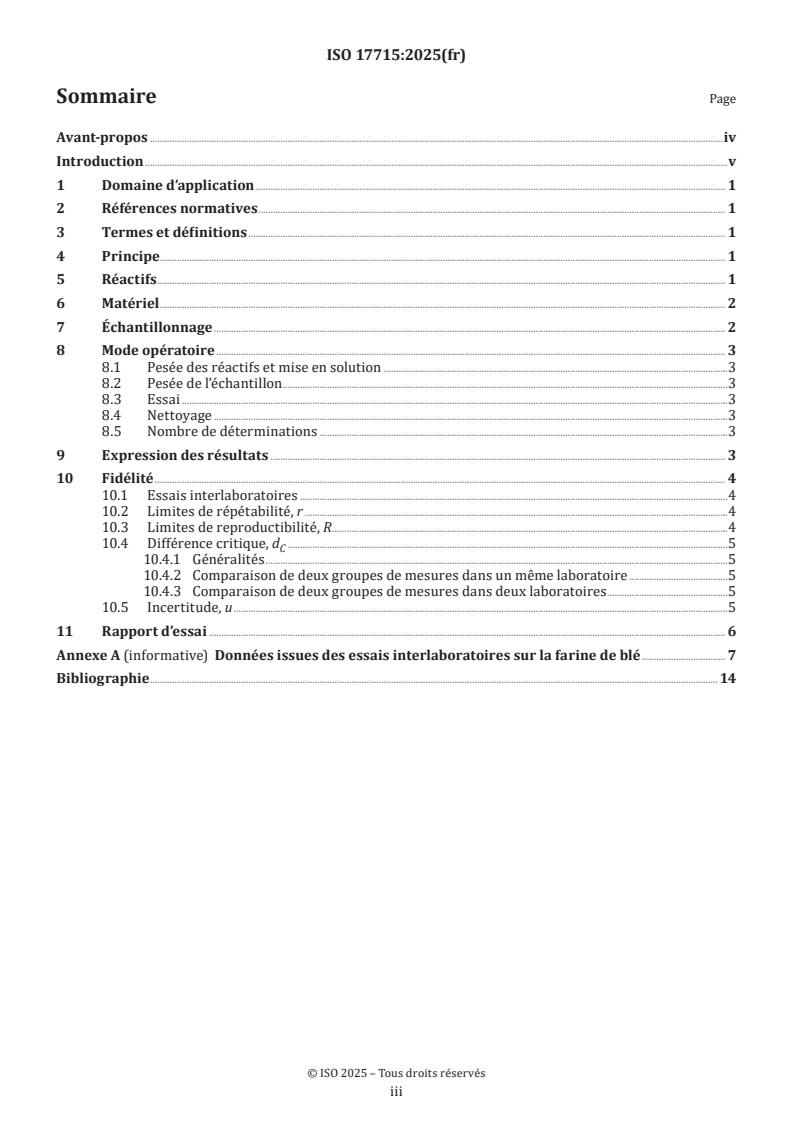
Sommaire Page
Avant-propos .iv
Introduction .v
1 Domaine d’application . 1
2 Références normatives . 1
3 Termes et définitions . 1
4 Principe. 1
5 Réactifs . 1
6 Matériel . 2
7 Échantillonnage . 2
8 Mode opératoire . 3
8.1 Pesée des réactifs et mise en solution .3
8.2 Pesée de l’échantillon .3
8.3 Essai .3
8.4 Nettoyage .3
8.5 Nombre de déterminations .3
9 Expression des résultats . 3
10 Fidélité . 4
10.1 Essais interlaboratoires .4
10.2 Limites de répétabilité, r .4
10.3 Limites de reproductibilité, R .4
10.4 Différence critique, d .5
C
10.4.1 Généralités .5
10.4.2 Comparaison de deux groupes de mesures dans un même laboratoire .5
10.4.3 Comparaison de deux groupes de mesures dans deux laboratoires .5
10.5 Incertitude, u .5
11 Rapport d’essai . 6
Annexe A (informative) Données issues des essais interlaboratoires sur la farine de blé . 7
Bibliographie . 14
iii
Avant-propos
L’ISO (Organisation internationale de normalisation) est une fédération mondiale d’organismes nationaux
de normalisation (comités membres de l’ISO). L’élaboration des Normes internationales est en général
confiée aux comités techniques de l’ISO. Chaque comité membre intéressé par une étude a le droit de faire
partie du comité technique créé à cet effet. Les organisations internationales, gouvernementales et non
gouvernementales, en liaison avec l’ISO participent également aux travaux. L’ISO collabore étroitement avec
la Commission électrotechnique internationale (IEC) en ce qui concerne la normalisation électrotechnique.
Les procédures utilisées pour élaborer le présent document et celles destinées à sa mise à jour sont
décrites dans les Directives ISO/IEC, Partie 1. Il convient, en particulier, de prendre note des différents
critères d’approbation requis pour les différents types de documents ISO. Le présent document a
été rédigé conformément aux règles de rédaction données dans les Directives ISO/IEC, Partie 2 (voir
www.iso.org/directives).
L’ISO attire l’attention sur le fait que la mise en application du présent document peut entraîner l’utilisation
d’un ou de plusieurs brevets. L’ISO ne prend pas position quant à la preuve, à la validité et à l’applicabilité de
tout droit de brevet revendiqué à cet égard. À la date de publication du présent document, l’ISO n’avait pas
reçu notification qu’un ou plusieurs brevets pouvaient être nécessaires à sa mise en application. Toutefois,
il y a lieu d’avertir les responsables de la mise en application du présent document que des informations
plus récentes sont susceptibles de figurer dans la base de données de brevets, disponible à l’adresse
www.iso.org/brevets. L’ISO ne saurait être tenue pour responsable de ne pas avoir identifié tout ou partie de
tels droits de propriété.
Les appellations commerciales éventuellement mentionnées dans le présent document sont données pour
information, par souci de commodité, à l’intention des utilisateurs et ne sauraient constituer un engagement.
Pour une explication de la nature volontaire des normes, la signification des termes et expressions
spécifiques de l’ISO liés à l’évaluation de la conformité, ou pour toute information au sujet de l’adhésion de
l’ISO aux principes de l’Organisation mondiale du commerce (OMC) concernant les obstacles techniques au
commerce (OTC), voir www.iso.org/avant-propos.
Le présent document a été élaboré par le comité technique ISO/TC 34, Produits alimentaires, sous-comité
SC 4, Céréales et légumineuses, en collaboration avec le comité technique CEN/TC 338, Céréales et produits
céréaliers, du Comité européen de normalisation (CEN) conformément à l’Accord de coopération technique
entre l’ISO et le CEN (Accord de Vienne).
Cette deuxième édition annule et remplace la première édition (ISO 17715:2013), qui a fait l’objet d’une
révision technique.
La principale modification est la suivante:
— possibilité d’utiliser une solution de thiosulfate de sodium prête à l’emploi a été ajoutée.
Il convient que l’utilisateur adresse tout retour d’information ou toute question concernant le présent
document à l’organisme national de normalisation de son pays. Une liste exhaustive desdits organismes se
trouve à l’adresse www.iso.org/fr/members.html.
iv
Introduction
Le taux d’endommagement de l’amidon est un paramètre important de la qualité d’une farine car il influence
le taux d’hydratation de celle-ci et donc son utilisation dans l’industrie agroalimentaire.
Historiquement, de nombreuses méthodes reposant sur des principes différents ont été mises au point pour
estimer ce taux, la comparaison des résultats s’avérant difficile pour des raisons de principe de mesure et
d’unité d’expression.
Un appareil de laboratoire est dédié à la détermination du taux d’endommagement de l’amidon au
moyen d’une méthode ampérométrique. Il propose plusieurs unités de mesure en fonction de références
individuelles.
v
Norme internationale ISO 17715:2025(fr)
Farine de blé tendre (Triticum aestivum L.) — Méthode
ampérométrique pour le mesurage de l'endommagement de
l'amidon
1 Domaine d’application
Le présent document spécifie une méthode ampérométrique pour déterminer le taux d’endommagement de
l’amidon dans la farine.
Il est applicable à tous les échantillons de farine de blé tendre (Triticum aestivum L.) issus d’une mouture
industrielle ou de laboratoire.
[9]
NOTE 1 La mouture de laboratoire des blés peut être faite selon les méthodes décrites dans l’ISO 27971 ou dans la
[10]
Directive BIPEA BY.102.D .
NOTE 2 En l’absence d’études de validité, les résultats obtenus sur des farines semi-complètes ou complètes,
bien que pouvant satisfaire aux conditions de répétabilité données à l’Article 9, nécessitent d’être interprétés avec
prudence.
2 Références normatives
Le présent document ne contient aucune référence normative.
3 Termes et définitions
Pour les besoins du présent document, les termes et définitions suivants s’appliquent.
L’ISO et l’IEC tiennent à jour des bases de données terminologiques destinées à être utilisées en normalisation,
consultables aux adresses suivantes:
— ISO Online browsing platform: disponible à l’adresse https:// www .iso .org/ obp
— IEC Electropedia: disponible à l’adresse https:// www .electropedia .org/
3.1
endommagement de l’amidon
granules d’amidon présents dans la farine de blé endommagés mécaniquement lors de la mouture, ce qui
accroît la capacité d’absorption d’eau de l’amidon et sa sensibilité aux enzymes amylolytiques
Note 1 à l'article: Un endommagement trop important de l’amidon a un effet négatif sur la qualité des farines.
4 Principe
Détermination du taux d’endommagement de l’amidon d’un échantillon de farine par mesure de la cinétique
d’absorption d’iode en milieu aqueux au moyen d’une électrode ampérométrique.
La méthode ampérométrique repose sur la proportionnalité qui existe entre la capacité d’absorption de
l’iode et le taux d’endommagement de l’amidon.
5 Réactifs
Sauf spécification contraire, utiliser uniquement des réactifs de qualité analytique reconnue.
5.1 Eau, osmosée ou déminéralisée ou de qualité au moins équivalente.
5.2 Acide borique ou acide citrique, en poudre, pour analyses.
AVERTISSEMENT — L’utilisation d’acide borique implique des opérations à caractère dangereux. Le
présent document n’a pas pour but de traiter tous les problèmes de sécurité qui sont, le cas échéant,
liés à son utilisation. Il incombe à l’utilisateur de ce document d’établir des pratiques appropriées en
matière d’hygiène et de sécurité.
5.3 Iodure de potassium, en poudre, pour analyses.
5.4 Thiosulfate de sodium, solution dans l’eau à 0,1 mol/l prête à l’emploi ou préparée à partir d’une
ampoule contenant 0,1 mol de thiosulfate de sodium, à diluer avec de l’eau (5.1) dans une fiole de 1 l.
L’utilisation de thiosulfate de sodium en poudre est aussi possible à partir du moment où la concentration de
la solution finale est de 0,1 mol/l. Protéger la solution de la lumière et utiliser dans les trois mois.
6 Matériel
Le matériel courant de laboratoire et, en particulier, ce qui suit, doit être utilisé.
1)
® )
6.1 SDmatic CHOPIN , équipé d’un vase de réaction et d’un porte-échantillon.
® 1
NOTE Le présent document a été élaboré au moyen du SDmatic CHOPIN . Il ne s’applique pas aux appareils
SD4 CHOPIN et Rapid FT, qui mesurent également le taux d’endommagement de l’amidon, mais avec une autre
technologie.
−2
6.2 Balances de laboratoire, ayant une résolution d’affichage de 10 g et permettant des pesées à
−1
10 g près.
−4
6.3 Balances de laboratoire, ayant une résolution d’affichage de 10 g et permettant des pesées
−3
à 10 g près.
6.4 Distributeur à piston, permettant de délivrer 120 ml d’eau distillée à 0,5 ml près.
6.5 Fiole jaugée à un trait, de capacité 1 000 ml, (voir l’ISO 1042), classe A.
7 Échantillonnage
L’échantillonnage ne fait pas partie de la méthode spécifiée dans le présent document. Une méthode
[8]
d’échantillonnage recommandée est donnée dans l’ISO 24333 .
Il est important que le laboratoire reçoive un échantillon qui soit réellement représentatif et qui n’ait pas été
endommagé ou modifié pendant le transport ou le stockage. ®
1) SDmatic CHOPIN est l’appellation commerciale d’un produit fourni par Chopin Technologies. Cette information est
donnée par souci de commodité à l’intention des utilisateurs du présent document et ne saurait constituer un engagement
de l’ISO à l’égard de ce produit. Des produits équivalents peuvent être utilisés s’il est démontré qu’ils conduisent aux
mêmes résultats.
8 Mode opératoire
8.1 Pesée des réactifs et mise en solution
Peser (6.2) à 0,5 g près, 3,0 g d’acide borique (5.2) ou 1,5 g d’acide citrique (5.2) et 3,0 g d’iodure de potassium
(5.3) et les introduire dans un vase de réaction (6.1) propre et sec. Ajouter une goutte (environ 0,04 ml) de
solution de thiosulfate de sodium (5.4) et distribuer (6.4) 120 ml d’eau distillée (5.1) dans le vase.
L’essai commençant par une phase de chauffage et d’agitation, il n’est pas nécessaire d’obtenir, à ce stade,
une mise en solution complète des réactifs. Afin de limiter les pertes lors du transvasement, introduire les
réactifs en poudre directement dans le vase de réaction.
8.2 Pesée de l’échantillon
−3
Peser (6.3) à 10 g près, 1 000 g ± 0,100 g de l’échantillon pour essai de farine et le déposer sur le porte-
échantillon (6.1) préalablement nettoyé.
8.3 Essai
Déposer le vase de réaction à l’emplacement prévu à cet effet sur l’appareil.
Abaisser la tête de l’appareil, introduire le porte-échantillon avec la farine (voir 8.2) dans le logement prévu
à cet effet.
−3
Démarrer l’essai. Indiquer la masse exacte de la prise d’essai de farine pesée à 10 g près. Il est aussi
possible d’indiquer la teneur en eau et la teneur en protéines de l’échantillon si l’on souhaite obtenir un
résultat corrigé sur cette base; sinon, il convient de laisser les valeurs par défaut (respectivement fractions
massiques de 14 % et 12 %) pour ces deux composantes. Confirmer le lancement de l’essai.
L’essai dure 6 min à 7 min. Veiller à ce que la totalité de la farine descende bien dans le vase de réaction
lorsque le vibreur se déclenche. Au besoin, aider avec la pointe d’un pinceau ou un courant d’air léger.
Attendr
...