

ISO 18106:2026
(Main)Passenger car, commercial vehicle, truck and bus tyres — Methods for measuring snow grip performance — Loaded new tyres
- Abstract
This document specifies the method for measuring the relative snow grip performance index of a candidate tyre compared to a reference, under loaded conditions for new tyres intended to be used on passenger car, commercial vehicle, truck and bus vehicles on a snow packed surface. This document applies to all passenger car, commercial vehicle, truck and bus tyres.
- Status
- Published
- Publication Date
- 05-Aug-2026
- Technical Committee
- ISO/TC 31 - Tyres, rims and valves
- Drafting Committee
- ISO/TC 31/WG 8 - Methods for measuring snow and ice grip performance
- Current Stage
- 6060 - International Standard published
- Start Date
- 06-Aug-2026
- Due Date
- 03-Oct-2026
- Completion Date
- 06-Aug-2026
ISO 18106:2026 is an International Standard from ISO for measuring the relative snow grip performance of loaded new tyres for passenger car, commercial vehicle, truck and bus applications. ISO 18106:2026 specifies snow-packed braking and acceleration test methods that compare a candidate tyre with a standard reference test tyre (SRTT) and report the result as a snow grip index (SG).
What does ISO 18106:2026 specify?
ISO 18106:2026 specifies the method for measuring the relative snow grip performance index of a candidate tyre against a reference tyre under loaded conditions on a snow packed surface. The document applies to all passenger car, commercial vehicle, truck and bus tyres.
Clause 4 is organized by tyre type and test principle:
- Clause 4.1 - braking on snow for passenger car tyres
- Clause 4.2 - braking on snow for commercial vehicle tyres
- Clause 4.3 - acceleration on snow for truck and bus tyres
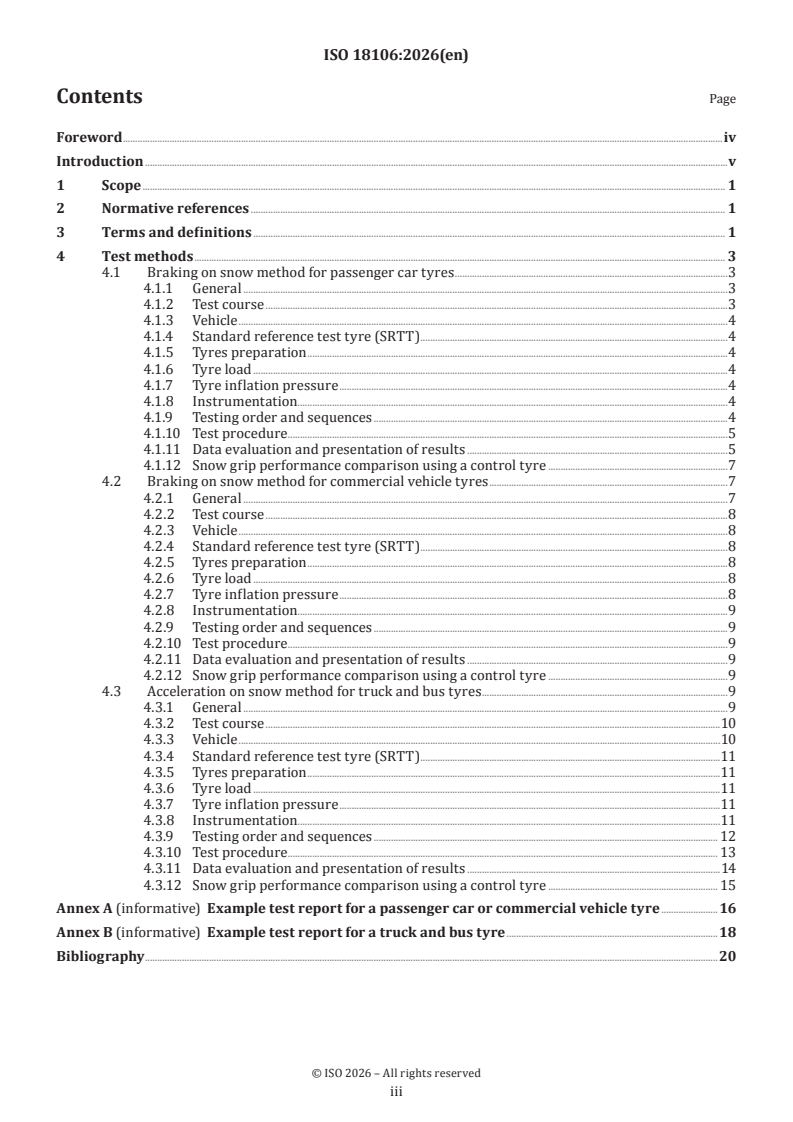
The front matter, Clause 2 and Clause 3 support those methods with references and definitions. Annex A and Annex B provide example test report formats.
| Annex | What it covers |
|---|---|
| Annex A | Example test report for a passenger car or commercial vehicle tyre |
| Annex B | Example test report for a truck and bus tyre |
What are the key requirements of ISO 18106:2026?
ISO 18106:2026 is built around comparing a candidate tyre with an SRTT on a controlled snow surface, then checking repeatability before reporting SG. In practice, the standard is not just about driving on snow - it fixes the test surface, vehicle setup, tyre load, pressure, sequence of runs and how the results are averaged.
Shared test conditions
For both braking and acceleration methods, ISO 18106:2026 requires a flat packed-snow test surface with a maximum 2 % gradient. The snow structure, air temperature, snow temperature and compaction range are controlled so that the candidate tyre and reference tyre are tested under comparable conditions.
This matters because snow grip changes quickly with temperature, surface preparation and compaction. The standard therefore requires the same slope and snow compaction condition for the candidate tyre and the reference tyre, and it recommends avoiding direct sunlight, strong light changes, humidity changes and wind.
Passenger car and commercial vehicle braking methods
ISO 18106:2026 uses mean fully developed deceleration (MFDD) for braking tests on passenger car tyres and commercial vehicle tyres. The vehicle shall be a standard production vehicle in good condition and equipped with anti-lock braking system (ABS), and the tyres shall be tested on snow using the SRTT named for each tyre group.
For passenger car tyres, the reference tyre is ASTM F2493-24, SRTT P225/60R16 97S. For commercial vehicle tyres, the reference tyre is ASTM F2872-25, SRTT 225/75R16C 116/114S. The standard requires the tyres to be mounted on suitable rims, conditioned before testing, and cleaned so that moulding residue does not affect the snow contact.
Load and pressure control are central to the braking method. Passenger car tyres are tested with loads between 60 % and 90 % of the load index load and a cold inflation pressure of 240 kPa. Commercial vehicle tyres are tested with loads between 60 % and 100 % of the load index load, with axle load balance controlled and inflation pressure calculated to maintain the required deflection condition.
Truck and bus acceleration method
ISO 18106:2026 uses average acceleration (AA) for truck and bus tyres. The test is performed on a two-axle standard production vehicle with traction control, or with a controlled-slip procedure when traction control is not available. The test speed range, slip ratio control and acceleration distance are defined so that the tyre is evaluated under a repeatable traction condition.
The truck and bus method uses SRTT families that are considered equivalent within the test boundary conditions. The document names ASTM F2870-23 and ASTM F2871-25, and also ASTM F3677-23 and ASTM F3678-25 for the SW references. This matters in practice because the test can be set up with the tyre size that fits the vehicle while still preserving the reference comparison.
Repeats, order of testing and validation
ISO 18106:2026 requires at least six runs for each tyre set. The order of testing alternates candidate tyres and SRTT runs so that surface evolution can be tracked. The braking method allows up to two candidate tyres between reference runs, while the truck and bus acceleration method allows up to three.
The data are only accepted if repeatability is good. For braking, the coefficient of variation (CV) shall not be greater than 6 %, and successive SRTT means shall not differ by more than 5 %. For acceleration, the CV shall not be greater than 6 %, and the SRTT stability coefficient shall not be greater than 6 %.
Control tyre use and reporting
ISO 18106:2026 allows a control tyre when the candidate tyre and the SRTT cannot be fitted to the same vehicle. The control tyre is first compared with the SRTT and then with the candidate tyre, and the final candidate result is derived from those two comparisons.
The test report format in Annex A and Annex B captures the track conditions, tyre identification, loads, pressures, run results, variation checks and final SG. In practice, this is the record that shows how the result was obtained and whether the test met the standard’s validation criteria.
What terms does ISO 18106:2026 define?
- Candidate tyre (T) - the tyre set being evaluated against the reference tyre.
- Reference tyre (R) - the benchmark tyre set used for comparison; the document also treats the SRTT as the reference tyre.
- Control tyre - an intermediate tyre set used when the candidate tyre cannot be tested directly against the SRTT on the same vehicle.
- Test run - one pass of a loaded tyre over the test surface.
- Tyre set - a group of two or four same tyres.
- Mean fully developed deceleration (MFDD) - the average braking deceleration calculated from the measured distance between two specified speeds.
- Average acceleration (AA) - the average acceleration calculated from measured distance between two specified speeds during an acceleration test.
- Snow grip index (SG) - the ratio used to express the candidate tyre performance relative to the proper SRTT.
Who uses ISO 18106:2026?
ISO 18106:2026 is used by tyre developers, test laboratories, vehicle test teams and technical staff who compare snow grip performance on passenger car, commercial vehicle, truck and bus tyres. It is also relevant to quality managers and buyers who need a controlled method for checking or specifying winter performance claims.
The document is especially useful where a team must choose the correct SRTT, set up a packed-snow track, run repeatable braking or acceleration tests, and prepare a formal test report. Annex A and Annex B show the report structure that these teams can use.
What changed in ISO 18106:2026 from the previous edition?
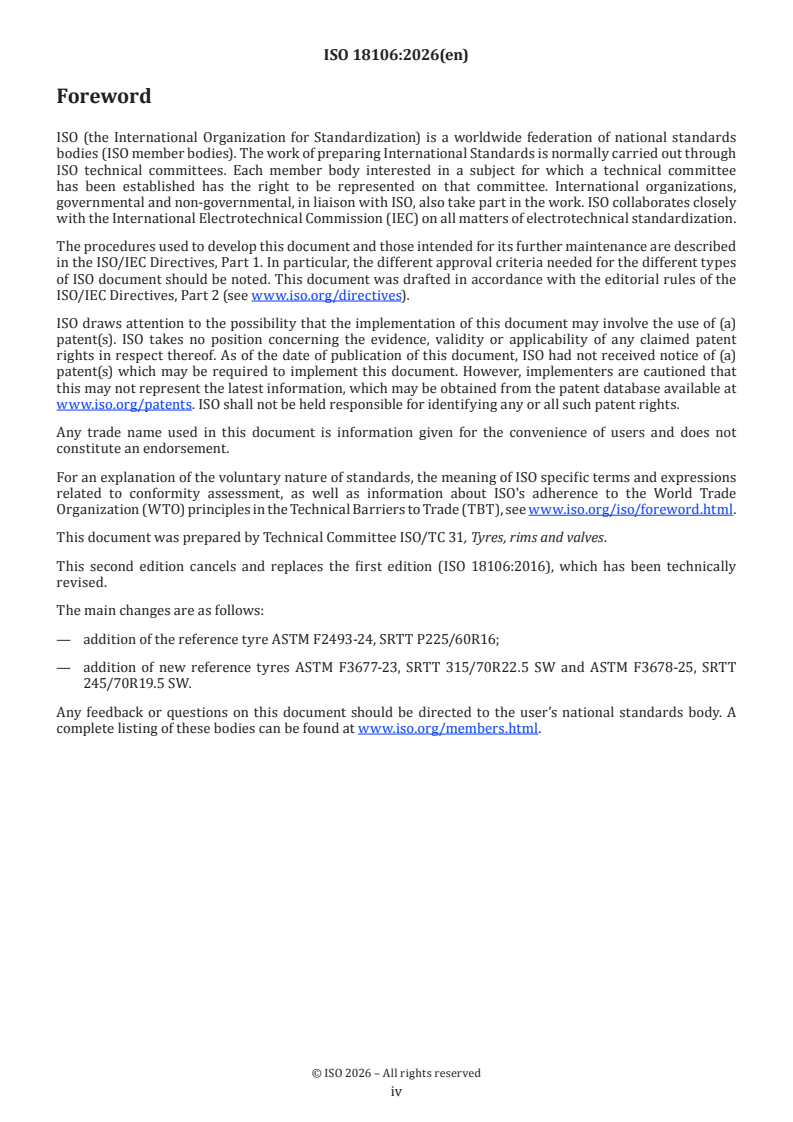
ISO 18106:2026 is the second edition and it cancels and replaces ISO 18106:2016. The document states that it has been technically revised.
The main changes named in the standard are:
- addition of the reference tyre ASTM F2493-24, SRTT P225/60R16
- addition of the reference tyres ASTM F3677-23, SRTT 315/70R22.5 SW and ASTM F3678-25, SRTT 245/70R19.5 SW
Which standards are used with ISO 18106:2026?
| Standard | What it contributes |
|---|---|
| ISO 4000-1 | Tyre designation and rim-related requirements for passenger car tyres |
| ISO 4209-1 | Tyre designation and rim-related requirements for truck and bus tyres |
| ASTM E1136-19 | Standard reference test tire named for SRTT use in the document |
| ASTM F1805-20 | Method for measuring snow compaction index with a CTI penetrometer |
| ASTM F2872-25 | SRTT for commercial vehicle tyre braking tests |
| ASTM F2493-24 | SRTT for passenger car tyre braking tests |
| ASTM F3677-23 | SRTT for truck and bus snow work, including SW reference use |
The document also names ASTM F2870-23, ASTM F2871-25 and ASTM F3678-25 when it describes equivalent SRTT options for truck and bus testing.
What does the ISO 18106:2026 document contain?
ISO 18106:2026 contains three detailed test methods, each with setup, procedure, result calculation and validation steps. Clause 4.1 and Clause 4.2 use braking-based MFDD measurements, while Clause 4.3 uses acceleration-based AA, slip ratio and acceleration force coefficient (AFC) calculations.
The document also includes the formulas and tables used to compute variation, weighted averages, SG and control-tyre comparisons. Annex A and Annex B provide example report layouts that capture test conditions, tyre data, run-by-run results and validation checks.
Relations
- Effective Date
- 28-Oct-2023
Get Certified
Connect with accredited certification bodies for this standard

DIN CERTCO
DIN Group product certification.

Smithers Quality Assessments
US management systems and product certification.
Sponsored listings
Frequently Asked Questions
ISO 18106:2026 is a standard published by the International Organization for Standardization (ISO). Its full title is "Passenger car, commercial vehicle, truck and bus tyres — Methods for measuring snow grip performance — Loaded new tyres". This standard covers: This document specifies the method for measuring the relative snow grip performance index of a candidate tyre compared to a reference, under loaded conditions for new tyres intended to be used on passenger car, commercial vehicle, truck and bus vehicles on a snow packed surface. This document applies to all passenger car, commercial vehicle, truck and bus tyres.
This document specifies the method for measuring the relative snow grip performance index of a candidate tyre compared to a reference, under loaded conditions for new tyres intended to be used on passenger car, commercial vehicle, truck and bus vehicles on a snow packed surface. This document applies to all passenger car, commercial vehicle, truck and bus tyres.
ISO 18106:2026 is classified under the following ICS (International Classification for Standards) categories: 83.160.10 - Road vehicle tyres. The ICS classification helps identify the subject area and facilitates finding related standards.
ISO 18106:2026 has the following relationships with other standards: It is inter standard links to ISO 18106:2016. Understanding these relationships helps ensure you are using the most current and applicable version of the standard.
ISO 18106:2026 is available in PDF format for immediate download after purchase. The document can be added to your cart and obtained through the secure checkout process. Digital delivery ensures instant access to the complete standard document.
Standards Content (Sample)
International
Standard
ISO 18106
Second edition
Passenger car, commercial vehicle,
2026-08
truck and bus tyres — Methods for
measuring snow grip performance
— Loaded new tyres
Pneumatiques pour voitures particulières, véhicules utilitaires,
camions et autobus — Méthodes de mesurage de l´adhérence sur
neige — Pneumatiques neufs en charge
Reference number
© ISO 2026
All rights reserved. Unless otherwise specified, or required in the context of its implementation, no part of this publication may
be reproduced or utilized otherwise in any form or by any means, electronic or mechanical, including photocopying, or posting on
the internet or an intranet, without prior written permission. Permission can be requested from either ISO at the address below
or ISO’s member body in the country of the requester.
ISO copyright office
CP 401 • Ch. de Blandonnet 8
CH-1214 Vernier, Geneva
Phone: +41 22 749 01 11
Email: copyright@iso.org
Website: www.iso.org
Published in Switzerland
ii
Contents Page
Foreword .iv
Introduction .v
1 Scope . 1
2 Normative references . 1
3 Terms and definitions . 1
4 Test methods . 3
4.1 Braking on snow method for passenger car tyres .3
4.1.1 General .3
4.1.2 Test course .3
4.1.3 Vehicle .4
4.1.4 Standard reference test tyre (SRTT) .4
4.1.5 Tyres preparation .4
4.1.6 Tyre load .4
4.1.7 Tyre inflation pressure .4
4.1.8 Instrumentation.4
4.1.9 Testing order and sequences .4
4.1.10 Test procedure.5
4.1.11 Data evaluation and presentation of results .5
4.1.12 Snow grip performance comparison using a control tyre .7
4.2 Braking on snow method for commercial vehicle tyres .7
4.2.1 General .7
4.2.2 Test course .8
4.2.3 Vehicle .8
4.2.4 Standard reference test tyre (SRTT) .8
4.2.5 Tyres preparation .8
4.2.6 Tyre load .8
4.2.7 Tyre inflation pressure .8
4.2.8 Instrumentation.9
4.2.9 Testing order and sequences .9
4.2.10 Test procedure.9
4.2.11 Data evaluation and presentation of results .9
4.2.12 Snow grip performance comparison using a control tyre .9
4.3 Acceleration on snow method for truck and bus tyres .9
4.3.1 General .9
4.3.2 Test course .10
4.3.3 Vehicle .10
4.3.4 Standard reference test tyre (SRTT) .11
4.3.5 Tyres preparation .11
4.3.6 Tyre load .11
4.3.7 Tyre inflation pressure .11
4.3.8 Instrumentation.11
4.3.9 Testing order and sequences . 12
4.3.10 Test procedure. 13
4.3.11 Data evaluation and presentation of results .14
4.3.12 Snow grip performance comparison using a control tyre . 15
Annex A (informative) Example test report for a passenger car or commercial vehicle tyre .16
Annex B (informative) Example test report for a truck and bus tyre .18
Bibliography .20
iii
Foreword
ISO (the International Organization for Standardization) is a worldwide federation of national standards
bodies (ISO member bodies). The work of preparing International Standards is normally carried out through
ISO technical committees. Each member body interested in a subject for which a technical committee
has been established has the right to be represented on that committee. International organizations,
governmental and non-governmental, in liaison with ISO, also take part in the work. ISO collaborates closely
with the International Electrotechnical Commission (IEC) on all matters of electrotechnical standardization.
The procedures used to develop this document and those intended for its further maintenance are described
in the ISO/IEC Directives, Part 1. In particular, the different approval criteria needed for the different types
of ISO document should be noted. This document was drafted in accordance with the editorial rules of the
ISO/IEC Directives, Part 2 (see www.iso.org/directives).
ISO draws attention to the possibility that the implementation of this document may involve the use of (a)
patent(s). ISO takes no position concerning the evidence, validity or applicability of any claimed patent
rights in respect thereof. As of the date of publication of this document, ISO had not received notice of (a)
patent(s) which may be required to implement this document. However, implementers are cautioned that
this may not represent the latest information, which may be obtained from the patent database available at
www.iso.org/patents. ISO shall not be held responsible for identifying any or all such patent rights.
Any trade name used in this document is information given for the convenience of users and does not
constitute an endorsement.
For an explanation of the voluntary nature of standards, the meaning of ISO specific terms and expressions
related to conformity assessment, as well as information about ISO's adherence to the World Trade
Organization (WTO) principles in the Technical Barriers to Trade (TBT), see www.iso.org/iso/foreword.html.
This document was prepared by Technical Committee ISO/TC 31, Tyres, rims and valves.
This second edition cancels and replaces the first edition (ISO 18106:2016), which has been technically
revised.
The main changes are as follows:
— addition of the reference tyre ASTM F2493-24, SRTT P225/60R16;
— addition of new reference tyres ASTM F3677-23, SRTT 315/70R22.5 SW and ASTM F3678-25, SRTT
245/70R19.5 SW.
Any feedback or questions on this document should be directed to the user’s national standards body. A
complete listing of these bodies can be found at www.iso.org/members.html.
iv
Introduction
The methods developed in this document are meant to reduce the variability of the tyre snow grip
performance measurement. The proper reference tyres must be used in order to limit the variability of the
testing method procedures.
v
International Standard ISO 18106:2026(en)
Passenger car, commercial vehicle, truck and bus tyres —
Methods for measuring snow grip performance — Loaded
new tyres
1 Scope
This document specifies the method for measuring the relative snow grip performance index of a candidate
tyre compared to a reference, under loaded conditions for new tyres intended to be used on passenger car,
commercial vehicle, truck and bus vehicles on a snow packed surface.
This document applies to all passenger car, commercial vehicle, truck and bus tyres.
2 Normative references
The following documents are referred to in the text in such a way that some or all of their content constitutes
requirements of this document. For dated references, only the edition cited applies. For undated references,
the latest edition of the referenced document (including any amendments) applies.
ISO 4000-1, Passenger car tyres and rims — Part 1: Tyres (metric series)
ISO 4209-1, Truck and bus tyres and rims (metric series) — Part 1: Tyres
ASTM E1136-19, Standard Specification for P195/75R14 Radial Standard Reference Test Tire
ASTM F1805-20, Standard Test Method for Single Wheel Driving Traction in a Straight Line on Snow- and Ice-
Covered Surfaces
ASTM F2872-25, Standard Specification for 225/75R16C 116/114S M+S Radial Light Truck Standard Reference
Test Tire
ASTM F2493-24, Standard Specification for P225/60R16 97S Radial Standard Reference Test Tire
ASTM F3677-23, Standard Specification for 315/70R22.5 154/150L Radial Truck Standard Reference Test Tire
SW
3 Terms and definitions
For the purposes of this document, the following terms and definitions apply.
ISO and IEC maintain terminology databases for use in standardization at the following addresses:
— ISO Online browsing platform: available at https:// www .iso .org/ obp
— IEC Electropedia: available at https:// www .electropedia .org/
3.1
passenger car tyre
tyres conforming to ISO 4000-1
3.2
commercial vehicle tyre
tyres conforming to ISO 4209-1 and identified by a load index in single configuration lower or equal to 121
and a speed symbol higher or equal to “N”
3.3
truck and bus tyre
tyres conforming to ISO 4209-1 and identified by:
a) a load index in single configuration higher or equal to 122; or
b) a load index in single configuration lower or equal to 121 and a speed symbol lower or equal to “M”
3.4
test run
single pass of a loaded tyre over a given test surface
3.5
tyre set
group of two or four same tyres
3.6
candidate tyre
T
test tyre set (3.5) that is part of an evaluation program
3.7
reference tyre
R
special test tyre set (3.5), also known as a standard reference test tyre (SRTT), that is used as a benchmark
in an evaluation program
Note 1 to entry: In order to minimize their variation, these tyres have carefully controlled design features and are
produced, controlled and stored in accordance with the following ASTM standards:
— ASTM E1136-19, SRTT P195/75R14;
— ASTM F2870-23, SRTT 315/70 R 22.5 - 154/150 L;
— ASTM F2871-25, SRTT 245/70 R 19.5 - 136/134 M;
— ASTM F2872-25, SRTT 225/75 R 16 C - 116/114 S;
— ASTM F2493-24, SRTT P225/60R16 97 S;
— ASTM F3677-23, SRTT 315/70 R 22.5 SW - 154/150 L;
— ASTM F3678-25, SRTT 245/70 R 19.5 SW - 136/134 M.
3.8
control tyre
C
tyre set (3.5) that is part of an evaluation program
Note 1 to entry: It is an intermediate set of tyres which is used when the candidate tyre and the reference tyre cannot
be directly compared on the same vehicle.
3.9
braking test
series of a specified number of anti-lock braking system (ABS) braking test runs (3.4) of the same tyre
repeated within a short time frame
3.10
mean fully developed deceleration
MFDD
average deceleration calculated on the basis of the measured distance recorded when decelerating a vehicle
between two specified speeds
3.11
acceleration test
series of a specified number of traction-controlled acceleration test runs (3.4) of the same tyre repeated
within a short time frame
3.12
acceleration force of a tyre
longitudinal force resulting from acceleration torque application
Note 1 to entry: It is expressed in newtons, N.
3.13
acceleration force coefficient of a tyre
AFC
ratio of acceleration force of a tyre to its vertical load
3.14
average acceleration
AA
average acceleration calculated on the basis of the measured distance recorded when accelerating a vehicle
between two specified speeds
3.15
snow grip index
SG
ratio between the performance of the candidate tyre to the performance of the proper standard reference
test tyre
3.16
loaded radius
distance from wheel axis of rotation to supporting surface (ground) at a given load and stated inflation
pressure
4 Test methods
4.1 Braking on snow method for passenger car tyres
4.1.1 General
Snow performance is based on a test method by which the mean fully developed deceleration in a braking
test, of a candidate tyre is compared to that of a standard reference test tyre.
The relative performance shall be indicated by a snow grip index (SG) in a test report format as shown in
Annex A.
4.1.2 Test course
The braking tests shall be done on a flat test surface with a maximum 2 % gradient, covered with packed
snow.
The snow surface shall be composed of a hard-packed snow base at least 3 cm thick and a surface layer of
medium packed and prepared snow about 2 cm thick.
The air temperature, measured about one meter above the ground, shall be between −2 °C and −15 °C; the
snow temperature, measured at a depth of about one centimetre, shall be between −4 °C and −15 °C.
It is recommended to avoid direct sunlight, large variations of sunlight or humidity, as well as wind.
The snow compaction index shall be measured according to ASTM F1805-20 by using a CTI penetrometer.
The snow compaction index shall be between 75 and 85.
The candidate tyre should be tested in the same slope and snow compaction condition as the reference tyre
to avoid any advantage or disadvantage for the candidate tyre.
4.1.3 Vehicle
The test shall be conducted with a standard production vehicle in good running order and equipped with
ABS.
The vehicle used shall be such that the loads on each wheel are appropriate to the tyres being tested. Several
different tyre sets can be tested on the same vehicle.
4.1.4 Standard reference test tyre (SRTT)
The passenger car tyre snow grip performance shall be evaluated by using ASTM F2493-24, SRTT
P225/60R16 97S as the reference tyre.
4.1.5 Tyres preparation
Fit the test tyres on rims in accordance with ISO 4000-1 using conventional mounting methods. Ensure
proper bead seating by the use of a tyre industry accepted lubricant. Excessive use of lubricant should be
avoided to prevent slipping of the tyre on the wheel rim.
The tyres should be prepared prior to testing to remove spew, compound nodules or flashes resulting from
the moulding process. The tyre surface in contact with snow shall be clean before performing a test.
Tyres shall be conditioned at the outdoor ambient temperature at least two hours before their mounting for
tests. Tyre pressures shall then be adjusted to the values specified for the test.
In case a vehicle cannot accommodate both the reference and candidate tyres, a third tyre (“control” tyre)
may be used as an intermediate. First, test the control tyre against the reference on a vehicle, then test the
candidate tyre against the control on the other vehicle.
4.1.6 Tyre load
The vehicle load shall be such that the resulting loads on the tyres are between 60 % and 90 % of the load
corresponding to the tyre load index.
4.1.7 Tyre inflation pressure
The cold inflation pressure shall be 240 kPa.
4.1.8 Instrumentation
The vehicle shall be fitted with calibrated sensors suitable for measurements in winter conditions. There
shall be a data acquisition system to store measurements.
The accuracy of measurement sensors and systems shall be such that the relative uncertainty of the
measured or computed mean fully developed decelerations is less than 1 %.
4.1.9 Testing order and sequences
For every candidate tyre and the standard reference test tyre, ABS-braking test runs shall be repeated a
minimum of six times.
The zones where ABS-braking is fully applied shall not overlap.
When a new set of tyres is tested, the runs are performed after shifting aside the vehicle trajectory in order
not to brake on the tracks of the previous tyre.
When it is no longer possible not to overlap full ABS-braking zones, the test course shall be re-groomed.
The order of testing is as follows.
— If only one candidate tyre must be evaluated, the order of testing shall be as shown in Formula (1):
R - T - R (1)
i f
where
R is the initial test of the SRTT;
i
R is the repeat test of the SRTT;
f
T is the test of the candidate tyre to be evaluated.
— A maximum of two candidate tyres (T1 and T2) may be tested before repeating the SRTT test, for example
as shown in Formula (2):
R - T - T - R (2)
i 1 2 f
Required sequence is as follows:
— six SRTT repetitions, then shift aside to test next tyre on fresh surface;
— six candidate one repetitions, then shift aside;
— six candidate two repetitions, then shift aside;
— six SRTT repetitions, then shift aside.
The comparative tests of SRTT and candidate tyres shall be repeated on two different days.
4.1.10 Test procedure
Drive the vehicle at a speed not lower than 28 km/h.
When the measuring zone has been reached, the vehicle gear is set into neutral, the brake pedal is depressed
sharply by a constant force sufficient to cause operation of the ABS on all wheels of the vehicle and to result
in stable deceleration of the vehicle and held down until the speed is lower than 8 km/h.
The mean fully developed deceleration between 25 km/h and 10 km/h shall be computed from distance,
speed, or deceleration measurements.
The mean fully developed deceleration, MFDD, is given by Formula (3):
Sf −Si
(3)
2D
where
D is the distance covered between Si and Sf, in m;
Si is the initial speed, in m/s;
Sf is the final speed, in m/s.
4.1.11 Data evaluation and presentation of results
4.1.11.1 C
...