

ISO/IEC 14496-15:2024/FDAmd 2
(Amendment)Information technology — Coding of audio-visual objects — Part 15: Carriage of network abstraction layer (NAL) unit structured video in the ISO base media file format — Amendment 2: Improvement of carriage of L-HEVC
- Status
- Not Published
- Technical Committee
- ISO/IEC JTC 1/SC 29 - Coding of audio, picture, multimedia and hypermedia information
- Drafting Committee
- ISO/IEC JTC 1/SC 29/WG 3 - MPEG Systems
- Current Stage
- 5020 - FDIS ballot initiated: 2 months. Proof sent to secretariat
- Start Date
- 10-Sep-2026
- Completion Date
- 10-Sep-2026
Buy Documents

ISO/IEC 14496-15:2024/FDAmd 2 - Information technology — Coding of audio-visual objects — Part 15: Carriage of network abstraction layer (NAL) unit structured video in the ISO base media file format — Amendment 2: Improvement of carriage of L-HEVC

REDLINE ISO/IEC 14496-15:2024/FDAmd 2 - Information technology — Coding of audio-visual objects — Part 15: Carriage of network abstraction layer (NAL) unit structured video in the ISO base media file format — Amendment 2: Improvement of carriage of L-HEVC
ISO/IEC 14496-15:2024/FDAmd 2 is an ISO/IEC amendment to Part 15 of the Coding of audio-visual objects series. It updates how layered HEVC (L-HEVC) is carried in the ISO base media file format, with rules for sample groups, track relationships, and a backwards-compatibility brand. It is aimed at people who author, multiplex, decode, or test ISO base media files that contain layered video.
What does ISO/IEC 14496-15:2024/FDAmd 2 specify?
ISO/IEC 14496-15:2024/FDAmd 2 specifies targeted changes to the carriage of L-HEVC in the ISO base media file format. In practice, it refines how a layered bitstream is represented in one track or several tracks, and how readers should interpret the signaling.
The amendment touches these parts of the document:
| Clause / annex | What it covers |
|---|---|
| 4.19.2 | A sample group entry structure for NNPFC SEI data |
| 9.6.2.1 | Track relationships for the 'oinf' sample group |
| 9.6.3 | Track relationships for the 'linf' sample group |
| 11.1.3 | Use of the specified sample entries in tracks that also carry other sample entries |
| D.4.7 | The 'hvcs' backwards compatibility brand |
| E.4 | Editorial cleanup of repeated text |
The practical effect is clearer packaging and reader behavior for L-HEVC files, especially when a stream is split across multiple tracks or when a single-track file needs to remain readable by older decoders.
What are the key requirements of ISO/IEC 14496-15:2024/FDAmd 2?
ISO/IEC 14496-15:2024/FDAmd 2 updates the rules that matter most when writing or reading layered HEVC files.
NnpfcSeiSampleGroupEntry in clause 4.19.2
ISO/IEC 14496-15:2024/FDAmd 2 replaces the content of clause 4.19.2 with a defined NnpfcSeiSampleGroupEntry class. The class carries a meta_box_handler_type, a count of items, a list of item_id values, and the nnpfc_sei_data_byte payload.
For implementers, this means the sample group has a fixed structure for linking SEI data to items identified in the file metadata. Muxers need to write the fields consistently, and parsers need to read the list of item identifiers before the byte payload.
'oinf' signaling in clause 9.6.2.1
ISO/IEC 14496-15:2024/FDAmd 2 changes the rule for the 'oinf' sample group when an L-HEVC bitstream uses more than one video track. In that case, exactly one track in the set carries 'oinf', and the other tracks use 'oref' references to that track.
For a single-track L-HEVC file, 'oinf' is no longer mandatory in the base wording. If it is absent, the VPS must be present in the sample entry. That matters for file creation because a single-track package can be valid without 'oinf', but compatibility with earlier readers is improved if 'oinf' is still included.
'linf' signaling in clause 9.6.3
ISO/IEC 14496-15:2024/FDAmd 2 limits the mandatory use of 'linf' to the multi-track case. When an L-HEVC bitstream is represented by more than one video track, every L-HEVC track, including the base track when coded with HEVC, carries a 'linf' sample group.
For single-track files, the note recommends including 'linf' for readers that follow earlier versions. This gives packagers a compatibility choice: strict minimum signaling for the current wording, or extra signaling for older deployments.
Mixed sample-entry tracks in clause 11.1.3
ISO/IEC 14496-15:2024/FDAmd 2 adds a rule that the sample entries from this clause may also be used in tracks that contain other sample entry types, including tracks with more than one coding type. When applying the clause in such tracks, other sample entries and the samples that point to them are treated as not present.
This is important for mixed-content tracks because it tells readers which samples belong to the L-HEVC signaling model and which should be ignored for that purpose.
The 'hvcs' brand in Annex D.4.7
ISO/IEC 14496-15:2024/FDAmd 2 adds the 'hvcs' compatible brand for FileTypeBox. It is intended for single-track packaging of a layered HEVC bitstream in a backwards-compatible form so that a decoder that only handles the base layer can still decode the video samples.
The annex also states that files claiming this brand shall contain only one track carrying a layered HEVC bitstream with sample entry 'hvc1'. That gives authoring tools a concrete interoperability target for legacy playback.
What terms does ISO/IEC 14496-15:2024/FDAmd 2 define?
- L-HEVC - Layered HEVC bitstream; the amendment focuses on how this is carried in one or more video tracks.
- 'oinf' sample group - The sample group used to identify the track that other L-HEVC tracks relate to.
- 'linf' sample group - The sample group used on L-HEVC tracks in the multi-track case.
- 'hvcs' - A compatible brand for single-track, backwards-compatible layered HEVC packaging.
- 'hvc1' - The sample entry used by the single layered-HEVC track in the 'hvcs' case.
- FileTypeBox - The box that can list
compatible_brands, including 'hvcs'.
Who uses ISO/IEC 14496-15:2024/FDAmd 2?
ISO/IEC 14496-15:2024/FDAmd 2 is used by media format engineers, codec implementers, and packaging tool developers working with ISO base media files. It is also relevant to decoder and player vendors that need to interpret layered HEVC track signaling correctly.
Quality teams use it when checking interoperability between single-track and multi-track files, especially for compatibility with earlier readers. Content preparation teams use it when deciding whether to include 'oinf', 'linf', or the 'hvcs' brand in a file.
What changed in ISO/IEC 14496-15:2024/FDAmd 2 from the previous edition?
ISO/IEC 14496-15:2024/FDAmd 2 is Amendment 2 to Part 15, and it introduces these changes:
- revises the
NnpfcSeiSampleGroupEntrystructure in clause 4.19.2 - updates the 'oinf' rule in clause 9.6.2.1 for multi-track and single-track L-HEVC files
- updates the 'linf' rule in clause 9.6.3 for the multi-track case
- allows the clause 11.1.3 sample entries to be used in tracks that also contain other sample entry types
- adds Annex D.4.7 for the 'hvcs' backwards compatibility brand
- removes redundant repeated text in Annex E.4
What does the ISO/IEC 14496-15:2024/FDAmd 2 document contain?
The document contains replacement text for one sample group class, revised track-signaling rules, and a new compatibility brand annex. It also includes notes that explain how the current wording relates to earlier versions, which helps implementers preserve backward compatibility.
For practical use, the important parts are the updated clauses in 4, 9, and 11, plus Annex D.4.7 for packaging rules. Annex E.4 is an editorial cleanup. These are the sections to consult when updating muxers, demuxers, validators, or conformance tests for L-HEVC files.
Relations
- Effective Date
- 09-Aug-2025
Buy Documents
ISO/IEC 14496-15:2024/FDAmd 2 - Information technology — Coding of audio-visual objects — Part 15: Carriage of network abstraction layer (NAL) unit structured video in the ISO base media file format — Amendment 2: Improvement of carriage of L-HEVC
REDLINE ISO/IEC 14496-15:2024/FDAmd 2 - Information technology — Coding of audio-visual objects — Part 15: Carriage of network abstraction layer (NAL) unit structured video in the ISO base media file format — Amendment 2: Improvement of carriage of L-HEVC
Get Certified
Connect with accredited certification bodies for this standard

BSI Group
BSI (British Standards Institution) is the business standards company that helps organizations make excellence a habit.

NYCE
Mexican standards and certification body.
Sponsored listings
Frequently Asked Questions
ISO/IEC 14496-15:2024/FDAmd 2 is a draft published by the International Organization for Standardization (ISO). Its full title is "Information technology — Coding of audio-visual objects — Part 15: Carriage of network abstraction layer (NAL) unit structured video in the ISO base media file format — Amendment 2: Improvement of carriage of L-HEVC". This standard covers: Information technology — Coding of audio-visual objects — Part 15: Carriage of network abstraction layer (NAL) unit structured video in the ISO base media file format — Amendment 2: Improvement of carriage of L-HEVC
Information technology — Coding of audio-visual objects — Part 15: Carriage of network abstraction layer (NAL) unit structured video in the ISO base media file format — Amendment 2: Improvement of carriage of L-HEVC
ISO/IEC 14496-15:2024/FDAmd 2 is classified under the following ICS (International Classification for Standards) categories: 35.040.40 - Coding of audio, video, multimedia and hypermedia information. The ICS classification helps identify the subject area and facilitates finding related standards.
ISO/IEC 14496-15:2024/FDAmd 2 has the following relationships with other standards: It is inter standard links to ISO/IEC 14496-15:2024. Understanding these relationships helps ensure you are using the most current and applicable version of the standard.
ISO/IEC 14496-15:2024/FDAmd 2 is available in PDF format for immediate download after purchase. The document can be added to your cart and obtained through the secure checkout process. Digital delivery ensures instant access to the complete standard document.
Standards Content (Sample)
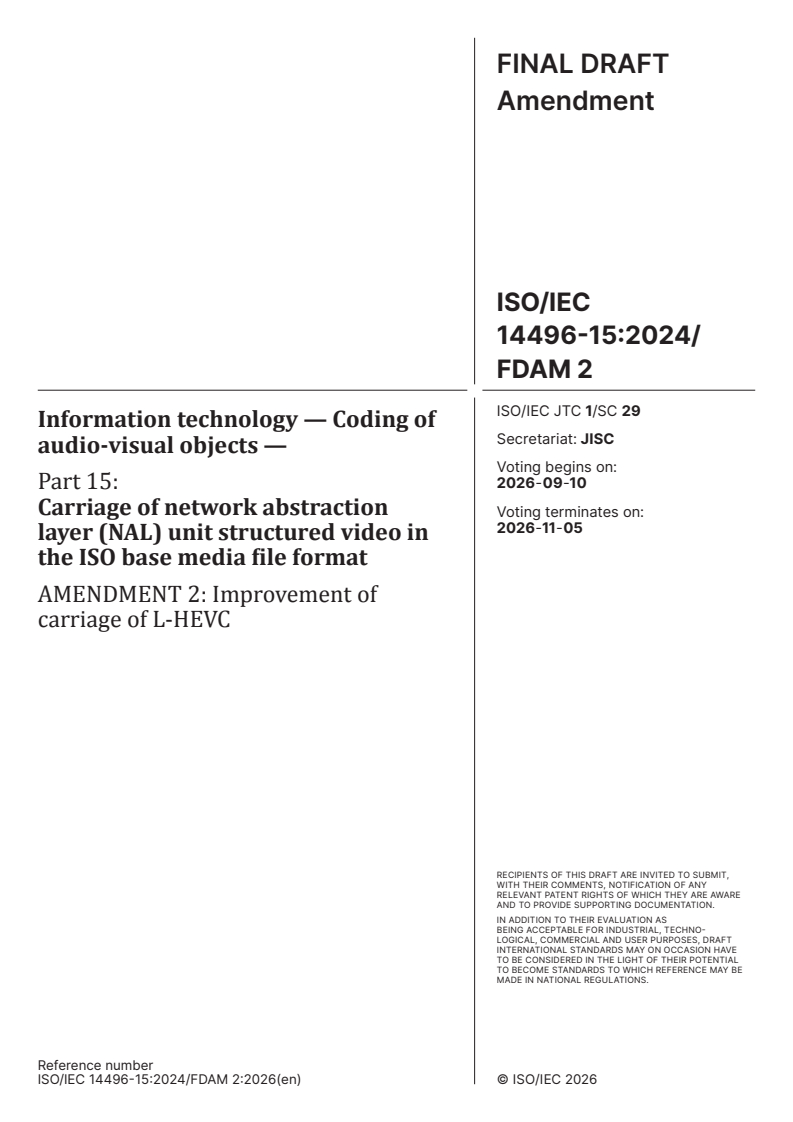
FINAL DRAFT
Amendment
ISO/IEC
14496-15:2024/
FDAM 2
ISO/IEC JTC 1/SC 29
Information technology — Coding of
Secretariat: JISC
audio-visual objects —
Voting begins on:
2026-09-10
Part 15:
Carriage of network abstraction
Voting terminates on:
2026-11-05
layer (NAL) unit structured video in
the ISO base media file format
AMENDMENT 2: Improvement of
carriage of L-HEVC
RECIPIENTS OF THIS DRAFT ARE INVITED TO SUBMIT,
WITH THEIR COMMENTS, NOTIFICATION OF ANY
RELEVANT PATENT RIGHTS OF WHICH THEY ARE AWARE
AND TO PROVIDE SUPPOR TING DOCUMENTATION.
IN ADDITION TO THEIR EVALUATION AS
BEING ACCEPTABLE FOR INDUSTRIAL, TECHNO
LOGICAL, COMMERCIAL AND USER PURPOSES, DRAFT
INTERNATIONAL STANDARDS MAY ON OCCASION HAVE
TO BE CONSIDERED IN THE LIGHT OF THEIR POTENTIAL
TO BECOME STAN DARDS TO WHICH REFERENCE MAY BE
MADE IN NATIONAL REGULATIONS.
Reference number
ISO/IEC 1449615:2024/FDAM 2:2026(en) © ISO/IEC 2026
FINAL DRAFT
ISO/IEC 14496-15:2024/FDAM 2:2026(en)
Amendment
ISO/IEC
14496-15:2024/
FDAM 2
ISO/IEC JTC 1/SC 29
Information technology — Coding of
Secretariat: JISC
audio-visual objects —
Voting begins on:
Part 15:
Carriage of network abstraction
Voting terminates on:
layer (NAL) unit structured video in
the ISO base media file format
AMENDMENT 2: Improvement of
carriage of L-HEVC
RECIPIENTS OF THIS DRAFT ARE INVITED TO SUBMIT,
WITH THEIR COMMENTS, NOTIFICATION OF ANY
RELEVANT PATENT RIGHTS OF WHICH THEY ARE AWARE
AND TO PROVIDE SUPPOR TING DOCUMENTATION.
© ISO/IEC 2026
IN ADDITION TO THEIR EVALUATION AS
All rights reserved. Unless otherwise specified, or required in the context of its implementation, no part of this publication may
BEING ACCEPTABLE FOR INDUSTRIAL, TECHNO
LOGICAL, COMMERCIAL AND USER PURPOSES, DRAFT
be reproduced or utilized otherwise in any form or by any means, electronic or mechanical, including photocopying, or posting on
INTERNATIONAL STANDARDS MAY ON OCCASION HAVE
the internet or an intranet, without prior written permission. Permission can be requested from either ISO at the address below
TO BE CONSIDERED IN THE LIGHT OF THEIR POTENTIAL
or ISO’s member body in the country of the requester.
TO BECOME STAN DARDS TO WHICH REFERENCE MAY BE
MADE IN NATIONAL REGULATIONS.
ISO copyright office
CP 401 • Ch. de Blandonnet 8
CH-1214 Vernier, Geneva
Phone: +41 22 749 01 11
Email: copyright@iso.org
Website: www.iso.org
Published in Switzerland Reference number
ISO/IEC 1449615:2024/FDAM 2:2026(en) © ISO/IEC 2026
© ISO/IEC 2026 – All rights reserved
ii
ISO/IEC 14496-15:2024/FDAM 2:2026(en)
Foreword
ISO (the International Organization for Standardization) and IEC (the International Electrotechnical
Commission) form the specialized system for worldwide standardization. National bodies that are
members of ISO or IEC participate in the development of International Standards through technical
committees established by the respective organization to deal with particular fields of technical activity.
ISO and IEC technical committees collaborate in fields of mutual interest. Other international organizations,
governmental and non-governmental, in liaison with ISO and IEC, also take part in the work.
The procedures used to develop this document and those intended for its further maintenance are described
in the ISO/IEC Directives, Part 1. In particular, the different approval criteria needed for the different types
of document should be noted. This document was drafted in accordance with the editorial rules of the ISO/
IEC Directives, Part 2 (see www.iso.org/directives or www.iec.ch/members_experts/refdocs).
ISO and IEC draw attention to the possibility that the implementation of this document may involve the
use of (a) patent(s). ISO and IEC take no position concerning the evidence, validity or applicability of any
claimed patent rights in respect thereof. As of the date of publication of this document, ISO and IEC had not
received notice of (a) patent(s) which may be required to implement this document. However, implementers
are cautioned that this may not represent the latest information, which may be obtained from the patent
database available at www.iso.org/patents and https://patents.iec.ch. ISO and IEC shall not be held
responsible for identifying any or all such patent rights.
Any trade name used in this document is information given for the convenience of users and does not
constitute an endorsement.
For an explanation of the voluntary nature of standards, the meaning of ISO specific terms and expressions
related to conformity assessment, as well as information about ISO's adherence to the World Trade
Organization (WTO) principles in the Technical Barriers to Trade (TBT) see www.iso.org/iso/forew
...
ISO/IEC 14496-15:2024/FDAMFDAmd 2:2026(en)
ISO/IEC JTC 1/SC 29/WG 03
Secretariat: JISC
Date: 2026-07-07xx
Information technology — Coding of audio-visual objects — —
Part 15:
Carriage of network abstraction layer (NAL) unit structured video in
the ISO base media file format — Amendment
AMENDMENT 2: Improvement of carriage of L-HEVC
FDIS stage
© ISO/IEC 2026
All rights reserved. Unless otherwise specified, or required in the context of its implementation, no part of this publication
may be reproduced or utilized otherwise in any form or by any means, electronic or mechanical, including photocopying,
or posting on the internet or an intranet, without prior written permission. Permission can be requested from either ISO
at the address below or ISO’s member body in the country of the requester.
ISO copyright office
CP 401 • Ch. de Blandonnet 8
CH-1214 Vernier, Geneva
Phone: + 41 22 749 01 11
EmailE-mail: copyright@iso.org
Website: www.iso.org
Published in Switzerland
© ISO/IEC 2026 – All rights reserved
ii
Foreword
ISO (the International Organization for Standardization) and IEC (the International Electrotechnical
Commission) form the specialized system for worldwide standardization. National bodies that are members
of ISO or IEC participate in the development of International Standards through technical committees
established by the respective organization to deal with particular fields of technical activity. ISO and IEC
technical committees collaborate in fields of mutual interest. Other international organizations, governmental
and non-governmental, in liaison with ISO and IEC, also take part in the work.
The procedures used to develop this document and those intended for its further maintenance are described
in the ISO/IEC Directives, Part 1. In particular, the different approval criteria needed for the different types of
document should be noted. This document was drafted in accordance with the editorial rules of the ISO/IEC
Directives, Part 2 (see www.iso.org/directives or www.iec.ch/members_experts/refdocs).
ISO and IEC draw attention to the possibility that the implementation of this document may involve the use of
(a) patent(s). ISO and IEC take no position concerning the evidence, validity or applicability of any claimed
patent rights in respect thereof. As of the date of publication of this document, ISO and IEC [had/had not]
received notice of (a) patent(s) which may be required to implement this document. However, implementers
are cautioned that this may not represent the latest information, which may be obtained from the patent
database available at www.iso.org/patents and https://patents.iec.ch. ISO and IEC shall not be held
responsible for identifying any or all such patent rights.
Any trade name used in this document is information given for the convenience of users and does not
constitute an endorsement.
For an explanation of the voluntary nature of standards, the meaning of ISO specific terms and expressions
related to conformity assessment, as well as information about ISO's adherence to the World Trade
Organization (WTO) principles in the Technical Barriers to Trade (TBT) see www.iso.org/iso/foreword.html.
In the IEC, see www.iec.ch/understanding-standards.
This document was prepared by Joint Technical Committee ISO/IEC JTC 1, Information technology,
Subcommittee SC 29, Coding of audio, picture, multimedia and hypermedia information.
A list of all parts in the ISO/IEC 14496 series can be found on the ISO and IEC websites.
Any feedback or questions on this document should be directed to the user’s national standards body. A
complete listing of these bodies can be found at www.iso.org/members.html and www.iec.ch/national-
committees.
© ISO/IEC 2026 – All rights reserved
iii
Information technology — Coding of audio-visual objects — —
Part 15:
Carriage of network abstraction layer (NAL) unit structured video in
the ISO base media fi
...