


ISO/PRF 15926-100
(Main)Industrial automation systems and integration — Integration of life-cycle data for process plants including oil and gas production facilities — Part 100: Vocabulary
Industrial automation systems and integration — Integration of life-cycle data for process plants including oil and gas production facilities — Part 100: Vocabulary
This document defines terms relating to integration of life-cycle data for process. These terms are used by the parts in the ISO 15926 series. The following are outside the scope of this document: - The reference data items that are contained in the reference data library, such as ISO/TS 15926-4; - The entities used in the data model, such as ISO 15926-2.
Systèmes d'automatisation industrielle et intégration — Intégration de données de cycle de vie pour les industries de "process", y compris les usines de production de pétrole et de gaz — Partie 100: Titre manque
General Information
- Status
- Not Published
- Technical Committee
- ISO/TC 184/SC 4 - Industrial data
- Drafting Committee
- ISO/TC 184/SC 4/WG 3 - Oil, Gas, Process and Power
- Current Stage
- 5020 - FDIS ballot initiated: 2 months. Proof sent to secretariat
- Start Date
- 10-Apr-2026
- Completion Date
- 11-Apr-2026
Overview
ISO/PRF 15926-100 is an international standard developed by ISO for the industrial automation sector, specifically focusing on the integration of life-cycle data for process plants, including oil and gas production facilities. Part 100 of the ISO 15926 series serves as a comprehensive vocabulary document, meticulously defining essential terminology used throughout the ISO 15926 standards family. This harmonized set of terms forms the basis for effective data exchange and seamless integration in complex process industries.
By providing clear and consistent vocabulary, ISO/PRF 15926-100 supports interoperability between engineering, construction, operation, and maintenance systems across the entire facility life-cycle. This standard is indispensable for organizations aiming to implement digital transformation initiatives, drive efficiency, and ensure accurate interpretation of data shared among stakeholders.
Key Topics
ISO/PRF 15926-100 covers an extensive range of key terms and definitions related to process plant data integration, ensuring all parties use a shared language. Major topics include:
- Basic concepts such as data, information, metadata, and conceptual data models
- Entities and classes, including classified items, individuals, instances, and taxonomies
- Artefacts and physical objects, defining facilities, products, and engineered items
- Part-whole relationships and system components
- Activity and participation, covering processes, projects, events, and resources
- State, behaviour, and capability, such as interoperability, validation, and verification
- Roles and organizations, including enterprise, stakeholder, and maintenance organization
- Requirements and design, encompassing system, stakeholder, and technical requirements
- Planning and methods, such as scheduling concepts, milestones, and work orders
- Physical quantities and properties, helping in precise data modeling
Each term is defined to align with industry practice and other relevant ISO standards, removing ambiguity and fostering compatibility.
Applications
The vocabulary provided by ISO/PRF 15926-100 is foundational to integrating plant life-cycle data in the following contexts:
- Digital transformation of process industries: Ensures consistent vocabulary in digital twins, asset management, and smart plant systems.
- System interoperability: Supports standardization needed for systems to effectively exchange data in engineering, procurement, construction, operation, and maintenance phases.
- Supplier collaboration: Provides a common reference for contractors, vendors, and stakeholders working together on large industrial projects.
- Quality and compliance: Enhances traceability and quality assurance by ensuring all lifecycle data references the same terminology and structure.
- Knowledge management: Facilitates the sharing and retrieval of information across global teams, helping to reduce errors and misinterpretations.
ISO/PRF 15926-100 is particularly valuable for process plants where integrating vast and complex data sets is vital for efficient, safe, and compliant operation.
Related Standards
ISO/PRF 15926-100 is part of the broader ISO 15926 series, which collectively establish frameworks and models for industrial data integration. Related standards in the series include:
- ISO 15926-2: Focuses on the data model for process plant integration.
- ISO/TS 15926-4: Specifies the reference data library for classifying plant data.
- Other parts of ISO 15926: Cover implementation methods, conformance, and additional requirements for industrial data integration.
By aligning terminology across the ISO 15926 suite, Part 100 enables organizations to implement consistent, standardized approaches to digital information management throughout the asset life-cycle.
For the complete vocabulary and downloadable resources, visit the ISO 15926-100 online repository.
Reference: Developed by ISO/TC 184/SC 4, Automation systems and integration, Industrial data. For more information about ISO and national standards bodies, see www.iso.org.
Buy Documents


ISO/PRF 15926-100 - Industrial automation systems and integration — Integration of life-cycle data for process plants including oil and gas production facilities — Part 100: Vocabulary

REDLINE ISO/PRF 15926-100 - Industrial automation systems and integration — Integration of life-cycle data for process plants including oil and gas production facilities — Part 100: Vocabulary
Get Certified
Connect with accredited certification bodies for this standard

ABS Quality Evaluations Inc.
American Bureau of Shipping quality certification.

Element Materials Technology
Materials testing and product certification.

National Aerospace and Defense Contractors Accreditation Program (NADCAP)
Global cooperative program for special process quality in aerospace.
Sponsored listings
Frequently Asked Questions
ISO/PRF 15926-100 is a draft published by the International Organization for Standardization (ISO). Its full title is "Industrial automation systems and integration — Integration of life-cycle data for process plants including oil and gas production facilities — Part 100: Vocabulary". This standard covers: This document defines terms relating to integration of life-cycle data for process. These terms are used by the parts in the ISO 15926 series. The following are outside the scope of this document: - The reference data items that are contained in the reference data library, such as ISO/TS 15926-4; - The entities used in the data model, such as ISO 15926-2.
This document defines terms relating to integration of life-cycle data for process. These terms are used by the parts in the ISO 15926 series. The following are outside the scope of this document: - The reference data items that are contained in the reference data library, such as ISO/TS 15926-4; - The entities used in the data model, such as ISO 15926-2.
ISO/PRF 15926-100 is classified under the following ICS (International Classification for Standards) categories: 01.040.25 - Manufacturing engineering (Vocabularies); 01.040.75 - Petroleum and related technologies (Vocabularies); 25.040.40 - Industrial process measurement and control; 75.020 - Extraction and processing of petroleum and natural gas. The ICS classification helps identify the subject area and facilitates finding related standards.
ISO/PRF 15926-100 is available in PDF format for immediate download after purchase. The document can be added to your cart and obtained through the secure checkout process. Digital delivery ensures instant access to the complete standard document.
Standards Content (Sample)
International
Standard
ISO 15926-100
First edition
Industrial automation systems
and integration — Integration of
life-cycle data for process plants
including oil and gas production
facilities —
Part 100:
Vocabulary
PROOF/ÉPREUVE
Reference number
ISO 15926-100:2026(en) © ISO 2026
ISO 15926-100:2026(en)
© ISO 2026
All rights reserved. Unless otherwise specified, or required in the context of its implementation, no part of this publication may
be reproduced or utilized otherwise in any form or by any means, electronic or mechanical, including photocopying, or posting on
the internet or an intranet, without prior written permission. Permission can be requested from either ISO at the address below
or ISO’s member body in the country of the requester.
ISO copyright office
CP 401 • Ch. de Blandonnet 8
CH-1214 Vernier, Geneva
Phone: +41 22 749 01 11
Email: copyright@iso.org
Website: www.iso.org
Published in Switzerland
PROOF/ÉPREUVE
ii
ISO 15926-100:2026(en)
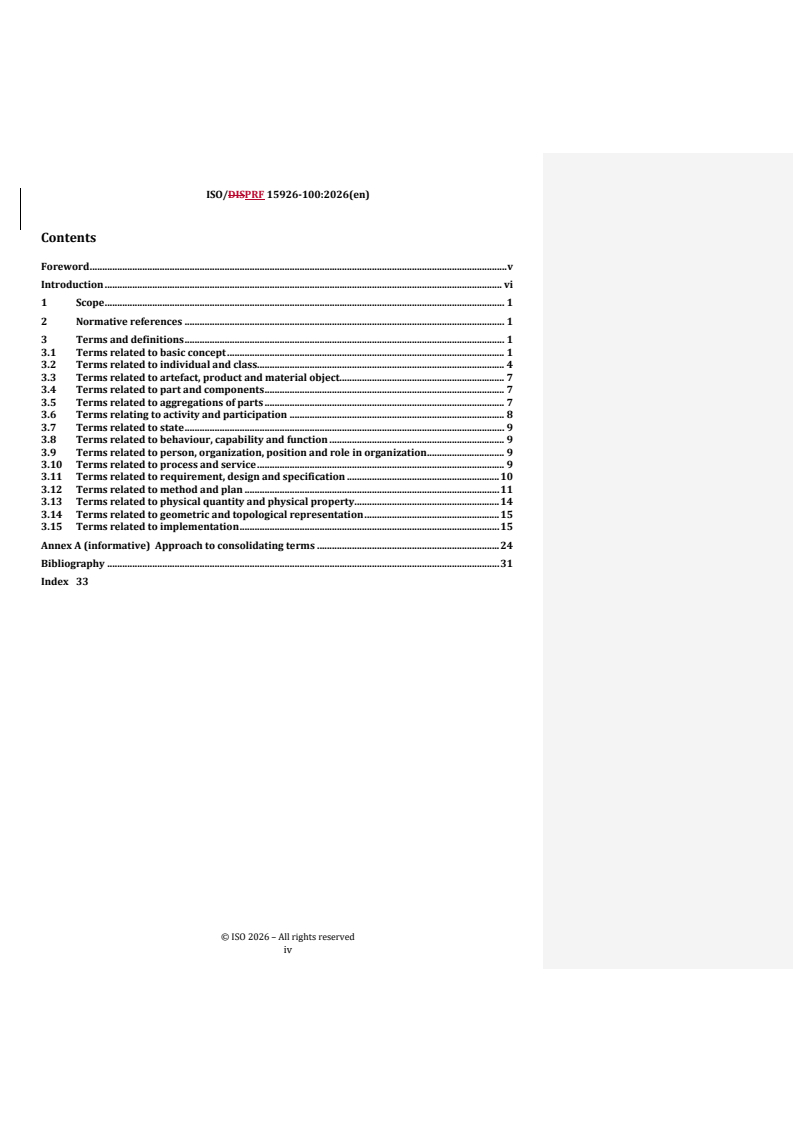
Contents Page
Foreword .iv
Introduction .v
1 Scope . 1
2 Normative references . 1
3 Terms and definitions . 1
3.1 Terms related to basic concept.1
3.2 Terms related to individual and class .4
3.3 Terms related to artefact, product and material object .7
3.4 Terms related to part and components .7
3.5 Terms related to aggregations of parts .7
3.6 Terms relating to activity and participation .7
3.7 Terms related to state .8
3.8 Terms related to behaviour, capability and function .8
3.9 Terms related to person, organization, position and role in organization .8
3.10 Terms related to process and service .9
3.11 Terms related to requirement, design and specification .9
3.12 Terms related to method and plan .10
3.13 Terms related to physical quantity and physical property . 13
3.14 Terms related to geometric and topological representation . .14
3.15 Terms related to implementation .14
Annex A (informative) Approach to consolidating terms .22
Bibliography .27
Index .29
PROOF/ÉPREUVE
iii
ISO 15926-100:2026(en)
Foreword
ISO (the International Organization for Standardization) is a worldwide federation of national standards
bodies (ISO member bodies). The work of preparing International Standards is normally carried out through
ISO technical committees. Each member body interested in a subject for which a technical committee
has been established has the right to be represented on that committee. International organizations,
governmental and non-governmental, in liaison with ISO, also take part in the work. ISO collaborates closely
with the International Electrotechnical Commission (IEC) on all matters of electrotechnical standardization.
The procedures used to develop this document and those intended for its further maintenance are described
in the ISO/IEC Directives, Part 1. It is noted different approval criteria are needed for the different types of
ISO documents. This document was drafted in accordance with the editorial rules of the ISO/IEC Directives,
Part 2 (see www.iso.org/directives).
ISO draws attention to the possibility that the implementation of this document may involve the use of (a)
patent(s). ISO takes no position concerning the evidence, validity or applicability of any claimed patent
rights in respect thereof. As of the date of publication of this document, ISO had not received notice of (a)
patent(s) which may be required to implement this document. However, implementers are cautioned that
this may not represent the latest information, which may be obtained from the patent database available at
www.iso.org/patents. ISO shall not be held responsible for identifying any or all such patent rights.
Any trade name used in this document is information given for the convenience of users and does not
constitute an endorsement.
For an explanation of the voluntary nature of standards, the meaning of ISO specific terms and expressions
related to conformity assessment, as well as information about ISO's adherence to the World Trade
Organization (WTO) principles in the Technical Barriers to Trade (TBT), see www.iso.org/iso/foreword.html.
This document was prepared by Technical Committee ISO/TC 184, Automation systems and integration,
Subcommittee SC 4, Industrial data.
A list of all parts in the ISO 15926 series can be found on the ISO website.
Any feedback or questions on this document can be directed to the user’s national standards body. A
complete listing of these bodies can be found at www.iso.org/members.html.
PROOF/ÉPREUVE
iv
ISO 15926-100:2026(en)
Introduction
The ISO 15926 series specifies the representation of process plant life-cycle information. This representation
is based on a generic, conceptual data model that is suitable as the basis for implementation in a shared
database or data warehouse.
The data model is designed to be used in conjunction with reference data: standard instances that represent
data common to a substantial number of experts from the process plant engineering supply chain.
The support for a specific life-cycle activity depends on the use of an appropriate selection of reference data
in conjunction with an appropriate data model derived from the ISO 15926 data model ontology.
This document lists terms used in the different parts of the ISO 15926 series. The terms are grouped based
[1]
on ISO/TS 23164:2025 . All terms used in the ISO 15926 series are indexed in the MS Excel and JSON file
available at the following URL:
https://standards.iso.org/iso/15926/-100/ed-1/en
The approach used to develop the content of this document is described in Annex A.
The terms in this document will be updated in accordance with any new or revised parts that are developed,
and revised editions will be released on a regular basis.
PROOF/ÉPREUVE
v
International Standard ISO 15926-100:2026(en)
Industrial automation systems and integration — Integration
of life-cycle data for process plants including oil and gas
production facilities —
Part 100:
Vocabulary
1 Scope
This document defines terms related to integration of life-cycle data for process plant installations. These
terms are used by the parts in the ISO 15926 series.
The following are outside the scope of this document:
— the reference data items that are contained in the reference data library, such as those covered in
[2]
ISO/TS 15926-4:2024 ;
[3]
— the entities used in the data model, such as those covered in ISO 15926-2:2003 .
2 Normative references
There are no normative references in this document.
3 Terms and definitions
ISO and IEC maintain terminology databases for use in standardization at the following addresses:
— ISO Online browsing platform: available at http:// www .iso .org/ obp
— IEC Electropedia: available at http:// www .electropedia .org/
3.1 Terms related to basic concept
3.1.1
4-dimensionalism
data modelling approach that an object's persistence through time is like its extension (3.1.9) through space
3.1.2
asset
item, thing (3.1.23) or entity (3.1.8) that has potential or actual value (3.15.64) to an organization
[4]
[SOURCE: ISO 55000:2024 , 3.1.1, modified — Notes 1 and 2 to entry have been deleted.]
3.1.3
conceptual data model
[5]
data model in the three schema architecture defined by ISO TR 9007:1987 in which the structure of data
(3.1.4) is represented in a form independent of any physical storage or external presentation format
PROOF/ÉPREUVE
ISO 15926-100:2026(en)
3.1.4
data
representation of information (3.1.10) in a formal manner suitable for communication, interpretation, or
processing by human beings or computers
[6]
[SOURCE: ISO 10303-2:2024 , 3.1.207]
3.1.5
document
thing (3.1.23) serving as a representation of information (3.1.10) by means of symbolic marks
Note 1 to entry: The word “document” is used in a wider sense. Next to the information content of customary (paper)
documents (not a paper document itself), such as equipment data sheets or purchase orders, it can also be used for
other sets of data (3.1.4), like the transaction data that are input to an engineering (3.11.3) program or data sets that
are exchanged between systems of business partners.
3.1.6
engineering data
data (3.1.4) that represents the design and or engineering (3.11.3) of a system or a system element (3.5.2)
Note 1 to entry: The scope can be limited to a specific discipline (electrical, mechanical, civil), however after integrating
all engineering data obtained from engineering tools, the result should represent the integrated design in a consistent
way, which implies appropriate quality and harmonization of the data, obtained from the various tools.
3.1.7
entity
class (3.2.1) of information (3.1.10) defined by common properties (3.13.3)
[7]
Note 1 to entry: In OWL , which is used by some parts of the ISO 15926 series for implementation, an entity is a
storage unit that an XML (extensible markup language) document can consist of.
[6]
[SOURCE: ISO 10303-2:2024 , 3.2.9, modified — Note 1 of entry has been added.]
3.1.8
entity
something that exists separately from other things and has its own identity
3.1.9
extension
totality of objects to which a concept corresponds
[2] [3]
Note 1 to entry: ISO/TS 15926-4:2024 is an extension of ISO 15926-2:2003 , wherein all reference data items
[3]
(3.1.18) are classified as members (3.2.10) of ISO 15926-2:2003 entities.
[8]
[SOURCE: ISO 22745-2:2010 , 4.3, modified — Note 1 to entry has been added.]
3.1.10
information
facts, concepts, or instructions
[6]
[SOURCE: ISO 10303-2:2024 , 3.1.227]
3.1.11
life-cycle information
information (3.1.10) about an individual (3.2.6), collected at any point in time during the life-cycle of that
individual
3.1.12
metadata
data (3.1.4) that describes and defines other data
[9]
[SOURCE: ISO/IEC 11179-1:2023 , 3.2.26]
PROOF/ÉPREUVE
ISO 15926-100:2026(en)
3.1.13
model
simplified description, especially a mathematical one, of a system or process, to assist
calculations and predictions
3.1.14
ontology
formal statement (3.15.50) of an understanding of the world
Note 1 to entry: An ontology can be represented in any language. It need not be represented in a language specifically
designed for ontologies, such as OWL. An ontology can have different representations.
Note 2 to entry: An ontology does not specify what data (3.1.4) must be recorded about the world.
Note 3 to entry: The ontology is principally concerned with the world outside a computer system.
3.1.15
ontology
formal representation of a set
of concepts within a domain and the relationships between those concepts
Note 1 to entry: Ontologies are usually used to reason about the properties of that domain, and can be used to define
the domain.
Note 2 to entry: Ontologies are usually expressed in a logic-based language, but this is not a requirement, neither is
the need for reasoning capability. In addition to relationships, classes, properties, instances and axioms can be used.
3.1.16
process plant life-cycle data
data (3.1.4) that represents, in computer-processable form, information (3.1.10) about one or more process
plants in or throughout any phase or phases of a process plant's life-cycle, including design, engineering
(3.11.3), construction, operation, maintenance, decommissioning and demolition
3.1.17
reference data
process plant life-cycle data (3.1.16) that represent information (3.1.10) about classes (3.2.1) or individuals
(3.2.6) things which are common to many facilities or of interest to many users
3.1.18
reference data item
RDI
thing (3.1.23) that is defined within a reference data library (3.1.19)
3.1.19
reference data library
RDL
managed collection of reference data items (3.1.18)
3.1.20
relationship
connection among model (3.1.13) elements
[3]
Note 1 to entry: ISO 15926-2:2003 entity “relationship” is something that one thing (3.1.23) has to do with another.
[3] [3]
ISO 15926-2:2003 uses the spatio-temporal paradigm. ISO 15926-2:2003 entity “relationship” does not exist in
space-time.
[10]
[SOURCE: ISO/IEC 11179-3:2023 , 3.1.4, modified — Note 1 to entry has been rewritten.]
3.1.21
taxonomy
collection of controlled vocabulary terms organized in a hierarchical structure, where each term is in one or
more parent/child (broader/narrower) relationship to other terms in the taxonomy
PROOF/ÉPREUVE
ISO 15926-100:2026(en)
3.1.22
term
designation that represents a general concept by linguistic means
EXAMPLE “laser printer”, “planet”, “pacemaker”, “chemical compound”, “¾ time”, “Influenza A virus”, “oil
painting”.
[11]
[SOURCE: ISO 1087:2019 , 3.4.2, modified — Note 1 to entry has been deleted.]
3.1.23
thing
anything that is, or can be thought about, or perceived
Note 1 to entry: A thing can be a material or non-material object, idea or action.
3.2 Terms related to individual and class
3.2.1
class
kind
category or division of things (3.1.23) based on one or more criteria for inclusion and exclusion
Note 1 to entry: A class need not have any members (3.2.10).
Note 2 to entry: Because a spatio-temporal paradigm is used to define individuals in this document, all classes are
[3]
non-well-founded sets. These are explained in ISO 15926-2:2003 , D.2.4.
3.2.2
classification
type of relationship (3.1.20) that indicates that the classified thing (3.1.23) is a member (3.2.10) of the
classifier class (3.2.1)
Note 1 to entry: Classification is not transitive.
3.2.3
commodity product class
manufactured product class (3.2.9) that has sufficient characterization to indicate suitability for a defined
use, and that is an open agreed standard
EXAMPLE The type of lightbulb known as 60 W 230 V E27 is a commodity product class.
Note 1 to entry: Often a commodity product class is defined by several other standards. A piping component typically
conforms to a “shape standard” and a “material standard”.
Note 2 to entry: Different manufactured product classes, which are specializations of the same commodity product
class, are interchangeable for the usage defined by the commodity product class.
3.2.4
core class
class (3.2.1) that is a commonly used subdivision corresponding to terms (3.1.22) used in common language
EXAMPLE Pipe, floor, pump, and light bulb are all core classes.
3.2.5
de facto class
class (3.2.1) corresponding to common natures that are widely recognized but not formally agreed or defined
EXAMPLE USB port and HB pencil are de facto classes.
Note 1 to entry: De facto classes can be subsequently formalized by international, national, or industry agreement.
Note 2 to entry: A manufacturer can choose to make a product of similar specification to that of another manufacturer
in order to compete for the market share by choosing to conform to some characteristics of the other product.
PROOF/ÉPREUVE
ISO 15926-100:2026(en)
3.2.6
individual
particular
thing (3.1.23) that exists in space and time
EXAMPLE A pump with serial number ABC123, Battersea Power Station, Sir Joseph Whitworth, and the starship
"Enterprise" are examples of individuals.
Note 1 to entry: In this context, existence can be within the world we live in, or some “possible” world that can be
imagined. This therefore includes actual, hypothetical, planned, expected, or required individuals.
[1]
Note 2 to entry: Particular is added as an admitted term (3.1.22) to align with ISO/TS 23164:2025 .
3.2.7
instance
data (3.1.4) that represents, in computer-processable
form, some real-world thing (3.1.23)
[3]
Note 1 to entry: In ISO 15926-2:2003 , member (3.2.10) and instance both mean member of a class (3.2.1), instance is
used when the class is an entity type in the conceptual data model (3.1.3), whilst member of means there is an instance
of the classification (3.2.2) entity type between instance of the conceptual data model.
[6]
Note 2 to entry: This is different from the ISO 10303-2:2024 definition due to its use for reference (3.15.34) and life-
cycle data.
3.2.8
instance
named value (3.15.64)
[6]
[SOURCE: ISO 10303-2:2024 , 3.2.21, modified — Note 1 to entry has been added]
3.2.9
manufactured product class
class (3.2.1) whose members are individuals (3.2.6) produced by a manufacturing process
EXAMPLE 1 Lightbulbs of type “60 W 230 V E27” is a manufactured product class whose members (3.2.10) are
discrete.
EXAMPLE 2 “EN 228” unleaded petrol is a manufactured product class whose members are continuous.
Note 1 to entry: The members of a manufactured product class can be discrete, or can be batches or continuous flows,
such as process fluids.
Note 2 to entry: A manufactured product class can correspond to a specification that has not been realized, such
product specification for which no products have been made.
3.2.10
member
thing (3.1.23) that satisfies classification (3.2.2) criteria for membership
[3]
Note 1 to entry: In ISO 15926-2:2003 , member and instance (3.2.7) both mean member of a class (3.2.1), instance is
used when the class is an entity type in the conceptual data model (3.1.3), whilst member of means there is an instance
of the classification entity type between instance of the conceptual data model.
3.2.11
power class
set of all subclass (3.2.17) of a class (3.2.1), including the class itself and the empty set
Note 1 to entry: A subclass of a power class selects subclasses that satisfy a specific context. A restricted set of
subclasses can be a “facet” or “aspect”.
PROOF/ÉPREUVE
ISO 15926-100:2026(en)
3.2.12
product class
artefact that has been designed by a manufacturer and whose members (3.2.10) can fulfil the requirements
set forth in an instance (3.2.7) of an asset (3.1.2) requirement class (3.2.1)
3.2.13
proprietary class
class (3.2.1) whose specification for membership is owned, controlled, or protected by an organization and
is not generally available outside that organization
3.2.14
proprietary product class
class (3.2.1) that is a manufactured product class (3.2.9) and a proprietary class (3.2.13)
EXAMPLE 1 A product specification that is owned by a commercial organization, and that is marketed under and
protected by a registered trade name, is the basis for a proprietary product class.
EXAMPLE 2 Lightbulbs of type “60 W 230 V E27” manufactured by Phillips are members (3.2.10) of a proprietary
product class.
Note 1 to entry: Proprietary product classes are specializations that depend on rules of inclusion and exclusion some
of which are controlled in a closed way. This means that some aspects of the specification can be arbitrarily changed.
Many proprietary product classes are specializations of commodity product classes (3.2.3), de facto classes (3.2.5),
or both, where the additional restrictions reflect design or manufacturing details that the manufacturer uses to
differentiate its product from others of the same general type.
3.2.15
standard class
class (3.2.1) whose specification for membership is owned or controlled by a standardization body and is
publicly available
[12]
EXAMPLE 1 ASME B16.9:2024 constrains the dimensions and shapes of steel butt welding pipe fittings.
[13]
EXAMPLE 2 IEC 60079-1:2014 specifies constraint (3.15.5) on electrical equipment to ensure standard degrees
of explosion-proofness.
Note 1 to entry: Standard classes result from the work of national, international, or industry standardization bodies
and cover sizes, shapes, materials, performance, and manufacturing processes of equipment and materials. The
rules for exclusion and inclusion (or conformance) are agreed by an open, consensus process and are made publicly
available. A standard class need only constrain one particular aspect and can often be insufficient to determine usage
or be a full manufacturing specification.
3.2.16
superclass
class (3.2.1) that is a generalization of one or more other classes
Note 1 to entry: The classes being generalized is known as a subclasses (3.2.17).
Note 2 to entry: A particular class can be a superclass with respect to one relationship (3.1.20) and simultaneously a
subclass with respect to another relationship (3.1.20) .
[10]
[SOURCE: ISO/IEC 11179-3:2023 , 3.1.9, modified — Note 2 to entry has been deleted.]
3.2.17
subclass
class (3.2.1) that is a specialization of another class
Note 1 to entry: The class being specialized is known as superclass (3.2.16).
Note 2 to entry: A particular class can be a subclass with respect to one relationship (3.1.20) and simultaneously a
superclass with respect to another relationship (3.1.20) .
[10]
[SOURCE: ISO/IEC 11179-3:2023 , 3.1.10, modified — Note 2 to entry has been deleted.]
PROOF/ÉPREUVE
ISO 15926-100:2026(en)
3.3 Terms related to artefact, product and material object
3.3.1
facility
permanent, semi-permanent, or temporary commercial or industrial property (3.13.3) built, established, or
installed for the performance of one or more specific activities (3.6.1) or functions
EXAMPLE A building, plant, or structure.
3.3.2
physical object
<4-Dimensionalism> individual (3.2.6) that is a distribution of energy, matter or both
3.4 Terms related to part and components
3.4.1
temporal part relationship
whole-part relationship (3.4.2) such that the part is all of the whole for a period of time
3.4.2
whole-part relationship
relationship (3.1.20) between two individuals (3.2.6) such that 4D extent of one is part of the 4D extent of the
other
3.5 Terms related to aggregations of parts
3.5.1
engineered item
type of equipment created by specific and unique engineering (3.11.3) and specifications, developed with a
supplier or manufacturer
Note 1 to entry: An engineered item has a unique identifier (UID).
3.5.2
system element
part of a system which can be inanimate physical objects (not alive) and animate physical objects (alive)
Note 1 to entry: A system often is called a “set of elements”.
3.5.3
tagged item
equipment and major electrical and instrumentation item that has a specific tag number and which is treated
individually for tracking and tracing purposes
Note 1 to entry: Bulk materials are excluded from this definition which normally are identified batches.
3.6 Terms relating to activity and participation
3.6.1
activity
<4-Dimensionalism> individual (3.2.6) that is something happening or changing
[1]
Note 1 to entry: The ISO/TS 23164:2025 definition of "activity" is "something that happens or is being done".
[14]
Note 2 to entry: The ISO/IEC/IEEE 15288:2023 definition of “activity” as “set of cohesive tasks of a process” implies
a hierarchy in which processes contain activities, and activities contain tasks.
[15]
Note 3 to entry: The definition in the PMI Lexicon: 2024 of project management terms states that “activity” is an
element of work performed during the course of a project. An activity normally has an expected duration, an expected
cost, and expected resource requirements. Activities can be subdivided in tasks.
PROOF/ÉPREUVE
ISO 15926-100:2026(en)
3.6.2
event
<4-Dimensionalism> individual (3.2.6) that has zero extent in time
3.6.3
managed programme of work
activity (3.6.1) that contains management and planning (3.11.6) for the whole
3.6.4
project
activity (3.6.1) with defined start and finish criteria undertaken to create a product or service in accordance
with specified resources (3.6.5) and requirements
Note 1 to entry: A continuing operational activity is not a project.
Note 2 to entry: A project has a beginning and end, and can be constrained by available time, funding and resources.
Note 3 to entry: In many cases an activity that is planned consists of parts of different projects with different
objectives. Therefore the activity is not a project.
Note 4 to entry: Product here is a result of the project activity, not directly related to product breakdown structure
(3.14.6) .
[14]
[SOURCE: ISO/IEC/IEEE 15288:2023 , modified — “endeavour” has been changed to “activity”; the
original Notes to entry have been deleted.]
3.6.5
resource
individual (3.2.6) that is used to perform an activity (3.6.1)
Note 1 to entry: A resource can be material or staff time or equipment.
3.7 Terms related to state
3.7.1
temporal part
state
part of an object that exists in time
3.8 Terms related to behaviour, capability and function
3.8.1
interoperability
ability of different types of computers, networks, operating systems, and
applications to work together effectively, without prior communication, in order to exchange information
(3.1.10) in a useful and meaningful manner
3.8.2
interoperability
ability of effective interaction between systems based on the exchange of information
(3.1.10)
Note 1 to entry: Systems can be computerized systems or enterprises.
3.9 Terms related to person, organization, position and role in organization
3.9.1
enterprise
any private or public business or company
PROOF/ÉPREUVE
ISO 15926-100:2026(en)
3.9.2
maintenance organization
organizational unit that is responsible for the maintenance of the reference data library (3.1.19)
Note 1 to entry: The responsibilities of the maintenance organization for the maintenance of reference data items
[16]
(3.1.18) are described in ISO 15926-6:2024 . The maintenance procedure is recorded in the reference data
[17]
maintenance procedure document .
3.9.3
stakeholder
person or company that is involved in a particular organization, project (3.6.4) or system
EXAMPLE Involvement of a person or company can concern safety, environment or other.
Note 1 to entry: The stakeholder's involvement is especially because they have invested money in it or have a functional
responsibility.
3.10 Terms related to process and service
3.10.1
conformance testing
process to determine whether an implementation meets the requirements of a standard
3.10.2
V-model
graphical representation of a system's development life-cycle
Note 1 to entry: It is used to produce development life-cycle models and project (3.6.4) management models.
3.10.3
validation
proof that the system accomplishes or, toned down, can accomplish its purpose
Note 1 to entry: It is usually much more difficult and much more important to validate a system than to verify it, and
give an answer to the question: "Have we made the correct product?"
3.10.4
verification
proof of conformity with the specification
Note 1 to entry: Conformance can be determined by an objective test, analysis, demonstration, inspection, etc. for
each requirement or set of requirements. It answers the question: "Have we made the product correctly?"
Note 2 to entry: In general, verification is seen as the process of checking the conformance with a requirement.
3.11 Terms related to requirement, design and specification
3.11.1
asset planning
planning (3.11.6) that is for the construction, commissioning, refurbishment, maintenance, decommissioning,
and disposal of assets (3.1.2), including the running down and starting up of production by assets
3.11.2
designing
activity (3.6.1) of developing by creating, planning (3.11.6) , calculation, or laying out for a predetermined
purpose
PROOF/ÉPREUVE
ISO 15926-100:2026(en)
3.11.3
engineering
activity (3.6.1) of designing (3.11.2) or producing by methods of technical sciences
Note 1 to entry: During the activity the properties of matter and the sources of energy in nature are made useful for
human beings in structures, machines, and products.
3.11.4
functional requirement
requirement defining either the functional capabilities or behaviour, or both, of a product
3.11.5
model based systems engineering
MBSE
formalized application of modelling systems engineering (3.11.10) information (3.1.10)
Note 1 to entry: The application of modelling supports system requirements (3.11.9), design, analysis, verification
(3.10.4) and validation (3.10.3) (V&V) activities (3.6.1) with their mutual relationships, beginning in the conceptual
design phase and continuing throughout development and later life-cycle phases.
3.11.6
planning
activity (3.6.1) that is creating a plan (3.12.17)
3.11.7
specified requirement
need or expectation that is stated
3.11.8
stakeholder requirement
requirement defining how a stakeholder (3.9.3) wants to interact with an intended solution for a requirement
3.11.9
system requirement
result of the transformation of the stakeholder (3.9.3), user-oriented view of desired capabilities into a
technical view of a solution that meets the operational needs of the user
3.11.10
systems engineering
interdisciplinary approach governing the total technical and managerial effort required to transform a set
of stakeholder (3.9.3) needs, expectations, and constraints (3.15.5) into a solution
EXAMPLE A solution can be a system.
Note 1 to entry: The approach supports a solution throughout its life.
3.11.11
technical solution
solution to a problem that is dealt with so that the difficulty is removed by applying an appropriate
technology or design principle
3.12 Terms related to method and plan
3.12.1
baseline schedule
schedule (3.12.21) that is used by a planning (3.11.6) activity (3.6.1) as a reference basis for comparison to
monitor and control progress on the planned activity
[15]
Note 1 to entry: The PMI Lexicon: 2024 of project (3.6.4) management terms defines baseline schedule as “the
approved version of a schedule model that can be changed using formal change control procedures and is used as the
basis for comparison to actual results”.
PROOF/ÉPREUVE
ISO 15926-100:2026(en)
[14]
Note 2 to entry: A baseline schedule is a specialization of the ISO/IEC/IEEE 15288:2023 definition of “baseline” as
“formally approved version of a configuration item, regardless of media, formally designated and fixed at a specific
time during the configuration item's life-cycle”.
3.12.2
calendar
pattern of working days and shifts that are available for scheduled activities (3.6.1)
3.12.3
current schedule
schedule (3.12.21) of the planned activity (3.6.1) that is currently specified as the agreed working schedule
by a planning (3.11.6) activity to the performer of the planned activity
Note 1 to entry: The role of a current schedule is to avoid adverse schedule impact.
3.12.4
decision gate
activity (3.6.1) that approves continuation
Note 1 to entry: Continuation of work beyond a decision gate is contingent on the agreement of the decision-makers.
Note 2 to entry: Criteria for continuation of abandonment are established for each decision gate.
3.12.5
early finish
earliest possible point in time when the uncompleted portions of the activity (3.6.1) can finish based on the
schedule (3.12.21)
3.12.6
early start
earliest possible point in time when the uncompleted portions of the activity (3.6.1) can start based on the
schedule (3.12.21)
3.12.7
finish to finish
successor relationship (3.1.20) in a plan (3.12.17) that is from the finish of one activity (3.6.1) to the finish of
the next
3.12.8
finish to start
successor relationship (3.1.20) in a plan (3.12.17) that is from the finish of one activity (3.6.1) to the start of
the next
3.12.9
free float
period of time into which an activity (3.6.1) in a plan (3.12.17) can overrun without causing a delay to
subsequent activities in the plan
3.12.10
frontline date
date on which the achieved progress on an activity (3.6.1) was scheduled
3.12.11
functional approach
series of three functions that satisfy a need or demand for a demonstration that specified requirements
(3.11.7) are fulfilled
Note 1 to entry: The three functions are selection, determination, and review and attestation.
3.12.12
lag
period in time that is specified for a plan succession link (3.12.18)
PROOF/ÉPREUVE
ISO 15926-100:2026(en)
3.12.13
late finish
latest point in time that an activity (3.6.1) can finish based on the schedule (3.12.21)
3.12.14
late start
latest point in time that an activity (3.6.1) can start based on the schedule (3.12.21)
3.12.15
live schedule
schedule (3.12.21) that has been revised from the current schedule (3.12.3) to mitigate any delays
3.12.16
milestone
event (3.6.2) that is significant in a project (3.6.4), programme of work, or portfolio
3.12.17
plan
specification of how an activity (3.6.1) will be done
Note 1 to entry: A plan can include the following: a breakdown into component activities; resources (3.6.5) required
by component activities; durations of component activities; required dates for milestones (3.12.16); succession
relationships (3.1.20) and lags (3.12.12) between component activities; calendars (3.12.2) for activities, resources and
lags; start and end dates for component activities.
Note 2 to entry: An unscheduled plan does not contain start and end dates for component activities. A schedule
(3.12.21) does contain start and end dates for component activities.
[14]
Note 3 to entry: Plan corresponds to the term “design (noun)” defined in ISO/IEC/IEEE 15288:2023 , where the
design is for an activity rather than for a system or system element (3.5.2).
Note 4 to entry: A plan can be more or less detailed.
[15]
Note 5 to entry: The PMI Lexicon: 2024 of project management terms defines “project management plan” as “the
document that describes how the project will be executed, monitored and controlled, and closed.”
3.12.18
plan succession link
succession relationship (3.1.20) between one activity (3.6.1) or milestone (3.12.16) and the next in a plan
(3.12.17)
3.12.19
revised schedule
schedule (3.12.21) that has been revised from the current schedule (3.12.3)
3.12.20
revision shutdown
shutdown that is in order to make a change to a production activity (3.6.1)
3.12.21
schedule
specification of an activity (3.6.1) that contains all that is required as a basis for execution, and that specifies
start and end dates for component activities
Note 1 to entry: A schedule is the end product of a planning (3.11.6) activity at a point in time. A schedule can be
revised as a project (3.6.4) progresses.
Note 2 to entry: A schedule includes calendar (3.12.2), succession relationship (3.1.20), and all other constraint (3.15.5).
3.12.22
start to finish
successor relationship (3.1.20) in which a successor activity (3.6.1) cannot finish until a predecessor activity
has started
PROOF/ÉPREUVE
ISO 15926-100:2026(en)
3.12.23
start to start
successor relationship (3.1.20) in which a successor activity (3.6.1) cannot start until a predecessor activity
has started
3.12.24
subject of work
physical object (3.3.2) that an activity (3.6.1) is carried out upon
3.12.25
total float
period of time into which an activity (3.6.1) in a plan (3.12.17) can overrun without causing a delay to the
completion of the plan as a whole
Note 1 to entry: Total float is calculated as the latest start time minus the earliest start time, or the latest finish time
minus the earliest finish time, whichever is greater.
3.12.26
work order
managed programme of work (3.6.3) that contains a request from one party to another for one or more
activities (3.6.1) to be performed
3.13 Terms related to physical quantity and physical property
3.13.1
attribute
data element for the computer-sensible description of a property (3.13.3), a relation or a class
(3.2.1)
EXAMPLE The name of a property, the code of a class, the measure unit in which value (3.15.64) of a property are
provided.
Note 1 to entry: An attribute describes only one single detail of a property, class or relation.
[18]
Note 2 to entry: In ISO 15926 and other process industry data standards, i.e. CFIHOS , attributes describe details of
entities (3.1.7) of the conceptual data model (3.1.3), where property is one of the entities.
[19]
Note 3 to entry: In RDF , which is used by some ISO 15926 parts for implementation, an attribute is a characteristic
of an object, and a property is a specific attribute with defined meaning that can be used to describe other resources.
[20]
[SOURCE: ISO 13584-42:2010 , 3.3, modified - Note 3 of entry has been modified.]
3.13.2
attribute
quality or feature of something
3.13.3
property
physical quantity
aspect or quality of something that can be determined by measurement or observation
[21]
Note 1 to entry: Physical quantity is added as an admitted term (3.1.22) to align with ISO/IEC Guide 99 and
[22]
ISO 80000-1:2022 . A physical quantity is something observable about phenomenon, body, or substance that has a
magnitude that can be expressed as a number and a reference (3.15.34).
Note 2 to entry: A property is defined by the totality of its associated attributes (3.13.1).
[3] [3]
Note 3 to entry: ISO 15926-2:2003 entity "property" is an ISO 15926-2:2003 entity "class" whose member (3.2.10)
individuals (3.2.6) have the same degree or magnitude of a quality or characteristic, and can be quantified by mapping
to a number on a scale.
[19]
Note 4 to entry: In RDF , which is used by some ISO 15926 parts for implementation, an attribute is a characteristic
of an object, and a property is a specific attribute with defined meaning that might be used to describe other resources.
PROOF/ÉPREUVE
ISO 15926-100:2026(en)
3.14 Terms related to geometric and topological representation
3.14.1
3D model
representation of a physical body using a collection of interconnected points in a three-dimensional space
Note 1 to entry: Interconnected points can form triangles, lines, curved surfaces.
3.14.2
graph of mapping
set of pairs defined by a mapping, where each consists of a member (3.2.10) of the domain (3.15.11) and a
member of the range
Note 1 to entry: A graph of a mapping is sometimes called an “extension (3.1.9)” of a mapping.
3.14.3
parameterization function
mapping from a numeric space to the principal set (3.14.5), which provides a unique numeric identification
for each member (3.2.10) of the principal set
3.14.4
parameterized
having a parameterization function (3.14.3)
3.14.5
principal set
set of things (3.1.23) for which a structure (3.14.6) specifies relationships (3.1.20)
Note 1 to entry: A principal set of a structure is sometimes called an “extension (3.1.9)” of a structure.
3.14.6
structure
set of things (3.1.23) with a set of relationships (3.1.20)
3.15 Terms related to implementation
3.15.1
administrative information
information (3.1.10) about the administration of an item in a reference data library (3.1.19)
EXAMPLE Creation date, last change date, origin, change description, explanatory comment.
[10]
[SOURCE: ISO/IEC 11179-3:2023 , 3.2.67, modified — The domain has been removed and "registry" has
been replaced by "reference data library".]
3.15.2
base template
template (3.15.51) with only entity (3.1.7) types in the expansion of its template axiom (3.15.53)
3.15.3
blank node
BN
node in an RDF graph (3.15.31) representing a resource (3.6.5) for which a literal is not given
Note 1 to entry: The resource represented by a blank node is also called an anonymous resource. According to the RDF
standard a blank node can only be used as subject or object of an RDF triple (3.15.35).
3.15.4
class template
template (3.15.51) for making statements (3.15.50) about classes (3.2.1)
PROOF/ÉPREUVE
ISO 15926-100:2026(en)
3.15.5
constraint
thing (3.1.23) that limits something, or limits one’s freedom to do something
EXAMPLE A design constraint , legal constraint or implementation constraint.
3.15.6
core RDL
set of RDLs (3.1.19) that only hold core classes (3.2.4) and reference individuals (3.2.6)
Note 1 to entry: Part of the content is normalized.
3.15.7
core template
RDL (3.15.34) template (3.15.51) for which all reference data items (3.1.18) in the expansion of its template
axiom (3.15.53) are core classes (3.2.4)
3.15.8
data store
...
ISO/DISPRF 15926-100
ISO/TC 184/SC 4
Secretariat: ANSI
Date: 2026-02-2404-10
Industrial automation systems and integration — Integration of life-
cycle data for process plants including oil and gas production
facilities —
Part 100:
Vocabulary
DIS stage
VVVVoooottttiiiinnnng bg bg bg beeeegigigiginsnsnsns o o o on:n:n:n: 2 2 2 2020202025555----00008888----27272727
VoVoVoVottttinininingggg teteteterrrrminminminminaaaatetetetessss o o o onnnn:::: 2 2 2 2000022225555----11111111----11119999
PROOF
ISO/DISPRF 15926-100:2026(en)
All rights reserved. Unless otherwise specified, or required in the context of its implementation, no part of this publication
may be reproduced or utilized otherwise in any form or by any means, electronic or mechanical, including photocopying,
or posting on the internet or an intranet, without prior written permission. Permission can be requested from either ISO
at the address below or ISO’s member body in the country of the requester.
ISO copyright office
CP 401 • Ch. de Blandonnet 8
CH-1214 Vernier, Geneva
Phone: + 41 22 749 01 11
E-mail: copyright@iso.org
Website: www.iso.org
Published in Switzerland
iii
ISO/DISPRF 15926-100:2026(en)
Contents
Foreword . v
Introduction . vi
1 Scope . 1
2 Normative references . 1
3 Terms and definitions . 1
3.1 Terms related to basic concept . 1
3.2 Terms related to individual and class. 4
3.3 Terms related to artefact, product and material object. 7
3.4 Terms related to part and components . 7
3.5 Terms related to aggregations of parts . 7
3.6 Terms relating to activity and participation . 8
3.7 Terms related to state . 9
3.8 Terms related to behaviour, capability and function . 9
3.9 Terms related to person, organization, position and role in organization . 9
3.10 Terms related to process and service . 9
3.11 Terms related to requirement, design and specification . 10
3.12 Terms related to method and plan . 11
3.13 Terms related to physical quantity and physical property . 14
3.14 Terms related to geometric and topological representation . 15
3.15 Terms related to implementation . 15
Annex A (informative) Approach to consolidating terms . 24
Bibliography . 31
Index 33
iv
ISO/DISPRF 15926-100:2026(en)
Foreword
ISO (the International Organization for Standardization) is a worldwide federation of national standards
bodies (ISO member bodies). The work of preparing International Standards is normally carried out through
ISO technical committees. Each member body interested in a subject for which a technical committee has been
established has the right to be represented on that committee. International organizations, governmental and
non-governmental, in liaison with ISO, also take part in the work. ISO collaborates closely with the
International Electrotechnical Commission (IEC) on all matters of electrotechnical standardization.
The procedures used to develop this document and those intended for its further maintenance are described
in the ISO/IEC Directives, Part 1. It is noted different approval criteria are needed for the different types of ISO
documents. This document was drafted in accordance with the editorial rules of the ISO/IEC Directives, Part
2 (see www.iso.org/directives).
ISO draws attention to the possibility that the implementation of this document may involve the use of (a)
patent(s). ISO takes no position concerning the evidence, validity or applicability of any claimed patent rights
in respect thereof. As of the date of publication of this document, ISO had not received notice of (a) patent(s)
which may be required to implement this document. However, implementers are cautioned that this may not
represent the latest information, which may be obtained from the patent database available at
www.iso.org/patents. ISO shall not be held responsible for identifying any or all such patent rights.
Any trade name used in this document is information given for the convenience of users and does not
constitute an endorsement.
For an explanation of the voluntary nature of standards, the meaning of ISO specific terms and expressions
related to conformity assessment, as well as information about ISO's adherence to the World Trade
Organization (WTO) principles in the Technical Barriers to Trade (TBT), see www.iso.org/iso/foreword.html.
This document was prepared by Technical Committee ISO/TC 184, Automation systems and integration,
Subcommittee SC 4, Industrial data.
A list of all parts in the ISO 15926 series can be found on the ISO website.
Any feedback or questions on this document can be directed to the user’s national standards body. A complete
listing of these bodies can be found at www.iso.org/members.html.
v
ISO/DISPRF 15926-100:2026(en)
Introduction
The ISO 15926 series specifies the representation of process plant life-cycle information. This representation
is based on a generic, conceptual data model that is suitable as the basis for implementation in a shared
database or data warehouse.
The data model is designed to be used in conjunction with reference data: standard instances that represent
data common to a substantial number of experts from the process plant engineering supply chain.
The support for a specific life-cycle activity depends on the use of an appropriate selection of reference data
in conjunction with an appropriate data model derived from the ISO 15926 data model ontology.
This document lists terms used in the different parts of the ISO 15926 partsseries. The terms are grouped
based on ISO/TS 23164. All terms used in the ISO 15926 series are indexed in the MS Excel and JSON file
available at the following URL:
https://standards.iso.org/iso/15926/-100/ed-1/en
The approach used to develop the content of this document is described in Annex A.
The terms in this document will be updated in accordance with any new or revised parts that are developed,
and revised editions will be released on a regular basis.
vi
ISO/DISPRF 15926-100:2026(en)
Industrial automation systems and integration — Integration of life-
cycle data for process plants including oil and gas production
facilities —
Part 100:
Vocabulary
1 Scope
This document defines terms relatingrelated to integration of life-cycle data for process plant installations.
These terms are used by the parts in the ISO 15926 series.
The following are outside the scope of this document:
— the reference data items that are contained in the reference data library, such as those covered in ISO/TS
15926-4;;
— the entities used in the data model, such as those covered in ISO 15926-2.
2 Normative references
There are no normative references in this document.
3 Terms and definitions
ISO and IEC maintain terminologicalterminology databases for use in standardization at the following
addresses:
— ISO Online browsing platform: available at http://www.iso.org/obp
— IEC Electropedia: available at http://www.electropedia.org/
— ISO Online browsing platform: available at http://www.iso.org/obp
3.1 Terms relatingrelated to basic concept
3.1.1
4-dimensionalism
data modelling approach that an object's persistence through time is like its extension (3.1.9) through space
3.1.2
asset
item, thing (3.1.23) or entity (3.1.8) that has potential or actual value (3.15.64) to an organization
[SOURCE: ISO 55000,, 3.1.1, modified — Notes 1 and 2 to entry have been deleted.]
3.1.3
conceptual data model
data model in the three schema architecture defined by ISO TR 9007 in which the structure of data (3.1.4) is
represented in a form independent of any physical storage or external presentation format
ISO/DISPRF 15926-100:2026(en)
3.1.4
data
representation of information (3.1.10) in a formal manner suitable for communication, interpretation, or
processing by human beings or computers
[SOURCE: ISO 10303-2,, 3.1.207]
3.1.5
document
thing (3.1.23) serving as a representation of information (3.1.10) by means of symbolic marks
Note 1 to entry: The word “document” is used in a wider sense. Next to the information content of customary (paper)
documents (not a paper document itself), such as equipment data sheets or purchase orders, it can also be used for other
sets of data (3.1.4), like the transaction data that are input to an engineering (3.11.3) program or data sets that are
exchanged between systems of business partners.
3.1.6
engineering data
data (3.1.4) that represents the design and or engineering (3.11.3) of a system or a system element (3.5.2)
Note 1 to entry: The scope can be limited to a specific discipline (electrical, mechanical, civil), however after integrating
all engineering data obtained from engineering tools, the result should represent the integrated design in a consistent
way, which implies appropriate quality and harmonization of the data, obtained from the various tools.
3.1.7
entity
class (3.2.1) of information (3.1.10) defined by common properties (3.13.3)
[7]
Note 1 to entry: In OWL , which is used by some parts of the ISO 15926 partsseries for implementation, an entity is a
storage unit that an XML (extensible markup language) document can consist of.
[SOURCE: ISO 10303-2,, 3.2.9, modified — Note 1 of entry has been added.]
3.1.8
entity
something that exists separately from other things and has its own identity
3.1.9
extension
totality of objects to which a concept corresponds
Note 1 to entry: ISO/TS 15926-4 is an extension of ISO 15926-2,, wherein all reference data items (3.1.18) are classified
as members (3.2.10) of ISO 15926-2 entities.
[SOURCE: ISO 22745-2,, 4.3, modified — Note 1 to entry has been added.]
3.1.10
information
facts, concepts, or instructions
[SOURCE: ISO 10303-2,, 3.1.227]
3.1.11
life-cycle information
information (3.1.10) about an individual (3.2.6), collected at any point in time during the life-cycle of that
individual
ISO/DISPRF 15926-100:2026(en)
3.1.12
metadata
data (3.1.4) that describes and defines other data
[SOURCE: ISO/IEC 11179-1,, 3.2.26]
3.1.13
model
simplified description, especially a mathematical one, of a system or process, to assist
calculations and predictions
3.1.14
ontology
formal statement (3.15.50) of an understanding of the world
Note 1 to entry: An ontology can be represented in any language. It need not be represented in a language specifically
designed for ontologies, such as OWL. An ontology can have different representations.
Note 2 to entry: An ontology does not specify what data (3.1.4) must be recorded about the world.
Note 3 to entry: The ontology is principally concerned with the world outside a computer system.
3.1.15
ontology
formal representation of a set of
concepts within a domain and the relationships between those concepts
Note 1 to entry: Ontologies are usually used to reason about the properties of that domain, and can be used to define the
domain.
Note 2 to entry: Ontologies are usually expressed in a logic-based language, but this is not a requirement, neither is the
need for reasoning capability. In addition to relationships, classes, properties, instances and axioms can be used.
3.1.16
process plant life-cycle data
data (3.1.4) that represents, in computer-processable form, information (3.1.10) about one or more process
plants in or throughout any phase or phases of a process plant's life-cycle, including design, engineering
(3.11.3), construction, operation, maintenance, decommissioning and demolition
3.1.17
reference data
process plant life-cycle data (3.1.16) that represent information (3.1.10) about classes (3.2.1) or individuals
(3.2.6) things which are common to many facilities or of interest to many users
3.1.18
reference data item
RDI
thing (3.1.23) that is defined within a reference data library (3.1.19)
3.1.19
reference data library
RDL
managed collection of reference data items (3.1.18)
3.1.20
relationship
connection among model (3.1.13) elements
ISO/DISPRF 15926-100:2026(en)
Note 1 to entry: ISO 15926-2 entity “relationship” is something that one thing (3.1.23) has to do with another. ISO 15926-
2 uses the spatio-temporal paradigm. ISO 15926-2 entity “relationship” does not exist in space-time.
[SOURCE: ISO/IEC 11179-3,, 3.1.4, modified — Note 1 to entry has been rewritten.]
3.1.21
taxonomy
collection of controlled vocabulary terms organized in a hierarchical structure, where each term is in one or
more parent/child (broader/narrower) relationship to other terms in the taxonomy
3.1.22
term
designation that represents a general concept by linguistic means
EXAMPLE “laser printer”, “planet”, “pacemaker”, “chemical compound”, “¾ time”, “Influenza A virus”, “oil painting”.
[SOURCE: ISO 1087,, 3.4.2, modified — Note 1 to entry has been deleted.]
3.1.23
thing
anything that is, or can be thought about, or perceived
Note 1 to entry: A thing can be a material or non-material object, idea or action.
3.2 Terms relatingrelated to individual and class
3.2.1
class
kind
category or division of things (3.1.23) based on one or more criteria for inclusion and exclusion
Note 1 to entry: A class need not have any members (3.2.10).
Note 2 to entry: Because a spatio-temporal paradigm is used to define individuals in this document, all classes are non-
well-founded sets. These are explained in ISO 15926-2,, D.2.4.
3.2.2
classification
type of relationship (3.1.20) that indicates that the classified thing (3.1.23) is a member (3.2.10) of the classifier
class (3.2.1)
Note 1 to entry: Classification is not transitive.
3.2.3
commodity product class
manufactured product class (3.2.9) that has sufficient characterization to indicate suitability for a defined use,
and that is an open agreed standard
EXAMPLE The type of lightbulb known as 60 W 230 V E27 is a commodity product class.
Note 1 to entry: Often a commodity product class is defined by several other standards. A piping component typically
conforms to a “shape standard” and a “material standard”.
Note 2 to entry: Different manufactured product classes, which are specializations of the same commodity product class,
are interchangeable for the usage defined by the commodity product class.
ISO/DISPRF 15926-100:2026(en)
3.2.4
core class
class (3.2.1) that is a commonly used subdivision corresponding to terms (3.1.22) used in common language
EXAMPLE Pipe, floor, pump, and light bulb are all core classes.
3.2.5
de facto class
class (3.2.1) corresponding to common natures that are widely recognized but not formally agreed or defined
EXAMPLE USB port and HB pencil are de facto classes.
Note 1 to entry: De facto classes can be subsequently formalized by international, national, or industry agreement.
Note 2 to entry: A manufacturer can choose to make a product of similar specification to that of another manufacturer in
order to compete for the market share by choosing to conform to some characteristics of the other product.
3.2.6
individual
particular
thing (3.1.23) that exists in space and time
EXAMPLE A pump with serial number ABC123, Battersea Power Station, Sir Joseph Whitworth, and the starship
"Enterprise" are examples of individuals.
Note 1 to entry: In this context, existence can be within the world we live in, or some “possible” world that can be
imagined. This therefore includes actual, hypothetical, planned, expected, or required individuals.
Note 2 to entry: Particular is added as an admitted term (3.1.22) to align with ISO/TS 23164.
3.2.7
instance
data (3.1.4) that represents, in computer-processable form,
some real-world thing (3.1.23)
Note 1 to entry: In ISO 15926-2,, member (3.2.10) and instance both mean member of a class (3.2.1), instance is used
when the class is an entity type in the conceptual data model (3.1.3), whilst member of means there is an instance of the
classification (3.2.2) entity type between instance of the conceptual data model.
Note 2 to entry: This is different from the ISO 10303-2 definition due to its use for reference (3.15.34) and life-cycle data.
3.2.8
instance
named value (3.15.64)
[SOURCE: ISO 10303-2,, 3.2.21, modified -— Note 1 to entry has been added]
3.2.9
manufactured product class
class (3.2.1) whose members are individuals (3.2.6) produced by a manufacturing process
EXAMPLE 1 Lightbulbs of type “60 W 230 V E27” is a manufactured product class whose members (3.2.10) are
discrete.
EXAMPLE 2 “EN 228” unleaded petrol is a manufactured product class whose members are continuous.
Note 1 to entry: The members of a manufactured product class can be discrete, or can be batches or continuous flows,
such as process fluids.
ISO/DISPRF 15926-100:2026(en)
Note 2 to entry: A manufactured product class can correspond to a specification that has not been realized, such product
specification for which no products have been made.
3.2.10
member
thing (3.1.23) that satisfies classification (3.2.2) criteria for membership
Note 1 to entry: In ISO 15926-2,, member and instance (3.2.7) both mean member of a class (3.2.1), instance is used when
the class is an entity type in the conceptual data model (3.1.3), whilst member of means there is an instance of the
classification entity type between instance of the conceptual data model.
3.2.11
power class
set of all subclass (3.2.17) of a class (3.2.1), including the class itself and the empty set
Note 1 to entry: A subclass of a power class selects subclasses that satisfy a specific context. A restricted set of subclasses
can be a “facet” or “aspect”.
3.2.12
product class
artefact that has been designed by a manufacturer and whose members (3.2.10) can fulfil the requirements set
forth in an instance (3.2.7) of an asset (3.1.2) requirement class (3.2.1)
3.2.13
proprietary class
class (3.2.1) whose specification for membership is owned, controlled, or protected by an organization and is
not generally available outside that organization
3.2.14
proprietary product class
class (3.2.1) that is a manufactured product class (3.2.9) and a proprietary class (3.2.13)
EXAMPLE 1 A product specification that is owned by a commercial organization, and that is marketed under and
protected by a registered trade name, is the basis for a proprietary product class.
EXAMPLE 2 Lightbulbs of type “60 W 230 V E27” manufactured by Phillips are members (3.2.10) of a proprietary
product class.
Note 1 to entry: Proprietary product classes are specializations that depend on rules of inclusion and exclusion some of
which are controlled in a closed way. This means that some aspects of the specification can be arbitrarily changed. Many
proprietary product classes are specializations of commodity product classes (3.2.3), de facto classes (3.2.5), or both,
where the additional restrictions reflect design or manufacturing details that the manufacturer uses to differentiate its
product from others of the same general type.
3.2.15
standard class
class (3.2.1) whose specification for membership is owned or controlled by a standardization body and is
publicly available
EXAMPLE 1 ASME B16.9 constrains the dimensions and shapes of steel butt welding pipe fittings.
EXAMPLE 2 IEC 60079-1 specifies constraint (3.15.5) on electrical equipment to ensure standard degrees of
explosion-proofness.
Note 1 to entry: Standard classes result from the work of national, international, or industry standardization bodies and
cover sizes, shapes, materials, performance, and manufacturing processes of equipment and materials. The rules for
exclusion and inclusion (or conformance) are agreed by an open, consensus process and are made publicly available. A
ISO/DISPRF 15926-100:2026(en)
standard class need only constrain one particular aspect and can often be insufficient to determine usage or be a full
manufacturing specification.
3.2.16
superclass
class (3.2.1) that is a generalization of one or more other classes
Note 1 to entry: The classes being generalized is known as a subclasses (3.2.17).
Note 2 to entry: A particular class can be a superclass with respect to one relationship (3.1.20) and simultaneously a
subclass with respect to another relationship (3.1.20) .
[SOURCE: ISO/IEC 11179-3,, 3.1.9, modified — Note 2 to entry has been deleted.]
3.2.17
subclass
class (3.2.1) that is a specialization of another class
Note 1 to entry: The class being specialized is known as superclass (3.2.16).
Note 2 to entry: A particular class can be a subclass with respect to one relationship (3.1.20) and simultaneously a
superclass with respect to another relationship (3.1.20) .
[SOURCE: ISO/IEC 11179-3,, 3.1.10, modified — Note 2 to entry has been deleted.]
3.3 Terms relatingrelated to artefact, product and material object
3.3.1
facility
permanent, semi-permanent, or temporary commercial or industrial property (3.13.3) built, established, or
installed for the performance of one or more specific activities (3.6.1) or functions
EXAMPLE A building, plant, or structure.
3.3.2
physical object
<4-Dimensionalism> individual (3.2.6) that is a distribution of energy, matter or both
3.4 Terms relatingrelated to part and components
3.4.1
temporal part relationship
whole-part relationship (3.4.2) such that the part is all of the whole for a period of time
3.4.2
whole-part relationship
relationship (3.1.20) between two individuals (3.2.6) such that 4D extent of one is part of the 4D extent of the
other
3.5 Terms relatingrelated to aggregations of parts
3.5.1
engineered item
type of equipment created by specific and unique engineering (3.11.3) and specifications, developed with a
supplier or manufacturer
Note 1 to entry: An engineered item has a unique identifier (UID).
ISO/DISPRF 15926-100:2026(en)
3.5.2
system element
part of a system which can be inanimate physical objects (not alive) and animate physical objects (alive)
Note 1 to entry: A system often is called a “set of elements”.
3.5.3
tagged item
equipment and major electrical and instrumentation item that has a specific tag number and which is treated
individually for tracking and tracing purposes
Note 1 to entry: Bulk materials are excluded from this definition which normally are identified batches.
3.6 Terms relating to activity and participation
3.6.1
activity
<4-Dimensionalism> individual (3.2.6) that is something happening or changing
Note 1 to entry: The ISO/TS 23164 definition of "activity" is "something that happens or is being done".
Note 2 to entry: The ISO/IEC/IEEE 15288 definition of “activity” as “set of cohesive tasks of a process” implies a hierarchy
in which processes contain activities, and activities contain tasks.
Note 3 to entry: The definition in the PMI Lexicon of project management terms states that “activity” is an element of
work performed during the course of a project. An activity normally has an expected duration, an expected cost, and
expected resource requirements. Activities can be subdivided in tasks.
3.6.2
event
<4-Dimensionalism> individual (3.2.6) that has zero extent in time
3.6.3
managed programme of work
activity (3.6.1) that contains management and planning (3.11.6) for the whole
3.6.4
project
activity (3.6.1) with defined start and finish criteria undertaken to create a product or service in accordance
with specified resources (3.6.5) and requirements
Note 1 to entry: A continuing operational activity is not a project.
Note 2 to entry: A project has a beginning and end, and can be constrained by available time, funding and resources.
Note 3 to entry: In many cases an activity that is planned consists of parts of different projects with different objectives.
Therefore the activity is not a project.
Note 4 to entry: Product here is a result of the project activity, not directly related to product breakdown structure
(3.14.6) .
[SOURCE: ISO/IEC/IEEE 15288,, modified — “endeavour” has been changed to “activity”; the original Notes to
entry have been deleted.]
3.6.5
resource
individual (3.2.6) that is used to perform an activity (3.6.1)
ISO/DISPRF 15926-100:2026(en)
Note 1 to entry: A resource can be material or staff time or equipment.
3.7 Terms related to state
3.7.1
temporal part
state
part of an object that exists in time
3.8 Terms related to behaviour, capability and function
3.8.1
interoperability
ability of different types of computers, networks, operating systems, and
applications to work together effectively, without prior communication, in order to exchange information
(3.1.10) in a useful and meaningful manner
3.8.2
interoperability
ability of effective interaction between systems based on the exchange of information
(3.1.10)
Note 1 to entry: Systems can be computerized systems or enterprises.
3.9 Terms relatingrelated to person, organization, position and role in organization
3.9.1
enterprise
any private or public business or company
3.9.2
maintenance organization
organizational unit that is responsible for the maintenance of the reference data library (3.1.19)
Note 1 to entry: The responsibilities of the maintenance organization for the maintenance of reference data items (3.1.18)
are described in ISO 15926-6. The maintenance procedure is documentedrecorded in the reference data maintenance
[17]
procedure document .
3.9.3
stakeholder
person or company that is involved in a particular organization, project (3.6.4) or system
EXAMPLE Involvement of a person or company can concern safety, environment or other.
Note 1 to entry: The stakeholder's involvement is especially because they have invested money in it or have a functional
responsibility.
3.10 Terms relatingrelated to process and service
3.10.1
conformance testing
process to determine whether an implementation meets the requirements of a standard
3.10.2
V-model
graphical representation of a system's development life-cycle
ISO/DISPRF 15926-100:2026(en)
Note 1 to entry: It is used to produce development life-cycle models and project (3.6.4) management models.
3.10.3
validation
proof that the system accomplishes or, toned down, can accomplish its purpose
Note 1 to entry: It is usually much more difficult and much more important to validate a system than to verify it, and give
an answer to the question: "Have we made the correct product?"
3.10.4
verification
proof of conformity with the specification
Note 1 to entry: Conformance can be determined by an objective test, analysis, demonstration, inspection, etc. for each
requirement or set of requirements. It answers the question: "Have we made the product correctly?"
Note 2 to entry: In general, verification is seen as the process of checking the conformance with a requirement.
3.11 Terms relatingrelated to requirement, design and specification
3.11.1
asset planning
planning (3.11.6) that is for the construction, commissioning, refurbishment, maintenance, decommissioning,
and disposal of assets (3.1.2), including the running down and starting up of production by assets
3.11.2
designing
activity (3.6.1) of developing by creating, planning (3.11.6) , calculation, or laying out for a predetermined
purpose
3.11.3
engineering
activity (3.6.1) of designing (3.11.2) or producing by methods of technical sciences
Note 1 to entry: During the activity the properties of matter and the sources of energy in nature are made useful for
human beings in structures, machines, and products.
3.11.4
functional requirement
requirement defining either the functional capabilities or behaviour, or both, of a product
3.11.5
model based systems engineering
MBSE
formalized application of modelling systems engineering (3.11.10)information (3.1.10)
Note 1 to entry: The application of modelling supports system requirements (3.11.9), design, analysis, verification (3.10.4)
and validation (3.10.3) (V&V) activities (3.6.1) with their mutual relationships, beginning in the conceptual design phase
and continuing throughout development and later life-cycle phases.
3.11.6
planning
activity (3.6.1) that is creating a plan (3.12.17)
3.11.7
specified requirement
need or expectation that is stated
ISO/DISPRF 15926-100:2026(en)
3.11.8
stakeholder requirement
requirement defining how a stakeholder (3.9.3) wants to interact with an intended solution for a requirement
3.11.9
system requirement
result of the transformation of the stakeholder (3.9.3), user-oriented view of desired capabilities into a
technical view of a solution that meets the operational needs of the user
3.11.10
systems engineering
interdisciplinary approach governing the total technical and managerial effort required to transform a set of
stakeholder (3.9.3) needs, expectations, and constraints (3.15.5) into a solution
EXAMPLE A solution can be a system.
Note 1 to entry: The approach supports a solution throughout its life.
3.11.11
technical solution
solution to a problem that is dealt with so that the difficulty is removed by applying an appropriate technology
or design principle
3.12 Terms relatingrelated to method and plan
3.12.1
baseline schedule
schedule (3.12.21) that is used by a planning (3.11.6)activity (3.6.1) as a reference basis for comparison to
monitor and control progress on the planned activity
Note 1 to entry: The PMI Lexicon of project (3.6.4) management terms defines baseline schedule as “the approved version
of a schedule model that can be changed using formal change control procedures and is used as the basis for comparison
to actual results”.
Note 2 to entry: A baseline schedule is a specialization of the ISO/IEC/IEEE 15288 definition of “baseline” as “formally
approved version of a configuration item, regardless of media, formally designated and fixed at a specific time during the
configuration item's life-cycle”.
3.12.2
calendar
pattern of working days and shifts that are available for scheduled activities (3.6.1)
3.12.3
current schedule
schedule (3.12.21) of the planned activity (3.6.1) that is currently specified as the agreed working schedule by
a planning (3.11.6) activity to the performer of the planned activity
Note 1 to entry: The role of a current schedule is to avoid adverse schedule impact.
3.12.4
decision gate
activity (3.6.1) that approves continuation
Note 1 to entry: Continuation of work beyond a decision gate is contingent on the agreement of the decision-makers.
Note 2 to entry: Criteria for continuation of abandonment are established for each decision gate.
ISO/DISPRF 15926-100:2026(en)
3.12.5
early finish
earliest possible point in time when the uncompleted portions of the activity (3.6.1) can finish based on the
schedule (3.12.21)
3.12.6
early start
earliest possible point in time when the uncompleted portions of the activity (3.6.1) can start based on the
schedule (3.12.21)
3.12.7
finish to finish
successor relationship (3.1.20) in a plan (3.12.17) that is from the finish of one activity (3.6.1) to the finish of
the next
3.12.8
finish to start
successor relationship (3.1.20) in a plan (3.12.17) that is from the finish of one activity (3.6.1) to the start of
the next
3.12.9
free float
period of time into which an activity (3.6.1) in a plan (3.12.17) can overrun without causing a delay to
subsequent activities in the plan
3.12.10
frontline date
date on which the achieved progress on an activity (3.6.1) was scheduled
3.12.11
functional approach
series of three functions that satisfy a need or demand for a demonstration that specified requirements (3.11.7)
are fulfilled
Note 1 to entry: The three functions are selection, determination, and review and attestation.
3.12.12
lag
period in time that is specified for a plan succession link (3.12.18)
3.12.13
late finish
latest point in time that an activity (3.6.1) can finish based on the schedule (3.12.21)
3.12.14
late start
latest point in time that an activity (3.6.1) can start based on the schedule (3.12.21)
3.12.15
live schedule
schedule (3.12.21) that has been revised from the current schedule (3.12.3) to mitigate any delays
3.12.16
milestone
event (3.6.2) that is significant in a project (3.6.4), programme of work, or portfolio
ISO/DISPRF 15926-100:2026(en)
3.12.17
plan
specification of how an activity (3.6.1) will be done
Note 1 to entry: A plan can include the following: a breakdown into component activities; resources (3.6.5) required by
component activities; durations of component activities; required dates for milestones (3.12.16); succession relationships
(3.1.20) and lags (3.12.12) between component activities; calendars (3.12.2) for activities, resources and lags; start and
end dates for component activities.
Note 2 to entry: An unscheduled plan does not contain start and end dates for component activities. A schedule (3.12.21)
does contain start and end dates for component activities.
Note 3 to entry: Plan corresponds to the term “design (noun)” defined in ISO/IEC/IEEE 15288,, where the design is for
an activity rather than for a system or system element (3.5.2).
Note 4 to entry: A plan can be more or less detailed.
Note 5 to entry: The PMI Lexicon of project management terms defines “project management plan” as “the document that
describes how the project will be executed, monitored and controlled, and closed.”
3.12.18
plan succession link
succession relationship (3.1.20) between one activity (3.6.1) or milestone (3.12.16) and the next in a plan
(3.12.17)
3.12.19
revised schedule
schedule (3.12.21) that has been revised from the current schedule (3.12.3)
3.12.20
revision shutdown
shutdown that is in order to make a change to a production activity (3.6.1)
3.12.21
schedule
specification of an activity (3.6.1) that contains all that is required as a basis for execution, and that specifies
start and end dates for component activities
Note 1 to entry: A schedule is the end product of a planning (3.11.6) activity at a point in time. A schedule can be revised
as a project (3.6.4) progresses.
Note 2 to entry: A schedule includes calendar (3.12.2), succession relationship (3.1.20), and all other constraint (3.15.5).
3.12.22
start to finish
successor relationship (3.1.20) in which a successor activity (3.6.1) cannot finish until a predecessor activity
has started
3.12.23
start to start
successor relationship (3.1.20) in which a successor activity (3.6.1) cannot start until a predecessor activity
has started
3.12.24
subject of work
physical object (3.3.2) that an activity (3.6.1) is carried out upon
ISO/DISPRF 15926-100:2026(en)
3.12.25
total float
period of time into which an activity (3.6.1) in a plan (3.12.17) can overrun without causing a delay to the
completion of the plan as a whole
Note 1 to entry: Total float is calculated as the latest start time minus the earliest start time, or the latest finish time minus
the earliest finish time, whichever is greater.
3.12.26
work order
managed programme of work (3.6.3) that contains a request from one party to another for one or more
activities (3.6.1) to be performed
3.13 Terms relatingrelated to physical quantity and physical property
3.13.1
attribute
data element for the computer-sensible description of a property (3.13.3), a relation or a class
(3.2.1)
EXAMPLE The name of a property, the code of a class, the measure unit in which value (3.15.64) of a property are
provided.
Note 1 to entry: An attribute describes only one single detail of a property, class or relation.
Note 2 to entry: In ISO 15926 and other process industry data standards, i.e.,. CFIHOS,, attributes describe details of
entities (3.1.7) of the conceptual data model (3.1.3), where property is one of the entities.
[19]
Note 3 to entry: In RDF , which is used by some ISO 15926 parts for implementation, an attribute is a characteristic of
an object, and a property is a specific attribute with defined meaning that can be used to describe other resources.
[SOURCE: ISO 13584-42,, 3.3, modified - Note 3 of entry has been modified.]
3.13.2
attribute
quality or feature of something
3.13.3
property
physical quantity
aspect or quality of something that can be determined by measurement or observation
Note 1 to entry: physicalPhysical quantity is added as an admitted term (3.1.22) to align with ISO/IEC Guide 99 and ISO
80000-1. A physical quantity is something observable about phenomenon, body, or substance that has a magnitude that
can be expressed as a number and a reference (3.15.34).
Note 2 to entry: A property is defined by the totality of its associated attributes (3.13.1).
Note 3 to entry: ISO 15926-2 entity "property" is an ISO 15926-2 entity "class" whose member (3.2.10)individuals (3.2.6)
have the same degree or magnitude of a quality or characteristic, and can be quantified by mapping to a number on a
scale.
[19]
Note 4 to entry: In RDF , which is used by some ISO 15926 parts for implementation, an attribute is a characteristic of
an object, and a property is a specific attribute with defined meaning that might be used to describe other resources.
ISO/DISPRF 15926-100:2026(en)
3.14 Terms relatingrelated to geometric and topological representation
3.14.1
3D model
representation of a physical body using a collection of interconnected points in a three-dimensional space
Note 1 to entry: Interconnected points can form triangles, lines, curved surfaces.
3.14.2
graph of mapping
set of pairs defined by a mapping, where each consists of a member (3.2.10) of the domain (3.15.11) and a
member of the range
Note 1 to entry: A graph of a mapping is sometimes called an “extension (3.1.9)” of a mapping.
3.14.3
parameterization function
mapping from a numeric space to the principal set (3.14.5), which provides a unique numeric identification
for each member (3.2.10) of the principal set
3.14.4
parameterized
having a parameterization function (3.14.3)
3.14.5
principal set
set of things (3.1.23) for which a structure (3.14.6) specifies relationships (3.1.20)
Note 1 to entry: A principal set of a structure is sometimes called an “extension (3.1.9)” of a structure.
3.14.6
structure
set of things (3.1.23) with a set of relationships (3.1.20)
3.15 Terms relatingrelated to implementation
3.15.1
administrative information
information (3.1.10) about the administration of an item in a reference data library (3.1.19)
EXAMPLE Creation date, last change date, origin, change description, explanatory comment.
[SOURCE: ISO/IEC 11179-3 , 3.2.67, modified — The domain has been removed and "registry" has been
replaced by "reference data library".]]".]
3.15.2
base template
template (3.15.51) with only entity (3.1.7) types in the expansion of its template axiom (3.15.53)
3.15.3
blank node
BN
node in an RDF graph (3.15.31) representing a resource (3.6.5) for which a literal is not given
Note 1 to entry: The resource represented by a blank node is also called an anonymous resource. According to the RDF
standard a blank node can only be used as subject or object of an RDF triple (3.15.35).
ISO/DISPRF 15926-100:2026(en)
3.15.4
class template
template (3.15.51) for making statements (3.15.50) about classes (3.2.1)
3.15.5
constraint
thing (3.1.23) that limits something, or limits one’s freedom to do something
EXAMPLE A design constraint , legal constraint or implementation constraint.
3.15.6
core RDL
set of RDLs (3.1.19) that only hold core classes (3.2.4) and reference individuals (3.2.6)
Note 1 to entry: Part of the content is normalized.
3.15.7
core template
RDL (3.15.34)template (3.15.51) for which all reference data items (3.1.18) in the expansion of its template
axiom (3.15.53) are core classes (3.2.4)
3.15.8
data store
computer system that allows data (3.1.4) to be stored for future reference (3.15.34)
3.15.9
data type
domain of values (3.15.64)
[SOURCE: ISO 10303-2,, 3.2.9]
3.15.10
data warehouse
data store (3.15.8) in which related data (3.1.4) are merged to provide an integrated set
...
Questions, Comments and Discussion
Ask us and Technical Secretary will try to provide an answer. You can facilitate discussion about the standard in here.
Loading comments...