


ISO 698:1975
(Main)Filler rods for braze welding — Determination of conventional bond strength on steel, cast iron and other metals
Filler rods for braze welding — Determination of conventional bond strength on steel, cast iron and other metals
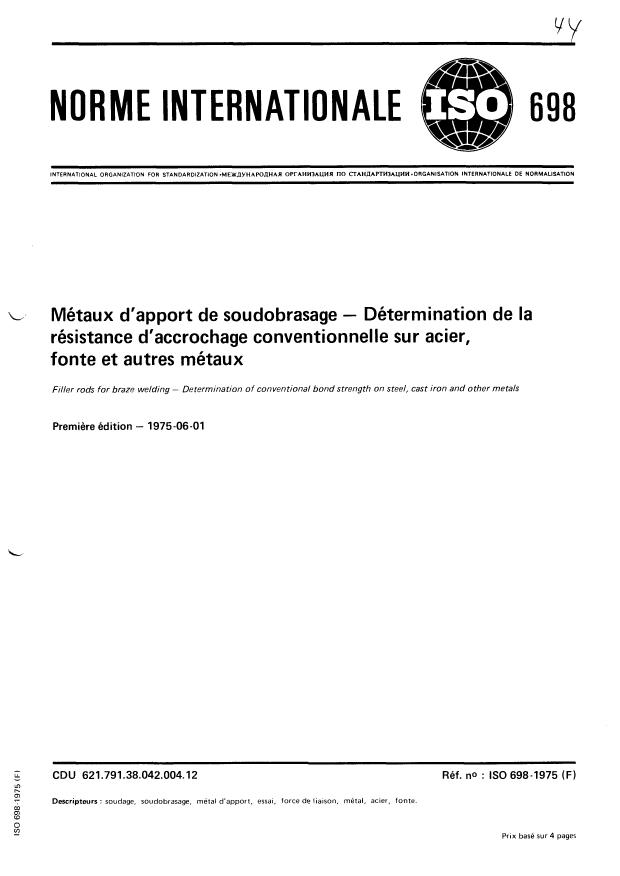
Métaux d'apport de soudobrasage — Détermination de la résistance d'accrochage conventionnelle sur acier, fonte et autres métaux
General Information
- Status
- Withdrawn
- Publication Date
- 31-May-1975
- Withdrawal Date
- 31-May-1975
- Technical Committee
- ISO/TC 44/SC 3 - Welding consumables
- Drafting Committee
- ISO/TC 44/SC 3 - Welding consumables
- Current Stage
- 9599 - Withdrawal of International Standard
- Start Date
- 12-Mar-1998
- Completion Date
- 12-Feb-2026
ISO 698:1975 - Filler rods for braze welding -- Determination of conventional bond strength on steel, cast iron and other metals
ISO 698:1975 - Métaux d'apport de soudobrasage -- Détermination de la résistance d'accrochage conventionnelle sur acier, fonte et autres métaux
Get Certified
Connect with accredited certification bodies for this standard

National Aerospace and Defense Contractors Accreditation Program (NADCAP)
Global cooperative program for special process quality in aerospace.
CARES (UK Certification Authority for Reinforcing Steels)
UK certification for reinforcing steels and construction.
DVS-ZERT GmbH
German welding certification society.
Sponsored listings
Frequently Asked Questions
ISO 698:1975 is a standard published by the International Organization for Standardization (ISO). Its full title is "Filler rods for braze welding — Determination of conventional bond strength on steel, cast iron and other metals". This standard covers: Filler rods for braze welding — Determination of conventional bond strength on steel, cast iron and other metals
Filler rods for braze welding — Determination of conventional bond strength on steel, cast iron and other metals
ISO 698:1975 is classified under the following ICS (International Classification for Standards) categories: 25.160.50 - Brazing and soldering. The ICS classification helps identify the subject area and facilitates finding related standards.
ISO 698:1975 is available in PDF format for immediate download after purchase. The document can be added to your cart and obtained through the secure checkout process. Digital delivery ensures instant access to the complete standard document.
Standards Content (Sample)
@ 698
INTERNATIONAL STANDARD
‘*@/e
~~
~
INTERNATIONAL ORGANIZATION FOR STANDARDIZATION .MEX.IYHAPOLlHAII OPI 4HM3AUMR no CTAHLlAPTMSAUMM .ORGANISATION INTERNATIONALE DE NORMALISATION
Filler rods for braze welding - Determination of
conventional bond strength on steel, cast iron and
other metals
Métaux d‘apport de soudobrasage - Détermination de la résistance d‘accrochage
conventionnelle sur acier, fonte et autres métaux
First edition - 1975-06-01
UDC 621.791.38.042.004.12 Ref. No. IS0 698-1975 (E)
Descriptors : welding, braze welding, filler metal, tests, bonding strength, metals, steel, cast iron
Price based on 4 pages
FOREWORD
IS0 (the International Organization for Standardization) is a worldwide federation
of national standards institutes (IS0 Member Bodies). The work of developing
International Standards is carried out through IS0 Technical Committees. Every
Member Body interested in a subject for which a Technical Committee has been set
up has the right to be represented on that Committee. International organizations,
governmental and non-governmental, in liaison with ISO, also take part in the work.
Draft International Standards adopted by the Technical Committees are circulated
to the Member Bodies for approval before their acceptance as International
Standards by the IS0 Council.
Prior to 1972, the results of the work of the Technical Committees were published
as IS0 Recommendations; these documents are now in the process of being
transformed into International Standards. As part of this process, Technical
Committee ISOTTC44 has reviewed IS0 Recommendation R 698 and found it
technically suitable for transformation. International Standard IS0 698 therefore
replaces IS0 Recommendation R 698-1968 to which it is technically identical.
IS0 Recommendation R 698 was approved by the Member Bodies of the following
countries :
Romania
Austr a I i a India
Spain
Austria Ireland
Sweden
Brazil Israel
Switzerland
Canada Italy
Chile United Kingdom
Japan
U.S.S. R.
Denmark Netherlands
New Zealand Yugoslavia
Egypt, Arab Rep. of
France Portuga I
The Member Bodies of the following countries expressed disapproval of the
Recommendation on technical grounds :
Belgium
Germany
South Africa, Rep of
U.S.A.
The Member Body of the following country disapproved the transformation of
ISO/R 698 into an International Standard :
Germany
O International Organization for Standardization, 1975
Printed in Switzerland
IS0 698-1975 (E)
I NTE RNATl ON AL STANDARD
Filler rods for braze welding - Determination of
conventional bond strength on steel, cast iron and
other metals
4.1.1.2 The plates shall be of mild steel. The faces of the
O INTRODUCTION
bevel, which shall be smooth, as well as the immediately
This International Standard is a companion to IS0 688,
surrounding areas (over a width of 10 to 15 mm), shall be
Filler rods for braze welding - Determination of
cleaned of oxide and other surface contamination and
characteristics of deposited metal.
degreased before assembly.
L
4.1.2 Operating conditions
SCOPE AND FIELD OF APPLICATION
This International Standard specifies methods of test for
4.1.2.1 The thickness of the plates and the operating
filler rods for braze welding, to determine the conventional
conditions shall be as specified in table 1, according to the
bond strength on
diameter of the filler rod').
- steel,
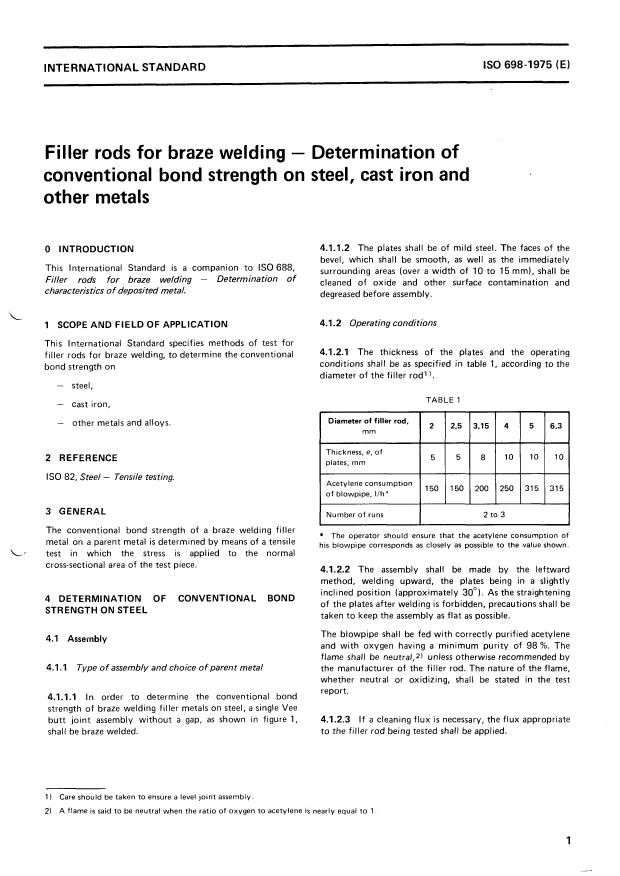
TABLE 1
- cast iron,
Diameter of filler rod,
- other metals and alloys.
2 2.5 3.15 4 5 6,3
mm
Thickness, e, of
5 8 10 10 10
2 REFERENCE
plates, mm
IS0 82, Steel - Tensile testing.
Acetylene consumption
150 150 200 250 315 315
of blowpipe. I/h*
3 GENERAL
Number of runs 2 to 3
I
The conventional bond strength of a braze welding filler
The operator should ensure that the acetylene consumption of
metal on a parent metal is determined by means of a tensile
his blowpipe corresponds as closely as possible to the value shown.
L- test in which the stress is applied to the normal
cross-sectional area of the test piece.
4.1.2.2 The assembly shall be made by the leftward
method, welding upward, the plates being in a slightly
inclined position (approximately 30'). As the straightening
4 DETERMINATION OF CONVENTIONAL BOND
of the plates after welding is forbidden, precautions shall be
STRENGTH ON STEEL
taken to keep the assembly as flat as possible.
The blowpipe shall be fed with correctly purified acetylene
4.1 Assembly
and with oxygen having a minimum purity of 98%. The
flame shall be neutral,z) unless otherwise recommended by
4.1 .I Type of assembly and choice of parent metal
the manufacturer of the filler rod. The nature of the flame,
whether neutral or oxidizing, shall be stated in the test
report.
4.1.1.1 In order to determine the conventional bond
strength of braze welding filler metals on steel, a single Vee
4.1.2.3 If a cleaning flux is necessary, the flux appropriate
butt joint assembl
...
NORME INTERNATIONALE 698
INTERNATIONAL ORGANIZATION FOR STANDARDIZATION .MEXflYHAPOflHAR OPFAHMJAUMR ii0 ITAHflAPTIIJAUMH .ORGANISATION INTERNATIONALE DE NORMALISATION
L
Métaux d'apport de soudobrasage - Détermination de la
résistance d'accrochage conventionnelle sur acier,
fonte et autres métaux
Filler rods for braze welding - Determination of conventional bond strength on steel, cast iron and other metals
Première édition - 1975-06-01
CDU 621.791.38.042.004.12 Réf. no : IS0 698-1975 (FI
Descripteurs : soudage, soudobrasage, métal d'apport, essai, force de liaison, métal, acier, fonte.
CO
m
(D
s
Prix base sur 4 pages
AVANT-PROPOS
L'ISO (Organisation Internationale de Normalisation) est une fédération mondiale
d'organismes nationaux de normalisation (Comités Membres ISO). L'élaboration de
Normes Internationales est confiée aux Comités Techniques ISO. Chaque Comité
Membre intéressé par une étude a le droit de faire partie du Comité Technique
Les organisations internationales, gouvernementales et non
correspondant.
gouvernementales, en liaison avec I'ISO, participent également aux travaux.
Les Projets de Normes Internationales adoptés par les Comités Techniques sont
soumis aux Comités Membres pour approbation, avant leur acceptation comme
Normes Internationales par le Conseil de I'ISO.
Avant 1972, les résultats des travaux des Comités Techniques étaient publiés
comme Recommandations ISO; maintenant, ces documents sont en cours de
transformation en Normes Internationales. Compte tenu de cette procédure, le
Comité Technique ISO/TC 44 a examiné la Recommandation ISO/R 698 et est
d'avis qu'elle peut, du point de vue technique, être transformée en Norme
Internationale. La présente Norme Internationale remplace donc la
Recommandation ISO/R 698-1968 à laquelle elle est techniquement identique.
La Recommandation ISO/R 698 avait été approuvée par les Comités Membres des
pays suivants :
Australie France Po rtu ga I
Autriche Inde Roumanie
Brésil Irlande
Royaume-Uni
Canada Israël Suède
Chili Italie Suisse
Danemark Japon U.R.S.S.
Egypte, Rép. Arabe à' Nouvelle-Zélande Yougoslavie
Espagne Pays-Bas
Les Comités Membres des pays suivants avaient désapprouvé la Recommandation
pour des raisons techniques :
Afrique du Sud, Rép. ci'
Al lemagne
Belgique
U.S.A.
Le Comité Membre du pays suivant a désapprouvé la transformation de la
Recommandation ISO/R 698 en Norme Internationale :
Allemagne
O Organisation Internationale de Normalisation, 1975
Imprimé en Suisse
IS0 698-1975 (F)
NORME INTERNATIONALE
Métaux d'apport de soudobrasage - Détermination de la
résistance d'accrochage conventionnelle sur acier,
et autres métaux
fonte
4.1.1.2 Les plaques doivent être en acier doux. Les faces
O INTRODUCTION
du chanfrein, qui doivent être lisses, ainsi que leurs abords
La présente Norme Internationale est associée à 1'1S0 688,
immédiats (sur une largeur de 10 a 15mm) doivent être
Métaux d'apport de soudobrasage - Détermination des
décapés (débarrassés d'oxyde et d'autres contaminations
caractéristiques du métal déposé.
superficielles) et dégraissés avant l'opération d'assemblage.
4.1.2 Conditions opératoires
1 OBJET ET DOMAINE D'APPLICATION
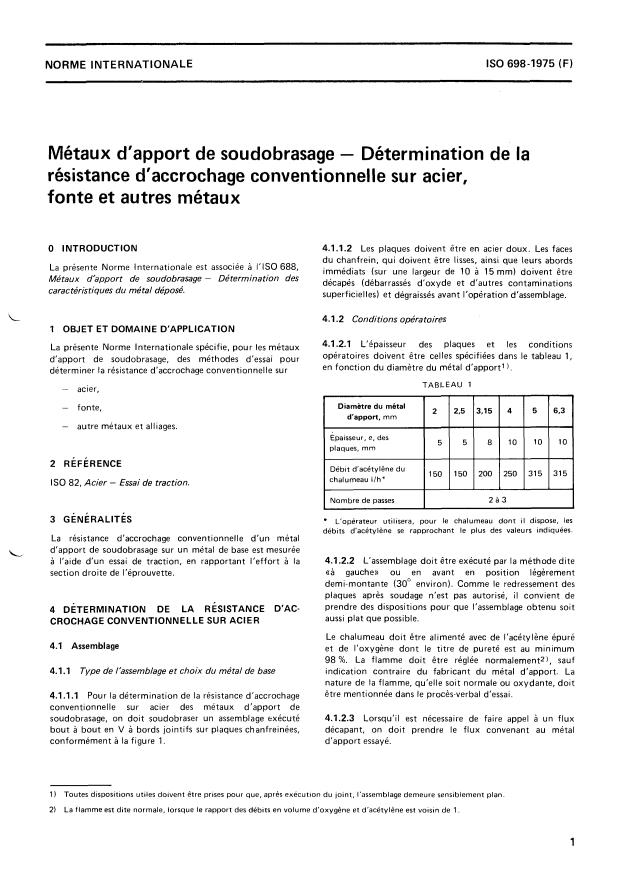
4.1.2.1 L'6paisseur des plaques et les conditions
La présente Norme Internationale spécifie, pour les métaux
opératoires doivent être celles spécifiées dans le tableau 1,
d'apport de soudobrasage, des méthodes d'essai pour
en fonction du diamètre du métal d'apport' ).
déterminer la résistance d'accrochage conventionnelle sur
TABLEAU 1
- acier,
Diamètre du métal
- fonte,
2 2,5 3.15 4 5 6.3
d'apport, mm
- autre métaux et alliages.
Epaisseur, e, des
5 8 10 10 10
plaques, mm
2 RÉFÉRENCE
Débit d'acétylène du
150 200 250 315 315
chalumeau I/h*
IS0 82, Acier - Essai de traction.
Nombre de passes 2à3
I 1
3 GÉNÉRALITÉS
L'opérateur utilisera, pour le chalumeau dont il dispose, les
debits d'acétylène se rapprochant le plus des valeurs indiquées.
La résistance d'accrochage conventionnelle d'un métal
d'apport de soudobrasage sur un métal de base est mesurée
'I,
4.1.2.2 L'assemblage doit être execute par la méthode dite
à l'aide d'un essai de traction, en rapportant l'effort à la
section droite de l'éprouvette. «à gauche)) ou en avant en position légèrement
demi-montante (30" environ). Comme le redressement des
plaques après soudage n'est pas autorisé, il convient de
prendre des dispositions pour que l'assemblage obtenu soit
4 DETERMINATION DE LA RESISTANCE D'AC-
aussi plat que possible.
CROCHAGE CONVENTIONNELLE SUR ACIER
Le chalumeau doit être alimenté avec de l'acétylène épuré
4.1 Assemblage
et de l'oxygène dont le titre de pureté est au minimum
98 %. La flamme doit être réglée normalementz), sauf
Type de l'assemblage et choix du métal de base
4.1.1 indication contraire du fabricant du métal d'apport. La
nature de la flamme, qu'elle soit normale ou oxydante, doit
le procès-verbal d'essai.
être mentionnée dans
4.1 .I .I Pour la détermination de la résistance d'accrochage
conventionnelle sur acier des métaux d'apport de
soudobrasage, on doit soudobraser un assemblage exécuté 4.1.2.3 Lorsqu'il est nécessaire de faire appel à un flux
bout à bout en V a bords jointifs sur plaques chanfreinées, décapant, on doit prendre le flux convenant au métal
conformément à la figure 1. d'apport essayé.
Toutes dispositions utiles doivent être prises pour que, après execution du joint, l'assemblage demeure sensiblement plan
1 )
La flamme est dite normale, lorsque le rapport de
...
Questions, Comments and Discussion
Ask us and Technical Secretary will try to provide an answer. You can facilitate discussion about the standard in here.
Loading comments...