


ISO 10825:1995
(Main)Gears — Wear and damage to gear teeth — Terminology
Gears — Wear and damage to gear teeth — Terminology
Defines terms used to describe the appearance of the visible surfaces of tooth flanks or the damage that can be observed on gears. Causes and preventive measures are not discussed.
Engrenages — Usure et défauts des dentures — Terminologie
Zobniki - Obraba in okvare zobnih zob - Terminologija
General Information
- Status
- Withdrawn
- Publication Date
- 16-Aug-1995
- Technical Committee
- ISO/TC 60/SC 1 - Nomenclature and wormgearing
- Drafting Committee
- ISO/TC 60/SC 1/WG 4 - Terminology and notation of gears
- Current Stage
- 9599 - Withdrawal of International Standard
- Start Date
- 05-Oct-2022
- Completion Date
- 12-Feb-2026
Relations
- Revised
ISO 10825-1:2022 - Gears — Wear and damage to gear teeth — Part 1: Nomenclature and characteristics - Effective Date
- 23-Apr-2020
- Revised
ISO/TR 10825-2:2022 - Gears — Wear and damage to gear teeth — Part 2: Supplementary information - Effective Date
- 23-Apr-2020

Frequently Asked Questions
ISO 10825:1995 is a standard published by the International Organization for Standardization (ISO). Its full title is "Gears — Wear and damage to gear teeth — Terminology". This standard covers: Defines terms used to describe the appearance of the visible surfaces of tooth flanks or the damage that can be observed on gears. Causes and preventive measures are not discussed.
Defines terms used to describe the appearance of the visible surfaces of tooth flanks or the damage that can be observed on gears. Causes and preventive measures are not discussed.
ISO 10825:1995 is classified under the following ICS (International Classification for Standards) categories: 01.040.21 - Mechanical systems and components for general use (Vocabularies); 21.200 - Gears. The ICS classification helps identify the subject area and facilitates finding related standards.
ISO 10825:1995 has the following relationships with other standards: It is inter standard links to ISO 10825-1:2022, ISO/TR 10825-2:2022. Understanding these relationships helps ensure you are using the most current and applicable version of the standard.
ISO 10825:1995 is available in PDF format for immediate download after purchase. The document can be added to your cart and obtained through the secure checkout process. Digital delivery ensures instant access to the complete standard document.
Standards Content (Sample)
SLOVENSKI STANDARD
01-junij-1998
Zobniki - Obraba in okvare zobnih zob - Terminologija
Gears -- Wear and damage to gear teeth -- Terminology
Engrenages -- Usure et défauts des dentures -- Terminologie
Ta slovenski standard je istoveten z: ISO 10825:1995
ICS:
01.040.21 Mehanski sistemi in deli za Mechanical systems and
splošno rabo (Slovarji) components for general use
(Vocabularies)
21.200 Gonila Gears
2003-01.Slovenski inštitut za standardizacijo. Razmnoževanje celote ali delov tega standarda ni dovoljeno.
ISO
INTERNATIONAL
STANDARD
First edition
NORME
Premikre Edition
1995-08-0 1
INTERNATIONALE
Gears - Wear and darnage to gear teeth -
Terminology
Engrenages - Usure et dbfauts des dentures -
Terminologie
Reference number
Num6ro de rkfkrence
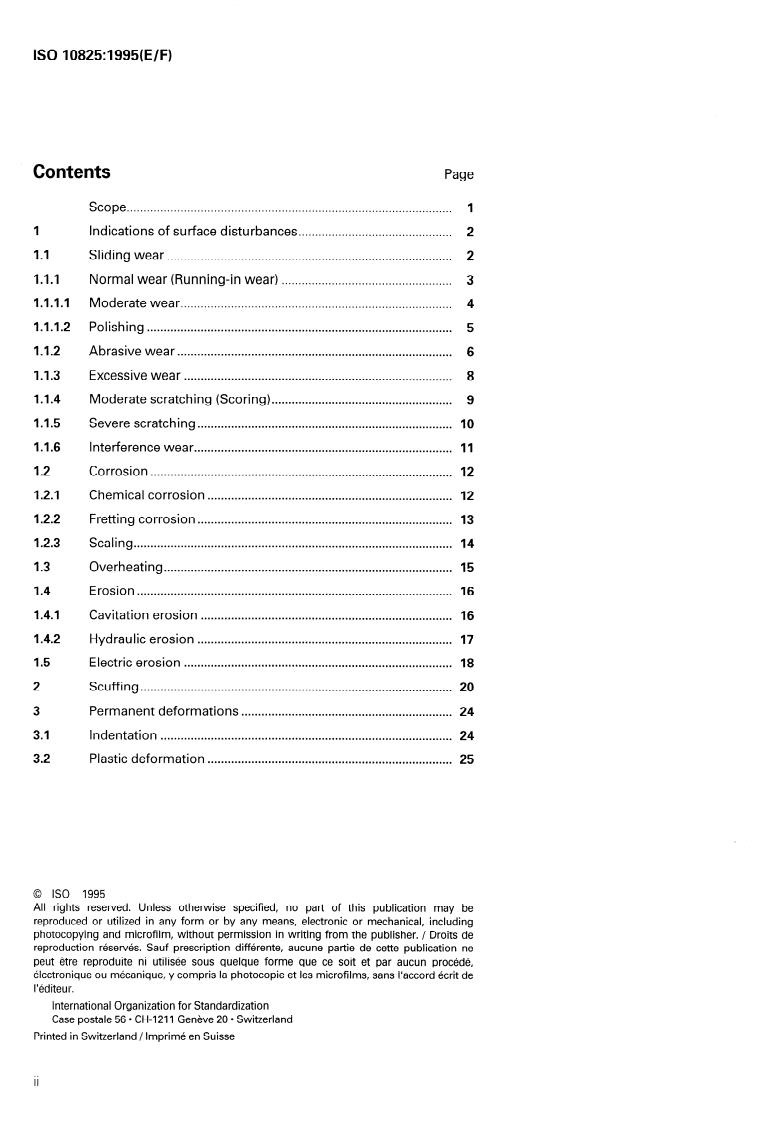
Contents Page
Scope . . . . . . . . . . . . . . . . . . . . . . . . . . . . . . . . . . . . . . . . . . . . . . . . . . . . . . . . . . . . . . . . . . . . . . . . . . . . . . . . . . . . . . . . . . . . . . . . . 1
1 Indications of surface disturbances . . . . . . . . . . . . . . . . . . . . . . . . . . . . . . . . . . . . . . . . . . . . . . 2
1.1 Sliding wear . . . . . . . . . . . . . . . . . . . . . . . . . . . . . . . .
1.1.1 Normal wear (Running-in wear
‘1
1.1.1.1 Moderate wear . . . . . . . . . . . . . . . . . . . . . . . . . . . .
1.1.1.2 Polishing . . . . . . . . . . . . . . . . . . . . . . . . . . . . . . . . . . . . . . . . . . . . . . . . . . . . . . . . . . . . . . . . . . . . . . . . . . . . . . . . . . . . . . . . . .
1.1.2 Abrasive wear . 6
1.1.3 Excessive wear . 8
1.1.4 Moderate scratching (Scoring) . 9
1.1.5 Severe scratching . 10
1.1.6 Interference wear . 11
1.2 Corrosion . 12
1.2.1 Chemical corrosion . 12
1.2.2 Fretting corrosion . 13
1.2.3 Scaling . 14
1.3 Overheating . 15
1.4 Erosion . 16
1.4.1 Cavitation erosion . 16
1.4.2 Hydraulic erosion . 17
1.5 Electric erosion . 18
2 Scuffing . 20
3 Permanent deformations . 24
3.1 Indentation . 24
3.2 Plastic deformation . 25
0 ISO 1995
All rights reserved. Unless otherwise specified, no patt of this publication may be
reproduced or utilized in any form or by any means, electronie or mechanical, including
photocopying and microfilm, without Permission in writing from the publisher. / Droits de
reproduction reserves. Sauf prescription differente, aucune Partie de cette publication ne
peut etre reproduite ni utilisee sous quelque forme que ce soit et par aucun procede,
electronique ou mecanique, y compris Ia photocopie et les microfilms, sans l ’accord ecrit de
I ’editeur.
‘International Organization for Standardization
Case postale 56 l CH-121 1 Geneve 20 l Switzerland
Printed in Switzerland / Imprime en Suisse
@ ISO
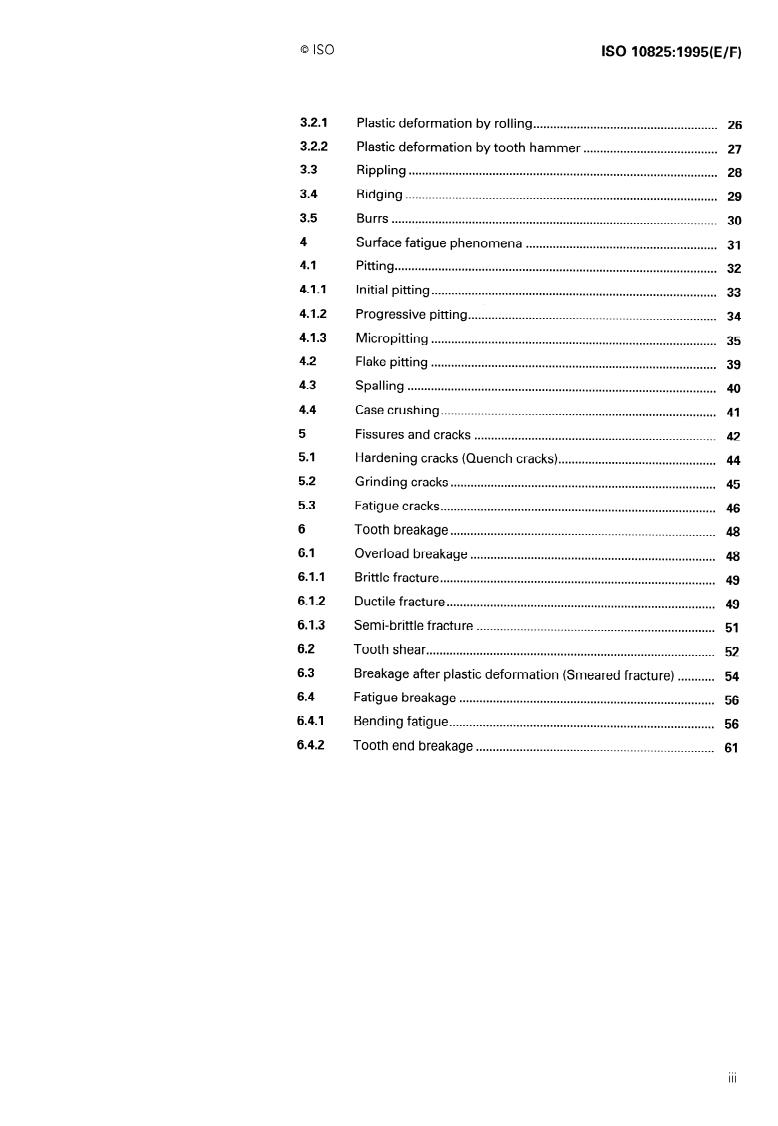
3.2.1 Plastic deformation by rolling . 26
3.2.2 Plastic deformation by tooth hammer . 27
............................................................................................
3.3 Rippling 28
.............................................................................................
3.4 Ridging 29
3.5 Bu rrs . . . . . . . . . . . . . . . . . . . . . . . . . . . . . . . . . . . . . . . . . . . . . . . . . . . . . . . . . . . . . . . . . . . . . . . . . . . . . . . . . . . . . . . . . . . . . . . . . 30
4 .
Surface fatigue phenomena 31
4.1 Pitting .
4.1.1 .
Initial pitting 33
4.1.2 Progressive pitting .
4.1.3 Micropitting .
4.2 Flake pitting .
4.3 Spalling .
4.4 . 41
Case crushing
5 . 42
Fissures and Cracks
5.1 Hardening Cracks (Quench Cracks) . 44
5.2 Grinding Cracks .
5.3 Fatigue Cracks . 46
6 Tooth breakage . 48
6.1 Overload breakage . 48
6.1.1 Brittle fracture . 49
6.1.2 Ductile fracture . 49
6.1.3 Semi-brittle fracture . 51
6.2 Tooth shear . 52
6.3 Breakage after plastic deformation (Smeared fracture) . 54
6.4 Fatigue breakage . 56
6.4.1 Bending fatigue . 56
6.4.2 Tooth end breakage . 61
@ ISO
Page
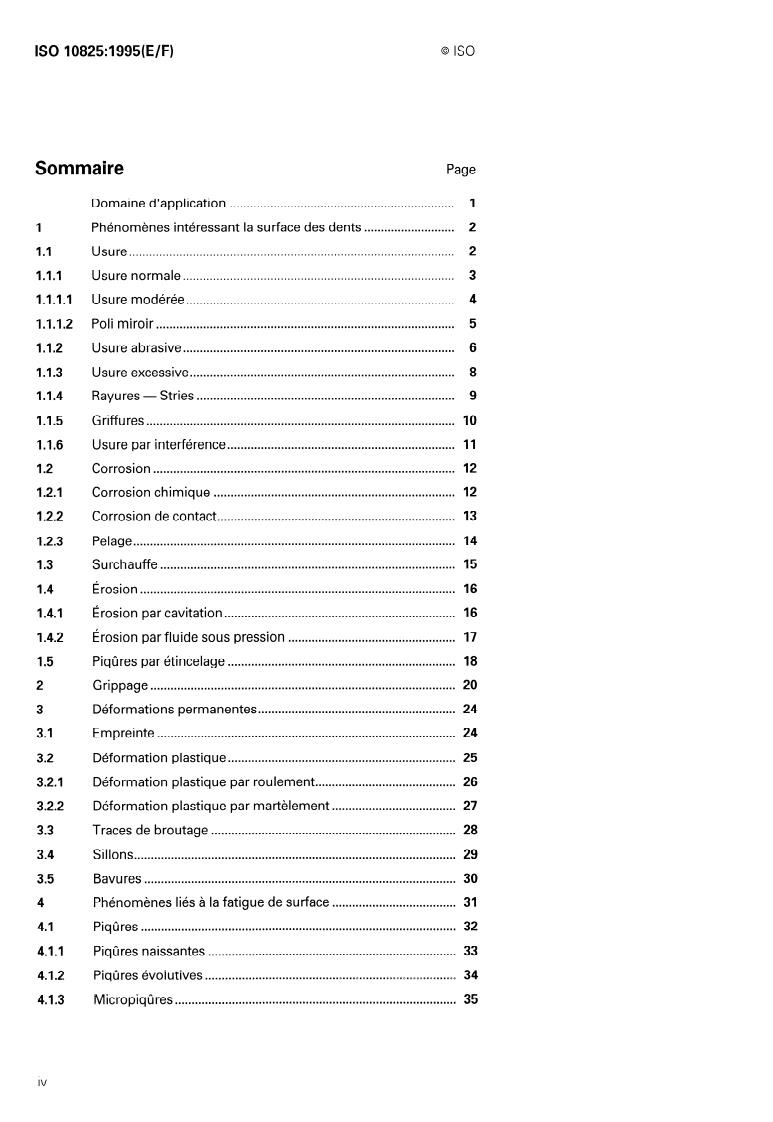
Sommaire
................................................................... 1
Domaine d ’application
........................... 2
1 Phenomenes interessant Ia surface des dents
1.1 Usure .
1.1.1 Usure normale .
................................................................................ 4
1.1.1.1 Usure moderee
......................................................................................... 5
1.1.1.2 Poli miroir
................................................................................. 6
1.1.2 Usure abrasive
............................................................................... 8
1.1.3 Usure excessive
............................................................................. 9
1.1.4 Rayures - Stries
............................................................................................ 10
1.1.5 Griffures
.................................................................... 11
1.1.6 Usure par interference
.......................................................................................... 12
1.2 Corrosion
........................................................................ 12
1.2.1 Corrosion chimique
....................................................................... 13
1.2.2 Corrosion de contact
................................................................................................
1.2.3 Pelage
........................................................................................
1.3 Surchauffe
. . . . . . . . . . . . . . . . . . . . . . . . . . . . . . . . . . . . . . . . . . . . . . . . . . . . . . . . . . . . . . . . . . . . . . . . . . . . . . . . . . . . . . . . . . . . . . 16
1.4 Erosion
.....................................................................
1.4.1 irosion par cavitation
Erosion par fluide sous Pression .
1.4.2
.................................................................... 18
1.5 Piqures par etincelage
...........................................................................................
2 Grippage
...........................................................
3 Deformations permanentes
Empreinte .
3.1
....................................................................
3.2 Deformation plastique
.......................................... 26
3.2.1 Deformation plastique par roulement
.....................................
3.2.2 Deformation plastique par martelement
......................................................................... 28
3.3 Traces de broutage
................................................................................................ 29
3.4 Sillons
............................................................................................. 30
3.5 Bavu res
..................................... 31
4 Phenomenes lies a Ia fatigue de surface
.............................................................................................. 32
4.1 Piqures
.......................................................................... 33
4.1.1 Piqures naissantes
........................................................................... 34
4.1.% Piqures evolutives
.................................................................................... 35
4.1.3 Micropiqures
iv
@ ISO
4.2 Piqures en ecailles . . . . . . . . . . . . . . . . . . . . . . . . . . . . . . . . . . . . . . . . . . . . . . . . . . . . . . . . . . . . . . . . . . . . . . . . . .
4.3 Ecaillage .
4.4
Dislocation .
Fissures et criques .
5.1
Tapure .
5.2
Criques de rectification .
5.3
Fissures de fatigue .
Rupture de dent .
6.1 Rupture par surcharge
...................................................................
6.1.1 Rupture fragile
................................................................................. 49
6.1.2 Rupture ductile
................................................................................ 49
6.1.3 Rupture semi-fragile
....................................................................... 51
6.2 Cisaillement de dent
....................................................................... 52
6.3 Rupture apres deformation plastique
......................................... 54
6.4 Rupture par fatigue .
6.4.1 Fatigue de flexion .
6.4.2 Rupture par surcharge d ’extremite de dent
............................... 61
Foreword
ISO (the International Organization for Standardization) is a worldwide
federation of national Standards bodies (ISO member bodies). The work
of preparing International Standards is normally carried out through ISO
technical committees. Esch member body interested in a subject for
which a technical committee has been established has the right to be rep-
resented on that committee. International organizations, governmental
and non-governmental, in liaison with ISO, also take patt in the work. ISO
collaborates closely with the International Electrotechnical Commission
(IEC) on all matters of electrotechnical standardization.
Draft International Standards adopted by the technical committees are
circulated to the member bodies for voting. Publication as an Inter-
national Standard requires approval by at least 75 % of the member
bodies casting a vote.
International Standard ISO 10825 was prepared by Technical Committee
PSO/TC 60, Gears, Subcommittee SC 1, Nomenclature and wormgearing.
@ ISO
Avant-propos
L ’ISO (Organisation internationale de normalisation) est une federation
mondiale d ’organismes nationaux de normalisation (comites membres
de I ’ISO). L ’elaboration des Normes internationales est en general confiee
aux comites techniques de I ’ISO. Chaque comite membre interesse par
une etude a Ie droit de faire Partie du comite technique cr& a cet effet.
Les organisations internationales, gouvernementales et non gouver-
nementales, en liaison avec I ’ISO patticipent egalement aux travaux.
L ’ISO collabore etroitement avec Ia Commission electrotechnique inter-
nationale (CEI) en ce qui concerne Ia normalisation electrotechnique.
Les projets de Normes internationales adoptes par les comites techni-
ques sont soumis aux comites membres pour vote. Leur publication
comme Normes internationales requiert I ’approbation de 75 % au moins
des comites membres votants.
La Norme internationale ISO 10825 a etc elaboree par Ie comite technique
lSO/TC 60, Engrenages, sous-comite SC 1, Nomenclature et engrenages 5
vis.
VII
This page intentionally left blank
INTERNATIONAL STANDARD
@ ISO
NORME INTERNATIONALE
Engrenages - Usure et
- Wear and darnage
Gears
to gear teeth - dbfauts des dentures -
Terminologie
Terminology
Domaine d ’application
Scope
La presente Norme internationale fixe les termes a
This International Standard defines terms used to
utiliser pour decrire les differents aspects de surface
describe the appearance of the visible sut-faces of
tooth flanks or the darnage that tan be observed on visibles sur les flancs des dents ou les differents
gears. defauts que I ’on peut observer sur les engrenages.
Un texte aussi Precis et aussi bref que possible a etc
For each term, a clear concise description of the
redige apres chaque terme pour definir chaque
relevant gear-tooth surface is given, including
mention of the significant features to be observed, aspect de denture et pour faciliter son identification
which tan facilitate identification of the type of en fixant des criteres Precis a controler ou a observer.
condition indicated.
Chaque aspect de denture classifie a etc illustre au
moins par un Cliche montrant un exemple typique
Esch description of appearance constitutes a classifi-
d ’une ou plusieurs dents concernees. Dans certains
cation of a type of condition of a gear tooth or gear-
cas, plusieurs cliches sont presentes pour Ie meme
tooth darnage. Esch description is accompanied by
type d ’aspect de dent ou de rupture montrant I ’exis-
one or more illustrations to show differentes which
tence de variantes possibles, ou les diversites
tan exist with different gear tooth geometries.
pouvant exister dans Ie cas de dentures geometri-
Comments are given with each illustration to
facilitate the interpretation. quement differentes. Tous les cliches sont accom-
pagnes de commentaires facilitant leur interpretation.
This International Standard specifies only the termin-
ology which is intended to help the recognition and La presente Norme internationale est exclusivement
repot-ting of the appearance and condition of gears une terminologie elaboree pour faciliter Ia recon-
of Operation. Neither Causes nor naissance des differents types d ’aspects des dents ou
after a period
condition described are de cassures que I ’on peut trouver en examinant un
preventive measures for any
engrenage en Service. Pour respecter ce but fixe
discussed.
initialement, elle ne donne aucune information ni sur
- The English and corresponding French texts
NOTE
les Causes possibles des phenomenes constates ni
appear in adjacent columns to enable this International
sur les remedes a appliquer eventuellement.
Standard to be used as a bilingual glossary for the
appearance of gear teeth.
NOTE - Les textes anglais et francais ont etc mis tote a
tote pour faciliter Ie passage d ’une langue a I ’autre dans Ie
This International Standard is arranged so that on the same
but de pouvoir utiliser Ia presente Norme internationale
page there are:
comme un glossaire bilingue d ’aspects de dentures
a definition of the appearance of th e gear tooth
-
d ’engrenages.
with corresponding explanations, and
La presentation du texte de Ia presente Norme inter-
- an illustration of a typica I example of each with
nationale a etc faite pour que I ’on ait sur une seule et
associated comments.
meme Page:
Ia definition de I ’aspect de denture concerne avec
les explications correspondantes;
un Cliche donnant un exemple typique de cet
aspect avec des commentaires appropries.
1 Phenomenes interessant Ia surface
1 Indications of surface disturbances
des dents
1.1 Usure
1.1 Sliding wear
Wear is a general term covering the removal of L ’usure est un terme general se rapportant au
material which occurs when two sutfaces slide on phenomene local caracterise par un enlevement
one another. de matiere du au glissement de deux surfaces
I ’une sur I ’autre.
lt includes the removal of material as a result of
the abrasive action of contaminants in the Ce terme couvre egalement I ’enlevement de
lu bricant. matiere par I ’action abrasive des impuretes pre-
sentes dans Ie lubrifiant.
Adhesive wear is also included, which is a result
of localized welding and subsequent detachment Ce terme inclut aussi I ’usure adhesive resultant de
and transfer of particles from the gear teeth. soudures localisees Provoquant des arrachements
et des transfetts de particules en provenance des
dentures.
(Pas d ’illustration)
(Not illustrated)
@ ISO
1.1.1 Normal wear (Running-in wear) 1.1.1 Usure normale
Wear begins early in the life of gearing, and the L ’usure commence tot dans Ia vie d ’un engre-
sutface texture of the machined tooth flank is nage, et Ia texture de Ia sutface des dents prend
alors un aspect lisse et souvent brillant.
reduced to a smooth often Iustrous appearance.
On distinguera dans ce type d ’usure:
Included in this type of wear are:
- moderate wear; - I ’usure moderee;
- polishing.
- Ie poli miroir.
Normal wear on the tooth flanks of a gear wheel.
Usure normale sur Ia denture d ’une roue dentee.
In the illustration, lustrous (or shiny) areas and
On constate Ia presence simultanee sur les flancs
also areas with fine grooves are visibfe on the de Parties brillantes et de Parties avec de fines
flanks. rayu res.
@ ISO
1.1.1.1 Usure modikbe
1 .l .l .l Moderate wear
L ’examen des flancs montre que du metal a etc
Examination of the flanks reveals that metal has
enleve aussi bien sur Ia saillie que dans Ie creux
been removed from both the addendum and
des dents.
dedendum tooth surfaces.
Une trace continue au niveau de Ia surface pri-
The pitch surface begins to show as a line con-
mitive de fonctionnement commence a se former.
tinuous.
Denture d ’un pignon avec usure moderee. On
Tooth surfaces of a pinion with moderate wear.
peut voir facilement Ia Position de Ia ligne
The Position of the operating pitch surface is
primitive de fonctionnement marquee sur les
clearly seen on the working flanks.
flancs actifs.
0 ISO
1.1.1.2 Polishing
1 .l .1.2 Poli miroir
This is a very slow wearing-in process in which Processus tres lent d ’usure dans lequel les
the irregularities of the contacting sutfaces are asperites des sutfaces de contact sont progres-
gradually worn until mirror-Iike, smooth surfaces sivement ecrouies jusqu ’a ce qu ’il se developpe
develop. de tres belles sutfaces lisses et brillantes.
lt tan be seen that all active tooth flanks of a bevel Aspect de poli miroir visible sur les deux flancs
pinion from an automobile differential are d ’un pignon conique de differentiel automobile.
polished.
1 .i 2
1.12 Abrasive wear Usure abrasive
Abrasion is the removal or displacement of ma- Defaut se traduisant par un enlevement ou un
terial due to the presence of hard particles (e.g. transfert de matiere provoque par Ia presence de
metallic debris, scale, rust, Sand, abrasive powder particules dures (par exemple debris metalliques,
or the like) suspended in the lubricant or embed- scories, rouille, sable, poudre abrasive ou simi-
ded in the flanks of the mating teeth. laire) en Suspension dans Ie Iubrifiant ou incrus-
tees dans les flancs des dents en contact.
Illustration of a pinion with opposite tooth flanks Exemple de pignon dont les dents ont etc usees
worn by abrasion to such an extent that the tooth par abrasion jusqu ’a devenir coupantes. La sur-
face du Profil sur les deux flancs actifs est mate et
tips are reduced to sharp edges. Active surfaces of
the flanks are smooth but radial scratches due to lisse, et on trouve les traces radiales de particules
dures qui se sont incrustees a Ia surface des
hard particles embedded in the flanks of the
dents.
mating gear are also present.
Plastic deformation is visible at the ends 0% the Des deformations plastiques sont aussi visibles a
P ’extremite des dents (voir 1.72).
teeth (see 1.72).
1.1.2 Abrasive wear (concluded)
1.1.2 Usure abrasive (fin)
Usure abrasive qui s ’est developpee sur les deux
Abrasive wear which has removed significant
flancs et qui a fait disparaitre une grande quantite
amounts of material from opposite flanks of gear
de matiere a Ia surface des dents.
teeth,,
Qn note Ia presence de profondes rayures radiales
Deep radial grooves tan be seen in the dedenda.
au niveau du creux des dents.
0 ISO
1.1.3 Excessive wear
1.1.3 Usure excessive
Excessive wear may appear similar to moderate L ’aspect d ’une usure excessive sera similaire a
or abrasive wear. The Progression rate, however, celui d ’une usure moderee ou abrasive. Toutefois,
is such that the design life of the gear set may not Ia vitesse de developpement est teile que Ia duree
be attained. The teeth will have a considerable de vie prevue ne pourra pas etre atteinte. Les
amount of material removed from the surfaces. dents auront une quantite de matiere enlevee
considerable.
Excessive wear by the abrasion of opposite flanks Pignon avec une usure excessive sur les deux
of pinion teeth. flancs obtenue par abrasion.
NO-I-E - Excessive wear tan als0 be caused by NO-E - Une usure excessive peut aussi etre causee
polishing after tooth geometry has been extensively par du poli miroir lorsque Ia geomktrie des dents a et6
changed. dbformke dans de trop grandes proportions.
@ ISO
Rayures - Stries
1 .1.4
1 .1.4 Moderate scratching (Scoring)
Fins sillons orientes dans Ie sens du glissement,
Fine grooves, running in the direction of sliding
irregulierement espaces, de longueurs variables et
motion, irregularly spaced and of varying length,
qui sont souvent clairsemes sur les flancs des
and often scattered over the tooth flanks.
dents.
Fines rayures visibles pres du sommet des dents
Fine grooves visible near the tip on the tooth
d ’un pignon rectifie. Dans ce cas, les rayures sont
surfaces of a ground pinion. In this case, the
reparties regulierement sur toutes les dents. Voir
scratches are distributed regularly on all the teeth.
aussi Ie Cliche en 1 .l .l.
See also the illustration in 1 .l .l.
Des traces de rectification sont visibles au bas des
Note the presence of grinding marks on the
flancs.
dedendum flank.
0 ISO
1.15 Griffures
1 .1.5 Severe scratching
A form of abrasive wear characterized by the Forme d ’usure abrasive caracterisee par Ia pre-
presence of linear grooves in the direction of tooth sence de rayures Iineaires orientees dans Ia
sliding. The grooves are smooth, similar in direction du glissement. Ces rayures sont lisses et
appearance to those formed by “ridging” (see sont d ’aspect semblable a celui des «sillons» (voir
3.4), but are created by the ploughing action of 3.4) mais elles sont dues au labourage des dents
hard asperities on mating flanks or by hard par des asperites dures se trouvant dans
particles embedded therein. I ’engrenement ou par des particules qui sont
incrustees dans les flancs.
Severe scratching of the entire contact surface. Griffures presentes dans toute Ia Zone de contact.
Wear is less severe near the operating pitch On note une usure beaucoup plus faible au niveau
surface. Another type sf severe scratching is du cylindre primitif de fonctionnement. Une autre
shown in the illustration in 1.1.2. forme de griffure est visibfe sur Ie Cliche de 1.1.2.
@ ISO
1 .1.6 Intetference wear 1 .1.6 Usure par interkrence
Usure en tete de saillie des dents de I ’une des
Wear at the tip of one tooth and/or at the root of
the mating tooth, caused by excess material at the roues et/ou au pied des dents de I ’autre, due a un
tips of one or at the roots of the other. exc& de matiere en tete de saillie des dents de
I ’une ou au pied des dents de I ’autre.
The result is scraping and wear of both roots and
Elle se traduit par des ecorchures ou par une
tips of the teeth, hollowing the former and round-
abrasion des pieds des flancs en les evidant, ainsi
ing the latter.
que par une abrasion ou une deformation des
tetes de dents en les arrondissant.
Usure par interference nettement visible au pied
Interference wear at a tooth flank of a gear wheel.
des flancs d ’une roue.
1.2 Corrosion 1.2 Corrosion
1.2.1 Chemical corrosion 1.2.1 Corrosion chimique
Surface degradation caused by Chemical attack. Degradation de surface due a une attaque chi-
Common Symptoms are fine pitting over the mique. Les Symptomes habituels sont de fines
entire tooth surface and grain boundary Oxidation. piqures sur Ia surface entiere des dents et une
Sometimes, reddish brown rust traces are found, Oxydation intergranulaire. Parfois, des traces de
usually near active Parts of the tooth flanks. rouille brun rouge, en general pres des Parties
actives des flancs des dents, sont visibles.
Extensive corrosion on gear tooth surfaces as a Corrosion importante sur Ia surface des dents
result of Chemical attack. d ’une roue qui resulte d ’une attaque chimique.
Darnage of this nature tan continue until the gear Une degradation de cette nature peut continuer
is no longer fit for use. jusqu ’a ce que Ia surface des dents soit devenue
completement i’nutilisable.
@ ISO ISO 10825:1995(E/F)
1.2.2 Fretting corrosion 1.2.2 Corrosion de contact
Sut-face darnage caused by repeated small move- Defaut superficiel Cause par de Petits mouve-
ments of one contacting surface over another ments repetes d ’une surface au contact d ’une
autre avec pour resultat Ia production de fines
which results in the production of finely divided
reddish brown Oxide particles. particules d ’oxyde brun rouge.
These are retained in the contact region and their Celles-ci restent dans Ia region du contact et leur
abrasive action adds to the rate of surface deterio- action abrasive fait progresser Ia deterioration des
ration. sut-faces.
Stationary gears may be thus affected if they are Des engrenages a I ’arret peuvent etre affectes de
su bjected to structure-borne vibrations such as cette maniere s ’ils sont soumis a des vibrations
those encountered during transport. prenant naissance au niveau des structures envi-
ronnantes comme c ’est Ie cas durant Ie transport
de materiels.
Fretting corrosion present on the flanks of the Corrosion de contact qui s ’est developpee sur les
flancs de Ia denture interieure d ’un accouplement
internal gear of a gear coupling.
a dentures.
@ ISO
1.2.3 Scaling 1.2.3 Pelage
Patchy, raised areas on tooth flanks, due to an Zones inegalement en relief sur les flancs de
Oxidation process during heat treatment. When dents, et qui sont dues a un processus d ’oxy-
running under load, the power is transmitted dation Pendant Ie traitement thermique. En
initially by way of these projections which rapidly fonctionnement sous Charge, Ia puissance est
acquire a metallic sheen. d ’abord transmise par ces Parties en saillie, de
Sorte que les zones en question prennent
rapidement un aspect de metal brillant.
Scaling on the teeth of a helical pinion. Traces de pelage sur les dents d ’un pignon
helico*idaI.
@ ISO ISO 10825:1995(E/F)
1.3 Overheating
1.3 Surchauffe
The gears resch an excessively high temperature, Se rencontre sur des engrenages travaillant a une
usually due to inadequate lubrication or insuf- temperature excessive due, en general, a une
ficient backlash. In the Iatter case, evidente of mauvaise lubrification ou a un jeu insuffisant.
heavy loading will be found on both working and Dans ce dernier cas, on verra des traces de
non-working flanks. Temper colours are present surcharge sur les deux flancs des dents (travaillant
and frequently scuffed areas and plastic defor- ou non). On trouvera toutes les couleurs de Ia
trempe et frequemment des zones grippees ainsi
mation are also found.
que des deformations plastiques.
Overheating on the active flank of a gear tooth
due to sudden and severe overload during
running.
Traces de surchauffe sur Ie flanc actif d ’une dent
apparues en Service a Ia Suite d ’une surcharge
brutale et instantanee.
@ ISO
1.4 Erosion
1.4 Erosion
1.2.1 Erosion par cavitation
1.4.1 Cavitation erosion
On rencontre sur les flancs de toutes les dents un
The flanks of all teeth reveal uniformly distributed,
decapage localise uniformement distribue; alter-
localized scoring; alternatively, the entire surface
nativement, Ia surface entiere des flancs de dents
of the tooth flanks appears as if sandblasted.
apparait comme si elle avait etc grenaillee.
This wear process may occur when high-
Ce processus d ’usure peut se produire en pre-
frequency vibrations are present or when the
sence de vibrations a haute frequence ou Iorsque
lubricant is contamined with entrained water, air
Ie Iubrifiant est pollue par de l’eau, de I ’air ou
and/or other gases.
d ’autres gaz en Suspension.
Cavitation erosion on the flanks of the teeth of a Erosion par cavitation sur les flancs des dents
d ’une roue.
gear wheel.
1.4.2 Erosion par fluide sous Pression
1.4.2 Hydraulic erosion
Erosion due a I ’action d ’un jet de liquide ou d ’un
Erosion due to the action of a jet of liquid or a
liquide contenant de I ’air ou de fines particules.
liquid containing air or fine particles.
Erosion pres des sommets des dents d ’une roue
Hydraulic erosion near the tip of the flanks of a
((grande vitesse» causee par Ia projection d ’huile
gear wheel running at high Speed.
sous Pression.
The erosion is in line with lubricant Spray nozzles.
L ’erosion est localisee en face des buses d ’in-
jection du Pu brifiant.
@ ISO
1.5 Electric erosion 1.5 Piqures par btincelage
The discharge of electric arcs or Sparks between Petits crateres aux bords emousses produits par
mating flanks produces numerous small, smooth des decharges d ’arcs electriques entre les flancs
edged craters in gear teeth. de dents conjugues en cours d ’engrenement.
Occasionally, larger burned areas exhibiting tem- Occasionnellement, on peut trouver des zones
per colours at their margins are to be found. brulees plus vastes, dont Ie pourtour est irise.
Electric erosion due to the passage of a small Piqures par etincelage dues a un passage de
electric current. courant de faible intensite,
@ ISO
r
1.5 PiqCires par btincelage (fin)
1.5 Electric erosion (concluded)
Foisonnement de piqfires par ktincelage dues 5
Severe electric erosion due to the passage sf an
un passage de courant de haute intensitk
electric current of high intensity.
2 Grippage
2 Scuffing
Rugosites en bande se developpant dans Ie sens
Banded roughness, running in the direction of
du glissement, et d ’importance variable depuis Ie
sliding, varying in degree from mild to severe
grippage leger jusqu ’au grippage severe. Le film
scuffing. The lubricant film between the tooth
de lubrifiant entre les surfaces en contact est
flanks is disrupted and this tan lead to localized
interrompu, et ceci peut conduire a des micro-
welding of the tooth flanks with transfer of
soudures locales sur les flancs entrainant des
material.
transferts de matiere.
Scuffing of only small areas of tooth flanks,
Les rayures qui n ’impliquent que de petites sur-
commonly at tooth tips or tooth roots, may heaY
faces, en general pt-es des pieds ou des sommets
spontaneously [see Photos a) and b)]. Severe
des flancs, peuvent s ’estomper d ’elles-memes
scuffing which covers large areas of tooth flanks
[voir Photos a) et b)]. Le grippage generalise qui
Causes an increase of noise and Vibration, leading
couvre de larges surfaces des flancs provoque un
eventually to failure unless corrective measures
accroissement du bruit et des vibrations, condui-
are taken [see Photos c) and d)].
sant eventuellement a des ruptures si des mesu-
res correctives ne sont pas mises en oeuvre [voir
Photos c) et d)].
Fines traces d ’un leger grippage visibles au
Light scuffing at tooth tips of a ground pinion.
sommet des dents d ’un pignon rectifie. Ce type de
Often this type of scuffing heals itself during a
grippage disparait souvent de lui-meme apres un
period of running under good conditions.
certain temps de fonctionnement dans de bonnes
conditions.
@ ISO
2 Grippage (Suite)
2 Scuffing (continued)
b)
Arrachements avec Egers transferts de matiere
Localized scuffing near the tooth tips of a spiral
visibles pt-es du sommet des dents d ’un pignon
bevel gear. This type of darnage is often self-
healing if the initiatinq mechanism does not recur. conique qui ont etc Causes par un grippage
.
Ilocalise. Ces traces ont tendance a disparaitre par
%a Suite si Ie phenomene qui les a provoquees ne
se reproduit pas.
2%
2 Scuffing (continued) 2 Grippage (Suite)
Severe scuffing on the teeth of a spiral bevel Grippage generalise sur les dents d ’une couronne
wheel. In some cases the occurrence of this type d ’un engrenage conique spiral. La plupart du
of darnage is followed by an increase in working temps I ’apparition de ce type de deterioration
temperature. s ’accompagne d ’une elevation de temperature de
fonctionnement.
@ ISO
2 Scuff ing (concluded)
2 Grippage (fin)
d)
Severe scuffing obsetved on pinion teeth running
Grippage skkre observk sur les dents d ’un
at low Speed and lubricated with grease.
pignon fonctionnant 5 basse vitesse et lubrifi6 A Ia
graisse.
This type of darnage is commonly called “cold
scuffing ”.
Ce type d ’endommagement est commurkment
appel6 ((grippage 5 froid».
3 Permanent deformations 3 Dbformations permanentes
3.1 Indentation 3.1 Empreinte
Depressions in tooth flanks caused by passage Creux dans les flancs de dents Causes par Ie
through a mesh of foreign bodies. passage dans I ’engrenement d ’un Corps etranger.
Indentations in several teeth of a pinion, caused Empreintes sur plusieurs dents d ’un pignon cau-
by passage through a mesh of metal patticles. sees par Ie passage dans I ’engrenement de mor-
ceaux de metal.
@ ISO
3.2 Plastic deformation 3.2 Deformation plastique
Deformation remaining after the removal of the Deformation subsistant apres Ia suppression de Ia
applied load. Teeth may be bent, swaged by tooth Charge. Les dents peuvent etre flechies, defor-
hammer, or sutface material may be displaced by mees par Ie martelage des dents, ou on peut
the roIling/sliding action of gears operating under constater des deplacements de matiere provo-
excessively high load and friction. ques par I ’action combinee de roulement/
glissement Pendant I ’engrenement qui s ’effectue
sous des charges et avec des frottements trop
eleves.
(Not illustrated)
(Pas d ’illustration)
3.2.1 Plastic deformation by rolling 3.2.1 Deformation plastique par roulement
In this case, material is displaced from the pitch Dans ce cas, Ia matiere est deplacee du cylindre
primitif de Ia roue menante vers Ia racine et Ie
cylinder of the driving gear towards the root and
sommet des dents, ou une bavure peut souvent
the tooth tips where a burr is often found. The
etre trouvee. La matiere correspondante de Ia
corresponding material of the driven gear is
roue menee est deplacee vers Ie primitif. C ’est
displaced towards the pitch cylinder. Thus a
ainsi qu ’il se forme un sillon sur Ie flanc de Ia roue
groove is created in the tooth flank of the driver
menante et une arete correspondante sur Ia dent
and a corresponding ridge on the tooth of the
driven gear. de Ia roue menee.
Plastic deformation of teeth by rolling. This was a Deformations plastiques par roulement de dents
driven wheel and the presence of a pronounced d ’engrenage. Cette roue est menee car on peut
ridge near the operating pitch sut-face tan be voir facilement Ia presence d ’une arete vive im-
clearly Seen. portante au niveau du cylindre primitif de fonc-
tionnement.
@ ISO
3.2.2 Deformation plastique par martklement
3.2.2 Plastic deformation by tooth hammer
On reconnait facilement de telles deformations
Evidente of such deformation tan easily be seen
par Ia presence sur les flancs de sillons peu pro-
as shallow grooves on flanks. The grooves co-
fonds. Ces sillons coincident avec les lignes de
incide with the lines of contact between mating
contact qui s ’etablissent au cours de I ’engrene-
gear teeth.
ment des dents.
Plastic deformation by tooth hammer of the
Deformation plastique par mattelement des flancs
working flanks of an internal gear annulus. A
actifs d ’une couronne a denture interieure. On
pronounced burr has been formed at the tooth
remarque Ia formation d ’une importante bavure
tips.
au sommet des dents.
@ ISO
3.3 Traces de broutage
3.3 Rippling
Petites rides s ’etendant sur les flancs des dents,
Minute ridges running perpendicular to the direc-
perpendiculairement a Ia direction du glissement.
tion of sliding are to be found on tooth flanks. The
Ces rides sont ondulees plutot que droites, et leur
ridges themselves are wavy rather than straight
aspect general est semblable a celui provoque par
and the Overall appearance is similar to that of
I ’action du vent ou de I ’eau sur de Ia boue ou du
sand or mud which has been disturbed by wind or
sable mais a tres petite echelle.
water, but on a much smaller scale.
Pignon cemente trempe avec des traces de brou-
Illustration of a pinion showing rippling near the
tage sur Ia Partie droite des dents qui est Ia plus
right ends of the teeth where tooth loading was
chargee. Dans ce cas, I ’apparition du broutage est
heaviest. In this case, the formation of rippling has
survenue sur Ia surface des flancs apres Ie poli
occurred after high polishing on the flanks.
miroir.
@ ISO ISO 10825:1995(E/F)
3.4 Ridging 3.4 Sillons
The formation of pronounced ridges and grooves Formation de bourrelets et de creux par ecrou-
by plastic deformation, and sometimes wear, on issage et parfois par usure abrasive sur les flancs
the flanks of gear teeth. This form of darnage is de dents. On rencontre ce type de defaut surtout
most frequently found on the teeth of slow-Speed sur les dents d ’engrenages lents qui ont une
gears which have a significant sliding component importante composante de glissement dans Ia
in the direction of the lines of tooth contact (e.g. direction des lignes de contact, par exemple sur
worm and hypoid gears). lt occurs on low- les engrenages a reue et a vis et sur les engre-
hardness materials. lt may also occur on high- nages hypoides. Ce defaut se produit avec des
hardness materials if the contact Stresses are high, materiaux a faible durete. II arrive aussi avec des
such as those in the case-hardened hypoid gears ma
...
ISO
INTERNATIONAL
STANDARD
First edition
NORME
Premikre Edition
1995-08-0 1
INTERNATIONALE
Gears - Wear and darnage to gear teeth -
Terminology
Engrenages - Usure et dbfauts des dentures -
Terminologie
Reference number
Num6ro de rkfkrence
Contents Page
Scope . . . . . . . . . . . . . . . . . . . . . . . . . . . . . . . . . . . . . . . . . . . . . . . . . . . . . . . . . . . . . . . . . . . . . . . . . . . . . . . . . . . . . . . . . . . . . . . . . 1
1 Indications of surface disturbances . . . . . . . . . . . . . . . . . . . . . . . . . . . . . . . . . . . . . . . . . . . . . . 2
1.1 Sliding wear . . . . . . . . . . . . . . . . . . . . . . . . . . . . . . . .
1.1.1 Normal wear (Running-in wear
‘1
1.1.1.1 Moderate wear . . . . . . . . . . . . . . . . . . . . . . . . . . . .
1.1.1.2 Polishing . . . . . . . . . . . . . . . . . . . . . . . . . . . . . . . . . . . . . . . . . . . . . . . . . . . . . . . . . . . . . . . . . . . . . . . . . . . . . . . . . . . . . . . . . .
1.1.2 Abrasive wear . 6
1.1.3 Excessive wear . 8
1.1.4 Moderate scratching (Scoring) . 9
1.1.5 Severe scratching . 10
1.1.6 Interference wear . 11
1.2 Corrosion . 12
1.2.1 Chemical corrosion . 12
1.2.2 Fretting corrosion . 13
1.2.3 Scaling . 14
1.3 Overheating . 15
1.4 Erosion . 16
1.4.1 Cavitation erosion . 16
1.4.2 Hydraulic erosion . 17
1.5 Electric erosion . 18
2 Scuffing . 20
3 Permanent deformations . 24
3.1 Indentation . 24
3.2 Plastic deformation . 25
0 ISO 1995
All rights reserved. Unless otherwise specified, no patt of this publication may be
reproduced or utilized in any form or by any means, electronie or mechanical, including
photocopying and microfilm, without Permission in writing from the publisher. / Droits de
reproduction reserves. Sauf prescription differente, aucune Partie de cette publication ne
peut etre reproduite ni utilisee sous quelque forme que ce soit et par aucun procede,
electronique ou mecanique, y compris Ia photocopie et les microfilms, sans l ’accord ecrit de
I ’editeur.
‘International Organization for Standardization
Case postale 56 l CH-121 1 Geneve 20 l Switzerland
Printed in Switzerland / Imprime en Suisse
@ ISO
3.2.1 Plastic deformation by rolling . 26
3.2.2 Plastic deformation by tooth hammer . 27
............................................................................................
3.3 Rippling 28
.............................................................................................
3.4 Ridging 29
3.5 Bu rrs . . . . . . . . . . . . . . . . . . . . . . . . . . . . . . . . . . . . . . . . . . . . . . . . . . . . . . . . . . . . . . . . . . . . . . . . . . . . . . . . . . . . . . . . . . . . . . . . . 30
4 .
Surface fatigue phenomena 31
4.1 Pitting .
4.1.1 .
Initial pitting 33
4.1.2 Progressive pitting .
4.1.3 Micropitting .
4.2 Flake pitting .
4.3 Spalling .
4.4 . 41
Case crushing
5 . 42
Fissures and Cracks
5.1 Hardening Cracks (Quench Cracks) . 44
5.2 Grinding Cracks .
5.3 Fatigue Cracks . 46
6 Tooth breakage . 48
6.1 Overload breakage . 48
6.1.1 Brittle fracture . 49
6.1.2 Ductile fracture . 49
6.1.3 Semi-brittle fracture . 51
6.2 Tooth shear . 52
6.3 Breakage after plastic deformation (Smeared fracture) . 54
6.4 Fatigue breakage . 56
6.4.1 Bending fatigue . 56
6.4.2 Tooth end breakage . 61
@ ISO
Page
Sommaire
................................................................... 1
Domaine d ’application
........................... 2
1 Phenomenes interessant Ia surface des dents
1.1 Usure .
1.1.1 Usure normale .
................................................................................ 4
1.1.1.1 Usure moderee
......................................................................................... 5
1.1.1.2 Poli miroir
................................................................................. 6
1.1.2 Usure abrasive
............................................................................... 8
1.1.3 Usure excessive
............................................................................. 9
1.1.4 Rayures - Stries
............................................................................................ 10
1.1.5 Griffures
.................................................................... 11
1.1.6 Usure par interference
.......................................................................................... 12
1.2 Corrosion
........................................................................ 12
1.2.1 Corrosion chimique
....................................................................... 13
1.2.2 Corrosion de contact
................................................................................................
1.2.3 Pelage
........................................................................................
1.3 Surchauffe
. . . . . . . . . . . . . . . . . . . . . . . . . . . . . . . . . . . . . . . . . . . . . . . . . . . . . . . . . . . . . . . . . . . . . . . . . . . . . . . . . . . . . . . . . . . . . . 16
1.4 Erosion
.....................................................................
1.4.1 irosion par cavitation
Erosion par fluide sous Pression .
1.4.2
.................................................................... 18
1.5 Piqures par etincelage
...........................................................................................
2 Grippage
...........................................................
3 Deformations permanentes
Empreinte .
3.1
....................................................................
3.2 Deformation plastique
.......................................... 26
3.2.1 Deformation plastique par roulement
.....................................
3.2.2 Deformation plastique par martelement
......................................................................... 28
3.3 Traces de broutage
................................................................................................ 29
3.4 Sillons
............................................................................................. 30
3.5 Bavu res
..................................... 31
4 Phenomenes lies a Ia fatigue de surface
.............................................................................................. 32
4.1 Piqures
.......................................................................... 33
4.1.1 Piqures naissantes
........................................................................... 34
4.1.% Piqures evolutives
.................................................................................... 35
4.1.3 Micropiqures
iv
@ ISO
4.2 Piqures en ecailles . . . . . . . . . . . . . . . . . . . . . . . . . . . . . . . . . . . . . . . . . . . . . . . . . . . . . . . . . . . . . . . . . . . . . . . . . .
4.3 Ecaillage .
4.4
Dislocation .
Fissures et criques .
5.1
Tapure .
5.2
Criques de rectification .
5.3
Fissures de fatigue .
Rupture de dent .
6.1 Rupture par surcharge
...................................................................
6.1.1 Rupture fragile
................................................................................. 49
6.1.2 Rupture ductile
................................................................................ 49
6.1.3 Rupture semi-fragile
....................................................................... 51
6.2 Cisaillement de dent
....................................................................... 52
6.3 Rupture apres deformation plastique
......................................... 54
6.4 Rupture par fatigue .
6.4.1 Fatigue de flexion .
6.4.2 Rupture par surcharge d ’extremite de dent
............................... 61
Foreword
ISO (the International Organization for Standardization) is a worldwide
federation of national Standards bodies (ISO member bodies). The work
of preparing International Standards is normally carried out through ISO
technical committees. Esch member body interested in a subject for
which a technical committee has been established has the right to be rep-
resented on that committee. International organizations, governmental
and non-governmental, in liaison with ISO, also take patt in the work. ISO
collaborates closely with the International Electrotechnical Commission
(IEC) on all matters of electrotechnical standardization.
Draft International Standards adopted by the technical committees are
circulated to the member bodies for voting. Publication as an Inter-
national Standard requires approval by at least 75 % of the member
bodies casting a vote.
International Standard ISO 10825 was prepared by Technical Committee
PSO/TC 60, Gears, Subcommittee SC 1, Nomenclature and wormgearing.
@ ISO
Avant-propos
L ’ISO (Organisation internationale de normalisation) est une federation
mondiale d ’organismes nationaux de normalisation (comites membres
de I ’ISO). L ’elaboration des Normes internationales est en general confiee
aux comites techniques de I ’ISO. Chaque comite membre interesse par
une etude a Ie droit de faire Partie du comite technique cr& a cet effet.
Les organisations internationales, gouvernementales et non gouver-
nementales, en liaison avec I ’ISO patticipent egalement aux travaux.
L ’ISO collabore etroitement avec Ia Commission electrotechnique inter-
nationale (CEI) en ce qui concerne Ia normalisation electrotechnique.
Les projets de Normes internationales adoptes par les comites techni-
ques sont soumis aux comites membres pour vote. Leur publication
comme Normes internationales requiert I ’approbation de 75 % au moins
des comites membres votants.
La Norme internationale ISO 10825 a etc elaboree par Ie comite technique
lSO/TC 60, Engrenages, sous-comite SC 1, Nomenclature et engrenages 5
vis.
VII
This page intentionally left blank
INTERNATIONAL STANDARD
@ ISO
NORME INTERNATIONALE
Engrenages - Usure et
- Wear and darnage
Gears
to gear teeth - dbfauts des dentures -
Terminologie
Terminology
Domaine d ’application
Scope
La presente Norme internationale fixe les termes a
This International Standard defines terms used to
utiliser pour decrire les differents aspects de surface
describe the appearance of the visible sut-faces of
tooth flanks or the darnage that tan be observed on visibles sur les flancs des dents ou les differents
gears. defauts que I ’on peut observer sur les engrenages.
Un texte aussi Precis et aussi bref que possible a etc
For each term, a clear concise description of the
redige apres chaque terme pour definir chaque
relevant gear-tooth surface is given, including
mention of the significant features to be observed, aspect de denture et pour faciliter son identification
which tan facilitate identification of the type of en fixant des criteres Precis a controler ou a observer.
condition indicated.
Chaque aspect de denture classifie a etc illustre au
moins par un Cliche montrant un exemple typique
Esch description of appearance constitutes a classifi-
d ’une ou plusieurs dents concernees. Dans certains
cation of a type of condition of a gear tooth or gear-
cas, plusieurs cliches sont presentes pour Ie meme
tooth darnage. Esch description is accompanied by
type d ’aspect de dent ou de rupture montrant I ’exis-
one or more illustrations to show differentes which
tence de variantes possibles, ou les diversites
tan exist with different gear tooth geometries.
pouvant exister dans Ie cas de dentures geometri-
Comments are given with each illustration to
facilitate the interpretation. quement differentes. Tous les cliches sont accom-
pagnes de commentaires facilitant leur interpretation.
This International Standard specifies only the termin-
ology which is intended to help the recognition and La presente Norme internationale est exclusivement
repot-ting of the appearance and condition of gears une terminologie elaboree pour faciliter Ia recon-
of Operation. Neither Causes nor naissance des differents types d ’aspects des dents ou
after a period
condition described are de cassures que I ’on peut trouver en examinant un
preventive measures for any
engrenage en Service. Pour respecter ce but fixe
discussed.
initialement, elle ne donne aucune information ni sur
- The English and corresponding French texts
NOTE
les Causes possibles des phenomenes constates ni
appear in adjacent columns to enable this International
sur les remedes a appliquer eventuellement.
Standard to be used as a bilingual glossary for the
appearance of gear teeth.
NOTE - Les textes anglais et francais ont etc mis tote a
tote pour faciliter Ie passage d ’une langue a I ’autre dans Ie
This International Standard is arranged so that on the same
but de pouvoir utiliser Ia presente Norme internationale
page there are:
comme un glossaire bilingue d ’aspects de dentures
a definition of the appearance of th e gear tooth
-
d ’engrenages.
with corresponding explanations, and
La presentation du texte de Ia presente Norme inter-
- an illustration of a typica I example of each with
nationale a etc faite pour que I ’on ait sur une seule et
associated comments.
meme Page:
Ia definition de I ’aspect de denture concerne avec
les explications correspondantes;
un Cliche donnant un exemple typique de cet
aspect avec des commentaires appropries.
1 Phenomenes interessant Ia surface
1 Indications of surface disturbances
des dents
1.1 Usure
1.1 Sliding wear
Wear is a general term covering the removal of L ’usure est un terme general se rapportant au
material which occurs when two sutfaces slide on phenomene local caracterise par un enlevement
one another. de matiere du au glissement de deux surfaces
I ’une sur I ’autre.
lt includes the removal of material as a result of
the abrasive action of contaminants in the Ce terme couvre egalement I ’enlevement de
lu bricant. matiere par I ’action abrasive des impuretes pre-
sentes dans Ie lubrifiant.
Adhesive wear is also included, which is a result
of localized welding and subsequent detachment Ce terme inclut aussi I ’usure adhesive resultant de
and transfer of particles from the gear teeth. soudures localisees Provoquant des arrachements
et des transfetts de particules en provenance des
dentures.
(Pas d ’illustration)
(Not illustrated)
@ ISO
1.1.1 Normal wear (Running-in wear) 1.1.1 Usure normale
Wear begins early in the life of gearing, and the L ’usure commence tot dans Ia vie d ’un engre-
sutface texture of the machined tooth flank is nage, et Ia texture de Ia sutface des dents prend
alors un aspect lisse et souvent brillant.
reduced to a smooth often Iustrous appearance.
On distinguera dans ce type d ’usure:
Included in this type of wear are:
- moderate wear; - I ’usure moderee;
- polishing.
- Ie poli miroir.
Normal wear on the tooth flanks of a gear wheel.
Usure normale sur Ia denture d ’une roue dentee.
In the illustration, lustrous (or shiny) areas and
On constate Ia presence simultanee sur les flancs
also areas with fine grooves are visibfe on the de Parties brillantes et de Parties avec de fines
flanks. rayu res.
@ ISO
1.1.1.1 Usure modikbe
1 .l .l .l Moderate wear
L ’examen des flancs montre que du metal a etc
Examination of the flanks reveals that metal has
enleve aussi bien sur Ia saillie que dans Ie creux
been removed from both the addendum and
des dents.
dedendum tooth surfaces.
Une trace continue au niveau de Ia surface pri-
The pitch surface begins to show as a line con-
mitive de fonctionnement commence a se former.
tinuous.
Denture d ’un pignon avec usure moderee. On
Tooth surfaces of a pinion with moderate wear.
peut voir facilement Ia Position de Ia ligne
The Position of the operating pitch surface is
primitive de fonctionnement marquee sur les
clearly seen on the working flanks.
flancs actifs.
0 ISO
1.1.1.2 Polishing
1 .l .1.2 Poli miroir
This is a very slow wearing-in process in which Processus tres lent d ’usure dans lequel les
the irregularities of the contacting sutfaces are asperites des sutfaces de contact sont progres-
gradually worn until mirror-Iike, smooth surfaces sivement ecrouies jusqu ’a ce qu ’il se developpe
develop. de tres belles sutfaces lisses et brillantes.
lt tan be seen that all active tooth flanks of a bevel Aspect de poli miroir visible sur les deux flancs
pinion from an automobile differential are d ’un pignon conique de differentiel automobile.
polished.
1 .i 2
1.12 Abrasive wear Usure abrasive
Abrasion is the removal or displacement of ma- Defaut se traduisant par un enlevement ou un
terial due to the presence of hard particles (e.g. transfert de matiere provoque par Ia presence de
metallic debris, scale, rust, Sand, abrasive powder particules dures (par exemple debris metalliques,
or the like) suspended in the lubricant or embed- scories, rouille, sable, poudre abrasive ou simi-
ded in the flanks of the mating teeth. laire) en Suspension dans Ie Iubrifiant ou incrus-
tees dans les flancs des dents en contact.
Illustration of a pinion with opposite tooth flanks Exemple de pignon dont les dents ont etc usees
worn by abrasion to such an extent that the tooth par abrasion jusqu ’a devenir coupantes. La sur-
face du Profil sur les deux flancs actifs est mate et
tips are reduced to sharp edges. Active surfaces of
the flanks are smooth but radial scratches due to lisse, et on trouve les traces radiales de particules
dures qui se sont incrustees a Ia surface des
hard particles embedded in the flanks of the
dents.
mating gear are also present.
Plastic deformation is visible at the ends 0% the Des deformations plastiques sont aussi visibles a
P ’extremite des dents (voir 1.72).
teeth (see 1.72).
1.1.2 Abrasive wear (concluded)
1.1.2 Usure abrasive (fin)
Usure abrasive qui s ’est developpee sur les deux
Abrasive wear which has removed significant
flancs et qui a fait disparaitre une grande quantite
amounts of material from opposite flanks of gear
de matiere a Ia surface des dents.
teeth,,
Qn note Ia presence de profondes rayures radiales
Deep radial grooves tan be seen in the dedenda.
au niveau du creux des dents.
0 ISO
1.1.3 Excessive wear
1.1.3 Usure excessive
Excessive wear may appear similar to moderate L ’aspect d ’une usure excessive sera similaire a
or abrasive wear. The Progression rate, however, celui d ’une usure moderee ou abrasive. Toutefois,
is such that the design life of the gear set may not Ia vitesse de developpement est teile que Ia duree
be attained. The teeth will have a considerable de vie prevue ne pourra pas etre atteinte. Les
amount of material removed from the surfaces. dents auront une quantite de matiere enlevee
considerable.
Excessive wear by the abrasion of opposite flanks Pignon avec une usure excessive sur les deux
of pinion teeth. flancs obtenue par abrasion.
NO-I-E - Excessive wear tan als0 be caused by NO-E - Une usure excessive peut aussi etre causee
polishing after tooth geometry has been extensively par du poli miroir lorsque Ia geomktrie des dents a et6
changed. dbformke dans de trop grandes proportions.
@ ISO
Rayures - Stries
1 .1.4
1 .1.4 Moderate scratching (Scoring)
Fins sillons orientes dans Ie sens du glissement,
Fine grooves, running in the direction of sliding
irregulierement espaces, de longueurs variables et
motion, irregularly spaced and of varying length,
qui sont souvent clairsemes sur les flancs des
and often scattered over the tooth flanks.
dents.
Fines rayures visibles pres du sommet des dents
Fine grooves visible near the tip on the tooth
d ’un pignon rectifie. Dans ce cas, les rayures sont
surfaces of a ground pinion. In this case, the
reparties regulierement sur toutes les dents. Voir
scratches are distributed regularly on all the teeth.
aussi Ie Cliche en 1 .l .l.
See also the illustration in 1 .l .l.
Des traces de rectification sont visibles au bas des
Note the presence of grinding marks on the
flancs.
dedendum flank.
0 ISO
1.15 Griffures
1 .1.5 Severe scratching
A form of abrasive wear characterized by the Forme d ’usure abrasive caracterisee par Ia pre-
presence of linear grooves in the direction of tooth sence de rayures Iineaires orientees dans Ia
sliding. The grooves are smooth, similar in direction du glissement. Ces rayures sont lisses et
appearance to those formed by “ridging” (see sont d ’aspect semblable a celui des «sillons» (voir
3.4), but are created by the ploughing action of 3.4) mais elles sont dues au labourage des dents
hard asperities on mating flanks or by hard par des asperites dures se trouvant dans
particles embedded therein. I ’engrenement ou par des particules qui sont
incrustees dans les flancs.
Severe scratching of the entire contact surface. Griffures presentes dans toute Ia Zone de contact.
Wear is less severe near the operating pitch On note une usure beaucoup plus faible au niveau
surface. Another type sf severe scratching is du cylindre primitif de fonctionnement. Une autre
shown in the illustration in 1.1.2. forme de griffure est visibfe sur Ie Cliche de 1.1.2.
@ ISO
1 .1.6 Intetference wear 1 .1.6 Usure par interkrence
Usure en tete de saillie des dents de I ’une des
Wear at the tip of one tooth and/or at the root of
the mating tooth, caused by excess material at the roues et/ou au pied des dents de I ’autre, due a un
tips of one or at the roots of the other. exc& de matiere en tete de saillie des dents de
I ’une ou au pied des dents de I ’autre.
The result is scraping and wear of both roots and
Elle se traduit par des ecorchures ou par une
tips of the teeth, hollowing the former and round-
abrasion des pieds des flancs en les evidant, ainsi
ing the latter.
que par une abrasion ou une deformation des
tetes de dents en les arrondissant.
Usure par interference nettement visible au pied
Interference wear at a tooth flank of a gear wheel.
des flancs d ’une roue.
1.2 Corrosion 1.2 Corrosion
1.2.1 Chemical corrosion 1.2.1 Corrosion chimique
Surface degradation caused by Chemical attack. Degradation de surface due a une attaque chi-
Common Symptoms are fine pitting over the mique. Les Symptomes habituels sont de fines
entire tooth surface and grain boundary Oxidation. piqures sur Ia surface entiere des dents et une
Sometimes, reddish brown rust traces are found, Oxydation intergranulaire. Parfois, des traces de
usually near active Parts of the tooth flanks. rouille brun rouge, en general pres des Parties
actives des flancs des dents, sont visibles.
Extensive corrosion on gear tooth surfaces as a Corrosion importante sur Ia surface des dents
result of Chemical attack. d ’une roue qui resulte d ’une attaque chimique.
Darnage of this nature tan continue until the gear Une degradation de cette nature peut continuer
is no longer fit for use. jusqu ’a ce que Ia surface des dents soit devenue
completement i’nutilisable.
@ ISO ISO 10825:1995(E/F)
1.2.2 Fretting corrosion 1.2.2 Corrosion de contact
Sut-face darnage caused by repeated small move- Defaut superficiel Cause par de Petits mouve-
ments of one contacting surface over another ments repetes d ’une surface au contact d ’une
autre avec pour resultat Ia production de fines
which results in the production of finely divided
reddish brown Oxide particles. particules d ’oxyde brun rouge.
These are retained in the contact region and their Celles-ci restent dans Ia region du contact et leur
abrasive action adds to the rate of surface deterio- action abrasive fait progresser Ia deterioration des
ration. sut-faces.
Stationary gears may be thus affected if they are Des engrenages a I ’arret peuvent etre affectes de
su bjected to structure-borne vibrations such as cette maniere s ’ils sont soumis a des vibrations
those encountered during transport. prenant naissance au niveau des structures envi-
ronnantes comme c ’est Ie cas durant Ie transport
de materiels.
Fretting corrosion present on the flanks of the Corrosion de contact qui s ’est developpee sur les
flancs de Ia denture interieure d ’un accouplement
internal gear of a gear coupling.
a dentures.
@ ISO
1.2.3 Scaling 1.2.3 Pelage
Patchy, raised areas on tooth flanks, due to an Zones inegalement en relief sur les flancs de
Oxidation process during heat treatment. When dents, et qui sont dues a un processus d ’oxy-
running under load, the power is transmitted dation Pendant Ie traitement thermique. En
initially by way of these projections which rapidly fonctionnement sous Charge, Ia puissance est
acquire a metallic sheen. d ’abord transmise par ces Parties en saillie, de
Sorte que les zones en question prennent
rapidement un aspect de metal brillant.
Scaling on the teeth of a helical pinion. Traces de pelage sur les dents d ’un pignon
helico*idaI.
@ ISO ISO 10825:1995(E/F)
1.3 Overheating
1.3 Surchauffe
The gears resch an excessively high temperature, Se rencontre sur des engrenages travaillant a une
usually due to inadequate lubrication or insuf- temperature excessive due, en general, a une
ficient backlash. In the Iatter case, evidente of mauvaise lubrification ou a un jeu insuffisant.
heavy loading will be found on both working and Dans ce dernier cas, on verra des traces de
non-working flanks. Temper colours are present surcharge sur les deux flancs des dents (travaillant
and frequently scuffed areas and plastic defor- ou non). On trouvera toutes les couleurs de Ia
trempe et frequemment des zones grippees ainsi
mation are also found.
que des deformations plastiques.
Overheating on the active flank of a gear tooth
due to sudden and severe overload during
running.
Traces de surchauffe sur Ie flanc actif d ’une dent
apparues en Service a Ia Suite d ’une surcharge
brutale et instantanee.
@ ISO
1.4 Erosion
1.4 Erosion
1.2.1 Erosion par cavitation
1.4.1 Cavitation erosion
On rencontre sur les flancs de toutes les dents un
The flanks of all teeth reveal uniformly distributed,
decapage localise uniformement distribue; alter-
localized scoring; alternatively, the entire surface
nativement, Ia surface entiere des flancs de dents
of the tooth flanks appears as if sandblasted.
apparait comme si elle avait etc grenaillee.
This wear process may occur when high-
Ce processus d ’usure peut se produire en pre-
frequency vibrations are present or when the
sence de vibrations a haute frequence ou Iorsque
lubricant is contamined with entrained water, air
Ie Iubrifiant est pollue par de l’eau, de I ’air ou
and/or other gases.
d ’autres gaz en Suspension.
Cavitation erosion on the flanks of the teeth of a Erosion par cavitation sur les flancs des dents
d ’une roue.
gear wheel.
1.4.2 Erosion par fluide sous Pression
1.4.2 Hydraulic erosion
Erosion due a I ’action d ’un jet de liquide ou d ’un
Erosion due to the action of a jet of liquid or a
liquide contenant de I ’air ou de fines particules.
liquid containing air or fine particles.
Erosion pres des sommets des dents d ’une roue
Hydraulic erosion near the tip of the flanks of a
((grande vitesse» causee par Ia projection d ’huile
gear wheel running at high Speed.
sous Pression.
The erosion is in line with lubricant Spray nozzles.
L ’erosion est localisee en face des buses d ’in-
jection du Pu brifiant.
@ ISO
1.5 Electric erosion 1.5 Piqures par btincelage
The discharge of electric arcs or Sparks between Petits crateres aux bords emousses produits par
mating flanks produces numerous small, smooth des decharges d ’arcs electriques entre les flancs
edged craters in gear teeth. de dents conjugues en cours d ’engrenement.
Occasionally, larger burned areas exhibiting tem- Occasionnellement, on peut trouver des zones
per colours at their margins are to be found. brulees plus vastes, dont Ie pourtour est irise.
Electric erosion due to the passage of a small Piqures par etincelage dues a un passage de
electric current. courant de faible intensite,
@ ISO
r
1.5 PiqCires par btincelage (fin)
1.5 Electric erosion (concluded)
Foisonnement de piqfires par ktincelage dues 5
Severe electric erosion due to the passage sf an
un passage de courant de haute intensitk
electric current of high intensity.
2 Grippage
2 Scuffing
Rugosites en bande se developpant dans Ie sens
Banded roughness, running in the direction of
du glissement, et d ’importance variable depuis Ie
sliding, varying in degree from mild to severe
grippage leger jusqu ’au grippage severe. Le film
scuffing. The lubricant film between the tooth
de lubrifiant entre les surfaces en contact est
flanks is disrupted and this tan lead to localized
interrompu, et ceci peut conduire a des micro-
welding of the tooth flanks with transfer of
soudures locales sur les flancs entrainant des
material.
transferts de matiere.
Scuffing of only small areas of tooth flanks,
Les rayures qui n ’impliquent que de petites sur-
commonly at tooth tips or tooth roots, may heaY
faces, en general pt-es des pieds ou des sommets
spontaneously [see Photos a) and b)]. Severe
des flancs, peuvent s ’estomper d ’elles-memes
scuffing which covers large areas of tooth flanks
[voir Photos a) et b)]. Le grippage generalise qui
Causes an increase of noise and Vibration, leading
couvre de larges surfaces des flancs provoque un
eventually to failure unless corrective measures
accroissement du bruit et des vibrations, condui-
are taken [see Photos c) and d)].
sant eventuellement a des ruptures si des mesu-
res correctives ne sont pas mises en oeuvre [voir
Photos c) et d)].
Fines traces d ’un leger grippage visibles au
Light scuffing at tooth tips of a ground pinion.
sommet des dents d ’un pignon rectifie. Ce type de
Often this type of scuffing heals itself during a
grippage disparait souvent de lui-meme apres un
period of running under good conditions.
certain temps de fonctionnement dans de bonnes
conditions.
@ ISO
2 Grippage (Suite)
2 Scuffing (continued)
b)
Arrachements avec Egers transferts de matiere
Localized scuffing near the tooth tips of a spiral
visibles pt-es du sommet des dents d ’un pignon
bevel gear. This type of darnage is often self-
healing if the initiatinq mechanism does not recur. conique qui ont etc Causes par un grippage
.
Ilocalise. Ces traces ont tendance a disparaitre par
%a Suite si Ie phenomene qui les a provoquees ne
se reproduit pas.
2%
2 Scuffing (continued) 2 Grippage (Suite)
Severe scuffing on the teeth of a spiral bevel Grippage generalise sur les dents d ’une couronne
wheel. In some cases the occurrence of this type d ’un engrenage conique spiral. La plupart du
of darnage is followed by an increase in working temps I ’apparition de ce type de deterioration
temperature. s ’accompagne d ’une elevation de temperature de
fonctionnement.
@ ISO
2 Scuff ing (concluded)
2 Grippage (fin)
d)
Severe scuffing obsetved on pinion teeth running
Grippage skkre observk sur les dents d ’un
at low Speed and lubricated with grease.
pignon fonctionnant 5 basse vitesse et lubrifi6 A Ia
graisse.
This type of darnage is commonly called “cold
scuffing ”.
Ce type d ’endommagement est commurkment
appel6 ((grippage 5 froid».
3 Permanent deformations 3 Dbformations permanentes
3.1 Indentation 3.1 Empreinte
Depressions in tooth flanks caused by passage Creux dans les flancs de dents Causes par Ie
through a mesh of foreign bodies. passage dans I ’engrenement d ’un Corps etranger.
Indentations in several teeth of a pinion, caused Empreintes sur plusieurs dents d ’un pignon cau-
by passage through a mesh of metal patticles. sees par Ie passage dans I ’engrenement de mor-
ceaux de metal.
@ ISO
3.2 Plastic deformation 3.2 Deformation plastique
Deformation remaining after the removal of the Deformation subsistant apres Ia suppression de Ia
applied load. Teeth may be bent, swaged by tooth Charge. Les dents peuvent etre flechies, defor-
hammer, or sutface material may be displaced by mees par Ie martelage des dents, ou on peut
the roIling/sliding action of gears operating under constater des deplacements de matiere provo-
excessively high load and friction. ques par I ’action combinee de roulement/
glissement Pendant I ’engrenement qui s ’effectue
sous des charges et avec des frottements trop
eleves.
(Not illustrated)
(Pas d ’illustration)
3.2.1 Plastic deformation by rolling 3.2.1 Deformation plastique par roulement
In this case, material is displaced from the pitch Dans ce cas, Ia matiere est deplacee du cylindre
primitif de Ia roue menante vers Ia racine et Ie
cylinder of the driving gear towards the root and
sommet des dents, ou une bavure peut souvent
the tooth tips where a burr is often found. The
etre trouvee. La matiere correspondante de Ia
corresponding material of the driven gear is
roue menee est deplacee vers Ie primitif. C ’est
displaced towards the pitch cylinder. Thus a
ainsi qu ’il se forme un sillon sur Ie flanc de Ia roue
groove is created in the tooth flank of the driver
menante et une arete correspondante sur Ia dent
and a corresponding ridge on the tooth of the
driven gear. de Ia roue menee.
Plastic deformation of teeth by rolling. This was a Deformations plastiques par roulement de dents
driven wheel and the presence of a pronounced d ’engrenage. Cette roue est menee car on peut
ridge near the operating pitch sut-face tan be voir facilement Ia presence d ’une arete vive im-
clearly Seen. portante au niveau du cylindre primitif de fonc-
tionnement.
@ ISO
3.2.2 Deformation plastique par martklement
3.2.2 Plastic deformation by tooth hammer
On reconnait facilement de telles deformations
Evidente of such deformation tan easily be seen
par Ia presence sur les flancs de sillons peu pro-
as shallow grooves on flanks. The grooves co-
fonds. Ces sillons coincident avec les lignes de
incide with the lines of contact between mating
contact qui s ’etablissent au cours de I ’engrene-
gear teeth.
ment des dents.
Plastic deformation by tooth hammer of the
Deformation plastique par mattelement des flancs
working flanks of an internal gear annulus. A
actifs d ’une couronne a denture interieure. On
pronounced burr has been formed at the tooth
remarque Ia formation d ’une importante bavure
tips.
au sommet des dents.
@ ISO
3.3 Traces de broutage
3.3 Rippling
Petites rides s ’etendant sur les flancs des dents,
Minute ridges running perpendicular to the direc-
perpendiculairement a Ia direction du glissement.
tion of sliding are to be found on tooth flanks. The
Ces rides sont ondulees plutot que droites, et leur
ridges themselves are wavy rather than straight
aspect general est semblable a celui provoque par
and the Overall appearance is similar to that of
I ’action du vent ou de I ’eau sur de Ia boue ou du
sand or mud which has been disturbed by wind or
sable mais a tres petite echelle.
water, but on a much smaller scale.
Pignon cemente trempe avec des traces de brou-
Illustration of a pinion showing rippling near the
tage sur Ia Partie droite des dents qui est Ia plus
right ends of the teeth where tooth loading was
chargee. Dans ce cas, I ’apparition du broutage est
heaviest. In this case, the formation of rippling has
survenue sur Ia surface des flancs apres Ie poli
occurred after high polishing on the flanks.
miroir.
@ ISO ISO 10825:1995(E/F)
3.4 Ridging 3.4 Sillons
The formation of pronounced ridges and grooves Formation de bourrelets et de creux par ecrou-
by plastic deformation, and sometimes wear, on issage et parfois par usure abrasive sur les flancs
the flanks of gear teeth. This form of darnage is de dents. On rencontre ce type de defaut surtout
most frequently found on the teeth of slow-Speed sur les dents d ’engrenages lents qui ont une
gears which have a significant sliding component importante composante de glissement dans Ia
in the direction of the lines of tooth contact (e.g. direction des lignes de contact, par exemple sur
worm and hypoid gears). lt occurs on low- les engrenages a reue et a vis et sur les engre-
hardness materials. lt may also occur on high- nages hypoides. Ce defaut se produit avec des
hardness materials if the contact Stresses are high, materiaux a faible durete. II arrive aussi avec des
such as those in the case-hardened hypoid gears materiaux a grande durete si les contraintes de
of vehicle rear axles. Pression de hertz sont fortes comme dans les
engrenages hypoides, durcis supetficiellement sur
les flancs actifs utilises dans les ponts de
vehicules.
Spiral bevel gear with pronounced ridging on the
Roue conique a denture spirale avec des sillons
active flanks. bien marques sur les flancs actifs.
@ ISO
3.5 Burrs 3.5 Bavures
Rough, often sharp, extensions formed on the Saillies grossieres souvent aigues qu ’on trouve au
edges of components and caused by heavy load- bord des pieces, dues a des charges ou frotte-
ing with high friction or by the action of scuffing; ments eleves ou a du grippage; elles peuvent
sometimes caused during manufacture. aussi apparaitre au cours de Ia fabrication.
A pronounced burr tan be seen at the tip of the Bavure importante au sommet des dents et dans
worm thread ’s working flank. This burr has been Ia Partie active du filet d ’une vis. Cette bavure s ’est
generated by plastic deformation due to pressure formee par deformation plastique due a I ’action
and sliding action along the active sutface of the combinee de Ia Pression et du glissement Ie long
flanks. de Ia surface active des flancs en contact.
0 ISO
4 Surface fatigue phenomena 4 Phbnombnes lies 5 Ia fatigue de
surface
Material darnage due to surface and
...
Questions, Comments and Discussion
Ask us and Technical Secretary will try to provide an answer. You can facilitate discussion about the standard in here.
Loading comments...