

ISO 10825-1:2022
(Main)Gears — Wear and damage to gear teeth — Part 1: Nomenclature and characteristics
General Information
- Abstract
This document provides nomenclature for general modes of gear tooth wear and failure. It classifies, identifies, and describes the most common types of failure and provides information that, in many cases, enables the user to identify failure modes and evaluate the degree or change from original condition. This document is based on experience with steel gears; however, many of the failure modes discussed apply to gears made from other materials. Not all failure modes that can occur on other types of gears, such as plastic, bronze, or powder metal gears, are included. The solution to many gear problems requires detailed investigation and analysis by specialists and is beyond the scope of this document. This document specifies only the terminology intended to help with the identification and reporting of the appearance and conditions of gears after a period of operation. Neither causes nor preventive measures for any condition described are discussed. In this document, gear refers to both gear wheels and pinions, unless the gear is specifically identified. This document does not define “gear failure”.
- Status
- Published
- Publication Date
- 24-May-2022
- Technical Committee
- ISO/TC 60/SC 1 - Nomenclature and wormgearing
- Drafting Committee
- ISO/TC 60/SC 1/WG 4 - Terminology and notation of gears
- Current Stage
- 6060 - International Standard published
- Start Date
- 25-May-2022
- Due Date
- 06-Jun-2023
- Completion Date
- 25-May-2022
Buy Documents
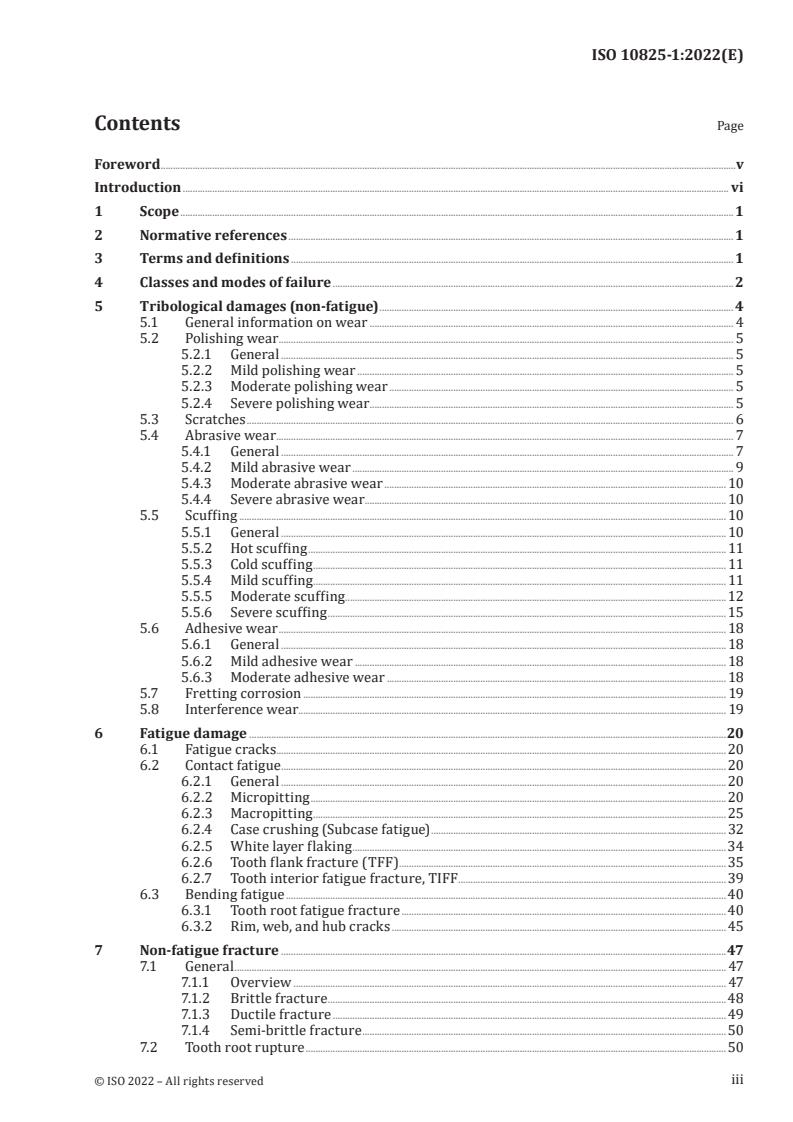
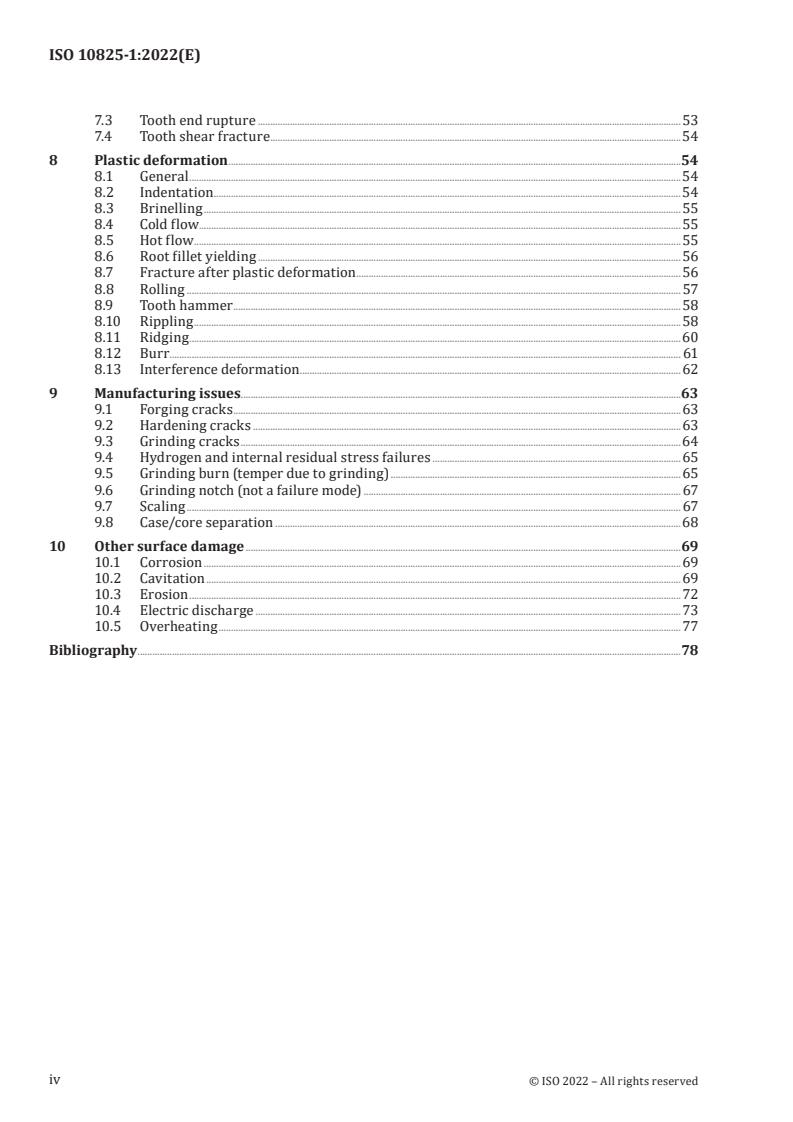
ISO 10825-1:2022 - Gears — Wear and damage to gear teeth — Part 1: Nomenclature and characteristics Released:5/25/2022
ISO 10825-1:2022 - Gears — Wear and damage to gear teeth — Part 1: Nomenclature and characteristics Released:5/25/2022
Overview
ISO 10825-1:2022 - Gears - Wear and damage to gear teeth - Part 1: Nomenclature and characteristics defines a common vocabulary and descriptive criteria for the typical modes of gear tooth wear and damage. The standard classifies, identifies and describes the appearance and characteristics of the most common failure modes so users can consistently report and, in many cases, recognize changes from the original condition. It is based largely on experience with steel gears; many modes are relevant to other materials, but the document does not cover all failure types for plastics, bronze or powder‑metal gears. ISO 10825-1:2022 specifies terminology only - it does not prescribe causes, diagnostic procedures, or preventive measures, nor does it attempt to define “gear failure.”
Key topics and technical content
The document is organized to help inspect and describe gear tooth conditions, including:
- Classes and modes of failure: an overarching classification framework for damage types.
- Tribological damages (non‑fatigue): polishing wear (mild → severe), scratches, abrasive wear, scuffing (hot/cold, severity levels), adhesive wear, fretting corrosion and interference wear.
- Fatigue damage: contact fatigue (micropitting, macropitting, case crushing, white‑layer flaking, tooth flank fracture (TFF), tooth interior fatigue fracture (TIFF)) and bending fatigue (tooth‑root cracks and related fractures).
- Non‑fatigue fracture: brittle, ductile and semi‑brittle fracture descriptions; tooth root and shear fractures.
- Plastic deformation: indentation, brinelling, cold/hot flow, ridging, burrs and related deformations.
- Manufacturing issues and surface damage: forging/hardening/grinding cracks, grinding burn, case/core separation, corrosion, cavitation, erosion, electric discharge and overheating.
- Clear definitions and photographic/descriptive guidance (where applicable) to assist in identifying and reporting appearance and condition changes.
Practical applications
- Standardized failure reporting and inspection records for maintenance teams and reliability engineers.
- Common terminology for root cause analysis and communication between manufacturers, service providers and laboratories.
- Reference for preparing inspection protocols, condition‑monitoring reports and procurement specifications.
- Training material for maintenance, inspection and failure‑analysis personnel to recognize and describe common wear and damage phenomena.
- Useful in mechanical design reviews where clarifying expected damage modes improves specification of materials and treatments.
Who should use this standard
- Gear designers and OEMs, maintenance and reliability engineers, failure analysis specialists, tribologists, inspection and QA personnel, and standards committees involved with gear systems.
Related standards
- ISO 10825‑1 is part of the ISO gear standardization activity (ISO/TC 60). Users should consult other ISO gear standards and later parts of the ISO 10825 series for additional guidance, testing or measurement protocols.
Keywords: ISO 10825-1, gear wear, gear tooth damage, gear failure modes, gear inspection, contact fatigue, micropitting, macropitting, scuffing, abrasive wear, gear nomenclature.
Relations
- Consolidated By
ISO 26203-1:2025 - Metallic materials — Tensile testing at high strain rates — Part 1: Elastic-bar-type systems - Effective Date
- 07-Oct-2023
- Effective Date
- 23-Apr-2020
Buy Documents
ISO 10825-1:2022 - Gears — Wear and damage to gear teeth — Part 1: Nomenclature and characteristics Released:5/25/2022
ISO 10825-1:2022 - Gears — Wear and damage to gear teeth — Part 1: Nomenclature and characteristics Released:5/25/2022
Frequently Asked Questions
ISO 10825-1:2022 is a standard published by the International Organization for Standardization (ISO). Its full title is "Gears — Wear and damage to gear teeth — Part 1: Nomenclature and characteristics". This standard covers: This document provides nomenclature for general modes of gear tooth wear and failure. It classifies, identifies, and describes the most common types of failure and provides information that, in many cases, enables the user to identify failure modes and evaluate the degree or change from original condition. This document is based on experience with steel gears; however, many of the failure modes discussed apply to gears made from other materials. Not all failure modes that can occur on other types of gears, such as plastic, bronze, or powder metal gears, are included. The solution to many gear problems requires detailed investigation and analysis by specialists and is beyond the scope of this document. This document specifies only the terminology intended to help with the identification and reporting of the appearance and conditions of gears after a period of operation. Neither causes nor preventive measures for any condition described are discussed. In this document, gear refers to both gear wheels and pinions, unless the gear is specifically identified. This document does not define “gear failure”.
This document provides nomenclature for general modes of gear tooth wear and failure. It classifies, identifies, and describes the most common types of failure and provides information that, in many cases, enables the user to identify failure modes and evaluate the degree or change from original condition. This document is based on experience with steel gears; however, many of the failure modes discussed apply to gears made from other materials. Not all failure modes that can occur on other types of gears, such as plastic, bronze, or powder metal gears, are included. The solution to many gear problems requires detailed investigation and analysis by specialists and is beyond the scope of this document. This document specifies only the terminology intended to help with the identification and reporting of the appearance and conditions of gears after a period of operation. Neither causes nor preventive measures for any condition described are discussed. In this document, gear refers to both gear wheels and pinions, unless the gear is specifically identified. This document does not define “gear failure”.
ISO 10825-1:2022 is classified under the following ICS (International Classification for Standards) categories: 01.040.21 - Mechanical systems and components for general use (Vocabularies); 21.200 - Gears. The ICS classification helps identify the subject area and facilitates finding related standards.
ISO 10825-1:2022 has the following relationships with other standards: It is inter standard links to ISO 26203-1:2025, ISO 10825:1995. Understanding these relationships helps ensure you are using the most current and applicable version of the standard.
ISO 10825-1:2022 is available in PDF format for immediate download after purchase. The document can be added to your cart and obtained through the secure checkout process. Digital delivery ensures instant access to the complete standard document.
Standards Content (Sample)
INTERNATIONAL ISO
STANDARD 10825-1
First edition
2022-05
Gears — Wear and damage to gear
teeth —
Part 1:
Nomenclature and characteristics
Engrenages — Usure et défauts des dentures —
Partie 1: Nomenclature et caractéristiques
Reference number
© ISO 2022
All rights reserved. Unless otherwise specified, or required in the context of its implementation, no part of this publication may
be reproduced or utilized otherwise in any form or by any means, electronic or mechanical, including photocopying, or posting on
the internet or an intranet, without prior written permission. Permission can be requested from either ISO at the address below
or ISO’s member body in the country of the requester.
ISO copyright office
CP 401 • Ch. de Blandonnet 8
CH-1214 Vernier, Geneva
Phone: +41 22 749 01 11
Email: copyright@iso.org
Website: www.iso.org
Published in Switzerland
ii
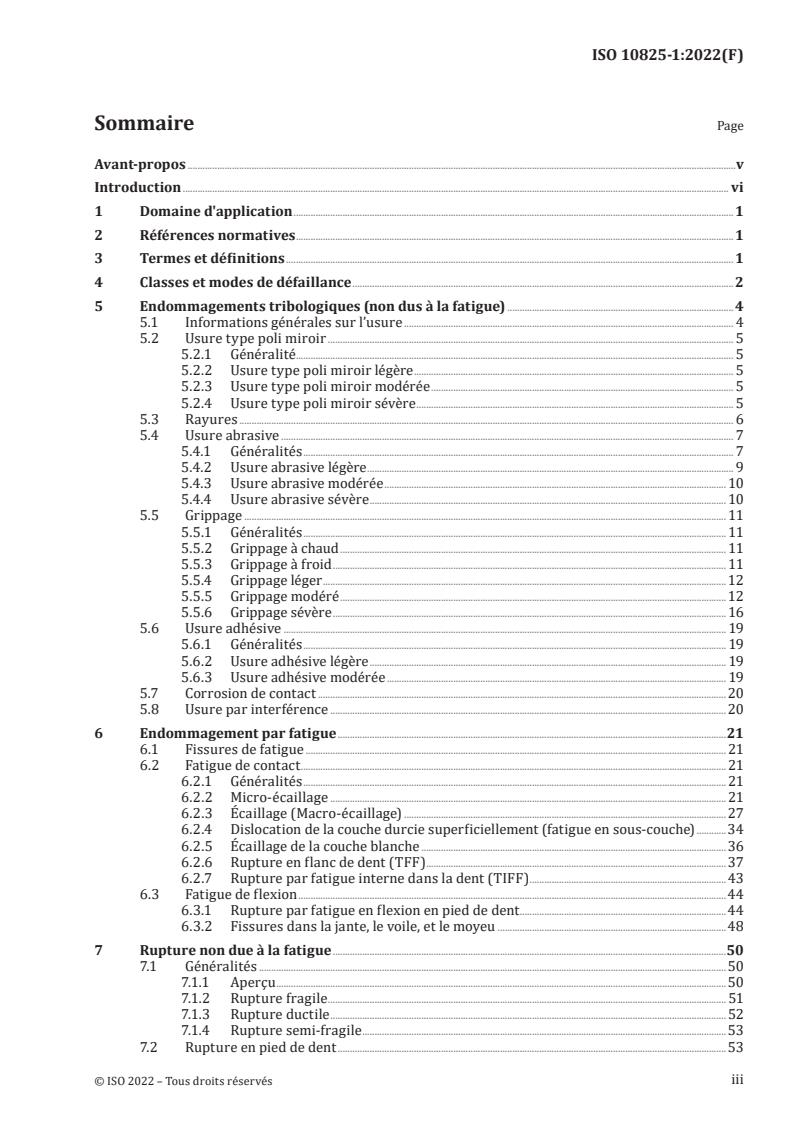
Contents Page
Foreword .v
Introduction . vi
1 Scope . 1
2 Normative references . 1
3 Terms and definitions . 1
4 Classes and modes of failure .2
5 Tribological damages (non-fatigue) . 4
5.1 General information on wear . 4
5.2 Polishing wear . 5
5.2.1 General . 5
5.2.2 Mild polishing wear . 5
5.2.3 Moderate polishing wear . 5
5.2.4 Severe polishing wear . 5
5.3 Scratches . 6
5.4 Abrasive wear . 7
5.4.1 General . 7
5.4.2 Mild abrasive wear . 9
5.4.3 Moderate abrasive wear . 10
5.4.4 Severe abrasive wear . . 10
5.5 Scuffing . 10
5.5.1 General . 10
5.5.2 Hot scuffing . 11
5.5.3 Cold scuffing . 11
5.5.4 Mild scuffing . 11
5.5.5 Moderate scuffing.12
5.5.6 Severe scuffing . 15
5.6 Adhesive wear . 18
5.6.1 General . 18
5.6.2 Mild adhesive wear . 18
5.6.3 Moderate adhesive wear . 18
5.7 Fretting corrosion . 19
5.8 Interference wear. 19
6 Fatigue damage .20
6.1 Fatigue cracks. 20
6.2 Contact fatigue . 20
6.2.1 General .20
6.2.2 Micropitting .20
6.2.3 Macropitting . 25
6.2.4 Case crushing (Subcase fatigue) . 32
6.2.5 White layer flaking .34
6.2.6 Tooth flank fracture (TFF) . 35
6.2.7 Tooth interior fatigue fracture, TIFF .39
6.3 Bending fatigue .40
6.3.1 Tooth root fatigue fracture .40
6.3.2 Rim, web, and hub cracks . 45
7 Non-fatigue fracture .47
7.1 General . 47
7.1.1 Overview . 47
7.1.2 Brittle fracture .48
7.1.3 Ductile fracture .49
7.1.4 Semi-brittle fracture .50
7.2 Tooth root rupture .50
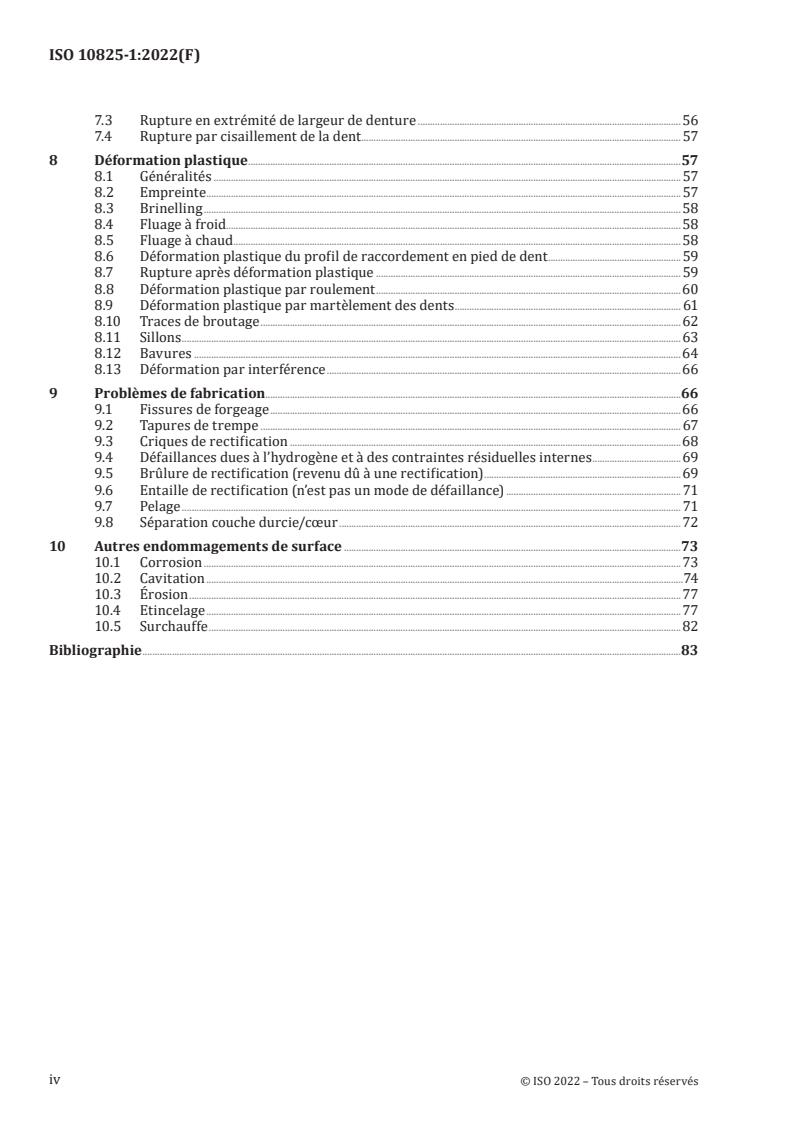
iii
7.3 Tooth end rupture . 53
7.4 Tooth shear fracture . .54
8 Plastic deformation .54
8.1 General .54
8.2 Indentation .54
8.3 Brinelling . 55
8.4 Cold flow . . 55
8.5 Hot flow . 55
8.6 Root fillet yielding . 56
8.7 Fracture after plastic deformation .56
8.8 Rolling . 57
8.9 Tooth hammer .58
8.10 Rippling .58
8.11 Ridging .60
8.12 Burr . . . 61
8.13 Interference deformation . 62
9 Manufacturing issues . .63
9.1 Forging cracks .63
9.2 Hardening cracks .63
9.3 Grinding cracks .64
9.4 Hydrogen and internal residual stress failures .65
9.5 Grinding burn (temper due to grinding) .65
9.6 Grinding notch (not a failure mode) . 67
9.7 Scaling . 67
9.8 Case/core separation .68
10 Other surface damage .69
10.1 Corrosion .69
10.2 Cavitation . 69
10.3 Erosion .72
10.4 Electric discharge .73
10.5 Overheating .77
Bibliography .78
iv
Foreword
ISO (the International Organization for Standardization) is a worldwide federation of national standards
bodies (ISO member bodies). The work of preparing International Standards is normally carried out
through ISO technical committees. Each member body interested in a subject for which a technical
committee has been established has the right to be represented on that committee. International
organizations, governmental and non-governmental, in liaison with ISO, also take part in the work.
ISO collaborates closely with the International Electrotechnical Commission (IEC) on all matters of
electrotechnical standardization.
The procedures used to develop this document and those intended for its further maintenance are
described in the ISO/IEC Directives, Part 1. In particular, the different approval criteria needed for the
different types of ISO documents should be noted. This document was drafted in accordance with the
editorial rules of the ISO/IEC Directives, Part 2 (see www.iso.org/directives).
Attention is drawn to the possibility that some of the elements of this document may be the subject of
patent rights. ISO shall not be held responsible for identifying any or all such patent rights. Details of
any patent rights identified during the development of the document will be in the Introduction and/or
on the ISO list of patent declarations received (see www.iso.org/patents).
Any trade name used in this document is information given for the convenience of users and does not
constitute an endorsement.
For an explanation of the voluntary nature of standards, the meaning of ISO specific terms and
expressions related to conformity assessment, as well as information about ISO's adherence to
the World Trade Organization (WTO) principles in the Technical Barriers to Trade (TBT), see
www.iso.org/iso/foreword.html.
This document was prepared by Technical Committee ISO/TC 60, Gears, Subcommittee SC 1,
Nomenclature and wormgearing.
This first edition of ISO 10825-1, together with ISO/TR 10825-2, cancels and replaces ISO 10825:1995,
which has been technically revised.
The main changes are as follows:
— the document has been split into two parts: ISO 10825-1 and ISO/TR 10825-2 that gives additional
information on failure modes;
— some additional modes of failures are described;
— most figures have been replaced and are in colour.
A list of all parts in the ISO 10825 series can be found on the ISO website.
Any feedback or questions on this document should be directed to the user’s national standards body. A
complete listing of these bodies can be found at www.iso.org/members.html.
v
Introduction
This document provides a common language to describe gear wear and failure and serves as
guidelines to uniformity and consistency in the use of that language. It describes the appearance of
gear tooth failure modes. It is intended to improve communication between equipment users and gear
manufacturers for failure and wear analysis. Since there can be many different causes for each type of
gear tooth wear or failure, it is not possible in this document to identify a single cause for each type of
wear or failure, nor to prescribe remedies.
vi
INTERNATIONAL STANDARD ISO 10825-1:2022(E)
Gears — Wear and damage to gear teeth —
Part 1:
Nomenclature and characteristics
IMPORTANT — The electronic file of this document contains colours which are considered to be
useful for the correct understanding of the document. Users should therefore consider printing
this document using a colour printer.
1 Scope
This document provides nomenclature for general modes of gear tooth wear and failure. It classifies,
identifies, and describes the most common types of failure and provides information that, in many cases,
enables the user to identify failure modes and evaluate the degree or change from original condition.
This document is based on experience with steel gears; however, many of the failure modes discussed
apply to gears made from other materials. Not all failure modes that can occur on other types of gears,
such as plastic, bronze, or powder metal gears, are included.
The solution to many gear problems requires detailed investigation and analysis by specialists and is
beyond the scope of this document.
This document specifies only the terminology intended to help with the identification and reporting
of the appearance and conditions of gears after a period of operation. Neither causes nor preventive
measures for any condition described are discussed.
In this document, gear refers to both gear wheels and pinions, unless the gear is specifically identified.
This document does not define “gear failure”.
2 Normative references
The following documents are referred to in the text in such a way that some or all of their content
constitutes requirements of this document. For dated references, only the edition cited applies. For
undated references, the latest edition of the referenced document (including any amendments) applies.
ISO 1122-1, Vocabulary of gear terms — Part 1: Definitions related to geometry
3 Terms and definitions
For the purposes of this document, the terms and definitions given in ISO 1122-1 apply.
ISO and IEC maintain terminology databases for use in standardization at the following addresses:
— ISO Online browsing platform: available at https:// www .iso .org/ obp
— IEC Electropedia: available at https:// www .electropedia .org/
4 Classes and modes of failure
This document does not define gear failure. One observer's “failure” is another observer's “run-in”.
There is no single definition of gear failure, since whether or not a gear has failed depends on the
specific application.
NOTE The term “gear failure” is subjective and a source of considerable disagreement. For example, a
person observing gear teeth that have a bright, mirrorlike appearance can think that the gears have “run-in”
properly. However, another observer can think that the gears have failed by polishing wear. Whether the gears
are considered failed or not depends on how much change from original condition is tolerable.
Changes made to reduce the risk of one failure mode can sometimes worsen or create other failure modes
or have other unintended consequences. Therefore, it is imperative that any remedy be evaluated prior
1)
to implementation and thoroughly tested and evaluated after implementation. See ISO/TR 10825-2
for additional discussion on the potential causes of the different failure modes and some suggestions to
minimize the risk of them occurring.
Table 1 groups the common modes of gear failure into six general classes. For each class, the preferred
terminology is listed, and older or other commonly used names are listed as non-preferred. Additional
terms which can help to clarify the general mode are listed in Table 2.
Table 1 — Nomenclature of gear failure modes
Sub-
General mode Non-preferred terminology
clause
Tribological damage (non-fatigue)
Polishing (unintentional) Burnishing 5.2
Scratches 5.3
a
Abrasive wear Cutting, Scoring 5.4
a
Scuffing Scoring , Welding, Microwelding, Galling, Seizing 5.5
Adhesive wear Normal, Running-in wear, Tearing, Plucking, Microwelding 5.6
Fretting corrosion 5.7
Interference wear 5.8
Fatigue damage
Micropitting Frosting, Gray staining, Peeling 6.2.2
Macropitting Contact fatigue, Destructive, Arrowhead 6.2.3
Case crushing (subcase fatigue) Internal rupture 6.2.4
White layer flaking 6.2.5
Tooth flank fracture (TFF) 6.2.6
Tooth interior fatigue fracture (TIFF) 6.2.7
Tooth root fatigue fracture 6.3.1
Rim, web, and hub cracks 6.3.2
Non-fatigue fracture
Tooth root rupture Fast fracture 7.2
Tooth end rupture 7.3
Tooth shear fracture 7.4
Plastic deformation
Indentation Bruising, Peening 8.2
Brinelling Denting 8.3
a
The use of the term “scoring“ is strongly discouraged because it can be applied to different types of wear. While it is
often considered as a form of adhesive wear, it is sometimes used for abrasive wear.
1) Under preparation. Stage at the time of publication: ISO/DTR 10825-2:2022.
Table 1 (continued)
Sub-
General mode Non-preferred terminology
clause
Cold flow 8.4
Hot flow 8.5
Root fillet yielding 8.6
Fracture after plastic deformation 8.7
Rolling 8.8
Tooth hammer 8.9
Rippling Fish scaling, Scalloping 8.10
Ridging 8.11
Burr 8.12
Interference deformation 8.13
Manufacturing issues
Forging cracks 9.1
Hardening cracks Quenching cracks 9.2
Grinding cracks 9.3
Hydrogen and internal residual stress 9.4
Grinding burn (temper due to grinding) 9.5
Grinding notch (not a failure mode) 9.6
Scaling 9.7
Case/core separation 9.8
Other surface damage
Corrosion 10.1
Cavitation 10.2
Erosion 10.3
Electrical discharge Arcing 10.4
Overheating 10.5
a
The use of the term “scoring“ is strongly discouraged because it can be applied to different types of wear. While it is
often considered as a form of adhesive wear, it is sometimes used for abrasive wear.
Table 2 — Additional terms
Additional terms Mentioned in subclause on: Subclause
Point-surface-origin Macropitting 6.2.3
Spall, Spalling Macropitting 6.2.3
Root fillet cracks Tooth root fatigue fracture 6.3.1
Non-fatigue overload Tooth root rupture 7.2
False brinelling Fretting corrosion 5.7
Gross plastic deformation Fracture after plastic deformation 7.1, 8.7
Subsurface-initiated bending fatigue Tooth flank fracture 6.2.6
5 Tribological damages (non-fatigue)
5.1 General information on wear
Wear describes changes to a gear tooth flank surface involving the removal of material without any
evidence of fatigue cracks. It can be accompanied by some displacement of material. See ISO 1122-1 for
definition of flank.
Wear includes polishing, scratches, and abrasive wear. It can be categorized as mild, moderate or severe.
Figures 1 and 2 show moderate and severe wear. They are not intended to indicate the mode of wear.
Figure 1 — Moderate wear
Figure 2 — Severe wear
5.2 Polishing wear
5.2.1 General
Polishing wear is a very slow wearing-in process in which the irregularities of the contacting surfaces
are gradually worn until mirror-like, smooth surfaces develop. The gear tooth flank can be smooth
or wavy with local bumps. Under sufficient magnification, the surface appears to be covered by fine
scratches that are oriented in the direction of sliding.
NOTE Intentional polishing can occur during the manufacturing process or during running-in.
5.2.2 Mild polishing wear
Polishing wear is classified as mild if it is confined to the peaks of the surface asperities. Mild polishing
wear typically occurs during running-in and ceases before the original machining marks are removed
from the tooth surface.
5.2.3 Moderate polishing wear
Polishing wear is classified as moderate if remnants of the original machining marks are visible on the
tooth surface.
5.2.4 Severe polishing wear
Severe polishing wear removes all of the original machining marks from the active flank of the tooth.
The polished surface can be wavy and there can be wear steps at the ends of the active face and in the
dedendum. See Figures 3 and 4.
Figure 3 — Severe polishing on both flanks
Figure 4 — Severe polishing on a misaligned gear
5.3 Scratches
Scratches are narrow and shallow grooves or furrows in the surface. They are usually oriented in the
sliding direction. This is a specific type of abrasive wear. See Figure 5.
Scratches can also occur during the manufacturing or assembly process; and such scratches can be in
any direction.
Figure 5 — Scratches in sliding direction
5.4 Abrasive wear
5.4.1 General
Abrasive wear, also known as abrasion, is the removal or displacement of material due to the presence
of hard particles (for example, metallic debris, scale, rust, sand, or abrasive powder, suspended in the
lubricant or embedded in the flanks of the mating teeth).
Abrasive wear causes scratches or gouges on the tooth surface that are oriented in the direction of
sliding. Under magnification, the scratches appear as parallel furrows that are smooth and clean. See
Figure 6.
NOTE The diagonal line is a scratch, an abrasive wear furrow cut by a hard particle showing smooth, clean
appearance. The horizontal lines are the original grind marks.
Figure 6 — A scratch due to abrasive wear, scanning electron microscope (SEM) image
Abrasive wear due to loose contaminants is called three-body abrasion. The three bodies are the two
gear elements and the loose contaminant. Three-body abrasive wear appears as small, usually square,
randomly distributed areas that are scuffed or scored. See Figures 7 and 8. Two-body abrasive wear
occurs when embedded particles or asperities on one gear tooth abrade the opposing tooth surface,
leaving long scratches that often form a repeating pattern.
Based on the severity, abrasive wear can be categorized as mild, moderate, or severe.
Figure 7 — Three body abrasive wear
Figure 8 — Three body abrasive wear
5.4.2 Mild abrasive wear
Abrasive wear is classified as mild if it consists of fine scratches that are not so numerous or deep
enough to remove significant amounts of material from the tooth flank surface and some machining
marks are visible on the tooth surface. See Figure 9.
Figure 9 — Mild abrasive wear near the tip of a ground gear
5.4.3 Moderate abrasive wear
Abrasive wear is classified as moderate if only a few remnants of the original machining marks are
visible on the tooth flank surface.
5.4.4 Severe abrasive wear
Severe abrasive wear removes all of the original machining marks from the active flank surface of the
tooth. There can be wear steps at the ends of the active face and at the lowest point of tooth contact. The
tooth thickness can be reduced significantly, and in some instances the tooth tip can be reduced to a
sharp edge. See Figures 10 and 11.
Figure 10 — Severe abrasive wear, full flank and enlarged view
Figure 11 — Severe abrasive wear
5.5 Scuffing
5.5.1 General
Scuffing is severe adhesion that causes transfer of metal from one tooth surface to another, or loss of
material, due to welding and tearing. The damage typically occurs away from the operating pitch line,
in narrow or broad bands that are oriented in the direction of sliding. Scuffing can occur in localized
patches if it is due to load concentrations. The scuffed areas appear to have a rough or matte texture.
Under magnification, the scuffed surface appears rough, torn, and plastically deformed.
Scuffing can affect the material characteristics of the tooth flanks, including properties such as
hardness and grain structure. The residual stresses can be affected. Discoloration can also be observed.
Scuffing is not a fatigue phenomenon, it occurs suddenly.
Although the basic failure mechanism is the same (lubricant film breakdown, welding and metal pull-
off), it should be distinguished between what can be referred to as “hot” and “cold” scuffing.
All scuffing can also be categorized as mild, moderate, or severe based on the severity of damage.
5.5.2 Hot scuffing
In the case of hot scuffing, it is the combined action of high pressure between surfaces, high sliding
speeds, excessive contact temperature (resulting from pressure and sliding speed values), and
inadequate lubricant properties which cause oil film breakdown between the tooth flanks resulting
in metal-to-metal contact. Local welds and tearing alternately occur between the contact surfaces and
contribute to the quick pull-off of metallic particles from the tooth flanks, thus progressively modifying
the condition of their profile. See Figures 12 to 21.
The scuffing marks are generally more clearly pronounced near the tooth tip and near the tooth root
in the high sliding areas. The scuffing marks appear in the form of streaks or scratches with sharpened
bottoms and sides, often appearing as bands of variable depth and width oriented in the sliding
direction and can affect either isolated zones or the whole face width.
5.5.3 Cold scuffing
In this case, it concerns the joint action of high pressure between surfaces and low tangential velocity
resulting in low maximum sliding velocity (linear speed not higher than approximately 4 m/s), which
cause the breakdown of the lubricant film between the contact surfaces during meshing, causing a
metal-to-metal contact on the tooth flank. In general, this kind of scuffing begins with one or more
adhesions on a few tooth flanks and spreads gradually nearer and nearer until the whole circumference
of the gear is involved. The spreading speed of damage is a function of the type of lubricant used, the
finishing process, and the hardness of the gear material. See Figure 22.
Cold scuffing primarily occurs on gears with low surface hardness, e.g. through or non-hardened
gears that are running in the boundary lubrication regime or mixed regime condition according to the
[2]
STRIBECK curve .
5.5.4 Mild scuffing
Scuffing is classified as mild if it occurs only on small areas of the tooth flanks and is confined to the
peaks of the surface asperities. It is generally nonprogressive.
See Figure 12.
Figure 12 — Mild hot scuffing
5.5.5 Moderate scuffing
Moderate scuffing occurs in patches that cover significant portions of the tooth flanks. If the operating
conditions do not change, moderate scuffing can be progressive. See Figures 13 to 17.
Figure 13 — Moderate hot scuffing
Figure 14 — Moderate hot scuffing
Figure 15 — Moderate hot scuffing
NOTE SEM images showing rough, torn, and plastically deformed appearance.
Figure 16 — Hot scuffing damage
NOTE SEM image showing crater formed when welded material was torn from surface.
Figure 17 — Hot scuffing damage
5.5.6 Severe scuffing
Severe scuffing occurs on significant portions of the gear tooth flank (e.g. the entire addendum,
the entire dedendum, or both). In some cases, the surface material can be plastically deformed and
displaced over the tip of the tooth or into the root of the tooth. Unless corrective measures are taken,
severe scuffing is usually progressive. See Figures 18 to 22.
Figure 18 — Severe hot scuffing
Figure 19 — Severe hot scuffing
Figure 20 — Severe hot scuffing (magnification of yellow marked tooth on Figure 19)
Figure 21 — Severe hot scuffing
Figure 22 — Severe cold scuffing
5.6 Adhesive wear
5.6.1 General
Adhesive wear, also known simply as adhesion, involves the transfer of material from one tooth surface
to another by microwelding and tearing.
Adhesive wear can be categorized as mild or moderate. Severe adhesive wear can transition to scuffing,
which is discussed in 5.5.
5.6.2 Mild adhesive wear
Mild adhesive wear typically occurs during running-in and usually subsides after it has smoothed the
tooth flank surfaces by removing minor imperfections through localized wear. To the unaided eye,
the tooth surface appears undamaged and the original machining marks are visible. Microscopically,
smooth microplateaus can be seen between the machining furrows.
5.6.3 Moderate adhesive wear
Adhesive wear is classified as moderate if it removes some or all of the original machining marks from
the active surface of the tooth. With moderate adhesive wear, the pitch line sometimes becomes visible
on the tooth flank.
Adhesive wear can also be due to mild interference creating metal to metal contact. More serious
interference can cause plastic deformation. See 5.8.
5.7 Fretting corrosion
Fretting corrosion (often referred to as just fretting) damages gear surfaces by forming shallow groves
along lines of contact. See Figure 23. The original machining marks within the grooves are worn away
by mild adhesive wear. Generally, the damage caused by fretting corrosion is negligible and the wear
rate is low. Fretting corrosion occurs on gear teeth when they are not rotating but oscillating through
extremely small angles. The wear debris, which comes from the gears themselves, is hard and abrasive,
and is in fact the same composition as jeweller's rouge, and polishing (fine scale abrasion) is frequently
found around the periphery of a fretting corrosion scar. Hematite discolours the lubricant surrounding
the contact and forms rouge-coloured paste. Usually, the wear scar is discoloured with black or reddish
films. When very localized, fretting corrosion is sometimes referred to as false brinelling or stand still
marks. False brinelling can also be the initial stage of fretting corrosion.
NOTE Brinelling (see 8.3) is a separate failure mode that is unrelated to false brinelling.
Figure 23 — Fretting corrosion
5.8 Interference wear
Interference wear shows evidence of high-pressure contact between the affected surfaces. See
Figure 24. When the mating gears have similar hardness, similar distress is often seen on the mating
parts. Interference wear can usually be seen either on the tip of one gear and at or near the root of
the mate (tip to root interference), or on the corresponding flanks of the mating gears. It can result in
plastic deformation, adhesion, abrasion or macropitting. Sliding marks are usually visible. See also 8.13
on interference deformation.
Key
1 tip 3 root
2 pitch line 4 plastic deformation with scoring and macropitting
Figure 24 — Interference wear due to tip-to-root interference
6 Fatigue damage
6.1 Fatigue cracks
Fatigue cracks initiate and propagate under the influence of repeated cyclic or alternating stresses that
are below the yield strength (on a macroscopic level) of the material. These cracks can appear at or
below the surface on tooth flanks or in tooth root fillets. Non-fatigue-initiated cracks can sometimes
propagate slowly like a fatigue-initiated crack.
6.2 Contact fatigue
6.2.1 General
Contact fatigue can occur in the presence of repeated loaded rolling or mixed rolling and sliding contacts
and is characterized by surface or subsurface fatigue cracks. It results in the detachment of material
fragments from the gear tooth flank surface or it can result in a tooth fracture. The mechanism can
change from contact to bending fatigue as cracks progress.
6.2.2 Micropitting
Micropitting appears as a dull, matte, surface during unmagnified visual inspection of high surface
hardness gears such as surface or case-hardened gears. Under magnification, dense patches of
micropits or micro-cracks are visible. Micropitting cracks grow at a shallow angle to the surface,
against the direction of sliding force, forming micropits. The micropits are small relative to the size of
the contact zone, typically of the order of 10 μm to 20 μm deep. The micropits can coalesce to produce
a continuous fractured surface, but can also arrest and not progress further during the life of the gear
set. See Figures 25 to 30. Figures 31 and 32 show how micropits can progress to macropits.
Figure 25 — Micropitting on misaligned carburized gear
Figure 26 — Micropitting on induction hardened spur gear with crowned teeth
Figure 27 — Micropitting on nitrided and ground spur gear
Key
1 sliding direction 2 rolling direction 3 pitchline
NOTE A shaved pinion that was carburized.
Figure 28 — Detail of tooth surface showing micropitting
Key
1 crack growth direction 3 direction of sliding
2 feather edge
Figure 29 — Detail of tooth surface showing micropitting at 500X magnification
Figure 30 — Regularly distributed micropitting
Key
1 micropits 2 initiation point
3 pit 4 conjugate flank
5 sliding direction of flank versus conjugate flank
Figure 31 — Schematic drawing of a macropit initiated by micropitting
NOTE The arrow shows the direction of sliding.
Figure 32 — Progression of a macropit initiated by micropitting
6.2.3 Macropitting
6.2.3.1 General
Macropitting is observed when particles break out of effected areas leaving a surface pock marked with
scattered holes. Macropitting occurs when fatigue cracks initiate either at the surface of the gear tooth
or at a shallow depth below the surface. Orientation of the cracks initiated at the surface is against
the direction of sliding force. The crack usually propagates for a short distance in a direct
...
NORME ISO
INTERNATIONALE 10825-1
Première édition
2022-05
Engrenages — Usure et défauts des
dentures —
Partie 1:
Nomenclature et caractéristiques
Gears — Wear and damage to gear teeth —
Part 1: Nomenclature and characteristics
Numéro de référence
DOCUMENT PROTÉGÉ PAR COPYRIGHT
© ISO 2022
Tous droits réservés. Sauf prescription différente ou nécessité dans le contexte de sa mise en œuvre, aucune partie de cette
publication ne peut être reproduite ni utilisée sous quelque forme que ce soit et par aucun procédé, électronique ou mécanique,
y compris la photocopie, ou la diffusion sur l’internet ou sur un intranet, sans autorisation écrite préalable. Une autorisation peut
être demandée à l’ISO à l’adresse ci-après ou au comité membre de l’ISO dans le pays du demandeur.
ISO copyright office
Case postale 401 • Ch. de Blandonnet 8
CH-1214 Vernier, Genève
Tél.: +41 22 749 01 11
E-mail: copyright@iso.org
Web: www.iso.org
Publié en Suisse
ii
Sommaire Page
Avant-propos .v
Introduction . vi
1 Domaine d'application .1
2 Références normatives .1
3 Termes et définitions . 1
4 Classes et modes de défaillance .2
5 Endommagements tribologiques (non dus à la fatigue) . 4
5.1 Informations générales sur l’usure . 4
5.2 Usure type poli miroir . 5
5.2.1 Généralité. 5
5.2.2 Usure type poli miroir légère . 5
5.2.3 Usure type poli miroir modérée . 5
5.2.4 Usure type poli miroir sévère . 5
5.3 Rayures . 6
5.4 Usure abrasive . 7
5.4.1 Généralités . 7
5.4.2 Usure abrasive légère . 9
5.4.3 Usure abrasive modérée . 10
5.4.4 Usure abrasive sévère . 10
5.5 Grippage . 11
5.5.1 Généralités . 11
5.5.2 Grippage à chaud . 11
5.5.3 Grippage à froid . 11
5.5.4 Grippage léger .12
5.5.5 Grippage modéré .12
5.5.6 Grippage sévère . 16
5.6 Usure adhésive . 19
5.6.1 Généralités . 19
5.6.2 Usure adhésive légère . 19
5.6.3 Usure adhésive modérée . 19
5.7 Corrosion de contact . 20
5.8 Usure par interférence . 20
6 Endommagement par fatigue .21
6.1 Fissures de fatigue . 21
6.2 Fatigue de contact . 21
6.2.1 Généralités . 21
6.2.2 Micro-écaillage . 21
6.2.3 Écaillage (Macro-écaillage) . 27
6.2.4 Dislocation de la couche durcie superficiellement (fatigue en sous-couche) .34
6.2.5 Écaillage de la couche blanche .36
6.2.6 Rupture en flanc de dent (TFF) . 37
6.2.7 Rupture par fatigue interne dans la dent (TIFF) . 43
6.3 Fatigue de flexion .44
6.3.1 Rupture par fatigue en flexion en pied de dent .44
6.3.2 Fissures dans la jante, le voile, et le moyeu .48
7 Rupture non due à la fatigue .50
7.1 Généralités . 50
7.1.1 Aperçu .50
7.1.2 Rupture fragile . 51
7.1.3 Rupture ductile . 52
7.1.4 Rupture semi-fragile .53
7.2 Rupture en pied de dent .53
iii
7.3 Rupture en extrémité de largeur de denture .56
7.4 Rupture par cisaillement de la dent . 57
8 Déformation plastique .57
8.1 Généralités . 57
8.2 Empreinte . . 57
8.3 Brinelling .58
8.4 Fluage à froid.58
8.5 Fluage à chaud .58
8.6 Déformation plastique du profil de raccordement en pied de dent . 59
8.7 Rupture après déformation plastique . 59
8.8 Déformation plastique par roulement .60
8.9 Déformation plastique par martèlement des dents . 61
8.10 Traces de broutage . 62
8.11 Sillons .63
8.12 Bavures .64
8.13 Déformation par interférence .66
9 Problèmes de fabrication . .66
9.1 Fissures de forgeage .66
9.2 Tapures de trempe . 67
9.3 Criques de rectification .68
9.4 Défaillances dues à l’hydrogène et à des contraintes résiduelles internes .69
9.5 Brûlure de rectification (revenu dû à une rectification) . 69
9.6 Entaille de rectification (n’est pas un mode de défaillance) . 71
9.7 Pelage . 71
9.8 Séparation couche durcie/cœur .72
10 Autres endommagements de surface .73
10.1 Corrosion .73
10.2 Cavitation .74
10.3 Érosion .77
10.4 Etincelage .77
10.5 Surchauffe .82
Bibliographie .83
iv
Avant-propos
L'ISO (Organisation internationale de normalisation) est une fédération mondiale d'organismes
nationaux de normalisation (comités membres de l'ISO). L'élaboration des Normes internationales est
en général confiée aux comités techniques de l'ISO. Chaque comité membre intéressé par une étude
a le droit de faire partie du comité technique créé à cet effet. Les organisations internationales,
gouvernementales et non gouvernementales, en liaison avec l'ISO participent également aux travaux.
L'ISO collabore étroitement avec la Commission électrotechnique internationale (IEC) en ce qui
concerne la normalisation électrotechnique.
Les procédures utilisées pour élaborer le présent document et celles destinées à sa mise à jour sont
décrites dans les Directives ISO/IEC, Partie 1. Il convient, en particulier, de prendre note des différents
critères d'approbation requis pour les différents types de documents ISO. Le présent document a
été rédigé conformément aux règles de rédaction données dans les Directives ISO/IEC, Partie 2 (voir
www.iso.org/directives).
L'attention est attirée sur le fait que certains des éléments du présent document peuvent faire l'objet de
droits de propriété intellectuelle ou de droits analogues. L'ISO ne saurait être tenue pour responsable
de ne pas avoir identifié de tels droits de propriété et averti de leur existence. Les détails concernant
les références aux droits de propriété intellectuelle ou autres droits analogues identifiés lors de
l'élaboration du document sont indiqués dans l'Introduction et/ou dans la liste des déclarations de
brevets reçues par l'ISO (voir www.iso.org/brevets).
Les appellations commerciales éventuellement mentionnées dans le présent document sont données
pour information, par souci de commodité, à l’intention des utilisateurs et ne sauraient constituer un
engagement.
Pour une explication de la nature volontaire des normes, la signification des termes et expressions
spécifiques de l'ISO liés à l'évaluation de la conformité, ou pour toute information au sujet de l'adhésion
de l'ISO aux principes de l’Organisation mondiale du commerce (OMC) concernant les obstacles
techniques au commerce (OTC), voir www.iso.org/avant-propos.
Le présent document été élaborée par le comité technique ISO/TC 60, Engrenages, sous-comité SC 1,
Nomenclature et engrenages à vis.
Cette première édition de l’ISO 10825-1, avec l’ISO/TR 10825-2, annule et remplace l’ISO 10825:1995,
qui a fait l’objet d’une révision technique.
Les principales modifications sont les suivantes:
— le document a été scindé en deux parties: ISO 10825-1 et ISO/TR 10825-2 qui fournit des informations
supplémentaires sur les modes de défaillance;
— certains modes de défaillance supplémentaires sont décrits;
— la plupart des figures ont été remplacées, et sont en couleur.
Une liste de toutes les parties de la série ISO 10825 se trouve sur le site web de l’ISO.
Il convient que l’utilisateur adresse tout retour d’information ou toute question concernant le présent
document à l’organisme national de normalisation de son pays. Une liste exhaustive desdits organismes
se trouve à l’adresse www.iso.org/fr/members.html.
v
Introduction
Le présent document fournit un langage commun pour décrire l’usure et la défaillance des dentures,
et sert de guide pour l’uniformité et la cohérence dans l’utilisation de ce langage. Il décrit l’aspect des
modes de défaillance de denture. Il est destiné à améliorer la communication entre les utilisateurs
d’équipements et les fabricants d’engrenages pour l’analyse de défaillance et d’usure. Sachant qu’il peut
exister de nombreuses causes différentes pour chaque type d’usure ou de défaillance de denture, il n’est
pas possible dans le présent document d’identifier une unique cause pour chaque type d’usure ou de
défaillance, ni de prescrire des remèdes.
vi
NORME INTERNATIONALE ISO 10825-1:2022(F)
Engrenages — Usure et défauts des dentures —
Partie 1:
Nomenclature et caractéristiques
IMPORTANT — Le fichier électronique de ce document contient des couleurs qui sont considérées
comme utiles pour la bonne compréhension du document. Il conviendrait que les utilisateurs
envisagent d’imprimer ce document à l’aide d’une imprimante couleur.
1 Domaine d'application
Le présent document fournit une nomenclature pour les modes généraux d’usure et de défaillance
des dentures. Il classe, identifie, et décrit les types de défaillance les plus courants et fournit des
informations qui, dans de nombreux cas, permettent à l’utilisateur d’identifier des modes de défaillance
et d’évaluer le degré ou le changement par rapport à l’état d’origine.
Le présent document est basé sur l’expérience avec des roues dentées en acier; cependant, beaucoup
de modes de défaillance étudiés s’appliquent à des roues dentées fabriquées dans d’autres matériaux.
Tous les modes de défaillance qui peuvent se produire sur d’autres types d’engrenages, tels que les
engrenages en plastique, en bronze ou en matériaux frittés, ne sont pas inclus.
La solution à de nombreux problèmes de roue dentées nécessite une étude et une analyse détaillées par
des spécialistes et est en dehors du domaine d’application du présent document.
Le présent document spécifie seulement la terminologie destinée à faciliter l’identification et la
déclaration de l’aspect et de l’état des roues dentées après une période de fonctionnement. Ni les causes
ni les mesures préventives pour toute condition décrite ne sont discutées.
Dans le présent document, le terme «engrenage» désigne une roue dentée ou un pignon, à moins que la
roue dentée ne soit précisément identifiée.
NOTE Dans le présent document français, le terme «gear» est traduit par «roue dentée» quand le contexte le
nécessite et par «engrenage» quand il concerne le couple pignon-roue. Une roue dentée peut être soit le pignon,
soit la roue.
Le présent document ne définit pas une «défaillance de denture».
2 Références normatives
Les documents suivants sont cités dans le texte de sorte qu’ils constituent, pour tout ou partie de leur
contenu, des exigences du présent document. Pour les références datées, seule l’édition citée s’applique.
Pour les références non datées, la dernière édition du document de référence s'applique (y compris les
éventuels amendements).
ISO 1122-1, Vocabulaire des engrenages — Partie 1: Définitions géométriques
3 Termes et définitions
Pour les besoins du présent document, les termes et définitions donnés dans l’ISO 1122-1 s'appliquent.
L'ISO et l'IEC tiennent à jour des bases de données terminologiques destinées à être utilisées en
normalisation, consultables aux adresses suivantes:
— ISO Online browsing platform: disponible à l'adresse https:// www .iso .org/ obp
— IEC Electropedia: disponible à l'adresse https:// www .electropedia .org/
4 Classes et modes de défaillance
Le présent document ne définit pas la défaillance d’un engrenage. Une «défaillance» pour un observateur
peut constituer un «état de rodage» pour un autre observateur. Il n’existe pas une définition unique
d’une défaillance d’un engrenage, puisque le fait qu’une roue dentée soit endommagée ou non dépend de
l’application spécifique.
NOTE Le terme «défaillance de denture» est subjectif et est source de désaccords considérables. Par exemple,
une personne observant les dents d’une roue dentée qui ont un aspect brillant, miroitant, peut estimer que les
roues dentées ont été «rodées» correctement. Cependant, un autre observateur peut estimer que les dents ont été
endommagées par une usure type poli miroir. La réponse à la question de savoir s’il convient que les dents soient
considérées comme endommagées ou non dépend de l’ampleur du changement qui est tolérable par rapport à
l’état d’origine.
Des modifications apportées pour réduire le risque d’un mode de défaillance peuvent parfois aggraver
ou créer d’autres modes de défaillance ou avoir d’autres conséquences inattendues. Il est donc impératif
que tout remède soit évalué avant d’être mis en œuvre et rigoureusement testé et évalué après mise
1)
en œuvre. Voir ISO/TR 10825-2 pour une discussion supplémentaire sur les causes potentielles des
différents modes de défaillance et des suggestions permettant de réduire au minimum le risque qu’ils
se produisent.
Le Tableau 1 regroupe les modes courants de défaillance de denture en six classes générales. Pour
chaque classe, les termes préférés sont indiqués, et des noms plus anciens ou d’autres noms couramment
utilisés sont mentionnés comme étant non préférés. Des termes supplémentaires qui peuvent faciliter la
clarification du mode général figurent dans le Tableau 2.
Tableau 1 — Nomenclature des modes de défaillance de denture
Para-
Mode général Termes non préférés
graphe
Endommagements tribologiques (non dus à la fatigue)
Poli miroir (involontaire) Brunissing 5.2
Rayures 5.3
a
Usure abrasive Griffures, Stries de grippage 5.4
a
Grippage Stries de grippage , Soudures, Microsoudures, Arrache- 5.5
ment, Adhésion
Usure adhésive Usure normale, Usure de rodage, Striage, Arrachement, 5.6
Microsoudures
Corrosion de contact 5.7
Usure par interférence 5.8
Endommagement par fatigue
Micro-écaillage Micro-gerçures, Formation de taches grises, Gerçure 6.2.2
Ecaillage (Macro-écaillage) Fatigue de contact, destructive, en forme triangulaire 6.2.3
Dislocation de la couche durcie superficiel- Rupture en sous couche 6.2.4
lement (fatigue en sous-couche)
Dislocation de la couche blanche 6.2.5
Rupture en flanc de dent (TFF) 6.2.6
Rupture de dent par fatigue en sous couche 6.2.7
(TIFF)
a
L’utilisation du terme «stries de grippage» est fortement déconseillée car il peut s’appliquer à différents types d’usure.
Bien qu’il soit souvent considéré comme une forme d’usure adhésive, il est parfois utilisé pour l’usure abrasive.
1) En cours de préparation. Stade au moment de la publication: ISO/DTR 10825-2:2022.
Tableau 1 (suite)
Para-
Mode général Termes non préférés
graphe
Rupture par fatigue en flexion en pied de 6.3.1
dent
Fissures dans la couronne, le voile, et la 6.3.2
jante
Rupture non due à la fatigue
Rupture en pied de dent Rupture brutale 7.2
Rupture en extrémité de denture 7.3
Rupture par cisaillement de la dent 7.4
Déformation plastique
Indentation Empreinte, impact 8.2
Brinelling Indentation 8.3
Fluage à froid 8.4
Fluage à chaud 8.5
Déformation plastique en flexion du profil 8.6
de raccordement en pied de dent
Rupture après déformation plastique 8.7
Roulement 8.8
Martèlement de dent 8.9
Traces de broutage Aspect en écaille de poisson, festonnage 8.10
Sillons 8.11
Bavures 8.12
Déformation par interférence 8.13
Problèmes de fabrication
Fissures de forge 9.1
Tapures de trempe Fissures de trempe 9.2
Criques de rectification 9.3
Fragilisation par hydrogène et contraintes 9.4
résiduelles internes
Brûlure de rectification (revenu pendant la 9.5
rectification)
Entaille de rectification (pas un mode de 9.6
défaillance)
Pelage 9.7
Décohésion de la couche durcie par rap- 9.8
port au cœur de la dent
Autres endommagements de surface
Corrosion 10.1
Cavitation 10.2
Érosion 10.3
Etincelage Arc électrique 10.4
Surchauffe 10.5
a
L’utilisation du terme «stries de grippage» est fortement déconseillée car il peut s’appliquer à différents types d’usure.
Bien qu’il soit souvent considéré comme une forme d’usure adhésive, il est parfois utilisé pour l’usure abrasive.
Tableau 2 — Termes supplémentaires
Termes supplémentaires Mentionnés dans la section sur: Article
Initiation d’écaillage en surface (piqûres) Macro-écaillage 6.2.3
Écaillage Macro-écaillage 6.2.3
Fissures dans le profil de raccordement Rupture par fatigue en pied de dent 6.3.1
en pied de dent
Rupture par surcharge Rupture en pied de dent 7.2
Faux effet Brinell Corrosion de contact 5.7
Déformation plastique globale Rupture après déformation plastique 7.1, 8.7
Fatigue de flexion initiée en sous-couche Rupture en flanc de dent 6.2.6
5 Endommagements tribologiques (non dus à la fatigue)
5.1 Informations générales sur l’usure
L’usure décrit des changements de la surface du flanc de la dent consistant en l’enlèvement de matière
sans aucun signe de fissures de fatigue. Elle peut être accompagnée d’un transfert de matière. Voir
l’ISO 1122-1 pour la définition du flanc.
L’usure comprend le poli miroir, les rayures et l’usure abrasive. Elle peut être classée comme légère,
modérée ou sévère.
Les Figures 1 et 2 montrent une usure modérée et sévère. Elles ne sont pas destinées à indiquer le mode
d’usure.
Figure 1 — Usure modérée
Figure 2 — Usure sévère
5.2 Usure type poli miroir
5.2.1 Généralité
L’usure type poli miroir est un processus très lent d’usure dans lequel les aspérités des surfaces en
contact sont progressivement écrouies jusqu’à ce qu’il se développe des surfaces lisses et brillantes. Le
flanc de la dent peut être lisse ou ondulé avec des bosses locales. Sous un grossissement suffisant, la
surface semble être couverte de fines rayures qui sont orientées dans le sens du glissement.
NOTE Une usure type poli miroir intentionnelle peut se produire pendant le processus de fabrication ou
pendant le rodage.
5.2.2 Usure type poli miroir légère
L'usure type poli miroir est classé comme légère si elle est limitée aux sommets des aspérités de surface.
Une usure type poli miroir légère se produit généralement pendant le rodage et cesse avant que les
stries d’usinage d’origine ne soient enlevées de la surface de la dent.
5.2.3 Usure type poli miroir modérée
Une usure type poli miroir est classée comme modérée si des vestiges de stries d’usinage d’origine sont
visibles sur la surface de la dent.
5.2.4 Usure type poli miroir sévère
Une usure type poli miroir sévère enlève toutes les stries d’usinage d’origine du flanc actif de la dent. La
surface polie peut être ondulée et il peut y avoir des ressauts d’usure aux extrémités du flanc actif et au
niveau du creux des dents. Voir les Figures 3 et 4.
Figure 3 — Usure type poli miroir sévère sur les deux flancs
Figure 4 — Usure type poli miroir sévère sur une roue dentée désalignée
5.3 Rayures
Les rayures sont des sillons étroits et peu profonds sur la surface. Elles sont normalement orientées
dans le sens du glissement. Il s’agit d’un type spécifique d’usure abrasive. Voir la Figure 5.
Des rayures peuvent également se produire pendant le processus de fabrication ou de montage, et
peuvent être orientées dans n’importe quelle direction.
Figure 5 — Rayures dans le sens du glissement
5.4 Usure abrasive
5.4.1 Généralités
L’usure abrasive, également appelée abrasion, est l’enlèvement ou le transfert de matière provoqué
par la présence de particules dures (par exemple, débris métalliques, scories, rouille, sable, ou poudre
abrasive en suspension dans le lubrifiant ou incrustées dans les flancs des dents conjugués).
L’usure abrasive provoque des griffures ou des sillons sur la surface de la dent, qui sont orientées dans
le sens du glissement. Sous grossissement, les griffures prennent l’aspect de sillons parallèles qui sont
lisses et propres. Voir la Figure 6.
NOTE La ligne diagonale est une griffure, un sillon d’usure abrasive tracé par une particule dure et
présentant un aspect lisse, propre. Les lignes horizontales sont les stries de rectification d’origine.
Figure 6 — Une griffure due à l’usure abrasive, image au microscope électronique à balayage
(MEB)
L’usure abrasive due à la présence d’impuretés en suspension est appelée abrasion à trois corps. Les
trois corps sont les deux roues dentées et les impuretés en suspension. L’usure abrasive à trois corps se
présente sous l’aspect de petites zones généralement carrées, réparties aléatoirement, qui sont éraflées
ou marquées. Voir les Figures 7 et 8. L’usure abrasive à deux corps se produit lorsque des particules
incrustées ou des aspérités sur une dent abrasent la surface de la dent opposée, laissant de longues
griffures qui forment souvent un motif récurrent.
En fonction de la sévérité, l’usure abrasive peut être classée comme légère, modérée, ou sévère.
Figure 7 — Usure abrasive à trois corps
Figure 8 — Usure abrasive à trois corps
5.4.2 Usure abrasive légère
L’usure abrasive est classée comme légère si elle consiste en de fines griffures qui ne sont pas
suffisamment nombreuses ou profondes pour enlever des quantités importantes de matière de la
surface d’un flanc de la dent et que certaines stries d’usinage sont visibles sur la surface de la dent. Voir
la Figure 9.
Figure 9 — Usure abrasive légère à proximité du sommet d’une roue dentée rectifiée
5.4.3 Usure abrasive modérée
L’usure abrasive est classée comme modérée si seulement quelques vestiges des stries d’usinage
d’origine sont visibles sur la surface du flanc de la dent.
5.4.4 Usure abrasive sévère
L’usure abrasive sévère enlève toutes les stries d’usinage d’origine de la surface du flanc actif de la dent.
Il peut y avoir des ressauts d’usure aux extrémités de la largeur active de denture et au niveau du point
de contact le plus bas en début de flanc actif en pied de dent. L’épaisseur de la dent peut être réduite
significativement, et dans certains cas, la tête de la dent peut être réduite à des bords tranchants. Voir
les Figures 10 et 11.
Figure 10 — Usure abrasive sévère, flanc entier et vue agrandie
Figure 11 — Usure abrasive sévère
5.5 Grippage
5.5.1 Généralités
Le grippage est une adhérence sévère qui provoque un transfert de métal de la surface d’une dent
vers une autre, ou une perte de matière, due à une soudure et à un arrachement. L’endommagement
se produit généralement loin du primitif de fonctionnement, en bandes étroites ou larges qui sont
orientées dans le sens du glissement. Le grippage peut se produire dans des endroits localisés s’il est dû
à des concentrations de charge. Les zones grippées semblent avoir une texture rugueuse ou mate. Sous
grossissement, la surface grippée apparaît rugueuse, déchirée, et plastiquement déformée.
Le grippage peut affecter les caractéristiques du matériau des flancs de la dent, y compris des propriétés
telles que la dureté et la structure du grain. Les contraintes résiduelles peuvent être affectées. Une
décoloration peut également être observée.
Le grippage n’est pas un phénomène de fatigue, il se produit soudainement.
Bien que le mécanisme de défaillance de base soit le même (rupture du film lubrifiant, soudure
et arrachement de métal), il convient de faire une distinction entre ce qui peut être désigné comme
grippage «à chaud» et grippage «à froid».
Tout grippage peut aussi être classé comme léger, modéré, ou sévère en fonction de la sévérité de
l’endommagement.
5.5.2 Grippage à chaud
Dans le cas d’un grippage à chaud, c’est l’action combinée d’une pression élevée entre surfaces, de vitesses
de glissement élevées, d’une température de contact excessive (résultant des valeurs de pression et de
vitesse de glissement), et de propriétés inadéquates du lubrifiant, qui provoque une rupture du film
d’huile entre les flancs de dents et conduit à un contact métal contre métal. Des soudures locales et des
arrachements se produisent alternativement entre les surfaces en contact et contribuent à l’enlèvement
rapide de particules métalliques des flancs de dents, modifiant ainsi progressivement l’état de leur
profil. Voir les Figures 12 à 21.
Les traces de grippage sont généralement plus clairement prononcées à proximité de la tête de dent et
du pied de dent dans les zones à glissement élevé. Les traces de grippage apparaissent sous la forme de
stries ou de rayures à fonds et côtés tranchants, se présentant souvent comme des bandes de profondeur
et de largeur variables orientées dans le sens du glissement, et peuvent affecter des zones isolées ou
toute la largeur de denture.
5.5.3 Grippage à froid
Ce cas concerne l’action conjointe d’une pression élevée entre des surfaces et d’une faible vitesse
tangentielle se traduisant par une faible vitesse de glissement maximale (vitesse linéaire ne dépassant
pas environ 4 m/s), qui entraîne la rupture du film lubrifiant entre les surfaces en contact pendant
l’engrènement, provoquant un contact métal contre métal sur le flanc de dents. En général, ce type
de grippage commence par une ou plusieurs adhérences sur quelques flancs de dents et se propage
graduellement jusqu’à ce que toute la circonférence de la roue dentée soit concernée. La vitesse de
propagation de la dégradation est fonction du type de lubrifiant utilisé, du procédé de finition, et de la
dureté du matériau de l’engrenage. Voir la Figure 22.
Le grippage à froid se produit principalement sur les roues dentées avec une faible dureté superficielle,
par exemple des roues dentées traitées dans la masse ou des roues dentées non-durcies qui tournent
dans un régime de lubrification limite ou dans une condition de régime mixte selon la courbe de
[2]
Stribeck .
5.5.4 Grippage léger
Un grippage est classé comme léger s’il se produit seulement sur de petites zones des flancs de dents et
est limité aux sommets des aspérités de surface. Il est généralement non évolutif.
Voir la Figure 12.
Figure 12 — Grippage à chaud léger
5.5.5 Grippage modéré
Un grippage modéré se produit dans des zones qui couvrent des surfaces importantes des flancs de
dents. Si les conditions de fonctionnement ne changent pas, un grippage modéré peut être progressif.
Voir les Figures 13 à 17.
Figure 13 — Grippage à chaud modéré
Figure 14 — Grippage à chaud modéré
Figure 15 — Grippage à chaud modéré
NOTE Images MEB montrant un aspect rugueux, déchiré et plastiquement déformé.
Figure 16 — Endommagement par un grippage à chaud
NOTE Image MEB montrant le cratère formé lorsque de la matière soudée a été arrachée de la surface.
Figure 17 — Endommagement par un grippage à chaud
5.5.6 Grippage sévère
Un grippage sévère se produit sur des parties importantes du flanc de dent d’une roue dentée (par
exemple, la saillie tout entière, le creux tout entier ou les deux). Dans certains cas, le matériau en surface
peut être plastiquement déformé et déplacé au-dessus de la tête de la dent ou vers le pied de la dent. À
moins que des mesures correctives ne soient prises, un grippage sévère est généralement évolutif. Voir
les Figures 18 à 22.
Figure 18 — Grippage à chaud sévère
Figure 19 — Grippage à chaud sévère
Figure 20 — Grippage à chaud sévère (grossissement de la dent marquée en jaune
à la Figure 19)
Figure 21 — Grippage à chaud sévère
Figure 22 — Grippage à froid sévère
5.6 Usure adhésive
5.6.1 Généralités
L’usure adhésive, également appelée simplement adhésion, se caractérise par le transfert de matière de
la surface d’une dent vers une autre par microsoudure et arrachement.
L’usure adhésive peut être classée comme légère ou modérée. Une usure adhésive sévère peut évoluer
vers un grippage, qui est étudié en 5.5.
5.6.2 Usure adhésive légère
Une usure adhésive légère se produit généralement pendant le rodage et se stabilise normalement
après qu’elle a lissé les surfaces des flancs de dents en enlevant les imperfections mineures par une
usure localisée. Sans aide visuelle, la surface des dents apparaît non endommagée et les stries d’usinage
d’origine sont visibles. Au microscope, des micro-plateaux lisses peuvent être observés entre les sillons
d’usinage.
5.6.3 Usure adhésive modérée
L’usure adhésive est classée comme modérée si elle enlève une partie ou la totalité des marques
d’usinage d’origine de la surface active de la dent. Avec une usure adhésive modérée, le primitif de
fonctionnement devient parfois visible sur le flanc de la dent.
L’usure adhésive peut également être due à une interférence légère créant un contact métal contre
métal. Une interférence plus grave peut provoquer une déformation plastique. Voir 5.8.
5.7 Corrosion de contact
La corrosion de contact (souvent désignée «usure de contact ») endommage les surfaces des roues
dentées en formant des sillons superficiels le long des lignes de contact. Voir la Figure 23. Les marques
d’usinage d’origine à l’intérieur des sillons s’effacent sous l’action d’une usure adhésive légère.
Généralement, la détérioration provoquée par la corrosion de contact est négligeable et le taux d’usure
est faible. La corrosion de contact se produit sur les dents lorsqu’elles ne sont pas en rotation mais
oscillent avec des angles extrêmement faibles. Les débris d’usure, qui viennent des roues dentées
elles-mêmes, sont durs et abrasifs, et sont en fait de la même composition que le rouge du bijoutier,
et un poli miroir (abrasion à échelle fine) se rencontre fréquemment autour de la périphérie du sillon
de la corrosion de contact. L’hématite colore le lubrifiant entourant le contact et forme une pâte de
couleur rouge. Normalement, le sillon d’usure présente une coloration noire ou rougeâtre. Lorsqu’elle
est très localisée, la corrosion de contact est parfois désignée «faux effet Brinell» ou «marques de
micromouvement». Un faux effet Brinell peut aussi être la première étape d’une corrosion de contact.
NOTE Brinelling (voir 8.3) est un mode de défaillance séparé qui est sans rapport avec le faux effet Brinell.
Figure 23 — Corrosion de contact
5.8 Usure par interférence
L’usure par interférence révèle des traces d’une pression de contact élevée entre les surfaces affectées.
Voir la Figure 24. Lorsque les roues dentées conjuguées ont une dureté similaire, une dégradation
similaire est souvent observée sur les flancs conjugués. L’usure par inter
...