

ISO/IEC Guide 98-3:2008/Amd 1:2026
(Amendment)Uncertainty of measurement — Part 3: Guide to the expression of uncertainty in measurement (GUM:1995) — Amendment 1: Nonlinearity in measurement models
- Status
- Published
- Publication Date
- 26-Jul-2026
- Technical Committee
- ISO/TMBG - Technical Management Board - groups
- Drafting Committee
- ISO/TMBG - Technical Management Board - groups
- Current Stage
- 6060 - International Standard published
- Start Date
- 27-Jul-2026
- Due Date
- 13-Aug-2028
- Completion Date
- 27-Jul-2026
Buy Documents

ISO/IEC Guide 98-3:2008/Amd 1:2026 - Uncertainty of measurement — Part 3: Guide to the expression of uncertainty in measurement (GUM:1995) — Amendment 1: Nonlinearity in measurement models

ISO/IEC Guide 98-3:2008/Amd 1:2026 - Incertitude de mesure — Partie 3: Guide pour l'expression de l'incertitude de mesure (GUM:1995) — Amendement 1: Non-linéarité dans les modèles de mesure
ISO/IEC Guide 98-3:2008/Amd 1:2026 is an amendment to the Guide to the expression of uncertainty in measurement (GUM:1995), published by ISO and IEC through the Joint Committee for Guides in Metrology (JCGM). It focuses on nonlinearity in measurement models. The amendment tells users when to move beyond a linear uncertainty treatment and use a Monte Carlo method or higher-order Taylor terms, so it is aimed at people who evaluate and report measurement uncertainty.
What does ISO/IEC Guide 98-3:2008/Amd 1:2026 specify?
ISO/IEC Guide 98-3:2008/Amd 1:2026 specifies updates to the GUM guidance for cases where the measurement model is significantly nonlinear. The amendment changes clause 4.1.4, revises worked-example text in Annex H, adds a bibliography reference, and appends an informative correspondence annex.
| Annex | What it covers |
|---|---|
| Annex ZZ | Corresponding ISO/IEC Guides for JCGM guidance documents whose equivalents are not given in the text |
In practice, this amendment matters when the usual linear propagation of uncertainty is not enough. It gives users a clear trigger for switching to a Monte Carlo approach or for including higher-order terms in the Taylor expansion of the model.
What are the key requirements of ISO/IEC Guide 98-3:2008/Amd 1:2026?
Handling significant nonlinearity
ISO/IEC Guide 98-3:2008/Amd 1:2026 adds a new Note 1 to clause 4.1.4 saying that significant nonlinearity in the function (f) calls for a Monte Carlo method, as described in JCGM 101:2008, or for higher-order Taylor terms in the expression for the output quantity. In practice, this tells the reader not to stop at the linear approximation when curvature in the model affects the result.
The note also says that, for independent input quantities with normal distributions, the next correction terms come from the second-order part of the Taylor series. That matters because the uncertainty budget may need curvature terms even when the reported estimate itself changes very little.
For non-independent, normally distributed input quantities, ISO/IEC Guide 98-3:2008/Amd 1:2026 points to Equation (H.10) as the generalization. In practice, correlations between inputs must be handled explicitly, not treated as a minor detail.
Updating the worked example in Annex H
ISO/IEC Guide 98-3:2008/Amd 1:2026 revises the first paragraph of H.1.7 so the example reflects the new guidance on nonlinearity. The amendment states that the equations used to obtain the measurand estimate and its combined standard uncertainty must be augmented when higher-order terms cannot be neglected.
The revised text also explains that the first higher-order expression in the new note to 4.1.4 is zero in this example, so the estimate of the measurand is unchanged. In practice, this shows that nonlinearity can leave the central value untouched while still changing the uncertainty.
The example then adds two non-negligible second-order terms to the uncertainty calculation. That is important for anyone using the annex as a worked model, because it shows where the extra contribution enters the calculation.
Pointing readers to the Monte Carlo supplement
ISO/IEC Guide 98-3:2008/Amd 1:2026 adds JCGM 101:2008 to the bibliography. This supports users who need the detailed Monte Carlo propagation method when the measurement model is too nonlinear for a simple Taylor expansion.
What terms does ISO/IEC Guide 98-3:2008/Amd 1:2026 define?
- Joint Committee for Guides in Metrology (JCGM) - the committee that publishes the GUM guidance documents and the amendment.
- GUM - the Guide to the expression of uncertainty in measurement, the family of guidance being amended here.
- Measurand - the quantity intended to be measured; the amendment discusses how to estimate it and its uncertainty.
- Measurement model - the relationship (Y = f(X_1, X_2, ..., X_N)) that connects input quantities to the output quantity.
- Nonlinearity - the situation where the measurement model cannot be treated adequately with a linear approximation.
- Monte Carlo method - a numerical propagation method that uses repeated random sampling to evaluate the output distribution.
- Taylor series expansion - an approximation method that adds higher-order terms when the linear term is not sufficient.
- Combined standard uncertainty - the standard uncertainty associated with the output quantity after combining input contributions.
Who uses ISO/IEC Guide 98-3:2008/Amd 1:2026?
ISO/IEC Guide 98-3:2008/Amd 1:2026 is used by metrology specialists, calibration and testing laboratories, quality managers, and conformity assessment staff who need to evaluate measurement uncertainty. It is also relevant to engineers and analysts who build or review measurement models and need to decide whether a linear approximation is adequate. In practice, it helps users document uncertainty calculations when model curvature or input correlations matter.
What changed in ISO/IEC Guide 98-3:2008/Amd 1:2026 from the previous edition?
- Adds a new note to clause 4.1.4 on significant nonlinearity in measurement models.
- Says that users can apply JCGM 101:2008 Monte Carlo propagation or include higher-order Taylor terms.
- Identifies the next higher-order terms for independent, normally distributed input quantities.
- Points to Equation (H.10) for the non-independent, normally distributed case.
- Revises Annex H.1.7 to reflect the need for higher-order corrections in the worked example.
- Adds JCGM 101:2008 to the bibliography.
- Appends informative Annex ZZ with corresponding ISO/IEC Guides and JCGM documents.
Which standards are used with ISO/IEC Guide 98-3:2008/Amd 1:2026?
ISO/IEC Guide 98-3:2008/Amd 1:2026 directly cites JCGM 101:2008 for Monte Carlo propagation and Annex ZZ maps the related Guide 98 and JCGM documents.
| Reference | What it contributes |
|---|---|
| JCGM 101:2008 / ISO/IEC Guide 98-3:2008/Suppl.1 | Propagation of distributions using a Monte Carlo method |
| ISO/IEC Guide 98-1:2024 / JCGM GUM-1 | Introduction to the expression of uncertainty in measurement |
| ISO/IEC Guide 98-2 / JCGM GUM-2 | Concepts |
| ISO/IEC Guide 98-4 / JCGM GUM-4 | Role of measurement uncertainty in conformity assessment |
| ISO/IEC Guide 98-5:2026 / JCGM GUM-5 | Examples |
| ISO/IEC Guide 98-6:2021 / JCGM GUM-6 | Developing and using measurement models |
| ISO/IEC Guide 98-3:2008/Suppl.2 / JCGM GUM-8 | Extension to any number of output quantities |
| ISO/IEC Guide 98-9 / JCGM GUM-9 | Statistical models and data analysis for interlaboratory studies |
| ISO/IEC Guide 98-10 / JCGM GUM-10 | Applications of the least-squares method |
| ISO/IEC Guide 98-11 / JCGM GUM-11 | Bayesian methods |
| ISO/IEC Guide 98-12 / JCGM GUM-12 | Basic methods for uncertainty propagation |
| ISO/IEC Guide 99:2007 / JCGM 200 | International vocabulary of metrology terms and concepts |
What does the ISO/IEC Guide 98-3:2008/Amd 1:2026 document contain?
ISO/IEC Guide 98-3:2008/Amd 1:2026 contains one technical note added to clause 4.1.4, revised worked-example text in Annex H.1.7, a new bibliography entry for JCGM 101:2008, and informative Annex ZZ with correspondence information. It gives users a practical trigger for when nonlinearity requires Monte Carlo propagation or higher-order terms. The amendment is aimed at readers who need to apply the GUM framework to real measurement models, uncertainty budgets, and documented evaluation procedures.
Relations
- Effective Date
- 16-Aug-2025
Buy Documents
ISO/IEC Guide 98-3:2008/Amd 1:2026 - Uncertainty of measurement — Part 3: Guide to the expression of uncertainty in measurement (GUM:1995) — Amendment 1: Nonlinearity in measurement models
ISO/IEC Guide 98-3:2008/Amd 1:2026 - Incertitude de mesure — Partie 3: Guide pour l'expression de l'incertitude de mesure (GUM:1995) — Amendement 1: Non-linéarité dans les modèles de mesure
Get Certified
Connect with accredited certification bodies for this standard

BSMI (Bureau of Standards, Metrology and Inspection)
Taiwan's standards and inspection authority.
Sponsored listings
Frequently Asked Questions
ISO/IEC Guide 98-3:2008/Amd 1:2026 is a guide published by the International Organization for Standardization (ISO). Its full title is "Uncertainty of measurement — Part 3: Guide to the expression of uncertainty in measurement (GUM:1995) — Amendment 1: Nonlinearity in measurement models". This standard covers: Uncertainty of measurement — Part 3: Guide to the expression of uncertainty in measurement (GUM:1995) — Amendment 1: Nonlinearity in measurement models
Uncertainty of measurement — Part 3: Guide to the expression of uncertainty in measurement (GUM:1995) — Amendment 1: Nonlinearity in measurement models
ISO/IEC Guide 98-3:2008/Amd 1:2026 is classified under the following ICS (International Classification for Standards) categories: 17.020 - Metrology and measurement in general. The ICS classification helps identify the subject area and facilitates finding related standards.
ISO/IEC Guide 98-3:2008/Amd 1:2026 has the following relationships with other standards: It is inter standard links to ISO/IEC Guide 98-3:2008. Understanding these relationships helps ensure you are using the most current and applicable version of the standard.
ISO/IEC Guide 98-3:2008/Amd 1:2026 is available in PDF format for immediate download after purchase. The document can be added to your cart and obtained through the secure checkout process. Digital delivery ensures instant access to the complete standard document.
Standards Content (Sample)
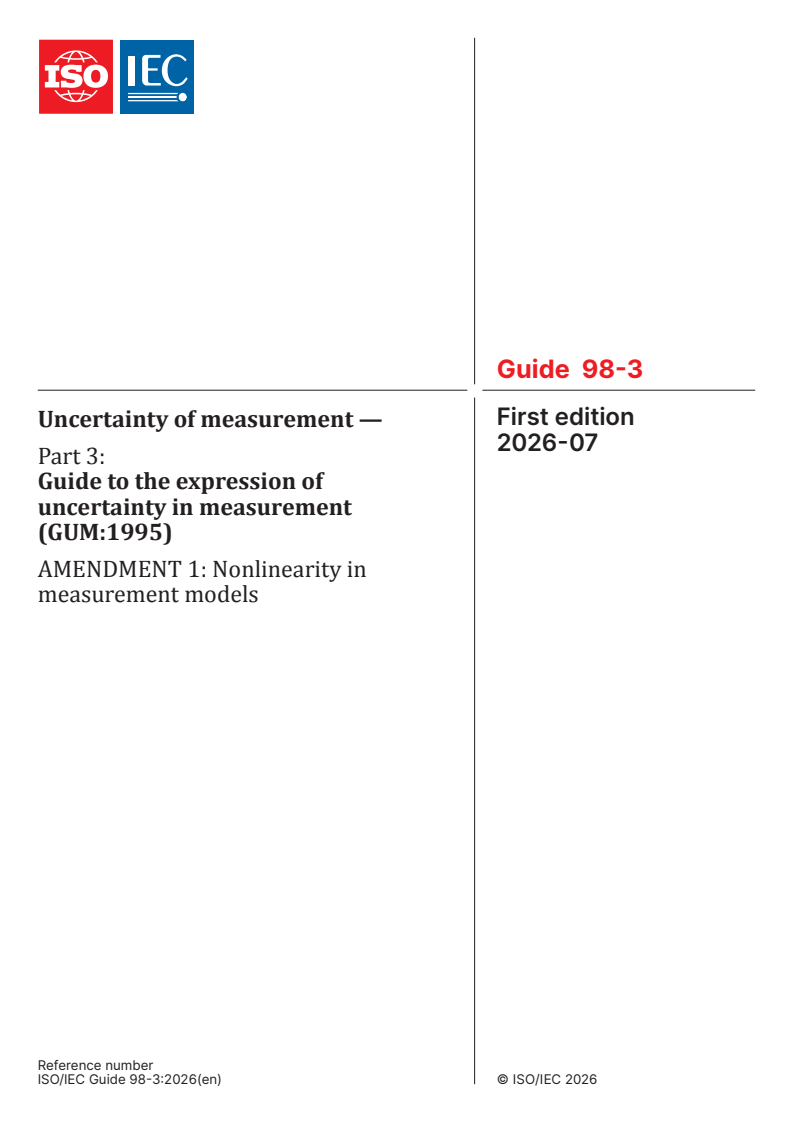
Guide 98-3
First edition
Uncertainty of measurement —
2026-07
Part 3:
Guide to the expression of
uncertainty in measurement
(GUM:1995)
AMENDMENT 1: Nonlinearity in
measurement models
Reference number
ISO/IEC Guide 98-3:2026(en) © ISO/IEC 2026
ISO/IEC Guide 98-3:2026(en)
© ISO/IEC 2026
All rights reserved. Unless otherwise specified, or required in the context of its implementation, no part of this publication may
be reproduced or utilized otherwise in any form or by any means, electronic or mechanical, including photocopying, or posting on
the internet or an intranet, without prior written permission. Permission can be requested from either ISO at the address below
or ISO’s member body in the country of the requester.
ISO copyright office
CP 401 • Ch. de Blandonnet 8
CH-1214 Vernier, Geneva
Phone: +41 22 749 01 11
Email: copyright@iso.org
Website: www.iso.org
Published in Switzerland
© ISO/IEC 2026 – All rights reserved
ii
ISO/IEC Guide 98-3:2026(en)
Foreword
ISO (the International Organization for Standardization) and IEC (the International Electrotechnical
Commission) form the specialized system for worldwide standardization. National bodies that are members
of ISO or IEC participate in the development of International Standards through technical committees
established by the respective organization to deal with particular fields of technical activity. ISO and IEC
technical committees collaborate in fields of mutual interest. Other international organizations, governmental
and non-governmental, in liaison with ISO and IEC, also take part in the work.
The procedures used to develop this document and those intended for its further maintenance are described
in the ISO/IEC Directives, Part 1. In particular, the different approval criteria needed for the different types of
document should be noted. This document was drafted in accordance with the editorial rules of the ISO/IEC
Directives, Part 2 (see www.iso.org/directives or www.iec.ch/members_experts/refdocs).
ISO and IEC draw attention to the possibility that the implementation of this document may involve the use of
(a) patent(s). ISO and IEC take no position concerning the evidence, validity or applicability of any claimed
patent rights in respect thereof. As of the date of publication of this document, ISO and IEC had not received
notice of (a) patent(s) which may be required to implement this document. However, implementers are
cautioned that this may not represent the latest information, which may be obtained from the patent database
available at www.iso.org/patents and https://patents.iec.ch. ISO and IEC shall not be held responsible for
identifying any or all such patent rights.
Any trade name used in this document is information given for the convenience of users and does not
constitute an endorsement.
For an explanation of the voluntary nature of standards, the meaning of ISO specific terms and expressions
related to conformity assessment, as well as information about ISO's adherence to the World Trade
Organization (WTO) principles in the Technical Barriers to Trade (TBT) see www.iso.org/iso/foreword.html.
In the IEC, see www.iec.ch/understanding-standards.
This document was prepared by the Joint Committee for Guides in Metrology and was adopted by the national
bodies of ISO and IEC.
A list of all parts in the ISO/IEC Guide 98 series can be found on the ISO and IEC websites.
Given that ISO/IEC Guide 98-3 is identical in content to JCGM 100:2008/Amd 1, the decimal symbol is a point
on the line in the English version and a comma on the line in the French version.
Annex ZZ has been appended to provide a list of corresponding ISO/IEC Guides and JCGM guidance documents
for which equivalents are not given in the text.
Any feedback or questions on this document should be directed to the user’s national standards body. A
complete listing of these bodies can be found at www.iso.org/members.html and www.iec.ch/national-
committees.
© ISO/IEC 2026 – All rights reserved
iii
ISO/IEC Guide 98-3:2026(en)
Joint Committee for Guides in Metrology
Evaluation of measurement data — Guide to the
expression of uncertainty in measurement.
AMENDMENT 1: Nonlinearity in measurement models
Évaluation des données de mesure — Guide pour l’expression de
l’incertitude de mesure. AMENDEMENT 1: Non-linéarité dans les
modèles de mesure
JCGM 100:2008/Amd.1:2026
© JCGM 2026 – All rights reserved
© ISO/IEC 2026 – All rights reserved
ISO/IEC Guide 98-3:2026(en)
ii JCGM 100:2008/Amd.1:2026
© JCGM 2024
Copyright of this JCGM guidance document is shared jointly by the JCGM member organizations
(BIPM, IEC, IFCC, ILAC, ISO, IUPAC, IUPAP and OIML).
Copyright
Even if electronic versions are available free of charge on the website of one or more of the JCGM
member organizations, economic and moral copyrights related to all JCGM publications are inter-
nationally protected. The JCGM does not, without its written authorisation, permit third parties
to rewrite or re-brand issues, to sell copies to the public, or to broadcast or use on-line its publica-
tions. Equally, the JCGM also objects to distortion, augmentation or mutilation of its publications,
including its titles, slogans and logos, and those of its member organizations.
Official versions and translations
The only official versions of documents are those published by the JCGM, in their original languages.
The JCGM’s publications may be translated into languages other than those in which the documents
were originally published by the JCGM. Permission must be obtained from the JCGM before a
translation can be made. All translations should respect the original and official format of the
formulae and units (without any conversion to other formulae or units), and contain the following
statement (to be translated into the chosen language):
All JCGM’s products are internationally protected by copyright. This translation of
the original JCGM document has been produced with the permission of the JCGM.
The JCGM retains full internationally protected copyright on the design and content of
this document and on the JCGM’s titles, slogan and logos. The member organizations
of the JCGM also retain full internationally protected right on their titles, slogans and
logos included in the JCGM’s publications. The only official version is the document
published by the JCGM, in the original languages.
The JCGM does not accept any liability for the relevance, accuracy, completeness or quality of the
information and materials offered in any translation. A copy of the translation shall be provided to
the JCGM at the time of publication.
Reproduction
The JCGM’s publications may be reproduced, provided written permission has been granted by
the JCGM. A sample of any reproduced document shall be provided to the JCGM at the time of
reproductio
...
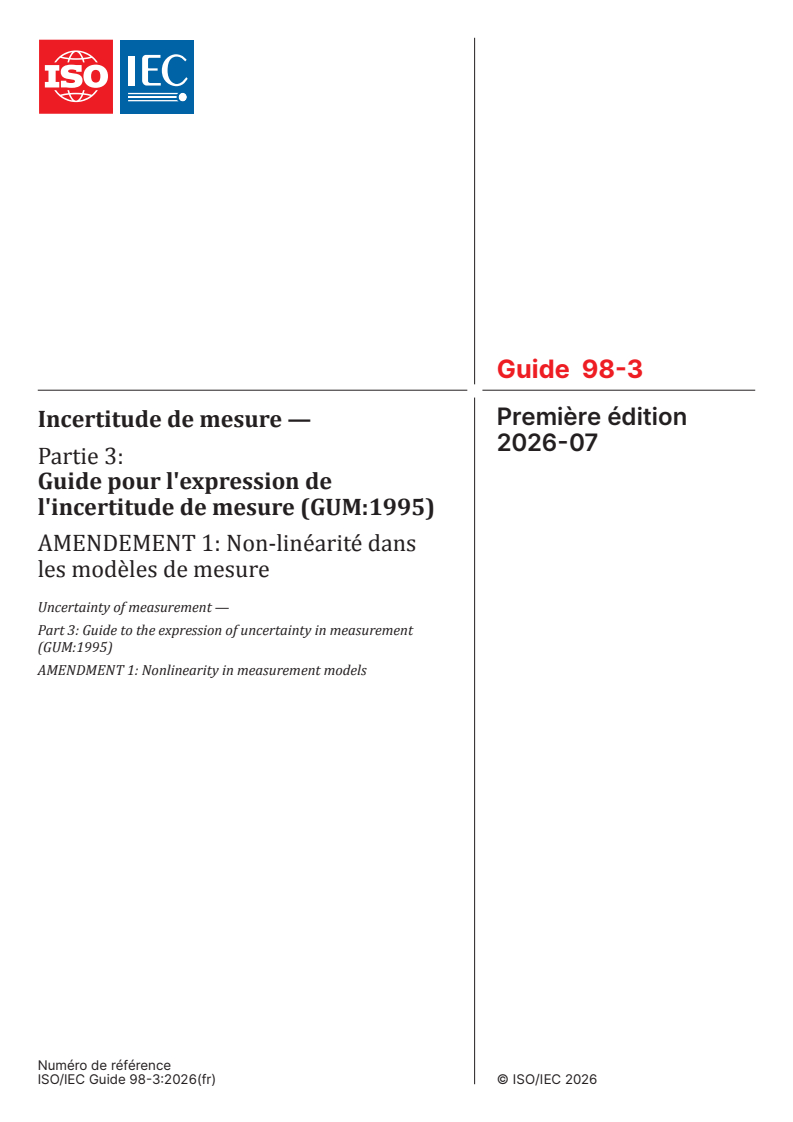
Guide 98-3
Première édition
Incertitude de mesure —
2026-07
Partie 3:
Guide pour l'expression de
l'incertitude de mesure (GUM:1995)
AMENDEMENT 1: Non-linéarité dans
les modèles de mesure
Uncertainty of measurement —
Part 3: Guide to the expression of uncertainty in measurement
(GUM:1995)
AMENDMENT 1: Nonlinearity in measurement models
Numéro de référence
ISO/IEC Guide 98-3:2026(fr) © ISO/IEC 2026
ISO/IEC Guide 98-3:2026(fr)
DOCUMENT PROTÉGÉ PAR COPYRIGHT
© ISO/IEC 2026
Tous droits réservés. Sauf prescription différente ou nécessité dans le contexte de sa mise en œuvre, aucune partie de cette
publication ne peut être reproduite ni utilisée sous quelque forme que ce soit et par aucun procédé, électronique ou mécanique,
y compris la photocopie, ou la diffusion sur l’internet ou sur un intranet, sans autorisation écrite préalable. Une autorisation peut
être demandée à l’ISO à l’adresse ci-après ou au comité membre de l’ISO dans le pays du demandeur.
ISO copyright office
Case postale 401 • Ch. de Blandonnet 8
CH-1214 Vernier, Genève
Tél.: +41 22 749 01 11
E-mail: copyright@iso.org
Web: www.iso.org
Publié en Suisse
© ISO/IEC 2026 – Tous droits réservés
ii
ISO/IEC Guide 98-3:2026(fr)
Avant-propos
L'ISO (Organisation internationale de normalisation) et l’IEC (Commission électrotechnique internationale)
forment le système spécialisé de la normalisation mondiale. Les organismes nationaux membres de l'ISO ou
de l’IEC participent au développement de Normes internationales par l'intermédiaire des comités techniques
créés par l'organisation concernée afin de s'occuper des domaines particuliers de l'activité technique. Les
comités techniques de l'ISO et de l’IEC collaborent dans des domaines d'intérêt commun. D'autres
organisations internationales, gouvernementales et non gouvernementales, en liaison avec l'ISO et l’IEC,
participent également aux travaux.
Les procédures utilisées pour élaborer le présent document et celles destinées à sa mise à jour sont décrites
dans les Directives ISO/IEC, Partie 1. Il convient, en particulier de prendre note des différents critères
d'approbation requis pour les différents types de document. Le présent document a été rédigé conformément
aux règles de rédaction données dans les Directives ISO/IEC, Partie 2 (voir www.iso.org/directives ou
www.iec.ch/members_experts/refdocs).
L’ISO et l’IEC attirent l’attention sur le fait que la mise en application du présent document peut entraîner
l’utilisation d’un ou de plusieurs brevets. L’ISO et l’IEC ne prennent pas position quant à la preuve, à la validité
et à l’applicabilité de tout droit de brevet revendiqué à cet égard. À la date de publication du présent document,
l’ISO et l’IEC n'avaient pas reçu notification qu’un ou plusieurs brevets pouvaient être nécessaires à sa mise
en application. Toutefois, il y a lieu d’avertir les responsables de la mise en application du présent document
que des informations plus récentes sont susceptibles de figurer dans la base de données de brevets, disponible
à l'adresse www.iso.org/brevets et https://patents.iec.ch. L’ISO et l’IEC ne sauraient être tenues pour
responsables de ne pas avoir identifié tout ou partie de tels droits de propriété.
Les appellations commerciales éventuellement mentionnées dans le présent document sont données pour
information, par souci de commodité, à l’intention des utilisateurs et ne sauraient constituer un engagement.
Pour une explication de la nature volontaire des normes, la signification des termes et expressions spécifiques
de l’ISO liés à l’évaluation de la conformité, ou pour toute information au sujet de l’adhésion de l’ISO aux
principes de l’Organisation mondiale du commerce (OMC) concernant les obstacles techniques au commerce
(OTC), voir le lien suivant: www.iso.org/avant-propos. Pour l'IEC, voir www.iec.ch/understanding-standards.
Le présent document a été élaboré par le Comité commun pour les guides en métrologie et a été adopté par
les organismes nationaux de l'ISO et l'IEC.
Une liste de toutes les parties de la série Guide ISO/IEC 98 se trouve sur les sites Web de l’ISO et de l'IEC.
Dans la mesure où le contenu du Guide ISO/IEC 98-3 est identique à celui du JCGM 100:2008/Amd 1, le
séparateur décimal est représenté par un point dans la version anglaise et une virgule dans la version
française.
L’Annexe ZZ a été ajoutée pour fournir une liste de Guides ISO/IEC et de documents élaborés sous la conduite
du JCGM pour lesquels des équivalents ne sont pas donnés dans le texte.
Il convient que l’utilisateur adresse tout retour d’information ou toute question concernant le présent
document à l’organisme national de normalisation de son pays. Une liste exhaustive desdits organismes se
trouve à l’adresse www.iso.org/members.html et www.iec.ch/national-committees.
© ISO/IEC 2026 – Tous droits réservés
iii
ISO/IEC Guide 98-3:2026(fr)
Comité commun pour les guides en métrologie
Évaluation des données de mesure — Guide pour l'expression de
l'incertitude de mesure
AMENDEMENT 1: Non-linéarité dans les modèles de mesure
Evaluation of measurement data — Guide to the expression of uncertainty in
measurement
AMENDMENT 1: Nonlinearity in measurement models
JCGM 100:2008/Amd.1:2026
© ISO/IEC 2026 – Tous droits réservés
ISO/IEC Guide 98-3:2026(fr)
ii JCGM 100:2008/Amd.1:2025
__________________________________________________________________________________________________________________________
© JCGM 2024
Les droits d’auteur du présent document, élaboré sous la conduite du JCGM, appartiennent conjointement aux organisations
membres du JCGM (BIPM, IEC, IFCC, ILAC, ISO, IUPAC, IUPAP et OIML).
Droits d'auteur
Les droits économiques et moraux attachés aux publications du JCGM font l’objet d’une protection internationale, même si des
versions électroniques peuvent en être téléchargées gratuitement sur les sites internet d’une ou de plusieurs organisations
membres du JCGM. Les tiers ne sont pas autorisés, sans accord écrit du JCGM, à réécrire ou à modifier ses publications, à vendre
des copies au public, ni à diffuser ou à mettre en ligne ses publications. De même, le JCGM s’oppose aux altérations, ajouts et
censures qui pourraient être faits à ses publications, y compris à ses titres, slogans ou logos, et ceux de ses organisations
membres.
Versions faisant foi et traductions
Les seules versions qui font foi sont les versions originales des documents publiés par le JCGM, dans leur langue originale.
Les publications du JCGM peuvent faire l’objet de traductions dans d’autres langues que celles dans lesquelles le document a
été publié originellement par le JCGM. L’accord du JCGM doit être obtenu avant qu’une traduction puisse être faite. Toutes les
traductions doivent respecter le format, les formules et unités originaux et faisant foi (sans aucune conversion de formules ou
d’unités) et faire mention de la phrase suivante (devant être traduite vers la langue de traduction):
Tous les travaux du JCGM font l’objet de droits d’auteurs protégés internationalement. La présente traduction du
document original du JCGM a été établie avec l’accord du JCGM. Le JCGM conserve l’intégralité des droits d’auteur,
protégés internationalement, sur la forme et le contenu de ce document et sur ses titres, slogans ou logos. Les
organisations membres du JCGM conservent également l’intégralité des droits, protégés internationalement, sur leurs
titres, slogans ou logos contenus dans les publications du JCGM. La seule version qui fait foi est le document publié par
le JCGM, dans la langue originale.
Le JCGM ne peut être tenu responsable de la pertinence, de l’exactitude, de l’exhaustivité ou de la qualité des informations ou
documentations contenues dans quelque traduction que ce soit. Une copie de la traduction doit être adressée au JCGM au
moment de la publication.
Reproduction
Les publications du JCGM peuvent êt
...