

ISO/TS 24929-5:2026
(Main)Child care articles — General safety — Part 5: Product information
- Abstract
This document establishes good practices for drafting product information requirements in standards related to child care articles. Annex A provides rationales for these requirements.
- Status
- Published
- Publication Date
- 14-Sep-2026
- Technical Committee
- ISO/TC 310 - Child care articles
- Current Stage
- 6060 - International Standard published
- Start Date
- 15-Sep-2026
- Due Date
- 05-Mar-2027
- Completion Date
- 15-Sep-2026
ISO/TS 24929-5:2026 is a Technical Specification from the International Organization for Standardization (ISO) for child care articles. It gives good practices for drafting product information requirements in standards for these products, covering what should appear on the product, on packaging, at the point of sale, and in instructions for use. It is written for people who prepare child care article standards and for manufacturers, importers, and sellers who need to turn those requirements into usable markings, warnings, and user information.
What does ISO/TS 24929-5:2026 specify?
ISO/TS 24929-5:2026 specifies how standards for child care articles should handle product information. It organizes that guidance into clauses on general requirements, marking, purchase information, instructions for use, quick-start guides, and warnings, plus one informative annex with rationales.
| Annex | What it covers |
|---|---|
| Annex A | Rationales for the product-information requirements |
What are the key requirements of ISO/TS 24929-5:2026?
Clause 4 requires all product information to be in the official language(s) of the country of sale and to be clear, legible, unambiguous, and easy to understand. In practice, that means the standard should support information that a caregiver can read quickly and interpret without guesswork.
Clause 4 also links safety information to risk analysis. ISO/TS 24929-5:2026 says a risk analysis should identify which hazards need safety-related product information, so warnings are tied to real hazards rather than added generically.
Clause 4 sets a specific warning style: the word WARNING should begin a warning sentence or head a list of warnings, and the signal word and first letter should be in uppercase letters at least 2,5 mm high. That matters because warning text has to stand out and remain readable in use.
Clause 5.1 and 5.2 require markings to be permanently attached to the product, not to interfere with use, and not to introduce new risk. If packaging itself can create a suffocation risk, it also needs a warning. The markings should be visible when the product is assembled for use, and they should include only hazards that are known for the article under consideration.
Clause 5.3 requires additional markings such as product identification, identification of the manufacturer, importer or other responsible organization, and identification of the relevant International Standard. If detailed product information is not supplied with the product, there should be a direct way to reach it, such as a QR code or web address.
Clause 5.4 calls for suitable durability requirements and a test method for markings. The practical point is that warnings and identification need to survive normal use long enough to remain useful to the consumer.
Clause 5.5 gives formatting advice for warning text. It favors strong contrast, simple backgrounds, no problematic red-green or blue-yellow combinations, no highly reflective surfaces that reduce legibility, and sans-serif typefaces with readable size. This is about making warnings readable for as many users as possible, including people with corrected vision or colour-vision deficiency.
Clause 6 says purchase information belongs at the point of sale and should help the buyer decide before purchase, including age, weight, ability, or compatibility limits where relevant. For internet sales, the web page where the product is sold is the point of sale.
Clause 7 requires instructions for use to cover safety statements and relevant information for assembly, installation, operation, storage, maintenance, repair, and disposal, in printed and/or digital form. The digital version must be printable and available for the product’s lifetime, and if the detailed instructions are only digital, the product should be supplied with a paper quick-start guide.
Clause 8 requires that quick-start guide to direct the user to the full instructions, warn about the main hazards where appropriate, and provide access to the digital version without asking for personal data first. Clause 9 limits warnings to the most critical hazards and gives a standard way to present AGE, WEIGHT, and HEIGHT limits.
What terms does ISO/TS 24929-5:2026 define?
- Product information - Text, images, video, or similar information in printed and/or digital form that accompanies or is associated with a specific child care article.
- Marking of the product - Product information that is permanently attached to the child care article.
- Purchase information - Information provided at the point of sale so the buyer can make an informed choice before purchase.
- Instructions for use - Information on safe use, including safety, assembly, installation, operation, storage, maintenance, repair, and disposal where relevant.
- Quick-start guide - A printed document supplied with the product that highlights safe use warnings and explains how to obtain the detailed product information.
Who uses ISO/TS 24929-5:2026?
ISO/TS 24929-5:2026 is used by standards writers working on child care articles, especially Technical Committees such as ISO/TC 310. It is also relevant to manufacturers, importers, retailers, and brand owners who must prepare labels, warnings, purchase information, and instructions that match a product standard. Quality, regulatory, and product safety teams use it when deciding what information has to appear on the product, on packaging, at sale, and in user documentation.
Which standards are used with ISO/TS 24929-5:2026?
ISO/TS 24929-5:2026 states that it has no normative references. In the body of the document, it points readers to IEC/IEEE 82079-1 for further guidance on preparing instructions for use. It also belongs to the ISO 24929 series, which the foreword says has multiple parts listed on the ISO website.
What does the ISO/TS 24929-5:2026 document contain?
The document contains requirements and guidance for drafting product-information clauses in child care article standards. It includes general language and presentation rules, marking requirements for products and packaging, purchase information at the point of sale, instructions for use in printed and/or digital form, quick-start guide content, and warning wording and presentation. It also gives example warning sentences and a format for age, weight, and height limitations.
Annex A explains why these product-information requirements matter. Its rationale is that product information supports safety by helping to communicate hazards and safe use, but it does not replace safe product design.
Frequently Asked Questions
ISO/TS 24929-5:2026 is a technical specification published by the International Organization for Standardization (ISO). Its full title is "Child care articles — General safety — Part 5: Product information". This standard covers: This document establishes good practices for drafting product information requirements in standards related to child care articles. Annex A provides rationales for these requirements.
This document establishes good practices for drafting product information requirements in standards related to child care articles. Annex A provides rationales for these requirements.
ISO/TS 24929-5:2026 is classified under the following ICS (International Classification for Standards) categories: 97.190 - Equipment for children. The ICS classification helps identify the subject area and facilitates finding related standards.
ISO/TS 24929-5:2026 is available in PDF format for immediate download after purchase. The document can be added to your cart and obtained through the secure checkout process. Digital delivery ensures instant access to the complete standard document.
Standards Content (Sample)
Technical
Specification
ISO/TS 24929-5
First edition
Child care articles — General
2026-09
safety —
Part 5:
Product information
Articles de puériculture — Sécurité générale —
Partie 5: Informations sur le produit
Reference number
© ISO 2026
All rights reserved. Unless otherwise specified, or required in the context of its implementation, no part of this publication may
be reproduced or utilized otherwise in any form or by any means, electronic or mechanical, including photocopying, or posting on
the internet or an intranet, without prior written permission. Permission can be requested from either ISO at the address below
or ISO’s member body in the country of the requester.
ISO copyright office
CP 401 • Ch. de Blandonnet 8
CH-1214 Vernier, Geneva
Phone: +41 22 749 01 11
Email: copyright@iso.org
Website: www.iso.org
Published in Switzerland
ii
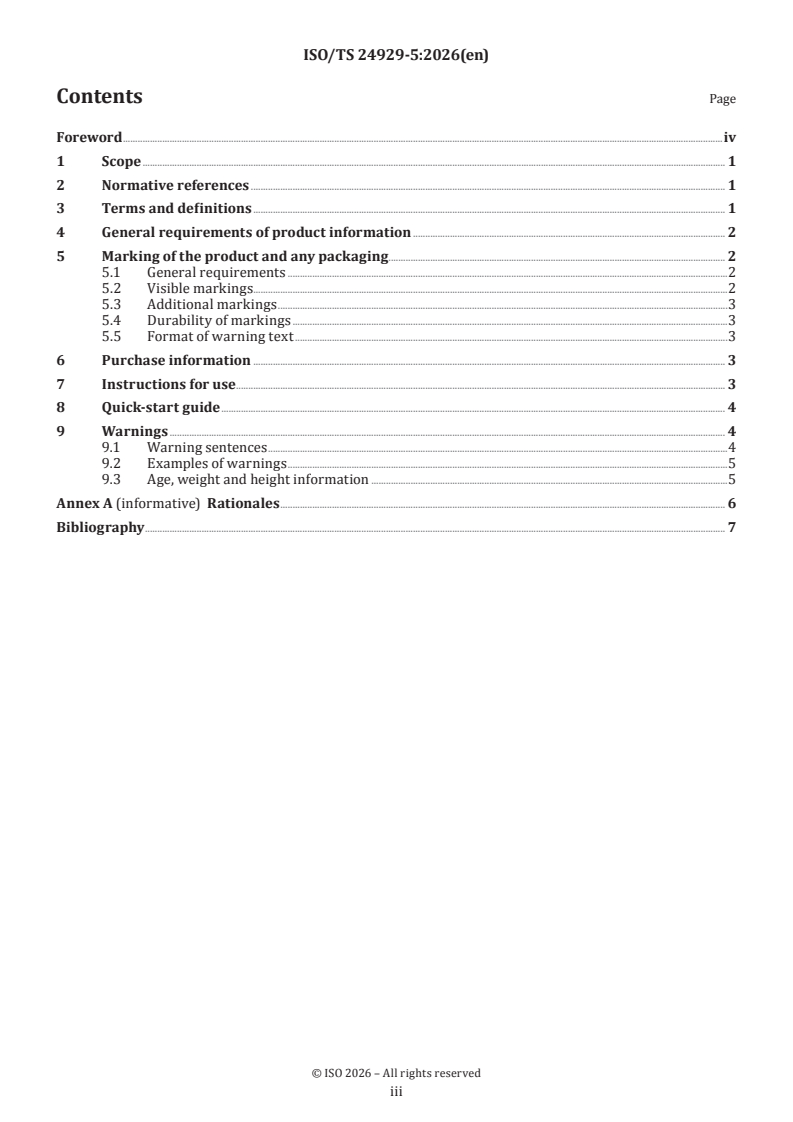
Contents Page
Foreword .iv
1 Scope . 1
2 Normative references . 1
3 Terms and definitions . 1
4 General requirements of product information . 2
5 Marking of the product and any packaging . 2
5.1 General requirements .2
5.2 Visible markings.2
5.3 Additional markings .3
5.4 Durability of markings .3
5.5 Format of warning text .3
6 Purchase information . 3
7 Instructions for use . . 3
8 Quick-start guide . 4
9 Warnings . 4
9.1 Warning sentences .4
9.2 Examples of warnings .5
9.3 Age, weight and height information .5
Annex A (informative) Rationales . 6
Bibliography . 7
iii
Foreword
ISO (the International Organization for Standardization) is a worldwide federation of national standards
bodies (ISO member bodies). The work of preparing International Standards is normally carried out through
ISO technical committees. Each member body interested in a subject for which a technical committee
has been established has the right to be represented on that committee. International organizations,
governmental and non-governmental, in liaison with ISO, also take part in the work. ISO collaborates closely
with the International Electrotechnical Commission (IEC) on all matters of electrotechnical standardization.
The procedures used to develop this document and those intended for its further maintenance are described
in the ISO/IEC Directives, Part 1. In particular, the different approval criteria needed for the different types
of ISO document should be noted. This document was drafted in accordance with the editorial rules of the
ISO/IEC Directives, Part 2 (see www.iso.org/directives).
ISO draws attention to the possibility that the implementation of this document may involve the use of (a)
patent(s). ISO takes no position concerning the evidence, validity or applicability of any claimed patent
rights in respect thereof. As of the date of publication of this document, ISO had not received notice of (a)
patent(s) which may be required to implement this document. However, implementers are cautioned that
this may not represent the latest information, which may be obtained from the patent database available at
www.iso.org/patents. ISO shall not be held responsible for identifying any or all such patent rights.
Any trade name used in this document is information given for the convenience of users and does not
constitute an endorsement.
For an explanation of the voluntary nature of standards, the meaning of ISO specific terms and expressions
related to conformity assessment, as well as information about ISO’s adherence to the World Trade
Organization (WTO) principles in the Technical Barriers to Trade (TBT), see www.iso.org/iso/foreword.html.
This document was prepared by Technical Committee ISO/TC 310, Child care articles.
A list of all parts in the ISO 24929 series can be found on the ISO website.
Any feedback or questions on this document should be directed to the user’s national standards body. A
complete listing of these bodies can be found at www.iso.org/members.html.
iv
Technical Specification ISO/TS 24929-5:2026(en)
Child care articles — General safety —
Part 5:
Product information
1 Scope
This document establishes good practices for drafting product information requirements in standards
related to child care articles. Annex A provides rationales for these requirements.
2 Normative references
There are no normative references in this document.
3 Terms and definitions
For the purposes of this document, the following terms and definitions apply.
ISO and IEC maintain terminology databases for use in standardization at the following addresses:
— ISO Online browsing platform: available at https:// www .iso .org/ obp
— IEC Electropedia: available at https:// www .electropedia .org/
3.1
product information
text, images, video, etc., provided in printed and/or digital formats that can accompany or be associated
with a specific child care article
Note 1 to entry: This includes marking of the product (3.2) and any packaging, purchase information (3.3) and
instructions for use (3.4).
3.2
marking of the product
product information (3.1) permanently attached to the child care article
Note 1 to entry: All markings belong to one of the categories “purchase information (3.3)” or “instructions for use (3.4)”,
or both.
3.3
purchase information
information provided at the point of sale that will enable the purchaser to make an informed choice before
purchasing the product
Note 1 to entry: This information may be on the product, its packaging and/or other points of sale, such as web pages
and mail order catalogues.
3.4
instructions for use
information provided regarding safe use of the product
Note 1 to entry: This may comprise information on safety, assembly, installation, operation, storage, maintenance,
repair, disposal, etc., where appropriate.
3.5
quick-start guide
printed document provided with the product that provides warnings regarding the safe
...