

ISO/FDIS 8537
(Main)Sterile single-use syringes, with or without needle, for insulin
- Abstract
ISO 8537:2016 specifies requirements and test methods for empty, sterile, single-use syringes, with or without needles, made of plastic materials and intended solely for the injection of insulin, with which the syringes are filled by the end user. This International Standard covers syringes intended for single-use only in humans and with insulins of various concentrations. The insulin syringes specified in this International Standard are intended for use (i.e. insulin injection) immediately after filling and are not intended to contain insulin for extended periods of time. ISO 8537:2016 excludes single-use syringes made of glass, syringes for use with power-driven syringe pumps, syringes that are pre-filled by the manufacturer, and syringes intended to be stored after filling (e.g. in a kit intended for filling by a pharmacist).
- Status
- Not Published
- Technical Committee
- ISO/TC 84 - Devices for administration of medicinal products and catheters
- Drafting Committee
- ISO/TC 84/WG 11 - Syringes
- Current Stage
- 5020 - Proof sent to secretariat or FDIS ballot initiated: 8 weeks - 50 Approval
- Start Date
- 16-Oct-2026
- Due Date
- 16-Oct-2026
- Completion Date
- 16-Oct-2026
Buy Documents
ISO/FDIS 8537 - Sterile single-use syringes, with or without needle, for insulin
REDLINE ISO/FDIS 8537 - Sterile single-use syringes, with or without needle, for insulin
ISO/FDIS 8537 - Seringues à insuline, stériles, non réutilisables, avec ou sans aiguille
ISO/FDIS 8537 is an ISO document for sterile single-use syringes, with or without needle, for insulin. It specifies requirements and test methods for empty plastic syringes that the end user fills immediately before use, so manufacturers, laboratories and buyers can assess design, safety, packaging, marking and performance for human insulin injection.
What does ISO/FDIS 8537 specify?
ISO/FDIS 8537 specifies requirements and test methods for empty, sterile, single-use insulin syringes made of plastic, with or without needles, for human use. It applies to syringes filled by the end user and intended for immediate insulin injection after filling.
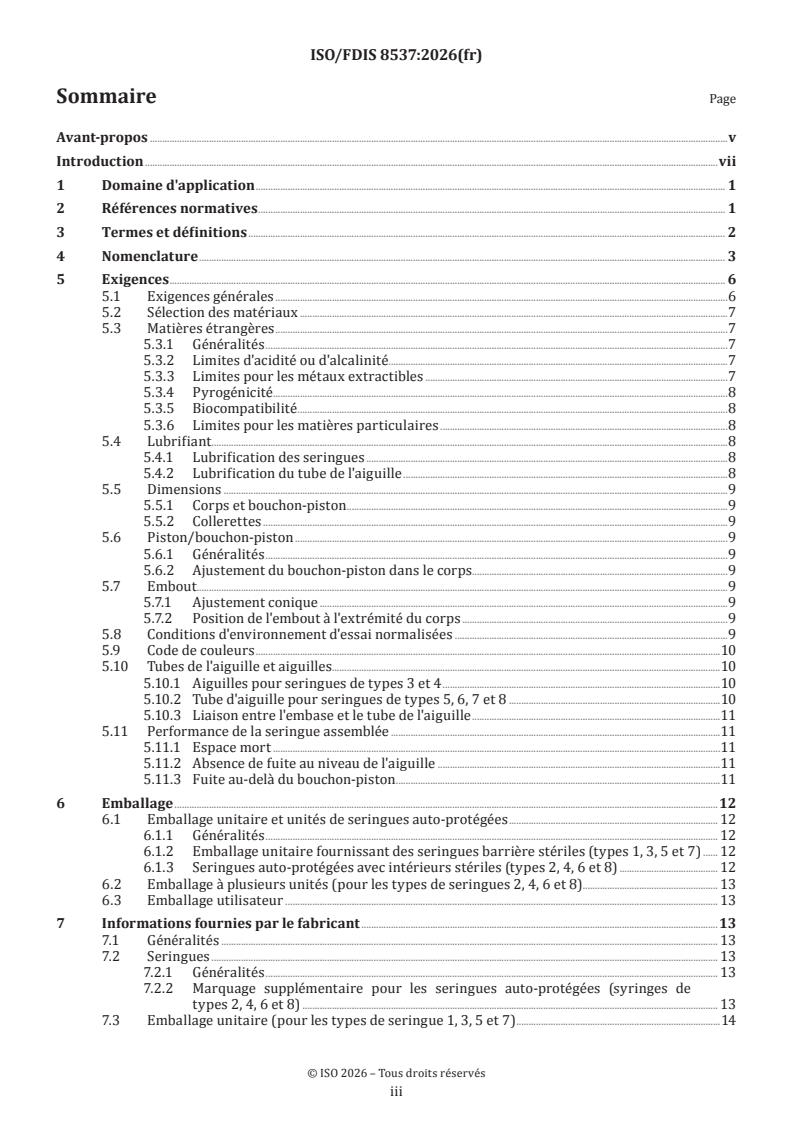
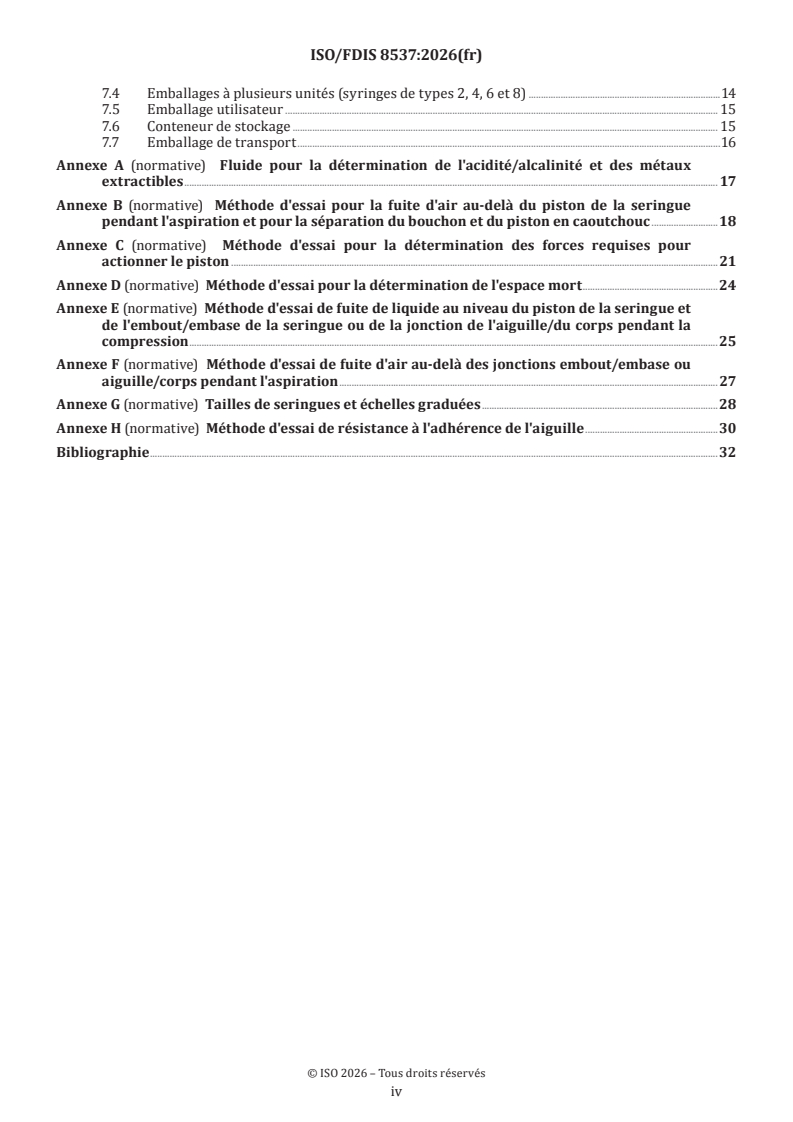
ISO/FDIS 8537 excludes glass syringes, syringes for power-driven syringe pumps, pre-filled syringes, and syringes intended to be stored after filling. The document is organized into Scope, Normative references, Terms and definitions, Nomenclature, Requirements, Packaging, and Information supplied by the manufacturer, followed by test and reference annexes.
| Annex | What it covers |
|---|---|
| Annex A | Fluid for acidity/alkalinity and extractable metals checks |
| Annex B | Air leakage past the piston during aspiration and separation of rubber stopper and plunger |
| Annex C | Force required to operate the piston |
| Annex D | Dead space determination |
| Annex E | Liquid leakage at the piston and at nozzle/hub or needle/barrel unions during compression |
| Annex F | Air leakage at nozzle/hub or needle/barrel unions during aspiration |
| Annex G | Syringe sizes and graduated scales |
| Annex H | Needle bonding strength test method |
What are the key requirements of ISO/FDIS 8537?
ISO/FDIS 8537 is performance-based: it focuses on safe use, correct insulin identification, biological safety, mechanical function, leakage control, packaging integrity and user information. In practice, manufacturers need to design the syringe system, the markings and the packaging together, then verify them with the prescribed tests.
Design, identification and usability
The standard requires risk mitigation for wrong-dose errors where multiple insulin concentrations and concentration-specific syringes exist. The syringe must show the intended insulin concentration visually, and should also do so by non-visual means such as tactile features.
Dedicated syringes for a specific insulin concentration must be visually differentiated and that differentiation must be justified by risk assessment and usability validation. The scale must correspond to units of only one insulin concentration, and the nominal capacity must be stated in millilitres. If the syringe is used with automated functions, sharps protection or a Luer attachment, the relevant companion standards apply.
Materials, cleanliness and biological safety
ISO/FDIS 8537 requires the barrel material to be clear enough to read doses and see air bubbles. Materials, lubricant and packaging must not reduce insulin performance or be adversely affected by insulin.
The syringe and needle surfaces that contact insulin must be clean and free from extraneous matter under specified visual inspection conditions. The document also sets checks for acidity/alkalinity and extractable metals through Annex A, addresses pyrogenicity using endotoxin testing references, and requires biocompatibility in line with ISO 10993-1.
Sub-visible particulate matter is limited, and lubricants are controlled so they do not create visible droplets or pools. The sterilization process for sterile interiors and unit packaging must achieve a sterility assurance level (SAL) of 10^-6, with shelf life studies and shipping validation used to show sterility is maintained.
Mechanical performance and leakage control
The barrel length must allow air bubbles to be expelled without reducing the nominal capacity, and the finger grips must stop the syringe rolling on a 10° incline. The plunger and push-button must allow thumb operation and the plunger stopper must not detach during the Annex B test.
The fit of the plunger stopper must prevent gravity-driven movement and keep the force to start expelling water within the specified limit, checked by Annex C. The nozzle on types with a male conical fitting must conform to ISO 80369-7, and the nozzle must be centered on the barrel.
The standard also requires no liquid leakage at the piston or at nozzle/hub or needle/barrel unions, and no air leakage in the corresponding aspiration tests. Dead space is classified as RDS, LDS or ULDS, with maximum values set by syringe type in Clause 5.11.1 and determined by Annex D.
Needle construction and colour coding
Needles for certain syringe types must conform to ISO 7864, and needle tubing for other types must conform to ISO 9626. The needle length is measured from the defined usable length, and the hub-to-needle bond must pass the strength test in Annex H.
Colour coding is part of the safety system. The barrel must remain clear, the graduation marks must contrast clearly, and the insulin concentration colour is carried on at least one syringe component and repeated on the packaging. The standard names dedicated colours for U40, U100, U200, U300, U400 and U500.
Packaging and manufacturer information
ISO/FDIS 8537 distinguishes unit packaging, self-contained syringes, multiple-unit packaging and user packaging. Packaging must protect sterility where required, prevent easy resealing once opened, and preserve the sterile barrier or sterile interior through normal handling, transit and storage.
The syringe, unit pack, multiple-unit pack and user packaging must carry specific information such as sterile status, single-use status, batch identification, insulin concentration, total capacity, needle size where relevant, manufacturer identification and expiration date. The labels and symbols are aligned with ISO 15223-1:2021.
What terms does ISO/FDIS 8537 define?
- Dead space - the liquid volume left in the syringe and needle after the plunger is fully depressed in normal use.
- Fiducial line - the leading edge of the plunger stopper that aligns with the zero marking when the piston is fully inserted.
- Nominal capacity - the capacity of the syringe as designated by the manufacturer.
- Total graduated capacity - the capacity at the graduation line farthest from zero.
- Self-contained syringe - a syringe with protective end caps that keep the interior sterile until one cap is removed.
- Unit packaging - packaging for one syringe, with or without a needle, that maintains sterility until opened.
- Multiple-unit packaging - packaging containing more than one self-contained syringe.
- User packaging - packaging that contains unit packs, self-contained syringes or multiple-unit packs, but is not intended to maintain sterility.
Who uses ISO/FDIS 8537?
ISO/FDIS 8537 is used by syringe manufacturers, component suppliers, test laboratories, quality teams, regulatory staff and procurement specialists. It is especially relevant to organizations making insulin syringes, needles, packaging and labeling systems.
In practice, these users apply it to design syringe formats, choose and qualify materials, validate sterilization and shipping, verify graduations and dead space, check leakage and piston force, and prepare compliant labels and instructions. Buyers and evaluators use it to compare products and confirm that a syringe type matches a specific insulin concentration and intended use.
What changed in ISO/FDIS 8537 from the previous edition?
ISO/FDIS 8537 is the fourth edition and replaces ISO 8537:2016. The foreword lists these main changes:
- A specific sterilization assurance level of 10^-6 is added, with shelf life studies and shipping validation for sterility maintenance.
- New safety topics are added for pyrogenicity, biocompatibility and sub-visible particulate matter.
- Lubricant quantity is limited on the syringe interior surface.
- Dead space is split into Regular Dead Space (RDS), Low Dead Space (LDS) and Ultra Low Dead Space (ULDS).
- Annex C is revised, including updated needle dimensions, tubing specifications and a defined test speed of 100 mm/min.
- Annex H adds a needle bonding strength test method.
- References to ISO 594-1 are replaced by ISO 80369-7.
- Colour coding is reorganized, and the introduction now includes U200 alongside U300 and U500 as higher-risk concentrations.
Which standards are used with ISO/FDIS 8537?
| Standard | How it contributes |
|---|---|
| ISO 3696 | Provides water quality for analytical and test procedures |
| ISO 7864 | Covers sterile hypodermic needles for single use |
| ISO 9626 | Covers stainless steel needle tubing |
| ISO 10993-1 | Sets the biological evaluation framework for syringe materials |
| ISO 11608-1 | Applies when syringes are used with needle-based injection system functions |
| ISO 11608-5 | Applies when automated functions are included |
| ISO 14971 | Supports risk management for wrong-dose prevention and design decisions |
| ISO 15223-1:2021 | Supports symbols and label information on packs and devices |
| ISO 23908 | Applies to sharps protection mechanisms |
| ISO 80369-7 | Defines the small-bore connector requirements for Luer-type fittings |
| IEC 62366-1 | Supports usability engineering for concentration identification and safe use |
| ISO/TR 19244 | Gives transition-period guidance mentioned in the introduction |
Annexes also refer to AAMI/ST72, USP <85>, USP <161>, USP <788>, Ph.Eur. 2.6.14 and JP 4.01 for endotoxin, pyrogen and particulate matter-related testing.
What does the ISO/FDIS 8537 document contain?
ISO/FDIS 8537 contains the full set of design and verification elements for insulin syringes: nomenclature, type definitions, packaging categories, marking requirements and test methods. It includes visual figures for the syringe layout and for test apparatus, plus tables for syringe types, dead space limits, bond strength limits and example graduation scales.
The annexes provide the practical procedures a laboratory or manufacturer would use to check cleanliness, piston operation, dead space, leakage and needle bonding strength. That makes the document useful both for product development and for final design verification before market release.
Relations
- Consolidates
FprEN ISO 8537 - Sterile single-use syringes, with or without needle, for insulin (ISO/FDIS 8537:2026) - Effective Date
- 12-Feb-2026
- Effective Date
- 17-Aug-2024
- Effective Date
- 06-Jun-2022
Buy Documents
ISO/FDIS 8537 - Sterile single-use syringes, with or without needle, for insulin
REDLINE ISO/FDIS 8537 - Sterile single-use syringes, with or without needle, for insulin
ISO/FDIS 8537 - Seringues à insuline, stériles, non réutilisables, avec ou sans aiguille
Get Certified
Connect with accredited certification bodies for this standard

BSI Group
BSI (British Standards Institution) is the business standards company that helps organizations make excellence a habit.

TÜV Rheinland
TÜV Rheinland is a leading international provider of technical services.

TÜV SÜD
TÜV SÜD is a trusted partner of choice for safety, security and sustainability solutions.
Sponsored listings
Frequently Asked Questions
ISO/FDIS 8537 is a draft published by the International Organization for Standardization (ISO). Its full title is "Sterile single-use syringes, with or without needle, for insulin". This standard covers: ISO 8537:2016 specifies requirements and test methods for empty, sterile, single-use syringes, with or without needles, made of plastic materials and intended solely for the injection of insulin, with which the syringes are filled by the end user. This International Standard covers syringes intended for single-use only in humans and with insulins of various concentrations. The insulin syringes specified in this International Standard are intended for use (i.e. insulin injection) immediately after filling and are not intended to contain insulin for extended periods of time. ISO 8537:2016 excludes single-use syringes made of glass, syringes for use with power-driven syringe pumps, syringes that are pre-filled by the manufacturer, and syringes intended to be stored after filling (e.g. in a kit intended for filling by a pharmacist).
ISO 8537:2016 specifies requirements and test methods for empty, sterile, single-use syringes, with or without needles, made of plastic materials and intended solely for the injection of insulin, with which the syringes are filled by the end user. This International Standard covers syringes intended for single-use only in humans and with insulins of various concentrations. The insulin syringes specified in this International Standard are intended for use (i.e. insulin injection) immediately after filling and are not intended to contain insulin for extended periods of time. ISO 8537:2016 excludes single-use syringes made of glass, syringes for use with power-driven syringe pumps, syringes that are pre-filled by the manufacturer, and syringes intended to be stored after filling (e.g. in a kit intended for filling by a pharmacist).
ISO/FDIS 8537 is classified under the following ICS (International Classification for Standards) categories: 11.040.25 - Syringes, needles and catheters. The ICS classification helps identify the subject area and facilitates finding related standards.
ISO/FDIS 8537 has the following relationships with other standards: It is inter standard links to FprEN ISO 8537, ISO 4931-1:2024, ISO 8537:2016. Understanding these relationships helps ensure you are using the most current and applicable version of the standard.
ISO/FDIS 8537 is available in PDF format for immediate download after purchase. The document can be added to your cart and obtained through the secure checkout process. Digital delivery ensures instant access to the complete standard document.
Standards Content (Sample)
FINAL DRAFT
International
Standard
ISO/TC 84
Sterile single-use syringes, with or
Secretariat: DS
without needle, for insulin
Voting begins on:
Seringues à insuline, stériles, non réutilisables, avec ou sans 2026-10-16
aiguille
Voting terminates on:
2026-12-11
RECIPIENTS OF THIS DRAFT ARE INVITED TO SUBMIT,
WITH THEIR COMMENTS, NOTIFICATION OF ANY
RELEVANT PATENT RIGHTS OF WHICH THEY ARE AWARE
AND TO PROVIDE SUPPOR TING DOCUMENTATION.
IN ADDITION TO THEIR EVALUATION AS
BEING ACCEPTABLE FOR INDUSTRIAL, TECHNO
ISO/CEN PARALLEL PROCESSING LOGICAL, COMMERCIAL AND USER PURPOSES, DRAFT
INTERNATIONAL STANDARDS MAY ON OCCASION HAVE
TO BE CONSIDERED IN THE LIGHT OF THEIR POTENTIAL
TO BECOME STAN DARDS TO WHICH REFERENCE MAY BE
MADE IN NATIONAL REGULATIONS.
Reference number
FINAL DRAFT
International
Standard
ISO/TC 84
Sterile single-use syringes, with or
Secretariat: DS
without needle, for insulin
Voting begins on:
Seringues à insuline, stériles, non réutilisables, avec ou sans
aiguille
Voting terminates on:
© ISO 2026
All rights reserved.
RECIPIENTS OF THIS DRAFT ARE INVITED TO SUBMIT,
WITH THEIR COMMENTS, NOTIFICATION OF ANY
This ISO publication is protected by copyright and is owned by ISO and/or its licensors.
RELEVANT PATENT RIGHTS OF WHICH THEY ARE AWARE
The content of this ISO publication is provided under licence, not sold. Use is subject to the applicable licence terms issued by ISO,
AND TO PROVIDE SUPPOR TING DOCUMENTATION.
an ISO member body, or an authorized third-party distributor.
IN ADDITION TO THEIR EVALUATION AS
BEING ACCEPTABLE FOR INDUSTRIAL, TECHNO
Except as required for implementation or expressly permitted by a separate licence, no part of this ISO publication may be
ISO/CEN PARALLEL PROCESSING
LOGICAL, COMMERCIAL AND USER PURPOSES, DRAFT
reproduced, distributed, modified, used, or made available in any form or by any means – electronic or mechanical, including
INTERNATIONAL STANDARDS MAY ON OCCASION HAVE
photocopying, scanning, recording, or posting on internal or external digital platforms. TO BE CONSIDERED IN THE LIGHT OF THEIR POTENTIAL
TO BECOME STAN DARDS TO WHICH REFERENCE MAY BE
Any use beyond the scope of the granted rights is prohibited and may result in legal action.
MADE IN NATIONAL REGULATIONS.
ISO copyright office
CP 401 • CH-1214 Vernier, Geneva
Phone: +41 22 749 01 11
Email: copyright@iso.org
Website: www.iso.org
Published in Switzerland
Reference number
ii
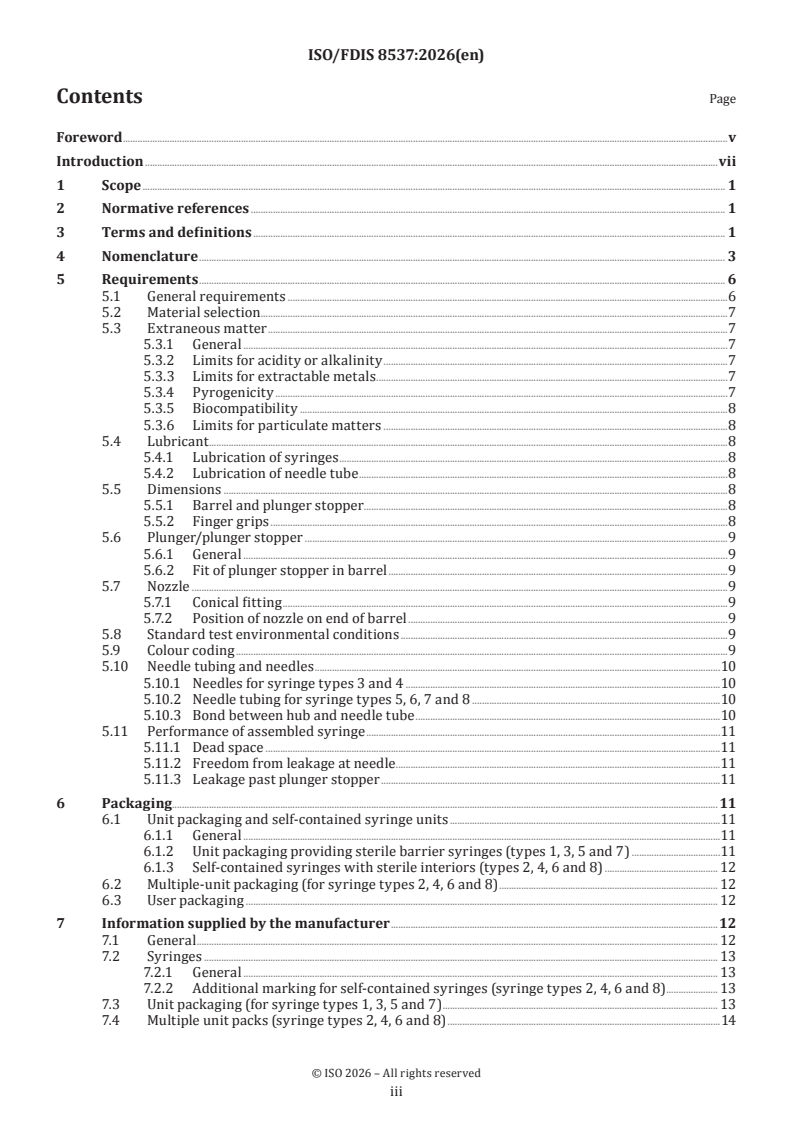
Contents Page
Foreword .v
Introduction .vii
1 Scope . 1
2 Normative references . 1
3 Terms and definitions . 1
4 Nomenclature . 3
5 Requirements . 6
5.1 General requirements .6
5.2 Material selection .7
5.3 Extraneous matter .7
5.3.1 General .7
5.3.2 Limits for acidity or alkalinity .7
5.3.3 Limits for extractable metals .7
5.3.4 Pyrogenicity .7
5.3.5 Biocompatibility .8
5.3.6 Limits for particulate matters .8
5.4 Lubricant .8
5.4.1 Lubrication of syringes .8
5.4.2 Lubrication of needle tube .8
5.5 Dimensions .8
5.5.1 Barrel and plunger stopper .8
5.5.2 Finger grips .8
5.6 Plunger/plunger stopper .9
5.6.1 General .9
5.6.2 Fit of plunger stopper in barrel .9
5.7 Nozzle .9
5.7.1 Conical fitting .9
5.7.2 Position of nozzle on end of barrel .9
5.8 Standard test environmental conditions .9
5.9 Colour coding .9
5.10 Needle tubing and needles .10
5.10.1 Needles for syringe types 3 and 4 .10
5.10.2 Needle tubing for syringe types 5, 6, 7 and 8 .10
5.10.3 Bond between hub and needle tube .10
5.11 Performance of assembled syringe .11
5.11.1 Dead space .11
5.11.2 Freedom from leakage at needle .11
5.11.3 Leakage past plunger stopper .11
6 Packaging.11
6.1 Unit packaging and self-contained syringe units .11
6.1.1 General .11
6.1.2 Unit packaging providing sterile barrier syringes (types 1, 3, 5 and 7) .11
6.1.3 Self-contained syringes with sterile interiors (types 2, 4, 6 and 8) . 12
6.2 Multiple-unit packaging (for syringe types 2, 4, 6 and 8) . 12
6.3 User packaging . 12
7 Information supplied by the manufacturer .12
7.1 General . 12
7.2 Syringes . 13
7.2.1 General . 13
7.2.2 Additional marking for self-contained syringes (syringe types 2, 4, 6 and 8) . 13
7.3 Unit packaging (for syringe types 1, 3, 5 and 7) . 13
7.4 Multiple unit packs (syringe types 2, 4, 6 and 8) .14
iii
7.5 User packaging .14
7.6 Storage container . 15
7.7 Transport wrapping . . 15
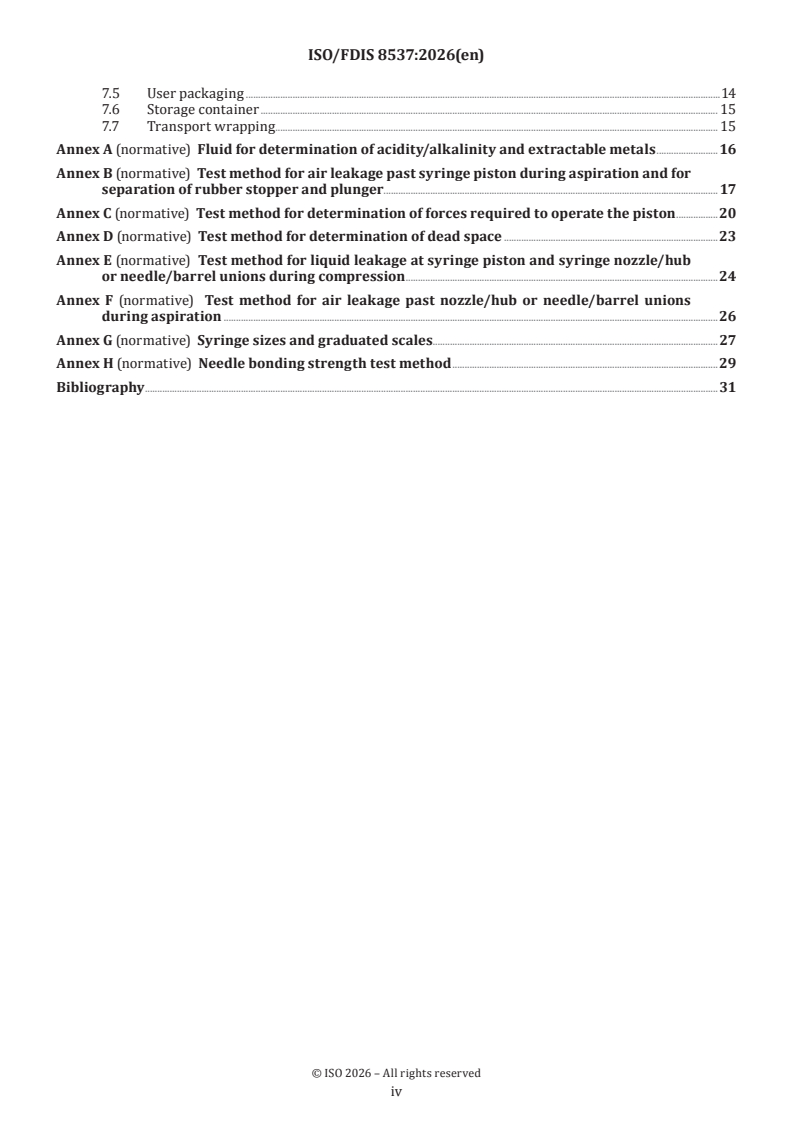
Annex A (normative) Fluid for determination of acidity/alkalinity and extractable metals .16
Annex B (normative) Test method for air leakage past syringe piston during aspiration and for
separation of rubber stopper and plunger . 17
Annex C (normative) Test method for determination of forces required to operate the piston .20
Annex D (normative) Test method for determination of dead space .23
Annex E (normative) Test method for liquid leakage at syringe piston and syringe nozzle/hub
or needle/barrel unions during compression .24
Annex F (normative) Test method for air leakage past nozzle/hub or needle/barrel unions
during aspiration .26
Annex G (normative) Syringe sizes and graduated scales.27
Annex H (normative) Needle bonding strength test method .29
Bibliography .31
iv
Foreword
ISO (the International Organization for Standardization) is a worldwide federation of national standards
bodies (ISO member bodies). The work of preparing International Standards is normally carried out through
ISO technical committees. Each member body interested in a subject for which a technical committee
has been established has the right to be represented on that committee. International organizations,
governmental and non-governmental, in liaison with ISO, also take part in the work. ISO collaborates closely
with the International Electrotechnical Commission (IEC) on all matters of electrotechnical standardization.
The procedures used to develop this document and those intended for its further maintenance are described
in the ISO/IEC Directives, Part 1. In particular, the different approval criteria needed for the different types
of ISO documents should be noted. This document was drafted in accordance with the editorial rules of the
ISO/IEC Directives, Part 2 (see www.iso.org/directives).
ISO draws attention to the possibility that the implementation of this document may involve the use of (a)
patent(s). ISO takes no position concerning the evidence, validity or applicability of any claimed patent
rights in respect thereof. As of the date of publication of this document, ISO had not received notice of (a)
patent(s) which may be required to implement this document. However, implementers are cautioned that
this may not represent the latest information, which may be obtained from the patent database available at
www.iso.org/patents. ISO shall not be held responsible for identifying any or all such patent rights.
Any trade name used in this document is information given for the convenience of users and does not
constitute an endorsement.
For an explanation of the voluntary nature of standards, the meaning of ISO specific terms and expressions
related to conformity assessment, as well as information about ISO’s adherence to the World Trade
Organization (WTO) principles in the Technical Barriers to Trade (TBT), see www.iso.org/iso/foreword.html.
This document was prepared by Technical Committee ISO/TC 84, Devices for administration of medicinal
products and catheters, in collaboration with the European Committee for Standardization (CEN) Technical
Committee CEN/TC 205, Non-active medical devices, in accordance with the Agreement on technical
cooperation between ISO and CEN (Vienna Agreement).
This fourth edition cancels and replaces the third edition (ISO 8537:2016), which has been technically
revised.
The main changes are as follows:
−6
— Sterilization requirements: this document adds a specific SAL of 10 and requires shelf life studies and
shipping validation to demonstrate sterility maintenance requirements.
— New safety requirements: Three entirely new subclauses address pyrogenicity (referencing LAL testing
per AAMI/ST72, USP <85>, and Ph.Eur.), biocompatibility per ISO 10993, and sub-visible particulate
matter limits (≥10 µm: 3,000 max/syringe; ≥25 µm: 300 max/syringe).
— Quantitative lubrication limit: Maximum lubricant quantity of 0,25 mg/cm of interior surface area.
— Dead space classification: The single dead space limit per syringe type in the 2016 standard is replaced
by a three-tier system Regular (RDS), Low (LDS), and Ultra Low (ULDS) offering more granular
performance options.
— Revised piston force test (Annex C): this document standardizes the test with updated needle dimensions,
tubing specifications, and a defined test speed of 100 ± 5 mm/min.
— New needle bonding Annex: a new informative annex (Annex H) provides a complete tensile test method
for needle-to-hub bonding strength.
— Connector standard update: references to ISO 594-1 are replaced throughout with ISO 80369-7, reflecting
the updated small-bore connector standard and affecting nozzle fitting requirements and test apparatus
specifications.
v
— Structural reorganization: Colour coding is relocated from 5.3 to 5.8, syringe types are reframed as
“Nomenclature”, and the Introduction is updated to explicitly include U200 as a higher-risk concentration
alongside U300 and U500.
Any feedback or questions on this document should be directed to the user’s national standards body. A
complete listing of these bodies can be found at www.iso.org/members.html.
vi
Introduction
This document covers insulin syringes primarily intended for human use and provides performance and
testing requirements. It permits broader variation in design so as to not limit innovation in technology or
methods of packaging. Its appearance and layout are consistent with other ISO/TC 84 documents, which are
designed to be more performance-based than design-prescriptive.
Manufacturers are expected to follow a risk-based approach and employ usability engineering during the
design, development and manufacture of insulin syringes.
This edition introduces general requirements as design guidelines for manufacturers. This edition retains a
number of limits on requirements, which were originally based on consensus opinion but subsequently have
been confirmed in practice.
This document does not specify materials to be used for the construction and lubrication of sterile
insulin syringes and needles for single use because their selection will depend, to some extent, upon the
manufacturer’s specific syringe design, process of manufacture, and sterilization method.
Insulin syringes and needles are manufactured and sterilized in accordance with recognized national or
international codes of good manufacturing practice for medical devices.
This document emphasises the importance of having individual syringes that are appropriately graduated
and labelled for only one concentration of insulin. Serious problems can result if a syringe is used with a
concentration of insulin that is different from the one for which it was designed. Hazards associated with
dosing errors with highly concentrated insulin (U200, U300 and U500) are more severe than with U40 and
U100.
It is preferred that when more than one insulin concentration is in a market, the new concentration be
provided in a dedicated delivery system that makes mis-dosing less likely.
In acknowledgement that vials with higher concentrations of insulin are available in some markets, new
formulations are under development and dedicated delivery systems other than syringes are not always
appropriate for all markets, this document introduces new colour codes to differentiate syringes for the new
higher concentrations of insulin.
The sampling plans for inspection selected for this document are intended to verify the design at a high
confidence level. The sampling plans for inspection do not replace the more general manufacturing quality
systems that appear in quality management systems, e.g. ISO 9001 or ISO 13485.
Guidance on transition periods for implementing the requirements of this document is given in ISO/TR 19244.
vii
FINAL DRAFT International Standard ISO/FDIS 8537:2026(en)
Sterile single-use syringes, with or without needle, for insulin
1 Scope
This document specifies requirements and test methods for empty, sterile, single-use syringes, with or
without needles, made of plastic materials and intended solely for the injection of insulin, with which the
syringes are filled by the end user. This document covers syringes intended for single-use only in humans
and with insulins of various concentrations.
The insulin syringes specified in this document are intended for use (i.e. insulin injection) immediately after
filling and are not intended to contain insulin for extended periods of time.
This document excludes single-use syringes made of glass, syringes for use with power-driven syringe
pumps, syringes that are pre-filled by the manufacturer, and syringes intended to be stored after filling (e.g.
in a kit intended for filling by a pharmacist).
2 Normative references
The following documents are referred to in the text in such a way that some or all of their content constitutes
requirements of this document. For dated references, only the edition cited applies. For undated references,
the latest edition of the referenced document (including any amendments) applies.
ISO 3696, Water for analytical laboratory use — Specification and test methods
ISO 7864, Sterile hypodermic needles for single use
ISO 9626, Stainless steel needle tubing for the manufacture of medical devices
ISO 10993-1, Biological evaluation of medical devices — Part 1: Requirements and general principles for the
evaluation of biological safety within a risk management process
ISO 11608-1, Needle-based injection systems for medical use — Requirements and test methods — Part 1:
Needle-based injection systems
ISO 11608-5, Needle-based injection systems for medical use — Requirements and test methods — Part 5:
Automated functions
ISO 14971, Medical devices — Application of risk management to medical devices
ISO 15223-1:2021, Medical devices — Symbols to be used with information to be supplied by the manufacturer —
Part 1: General requirements
ISO 23908, Sharps injury protection — Sharps protection mechanisms for single-use needles, introducers for
catheters and needles used for blood testing, monitoring, sampling and medical substance administration —
Requirements and test methods
ISO 80369-7, Small-bore connectors for liquids and gases in healthcare applications — Part 7: Connectors for
intravascular or hypodermic applications
IEC 62366-1, Medical devices — Part 1: Application of usability engineering to medical devices
3 Terms and definitions
For the purposes of this document, the following terms and definitions apply.
ISO and IEC maintain terminology databases for use in standardization at the following addresses:
— ISO Online browsing platform: available at https:// www .iso .org/ obp
— IEC Electropedia: available at https:// www .electropedia .org/
3.1
dead space
volume of liquid left in the syringe and needle, where supplied with the syringe, when the plunger is fully
depressed during normal use
3.2
fiducial line
leading edge of the plunger stopper (3.14), which is in contact with and perpendicular to the syringe barrel
and aligns with the zero marking on the syringe barrel when the piston is fully inserted
3.3
nominal capacity
capacity of the syringe as designated by the manufacturer
3.4
total graduated capacity
capacity of the syringe at the graduation line farthest from the zero graduation line
Note 1 to entry: The total graduated capacity can be equal to, or greater than, the nominal capacity (3.3).
3.5
self-contained syringe
syringe with protective end caps intended to maintain the sterility of the interior of the syringe until one of
the caps is removed
3.6
unit packaging
package containing a single syringe, with or without a needle, which maintains the sterility of the contents
until the package is opened
3.7
multiple-unit packaging
package containing more than one self-contained syringe (3.5)
3.8
user packaging
packaging which contains one or more items of unit packaging (3.6) or self-contained syringes (3.5) or
multiple-unit packaging (3.7), but not intended to maintain sterility of the contents
3.9
needle cap
cover intended to protect physically the needle tube prior to use
3.10
needle length
usable length of needle
Note 1 to entry: Needle length is shown in Figure 1.
Key
1 needle length
Figure 1 — Needle length
3.11
nozzle cap
sheath intended to protect physically the needle hub prior to use
3.12
piston
assembled component of plunger and plungerstopper (3.14)
3.13
plunger cap
cover intended to maintain the sterility of the syringe and to enclose the projecting portion of the plunger
and push button, if present
3.14
plunger stopper
component connected to the leading end of the plunger and which seals the open end of the syringe barrel
Note 1 to entry: Protective end caps may be plunger cap (3.13), nozzle cap (3.11) or needle cap (3.9).
4 Nomenclature
The type of syringe shall be designated as follows (see also Figure 2):
— Type 1; syringe having a 6 % (Luer) male conical fitting, supplied with no needle and packaged in unit
packaging.
— Type 2; syringe having a 6 % (Luer) male conical fitting, supplied with no needle and fitted with protective
plunger and nozzle caps and packaged.
— Type 3; syringe having a 6 % (Luer) male conical fitting and supplied with a detached or detachable
needle and packaged in a unit packaging.
— Type 4; syringe having a 6 % (Luer) male conical fitting and supplied with a detachable needle and fitted
with protective plunger and needle caps and packaged.
— Type 5; syringe having a fitting other than a 6 % (Luer) taper, supplied with a needle not intended to be
detached and packaged in a unit packaging.
— Type 6; syringe having a fitting other than a 6 % (Luer) taper, supplied with a needle not intended to be
detached and fitted with protective caps and packaged.
— Type 7; syringe with fixed needle tube and packaged in a unit packaging.
— Type 8; syringe with fixed needle tube and fitted with protective end caps and packaged.
Key
1 needle cap
2 nozzle cap
3 nozzle lumen
4 nozzle
5 barrel
6 plunger stopper
7 seals
8 plunger
9 push-button
10 plunger cap
11 finger grips
12 fiducial line
13 nominal capacity
14 graduation lines
15 zero line
16 needle tube
17 hub
NOTE This figure is only intended to be illustrative of the components of a syringe. The piston might or might not
be of integral construction and might incorporate more than one seal.
Figure 2 — Schematic representation of insulin syringe for single use
NOTE This document provides designations for eight types of syringes to encompass different product
configurations, but the number of types in use in a particular country is likely to be fewer than eight.
5 Requirements
5.1 General requirements
The following general requirements concern the design of syringes and shall be followed by (or apply to)
manufacturers.
a) Given the likelihood that multiple insulin concentrations and concentration-specific syringes will exist
in a particular country or locality, the manufacturer shall develop risk mitigation strategies to minimize
the occurrence of “wrong dose” medication errors.
b) The syringe shall indicate, through visual means, the insulin concentration it is intended to contain.
The insulin syringes should also indicate, through non-visual means (e.g. tactile), the insulin
concentration they are intended to contain.
c) Syringes designed to contain a specific concentration of insulin (e.g. U-100) shall be adequately
differentiated visually from other dedicated syringes. This differentiation shall be determined based on
a risk assessment and confirmed through usability validation testing.
d) The syringe and needle should be free from defects affecting safety, serviceability for their intended
use, and appearance.
e) The syringe scale shall be graduated in increments corresponding to units of only one concentration
of insulin. The syringe scale graduation and numbering increments shall be determined through risk
analysis and confirmed through usability validation testing.
NOTE Annex G offers guidance for graduation and numbering increments on U-40 and U-100 syringes.
f) The nominal capacity of the syringe shall be designated in millilitres (ml).
g) The tolerances on the graduated capacity shall be in accordance with Table G.1.
h) Syringes indicated for use with devices or accessories that provide automated functions (e.g. needle
insertion and retraction) shall conform with applicable requirements of ISO 11608-1 and ISO 11608-5.
i) Syringes with integrated or add-on sharps protection shall conform with ISO 23908.
j) Syringes with Luer attachment features shall conform with ISO 80369-7.
k) The length of the barrel shall be sufficient to allow the expulsion of any air bubbles without affecting the
syringe’s nominal capacity.
NOTE Conformity with this requirement can be achieved, for example, by meeting the requirements in 5.6.1.
l) The syringe’s finger grips shall be of adequate size, shape and strength for the intended purpose. The
design specifications for the finger grips shall be determined through risk analysis and confirmed
through usability validation testing.
m) The materials used in the syringe shall be tested and qualified according to ISO 10993-1.
n) The self-contained syringes with sterile interiors and syringes provided in its unit packaging shall have
−6
been subjected to a validated sterilization process resulting in a sterility assurance level (SAL) of 10 .
The packaging shall ensure the content sterility until end of shelf life through shelf life studies including
a shipping validation.
o) The materials shall satisfy acceptable levels of pyrogens and toxins appropriate to the intended use of
the product.
NOTE Testing for these properties is described in Annex G.
5.2 Material selection
With regard to material selection:
— materials used for fabrication of the syringe barrel shall be of sufficient clarity to enable dosages to be
read and for air bubbles to be seen without difficulty;
— materials used for fabrication of syringes and needles (including lubricant) and packaging shall not, in
their final form after sterilization and under conditions of intended use, adversely affect the efficacy,
safety and acceptability of insulin preparations. The fabrication materials shall also not be affected,
either physically or chemically, by insulin preparations.
5.3 Extraneous matter
5.3.1 General
The surfaces of the syringe and needle that come in contact with insulin shall be clean and free from
extraneous matter when inspected without magnification, with normal or corrected to normal vision under
an illuminance of minimum 500 lx, and from a reading distance of between 30 cm and 70 cm.
NOTE 1 Conformance with this requirement is determined through inspection by an individual with normal vision
(or corrected-to-normal vision), without magnification.
NOTE 2 The lighting levels chosen for this subclause were the lighting levels listed in ISO 8995-1 expected to be
seen in inspection areas in the chemical, plastics or rubber industry.
5.3.2 Limits for acidity or alkalinity
Exposure of distilled water to the finished syringe product shall not change its pH value by more than one
unit.
This requirement shall be demonstrated by preparing the solutions described in Annex A. The results shall
show that the pH value of the syringe assessment fluid is within one pH unit of the pH value of the control
fluid.
NOTE The pH value of both solutions can be determined with a laboratory potentiometric pH meter using a
general purpose electrode.
5.3.3 Limits for extractable metals
Exposure of distilled water to the finished syringe product shall not change its content of metals by more
than a combined total of 5 mg/kg of lead, tin, zinc and iron; the cadmium content shall be less than 0,1 mg/
kg.
This shall be checked by preparing the solutions described in Annex A and testing them using a recognized
micro-analytical method, for example, by an atomic absorption method.
5.3.4 Pyrogenicity
Pyrogenicity mediated by endotoxin can be measured by an endotoxin-specific LAL (Limulus Amebocyte
Lysate) test, referring to the specific test given in AAMI/ST72 as suggested by ISO 10993-11:2017, Annex G.
Other references to this test can be found in USP <85> and/or EU pharmacopeia.
Extraction method and testing are specified in regional and national pharmacopoeias:
— for extraction method, see USP <161>;
— for testing, see Ph.Eur., 2.6.14, method c), USP <85> and JP 4.01.
5.3.5 Biocompatibility
Biocompatibility evaluation of syringes shall be in conformity with ISO 10993-1.
5.3.6 Limits for particulate matters
Sterilized syringes shall be manufactured by processes that reduce the risk of particulate contamination of
the intended content.
The particle-related specifications given in pharmacopoeias (e.g. Ph.Eur., USP, JP) do not apply to empty
containers but to show a certain cleanliness level, specifications have been set.
For sub-visible particles, the following applies:
— particles ≥10 µm: 3 000 max. per syringe.
— particles ≥25 µm: 300 max. per syringe.
NOTE These limits have been derived from the USP <788> (small volume parenteral) limit values for filled
containers with a nominal volume of less than 100 ml. The limits, which is 50 % of the USP <788>, have been chosen
based on historical proven capability using the light obscuration method as given in Annex G.
5.4 Lubricant
5.4.1 Lubrication of syringes
For lubricants applied to the interior surface of the syringe, the quantity of lubricant applied shall not exceed
0,25 mg/cm of the interior surface area of the syringe in contact with the injection fluid. If the interior
surfaces of the syringe, including the plunger stopper, are lubricated, the lubricant shall not form pools of
fluid on the interior surface of the syringe.
5.4.2 Lubrication of needle tube
If the needle tube is lubricated, the lubricant shall not be visible to an individual with normal or corrected-
to-normal vision under an illuminance of min. 500 lx, as droplets of fluid on the outside surfaces of the
needle tube.
5.5 Dimensions
5.5.1 Barrel and plunger stopper
The barrel length shall be such that the syringe has a usable capacity of either 10 % more than the nominal
capacity or 3 mm of plunger travel beyond the scale marking, whichever is less.
5.5.2 Finger grips
The open end of the barrel shall be provided with finger grips that prevent the syringe from rolling when the
axis of the barrel is placed perpendicular to the incline of a flat surface angled at 10° from horizontal.
5.6 Plunger/plunger stopper
5.6.1 General
The design of the plunger and push-button on the end of the plunger shall be such that when the barrel is
held in one hand, the plunger can be depressed by the thumb of that hand. The plunger stopper shall not
become detached from the plunger during the test described in Annex B.
The projection of the plunger and the configuration of the push-button should be such as to enable the
plunger, when in the fully inserted position, to be grasped and drawn back without difficulty.
5.6.2 Fit of plunger stopper in barrel
When the syringe is filled with water and then held in both vertical orientations (i.e. with the needle end
either up or down), the plunger shall not move by the force of gravity acting on the combined mass of
the plunger and the water in the barrel. When a needle is secured to the syringe in accordance with the
instructions provided by the manufacturer, the force required to initiate movement of the plunger to expel
water from the syringe shall not exceed 15 N.
This shall be checked by using the method described in Annex C.
The fit of the plunger stopper in the barrel should be such that the plunger stopper slides smoothly
throughout the full range of its travel within the barrel.
5.7 Nozzle
5.7.1 Conical fitting
The male conical fitting of the syringe nozzle on syringe types 1, 2, 3 and 4 shall conform with the
requirements of ISO 80369-7.
5.7.2 Position of nozzle on end of barrel
The syringe nozzle shall be situated centrally, i.e. shall be co-axial with the barrel.
5.8 Standard test environmental conditions
Unless otherwise specified, measurements shall be performed under the following atmospheric conditions:
— temperature between 18 °C and 28 °C;
— relative humidity between 25 % RH and 75 % RH.
Testing shall be performed after samples have been stored under these conditions for at least 4 h.
5.9 Colour coding
Colour coding of syringes intended for dedicated use with specific insulin concentrations is as follows:
— The barrel of the insulin syringe shall be clear, with graduation markings of a colour that contrasts
clearly with the syringe.
— The colour used to indicate the insulin concentration shall appear on at least one component of the syringe
(e.g. needle cap, plunger cap, plunger, a portion of the barrel that does not interfere with visibility of the
graduation lines).
— For insulin syringes with fixed needles, the colour of the needle cap shall be the colour designated for the
insulin concentration.
— The colour coding used on the syringes shall be repeated and explained on the user packaging and, if
applicable, on the unit packaging.
NOTE 1 The presence of colour coding on a syringe or package does not absolve the user of the responsibility
to check the marked insulin concentration of the syringe.
— No additional colours, other than black and white, shall be used on the syringe barrel.
NOTE 2 In acknowledgement of the fact that established syringes on the market use red to indicate the U40
insulin strength on the barrel, these syringes are exempted.
— The dedicated colours used to indicate insulin concentration shall be the following:
— red for U40;
— orange for U100.
The following colours are given in order to prevent regional variation and to prevent the use of the same
colour for different concentrations and different colours for the same concentration:
— light blue for U200;
— yellow for U300;
— purple for U400;
— green for U500.
For the newly introduced colours and for any new colour selected, the complete information provided for the
user shall be assessed for risk according to ISO 14971 and for usability according to IEC 62366-1.
NOTE 3 These colour restrictions do not apply to detachable needles.
5.10 Needle tubing and needles
5.10.1 Needles for syringe types 3 and 4
Needles for syringe types 3 and 4 shall be in accordance with ISO 7864.
5.10.2 Needle tubing for syringe types 5, 6, 7 and 8
Needle tubing for syringe types 5, 6, 7 and 8 shall be in accordance with ISO 9626.
The needle point shall be in accordance with ISO 7864.
The needle length shall be measured as shown in Figure 1 and the tolerance of the needle length shall be
within ±1,25 mm.
5.10.3 Bond between hub and needle tube
The bond between the hub and needle tube shall withstand at least the strength forces shown in Table 1. See
also Annex H.
Table 1 — Minimum strength of bond between hub and needle tube for different needle sizes
Nominal outside diameter of needle Minimum shearing strength
mm N
≥0,33 22
<0,33 11
5.11 Performance of assembled syringe
5.11.1 Dead space
The dead space shall be determined as defined in Annex D.
Dead space is described as RDS = regular dead space, LDS = low dead space and ULDS = ultra low dead space
as designated in Table 2.
Table 2 — Maximum dead space
Maximum dead space
(ml)
Type of
syringe
regular dead space low dead space ultra low dead space
(RDS) (LDS) (ULDS)
1 and 2 0,070 0,025 0,015
3 and 4 0,100 0,030 0,020
5 and 6 NA NA 0,020
7 and 8 NA NA 0,010
NOTE Types of syringes (with or without needle) are discussed in Clause 4.
5.11.2 Freedom from leakage at needle
There shall be no leakage of water sufficient to form a falling drop within 30 s from the junction point
between the syringe nozzle and the needle hub or the junction point between the syringe and the needle
tube, as appropriate. This shall be checked by using the method described in Annex E.
There shall be no continued formation of air bubbles from the junction point between the syringe nozzle and
the needle hub or the junction point between the syringe and the needle tube, as appropriate. This shall be
checked by using the method described in Annex F.
5.11.3 Leakage past plunger stopper
There shall be no leakage of water past the piston seal. This shall be checked by using the method described
in Annex E.
There shall be no leakage of air past the plunger stopper seal and there shall be no drop in the manometer
reading. This shall be checked by using th
...
Text for ISO/FDIS 8537:2026(en)
ISO/TC 84
Secretariat: DS
Date: 2026-06-0210-01
Sterile single-use syringes, with or without needle, for insulin
Seringues à insuline, stériles, non réutilisables, avec ou sans aiguille
TThhiis drs draafftt i is s susubbmmiitttteed d ttoo aa ppaarraallellell vvoottee i inn IISSOO,, CCEEN.N.
© FDIS stage
All rights reserved. Unless otherwise specified,
This ISO publication is protected by copyright and is owned by ISO and/or its licensors.
The content of this ISO publication is provided under licence, not sold. Use is subject to the applicable licence terms issued
by ISO, an ISO member body, or an authorized third-party distributor.
Except as required in the context of its for implementation or expressly permitted by a separate licence, no part of this
ISO publication may be reproduced or utilized otherwise, distributed, modified, used, or made available in any form or
by any means, – electronic or mechanical, including photocopying, scanning, recording, or posting on internal or external
digital platforms.
Any use beyond the internet or an intranet, without prior written permission. Permission can be requested from either
ISO at the address below or ISO’s member body in the countryscope of the requestergranted rights is prohibited and may
result in legal action.
ISO copyright office
CP 401 • Ch. de Blandonnet 8
CH-1214 Vernier, Geneva
Phone: + 41 22 749 01 11
Email: copyright@iso.org
Website: www.iso.org
Published in Switzerland
iii
Contents
Foreword . v
Introduction . vii
1 Scope . 1
2 Normative references . 1
3 Terms and definitions . 2
4 Nomenclature . 4
5 Requirements . 7
5.1 General requirements . 7
5.2 Material selection . 8
5.3 Extraneous matter . 8
5.4 Lubricant . 9
5.5 Dimensions . 10
5.6 Plunger/plunger stopper . 10
5.7 Nozzle . 10
5.8 Standard test environmental conditions . 10
5.9 Colour coding . 11
5.10 Needle tubing and needles . 11
5.11 Performance of assembled syringe . 12
6 Packaging . 13
6.1 Unit packaging and self-contained syringe units . 13
6.2 Multiple-unit packaging (for syringe types 2, 4, 6 and 8) . 14
6.3 User packaging . 14
7 Information supplied by the manufacturer . 14
7.1 General . 14
7.2 Syringes . 14
7.3 Unit packaging (for syringe types 1, 3, 5 and 7) . 15
7.4 Multiple unit packs (syringe types 2, 4, 6 and 8) . 16
7.5 User packaging . 16
7.6 Storage container . 17
7.7 Transport wrapping . 18
Annex A (normative) Fluid for determination of acidity/alkalinity and extractable metals . 19
Annex B (normative) Test method for air leakage past syringe piston during aspiration and for
separation of rubber stopper and plunger . 20
Annex C (normative) Test method for determination of forces required to operate the piston . 24
Annex D (normative) Test method for determination of dead space . 28
Annex E (normative) Test method for liquid leakage at syringe piston and syringe nozzle/hub
or needle/barrel unions during compression . 29
Annex F (normative) Test method for air leakage past nozzle/hub or needle/barrel unions
during aspiration . 31
Annex G (normative) Syringe sizes and graduated scales . 32
Annex H (normative) Needle bonding strength test method . 34
Bibliography . 36
iv
Foreword
ISO (the International Organization for Standardization) is a worldwide federation of national standards
bodies (ISO member bodies). The work of preparing International Standards is normally carried out through
ISO technical committees. Each member body interested in a subject for which a technical committee has been
established has the right to be represented on that committee. International organizations, governmental and
non-governmental, in liaison with ISO, also take part in the work. ISO collaborates closely with the
International Electrotechnical Commission (IEC) on all matters of electrotechnical standardization.
The procedures used to develop this document and those intended for its further maintenance are described
in the ISO/IEC Directives, Part 1. In particular, the different approval criteria needed for the different types of
ISO documents should be noted. This document was drafted in accordance with the editorial rules of the
ISO/IEC Directives, Part 2 (see www.iso.org/directives).
ISO draws attention to the possibility that the implementation of this document may involve the use of (a)
patent(s). ISO takes no position concerning the evidence, validity or applicability of any claimed patent rights
in respect thereof. As of the date of publication of this document, ISO had not received notice of (a) patent(s)
which may be required to implement this document. However, implementers are cautioned that this may not
represent the latest information, which may be obtained from the patent database available at
www.iso.org/patents. ISO shall not be held responsible for identifying any or all such patent rights.
Any trade name used in this document is information given for the convenience of users and does not
constitute an endorsement.
For an explanation of the voluntary nature of standards, the meaning of ISO specific terms and expressions
related to conformity assessment, as well as information about ISO'sISO’s adherence to the World Trade
Organization (WTO) principles in the Technical Barriers to Trade (TBT), see www.iso.org/iso/foreword.html.
This document was prepared by Technical Committee ISO/TC 84, Devices for administration of medicinal
products and catheters, in collaboration with the European Committee for Standardization (CEN) Technical
Committee CEN/TC 205, Non-active medical devices, in accordance with the Agreement on technical
cooperation between ISO and CEN (Vienna Agreement).
This fourth edition cancels and replaces the third edition (ISO 8537:2016), which has been technically revised.
The main changes are as follows:
−6
— Sterilization requirements: The draftthis document adds a specific SAL of 10⁻⁶ and requires shelf life
studies and shipping validation to demonstrate sterility maintenance requirements.
— New safety requirements: Three entirely new subsectionssubclauses address pyrogenicity (referencing
LAL testing per AAMI/ST72, USP <85>, and Ph.Eur.), biocompatibility per ISO 10993, and sub-visible
particulate matter limits (≥10 µm: 3,000 max/syringe; ≥25 µm: 300 max/syringe).
— Quantitative lubrication limit: Maximum lubricant quantity of 0.,25 mg/cm²cm of interior surface area.
— Dead space classification: The single dead space limit per syringe type in the 2016 standard is replaced by
a three-tier system Regular (RDS), Low (LDS), and Ultra Low (ULDS) offering more granular performance
options.
— Revised piston force test (Annex C(Annex C): The draft): this document standardizes the test with updated
needle dimensions, tubing specifications, and a defined test speed of 100 ± ± 5 mm/min.
— New needle bonding aAnnex: AAnnex: a new informative annex (Annex H(Annex H)) provides a complete
tensile test method for needle-to-hub bonding strength.
v
— Connector standard update: Referencesreferences to ISO 594-1 are replaced throughout with ISO 80369-
7, reflecting the updated small-bore connector standard and affecting nozzle fitting requirements and test
apparatus specifications.
— Structural reorganization: Colour coding is relocated from 5.3Section 5.3 to 5.8Section 5.8,, syringe types
are reframed as "“Nomenclature,"”, and the Introduction is updated to explicitly include U200 as a higher-
risk concentration alongside U300 and U500.
Any feedback or questions on this document should be directed to the user’s national standards body. A
complete listing of these bodies can be found at www.iso.org/members.html.
vi
Introduction
This document covers insulin syringes primarily intended for human use and provides performance and
testing requirements. It permits broader variation in design so as to not limit innovation in technology or
methods of packaging. Its appearance and layout are consistent with other ISO/TC 84 documents, which are
designed to be more performance-based than design-prescriptive.
Manufacturers are expected to follow a risk-based approach and employ usability engineering during the
design, development and manufacture of insulin syringes.
This edition introduces general requirements as design guidelines for manufacturers. This edition retains a
number of limits on requirements, which were originally based on consensus opinion but subsequently have
been confirmed in practice.
This document does not specify materials to be used for the construction and lubrication of sterile insulin
syringes and needles for single use because their selection will depend, to some extent, upon the
manufacturer’s specific syringe design, process of manufacture, and sterilization method.
Insulin syringes and needles are manufactured and sterilized in accordance with recognized national or
international codes of good manufacturing practice for medical devices.
This document emphasises the importance of having individual syringes that are appropriately graduated and
labelled for only one concentration of insulin. Serious problems can result if a syringe is used with a
concentration of insulin that is different from the one for which it was designed. Hazards associated with
dosing errors with highly concentrated insulin (U200, U300 and U500) are more severe than with U40 and
U100.
It is preferred that when more than one insulin concentration is in a market, the new concentration be
provided in a dedicated delivery system that makemakes mis-dosing less likely.
In acknowledgement that insulin invials with higher concentrations in vialsof insulin are available in some
markets, new formulations are under development and dedicated delivery systems other than syringes are
not always appropriate for all markets, this document introduces new colour codes to differentiate syringes
for the new higher concentrations of insulin.
The sampling plans for inspection selected for this document are intended to verify the design at a high
confidence level. The sampling plans for inspection do not replace the more general manufacturing quality
systems that appear in quality management systems, e.g. ISO 9001 or ISO 13485.
Guidance on transition periods for implementing the requirements of this document is given in ISO/TR 19244.
vii
DRAFT International Standard ISO/DIS 8537:2025(en)
Sterile single-use syringes, with or without needle, for insulin
1 Scope
This document specifies requirements and test methods for empty, sterile, single-use syringes, with or without
needles, made of plastic materials and intended solely for the injection of insulin, with which the syringes are
filled by the end user. This document covers syringes intended for single-use only in humans and with insulins
of various concentrations.
The insulin syringes specified in this document are intended for use (i.e. insulin injection) immediately after
filling and are not intended to contain insulin for extended periods of time.
This document excludes single-use syringes made of glass, syringes for use with power-driven syringe pumps,
syringes that are pre-filled by the manufacturer, and syringes intended to be stored after filling (e.g. in a kit
intended for filling by a pharmacist).
2 Normative references
The following documents are referred to in the text in such a way that some or all of their content constitutes
requirements of this document. For dated references, only the edition cited applies. For undated references,
the latest edition of the referenced document (including any amendments) applies.
ISO 3696, Water for analytical laboratory use — Specification and test methods
ISO 7864, Sterile hypodermic needles for single use
ISO 9626, Stainless steel needle tubing for the manufacture of medical devices
ISO 10993--1, Biological evaluation of medical devices — Part 1: Evaluation and testingRequirements and
general principles for the evaluation of biological safety within a risk management process
ISO 11608--1, Needle-based injection systems for medical use — Requirements and test methods — Part 1:
Needle-based injection systems
ISO 11608--5, Needle-based injection systems for medical use — Requirements and test methods — Part 5:
Automated functions
ISO 14971, Medical devices — Application of risk management to medical devices
ISO 15223--1:2021, Medical devices — Symbols to be used with information to be supplied by the
manufacturer — Part 1: General requirements
ISO 23908, Sharps injury protection — Sharps protection mechanisms for single-use needles, introducers for
catheters and needles used for blood testing, monitoring, sampling and medical substance administration —
Requirements and test methods
ISO 80369--7, Small-bore connectors for liquids and gases in healthcare applications — Part 7: Connectors for
intravascular or hypodermic applications
IEC 62366--1, Medical devices — Part 1: Application of usability engineering to medical devices
3 Terms and definitions
For the purposes of this document, the following terms and definitions apply.
ISO and IEC maintain terminology databases for use in standardization at the following addresses:
— — ISO Online browsing platform: available at https://www.iso.org/obp
— — IEC Electropedia: available at https://www.electropedia.org/
3.1 3.1
dead space
volume of liquid left in the syringe and needle, where supplied with the syringe, when the plunger is fully
depressed during normal use
3.2 3.2
fiducial line
leading edge of the plunger stopper (3.14(3.11),), which is in contact with and perpendicular to the syringe
barrel and aligns with the zero marking on the syringe barrel when the piston is fully inserted
3.3 3.3
nominal capacity
capacity of the syringe as designated by the manufacturer
3.4 3.4
total graduated capacity
capacity of the syringe at the graduation line farthest from the zero graduation line
Note 1 to entry: The total graduated capacity can be equal to, or greater than, the nominal capacity (3.3(3.3).).
3.5 3.5
self-contained syringe
syringe with protective end caps intended to maintain the sterility of the interior of the syringe until one of
the caps is removed
3.6 3.6
unit packaging
package containing a single syringe, with or without a needle, which maintains the sterility of the contents
until the package is opened
3.7 3.7
multiple-unit packaging
package containing more than one self-contained syringe (3.5(3.5))
3.8 3.8
user packaging
packaging which contains one or more items of unit packaging (3.6(3.6)) or self-contained syringes (3.5(3.5))
or multiple-unit packaging (3.7(3.7),), but is not intended to maintain sterility of the contents
3.9 3.9
needle cap
cover intended to protect physically the needle tube prior to use
3.10 3.10
needle length
usable length of needle
Note 1 to entry: Needle length is shown in Figure 1Figure 1.
Key
1 needle length
Figure 1 — Needle length
3.11 3.11
nozzle cap
sheath intended to protect physically the needle hub prior to use
3.12 3.12
piston
assembled component of plunger and plungerstopper (3.14plunger stopper (3.11))
3.13 3.13
plunger cap
cover intended to maintain the sterility of the syringe and to enclose the projecting portion of the plunger and
push button, if present
3.14 3.14
plunger stopper
component connected to the leading end of the plunger and which seals the open end of the syringe barrel
Note 1 to entry: Protective end caps may be plunger cap (3.13(3.9),), nozzle cap (3.11(3.7)) or needle cap (3.9(3.5).).
4 Nomenclature
The type of syringe shall be designated as follows (see also Figure 2Figure 2):):
— — Type 1; syringe having a 6 % (Luer) male conical fitting, supplied with no needle and packaged in unit
packaging.
— — Type 2; syringe having a 6 % (Luer) male conical fitting, supplied with no needle and fitted with
protective plunger and nozzle caps and packaged.
— — Type 3; syringe having a 6 % (Luer) male conical fitting and supplied with a detached or detachable
needle and packaged in a unit packaging.
— — Type 4; syringe having a 6 % (Luer) male conical fitting and supplied with a detachable needle and
fitted with protective plunger and needle caps and packaged.
— — Type 5; syringe having a fitting other than a 6 % (Luer) taper, supplied with a needle not intended to
be detached and packaged in a unit packaging.
— — Type 6; syringe having a fitting other than a 6 % (Luer) taper, supplied with a needle not intended to
be detached and fitted with protective caps and packaged.
— — Type 7; syringe with fixed needle tube and packaged in a unit packaging.
— — Type 8; syringe with fixed needle tube and fitted with protective end caps and packaged.
Key
1 needle cap
2 nozzle cap
3 nozzle lumen
4 nozzle
5 barrel
6 plunger stopper
7 seals
8 plunger
9 push-button
10 plunger cap
11 finger grips
12 fiducial line
13 nominal capacity
14 graduation lines
15 zero line
16 needle tube
17 hub
NOTE This figure is only intended to be illustrative of the components of a syringe. The piston might or might not be
of integral construction and might incorporate more than one seal.
Figure 2 — Schematic representation of insulin syringe for single use
NOTE This document provides designations for eight types of syringes to encompass different product
configurations, but the number of types in use in a particular country is likely to be fewer than eight.
5 Requirements
5.1 General requirements
The following general requirements concern the design of syringes and shall be followed by (or apply to)
manufacturers.
a) a) Given the likelihood that multiple insulin concentrations and concentration-specific syringes
will exist in a particular country or locality, the manufacturer shall develop risk mitigation strategies to
minimize the occurrence of “wrong dose” medication errors.
b) b) The syringe shall indicate, through visual means, the insulin concentration it is intended to
contain.
The insulin syringes should also indicate, through non-visual means (e.g. tactile), the insulin concentration
they are intended to contain.
c) c) Syringes designed to contain a specific concentration of insulin (e.g. U-100) shall be adequately
differentiated visually from other dedicated syringes. This differentiation shall be determined based on a
risk assessment and confirmed through usability validation testing.
d) d) The syringe and needle should be free from defects affecting safety, serviceability for their
intended use, and appearance.
e) e) The syringe scale shall be graduated in increments corresponding to units of only one
concentration of insulin. The syringe scale graduation and numbering increments shall be determined
through risk analysis and confirmed through usability validation testing.
NOTE Annex GAnnex G offers guidance for graduation and numbering increments on U-40 and U-100 syringes.
f) f) The nominal capacity of the syringe shall be designated in millilitres (ml).
g) g) The tolerances on the graduated capacity shall be in accordance with Table G.1Table G.1.
h) h) Syringes indicated for use with devices or accessories that provide automated functions (e.g.
needle insertion and retraction) shall conform with applicable requirements of ISO 11608--1 and
ISO 11608--5.
i) i) Syringes with integrated or add-on sharps protection shall conform with ISO 23908.
j) j) Syringes with Luer attachment features shall conform with ISO 80369--7.
k) k) The length of the barrel shall be sufficient to allow the expulsion of any air bubbles without
affecting the syringe’s nominal capacity.
NOTE ComplianceConformity with this requirement can be demonstratedachieved, for example, by meeting the
requirements in 5.6.15.6.1.
l) l) The syringe’s finger grips shall be of adequate size, shape and strength for the intended
purpose. The design specifications for the finger grips shall be determined through risk analysis and
confirmed through usability validation testing.
m) m) The materials used in the syringe shall be tested and qualified according to ISO 10993--1.
n) n) The self-contained syringes with sterile interiors and syringes provided in its unit packaging
shall have been subjected to a validated sterilization process resulting in a Sterility Assurance
−6
Levelsterility assurance level (SAL) of 10 . The packaging shall ensure the content sterility until end of
shelf life through shelf life studies including a shipping validation.
o) o) The materials shall satisfy acceptable levels of pyrogens and toxins appropriate to the intended
use of the product.
NOTE Testing for these properties is described in Annex GAnnex G.
5.2 Material selection
With regard to material selection:
— — materials used for fabrication of the syringe barrel shall be of sufficient clarity to enable dosages to be
read and for air bubbles to be seen without difficulty;
— — materials used for fabrication of syringes and needles (including lubricant) and packaging shall not, in
their final form after sterilization and under conditions of intended use, adversely affect the efficacy, safety
and acceptability of insulin preparations. The fabrication materials shall also not be affected, either
physically or chemically, by insulin preparations.
5.3 Extraneous matter
5.3.1 General
The surfaces of the syringe and needle that come in contact with insulin shall be clean and free from
extraneous matter when inspected without magnification, with normal or corrected to normal vision under
an illuminance of minimum 500 lx, and from a reading distance of between 30 cm and 70 cm.
NOTE 1 Conformance with this requirement is determined through inspection by an individual with normal vision (or
corrected-to-normal vision), without magnification.
NOTE 2 The lighting levels chosen for this subclause were the lighting levels listed in ISO 8995-1 expected to be seen
in inspection areas in the chemical, plastics or rubber industry.
5.3.2 Limits for acidity or alkalinity
Exposure of distilled water to the finished syringe product shall not change its pH value by more than one unit.
This requirement shall be demonstrated by preparing the solutions described in Annex AAnnex A. The results
shall show that the pH value of the syringe assessment fluid is within one pH unit of the pH value of the control
fluid.
NOTE The pH value of both solutions can be determined with a laboratory potentiometric pH meter using a general
purpose electrode.
5.3.3 Limits for extractable metals
Exposure of distilled water to the finished syringe product shall not change its content of metals by more than
a combined total of 5 mg/kg of lead, tin, zinc and iron; the cadmium content shall be less than 0,1 mg/kg.
This shall be checked by preparing the solutions described in Annex AAnnex A and testing them using a
recognized micro-analytical method, for example, by an atomic absorption method.
5.3.4 Pyrogenicity
Pyrogenicity mediated by endotoxin can be measured by an endotoxin-specific LAL (Limulus Amebocyte
Lysate) test, referring to the specific test given in AAMI/ST72 as suggested by ISO 10993-11:2017, Annex G.
Other references to this test can be found in USP <85> and/or EU pharmacopeia.
Extraction method and testing are specified in regional and national pharmacopoeias:
— — for extraction method, see USP <161>;
— — for testing, see Ph.Eur., 2.6.14, method c), USP <85> and JP 4.01.
5.3.5 Biocompatibility
Biocompatibility evaluation of syringes shall be in conformity with ISO 10993-1.
5.3.6 Limits for particulate matters
Sterilized syringes shall be manufactured by processes that reduce the risk of particulate contamination of the
intended content.
The particle-related specifications given in pharmacopoeias (e.g. Ph.Eur., USP, JP) do not apply to empty
containers but to show a certain cleanliness level, specifications have been set.
For sub-visible particles, the following applies:
— — particles ≥10 µm: 3 000 max. per syringe.
— — particles ≥25 µm: 300 max. per syringe.
NOTE These limits have been derived from the USP <788> (small volume parenteral) limit values for filled
containers with a nominal volume of less than 100 ml. The limits, which is 50 % of the USP <788>, have been chosen
based on historical proven capability using the light obscuration method as given in Annex GAnnex G.
5.4 Lubricant
5.4.1 Lubrication of syringes
For lubricants applied to the interior surface of the syringe, the quantity of lubricant applied shall not exceed
0,25 mg/cm of the interior surface area of the syringe in contact with the injection fluid. If the interior
surfaces of the syringe, including the plunger stopper, are lubricated, the lubricant shall not form pools of fluid
on the interior surface of the syringe.
5.4.2 Lubrication of needle tube
If the needle tube is lubricated, the lubricant shall not be visible to an individual with normal or corrected-to-
normal vision under an illuminance of min. 500 lx, as droplets of fluid on the outside surfaces of the needle
tube.
5.5 Dimensions
5.5.1 Barrel and plunger stopper
The barrel length shall be such that the syringe has a usable capacity of either 10 % more than the nominal
capacity or 3 mm of plunger travel beyond the scale marking, whichever is less.
5.5.2 Finger grips
The open end of the barrel shall be provided with finger grips that prevent the syringe from rolling when the
axis of the barrel is placed perpendicular to the incline of a flat surface angled at 10° from horizontal.
5.6 Plunger/plunger stopper
5.6.1 General
The design of the plunger and push-button on the end of the plunger shall be such that when the barrel is held
in one hand, the plunger can be depressed by the thumb of that hand. The plunger stopper shall not become
detached from the plunger during the test described in Annex BAnnex B.
The projection of the plunger and the configuration of the push-button should be such as to enable the plunger,
when in the fully inserted position, to be grasped and drawn back without difficulty.
5.6.2 Fit of plunger stopper in barrel
When the syringe is filled with water and then held in both vertical orientations (i.e. with the needle end either
up or down), the plunger shall not move by the force of gravity acting on the combined mass of the plunger
and the water in the barrel. When a needle is secured to the syringe in accordance with the instructions
provided by the manufacturer, the force required to initiate movement of the plunger to expel water from the
syringe shall not exceed 15 N.
NOTE This shall be checked by using the method described in Annex CAnnex C.
The fit of the plunger stopper in the barrel should be such that the plunger stopper slides smoothly throughout
the full range of its travel within the barrel.
5.7 Nozzle
5.7.1 Conical fitting
The male conical fitting of the syringe nozzle on syringe types 1, 2, 3 and 4 shall conform with the requirements
of ISO 80369-7.
5.7.2 Position of nozzle on end of barrel
The syringe nozzle shall be situated centrally, i.e. shall be co-axial with the barrel.
5.8 Standard test environmental conditions
Unless otherwise specified, measurements shall be performed under the following atmospheric conditions:
— — temperature between 18 °C and 28 °C;
— — relative humidity between 25 % RH and 75 % RH.
Testing shall be performed after samples have been stored under these conditions for at least 4 h.
5.9 Colour coding
Colour coding of syringes intended for dedicated use with specific insulin concentrations is as follows:
— — The barrel of the insulin syringe shall be clear, with graduation markings of a colour that contrasts
clearly with the syringe.
— — The colour used to indicate the insulin concentration shall appear on at least one component of the
syringe (e.g. needle cap, plunger cap, plunger, a portion of the barrel that does not interfere with visibility
of the graduation lines).
— — For insulin syringes with fixed needles, the colour of the needle cap shall be the colour designated for
the insulin concentration.
— — The colour coding used on the syringes shall be repeated and explained on the user packaging and, if
applicable, on the unit packaging.
NOTE 1 The presence of colour coding on a syringe or package does not absolve the user of the responsibility to
check the marked insulin concentration of the syringe.
— — No additional colours, other than black and white, shall be used on the syringe barrel.
NOTE 2 In acknowledgement of the fact that established syringes on the market use red to indicate the U40
insulin strength on the barrel, these syringes are exempted.
— — The dedicated colours used to indicate insulin concentration shall be the following:
— — red for U40;
— — orange for U100.
The following colours are given in order to prevent regional variation and to prevent the use of the same
colour for different concentrations and different colours for the same concentration:
— — light blue for U200;
— — yellow for U300;
— — purple for U400;
— — green for U500.
For the newly introduced colours and for any new colour selected, the complete information provided for the
user shall be assessed for risk according to ISO 14971 and for usability according to IEC 62366-1.
NOTE 3 These colour restrictions do not apply to detachable needles.
5.10 Needle tubing and needles
5.10.1 Needles for syringe types 3 and 4
Needles for syringe types 3 and 4 shall be in accordance with ISO 7864.
5.10.2 Needle tubing for syringe types 5, 6, 7 and 8
Needle tubing for syringe types 5, 6, 7 and 8 shall be in accordance with ISO 9626.
The needle point shall be in accordance with ISO 7864.
The needle length shall be measured as shown in Figure 1Figure 1 and the tolerance of the needle length shall
be within ±1,25 mm.
5.10.3 Bond between hub and needle tube
The bond between the hub and needle tube shall withstand at least the strength forces shown in
Table 1Table 1. See also Annex HAnnex H.
Table 1 — Minimum strength of bond between hub and needle tube for different needle sizes
Nominal outside diameter of needle Minimum shearing strength
N
(mm)
≥0,33 22 N
<0,33 11 N
5.11 Performance of assembled syringe
5.11.1 Dead space
The dead space shall be determined as defined in Annex DAnnex D. .
Dead space is described as RDS=Regular Dead Space = regular dead space, LDS=Low Dead Space = low dead
space and ULDS=Ultra Low Dead Space = ultra low dead space as designated in Table 2Table 2.
Table 2 — Maximum dead space
Maximum dead space
(ml)
Type of
Regular Dead Space Low Dead Ultra Low
Syringe
regular dead space Space Dead Space
syringe
(RDS) low dead space ultra low dead space
(LDS) (ULDS)
1 and 2 0,070 0,025 0,015
3 and 4 0,100 0,030 0,020
5 and 6 NA NA 0,020
7 and 8 NA NA 0,010
NOTE Types of syringes (with or without needle) are discussed in
Clause 4Clause 4.
5.11.2 Freedom from leakage at needle
There shall be no leakage of water sufficient to form a falling drop within 30 s from the junction point between
the syringe nozzle and the needle hub or the junction point between the syringe and the needle tube, as
appropriate. This shall be checked by using the method described in Annex E.
NOTE 1 This shall be checked by using the method described in Annex E.
There shall be no continued formation of air bubbles from the junction point between the syringe nozzle and
the needle hub or the junction point between the syringe and the needle tube, as appropriate. This shall be
checked by using the method described in Annex F.
NOTE 2 This shall be checked by using the method described in Annex F.
5.11.3 Leakage past plunger stopper
There shall be no leakage of water past the piston seal.
NOTE 1 This shall be checked by using the method described in Annex EAnnex E.
There shall be no leakage of air past the plunger stopper seal and there shall be no drop in the manometer
reading. This shall be checked by using the method described in Annex B.
NOTE 2 This shall be checked by using the method described in Annex B.
The plunger stopper seal shall be designed to ensure no leakage of air past the seal. The manometer reading
shall not fall by more than 1 kPa, ensuring the design minimizes pressure loss while maintaining the required
functionality.
6 Packaging
6.1 Unit packaging and self-contained syringe units
6.1.1 General
Syringe types 1, 3, 5 and 7 shall be packaged in unit packaging and syringe types 2, 4, 6 and 8 shall be packed
as self-contained syringes.
6.1.2 Unit packaging providing sterile barrier syringes (types 1, 3, 5 and 7)
The syringe, together with the needle if supplied, shall be sealed individually in unit packaging that provides
and maintains a sterile barrier.
For syringe types 3, 5 and 7, the needle shall be supplied with a protective needle cap.
The needles of type 3 syringes may be packaged in separate packaging inside the unit packaging.
The materials and design of the unit packaging should have no adverse effects on the contents and should
ensure the following:
a) a) maintenance of sterility of the contents under dry, clean and adequately ventilated storage
conditions;
b) b) minimum risk of contamination of the contents during opening and removal from the
packaging;
c) c) adequate protection of the contents during normal handling, transit and storage;
d) d) once opened, the packaging cannot be easily re-sealed and it shall be obvious that the
packaging has been opened.
6.1.3 Self-contained syringes with sterile interiors (types 2, 4, 6 and 8)
The syringe shall be fitted with a needle cap and a plunger cap.
The materials and design of the self-contained syringe shall ensure the following:
a) a) maintenance of sterility of the interior of the syringe unit (i.e. the needle, the protruding part
of the plunger and its push-button, and the fluid path of the syringe and of the needle, if fitted) under dry,
clean and adequately ventilated conditions;
b) b) minimum risk of contamination of the covered components (i.e. the needle, the protruding part
of the plunger and its push-button) during removal of the end caps;
c) c) adequate protection of the fluid path of the syringe and of the needle, if fitted during normal
handling, transit and storage.
NOTE The self-contained syringe can provide a means of detecting that the end caps were removed previously.
6.2 Multiple-unit packaging (for syringe types 2, 4, 6 and 8)
The materials and design of multiple-unit packaging shall ensure the following:
a) a) minimum risk of contamination of a single self-contained syringe during opening of the
packaging;
b) b) adequate protection of the self-contained syringes during normal handling, transit and storage.
6.3 User packaging
Multiple items of unit packaging, self-contained syringes, or multiple-unit packaging shall be packed in user
packaging.
The user packaging system shall provide physical protection of the syringes and maintain the integrity of the
sterile barrier system during normal handling, transit, and storage for the duration of the shelf life or until the
expiration date.
7 Information supplied by the manufacturer
7.1 General
The syringe shall be accompanied by the information that are sufficient for its safe use, taking account of the
training and knowledge of potential users.
The information shall include the identity of the manufacturer.
7.2 Syringes
7.2.1 General
The barrels of syringes shall be marked with the following information:
a) a) an appropriate graduated scale in accordance with Annex HAnnex H;;
b) b) a text indicating the insulin concentration for which the syringe was designed to hold, e.g. the
text “U-40 insulin” or “U-100 insulin”;
c) c) the word “units” or “I.U.”;
d) d) the total graduated capacity of the syringe, in millilitres.
7.2.2 Additional marking for self-contained syringes (syringe types 2, 4, 6 and 8)
The self-contained syringe shall additionally be marked with the following information in accordance with
ISO 15223--1:2021, Table 1:
a) a) the words “for single use” or equivalent, such as the symbol for “do not reuse”; the term
“disposable” shall not be used;
NOTE 1 See ISO 15223--1:2021, Table 1, symbol number 5.4.2.
b) b) the name and/or trade-mark of the manufacturer or authorized representative.
NOTE 2 A warning can be given to check the integrity of the seals of the self-contained syringe before use can be given.
All information that appears on the barrel should be marked in such a position as to interfere as little as
possible with the reading of the graduated scale.
7.3 Unit packaging (for syringe types 1, 3, 5 and 7)
The unit packaging shall be marked with the following information in accordance with ISO 15223--1:2021,
Table 1:
a) a) the word “sterile” or equivalent; such as symbol for “Sterile”;
NOTE 1 See ISO 15223--1:2021, Table 1, symbol number 5.2.1 or symbol numbers 5.2.2 to 5.2.5, which indicate
the specific sterilization method used.
b) b) the words “for single use” or equivalent, such as the symbol for “do not reuse”; the term
“disposable” shall not be used;
NOTE 2 See ISO 15223--1:2021, Table 1, symbol number 5.4.2.
NOTE 3 A warning can be given to check the integrity of the unit packaging before use can be given, such as using
the symbol from ISO 15223--1:2021, Table 1, symbol number 5.2.8, “Do not use if package is damaged”.
c) c) an identifying reference to the batch code or lot number, preceded by the symbol for “batch
code” or the word “LOT”;
NOTE 4 See ISO 15223--1:2021, Table 1, symbol number 5.1.5.
d) d) the external diameter and length of the needle in millimetres, if included; the gauge size of the
needle may also be marked.
The unit packaging shall also be marked with the following information unless the product is marked w
...
PROJET FINAL
Norme
internationale
ISO/TC 84
Seringues à insuline, stériles, non
Secrétariat: DS
réutilisables, avec ou sans aiguille
Début de vote:
Sterile single-use syringes, with or without needle, for insulin 2026-10-16
Vote clos le:
2026-12-11
LES DESTINATAIRES DU PRÉSENT PROJET SONT
INVITÉS À PRÉSENTER, AVEC LEURS OBSERVATIONS,
NOTIFICATION DES DROITS DE PROPRIÉTÉ DONT ILS
AURAIENT ÉVENTUELLEMENT CONNAISSANCE ET À
FOURNIR UNE DOCUMENTATION EXPLICATIVE.
OUTRE LE FAIT D’ÊTRE EXAMINÉS POUR
ÉTABLIR S’ILS SONT ACCEPTABLES À DES FINS
INDUSTRIELLES, TECHNOLOGIQUES ET COM-MERCIALES,
AINSI QUE DU POINT DE VUE DES UTILISATEURS, LES
PROJETS DE NORMES
TRAITEMENT PARALLÈLE ISO/CEN
INTERNATIONALES DOIVENT PARFOIS ÊTRE CONSIDÉRÉS
DU POINT DE VUE DE LEUR POSSI BILITÉ DE DEVENIR DES
NORMES POUVANT
SERVIR DE RÉFÉRENCE DANS LA RÉGLEMENTATION
NATIONALE.
Numéro de référence
PROJET FINAL
Norme
internationale
ISO/TC 84
Seringues à insuline, stériles, non
Secrétariat: DS
réutilisables, avec ou sans aiguille
Début de vote:
Sterile single-use syringes, with or without needle, for insulin
2026-10-16
Vote clos le:
2026-12-11
DOCUMENT PROTÉGÉ PAR COPYRIGHT
© ISO 2026
LES DESTINATAIRES DU PRÉSENT PROJET SONT
Tous droits réservés.
INVITÉS À PRÉSENTER, AVEC LEURS OBSERVATIONS,
NOTIFICATION DES DROITS DE PROPRIÉTÉ DONT ILS
La présente publication de l’ISO est protégée par le droit d’auteur et demeure la propriété de l’ISO et/ou de ses concédants de
AURAIENT ÉVENTUELLEMENT CONNAISSANCE ET À
licence.
FOURNIR UNE DOCUMENTATION EXPLICATIVE.
Le contenu de la présente publication de l’ISO est fourni sous licence, et n’est pas vendu. Son utilisation est soumise aux conditions
OUTRE LE FAIT D’ÊTRE EXAMINÉS POUR
ÉTABLIR S’ILS SONT ACCEPTABLES À DES FINS
de licence applicables définies par l’ISO, un organisme membre de l’ISO, ou un distributeur tiers agréé.
INDUSTRIELLES, TECHNOLOGIQUES ET COM-MERCIALES,
Sous réserve des besoins liés à sa mise en œuvre ou d’une autorisation expresse prévue aux termes d’une licence distincte, aucune
AINSI QUE DU POINT DE VUE DES UTILISATEURS, LES
partie de la présente publication de l’ISO ne peut être reproduite, distribuée, modifiée, utilisée ou mise à disposition sous quelque PROJETS DE NORMES
TRAITEMENT PARALLÈLE ISO/CEN
INTERNATIONALES DOIVENT PARFOIS ÊTRE CONSIDÉRÉS
forme ou par quelque moyen que ce soit – électronique ou mécanique, y compris la photocopie, la numérisation, l’enregistrement
DU POINT DE VUE DE LEUR POSSI BILITÉ DE DEVENIR DES
ou la publication sur des plateformes numériques internes ou externes.
NORMES POUVANT
SERVIR DE RÉFÉRENCE DANS LA RÉGLEMENTATION
Toute utilisation hors du champ d’application des droits accordés est interdite et peut donner lieu à des poursuites judiciaires.
NATIONALE.
ISO copyright office
Case postale 401 • CH-1214 Vernier, Genève
Tél.: +41 22 749 01 11
E-mail: copyright@iso.org
Web: www.iso.org
Publié en Suisse
Numéro de référence
ii
Sommaire Page
Avant-propos .v
Introduction .vii
1 Domaine d'application . 1
2 Références normatives . 1
3 Termes et définitions . 2
4 Nomenclature . 3
5 Exigences . 6
5.1 Exigences générales .6
5.2 Sélection des matériaux .7
5.3 Matières étrangères .7
5.3.1 Généralités .7
5.3.2 Limites d'acidité ou d'alcalinité . .7
5.3.3 Limites pour les métaux extractibles .7
5.3.4 Pyrogénicité.8
5.3.5 Biocompatibilité .8
5.3.6 Limites pour les matières particulaires .8
5.4 Lubrifiant . .8
5.4.1 Lubrification des seringues .8
5.4.2 Lubrification du tube de l'aiguille .8
5.5 Dimensions .9
5.5.1 Corps et bouchon-piston .9
5.5.2 Collerettes .9
5.6 Piston/bouchon-piston .9
5.6.1 Généralités .9
5.6.2 Ajustement du bouchon-piston dans le corps.9
5.7 Embout .9
5.7.1 Ajustement conique .9
5.7.2 Position de l'embout à l'extrémité du corps .9
5.8 Conditions d'environnement d'essai normalisées .9
5.9 Code de couleurs .10
5.10 Tubes de l'aiguille et aiguilles.10
5.10.1 Aiguilles pour seringues de types 3 et 4 .10
5.10.2 Tube d'aiguille pour seringues de types 5, 6, 7 et 8 .10
5.10.3 Liaison entre l'embase et le tube de l'aiguille .11
5.11 Performance de la seringue assemblée .11
5.11.1 Espace mort .11
5.11.2 Absence de fuite au niveau de l'aiguille .11
5.11.3 Fuite au-delà du bouchon-piston .11
6 Emballage .12
6.1 Emballage unitaire et unités de seringues auto-protégées . 12
6.1.1 Généralités . 12
6.1.2 Emballage unitaire fournissant des seringues barrière stériles (types 1, 3, 5 et 7) . 12
6.1.3 Seringues auto-protégées avec intérieurs stériles (types 2, 4, 6 et 8) . 12
6.2 Emballage à plusieurs unités (pour les types de seringues 2, 4, 6 et 8) . 13
6.3 Emballage utilisateur . 13
7 Informations fournies par le fabricant .13
7.1 Généralités . 13
7.2 Seringues . 13
7.2.1 Généralités . 13
7.2.2 Marquage supplémentaire pour les seringues auto-protégées (syringes de
types 2, 4, 6 et 8) . 13
7.3 Emballage unitaire (pour les types de seringue 1, 3, 5 et 7) .14
iii
7.4 Emballages à plusieurs unités (syringes de types 2, 4, 6 et 8) .14
7.5 Emballage utilisateur . 15
7.6 Conteneur de stockage . 15
7.7 Emballage de transport .16
Annexe A (normative) Fluide pour la détermination de l'acidité/alcalinité et des métaux
extractibles . 17
Annexe B (normative) Méthode d'essai pour la fuite d'air au-delà du piston de la seringue
pendant l'aspiration et pour la séparation du bouchon et du piston en caoutchouc .18
Annexe C (normative) Méthode d'essai pour la détermination des forces requises pour
actionner le piston .21
Annexe D (normative) Méthode d'essai pour la détermination de l'espace mort .24
Annexe E (normative) Méthode d'essai de fuite de liquide au niveau du piston de la seringue et
de l'embout/embase de la seringue ou de la jonction de l'aiguille/du corps pendant la
compression .25
Annexe F (normative) Méthode d'essai de fuite d'air au-delà des jonctions embout/embase ou
aiguille/corps pendant l'aspiration .27
Annexe G (normative) Tailles de seringues et échelles graduées .28
Annexe H (normative) Méthode d'essai de résistance à l'adhérence de l'aiguille .30
Bibliographie .32
iv
Avant-propos
L'ISO (Organisation internationale de normalisation) est une fédération mondiale d'organismes nationaux
de normalisation (comités membres de l'ISO). L'élaboration des Normes internationales est en général
confiée aux comités techniques de l'ISO. Chaque comité membre intéressé par une étude a le droit de faire
partie du comité technique créé à cet effet. Les organisations internationales, gouvernementales et non
gouvernementales, en liaison avec l'ISO participent également aux travaux. L'ISO collabore étroitement avec
la Commission électrotechnique internationale (IEC) en ce qui concerne la normalisation électrotechnique.
Les procédures utilisées pour élaborer le présent document et celles destinées à sa mise à jour sont
décrites dans les Directives ISO/IEC, Partie 1. Il convient, en particulier, de prendre note des différents
critères d'approbation requis pour les différents types de documents ISO. Le présent document
a été rédigé conformément aux règles de rédaction données dans les Directives ISO/IEC, Partie 2
(voir www.iso.org/directives).
L'ISO attire l'attention sur le fait que la mise en application du présent document peut entraîner l'utilisation
d'un ou de plusieurs brevets. L'ISO ne prend pas position quant à la preuve, à la validité et à l'applicabilité
de tout droit de propriété revendiqué à cet égard. À la date de publication du présent document, l'ISO
n'avait pas reçu notification qu'un ou plusieurs brevets pouvaient être nécessaires à sa mise en application.
Toutefois, il y a lieu d'avertir les responsables de la mise en application du présent document que des
informations plus récentes sont susceptibles de figurer dans la base de données de brevets, disponible à
l'adresse www.iso.org/brevets. L'ISO ne saurait être tenue pour responsable de ne pas avoir identifié tout ou
partie de tels droits de brevet.
Les appellations commerciales éventuellement mentionnées dans le présent document sont données pour
information, par souci de commodité, à l'intention des utilisateurs et ne sauraient constituer un engagement.
Pour une explication de la nature volontaire des normes, la signification des termes et expressions
spécifiques de l'ISO liés à l'évaluation de la conformité, ou pour toute information au sujet de l'adhésion de
l'ISO aux principes de l'Organisation mondiale du commerce (OMC) concernant les obstacles techniques au
commerce (OTC), voir le lien suivant: www.iso.org/iso/fr/avant-propos.
Le présent document a été élaboré par le comité technique ISO/TC 84, Dispositifs pour administration des
produits médicaux et cathéters, en collaboration avec le comité technique CEN/TC 205, Dispositifs médicaux
non actifs, du Comité européen de normalisation (CEN), selon l’Accord de coopération technique entre l'ISO
et le CEN (Accord de Vienne).
Cette quatrième édition annule et remplace la troisième édition (ISO 8537:2016), qui a fait l'objet d'une
révision technique.
Les principales modifications sont les suivantes:
— exigences en matière de stérilisation: le présent document ajoute un niveau de stérilité (SAL) spécifique
−6
de 10 et exige la réalisation d'études de durée de conservation ainsi qu'une validation de l'expédition
afin de démontrer le respect des exigences relatives au maintien de la stérilité;
— nouvelles exigences en matière de sécurité: trois paragraphes entièrement nouveaux traitent de la
pyrogénicité (en référence aux essais LAL selon l'AAMI/ST72, USP <85> et la Ph.Eur.), de la biocompatibilité
selon l'ISO 10993, ainsi que des limites pour les matières particulaires sous-visibles (≥10 µm: 3,000 max/
seringue; ≥ 25 µm: 300 max/seringue);
— limite de lubrification quantitative: quantité maximale de lubrifiant de 0,25 mg/cm de surface intérieure;
— classification des espaces morts: la limite unique relative à l'espace mort par type de seringue prévue par
la norme de 2016 est remplacée par un système à trois niveaux: normal (RDS), faible (LDS) et très faible
(ULDS), offrant ainsi des options de performance plus précises;
— révision de l'essai de force du piston (Annexe C): le présent document normalise l'essai en précisant
les dimensions actualisées de l'aiguille, les spécifications des tubes et une vitesse d'essai définie
de 100 ± 5 mm/min;
v
— nouvelle annexe sur l'adhérence de l'aiguille: une nouvelle (Annexe H) informative présente une méthode
complète d'essai de traction pour déterminer la résistance d'adhérence entre l'aiguille et l'embase;
— mise à jour de la norme relative aux raccords: les références à l'ISO 594-1 sont remplacées partout par
celles de l'ISO 80369-7, ce qui tient compte de la mise à jour de la norme relative aux raccords de petite
taille et a une incidence sur les exigences relatives aux raccords de l'embout et sur les spécifications de
l'appareillage d'essai;
— réorganisation structurelle: le code de couleurs est déplacé de 5.3 à 5.8, les types de seringues sont
désormais regroupés dans la “Nomenclature”, et l'Introduction est mise à jour afin d'inclure explicitement
la concentration U200 parmi les concentrations à haut risque, aux côtés des concentrations U300 et U500.
Il convient que l'utilisateur adresse tout retour d'information ou toute question concernant le présent
document à l'organisme national de normalisation de son pays. Une liste exhaustive desdits organismes se
trouve à l'adresse www.iso.org/fr/members.html.
vi
Introduction
Le présent document couvre les seringues à insuline principalement destinées à l'usage sur l'homme et
fournit des exigences de performance et d'essai. Elle permet une plus grande variation de conception de
manière à ne pas limiter l'innovation dans la technologie ou les méthodes d'emballage. Son aspect et sa
disposition sont cohérents avec d'autres documents de l'ISO/TC 84, qui sont conçus pour être davantage
basés sur les performances que sur la conception.
Les fabricants sont censés suivre une approche fondée sur les risques et faire appel à l'ingénierie de
l'utilisabilité pendant la conception, le développement et la fabrication des seringues à insuline.
La présente édition présente des exigences générales en tant que lignes directrices de conception pour les
fabricants. La présente édition conserve un certain nombre de limites aux exigences, qui étaient initialement
basées sur l'opinion du consensus, mais qui ont ensuite été confirmées dans la pratique.
Le présent document ne spécifie pas les matériaux à utiliser pour la construction et la lubrification des
seringues et aiguilles stériles à usage unique, car leur choix dépendra, dans une certaine mesure, de la
conception spécifique de la seringue du fabricant, du procédé de fabrication et de la méthode de stérilisation.
Les seringues et aiguilles à insuline sont fabriquées et stérilisées conformément aux codes nationaux ou
internationaux reconnus de bonnes pratiques de fabrication pour les dispositifs médicaux.
Le présent document souligne l'importance de disposer de seringues individuelles graduées et étiquetées de
manière appropriée pour une seule concentration d'insuline. De graves problèmes peuvent survenir si une
seringue est utilisée avec une concentration d'insuline différente de celle pour laquelle elle a été conçue. Les
risques associés aux erreurs de dosage avec l'insuline hautement concentrée (U200, U300 et U500) sont plus
graves qu'avec U40 et U100.
Il est préférable que, lorsque plusieurs concentrations d'insuline sont sur le marché, la nouvelle concentration
soit fournie dans un système d'introduction dédié qui rend les erreurs d'administration moins probables.
Compte tenu du fait que des flacons ayant des concentrations élevées d'insuline sont disponibles sur certains
marchés, que de nouvelles formulations sont en cours d'élaboration et que des systèmes d'introduction
dédiés autres que les seringues ne sont pas toujours appropriés pour tous les marchés, le présent document
introduit de nouveaux codes de couleurs pour différencier les seringues pour les nouvelles concentrations
élevées d'insuline.
Les plans d'échantillonnage pour l'inspection sélectionnés pour le présent document sont destinés à vérifier
la conception à un niveau de confiance élevé. Les plans d'échantillonnage pour l'inspection ne remplacent
pas les systèmes de qualité de fabrication plus généraux qui apparaissent dans les systèmes de management
de la qualité, par exemple l'ISO 9001 ou l'ISO 13485.
Des recommandations relatives aux périodes de transition pour la mise en œuvre des exigences du présent
document sont données dans l'ISO/TR 19244.
vii
PROJET FINAL Norme internationale ISO/FDIS 8537:2026(fr)
Seringues à insuline, stériles, non réutilisables, avec ou sans
aiguille
1 Domaine d'application
Le présent document spécifie les exigences et les méthodes d'essai pour les seringues vides, stériles, à usage
unique, avec ou sans aiguilles, faites de matériaux plastiques et destinées uniquement à l'injection d'insuline,
avec lesquelles les seringues sont remplies par l'utilisateur final. Le présent document couvre les seringues
destinées à un usage unique uniquement sur l'homme et avec des insulines de diverses concentrations.
Les seringues à insuline spécifiées dans le présent document sont destinées à être utilisées (c'est-à-dire une
injection d'insuline) immédiatement après le remplissage et ne sont pas destinées à contenir de l'insuline
pendant de longues périodes.
Le présent document exclut les seringues à usage unique en verre, les seringues destinées à être utilisées
avec des pompes à seringue à moteur, les seringues préremplies par le fabricant et les seringues destinées à
être stockées après remplissage (par exemple dans un kit destiné à être rempli par un pharmacien).
2 Références normatives
Les documents suivants sont cités dans le texte de sorte qu'ils constituent, pour tout ou partie de leur
contenu, des exigences du présent document. Pour les références datées, seule l'édition citée s'applique. Pour
les références non datées, la dernière édition du document de référence s'applique (y compris les éventuels
amendements).
ISO 3696, Eau pour laboratoire à usage analytique — Spécification et méthodes d'essai
ISO 7864, Aiguilles hypodermiques stériles, non réutilisables
ISO 9626, Tubes d’aiguilles en acier inoxydable pour la fabrication de matériel médical
ISO 10993-1, Évaluation biologique des dispositifs médicaux — Partie 1: Exigences et principes généraux pour
l’évaluation de la sécurité biologique au sein d’un processus de gestion des risques
ISO 11608-1, Systèmes d'injection à aiguille pour usage médical — Exigences et méthodes d'essai — Partie 1:
Systèmes d'injection à aiguille
ISO 11608-5, Systèmes d'injection à aiguille pour usage médical — Exigences et méthodes d'essai — Partie 5:
Fonctions automatisées
ISO 14971, Dispositifs médicaux — Application de la gestion des risques aux dispositifs médicaux
ISO 15223-1:2021, Dispositifs médicaux — Symboles à utiliser avec les informations à fournir par le fabricant —
Partie 1: Exigences générales
ISO 23908, Protection contre les blessures par perforants — Mécanismes de protection des aiguilles à
usage unique, des introducteurs pour cathéters et des aiguilles utilisées pour les prélèvements, le contrôle et
l’échantillonnage sanguins et l’administration de substances médicales — Exigences et méthodes d’essai
ISO 80369-7, Raccords de petite taille pour liquides et gaz utilisés dans le domaine de la santé — Partie 7:
Connecteurs pour les applications intravasculaires ou hypodermiques
IEC 62366-1, Dispositifs médicaux — Partie 1: Application de l'ingénierie de l'aptitude à l'utilisation aux
dispositifs médicaux
3 Termes et définitions
Pour les besoins du présent document, les termes et définitions suivants s'appliquent.
L'ISO et l'IEC tiennent à jour des bases de données terminologiques destinées à être utilisées en normalisation,
consultables aux adresses suivantes:
— ISO Online browsing platform: disponible à l'adresse https:// www .iso .org/ obp
— IEC Electropedia: disponible à l'adresse https:// www .electropedia .org/
3.1
espace mort
volume de liquide laissé dans la seringue et l'aiguille, lorsqu'il est fourni avec la seringue, lorsque le piston
est complètement enfoncé pendant l'utilisation normale
3.2
ligne de référence
bord d'attaque du bouchon-piston (3.14), qui est en contact avec le corps de la seringue et perpendiculaire à
celui-ci, et qui s'aligne avec le marquage zéro sur le corps de la seringue lorsque le piston est entièrement
inséré
3.3
capacité nominale
capacité de la seringue telle que désignée par le fabricant
3.4
capacité graduée totale
capacité de la seringue au niveau du trait de graduation la plus éloignée du trait de graduation zéro
Note 1 à l'article: La capacité graduée totale peut être égale ou supérieure à la capacité nominale (3.3).
3.5
seringue auto-protégée
seringue avec bouchons protecteurs destinés à maintenir la stérilité de l'intérieur de la seringue jusqu'à ce
que l'un des protecteurs soit retiré
3.6
emballage unitaire
emballage contenant une seule seringue, avec ou sans aiguille, qui maintient la stérilité du contenu jusqu'à
ce que l'emballage soit ouvert
3.7
emballage à plusieurs unités
emballage contenant plusieurs seringues auto-protégées (3.5)
3.8
emballage utilisateur
emballage qui contient un ou plusieurs éléments d'un emballage unitaire (3.6) ou de seringues auto-protégées
(3.5) ou d'un emballage à plusieurs unités (3.7), mais qui n'est pas destiné à maintenir la stérilité du contenu
3.9
protecteur de l'aiguille
protection destinée à protéger physiquement le tube de l'aiguille avant utilisation
3.10
longueur d'aiguille
longueur utile de l'aiguille
Note 1 à l'article: La longueur de l'aiguille est représentée à la Figure 1.
Légende
1 longueur d'aiguille
Figure 1 — Longueur d'aiguille
3.11
protecteur de l'embout
gaine destinée à protéger physiquement l'embase de l'aiguille avant utilisation
3.12
piston
composant assemblé du piston et du bouchon-piston (3.14)
3.13
protecteur du piston
protection destinée à maintenir la stérilité de la seringue et à contenir la partie saillante du piston et du
bouton-poussoir, le cas échéant
3.14
bouchon-piston
composant relié à l'extrémité principale du piston et qui scelle l'extrémité ouverte du corps de la seringue
Note 1 à l'article: Les bouchons d'extrémité de protection peuvent être un protecteur du piston (3.13), un protecteur de
l'embout (3.11) ou un protecteur de l'aiguille (3.9).
4 Nomenclature
Le type de seringue doit être désigné comme suit (voir également Figure 2):
— type 1; seringue comportant un raccord conique mâle de 6 % (Luer), fournie sans aiguille et emballée
dans un emballage unitaire;
— type 2; seringue comportant un raccord conique mâle de 6 % (Luer), fournie sans aiguille, équipée de
protecteurs de piston et d'embout et emballée;
— type 3; seringue comportant un raccord conique mâle de 6 % (Luer), fournie avec une aiguille détachée
ou détachable et emballée dans un emballage unitaire;
— type 4; seringue comportant un raccord conique mâle de 6 % (Luer), fournie avec une aiguille détachable,
équipée de protecteurs de piston et d'embout et emballée;
— type 5; seringue ayant un raccord autre qu'un taquet de 6 % (Luer), fournie avec une aiguille non destinée
à être détachée et emballée dans un emballage unitaire;
— type 6; seringue ayant un raccord autre qu'un taquet de 6 % (Luer), fournie avec une aiguille non destinée
à être détachée, équipée de protecteurs et emballée;
— type 7; seringue avec tube à aiguille fixe et conditionnée dans un emballage unitaire;
— type 8; seringue avec tube à aiguille fixe, équipée de protecteurs d'extrémité et emballée.
Légende
1 protecteur de l'aiguille
2 protecteur de l'embout
3 lumière de l'embout
4 embout
5 corps
6 bouchon-piston
7 joints
8 piston
9 bouton-poussoir
10 protecteur du piston
11 collerette
12 ligne de référence
13 capacité nominale
14 traits de graduation
15 ligne zéro
16 tube de l'aiguille
17 embase
NOTE Cette figure n'est destinée qu'à illustrer les composants d'une seringue. Le piston peut ou non être de
construction intégrale et peut comporter plusieurs joints.
Figure 2 — Représentation schématique de la seringue à insuline à usage unique
NOTE Le présent document fournit des désignations pour huit types de seringues afin d'englober différentes
configurations de produits, mais le nombre de types utilisés dans un pays particulier est probablement inférieur à
huit.
5 Exigences
5.1 Exigences générales
Les exigences générales suivantes concernent la conception des seringues et doivent être respectées par les
fabricants (ou appliquées à ces derniers).
a) Étant donné la probabilité qu'il existe plusieurs concentrations d'insuline et des seringues spécifiques
à la concentration dans un pays ou une localité particulière, le fabricant doit élaborer des stratégies
d'atténuation des risques afin de réduire au minimum l'occurrence d'erreurs médicales de “mauvaise
dosage”.
b) La seringue doit indiquer, par des moyens visuels, la concentration d'insuline qu'elle est destinée à
contenir.
Il convient également que les seringues d'insuline indiquent, par des moyens non visuels (par exemple
tactiles), la concentration d'insuline qu'elles sont destinées à contenir.
c) Les seringues conçues pour contenir une concentration spécifique d'insuline (par exemple U-100)
doivent être correctement différenciées visuellement des autres seringues dédiées. Cette différenciation
doit être déterminée sur la base d'une évaluation des risques et confirmée par des essais de validation
de l'utilisabilité.
d) Il convient que la seringue et l'aiguille soient exemptes de défauts affectant la sécurité, l'aptitude au
service pour l'utilisation prévue et l'aspect.
e) L'échelle de seringues doit être graduée par tranches correspondant aux unités d'une seule concentration
d'insuline. La graduation de l'échelle de la seringue et les incréments de numérotation doivent être
déterminés au moyen d'une analyse des risques et confirmés par des essais de validation de l'utilisabilité.
NOTE L'Annexe G donne des recommandations pour les graduations et incréments de numérotation sur les
seringues U-40 et U-100.
f) La capacité nominale de la seringue doit être désignée en millilitres (ml).
g) Les tolérances sur la capacité graduée doivent être conformes au Tableau G.1.
h) Les seringues indiquées pour être utilisées avec des dispositifs ou accessoires assurant des fonctions
automatisées (par exemple insertion et retrait de l'aiguille) doivent être conformes aux exigences
applicables de l'ISO 11608-1 et de l'ISO 11608-5.
i) Les seringues avec protection intégrée ou supplémentaire contre les pointes doivent être conformes à
l'ISO 23908.
j) Les seringues comportant des éléments de fixation Luer doivent être conformes à l'ISO 80369-7.
k) La longueur du corps doit être suffisante pour permettre l'expulsion de toute bulle d'air sans affecter la
capacité nominale de la seringue.
NOTE La conformité à cette exigence peut être obtenue, par exemple, en satisfaisant aux exigences de 5.6.1.
l) Les collerettes de la seringue doivent être de taille, de forme et de résistance adaptées à l'usage prévu.
Les spécifications de conception des collerettes doivent être déterminées par une analyse des risques et
confirmées par des essais de validation de l'utilisabilité.
m) Les matériaux utilisés dans la seringue doivent être soumis à essai et qualifiés conformément à
l'ISO 10993-1.
n) Les seringues auto-protégées avec intérieurs stériles et les seringues fournies dans leur emballage
unitaire doivent avoir été soumises à un procédé de stérilisation validé entraînant un niveau d'assurance
−6
de la stérilisation (SAL) de 10 . L'emballage doit garantir la stérilité du contenu jusqu'à la fin de la durée
de conservation au moyen d'études de durée de conservation comprenant une validation de l'expédition.
o) Les matériaux doivent satisfaire aux niveaux acceptables de pyrogènes et de substances toxiques
appropriés à l'utilisation prévue du produit.
NOTE Les essais pour ces propriétés sont décrits à l'Annexe G.
5.2 Sélection des matériaux
En ce qui concerne la sélection des matériaux:
— les matériaux utilisés pour la fabrication du corps de la seringue doivent être suffisamment clairs pour
permettre de lire les dosages et de voir sans difficulté les bulles d'air;
— les matériaux utilisés pour la fabrication des seringues et aiguilles (y compris le lubrifiant) et l'emballage
ne doivent pas, sous leur forme finale après stérilisation et dans les conditions d'utilisation prévues,
avoir d'incidence néfaste sur l'efficacité, à la sécurité et à l'acceptabilité des préparations d'insuline. Les
matériaux de fabrication ne doivent pas non plus être affectés, physiquement ou chimiquement, par les
préparations d'insuline.
5.3 Matières étrangères
5.3.1 Généralités
Les surfaces de la seringue et de l'aiguille qui entrent en contact avec l'insuline doivent être propres et
exemptes de matière étrangère lorsqu'elles sont inspectées sans grossissement, avec une vue normale ou
corrigée sous une lumière de minimum 500 lx, et à une distance de lecture comprise entre 30 cm et 70 cm.
NOTE 1 La conformité à cette exigence est déterminée par l'inspection d'une personne ayant une vision normale
(ou une vision corrigée), sans grossissement.
NOTE 2 Les niveaux d'éclairage choisis pour le présent paragraphe correspondaient aux niveaux d'éclairage
énumérés dans l'ISO 8995-1 attendus dans les zones d'inspection de l'industrie chimique, plastique ou du caoutchouc.
5.3.2 Limites d'acidité ou d'alcalinité
L'exposition de l'eau distillée au produit fini de la seringue ne doit pas modifier sa valeur de pH de plus d'une
unité.
La conformité à cette exigence doit être démontrée en préparant les solutions décrites à l'Annexe A. Les
résultats doivent démontrer que la valeur de pH du fluide d'évaluation de la seringue est comprise dans une
unité de pH de la valeur de pH du fluide témoin.
NOTE La valeur de pH des deux solutions peut être déterminée à l'aide d'un pH-mètre potentiométrique de
laboratoire à l'aide d'une électrode d'usage général.
5.3.3 Limites pour les métaux extractibles
L'exposition de l'eau distillée au produit fini de la seringue ne doit pas modifier sa teneur en métaux de plus
d'un total combiné de 5 mg/kg de plomb, d'étain, de zinc et de fer; la teneur en cadmium doit être inférieure
à 0,1 mg/kg.
Cela doit être vérifié en préparant les solutions décrites à l'Annexe A et en les testant à l'aide d'une méthode
microanalytique reconnue, par exemple par une méthode d'absorption atomique.
5.3.4 Pyrogénicité
La pyrogénicité médiée par l'endotoxine peut être mesurée par un essai LAL (Limulus Amebocyte Lysate)
spécifique aux endotoxines, faisant référence à l'essai spécifique donné dans l'AAMI/ST72 tel que suggéré
par l'ISO 10993-11:2017, Annexe G.
D'autres références à cet essai sont disponibles dans l'USP <85> et/ou la pharmacopée de l'UE.
La méthode d'extraction et les essais sont spécifiés dans les pharmacopées régionales et nationales:
— pour la méthode d'extraction, voir USP <161>;
— pour les essais, voir Ph.Eur., 2.6.14, méthode c), USP <85> et JP 4.01.
5.3.5 Biocompatibilité
L'évaluation de la biocompatibilité des seringues doit être conforme à l'ISO 10993-1.
5.3.6 Limites pour les matières particulaires
Les seringues stérilisées doivent être fabriquées par des procédés qui réduisent le risque de contamination
particulaire du contenu prévu.
Les spécifications relatives aux particules données dans les pharmacopées (par exemple Ph.Eur., USP, JP) ne
s'appliquent pas aux conteneurs vides, mais pour montrer un certain niveau de propreté, des spécifications
ont été définies.
Pour les particules sous-visibles, les dispositions suivantes s'appliquent:
— particules ≥ 10 μm: 3 000 max. par seringue;
— particules ≥ 25 μm: 300 max. par seringue.
NOTE Ces limites sont dérivées des valeurs limites de l'USP < 788 > (parentérales de petit volume) pour les
conteneurs remplis d'un volume nominal inférieur à 100 ml. Les limites, qui représentent 50 % de la USP <788>, ont
été choisies sur la base de la capacité prouvée historiquement à l'aide de la méthode d'obscurcissement de la lumière
donnée à l'Annexe G.
5.4 Lubrifiant
5.4.1 Lubrification des seringues
Pour les lubrifiants appliqués à la surface intérieure de la seringue, la quantité de lubrifiant appliquée ne
doit pas dépasser 0,25 mg/cm de la surface intérieure de la seringue en contact avec le liquide injecté. Si
les surfaces intérieures de la seringue, y compris le bouchon-piston, sont graissées, le lubrifiant ne doit pas
former de poches de liquide sur la surface intérieure de la seringue.
5.4.2 Lubrification du tube de l'aiguille
Si le tube de l'aiguille est lubrifié, le lubrifiant ne doit pas être visible par une personne ayant une vision
normale ou corrigée sous une lumière de minimum 500 lx, sous forme de gouttelettes de liquide sur les
surfaces extérieures du tube de l'aiguille.
5.5 Dimensions
5.5.1 Corps et bouchon-piston
La longueur du corps doit être telle que la seringue ait une capacité utile supérieure de 10 % à la capacité
nominale ou de 3 mm du trajet du piston au-delà du marquage de l'échelle, la valeur la plus faible étant
retenue.
5.5.2 Collerettes
L'extrémité ouverte du corps doit être munie de collerettes qui empêchent la seringue de se déplacer lorsque
l'axe du corps est placé perpendiculairement à l'inclinaison d'une surface plane inclinée à 10°par rapport à
l'horizontale.
5.6 Piston/bouchon-piston
5.6.1 Généralités
La conception du piston et du bouton-poussoir à l'extrémité du piston doit être telle que lorsque le corps est
maintenu dans une main, le piston peut être enfoncé par le pouce de cette main. Le bouchon-piston ne doit
pas se détacher du piston pendant l'essai décrit à l'Annexe B.
Il convient que la projection du piston et la configuration du bouton-poussoir soient telles qu'elles permettent
au piston, lorsqu'il se trouve dans la position complètement insérée, d'être saisi et tiré en arrière sans
difficulté.
5.6.2 Ajustement du bouchon-piston dans le corps
Lorsque la seringue est remplie d'eau puis maintenue dans les deux directions verticales (c'est-à-dire avec
l'extrémité de l'aiguille en haut ou en bas), le piston ne doit pas se déplacer par la force de gravité agissant
sur la masse combinée du piston et de l'eau dans le corps. Lorsqu'une aiguille est fixée à la seringue
conformément aux instructions fournies par le fabricant, la force requise pour déclencher le mouvement du
piston pour expulser l'eau de la seringue ne doit pas dépasser 15 N.
Cela doit être vérifié en utilisant la méthode décrite dans l'Annexe C.
Il convient que l'ajustement du bouchon-piston dans le corps soit tel que le bouchon-piston glisse doucement
sur toute la portée de son trajet dans le corps.
5.7 Embout
5.7.1 Ajustement conique
L'ajustement conique mâle de l'embout de la seringue sur les types de seringue 1, 2, 3 et 4 doit être conforme
aux exigences de l'ISO 80369-7.
5.7.2 Position de l'embout à l'extrémité du corps
L'embout de la seringue doit être situé au centre, c'est-à-dire qu'il doit être coaxial au corps.
5.8 Conditions d'enviro
...