

ISO/TS 22583:2024
(Main)Requirements and recommendations for supervisors and operators of point-of-care testing (POCT) equipment
General Information
- Abstract
This document provides requirements and recommendations for supervisors and operators of point-of-care testing (POCT) services where POCT is performed without medical laboratory training, supervision or support. It includes the key components that should be considered to provide safe and reliable POCT results. Self-testing is excluded from this document.
- Status
- Published
- Publication Date
- 25-Sep-2024
- Current Stage
- 6060 - International Standard published
- Start Date
- 26-Sep-2024
- Due Date
- 28-Feb-2025
- Completion Date
- 26-Sep-2024
Buy Documents


ISO/TS 22583:2024 - Requirements and recommendations for supervisors and operators of point-of-care testing (POCT) equipment Released:26. 09. 2024

ISO/TS 22583:2024 - Requirements and recommendations for supervisors and operators of point-of-care testing (POCT) equipment Released:17. 11. 2025
Overview
ISO/TS 22583:2024 is a Technical Specification from ISO that sets requirements and recommendations for supervisors and operators of point-of-care testing (POCT) equipment used where POCT is performed without medical laboratory training, supervision or support. Published as the second edition in 2024, it focuses on ensuring safe, reliable and interpretable POCT results across non-laboratory settings (self-testing is excluded). The document reflects lessons from the COVID‑19 pandemic and clarifies roles, quality processes and safety measures for POCT services.
Key topics and technical requirements
ISO/TS 22583:2024 addresses the full POCT lifecycle and includes both normative and informative annexes. Core technical topics include:
- Personnel and competence
- Roles and responsibilities of supervisors and operators
- Training, demonstrated competence and ongoing assessment (Annex A)
- POCT equipment selection
- Criteria for choosing appropriate devices and tests for the intended use (Annex B)
- Process management
- Pre‑testing: service planning, environment, consumables, equipment readiness, patient ID and consent
- Testing: procedures, internal quality control (IQC) and external quality assessment (EQA) (Annex D), problem identification and resolution
- Post‑testing: result interpretation, reporting, result recipients, cleanup and disposal
- Information management
- Confidentiality, security and record flows
- Documentation and records
- Required documents, record management, storage and correction processes (Annex C)
- Health, safety and biosafety
- Infection control, sharps handling, personal protection, waste disposal and hazard analysis (Annex E)
- Audit and oversight
- External audits and supervisory responsibilities for maintaining service quality
Practical applications - who uses this standard
ISO/TS 22583:2024 is practical for organizations implementing POCT outside traditional laboratories, including:
- Healthcare providers: hospitals, clinics, emergency services, long‑term care
- Community settings: pharmacies, outreach clinics, sporting events, workplaces
- First responders and transport (ambulance/field medicine)
- Occupational health, law enforcement and military medical services
- Device manufacturers, distributors and procurement teams seeking compliance guidance
- Quality managers, clinical supervisors and regulators overseeing POCT programs
Using this Technical Specification helps reduce errors, improve patient safety, ensure consistent IQC/EQA practices, and support defensible result interpretation and reporting.
Related standards
- Prepared by ISO/TC 212 (Medical laboratories and in vitro diagnostic systems).
- This edition supersedes ISO/TS 22583:2019 and removes references to the withdrawn ISO 22870. For integrated POCT quality systems, consult other ISO standards and national regulatory guidance as applicable.
Keywords: ISO/TS 22583:2024, point-of-care testing, POCT, supervisors, operators, IQC, EQA, biosafety, documentation, equipment selection.
Relations
- Revises
ISO/TS 22583:2019 - Guidance for supervisors and operators of point-of-care testing (POCT) devices - Effective Date
- 02-Sep-2023
Buy Documents
ISO/TS 22583:2024 - Requirements and recommendations for supervisors and operators of point-of-care testing (POCT) equipment Released:26. 09. 2024
ISO/TS 22583:2024 - Requirements and recommendations for supervisors and operators of point-of-care testing (POCT) equipment Released:17. 11. 2025
Get Certified
Connect with accredited certification bodies for this standard

BSI Group
BSI (British Standards Institution) is the business standards company that helps organizations make excellence a habit.

TÜV SÜD
TÜV SÜD is a trusted partner of choice for safety, security and sustainability solutions.

Bureau Veritas
Bureau Veritas is a world leader in laboratory testing, inspection and certification services.
Sponsored listings
Frequently Asked Questions
ISO/TS 22583:2024 is a technical specification published by the International Organization for Standardization (ISO). Its full title is "Requirements and recommendations for supervisors and operators of point-of-care testing (POCT) equipment". This standard covers: This document provides requirements and recommendations for supervisors and operators of point-of-care testing (POCT) services where POCT is performed without medical laboratory training, supervision or support. It includes the key components that should be considered to provide safe and reliable POCT results. Self-testing is excluded from this document.
This document provides requirements and recommendations for supervisors and operators of point-of-care testing (POCT) services where POCT is performed without medical laboratory training, supervision or support. It includes the key components that should be considered to provide safe and reliable POCT results. Self-testing is excluded from this document.
ISO/TS 22583:2024 is classified under the following ICS (International Classification for Standards) categories: 03.100.30 - Management of human resources; 11.100.01 - Laboratory medicine in general. The ICS classification helps identify the subject area and facilitates finding related standards.
ISO/TS 22583:2024 has the following relationships with other standards: It is inter standard links to ISO/TS 22583:2019. Understanding these relationships helps ensure you are using the most current and applicable version of the standard.
ISO/TS 22583:2024 is available in PDF format for immediate download after purchase. The document can be added to your cart and obtained through the secure checkout process. Digital delivery ensures instant access to the complete standard document.
Standards Content (Sample)
Technical
Specification
ISO/TS 22583
Second edition
Requirements and
2024-09
recommendations for supervisors
and operators of point-of-care
testing (POCT) equipment
Exigences et recommandations pour les superviseurs et les
opérateurs de tests biologiques effectués près du patient (POCT)
Reference number
© ISO 2024
All rights reserved. Unless otherwise specified, or required in the context of its implementation, no part of this publication may
be reproduced or utilized otherwise in any form or by any means, electronic or mechanical, including photocopying, or posting on
the internet or an intranet, without prior written permission. Permission can be requested from either ISO at the address below
or ISO’s member body in the country of the requester.
ISO copyright office
CP 401 • Ch. de Blandonnet 8
CH-1214 Vernier, Geneva
Phone: +41 22 749 01 11
Email: copyright@iso.org
Website: www.iso.org
Published in Switzerland
ii
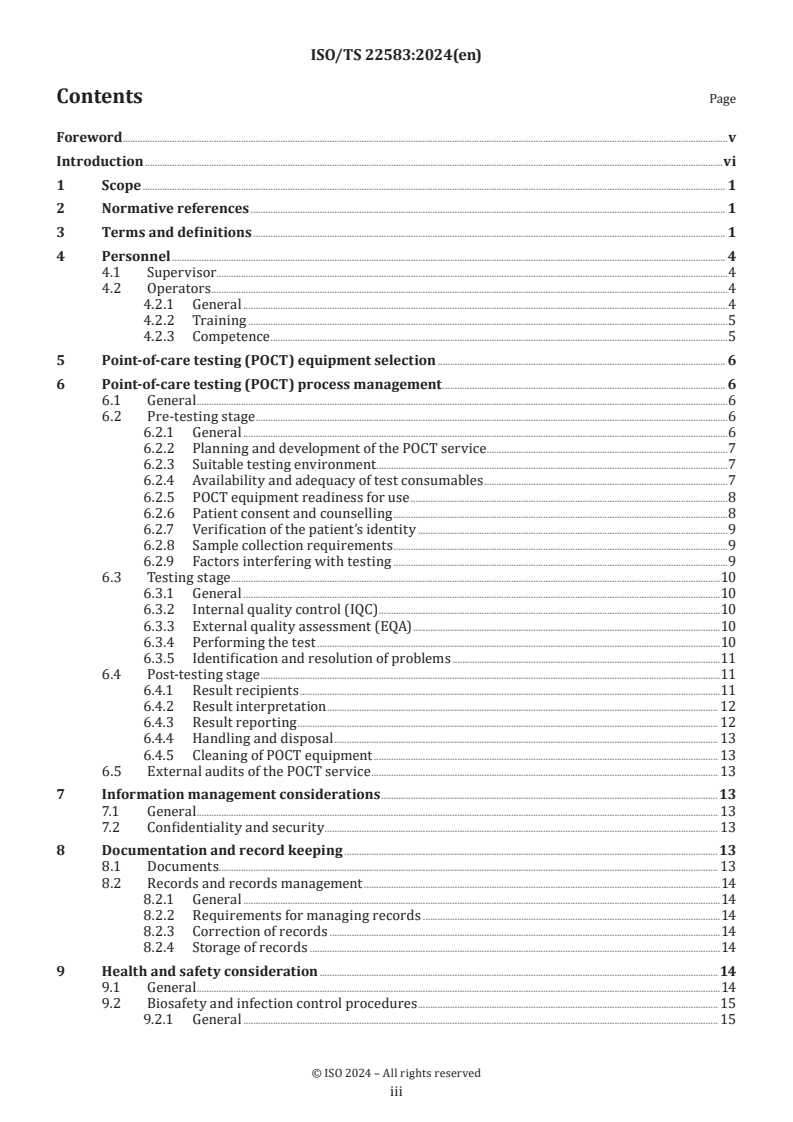
Contents Page
Foreword .v
Introduction .vi
1 Scope . 1
2 Normative references . 1
3 Terms and definitions . 1
4 Personnel . 4
4.1 Supervisor.4
4.2 Operators .4
4.2.1 General .4
4.2.2 Training .5
4.2.3 Competence .5
5 Point-of-care testing (POCT) equipment selection . 6
6 Point-of-care testing (POCT) process management . 6
6.1 General .6
6.2 Pre-testing stage .6
6.2.1 General .6
6.2.2 Planning and development of the POCT service .7
6.2.3 Suitable testing environment .7
6.2.4 Availability and adequacy of test consumables .7
6.2.5 POCT equipment readiness for use .8
6.2.6 Patient consent and counselling .8
6.2.7 Verification of the patient’s identity .9
6.2.8 Sample collection requirements .9
6.2.9 Factors interfering with testing .9
6.3 Testing stage .10
6.3.1 General .10
6.3.2 Internal quality control (IQC) .10
6.3.3 External quality assessment (EQA) .10
6.3.4 Performing the test .10
6.3.5 Identification and resolution of problems .11
6.4 Post-testing stage .11
6.4.1 Result recipients .11
6.4.2 Result interpretation . 12
6.4.3 Result reporting . 12
6.4.4 Handling and disposal . 13
6.4.5 Cleaning of POCT equipment . 13
6.5 External audits of the POCT service . 13
7 Information management considerations .13
7.1 General . 13
7.2 Confidentiality and security . 13
8 Documentation and record keeping .13
8.1 Documents. 13
8.2 Records and records management .14
8.2.1 General .14
8.2.2 Requirements for managing records .14
8.2.3 Correction of records .14
8.2.4 Storage of records .14
9 Health and safety consideration . 14
9.1 General .14
9.2 Biosafety and infection control procedures . 15
9.2.1 General . 15
iii
9.2.2 Use of sharps . 15
9.2.3 Personal protection . 15
9.2.4 Disposal of waste . 15
9.2.5 Hazard analysis . 15
9.3 Other health and safety considerations . 15
Annex A (normative) Training and competence of operators .16
Annex B (normative) Point-of-care testing (POCT) equipment and selection of the most
appropriate test . 19
Annex C (informative) Documents and records .25
Annex D (normative) Internal quality control (ICQ) and external quality assessment (EQA) .27
Annex E (informative) Biosafety and infection control procedures .31
Bibliography .33
iv
Foreword
ISO (the International Organization for Standardization) is a worldwide federation of national standards
bodies (ISO member bodies). The work of preparing International Standards is normally carried out through
ISO technical committees. Each member body interested in a subject for which a technical committee
has been established has the right to be represented on that committee. International organizations,
governmental and non-governmental, in liaison with ISO, also take part in the work. ISO collaborates closely
with the International Electrotechnical Commission (IEC) on all matters of electrotechnical standardization.
The procedures used to develop this document and those intended for its further maintenance are described
in the ISO/IEC Directives, Part 1. In particular, the different approval criteria needed for the different types
of ISO documents should be noted. This document was drafted in accordance with the editorial rules of the
ISO/IEC Directives, Part 2 (see www.iso.org/directives).
ISO draws attention to the possibility that the implementation of this document may involve the use of (a)
patent(s). ISO takes no position concerning the evidence, validity or applicability of any claimed patent
rights in respect thereof. As of the date of publication of this document, ISO had not received notice of (a)
patent(s) which may be required to implement this document. However, implementers are cautioned that
this may not represent the latest information, which may be obtained from the patent database available at
www.iso.org/patents. ISO shall not be held responsible for identifying any or all such patent rights.
Any trade name used in this document is information given for the convenience of users and does not
constitute an endorsement.
For an explanation of the voluntary nature of standards, the meaning of ISO specific terms and expressions
related to conformity assessment, as well as information about ISO's adherence to the World Trade
Organization (WTO) principles in the Technical Barriers to Trade (TBT) see www.iso.org/iso/foreword.html.
This document was prepared by Technical Committee ISO/TC 212, Medical laboratories and in vitro diagnostic
systems.
This second edition cancels and replaces the first edition (ISO/TS 22583:2019), which has been technically
revised.
The main changes are as follows:
— title changed from Guidance for supervisors and operators of point-of-care testing (POCT) devices to
Requirements and recommendations for supervisors and operators of point-of-care testing (POCT) equipment;
— insertion of a paragraph in the Introduction to include reference to the COVID-19 pandemic;
— removal of refences to ISO 22870, Point of care testing (POCT) — Requirements for quality and competence
(withdrawn document).
Any feedback or questions on this document should be directed to the user’s national standards body. A
complete listing of these bodies can be found at www.iso.org/members.html.
v
Introduction
Due to the ease of use and rapidness of point-of-care-testing (POCT), POCT equipment is widely used as a
tool for making decisions related to the health, management or care needs of patients. Such decisions can
include admission to hospital, evacuation to more appropriate care environments and directed patient
management. There can also be either significant civil or legal implications, or both that arise from POCT
such as cessation or termination of employment, family court rulings or revocation of bail or parole.
The availability of simple-to-use POCT equipment has led to continuous development in POCT, examples
include testing for diabetes management, blood clotting factors, infectious disease markers, haemoglobin,
white blood cell counts, pregnancy tests, cardiac markers, illicit drug use and performance enhancing
chemical testing.
Whilst examinations of a patient’s body fluids, excreta and tissues have been performed traditionally in
the controlled and regulated environment of a medical laboratory, globally, POCT is increasingly being
performed outside of a traditional laboratory setting and by operators without medical laboratory support.
Circumstances where POCT testing can occur include, but are not limited to, hospitals, medical practices,
pharmacies, ambulances, long-term care facilities, outreach clinics in remote and rural settings, in
emergency and natural disasters and community settings such as law enforcement, workplace health and
safety, sporting facilities, academia, the military and public areas such as shopping centres.
As POCT results can be used to make important decisions about patients, it is vital that the equipment works
properly to yield the correct results and that the operators are trained and competent. This requires that a
quality testing structure is provided by supervisors and made available to the operators.
Testing should be of benefit to the patient being tested. If the testing is not performed within a defined
quality testing structure, then incorrect results can be obtained which can have a negative effect on the
patient in terms of health outcomes or punitive action taken.
During the COVID-19 pandemic, the importance and context of POCT increased substantially. Testing was
used to determine whether a patient could leave their residence, attend work or travel within and/or outside
their country on a simple POCT, often self-conducted. The need for accurate POCT results in this context was
never more obvious due to the profound effect an incorrect result could have on a patient.
This document has been written in easy to understand language. Its purpose is to provide supervisors
and operators of POCT services guidance for assessing the appropriateness of proposed POCT, test and
equipment selection, as well as skill requirements for technical performance and result interpretation that
will ensure that the reliability, quality and interpretation of the results produced is of a quality appropriate
to the intended use.
Manufacturers and their distributors should draw this document to the attention of purchasers of POCT
equipment and encourage them to follow this document.
NOTE 1 Annexes A to E provide detailed information and add context that is not included in the main body of this
document.
NOTE 2 Reference is made to medical laboratory professionals in 4.1, 6.2.2, 6.2.6.3, 6.2.9, 6.3.5, 6.4.2, 6.4.3.2, 6.5,
7.1, B.1.1 and D.1. Medical laboratory professionals with the required competence to offer advice can be found in
laboratories adhering to international standards, e.g. ISO 15189.
vi
Technical Specification ISO/TS 22583:2024(en)
Requirements and recommendations for supervisors and
operators of point-of-care testing (POCT) equipment
1 Scope
This document provides requirements and recommendations for supervisors and operators of point-of-
care testing (POCT) services where POCT is performed without medical laboratory training, supervision or
support. It includes the key components that should be considered to provide safe and reliable POCT results.
Self-testing is excluded from this document.
2 Normative references
There are no normative references in this document.
3 Terms and definitions
For the purposes of this document, the following terms and definitions apply.
ISO and IEC maintain terminology databases for use in standardization at the following addresses:
— ISO Online browsing platform: available at https:// www .iso .org/ obp
— IEC Electropedia: available at https:// www .electropedia .org/
3.1
analyte
item that is being measured, tested or calculated
EXAMPLE Glucose, troponin, cocaine, HIV antibodies.
3.2
biological reference interval
reference range
normal range
normal value
specified interval of the distribution of values taken from a biological reference population
[SOURCE: ISO 15189:2022, 3.2, modified — Notes 1 to 4 have been deleted.]
3.3
clinical handover
patient handover
handover
transfer of professional responsibility and accountability for some or all aspects of care for a patient (3.10)
to another person or professional group on a temporary or permanent basis
Note 1 to entry: Transferring all or part of a patient’s (3.10) care between healthcare providers or locations is a high-
risk situation and a failure in clinical handover is a major source in preventable patient (3.10) harm.
Note 2 to entry: Effective clinical handover, which is structured and standardised, can reduce communication errors
and improve patient (3.10) safety.
Note 3 to entry: A simple example of clinical handover is ensuring critical result notification to an appropriate person
is performed in a timely manner to minimise harm to the patient (3.10).
3.4
competence
demonstrated ability to apply knowledge and skills to produce an accurate point-of-care testing (POCT)
(3.11) result
[SOURCE: ISO 15189:2022, 3.5, modified — “to produce an accurate POCT result” has been added.]
3.5
critical results
results outside defined limits which may indicate a life-threatening situation and require immediate
notification of the referring doctor, nurse or physician’s assistant
3.6
equipment
any device or apparatus which can be used to perform a point-of-care testing (POCT) (3.11)
Note 1 to entry: Examples include simple colour changing urine test strips for glucose to more complex electronic
handheld or bench top analysers such as glucometers, lipid analysers and alcoholmeters.
Note 2 to entry: For the purposes of this document equipment includes any reagents or consumables required to
perform the test.
3.7
external quality assessment
EQA
proficiency testing
PT
process where samples (3.13) of known values are tested periodically and the results are not known to the
operator at the time of testing
Note 1 to entry: The results obtained are then compared against others testing the same sample (3.13) with the same
point-of-care testing (POCT) (3.11) equipment (3.6) type giving the participant the ability to evaluate their performance
against others.
Note 2 to entry: Commercially available EQA programmes are recommended but are not always available. Where these
are not available, either manufacturers or laboratories, or both, can be able to offer assistance with sample (3.13)
exchange programs.
3.8
interference factors
substance or process which falsely alters a test result
Note 1 to entry: Interference can be significant.
Note 2 to entry: Interfering substances can be endogenous [substances found naturally in the patient (3.10) sample
(3.13) such as lipids, proteins, antibodies] or exogenous (substances not naturally found in the patient’s sample such
as drugs, poisons or medications).
Note 3 to entry: The most common interfering factors are haemolysis (the rupturing of red blood cells and the release
of their contents into surrounding fluid, e.g. blood plasma/serum), hyperbilirubinemia (a yellow or green pigmentation
of the blood plasma/serum due to high bilirubin) and lipaemia (an abnormally high concentration of lipids in the blood,
characteristically the blood plasma can appear white or milky in colour due to the presence of fat).
Note 4 to entry: The type of collection tube can also cause test interference as these often contain additive components.
3.9
internal quality control
IQC
quality control
QC
internal procedure which monitors the testing process which can be used to decide if the system is working
correctly and gives confidence that the results are reliable enough to be released
Note 1 to entry: IQC samples (3.13) have known quantities of the analyte (3.1) being tested. The result obtained is
expected to be close to the known value and within an acceptable range. Where results fall outside the acceptable
range, action to rectify the issue needs to occur before patients (3.10) are tested.
3.10
patient
individual undergoing point-of-care testing (POCT) (3.11)
Note 1 to entry: It should be noted that an individual who undergoes POCT (3.11) may not have an ongoing disease and
therefore may not be a patient as such. They can be clients or employees being tested for reasons other than to receive
medical care, such as community screening, pre-employment testing or assessing the use of performance-enhancing
drugs or chemicals.
Note 2 to entry: For this document the term patient has been used for consistency.
3.11
point-of-care testing
POCT
near-patient testing
testing that is performed near or at the site of a patient (3.10)
3.12
point-of-care testing service provider
POCT service provider
individual or organisation responsible for providing point-of-care testing (POCT) (3.11)
3.13
sample
specimen
discrete portion of a body fluid (e.g. blood, urine, saliva), breath, hair or tissue taken from the human body
for point-of-care testing (POCT) (3.11) which is assumed to represent the whole patient
Note 1 to entry: In some countries, the terms “specimen” or “primary sample" are used instead of sample. For the
purpose of this document the terms “sample”, “primary sample” and “specimen” should be considered interchangeable,
however for the purpose of this document only “sample” is used.
Note 2 to entry: The source of blood samples (whether arterial, venous or capillary) is another important consideration
as POCT results for capillary specimens can differ from arterial, venous values for certain tests and in certain
circumstances.
3.14
urgent results
results needed for the care management of a patient within a minimal time period, e.g. Troponin
3.15
validation
process of establishing the performance characteristics and limitations of point-of-care testing (POCT) (3.11)
equipment (3.6) and the identification of the influences which can change these characteristics and to what extent
Note 1 to entry: Which analytes (3.1) it can measure and in which sample (3.13) type (blood arterial, venous or
capillary, plasma, urine) in the presence of which interferences (3.8) are important considerations.
Note 2 to entry: The process for confirming that a method is fit-for-purpose (is appropriate for its intended use).
3.16
verification
process of demonstrating the performance criteria to which the method has been validated have been met
by the point-of-care testing (POCT) service provider (3.12) prior to introducing into routine use
4 Personnel
4.1 Supervisor
There shall be an appointed person(s) (supervisor) who has the authority and takes responsibility for, the
quality of the service and is competent to supervise the testing provided.
The supervisor is responsible for the quality, timeliness, accuracy and safe delivery of the POCT, which
includes hazard analysis (see 9.2.5).
The supervisor shall define the roles and responsibilities of POCT operators.
The supervisor shall ensure implementation of the following:
— selection of appropriate tests in consultation with a medical professional, when indicated;
— maintaining privacy, safety and confidentiality of personal information and test results of patients
undergoing testing;
— availability of appropriate result interpretation;
— access to advisory services;
— either confirmatory testing or referral for appropriate or necessary additional testing, or both;
— selection of suitable testing equipment;
— identification and adherence to applicable guidelines;
— performance and review of quality control with corrective actions;
— establishment and maintenance of internal instructions or processes;
— operator training and competency assessment;
— appropriate environment for testing;
— inventory control management processes;
— monitoring and reporting medical device adverse events;
— appropriate and effective clinical handover;
— appropriate biosafety and infection control procedures.
The supervisor shall ensure procedures are in place and appropriate for the POCT service provided and that
operators adhere to all instructions and procedures relating to POCT.
The supervisor should ensure there is access to medical experts and medical laboratory professionals to
provide consultation as needed.
4.2 Operators
4.2.1 General
There shall be an appointed person(s) (operator) who has been trained and has demonstrated the competence
required to perform testing. A supervisor may also be an operator.
4.2.2 Training
An operator training program shall be implemented that
— describes the key aspects of the testing process including:
— the intent of the testing process;
— its essential steps;
— the significance of each step;
— ensures the operators can produce reliable results;
— describes the requirements for use of IQC and EQA programs and ensure they are used (if available);
— states the importance of following policies, procedures and instructions for use.
All operators are required to have successfully completed the training program.
The training program shall be updated when changes to the testing service occur (e.g. new equipment or
procedure is introduced) and operators shall be trained to the new processes.
The training program shall be evaluated periodically for effectiveness.
NOTE Aspects of the testing process to consider in training programs are described in Annex A.
4.2.3 Competence
Operators shall be assessed for competence after training and before being allowed to perform testing.
Operators not deemed competent shall not perform any testing until they have been retrained and deemed
competent.
The competence of operators shall be reassessed at planned intervals. The interval for competence
reassessment should be based on the following:
— test volume and frequency;
— frequency of individual operator involvement in testing;
— complexity of testing (degree of difficulty);
— quality assessment data (e.g. more errors can require more frequent training and a search for root cause).
Where patient testing does not occur immediately after competence has been granted, the POCT service
should consider a reasonable timeframe whereby the operator is still deemed competent to test and
competence reassessment does not need to occur. After this time, however, the operator should be reassessed
for competence.
Generally low volume or less frequent testing requires more frequent competency assessment.
The volume and frequency of tests and the frequency of operator involvement in POCT can determine an
operator’s ability to remain competent. The complexity of the POCT can influence this as more complex
tests are often more difficult to perform correctly, especially when performed rarely. Therefore, planned
reassessment intervals should take into account how often and how many POCT an operator performs,
i.e. 1 test, 10 tests, 100 tests performed daily, weekly, monthly or yearly in conjunction with the degree
of difficulty of the POCT. Each competency assessment shall be recorded against a predetermined set of
realistic and measurable targets as defined by the supervisor.
When operators are deemed not competent after training, the training program should be evaluated and
improved as necessary.
NOTE Aspects of the testing process to consider in competence assessment programs are described in Annex A.
Normative Annex A provides additional requirements for training and competence of operators.
5 Point-of-care testing (POCT) equipment selection
Selection of POCT equipment shall be based on:
— scope and purpose of the POCT service;
— performance specifications of the equipment;
— reliability of the equipment when used;
— needs of those to be tested;
— other third-party needs, e.g. employer request;
Selection of POCT equipment should take into consideration local and national regulatory requirements.
Whilst POCT equipment may not meet every desirable attribute that has been identified, the equipment that
is the most appropriate for a given testing scenario should be considered fit-for-purpose in the absence of
alternatives.
Lack of understanding of the testing requirements can result in selection of equipment that is not fit-for-
purpose. Selection of inappropriate equipment can impact patient safety.
Before equipment is purchased and testing is implemented, the POCT equipment shall be approved by the
supervisor as being fit-for-purpose.
Normative Annex B provides additional requirements for the selection of POCT equipment.
6 Point-of-care testing (POCT) process management
6.1 General
The testing process consists of three stages: pre-testing, testing and post-testing.
Pre-testing includes all activities performed up to the point of performing the test.
Testing includes using the patient sample and POCT equipment to generate a test result.
Post-testing includes review, interpretation and reporting of results as well as disposal of residual samples,
collection equipment and restoring the testing environment and equipment to its pre-testing stage.
All three stages contribute to the quality of the test results.
6.2 Pre-testing stage
6.2.1 General
The majority and often most serious errors (e.g. misidentified patient, insufficient sample, unsuitable
sample, improper sample handling) occur in the pre-testing stage. If errors occur in this stage, the reliability
and accuracy of test results are affected no matter how good the testing or post-testing processes are.
Testing on the wrong patient will always mean the wrong result is produced. As such the wrong treatment
can be provided to the wrong patient or a patient can miss the treatment needed, causing harm.
6.2.2 Planning and development of the POCT service
The planning and development of the POCT service shall consider:
— the reasons for testing including potential outcomes to those being tested;
— what patient population is the POCT service directed toward;
— who is eligible to be tested;
— the criteria for selecting appropriate testing methods, equipment and the tests to be provided;
— who can request the test;
— who can receive test results;
— personnel resources;
— appropriate methods to assure the POCT service is performing as expected;
— evaluation of failures and their consequences to patients and POCT service;
— requirements for quality including IQC and EQA;
— storage of equipment, reagents and consumables;
— regulatory requirements.
Either medical or medical laboratory professionals, or both should be available to provide consultation
and advice.
6.2.3 Suitable testing environment
A testing environment shall be available which is suitable for POCT. Such an environment shall provide
safety for patients and operators, suitable accommodation and sufficient space for testing operations and
privacy to maintain patient confidentiality according to ethical, legal and cultural considerations.
6.2.4 Availability and adequacy of test consumables
6.2.4.1 General
Test consumables shall be available and adequate for the test to be performed. This includes sample
collection devices, test tubes, test strips or test cards as well as reagents, labels and writing instruments to
label samples.
Availability of extra consumables can be appropriate in case of contamination or loss of supplies while POCT
is being performed.
All consumables shall be handled in accordance with manufacturer's recommendations.
6.2.4.2 Collection devices
The correct use of sample collection devices is critical to providing the correct result and these devices shall
always be used according to manufacturer’s instructions.
In all cases where blood is used as the sample type, single use devices, such as needles or lancets, shall be used
and the needle appropriately sheathed (shielded) with needle protection and discarded after the single use.
If blood collection supplementary equipment such as tube holders and tourniquets, are reused, thorough
disinfection procedures shall be employed to reduce the chance of cross-contamination.
6.2.5 POCT equipment readiness for use
6.2.5.1 General
Equipment shall be confirmed to be functional and set up appropriately prior to patient testing.
Equipment shall have undergone and passed the prescribed quality control at the site of testing and where
applicable, have sufficient electrical or battery power to complete testing.
The temperature of the testing environment shall not fall outside the temperature range recommended for
the POCT equipment by the manufacturer.
Additional environmental conditions prescribed by the manufacturer shall also be verified as being met.
6.2.5.2 Validation of POCT equipment
Validation of POCT equipment shall be performed before the equipment is introduced into the testing
environment to establish the performance specifications. Where the manufacturer has performed validation,
users may rely on the manufacturer’s validation and shall only perform verification.
Where the equipment or test is modified or is developed in-house by the user, or is used in clinical settings
which have not been validated by the manufacturer, validation shall be performed.
NOTE 1 Regulations in some countries have prohibited the modification of equipment or tests by the user of POCT.
NOTE 2 Clause B.2 gives more information on validation.
6.2.5.3 Verification of POCT equipment
Verification shall be performed before the equipment is introduced into the testing environment to confirm
that the operators can achieve the same test performance in their testing environment, as has been attained
in the manufacturer’s validation.
NOTE Clause B.2 gives more information on verification.
6.2.5.4 Calibration of POCT equipment
When required, POCT equipment shall be calibrated according to the manufacturer’s instructions using the
calibrator recommended by the manufacturer.
NOTE Clause B.3 gives more information on calibration.
6.2.5.5 Preventive maintenance of POCT equipment
A program of preventive maintenance of the POCT equipment shall be developed considering the complexity
of the equipment and the manufacturer’s instructions. Preventive maintenance can require external
servicing by the manufacturer.
6.2.6 Patient consent and counselling
6.2.6.1 General
Patients shall be given information to enable them to understand the risks, benefits and possible outcomes
of the POCT to be performed. Plain language shall be used to convey information to a level the patient can
understand.
6.2.6.2 Patient consent
The patient (or where appropriate their legal guardian) shall consent to testing before the sample is
collected. For most routine POCT, consent can be inferred when the patient presents for testing and willingly
submits to the sample being collected and tested.
NOTE Inferred consent is consent that is not expressly granted by a person, but rather implicitly granted by a
person's actions and the facts and circumstances of the situation (or in some cases, by a person's silence or inaction).
Patients should be given the opportunity to refuse POCT prior to sample collection.
In emergency situations, such as an unconscious patient, consent might not be possible. Under these
circumstances it is acceptable to carry out necessary POCT, provided they are in the patient’s best interest.
A greater level of consent, known as informed consent, can be required.
Where required, informed consent should be obtained by the operator to ensure the patient understands
the facts, implications, and consequences of the POCT.
Informed consent should be required for POCT that can have profound impact on the patient (e.g. drug
testing or infectious disease testing).
To allow informed consent to be obtained, information should be made available to the patient that includes
an explanation of the POCT to be performed in plain language the patient can understand.
A formal record that informed consent has been obtained should be kept.
6.2.6.3 Patient counselling
Where appropriate the patient should be counselled about the test, including the likelihood of false positive
and false negative results and the process for confirming results where appropriate.
The POCT operator will not always be the most appropriate person to provide detailed information
regarding the test. In such cases a medical laboratory professional and/or the person requesting the test
should be available to provide advice. In addition, written instructions (as well as graphical education
materials designed for patients) can be used to support verbal communication.
6.2.7 Verification of the patient’s identity
Before initiating POCT the patient shall have their identity unequivocally verified by the POCT operator.
Procedures for verifying a patient’s identity shall be established and available to the operator.
Failure to identify the patient correctly can lead to either serious patient harm or adverse consequences, or both.
6.2.8 Sample collection requirements
Operators shall ensure all samples collected meet the manufacturer’s sample collection requirements.
Deviations from these requirements can lead to incorrect results as POCT equipment is validated for specific
sample collection requirements.
The time between sample collection and testing shall not exceed that allowed by the manufacturer of the
POCT equipment as some tests become invalid if excessive time is taken between collection and testing.
6.2.9 Factors interfering with testing
Operators shall understand that the presence of certain substances or conditions (interference factors), such
as medications or diet, could impact test results.
This information should also be included in information provided to patients in order that they understand
that factors such as medications or diet are important to disclose to the operator.
NOTE Advice on these factors and their impact on results can be obtained from medical laboratory professionals.
6.3 Testing stage
6.3.1 General
POCT equipment shall undergo regular quality control testing to ensure POCT equipment is working
properly and that results are accurate and reliable.
6.3.2 Internal quality control (IQC)
An IQC program shall be designed based on the manufacturer’s instructions. IQC materials with expected
values at clinically important levels i.e. close to the biological refere
...
Especificación
Técnica
ISO/TS 22583
Segunda edición
Requisitos y recomendaciones
2024-09
para supervisores y operadores de
equipamiento para análisis que se
realizan cerca del paciente (POCT)
Requirements and recommendations for supervisors and
operators of point-of-care testing (POCT) equipment
Publicado por la Secretaría Central de ISO en Ginebra, Suiza,
como traducción oficial en español avalada por el Translation
Management Group, que ha certificado la conformidad en
relación con las versiones inglesa y francesa.
Número de referencia
DOCUMENTO PROTEGIDO POR COPYRIGHT
© ISO 2024
Todos los derechos reservados. Salvo que se especifique de otra manera o se requiera en el contexto de su implementación, no
puede reproducirse ni utilizarse ninguna parte de esta publicación bajo ninguna forma y por ningún medio, electrónico o mecánico,
incluidos el fotocopiado, o la publicación en Internet o una Intranet, sin la autorización previa por escrito. La autorización puede
solicitarse a ISO en la siguiente dirección o al organismo miembro de ISO en el país del solicitante.
ISO copyright office
CP 401 • Ch. de Blandonnet 8
CH-1214 Vernier, Geneva
Phone: +41 22 749 01 11
Email: copyright@iso.org
Website: www.iso.org
Publicado en Suiza
Versión en español publicada en
Traducción oficial
ii
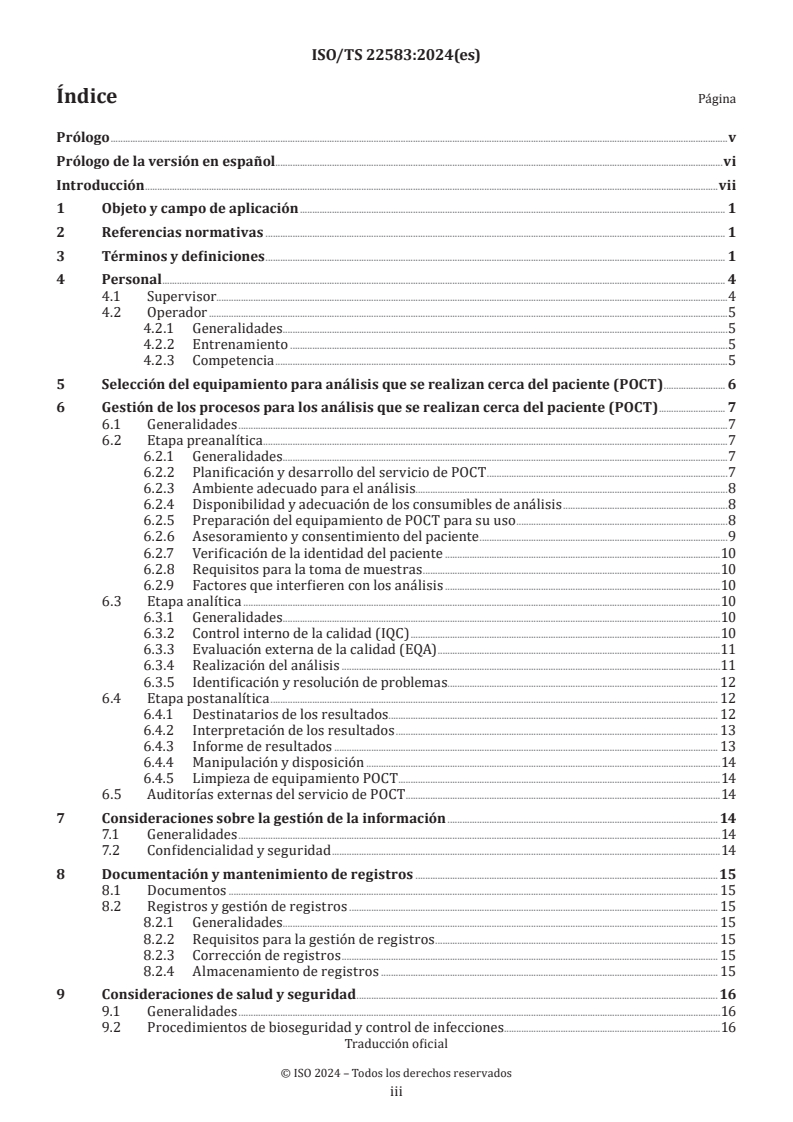
Índice Página
Prólogo .v
Prólogo de la versión en español.vi
Introducción .vii
1 Objeto y campo de aplicación . 1
2 Referencias normativas . 1
3 Términos y definiciones . 1
4 Personal . 4
4.1 Supervisor.4
4.2 Operador .5
4.2.1 Generalidades .5
4.2.2 Entrenamiento .5
4.2.3 Competencia .5
5 Selección del equipamiento para análisis que se realizan cerca del paciente (POCT) . 6
6 Gestión de los procesos para los análisis que se realizan cerca del paciente (POCT) . 7
6.1 Generalidades .7
6.2 Etapa preanalítica .7
6.2.1 Generalidades .7
6.2.2 Planificación y desarrollo del servicio de POCT .7
6.2.3 Ambiente adecuado para el análisis.8
6.2.4 Disponibilidad y adecuación de los consumibles de análisis .8
6.2.5 Preparación del equipamiento de POCT para su uso .8
6.2.6 Asesoramiento y consentimiento del paciente .9
6.2.7 Verificación de la identidad del paciente .10
6.2.8 Requisitos para la toma de muestras .10
6.2.9 Factores que interfieren con los análisis .10
6.3 Etapa analítica .10
6.3.1 Generalidades .10
6.3.2 Control interno de la calidad (IQC) .10
6.3.3 Evaluación externa de la calidad (EQA) .11
6.3.4 Realización del análisis .11
6.3.5 Identificación y resolución de problemas. 12
6.4 Etapa postanalítica . 12
6.4.1 Destinatarios de los resultados . 12
6.4.2 Interpretación de los resultados . 13
6.4.3 Informe de resultados . 13
6.4.4 Manipulación y disposición .14
6.4.5 Limpieza de equipamiento POCT .14
6.5 Auditorías externas del servicio de POCT .14
7 Consideraciones sobre la gestión de la información . 14
7.1 Generalidades .14
7.2 Confidencialidad y seguridad .14
8 Documentación y mantenimiento de registros .15
8.1 Documentos . 15
8.2 Registros y gestión de registros . 15
8.2.1 Generalidades . 15
8.2.2 Requisitos para la gestión de registros . 15
8.2.3 Corrección de registros . 15
8.2.4 Almacenamiento de registros . 15
9 Consideraciones de salud y seguridad .16
9.1 Generalidades .16
9.2 Procedimientos de bioseguridad y control de infecciones .16
Traducción oficial
iii
9.2.1 Generalidades .16
9.2.2 Uso de objetos cortopunzantes .16
9.2.3 Protección personal .16
9.2.4 Disposición de residuos .16
9.2.5 Análisis de peligros .17
9.3 Otras consideraciones de salud y seguridad .17
Anexo A (normativo) Entrenamiento y competencia de los operadores . 18
Anexo B (normativo) Equipamiento para análisis que se realizan cerca del paciente (POCT) y
selección de los análisis más adecuados .21
Anexo C (informativo) Documentos y registros .28
Anexo D (normativo) Control interno de la calidad (IQC) y evaluación externa de la calidad
(EQA) .30
Anexo E (informativo) Procedimientos de bioseguridad y control de infecciones . 35
Bibliografía.38
Traducción oficial
iv
Prólogo
ISO (Organización Internacional de Normalización) es una federación mundial de organismos nacionales
de normalización (organismos miembros de ISO). El trabajo de elaboración de las Normas Internacionales
se lleva a cabo normalmente a través de los comités técnicos de ISO. Cada organismo miembro interesado
en una materia para la cual se haya establecido un comité técnico, tiene el derecho de estar representado
en dicho comité. Las organizaciones internacionales, gubernamentales y no gubernamentales, vinculadas
con ISO, también participan en el trabajo. ISO colabora estrechamente con la Comisión Electrotécnica
Internacional (IEC) en todos los temas de normalización electrotécnica.
En la Parte 1 de las Directivas ISO/IEC se describen los procedimientos utilizados para desarrollar este
documento y aquellos previstos para su mantenimiento posterior. En particular debería tomarse nota de los
diferentes criterios de aprobación necesarios para los distintos tipos de documentos ISO. Este documento
ha sido redactado de acuerdo con las reglas editoriales de la Parte 2 de las Directivas ISO/IEC (véase
www.iso.org/directives).
ISO llama la atención sobre la posibilidad de que la implementación de este documento pueda conllevar el uso
de una o varias patentes. ISO no se posiciona respecto a la evidencia, validez o aplicabilidad de los derechos
de patente reivindicados. A la fecha de publicación de este documento, ISO no había recibido notificación
de que una o varias patentes pudieran ser necesarias para su implementación. No obstante, se advierte a
los usuarios que esta puede no ser la información más reciente, la cual puede obtenerse de la base de datos
de patentes disponible en www.iso.org/patents. ISO no será responsable de la identificación de parte o la
totalidad de dichos derechos de patente.
Cualquier nombre comercial utilizado en este documento es información que se proporciona para comodidad
del usuario y no constituye una recomendación.
Para una explicación de la naturaleza voluntaria de las normas, el significado de los términos específicos de
ISO y las expresiones relacionadas con la evaluación de la conformidad, así como la información acerca de la
adhesión de ISO a los principios de la Organización Mundial del Comercio (OMC) respecto a los Obstáculos
Técnicos al Comercio (OTC), véase www.iso.org/iso/foreword.html.
Este documento ha sido elaborado por el Comité Técnico ISO/TC 212, Laboratorio clínico y sistemas de análisis
por diagnóstico in vitro.
Esta segunda edición anula y sustituye a la primera edición (ISO/TS 22583:2019), que ha sido revisada
técnicamente.
Los principales cambios son los siguientes:
— modificación del título de “Orientación para supervisores y operadores de equipamiento para análisis
que se realizan cerca del paciente (POCT, por sus siglas en inglés, point-of-care testing)” a “Requisitos y
recomendaciones para supervisores y operadores de equipamiento para análisis que se realizan cerca
del paciente (POCT, por sus siglas en inglés, point-of-care testing)”;
— inserción de un párrafo en la Introducción para incluir una referencia a la pandemia de COVID-19;
— eliminación de la referencia a la Norma ISO 22870, Point of care testing (POCT). Requirements for
quality and competence ISO 22870, (documento retirado).
Cualquier comentario o pregunta sobre este documento deberían dirigirse al organismo nacional de
normalización del usuario. En www.iso.org/members.html se puede encontrar un listado completo de estos
organismos.
Traducción oficial
v
Prólogo de la versión en español
Este documento ha sido traducido por el Grupo de Trabajo Spanish Translation Task Force (STTF) del Comité
Técnico ISO/TC 212, Laboratorio clínico y sistemas de análisis por diagnóstico in vitro, en el que participan
representantes de los organismos nacionales de normalización y otras partes interesadas, para lograr la
unificación de la terminología en lengua española en el ámbito de la gestión de los riesgos y de la seguridad
en laboratorios.
Este documento ha sido validado por el ISO/TMBG/Spanish Translation Management Group (STMG)
conformado por los siguientes países: Argentina, Bolivia, Chile, Colombia, Costa Rica, Cuba, Ecuador, El
Salvador, España, Guatemala, Honduras, República Dominicana, México, Panamá, Paraguay, Perú y Uruguay.
Se ha traducido el término “medical device (MD)” como “dispositivo médico/producto sanitario (MD)”, ya
que en diferentes reglamentaciones nacionales se utilizan términos tales como: dispositivo médico, equipo
médico, producto médico y producto sanitario.
Los dispositivos médicos para diagnóstico in vitro también se identifican con las siglas DMDIV.
Traducción oficial
vi
Introducción
Debido a la facilidad de uso y la rapidez de los análisis que se realizan cerca del paciente (POCT, por sus siglas
en inglés, point-of-care testing), el equipamiento para POCT se utiliza ampliamente como herramienta para
tomar decisiones relacionadas con la salud, la gestión o las necesidades de atención de los pacientes. Tales
decisiones pueden incluir la admisión al hospital, la evacuación a entornos de atención más apropiados y la
gestión dirigida del paciente. También puede haber implicaciones civiles o legales significativas, o ambas,
que surjan de los POCT, como el cese o la finalización del empleo, las sentencias de los tribunales de familia o
la revocación de la fianza o la libertad condicional.
La disponibilidad de equipamiento para POCT fácil de usar ha llevado a un desarrollo continuo de POCT, los
ejemplos incluyen análisis para el control de la diabetes, factores de coagulación sanguínea, marcadores de
enfermedades infecciosas, hemoglobina, recuento de glóbulos blancos, pruebas de embarazo, marcadores
cardíacos, análisis para detectar el consumo de drogas ilícitas y de sustancias químicas para aumentar el
rendimiento.
Mientras que los análisis de los fluidos corporales, las heces y los tejidos de un paciente se han realizado
tradicionalmente en un ambiente controlado y regulado de un laboratorio clínico, a nivel mundial, los POCT
se realizan cada vez más fuera del ambiente del laboratorio tradicional y por operadores sin apoyo del
laboratorio clínico.
Las circunstancias en las que se pueden realizar los análisis POCT incluyen, entre otras, hospitales,
consultorios médicos, farmacias, ambulancias, centros de cuidado prolongado, centros de salud localizados
en lugares lejanos y rurales, en emergencias y en desastres naturales y ambientes comunitarios, tales
como los relacionados con aspectos legales, de salud y de seguridad en el lugar de trabajo, las instalaciones
deportivas, ámbitos académicos, de fuerzas de seguridad y áreas públicas como centros comerciales.
Como los resultados de los POCT se pueden utilizar para tomar decisiones importantes sobre los pacientes,
es vital que el equipamiento funcione correctamente para obtener los resultados correctos y que los
operadores estén entrenados y sean competentes. Esto requiere que los supervisores proporcionen un
diseño de análisis de calidad y la pongan a disposición de los operadores.
Los análisis deberían ser beneficiosos para el paciente al que se le realizan. Si los análisis no se realizan
dentro de una estructura de análisis de calidad definida, se pueden obtener resultados incorrectos que
pueden tener un efecto negativo en el paciente en términos de resultados de salud o de toma de acciones
punitivas.
Durante la pandemia de COVID-19, la importancia y el contexto de los POCT aumentaron sustancialmente.
Los análisis se utilizaron para determinar si un paciente podía salir de su residencia, asistir al trabajo o
viajar dentro y/o fuera de su país mediante un POCT simple, por lo general autorrealizado. La necesidad de
obtener resultados exactos de los POCT en este contexto nunca fue más obvia debido al profundo efecto que
un resultado incorrecto podría tener en un paciente.
Este documento ha sido escrito en un lenguaje fácil de entender. Su propósito es proporcionar orientación
a los supervisores y operadores que brindan servicios mediante equipamiento para POCT para evaluar la
idoneidad de la propuesta del POCT, de los análisis y la selección del equipamiento, así como los requisitos de
habilidades para el desempeño técnico y la interpretación de los resultados que aseguran que la confiabilidad
y la calidad de los resultados producidos sean adecuadas para el uso previsto.
Los fabricantes y sus distribuidores deberían mencionar este documento a los compradores de equipamiento
para POCT y alentarlos a seguirlo.
NOTA 1 En los Anexos A al E se proporciona información detallada y se añade un contexto que no se incluye en el
cuerpo principal del presente documento.
NOTA 2 En los apartados 4.1, 6.2.2, 6.2.6.3, 6.2.9, 6.3.5, 6.4.2, 6.4.3.2, 6.5, 7.1, B.1.1 y el capítulo D.1 se hace referencia
a los profesionales del laboratorio clínico. Los profesionales del laboratorio clínico con la competencia necesaria para
ofrecer asesoramiento se pueden encontrar en laboratorios que se adhieren a las normas internacionales, por ejemplo,
la ISO 15189.
Traducción oficial
vii
Especificación Técnica ISO/TS 22583:2024(es)
Requisitos y recomendaciones para supervisores y
operadores de equipamiento para análisis que se realizan
cerca del paciente (POCT)
1 Objeto y campo de aplicación
Este documento proporciona requisitos y recomendaciones para los supervisores y operadores que brindan
servicios mediante equipamiento para análisis que se realizan cerca del paciente (POCT, por sus siglas
en inglés, point-of-care testing), donde los POCT se realizan sin entrenamiento, supervisión o apoyo del
laboratorio clínico. Incluye los componentes clave que se deberían considerar para proporcionar resultados
seguros y confiables de los POCT.
Se excluye de este documento la autoevaluación.
2 Referencias normativas
No hay referencias normativas en este documento.
3 Términos y definiciones
Para los fines de este documento, se aplican los siguientes términos y definiciones.
ISO y la IEC mantienen bases de datos terminológicas para su uso en normalización en las siguientes
direcciones:
— Plataforma de búsqueda en línea de ISO: disponible en https:// www .iso .org/ obp
— Electropedia de IEC: disponible en https:// www .electropedia .org/
3.1
analito
ítem que se mide, ensaya o calcula
EJEMPLO Glucosa, troponina, cocaína, anticuerpos contra el VIH.
3.2
intervalo de referencia biológico
intervalo de referencia
intervalo normal
valor normal
intervalo especificado de la distribución de los valores tomados a partir de una población biológica de
referencia
[FUENTE: ISO 15189:2022, 3.2, modificada — se han eliminado las Notas 1 a 4.]
Traducción oficial
3.3
transferencia clínica
transferencia de pacientes
transferencia
traspaso de la responsabilidad profesional y la rendición de cuentas por algunos o todos los aspectos de la
atención de un paciente (3.10) a otra persona o grupo profesional de forma temporal o permanente
Nota 1 a la entrada: La transferencia de la totalidad o parte de la atención de un paciente (3.10) entre proveedores
o ubicaciones de atención médica es una situación de alto riesgo y una falla en la transferencia clínica es una fuente
importante de daño prevenible para el paciente (3.10).
Nota 2 a la entrada: El traspaso clínico eficaz, estructurado y estandarizado, puede reducir los errores de comunicación
y mejorar la seguridad del paciente (3.10).
Nota 3 a la entrada: Un ejemplo simple de transferencia clínica es asegurar que la notificación de resultados críticos a
una persona adecuada se realice de manera oportuna para minimizar el daño al paciente (3.10).
3.4
competencia
aptitud demostrada para aplicar conocimientos y habilidades para producir un resultado exacto de los
análisis que se realizan cerca del paciente (POCT) (3.11)
[FUENTE: ISO 15189:2022, 3.5, modificada — se ha añadido "para producir un resultado exacto de los POCT".]
3.5
resultados críticos
resultados fuera de los límites definidos, lo que puede indicar una situación potencialmente mortal y
requiere una notificación inmediata al personal médico, de enfermería o al médico asociado solicitante
3.6
equipamiento
cualquier dispositivo o aparato que se pueda utilizar para efectuar análisis que se realizan cerca del paciente
(POCT) (3.11)
Nota 1 a la entrada: Algunos ejemplos son las tiras reactivas de glucosa en orina que cambian de color y los
analizadores electrónicos portátiles o de sobremesa más complejos, como glucómetros, analizadores de lípidos y
alcoholímetros.
Nota 2 a la entrada: A los efectos de este documento, el equipamiento incluye cualquier reactivo o consumible necesario
para realizar el análisis.
3.7
evaluación externa de la calidad
EQA (por sus siglas en inglés, external quality assessment)
ensayo de aptitud
PT (por sus siglas en inglés, proficiency testing)
proceso en el cual las muestras (3.13) de valores conocidos se analizan periódicamente y el operador no
conoce los resultados en el momento del análisis
Nota 1 a la entrada: Los resultados obtenidos se comparan con otros resultados de análisis de la misma muestra
(3.13) con el mismo tipo de equipamiento (3.6)de análisis que se realizan cerca del paciente (POCT) (3.11), lo que le da al
participante la capacidad de evaluar su desempeño en comparación con otros.
Nota 2 a la entrada: Se recomiendan los programas de EQA comerciales, pero no siempre están disponibles. Cuando
no estén disponibles, los fabricantes o los laboratorios, o ambos, pueden proporcionar ayuda con programas de
intercambio de muestras (3.13).
3.8
factores interferentes
sustancia o proceso que altera falsamente el resultado de un análisis
Nota 1 a la entrada: La interferencia puede ser significativa.
Traducción oficial
Nota 2 a la entrada: Las sustancias interferentes pueden ser endógenas [sustancias que se encuentran naturalmente en
la muestra (3.13) del paciente (3.10) como lípidos, proteínas, anticuerpos] o exógenas (sustancias que no se encuentran
naturalmente en la muestra del paciente, como drogas, venenos o medicamentos).
Nota 3 a la entrada: Los factores interferentes más comunes son la hemólisis (la ruptura de los glóbulos rojos y la
liberación de su contenido en el líquido circundante, por ejemplo, el plasma sanguíneo/suero), la hiperbilirrubinemia
(una pigmentación amarilla o verde del plasma/suero sanguíneo debido a un alto nivel de bilirrubina) y la lipemia (una
concentración anormalmente alta de lípidos en la sangre, característicamente, el plasma sanguíneo puede aparecer de
color blanco o lechoso debido a la presencia de grasa).
Nota 4 a la entrada: El tipo de tubo de recolección también puede causar interferencias en el análisis, ya que por lo
general contiene aditivos.
3.9
control interno de la calidad
IQC (por sus siglas en inglés, internal quality control)
control de la calidad
QC (por sus siglas en inglés, quality control)
procedimiento interno que monitorea el proceso de análisis, que se puede utilizar para decidir si el sistema
funciona correctamente y proporciona confianza de que los resultados son lo suficientemente confiables
como para su liberación
Nota 1 a la entrada: Las muestras (3.13) para IQC poseen cantidades conocidas del analito (3.1) que se está analizando.
Se espera que el resultado obtenido esté cerca del valor conocido y dentro de un rango aceptable. Cuando los resultados
están fuera del rango aceptable, es necesario realizar acciones para corregir el problema antes de que se realicen los
análisis a los pacientes (3.10).
3.10
paciente
persona a la cual se le efectúan análisis que se realizan cerca del paciente (POCT) (3.11)
Nota 1 a la entrada: Se debería tener en cuenta que una persona a la cual se le realizan POCT (3.11) puede no tener una
enfermedad en curso y, por lo tanto, puede no ser un paciente como tal. Pueden ser clientes o empleados a los que se
les realizan análisis por razones distintas a la de recibir atención médica, como tamizaje/cribado (del inglés screening)
comunitarios, análisis previos al empleo o evaluación del uso de drogas o sustancias para mejorar el rendimiento.
Nota 2 a la entrada: Para este documento se ha utilizado el término paciente para mantener la coherencia.
3.11
análisis que se realizan cerca del paciente
POCT (por sus siglas en inglés, point-of-care testing)
análisis que se efectúan cerca o en el lugar donde se encuentra el paciente (3.10)
Nota 1 a la entrada: Las expresiones “análisis que se realizan cerca del paciente”, “análisis que se realizan en el lugar
en que se encuentra el paciente”; “análisis que se realizan en el lugar de asistencia al paciente”; “análisis que se
realizan junto al paciente”; “análisis que se realizan en el punto de atención del paciente” son diferentes maneras de
denominar las siglas POCT (por sus siglas en inglés, point-of-care testing).
3.12
proveedor de servicios de análisis que se realizan cerca del paciente
proveedor de servicios POCT
persona u organización responsable de proporcionar los análisis que se realizan cerca del paciente (POCT) (3.11)
3.13
muestra
espécimen
porción discreta de un fluido corporal (por ejemplo, sangre, orina, saliva), aliento, cabello o tejido obtenido
del cuerpo humano para efectuar un análisis realizado cerca del paciente (POCT) (3.11) que se supone que
representa al paciente
Nota 1 a la entrada: En algunos países, se utilizan los términos "espécimen" o "muestra primaria" en lugar de “muestra”.
A los efectos del presente documento, los términos "muestra", "muestra primaria" y "espécimen" se deberían considerar
intercambiables, sin embargo, a los efectos del presente documento solo se utiliza "muestra".
Traducción oficial
Nota 2 a la entrada: El origen de las muestras de sangre (ya sea arterial, venosa o capilar) es otra consideración
importante, ya que los resultados de los POCT para muestras capilares pueden diferir de los valores arteriales y
venosos para ciertos análisis y en ciertas circunstancias.
3.14
resultados urgentes
resultados necesarios para la gestión de la atención de un paciente en un período de tiempo mínimo, por
ejemplo, troponina
3.15
validación
proceso de establecimiento de las características de desempeño y las limitaciones del equipamiento (3.6) de
los análisis que se realizan cerca del paciente (POCT) (3.11) y de la identificación y extensión de las influencias
que pueden cambiar estas características
Nota 1 a la entrada: Son consideraciones importantes qué analitos (3.1) se pueden medir y en qué tipo de muestra
(3.13) (sangre arterial, venosa o capilar, plasma, orina) y en presencia de qué factores interferentes (3.8).
Nota 2 a la entrada: El proceso para confirmar que un método es adecuado para su propósito (es apropiado para su uso
previsto).
3.16
verificación
proceso de demostración de que los criterios de desempeño, obtenidos por el proveedor de servicios de POCT
(3.12) al validar el método, se cumplen previamente al uso de rutina
4 Personal
4.1 Supervisor
Se debe designar una o más personas (supervisor) que tengan la autoridad y asuman la responsabilidad de la
calidad del servicio y sean competentes para supervisar los análisis proporcionados.
El supervisor es responsable de la calidad, puntualidad, exactitud y entrega segura del POCT, que incluye el
análisis de peligros (véase 9.2.5).
El supervisor debe definir las funciones y responsabilidades de los operadores del POCT.
El supervisor debe asegurar la implementación de lo siguiente:
— selección de los análisis apropiados con el asesoramiento de un profesional médico, cuando esté indicado;
— mantenimiento de la privacidad, seguridad y confidencialidad de la información personal y los resultados
de los análisis de los pacientes a los que se le realizan los análisis;
— disponibilidad de una interpretación adecuada de los resultados;
— el acceso a los servicios de asesoramiento;
— el análisis de confirmación o de derivación para análisis adicionales apropiados o necesarios, o ambos;
— selección del equipamiento adecuado para los análisis;
— identificación y cumplimiento de las directrices aplicables;
— desempeño y revisión del control de calidad con acciones correctivas;
— establecimiento y mantenimiento de instrucciones o procesos internos;
— entrenamiento y evaluación de competencias del operador;
— ambiente adecuado para los análisis;
Traducción oficial
— procesos de gestión de control de inventario;
— monitoreo y notificación de eventos adversos de los dispositivos médicos/productos sanitarios (MD);
— transferencia clínica adecuada y eficaz;
— procedimientos adecuados de bioseguridad y control de infecciones.
El supervisor debe asegurar que existan procedimientos adecuados para el servicio de POCT prestado y que
los operadores se adhieran a todas las instrucciones y los procedimientos relacionados con POCT.
El supervisor se debería asegurar de que haya acceso a expertos médicos y profesionales del laboratorio
clínico a quienes puedan consultar, según sea necesario.
4.2 Operador
4.2.1 Generalidades
Se debe designar una o más personas (operador), que hayan sido entrenadas y hayan demostrado la
competencia requerida para realizar los análisis. Un supervisor también puede ser un operador.
4.2.2 Entrenamiento
Se debe implementar un programa de entrenamiento de operadores que:
— describa los aspectos clave del proceso de análisis, entre ellos:
— el propósito del proceso de análisis;
— sus pasos esenciales;
— la importancia de cada paso;
— asegure que los operadores puedan producir resultados confiables;
— describa los requisitos para el uso de los programas IQC y EQA y que asegure que se utilicen (si están
disponibles);
— establece la importancia de seguir las políticas, los procedimientos y las instrucciones de uso.
Se requiere que todos los operadores hayan completado con éxito el programa de entrenamiento.
El programa de entrenamiento se debe actualizar cuando se produzcan cambios en el servicio de análisis
(por ejemplo, se introduzcan nuevos equipamientos o procedimientos) y se debe entrenar a los operadores
en los nuevos procesos.
El programa de entrenamiento se debe evaluar periódicamente para determinar su eficacia.
NOTA En el Anexo A se describen los aspectos del proceso de análisis a considerar en los programas de evaluación
de entrenamiento.
4.2.3 Competencia
Se debe evaluar la competencia de los operadores después del entrenamiento y antes de que se les permita
realizar análisis.
Los operadores que no se consideren competentes no deben realizar ningún análisis hasta que hayan sido
entrenados nuevamente y considerados competentes.
La competencia de los operadores se debe volver a evaluar a intervalos planificados. El intervalo para la
reevaluación de competencias se debería basar en lo siguiente:
— el volumen y la frecuencia de análisis;
Traducción oficial
— la frecuencia de la participación individual del operador en los análisis;
— la complejidad de los análisis (grado de dificultad);
— los datos de evaluación de la calidad (por ejemplo, si hay más cantidad de errores pueden requerir un
entrenamiento más frecuente y una búsqueda de la causa raíz).
Si no se realizan análisis al paciente inmediatamente después de que se le haya concedido la competencia, el
servicio de POCT debería establecer un plazo razonable durante el cual el operador siga siendo considerado
competente para realizar el análisis, y no sea necesario volver a evaluarlo. Sin embargo, después de este
tiempo, se debería volver a evaluar la competencia del operador.
Por lo general, los análisis de bajo volumen o menos frecuentes requieren una evaluación de competencias
más frecuente.
El volumen y la frecuencia de los análisis y la frecuencia de la participación del operador en POCT pueden
determinar la capacidad de un operador para seguir siendo competente. La complejidad del POCT puede
influir en esto, ya que los análisis más complejos suelen ser más difíciles de realizar correctamente, en
especial cuando se realizan con poca frecuencia. Por lo tanto, los intervalos de reevaluación planificados
deberían tener en cuenta la frecuencia y la cantidad de POCT que realiza un operador, es decir, 1 análisis, 10
análisis, 100 análisis que realiza diaria, semanal, mensual o anualmente, junto con el grado de dificultad del
POCT. Cada evaluación de competencias se debe registrar en relación con un conjunto predeterminado de
objetivos realistas y medibles según lo definido por el supervisor.
Cuando se considera que los operadores no son competentes después del entrenamiento, el programa de
entrenamiento se debería evaluar y mejorar, según sea necesario.
NOTA En el Anexo A se describen los aspectos del proceso de análisis a considerar en los programas de evaluación
de competencias.
El Anexo A normativo establece requisitos adicionales para el entrenamiento y la competencia de los
operadores.
5 Selección del equipamiento para análisis que se realizan cerca del paciente (POCT)
La selección del equipamiento para POCT se debe basar en:
— el alcance y el propósito del servicio de POCT;
— las especificaciones del desempeño del equipamiento;
— la fiabilidad del equipamiento cuando se utiliza;
— las necesidades de aquellos a quienes se les va a realizar el análisis;
— otras necesidades de terceros, por ejemplo, solicitud del empleador.
La selección del equipamiento para POCT debería tener en cuenta los requisitos reglamentarios locales y
nacionales.
Aunque es posible que el equipamiento para POCT no cumpla todos los atributos deseables que se han
identificado, el equipamiento que se debería considerar más adecuado para su propósito es el más apropiado
para un escenario de análisis, en ausencia de alternativas.
La falta de comprensión de los requisitos del análisis puede dar lugar a la selección de equipamiento que no
sea adecuado para su propósito. La selección de equipamiento inadecuado puede impactar en la seguridad
del paciente.
Antes de comprar el equipamiento e implementar los análisis, el supervisor debe aprobar el equipamiento
para POCT como adecuado para su propósito.
En el Anexo B normativo se proporcionan requisitos adicionales para la selección de equipamiento para POCT.
Traducción oficial
6 Gestión de los procesos para los análisis que se realizan cerca del paciente (POCT)
6.1 Generalidades
El proceso de análisis consta de tres etapas: preanalítica, analítica y postanalítica.
La etapa preanalítica incluye todas las actividades realizadas hasta el momento de realizar el análisis.
La etapa analítica incluye el uso de la muestra del paciente y el equipamiento para POCT para generar el
resultado del análisis.
La etapa postanalítica incluye la revisión, la interpretación y el informe de los resultados, así como la
disposición de las muestras residuales, el equipamiento de toma de muestra, y la restauración del ambiente
y del equipamiento tal como estaban en la etapa preanalítica.
Las tres etapas contribuyen a la calidad de los resultados de los análisis.
6.2 Etapa preanalítica
6.2.1 Generalidades
La mayoría de los errores, y por lo general los más graves (por ejemplo, paciente mal identificado, muestra
insuficiente, muestra inadecuada, manejo inadecuado de la muestra) ocurren en la etapa preanalítica. Si se
producen errores en esta etapa, la fiabilidad y la exactitud de los resultados del análisis se ven afectadas,
independientemente de lo bueno que sean los procesos analíticos o postanalíticos.
Realizar el análisis en el paciente equivocado siempre significa que se produce un resultado incorrecto.
Como tal, se puede causar daño al proporcionar el tratamiento incorrecto al paciente equivocado, o que el
paciente pierda el tratamiento necesario.
6.2.2 Planificación y desarrollo del servicio de POCT
La planificación y el desarrollo del servicio de POCT deben considerar lo siguiente:
— las razones para realizar el análisis, incluidos los potenciales resultados para las personas a las que se les
realiza el análisis;
— a qué población de pacientes se dirige el servicio de POCT;
— quién es elegible para realizarle el análisis;
— los criterios para la selección de los métodos de análisis adecuados, el equipamiento y los análisis que se
proporcionan;
— quién puede solicitar el análisis;
— quién puede recibir los resultados de los análisis;
— recursos humanos;
— métodos apropiados para asegurar que el servicio de POCT funciona como se espera;
— evaluación de fallas y sus consecuencias para los pacientes y el servicio de POCT;
— requisitos de calidad, incluidos IQC y EQA;
— almacenamiento de equipamiento, reactivos y consumibles, y
— requisitos reglamentarios.
Los profesionales médicos o del laboratorio clínico, o ambos, deberían estar disponibles para proporcionar
consultas y asesoramiento.
Traducción oficial
6.2.3 Ambiente adecuado para el análisis
Se debe disponer de un ambiente de análisis adecuado para los POCT. Dicho ambiente debe proporcionar
seguridad a los pacientes y a los operadores, lugar adecuado y espacio suficiente para realizar las
operaciones de análisis, así como privacidad para mantener la confidencialidad del paciente, de acuerdo con
consideraciones éticas, legales y culturales.
6.2.4 Disponibilidad y adecuación de los consumibles de análisis
6.2.4.1 Generalidades
Los consumibles deben estar disponibles y ser adecuados para el análisis que se vaya a realizar. Esto incluye
dispositivos de toma de muestras, tubos de análisis, tiras reactivas o tarjetas de análisis, así como reactivos,
etiquetas y herramientas de escritura para etiquetar las muestras.
La disponibilidad de consumibles adicionales puede ser conveniente en caso de contaminación o pérdida de
suministros mientras se realiza el POCT.
Todos los consumibles se deben manipular de acuerdo con las recomendaciones del fab
...