


ISO 8307:2018
(Main)Flexible cellular polymeric materials - Determination of resilience by ball rebound
Flexible cellular polymeric materials - Determination of resilience by ball rebound
This document specifies a method for determining the resilience by ball rebound of flexible cellular polymeric materials.
Matériaux polymères alvéolaires souples — Détermination de la résilience par rebondissement d'une bille
Le présent document spécifie une méthode d'essai utilisant le rebondissement d'une bille pour déterminer la résilience de matériaux polymères alvéolaires souples.
General Information
Relations
Overview - ISO 8307:2018 (Ball rebound resilience test)
ISO 8307:2018 specifies a standardized method to determine the resilience by ball rebound of flexible cellular polymeric materials (foams). Commonly called the ball rebound test, the method measures how high a steel ball rebounds after being dropped from a fixed height onto a foam specimen, producing a repeatable percentage resilience value used for quality control, product specification and material comparison.
Key topics and requirements
- Test principle: a steel ball is released without rotation and dropped vertically onto a test piece; rebound height is measured and expressed as a percentage of the drop height.
- Apparatus:
- Transparent vertical tube, inside diameter 30–65 mm.
- Steel ball: diameter 16 mm ± 0.5 mm, mass 16.8 g ± 1.5 g.
- Drop height: 500 mm ± 0.5 mm. Tube must be perfectly vertical and mounted on a rigid, horizontal baseplate.
- Manual-reading tubes require graduated circles/marks to avoid parallax; automatic systems (electronic timing/light barrier) are permitted if demonstrated equivalent and accurate to ±1% of drop height (±5 mm).
- Test pieces:
- Plane, parallel surfaces; minimum thickness 50 mm and area at least 100 mm × 100 mm. Thinner pieces may be plied (no adhesive) to reach 50 mm.
- For moulded products remove top skin.
- Conditioning:
- Standard: test not less than 72 h after manufacture (with measured exceptions at 16 or 48 h if criteria met).
- Conditioning atmospheres per ISO 23529: 23 °C ± 2 °C, 50 % RH ± 5 % or 27 °C ± 2 °C, 65 % RH ± 5 %.
- Preflexing:
- Required for open-cell materials: compress twice to 75–80% thickness at 0.4–6 mm/s and allow recovery 10 min ± 5 min.
- Procedure and results:
- Test three specimens; take three successive rebounds per specimen (median used). If a value deviates >20% from median, perform two additional drops and use the median of five.
- Report the median of the three specimen medians as the material’s rebound resilience.
Applications - who uses ISO 8307:2018
- Foam and flexible polymer manufacturers for product specification and R&D
- Third‑party test laboratories and quality‑control departments
- Procurement and specification writers requiring objective resilience data
- Designers evaluating comfort, impact absorption or elasticity of foam materials
Related standards
- ISO 23529 - procedures for preparing and conditioning test pieces (referenced by ISO 8307:2018)
ISO 8307:2018 provides a simple, reproducible foam resilience metric (ball rebound) widely used in materials testing, product development and quality assurance for flexible cellular polymeric materials.
Frequently Asked Questions
ISO 8307:2018 is a standard published by the International Organization for Standardization (ISO). Its full title is "Flexible cellular polymeric materials - Determination of resilience by ball rebound". This standard covers: This document specifies a method for determining the resilience by ball rebound of flexible cellular polymeric materials.
This document specifies a method for determining the resilience by ball rebound of flexible cellular polymeric materials.
ISO 8307:2018 is classified under the following ICS (International Classification for Standards) categories: 83.100 - Cellular materials. The ICS classification helps identify the subject area and facilitates finding related standards.
ISO 8307:2018 has the following relationships with other standards: It is inter standard links to ISO 8307:2007. Understanding these relationships helps ensure you are using the most current and applicable version of the standard.
You can purchase ISO 8307:2018 directly from iTeh Standards. The document is available in PDF format and is delivered instantly after payment. Add the standard to your cart and complete the secure checkout process. iTeh Standards is an authorized distributor of ISO standards.
Standards Content (Sample)
INTERNATIONAL ISO
STANDARD 8307
Third edition
2018-07
Flexible cellular polymeric
materials — Determination of
resilience by ball rebound
Matériaux polymères alvéolaires souples — Détermination de la
résilience par rebondissement d'une bille
Reference number
©
ISO 2018
© ISO 2018
All rights reserved. Unless otherwise specified, or required in the context of its implementation, no part of this publication may
be reproduced or utilized otherwise in any form or by any means, electronic or mechanical, including photocopying, or posting
on the internet or an intranet, without prior written permission. Permission can be requested from either ISO at the address
below or ISO’s member body in the country of the requester.
ISO copyright office
CP 401 • Ch. de Blandonnet 8
CH-1214 Vernier, Geneva
Phone: +41 22 749 01 11
Fax: +41 22 749 09 47
Email: copyright@iso.org
Website: www.iso.org
Published in Switzerland
ii © ISO 2018 – All rights reserved
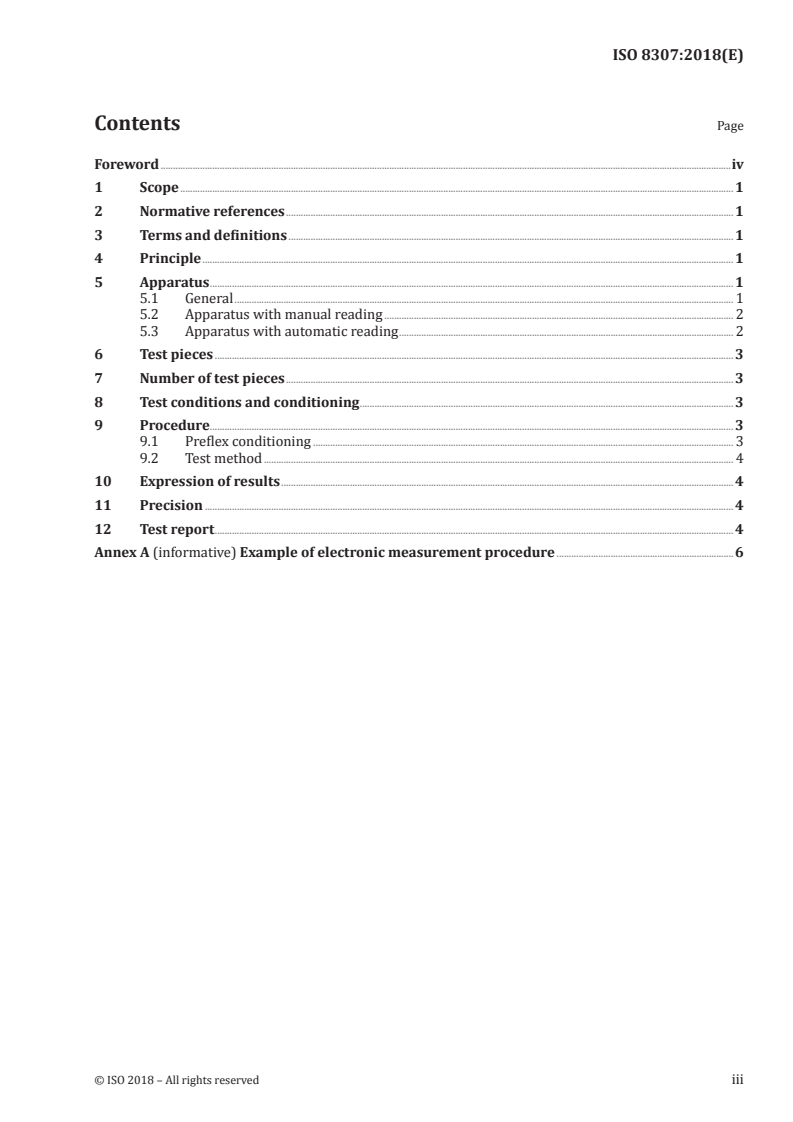
Contents Page
Foreword .iv
1 Scope . 1
2 Normative references . 1
3 Terms and definitions . 1
4 Principle . 1
5 Apparatus . 1
5.1 General . 1
5.2 Apparatus with manual reading . 2
5.3 Apparatus with automatic reading . 2
6 Test pieces . 3
7 Number of test pieces . 3
8 Test conditions and conditioning . 3
9 Procedure. 3
9.1 Preflex conditioning . 3
9.2 Test method . 4
10 Expression of results . 4
11 Precision . 4
12 Test report . 4
Annex A (informative) Example of electronic measurement procedure .6
Foreword
ISO (the International Organization for Standardization) is a worldwide federation of national standards
bodies (ISO member bodies). The work of preparing International Standards is normally carried out
through ISO technical committees. Each member body interested in a subject for which a technical
committee has been established has the right to be represented on that committee. International
organizations, governmental and non-governmental, in liaison with ISO, also take part in the work.
ISO collaborates closely with the International Electrotechnical Commission (IEC) on all matters of
electrotechnical standardization.
The procedures used to develop this document and those intended for its further maintenance are
described in the ISO/IEC Directives, Part 1. In particular the different approval criteria needed for the
different types of ISO documents should be noted. This document was drafted in accordance with the
editorial rules of the ISO/IEC Directives, Part 2 (see www .iso .org/directives).
Attention is drawn to the possibility that some of the elements of this document may be the subject of
patent rights. ISO shall not be held responsible for identifying any or all such patent rights. Details of
any patent rights identified during the development of the document will be in the Introduction and/or
on the ISO list of patent declarations received (see www .iso .org/patents).
Any trade name used in this document is information given for the convenience of users and does not
constitute an endorsement.
For an explanation on the voluntary nature of standards, the meaning of ISO specific terms and
expressions related to conformity assessment, as well as information about ISO's adherence to the
World Trade Organization (WTO) principles in the Technical Barriers to Trade (TBT) see the following
URL: www .iso .org/iso/foreword .html.
This document was prepared by Technical Committee ISO/TC 45, Rubber and rubber products,
Subcommittee SC 4, Products (other than hoses).
This third edition cancels and replaces the second edition (ISO 8307:2007), which has been technically
revised.
The main changes compared to the previous edition are as follows:
— Figure 1 has been modified.
— Annex A has been revised to represent the practical electric measurement.
iv © ISO 2018 – All rights reserved
INTERNATIONAL STANDARD ISO 8307:2018(E)
Flexible cellular polymeric materials — Determination of
resilience by ball rebound
1 Scope
This document specifies a method for determining the resilience by ball rebound of flexible cellular
polymeric materials.
2 Normative references
The following documents are referred to in the text in such a way that some or all of their content
constitutes requirements of this document. For dated references, only the edition cited applies. For
undated references, the latest edition of the referenced document (including any amendments) applies.
ISO 23529, Rubber — General procedures for preparing and conditioning test pieces for physical test methods
3 Terms and definitions
For the purposes of this document, the following terms and definitions apply.
ISO and IEC maintain terminological databases for use in standardization at the following addresses:
— ISO Online browsing platform: available at http: //www .iso .org/obp
— IEC Electropedia: available at http: //www .electropedia .org/
3.1
open-cell flexible cellular material
flexible cellular material with less than 25 % of its cell volume closed
3.2
closed-cell flexible cellular material
flexible cellular material with more than 25 % of its cell volume closed
4 Principle
A steel ball is dropped on to a test piece from a specified height and the height of rebound is measured.
5 Apparatus
5.1 General
The rebound test apparatus (see Figure 1) shall consist of a vertical transparent tube, of inside diameter
30 mm to 65 mm. A steel ball of diameter 16 mm ± 0,5 mm and mass of 16,8 g ± 1,5 g is dropped vertically
on the test piece through the tube from a height of 500 mm ± 0,5 mm using a magnet or other suitable
devi
...
NORME ISO
INTERNATIONALE 8307
Troisième édition
2018-07
Matériaux polymères alvéolaires
souples — Détermination de la
résilience par rebondissement d'une
bille
Flexible cellular polymeric materials — Determination of resilience by
ball rebound
Numéro de référence
©
ISO 2018
DOCUMENT PROTÉGÉ PAR COPYRIGHT
© ISO 2018
Tous droits réservés. Sauf prescription différente ou nécessité dans le contexte de sa mise en oeuvre, aucune partie de cette
publication ne peut être reproduite ni utilisée sous quelque forme que ce soit et par aucun procédé, électronique ou mécanique,
y compris la photocopie, ou la diffusion sur l’internet ou sur un intranet, sans autorisation écrite préalable. Une autorisation peut
être demandée à l’ISO à l’adresse ci-après ou au comité membre de l’ISO dans le pays du demandeur.
ISO copyright office
Case postale 401 • Ch. de Blandonnet 8
CH-1214 Vernier, Geneva
Tél.: +41 22 749 01 11
Fax: +41 22 749 09 47
E-mail: copyright@iso.org
Web: www.iso.org
Publié en Suisse
ii © ISO 2018 – Tous droits réservés
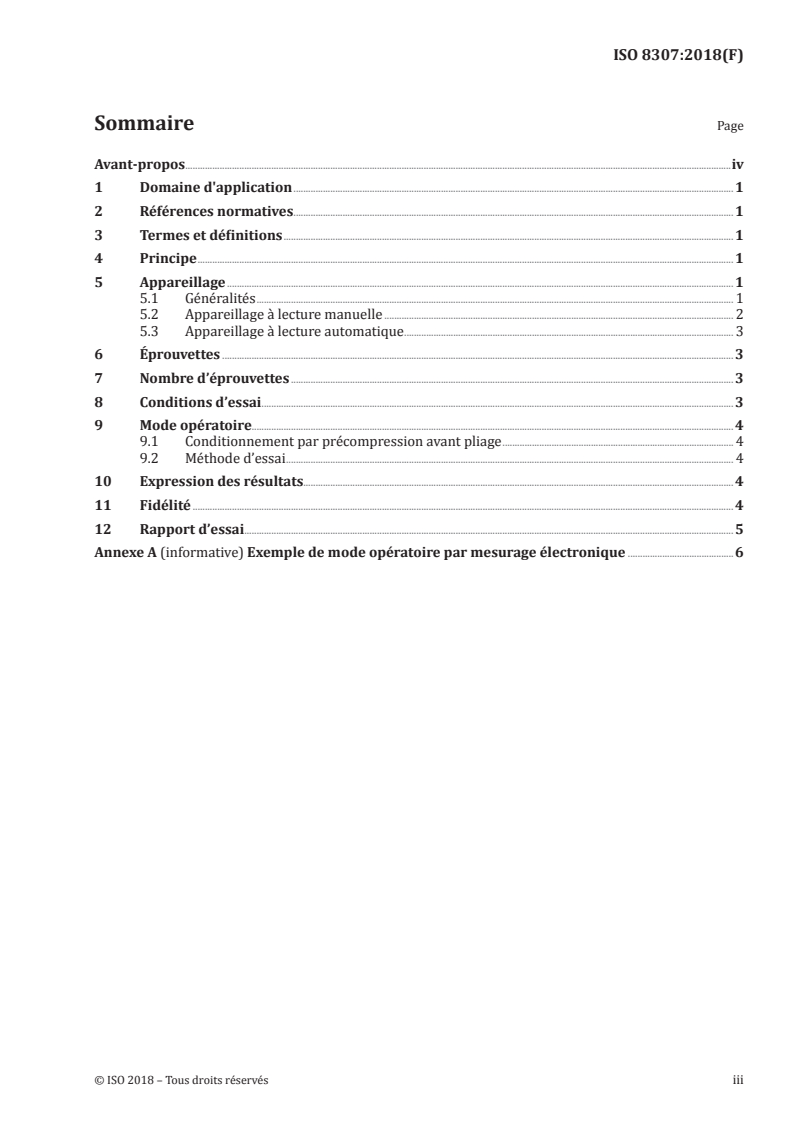
Sommaire Page
Avant-propos .iv
1 Domaine d'application . 1
2 Références normatives . 1
3 Termes et définitions . 1
4 Principe . 1
5 Appareillage . 1
5.1 Généralités . 1
5.2 Appareillage à lecture manuelle . 2
5.3 Appareillage à lecture automatique . 3
6 Éprouvettes . 3
7 Nombre d’éprouvettes . 3
8 Conditions d’essai . 3
9 Mode opératoire. 4
9.1 Conditionnement par précompression avant pliage . 4
9.2 Méthode d’essai . 4
10 Expression des résultats. 4
11 Fidélité . 4
12 Rapport d’essai . 5
Annexe A (informative) Exemple de mode opératoire par mesurage électronique .6
Avant-propos
L'ISO (Organisation internationale de normalisation) est une fédération mondiale d'organismes
nationaux de normalisation (comités membres de l'ISO). L'élaboration des Normes internationales est
en général confiée aux comités techniques de l'ISO. Chaque comité membre intéressé par une étude
a le droit de faire partie du comité technique créé à cet effet. Les organisations internationales,
gouvernementales et non gouvernementales, en liaison avec l'ISO participent également aux travaux.
L'ISO collabore étroitement avec la Commission électrotechnique internationale (IEC) en ce qui
concerne la normalisation électrotechnique.
Les procédures utilisées pour élaborer le présent document et celles destinées à sa mise à jour sont
décrites dans les Directives ISO/IEC, Partie 1. Il convient, en particulier de prendre note des différents
critères d'approbation requis pour les différents types de documents ISO. Le présent document a été
rédigé conformément aux règles de rédaction données dans les Directives ISO/IEC, Partie 2 (voir www
.iso .org/directives).
L'attention est appelée sur le fait que certains des éléments du présent document peuvent faire l'objet de
droits de propriété intellectuelle ou de droits analogues. L'ISO ne saurait être tenue pour responsable
de ne pas avoir identifié de tels droits de propriété et averti de leur existence. Les détails concernant
les références aux droits de propriété intellectuelle ou autres droits analogues identifiés lors de
l'élaboration du document sont indiqués dans l'Introduction et/ou dans la liste des déclarations de
brevets reçues par l’ISO (voir www .iso .org/brevets).
Les appellations commerciales éventuellement mentionnées dans le présent document sont données
pour information, par souci de commodité à l'intention des utilisateurs et ne sauraient constituer un
engagement.
Pour une explication de la nature volontaire des normes, la signification des termes et expressions
spécifiques de l'ISO liés à l'évaluation de la conformité, ou pour toute information au sujet de l'adhésion
de l'ISO aux principes de l'Organisation mondiale du commerce (OMC) concernant les obstacles
techniques au commerce (OTC) voir le lien suivant: www .iso .org/iso/fr/foreword .html.
Le présent document a été élaboré par le comité technique ISO/TC 45, Élastomères et produits à base
d'élastomères, sous-comité SC 4, Produits (autres que tuyaux).
Cette troisième édition annule et remplace la deuxième édition (ISO 8307:2007), qui a fait l'objet d'une
révision technique. Les principales modifications par rapport à l’édition précédente sont les suivantes:
— La Figure 1 a été modifiée.
— L’Annexe A a été révisée pour représenter le mesurage électrique pratique.
iv © ISO 2018 – Tous droits réservés
NORME INTERNATIONALE ISO 8307:2018(F)
Matériaux polymères alvéolaires souples — Détermination
de la résilience par rebondissement d'une bille
1 Domaine d'application
Le présent document spécifie une méthode d’essai utilisant le rebondissement d’une bille pour
déterminer la résilience de matériaux polymères alvéolaires souples.
2 Références normatives
Les documents suivants cités dans le texte constituent, pour tout ou partie de leur contenu, des
exigences du présent document. Pour les références datées, seule l’édition citée s’applique. Pour les
références non datées, la dernière édition du document de référence s’applique (y compris les éventuels
amendements).
ISO 23529, Caoutchouc — Procédures générales pour la préparation et le conditionnement des éprouvettes
pour les méthodes d'essais physiques
3 Termes et définitions
Pour les besoins du présent document, les termes et définitions suivants s'appliquent.
L’ISO et l’IEC tiennent à jour des bases de données terminologiques destinées à être utilisées en
normalisation, consultables aux adresses suivantes:
— ISO Online browsing platform: disponible à l’adresse https: //www .iso .org ./obp
— IEC Electropedia: disponible à l’adresse http: //www .electropedia .org/
3.1
matériau alvéolaire souple à cellules ouvertes
matériau alvéolaire souple dont moins de 25 %, en volume, des cellules sont fermées
3.2
matériau alvéolaire souple à cellules fermées
matériau alvéolaire souple dont plus de 25 %, en volume, des cellules sont fermées
4 Principe
Une bille d’acier est lâchée sur une éprouvette depuis une hauteur spécifiée et la hauteur de rebond est
mesurée.
5 Appareillage
5.1 Généralités
L’appareil prévu pour l’essai de rebondissement de la bille (voir Figure 1) doit être composé d’un tube
transparent vertical d’un diamètre intérieur de 30 mm à 65 mm. Une bille d’acier d’un diamètre de
16 mm ± 0,5 mm et d’une masse de 16,8 g ± 1,5 g est lâchée verticalement sur l’éprouvette dans le
tube d’une hauteur de 500 mm ± 0,5 mm au moyen d’un aimant ou d’un autre dispositif adapté. La bille
d’acier doit être lâchée de manière à tomber sans effectuer de rotations et à être parfaitement centrée.
Des erreurs de mesure peuvent se produire si le tube n’est pas maintenu en position verticale, et la
validité des mesu
...
Questions, Comments and Discussion
Ask us and Technical Secretary will try to provide an answer. You can facilitate discussion about the standard in here.
Loading comments...