

ISO 23753-2:2019
(Main)Soil quality — Determination of dehydrogenases activity in soils — Part 2: Method using iodotetrazolium chloride (INT)
General Information
- Abstract
This document specifies a method for determining activity of dehydrogenases in soil, using 2-(4-iodophenyl)-3-(4-nitrophenyl)-5-phenyltetrazolium chloride (INT)[1]-[5]. As the INT reduction is less sensitive to O2, the method is more robust than the TTC-method described in ISO 23753-1.
- Status
- Published
- Publication Date
- 14-Feb-2019
- Technical Committee
- ISO/TC 190/SC 4 - Biological characterization
- Drafting Committee
- ISO/TC 190/SC 4/WG 4 - Effects on soil micro-organisms
- Current Stage
- 9093 - International Standard confirmed
- Start Date
- 17-Jun-2024
- Completion Date
- 29-Aug-2026
Buy Documents


ISO 23753-2:2019 - Soil quality -- Determination of dehydrogenases activity in soils
ISO 23753-2:2019 - Soil quality — Determination of dehydrogenases activity in soils — Part 2: Method using iodotetrazolium chloride (INT)/15/2019


ISO 23753-2:2019 - Qualité du sol -- Détermination de l'activité des déshydrogénases dans les sols
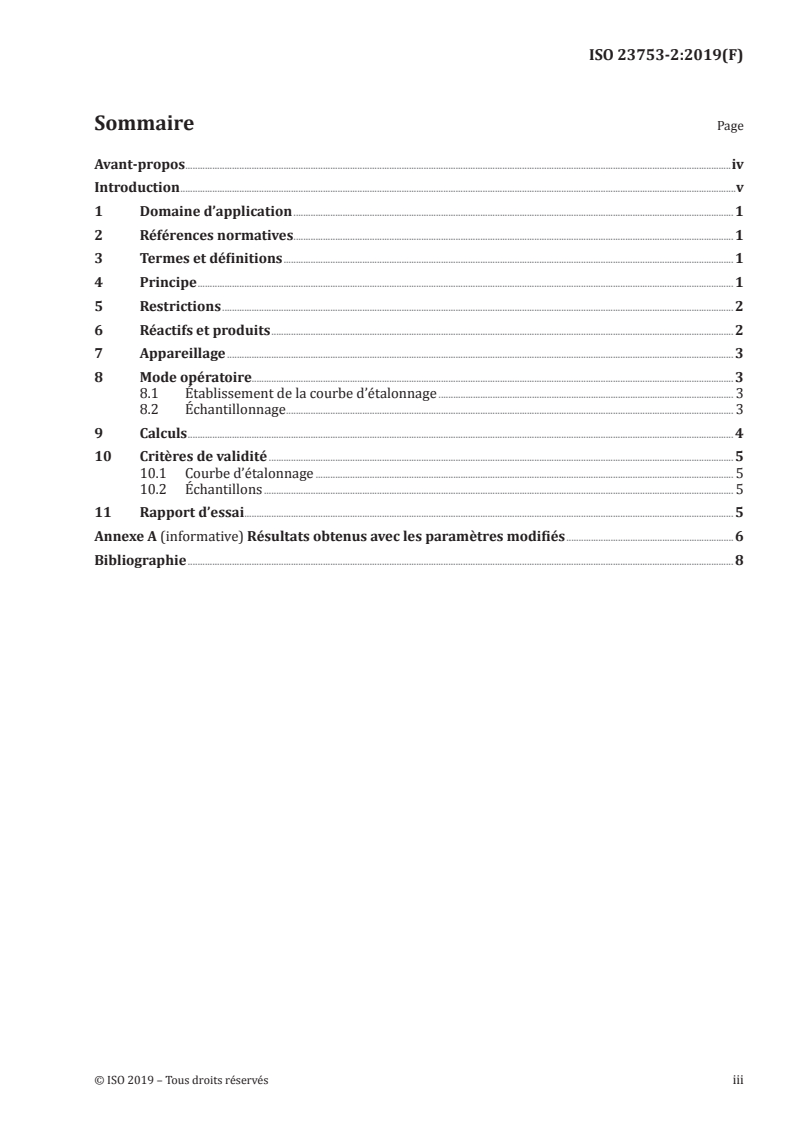
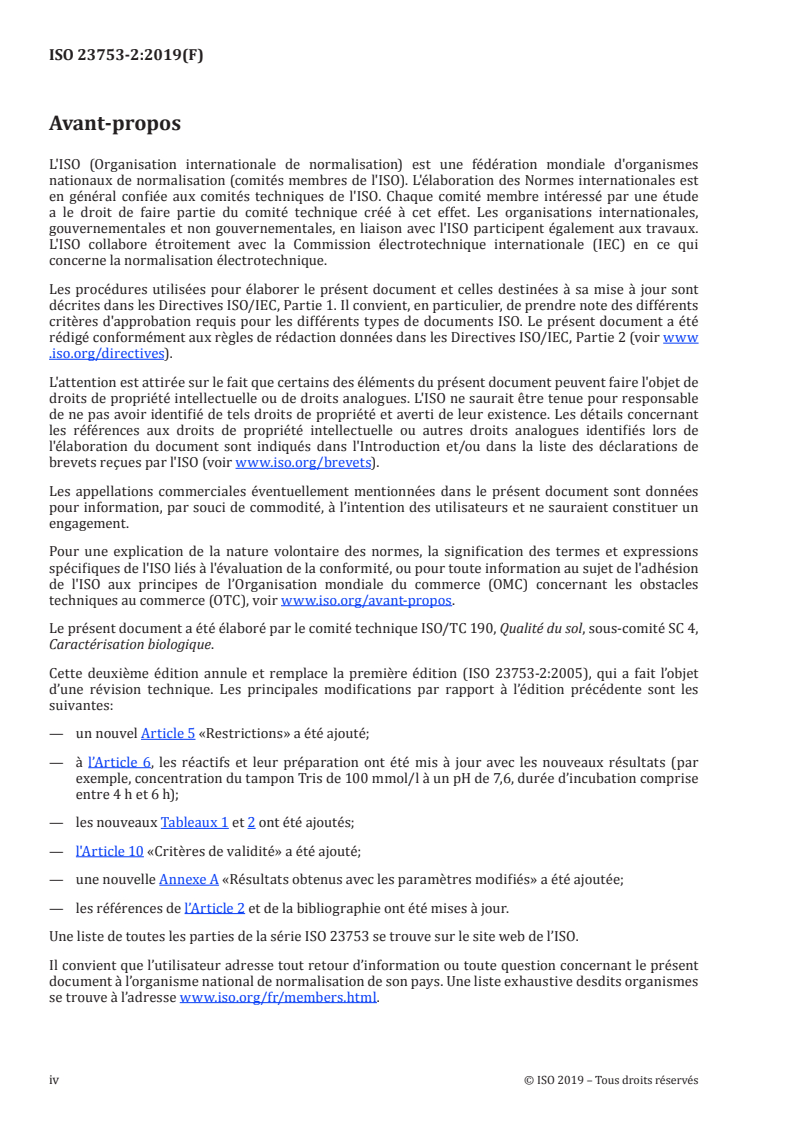
ISO 23753-2:2019 - Qualité du sol — Détermination de l'activité des déshydrogénases dans les sols — Partie 2: Méthode au chlorure de iodotétrazolium (INT)/15/2019
Overview
ISO 23753-2:2019 - Soil quality - Determination of dehydrogenases activity in soils - Part 2: Method using iodotetrazolium chloride (INT) specifies a standardized laboratory method to quantify microbial dehydrogenase activity in soils using 2-(4-iodophenyl)-3-(4-nitrophenyl)-5-phenyltetrazolium chloride (INT). The method measures reduction of INT to iodonitrotetrazolium formazan (INTF), extracted with acetone and quantified by spectrophotometry (λ = 485 nm). Because INT reduction is less sensitive to oxygen than the TTC method, this approach is more robust for assessing soil microbial oxidative activity and viable microbial biomass.
Key topics and technical requirements
- Principle: INT added to sieved soil, incubated at 25 °C ± 1 °C for 4–6 h; INTF extracted with acetone and measured spectrophotometrically at 485 nm.
- Reagents: Tris buffer 100 mmol/L, pH 7.6; INT substrate solution (15 mmol/L); INTF stock (1 µmol/mL) for standard curve.
- Sample prep: Sieved soil, typically 2 g (reduced) or 5 g (large sample) per tube; substrate and control tubes in triplicate.
- Volumes & timings: Substrate or buffer volumes (2 or 5 mL) plus acetone extraction (8 or 20 mL); 1 h orbital agitation during extraction; centrifuge 5 min at 2 000 g, 20 °C.
- Standard curve & calculation: Calibration using INTF standards (0–80 nmol/mL) to derive INTF concentration and calculate activity in mU/g (nmol/min/g dry soil).
- Validity criteria: Standard curve R² ≥ 0.990; maximum absorbance for 80 nmol/mL between 2.3–2.6; sample triplicate CV ≤ 15%; absorbance difference sample vs control ≥ 0.02–0.05; solution color between pink and red.
- Limitations: Storage affects enzyme activity - compare only samples with equivalent storage. Method may give low/variable results for organic-rich forest humus layers.
Applications and users
- Practical applications: Routine laboratory assessment of soil biological activity, monitoring effects of land management, contamination, remediation, and agricultural practices; research on microbial respiration and soil health indicators.
- Who uses it: Soil testing laboratories, environmental consultancies, agronomy and forestry researchers, regulatory bodies and practitioners assessing soil quality and microbial activity.
- Why use this method: Provides a reproducible, oxygen-tolerant measure of viable microbial oxidative activity that complements respiration and other biological soil quality indicators.
Related standards
- ISO 23753-1 (TTC method) - alternative tetrazolium-based dehydrogenase test.
- ISO 18400-206 - soil sampling and handling for microbiological assessment.
- ISO 11465 - dry matter and water content determination.
Keywords: ISO 23753-2:2019, soil dehydrogenase activity, iodotetrazolium chloride (INT), INTF, soil quality testing, spectrophotometry 485 nm, Tris buffer pH 7.6, microbial activity indicator.
Relations
- Effective Date
- 12-Feb-2026
- Effective Date
- 13-Oct-2020
- Effective Date
- 14-Nov-2015
Buy Documents
ISO 23753-2:2019 - Soil quality -- Determination of dehydrogenases activity in soils
ISO 23753-2:2019 - Soil quality — Determination of dehydrogenases activity in soils — Part 2: Method using iodotetrazolium chloride (INT)/15/2019
ISO 23753-2:2019 - Qualité du sol -- Détermination de l'activité des déshydrogénases dans les sols
ISO 23753-2:2019 - Qualité du sol — Détermination de l'activité des déshydrogénases dans les sols — Partie 2: Méthode au chlorure de iodotétrazolium (INT)/15/2019
Get Certified
Connect with accredited certification bodies for this standard

CIS Institut d.o.o.
Personal Protective Equipment (PPE) certification body. Notified Body NB-2890 for EU Regulation 2016/425 PPE.

Kiwa BDA Testing
Building and construction product certification.
Kmetijski inštitut Slovenije
Agricultural Institute of Slovenia. Soil testing, plant health, agricultural product analysis.
Sponsored listings
Frequently Asked Questions
ISO 23753-2:2019 is a standard published by the International Organization for Standardization (ISO). Its full title is "Soil quality — Determination of dehydrogenases activity in soils — Part 2: Method using iodotetrazolium chloride (INT)". This standard covers: This document specifies a method for determining activity of dehydrogenases in soil, using 2-(4-iodophenyl)-3-(4-nitrophenyl)-5-phenyltetrazolium chloride (INT)[1]-[5]. As the INT reduction is less sensitive to O2, the method is more robust than the TTC-method described in ISO 23753-1.
This document specifies a method for determining activity of dehydrogenases in soil, using 2-(4-iodophenyl)-3-(4-nitrophenyl)-5-phenyltetrazolium chloride (INT)[1]-[5]. As the INT reduction is less sensitive to O2, the method is more robust than the TTC-method described in ISO 23753-1.
ISO 23753-2:2019 is classified under the following ICS (International Classification for Standards) categories: 13.080.30 - Biological properties of soils. The ICS classification helps identify the subject area and facilitates finding related standards.
ISO 23753-2:2019 has the following relationships with other standards: It is inter standard links to EN ISO 23753-2:2019, ISO 23753-2:2019/Amd 1:2020, ISO 23753-2:2005. Understanding these relationships helps ensure you are using the most current and applicable version of the standard.
ISO 23753-2:2019 is available in PDF format for immediate download after purchase. The document can be added to your cart and obtained through the secure checkout process. Digital delivery ensures instant access to the complete standard document.
Standards Content (Sample)
INTERNATIONAL ISO
STANDARD 23753-2
Second edition
2019-02
Soil quality — Determination of
dehydrogenases activity in soils —
Part 2:
Method using iodotetrazolium
chloride (INT)
Qualité du sol — Détermination de l'activité des déshydrogénases
dans les sols —
Partie 2: Méthode au chlorure de iodotétrazolium (INT)
Reference number
©
ISO 2019
© ISO 2019
All rights reserved. Unless otherwise specified, or required in the context of its implementation, no part of this publication may
be reproduced or utilized otherwise in any form or by any means, electronic or mechanical, including photocopying, or posting
on the internet or an intranet, without prior written permission. Permission can be requested from either ISO at the address
below or ISO’s member body in the country of the requester.
ISO copyright office
CP 401 • Ch. de Blandonnet 8
CH-1214 Vernier, Geneva
Phone: +41 22 749 01 11
Fax: +41 22 749 09 47
Email: copyright@iso.org
Website: www.iso.org
Published in Switzerland
ii © ISO 2019 – All rights reserved
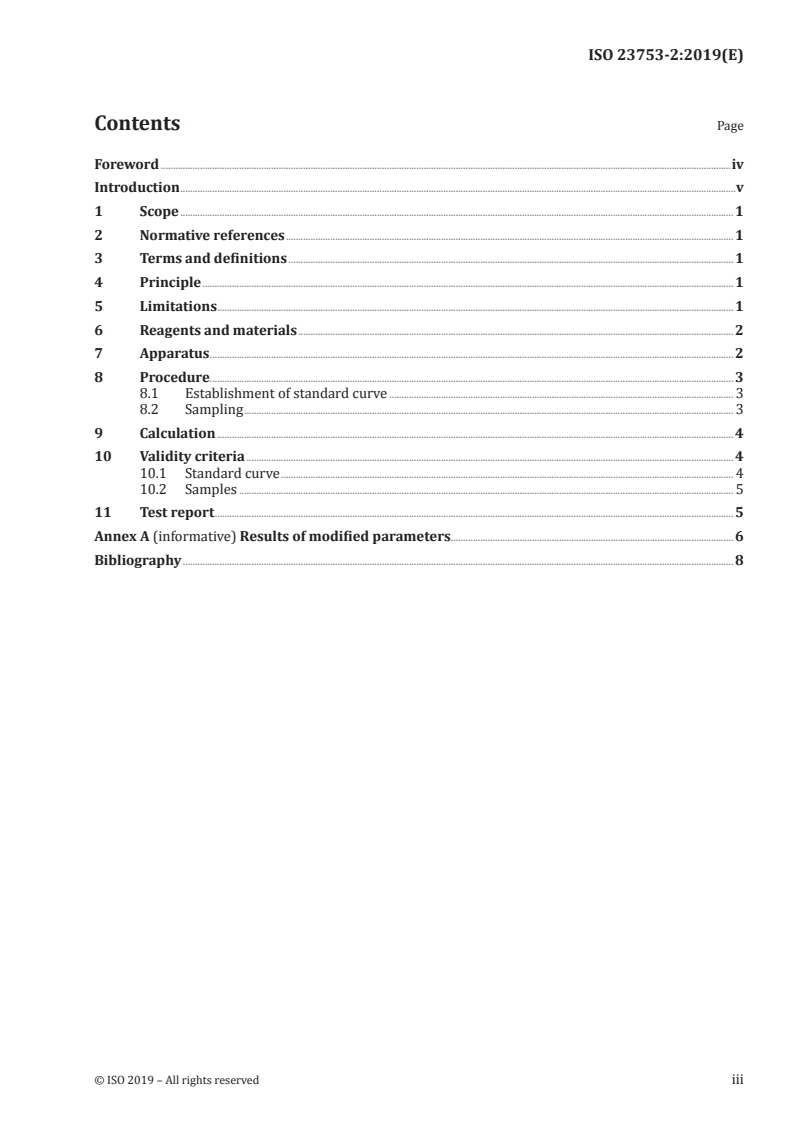
Contents Page
Foreword .iv
Introduction .v
1 Scope . 1
2 Normative references . 1
3 Terms and definitions . 1
4 Principle . 1
5 Limitations . 1
6 Reagents and materials . 2
7 Apparatus . 2
8 Procedure. 3
8.1 Establishment of standard curve . 3
8.2 Sampling . 3
9 Calculation . 4
10 Validity criteria . 4
10.1 Standard curve . 4
10.2 Samples . 5
11 Test report . 5
Annex A (informative) Results of modified parameters . 6
Bibliography . 8
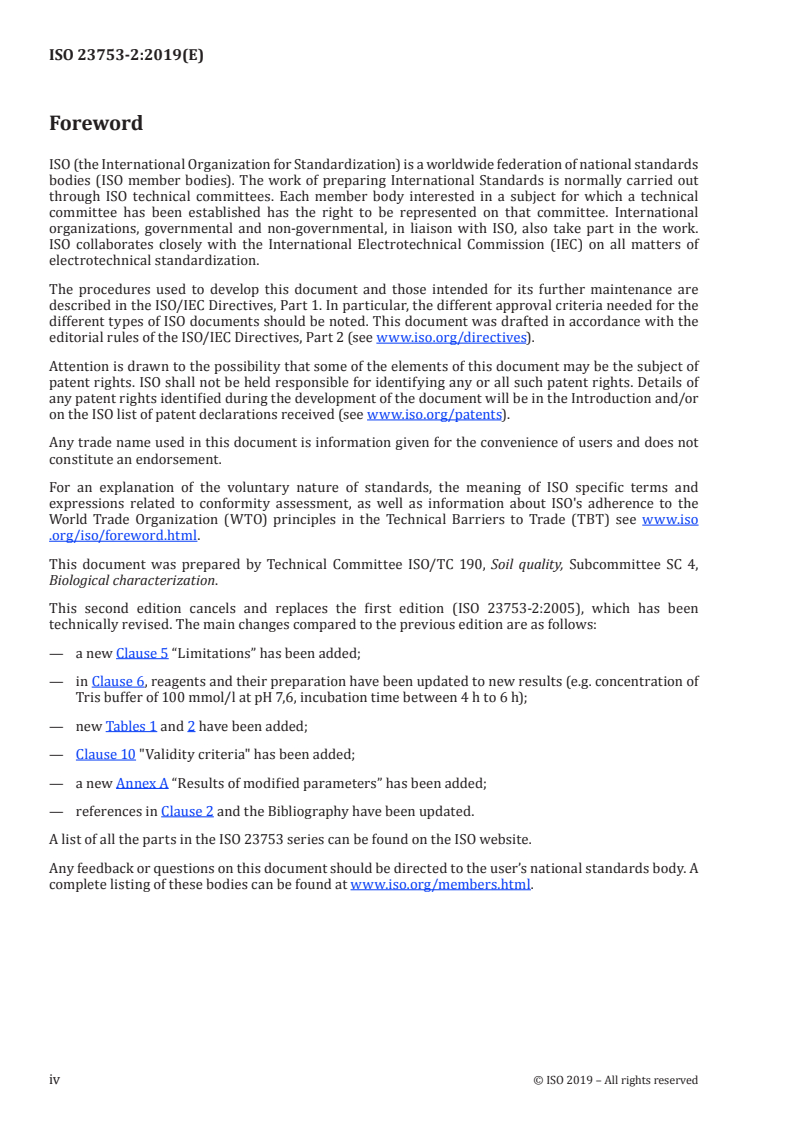
Foreword
ISO (the International Organization for Standardization) is a worldwide federation of national standards
bodies (ISO member bodies). The work of preparing International Standards is normally carried out
through ISO technical committees. Each member body interested in a subject for which a technical
committee has been established has the right to be represented on that committee. International
organizations, governmental and non-governmental, in liaison with ISO, also take part in the work.
ISO collaborates closely with the International Electrotechnical Commission (IEC) on all matters of
electrotechnical standardization.
The procedures used to develop this document and those intended for its further maintenance are
described in the ISO/IEC Directives, Part 1. In particular, the different approval criteria needed for the
different types of ISO documents should be noted. This document was drafted in accordance with the
editorial rules of the ISO/IEC Directives, Part 2 (see www .iso .org/directives).
Attention is drawn to the possibility that some of the elements of this document may be the subject of
patent rights. ISO shall not be held responsible for identifying any or all such patent rights. Details of
any patent rights identified during the development of the document will be in the Introduction and/or
on the ISO list of patent declarations received (see www .iso .org/patents).
Any trade name used in this document is information given for the convenience of users and does not
constitute an endorsement.
For an explanation of the voluntary nature of standards, the meaning of ISO specific terms and
expressions related to conformity assessment, as well as information about ISO's adherence to the
World Trade Organization (WTO) principles in the Technical Barriers to Trade (TBT) see www .iso
.org/iso/foreword .html.
This document was prepared by Technical Committee ISO/TC 190, Soil quality, Subcommittee SC 4,
Biological characterization.
This second edition cancels and replaces the first edition (ISO 23753-2:2005), which has been
technically revised. The main changes compared to the previous edition are as follows:
— a new Clause 5 “Limitations” has been added;
— in Clause 6, reagents and their preparation have been updated to new results (e.g. concentration of
Tris buffer of 100 mmol/l at pH 7,6, incubation time between 4 h to 6 h);
— new Tables 1 and 2 have been added;
— Clause 10 "Validity criteria" has been added;
— a new Annex A “Results of modified parameters” has been added;
— references in Clause 2 and the Bibliography have been updated.
A list of all the parts in the ISO 23753 series can be found on the ISO website.
Any feedback or questions on this document should be directed to the user’s national standards body. A
complete listing of these bodies can be found at www .iso .org/members .html.
iv © ISO 2019 – All rights reserved
Introduction
The soil microflora is responsible for the decomposition and conversion of organic substances, carbon,
nitrogen, sulfur and phosphorus cycles, soil aggregates stability and as a food source for microbivores.
Dehydrogenases, as intracellular enzymes and respiratory chain components of the microbial cells, play
a major role in the production of energy by organisms. They oxidize organic compounds by transferring
+
electrons to an acceptor (e.g. NAD ). Dehydrogenases are essential components of the enzyme system
of microorganisms. Dehydrogenase activity can therefore be used as an indicator of biological redox
systems and as a measure of the viable and physiologically active soil microbial community.
Microbial oxidative activity in soil is linked to respiratory activity, which could be approached with the
determination of dehydrogenases activity. Basal and induced respiration in soil could be affected by
soil management, practices and contamination.
INTERNATIONAL STANDARD ISO 23753-2:2019(E)
Soil quality — Determination of dehydrogenases activity
in soils —
Part 2:
Method using iodotetrazolium chloride (INT)
1 Scope
This document specifies a method for determining activity of dehydrogenases in soil, using
[1]-[5]
2-(4-iodophenyl)-3-(4-nitrophenyl)-5-phenyltetrazolium chloride (INT) . As the INT reduction is
less sensitive to O , the method is more robust than the TTC-method described in ISO 23753-1.
2 Normative references
The following documents are referred to in the text in such a way that some or all of their content
constitutes requirements of this document. For dated references, only the edition cited applies. For
undated references, the latest edition of the referenced document (including any amendments) applies.
ISO 11465, Soil quality — Determination of dry matter and water content on a mass basis —
Gravimetric method
ISO 18400-206, Soil quality — Sampling — Part 206: Collection, handling and storage of soil under aerobic
conditions for the assessment of microbiological processes, biomass and diversity in the laboratory
3 Terms and definitions
No terms and definitions are listed in this document.
ISO and IEC maintain terminological databases for use in standardization at the following addresses:
— ISO Online browsing platform: available at https: //www .iso .org/obp
— IEC Electropedia: available at http: //www .electropedia .org/
4 Principle
INT solution is added to a soil sample and the mixture is incubated at 25 °C ± 1 °C for 4 h to 6 h depending
of soil uses (agricult
...
INTERNATIONAL ISO
STANDARD 23753-2
Second edition
2019-02
Soil quality — Determination of
dehydrogenases activity in soils —
Part 2:
Method using iodotetrazolium
chloride (INT)
Qualité du sol — Détermination de l'activité des déshydrogénases
dans les sols —
Partie 2: Méthode au chlorure de iodotétrazolium (INT)
Reference number
©
ISO 2019
© ISO 2019
All rights reserved. Unless otherwise specified, or required in the context of its implementation, no part of this publication may
be reproduced or utilized otherwise in any form or by any means, electronic or mechanical, including photocopying, or posting
on the internet or an intranet, without prior written permission. Permission can be requested from either ISO at the address
below or ISO’s member body in the country of the requester.
ISO copyright office
CP 401 • Ch. de Blandonnet 8
CH-1214 Vernier, Geneva
Phone: +41 22 749 01 11
Fax: +41 22 749 09 47
Email: copyright@iso.org
Website: www.iso.org
Published in Switzerland
ii © ISO 2019 – All rights reserved
Contents Page
Foreword .iv
Introduction .v
1 Scope . 1
2 Normative references . 1
3 Terms and definitions . 1
4 Principle . 1
5 Limitations . 1
6 Reagents and materials . 2
7 Apparatus . 2
8 Procedure. 3
8.1 Establishment of standard curve . 3
8.2 Sampling . 3
9 Calculation . 4
10 Validity criteria . 4
10.1 Standard curve . 4
10.2 Samples . 5
11 Test report . 5
Annex A (informative) Results of modified parameters . 6
Bibliography . 8
Foreword
ISO (the International Organization for Standardization) is a worldwide federation of national standards
bodies (ISO member bodies). The work of preparing International Standards is normally carried out
through ISO technical committees. Each member body interested in a subject for which a technical
committee has been established has the right to be represented on that committee. International
organizations, governmental and non-governmental, in liaison with ISO, also take part in the work.
ISO collaborates closely with the International Electrotechnical Commission (IEC) on all matters of
electrotechnical standardization.
The procedures used to develop this document and those intended for its further maintenance are
described in the ISO/IEC Directives, Part 1. In particular, the different approval criteria needed for the
different types of ISO documents should be noted. This document was drafted in accordance with the
editorial rules of the ISO/IEC Directives, Part 2 (see www .iso .org/directives).
Attention is drawn to the possibility that some of the elements of this document may be the subject of
patent rights. ISO shall not be held responsible for identifying any or all such patent rights. Details of
any patent rights identified during the development of the document will be in the Introduction and/or
on the ISO list of patent declarations received (see www .iso .org/patents).
Any trade name used in this document is information given for the convenience of users and does not
constitute an endorsement.
For an explanation of the voluntary nature of standards, the meaning of ISO specific terms and
expressions related to conformity assessment, as well as information about ISO's adherence to the
World Trade Organization (WTO) principles in the Technical Barriers to Trade (TBT) see www .iso
.org/iso/foreword .html.
This document was prepared by Technical Committee ISO/TC 190, Soil quality, Subcommittee SC 4,
Biological characterization.
This second edition cancels and replaces the first edition (ISO 23753-2:2005), which has been
technically revised. The main changes compared to the previous edition are as follows:
— a new Clause 5 “Limitations” has been added;
— in Clause 6, reagents and their preparation have been updated to new results (e.g. concentration of
Tris buffer of 100 mmol/l at pH 7,6, incubation time between 4 h to 6 h);
— new Tables 1 and 2 have been added;
— Clause 10 "Validity criteria" has been added;
— a new Annex A “Results of modified parameters” has been added;
— references in Clause 2 and the Bibliography have been updated.
A list of all the parts in the ISO 23753 series can be found on the ISO website.
Any feedback or questions on this document should be directed to the user’s national standards body. A
complete listing of these bodies can be found at www .iso .org/members .html.
iv © ISO 2019 – All rights reserved
Introduction
The soil microflora is responsible for the decomposition and conversion of organic substances, carbon,
nitrogen, sulfur and phosphorus cycles, soil aggregates stability and as a food source for microbivores.
Dehydrogenases, as intracellular enzymes and respiratory chain components of the microbial cells, play
a major role in the production of energy by organisms. They oxidize organic compounds by transferring
+
electrons to an acceptor (e.g. NAD ). Dehydrogenases are essential components of the enzyme system
of microorganisms. Dehydrogenase activity can therefore be used as an indicator of biological redox
systems and as a measure of the viable and physiologically active soil microbial community.
Microbial oxidative activity in soil is linked to respiratory activity, which could be approached with the
determination of dehydrogenases activity. Basal and induced respiration in soil could be affected by
soil management, practices and contamination.
INTERNATIONAL STANDARD ISO 23753-2:2019(E)
Soil quality — Determination of dehydrogenases activity
in soils —
Part 2:
Method using iodotetrazolium chloride (INT)
1 Scope
This document specifies a method for determining activity of dehydrogenases in soil, using
[1]-[5]
2-(4-iodophenyl)-3-(4-nitrophenyl)-5-phenyltetrazolium chloride (INT) . As the INT reduction is
less sensitive to O , the method is more robust than the TTC-method described in ISO 23753-1.
2 Normative references
The following documents are referred to in the text in such a way that some or all of their content
constitutes requirements of this document. For dated references, only the edition cited applies. For
undated references, the latest edition of the referenced document (including any amendments) applies.
ISO 11465, Soil quality — Determination of dry matter and water content on a mass basis —
Gravimetric method
ISO 18400-206, Soil quality — Sampling — Part 206: Collection, handling and storage of soil under aerobic
conditions for the assessment of microbiological processes, biomass and diversity in the laboratory
3 Terms and definitions
No terms and definitions are listed in this document.
ISO and IEC maintain terminological databases for use in standardization at the following addresses:
— ISO Online browsing platform: available at https: //www .iso .org/obp
— IEC Electropedia: available at http: //www .electropedia .org/
4 Principle
INT solution is added to a soil sample and the mixture is incubated at 25 °C ± 1 °C for 4 h to 6 h depending
of soil uses (agricult
...
NORME ISO
INTERNATIONALE 23753-2
Deuxième édition
2019-02
Qualité du sol — Détermination de
l'activité des déshydrogénases dans
les sols —
Partie 2:
Méthode au chlorure de
iodotétrazolium (INT)
Soil quality — Determination of dehydrogenases activity in soils —
Part 2: Method using iodotetrazolium chloride (INT)
Numéro de référence
©
ISO 2019
DOCUMENT PROTÉGÉ PAR COPYRIGHT
© ISO 2019
Tous droits réservés. Sauf prescription différente ou nécessité dans le contexte de sa mise en œuvre, aucune partie de cette
publication ne peut être reproduite ni utilisée sous quelque forme que ce soit et par aucun procédé, électronique ou mécanique,
y compris la photocopie, ou la diffusion sur l’internet ou sur un intranet, sans autorisation écrite préalable. Une autorisation peut
être demandée à l’ISO à l’adresse ci-après ou au comité membre de l’ISO dans le pays du demandeur.
ISO copyright office
Case postale 401 • Ch. de Blandonnet 8
CH-1214 Vernier, Genève
Tél.: +41 22 749 01 11
Fax: +41 22 749 09 47
E-mail: copyright@iso.org
Web: www.iso.org
Publié en Suisse
ii © ISO 2019 – Tous droits réservés
Sommaire Page
Avant-propos .iv
Introduction .v
1 Domaine d’application . 1
2 Références normatives . 1
3 Termes et définitions . 1
4 Principe . 1
5 Restrictions . 2
6 Réactifs et produits . 2
7 Appareillage . 3
8 Mode opératoire. 3
8.1 Établissement de la courbe d’étalonnage . 3
8.2 Échantillonnage . 3
9 Calculs . 4
10 Critères de validité . 5
10.1 Courbe d’étalonnage . 5
10.2 Échantillons . 5
11 Rapport d’essai . 5
Annexe A (informative) Résultats obtenus avec les paramètres modifiés . 6
Bibliographie . 8
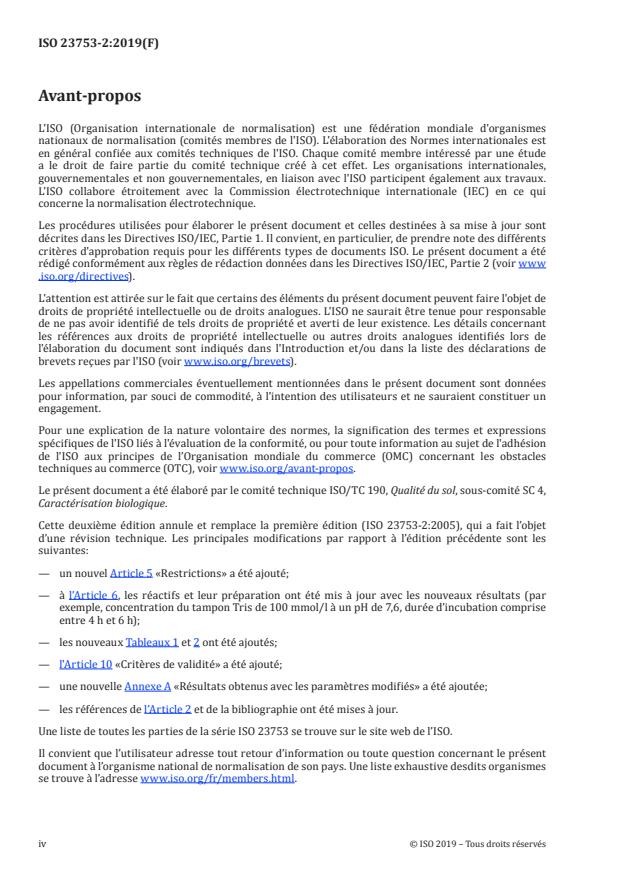
Avant-propos
L'ISO (Organisation internationale de normalisation) est une fédération mondiale d'organismes
nationaux de normalisation (comités membres de l'ISO). L'élaboration des Normes internationales est
en général confiée aux comités techniques de l'ISO. Chaque comité membre intéressé par une étude
a le droit de faire partie du comité technique créé à cet effet. Les organisations internationales,
gouvernementales et non gouvernementales, en liaison avec l'ISO participent également aux travaux.
L'ISO collabore étroitement avec la Commission électrotechnique internationale (IEC) en ce qui
concerne la normalisation électrotechnique.
Les procédures utilisées pour élaborer le présent document et celles destinées à sa mise à jour sont
décrites dans les Directives ISO/IEC, Partie 1. Il convient, en particulier, de prendre note des différents
critères d'approbation requis pour les différents types de documents ISO. Le présent document a été
rédigé conformément aux règles de rédaction données dans les Directives ISO/IEC, Partie 2 (voir www
.iso .org/directives).
L'attention est attirée sur le fait que certains des éléments du présent document peuvent faire l'objet de
droits de propriété intellectuelle ou de droits analogues. L'ISO ne saurait être tenue pour responsable
de ne pas avoir identifié de tels droits de propriété et averti de leur existence. Les détails concernant
les références aux droits de propriété intellectuelle ou autres droits analogues identifiés lors de
l'élaboration du document sont indiqués dans l'Introduction et/ou dans la liste des déclarations de
brevets reçues par l'ISO (voir www .iso .org/brevets).
Les appellations commerciales éventuellement mentionnées dans le présent document sont données
pour information, par souci de commodité, à l’intention des utilisateurs et ne sauraient constituer un
engagement.
Pour une explication de la nature volontaire des normes, la signification des termes et expressions
spécifiques de l'ISO liés à l'évaluation de la conformité, ou pour toute information au sujet de l'adhésion
de l'ISO aux principes de l’Organisation mondiale du commerce (OMC) concernant les obstacles
techniques au commerce (OTC), voir www .iso .org/avant -propos.
Le présent document a été élaboré par le comité technique ISO/TC 190, Qualité du sol, sous-comité SC 4,
Caractérisation biologique.
Cette deuxième édition annule et remplace la première édition (ISO 23753-2:2005), qui a fait l’objet
d’une révision technique. Les principales modifications par rapport à l’édition précédente sont les
suivantes:
— un nouvel Article 5 «Restrictions» a été ajouté;
— à l’Article 6, les réactifs et leur préparation ont été mis à jour avec les nouveaux résultats (par
exemple, concentration du tampon Tris de 100 mmol/l à un pH de 7,6, durée d’incubation comprise
entre 4 h et 6 h);
— les nouveaux Tableaux 1 et 2 ont été ajoutés;
— l'Article 10 «Critères de validité» a été ajouté;
— une nouvelle Annexe A «Résultats obtenus avec les paramètres modifiés» a été ajoutée;
— les références de l’Article 2 et de la bibliographie ont été mises à jour.
Une liste de toutes les parties de la série ISO 23753 se trouve sur le site web de l’ISO.
Il convient que l’utilisateur adresse tout retour d’information ou toute question concernant le présent
document à l’organisme national de normalisation de son pays. Une liste exhaustive desdits organismes
se trouve à l’adresse www .iso .org/fr/members .html.
iv © ISO 2019 – Tous droits réservés
Introduction
La microflore du sol est responsable de la décomposition et de la transformation des matières
organiques, des cycles du carbone, de l’azote, du soufre et du phosphore, de la stabilité des agrégats
du sol et sert de source de nourriture pour les organismes microbivores. Les déshydrogénases, en tant
qu’enzymes intracellulaires et composants de la chaîne respiratoire des cellules microbiennes, jouent
un rôle fondamental dans la production d’énergie par les organismes. Elles permettent l’oxydation
+
des composés organiques par le transfert d'électrons à un accepteur (par exemple, NAD ). Les
déshydrogénases sont des composants essentiels du système enzymatique des micro-organismes.
L’activité des déshydrogénases peut donc être utilisée comme indicateur des réactions biologiques
d’oxydoréduction ainsi que pour mesurer la communauté microbienne viable et physiologiquement
active dans le sol.
L’activité microbienne oxydative dans le sol est liée à l’activité respiratoire, qui pourrait être évaluée
approximativement en déterminant l’activité des déshydrogénases. La respiration basale et induite
dans le sol pourrait être affectée par la gestion, les pratiques de gestion et la contamination des sols.
NORME INTERNATIONALE ISO 23753-2:2019(F)
Qualité du sol — Détermination de l'activité des
déshydrogénases dans les sols —
Partie 2:
Méthode au chlorure de iodotétrazolium (INT)
1 Domaine d’application
Le présent document spécifie une méthode de détermination de l’activité des déshydrogénases dans
[1] [5]
le sol à l’aide de chlorure de 2-(4-iodophényl)-3-(4-nitrophényl)-5-phényltétrazolium (INT). -
Comme la réduction de l’INT est moins sensible à la présence d’O , cette méthode est plus robuste que la
méthode au CTT décrite dans l’ISO 23753-1.
2 Références normatives
Les documents suivants sont cités dans le texte de sorte qu’ils constituent, pour tout ou partie de leur
contenu, des exigences du présent document. Pour les références datées, seule l’édition citée s’applique.
Pour les références non datées, la dernière édition du document de référence s'applique (y compris les
éventuels amendements).
ISO 11465, Qualité du sol — Détermination de la teneur pondérale en matière sèche et en eau — Méthode
gravimétrique
ISO 18400-206, Qualité du sol — Échantillonnage — Partie 206: Collecte, manipulation et conservation de
sols destinés à l'évaluation de paramètres biologiques fonctionnels et structurels en laboratoire
3 Termes et définitions
Aucun terme n’est défini dans le présent document.
L’ISO et l’IEC tiennent à jour des bases de données terminologiques destinées à être utilisées en
normalisation, consultables aux adresses suivantes:
— ISO Online browsing platform: disponible à l’adresse https: //www .iso .org/obp
— IEC Electropedia: disponible à l’adresse http: //www .electropedia .org/
4 Principe
La solution d’INT est ajoutée à un échantillon de sol et le mélange est incubé à 25 °C ± 1 °C pendant
4 h à 6 h, en fonction des usages du sol (sol agricole ou forestier, par exemple). L’iodonitrotétrazolium
formazan (INTF) formé est extrait à l’acétone et dosé par spectrophotométrie à une longueur d’onde
de 485 nm.
NOTE 1 Cette méthode est fondée sur une version modifiée de la méthode décrite dans la Référence [1].
NOTE 2 L’acétone est utilisé
...
NORME ISO
INTERNATIONALE 23753-2
Deuxième édition
2019-02
Qualité du sol — Détermination de
l'activité des déshydrogénases dans
les sols —
Partie 2:
Méthode au chlorure de
iodotétrazolium (INT)
Soil quality — Determination of dehydrogenases activity in soils —
Part 2: Method using iodotetrazolium chloride (INT)
Numéro de référence
©
ISO 2019
DOCUMENT PROTÉGÉ PAR COPYRIGHT
© ISO 2019
Tous droits réservés. Sauf prescription différente ou nécessité dans le contexte de sa mise en œuvre, aucune partie de cette
publication ne peut être reproduite ni utilisée sous quelque forme que ce soit et par aucun procédé, électronique ou mécanique,
y compris la photocopie, ou la diffusion sur l’internet ou sur un intranet, sans autorisation écrite préalable. Une autorisation peut
être demandée à l’ISO à l’adresse ci-après ou au comité membre de l’ISO dans le pays du demandeur.
ISO copyright office
Case postale 401 • Ch. de Blandonnet 8
CH-1214 Vernier, Genève
Tél.: +41 22 749 01 11
Fax: +41 22 749 09 47
E-mail: copyright@iso.org
Web: www.iso.org
Publié en Suisse
ii © ISO 2019 – Tous droits réservés
Sommaire Page
Avant-propos .iv
Introduction .v
1 Domaine d’application . 1
2 Références normatives . 1
3 Termes et définitions . 1
4 Principe . 1
5 Restrictions . 2
6 Réactifs et produits . 2
7 Appareillage . 3
8 Mode opératoire. 3
8.1 Établissement de la courbe d’étalonnage . 3
8.2 Échantillonnage . 3
9 Calculs . 4
10 Critères de validité . 5
10.1 Courbe d’étalonnage . 5
10.2 Échantillons . 5
11 Rapport d’essai . 5
Annexe A (informative) Résultats obtenus avec les paramètres modifiés . 6
Bibliographie . 8
Avant-propos
L'ISO (Organisation internationale de normalisation) est une fédération mondiale d'organismes
nationaux de normalisation (comités membres de l'ISO). L'élaboration des Normes internationales est
en général confiée aux comités techniques de l'ISO. Chaque comité membre intéressé par une étude
a le droit de faire partie du comité technique créé à cet effet. Les organisations internationales,
gouvernementales et non gouvernementales, en liaison avec l'ISO participent également aux travaux.
L'ISO collabore étroitement avec la Commission électrotechnique internationale (IEC) en ce qui
concerne la normalisation électrotechnique.
Les procédures utilisées pour élaborer le présent document et celles destinées à sa mise à jour sont
décrites dans les Directives ISO/IEC, Partie 1. Il convient, en particulier, de prendre note des différents
critères d'approbation requis pour les différents types de documents ISO. Le présent document a été
rédigé conformément aux règles de rédaction données dans les Directives ISO/IEC, Partie 2 (voir www
.iso .org/directives).
L'attention est attirée sur le fait que certains des éléments du présent document peuvent faire l'objet de
droits de propriété intellectuelle ou de droits analogues. L'ISO ne saurait être tenue pour responsable
de ne pas avoir identifié de tels droits de propriété et averti de leur existence. Les détails concernant
les références aux droits de propriété intellectuelle ou autres droits analogues identifiés lors de
l'élaboration du document sont indiqués dans l'Introduction et/ou dans la liste des déclarations de
brevets reçues par l'ISO (voir www .iso .org/brevets).
Les appellations commerciales éventuellement mentionnées dans le présent document sont données
pour information, par souci de commodité, à l’intention des utilisateurs et ne sauraient constituer un
engagement.
Pour une explication de la nature volontaire des normes, la signification des termes et expressions
spécifiques de l'ISO liés à l'évaluation de la conformité, ou pour toute information au sujet de l'adhésion
de l'ISO aux principes de l’Organisation mondiale du commerce (OMC) concernant les obstacles
techniques au commerce (OTC), voir www .iso .org/avant -propos.
Le présent document a été élaboré par le comité technique ISO/TC 190, Qualité du sol, sous-comité SC 4,
Caractérisation biologique.
Cette deuxième édition annule et remplace la première édition (ISO 23753-2:2005), qui a fait l’objet
d’une révision technique. Les principales modifications par rapport à l’édition précédente sont les
suivantes:
— un nouvel Article 5 «Restrictions» a été ajouté;
— à l’Article 6, les réactifs et leur préparation ont été mis à jour avec les nouveaux résultats (par
exemple, concentration du tampon Tris de 100 mmol/l à un pH de 7,6, durée d’incubation comprise
entre 4 h et 6 h);
— les nouveaux Tableaux 1 et 2 ont été ajoutés;
— l'Article 10 «Critères de validité» a été ajouté;
— une nouvelle Annexe A «Résultats obtenus avec les paramètres modifiés» a été ajoutée;
— les références de l’Article 2 et de la bibliographie ont été mises à jour.
Une liste de toutes les parties de la série ISO 23753 se trouve sur le site web de l’ISO.
Il convient que l’utilisateur adresse tout retour d’information ou toute question concernant le présent
document à l’organisme national de normalisation de son pays. Une liste exhaustive desdits organismes
se trouve à l’adresse www .iso .org/fr/members .html.
iv © ISO 2019 – Tous droits réservés
Introduction
La microflore du sol est responsable de la décomposition et de la transformation des matières
organiques, des cycles du carbone, de l’azote, du soufre et du phosphore, de la stabilité des agrégats
du sol et sert de source de nourriture pour les organismes microbivores. Les déshydrogénases, en tant
qu’enzymes intracellulaires et composants de la chaîne respiratoire des cellules microbiennes, jouent
un rôle fondamental dans la production d’énergie par les organismes. Elles permettent l’oxydation
+
des composés organiques par le transfert d'électrons à un accepteur (par exemple, NAD ). Les
déshydrogénases sont des composants essentiels du système enzymatique des micro-organismes.
L’activité des déshydrogénases peut donc être utilisée comme indicateur des réactions biologiques
d’oxydoréduction ainsi que pour mesurer la communauté microbienne viable et physiologiquement
active dans le sol.
L’activité microbienne oxydative dans le sol est liée à l’activité respiratoire, qui pourrait être évaluée
approximativement en déterminant l’activité des déshydrogénases. La respiration basale et induite
dans le sol pourrait être affectée par la gestion, les pratiques de gestion et la contamination des sols.
NORME INTERNATIONALE ISO 23753-2:2019(F)
Qualité du sol — Détermination de l'activité des
déshydrogénases dans les sols —
Partie 2:
Méthode au chlorure de iodotétrazolium (INT)
1 Domaine d’application
Le présent document spécifie une méthode de détermination de l’activité des déshydrogénases dans
[1] [5]
le sol à l’aide de chlorure de 2-(4-iodophényl)-3-(4-nitrophényl)-5-phényltétrazolium (INT). -
Comme la réduction de l’INT est moins sensible à la présence d’O , cette méthode est plus robuste que la
méthode au CTT décrite dans l’ISO 23753-1.
2 Références normatives
Les documents suivants sont cités dans le texte de sorte qu’ils constituent, pour tout ou partie de leur
contenu, des exigences du présent document. Pour les références datées, seule l’édition citée s’applique.
Pour les références non datées, la dernière édition du document de référence s'applique (y compris les
éventuels amendements).
ISO 11465, Qualité du sol — Détermination de la teneur pondérale en matière sèche et en eau — Méthode
gravimétrique
ISO 18400-206, Qualité du sol — Échantillonnage — Partie 206: Collecte, manipulation et conservation de
sols destinés à l'évaluation de paramètres biologiques fonctionnels et structurels en laboratoire
3 Termes et définitions
Aucun terme n’est défini dans le présent document.
L’ISO et l’IEC tiennent à jour des bases de données terminologiques destinées à être utilisées en
normalisation, consultables aux adresses suivantes:
— ISO Online browsing platform: disponible à l’adresse https: //www .iso .org/obp
— IEC Electropedia: disponible à l’adresse http: //www .electropedia .org/
4 Principe
La solution d’INT est ajoutée à un échantillon de sol et le mélange est incubé à 25 °C ± 1 °C pendant
4 h à 6 h, en fonction des usages du sol (sol agricole ou forestier, par exemple). L’iodonitrotétrazolium
formazan (INTF) formé est extrait à l’acétone et dosé par spectrophotométrie à une longueur d’onde
de 485 nm.
NOTE 1 Cette méthode est fondée sur une version modifiée de la méthode décrite dans la Référence [1].
NOTE 2 L’acétone est utilisé
...