

ISO 8715-1:2026
(Main)Electric road vehicles — Road operating characteristics — Part 1: Passenger cars and light duty vehicles
- Abstract
This document specifies test methods for measurement of the performance of purely electrically propelled vehicles classified as passenger cars and light duty vehicles which are defined in the relevant regional applicable driving test (ADT) standards. NOTE Performance comprises road operating characteristics such as speed, acceleration and hill climbing ability.
- Status
- Published
- Publication Date
- 09-Jul-2026
- Technical Committee
- ISO/TC 22/SC 37 - Electrically propelled vehicles
- Drafting Committee
- ISO/TC 22/SC 37/WG 2 - Performance and energy consumption
- Current Stage
- 6060 - International Standard published
- Start Date
- 10-Jul-2026
- Due Date
- 28-Oct-2027
- Completion Date
- 10-Jul-2026

ISO 8715-1:2026 is an International Standard published by ISO for testing the road operating characteristics of purely electrically propelled passenger cars and light duty vehicles. It specifies test methods for measuring performance such as speed, acceleration and hill climbing ability for vehicles defined in the relevant regional applicable driving test (ADT) standards.
What does ISO 8715-1:2026 specify?
ISO 8715-1:2026 specifies how to measure the road operating characteristics of purely electrically propelled passenger cars and light duty vehicles. It is built around test methods, test conditions, preconditioning, and result calculations that let different vehicles be compared on the same basis.
| Part | What it covers |
|---|---|
| Clause 1 | Scope |
| Clause 2 | Normative references |
| Clause 3 | Terms and definitions |
| Clause 4 | Parameters, units and accuracy of measurements |
| Clause 5 | Test conditions |
| Clause 6 | Preconditioning of the vehicle |
| Clause 7 | Test procedure |
| Annex A | Rules for determining correction factors of loop tracks |
In practice, this means the standard tells a test lab what to prepare, what to measure, and how to report the result for speed and hill-climbing related vehicle performance.
What are the key requirements of ISO 8715-1:2026?
ISO 8715-1:2026 sets out the conditions that make the test repeatable, then gives separate procedures for each performance measurement.
Test conditions and measurement control
Clause 4 gives the required units and accuracy for time, length, temperature, wind speed, air pressure, speed, mass and tyre pressure. This matters because the results depend on accurate timing, stable weather and consistent vehicle loading.
Clause 5 requires defined vehicle, atmosphere and track conditions. The vehicle must be loaded as specified for each test, tyres must be at the manufacturer’s pressure, and the test area must be dry with good adhesion. For slope tests, the tyre pressure is increased and the tread condition is controlled, so the vehicle starts each climb test in a known state.
Preconditioning before testing
Clause 6 requires charging the rechargeable energy storage system (RESS), warm-up, and load distribution control. The RESS is charged by normal charge unless the manufacturer recommends a DC charging method, and special charging is excluded. This matters because the starting state of the battery can change the measured performance.
Clause 6 also requires a warm-up method to reach stable temperature conditions and records that method. Load distribution is specified separately for passenger cars and light duty vehicles, so the vehicle sits on the road or dynamometer in a defined way.
Performance tests
Clause 7 covers the actual measurements. The vehicle state of charge (SOC) must match the task: above 90 % for maximum thirty minutes speed, above 50 % or manufacturer recommendation for maximum speed, acceleration and uphill speed, and below 40 % for hill starting ability and maximum gradeability. That keeps battery state from distorting the result.
The test procedures include:
- maximum thirty minutes speed on a loop track or a chassis dynamometer calibrated to ISO 10521
- maximum speed on a straight track or loop track, including a single-direction method with wind correction
- acceleration ability from 0 km/h to 100 km/h, 60 km/h to 100 km/h, and 80 km/h to 120 km/h
- maximum speed uphill over 1 km
- hill starting ability on a slope
- maximum gradeability, including a repeat test if the first climb fails
Annex A gives the rules for correction factors on loop tracks. This is important when a loop track shape or centrifugal effects influence the measured speed.
What terms does ISO 8715-1:2026 define?
ISO 8715-1:2026 defines the main masses and performance terms used in its test methods.
- Maximum design total mass - the maximum vehicle mass specified by the vehicle manufacturer.
- Test mass for passenger car - the kerb mass plus a defined allowance for payload or driver mass, depending on the authorized pay mass.
- Test mass for light duty vehicle - the kerb mass plus the maximum design loading mass.
- Dynamic loaded radius - the effective tyre radius when the tyre is deformed by the loaded vehicle.
- Maximum speed - the highest average speed the vehicle can maintain in the specified test.
- Maximum thirty minutes speed (v30) - the highest average speed the vehicle can maintain over 30 minutes.
- Acceleration ability - the shortest time needed to accelerate from one speed to another.
- Maximum gradeability - the maximum percent grade the vehicle can traverse for a specified time and speed.
Who uses ISO 8715-1:2026?
ISO 8715-1:2026 is used by vehicle manufacturers, test laboratories, and engineers who need to measure or verify performance claims for electric passenger cars and light duty vehicles. Quality managers and buyers use it when they need a defined test method for comparing vehicles or checking reported road performance. It also supports certification and technical documentation work where measured speed, acceleration, and hill-climbing performance must be recorded in a consistent way.
What changed in ISO 8715-1:2026 from the previous edition?
ISO 8715-1:2026 is the first edition of Part 1 and, together with ISO 8715-2, it cancels and replaces ISO 8715:2001. The foreword lists these main changes:
- modified title and scope
- revised and added terms and definitions
- revised vehicle, atmosphere, and track conditions, including a slope requirement
- revised vehicle preconditioning and added load distribution requirements
- revised test methods for maximum thirty minutes speed, maximum speed, acceleration ability, maximum speed uphill, and hill starting ability
- added a maximum gradeability test
Which standards are used with ISO 8715-1:2026?
ISO 8715-1:2026 refers to ISO/TR 8713:2019 for vocabulary and for source definitions used in Clause 3. It also refers to ISO 10521 (all parts) for road load, and Clause 7 uses ISO 10521 when setting up a chassis dynamometer for the maximum thirty minutes speed test and the maximum speed uphill test. The foreword also names ISO 8715-2 as the companion part that, together with this document, replaces ISO 8715:2001.
What does the ISO 8715-1:2026 document contain?
ISO 8715-1:2026 contains measurement parameters and accuracy requirements, detailed test conditions, vehicle preconditioning steps, and step-by-step procedures for each performance test. It includes formulas for calculating speed, acceleration, uphill speed, hill starting ability, and maximum gradeability. It also includes Figure 1 for the test slope and Annex A for correcting loop-track measurements. These contents are used for vehicle testing, reporting, and comparing performance results under defined conditions.
Relations
- Effective Date
- 07-Jan-2025
Get Certified
Connect with accredited certification bodies for this standard

TÜV Rheinland
TÜV Rheinland is a leading international provider of technical services.

TÜV SÜD
TÜV SÜD is a trusted partner of choice for safety, security and sustainability solutions.

DEKRA Certification Inc.
DEKRA US certification services.
Sponsored listings
Frequently Asked Questions
ISO 8715-1:2026 is a standard published by the International Organization for Standardization (ISO). Its full title is "Electric road vehicles — Road operating characteristics — Part 1: Passenger cars and light duty vehicles". This standard covers: This document specifies test methods for measurement of the performance of purely electrically propelled vehicles classified as passenger cars and light duty vehicles which are defined in the relevant regional applicable driving test (ADT) standards. NOTE Performance comprises road operating characteristics such as speed, acceleration and hill climbing ability.
This document specifies test methods for measurement of the performance of purely electrically propelled vehicles classified as passenger cars and light duty vehicles which are defined in the relevant regional applicable driving test (ADT) standards. NOTE Performance comprises road operating characteristics such as speed, acceleration and hill climbing ability.
ISO 8715-1:2026 is classified under the following ICS (International Classification for Standards) categories: 43.120 - Electric road vehicles. The ICS classification helps identify the subject area and facilitates finding related standards.
ISO 8715-1:2026 has the following relationships with other standards: It is inter standard links to ISO 8715:2001. Understanding these relationships helps ensure you are using the most current and applicable version of the standard.
ISO 8715-1:2026 is available in PDF format for immediate download after purchase. The document can be added to your cart and obtained through the secure checkout process. Digital delivery ensures instant access to the complete standard document.
Standards Content (Sample)
International
Standard
ISO 8715-1
First edition
Electric road vehicles — Road
2026-07
operating characteristics —
Part 1:
Passenger cars and light duty
vehicles
Véhicules routiers électriques — Caractéristiques routières —
Partie 1: Voitures particulières et véhicules utilitaires légers
Reference number
© ISO 2026
All rights reserved. Unless otherwise specified, or required in the context of its implementation, no part of this publication may
be reproduced or utilized otherwise in any form or by any means, electronic or mechanical, including photocopying, or posting on
the internet or an intranet, without prior written permission. Permission can be requested from either ISO at the address below
or ISO’s member body in the country of the requester.
ISO copyright office
CP 401 • Ch. de Blandonnet 8
CH-1214 Vernier, Geneva
Phone: +41 22 749 01 11
Email: copyright@iso.org
Website: www.iso.org
Published in Switzerland
ii
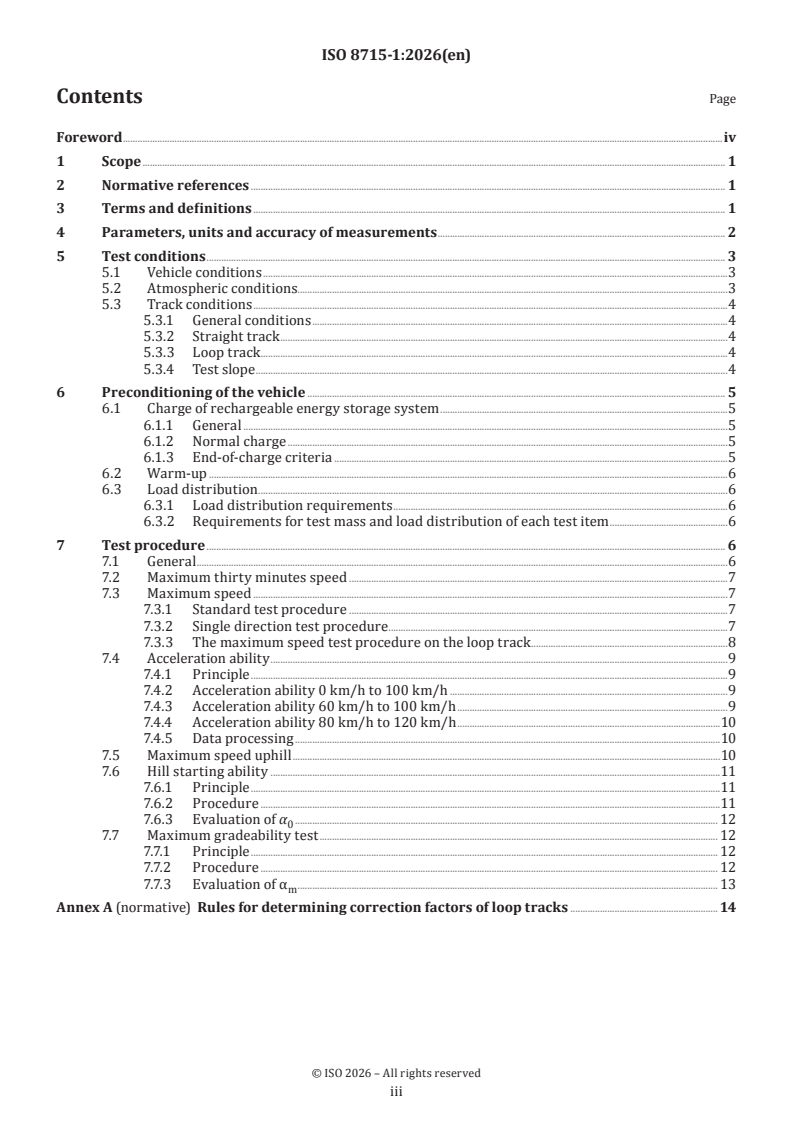
Contents Page
Foreword .iv
1 Scope . 1
2 Normative references . 1
3 Terms and definitions . 1
4 Parameters, units and accuracy of measurements . 2
5 Test conditions . 3
5.1 Vehicle conditions .3
5.2 Atmospheric conditions.3
5.3 Track conditions .4
5.3.1 General conditions .4
5.3.2 Straight track .4
5.3.3 Loop track .4
5.3.4 Test slope .4
6 Preconditioning of the vehicle . 5
6.1 Charge of rechargeable energy storage system .5
6.1.1 General .5
6.1.2 Normal charge .5
6.1.3 End-of-charge criteria .5
6.2 Warm-up .6
6.3 Load distribution .6
6.3.1 Load distribution requirements .6
6.3.2 Requirements for test mass and load distribution of each test item .6
7 Test procedure . 6
7.1 General .6
7.2 Maximum thirty minutes speed .7
7.3 Maximum speed .7
7.3.1 Standard test procedure .7
7.3.2 Single direction test procedure .7
7.3.3 The maximum speed test procedure on the loop track .8
7.4 Acceleration ability .9
7.4.1 Principle .9
7.4.2 Acceleration ability 0 km/h to 100 km/h .9
7.4.3 Acceleration ability 60 km/h to 100 km/h .9
7.4.4 Acceleration ability 80 km/h to 120 km/h .10
7.4.5 Data processing .10
7.5 Maximum speed uphill .10
7.6 Hill starting ability .11
7.6.1 Principle .11
7.6.2 Procedure .11
7.6.3 Evaluation of α . 12
7.7 Maximum gradeability test . 12
7.7.1 Principle . 12
7.7.2 Procedure . 12
7.7.3 Evaluation of α . 13
m
Annex A (normative) Rules for determining correction factors of loop tracks . 14
iii
Foreword
ISO (the International Organization for Standardization) is a worldwide federation of national standards
bodies (ISO member bodies). The work of preparing International Standards is normally carried out through
ISO technical committees. Each member body interested in a subject for which a technical committee
has been established has the right to be represented on that committee. International organizations,
governmental and non-governmental, in liaison with ISO, also take part in the work. ISO collaborates closely
with the International Electrotechnical Commission (IEC) on all matters of electrotechnical standardization.
The procedures used to develop this document and those intended for its further maintenance are described
in the ISO/IEC Directives, Part 1. In particular, the different approval criteria needed for the different types
of ISO document should be noted. This document was drafted in accordance with the editorial rules of the
ISO/IEC Directives, Part 2 (see www.iso.org/directives).
ISO draws attention to the possibility that the implementation of this document may involve the use of (a)
patent(s). ISO takes no position concerning the evidence, validity or applicability of any claimed patent
rights in respect thereof. As of the date of publication of this document, ISO had not received notice of (a)
patent(s) which may be required to implement this document. However, implementers are cautioned that
this may not represent the latest information, which may be obtained from the patent database available at
www.iso.org/patents. ISO shall not be held responsible for identifying any or all such patent rights.
Any trade name used in this document is information given for the convenience of users and does not
constitute an endorsement.
For an explanation of the voluntary nature of standards, the meaning of ISO specific terms and expressions
related to conformity assessment, as well as information about ISO's adherence to the World Trade
Organization (WTO) principles in the Technical Barriers to Trade (TBT), see www.iso.org/iso/foreword.html.
This document was prepared by Technical Committee ISO/TC 22, Road vehicles, Subcommittee SC 37,
Electrically propelled vehicles.
This first edition of ISO 8715-1, together with ISO 8715-2, cancels and replaces ISO 8715:2001.
The main changes are as follows:
— modification of the title and scope of this document;
— revision and addition of terms and definitions;
— deletion of Clauses 4, and 8, as well as Annex A;
— revision of the vehicle condition, atmosphere condition and track condition, and addition of the slope
requirement (see Clause 5);
— revision of the preconditioning of the vehicle, addition of the load distribution requirement (see Clause 6);
— revision of the maximum thirty minutes speed test (see 7.2);
— revision of the maximum speed test (see 7.3);
— revision of the acceleration ability test (see 7.4);
— revision of the maximum speed uphill test (see 7.5);
— revision of the hill starting ability test (see 7.6);
— addition of the maximum gradeability test (see 7.7).
A list of all parts in the ISO 8715 series can be found on the ISO website.
Any feedback or questions on this document should be directed to the user’s national standards body. A
complete listing of these bodies can be found at www.iso.org/members.html.
iv
International Standard ISO 8715-1:2026(en)
Electric road vehicles — Road operating characteristics —
Part 1:
Passenger cars and light duty vehicles
1 Scope
This document specifies test methods for measurement of the performance of purely electrically propelled
vehicles classified as passenger cars and light duty vehicles which are defined in the relevant regional
applicable driving test (ADT) standards.
NOTE Performance comprises road operating characteristics such as speed, acceleration and hill climbing ability.
2 Normative references
The following documents are referred to in the text in such a way that some or all of their content constitutes
requirements of this document. For dated references, only the edition cited applies. For undated references,
the latest edition of the referenced document (including any amendments) applies.
ISO/TR 8713:2019, Electrically propelled road vehicles — Vocabulary
ISO 10521 (all parts), Road vehicles — Road load
3 Terms and definitions
For the purposes of this document, the terms and definitions given in ISO/TR 8713 and the following apply.
ISO and IEC maintain terminology databases for use in standardization at the following addresses:
— ISO Online browsing platform: available at https:// www .iso .org/ obp
— IEC Electropedia: available at https:// www .electropedia .org/
3.1
maximum design total mass
maximum vehicle mass as specified by the vehicle manufacturer
[SOURCE: ISO/TR 8713:2019, 3.87]
3.2
test mass for passenger car
sum of the complete vehicle kerb mass plus:
— the maximum authorized pay mass (including driver) if it is equal or less than 180 kg;
— 180 kg, if the maximum authorized pay mass exceeds 180 kg but is less than or equal to 360 kg;
— half of the maximum authorized pay mass if this pay mass exceeds 360 kg.
3.3
test mass for light duty vehicle
sum of the complete vehicle kerb mass plus the maximum design loading mass
3.4
dynamic loaded radius
effective radius of a tyre when it is deformed by the mass of the vehicle loaded to its test mass
3.5
maximum speed
highest average speed that the vehicle can maintain throughout a specified test
Note 1 to entry: For the relevant test method, see 7.3.
[SOURCE: ISO/TR 8713:2019, 3.89, modified — Note 1 to entry has been added.]
3.6
maximum thirty minutes speed
v30
highest average speed which the vehicle can maintain over 30 min
Note 1 to entry: For the relevant test method, see 7.2.
[SOURCE: ISO/TR 8713:2019, 3.90, modified — Note 1 to entry has been revised. Note 2 to entry has been
removed.]
3.7
acceleration ability
shortest time required to accelerate the vehicle from speed v1 to speed v2
Note 1 to entry: For the relevant test method, see 7.4.
[SOURCE: ISO/TR 8713:2019, 3.1, modified — Note 1 to entry has been revised.]
3.8
maximum speed uphill
highest average speed which the vehicle can maintain on a given slope over 1 km
Note 1 to entry: For the relevant test method, see 7.5.
3.9
hill starting ability
maximum slope on which the vehicle can start moving over a minimum distance of 10 m
Note 1 to entry: For the relevant test method, see 7.6.
Note 2 to entry: [SOURCE: ISO/TR 8713:2019, 3.78, modified — Note 1 to entry has been revised.]
3.10
maximum gradeability
maximum percent grade which the vehicle can traverse for a specified time at a specified speed
Note 1 to entry: The gradeability limit is the grade upon which the vehicle can just move forward.
Note 2 to entry: For the relevant test method, see 7.7.
4 Parameters, units and accuracy of measurements
Table 1 specifies parameters and their units and accuracy.
Table 1 — Parameters, units and accuracy of measurements
Parameter Unit Accuracy
Time s ±0,1
Length m ±0,1 %
Temperature °C ±1
Wind speed m/s ±0,5
Air pressure kPa ±1
±1 % or ±0,1 km/h, whichever is
Speed km/h greater
Mass kg ±0,5 %
Tyre pressure kPa ±1 %
5 Test conditions
5.1 Vehicle conditions
The vehicle shall be loaded according to the specification for each test.
The vehicle tyres shall be inflated to the pressure specified by the vehicle manufacturer when the tyres are
at ambient temperature. For the tests on the slope, the tyre pressure shall be increased by 20 kPa based on
manufacture-specified cold state pressure, the tread depth of the tyre shall be at least 75 % of the original
tread depth, and the tread shall be in good condition.
The viscosity of oils for the mechanical moving parts and specification of coolant shall conform to the
specification of the vehicle manufacturer.
The lighting, signalling and auxiliary devices shall be off, except those required for testing and usual day-
time operation of the vehicle. Lamps should be in retracted position if they are concealable. If there is a need
for driving safety during the test, the lights can be turned on, but it should be noted in the record.
All energy storage systems available for other than traction purposes (electric, hydraulic, pneumatic, etc.)
shall be charged up to their maximum level specified by the vehicle manufacturer.
The vehicle shall be clean, and the windows and air entries, not needed for the correct operation of the
vehicle and the drive system, shall be closed by the normal operating controls.
If rechargeable energy storage systems (RESS) are to be operated at temperatures above ambient
temperature, the driver shall follow the procedure recommended by the vehicle manufacturer to keep the
RESS temperature within its operating range.
If not specified by the vehicle manufacture, the vehicle shall be driven at least 300 km before the test(s) with
the RESS that are installed in the test vehicle. The RESS shall undergo at least one process from the fully
charged state to the state of charge (SOC) alarm.
The RESS shall be in the state of charge required for the test to be performed.
5.2 Atmospheric conditions
Outdoor test steps shall be performed at an ambient temperature between 0 °C and 40 °C. Indoor test steps
shall be performed at a room temperature between 20 °C and 30 °C. The atmospheric pressure shall be
between 91 kPa and 104 kPa. The average wind speed measured 0,7 m above the ground shall be less than
3 m/s, and the maximum speed of gusts shall be less than 5 m/s. The relative humidity shall be less than
95 %. The tests shall be performed in the absence of rain, fog and snow etc.
5.3 Track conditions
5.3.1 General conditions
The measurements shall be taken on a dry track, which may be either a straight track (see 5.3.2), a loop
track (see 5.3.3) or test slopes (see 5.3.4). The surface of the track shall be hard, smooth, clean and have good
adhesion.
5.3.2 Straight track
The length of the measuring zone for maximum speed test shall be at least 200 m and marked with markers,
the length of the measuring zone for acceleration ability test shall be enough to finish the test.
The length of the launching track shall be long enough to achieve a stable speed 200 m ahead of the measuring
zone. The longitudinal slope on the measuring zone and on the last 200 m of the launching track shall not
exceed 0,5 %. If the test is conducted in one direction, the longitudinal slope of the straight track shall not
exceed 0,1 %.
The transverse slope in the measuring zone shall not exceed 3 %.
5.3.3 Loop track
The length of the loop track shall be not less than 1 000 m. For calculating the speeds, the length of run shall
be the distance actually covered by the vehicle while it is being timed.
The loop track may vary from a perfect circle to straight sections linked by approximately circular sections.
The radius of the curves shall be not less than 200 m.
The longitudinal slope in the measuring z
...