

ISO 3856-5:1984
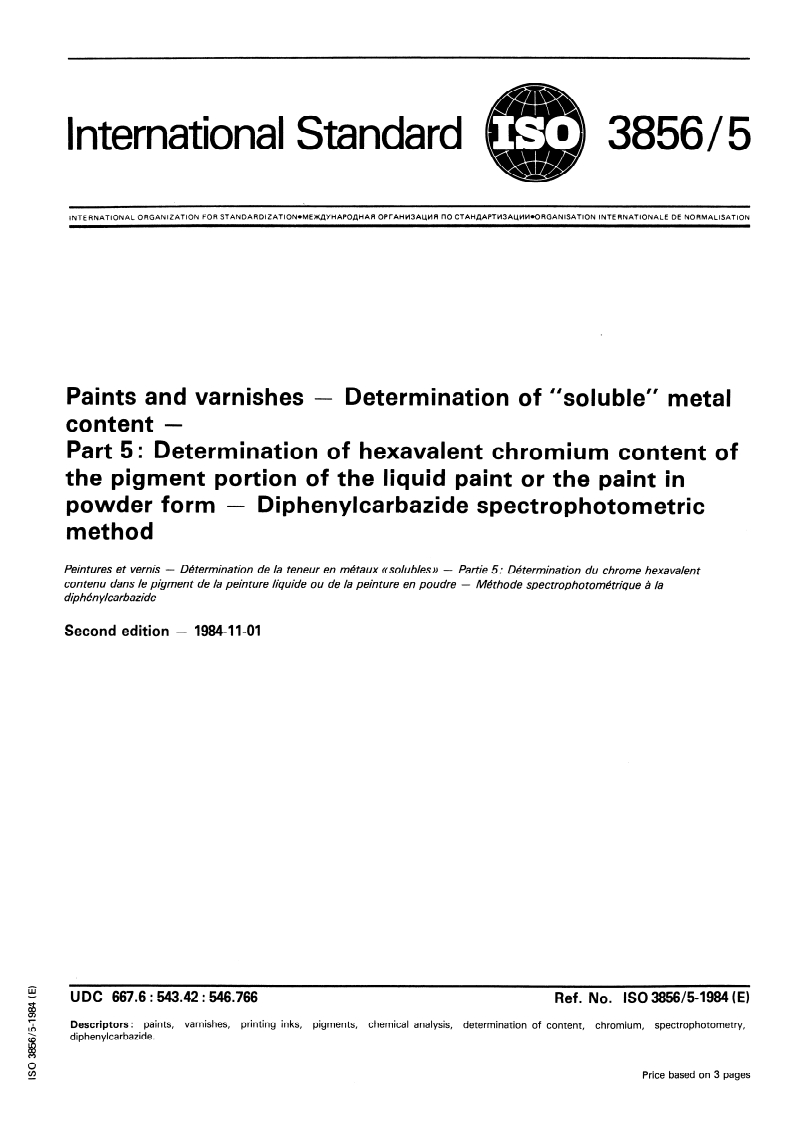
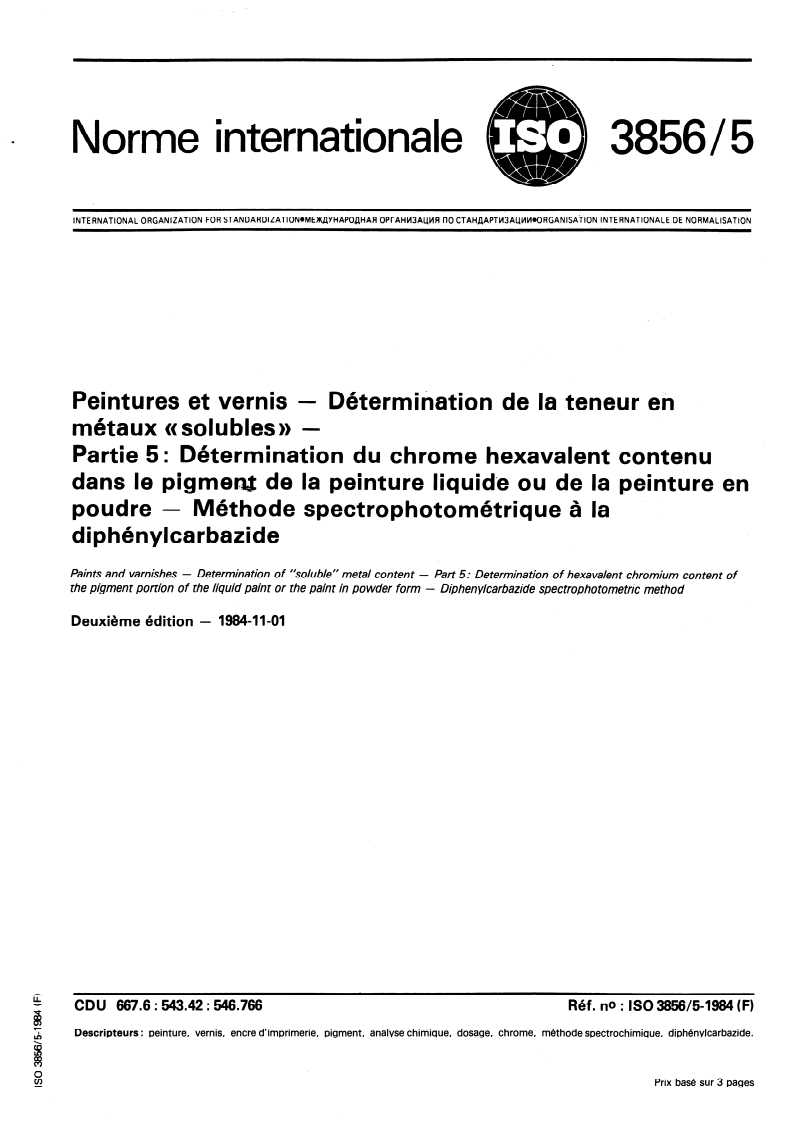
(Main)Paints and varnishes — Determination of "soluble" metal content — Part 5: Determination of hexavalent chromium content of the pigment portion of the liquid paint or the paint in powder form — Diphenylcarbazide spectrophotometric method
General Information
- Abstract
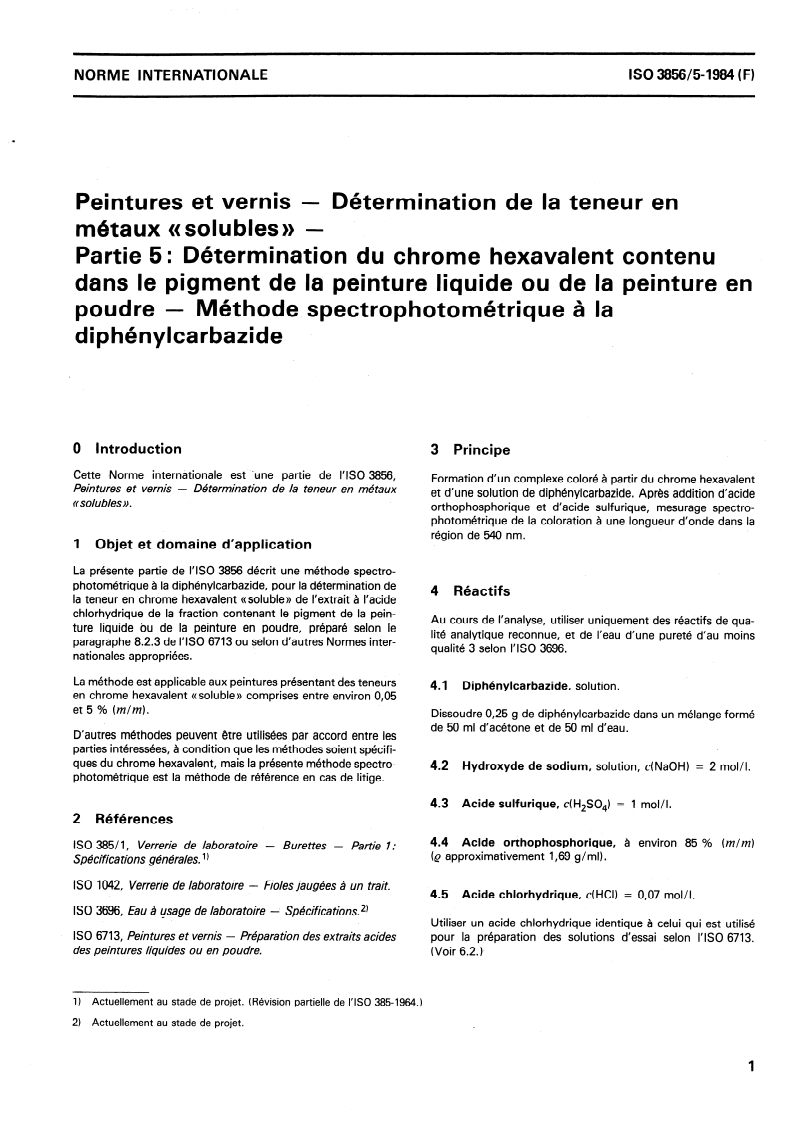
The principle consists in formation of a coloured complex from hexavalent chromium and diphenylcarbazide solution. After addition of orthophosphoric acid and sulfuric acid, spectralphotometric easurement of the colour at a wavelength in the region of 540 nm. The method is applicable to coating materials having hexavalent chromium contents in the range of about 0,05 % (m/m) to 5 % (m/m). This method id the referee method in cases of dispute. This second edition cancels and replaces the ISO 3856/5-1980, of which it constitutes a through revision.
- Status
- Published
- Publication Date
- 30-Sep-1984
- Technical Committee
- ISO/TC 256 - Pigments, dyestuffs and extenders
- Drafting Committee
- ISO/TC 256 - Pigments, dyestuffs and extenders
- Current Stage
- 9093 - International Standard confirmed
- Start Date
- 06-Mar-2023
- Completion Date
- 29-Aug-2026
Buy Documents
ISO 3856-5:1984 - Paints and varnishes -- Determination of "soluble" metal content
ISO 3856-5:1984 - Paints and varnishes — Determination of "soluble" metal content — Part 5: Determination of hexavalent chromium content of the pigment portion of the liquid paint or the paint in powder form — Diphenylcarbazide spectrophotometric method/1/1984
ISO 3856-5:1984 - Peintures et vernis -- Détermination de la teneur en métaux "solubles"
ISO 3856-5:1984 - Peintures et vernis -- Détermination de la teneur en métaux "solubles"
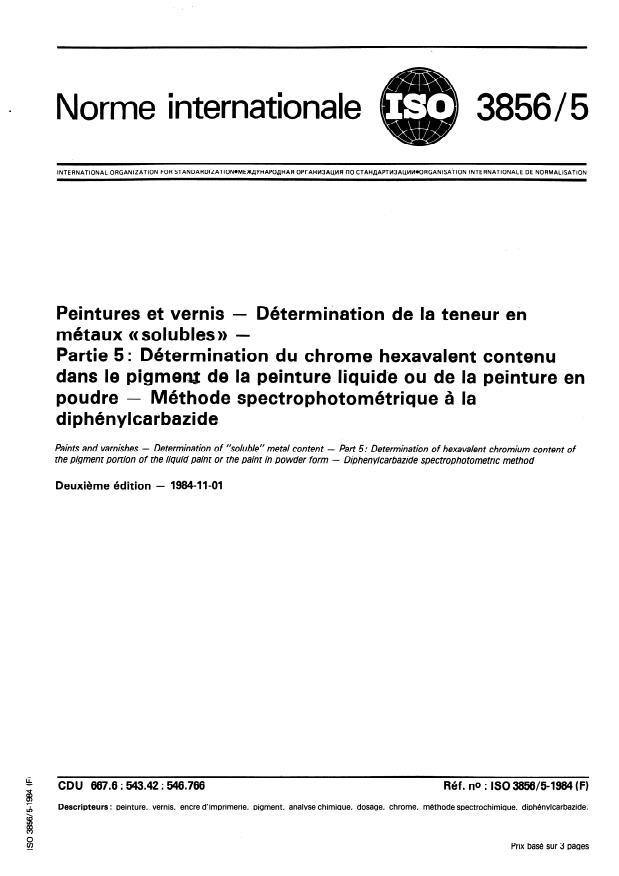
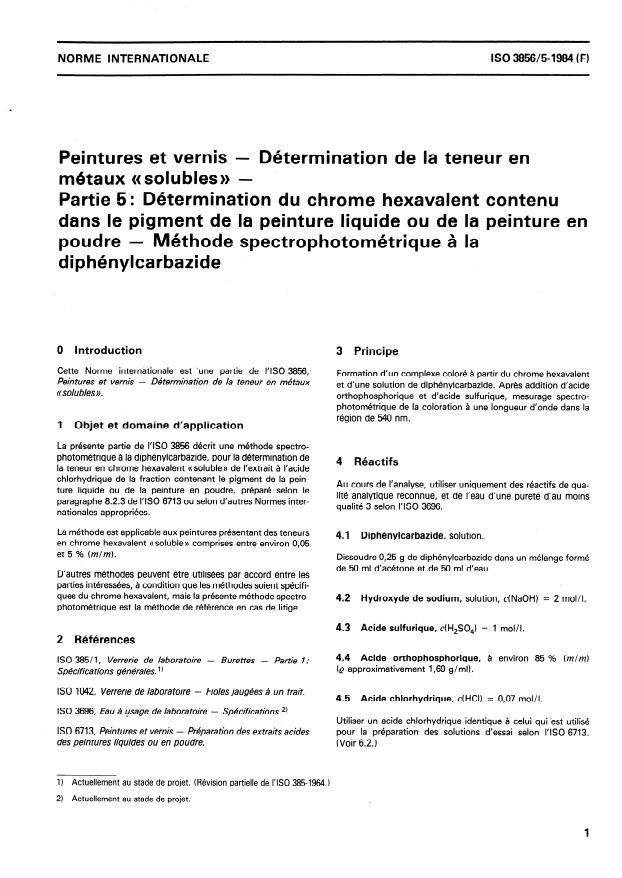
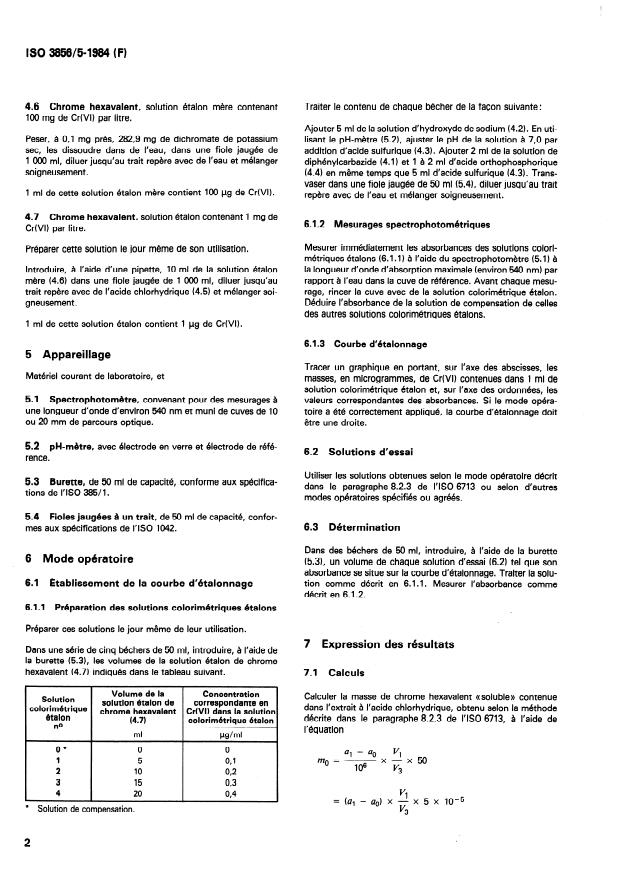
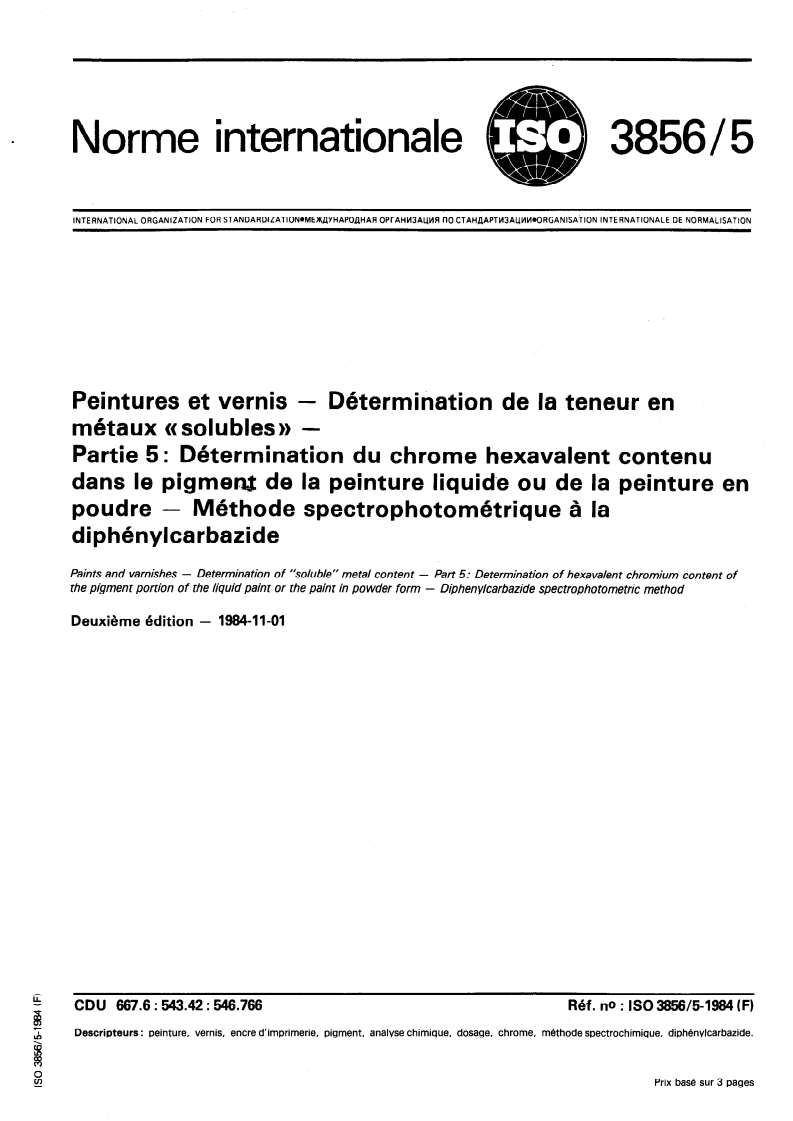
ISO 3856-5:1984 - Peintures et vernis — Détermination de la teneur en métaux "solubles" — Partie 5: Détermination du chrome hexavalent contenu dans le pigment de la peinture liquide ou de la peinture en poudre — Méthode spectrophoto- métrique à la diphénylcarbazide/1/1984
ISO 3856-5:1984 - Peintures et vernis — Détermination de la teneur en métaux "solubles" — Partie 5: Détermination du chrome hexavalent contenu dans le pigment de la peinture liquide ou de la peinture en poudre — Méthode spectrophoto- métrique à la diphénylcarbazide/1/1984
Overview - ISO 3856-5:1984 (Paints and varnishes - Cr(VI) in pigments)
ISO 3856-5:1984 specifies a diphenylcarbazide spectrophotometric method for determining the “soluble” hexavalent chromium (Cr(VI)) content in the pigment portion of liquid paints or powder paints. The method measures a coloured Cr(VI)–diphenylcarbazide complex by spectrophotometry at about 540 nm and is applicable to coating materials with Cr(VI) contents of approximately 0.05% to 5% (m/m). When disputes arise over Cr(VI) results, this spectrophotometric technique is the referee method.
Key topics and technical requirements
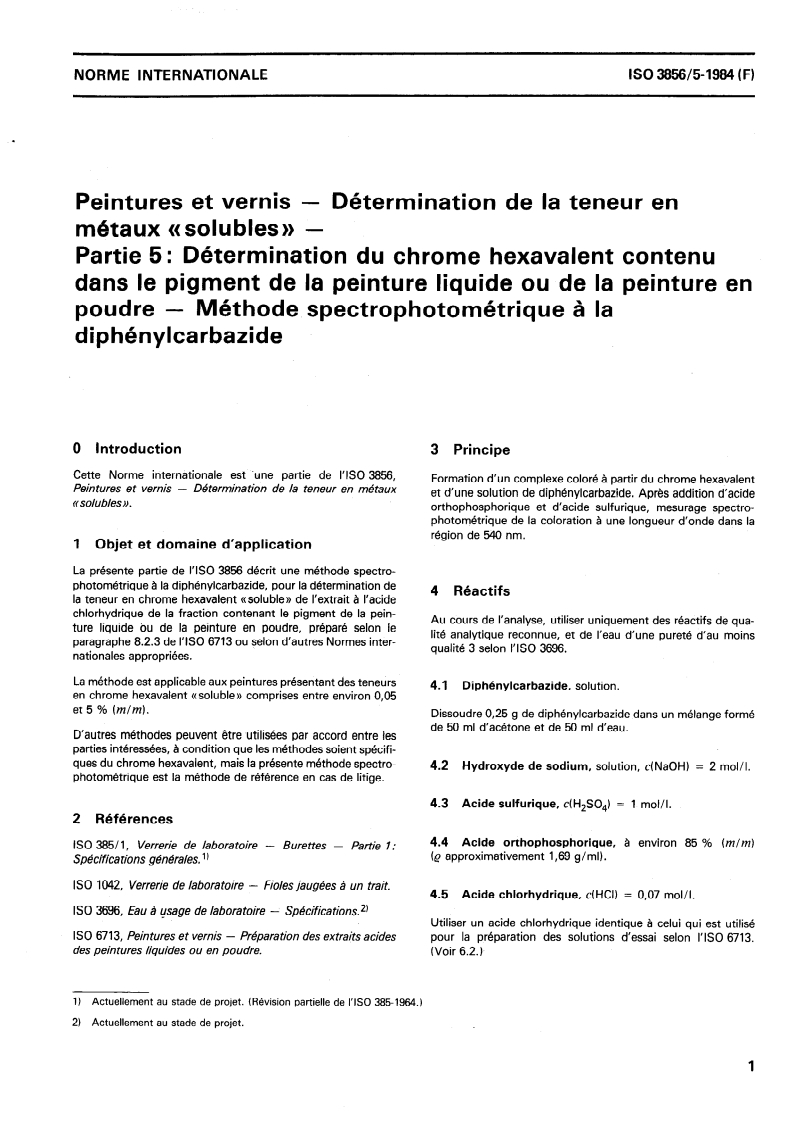
- Analytical principle: formation of a coloured complex between Cr(VI) and diphenylcarbazide after acidification; spectrophotometric measurement near 540 nm.
- Scope: evaluation of the pigment portion (hydrochloric acid extract) of liquid or powder paints; measures the “soluble” fraction of hexavalent chromium.
- Reagents (high level):
- Diphenylcarbazide solution (0.25 g in 50 ml acetone + 50 ml water)
- Sodium hydroxide c(NaOH) = 2 mol/L
- Sulfuric acid c(H2SO4) = 1 mol/L
- Orthophosphoric acid (~85% m/m)
- Hydrochloric acid c(HCl) = 0.07 mol/L
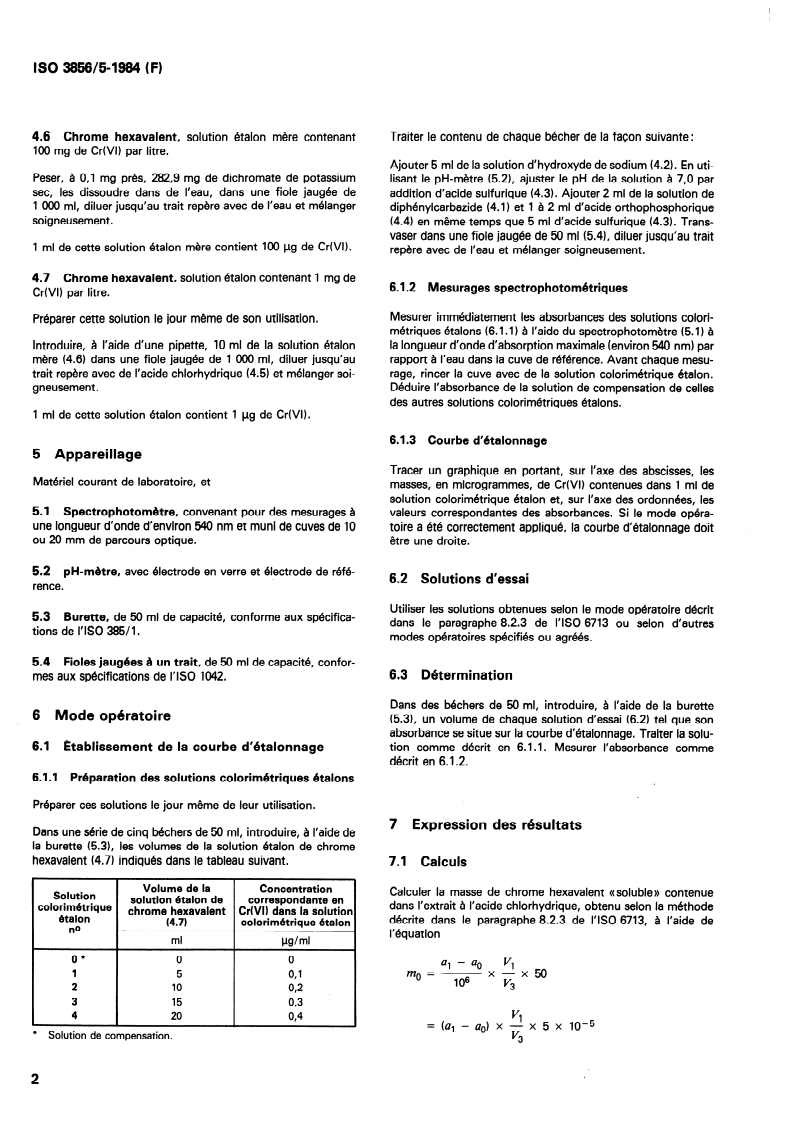
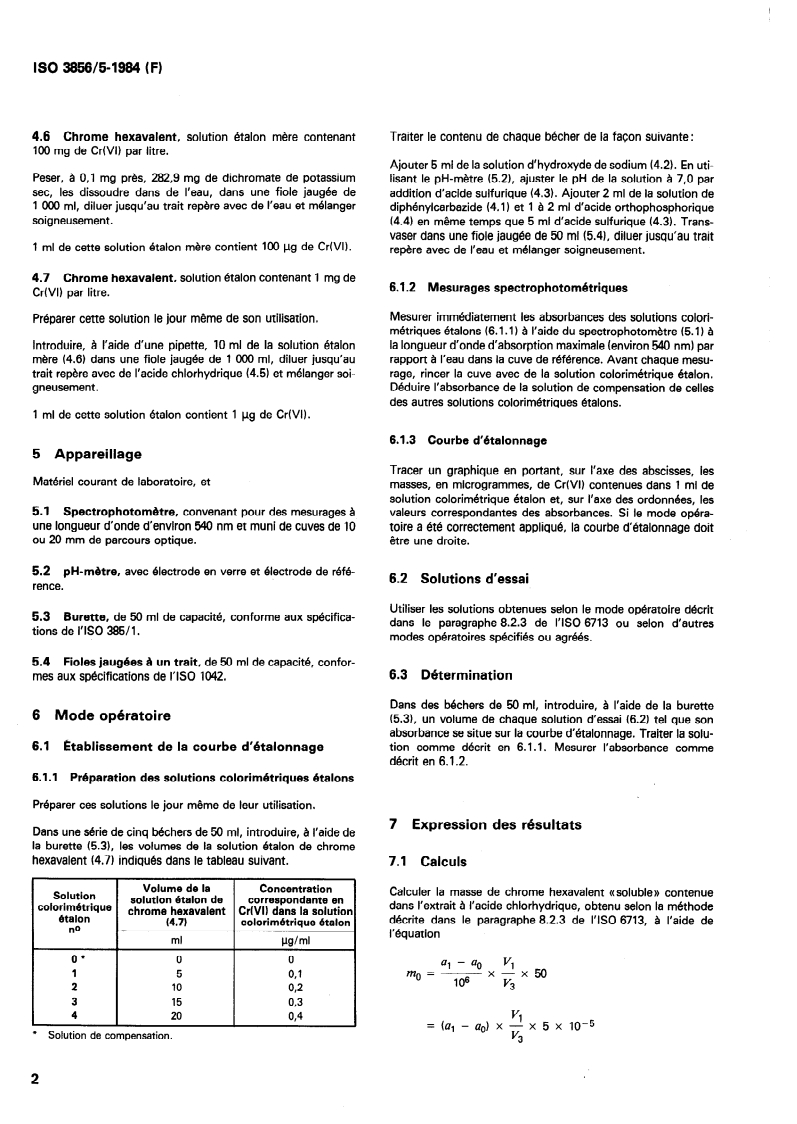
- Standard Cr(VI) stock (100 mg/L from potassium dichromate) and working standards (1 mg/L)
- Apparatus: spectrophotometer (10 or 20 mm cells), pH‑meter, 50 ml burette, one‑mark volumetric flasks.
- Calibration and measurement: prepare standard calorimetric solutions, build a calibration graph (mass of Cr(VI) in µg vs absorbance), treat test aliquots identically and read absorbance against water reference.
- Sample preparation: uses the hydrochloric acid extract procedure described in ISO 6713 (preparation of acid extracts from paints).
- Reporting: results expressed as percentage by mass of the paint (or pigment portion); test report must reference ISO 3856-5 and include product ID, extraction method, solvents used, and any deviations. Precision data are not provided in this edition.
Practical applications and users
- Quality control laboratories in paint, coating and pigment manufacturing
- Regulatory, environmental and occupational health testing for Cr(VI) compliance
- Third‑party conformity testing and dispute resolution (referee method)
- R&D teams assessing pigment safety, formulation changes, or substitution of chromium-containing pigments
Related standards
- ISO 6713 - Preparation of acid extracts from paints (sample extraction referenced by this method)
- Other parts of ISO 3856 - Determination of “soluble” metal content in paints and varnishes
Keywords: ISO 3856-5:1984, hexavalent chromium, Cr(VI), diphenylcarbazide, spectrophotometric method, paints, pigments, varnishes, chromium testing.
Relations
- Effective Date
- 25-Aug-2026
- Consolidated By
ISO 11608-2:2000 - Pen-injectors for medical use — Part 2: Needles — Requirements and test methods - Effective Date
- 06-Jun-2022
- Effective Date
- 15-Apr-2008
Buy Documents
ISO 3856-5:1984 - Paints and varnishes -- Determination of "soluble" metal content
ISO 3856-5:1984 - Paints and varnishes — Determination of "soluble" metal content — Part 5: Determination of hexavalent chromium content of the pigment portion of the liquid paint or the paint in powder form — Diphenylcarbazide spectrophotometric method/1/1984
ISO 3856-5:1984 - Peintures et vernis -- Détermination de la teneur en métaux "solubles"
ISO 3856-5:1984 - Peintures et vernis -- Détermination de la teneur en métaux "solubles"
ISO 3856-5:1984 - Peintures et vernis — Détermination de la teneur en métaux "solubles" — Partie 5: Détermination du chrome hexavalent contenu dans le pigment de la peinture liquide ou de la peinture en poudre — Méthode spectrophoto- métrique à la diphénylcarbazide/1/1984
ISO 3856-5:1984 - Peintures et vernis — Détermination de la teneur en métaux "solubles" — Partie 5: Détermination du chrome hexavalent contenu dans le pigment de la peinture liquide ou de la peinture en poudre — Méthode spectrophoto- métrique à la diphénylcarbazide/1/1984
Frequently Asked Questions
ISO 3856-5:1984 is a standard published by the International Organization for Standardization (ISO). Its full title is "Paints and varnishes — Determination of "soluble" metal content — Part 5: Determination of hexavalent chromium content of the pigment portion of the liquid paint or the paint in powder form — Diphenylcarbazide spectrophotometric method". This standard covers: The principle consists in formation of a coloured complex from hexavalent chromium and diphenylcarbazide solution. After addition of orthophosphoric acid and sulfuric acid, spectralphotometric easurement of the colour at a wavelength in the region of 540 nm. The method is applicable to coating materials having hexavalent chromium contents in the range of about 0,05 % (m/m) to 5 % (m/m). This method id the referee method in cases of dispute. This second edition cancels and replaces the ISO 3856/5-1980, of which it constitutes a through revision.
The principle consists in formation of a coloured complex from hexavalent chromium and diphenylcarbazide solution. After addition of orthophosphoric acid and sulfuric acid, spectralphotometric easurement of the colour at a wavelength in the region of 540 nm. The method is applicable to coating materials having hexavalent chromium contents in the range of about 0,05 % (m/m) to 5 % (m/m). This method id the referee method in cases of dispute. This second edition cancels and replaces the ISO 3856/5-1980, of which it constitutes a through revision.
ISO 3856-5:1984 is classified under the following ICS (International Classification for Standards) categories: 87.040 - Paints and varnishes. The ICS classification helps identify the subject area and facilitates finding related standards.
ISO 3856-5:1984 has the following relationships with other standards: It is inter standard links to CEN/TR 14589:2003, ISO 11608-2:2000, ISO 3856-5:1980. Understanding these relationships helps ensure you are using the most current and applicable version of the standard.
ISO 3856-5:1984 is available in PDF format for immediate download after purchase. The document can be added to your cart and obtained through the secure checkout process. Digital delivery ensures instant access to the complete standard document.
Standards Content (Sample)
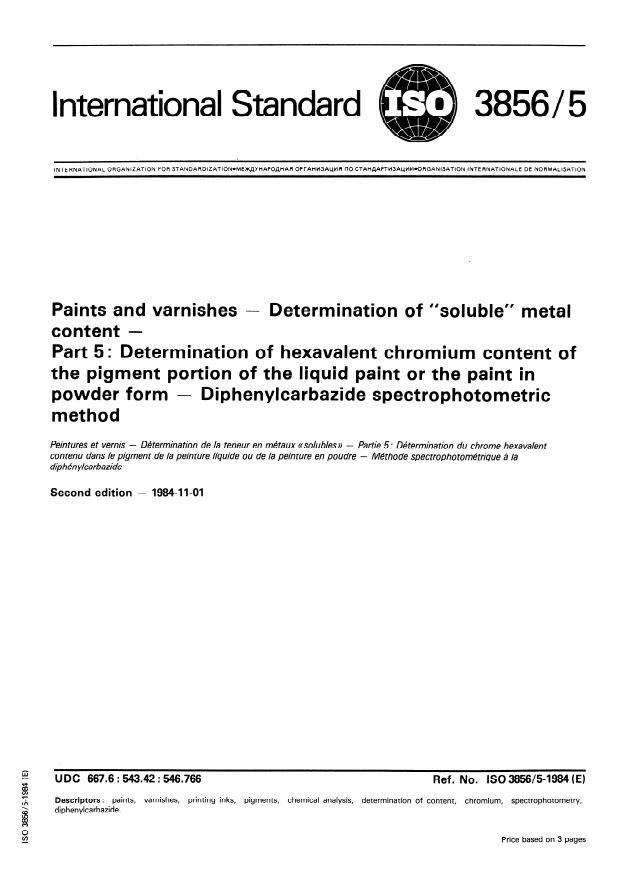
International Standard
INTERNATIONAL ORGANIZATION FOR STANDARDIZATlON.MEXflYHAPOAHAR OPTAHI43Al.WlR I-IO CTAH~APTM3A~MM*ORGANlSATlON INTERNATIONALE DE NORMALISATION
Determination of “soluble” metal
Paints and varnishes -
content -
Part 5: Determination of hexavalent chromium content of
the pigment portion of the liquid paint or the paint in
powder form - Diphenylcarbazide spectrophotometric
method
D&termination de la teneur en mt!taux f( solubles)> - Par-tie 5: D&termination du chrome hexavalent
Peintures et vernis -
contenu dans le pigment de la peinture liquide ou de la peinture en poudre - Mkthode spectrophotom&rique B la
diphkn ylcarbazide
Second edition - 1984-11-01
Ref. No. IS0 3856/5-1984 (E)
UDC 667.6 : 543.42 : 546.766
Descriptors : paints, varnishes, printing inks, pigments, chemical analysis, determination of content, chromium, spectrophotometry,
diphenylcarbazide.
Price based on 3 pages
isi
Foreword
IS0 (the International Organization for Standardization) is a worldwide federation of
national standards bodies (IS0 member bodies). The work of preparing International
Standards is normally carried out through IS0 technical committees. Each member
body interested in a subject for which a technical committee has been established has
the right to be represented on that committee. International organizations, govern-
mental and non-governmental, in liaison with ISO, also take part in the work.
Draft International Standards adopted by the technical committees are circulated to
the member bodies for approval before their acceptance as International Standards by
the IS0 Council. They are approved in accordance with IS0 procedures requiring at
least 75 % approval by the member bodies voting.
International Standard IS0 3856/5 was prepared by Technical Committee ISO/TC 35,’
Paints and varnishes.
IS0 3856/5 was first published in 1980. This second edition cancels and replaces the
first edition, of which it constitutes a thorough revision.
0 international Organization for Standardization, 1984
Printed in Switzerland
INTERNATIONAL STANDARD IS0 3856/5-1984 (E)
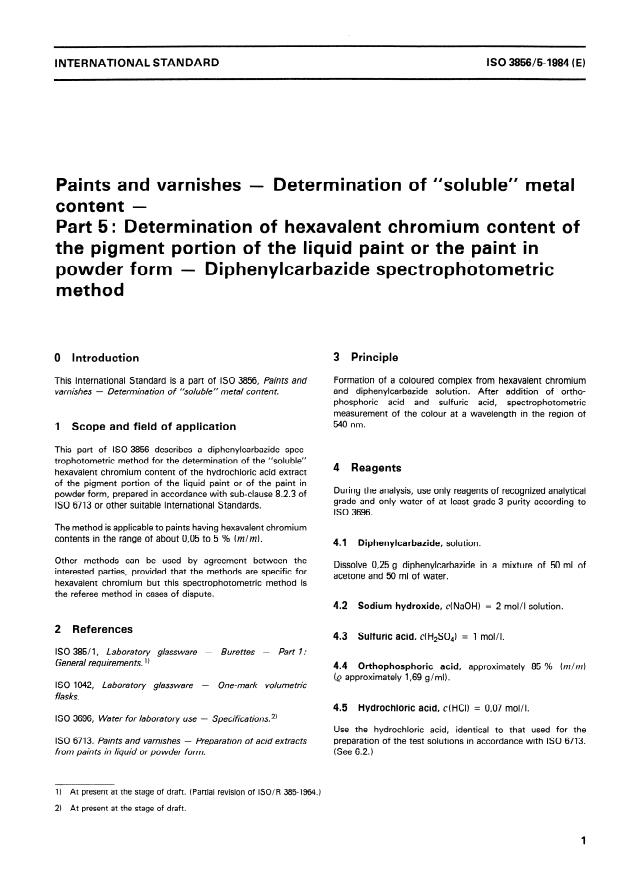
Paints and varnishes - Determination of “soluble” metal
content -
Part 5: Determination of hexavalent chromium content of
the pigment portion of the liquid paint or the paint in
powder form - Diphenylcarbazide spectrophotometric
method
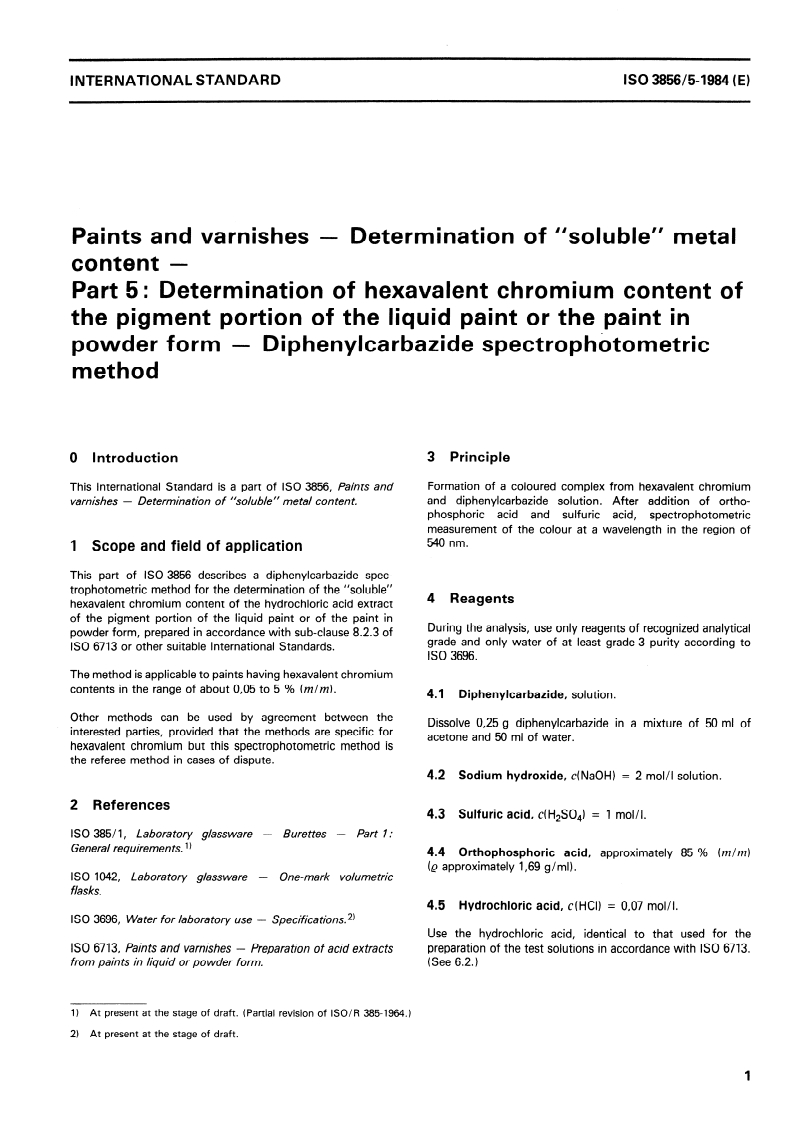
3 Principle
0 Introduction
This International Standard is a part of IS0 3856, Paints and Formation of a coloured complex from hexavalent chromium
and diphenylcarbazide solution. After addition of ortho-
varnishes - Determination of “soluble” metal con tent.
phosphoric acid and sulfuric acid, spectrophotometric
measurement of the colour at a wavelength in the region of
540 nm.
I Scope and field of application
This part of IS0 3856 describes a diphenylcarbazide spec-
trophotometric method for the determination of the “soluble”
4 Reagents
hexavalent chromium content of the hydrochloric acid extract
of the pigment portion of the liquid paint or of the paint in
During the analysis, use only reagents of recognized analytical
powder form, prepared in accordance with sub-clause 8.2.3 of
grade and only water of at least grade 3 purity according to
IS0 6713 or other suitable International Standards.
IS0 3696.
The method is applicable to paints having hexavalent chromium
contents in the range of about 0,05 to 5 % (m/m).
4.1 Diphenylcarbazide, solution.
Other methods can be used by agreement between the
Dissolve 0,25 g diphenylcarbazide in a mixture of 50 ml of
interested parties, provided that the methods are specific for
acetone and 50 ml of water.
hexavalent chromium but this spectrophotometric method is
the referee method in cases of dispute.
4.2 Sodium hydroxide, c(NaOH) = 2 mol/l solution.
2 References
4.3 Sulfuric acid, c(H2S04) = 1 mol/l.
IS0 385/l, Laboratory glassware - Burettes - Part 7:
General requirements. 1 )
4.4 Orthophosphoric acid, approximately 85 % (m/m)
(e approximately 1,69 g/ml).
IS0 1042, Laboratory glassware - One-mark volumetric
flasks.
4.5 Hydrochloric acid, c(HCI) = 0,07 mol/l.
IS0 3696, Water for laboratory use - Specifications. 2,
Use the hydrochloric acid, identical to that used for the
IS0 6713, Paints and varnishes - Preparation of acid extracts preparation of the test solutions in accordance with IS0 6713.
from paints in liquid or powder form. (See 6.2.)
1) At present at the stage of draft. (Partial revision of ISO/R 385-1964.)
2) At present at the stage of draft.
IS0 3856/5-1984 (E)
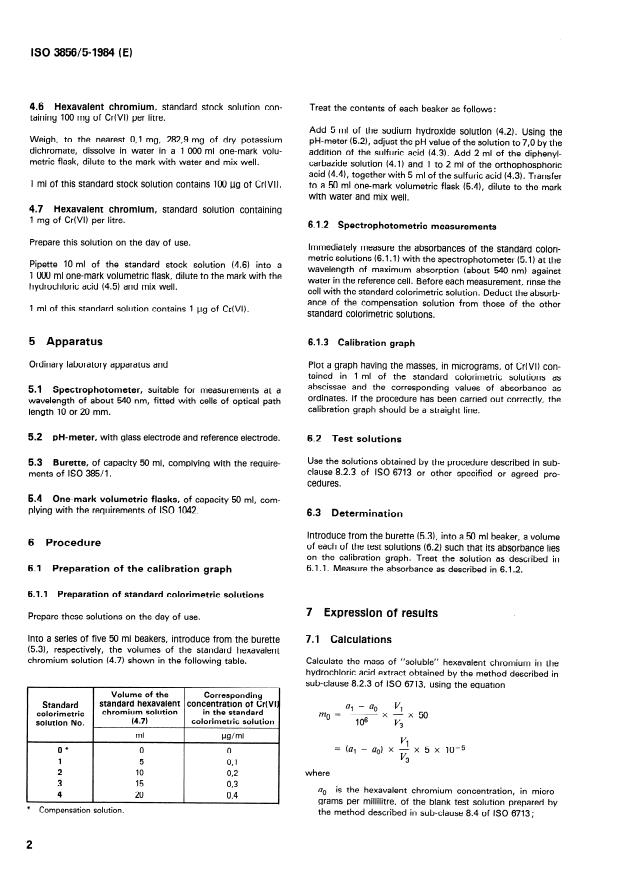
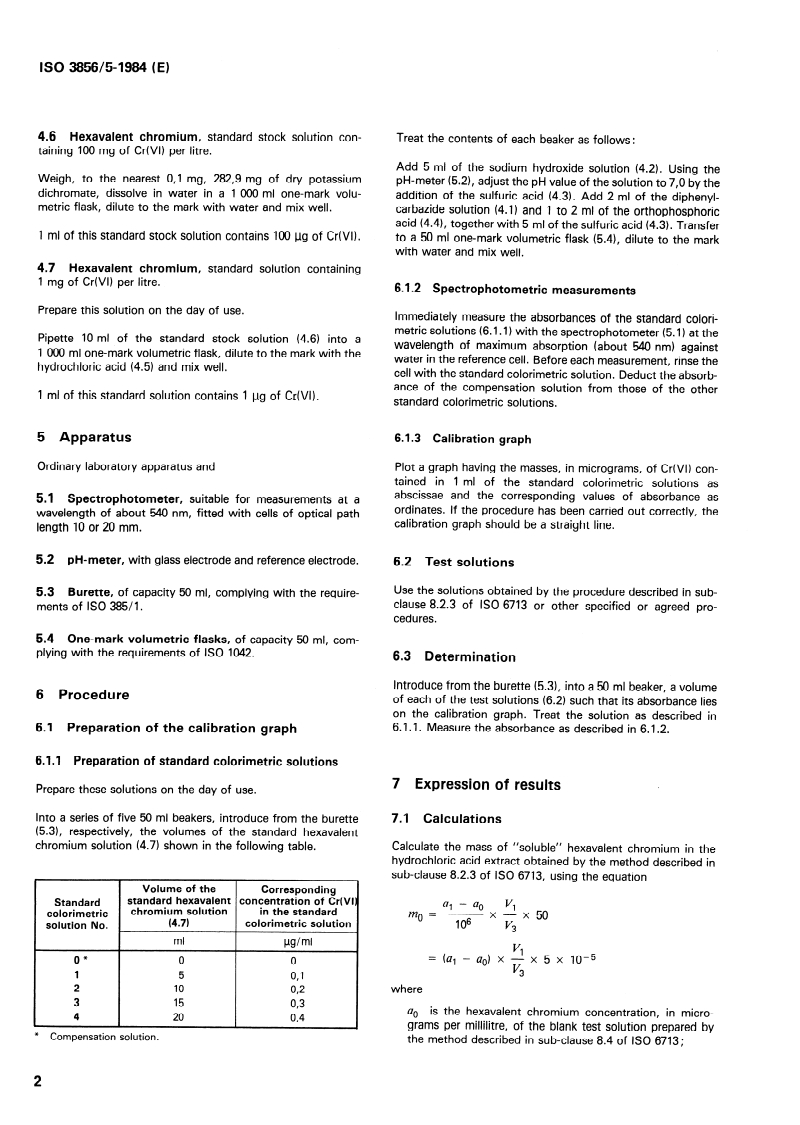
4.6 Hexavalent chromium, standard stock solution con- Treat the contents of each beaker as follows:
taining 100 mg of Cr(VI) per litre.
Add 5 ml of the sodium hydroxide solution (4.2). Using the
Weigh, to the nearest 0,l mg, 282,9 mg of dry potassium pH-meter (5.21, adjust the pH value of the solution to 7,0 by the
dichromate, dissolve in water in a 1 000 ml one-mark volu- addition of the sulfuric acid (4.3). Add 2 ml of the diphenyl-
metric flask, dilute to the mark with water and mix well. carbazide solution (4.1) and 1 to 2 ml of the orthophosphoric
acid (4.41, together with 5 ml of the sulfuric acid (4.3). Transfer
1 ml of this standard stock solution contains 100 pg of Cr(VI). to a 50 ml one-mark volumetric flask (5.41, dilute to the mark
with water and mix well.
4.7 Hexavalent chromium, standard solution containing
1 mg of Cr(
...
International Standard
INTERNATIONAL ORGANIZATION FOR STANDARDIZATlON.MEXflYHAPOAHAR OPTAHI43Al.WlR I-IO CTAH~APTM3A~MM*ORGANlSATlON INTERNATIONALE DE NORMALISATION
Determination of “soluble” metal
Paints and varnishes -
content -
Part 5: Determination of hexavalent chromium content of
the pigment portion of the liquid paint or the paint in
powder form - Diphenylcarbazide spectrophotometric
method
D&termination de la teneur en mt!taux f( solubles)> - Par-tie 5: D&termination du chrome hexavalent
Peintures et vernis -
contenu dans le pigment de la peinture liquide ou de la peinture en poudre - Mkthode spectrophotom&rique B la
diphkn ylcarbazide
Second edition - 1984-11-01
Ref. No. IS0 3856/5-1984 (E)
UDC 667.6 : 543.42 : 546.766
Descriptors : paints, varnishes, printing inks, pigments, chemical analysis, determination of content, chromium, spectrophotometry,
diphenylcarbazide.
Price based on 3 pages
isi
Foreword
IS0 (the International Organization for Standardization) is a worldwide federation of
national standards bodies (IS0 member bodies). The work of preparing International
Standards is normally carried out through IS0 technical committees. Each member
body interested in a subject for which a technical committee has been established has
the right to be represented on that committee. International organizations, govern-
mental and non-governmental, in liaison with ISO, also take part in the work.
Draft International Standards adopted by the technical committees are circulated to
the member bodies for approval before their acceptance as International Standards by
the IS0 Council. They are approved in accordance with IS0 procedures requiring at
least 75 % approval by the member bodies voting.
International Standard IS0 3856/5 was prepared by Technical Committee ISO/TC 35,’
Paints and varnishes.
IS0 3856/5 was first published in 1980. This second edition cancels and replaces the
first edition, of which it constitutes a thorough revision.
0 international Organization for Standardization, 1984
Printed in Switzerland
INTERNATIONAL STANDARD IS0 3856/5-1984 (E)
Paints and varnishes - Determination of “soluble” metal
content -
Part 5: Determination of hexavalent chromium content of
the pigment portion of the liquid paint or the paint in
powder form - Diphenylcarbazide spectrophotometric
method
3 Principle
0 Introduction
This International Standard is a part of IS0 3856, Paints and Formation of a coloured complex from hexavalent chromium
and diphenylcarbazide solution. After addition of ortho-
varnishes - Determination of “soluble” metal con tent.
phosphoric acid and sulfuric acid, spectrophotometric
measurement of the colour at a wavelength in the region of
540 nm.
I Scope and field of application
This part of IS0 3856 describes a diphenylcarbazide spec-
trophotometric method for the determination of the “soluble”
4 Reagents
hexavalent chromium content of the hydrochloric acid extract
of the pigment portion of the liquid paint or of the paint in
During the analysis, use only reagents of recognized analytical
powder form, prepared in accordance with sub-clause 8.2.3 of
grade and only water of at least grade 3 purity according to
IS0 6713 or other suitable International Standards.
IS0 3696.
The method is applicable to paints having hexavalent chromium
contents in the range of about 0,05 to 5 % (m/m).
4.1 Diphenylcarbazide, solution.
Other methods can be used by agreement between the
Dissolve 0,25 g diphenylcarbazide in a mixture of 50 ml of
interested parties, provided that the methods are specific for
acetone and 50 ml of water.
hexavalent chromium but this spectrophotometric method is
the referee method in cases of dispute.
4.2 Sodium hydroxide, c(NaOH) = 2 mol/l solution.
2 References
4.3 Sulfuric acid, c(H2S04) = 1 mol/l.
IS0 385/l, Laboratory glassware - Burettes - Part 7:
General requirements. 1 )
4.4 Orthophosphoric acid, approximately 85 % (m/m)
(e approximately 1,69 g/ml).
IS0 1042, Laboratory glassware - One-mark volumetric
flasks.
4.5 Hydrochloric acid, c(HCI) = 0,07 mol/l.
IS0 3696, Water for laboratory use - Specifications. 2,
Use the hydrochloric acid, identical to that used for the
IS0 6713, Paints and varnishes - Preparation of acid extracts preparation of the test solutions in accordance with IS0 6713.
from paints in liquid or powder form. (See 6.2.)
1) At present at the stage of draft. (Partial revision of ISO/R 385-1964.)
2) At present at the stage of draft.
IS0 3856/5-1984 (E)
4.6 Hexavalent chromium, standard stock solution con- Treat the contents of each beaker as follows:
taining 100 mg of Cr(VI) per litre.
Add 5 ml of the sodium hydroxide solution (4.2). Using the
Weigh, to the nearest 0,l mg, 282,9 mg of dry potassium pH-meter (5.21, adjust the pH value of the solution to 7,0 by the
dichromate, dissolve in water in a 1 000 ml one-mark volu- addition of the sulfuric acid (4.3). Add 2 ml of the diphenyl-
metric flask, dilute to the mark with water and mix well. carbazide solution (4.1) and 1 to 2 ml of the orthophosphoric
acid (4.41, together with 5 ml of the sulfuric acid (4.3). Transfer
1 ml of this standard stock solution contains 100 pg of Cr(VI). to a 50 ml one-mark volumetric flask (5.41, dilute to the mark
with water and mix well.
4.7 Hexavalent chromium, standard solution containing
1 mg of Cr(
...
Norme internationale 385615
INTERNATIONAL ORGANIZATION FOR STANDARDIZATIONWlEX~YHAPO~HAR OPfAHkl3A~MR f-l0 CTAHAAPTltl3A~MM.ORGANlSAilON INTERNATIONALE DE NORMALISATION
Peintures et vernis -
Détermination de la teneur en
métaux «solubles» -
Partie 5: Détermination du chrome hexavalent contenu
dans le pigmen$ de la peinture liquide ou de la peinture en
poudre - Méthode spectrophotométrique à la
diphénylcarbazide
Paints and varnishes - Determination of “soluble” metal content
- Part 5: Determination of hexavalent chromium content of
the pigment portion of the fiquid paint or the Paint in powder form
- Diphen yfcarbazide spectrophotometric method
Deuxième édition - 1984-l l-01
-
CDU 667.6 : 543.42 : 546.766 Réf. no : ISO 3856/5-1984 (FI
Descripteurs : peinture, vernis, encre d’imprimerie, pigment, analyse chimique, dosage, chrome, méthode spectrochimique, diphénylcarbazide.
Prix basé sur 3 pages
Avant-propos
L’ISO (Organisation internationale de normalisation) est une fédération mondiale
d’organismes nationaux de normalisation (comités membres de I’ISO). L’élaboration
des Normes internationales est confiée aux comités techniques de I’ISO. Chaque
comité membre intéressé par une étude a le droit de faire partie du comité technique
créé à cet effet. Les organisations internationales, gouvernementales et non gouverne-
mentales, en liaison avec I’ISO, participent également aux travaux.
Les projets de Normes internationales adoptés par les comités techniques sont soumis
aux comités membres pour approbation, avant leur acceptation comme Normes inter-
nationales par le Conseil de I’ISO. Les Normes internationales sont approuvées confor-
mément aux procédures de I’ISO qui requièrent l’approbation de 75 % au moins des
comités membres votants.
La Norme internationale ISO 3856/5 a été élaborée par le comité technique ISO/TC 35,
Pein turcs et vernis.
La Norme internationale ISO 3856/5 a été pour la Premiere fois publiée en 1980. Cette
deuxième édition annule et remplace la première édition, dont elle constitue une révi-
sion compléte.
0 Organisation internationale de normalisation, 1984 0
Imprimé en Suisse
ISO 3856/5-1984 (F)
NORME INTERNATIONALE
Détermination de la teneur en
Peintures et vernis -
métaux «solubles» -
Partie 5: Détermination du chrome hexavalent contenu
dans le pigment de la peinture liquide ou de la peinture en
poudre - Méthode spectrophotométrique à la
diphénylcarbazide
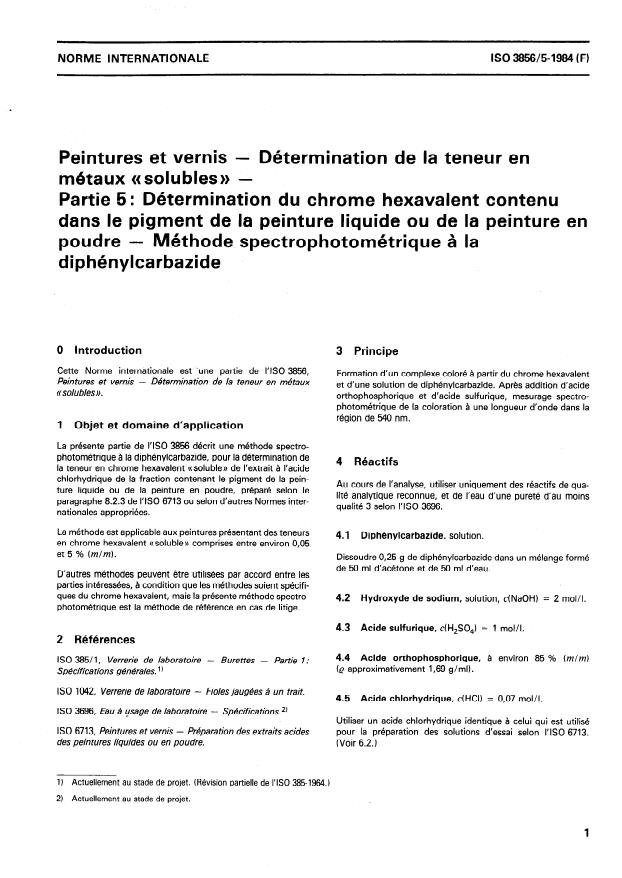
3 Principe
0 Introduction
Cette Norme internationale est ‘une partie de I’ISO 3856,
Formation d’un complexe coloré à partir du chrome hexavalent
Peintures et vernis - Détermination de la teneur en métaux
et d’une solution de diphénylcarbazide. Après addition d’acide
N solubles >j.
orthophosphorique et d’acide sulfurique, mesurage spectro-
photométrique de la coloration à une longueur d’onde dans la
région de 540 nm.
1 Objet et domaine d’application
La présente partie de I’ISO 3856 décrit une méthode spectro-
photométrique à la diphénylcarbazide, pour la détermination de
4 Réactifs
la teneur en chrome hexavalent ((soluble» de l’extrait à l’acide
chlorhydrique de la fraction contenant le pigment de la pein-
Au cours de l’analyse, utiliser uniquement des réactifs de qua-
ture liquide ou de la peinture en poudre, préparé selon le
lité analytique reconnue, et de l’eau d’une pureté d’au moins
paragraphe 8.2.3 de I’ISO 6713 ou selon d’autres Normes inter-
qualité 3 selon I’ISO 3696.
nationales appropriées.
La méthode est applicable aux peintures présentant des teneurs
4.1 Diphénylcarbazide, solution.
en chrome hexavalent «soluble)) comprises entre environ 0,05
et 5 % (mlm).
Dissoudre 0,25 g de diphénylcarbazide dans un mélange formé
de 50 ml d’acétone et de 50 ml d’eau.
D’autres méthodes peuvent être utilisées par accord entre les
parties intéressées, à condition que les méthodes soient spécifi-
ques du chrome hexavalent, mais la présente méthode spectro-
4.2 Hydroxyde de sodium, solution, c(NaOH) = 2 mol/l.
photométrique est la méthode de référence en cas de litige.
4.3 Acide sulfurique, c(H2S04) = 1 mol/l.
2 Références
4.4 Acide orthophosphorique, à environ 85 % (mlm)
ISO 38511, Verrerie de laboratoire - Burettes - Partie 1:
(Q approximativement 1,69 g/ml).
Spécifications générales. l)
ISO 1042, Verrerie de laboratoire - Fioles jaugées à un trait.
4.5 Acide chlorhydrique, C(H~I) = 0,07 mol/l.
ISO 3696, Eau à usage de laboratoire - Spécifications. 2,
Utiliser un acide chlorhydrique identique à celui qui est utilisé
Préparation des extraits acides pour la préparation des solutions d’essai selon I’ISO 6713.
ISO 6713, Peintures et vernis -
des peintures liquides ou en poudre. (Voir 6.2.)
1) Actuellement au stade de projet. (Révision partielle de I’ISO 3854964.)
2) Actuellement au stade de projet.
SO 3856/5-1984 (FI
Traiter le contenu de chaque bécher de la facon suivante:
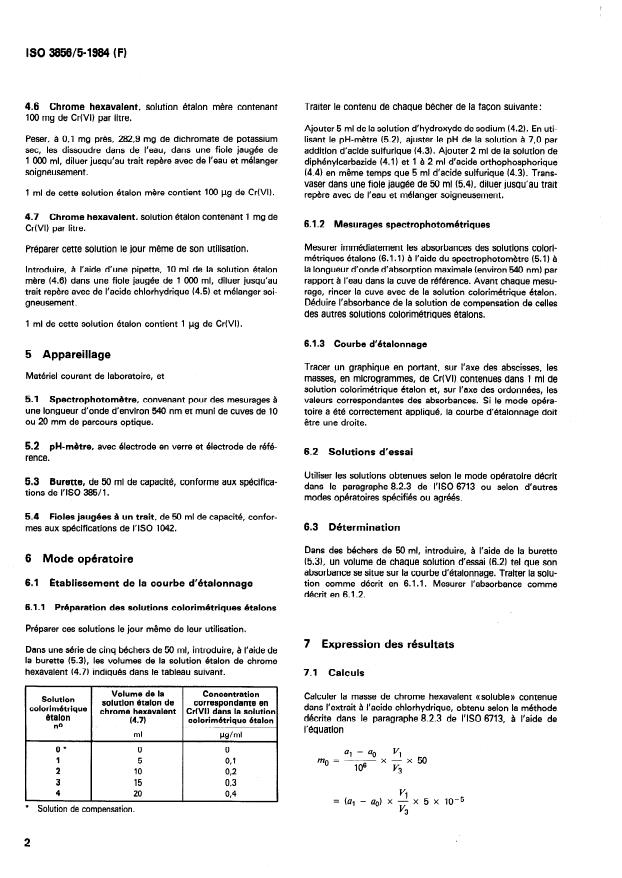
4.6 Chrome hexavalent, solution étalon mére contenant
100 mg de Cr(VI) par litre.
Ajouter 5 ml de la solution d’hydroxyde de sodium (4.2). En uti-
Peser, à 0,l mg prés, 282,9 mg de dichromate de potassium lisant le pH-mètre (5.21, ajuster le pH de la solution à 7,0 par
addition d’acide sulfurique (4.3). Ajouter 2 ml de la solution de
sec, les dissoudre dans de l’eau, dans une fiole jaugée de
1 000 ml, diluer jusqu’au trait repére avec de l’eau et mélanger diphénylcarbazide (4.1) et 1 à 2 ml d’acide orthophosphorique
soigneusement. (4.4) en même temps que 5 ml d’acide sulfurique (4.3). Trans-
vaser dans une fiole jaugée de 50 ml (5.41, diluer jusqu’au trait
1 ml de cette solution étalon mére contient 100 pg de Cr(VI).
repére avec de l’eau et mélanger soigneusement.
4.7 Chrome hexavalent, solution étalon contenant 1 mg de
6.1.2 Mesurages spectrophotom&riques
Cr(VI) par litre.
Mesurer immédiatement les absorbantes des solutions colori-
Préparer cette solution le jour même de son utilisation.
métriques étalons (6.1.1) à l’aide du spectrophotométre (5.1) à
la longueur d’onde d’absorption maximale (environ 540 nm) p
...
Norme internationale 385615
INTERNATIONAL ORGANIZATION FOR STANDARDIZATIONWlEX~YHAPO~HAR OPfAHkl3A~MR f-l0 CTAHAAPTltl3A~MM.ORGANlSAilON INTERNATIONALE DE NORMALISATION
Peintures et vernis -
Détermination de la teneur en
métaux «solubles» -
Partie 5: Détermination du chrome hexavalent contenu
dans le pigmen$ de la peinture liquide ou de la peinture en
poudre - Méthode spectrophotométrique à la
diphénylcarbazide
Paints and varnishes - Determination of “soluble” metal content
- Part 5: Determination of hexavalent chromium content of
the pigment portion of the fiquid paint or the Paint in powder form
- Diphen yfcarbazide spectrophotometric method
Deuxième édition - 1984-l l-01
L
Y
CDU 667.6 : 543.42 : 546.766 Réf. no : ISO 3856/5-1984 (FI
Descripteurs : peinture, vernis, encre d’imprimerie, pigment, analyse chimique, dosage, chrome, méthode spectrochimique, diphénylcarbazide.
Prix basé sur 3 pages
Avant-propos
L’ISO (Organisation internationale de normalisation) est une fédération mondiale
d’organismes nationaux de normalisation (comités membres de I’ISO). L’élaboration
des Normes internationales est confiée aux comités techniques de I’ISO. Chaque
comité membre intéressé par une étude a le droit de faire partie du comité technique
créé à cet effet. Les organisations internationales, gouvernementales et non gouverne-
mentales, en liaison avec I’ISO, participent également aux travaux.
Les projets de Normes internationales adoptés par les comités techniques sont soumis
aux comités membres pour approbation, avant leur acceptation comme Normes inter-
nationales par le Conseil de I’ISO. Les Normes internationales sont approuvées confor-
mément aux procédures de I’ISO qui requièrent l’approbation de 75 % au moins des
comités membres votants.
La Norme internationale ISO 3856/5 a été élaborée par le comité technique ISO/TC 35,
Pein turcs et vernis.
La Norme internationale ISO 3856/5 a été pour la Premiere fois publiée en 1980. Cette
deuxième édition annule et remplace la première édition, dont elle constitue une révi-
sion compléte.
0 Organisation internationale de normalisation, 1984
Imprimé en Suisse
ISO 3856/5-1984 (F)
NORME INTERNATIONALE
Détermination de la teneur en
Peintures et vernis -
métaux «solubles» -
Partie 5: Détermination du chrome hexavalent contenu
dans le pigment de la peinture liquide ou de la peinture en
poudre - Méthode spectrophotométrique à la
diphénylcarbazide
3 Principe
0 Introduction
Cette Norme internationale est ‘une partie de I’ISO 3856,
Formation d’un complexe coloré à partir du chrome hexavalent
Peintures et vernis - Détermination de la teneur en métaux
et d’une solution de diphénylcarbazide. Après addition d’acide
N solubles >j.
orthophosphorique et d’acide sulfurique, mesurage spectro-
photométrique de la coloration à une longueur d’onde dans la
région de 540 nm.
1 Objet et domaine d’application
La présente partie de I’ISO 3856 décrit une méthode spectro-
photométrique à la diphénylcarbazide, pour la détermination de
4 Réactifs
la teneur en chrome hexavalent ((soluble» de l’extrait à l’acide
chlorhydrique de la fraction contenant le pigment de la pein-
Au cours de l’analyse, utiliser uniquement des réactifs de qua-
ture liquide ou de la peinture en poudre, préparé selon le
lité analytique reconnue, et de l’eau d’une pureté d’au moins
paragraphe 8.2.3 de I’ISO 6713 ou selon d’autres Normes inter-
qualité 3 selon I’ISO 3696.
nationales appropriées.
La méthode est applicable aux peintures présentant des teneurs
4.1 Diphénylcarbazide, solution.
en chrome hexavalent «soluble)) comprises entre environ 0,05
et 5 % (mlm).
Dissoudre 0,25 g de diphénylcarbazide dans un mélange formé
de 50 ml d’acétone et de 50 ml d’eau.
D’autres méthodes peuvent être utilisées par accord entre les
parties intéressées, à condition que les méthodes soient spécifi-
ques du chrome hexavalent, mais la présente méthode spectro-
4.2 Hydroxyde de sodium, solution, c(NaOH) = 2 mol/l.
photométrique est la méthode de référence en cas de litige.
4.3 Acide sulfurique, c(H2S04) = 1 mol/l.
2 Références
4.4 Acide orthophosphorique, à environ 85 % (mlm)
ISO 38511, Verrerie de laboratoire - Burettes - Partie 1:
(Q approximativement 1,69 g/ml).
Spécifications générales. l)
ISO 1042, Verrerie de laboratoire - Fioles jaugées à un trait.
4.5 Acide chlorhydrique, C(H~I) = 0,07 mol/l.
ISO 3696, Eau à usage de laboratoire - Spécifications. 2,
Utiliser un acide chlorhydrique identique à celui qui est utilisé
Préparation des extraits acides pour la préparation des solutions d’essai selon I’ISO 6713.
ISO 6713, Peintures et vernis -
des peintures liquides ou en poudre. (Voir 6.2.)
1) Actuellement au stade de projet. (Révision partielle de I’ISO 3854964.)
2) Actuellement au stade de projet.
SO 3856/5-1984 (FI
Traiter le contenu de chaque bécher de la facon suivante:
4.6 Chrome hexavalent, solution étalon mére contenant
100 mg de Cr(VI) par litre.
Ajouter 5 ml de la solution d’hydroxyde de sodium (4.2). En uti-
Peser, à 0,l mg prés, 282,9 mg de dichromate de potassium lisant le pH-mètre (5.21, ajuster le pH de la solution à 7,0 par
addition d’acide sulfurique (4.3). Ajouter 2 ml de la solution de
sec, les dissoudre dans de l’eau, dans une fiole jaugée de
1 000 ml, diluer jusqu’au trait repére avec de l’eau et mélanger diphénylcarbazide (4.1) et 1 à 2 ml d’acide orthophosphorique
soigneusement. (4.4) en même temps que 5 ml d’acide sulfurique (4.3). Trans-
vaser dans une fiole jaugée de 50 ml (5.41, diluer jusqu’au trait
1 ml de cette solution étalon mére contient 100 pg de Cr(VI).
repére avec de l’eau et mélanger soigneusement.
4.7 Chrome hexavalent, solution étalon contenant 1 mg de
6.1.2 Mesurages spectrophotom&riques
Cr(VI) par litre.
Mesurer immédiatement les absorbantes des solutions colori-
Préparer cette solution le jour même de son utilisation.
métriques étalons (6.1.1) à l’aide du spectrophotométre (5.1) à
la longueur d’onde d’absor
...
Norme internationale 385615
INTERNATIONAL ORGANIZATION FOR STANDARDIZATIONWlEX~YHAPO~HAR OPfAHkl3A~MR f-l0 CTAHAAPTltl3A~MM.ORGANlSAilON INTERNATIONALE DE NORMALISATION
Peintures et vernis -
Détermination de la teneur en
métaux «solubles» -
Partie 5: Détermination du chrome hexavalent contenu
dans le pigmen$ de la peinture liquide ou de la peinture en
poudre - Méthode spectrophotométrique à la
diphénylcarbazide
Paints and varnishes - Determination of “soluble” metal content
- Part 5: Determination of hexavalent chromium content of
the pigment portion of the fiquid paint or the Paint in powder form
- Diphen yfcarbazide spectrophotometric method
Deuxième édition - 1984-l l-01
-
CDU 667.6 : 543.42 : 546.766 Réf. no : ISO 3856/5-1984 (FI
Descripteurs : peinture, vernis, encre d’imprimerie, pigment, analyse chimique, dosage, chrome, méthode spectrochimique, diphénylcarbazide.
Prix basé sur 3 pages
Avant-propos
L’ISO (Organisation internationale de normalisation) est une fédération mondiale
d’organismes nationaux de normalisation (comités membres de I’ISO). L’élaboration
des Normes internationales est confiée aux comités techniques de I’ISO. Chaque
comité membre intéressé par une étude a le droit de faire partie du comité technique
créé à cet effet. Les organisations internationales, gouvernementales et non gouverne-
mentales, en liaison avec I’ISO, participent également aux travaux.
Les projets de Normes internationales adoptés par les comités techniques sont soumis
aux comités membres pour approbation, avant leur acceptation comme Normes inter-
nationales par le Conseil de I’ISO. Les Normes internationales sont approuvées confor-
mément aux procédures de I’ISO qui requièrent l’approbation de 75 % au moins des
comités membres votants.
La Norme internationale ISO 3856/5 a été élaborée par le comité technique ISO/TC 35,
Pein turcs et vernis.
La Norme internationale ISO 3856/5 a été pour la Premiere fois publiée en 1980. Cette
deuxième édition annule et remplace la première édition, dont elle constitue une révi-
sion compléte.
0 Organisation internationale de normalisation, 1984 0
Imprimé en Suisse
ISO 3856/5-1984 (F)
NORME INTERNATIONALE
Détermination de la teneur en
Peintures et vernis -
métaux «solubles» -
Partie 5: Détermination du chrome hexavalent contenu
dans le pigment de la peinture liquide ou de la peinture en
poudre - Méthode spectrophotométrique à la
diphénylcarbazide
3 Principe
0 Introduction
Cette Norme internationale est ‘une partie de I’ISO 3856,
Formation d’un complexe coloré à partir du chrome hexavalent
Peintures et vernis - Détermination de la teneur en métaux
et d’une solution de diphénylcarbazide. Après addition d’acide
N solubles >j.
orthophosphorique et d’acide sulfurique, mesurage spectro-
photométrique de la coloration à une longueur d’onde dans la
région de 540 nm.
1 Objet et domaine d’application
La présente partie de I’ISO 3856 décrit une méthode spectro-
photométrique à la diphénylcarbazide, pour la détermination de
4 Réactifs
la teneur en chrome hexavalent ((soluble» de l’extrait à l’acide
chlorhydrique de la fraction contenant le pigment de la pein-
Au cours de l’analyse, utiliser uniquement des réactifs de qua-
ture liquide ou de la peinture en poudre, préparé selon le
lité analytique reconnue, et de l’eau d’une pureté d’au moins
paragraphe 8.2.3 de I’ISO 6713 ou selon d’autres Normes inter-
qualité 3 selon I’ISO 3696.
nationales appropriées.
La méthode est applicable aux peintures présentant des teneurs
4.1 Diphénylcarbazide, solution.
en chrome hexavalent «soluble)) comprises entre environ 0,05
et 5 % (mlm).
Dissoudre 0,25 g de diphénylcarbazide dans un mélange formé
de 50 ml d’acétone et de 50 ml d’eau.
D’autres méthodes peuvent être utilisées par accord entre les
parties intéressées, à condition que les méthodes soient spécifi-
ques du chrome hexavalent, mais la présente méthode spectro-
4.2 Hydroxyde de sodium, solution, c(NaOH) = 2 mol/l.
photométrique est la méthode de référence en cas de litige.
4.3 Acide sulfurique, c(H2S04) = 1 mol/l.
2 Références
4.4 Acide orthophosphorique, à environ 85 % (mlm)
ISO 38511, Verrerie de laboratoire - Burettes - Partie 1:
(Q approximativement 1,69 g/ml).
Spécifications générales. l)
ISO 1042, Verrerie de laboratoire - Fioles jaugées à un trait.
4.5 Acide chlorhydrique, C(H~I) = 0,07 mol/l.
ISO 3696, Eau à usage de laboratoire - Spécifications. 2,
Utiliser un acide chlorhydrique identique à celui qui est utilisé
Préparation des extraits acides pour la préparation des solutions d’essai selon I’ISO 6713.
ISO 6713, Peintures et vernis -
des peintures liquides ou en poudre. (Voir 6.2.)
1) Actuellement au stade de projet. (Révision partielle de I’ISO 3854964.)
2) Actuellement au stade de projet.
SO 3856/5-1984 (FI
Traiter le contenu de chaque bécher de la facon suivante:
4.6 Chrome hexavalent, solution étalon mére contenant
100 mg de Cr(VI) par litre.
Ajouter 5 ml de la solution d’hydroxyde de sodium (4.2). En uti-
Peser, à 0,l mg prés, 282,9 mg de dichromate de potassium lisant le pH-mètre (5.21, ajuster le pH de la solution à 7,0 par
addition d’acide sulfurique (4.3). Ajouter 2 ml de la solution de
sec, les dissoudre dans de l’eau, dans une fiole jaugée de
1 000 ml, diluer jusqu’au trait repére avec de l’eau et mélanger diphénylcarbazide (4.1) et 1 à 2 ml d’acide orthophosphorique
soigneusement. (4.4) en même temps que 5 ml d’acide sulfurique (4.3). Trans-
vaser dans une fiole jaugée de 50 ml (5.41, diluer jusqu’au trait
1 ml de cette solution étalon mére contient 100 pg de Cr(VI).
repére avec de l’eau et mélanger soigneusement.
4.7 Chrome hexavalent, solution étalon contenant 1 mg de
6.1.2 Mesurages spectrophotom&riques
Cr(VI) par litre.
Mesurer immédiatement les absorbantes des solutions colori-
Préparer cette solution le jour même de son utilisation.
métriques étalons (6.1.1) à l’aide du spectrophotométre (5.1) à
la longueur d’onde d’absorption maximale (environ 540 nm) p
...
Norme internationale 385615
INTERNATIONAL ORGANIZATION FOR STANDARDIZATIONWlEX~YHAPO~HAR OPfAHkl3A~MR f-l0 CTAHAAPTltl3A~MM.ORGANlSAilON INTERNATIONALE DE NORMALISATION
Peintures et vernis -
Détermination de la teneur en
métaux «solubles» -
Partie 5: Détermination du chrome hexavalent contenu
dans le pigmen$ de la peinture liquide ou de la peinture en
poudre - Méthode spectrophotométrique à la
diphénylcarbazide
Paints and varnishes - Determination of “soluble” metal content
- Part 5: Determination of hexavalent chromium content of
the pigment portion of the fiquid paint or the Paint in powder form
- Diphen yfcarbazide spectrophotometric method
Deuxième édition - 1984-l l-01
L
Y
CDU 667.6 : 543.42 : 546.766 Réf. no : ISO 3856/5-1984 (FI
Descripteurs : peinture, vernis, encre d’imprimerie, pigment, analyse chimique, dosage, chrome, méthode spectrochimique, diphénylcarbazide.
Prix basé sur 3 pages
Avant-propos
L’ISO (Organisation internationale de normalisation) est une fédération mondiale
d’organismes nationaux de normalisation (comités membres de I’ISO). L’élaboration
des Normes internationales est confiée aux comités techniques de I’ISO. Chaque
comité membre intéressé par une étude a le droit de faire partie du comité technique
créé à cet effet. Les organisations internationales, gouvernementales et non gouverne-
mentales, en liaison avec I’ISO, participent également aux travaux.
Les projets de Normes internationales adoptés par les comités techniques sont soumis
aux comités membres pour approbation, avant leur acceptation comme Normes inter-
nationales par le Conseil de I’ISO. Les Normes internationales sont approuvées confor-
mément aux procédures de I’ISO qui requièrent l’approbation de 75 % au moins des
comités membres votants.
La Norme internationale ISO 3856/5 a été élaborée par le comité technique ISO/TC 35,
Pein turcs et vernis.
La Norme internationale ISO 3856/5 a été pour la Premiere fois publiée en 1980. Cette
deuxième édition annule et remplace la première édition, dont elle constitue une révi-
sion compléte.
0 Organisation internationale de normalisation, 1984
Imprimé en Suisse
ISO 3856/5-1984 (F)
NORME INTERNATIONALE
Détermination de la teneur en
Peintures et vernis -
métaux «solubles» -
Partie 5: Détermination du chrome hexavalent contenu
dans le pigment de la peinture liquide ou de la peinture en
poudre - Méthode spectrophotométrique à la
diphénylcarbazide
3 Principe
0 Introduction
Cette Norme internationale est ‘une partie de I’ISO 3856,
Formation d’un complexe coloré à partir du chrome hexavalent
Peintures et vernis - Détermination de la teneur en métaux
et d’une solution de diphénylcarbazide. Après addition d’acide
N solubles >j.
orthophosphorique et d’acide sulfurique, mesurage spectro-
photométrique de la coloration à une longueur d’onde dans la
région de 540 nm.
1 Objet et domaine d’application
La présente partie de I’ISO 3856 décrit une méthode spectro-
photométrique à la diphénylcarbazide, pour la détermination de
4 Réactifs
la teneur en chrome hexavalent ((soluble» de l’extrait à l’acide
chlorhydrique de la fraction contenant le pigment de la pein-
Au cours de l’analyse, utiliser uniquement des réactifs de qua-
ture liquide ou de la peinture en poudre, préparé selon le
lité analytique reconnue, et de l’eau d’une pureté d’au moins
paragraphe 8.2.3 de I’ISO 6713 ou selon d’autres Normes inter-
qualité 3 selon I’ISO 3696.
nationales appropriées.
La méthode est applicable aux peintures présentant des teneurs
4.1 Diphénylcarbazide, solution.
en chrome hexavalent «soluble)) comprises entre environ 0,05
et 5 % (mlm).
Dissoudre 0,25 g de diphénylcarbazide dans un mélange formé
de 50 ml d’acétone et de 50 ml d’eau.
D’autres méthodes peuvent être utilisées par accord entre les
parties intéressées, à condition que les méthodes soient spécifi-
ques du chrome hexavalent, mais la présente méthode spectro-
4.2 Hydroxyde de sodium, solution, c(NaOH) = 2 mol/l.
photométrique est la méthode de référence en cas de litige.
4.3 Acide sulfurique, c(H2S04) = 1 mol/l.
2 Références
4.4 Acide orthophosphorique, à environ 85 % (mlm)
ISO 38511, Verrerie de laboratoire - Burettes - Partie 1:
(Q approximativement 1,69 g/ml).
Spécifications générales. l)
ISO 1042, Verrerie de laboratoire - Fioles jaugées à un trait.
4.5 Acide chlorhydrique, C(H~I) = 0,07 mol/l.
ISO 3696, Eau à usage de laboratoire - Spécifications. 2,
Utiliser un acide chlorhydrique identique à celui qui est utilisé
Préparation des extraits acides pour la préparation des solutions d’essai selon I’ISO 6713.
ISO 6713, Peintures et vernis -
des peintures liquides ou en poudre. (Voir 6.2.)
1) Actuellement au stade de projet. (Révision partielle de I’ISO 3854964.)
2) Actuellement au stade de projet.
SO 3856/5-1984 (FI
Traiter le contenu de chaque bécher de la facon suivante:
4.6 Chrome hexavalent, solution étalon mére contenant
100 mg de Cr(VI) par litre.
Ajouter 5 ml de la solution d’hydroxyde de sodium (4.2). En uti-
Peser, à 0,l mg prés, 282,9 mg de dichromate de potassium lisant le pH-mètre (5.21, ajuster le pH de la solution à 7,0 par
addition d’acide sulfurique (4.3). Ajouter 2 ml de la solution de
sec, les dissoudre dans de l’eau, dans une fiole jaugée de
1 000 ml, diluer jusqu’au trait repére avec de l’eau et mélanger diphénylcarbazide (4.1) et 1 à 2 ml d’acide orthophosphorique
soigneusement. (4.4) en même temps que 5 ml d’acide sulfurique (4.3). Trans-
vaser dans une fiole jaugée de 50 ml (5.41, diluer jusqu’au trait
1 ml de cette solution étalon mére contient 100 pg de Cr(VI).
repére avec de l’eau et mélanger soigneusement.
4.7 Chrome hexavalent, solution étalon contenant 1 mg de
6.1.2 Mesurages spectrophotom&riques
Cr(VI) par litre.
Mesurer immédiatement les absorbantes des solutions colori-
Préparer cette solution le jour même de son utilisation.
métriques étalons (6.1.1) à l’aide du spectrophotométre (5.1) à
la longueur d’onde d’absor
...