

ISO 16458:2004
(Main)Space systems — Unmanned spacecraft transportation — General requirements
- Abstract
ISO 16458:2004 is applicable to unmanned spacecraft and their supporting hardware including science instrument and payloads. It establishes the requirements for transportation by rail, road, air, and water and as a part of a launch vehicle and establishes the requirements for special containers and loading/unloading operations meant to safeguard unmanned spacecraft and their supporting hardware during transportation. ISO 16458:2004 is intended to be applied in international transportation. It may also be used in national transportation.
- Status
- Published
- Publication Date
- 05-Jan-2004
- Technical Committee
- ISO/TC 20/SC 14 - Space systems and operations
- Drafting Committee
- ISO/TC 20/SC 14/WG 5 - Space System Program Management and Quality
- Current Stage
- 9093 - International Standard confirmed - 90 Review
- Start Date
- 05-Sep-2023
Buy Documents
ISO 16458:2004 - Space systems — Unmanned spacecraft transportation — General requirements Released:1/6/2004
ISO 16458:2004 - Systemes spatiaux — Transport des véhicules spatiaux non habités — Exigences générales Released:1/6/2004
Overview
ISO 16458:2004 - Space systems - Unmanned spacecraft transportation - General requirements - defines general requirements for the safe international transportation of unmanned spacecraft (SC) and their supporting hardware, including science instruments and payloads. The standard covers transportation by rail, road, air and water, transportation as part of a launch vehicle, plus requirements for special shipping containers, loading/unloading operations, and operational documentation (OD) needed to safeguard spacecraft during transit.
Key topics and technical requirements
- Scope and applicability: Unmanned spacecraft, major components, support equipment and spare parts; intended primarily for international transport but usable for national movements.
- Operational documentation (OD): Transport modes, environmental limits, mechanical load limits and inspection procedures must be specified in the OD prepared by the spacecraft developer.
- Container design:
- Dust- and moisture-tight construction; protection against water penetration and contaminants
- Environmental control targets (example ranges given: temperature −50 °C to +50 °C unless OD specifies otherwise; relative humidity ≤ 60 % or per OD)
- Pressure equalization and, for thermal containers, typical pressure range (93–113 kPa) and air cleanliness per OD
- Shock-absorption systems to reduce transport loads when required
- RF shielding where SC is RF-sensitive; corrosion resistance; materials compatible with propellants and clean-room entry
- Monitoring & recording: Remote monitoring and shock-recording sensors integrated into containers when required by OD; defined permissible ranges to be recorded.
- Safety controls: Electrical grounding during transport, pyrotechnic items rendered safe/inactive, compliance with UN and national transport safety regulations.
- Mode-specific rules:
- Rail: prohibit humping, strict speed/approach limits and external inspections en route
- Road: pre-movement checks, inspections at defined intervals (e.g., ~1–1.5 km after start and every ~150 km, unless OD specifies otherwise)
- Air: inspections before takeoff and after landing; aircraft must withstand expected static/vibration loads and pressure differentials
- Water: secure tie-downs, protection from seawater, tie-down inspections at least four times per 24 h (first within 0.5–1 h)
Practical applications and who uses it
- Who: spacecraft manufacturers, launch service providers, systems integrators, payload suppliers, transport/logistics contractors, ground handling teams, safety officers, and regulatory compliance personnel.
- Use cases:
- Designing and qualifying spacecraft shipping containers and shock-absorption systems
- Writing transport plans and operational documentation (OD) with environmental and load limits
- Specifying contractual and inspection requirements for carriers and escorts
- Ensuring safety and regulatory compliance for international shipment of spacecraft hardware
Related standards
- ISO 14303 - Space systems - Launch-vehicle-to-spacecraft interfaces
- ISO 15863 - Space systems - Spacecraft-to-launch-vehicle interface control document
- ISO 17401 - Space systems - Documents for spacecraft interface requirements for launch vehicle services
Keywords: ISO 16458, unmanned spacecraft transportation, spacecraft shipping containers, transport requirements, shock absorption, moisture control, RF shielding, launch vehicle transport, international spacecraft logistics.
Buy Documents
ISO 16458:2004 - Space systems — Unmanned spacecraft transportation — General requirements Released:1/6/2004
ISO 16458:2004 - Systemes spatiaux — Transport des véhicules spatiaux non habités — Exigences générales Released:1/6/2004
Get Certified
Connect with accredited certification bodies for this standard

BUREAU VERITAS Certification Germany
Bureau Veritas certification in Germany.

Element Materials Technology
Materials testing and product certification.

AQMS Ltd.
AQMS provides ISO certification to SMEs across the UK.
Sponsored listings
Frequently Asked Questions
ISO 16458:2004 is a standard published by the International Organization for Standardization (ISO). Its full title is "Space systems — Unmanned spacecraft transportation — General requirements". This standard covers: ISO 16458:2004 is applicable to unmanned spacecraft and their supporting hardware including science instrument and payloads. It establishes the requirements for transportation by rail, road, air, and water and as a part of a launch vehicle and establishes the requirements for special containers and loading/unloading operations meant to safeguard unmanned spacecraft and their supporting hardware during transportation. ISO 16458:2004 is intended to be applied in international transportation. It may also be used in national transportation.
ISO 16458:2004 is applicable to unmanned spacecraft and their supporting hardware including science instrument and payloads. It establishes the requirements for transportation by rail, road, air, and water and as a part of a launch vehicle and establishes the requirements for special containers and loading/unloading operations meant to safeguard unmanned spacecraft and their supporting hardware during transportation. ISO 16458:2004 is intended to be applied in international transportation. It may also be used in national transportation.
ISO 16458:2004 is classified under the following ICS (International Classification for Standards) categories: 49.140 - Space systems and operations. The ICS classification helps identify the subject area and facilitates finding related standards.
ISO 16458:2004 is available in PDF format for immediate download after purchase. The document can be added to your cart and obtained through the secure checkout process. Digital delivery ensures instant access to the complete standard document.
Standards Content (Sample)
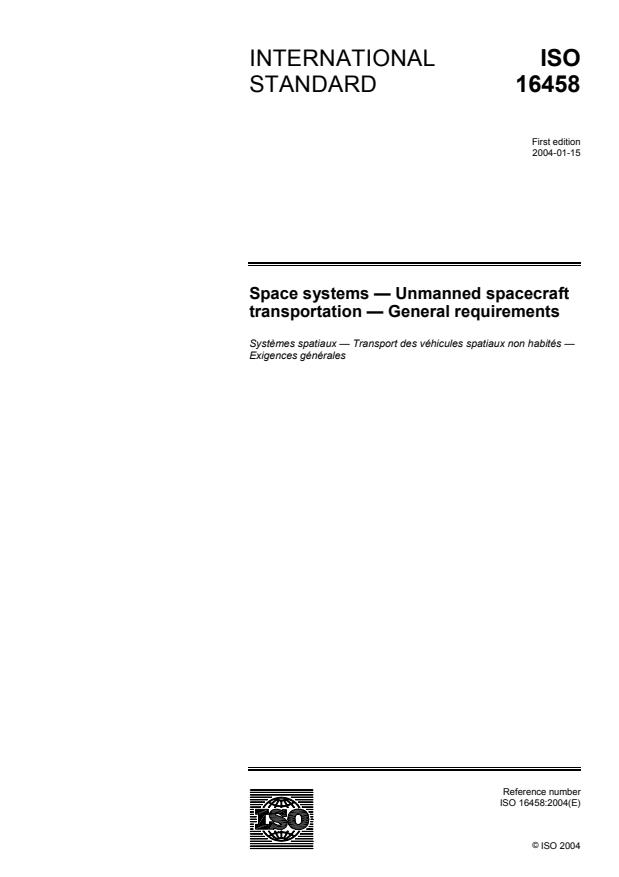
INTERNATIONAL ISO
STANDARD 16458
First edition
2004-01-15
Space systems — Unmanned spacecraft
transportation — General requirements
Systèmes spatiaux — Transport des véhicules spatiaux non habités —
Exigences générales
Reference number
©
ISO 2004
PDF disclaimer
This PDF file may contain embedded typefaces. In accordance with Adobe's licensing policy, this file may be printed or viewed but
shall not be edited unless the typefaces which are embedded are licensed to and installed on the computer performing the editing. In
downloading this file, parties accept therein the responsibility of not infringing Adobe's licensing policy. The ISO Central Secretariat
accepts no liability in this area.
Adobe is a trademark of Adobe Systems Incorporated.
Details of the software products used to create this PDF file can be found in the General Info relative to the file; the PDF-creation
parameters were optimized for printing. Every care has been taken to ensure that the file is suitable for use by ISO member bodies. In
the unlikely event that a problem relating to it is found, please inform the Central Secretariat at the address given below.
© ISO 2004
All rights reserved. Unless otherwise specified, no part of this publication may be reproduced or utilized in any form or by any means,
electronic or mechanical, including photocopying and microfilm, without permission in writing from either ISO at the address below or
ISO's member body in the country of the requester.
ISO copyright office
Case postale 56 • CH-1211 Geneva 20
Tel. + 41 22 749 01 11
Fax + 41 22 749 09 47
E-mail copyright@iso.org
Web www.iso.org
Published in Switzerland
ii © ISO 2004 – All rights reserved
Foreword
ISO (the International Organization for Standardization) is a worldwide federation of national standards bodies
(ISO member bodies). The work of preparing International Standards is normally carried out through ISO
technical committees. Each member body interested in a subject for which a technical committee has been
established has the right to be represented on that committee. International organizations, governmental and
non-governmental, in liaison with ISO, also take part in the work. ISO collaborates closely with the
International Electrotechnical Commission (IEC) on all matters of electrotechnical standardization.
International Standards are drafted in accordance with the rules given in the ISO/IEC Directives, Part 2.
The main task of technical committees is to prepare International Standards. Draft International Standards
adopted by the technical committees are circulated to the member bodies for voting. Publication as an
International Standard requires approval by at least 75 % of the member bodies casting a vote.
Attention is drawn to the possibility that some of the elements of this document may be the subject of patent
rights. ISO shall not be held responsible for identifying any or all such patent rights.
ISO 16458 was prepared by Technical Committee ISO/TC 20, Aircraft and space vehicles, Subcommittee
SC 14, Space systems and operations.
Introduction
International cooperation in space system design and operation determines how a spacecraft (SC) and its
hardware are transported, such as
transportation of special hardware for setup and operation of the SC from other countries;
transportation of the SC with hardware for integration with the launch vehicles.
To ensure that the problems of ground transportation of the SC and its hardware will not hinder the
development of international cooperation
transportation should not require excessive or unusual preparation of the SC and its hardware, and
transportation should be based on the available civilian or military transport facilities.
It would be ideal to develop international transportation requirements for all SC and all types of transportation
modes. However, development of such requirements for all areas and all SC of other countries is difficult; so
the following general requirements should be established initially:
the environment for the SC transportation;
the loads from all transportation modes;
the rules for the SC loading, transportation, and unloading.
This International Standard contains a list of requirements for different types of transport (rail, road, air, and
water).
iv © ISO 2004 – All rights reserved
INTERNATIONAL STANDARD ISO 16458:2004(E)
Space systems — Unmanned spacecraft transportation —
General requirements
1 Scope
This International Standard is applicable to unmanned spacecraft and their supporting hardware including
science instrument and payloads. It establishes the requirements for transportation by rail, road, air, and water
and as a part of a launch vehicle and establishes the requirements for special containers and
loading/unloading operations meant to safeguard unmanned spacecraft and their supporting hardware during
transportation.
This International Standard is intended to be applied in international transportation. It may also be used in
national transportation.
2 Normative references
The following referenced documents are indispensable for the application of this document. For dated
references, only the edition cited applies. For undated references, the latest edition of the referenced
document (including any amendments) applies.
ISO 14303, Space systems — Launch-vehicle-to-spacecraft interfaces
ISO 15863, Space systems — Spacecraft-to-launch-vehicle interface control document
ISO 17401, Space systems — Documents for space craft interface requirements for launch vehicle services
3 Symbols and abbreviated terms
LC launch complex
OD operational documentation
RF radio frequency
SC spacecraft
TS technical specification
4 Transportation requirements
4.1 General provisions
4.1.1 SC shipping containers or railway cars
When transporting an SC to an LC or to a maintenance structure, the spacecraft shipping container and other
special devices shall provide for the safe transportation of the spacecraft. The shipping container shall safely
provide for various transportation conditions, such as temperature, humidity, and shock. These conditions
shall be specified in the operational documentation (OD).
4.1.2 Mechanical loads
During transportation and loading/unloading operations, structural loads act on the SC. These loads depend
on SC securing methods, the stiffness of the transport device, the loading/unloading facilities used, and the
environment faced by transport. The limiting values and duration of the loads shall be specified in
documentation of the SC developer.
4.1.3 Types of transport
The types of transport, as well as the requirements for transportation, shall be specified in the OD for the SC.
4.1.4 Major components, support equipment and spare parts
Major components or subsystems shall be transported under the same conditions as the SC. Accessories,
tools, and spare parts shall be transported in accordance with the supplier's specifications.
4.1.5 Safety requirements
The SC shall be completely secured during transportation (except when transported as part of the launch
device). Containers with active fluid or active electrical systems shall not jeopardize transportation safety.
International transportation of SC shall comply with the international transportation regulations and the
international safety constraints that exist under the authority of the United Nations.
Transportation within a country shall conform to the national transportation safety regulations. Transportation
within a LC shall conform to the LC safety regulations.
4.1.6 Moisture and contamination
The components of SC or the entire SC that are sensitive to moisture and/or contamination that adversely
affect function or performance shall have a system to avoid or reduce the moisture and/or contamination
during transportation in accordance with the specific requirements defined in the OD for the SC.
4.1.7 Electrical grounding
The SC and container shall be electrically grounded during transportation in accordance with the OD for the
SC.
4.1.8 Pyrotechnic safety
Pyrotechnic components shall be in a safe inactive condition.
4.2 Requirements for the SC shipping containers and control over transportation
conditions
4.2.1 Containers
A container shall protect the SC from damage during transportation, loading/unloading operations, or storage,
as well as ensure protection against the natural environment.
4.2.2 Lifting devices and tie-down points
Lifting devices (yokes, shackles, etc.) and pick-up/tie-down points shall be provided for lifting and securing
containers on a transportation device. The location of the lifting points shall provide a stable lift during any
lifting operations. Intermediate elements for securing the container by lifting devices (yokes, shackles) on the
transportation device shall be in accordance with the requirements of the OD. Requirements for proof loading
of lift points, frames, and slings prior to use shall be specified in the OD.
2 © ISO 2004 – All rights reserved
4.2.3 Container dimensions
Dimensions of containers should be in accordance with the dimensional outlines of rolling stock adopted in
international and/or national practice. The container dimensions shall provide a safe clearance between the
SC and internal face of the container.
4.2.4 Design requirements
The design of the container shall ensure that
a) dust and moisture tightness is provided, protection against water penetration is provided, and
environmental parameters inside the container are maintained within the established limits;
b) air pressure inside the container is equal to the environment at air pressure or higher air pressure in
accordance with that specified in the OD;
c) relative air humidity inside the container is not more than 60 %, and the absolute humidity is not more
than 0,019 kg/m or in accordance with the OD for the SC;
d) temperature inside a container is from −50 °C to +50 °C or in accordance with the OD for the SC;
e) protection against penetration of rodents and insects is provided;
f) dust-generating materials are controlled;
g) container provides protection against static electricity build-up and/or a capability of discharge;
h) design load margins are in accordance with the OD for the SC;
i) transportation pressure is equalized, which adds a design requirement regarding the pressure
equalization capability of the shipping containers;
j) products and amounts of out-gassing materials in proximity of the SC are specified in the OD for the SC;
k) materials are compatible with SC propellants if an SC is transported filled with fuel; a propellant leak
and/or spillage cannot cause a spontaneous combustion and/or fire;
l) design and materials used for the SC shipping container are compatible for entry/operation inside a clean
room;
m) RF (radio frequency) shielding is required when the spacecraft being transported is sensitive to external
RF energy;
n) containers are constructed of corrosive-resistant materials or coatings, if likely to be subjected to
corrosive environments.
4.2.5 Thermal containers
Thermal containers shall ensure the following transportation conditions:
a) temperature is in accordance with the OD for the SC;
b) pressure is from 93 kPa to 113 kPa or in accordance with the OD for the SC;
c) relative humidity is a maximum of 60 % or in accordance with the OD for the SC;
d) air cleanliness is in accordance with the OD.
4.2.6 Shock absorption system
In order to reduce structural loads acting on SC during transportation down to acceptable values, the
container shall be equipped with a shock-absorption system or other load-reduction systems when required
...
NORME ISO
INTERNATIONALE 16458
Première édition
2004-01-15
Systèmes spatiaux — Transport des
véhicules spatiaux non habités —
Exigences générales
Space systems — Unmanned spacecraft transportation — General
requirements
Numéro de référence
©
ISO 2004
PDF – Exonération de responsabilité
Le présent fichier PDF peut contenir des polices de caractères intégrées. Conformément aux conditions de licence d'Adobe, ce fichier
peut être imprimé ou visualisé, mais ne doit pas être modifié à moins que l'ordinateur employé à cet effet ne bénéficie d'une licence
autorisant l'utilisation de ces polices et que celles-ci y soient installées. Lors du téléchargement de ce fichier, les parties concernées
acceptent de fait la responsabilité de ne pas enfreindre les conditions de licence d'Adobe. Le Secrétariat central de l'ISO décline toute
responsabilité en la matière.
Adobe est une marque déposée d'Adobe Systems Incorporated.
Les détails relatifs aux produits logiciels utilisés pour la création du présent fichier PDF sont disponibles dans la rubrique General Info
du fichier; les paramètres de création PDF ont été optimisés pour l'impression. Toutes les mesures ont été prises pour garantir
l'exploitation de ce fichier par les comités membres de l'ISO. Dans le cas peu probable où surviendrait un problème d'utilisation,
veuillez en informer le Secrétariat central à l'adresse donnée ci-dessous.
© ISO 2004
Droits de reproduction réservés. Sauf prescription différente, aucune partie de cette publication ne peut être reproduite ni utilisée sous
quelque forme que ce soit et par aucun procédé, électronique ou mécanique, y compris la photocopie et les microfilms, sans l'accord écrit
de l'ISO à l'adresse ci-après ou du comité membre de l'ISO dans le pays du demandeur.
ISO copyright office
Case postale 56 • CH-1211 Geneva 20
Tel. + 41 22 749 01 11
Fax. + 41 22 749 09 47
E-mail copyright@iso.org
Web www.iso.org
Publié en Suisse
ii © ISO 2004 – Tous droits réservés
Avant-propos
L'ISO (Organisation internationale de normalisation) est une fédération mondiale d'organismes nationaux de
normalisation (comités membres de l'ISO). L'élaboration des Normes internationales est en général confiée
aux comités techniques de l'ISO. Chaque comité membre intéressé par une étude a le droit de faire partie du
comité technique créé à cet effet. Les organisations internationales, gouvernementales et non
gouvernementales, en liaison avec l'ISO participent également aux travaux. L'ISO collabore étroitement avec
la Commission électrotechnique internationale (CEI) en ce qui concerne la normalisation électrotechnique.
Les Normes internationales sont rédigées conformément aux règles données dans les Directives ISO/CEI,
Partie 2.
La tâche principale des comités techniques est d'élaborer les Normes internationales. Les projets de Normes
internationales adoptés par les comités techniques sont soumis aux comités membres pour vote. Leur
publication comme Normes internationales requiert l'approbation de 75 % au moins des comités membres
votants.
L'attention est appelée sur le fait que certains des éléments du présent document peuvent faire l'objet de
droits de propriété intellectuelle ou de droits analogues. L'ISO ne saurait être tenue pour responsable de ne
pas avoir identifié de tels droits de propriété et averti de leur existence.
L'ISO 16458 a été élaborée par le comité technique ISO/TC 20, Aéronautique et espace, sous-comité SC 14,
Systèmes spatiaux, développement et mise en œuvre.
Introduction
La coopération internationale dans la conception et l’exploitation des systèmes spatiaux détermine les
conditions de transport des véhicules spatiaux (SC) et de leur matériel, telles que
le transport du matériel spécial pour l'installation et l’exploitation de SC d'autres pays, et
le transport des SC avec leur matériel pour intégration dans les lanceurs.
Pour garantir que les problèmes de transport au sol des SC et de leur matériel n'entraveront pas le
développement de la coordination internationale, il convient que
le transport ne demande pas de préparation spéciale des SC ni de leur matériel, et que
le transport s’effectue dans les infrastructures de transport civiles ou militaires disponibles.
Il serait idéal de pouvoir développer des exigences relatives au transport international, pour tous les SC et
pour tous les types de transport. Cependant, le développement de telles exigences, pour tous les sites et pour
tous les SC d'autres pays, s’avère difficile, et il convient d’établir au préalable des exigences générales
relatives à
l'environnement pour le transport des SC,
les charges de tous les modes de transport, et
les règles de chargement, de transport et de déchargement des SC.
La présente Norme internationale contient une liste d'exigences pour différents types de transport ferroviaire,
routier, aérien et par eau.
iv © ISO 2004 – Tous droits réservés
NORME INTERNATIONALE ISO 16458:2004(F)
Systèmes spatiaux — Transport des véhicules spatiaux non
habités — Exigences générales
1 Domaine d'application
La présente Norme internationale est applicable aux véhicules spatiaux (SC) non habités et à leur matériel
associé, y compris l’instrumentation scientifique et les charges utiles. Elle établit les exigences relatives à leur
transport ferroviaire, routier, aérien, par eau et en tant que faisant partie d’un lanceur, et fixe les exigences
relatives aux conteneurs spéciaux et aux opérations de chargement/déchargement, destinées à sécuriser les
SC non habités et leur matériel associé, pendant le transport.
La présente Norme internationale est censée être appliquée dans le cadre du transport international. Elle peut
également être appliquée dans le cadre du transport national.
2 Références normatives
Les documents de référence suivants sont indispensables pour l'application du présent document. Pour les
références datées, seule l'édition citée s'applique. Pour les références non datées, la dernière édition du
document de référence s'applique (y compris les éventuels amendements).
ISO 14303, Systèmes spatiaux — Interfaces entre le lanceur spatial et le véhicule spatial
ISO 15863, Systèmes spatiaux — Document de contrôle des interfaces entre le véhicule spatial et le lanceur
spatial
ISO 17401, Systèmes spatiaux — Document relatif aux exigences d’interface des véhicules spatiaux pour les
services de lancement
3 Symboles et termes abrégés
CL centre de lancement
DE documentation d’exploitation
RF radiofréquence
SC véhicule spatial
ST spécification technique
4 Exigences relatives au transport
4.1 Dispositions générales
4.1.1 Conteneurs ou wagons spéciaux d’expédition de SC
Le transport des SC vers un CL ou vers une structure de maintenance doit être effectué soit dans des
conteneurs d’expédition de SC, soit dans des dispositifs spéciaux, dont la capacité à remplir cette fonction a
été vérifiée. Les conteneurs d’expédition doivent être conçus de manière à satisfaire à différentes conditions
de transport (par exemple température, humidité, absorption des chocs, etc.), conditions qui doivent être
spécifiées dans la DE.
4.1.2 Charges mécaniques
Pendant les transports et les opérations de chargement/déchargement, des charges structurales agissent sur
le SC. Ces charges dépendent des méthodes de fixation du SC, de la rigidité du dispositif de transport, des
installations de chargement/déchargement utilisées et de l’environnement auquel doit faire face le transport.
Les valeurs et la durée limites des charges doivent être précisées dans la documentation du développeur du
SC.
4.1.3 Types de transport
Les types de transport, ainsi que les exigences relatives au transport, doivent être indiquées dans la DE du
SC.
4.1.4 Composants principaux, équipement de support et pièces détachées
Les composants ou sous-systèmes principaux doivent être transportés dans les mêmes conditions que le SC.
Les accessoires, les outillages et les pièces détachées doivent être transportés en conformité avec les
spécifications du fabricant.
4.1.5 Exigences relatives à la sécurité
Le SC doit être solidement arrimé pendant le transport (sauf s’il est transporté comme faisant partie du
lanceur). Des conteneurs à fluide actif ou à systèmes électriques actifs ne doivent pas compromettre la
sécurité du transport. Le transport international de SC doit être conforme aux règlements de transport
international et aux contraintes de sécurité internationale, qui existent actuellement sous l’autorité des Nations
Unies.
Le transport dans un pays doit être conforme aux règlements de sécurité du transport national. Le transport
dans un CL doit être conforme aux règlements de sécurité du CL.
4.1.6 Humidité et pollution
S’ils sont sensibles à l’humidité et/ou à la contamination au point d’altérer leur fonctionnement ou leur
performance, le SC complet ou ses composants doivent être munis d’un système pour éviter ou réduire
l’humidité ou la contamination pendant le transport, en conformité avec les exigences spécifiques de la DE du
SC.
4.1.7 Mise à la masse
Le SC et le conteneur doivent être mis à la masse pendant le transport, conformément à la DE du SC.
4.1.8 Sécurité pyrotechnique
Les composants pyrotechniques doivent être en condition inerte sûre.
4.2 Exigences relatives aux conteneurs d’expédition de SC et au contrôle des conditions
de transport
4.2.1 Conteneurs
Les conteneurs doivent protéger le SC de tout dommage pendant le transport, les opérations de
chargement/déchargement ou le stockage, et assurer sa protection vis-à-vis de l’environnement naturel.
4.2.2 Dispositifs de levage et points d’arrimage
Des dispositifs de levage (palanches, manilles, etc.) et des points d’arrimage/de reprise doivent être fournis
pour permettre le levage et l’arrimage des conteneurs sur un engin de transport. L’emplacement des points de
levage doit permettre un levage stable pendant toute opération de levage. Les éléments intermédiaires pour
arrimer le conteneur à l’aide de dispositifs de levage (palanches, manilles) sur l’engin de transport doivent être
2 © ISO 2004 – Tous droits réservés
conformes aux exigences de la DE. Les exigences pour l’épreuve de chargement des points, des cadres et
des élingues de levage, avant leur emploi, doivent être spécifiées dans la DE.
4.2.3 Dimensions des conteneurs
Il convient que les dimensions des conteneurs soient conformes aux cotes d’encombrement du matériel
roulant adoptées dans la pratique internationale et/ou nationale. Les dimensions des conteneurs doivent
ménager un espace sûr entre le SC et la paroi interne des conteneurs.
4.2.4 Exigences relatives à la conception
La conception des conteneurs doit:
a) assurer l’étanchéité à la poussière et à l’humidité, protéger contre la pénétration d’eau; assurer le
maintien des paramètres d’environnement des conteneurs dans les limites établies;
b) assurer que la pression de l’air à l’intérieur des conteneurs est égale à celle de l’environnement ou
supérieure, conformément à ce qui est spécifié dans la DE;
c) garantir que l’humidité relative de l’air à l’intérieur des conteneurs ne dépasse pas 60 % et que l’humidité
absolue n’est pas supérieure à 0,019 kg/m ou qu’elle est conforme à la DE du SC;
d) assurer une température à l’intérieur des conteneurs comprise entre −50°C et +50°C ou conforme à la DE
du SC;
e) protéger contre la pénétration de rongeurs et d’insectes;
f) assurer que les matériaux générateurs de poussière sont contrôlés;
g) prévoir une protection contre l’accumulation d’électricité statique et/ou un moyen de se décharger;
h) prévoir des marges de calcul des charges, qui doivent être en accord avec la DE;
i) assurer l’équilibrage de la pression de transport, sous la forme d’une exigence de conception
complémentaire relative à la capacité d’équilibrage de la pression des conteneurs d’expédition du SC;
j) vérifier que les produits et les quantités de matériaux de dégazage au voisinage du SC sont spécifiés
dans la DE;
k) assurer que les matériaux sont compatibles avec les propergols du SC si celui-ci est transporté pleins
effectués; aucune fuite et/ou écoulement accidentel de propergol ne doit causer une combustion
spontanée;
l) assurer que la conception et les matériaux des conteneurs d’expédition du SC sont compatibles avec
l’accès et avec l’utilisation à l’intérieur de la salle blanche;
m) assurer la protection contre les radiofréquences si le SC transporté est sensible à l’énergie RF externe
correspondante;
n) assurer que les conteneurs sont construits avec des matériaux ou protections résistants à la corrosion
s’ils sont susceptibles d’être utilisés en environnement corrosif.
4.2.5 Conteneurs thermiques
Les conteneurs thermiques doivent assurer les conditions de transport suivantes:
a) la température doit être conforme à la DE du SC;
b) la pression doit être comprise entre 93 kPa et 113 kPa, ou conforme à la DE du SC;
c) l’humidité relative doit être de 60% au maximum, ou conforme à la DE du SC;
d) la propreté de l’air doit être conforme à la DE.
...