

ISO/FDIS 25286
(Main)Space systems — Commercial off-the-shelf (COTS) electrical, electronic, and electromagnetic (EEE) components for space application — Quality assurance requirements
- Abstract
This document establishes technical guidelines for the key elements for COTS EEE components assurance, to ensure that performance, quality, schedule, cost and other requirements are met during the entire life cycle of the aerospace mission. The family includes electro-optical components.
- Status
- Not Published
- Technical Committee
- ISO/TC 20/SC 14 - Space systems and operations
- Drafting Committee
- ISO/TC 20/SC 14/WG 5 - Space System Program Management and Quality
- Current Stage
- 5020 - FDIS ballot initiated: 2 months. Proof sent to secretariat
- Start Date
- 06-Nov-2026
- Completion Date
- 06-Nov-2026
Buy Documents

ISO/FDIS 25286 - Space systems — Commercial off-the-shelf (COTS) electrical, electronic, and electromagnetic (EEE) components for space application — Quality assurance requirements

REDLINE ISO/FDIS 25286 - Space systems — Commercial off-the-shelf (COTS) electrical, electronic, and electromagnetic (EEE) components for space application — Quality assurance requirements
ISO/FDIS 25286 is an ISO draft International Standard for quality assurance of commercial off-the-shelf (COTS) electrical, electronic, and electromagnetic (EEE) components used in space applications. It sets technical guidelines for selecting, assuring, testing, applying, and managing these parts so mission performance, quality, schedule, cost, and other requirements are addressed across the full life cycle of a space mission.
What does ISO/FDIS 25286 specify?
ISO/FDIS 25286 specifies quality assurance requirements and guidance for COTS EEE components used in space missions, including electro-optical components. It is aimed at keeping component choice, supply, testing, application, risk handling, and data management aligned with mission needs throughout the life cycle.
ISO/FDIS 25286 does not cover specific test items for different component types. Its structure is straightforward: Clause 1 covers scope, Clause 2 lists normative references, Clause 3 gives terms and abbreviated terms, and Clause 4 sets the requirements. Annex A provides a COTS component selection checklist, and Annex B gives guidance on testing components at different integration levels.
| Annex | What it covers |
|---|---|
| Annex A | COTS component selection checking list |
| Annex B | Guidelines for testing components at different integration levels |
What are the key requirements of ISO/FDIS 25286?
General assurance planning and mission analysis
ISO/FDIS 25286 requires the parts management and control programme rules from ISO 14621-1 and ISO 14621-2, and the off-the-shelf item utilization rules from ISO 21350, to be applied. Clause 4.1 also expects a project to decide early whether a COTS solution will be used, then carry an assurance plan through design, development, risk management, and data collection.
In practice, that means the team should not treat COTS parts as a late procurement choice. The standard ties the decision to the pre-research and feasibility stage, so the later plan can match the mission’s real constraints on cost, schedule, environment, and reliability.
The assurance plan is based on mission-specific analysis
Clause 4.2 says the assurance plan should be built from a structured analysis of the mission, environment, application status, and life cycle. Table 1 groups these factors so the team can decide whether to use COTS parts, which supply base to use, and what level of quality assurance testing is needed.
This matters because a space mission’s scientific goal, stress environment, redundancy needs, and life duration all change the assurance work. The document is trying to prevent under-testing in critical missions and unnecessary testing where the risk is lower.
Selection must use heritage, supplier control, and execution standards
Clause 4.3 says selection should use flight heritage, supplier selection, execution standard selection, market pre-selection, and a documented decision process. The standard prefers COTS parts from original component manufacturers (OCMs) or authorized distributors, and it warns against parts that are still early in development, not in mass production, or operating at the edge of their technical limits.
The selection logic is practical: choose mature parts with known history, stable supply, and accessible technical information. Annex A supports this by listing checks for supplier status, obsolescence notices, product or process change control, counterfeit prevention, traceability, execution standard clarity, production-line certification, function and fit, environmental sensitivity, and reliability history.
Supply chain management must be controlled end to end
Clause 4.4 requires an approved supplier list, clear procurement documents, centralized batch procurement, a spare components and consumables plan, and a long-term storage plan where needed. It also calls for contract or agreement terms that cover delivery timing, product data, stable supply, obsolescence notices, traceability, original packaging, storage conditions, and counterfeit prevention.
In practice, this means the buyer and project team must manage more than the order itself. They need batch consistency, traceability back to the OCM, and a plan for long missions where storage, obsolescence, and configuration changes can affect later assembly or maintenance.
Testing is staged by integration level
Clause 4.5 uses five test levels: component level, board level, and box or subsystem level, with application class linked to cost, reliability, and typical use. The test program can include screening, LAT or qualification testing, construction analysis, destructive physical analysis (DPA), and radiation tests at component level, plus environmental and qualification tests at board or box level.
The practical message is that not all tests belong at the part level. For complex parts such as RF components, high-speed simulators, microprocessors, and field programmable gate arrays (FPGAs), board-level testing may be the most realistic way to learn how the part behaves in an actual design.
Application, mounting, and mitigation are part of assurance
Clause 4.6 covers storage, application design, circuit board mounting, and assembly. It calls for clean, ventilated, non-corrosive storage with electrostatic protection, and it expects design measures such as redundancy, thermal design, tolerance design, worst-case analysis, modularity, and radiation mitigation.
The document also lists common mitigation methods such as shielding for total ionizing dose (TID) and non-ionizing dose effects, error detection and correction (EDAC), watchdog and reset circuitry, latch-up detection, fault masking redundancy, operational constraints, and derating. For installation, it highlights moisture sensitivity level (MSL) handling, electrostatic protection, and correct soldering for lead-free finishes.
Risk and data management must continue through the mission
Clause 4.7 requires a risk management plan in line with ISO 17666. Clause 4.8 then calls for an assurance information database to capture component, supplier, historical quality assurance, application, and counterfeit-related information.
In practice, this gives teams a way to track traceability gaps, batch differences, screening results, radiation assessments, in-orbit history, and known counterfeit or refurbished part risks. That information supports future selection, qualification, troubleshooting, and mission reuse decisions.
What terms does ISO/FDIS 25286 define?
- off-the-shelf (OTS) - An existing item developed for one application and intended to be used in another application.
- COTS components - Equipment, including hardware and associated software or procedures, that is commercially available from current industry inventory and supplied on a commercial OTS basis.
- space rated COTS components - COTS components made on the manufacturer’s production line with enhanced process control measures, with the manufacturer claiming suitability for space applications.
- manufacturer screening - Non-destructive testing defined and performed by the manufacturer to verify some or all parameter specifications at room temperature or operating temperature, and to remove early failures or outliers.
- automotive grade COTS components - COTS components produced with enhanced process control and screening for automotive applications.
- DPA - Destructive physical analysis, used to inspect internal construction and integrity.
- SEE - Single event effect, a radiation-induced effect that can change device behavior during mission life.
- MSL - Moisture sensitivity level, used to control handling and pre-treatment before installation.
Who uses ISO/FDIS 25286?
ISO/FDIS 25286 is used by space systems engineers, part engineers, reliability and quality teams, procurement staff, suppliers, and program managers. It is relevant to traditional space missions and small satellites, especially where low cost, schedule pressure, and advanced technology drive the use of COTS parts.
These users apply it to part selection, supplier approval, procurement control, test planning, storage, assembly, radiation mitigation, and assurance data management.
Which standards are used with ISO/FDIS 25286?
- ISO 10795 - Provides the vocabulary used for programme management and quality terms.
- ISO 14621-1 - Supplies the baseline parts management requirements for EEE parts.
- ISO 14621-2 - Supplies the control programme requirements for EEE parts.
- ISO 17666 - Provides the risk management framework used in Clause 4.7.
- ISO 19683 - Supports subsystem-level testing for small spacecraft and units when needed.
- ISO 21350 - Gives the rules for off-the-shelf item utilization.
- IEC/TS 62686-1 and IEC/TS 62686-2 - Related process-management standards named in the bibliography for high-reliability integrated circuits, discrete semiconductors, and passive components.
- AEC-Q100, AEC-Q101, AEC-Q200, IATF 16949, JEDEC/IPC/ECIA J-STD-048, JESD46, and AS9100 - Related standards named in the bibliography and selection guidance for component qualification, quality systems, and product or process change notification.
What does the ISO/FDIS 25286 document contain?
ISO/FDIS 25286 contains several practical tables and annexes that support assurance work without reproducing detailed test rules. Table 1 structures the mission analysis, Table 2 classifies COTS component types, Table 3 links test level to application class, Table 4 pairs risk types with control measures, and Table 5 defines the assurance information database content.
Annex A gives a selection checklist for supplier, execution standard, component fit, environmental sensitivity, quality, and reliability questions. Annex B gives guidance on testing at different integration levels, and Table B.1 compares part, board, and box or subsystem testing for design verification, environmental testing, radiation work, and failure analysis.
Buy Documents
ISO/FDIS 25286 - Space systems — Commercial off-the-shelf (COTS) electrical, electronic, and electromagnetic (EEE) components for space application — Quality assurance requirements
REDLINE ISO/FDIS 25286 - Space systems — Commercial off-the-shelf (COTS) electrical, electronic, and electromagnetic (EEE) components for space application — Quality assurance requirements
Get Certified
Connect with accredited certification bodies for this standard

BUREAU VERITAS Certification Germany
Bureau Veritas certification in Germany.

Element Materials Technology
Materials testing and product certification.

AQMS Ltd.
AQMS provides ISO certification to SMEs across the UK.
Sponsored listings
Frequently Asked Questions
ISO/FDIS 25286 is a draft published by the International Organization for Standardization (ISO). Its full title is "Space systems — Commercial off-the-shelf (COTS) electrical, electronic, and electromagnetic (EEE) components for space application — Quality assurance requirements". This standard covers: This document establishes technical guidelines for the key elements for COTS EEE components assurance, to ensure that performance, quality, schedule, cost and other requirements are met during the entire life cycle of the aerospace mission. The family includes electro-optical components.
This document establishes technical guidelines for the key elements for COTS EEE components assurance, to ensure that performance, quality, schedule, cost and other requirements are met during the entire life cycle of the aerospace mission. The family includes electro-optical components.
ISO/FDIS 25286 is classified under the following ICS (International Classification for Standards) categories: 49.140 - Space systems and operations. The ICS classification helps identify the subject area and facilitates finding related standards.
ISO/FDIS 25286 is available in PDF format for immediate download after purchase. The document can be added to your cart and obtained through the secure checkout process. Digital delivery ensures instant access to the complete standard document.
Standards Content (Sample)
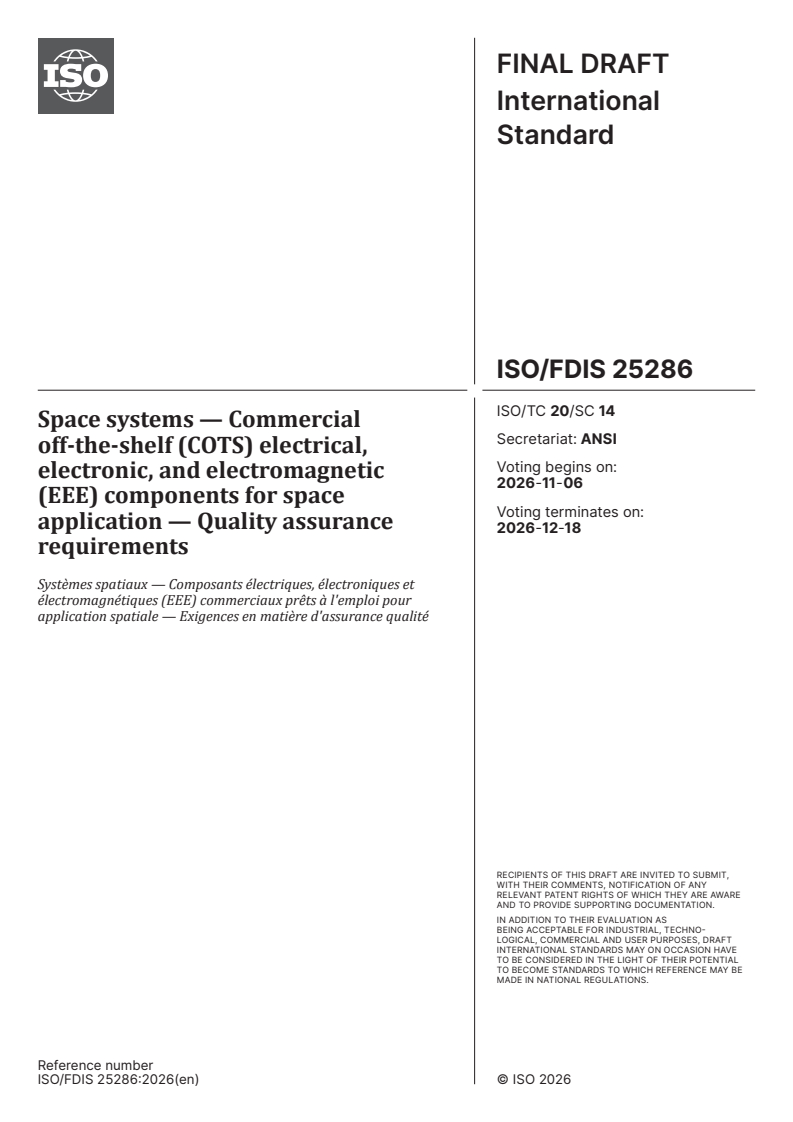
FINAL DRAFT
International
Standard
ISO/TC 20/SC 14
Space systems — Commercial
Secretariat: ANSI
off-the-shelf (COTS) electrical,
Voting begins on:
electronic, and electromagnetic
2026-11-06
(EEE) components for space
Voting terminates on:
application — Quality assurance
2026-12-18
requirements
Systèmes spatiaux — Composants électriques, électroniques et
électromagnétiques (EEE) commerciaux prêts à l'emploi pour
application spatiale — Exigences en matière d'assurance qualité
RECIPIENTS OF THIS DRAFT ARE INVITED TO SUBMIT,
WITH THEIR COMMENTS, NOTIFICATION OF ANY
RELEVANT PATENT RIGHTS OF WHICH THEY ARE AWARE
AND TO PROVIDE SUPPOR TING DOCUMENTATION.
IN ADDITION TO THEIR EVALUATION AS
BEING ACCEPTABLE FOR INDUSTRIAL, TECHNO
LOGICAL, COMMERCIAL AND USER PURPOSES, DRAFT
INTERNATIONAL STANDARDS MAY ON OCCASION HAVE
TO BE CONSIDERED IN THE LIGHT OF THEIR POTENTIAL
TO BECOME STAN DARDS TO WHICH REFERENCE MAY BE
MADE IN NATIONAL REGULATIONS.
Reference number
FINAL DRAFT
International
Standard
ISO/TC 20/SC 14
Space systems — Commercial
Secretariat: ANSI
off-the-shelf (COTS) electrical,
Voting begins on:
electronic, and electromagnetic
(EEE) components for space
Voting terminates on:
application — Quality assurance
requirements
Systèmes spatiaux — Composants électriques, électroniques et
électromagnétiques (EEE) commerciaux prêts à l'emploi pour
application spatiale — Exigences en matière d'assurance qualité
© ISO 2026
All rights reserved.
RECIPIENTS OF THIS DRAFT ARE INVITED TO SUBMIT,
WITH THEIR COMMENTS, NOTIFICATION OF ANY
This ISO publication is protected by copyright and is owned by ISO and/or its licensors.
RELEVANT PATENT RIGHTS OF WHICH THEY ARE AWARE
The content of this ISO publication is provided under licence, not sold. Use is subject to the applicable licence terms issued by ISO,
AND TO PROVIDE SUPPOR TING DOCUMENTATION.
an ISO member body, or an authorized third-party distributor.
IN ADDITION TO THEIR EVALUATION AS
BEING ACCEPTABLE FOR INDUSTRIAL, TECHNO
Except as required for implementation or expressly permitted by a separate licence, no part of this ISO publication may be
LOGICAL, COMMERCIAL AND USER PURPOSES, DRAFT
reproduced, distributed, modified, used, or made available in any form or by any means – electronic or mechanical, including
INTERNATIONAL STANDARDS MAY ON OCCASION HAVE
photocopying, scanning, recording, or posting on internal or external digital platforms. TO BE CONSIDERED IN THE LIGHT OF THEIR POTENTIAL
TO BECOME STAN DARDS TO WHICH REFERENCE MAY BE
Any use beyond the scope of the granted rights is prohibited and may result in legal action.
MADE IN NATIONAL REGULATIONS.
ISO copyright office
CP 401 • CH-1214 Vernier, Geneva
Phone: +41 22 749 01 11
Email: copyright@iso.org
Website: www.iso.org
Published in Switzerland
Reference number
ii
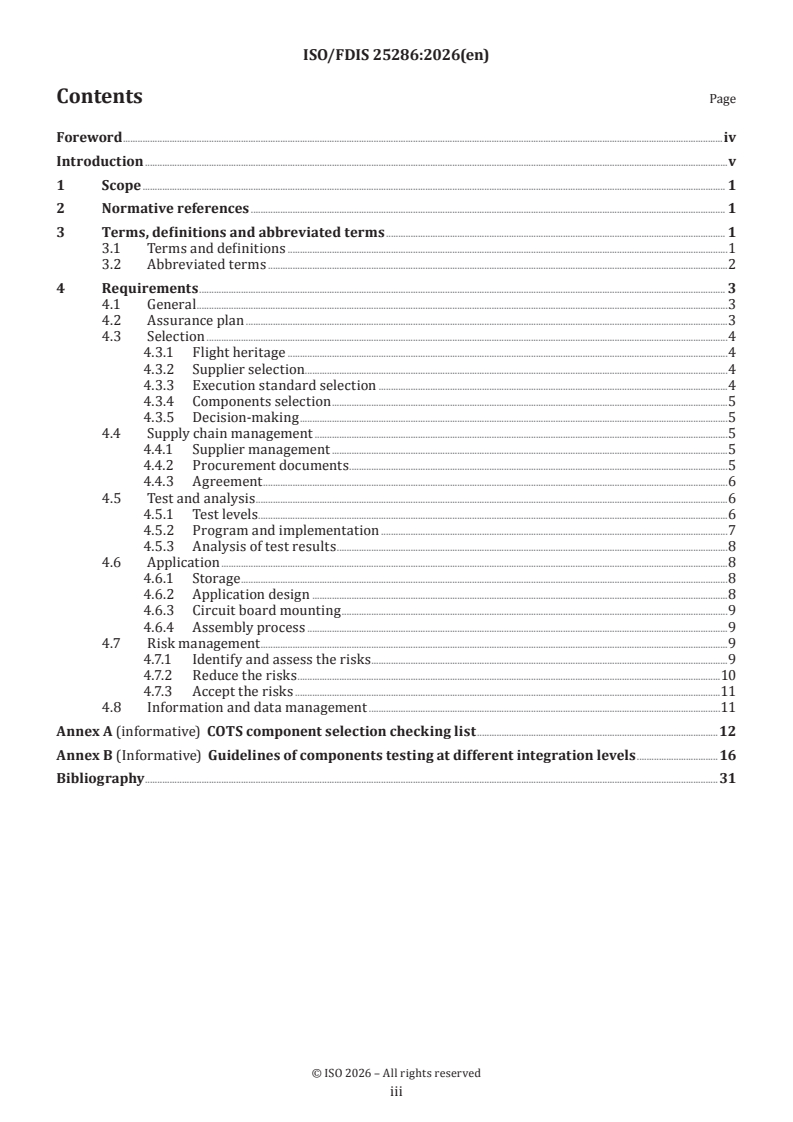
Contents Page
Foreword .iv
Introduction .v
1 Scope . 1
2 Normative references . 1
3 Terms, definitions and abbreviated terms . 1
3.1 Terms and definitions .1
3.2 Abbreviated terms .2
4 Requirements . 3
4.1 General .3
4.2 Assurance plan .3
4.3 Selection .4
4.3.1 Flight heritage .4
4.3.2 Supplier selection.4
4.3.3 Execution standard selection .4
4.3.4 Components selection .5
4.3.5 Decision-making .5
4.4 Supply chain management .5
4.4.1 Supplier management .5
4.4.2 Procurement documents . .5
4.4.3 Agreement .6
4.5 Test and analysis .6
4.5.1 Test levels .6
4.5.2 Program and implementation .7
4.5.3 Analysis of test results .8
4.6 Application .8
4.6.1 Storage .8
4.6.2 Application design .8
4.6.3 Circuit board mounting .9
4.6.4 Assembly process .9
4.7 Risk management .9
4.7.1 Identify and assess the risks .9
4.7.2 Reduce the risks .10
4.7.3 Accept the risks .11
4.8 Information and data management .11
Annex A (informative) COTS component selection checking list .12
Annex B (Informative) Guidelines of components testing at different integration levels .16
Bibliography .31
iii
Foreword
ISO (the International Organization for Standardization) is a worldwide federation of national standards
bodies (ISO member bodies). The work of preparing International Standards is normally carried out through
ISO technical committees. Each member body interested in a subject for which a technical committee
has been established has the right to be represented on that committee. International organizations,
governmental and non-governmental, in liaison with ISO, also take part in the work. ISO collaborates closely
with the International Electrotechnical Commission (IEC) on all matters of electrotechnical standardization.
The procedures used to develop this document and those intended for its further maintenance are described
in the ISO/IEC Directives, Part 1. In particular, the different approval criteria needed for the different types
of ISO document should be noted. This document was drafted in accordance with the editorial rules of the
ISO/IEC Directives, Part 2 (see www.iso.org/directives).
ISO draws attention to the possibility that the implementation of this document may involve the use of (a)
patent(s). ISO takes no position concerning the evidence, validity or applicability of any claimed patent
rights in respect thereof. As of the date of publication of this document, ISO had not received notice of (a)
patent(s) which may be required to implement this document. However, implementers are cautioned that
this may not represent the latest information, which may be obtained from the patent database available at
www.iso.org/patents. ISO shall not be held responsible for identifying any or all such patent rights.
Any trade name used in this document is information given for the convenience of users and does not
constitute an endorsement.
For an explanation of the voluntary nature of standards, the meaning of ISO specific terms and expressions
related to conformity assessment, as well as information about ISO's adherence to the World Trade
Organization (WTO) principles in the Technical Barriers to Trade (TBT), see www.iso.org/iso/foreword.html.
This document was prepared by Technical Committee ISO/TC 20, Aircraft and space vehicles, Subcommittee
SC 14, Space systems and operations.
Any feedback or questions on this document should be directed to the user’s national standards body. A
complete listing of these bodies can be found at www.iso.org/members.html.
iv
Introduction
The demand for advanced technology at a low cost, in traditional space missions and small satellites,
places great demand on commercial off-the-shelf (COTS) electrical, electronic, and electromagnetic (EEE)
components. Due to problems such as the risk of new technologies and materials, insufficiently reliable data,
and potential risk caused by plastic packaging structure, uncontrolled technical status, uncertain radiation
tolerance, and counterfeit components, the quality assurance requirements of COTS components for space
must be unified and standardized.
The assurance plan of the project based on the mission background and the supply basis, should cover the
entire working life cycle of COTS EEE components applications, such as selection, supply chain management,
test and analysis, and application. Through these activities:
— all requirements will be checked to ensure that they are correct and properly defined and implemented;
— new failure mechanisms and potential risks will be identified;
— all characteristics (electrical, thermal, mechanical, radiation) will be characterized;
— the final delivered components can meet the application requirements.
v
FINAL DRAFT International Standard ISO/FDIS 25286:2026(en)
Space systems — Commercial off-the-shelf (COTS) electrical,
electronic, and electromagnetic (EEE) components for space
application — Quality assurance requirements
1 Scope
This document specifies technical requirements for and gives guidelines on the quality assurance of
commercial off-the-shelf (COTS) electrical, electronic, and electromagnetic (EEE) components, ensuring
that performance, quality, schedule, cost and other critical requirements are met throughout the entire life
cycle of space mission. This includes electro-optical components.
This document does not cover specific test items for different types of components.
2 Normative references
The following documents are referred to in the text in such a way that some or all of their content constitutes
requirements of this document. For dated references, only the edition cited applies. For undated references,
the latest edition of the referenced document (including any amendments) applies.
ISO 10795, Space systems — Programme management and quality — Vocabulary
ISO 14621-1, Space systems — Electrical, electronic and electromechanical (EEE) parts — Part 1: Parts
management
ISO 14621-2, Space systems — Electrical, electronic and electromechanical (EEE) parts — Part 2: Control
programme requirements
ISO 17666, Space systems — Programme management — Risk management
ISO 19683, Space systems — Design qualification and acceptance tests of small spacecraft and units
ISO 21350, Space systems — Off-the-shelf item utilization
3 Terms, definitions and abbreviated terms
3.1 Terms and definitions
For the purposes of this document, the terms and definitions given in ISO 10795 and the following apply.
ISO and IEC maintain terminology databases for use in standardization at the following addresses:
— ISO Online browsing platform: available at https:// www .iso .org/ obp
— IEC Electropedia: available at https:// www .electropedia .org/
3.1.1
off-the-shelf
OTS
existing item which has been developed for a specific application and is intended to be used in another
application
[SOURCE: ISO 21350:2023, 3.4]
3.1.2
commercial-off-the-shelf components
COTS components
equipment, including hardware and associated software/procedures, that is commercially available from
current industry inventory
Note 1 to entry: COTS components for a project are supplied on a commercial OTS basis and include:
— product description (including data sheet, website information, etc.);
— development tools (software tools necessary for using components);
— components.
[SOURCE: ISO 14625: 2023, 3.1.2, modified — Note 1 to entry added.]
3.1.3
space rated commercial-off-the-shelf components
space rated COTS components
COTS components produced on the manufacturer's production line with enhanced process control measures,
and the manufacturer claims their suitability for space applications
Note 1 to entry: Enhanced requirements can include fabs and packaging lines with optimized material setups, wafer
lot acceptance testing, radiation hardened designs, screening and qualifications, etc. However, the oversight of
qualification and screening processes is not conducted by space or government agencies, and the specific details vary
depending on the manufacturer.
3.1.4
manufacturer screening
non-destructive testing, which is self-defined and implemented by component manufacturers, and is aimed
at verifying either some or all the component's manual parameter specifications at room temperature or
within the operating temperature range
Note 1 to entry: A manufacturer screening also serves to detect and eliminate early failures or to identify and address
parameter outliers.
3.1.5
automotive grade commercial-off-the-shelf components
automotive grade COTS components
COTS components manufactured on production lines with enhanced process controls and screening to
ensure suitability for automotive applications
Note 1 to entry: These components are produced in accordance with automotive industry standards, such as the
Automotive Electronics Council’s AEC-Q100 for packaged integrated circuits, AEC-Q101 for discrete semiconductors,
and AEC-Q200 for passive electronic components. Additionally, they meet other applicable standards, including IATF
16949.
3.2 Abbreviated terms
For the purposes of this document, the following abbreviated terms apply.
DPA destructive physical analysis
CA construction analysis
COTS commercial off-the-shelf
EEE electrical, electronic, and electromechanical
ESD electrostatic discharge
FPGA field programmable gate array
HI-REL high reliability
MSL moisture sensitivity level
OCM original components manufacturer
PEM plastic encapsulated microcircuit
SEE single event effect
TID total ionizing dose
4 Requirements
4.1 General
General requirements regarding parts management for EEE shall apply in accordance with ISO 14621-1.
General requirements regarding the control programme requirements for EEE shall apply in accordance
with ISO 14621-2.
The general requirements regarding the off-the-shelf item utilization shall apply in accordance with
ISO 21350.
Given the supply basis of COTS components, appropriate assurance measures should be implemented to
ensure that their performance, quality, schedule, cost, and other requirements are met throughout the entire
life cycle of the space mission.
For space missions, the decision on whether to adopt a COTS component solution shall be made during
the pre-research and feasibility demonstration stage. In the scheme design stage, an assurance plan shall
be established for the selected and applied COTS components. This plan is then implemented during the
development stage. Additionally, risk management and information data collection should be conducted
throughout the entire life cycle of the space mission as planned.
4.2 Assurance plan
Based on the specific requirements of the space mission, an analysis (see Table 1) is conducted to determine
whether to use COTS components, select the type of supply base, and establish the level of quality assurance
testing. When a space mission plans to permit the selection of COTS components or selects them through
non-conformance control, the necessary component assurance requirements should be specified in the
project's component assurance plan, based on the mission's background and supply basis.
Table 1 — Elements to be considered in space mission requirements analysis
Classification Main content Elements
The ultimate scientific goal Is it a crewed mission? What is the mission platform and payload?
Mission of a space mission, and other What level of risk is the task willing to take? The budget and cycle
restrictions that the project can accommodate.
The relevant environmental The stresses experienced, such as thermal effects, electromagnet-
conditions through which ic effects, electrostatic effects, radiation effects, etc. are defined,
Environment the system completes tasks and the required operating environment, component performance
during its life cycle thresholds and margins, and non-operating conditions are under-
stood
A specific function that is Application structure and its redundancy requirements. How do
Application
performed to achieve a task the components interface and interact with the rest of the circuit
status
goal and other subsystems
The total lifetime the system Mission life defines the criteria for selecting, applying, and testing
Life shall perform its intended components for a mission so that premature failure does not affect
function mission results
4.3 Selection
4.3.1 Flight heritage
Based on the COTS component assurance information database, missions should establish and maintain
component selection catalogues/preferences lists that fully incorporate COTS components successfully
applied in prior missions/models.
4.3.2 Supplier selection
COTS components are divided into two categories based on availability:
a) COTS components purchased from OCM or authorized distributors.
b) COTS components purchased from an unauthorized distributor.
Select mature COTS components from well-established, reputable manufacturers with a proven track record
of high-quality products. Source COTS components directly from original component manufacturers (OCMs)
or authorized distributors. If this is not feasible, ensure that the selected supplier has a documented history
of successful procurement and application experience with the specific component.
4.3.3 Execution standard selection
COTS components can be categorized into five distinct classes based on execution standard specifications.
The types of COTS components involved, along with their respective execution standard specifications,
production lines, and product characteristics, are detailed in Table 2. The implementation of these standard
specifications typically relies on information publicly disclosed by manufacturers via the internet, in
datasheets, and within quality documentation.
The designers and part engineers responsible for component selection shall have a comprehensive
understanding of the standards and relevant product specifications for the COTS components. When similar
baseline requirements are met, it is advisable to select COTS components from a higher category, as specified
in Table 2. However, it is not recommended to use COTS components that are designated for civilian use,
have unspecified applicable specifications, or lack accessible channels for querying datasheet.
Table 2 — Types of COTS components involved
Category
Classification Standards Characteristics
No.
Radiation tolerant and other space envi-
Vendor-SPEC or data-
I Space rated COTS components ronment adaptation design and testing,
sheet
usually with space application experience
AQEC, IEC/TS 62686-1,
Components that implement inter-
IEC/TS 62686-2
national standards (not for space Implement and qualified by industrial
use, such as automotive Grade AEC-Q standards
COTS components)
II
ISO/IEC
Components test (screening, LAT)
Products without qualification and ap-
by suppliers themselves according MIL-SPEC
proval.
to military standards
Vendor Hi-Rel components (not for Vendor-SPEC or data-
Need specific analysis
space use) sheet only
III
Vendor scientific-grade compo- Vendor-SPEC or data-
Need specific analysis
nents sheet only
Produced on the same line as space or
Vendor-SPEC or data-
IV Engineering samples military grade components, but without
sheet only
screening and LAT
Vendor-SPEC or data-
V General industrial components Need specific analysis
sheet only
4.3.4 Components selection
The selection process shall thoroughly conduct market research and pre-selection of COTS components,
evaluating a variety of candidates. The research should encompass the following aspects: the functional
capabilities and performance of the COTS components, their historical application data, compatibility with
the intended circuit, environmental adaptability, quality and reliability, and supply chain stability. Selecting
COTS components that are in the early stages of technological development, not yet in mass production,
or operating at the technical limits shall be avoided. For critical COTS components, especially when new
technologies are unproven, advance evaluation and validation are essential to confirm their suitability and
feasibility.
4.3.5 Decision-making
The user shall establish a decision-making policy and systematically confirm the selection assurance
elements. A checklist for COTS component selection is provided in Annex A for reference. Based on this
process, the final selection of COTS components, along with the necessary subsequent assurance activities
and their timing to mitigate risks, shall be determined.
4.4 Supply chain management
4.4.1 Supplier management
The user shall establish and maintain a list of approved suppliers. The approved supplier list shall be regularly
reviewed and updated to ensure on-going suitability and to mitigate supply chain risks. Supplier selection
should be based on their reputation, product quality history, and conformance to relevant certifications.
4.4.2 Procurement documents
The procurement documents shall clearly state the component selection conclusions and select an
appropriate procurement mode to ensure that the procured components fully meet the development and
sustainability requirements of space missions.
4.4.2.1 Procurement mode
Implement a centralized and batch procurement mode, ensuring that COTS components used across different
mission stages originate from the same production batch.
4.4.2.2 Spare components and consumables plan
A spare components and consumables plan shall be developed, specifying the types, specifications, batch
requirements, and quantities of spare components and consumables needed throughout the full lifecycle
and mission duration of the space mission. This plan should account for items such as consumables used in
quality assurance, application commissioning, and addressing expected early failures.
4.4.2.3 Long-term storage plan
For units requiring continuous or on-orbit maintenance, a long-term component storage plan should be
developed to address risks such as obsolescence and configuration changes. This plan shall define specific
long-term storage requirements, including storage conditions, packaging methods, storage durations,
reinspection requirements, as well as plans for spare components and consumables.
4.4.3 Agreement
COTS components purchased directly from OCM or authorized distributors, shall be governed by an
agreement which can specify the delivery period, product data to be provided, and long-term stable supply,
including obsolescence notices.
Preferably, do not purchase from other distributors. If COTS components are purchased from other agents,
the agreement can specify the following:
a) Ensure traceability back to OCM.
b) Components should use original packaging. If subcontracting is necessary, appropriate protective
measures shall be taken.
c) Store under the manufacturer's recommended conditions, particularly for components sensitive to
electrostatic discharge or moisture.
d) Counterfeit prevention and disposal policy.
4.5 Test and analysis
4.5.1 Test levels
Test levels 1 to 3 focus on component level tests, level 4 focuses on board level tests, and level 5 focuses on
box and subsystem level tests.
Table 3 — Test levels and application class
Application Quality /Relia-
Test level COST Typical use
class bility
1 Component level 1 Highest Highest Space flight
2 Component level 2 High High Space flight or critical ground support equipment
Space flight experiments, or noncritical space
3 Component level 3 Medium Medium flight, critical ground support equipment, test
demonstrations and ground support systems.
4 Board level Low Low Noncritical space flight, noncritical ground sup-
port equipment, ground support systems, test
Box level/ Sub-sys-
demonstrations and prototypes. Limited critical
5 Lowest Lowest
tem level
GSE.
4.5.2 Program and implementation
4.5.2.1 Choose the test levels
Project planning shall specify the required test levels for each end item’s COTS EEE components, as described
in Table 3. The selection of appropriate test levels significantly impacts the reliability and associated costs
of EEE components.
Omitting component-level testing typically aims to reduce costs and accelerate schedules. However, detecting
failures at higher levels can adversely affect both costs and schedules. Increased integration during testing
can limit the user’s understanding of COTS components’ design and failure margins.
Certain complex or high-speed components require numerous bias and support circuits, as well as
frequency-tuned circuit boards, to function properly. It is generally impractical to replicate these conditions
with temporary test fixtures and biases available for component-level testing. For components such as RF
components, high-speed simulators, complex microprocessors, and field programmable gate array (FPGAs),
board-level testing is often the most suitable option.
4.5.2.2 Test program
Based on manufacturer screening, develop a quality assurance program, determine the project-specific and
specific requirements before implementation including:
a) Component level (screening, LAT/qualification test, CA, DPA, radiation test).
b) Board level (screening, qualification test, radiation test).
c) Box level (qualification test).
The advantages and problems of common test items performed at the component level, board level, and box/
subsystem level are described in Annex B. Board- or box-level testing of parts should include thermal-cycling,
shock and vibration, high-temperature and humidity, and outgassing (if required per project), as these are
not typically performed by COTS manufacturers. ISO 19683 shall be applicable as needed for subsystem-
level testing. It is advisable to build multiple boards and boxes and perform a large amount of board-, box-,
and system-level testing early in the design cycle. This approach not only verifies the parts but also helps
identify design errors through concurrent engineering in hardware, software, and subsystems.
4.5.2.3 Precautions for part-level tests
Precautions for part-level tests shall include:
a) If additional part-level testing or screening is required, always consult the datasheets to ensure that
specified operational limits are not exceeded. Exceeding these limits can result in latent damage to the
parts, potentially leading to failures during flight.
b) Do not repeat tests that manufacturers have already performed, such as burn-in or highly accelerated
life testing, as there is no added value and it may damage or degrade the COTS parts.
c) If part-level testing becomes complicated, costly, and time-consuming with complex parts (e.g., those
with ASICs, programmable logic electronics, or high-performance analogue/mixed-signal parts), then
the most direct method to characterize part reliability is to test the parts in actual applications at the
board or box levels.
4.5.2.4 Precautions for board level tests
Precautions for board level tests shall include:
a) In board-level test, the ability to accelerate testing is relatively limited, however, it allows for extended
testing, such as over 48 hours of power operation, under conditions similar to those encountered in
flight.
b) Identify typical failure points in application scenarios and selectively replace faulty components.
c) Perform testing under actual full-load conditions, with particular attention to the use of unscreened
COTS components and modules.
4.5.2.5 Precautions for box level tests
Precautions shall include:
a) Environmental testing and qualification should be conducted early in the system design cycle to mitigate
risks, including thermal cycling, aging, and vibration testing.
b) The use of COTS components facilitates the efficient and cost-effective development of multiple
engineering unit versions, enabling earlier initiation of environmental testing and qualification, as well
as easier identification of significant issues early on.
c) Avoid over-testing. Typically, accumulate 1,000 hours of power-on test time, with no faults occurring in
the final 200 hours.
d) Perform testing under actual full-load conditions, with particular attention to the use of unscreened
COTS components and modules.
4.5.3 Analysis of test results
Non-conformance identified during testing can stem from the selection of standards that are not applicable
to certain COTS components. Non-conformance test results should be analysed in conjunction with failure
analysis, risk assessment, and evaluation.
4.6 Application
4.6.1 Storage
Components that are not installed should be stored in a clean, ventilated, non-corrosive environment,
meeting the requirements for electrostatic protection, as well as temperature and relative humidity
specifications within specified limits and packaging. Long-term storage of components should also be
conducted in accordance with the planned storage conditions and packaging methods.
4.6.2 Application design
Although mission budgets for COTS components are generally lower, a degree of technical status control
should still be maintained. Redundancy design should be adopted. Thermal design, tolerance design, worst-
case analysis, and other reliability design methods should be properly applied to ensure the correct use of
COTS components, preventing environmental overstress and component failure due to stress transfer. The
subsystem design should be modular to isolate and minimize damage, ensuring mission success.
Depending on the device technology, function, and radiation performance, a variety of mitigation techniques
have been effectively used. Below is a non-exhaustive list of mitigations:
a) Shielding for TID and TNID effects.
b) Error detections and correction (EDAC) encoding of data and scrubbing for SEUs.
c) Monitoring circuits (e.g., watch-dog timers) and reset circuitry for SEFIs.
d) Latch-up detection circuitry and reset logic can be effective for some devices exhibiting SELs.
e) Fault masking redundancy. This mitigation strategy can be implemented at any design level. Within a
programmable device (e.g., field programmable gate array (FPGA)), triple modular redundancy (TMR)
can be used internal to the device. Alternatively, at the other end of the design hierarchy, redundancy
can be implemented at the spacecraft level.
f) Operational constraints such as strategically powering off parts of the system in high radiation
environments (e.g., in the South Atlantic Anomaly or during Solar Particle Events) can provide
mitigations to some radiation effects.
g) Part derating for SEB and SEGR.
4.6.3 Circuit board mounting
Installation process precautions shall include:
a) Surface-mounted moisture-sensitive COTS components must be pre-treated according to their moisture
sensitivity level (MSL) before installation to prevent moisture-related issues during soldering or
operation.
b) Protection measures should be implemented based on the component with the highest electrostatic
sensitivity on the circuit board to safeguard against static electricity damage.
c) COTS components with lead-free coatings at the lead end should be properly soldered using compatible
lead-free solder or alternative methods to ensure reliable connections without introducing harmful
substances.
4.6.4 Assembly process
Assembly process notes shall include:
a) Secure components as much as possible, such as using mechanical reinforcement or adhesives for
cementing or potting.
b) Prepare for potential component failures during post-assembly testing by having spare components or
circuit boards on hand. This helps mitigate schedule delays and aids in efficient troubleshooting.
c) Store the chassis in a controlled humidity environment and employ appropriate electrostatic discharge
treatment methods to minimize the risk of damage caused by static electricity.
4.7 Risk management
A risk management plan shall be specified according to ISO 17666.
4.7.1 Identify and assess the risks
Risk types of COTS components are related to supplier classification. The degree of risk is correlated with the
implementation of standard classifications in Table 2, and gradually increased from category I to Category V.
The supplier shall be an original components manufacturer (OCM) or an authorized distributor. Risks come
from:
a) Little design margins.
b) Restricted structures (such as gold-aluminium bonding, pure tin-plating terminals).
c) Components from different batches may have different structures.
d) Unknown manufacturers of internal components.
e) Obsolescence.
f) Minimum order quantity risk.
Other suppliers can potentially involve more risk, such as operational injury, counterfeit, and artificial
virtual incremental demand leading to higher prices. Therefore, caution should be exercised when selecting
such suppliers.
4.7.2 Reduce the risks
Typical space application risks and control measures of COTS components are shown in Table 4.
Table 4 — Risk and control measures for typical space applications of COTS components
No. Risk type Risk Control measures
Used within the temperature range of COTS compo-
1 Features risk Narrow temperature range
nents design
Reduce the rating and conduct limit tests if necessary
2 Features risk Smaller design margin
to determine the bottom line
At high and low temperatures, If COTS components are used in critical systems,
the performance of COTS com- additional evaluation work is required to ensure that
3 Features risk
ponents occasionally exceeds their performance indicators meet the requirements
the data manual of space missions
Adopting vacuum packaging;
Quality and reliabil- Moisture absorption, contami-
Storage in a dry and clean environment (such as a
ity risks nation, and corrosion
nitrogen drying cabinet)
Collect ground use data to prove;
Quality and reliabil- Gold aluminium bonding and
ity risks Kirk-end all effect
Bonding reliability evaluation
Vacuum packaging and storage in a dry environment;
Quality and reliabil-
6 Popcorn effect
Using a special heating process and high-tempera-
ity risks
ture baking time to pre-eliminate water vapor
Dip lead tin solder treatment on the pure tin coating
of the pins;
Quality and reliabil-
7 Tin whisker short circuit
Pure tin solder balls can be replanted with lead tin
ity risks
solder balls, or lead based soldering processes can be
adopted
Conduct assessments in advance, establish databases
or guidelines;
Identify radiation resistant products according to
the design process platform. For advanced process
Space environment
8 No radiation resistant design
components which is considered to be radiation
adaptability risk
resistant, the total ionization dose test may not be
considered, and an evaluation can be conducted at
most once when selected, without the need for each
batch.
Conduct research on mature products that have been
Factory testing only applied in ground electronic components;
Quality and reliabil-
ity risks
No filtering Targeted screening and evaluation for highly reliable
application areas
Large differences between
Compare the origin and chip status;
Quality and reliabil-
batches
ity risks
Test comparison
(Uncontrolled state)
Low production and/or un-
Quality and reliabil- Targeted quality assurance, generally including DPA,
11 known manufacturers may
ity risks screening, and life testing
indicate higher component risks
Quality and reliabil- Handmade COTS components Targeted quality assurance, generally including DPA,
ity risks pose a high risk screening, and life testing
Make appropriate product reserves;
Production stoppage or shut- Can reserve chips and package them when needed;
13 obsolescence risk
down
Track product changes and promptly use upgraded
substitutes for replacement
The minimum order quantity
Minimum order
14 greatly exceeds the required Coordinate ordering
quantity risk
inventory level
4.7.3 Accept the risks
Monitor and communicate risks, to finally accept the risks.
4.8 Information and data management
An assurance information database should be established for COTS EEE components to address risks such
as insufficient traceability.
COTS component information and data are typically derived from supplier statements and provided evidence
of conformity with specifications. In view of commercial sensitivities, the information and data provided
by the supplier are generally limited. Users or third parties should establish assurance information and
database for COTS components to guide selection and application. The elements to be included in the COTS
component assurance information database are listed in Table 5.
Table 5 — Elements for the COTS component assurance information database
No. Information type Content elements
a) Performance parameters.
b) Packaging form, including coating materials or lead-free labelling.
c) Basic processes of electronic components, such as CMOS, bipolar, etc.
d) Operating temperature range.
e) Environmental sensitivity information, such as ESD level and MSL.
COTS component
f) Standard specifications for execution.
information
g) Internal component information (if any).
h) Quality level or commercial application field.
i) Work failure rate information.
j) Inspection data, such as manufacturer screening, identification, batch accept-
ance, quality consistency.
a) Production line quality certification and qualifications, such as space and mili-
tary standards.
b) Supply chains.
2 Supplier information
c) Supply cycle.
d) Procurement cost.
a) Inspection data, such as screening and batch receiving.
b) Radiation assessment information.
Historical quality
assurance infor-
c) Technical status information, such as plastic packaging materials, chip versions,
mation for COTS
etc.
components
d) Batch information on non-conforming components, such as batch code, supplier,
reason for no
...
ISO/DISFDIS 25286:2026(en)
ISO/TC 20/SC 14
Secretariat: ANSI
Date: 2026-07-0610-23
Space systems — Commercial off-the-shelf (COTS) electrical,
electronic, and electromagnetic (EEE) components for space
application — Quality assurance requirements
Systèmes spatiaux — Composants électriques, électroniques et électromagnétiques (EEE) commerciaux
prêts à l'emploi pour application spatiale — Exigences en matière d'assurance qualité
© FDIS stage
ISO/DISFDIS 25286:2026(en)
© ISO 2026
All rights reserved. Unless otherwise specified,
This ISO publication is protected by copyright and is owned by ISO and/or its licensors.
The content of this ISO publication is provided under licence, not sold. Use is subject to the applicable licence terms issued
by ISO, an ISO member body, or an authorized third-party distributor.
Except as required in the context of its for implementation or expressly permitted by a separate licence, no part of this
ISO publication may be reproduced or utilized otherwise, distributed, modified, used, or made available in any form or
by any means, – electronic or mechanical, including photocopying, scanning, recording, or posting on internal or external
digital platforms.
Any use beyond the internet or an intranet, without prior written permission. Permission can be requested from either
ISO at the address below or ISO’s member body in the countryscope of the requestergranted rights is prohibited and may
result in legal action.
ISO copyright office
CP 401 • Ch. de Blandonnet 8
CH-1214 Vernier, Geneva
Phone: + 41 22 749 01 11
Fax: +41 22 749 09 47
Email: copyright@iso.org
Website: www.iso.org
iii
Table of Published in Switzerland
iv
ISO/DISFDIS 25286:2026(en)
Contents
Foreword . vi
Introduction . vii
1 Scope . 1
2 Normative references . 1
3 Terms, definitions and abbreviated terms . 1
3.1 Terms and definitions . 1
3.2 Abbreviated terms . 3
4 Requirements . 3
4.1 General . 3
4.2 Assurance plan . 4
4.3 Selection . 4
4.4 Supply chain management . 6
4.5 Test and analysis . 7
4.6 Application . 9
4.7 Risk management . 10
4.8 Information and data management . 12
Annex A (informative) COTS component selection checking list. 14
Annex B (Informative) Guidelines of components testing at different integration levels . 1
Bibliography . 15
v
Foreword
ISO (the International Organization for Standardization) is a worldwide federation of national standards
bodies (ISO member bodies). The work of preparing International Standards is normally carried out through
ISO technical committees. Each member body interested in a subject for which a technical committee has been
established has the right to be represented on that committee. International organizations, governmental and
non-governmental, in liaison with ISO, also take part in the work. ISO collaborates closely with the
International Electrotechnical Commission (IEC) on all matters of electrotechnical standardization.
The procedures used to develop this document and those intended for its further maintenance are described
in the ISO/IEC Directives, Part 1. In particular, the different approval criteria needed for the different types of
ISO document should be noted. This document was drafted in accordance with the editorial rules of the
ISO/IEC Directives, Part 2 (see www.iso.org/directives).
ISO draws attention to the possibility that the implementation of this document may involve the use of (a)
patent(s). ISO takes no position concerning the evidence, validity or applicability of any claimed patent rights
in respect thereof. As of the date of publication of this document, ISO had not received notice of (a) patent(s)
which may be required to implement this document. However, implementers are cautioned that this may not
represent the latest information, which may be obtained from the patent database available at
www.iso.org/patents. ISO shall not be held responsible for identifying any or all such patent rights.
Any trade name used in this document is information given for the convenience of users and does not
constitute an endorsement.
For an explanation of the voluntary nature of standards, the meaning of ISO specific terms and expressions
related to conformity assessment, as well as information about ISO's adherence to the World Trade
Organization (WTO) principles in the Technical Barriers to Trade (TBT), see www.iso.org/iso/foreword.html.
This document was prepared by Technical Committee ISO/TC 20, Aircraft and space vehicles, Subcommittee
SC 14, Space systems and operations.
Any feedback or questions on this document should be directed to the user’s national standards body. A
complete listing of these bodies can be found at www.iso.org/members.html.
vi
ISO/DISFDIS 25286:2026(en)
Introduction
The demand for advanced technology at a low cost, in traditional space missions and small satellites, places
great demand on Commercialcommercial off-the-shelf (COTS) electrical, electronic, and electromagnetic
(EEE) components. Due to problems such as the risk of new technologies and materials, insufficiently reliable
data, and potential risk caused by plastic packaging structure, uncontrolled technical status, uncertain
radiation tolerance, and counterfeit components, the quality assurance requirements of COTS components for
space must be unified and standardized.
The assurance plan of the project based on the mission background and the supply basis, should cover the
entire working life cycle of COTS EEE components applications, such as selection, supply chain management,
test and analysis, and application. Through these activities:
— — all requirements will be checked to ensure that they are correct and properly defined and
implemented;
— — new failure mechanisms and potential risks will be identified;
— — all characteristics (electrical, thermal, mechanical, radiation) will be characterized;
— — the final delivered components can meet the application requirements.
vii
DRAFT International Standard ISO/DIS 25286:2026(en)
Space systems — — Commercial off-the-shelf (COTS ) electrical,
electronic, and electromagnetic (EEE) components for space
application — Quality assurance requirements
1 Scope
This document specifies technical requirements for and gives guidelines on the quality assurance of COTS
EEEcommercial off-the-shelf (COTS) electrical, electronic, and electromagnetic (EEE) components,
ensuring that performance, quality, schedule, cost and other critical requirements are met throughout
the entire life cycle of space mission. The familyThis includes electro-optical components.
This document does not cover specific test items for different types of components.
2 Normative references
The following documents are referred to in the text in such a way that some or all of their content
constitutes requirements of this document. For dated references, only the edition cited applies. For
undated references, the latest edition of the referenced document (including any amendments) applies.
ISO 10795, Space systems — Programme management and quality — Vocabulary
ISO 14621--1, Space systems — Electrical, electronic and electromechanical (EEE) parts — Part 1: Parts
management
ISO 14621--2, Space systems — Electrical, electronic and electromechanical (EEE) parts — Part 2: Control
programme requirements
ISO 17666, Space systems — Programme management — Risk management
ISO 19683, Space systems — Design qualification and acceptance tests of small spacecraft and units
ISO 21350, Space systems — Off-the-shelf item utilization
3 Terms, definitions and abbreviated terms
3.1 Terms and definitions
For the purposes of this document, the terms and definitions given in ISO 10795 and the following apply.
ISO and IEC maintain terminology databases for use in standardization at the following addresses:
— — ISO Online browsing platform: available at https://www.iso.org/obp
— — IEC Electropedia: available at https://www.electropedia.org/
3.1.1 3.1.1
off-the-shelf
OTS
existing item which has been developed for a specific application and is intended to be used in another
application
[SOURCE: ISO 21350:2023, 3.4]
3.1.2
3.1.2
commercial-off-the-shelf components
COTS components
equipment, including hardware and associated software/procedures, that is commercially available from
current industry inventory"
Note 1 to entry: COTS components for a project are supplied on a commercial OTS basis and include:
— — Productproduct description (including data sheet, website information, etc.).);
— — Developmentdevelopment tools (software tools necessary for using components).);
— Components.
— components.
[SOURCE: ISO 14625: 2023, 3.1.2, modified — Note 1 to entry added.]
3.1.3
3.1.3
space rated commercial-off-the-shelf components
space rated COTS components
COTS components produced on the manufacturer's production line with enhanced process control
measures, and the manufacturer claims their suitability for space applications.
Note 1 to entry: Enhanced requirements maycan include fabs and packaging lines with optimized material setups,
wafer lot acceptance testing, radiation hardened designs, screening and qualifications, etc. However, the oversight
of qualification and screening processes is not conducted by space or government agencies, and the specific details
vary depending on the manufacturer.
3.1.23.1.4 3.1.4
manufacturer screening
non-destructive testing, which is self-defined and implemented by component manufacturers, and is
aimed at verifying either some or all the component's manual parameter specifications at room
temperature or within the operating temperature range
Note 1 to entry: a A manufacturer screening also serves to detect and eliminate early failures or to identify and
address parameter outliers.
3.1.33.1.5 3.1.5
automotive Gradegrade commercial-off-the-shelf components
automotive grade COTS components
COTS components manufactured on production lines with enhanced process controls and screening to
ensure suitability for automotive applications.
Note 1 to entry: These components are produced in accordance with automotive industry standards, such as the
Automotive Electronics Council’s AEC-Q100 for packaged integrated circuits, AEC-Q101 for discrete
ISO/DIS 25286:2026(en)
semiconductors, and AEC-Q200 for passive electronic components. Additionally, they shall meet other applicable
standards, including IATF 16949.
3.2 Abbreviated terms
For the purposes of this document, the following abbreviated terms apply.
DPA destructive physical analysis
CA construction analysis
COTS commercial off-the-shelf
EEE electrical, electronic, and electromechanical
ESD electrostatic discharge
FPGA Field Programmable Gate Arrayfield programmable gate array
HI-REL high reliability
MSL moisture sensitivity level
OCM original components manufacturer
PEM plastic encapsulated microcircuit
SEE single event effect
TID total ionizing dose
4 Requirements
4.1 General
The generalGeneral requirements regarding the parts managementsmanagement for EEE must beshall
apply in accordance with ISO 14621--1, Space systems — Electrical, electronic and electromechanical
(EEE) parts — Part 1: Parts management.
The generalGeneral requirements regarding the control programme requirements for EEE must beshall
apply in accordance with ISO 14621--2, Space systems — Electrical, electronic and electromechanical
(EEE) parts — Part 2: Control programme requirements.
The general requirements regarding the Offoff-the-shelf item utilization must beshall apply in accordance
with ISO 21350, Space systems — Off-the-shelf item utilization.
Given the supply basis of COTS components, appropriate assurance measures should be implemented to
ensure that their performance, quality, schedule, cost, and other requirements are met throughout the
entire life cycle of the space mission.
For space missions, the decision on whether to adopt a COTS component solution shall be made during
the pre-research and feasibility demonstration stage. In the scheme design stage, an assurance plan shall
be established for the selected and applied COTS components. This plan is then implemented during the
development stage. Additionally, risk management and information data collection should be conducted
throughout the entire life cycle of the space mission as planned.
4.2 Assurance plan
Based on the specific requirements of the space mission, an analysis (see Table 1Table 1)) is conducted
to determine whether to use COTS components, select the type of supply base, and establish the level of
quality assurance testing. When a space mission plans to permit the selection of COTS components or
selects them through non-conformance control, the necessary component assurance requirements
should be specified in the project's component assurance plan, based on the mission's background and
supply basis.
Table 1 — Elements to be considered in space mission requirements analysis
Classificatio
Main content Elements
n
The ultimate scientific goal Is it a crewed mission? What is the mission platform and
Mission of a space mission, and payload? What level of risk is the task willing to take? The
other restrictions budget and cycle that the project can accommodate.
The relevant The stresses experienced, such as thermal effects,
environmental conditions electromagnetic effects, electrostatic effects, radiation effects,
Environment through which the system etc. are defined, and the required operating environment,
completes tasks during its component performance thresholds and margins, and non-
life cycle operating conditions are understood
A specific function that is Application structure and its redundancy requirements. How
Application
performed to achieve a do the components interface and interact with the rest of the
status
task goal circuit and other subsystems
The total lifetime the Mission life defines the criteria for selecting, applying, and
Life system shall perform its testing components for a mission so that premature failure
intended function does not affect mission results
4.3 Selection
4.3.1 Flight heritage
Based on the COTS component assurance information database, missions should establish and maintain
component selection catalogues/preferences lists that fully incorporate COTS components successfully
applied in prior missions/models.
4.3.2 Supplier selection
COTS components are divided into two categories based on availability:
a) a) COTS components purchased from OCM or authorized distributors.
b) b) COTS components purchased from an unauthorized distributor.
Select mature COTS components from well-established, reputable manufacturers with a proven track
record of high-quality products. Source COTS components directly from original component
manufacturers (OCMs) or authorized distributors. If this is not feasible, ensure that the selected supplier
has a documented history of successful procurement and application experience with the specific
component.
4.3.3 Execution standard selection
COTS components can be categorized into five distinct classes based on execution standard specifications.
The types of COTS components involved, along with their respective execution standard specifications,
ISO/DIS 25286:2026(en)
production lines, and product characteristics, are detailed in Table 2Table 2. The implementation of
these standard specifications typically relies on information publicly disclosed by manufacturers via the
internet, in datasheets, and within quality documentation.
The designers and part engineers responsible for component selection shall have a comprehensive
understanding of the standards and relevant product specifications for the COTS components. When
similar baseline requirements are met, it is advisable to select COTS components from a higher category,
as specified in Table 2Table 2. However, it is not recommended to use COTS components that are
designated for civilian use, have unspecified applicable specifications, or lack accessible channels for
querying datasheet.
Table 2 — Types of COTS components involved
Categor
Classification Standards Characteristics
y No.
Radiation tolerant and other space
Vendor-SPEC or environment adaptation design and
I Space rated COTS components
datasheet testing, usually with space application
experience
AQEC, IEC /TS 62686-
Components that implement
1, IEC /TS 62686-2
international standards (not for Implement and qualified by industrial
space use, such as automotive AEC-Q standards
Grade COTS components)
II
ISO/IEC
Components test (screening,
Products without qualification and
LAT) by suppliers themselves MIL-SPEC
approval.
according to military standards
Vendor Hi-Rel components (not Vendor-SPEC or
Need specific analysis
for space use) datasheet only
III
Vendor scientific-grade Vendor-SPEC or
Need specific analysis
components datasheet only
Produced on the same line as space or
Vendor-SPEC or
IV Engineering samples military grade components, but
datasheet only
without screening and LAT
Vendor-SPEC or
V General industrial components Need specific analysis
datasheet only
4.3.4 Components selection
The selection process shall thoroughly conduct market research and pre-selection of COTS components,
evaluating a variety of candidates. The research should encompass the following aspects: the functional
capabilities and performance of the COTS components, their historical application data, compatibility
with the intended circuit, environmental adaptability, quality and reliability, and supply chain stability.
It is crucial to avoid selectingSelecting COTS components that are in the early stages of technological
development, not yet in mass production, or operating at the technical limits. shall be avoided. For critical
COTS components, especially when new technologies are unproven, advance evaluation and validation
are essential to confirm their suitability and feasibility.
4.3.5 Decision-making
The user shall establish a decision-making policy and systematically confirm the selection assurance
elements. A checklist for COTS component selection is provided in Annex AAnnex A for reference. Based
on this process, the final selection of COTS components, along with the necessary subsequent assurance
activities and their timing to mitigate risks, shall be determined.
4.4 Supply chain management
4.4.1 Supplier management
The user shall establish and maintain a list of approved suppliers. The approved supplier list shall be
regularly reviewed and updated to ensure on-going suitability and to mitigate supply chain risks. Supplier
selection should be based on their reputation, product quality history, and conformance to relevant
certifications.
4.4.2 Procurement documents
The procurement documents shall clearly state the component selection conclusions and select an
appropriate procurement mode to ensure that the procured components fully meet the development and
sustainability requirements of space missions.
4.4.2.1 Procurement mode
Implement a centralized and batch procurement mode, ensuring that COTS components used across
different mission stages originate from the same production batch.
4.4.2.2 Spare components and consumables plan
A spare components and consumables plan shall be developed, specifying the types, specifications, batch
requirements, and quantities of spare components and consumables needed throughout the full lifecycle
and mission duration of the space mission. This plan should account for items such as consumables used
in quality assurance, application commissioning, and addressing expected early failures.
4.4.2.3 Long-term storage plan
For units requiring continuous or on-orbit maintenance, a long-term component storage plan should be
developed to address risks such as obsolescence and configuration changes. This plan shall define specific
long-term storage requirements, including storage conditions, packaging methods, storage durations,
reinspection requirements, as well as plans for spare components and consumables.
4.4.3 Contract or agreement
4.4.3 For Agreement
COTS components purchased directly from OCM or authorized distributors, the contract orshall be
governed by an agreement shallwhich can specify the delivery period, product data to be provided, and
long-term stable supply, including obsolescence notices.
Preferably, do not purchase from other distributors. If COTS components shall beare purchased from
other agents, the agreement can specify the following shall be specifically added to the contract or
agreement:
a) a) Ensure traceability back to OCM.
ISO/DIS 25286:2026(en)
b) b) Components should use original packaging. If subcontracting is necessary, appropriate
protective measures shall be taken.
c) c) Store under the manufacturer's recommended conditions, particularly for components
sensitive to electrostatic discharge or moisture.
d) d) Counterfeit prevention and disposal policy.
4.5 Test and analysis
4.5.1 Test levels
Test levels 1 to 3 focus on component level tests, level 4 focuses on board level tests, and level 5 focuses
on box and subsystem level tests.
Table 3 — Test levels and application class
Applicati Quality
Test level COST Typical use
on class /Reliability
Component level
1 Highest Highest Space flight
Component level Space flight or critical ground support
2 High High
2 equipment
Space flight experiments, or noncritical space
Component level Mediu
3 Medium flight, critical ground support equipment, test
3 m
demonstrations and ground support systems.
4 Board level Low Low Noncritical space flight, noncritical ground
support equipment, ground support systems,
Box level/ Sub-
test demonstrations and prototypes. Limited
5 Lowest Lowest
system level
critical GSE.
4.5.2 Program and implementation
4.5.2.1 Choose the test levels
Project planning shall specify the required test levels for each end item’s COTS EEE components, as
described in Table 3Table 3. The selection of appropriate test levels significantly impacts the reliability
and associated costs of EEE components.
Omitting component-level testing typically aims to reduce costs and accelerate schedules. However,
detecting failures at higher levels can adversely affect both costs and schedules. Increased integration
during testing can limit the user’s understanding of COTS components’ design and failure margins.
Certain complex or high-speed components require numerous bias and support circuits, as well as
frequency-tuned circuit boards, to function properly. It is generally impractical to replicate these
conditions with temporary test fixtures and biases available for component-level testing. For components
such as RF components, high-speed simulators, complex microprocessors, and field programmable gate
array (FPGAs), board-level testing is often the most suitable option.
4.5.2.2 Test program
Based on manufacturer screening, develop a quality assurance program, determine the project-specific
and specific requirements before implementation including:
a) a) Component level (screening, LAT/qualification test, CA, DPA, radiation test).
b) b) Board level (screening, qualification test, radiation test).
c) c) Box level (qualification test).
The advantages and problems of common test items performed at the component level, board level, and
box/subsystem level are described in Annex BAnnex B. Board- or box-level testing of parts should
include thermal-cycling, shock and vibration, high-temperature and humidity, and outgassing (if required
per project), as these are not typically performed by COTS manufacturers. ISO 19683 shall be applicable
as needed for subsystem-level testing. It is advisable to build multiple boards and boxes and perform a
large amount of board-, box-, and system-level testing early in the design cycle. This approach not only
verifies the parts but also helps identify design errors through concurrent engineering in hardware,
software, and subsystems.
4.5.2.3 Precautions for part-level tests
Precautions for part-level tests shall include:
a) a) If additional part-level testing or screening is required, always consult the datasheets to
ensure that specified operational limits are not exceeded. Exceeding these limits can result in latent
damage to the parts, potentially leading to failures during flight.
b) b) Do not repeat tests that manufacturers have already performed, such as burn-in or highly
accelerated life testing, as there is no added value and it may damage or degrade the COTS parts.
c) c) If part-level testing becomes complicated, costly, and time-consuming with complex parts
(e.g., those with ASICs, programmable logic electronics, or high-performance analogue/mixed-signal
parts), then the most direct method to characterize part reliability is to test the parts in actual
applications at the board or box levels.
4.5.2.4 Precautions for board level tests
Precautions for board level tests shall include:
a) a) In board-level test, the ability to accelerate testing is relatively limited, however, it allows
for extended testing, such as over 48 hours of power operation, under conditions similar to those
encountered in flight.
b) b) Identify typical failure points in application scenarios and selectively replace faulty
components.
c) c) Perform testing under actual full-load conditions, with particular attention to the use of
unscreened COTS components and modules.
4.5.2.5 Precautions for box level tests
Precautions shall include:
a) a) Environmental testing and qualification should be conducted early in the system design
cycle to mitigate risks, including thermal cycling, aging, and vibration testing;.
b) b) The use of COTS components facilitates the efficient and cost-effective development of
multiple engineering unit versions, enabling earlier initiation of environmental testing and
qualification, as well as easier identification of significant issues early on;.
ISO/DIS 25286:2026(en)
c) c) Avoid over-testing. Typically, accumulate 1,000 hours of power-on test time, with no
faults occurring in the final 200 hours;.
d) d) Perform testing under actual full-load conditions, with particular attention to the use of
unscreened COTS components and modules.
4.5.3 Analysis of test results
Non-conformance identified during testing can stem from the selection of standards that are not
applicable to certain COTS components. Non-conformance test results should be analysed in conjunction
with failure analysis, risk assessment, and evaluation.
4.6 Application
4.6.1 Storage
Components that are not installed should be stored in a clean, ventilated, non-corrosive environment,
meeting the requirements for electrostatic protection, as well as temperature and relative humidity
specifications within specified limits and packaging. Long-term storage of components should also be
conducted in accordance with the planned storage conditions and packaging methods.
4.6.2 Application design
Although mission budgets for COTS components are generally lower, a degree of technical status control
should still be maintained. Redundancy design should be adopted. Thermal design, tolerance design,
worst-case analysis, and other reliability design methods should be properly applied to ensure the
correct use of COTS components, preventing environmental overstress and component failure due to
stress transfer. The subsystem design should be modular to isolate and minimize damage, ensuring
mission success.
Depending on the device technology, function, and radiation performance, a variety of mitigation
techniques have been effectively used. Below is a non-exhaustive list of mitigations:
a) a) Shielding for TID and TNID effects.
b) b) Error Detectionsdetections and Correctioncorrection (EDAC) encoding of data and
scrubbing for SEUs.
c) c) Monitoring circuits (e.g., watch-dog timers) and reset circuitry for SEFIs.
d) d) Latch-up detection circuitry and reset logic can be effective for some devices exhibiting
SELs.
e) e) Fault masking redundancy. This mitigation strategy can be implemented at any design
level. Within a programmable device (e.g., field programmable gate array (FPGA)), triple modular
redundancy (TMR) can be used internal to the device. Alternatively, at the other end of the design
hierarchy, redundancy can be implemented at the spacecraft level.
f) f) Operational constraints such as strategically powering off parts of the system in high
radiation environments (e.g., in the South Atlantic Anomaly or during Solar Particle Events) can
provide mitigations to some radiation effects.
g) g) Part derating for SEB and SEGR.
4.6.3 Circuit board mounting
Installation process precautions shall include:
a) a) Surface-mounted moisture-sensitive COTS components must be pre-treated according to
their moisture sensitivity level (MSL) before installation to prevent moisture-related issues during
soldering or operation.
b) b) Protection measures should be implemented based on the component with the highest
electrostatic sensitivity on the circuit board to safeguard against static electricity damage.
c) c) COTS components with lead-free coatings at the lead end should be properly soldered
using compatible lead-free solder or alternative methods to ensure reliable connections without
introducing harmful substances.
4.6.4 Assembly process
Assembly process notes shall include:
a) a) Secure components as much as possible, such as using mechanical reinforcement or
adhesives for cementing or potting.
b) b) Prepare for potential component failures during post-assembly testing by having spare
components or circuit boards on hand. This helps mitigate schedule delays and aids in efficient
troubleshooting.
c) c) Store the chassis in a controlled humidity environment and employ appropriate
electrostatic discharge treatment methods to minimize the risk of damage caused by static electricity.
4.7 Risk management
A risk management plan shall be specified according to ISO 17666.
4.7.1 Identify and assess the risks
Risk types of COTS components are related to supplier classification. The degree of risk is correlated with
the implementation of standard classifications in Table 2Table 2,, and gradually increased from category
I to Category V.
The supplier shall be an original components manufacturer (OCM) or an authorized distributor. Risks
come from:
a) a) Little design margins,.
b) b) Restricted structures (such as gold-aluminium bonding, pure tin-plating terminals),).
c) c) Components from different batches may have different structures,.
d) d) Unknown manufacturers of internal components,.
e) e) Obsolescence,.
f) f) Minimum order quantity risk.
ISO/DIS 25286:2026(en)
Other suppliers maycan potentially involve more risk, such as operational injury, counterfeit, and
artificial virtual incremental demand leading to higher prices. Therefore, caution should be exercised
when selecting such suppliers.
4.7.2 Reduce the risks
Typical space application risks and control measures of COTS components are shown in Table 4Table 4.
Table 4 — Risk and control measures for typical space applications of COTS components
No. Risk type Risk Control Measuresmeasures
Used within the temperature range of COTS
1 Features risk Narrow temperature range
components design
Reduce the rating and conduct limit tests if
2 Features risk Smaller design margin
necessary to determine the bottom line
At high and low
If COTS components are used in critical systems,
temperatures, the
additional evaluation work is required to ensure
3 Features risk performance of COTS
that their performance indicators meet the
components occasionally
requirements of space missions
exceeds the data manual
Adopting vacuum packaging;
Quality and Moisture absorption,
Storage in a dry and clean environment (such as a
reliability risks contamination, and corrosion
nitrogen drying cabinet)
Collect ground use data to prove;
Quality and Gold aluminium bonding and
reliability risks Kirk-end all effect
Bonding reliability evaluation
Vacuum packaging and storage in a dry
environment;
Quality and
6 popcornPopcorn effect
Using a special heating process and high-
reliability risks
temperature baking time to pre -eliminate water
vapor
Dip lead tin solder treatment on the pure tin
coating of the pins;
Quality and
7 Tin whisker short circuit
Pure tin solder balls can be replanted with lead tin
reliability risks
solder balls, or lead based soldering processes can
be adopted
Conduct assessments in advance, establish
databases or guidelines;
Identify radiation resistant products according to
Space
the design process platform. For advanced
8 environment No radiation resistant design
process components which is considered to be
adaptability risk
radiation resistant, the total ionization dose test
may not be considered, and an evaluation can be
conducted at most once when selected, without
the need for each batch.
Conduct research on mature products that have
Factory testing only been applied in ground electronic components;
Quality and
reliability risks
No filtering Targeted screening and evaluation for highly
reliable application areas
Quality and Large differences between
10 Compare the origin and chip status;
reliability risks batches
No. Risk type Risk Control Measuresmeasures
(Uncontrolled state) Test comparison
Low production and/or
Quality and unknown manufacturers may Targeted quality assurance, generally including
reliability risks indicate higher component DPA, screening, and life testing
risks
Quality and Handmade COTS components Targeted quality assurance, generally including
reliability risks pose a high risk DPA, screening, and life testing
Make appropriate product reserves;
Can reserve chips and package them when
Production stoppage or
13 obsolescence risk needed;
shutdown
Track product changes and promptly use
upgraded substitutes for replacement
The minimum order quantity
Minimum order
14 greatly exceeds the required Coordinate ordering
quantity risk
inventory level
4.7.3 Accept the risks
Monitor and communicate risks, to finally accept the risks.
4.8 Information and data management
An assurance information database should be established for COTS EEE components to address risks such
as insufficient traceability.
COTS component information and data are typically derived from supplier statements and provided
evidence of conformity with specifications. In view of commercial sensitivities, the information and data
provided by the supplier are generally limited. Users or third parties should establish assurance
information and database for COTS components to guide selection and application. The elements to be
included in the COTS component assurance information database are listed in Table 5Table 5.
Table 5 — Elements for the COTS component assurance information database
Information
No. Content elements
type
a) Performance parameters;.
b) Packaging form, including coating materials or lead-free labeling;labelling.
c) Basic processes of electronic components, such as CMOS, bipolar, etc;.
d) Operating temperature range;.
e) Environmental sensitivity information, such as ESD level and MSL;.
COTS Component
1 Informationcomp
f) Standard specifications for execution;.
onent information
g) Internal component information (if any);).
h) Quality level or commercial application field;.
i) Work failure rate information;.
j) Inspection data, such as manufacturer screening, identification, batch
acceptance, quality consistency.
a) Production line quality certification and qualifications, such as space and
Supplier
military standards;.
2 Informationinfor
mation
b) Supply chains;.
ISO/DIS 25286:2026(en)
Information
No. Content elements
type
c) Supply cycle;.
d) Procurement cost.
Historical Quality
a) Inspection data, such as screening and batch receiving;.
Assurance
b) Radiation assessment information;.
Informationqualit
y assurance
c) technicalTechnical status information, such as plastic packaging materials,
information for
chip versions, etc;.
COTS
d) Batch information on non-conforming components, such as batch code,
Componentscomp
supplier, reason for non- conformity, etc.
onents
Historical
a) Track and lifespan of application standalone and application models;.
application
4 b) In orbit working status;.
information of
c) In orbit time.
COTS components
a) Counterfeit refurbished component information, such as batch code,
supplier, counterfeit refurbishment type;.
5 Other information
b) Other COTS component related information.
Annex A
(Informativeinformative)
COTS Componentcomponent selection checking list
The detailed selection checking items are summarized in Table A.1Table A.1.
Table A.1 — COTS Componentcomponent selection checking list
Risks
Selection COTS Componentcomponent
User selection elements and
factor source basic information
control
A.1 Supplier selection
☐ Y
Whether the supplier
is in the directory
☐ N
Whether the supplier
is an OCM or an
☐ Y
authorized
☐ N
A.1.1 Basic distributor of the
☐ Unknown
Informationinf component to be Analyse the basic information of the
ormation about selected supplier, understand the basic
the situation of the production line and
☐ Y
Suppliersuppli suppliers
Whether the supplier
er (manufacturer) line is
☐ N
mass-produced
☐ Unknown
Whether the supplier
☐ Y
(manufacturer) has a
☐ N
high market share of
☐ Unknown
the product
☐ goodGood
Analyse cost and program feasibility.
A.1.2 Cost and
Historical execution ☐ For example, the quality cost
Program
of supplier's purchase involved in the analysis, sample loss,
difficultDiffic
Feasibilityprog
orders and whether the test cycle can meet
ult
ram feasibility
the task requirements
☐ N
Whether
Suppliersupplier has
issued product Inventory, storage issues, and
A.1.3
☐ Y
obsolescence notice substitutability of product functions
Obsolescence
in accordance with ☐ N arising from COTS component
and long-term
industry standards obsolescence during the space
☐ Unknown
supply
(e.g. JEDEC/IPC/ECIA mission demand cycle
J-STD-048) or
equivalent method
Whether the supplier The changes to be notified by the
☐ Y
A.1.4 Product publishes product or Suppliersupplier, the form of
or Process process change notification and the requirements
☐ N
information in should be clearly stated in the
ISO/DIS 25286:2026(en)
Risks
Selection COTS Componentcomponent
User selection elements and
factor source basic information
control
Changeprocess accordance with contract or agreement in accordance
☐ Unknown
change industry standards with JESD 46 or equivalent method
(e.g. JESD 46) or
Are different batches of COTS
equivalent methods
components used on the same
board? Are there any product or
process changes?
Are there product or process
changes to COTS devices inherited
for mission use? Does it affect its
functionality?
If purchasing from an
It is appropriate to control the
unauthorized dealer,
☐ Y
A.1.5 supply channels, comprehensive
do you have a
prevention means, identification
Counterfeit ☐ N
counterfeit
control means, and disposal means to avoid
☐ Unknown
prevention control
the risk of counterfeit components
plan
Whether the source of
manufacturing can be
identified by line
☐ Y
traceability codes,
package week codes
☐ N
or other markings on
☐ Unknown
A.1.6 Clarify the extent to which the
the
traceability supply can be traced
device/cartridge/inn
er packaging etc
The ability to control
☐Y
suppliers when
☐ N
outsourcing chip
☐ Unknown
production
A.2 Execution standard selection
☐ I
☐ II
Executive standard
☐ III
classification
☐ IV
Whether the execution standards
A.2.1 Execution
☐ V
and version information are clear
standard
and reliable
COTS component that
are civil, applicable
☐ Y
specifications are
☐ N
unknown, or there
...