

ISO 10290:2018
(Main)Textiles — Cotton yarns — Basis for specification
General Information
- Abstract
This document specifies criteria, with relevant test methods, to be applied in describing single spun grey cotton yarns. These yarns are widely used in international trade.
- Status
- Published
- Publication Date
- 30-Oct-2018
- Technical Committee
- ISO/TC 38/SC 23 - Fibres and yarns
- Drafting Committee
- ISO/TC 38/SC 23/WG 2 - Fibres - Natural cellulosic
- Current Stage
- 9093 - International Standard confirmed
- Start Date
- 26-Jun-2025
- Completion Date
- 29-Aug-2026
Buy Documents
ISO 10290:2018 - Textiles -- Cotton yarns -- Basis for specification
ISO 10290:2018 - Textiles — Cotton yarns — Basis for specification/31/2018
Overview
ISO 10290:2018 - Textiles - Cotton yarns - Basis for specification - provides a standardized framework for describing and specifying single spun grey cotton yarns used in international trade. It defines the criteria and references the relevant test methods manufacturers, purchasers and testing laboratories should use when agreeing yarn characteristics for commercial contracts, quality control and product development. This second edition (2018) replaces the 1993 edition and updates terms, test-method cross-references and additional yarn attributes (appearance, hairiness, faults).
Key topics and technical requirements
ISO 10290 structures the basis for specification around measurable properties and agreed test methods. Major topics include:
- Linear density (tex): determined in accordance with ISO 2060.
- Evenness and yarn faults (thick places, thin places, neps): measured per ISO 16549.
- Breaking load / tenacity and elongation at break: single-end tensile testing per ISO 2062.
- Skein breaking strength: assessed by ISO 6939.
- Yarn twist and twist direction: measured by ISO 2061 or ISO 17202; direction designated S or Z per ISO 2.
- Moisture regain: measured using ISO 6741-1.
- Yarn appearance and hairiness: appearance grading via ASTM D2255, hairiness by ASTM D5647.
- Marking, sampling and inspection: recommended marking items (material, tex, lot number, spinning method, end use, packing), sampling procedures (refer to ISO 3951-4 if not agreed) and quality-control guidance (e.g., ISO 9001/ISO 9004).
- Annex A provides example specification formats and illustrative values (informative only) to guide commercial specifications.
Practical applications and users
ISO 10290 is practical for:
- Yarn manufacturers establishing saleable product specifications and batch markings.
- Textile traders and purchasers specifying contract requirements for grey cotton yarns in international commerce.
- Quality control and laboratory teams performing acceptance testing and inspection.
- Textile engineers and product developers comparing yarn properties for weaving, knitting or finishing processes.
- Compliance and procurement teams seeking consistent, reproducible test methods and sampling rules.
Using ISO 10290 helps reduce commercial disputes by aligning technical language, test methods and acceptance criteria across suppliers and buyers.
Related standards (selection)
- ISO 2060, ISO 2061, ISO 2062, ISO 16549, ISO 6939, ISO 6741-1, ISO 3951-4
- ISO 2 (twist designation), ISO 1144 (tex system)
- ASTM D2255 (appearance), ASTM D5647 (hairiness)
- ISO 9001 / ISO 9004 (quality control)
Keywords: ISO 10290, cotton yarn specification, grey cotton yarn, yarn testing methods, textile standard, yarn quality, linear density, tenacity, yarn twist.
Relations
- Effective Date
- 09-Jul-2016
Buy Documents
ISO 10290:2018 - Textiles -- Cotton yarns -- Basis for specification
ISO 10290:2018 - Textiles — Cotton yarns — Basis for specification/31/2018
Get Certified
Connect with accredited certification bodies for this standard

Control Union Certifications
Global certification for agriculture and sustainability.

Hohenstein Institut
Textile testing and certification.

Bureau Veritas Bangladesh
Bureau Veritas certification services in Bangladesh.
Sponsored listings
Frequently Asked Questions
ISO 10290:2018 is a standard published by the International Organization for Standardization (ISO). Its full title is "Textiles — Cotton yarns — Basis for specification". This standard covers: This document specifies criteria, with relevant test methods, to be applied in describing single spun grey cotton yarns. These yarns are widely used in international trade.
This document specifies criteria, with relevant test methods, to be applied in describing single spun grey cotton yarns. These yarns are widely used in international trade.
ISO 10290:2018 is classified under the following ICS (International Classification for Standards) categories: 59.080.20 - Yarns. The ICS classification helps identify the subject area and facilitates finding related standards.
ISO 10290:2018 has the following relationships with other standards: It is inter standard links to ISO 10290:1993. Understanding these relationships helps ensure you are using the most current and applicable version of the standard.
ISO 10290:2018 is available in PDF format for immediate download after purchase. The document can be added to your cart and obtained through the secure checkout process. Digital delivery ensures instant access to the complete standard document.
Standards Content (Sample)
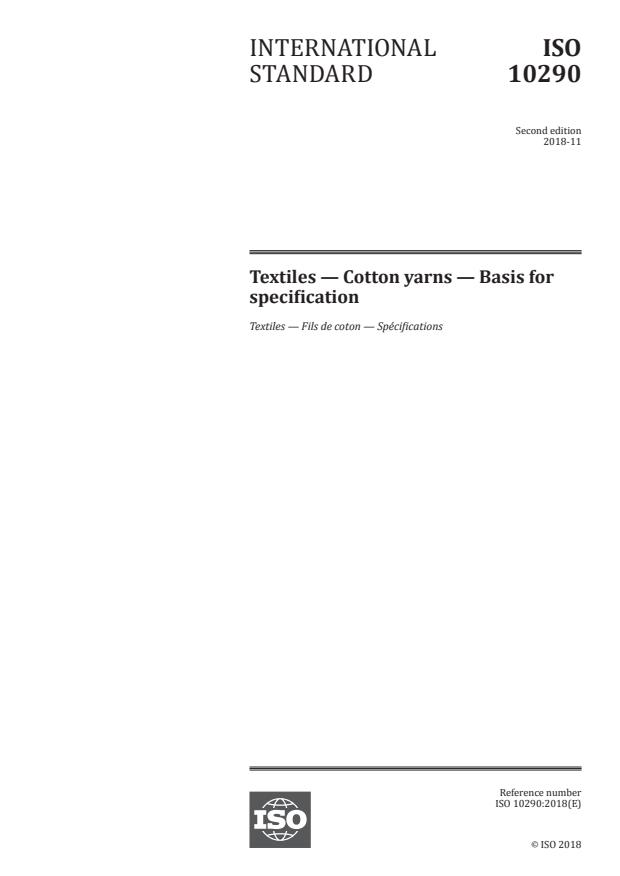
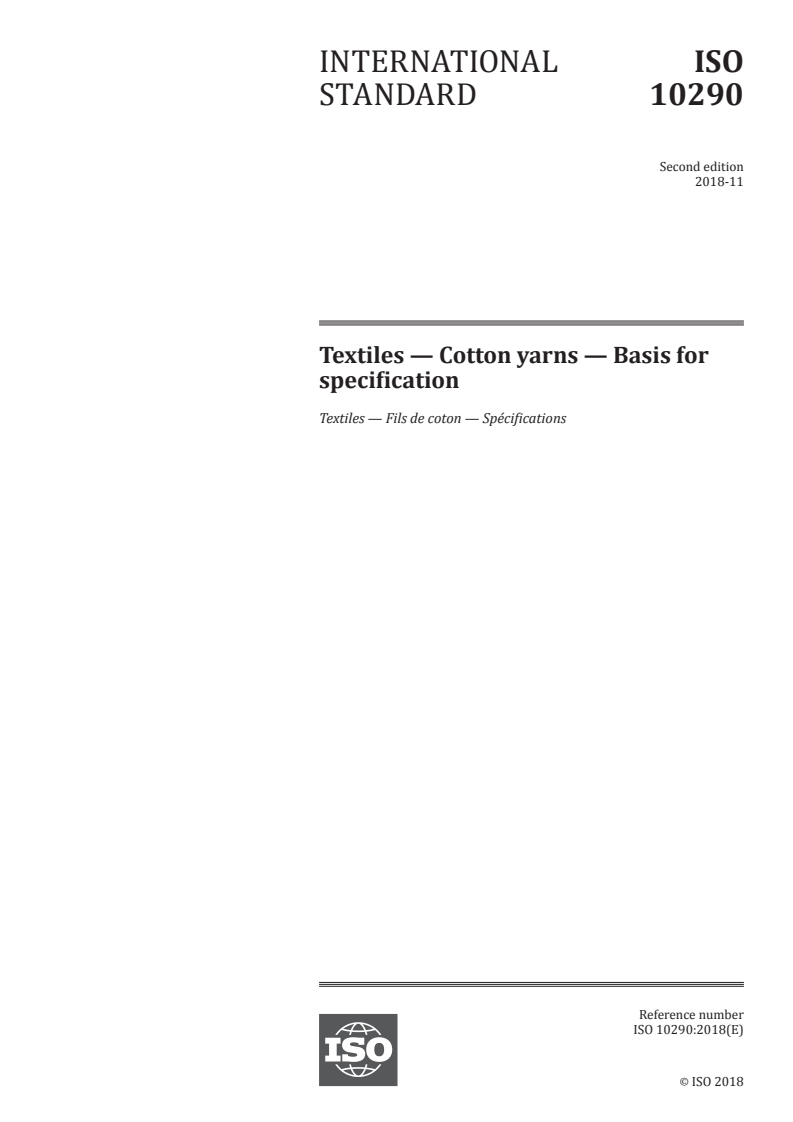
INTERNATIONAL ISO
STANDARD 10290
Second edition
2018-11
Textiles — Cotton yarns — Basis for
specification
Textiles — Fils de coton — Spécifications
Reference number
©
ISO 2018
© ISO 2018
All rights reserved. Unless otherwise specified, or required in the context of its implementation, no part of this publication may
be reproduced or utilized otherwise in any form or by any means, electronic or mechanical, including photocopying, or posting
on the internet or an intranet, without prior written permission. Permission can be requested from either ISO at the address
below or ISO’s member body in the country of the requester.
ISO copyright office
CP 401 • Ch. de Blandonnet 8
CH-1214 Vernier, Geneva
Phone: +41 22 749 01 11
Fax: +41 22 749 09 47
Email: copyright@iso.org
Website: www.iso.org
Published in Switzerland
ii © ISO 2018 – All rights reserved
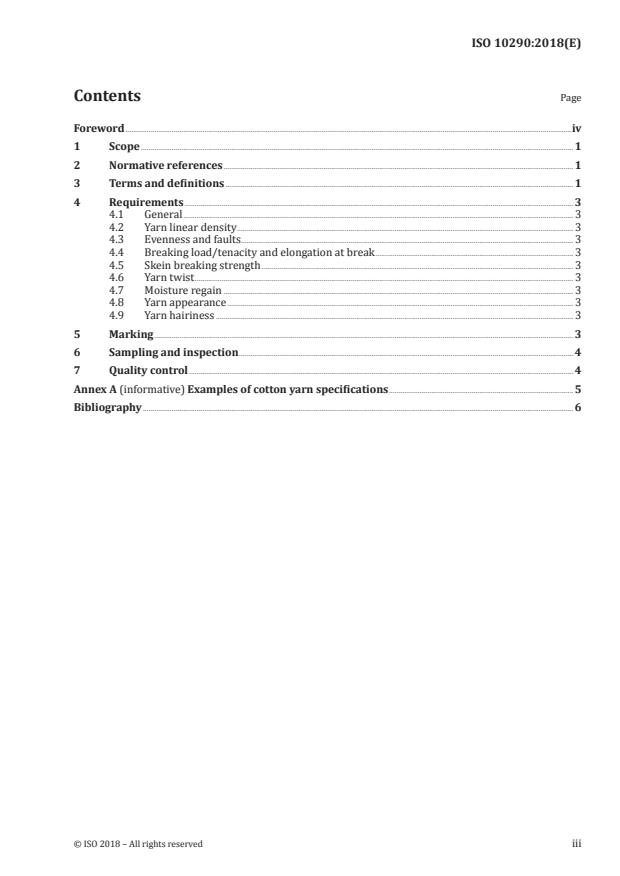
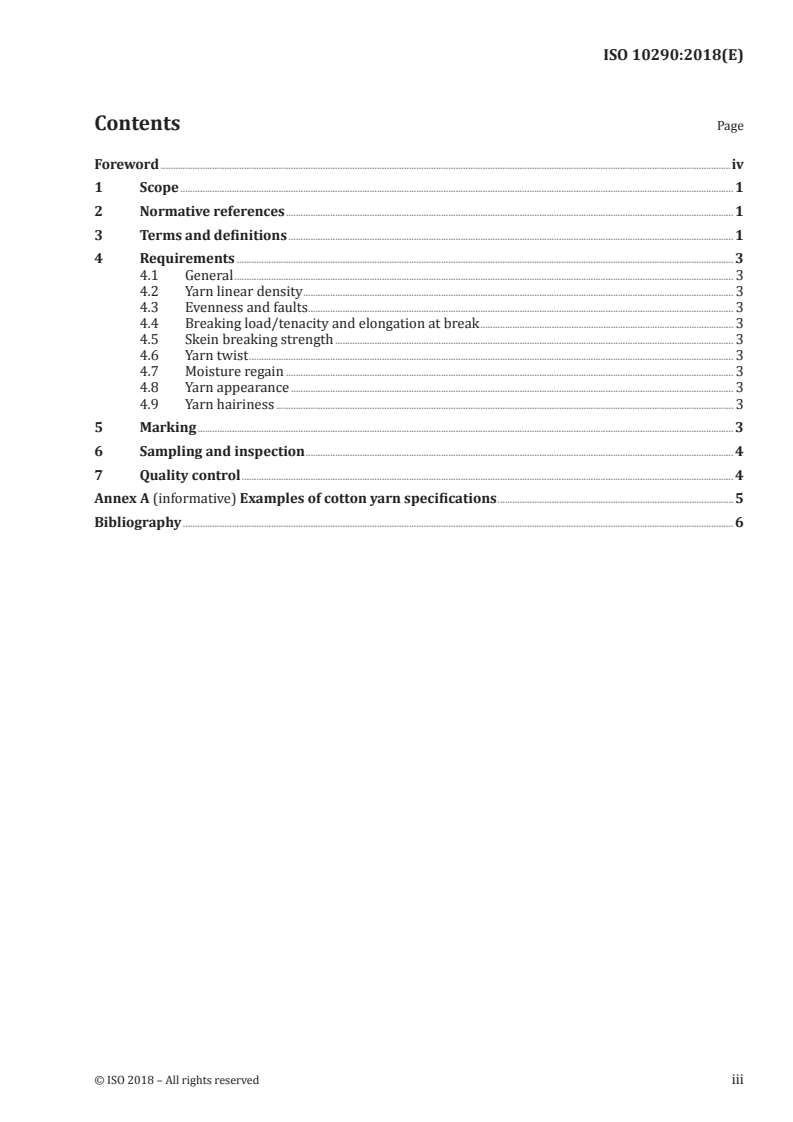
Contents Page
Foreword .iv
1 Scope . 1
2 Normative references . 1
3 Terms and definitions . 1
4 Requirements . 3
4.1 General . 3
4.2 Yarn linear density . 3
4.3 Evenness and faults . 3
4.4 Breaking load/tenacity and elongation at break . 3
4.5 Skein breaking strength . 3
4.6 Yarn twist . 3
4.7 Moisture regain . 3
4.8 Yarn appearance . 3
4.9 Yarn hairiness . 3
5 Marking . 3
6 Sampling and inspection . 4
7 Quality control . 4
Annex A (informative) Examples of cotton yarn specifications . 5
Bibliography . 6
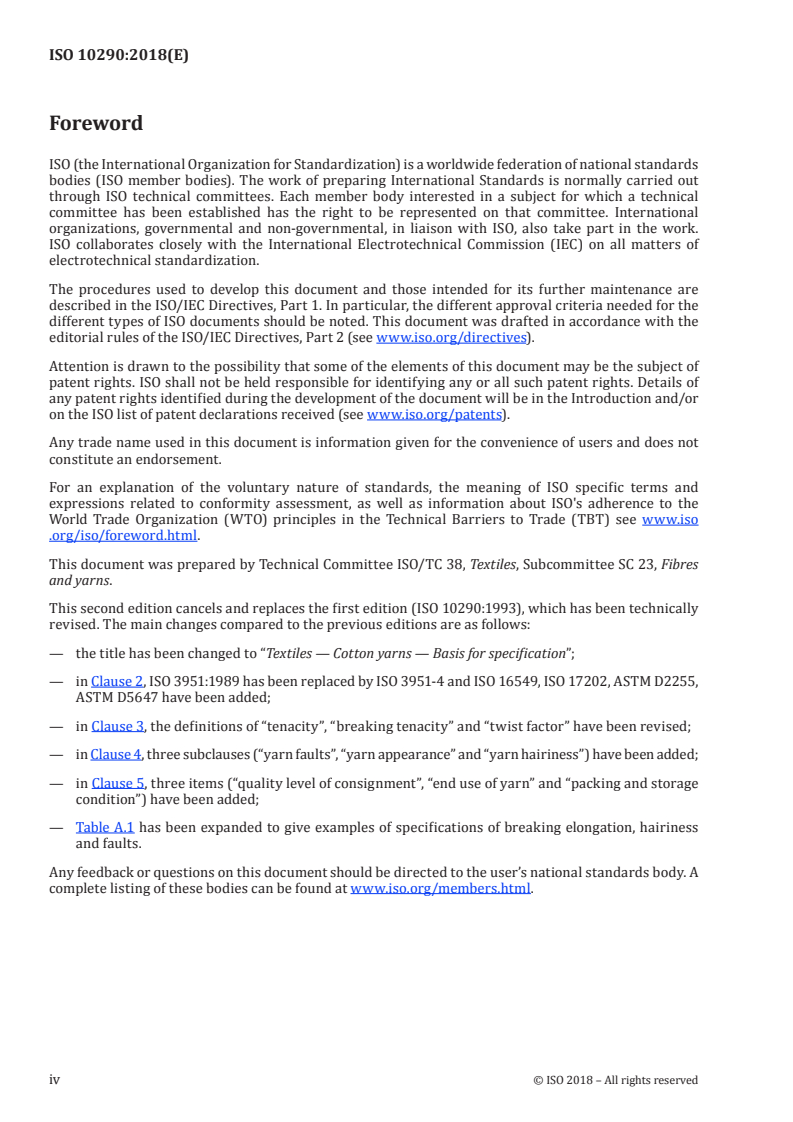
Foreword
ISO (the International Organization for Standardization) is a worldwide federation of national standards
bodies (ISO member bodies). The work of preparing International Standards is normally carried out
through ISO technical committees. Each member body interested in a subject for which a technical
committee has been established has the right to be represented on that committee. International
organizations, governmental and non-governmental, in liaison with ISO, also take part in the work.
ISO collaborates closely with the International Electrotechnical Commission (IEC) on all matters of
electrotechnical standardization.
The procedures used to develop this document and those intended for its further maintenance are
described in the ISO/IEC Directives, Part 1. In particular, the different approval criteria needed for the
different types of ISO documents should be noted. This document was drafted in accordance with the
editorial rules of the ISO/IEC Directives, Part 2 (see www .iso .org/directives).
Attention is drawn to the possibility that some of the elements of this document may be the subject of
patent rights. ISO shall not be held responsible for identifying any or all such patent rights. Details of
any patent rights identified during the development of the document will be in the Introduction and/or
on the ISO list of patent declarations received (see www .iso .org/patents).
Any trade name used in this document is information given for the convenience of users and does not
constitute an endorsement.
For an explanation of the voluntary nature of standards, the meaning of ISO specific terms and
expressions related to conformity assessment, as well as information about ISO's adherence to the
World Trade Organization (WTO) principles in the Technical Barriers to Trade (TBT) see www .iso
.org/iso/foreword .html.
This document was prepared by Technical Committee ISO/TC 38, Textiles, Subcommittee SC 23, Fibres
and yarns.
This second edition cancels and replaces the first edition (ISO 10290:1993), which has been technically
revised. The main changes compared to the previous editions are as follows:
— the title has been changed to “Textiles — Cotton yarns — Basis for specification”;
— in Clause 2, ISO 3951:1989 has been replaced by ISO 3951-4 and ISO 16549, ISO 17202, ASTM D2255,
ASTM D5647 have been added;
— in Clause 3, the definitions of “tenacity”, “breaking tenacity” and “twist factor” have been revised;
— in Clause 4, three subclauses (“yarn faults”, “yarn appearance” and “yarn hairiness”) have been added;
— in Clause 5, three items (“quality level of consignment”, “end use of yarn” and “packing and storage
condition”) have been added;
— Table A.1 has been expanded to give examples of specifications of breaking elongation, hairiness
and faults.
Any feedback or questions on this document should be directed to the user’s national standards body. A
complete listing of these bodies can be found at www .iso .org/members .html.
iv © ISO 2018 – All rights reserved
INTERNATIONAL STANDARD ISO 10290:2018(E)
Textiles — Cotton yarns — Basis for specification
1 Scope
This document specifies criteria, with relevant test methods, to be applied in describing single spun
grey cotton yarns. These yarns are widely used in international trade.
2 Normative references
The following documents are referred to in the text in such a way that some or all of their content
constitutes requirements of this document. For dated references, only the edition cited applies. For
undated references, the la
...
INTERNATIONAL ISO
STANDARD 10290
Second edition
2018-11
Textiles — Cotton yarns — Basis for
specification
Textiles — Fils de coton — Spécifications
Reference number
©
ISO 2018
© ISO 2018
All rights reserved. Unless otherwise specified, or required in the context of its implementation, no part of this publication may
be reproduced or utilized otherwise in any form or by any means, electronic or mechanical, including photocopying, or posting
on the internet or an intranet, without prior written permission. Permission can be requested from either ISO at the address
below or ISO’s member body in the country of the requester.
ISO copyright office
CP 401 • Ch. de Blandonnet 8
CH-1214 Vernier, Geneva
Phone: +41 22 749 01 11
Fax: +41 22 749 09 47
Email: copyright@iso.org
Website: www.iso.org
Published in Switzerland
ii © ISO 2018 – All rights reserved
Contents Page
Foreword .iv
1 Scope . 1
2 Normative references . 1
3 Terms and definitions . 1
4 Requirements . 3
4.1 General . 3
4.2 Yarn linear density . 3
4.3 Evenness and faults . 3
4.4 Breaking load/tenacity and elongation at break . 3
4.5 Skein breaking strength . 3
4.6 Yarn twist . 3
4.7 Moisture regain . 3
4.8 Yarn appearance . 3
4.9 Yarn hairiness . 3
5 Marking . 3
6 Sampling and inspection . 4
7 Quality control . 4
Annex A (informative) Examples of cotton yarn specifications . 5
Bibliography . 6
Foreword
ISO (the International Organization for Standardization) is a worldwide federation of national standards
bodies (ISO member bodies). The work of preparing International Standards is normally carried out
through ISO technical committees. Each member body interested in a subject for which a technical
committee has been established has the right to be represented on that committee. International
organizations, governmental and non-governmental, in liaison with ISO, also take part in the work.
ISO collaborates closely with the International Electrotechnical Commission (IEC) on all matters of
electrotechnical standardization.
The procedures used to develop this document and those intended for its further maintenance are
described in the ISO/IEC Directives, Part 1. In particular, the different approval criteria needed for the
different types of ISO documents should be noted. This document was drafted in accordance with the
editorial rules of the ISO/IEC Directives, Part 2 (see www .iso .org/directives).
Attention is drawn to the possibility that some of the elements of this document may be the subject of
patent rights. ISO shall not be held responsible for identifying any or all such patent rights. Details of
any patent rights identified during the development of the document will be in the Introduction and/or
on the ISO list of patent declarations received (see www .iso .org/patents).
Any trade name used in this document is information given for the convenience of users and does not
constitute an endorsement.
For an explanation of the voluntary nature of standards, the meaning of ISO specific terms and
expressions related to conformity assessment, as well as information about ISO's adherence to the
World Trade Organization (WTO) principles in the Technical Barriers to Trade (TBT) see www .iso
.org/iso/foreword .html.
This document was prepared by Technical Committee ISO/TC 38, Textiles, Subcommittee SC 23, Fibres
and yarns.
This second edition cancels and replaces the first edition (ISO 10290:1993), which has been technically
revised. The main changes compared to the previous editions are as follows:
— the title has been changed to “Textiles — Cotton yarns — Basis for specification”;
— in Clause 2, ISO 3951:1989 has been replaced by ISO 3951-4 and ISO 16549, ISO 17202, ASTM D2255,
ASTM D5647 have been added;
— in Clause 3, the definitions of “tenacity”, “breaking tenacity” and “twist factor” have been revised;
— in Clause 4, three subclauses (“yarn faults”, “yarn appearance” and “yarn hairiness”) have been added;
— in Clause 5, three items (“quality level of consignment”, “end use of yarn” and “packing and storage
condition”) have been added;
— Table A.1 has been expanded to give examples of specifications of breaking elongation, hairiness
and faults.
Any feedback or questions on this document should be directed to the user’s national standards body. A
complete listing of these bodies can be found at www .iso .org/members .html.
iv © ISO 2018 – All rights reserved
INTERNATIONAL STANDARD ISO 10290:2018(E)
Textiles — Cotton yarns — Basis for specification
1 Scope
This document specifies criteria, with relevant test methods, to be applied in describing single spun
grey cotton yarns. These yarns are widely used in international trade.
2 Normative references
The following documents are referred to in the text in such a way that some or all of their content
constitutes requirements of this document. For dated references, only the edition cited applies. For
undated references, the la
...