

ISO 9022-1:2016
(Main)Optics and photonics — Environmental test methods — Part 1: Definitions, extent of testing
General Information
- Abstract
ISO 9022-1:2016 defines terms relating to environmental tests of optical and photonic instruments, including additional assemblies from other fields (e.g. mechanical, chemical and electronic devices), and specifies basic features of testing.
- Status
- Published
- Publication Date
- 13-Jul-2016
- Technical Committee
- ISO/TC 172/SC 1 - Fundamental standards
- Drafting Committee
- ISO/TC 172/SC 1/WG 3 - Environmental test methods
- Current Stage
- 9060 - Close of review
- Completion Date
- 02-Dec-2031
Buy Documents

ISO 9022-1:2016 - Optics and photonics -- Environmental test methods

ISO 9022-1:2016 - Optics and photonics — Environmental test methods — Part 1: Definitions, extent of testing/14/2016

ISO 9022-1:2016 - Optique et photonique -- Méthodes d'essais d'environnement

ISO 9022-1:2016 - Optique et photonique — Méthodes d'essais d'environnement — Partie 1: Définitions, portée des essais/14/2016
ISO 9022-1:2016 - Optics and photonics: Environmental test methods (Part 1)
Overview
ISO 9022-1:2016 is the first part of the ISO 9022 series for optics and photonics. It defines the terminology, scope and basic features of laboratory environmental testing for optical and photonic instruments (including assemblies with mechanical, chemical or electronic sub‑systems). This third edition (2016) replaces the 2012 edition and establishes a common test sequence, ambient reference conditions and the framework used across the ISO 9022 parts.
Key topics and requirements
- Definitions: precise meanings for terms such as environmental test, optical instrument, optical assembly, specimen, conditioning, degree of severity, state of operation (0, 1, 2), examinations and tests (visual, function, measurement), and evaluation.
- Test sequence and procedure: structured steps include preconditioning, initial test, conditioning, intermediate test (when operating), recovery, final test and evaluation. Preconditioning requires specimen temperature adjustment to within ±3 K of ambient.
- Ambient atmospheric conditions: defined reference ambient range is 15 °C to 35 °C and 30 % to 85 % relative humidity.
- Conditioning method and severity: conditioning is the set of external influences (e.g., shock, damp heat) and associated parameter values (temperature, humidity, exposure time). The standard distinguishes conditioning method (what) and degree of severity (how severe).
- States of operation:
- State 0 - packaged/transport/storage condition
- State 1 - unprotected, ready for operation but unpowered
- State 2 - operating during the test (function checked)
- Environmental test code: ISO 9022‑1 provides rules for forming test identification codes used across the series.
- Annex A: lists relevant ISO 9022 parts and conditioning methods (examples: cold, dry heat, damp heat, shock, vibration, salt mist, dust, rain, immersion, solar radiation, mould, contamination, dew/ice and combined tests).
Applications and users
ISO 9022-1 is used by:
- Manufacturers of optical and photonic instruments (telescopes, microscopes, cameras, sensors) to define test programs and product specifications.
- Test laboratories and quality teams to design and sequence environmental tests.
- Design and reliability engineers to select appropriate conditioning methods and severity levels.
- Procurement, certification and technical compliance teams for specification, acceptance testing and comparative evaluation.
Practical uses include establishing baseline test procedures, defining specimen preparation, and harmonizing environmental test language across suppliers and test reports.
Related standards
- ISO 9022 series (Parts 2, 3, 4, 6, 7, 8, 9, 11, 12, 14, 17, 20, 22, 23) - detailed conditioning methods listed in Annex A.
- IEC 60529 (Degrees of protection by enclosures, IP Code) - referenced for related dust and rain methods.
Keywords: ISO 9022-1:2016, optics and photonics, environmental test methods, optical instrument testing, conditioning methods, test sequence, state of operation.
Relations
- Effective Date
- 05-Nov-2015
Buy Documents
ISO 9022-1:2016 - Optics and photonics -- Environmental test methods
ISO 9022-1:2016 - Optics and photonics — Environmental test methods — Part 1: Definitions, extent of testing/14/2016
ISO 9022-1:2016 - Optique et photonique -- Méthodes d'essais d'environnement
ISO 9022-1:2016 - Optique et photonique — Méthodes d'essais d'environnement — Partie 1: Définitions, portée des essais/14/2016
Frequently Asked Questions
ISO 9022-1:2016 is a standard published by the International Organization for Standardization (ISO). Its full title is "Optics and photonics — Environmental test methods — Part 1: Definitions, extent of testing". This standard covers: ISO 9022-1:2016 defines terms relating to environmental tests of optical and photonic instruments, including additional assemblies from other fields (e.g. mechanical, chemical and electronic devices), and specifies basic features of testing.
ISO 9022-1:2016 defines terms relating to environmental tests of optical and photonic instruments, including additional assemblies from other fields (e.g. mechanical, chemical and electronic devices), and specifies basic features of testing.
ISO 9022-1:2016 is classified under the following ICS (International Classification for Standards) categories: 37.020 - Optical equipment. The ICS classification helps identify the subject area and facilitates finding related standards.
ISO 9022-1:2016 has the following relationships with other standards: It is inter standard links to ISO 9022-1:2012. Understanding these relationships helps ensure you are using the most current and applicable version of the standard.
ISO 9022-1:2016 is available in PDF format for immediate download after purchase. The document can be added to your cart and obtained through the secure checkout process. Digital delivery ensures instant access to the complete standard document.
Standards Content (Sample)
INTERNATIONAL ISO
STANDARD 9022-1
Third edition
2016-07-15
Optics and photonics —
Environmental test methods —
Part 1:
Definitions, extent of testing
Optique et photonique — Méthodes d’essais d’environnement —
Partie 1: Définitions, portée des essais
Reference number
©
ISO 2016
© ISO 2016, Published in Switzerland
All rights reserved. Unless otherwise specified, no part of this publication may be reproduced or utilized otherwise in any form
or by any means, electronic or mechanical, including photocopying, or posting on the internet or an intranet, without prior
written permission. Permission can be requested from either ISO at the address below or ISO’s member body in the country of
the requester.
ISO copyright office
Ch. de Blandonnet 8 • CP 401
CH-1214 Vernier, Geneva, Switzerland
Tel. +41 22 749 01 11
Fax +41 22 749 09 47
copyright@iso.org
www.iso.org
ii © ISO 2016 – All rights reserved
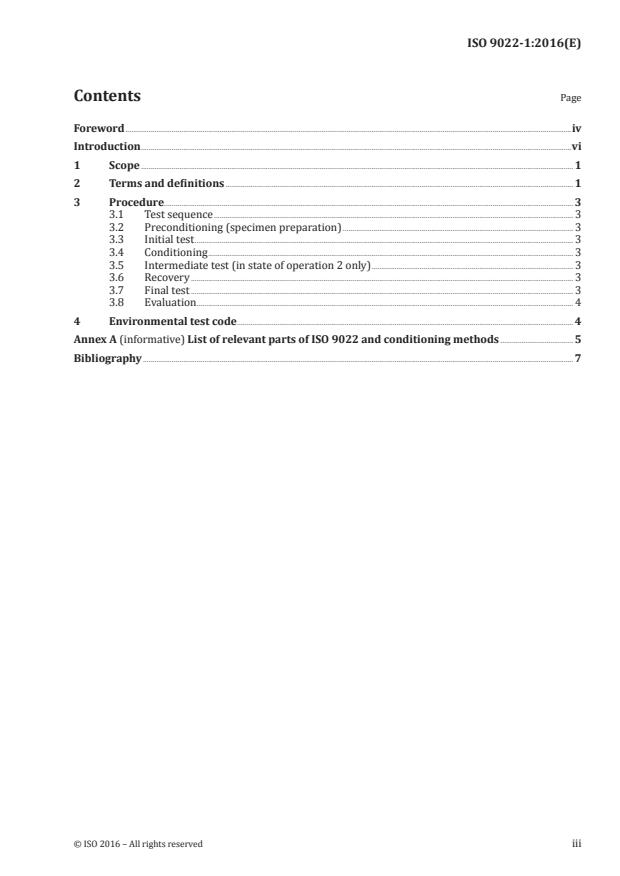
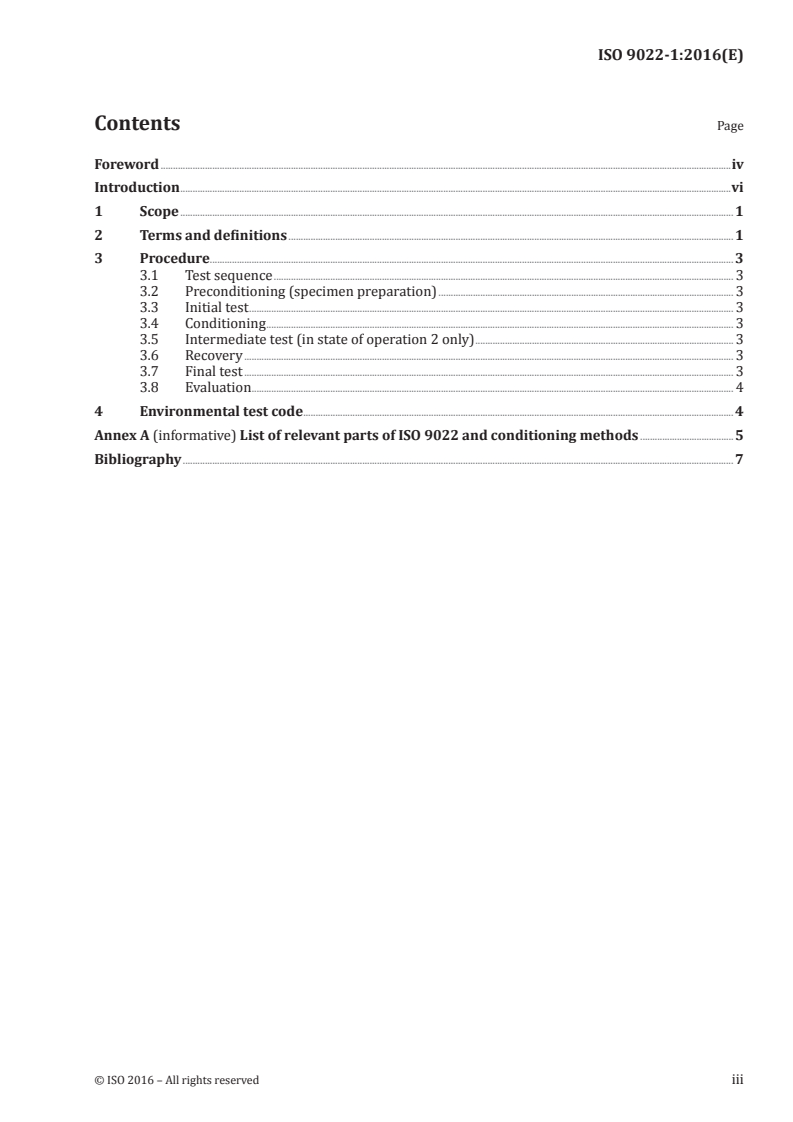
Contents Page
Foreword .iv
Introduction .vi
1 Scope . 1
2 Terms and definitions . 1
3 Procedure. 3
3.1 Test sequence . 3
3.2 Preconditioning (specimen preparation) . 3
3.3 Initial test . 3
3.4 Conditioning . 3
3.5 Intermediate test (in state of operation 2 only) . 3
3.6 Recovery . 3
3.7 Final test . 3
3.8 Evaluation . 4
4 Environmental test code . 4
Annex A (informative) List of relevant parts of ISO 9022 and conditioning methods .5
Bibliography . 7
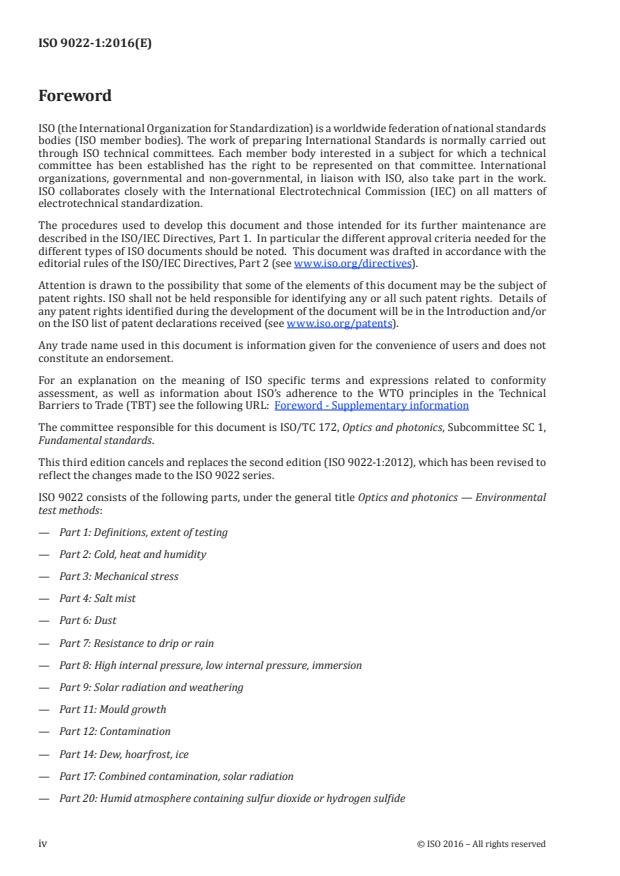
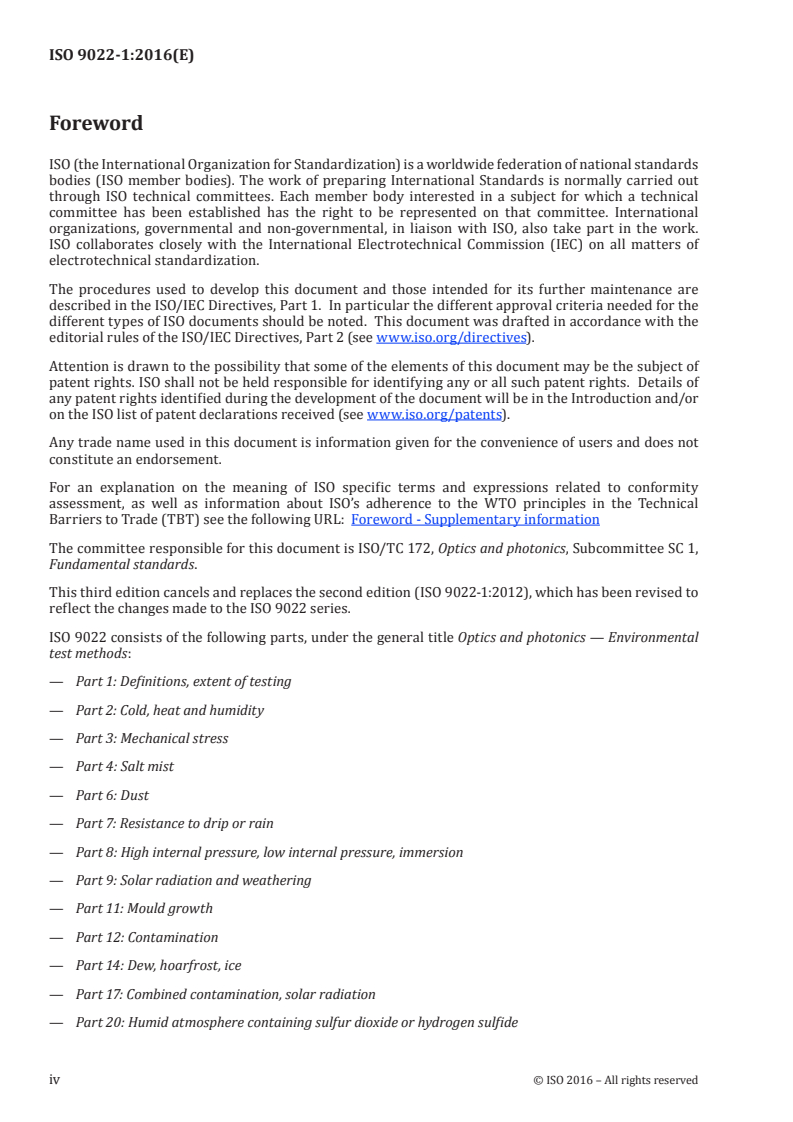
Foreword
ISO (the International Organization for Standardization) is a worldwide federation of national standards
bodies (ISO member bodies). The work of preparing International Standards is normally carried out
through ISO technical committees. Each member body interested in a subject for which a technical
committee has been established has the right to be represented on that committee. International
organizations, governmental and non-governmental, in liaison with ISO, also take part in the work.
ISO collaborates closely with the International Electrotechnical Commission (IEC) on all matters of
electrotechnical standardization.
The procedures used to develop this document and those intended for its further maintenance are
described in the ISO/IEC Directives, Part 1. In particular the different approval criteria needed for the
different types of ISO documents should be noted. This document was drafted in accordance with the
editorial rules of the ISO/IEC Directives, Part 2 (see www.iso.org/directives).
Attention is drawn to the possibility that some of the elements of this document may be the subject of
patent rights. ISO shall not be held responsible for identifying any or all such patent rights. Details of
any patent rights identified during the development of the document will be in the Introduction and/or
on the ISO list of patent declarations received (see www.iso.org/patents).
Any trade name used in this document is information given for the convenience of users and does not
constitute an endorsement.
For an explanation on the meaning of ISO specific terms and expressions related to conformity
assessment, as well as information about ISO’s adherence to the WTO principles in the Technical
Barriers to Trade (TBT) see the following URL: Foreword - Supplementary information
The committee responsible for this document is ISO/TC 172, Optics and photonics, Subcommittee SC 1,
Fundamental standards.
This third edition cancels and replaces the second edition (ISO 9022-1:2012), which has been revised to
reflect the changes made to the ISO 9022 series.
ISO 9022 consists of the following parts, under the general title Optics and photonics — Environmental
test methods:
— Part 1: Definitions, extent of testing
— Part 2: Cold, heat and humidity
— Part 3: Mechanical stress
— Part 4: Salt mist
— Part 6: Dust
— Part 7: Resistance to drip or rain
— Part 8: High internal pressure, low internal pressure, immersion
— Part 9: Solar radiation and weathering
— Part 11: Mould growth
— Part 12: Contamination
— Part 14: Dew, hoarfrost, ice
— Part 17: Combined contamination, solar radiation
— Part 20: Humid atmosphere containing sulfur dioxide or hydrogen sulfide
iv © ISO 2016 – All rights reserved
— Part 22: Combined cold, dry heat or temperature change with bump or random vibration
— Part 23: Low pressure combined with cold, ambient temperature and dry or damp heat
Introduction
Optical instruments are affected during their use by a number of different environmental parameters
which they are required to resist without significant reduction in performance and to remain within
defined specifications.
The type and severity of these parameters depend on the conditions of use of the instrument (for
example, in the laboratory or workshop) and on its geographical location. The environmental effects
on optical instrument performance in tropical and subtropical climates are totally different from those
found when they are used in the arctic regions. Individual parameters cause a variety of different and
overlapping effects on instrument performance.
The manufacturer attempts to ensure, and the user naturally expects, that instruments will resist the
likely rigours of their environment throughout their life. This expectation can be assessed by exposure
of the instrument to a range of simulated environmental parameters under controlled laboratory
conditions. The severity of these conditions is often increased to obtain meaningful results in a
relatively short period of time.
In order to allow assessment and comparison of the response of optical instruments to appropriate
environmental conditions, ISO 9022 contains details of a number of laboratory tests which reliably
simulate a variety of different environments. The tests are based largely on IEC standards, modified
where necessary to take into account features specific to optical instruments.
As a result of continuous progress in all fields, optical instruments are no longer only precision-
engineered optical products, but depending on their range of application, also contain additional
assemblies from other fields. For this reason, the principal function of the instrument is to be assessed to
determine which International Standard should be used for testing. If the optical function is of primary
importance, then ISO 9022 is applicable, but if other functions take precedence, then the appropriate
International Standard in the field concerned should be applied. Cases may arise where application of
both ISO 9022 and other appropriate International Standards will be necessary.
vi © ISO 2016 – All rights reserved
...
INTERNATIONAL ISO
STANDARD 9022-1
Third edition
2016-07-15
Optics and photonics —
Environmental test methods —
Part 1:
Definitions, extent of testing
Optique et photonique — Méthodes d’essais d’environnement —
Partie 1: Définitions, portée des essais
Reference number
©
ISO 2016
© ISO 2016, Published in Switzerland
All rights reserved. Unless otherwise specified, no part of this publication may be reproduced or utilized otherwise in any form
or by any means, electronic or mechanical, including photocopying, or posting on the internet or an intranet, without prior
written permission. Permission can be requested from either ISO at the address below or ISO’s member body in the country of
the requester.
ISO copyright office
Ch. de Blandonnet 8 • CP 401
CH-1214 Vernier, Geneva, Switzerland
Tel. +41 22 749 01 11
Fax +41 22 749 09 47
copyright@iso.org
www.iso.org
ii © ISO 2016 – All rights reserved
Contents Page
Foreword .iv
Introduction .vi
1 Scope . 1
2 Terms and definitions . 1
3 Procedure. 3
3.1 Test sequence . 3
3.2 Preconditioning (specimen preparation) . 3
3.3 Initial test . 3
3.4 Conditioning . 3
3.5 Intermediate test (in state of operation 2 only) . 3
3.6 Recovery . 3
3.7 Final test . 3
3.8 Evaluation . 4
4 Environmental test code . 4
Annex A (informative) List of relevant parts of ISO 9022 and conditioning methods .5
Bibliography . 7
Foreword
ISO (the International Organization for Standardization) is a worldwide federation of national standards
bodies (ISO member bodies). The work of preparing International Standards is normally carried out
through ISO technical committees. Each member body interested in a subject for which a technical
committee has been established has the right to be represented on that committee. International
organizations, governmental and non-governmental, in liaison with ISO, also take part in the work.
ISO collaborates closely with the International Electrotechnical Commission (IEC) on all matters of
electrotechnical standardization.
The procedures used to develop this document and those intended for its further maintenance are
described in the ISO/IEC Directives, Part 1. In particular the different approval criteria needed for the
different types of ISO documents should be noted. This document was drafted in accordance with the
editorial rules of the ISO/IEC Directives, Part 2 (see www.iso.org/directives).
Attention is drawn to the possibility that some of the elements of this document may be the subject of
patent rights. ISO shall not be held responsible for identifying any or all such patent rights. Details of
any patent rights identified during the development of the document will be in the Introduction and/or
on the ISO list of patent declarations received (see www.iso.org/patents).
Any trade name used in this document is information given for the convenience of users and does not
constitute an endorsement.
For an explanation on the meaning of ISO specific terms and expressions related to conformity
assessment, as well as information about ISO’s adherence to the WTO principles in the Technical
Barriers to Trade (TBT) see the following URL: Foreword - Supplementary information
The committee responsible for this document is ISO/TC 172, Optics and photonics, Subcommittee SC 1,
Fundamental standards.
This third edition cancels and replaces the second edition (ISO 9022-1:2012), which has been revised to
reflect the changes made to the ISO 9022 series.
ISO 9022 consists of the following parts, under the general title Optics and photonics — Environmental
test methods:
— Part 1: Definitions, extent of testing
— Part 2: Cold, heat and humidity
— Part 3: Mechanical stress
— Part 4: Salt mist
— Part 6: Dust
— Part 7: Resistance to drip or rain
— Part 8: High internal pressure, low internal pressure, immersion
— Part 9: Solar radiation and weathering
— Part 11: Mould growth
— Part 12: Contamination
— Part 14: Dew, hoarfrost, ice
— Part 17: Combined contamination, solar radiation
— Part 20: Humid atmosphere containing sulfur dioxide or hydrogen sulfide
iv © ISO 2016 – All rights reserved
— Part 22: Combined cold, dry heat or temperature change with bump or random vibration
— Part 23: Low pressure combined with cold, ambient temperature and dry or damp heat
Introduction
Optical instruments are affected during their use by a number of different environmental parameters
which they are required to resist without significant reduction in performance and to remain within
defined specifications.
The type and severity of these parameters depend on the conditions of use of the instrument (for
example, in the laboratory or workshop) and on its geographical location. The environmental effects
on optical instrument performance in tropical and subtropical climates are totally different from those
found when they are used in the arctic regions. Individual parameters cause a variety of different and
overlapping effects on instrument performance.
The manufacturer attempts to ensure, and the user naturally expects, that instruments will resist the
likely rigours of their environment throughout their life. This expectation can be assessed by exposure
of the instrument to a range of simulated environmental parameters under controlled laboratory
conditions. The severity of these conditions is often increased to obtain meaningful results in a
relatively short period of time.
In order to allow assessment and comparison of the response of optical instruments to appropriate
environmental conditions, ISO 9022 contains details of a number of laboratory tests which reliably
simulate a variety of different environments. The tests are based largely on IEC standards, modified
where necessary to take into account features specific to optical instruments.
As a result of continuous progress in all fields, optical instruments are no longer only precision-
engineered optical products, but depending on their range of application, also contain additional
assemblies from other fields. For this reason, the principal function of the instrument is to be assessed to
determine which International Standard should be used for testing. If the optical function is of primary
importance, then ISO 9022 is applicable, but if other functions take precedence, then the appropriate
International Standard in the field concerned should be applied. Cases may arise where application of
both ISO 9022 and other appropriate International Standards will be necessary.
vi © ISO 2016 – All rights reserved
...
NORME ISO
INTERNATIONALE 9022-1
Troisième édition
2016-07-15
Optique et photonique — Méthodes
d’essais d’environnement —
Partie 1:
Définitions, portée des essais
Optics and photonics — Environmental test methods —
Part 1: Definitions, extent of testing
Numéro de référence
©
ISO 2016
DOCUMENT PROTÉGÉ PAR COPYRIGHT
© ISO 2016, Publié en Suisse
Droits de reproduction réservés. Sauf indication contraire, aucune partie de cette publication ne peut être reproduite ni utilisée
sous quelque forme que ce soit et par aucun procédé, électronique ou mécanique, y compris la photocopie, l’affichage sur
l’internet ou sur un Intranet, sans autorisation écrite préalable. Les demandes d’autorisation peuvent être adressées à l’ISO à
l’adresse ci-après ou au comité membre de l’ISO dans le pays du demandeur.
ISO copyright office
Ch. de Blandonnet 8 • CP 401
CH-1214 Vernier, Geneva, Switzerland
Tel. +41 22 749 01 11
Fax +41 22 749 09 47
copyright@iso.org
www.iso.org
ii © ISO 2016 – Tous droits réservés
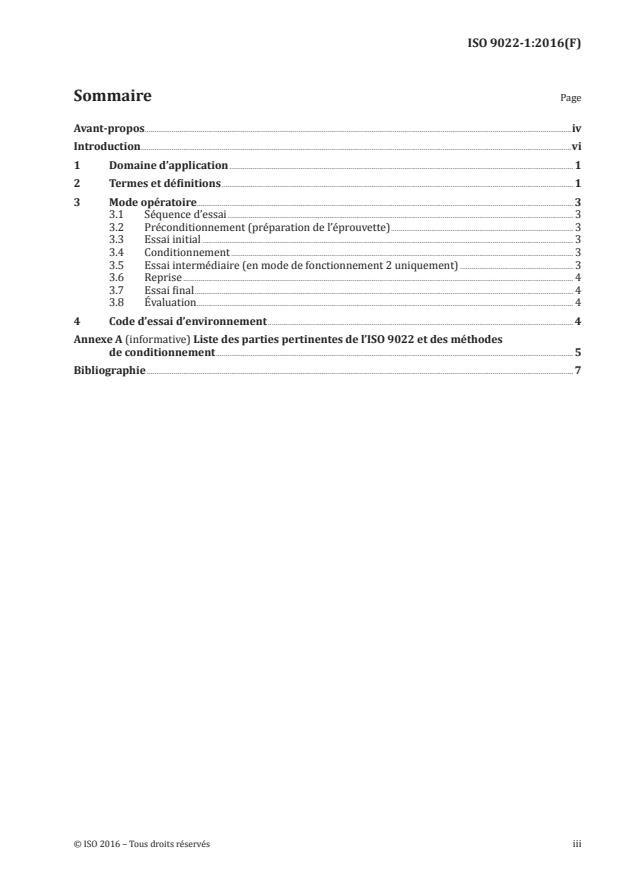
Sommaire Page
Avant-propos .iv
Introduction .vi
1 Domaine d’application . 1
2 Termes et définitions . 1
3 Mode opératoire. 3
3.1 Séquence d’essai . 3
3.2 Préconditionnement (préparation de l’éprouvette) . 3
3.3 Essai initial . 3
3.4 Conditionnement . 3
3.5 Essai intermédiaire (en mode de fonctionnement 2 uniquement) . 3
3.6 Reprise . 4
3.7 Essai final . 4
3.8 Évaluation . 4
4 Code d’essai d’environnement . 4
Annexe A (informative) Liste des parties pertinentes de l’ISO 9022 et des méthodes
de conditionnement . 5
Bibliographie . 7
Avant-propos
L’ISO (Organisation internationale de normalisation) est une fédération mondiale d’organismes
nationaux de normalisation (comités membres de l’ISO). L’élaboration des Normes internationales est
en général confiée aux comités techniques de l’ISO. Chaque comité membre intéressé par une étude
a le droit de faire partie du comité technique créé à cet effet. Les organisations internationales,
gouvernementales et non gouvernementales, en liaison avec l’ISO participent également aux travaux.
L’ISO collabore étroitement avec la Commission électrotechnique internationale (IEC) en ce qui
concerne la normalisation électrotechnique.
Les procédures utilisées pour élaborer le présent document et celles destinées à sa mise à jour sont
décrites dans les Directives ISO/IEC, Partie 1. Il convient, en particulier de prendre note des différents
critères d’approbation requis pour les différents types de documents ISO. Le présent document a été
rédigé conformément aux règles de rédaction données dans les Directives ISO/IEC, Partie 2 (voir www.
iso.org/directives).
L’attention est appelée sur le fait que certains des éléments du présent document peuvent faire l’objet de
droits de propriété intellectuelle ou de droits analogues. L’ISO ne saurait être tenue pour responsable
de ne pas avoir identifié de tels droits de propriété et averti de leur existence. Les détails concernant
les références aux droits de propriété intellectuelle ou autres droits analogues identifiés lors de
l’élaboration du document sont indiqués dans l’Introduction et/ou dans la liste des déclarations de
brevets reçues par l’ISO (voir www.iso.org/brevets).
Les appellations commerciales éventuellement mentionnées dans le présent document sont données
pour information, par souci de commodité, à l’intention des utilisateurs et ne sauraient constituer un
engagement.
Pour une explication de la signification des termes et expressions spécifiques de l’ISO liés à
l’évaluation de la conformité, ou pour toute information au sujet de l’adhésion de l’ISO aux principes
de l’OMC concernant les obstacles techniques au commerce (OTC), voir le lien suivant: Avant-propos —
Informations supplémentaires.
Le comité chargé de l’élaboration du présent document est l’ISO/TC 172, Optique et photonique,
Sous-Comité SC 1, Normes fondamentales.
Cette troisième édition annule et remplace la deuxième édition (ISO 9022-1:2012), qui a fait l’objet d’une
révision pour tenir compte des modifications apportées à la série ISO 9022.
L’ISO 9022 comprend les parties suivantes, présentées sous le titre général Optique et photonique —
Méthodes d’essais d’environnement:
— Partie 1: Définitions, portée des essais
— Partie 2: Froid, chaleur et humidité
— Partie 3: Contraintes mécaniques
— Partie 4: Brouillard salin
— Partie 6: Poussière
— Partie 7: Résistance au ruissellement ou à la pluie
— Partie 8: Pression interne élevée, pression interne faible, immersion
— Partie 9: Rayonnement solaire
— Partie 11: Moisissures
— Partie 12: Contamination
— Partie 14: Rosée, givre, glace
iv © ISO 2016 – Tous droits réservés
— Partie 17: Essai combiné contamination-rayonnement solaire
— Partie 20: Atmosphère humide contenant du dioxyde de soufre ou de l’hydrogène sulfuré
— Partie 22: Chaleurs sèche, froide ou changement de température combinés avec choc ou vibration
aléatoire
— Partie 23: Essais combinés basse pression et froid, température ambiante et chaleur sèche et humide
Introduction
Pendant leur utilisation, les instruments d’optique sont soumis à l’effet d’un certain nombre de
paramètres environnementaux auxquels ils doivent résister sans altération sensible de leurs
performances et pour lesquels ils doivent rester dans les limites des spécifications définies.
Le type et l’importance de ces paramètres dépendent des conditions d’utilisation de l’instrument (par
exemple en laboratoire ou en atelier) et de son emplacement géographique. Les effets de l’environnement
sur les performances d’un instrument d’optique dans les climats tropicaux et subtropicaux sont
totalement différents de ceux que l’on obtient lorsqu’ils sont utilisés dans les régions arctiques. Chaque
paramètre provoque toute une gamme d’effets différents et simultanés sur la performance d’un
instrument.
Le fabricant s’efforce de garantir la résistance des instruments aux rigueurs potentielles de leur
environnement pendant toute leur durée de vie, ce que l’utilisateur est en droit d’attendre. Cette
résistance peut être évaluée en exposant l’instrument à une série de paramètres environnementaux
simulés sous des conditions de laboratoire contrôlées. La sévérité de ces conditions est souvent accrue
pour obtenir des résultats significatifs sur une période de temps relativement courte.
Afin d’évaluer et de comparer la réponse des instruments d’optique aux conditions environnementales
appropriées, l’ISO 9022 spécifie le détail d’un certain nombre d’essais en laboratoire qui simulent de
façon fiable toute une gamme d’environnements différents. Les essais s’appuient en grande partie sur
des normes IEC, auxquelles certaines modifications nécessaires ont été apportées pour tenir compte
des caractéristiques propres aux instruments d’optique.
Grâce aux progrès continus réalisés dans tous les domaines, les instruments d’optique ne sont plus
uniquement des produits d’optique de précision mais selon leur champ d’application, ils possèdent
également des fonctionnalités complémentaires issues d’autres domaines. C’est pour cette raison
que la fonction principale de l’instrument a besoin d’être évaluée afin de déterminer quelle Norme
internationale il est recommandé d’utiliser pour les essais. Si la fonction optique est de première
importance, l’ISO 9022 s’applique, mais si d’autres fonctions sont plus importantes, alors il est
recommandé d’appliquer la Norme internationale appropriée dans le domaine concerné. Dans
certains cas, il peut être nécessaire d’appliquer à la fois l’ISO 9022 et d’autres Normes internationales
appropriées.
vi © ISO 2016 – Tous droits réservés
NORME INTERNATIONALE ISO 9022-1:2016(F)
Optique et photonique — Méthodes d’essais
d’environnement —
Partie 1:
Définit
...
NORME ISO
INTERNATIONALE 9022-1
Troisième édition
2016-07-15
Optique et photonique — Méthodes
d’essais d’environnement —
Partie 1:
Définitions, portée des essais
Optics and photonics — Environmental test methods —
Part 1: Definitions, extent of testing
Numéro de référence
©
ISO 2016
DOCUMENT PROTÉGÉ PAR COPYRIGHT
© ISO 2016, Publié en Suisse
Droits de reproduction réservés. Sauf indication contraire, aucune partie de cette publication ne peut être reproduite ni utilisée
sous quelque forme que ce soit et par aucun procédé, électronique ou mécanique, y compris la photocopie, l’affichage sur
l’internet ou sur un Intranet, sans autorisation écrite préalable. Les demandes d’autorisation peuvent être adressées à l’ISO à
l’adresse ci-après ou au comité membre de l’ISO dans le pays du demandeur.
ISO copyright office
Ch. de Blandonnet 8 • CP 401
CH-1214 Vernier, Geneva, Switzerland
Tel. +41 22 749 01 11
Fax +41 22 749 09 47
copyright@iso.org
www.iso.org
ii © ISO 2016 – Tous droits réservés
Sommaire Page
Avant-propos .iv
Introduction .vi
1 Domaine d’application . 1
2 Termes et définitions . 1
3 Mode opératoire. 3
3.1 Séquence d’essai . 3
3.2 Préconditionnement (préparation de l’éprouvette) . 3
3.3 Essai initial . 3
3.4 Conditionnement . 3
3.5 Essai intermédiaire (en mode de fonctionnement 2 uniquement) . 3
3.6 Reprise . 4
3.7 Essai final . 4
3.8 Évaluation . 4
4 Code d’essai d’environnement . 4
Annexe A (informative) Liste des parties pertinentes de l’ISO 9022 et des méthodes
de conditionnement . 5
Bibliographie . 7
Avant-propos
L’ISO (Organisation internationale de normalisation) est une fédération mondiale d’organismes
nationaux de normalisation (comités membres de l’ISO). L’élaboration des Normes internationales est
en général confiée aux comités techniques de l’ISO. Chaque comité membre intéressé par une étude
a le droit de faire partie du comité technique créé à cet effet. Les organisations internationales,
gouvernementales et non gouvernementales, en liaison avec l’ISO participent également aux travaux.
L’ISO collabore étroitement avec la Commission électrotechnique internationale (IEC) en ce qui
concerne la normalisation électrotechnique.
Les procédures utilisées pour élaborer le présent document et celles destinées à sa mise à jour sont
décrites dans les Directives ISO/IEC, Partie 1. Il convient, en particulier de prendre note des différents
critères d’approbation requis pour les différents types de documents ISO. Le présent document a été
rédigé conformément aux règles de rédaction données dans les Directives ISO/IEC, Partie 2 (voir www.
iso.org/directives).
L’attention est appelée sur le fait que certains des éléments du présent document peuvent faire l’objet de
droits de propriété intellectuelle ou de droits analogues. L’ISO ne saurait être tenue pour responsable
de ne pas avoir identifié de tels droits de propriété et averti de leur existence. Les détails concernant
les références aux droits de propriété intellectuelle ou autres droits analogues identifiés lors de
l’élaboration du document sont indiqués dans l’Introduction et/ou dans la liste des déclarations de
brevets reçues par l’ISO (voir www.iso.org/brevets).
Les appellations commerciales éventuellement mentionnées dans le présent document sont données
pour information, par souci de commodité, à l’intention des utilisateurs et ne sauraient constituer un
engagement.
Pour une explication de la signification des termes et expressions spécifiques de l’ISO liés à
l’évaluation de la conformité, ou pour toute information au sujet de l’adhésion de l’ISO aux principes
de l’OMC concernant les obstacles techniques au commerce (OTC), voir le lien suivant: Avant-propos —
Informations supplémentaires.
Le comité chargé de l’élaboration du présent document est l’ISO/TC 172, Optique et photonique,
Sous-Comité SC 1, Normes fondamentales.
Cette troisième édition annule et remplace la deuxième édition (ISO 9022-1:2012), qui a fait l’objet d’une
révision pour tenir compte des modifications apportées à la série ISO 9022.
L’ISO 9022 comprend les parties suivantes, présentées sous le titre général Optique et photonique —
Méthodes d’essais d’environnement:
— Partie 1: Définitions, portée des essais
— Partie 2: Froid, chaleur et humidité
— Partie 3: Contraintes mécaniques
— Partie 4: Brouillard salin
— Partie 6: Poussière
— Partie 7: Résistance au ruissellement ou à la pluie
— Partie 8: Pression interne élevée, pression interne faible, immersion
— Partie 9: Rayonnement solaire
— Partie 11: Moisissures
— Partie 12: Contamination
— Partie 14: Rosée, givre, glace
iv © ISO 2016 – Tous droits réservés
— Partie 17: Essai combiné contamination-rayonnement solaire
— Partie 20: Atmosphère humide contenant du dioxyde de soufre ou de l’hydrogène sulfuré
— Partie 22: Chaleurs sèche, froide ou changement de température combinés avec choc ou vibration
aléatoire
— Partie 23: Essais combinés basse pression et froid, température ambiante et chaleur sèche et humide
Introduction
Pendant leur utilisation, les instruments d’optique sont soumis à l’effet d’un certain nombre de
paramètres environnementaux auxquels ils doivent résister sans altération sensible de leurs
performances et pour lesquels ils doivent rester dans les limites des spécifications définies.
Le type et l’importance de ces paramètres dépendent des conditions d’utilisation de l’instrument (par
exemple en laboratoire ou en atelier) et de son emplacement géographique. Les effets de l’environnement
sur les performances d’un instrument d’optique dans les climats tropicaux et subtropicaux sont
totalement différents de ceux que l’on obtient lorsqu’ils sont utilisés dans les régions arctiques. Chaque
paramètre provoque toute une gamme d’effets différents et simultanés sur la performance d’un
instrument.
Le fabricant s’efforce de garantir la résistance des instruments aux rigueurs potentielles de leur
environnement pendant toute leur durée de vie, ce que l’utilisateur est en droit d’attendre. Cette
résistance peut être évaluée en exposant l’instrument à une série de paramètres environnementaux
simulés sous des conditions de laboratoire contrôlées. La sévérité de ces conditions est souvent accrue
pour obtenir des résultats significatifs sur une période de temps relativement courte.
Afin d’évaluer et de comparer la réponse des instruments d’optique aux conditions environnementales
appropriées, l’ISO 9022 spécifie le détail d’un certain nombre d’essais en laboratoire qui simulent de
façon fiable toute une gamme d’environnements différents. Les essais s’appuient en grande partie sur
des normes IEC, auxquelles certaines modifications nécessaires ont été apportées pour tenir compte
des caractéristiques propres aux instruments d’optique.
Grâce aux progrès continus réalisés dans tous les domaines, les instruments d’optique ne sont plus
uniquement des produits d’optique de précision mais selon leur champ d’application, ils possèdent
également des fonctionnalités complémentaires issues d’autres domaines. C’est pour cette raison
que la fonction principale de l’instrument a besoin d’être évaluée afin de déterminer quelle Norme
internationale il est recommandé d’utiliser pour les essais. Si la fonction optique est de première
importance, l’ISO 9022 s’applique, mais si d’autres fonctions sont plus importantes, alors il est
recommandé d’appliquer la Norme internationale appropriée dans le domaine concerné. Dans
certains cas, il peut être nécessaire d’appliquer à la fois l’ISO 9022 et d’autres Normes internationales
appropriées.
vi © ISO 2016 – Tous droits réservés
NORME INTERNATIONALE ISO 9022-1:2016(F)
Optique et photonique — Méthodes d’essais
d’environnement —
Partie 1:
Définit
...