

ISO 16140-3:2021
(Main)Microbiology of the food chain — Method validation — Part 3: Protocol for the verification of reference methods and validated alternative methods in a single laboratory
General Information
- Abstract
This document specifies the protocol for the verification of reference methods and validated alternative methods for implementation in the user laboratory. This document is applicable to the verification of methods used for the analysis (detection and/or quantification), confirmation and typing of microorganisms in: — products intended for human consumption; — products intended for animal feeding; — environmental samples in the area of food and feed production, handling; — samples from the primary production stage. This document is, in particular, applicable to bacteria and fungi. Some clauses can be applicable to other (micro)organisms or their metabolites, to be determined on a case-by-case basis. The technical protocols for the verification of validated qualitative methods and validated quantitative methods are described in Clauses 5 and 6. The technical protocol for the verification of validated alternative confirmation and typing methods is described in Clause 7. The protocols for the verification of non-validated reference methods are described in Annex F.
- Status
- Published
- Publication Date
- 18-Jan-2021
- Technical Committee
- ISO/TC 34/SC 9 - Microbiology
- Drafting Committee
- ISO/TC 34/SC 9/WG 3 - Method validation
- Current Stage
- 9093 - International Standard confirmed
- Start Date
- 26-Jun-2026
- Completion Date
- 29-Aug-2026
Buy Documents

ISO 16140-3:2021 - Microbiology of the food chain -- Method validation
ISO 16140-3:2021 - Microbiology of the food chain — Method validation — Part 3: Protocol for the verification of reference methods and validated alternative methods in a single laboratory/19/2021

ISO 16140-3:2021 - Microbiologie de la chaîne alimentaire -- Validation des méthodes
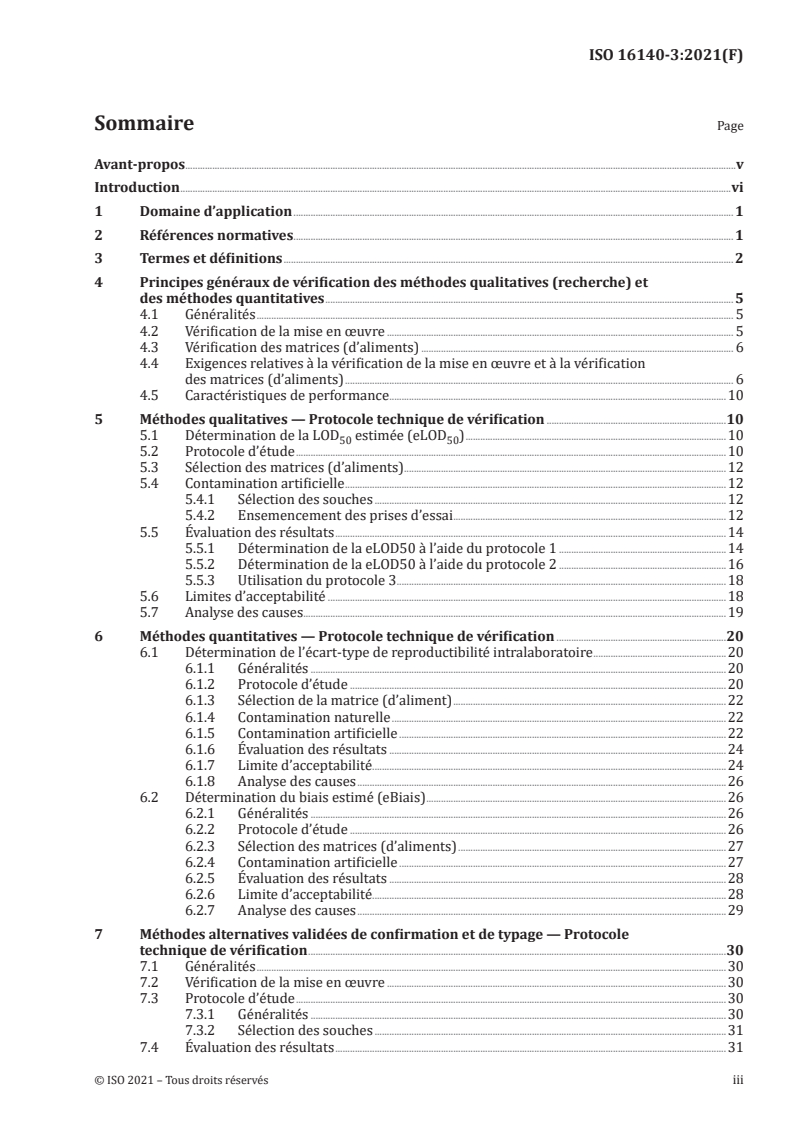
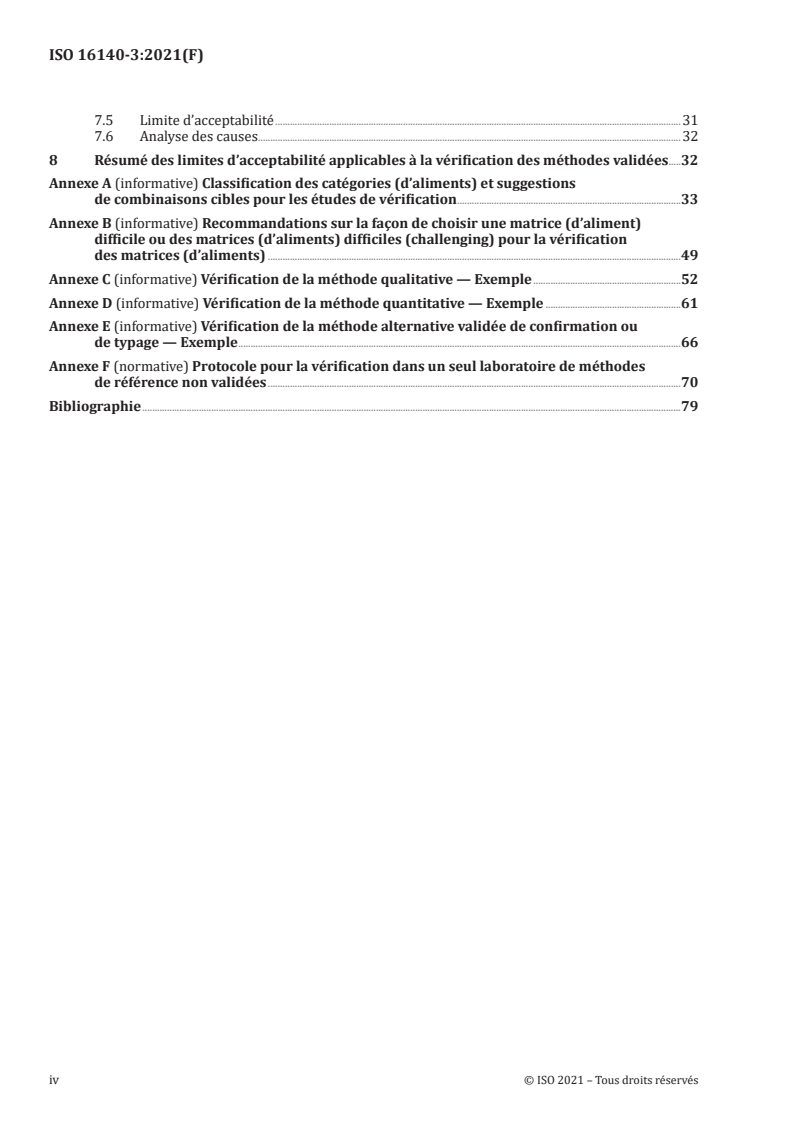
ISO 16140-3:2021 - Microbiologie de la chaîne alimentaire — Validation des méthodes — Partie 3: Protocole pour la vérification dans un seul laboratoire de méthodes de référence et de méthodes alternatives validées/19/2021
Overview
ISO 16140-3:2021 specifies protocols for verifying reference methods and validated alternative methods for microbiological testing of the food chain in a single laboratory. This standard is part of the ISO 16140 series, which addresses the validation and verification of microbiological methods for food safety. It applies to the analysis, confirmation, and typing of microorganisms such as bacteria and fungi in products for human consumption, animal feed, environmental samples from production and handling, and primary production samples.
This standard ensures that laboratories can demonstrate the reliability of the methods they implement, supporting accurate detection and quantification of microorganisms and helping maintain food safety and regulatory compliance.
Key Topics
Verification Protocols:
- Provides step-by-step protocols for verifying both reference methods (widely recognized international or national standards) and alternative methods that have been validated through interlaboratory studies.
Applicability:
- Relevant for methods used on foods, animal feeds, environmental samples, and primary production samples.
- Mainly targets verification for bacteria and fungi but can also address other microorganisms and their metabolites case-by-case.
Verification Types:
- Implementation verification: Confirms the user laboratory’s ability to correctly perform the validated method.
- (Food) item verification: Confirms the method’s performance for specific matrices or food items within the laboratory’s intended scope.
Qualitative and Quantitative Methods:
- Distinguishes between qualitative (detection) and quantitative (enumeration) methods and details separate protocols for each.
Alternative Methods:
- Details protocols for verification of validated alternative methods for confirmation and typing of microorganisms.
Non-validated Reference Methods:
- Offers guidance for verifying reference methods that have not yet undergone full validation.
Applications
ISO 16140-3:2021 is essential for:
- Food testing laboratories: Ensures that both reference and alternative methods are fully verified for intended use, maintaining high standards of microbiological safety.
- Quality assurance teams: Supports consistent, reliable microbiological results in food safety management systems.
- Regulatory compliance: Assists in meeting international, national, or industry-specific requirements for microbial testing in food chain sampling.
- Implementation of new methods: Provides a clear process to verify new reference or alternative methods before routine implementation, reducing the risk of errors or false results.
- Scope management: Helps laboratories define and manage their claimed application scope by guiding which food categories, types, and items require verification studies.
- Continuous improvement: Encourages regular method review and verification when expanding laboratory services or when there are changes in sample matrices.
Related Standards
Several standards and normative references underpin ISO 16140-3:2021:
ISO 16140 Series:
- ISO 16140-1: Vocabulary for method validation.
- ISO 16140-2: Validation of alternative (proprietary) methods against a reference method.
- ISO 16140-4: Validation protocols for a single laboratory.
- ISO 16140-5: Factorial interlaboratory validation for non-proprietary methods.
- ISO 16140-6: Validation of alternative methods for confirmation and typing procedures.
ISO 6887 (all parts): Preparation of test samples, initial suspension, and decimal dilutions.
ISO 7218: General requirements and guidance for microbiological examinations.
ISO 17468: Technical rules for the development and validation of standardized methods.
Laboratories implementing ISO 16140-3:2021 often work in close alignment with these related standards to ensure comprehensive method validation and verification within the food safety management framework.
Keywords: ISO 16140-3:2021, microbiological method verification, food safety, laboratory validation, reference methods, alternative methods, single laboratory, microorganism detection, food chain, method validation, bacteria, fungi, food testing standards.
Relations
- Effective Date
- 08-Jul-2026
- Effective Date
- 12-Feb-2026
- Effective Date
- 06-Jun-2022
- Effective Date
- 04-Nov-2023
- Effective Date
- 29-Mar-2014
- Effective Date
- 29-Mar-2014
Buy Documents
ISO 16140-3:2021 - Microbiology of the food chain -- Method validation
ISO 16140-3:2021 - Microbiology of the food chain — Method validation — Part 3: Protocol for the verification of reference methods and validated alternative methods in a single laboratory/19/2021
ISO 16140-3:2021 - Microbiologie de la chaîne alimentaire -- Validation des méthodes
ISO 16140-3:2021 - Microbiologie de la chaîne alimentaire — Validation des méthodes — Partie 3: Protocole pour la vérification dans un seul laboratoire de méthodes de référence et de méthodes alternatives validées/19/2021
Frequently Asked Questions
ISO 16140-3:2021 is a standard published by the International Organization for Standardization (ISO). Its full title is "Microbiology of the food chain — Method validation — Part 3: Protocol for the verification of reference methods and validated alternative methods in a single laboratory". This standard covers: This document specifies the protocol for the verification of reference methods and validated alternative methods for implementation in the user laboratory. This document is applicable to the verification of methods used for the analysis (detection and/or quantification), confirmation and typing of microorganisms in: — products intended for human consumption; — products intended for animal feeding; — environmental samples in the area of food and feed production, handling; — samples from the primary production stage. This document is, in particular, applicable to bacteria and fungi. Some clauses can be applicable to other (micro)organisms or their metabolites, to be determined on a case-by-case basis. The technical protocols for the verification of validated qualitative methods and validated quantitative methods are described in Clauses 5 and 6. The technical protocol for the verification of validated alternative confirmation and typing methods is described in Clause 7. The protocols for the verification of non-validated reference methods are described in Annex F.
This document specifies the protocol for the verification of reference methods and validated alternative methods for implementation in the user laboratory. This document is applicable to the verification of methods used for the analysis (detection and/or quantification), confirmation and typing of microorganisms in: — products intended for human consumption; — products intended for animal feeding; — environmental samples in the area of food and feed production, handling; — samples from the primary production stage. This document is, in particular, applicable to bacteria and fungi. Some clauses can be applicable to other (micro)organisms or their metabolites, to be determined on a case-by-case basis. The technical protocols for the verification of validated qualitative methods and validated quantitative methods are described in Clauses 5 and 6. The technical protocol for the verification of validated alternative confirmation and typing methods is described in Clause 7. The protocols for the verification of non-validated reference methods are described in Annex F.
ISO 16140-3:2021 is classified under the following ICS (International Classification for Standards) categories: 07.100.30 - Food microbiology. The ICS classification helps identify the subject area and facilitates finding related standards.
ISO 16140-3:2021 has the following relationships with other standards: It is inter standard links to EN ISO 24914:2026, EN ISO 16140-3:2021, ISO 11972:2015, ISO 16140-3:2021/Amd 1:2025, ISO 16140:2003, ISO 16140:2003/Amd 1:2011. Understanding these relationships helps ensure you are using the most current and applicable version of the standard.
ISO 16140-3:2021 is available in PDF format for immediate download after purchase. The document can be added to your cart and obtained through the secure checkout process. Digital delivery ensures instant access to the complete standard document.
Standards Content (Sample)
INTERNATIONAL ISO
STANDARD 16140-3
First edition
2021-01
Microbiology of the food chain —
Method validation —
Part 3:
Protocol for the verification of
reference methods and validated
alternative methods in a single
laboratory
Microbiologie de la chaîne alimentaire — Validation des méthodes —
Partie 3: Protocole pour la vérification dans un seul laboratoire de
méthodes de référence et de méthodes alternatives validées
Reference number
©
ISO 2021
© ISO 2021
All rights reserved. Unless otherwise specified, or required in the context of its implementation, no part of this publication may
be reproduced or utilized otherwise in any form or by any means, electronic or mechanical, including photocopying, or posting
on the internet or an intranet, without prior written permission. Permission can be requested from either ISO at the address
below or ISO’s member body in the country of the requester.
ISO copyright office
CP 401 • Ch. de Blandonnet 8
CH-1214 Vernier, Geneva
Phone: +41 22 749 01 11
Email: copyright@iso.org
Website: www.iso.org
Published in Switzerland
ii © ISO 2021 – All rights reserved
Contents Page
Foreword .v
Introduction .vi
1 Scope . 1
2 Normative references . 1
3 Terms and definitions . 1
4 General principles of verification of qualitative (detection) methods and
quantification methods . 5
4.1 General . 5
4.2 Implementation verification . 5
4.3 (Food) item verification . 6
4.4 Requirements for implementation verification and (food) item verification . . 6
4.5 Performance characteristics. 9
5 Qualitative methods — Technical protocol for verification . 9
5.1 Estimated LOD (eLOD ) determination . 9
50 50
5.2 Experimental design . 9
5.3 Selection of (food) items .10
5.4 Artificial contamination .10
5.4.1 Selection of strains .10
5.4.2 Inoculation of the test portions .11
5.5 Evaluation of results .13
5.5.1 Determination of eLOD using protocol 1 .13
5.5.2 Determination of eLOD using protocol 2 .16
5.5.3 Use of protocol 3 .17
5.6 Acceptability limits .18
5.7 Root cause analysis .18
6 Quantitative methods — Technical protocol for verification .19
6.1 Intralaboratory reproducibility standard deviation determination .19
6.1.1 General.19
6.1.2 Experimental design .19
6.1.3 Selection of the (food) item .21
6.1.4 Natural contamination .21
6.1.5 Artificial contamination .21
6.1.6 Evaluation of results .22
6.1.7 Acceptability limit .23
6.1.8 Root cause analysis .24
6.2 Estimated bias (eBias) determination .25
6.2.1 General.25
6.2.2 Experimental design .25
6.2.3 Selection of (food) items .25
6.2.4 Artificial contamination .25
6.2.5 Evaluation of results .27
6.2.6 Acceptability limit .27
6.2.7 Root cause analysis .28
7 Validated alternative confirmation and typing methods — Technical protocol for
verification.28
7.1 General .28
7.2 Implementation verification .28
7.3 Experimental design .28
7.3.1 General.28
7.3.2 Strain selection .29
7.4 Evaluation of results .29
7.5 Acceptability limit .30
7.6 Root cause analysis .30
8 Summary of acceptability limits for the verification of validated methods .30
Annex A (informative) Classification of (food) categories and suggested target
combinations for verification studies .31
Annex B (informative) Guidance on how to choose challenging (food) item(s) for (food)
item verification .45
Annex C (informative) Qualitative method verification — Example .47
Annex D (informative) Quantitative method verification — Example .55
Annex E (informative) Validated alternative confirmation or typing method verification —
Examples .60
Annex F (normative) Protocol for the verification of non-validated reference methods
in a single laboratory .63
Bibliography .70
iv © ISO 2021 – All rights reserved
Foreword
ISO (the International Organization for Standardization) is a worldwide federation of national standards
bodies (ISO member bodies). The work of preparing International Standards is normally carried out
through ISO technical committees. Each member body interested in a subject for which a technical
committee has been established has the right to be represented on that committee. International
organizations, governmental and non-governmental, in liaison with ISO, also take part in the work.
ISO collaborates closely with the International Electrotechnical Commission (IEC) on all matters of
electrotechnical standardization.
The procedures used to develop this document and those intended for its further maintenance are
described in the ISO/IEC Directives, Part 1. In particular, the different approval criteria needed for the
different types of ISO documents should be noted. This document was drafted in accordance with the
editorial rules of the ISO/IEC Directives, Part 2 (see www .iso .org/ directives).
Attention is drawn to the possibility that some of the elements of this document may be the subject of
patent rights. ISO shall not be held responsible for identifying any or all such patent rights. Details of
any patent rights identified during the development of the document will be in the Introduction and/or
on the ISO list of patent declarations received (see www .iso .org/ patents).
Any trade name used in this document is information given for the convenience of users and does not
constitute an endorsement.
For an explanation of the voluntary nature of standards, the meaning of ISO specific terms and
expressions related to conformity assessment, as well as information about ISO’s adherence to the
World Trade Organization (WTO) principles in the Technical Barriers to Trade (TBT) see www .iso .org/
iso/ foreword .html.
This document was prepared by Technical Committee ISO/TC 34, Food products, Subcommittee SC 9,
Microbiology, in collaboration with the European Committee for Standardization (CEN) Technical
Committee CEN/TC 463, Microbiology of the food chain, in accordance with the Agreement on technical
cooperation between ISO and CEN (Vienna Agreement).
A list of all parts in the ISO 16140 series can be found on the ISO website.
Any feedback or questions on this document should be directed to the user’s national standards body. A
complete listing of these bodies can be found at www .iso .org/ members .html.
Introduction
0.1 The ISO 16140 series
The ISO 16140 series has been expanded in response to the need for various ways to validate or verify
test methods. It is the successor to ISO 16140:2003. The ISO 16140 series consists of six parts with the
general title, Microbiology of the food chain — Method validation:
— Part 1: Vocabulary;
— Part 2: Protocol for the validation of alternative (proprietary) methods against a reference method;
— Part 3: Protocol for the verification of reference methods and validated alternative methods in a single
laboratory;
— Part 4: Protocol for method validation in a single laboratory;
— Part 5: Protocol for factorial interlaboratory validation for non-proprietary methods;
— Part 6: Protocol for the validation of alternative (proprietary) methods for microbiological confirmation
and typing procedures.
ISO 17468 is a closely linked International Standard, which establishes technical rules for the
development and validation of standardized methods.
In general, two stages are needed before a method can be used in a laboratory.
— The first stage is the validation of the method. Validation is conducted using a study in a single
laboratory followed by an interlaboratory study (see ISO 16140-2, ISO 16140-5 and ISO 16140-6).
In the case when a method is validated within one laboratory (see ISO 16140-4), no interlaboratory
study is conducted.
— The second stage is method verification, where a laboratory demonstrates that it can satisfactorily
perform a validated method. This is described in this document (i.e. ISO 16140-3). Verification is
only applicable to methods that have been validated using an interlaboratory study.
In general, two types of methods are distinguished: reference methods and alternative methods.
A reference method is defined in ISO 16140-1:2016, 2.59, as an “internationally recognized and widely
accepted method”. The note to entry clarifies that “these are ISO standards and standards jointly
published by ISO and CEN or other regional/national standards of equivalent standing”.
In the ISO 16140 series, reference methods include standardized reference (ISO and CEN) methods as
defined in ISO 17468:2016, 3.5, as a “reference method described in a standard”.
An alternative method (method submitted for validation) is defined in ISO 16140-1:2016, 2.4, as a
“method of analysis that detects or quantifies, for a given category of products, the same analyte as
is detected or quantified using the corresponding reference method”. The note to entry clarifies that:
“The method can be proprietary. The term ‘alternative’ is used to refer to the entire ‘test procedure
and reaction system’. This term includes all ingredients, whether material or otherwise, required for
implementing the method”.
ISO 16140-4 addresses validation within a single laboratory. The results are therefore only valid for
the laboratory that conducted the study. In this case, verification (as described in this document) is not
applicable. ISO 16140-5 describes protocols for non-proprietary methods where a more rapid validation
is required or when the method to be validated is highly specialized and the number of participating
laboratories required by ISO 16140-2 cannot be reached. ISO 16140-4 and ISO 16140-5 can be used
for validation against a reference method. ISO 16140-4 (qualitative and quantitative) and ISO 16140-5
(quantitative only) can also be used for validation without a reference method.
vi © ISO 2021 – All rights reserved
The flow chart in Figure 1 gives an overview of the links between the different parts mentioned above.
It also guides the user in selecting the right part of the ISO 16140 series, taking into account the purpose
of the study and the remarks given above.
Figure 1 — Flow chart for application of the ISO 16140 series
NOTE 1 In this document, the words “category”, “type” and/or “item” are sometimes combined with “(food)”
to improve readability. However, the word “(food)” is interchangeable with “(feed)” and other areas of the food
chain as mentioned in Clause 1.
NOTE 2 The general principle for method verification is that the method to be verified (either alternative or
reference) has been validated. However, some reference methods (including ISO or CEN standards) are not yet
(fully) validated. For verification of these methods, the protocols are described in Annex F.
ISO 16140-6 is somewhat different from the other parts in the ISO 16140 series in that it relates to
a very specific situation where only the confirmation procedure of a method is to be validated [e.g.
the biochemical confirmation of Enterobacteriaceae (see ISO 21528-2)]. The confirmation procedure
advances a suspected (presumptive) result to a confirmed positive result. The validation of alternative
typing techniques (e.g. serotyping of Salmonella) is also covered by ISO 16140-6. The validation study
in ISO 16140-6 clearly defines the selective agar(s) from which strains can be confirmed using the
alternative confirmation method. If successfully validated, the alternative confirmation method can
only be used if strains are recovered on an agar that was used and shown to be acceptable within the
validation study. Figure 2 shows the possibilities where an alternative confirmation method validated
in accordance with ISO 16140-6 can be applied (see text in the boxes).
Figure 2 — Use of validated alternative confirmation methods (see ISO 16140-6)
EXAMPLE An example application of a validated alternative confirmation method is as follows.
An alternative confirmation method based on ELISA has been validated to replace the biochemical confirmation
for Salmonella as described in ISO 6579-1. In the validation study, XLD (mandatory agar in accordance with
ISO 6579-1) plus BGA and a specified chromogenic agar (two optional agars for second plating in accordance with
ISO 6579-1) were used as the agars to start the confirmation. The validated confirmation method can be used to
replace the biochemical confirmation under the following conditions:
— by laboratories using the ISO 6579-1; or
— by laboratories using an ISO 16140-2 validated alternative method that refers to ISO 6579-1 for confirmation; or
— by laboratories using an ISO 16140-2 validated alternative method that starts the confirmation from XLD
and/or BGA agar and/or the specified chromogenic agar.
The validated confirmation method cannot be used under the following conditions:
— by laboratories using an ISO 16140-2 validated alternative method that refers only to agars other than those
included in the validation to start the confirmation (e.g. Hektoen agar and SS agar only); or
— by laboratories using an ISO 16140-2 validated alternative method that refers only to a confirmation
procedure that does not require isolation on agar.
0.2 Verification versus validation
ISO 16140-1:2016 defines the terms for validation and verification, as follows:
— validation: establishment of the performance characteristics of a method and provision of objective
evidence that the performance requirements for a specified intended use are fulfilled;
— verification: demonstration that a validated method performs, in the user’s hands, according to the
method’s specifications determined in the validation study and is fit for its intended purpose.
NOTE 1 The user’s hand means the user laboratory.
Method verification applies to methods that are:
— reference methods, including ISO or CEN standards, that are validated using at least an
interlaboratory study;
viii © ISO 2021 – All rights reserved
NOTE 2 However, some reference methods (including ISO or CEN standards) are not yet (fully) validated.
For verification of these methods, the protocols are described in Annex F.
— alternative methods, proprietary or otherwise, when the validation included an interlaboratory
study. The method has been validated in accordance with
— ISO 16140-2 for alternative (proprietary) methods,
— ISO 16140-5 for non-proprietary methods, or
— ISO 16140-6 for alternative (proprietary) confirmation and typing methods.
In a validation study, it is not possible to test all existing foods; the diversity and number of samples
used in any validation study is limited. In most cases, the validation is based on five different food
categories (categories as defined in ISO 16140-1:2016, 2.11, and specified in ISO 16140-2:2016, Annex A).
Sometimes the validation is supplemented with additional (other) categories such as pet food and
animal feed, environmental samples (food or feed production), and/or primary production samples.
When a minimum of five different food categories are validated, the method is regarded as being
validated for a “broad range of foods”. And even though only five food categories are tested during
the validation study, the method is expected to work for any type of food samples within the 15 food
categories in ISO 16140-2: 2016, Annex A. In other words, the “scope” of validation of the method is a
broad range of foods, corresponding to the 15 food categories included in ISO 16140-2:2016, Annex A.
The scope of validation is important for selecting categories, types and items for the verification.
Two kinds of verification are distinguished:
— The first one is named implementation verification. Its purpose is to demonstrate that the user
laboratory is able to perform the method correctly. The user laboratory tests a (food) item that
was used in the validation study (for qualitative methods) and any (food) item within the scope of
validation (for quantitative methods) and then compares the result obtained from the verification
to the result obtained from the validation.
— The second one is named (food) item verification. Its purpose is to demonstrate that the user
laboratory is capable of testing the (food) items it claims in the scope of laboratory application. The
user laboratory tests (food) items included in the scope of validation that are commonly examined
by the user. As not all (food) items can be included in the verification, the user laboratory is asked to
test challenging (food) items.
The scope specifies the (group of) products – categories or types or items – for which the method can
be applied. Different scopes are distinguished:
— scope of the method: (group of) products – categories or types or items – for which the method is
claimed to be applicable.
— scope of validation: (group of) products – categories or types or items – for which the applicability
of the method is claimed to be validated.
NOTE The claim for the scope of validation is in most cases wider than the products that are included
in the validation study itself. For example, in the case of alternative (proprietary) methods validated
in accordance with ISO 16140-2:2016: if at least five (≥ 5) food categories – by using a minimum of three
different food types per category – were tested in the validation study, then the scope of validation is a
“broad range of foods” (so all 15 food categories are claimed in the scope of validation). When less than five
(˂ 5) food categories were tested, the scope of validation is limited to only those food categories included in
the validation.
— scope of laboratory application: (group of) products – categories or types or items – for which the
method is claimed to be used by the laboratory and are within the scope of validation.
The overlap between the different scopes (including an example) is illustrated in Figure 3.
Figure 3 — Overlap between the different scopes (including an example)
At the time of publication of this document (i.e. ISO 16140-3:2021), some reference methods are not
yet (fully) validated and would therefore fall outside the scope of this document. It is recognized that
standardization organizations (including ISO and CEN committees) will need time to validate their
reference methods. Therefore, these non-validated reference methods (including ISO or CEN standards)
are verified in a user laboratory according to a specific protocol (see Annex F). This is seen as a
temporary situation until these methods are validated by the ISO and/or CEN committees. For further
information, see Reference [13].
x © ISO 2021 – All rights reserved
In this document:
— “shall” indicates a requirement;
— “should” indicates a recommendation;
— “may” indicates a permission;
— “can” indicates a possibility or a capability.
Information marked “NOTE” is for guidance in understanding or clarifying the associated sentence.
INTERNATIONAL STANDARD ISO 16140-3:2021(E)
Microbiology of the food chain — Method validation —
Part 3:
Protocol for the verification of reference methods and
validated alternative methods in a single laboratory
1 Scope
This document specifies the protocol for the verification of reference methods and validated alternative
methods for implementation in the user laboratory.
This document is applicable to the verification of methods used for the analysis (detection and/or
quantification), confirmation and typing of microorganisms in:
— products intended for human consumption;
— products intended for animal feeding;
— environmental samples in the area of food and feed production, handling;
— samples from the primary production stage.
This document is, in particular, applicable to bacteria and fungi. Some clauses can be applicable to other
(micro)organisms or their metabolites, to be determined on a case-by-case basis.
The technical protocols for the verification of validated qualitative methods and validated quantitative
methods are described in Clauses 5 and 6. The technical protocol for the verification of validated
alternative confirmation and typing methods is described in Clause 7. The protocols for the verification
of non-validated reference methods are described in Annex F.
2 Normative references
The following documents are referred to in the text in such a way that some or all of their content
constitutes requirements of this document. For dated references, only the edition cited applies. For
undated references, the latest edition of the referenced document (including any amendments) applies.
ISO 6887 (all parts), Microbiology of the food chain — Preparation of test samples, initial suspension and
decimal dilutions for microbiological examination
ISO 7218, Microbiology of food and animal feeding stuffs — General requirements and guidance for
microbiological examinations
ISO 16140-1:2016, Microbiology of the food chain — Method validation — Part 1: Vocabulary
3 Terms and definitions
For the purposes of this document, the terms and definitions given in ISO 16140-1 and the following apply.
ISO and IEC maintain terminological databases for use in standardization at the following addresses:
— ISO Online browsing platform: available at https:// www .iso .org/ obp
— IEC Electropedia: available at http:// www .electropedia .org/
3.1
alternative confirmation or typing method
confirmation or typing method submitted for validation
method of analysis that confirms or types the same analyte as is confirmed or typed using the
corresponding reference method
Note 1 to entry: The method can be proprietary. The term “alternative” is used to refer to the entire “test
procedure and reaction system”. This term includes all ingredients, whether material or otherwise, required for
implementing the method.
[SOURCE: ISO 16140-6:2019, 3.2, modified — Note 2 to entry has been deleted.]
3.2
bias
measurement bias
estimate of a systematic measurement error, or the systematic difference between the quantitative
assigned value and the average of measurement replicate results
[SOURCE: ISO 16140-1:2016, 2.9]
3.3
(food) category
group of (food) types (3.18) of the same origin
EXAMPLE Food category: heat-processed milk and dairy products. Food type: pasteurized dairy products.
Food item: crème brûlée.
Note 1 to entry: The (food) categories are listed in Annex A.
[SOURCE: ISO 16140-1:2016, 2.11, modified — In the term, “(food)” has been added before “category”.
In the definition, “(food)” has replaced “sample”. The example has been modified to align with the terms
used in Annex A. Note 1 to entry has been added.]
3.4
estimated bias
eBias
determination of the bias (3.2) based on the experimental design described in this document (i.e.
ISO 16140-3)
Note 1 to entry: An accurate determination of the bias is not possible as the number of samples tested is small.
Therefore, the term “estimated bias” (“eBias”) is used in this document.
3.5
estimated LOD
eLOD
determination of the LOD (level of detection at 50 % probability of detection) based on the
experimental design described in this document
Note 1 to entry: An accurate determination of the LOD is not possible as the number of samples tested is small
in comparison to the number of samples required in ISO 16140-2:2016. Therefore, the term “estimated LOD ”
(“eLOD ”) is used in this document.
Note 2 to entry: LOD is defined in ISO 16140-1:2016, 2.35.
3.6
exclusivity study
study involving pure non-target strains (3.11), which can be potentially cross-reactive, but are not
expected to be detected or enumerated by the alternative method
[SOURCE: ISO 16140-1:2016, 2.22]
2 © ISO 2021 – All rights reserved
3.7
inclusivity study
study involving pure target strains (3.15) to be detected or enumerated by the alternative method
[SOURCE: ISO 16140-1:2016, 2.31]
3.8
(food) item
single specified food, feed, environmental or primary production matrix (3.10)
EXAMPLE Food category: heat-processed milk and dairy products. Food type: pasteurized dairy products.
Food item: crème brûlée.
[SOURCE: ISO 16140-1:2016, 2.34, modified — In the term, “(food)” has been added before “item”. The
example has been modified to align with the terms used in Annex A.]
3.9
laboratory sample
sample prepared for sending to the laboratory and intended for inspection or testing
[SOURCE: ISO 6887-1:2017, 3.1]
3.10
matrix
all the components of the sample
[SOURCE: ISO 16140-1:2016, 2.38, modified — In the term, "(product)" has been deleted.]
3.11
non-target strain
strain, defined according to the scope of the reference method that would not reasonably be expected
to be confirmed, detected or enumerated by the alternative method
[SOURCE: ISO 16140-1:2016, 2.44, modified — In the definition, “confirmed” has been added to “detected
or enumerated”.]
3.12
reference material
material, sufficiently homogeneous and stable with respect to one or more specified properties, which
has been established to be fit for its intended use in a measurement process
Note 1 to entry: Properties can be quantitative or qualitative, e.g. identity of substances or species.
Note 2 to entry: Uses may include the calibration of a measurement system, assessment of a measurement
procedure, assigning values to other materials, and quality control.
[SOURCE: ISO Guide 30:2015, 2.1.1, modified — The original Notes 1 and 4 to entry have been omitted
and the notes have been renumbered.]
3.13
scope of laboratory application
categories, matrices, analytes and concentrations for an analytical method that a user laboratory (3.19)
claims to be capable of satisfactorily testing in its laboratory
Note 1 to entry: A method may have been validated to a broader range (scope) of analytes, matrices and
concentrations than the scope that will be claimed by a user laboratory. The scope of laboratory application
is ≤ the scope of validation (3.14).
3.14
scope of validation
categories, matrices, analytes and concentrations for which a validated method of analysis can be used
satisfactorily
[SOURCE: ISO 16140-1:2016, 2.70, modified — “categories” has been added and “matrices” has been
moved before “analytes”.]
3.15
target strain
strain, defined according to the scope of the reference method, that is expected to be confirmed,
detected or enumerated by the alternative method
[SOURCE: ISO 16140-1:2016, 2.74, modified — In the definition, “confirmed” has been added to “detected
or enumerated”.]
3.16
test portion
measured (volume or mass) representative sample taken from the laboratory sample (3.9) for use in the
preparation of the initial suspension
Note 1 to entry: Sometimes preparation of a test sample (3.17) from the laboratory sample is required before the
test portion is taken, but this is infrequently used in microbiological examinations.
[SOURCE: ISO 6887-1:2017, 3.5, modified — In the Note 1 to entry, “a test sample from” has been added
before “the laboratory sample”.]
3.17
test sample
sample prepared from the laboratory sample (3.9) according to the procedure specified in the test
method and from which test portions (3.16) are taken
Note 1 to entry: Preparation of the laboratory sample before the test portion is taken is infrequently used in
microbiological examinations.
Note 2 to entry: For confirmation and typing methods, the sample is an isolated colony on defined selective or
non-selective agar plates.
[SOURCE: ISO 6887-1:2017, 3.4, modified — In the definition, “test method” has replaced “method of
test” and Note 2 to entry has been added.]
3.18
(food) type
for a given (food) category (3.3), a group of (food) items (3.8) processed in a similar way, with similar
intrinsic characteristics and a similar microbial ecology
EXAMPLE Food category: heat-processed milk and dairy products. Food type: pasteurized dairy product.
[SOURCE: ISO 16140-1:2016, 2.78, modified — In the term and the definition, “(food)” has been added
before “type”, “category” and “items”.]
3.19
user laboratory
laboratory that implements a validated alternative method and/or a validated reference method
Note 1 to entry: Some reference methods (including ISO or CEN standards) are not yet (fully) validated. For
verification of these methods, the protocols are described in Annex F.
4 © ISO 2021 – All rights reserved
3.20
validation
establishment of the performance characteristics of a method and provision of objective evidence that
the performance requirements for a specified intended use are fulfilled
[SOURCE: ISO 16140-1:2016, 2.81]
3.21
verification
demonstration that a validated method performs, in the user’s hands, according to the method’s
specifications determined in the validation (3.20) study and is fit for its intended purpose
Note 1 to entry: Some reference methods (including ISO or CEN standards) are not yet (fully) validated. For
verification of these methods, the protocols are described in Annex F.
[SOURCE: ISO 16140-1: 2016, 2.83, modified — In the definition, “performs” has replaced “functions”
and “intended” has been added before “purpose”. Note 1 to entry has been replaced.]
4 General principles of verification of qualitative (detection) methods and
quantification methods
4.1 General
The verification of qualitative (detection) methods and quantitative methods is undertaken in two parts:
— implementation verification;
— (food) item verification.
The verification focuses on (food) items that are within the scope of validation and within the scope of
laboratory application.
Before performing method verification, the user laboratory shall refer to the validation report(s)
published by recognized standards bodies and/or method certification bodies as the source(s) for the
scope of validation and to select appropriate (food) items for verification.
Implementation verification occurs before (food) item verification. The technical rules for performing
implementation verification and (food) item verification are given in Clause 5 for qualitative methods
and Clause 6 for quantitative methods.
For the verification of non-validated reference methods, the user laboratory shall use the technical
protocols as described in Annex F.
4.2 Implementation verification
Implementation verification aims to demonstrate the competence of the user laboratory to perform the
validated method. This is achieved by its ability to obtain the expected results on a (food) item.
The user laboratory shall:
— review the validation data for the method;
— for qualitative methods:
— select one (food) item tested during the validation study that belongs within the scope of
laboratory application of the user laboratory;
— when the (food) items included in the validation study do not belong within the scope of
laboratory application of the user laboratory, the user laboratory shall obtain one of the (food)
items; this is necessary because the limit of detection of the method is affected by the (food) item;
— use this selected (food) item and the sample size that was used in the validation study to perform
the implementation verification;
— for quantitative methods: select any (food) item that belongs within the scope of validation of the
method (but not necessarily tested during the validation).
4.3 (Food) item verification
The (food) item verification aims to demonstrate the competence of the user laboratory to perform the
validated method with (food) items that are tested in the user laboratory.
The user laboratory shall:
— select one challenging (food) item from each (food) category listed within the scope of validation
(see 4.4 for details) that is also a (food) category tested within the scope of laboratory application of
the user laboratory;
— use this (food) item and the sample size (or a smaller sample size if routinely used in the user
laboratory) used in the validation study to perform the (food) item verification.
4.4 Requirements for implementation verification and (food) item verification
Figures 4, 5 and 6 show the number of (food) items required for implementation verification and (food)
item verification under different circumstances. Figures 4 and 5 only refer to food categories. Figure 6
includes other categories.
Figure 4 — Food items required when verifying a method for a “broad range of foods” scope
In Figure 4, the selection of the categories for (food) item verification is given only as an example
(arrows with dotted outlines). In contrast to implementation verification, there is no obligation to select
one food item from a category tested during the validation (in the case of qualitative methods) and four
food items from four food categories not tested during the validation. The user laboratory can make its
own selection from the 15 food categories.
6 © ISO 2021 – All rights reserved
The scope of laboratory application shown in Figure 4 is for a “broad range of foods”, meaning that the
user laboratory has included five or more food categories in its verification study and can therefore
claim application for a “broad range of foods”. If the scope of laboratory application is smaller than the
scope of validation, the user laboratory shall only test food items from its restricted food categories.
For example, if the scope of laboratory application is limited to three food categories, then the user
laboratory shall verify a minimum of one food item from each of the three food categories.
Figure 5 — Food items required when verifying a method for a “limited range of foods” scope
In Figure 5, the selection of the categories for (food) item verification is given only as an example. For
the “limited range of foods” scope, a limited number of food categories is tested during the validation.
It means the scope of validation is restricted to the tested categories. Consequently, the user laboratory
shall not verify the method with categories outside of the limited scope. If the scope of laboratory
application is smaller than the scope of validation, the user laboratory shall only test food items from
its restricted food categories (arrows with dotted outlines). When the scope of the validation is limited
to one category, both implementation verification and (food) item verification shall still be performed,
using a minimum of two items from the category: one item for implementation verification and another
food item for the (food) item verification.
Figure 6 shows the number of items required when food and other categories are validated and
included in the scope of laboratory application. These categories include pet food and animal feed,
environmental samples (food or feed production) and primary production samples (PPS). If any
...
INTERNATIONAL ISO
STANDARD 16140-3
First edition
2021-01
Microbiology of the food chain —
Method validation —
Part 3:
Protocol for the verification of
reference methods and validated
alternative methods in a single
laboratory
Microbiologie de la chaîne alimentaire — Validation des méthodes —
Partie 3: Protocole pour la vérification dans un seul laboratoire de
méthodes de référence et de méthodes alternatives validées
Reference number
©
ISO 2021
© ISO 2021
All rights reserved. Unless otherwise specified, or required in the context of its implementation, no part of this publication may
be reproduced or utilized otherwise in any form or by any means, electronic or mechanical, including photocopying, or posting
on the internet or an intranet, without prior written permission. Permission can be requested from either ISO at the address
below or ISO’s member body in the country of the requester.
ISO copyright office
CP 401 • Ch. de Blandonnet 8
CH-1214 Vernier, Geneva
Phone: +41 22 749 01 11
Email: copyright@iso.org
Website: www.iso.org
Published in Switzerland
ii © ISO 2021 – All rights reserved
Contents Page
Foreword .v
Introduction .vi
1 Scope . 1
2 Normative references . 1
3 Terms and definitions . 1
4 General principles of verification of qualitative (detection) methods and
quantification methods . 5
4.1 General . 5
4.2 Implementation verification . 5
4.3 (Food) item verification . 6
4.4 Requirements for implementation verification and (food) item verification . . 6
4.5 Performance characteristics. 9
5 Qualitative methods — Technical protocol for verification . 9
5.1 Estimated LOD (eLOD ) determination . 9
50 50
5.2 Experimental design . 9
5.3 Selection of (food) items .10
5.4 Artificial contamination .10
5.4.1 Selection of strains .10
5.4.2 Inoculation of the test portions .11
5.5 Evaluation of results .13
5.5.1 Determination of eLOD using protocol 1 .13
5.5.2 Determination of eLOD using protocol 2 .16
5.5.3 Use of protocol 3 .17
5.6 Acceptability limits .18
5.7 Root cause analysis .18
6 Quantitative methods — Technical protocol for verification .19
6.1 Intralaboratory reproducibility standard deviation determination .19
6.1.1 General.19
6.1.2 Experimental design .19
6.1.3 Selection of the (food) item .21
6.1.4 Natural contamination .21
6.1.5 Artificial contamination .21
6.1.6 Evaluation of results .22
6.1.7 Acceptability limit .23
6.1.8 Root cause analysis .24
6.2 Estimated bias (eBias) determination .25
6.2.1 General.25
6.2.2 Experimental design .25
6.2.3 Selection of (food) items .25
6.2.4 Artificial contamination .25
6.2.5 Evaluation of results .27
6.2.6 Acceptability limit .27
6.2.7 Root cause analysis .28
7 Validated alternative confirmation and typing methods — Technical protocol for
verification.28
7.1 General .28
7.2 Implementation verification .28
7.3 Experimental design .28
7.3.1 General.28
7.3.2 Strain selection .29
7.4 Evaluation of results .29
7.5 Acceptability limit .30
7.6 Root cause analysis .30
8 Summary of acceptability limits for the verification of validated methods .30
Annex A (informative) Classification of (food) categories and suggested target
combinations for verification studies .31
Annex B (informative) Guidance on how to choose challenging (food) item(s) for (food)
item verification .45
Annex C (informative) Qualitative method verification — Example .47
Annex D (informative) Quantitative method verification — Example .55
Annex E (informative) Validated alternative confirmation or typing method verification —
Examples .60
Annex F (normative) Protocol for the verification of non-validated reference methods
in a single laboratory .63
Bibliography .70
iv © ISO 2021 – All rights reserved
Foreword
ISO (the International Organization for Standardization) is a worldwide federation of national standards
bodies (ISO member bodies). The work of preparing International Standards is normally carried out
through ISO technical committees. Each member body interested in a subject for which a technical
committee has been established has the right to be represented on that committee. International
organizations, governmental and non-governmental, in liaison with ISO, also take part in the work.
ISO collaborates closely with the International Electrotechnical Commission (IEC) on all matters of
electrotechnical standardization.
The procedures used to develop this document and those intended for its further maintenance are
described in the ISO/IEC Directives, Part 1. In particular, the different approval criteria needed for the
different types of ISO documents should be noted. This document was drafted in accordance with the
editorial rules of the ISO/IEC Directives, Part 2 (see www .iso .org/ directives).
Attention is drawn to the possibility that some of the elements of this document may be the subject of
patent rights. ISO shall not be held responsible for identifying any or all such patent rights. Details of
any patent rights identified during the development of the document will be in the Introduction and/or
on the ISO list of patent declarations received (see www .iso .org/ patents).
Any trade name used in this document is information given for the convenience of users and does not
constitute an endorsement.
For an explanation of the voluntary nature of standards, the meaning of ISO specific terms and
expressions related to conformity assessment, as well as information about ISO’s adherence to the
World Trade Organization (WTO) principles in the Technical Barriers to Trade (TBT) see www .iso .org/
iso/ foreword .html.
This document was prepared by Technical Committee ISO/TC 34, Food products, Subcommittee SC 9,
Microbiology, in collaboration with the European Committee for Standardization (CEN) Technical
Committee CEN/TC 463, Microbiology of the food chain, in accordance with the Agreement on technical
cooperation between ISO and CEN (Vienna Agreement).
A list of all parts in the ISO 16140 series can be found on the ISO website.
Any feedback or questions on this document should be directed to the user’s national standards body. A
complete listing of these bodies can be found at www .iso .org/ members .html.
Introduction
0.1 The ISO 16140 series
The ISO 16140 series has been expanded in response to the need for various ways to validate or verify
test methods. It is the successor to ISO 16140:2003. The ISO 16140 series consists of six parts with the
general title, Microbiology of the food chain — Method validation:
— Part 1: Vocabulary;
— Part 2: Protocol for the validation of alternative (proprietary) methods against a reference method;
— Part 3: Protocol for the verification of reference methods and validated alternative methods in a single
laboratory;
— Part 4: Protocol for method validation in a single laboratory;
— Part 5: Protocol for factorial interlaboratory validation for non-proprietary methods;
— Part 6: Protocol for the validation of alternative (proprietary) methods for microbiological confirmation
and typing procedures.
ISO 17468 is a closely linked International Standard, which establishes technical rules for the
development and validation of standardized methods.
In general, two stages are needed before a method can be used in a laboratory.
— The first stage is the validation of the method. Validation is conducted using a study in a single
laboratory followed by an interlaboratory study (see ISO 16140-2, ISO 16140-5 and ISO 16140-6).
In the case when a method is validated within one laboratory (see ISO 16140-4), no interlaboratory
study is conducted.
— The second stage is method verification, where a laboratory demonstrates that it can satisfactorily
perform a validated method. This is described in this document (i.e. ISO 16140-3). Verification is
only applicable to methods that have been validated using an interlaboratory study.
In general, two types of methods are distinguished: reference methods and alternative methods.
A reference method is defined in ISO 16140-1:2016, 2.59, as an “internationally recognized and widely
accepted method”. The note to entry clarifies that “these are ISO standards and standards jointly
published by ISO and CEN or other regional/national standards of equivalent standing”.
In the ISO 16140 series, reference methods include standardized reference (ISO and CEN) methods as
defined in ISO 17468:2016, 3.5, as a “reference method described in a standard”.
An alternative method (method submitted for validation) is defined in ISO 16140-1:2016, 2.4, as a
“method of analysis that detects or quantifies, for a given category of products, the same analyte as
is detected or quantified using the corresponding reference method”. The note to entry clarifies that:
“The method can be proprietary. The term ‘alternative’ is used to refer to the entire ‘test procedure
and reaction system’. This term includes all ingredients, whether material or otherwise, required for
implementing the method”.
ISO 16140-4 addresses validation within a single laboratory. The results are therefore only valid for
the laboratory that conducted the study. In this case, verification (as described in this document) is not
applicable. ISO 16140-5 describes protocols for non-proprietary methods where a more rapid validation
is required or when the method to be validated is highly specialized and the number of participating
laboratories required by ISO 16140-2 cannot be reached. ISO 16140-4 and ISO 16140-5 can be used
for validation against a reference method. ISO 16140-4 (qualitative and quantitative) and ISO 16140-5
(quantitative only) can also be used for validation without a reference method.
vi © ISO 2021 – All rights reserved
The flow chart in Figure 1 gives an overview of the links between the different parts mentioned above.
It also guides the user in selecting the right part of the ISO 16140 series, taking into account the purpose
of the study and the remarks given above.
Figure 1 — Flow chart for application of the ISO 16140 series
NOTE 1 In this document, the words “category”, “type” and/or “item” are sometimes combined with “(food)”
to improve readability. However, the word “(food)” is interchangeable with “(feed)” and other areas of the food
chain as mentioned in Clause 1.
NOTE 2 The general principle for method verification is that the method to be verified (either alternative or
reference) has been validated. However, some reference methods (including ISO or CEN standards) are not yet
(fully) validated. For verification of these methods, the protocols are described in Annex F.
ISO 16140-6 is somewhat different from the other parts in the ISO 16140 series in that it relates to
a very specific situation where only the confirmation procedure of a method is to be validated [e.g.
the biochemical confirmation of Enterobacteriaceae (see ISO 21528-2)]. The confirmation procedure
advances a suspected (presumptive) result to a confirmed positive result. The validation of alternative
typing techniques (e.g. serotyping of Salmonella) is also covered by ISO 16140-6. The validation study
in ISO 16140-6 clearly defines the selective agar(s) from which strains can be confirmed using the
alternative confirmation method. If successfully validated, the alternative confirmation method can
only be used if strains are recovered on an agar that was used and shown to be acceptable within the
validation study. Figure 2 shows the possibilities where an alternative confirmation method validated
in accordance with ISO 16140-6 can be applied (see text in the boxes).
Figure 2 — Use of validated alternative confirmation methods (see ISO 16140-6)
EXAMPLE An example application of a validated alternative confirmation method is as follows.
An alternative confirmation method based on ELISA has been validated to replace the biochemical confirmation
for Salmonella as described in ISO 6579-1. In the validation study, XLD (mandatory agar in accordance with
ISO 6579-1) plus BGA and a specified chromogenic agar (two optional agars for second plating in accordance with
ISO 6579-1) were used as the agars to start the confirmation. The validated confirmation method can be used to
replace the biochemical confirmation under the following conditions:
— by laboratories using the ISO 6579-1; or
— by laboratories using an ISO 16140-2 validated alternative method that refers to ISO 6579-1 for confirmation; or
— by laboratories using an ISO 16140-2 validated alternative method that starts the confirmation from XLD
and/or BGA agar and/or the specified chromogenic agar.
The validated confirmation method cannot be used under the following conditions:
— by laboratories using an ISO 16140-2 validated alternative method that refers only to agars other than those
included in the validation to start the confirmation (e.g. Hektoen agar and SS agar only); or
— by laboratories using an ISO 16140-2 validated alternative method that refers only to a confirmation
procedure that does not require isolation on agar.
0.2 Verification versus validation
ISO 16140-1:2016 defines the terms for validation and verification, as follows:
— validation: establishment of the performance characteristics of a method and provision of objective
evidence that the performance requirements for a specified intended use are fulfilled;
— verification: demonstration that a validated method performs, in the user’s hands, according to the
method’s specifications determined in the validation study and is fit for its intended purpose.
NOTE 1 The user’s hand means the user laboratory.
Method verification applies to methods that are:
— reference methods, including ISO or CEN standards, that are validated using at least an
interlaboratory study;
viii © ISO 2021 – All rights reserved
NOTE 2 However, some reference methods (including ISO or CEN standards) are not yet (fully) validated.
For verification of these methods, the protocols are described in Annex F.
— alternative methods, proprietary or otherwise, when the validation included an interlaboratory
study. The method has been validated in accordance with
— ISO 16140-2 for alternative (proprietary) methods,
— ISO 16140-5 for non-proprietary methods, or
— ISO 16140-6 for alternative (proprietary) confirmation and typing methods.
In a validation study, it is not possible to test all existing foods; the diversity and number of samples
used in any validation study is limited. In most cases, the validation is based on five different food
categories (categories as defined in ISO 16140-1:2016, 2.11, and specified in ISO 16140-2:2016, Annex A).
Sometimes the validation is supplemented with additional (other) categories such as pet food and
animal feed, environmental samples (food or feed production), and/or primary production samples.
When a minimum of five different food categories are validated, the method is regarded as being
validated for a “broad range of foods”. And even though only five food categories are tested during
the validation study, the method is expected to work for any type of food samples within the 15 food
categories in ISO 16140-2: 2016, Annex A. In other words, the “scope” of validation of the method is a
broad range of foods, corresponding to the 15 food categories included in ISO 16140-2:2016, Annex A.
The scope of validation is important for selecting categories, types and items for the verification.
Two kinds of verification are distinguished:
— The first one is named implementation verification. Its purpose is to demonstrate that the user
laboratory is able to perform the method correctly. The user laboratory tests a (food) item that
was used in the validation study (for qualitative methods) and any (food) item within the scope of
validation (for quantitative methods) and then compares the result obtained from the verification
to the result obtained from the validation.
— The second one is named (food) item verification. Its purpose is to demonstrate that the user
laboratory is capable of testing the (food) items it claims in the scope of laboratory application. The
user laboratory tests (food) items included in the scope of validation that are commonly examined
by the user. As not all (food) items can be included in the verification, the user laboratory is asked to
test challenging (food) items.
The scope specifies the (group of) products – categories or types or items – for which the method can
be applied. Different scopes are distinguished:
— scope of the method: (group of) products – categories or types or items – for which the method is
claimed to be applicable.
— scope of validation: (group of) products – categories or types or items – for which the applicability
of the method is claimed to be validated.
NOTE The claim for the scope of validation is in most cases wider than the products that are included
in the validation study itself. For example, in the case of alternative (proprietary) methods validated
in accordance with ISO 16140-2:2016: if at least five (≥ 5) food categories – by using a minimum of three
different food types per category – were tested in the validation study, then the scope of validation is a
“broad range of foods” (so all 15 food categories are claimed in the scope of validation). When less than five
(˂ 5) food categories were tested, the scope of validation is limited to only those food categories included in
the validation.
— scope of laboratory application: (group of) products – categories or types or items – for which the
method is claimed to be used by the laboratory and are within the scope of validation.
The overlap between the different scopes (including an example) is illustrated in Figure 3.
Figure 3 — Overlap between the different scopes (including an example)
At the time of publication of this document (i.e. ISO 16140-3:2021), some reference methods are not
yet (fully) validated and would therefore fall outside the scope of this document. It is recognized that
standardization organizations (including ISO and CEN committees) will need time to validate their
reference methods. Therefore, these non-validated reference methods (including ISO or CEN standards)
are verified in a user laboratory according to a specific protocol (see Annex F). This is seen as a
temporary situation until these methods are validated by the ISO and/or CEN committees. For further
information, see Reference [13].
x © ISO 2021 – All rights reserved
In this document:
— “shall” indicates a requirement;
— “should” indicates a recommendation;
— “may” indicates a permission;
— “can” indicates a possibility or a capability.
Information marked “NOTE” is for guidance in understanding or clarifying the associated sentence.
INTERNATIONAL STANDARD ISO 16140-3:2021(E)
Microbiology of the food chain — Method validation —
Part 3:
Protocol for the verification of reference methods and
validated alternative methods in a single laboratory
1 Scope
This document specifies the protocol for the verification of reference methods and validated alternative
methods for implementation in the user laboratory.
This document is applicable to the verification of methods used for the analysis (detection and/or
quantification), confirmation and typing of microorganisms in:
— products intended for human consumption;
— products intended for animal feeding;
— environmental samples in the area of food and feed production, handling;
— samples from the primary production stage.
This document is, in particular, applicable to bacteria and fungi. Some clauses can be applicable to other
(micro)organisms or their metabolites, to be determined on a case-by-case basis.
The technical protocols for the verification of validated qualitative methods and validated quantitative
methods are described in Clauses 5 and 6. The technical protocol for the verification of validated
alternative confirmation and typing methods is described in Clause 7. The protocols for the verification
of non-validated reference methods are described in Annex F.
2 Normative references
The following documents are referred to in the text in such a way that some or all of their content
constitutes requirements of this document. For dated references, only the edition cited applies. For
undated references, the latest edition of the referenced document (including any amendments) applies.
ISO 6887 (all parts), Microbiology of the food chain — Preparation of test samples, initial suspension and
decimal dilutions for microbiological examination
ISO 7218, Microbiology of food and animal feeding stuffs — General requirements and guidance for
microbiological examinations
ISO 16140-1:2016, Microbiology of the food chain — Method validation — Part 1: Vocabulary
3 Terms and definitions
For the purposes of this document, the terms and definitions given in ISO 16140-1 and the following apply.
ISO and IEC maintain terminological databases for use in standardization at the following addresses:
— ISO Online browsing platform: available at https:// www .iso .org/ obp
— IEC Electropedia: available at http:// www .electropedia .org/
3.1
alternative confirmation or typing method
confirmation or typing method submitted for validation
method of analysis that confirms or types the same analyte as is confirmed or typed using the
corresponding reference method
Note 1 to entry: The method can be proprietary. The term “alternative” is used to refer to the entire “test
procedure and reaction system”. This term includes all ingredients, whether material or otherwise, required for
implementing the method.
[SOURCE: ISO 16140-6:2019, 3.2, modified — Note 2 to entry has been deleted.]
3.2
bias
measurement bias
estimate of a systematic measurement error, or the systematic difference between the quantitative
assigned value and the average of measurement replicate results
[SOURCE: ISO 16140-1:2016, 2.9]
3.3
(food) category
group of (food) types (3.18) of the same origin
EXAMPLE Food category: heat-processed milk and dairy products. Food type: pasteurized dairy products.
Food item: crème brûlée.
Note 1 to entry: The (food) categories are listed in Annex A.
[SOURCE: ISO 16140-1:2016, 2.11, modified — In the term, “(food)” has been added before “category”.
In the definition, “(food)” has replaced “sample”. The example has been modified to align with the terms
used in Annex A. Note 1 to entry has been added.]
3.4
estimated bias
eBias
determination of the bias (3.2) based on the experimental design described in this document (i.e.
ISO 16140-3)
Note 1 to entry: An accurate determination of the bias is not possible as the number of samples tested is small.
Therefore, the term “estimated bias” (“eBias”) is used in this document.
3.5
estimated LOD
eLOD
determination of the LOD (level of detection at 50 % probability of detection) based on the
experimental design described in this document
Note 1 to entry: An accurate determination of the LOD is not possible as the number of samples tested is small
in comparison to the number of samples required in ISO 16140-2:2016. Therefore, the term “estimated LOD ”
(“eLOD ”) is used in this document.
Note 2 to entry: LOD is defined in ISO 16140-1:2016, 2.35.
3.6
exclusivity study
study involving pure non-target strains (3.11), which can be potentially cross-reactive, but are not
expected to be detected or enumerated by the alternative method
[SOURCE: ISO 16140-1:2016, 2.22]
2 © ISO 2021 – All rights reserved
3.7
inclusivity study
study involving pure target strains (3.15) to be detected or enumerated by the alternative method
[SOURCE: ISO 16140-1:2016, 2.31]
3.8
(food) item
single specified food, feed, environmental or primary production matrix (3.10)
EXAMPLE Food category: heat-processed milk and dairy products. Food type: pasteurized dairy products.
Food item: crème brûlée.
[SOURCE: ISO 16140-1:2016, 2.34, modified — In the term, “(food)” has been added before “item”. The
example has been modified to align with the terms used in Annex A.]
3.9
laboratory sample
sample prepared for sending to the laboratory and intended for inspection or testing
[SOURCE: ISO 6887-1:2017, 3.1]
3.10
matrix
all the components of the sample
[SOURCE: ISO 16140-1:2016, 2.38, modified — In the term, "(product)" has been deleted.]
3.11
non-target strain
strain, defined according to the scope of the reference method that would not reasonably be expected
to be confirmed, detected or enumerated by the alternative method
[SOURCE: ISO 16140-1:2016, 2.44, modified — In the definition, “confirmed” has been added to “detected
or enumerated”.]
3.12
reference material
material, sufficiently homogeneous and stable with respect to one or more specified properties, which
has been established to be fit for its intended use in a measurement process
Note 1 to entry: Properties can be quantitative or qualitative, e.g. identity of substances or species.
Note 2 to entry: Uses may include the calibration of a measurement system, assessment of a measurement
procedure, assigning values to other materials, and quality control.
[SOURCE: ISO Guide 30:2015, 2.1.1, modified — The original Notes 1 and 4 to entry have been omitted
and the notes have been renumbered.]
3.13
scope of laboratory application
categories, matrices, analytes and concentrations for an analytical method that a user laboratory (3.19)
claims to be capable of satisfactorily testing in its laboratory
Note 1 to entry: A method may have been validated to a broader range (scope) of analytes, matrices and
concentrations than the scope that will be claimed by a user laboratory. The scope of laboratory application
is ≤ the scope of validation (3.14).
3.14
scope of validation
categories, matrices, analytes and concentrations for which a validated method of analysis can be used
satisfactorily
[SOURCE: ISO 16140-1:2016, 2.70, modified — “categories” has been added and “matrices” has been
moved before “analytes”.]
3.15
target strain
strain, defined according to the scope of the reference method, that is expected to be confirmed,
detected or enumerated by the alternative method
[SOURCE: ISO 16140-1:2016, 2.74, modified — In the definition, “confirmed” has been added to “detected
or enumerated”.]
3.16
test portion
measured (volume or mass) representative sample taken from the laboratory sample (3.9) for use in the
preparation of the initial suspension
Note 1 to entry: Sometimes preparation of a test sample (3.17) from the laboratory sample is required before the
test portion is taken, but this is infrequently used in microbiological examinations.
[SOURCE: ISO 6887-1:2017, 3.5, modified — In the Note 1 to entry, “a test sample from” has been added
before “the laboratory sample”.]
3.17
test sample
sample prepared from the laboratory sample (3.9) according to the procedure specified in the test
method and from which test portions (3.16) are taken
Note 1 to entry: Preparation of the laboratory sample before the test portion is taken is infrequently used in
microbiological examinations.
Note 2 to entry: For confirmation and typing methods, the sample is an isolated colony on defined selective or
non-selective agar plates.
[SOURCE: ISO 6887-1:2017, 3.4, modified — In the definition, “test method” has replaced “method of
test” and Note 2 to entry has been added.]
3.18
(food) type
for a given (food) category (3.3), a group of (food) items (3.8) processed in a similar way, with similar
intrinsic characteristics and a similar microbial ecology
EXAMPLE Food category: heat-processed milk and dairy products. Food type: pasteurized dairy product.
[SOURCE: ISO 16140-1:2016, 2.78, modified — In the term and the definition, “(food)” has been added
before “type”, “category” and “items”.]
3.19
user laboratory
laboratory that implements a validated alternative method and/or a validated reference method
Note 1 to entry: Some reference methods (including ISO or CEN standards) are not yet (fully) validated. For
verification of these methods, the protocols are described in Annex F.
4 © ISO 2021 – All rights reserved
3.20
validation
establishment of the performance characteristics of a method and provision of objective evidence that
the performance requirements for a specified intended use are fulfilled
[SOURCE: ISO 16140-1:2016, 2.81]
3.21
verification
demonstration that a validated method performs, in the user’s hands, according to the method’s
specifications determined in the validation (3.20) study and is fit for its intended purpose
Note 1 to entry: Some reference methods (including ISO or CEN standards) are not yet (fully) validated. For
verification of these methods, the protocols are described in Annex F.
[SOURCE: ISO 16140-1: 2016, 2.83, modified — In the definition, “performs” has replaced “functions”
and “intended” has been added before “purpose”. Note 1 to entry has been replaced.]
4 General principles of verification of qualitative (detection) methods and
quantification methods
4.1 General
The verification of qualitative (detection) methods and quantitative methods is undertaken in two parts:
— implementation verification;
— (food) item verification.
The verification focuses on (food) items that are within the scope of validation and within the scope of
laboratory application.
Before performing method verification, the user laboratory shall refer to the validation report(s)
published by recognized standards bodies and/or method certification bodies as the source(s) for the
scope of validation and to select appropriate (food) items for verification.
Implementation verification occurs before (food) item verification. The technical rules for performing
implementation verification and (food) item verification are given in Clause 5 for qualitative methods
and Clause 6 for quantitative methods.
For the verification of non-validated reference methods, the user laboratory shall use the technical
protocols as described in Annex F.
4.2 Implementation verification
Implementation verification aims to demonstrate the competence of the user laboratory to perform the
validated method. This is achieved by its ability to obtain the expected results on a (food) item.
The user laboratory shall:
— review the validation data for the method;
— for qualitative methods:
— select one (food) item tested during the validation study that belongs within the scope of
laboratory application of the user laboratory;
— when the (food) items included in the validation study do not belong within the scope of
laboratory application of the user laboratory, the user laboratory shall obtain one of the (food)
items; this is necessary because the limit of detection of the method is affected by the (food) item;
— use this selected (food) item and the sample size that was used in the validation study to perform
the implementation verification;
— for quantitative methods: select any (food) item that belongs within the scope of validation of the
method (but not necessarily tested during the validation).
4.3 (Food) item verification
The (food) item verification aims to demonstrate the competence of the user laboratory to perform the
validated method with (food) items that are tested in the user laboratory.
The user laboratory shall:
— select one challenging (food) item from each (food) category listed within the scope of validation
(see 4.4 for details) that is also a (food) category tested within the scope of laboratory application of
the user laboratory;
— use this (food) item and the sample size (or a smaller sample size if routinely used in the user
laboratory) used in the validation study to perform the (food) item verification.
4.4 Requirements for implementation verification and (food) item verification
Figures 4, 5 and 6 show the number of (food) items required for implementation verification and (food)
item verification under different circumstances. Figures 4 and 5 only refer to food categories. Figure 6
includes other categories.
Figure 4 — Food items required when verifying a method for a “broad range of foods” scope
In Figure 4, the selection of the categories for (food) item verification is given only as an example
(arrows with dotted outlines). In contrast to implementation verification, there is no obligation to select
one food item from a category tested during the validation (in the case of qualitative methods) and four
food items from four food categories not tested during the validation. The user laboratory can make its
own selection from the 15 food categories.
6 © ISO 2021 – All rights reserved
The scope of laboratory application shown in Figure 4 is for a “broad range of foods”, meaning that the
user laboratory has included five or more food categories in its verification study and can therefore
claim application for a “broad range of foods”. If the scope of laboratory application is smaller than the
scope of validation, the user laboratory shall only test food items from its restricted food categories.
For example, if the scope of laboratory application is limited to three food categories, then the user
laboratory shall verify a minimum of one food item from each of the three food categories.
Figure 5 — Food items required when verifying a method for a “limited range of foods” scope
In Figure 5, the selection of the categories for (food) item verification is given only as an example. For
the “limited range of foods” scope, a limited number of food categories is tested during the validation.
It means the scope of validation is restricted to the tested categories. Consequently, the user laboratory
shall not verify the method with categories outside of the limited scope. If the scope of laboratory
application is smaller than the scope of validation, the user laboratory shall only test food items from
its restricted food categories (arrows with dotted outlines). When the scope of the validation is limited
to one category, both implementation verification and (food) item verification shall still be performed,
using a minimum of two items from the category: one item for implementation verification and another
food item for the (food) item verification.
Figure 6 shows the number of items required when food and other categories are validated and
included in the scope of laboratory application. These categories include pet food and animal feed,
environmental samples (food or feed production) and primary production samples (PPS). If any
...
NORME ISO
INTERNATIONALE 16140-3
Première édition
2021-01
Microbiologie de la chaîne
alimentaire — Validation des
méthodes —
Partie 3:
Protocole pour la vérification dans
un seul laboratoire de méthodes de
référence et de méthodes alternatives
validées
Microbiology of the food chain — Method validation —
Part 3: Protocol for the verification of reference methods and
validated alternative methods in a single laboratory
Numéro de référence
©
ISO 2021
DOCUMENT PROTÉGÉ PAR COPYRIGHT
© ISO 2021
Tous droits réservés. Sauf prescription différente ou nécessité dans le contexte de sa mise en œuvre, aucune partie de cette
publication ne peut être reproduite ni utilisée sous quelque forme que ce soit et par aucun procédé, électronique ou mécanique,
y compris la photocopie, ou la diffusion sur l’internet ou sur un intranet, sans autorisation écrite préalable. Une autorisation peut
être demandée à l’ISO à l’adresse ci-après ou au comité membre de l’ISO dans le pays du demandeur.
ISO copyright office
Case postale 401 • Ch. de Blandonnet 8
CH-1214 Vernier, Genève
Tél.: +41 22 749 01 11
E-mail: copyright@iso.org
Web: www.iso.org
Publié en Suisse
ii © ISO 2021 – Tous droits réservés
Sommaire Page
Avant-propos .v
Introduction .vi
1 Domaine d’application . 1
2 Références normatives . 1
3 Termes et définitions . 2
4 Principes généraux de vérification des méthodes qualitatives (recherche) et
des méthodes quantitatives . 5
4.1 Généralités . 5
4.2 Vérification de la mise en œuvre . 5
4.3 Vérification des matrices (d’aliments) . 6
4.4 Exigences relatives à la vérification de la mise en œuvre et à la vérification
des matrices (d’aliments) . 6
4.5 Caractéristiques de performance .10
5 Méthodes qualitatives — Protocole technique de vérification .10
5.1 Détermination de la LOD estimée (eLOD ) .10
50 50
5.2 Protocole d’étude .10
5.3 Sélection des matrices (d’aliments) .12
5.4 Contamination artificielle .12
5.4.1 Sélection des souches .12
5.4.2 Ensemencement des prises d’essai .12
5.5 Évaluation des résultats .14
5.5.1 Détermination de la eLOD50 à l’aide du protocole 1 .14
5.5.2 Détermination de la eLOD50 à l’aide du protocole 2 .16
5.5.3 Utilisation du protocole 3 .18
5.6 Limites d’acceptabilité .18
5.7 Analyse des causes .19
6 Méthodes quantitatives — Protocole technique de vérification .20
6.1 Détermination de l’écart-type de reproductibilité intralaboratoire .20
6.1.1 Généralités .20
6.1.2 Protocole d’étude .20
6.1.3 Sélection de la matrice (d’aliment) .22
6.1.4 Contamination naturelle .22
6.1.5 Contamination artificielle .22
6.1.6 Évaluation des résultats .24
6.1.7 Limite d’acceptabilité.24
6.1.8 Analyse des causes .26
6.2 Détermination du biais estimé (eBiais) .26
6.2.1 Généralités .26
6.2.2 Protocole d’étude .26
6.2.3 Sélection des matrices (d’aliments) .27
6.2.4 Contamination artificielle .27
6.2.5 Évaluation des résultats .28
6.2.6 Limite d’acceptabilité.28
6.2.7 Analyse des causes .29
7 Méthodes alternatives validées de confirmation et de typage — Protocole
technique de vérification .30
7.1 Généralités .30
7.2 Vérification de la mise en œuvre .30
7.3 Protocole d’étude .30
7.3.1 Généralités .30
7.3.2 Sélection des souches .31
7.4 Évaluation des résultats .31
7.5 Limite d’acceptabilité .31
7.6 Analyse des causes .32
8 Résumé des limites d’acceptabilité applicables à la vérification des méthodes validées .32
Annexe A (informative) Classification des catégories (d’aliments) et suggestions
de combinaisons cibles pour les études de vérification .33
Annexe B (informative) Recommandations sur la façon de choisir une matrice (d’aliment)
difficile ou des matrices (d’aliments) difficiles (challenging) pour la vérification
des matrices (d’aliments) .49
Annexe C (informative) Vérification de la méthode qualitative — Exemple .52
Annexe D (informative) Vérification de la méthode quantitative — Exemple .61
Annexe E (informative) Vérification de la méthode alternative validée de confirmation ou
de typage — Exemple .66
Annexe F (normative) Protocole pour la vérification dans un seul laboratoire de méthodes
de référence non validées .70
Bibliographie .79
iv © ISO 2021 – Tous droits réservés
Avant-propos
L’ISO (Organisation internationale de normalisation) est une fédération mondiale d’organismes
nationaux de normalisation (comités membres de l’ISO). L’élaboration des Normes internationales est
en général confiée aux comités techniques de l’ISO. Chaque comité membre intéressé par une étude
a le droit de faire partie du comité technique créé à cet effet. Les organisations internationales,
gouvernementales et non gouvernementales, en liaison avec l’ISO participent également aux travaux.
L’ISO collabore étroitement avec la Commission électrotechnique internationale (IEC) en ce qui
concerne la normalisation électrotechnique.
Les procédures utilisées pour élaborer le présent document et celles destinées à sa mise à jour sont
décrites dans les Directives ISO/IEC, Partie 1. Il convient, en particulier de prendre note des différents
critères d’approbation requis pour les différents types de documents ISO. Le présent document a été
rédigé conformément aux règles de rédaction données dans les Directives ISO/IEC, Partie 2 (voir www
.iso .org/ directives).
L’attention est appelée sur le fait que certains des éléments du présent document peuvent faire l’objet de
droits de propriété intellectuelle ou de droits analogues. L’ISO ne saurait être tenue pour responsable
de ne pas avoir identifié de tels droits de propriété et averti de leur existence. Les détails concernant
les références aux droits de propriété intellectuelle ou autres droits analogues identifiés lors de
l’élaboration du document sont indiqués dans l’Introduction et/ou dans la liste des déclarations de
brevets reçues par l’ISO (voir www .iso .org/ brevets).
Les appellations commerciales éventuellement mentionnées dans le présent document sont données
pour information, par souci de commodité, à l’intention des utilisateurs et ne sauraient constituer un
engagement.
Pour une explication de la signification des termes et expressions spécifiques de l’ISO liés à l’évaluation
de la conformité, ou pour toute autre information au sujet de l’adhésion de l’ISO aux principes de
l’Organisation mondiale du commerce (OMC) concernant les obstacles techniques au commerce (OTC),
voir le lien suivant: www .iso .org/ iso/ fr/ avant -propos .html.
Le présent document a été élaboré par le comité technique ISO/TC 34, Produits alimentaires, sous-comité
SC 9, Microbiologie, en collaboration avec le comité technique CEN/TC 463, Microbiologie de la chaîne
alimentaire, du comité européen de normalisation (CEN), conformément à l’Accord sur la coopération
technique entre l’ISO et le CEN (Accord de Vienne).
Une liste de toutes les parties de la série ISO 16140 se trouve sur le site web de l’ISO.
Il convient que l’utilisateur adresse tout retour d’information ou toute question concernant le présent
document à l’organisme national de normalisation de son pays. Une liste exhaustive desdits organismes
se trouve à l’adresse www .iso .org/ members .html.
Introduction
0.1 La série ISO 16140
La série ISO 16140 a été élaborée en réponse à la nécessité de disposer de différentes techniques de
validation ou de vérification des méthodes d’essai. Elle succède à l’ISO 16140:2003. La série ISO 16140
comprend six parties ayant le titre général, Microbiologie de la chaîne alimentaire — Validation des
méthodes:
— Partie 1: Vocabulaire;
— Partie 2: Protocole pour la validation de méthodes alternatives (commerciales) par rapport à une
méthode de référence;
— Partie 3: Protocole pour la vérification dans un seul laboratoire de méthodes de référence et de méthodes
alternatives validées;
— Partie 4: Protocole pour la validation de méthodes dans un seul laboratoire;
— Partie 5: Protocole pour la validation interlaboratoires de méthodes non commerciales par plan
factoriel;
— Partie 6: Protocole pour la validation de méthodes alternatives (commerciales) pour la confirmation
microbiologique et le typage.
L’ISO 17468 est une Norme internationale étroitement liée, qui établit les règles techniques pour le
développement et la validation de méthodes normalisées.
En général, deux étapes sont nécessaires avant de pouvoir utiliser une méthode en laboratoire.
— La première étape est la validation de la méthode. Celle-ci est effectuée à l’aide d’une étude dans un seul
laboratoire suivie d’une étude interlaboratoires (voir l’ISO 16140-2, l’ISO 16140-5 et l’ISO 16140-6).
Dans le cas où une méthode est validée dans un unique laboratoire (voir l’ISO 16140-4), aucune
étude interlaboratoires n’est effectuée.
— La deuxième étape est la vérification des méthodes, au cours de laquelle un laboratoire prouve
qu’il peut mettre en œuvre une méthode validée de manière satisfaisante. Celle-ci est décrite dans
le présent document (c’est-à-dire, l’ISO 16140-3). La vérification est uniquement applicable aux
méthodes qui ont été validées à l’aide d’une étude interlaboratoires.
On distingue en général deux types de méthodes: les méthodes de référence et les méthodes alternatives.
Une méthode de référence est définie dans l’ISO 16140-1:2016, 2.59, comme étant une «méthode
reconnue internationalement et largement acceptée». La note à l’article clarifie qu’«il s’agit des normes
ISO et des normes publiées conjointement par l’ISO et le CEN ou d’autres normes régionales/nationales
de statut équivalent».
Dans la série ISO 16140, les méthodes de référence comprennent les méthodes de référence normalisées
(ISO et CEN) telles que définies dans l’ISO 17468:2016, 3.5, en tant que «méthode de référence décrite
dans une norme».
Une méthode alternative (méthode soumise à validation) est définie dans l’ISO 16140-1:2016, 2.4, en
tant que «méthode d’analyse permettant de détecter ou de quantifier, pour une catégorie de produits
donnée, le même analyte que celui détecté ou quantifié avec la méthode de référence correspondante».
La note à l’article clarifie que: «La méthode peut être commerciale. L’adjectif «alternatif» se réfère à la
totalité du «mode opératoire d’analyse et du système réactionnel». Ce terme recouvre tous les éléments
nécessaires à la mise en œuvre de la méthode, qu’ils soient matériels ou autres.»
L’ISO 16140-4 traite de la validation dans un seul laboratoire. Par conséquent, les résultats sont
uniquement valides dans le laboratoire effectuant l’étude. Dans ce cas, aucune vérification (comme
décrit dans le présent document) n’est requise. L’ISO 16140-5 décrit les protocoles applicables aux
vi © ISO 2021 – Tous droits réservés
méthodes non commerciales dans lesquelles une validation plus rapide est nécessaire ou dans lesquelles
la méthode à valider est hautement spécialisée, et le nombre de laboratoires participants requis par
l’ISO 16140-2 ne peut pas être atteint. L’ISO 16140-4 et l’ISO 16140-5 peuvent être utilisées pour la
validation comparativement à une méthode de référence. L’ISO 16140-4 (méthodes qualitatives et
quantitatives) et l’ISO 16140-5 (méthodes quantitatives uniquement) peuvent également être utilisées
pour la validation sans méthode de référence.
Le logigramme de la Figure 1 donne un aperçu des relations entre les différentes parties susmentionnées.
Il aide également l’utilisateur à choisir la partie appropriée de la série ISO 16140, en tenant compte de
l’objectif de l’étude et des remarques énoncées ci-dessus.
Figure 1 — Logigramme relatif à l’application de la série ISO 16140
NOTE 1 Dans le présent document, les termes «catégorie», «type» et/ou «matrice» sont parfois associés au
terme «(aliment)» pour une meilleure compréhension. Cependant, le terme «(aliment)» peut être remplacé par
«aliment pour (animaux)» et par les autres domaines de la chaîne alimentaire tels que mentionnés à l’Article 1.
NOTE 2 Le principe général de la vérification des méthodes est que la méthode à vérifier (méthode alternative
ou de référence) doit être validée. Cependant, certaines méthodes de référence (y compris les normes ISO ou
CEN) ne sont pas encore (entièrement) validées. Pour la vérification de ces méthodes, les protocoles sont décrits
à l’Annexe F.
L’ISO 16140-6 est quelque peu différente des autres parties de la série ISO 16140 car elle concerne une
situation très spécifique dans laquelle seul le mode opératoire de confirmation d’une méthode doit
être validé [par exemple, la confirmation biochimique des Enterobacteriaceae (voir l’ISO 21528-2)].
Le mode opératoire de confirmation modifie un résultat suspecté (présomptif) en un résultat positif
confirmé. La validation des méthodes de typage alternatives (par exemple, sérotypage de Salmonella)
est également couverte par l’ISO 16140-6. L’étude de validation de l’ISO 16140-6 définit clairement la ou
les gélose(s) sélective(s) à partir de laquelle/desquelles les souches peuvent être confirmées en utilisant
la méthode alternative de confirmation. Lorsque la méthode alternative de confirmation est validée,
elle ne peut être appliquée que si les souches sont cultivées sur une gélose utilisée et jugée acceptable
lors de l’étude de validation. La Figure 2 illustre les situations dans lesquelles une méthode alternative
de confirmation validée conformément à l’ISO 16140-6 peut être appliquée (voir le texte dans les cases).
Figure 2 — Utilisation de méthodes alternatives de confirmation (voir l’ISO 16140‑6)
EXEMPLE Un exemple d’application d’une méthode alternative de confirmation validée est donné ci-après.
Une méthode alternative de confirmation fondée sur une ELISA a été validée pour remplacer la confirmation
biochimique de Salmonella telle qu’elle est décrite dans l’ISO 6579-1. Lors de l’étude de validation, la gélose XLD
(gélose obligatoire conformément à l’ISO 6579-1) ainsi que la gélose BGA et une gélose chromogène spécifiée
(deux géloses facultatives pour le deuxième ensemencement conformément à l’ISO 6579-1) ont été utilisées
pour commencer la confirmation. La méthode de confirmation validée peut être utilisée pour remplacer la
confirmation biochimique dans les conditions suivantes:
— par des laboratoires utilisant l’ISO 6579-1; ou
— par des laboratoires utilisant une méthode alternative validée de l’ISO 16140-2 faisant référence à l’ISO 6579-1
pour la confirmation; ou
— par des laboratoires utilisant une méthode alternative validée de l’ISO 16140-2 qui initie la confirmation à
partir de la gélose XLD et/ou de la gélose BGA et/ou de la gélose chromogène spécifiée.
La méthode de confirmation validée ne peut pas être utilisée dans les conditions suivantes:
— par des laboratoires utilisant une méthode alternative validée de l’ISO 16140-2 faisant uniquement
référence à des géloses autres que celles incluses dans la validation pour initier la confirmation (par
exemple, la gélose Hektoen et la gélose SS uniquement); ou
— par des laboratoires utilisant une méthode alternative validée de l’ISO 16140-2 faisant uniquement
référence à un mode opératoire de confirmation ne nécessitant pas d’isolement sur gélose.
0.2 Vérification et validation
L’ISO 16140-1:2016 définit les termes de validation et de vérification, de la façon suivante:
— validation: étude des caractéristiques de performance d’une méthode et démonstration objective
que les exigences en termes de performance correspondent à l’utilisation prévue et spécifiée;
viii © ISO 2021 – Tous droits réservés
— vérification: démonstration apportant la preuve que la méthode validée lorsqu’elle est mise en
œuvre par l’utilisateur est conforme aux spécifications de la méthode déterminées lors de l’étude de
validation et qu’elle est en adéquation avec l’utilisation prévue.
NOTE 1 L’utilisateur désigne le laboratoire utilisateur.
La vérification des méthodes s’applique aux méthodes qui sont:
— des méthodes de référence, y compris des normes ISO ou CEN, qui sont validées à l’aide d’au moins
une étude interlaboratoires;
NOTE 2 Cependant, certaines méthodes de référence (y compris les normes ISO ou CEN) ne sont pas
encore (entièrement) validées. Pour la vérification de ces méthodes, les protocoles sont décrits à l’Annexe F.
— des méthodes alternatives, commerciales ou autres, lorsque la validation incluait une étude
interlaboratoires. La méthode a été validée conformément à
— l’ISO 16140-2 pour les méthodes alternatives (commerciales),
— l’ISO 16140-5 pour les méthodes non commerciales, ou
— l’ISO 16140-6 pour les méthodes alternatives (commerciales) pour la confirmation et le typage.
Dans une étude de validation, il est impossible d’analyser tous les aliments existants; la diversité et
le nombre d’échantillons utilisés dans une étude de validation sont limités. Dans la plupart des cas, la
validation repose sur cinq catégories d’aliments différentes (catégories définies dans l’ISO 16140-1:2016,
2.11, et spécifiées dans l’ISO 16140-2:2016, Annexe A). La validation est parfois complétée par des
catégories supplémentaires (autres) telles que les aliments pour animaux et animaux de compagnie,
les échantillons environnementaux (de production d’aliments ou d’aliments pour animaux) et/ou les
échantillons de production primaire.
Lorsqu’au moins cinq catégories d’aliments différentes sont validées, la méthode est considérée comme
validée pour une «vaste gamme d’aliments». De plus, même si seulement cinq catégories d’aliments
sont soumises à essai pendant l’étude de validation, la méthode est censée fonctionner pour n’importe
quel type d’échantillons d’aliments des 15 catégories d’aliments mentionnées dans l’ISO 16140-2:2016,
Annexe A. En d’autres termes, le «domaine d’application» de la validation de la méthode est une vaste
gamme d’aliments, correspondant aux 15 catégories d’aliments incluses dans l’ISO 16140-2:2016,
Annexe A. Le domaine d’application de la validation est important pour choisir les catégories, les types
et les matrices pour la vérification.
On distingue deux types de vérification:
— Le premier type est la vérification de la mise en œuvre. Elle sert à prouver que le laboratoire
utilisateur est capable de mettre en œuvre correctement la méthode. Le laboratoire utilisateur
analyse une matrice (d’aliment) qui a été utilisée lors de l’étude de validation (pour les méthodes
qualitatives) et une matrice (d’aliment) du domaine d’application de la validation (pour les méthodes
quantitatives) puis compare le résultat de la vérification avec le résultat de la validation.
— Le second type est la vérification des matrices (d’aliments). Elle sert à prouver que le laboratoire
utilisateur est capable d’analyser les matrices (d’aliments) qu’il revendique comme étant dans le
domaine d’application du laboratoire. Le laboratoire utilisateur analyse les matrices (d’aliments)
qu’il soumet couramment à essai et qui sont incluses dans le domaine d’application de la validation
qui sont couramment examinées par l’utilisateur. Étant donné que toutes les matrices (d’aliments)
ne peuvent pas être incluses dans la vérification, le laboratoire utilisateur est invité à analyser des
matrices (d’aliments) difficiles.
Le domaine d’application spécifie le (groupe de) produits – catégories, types ou matrices – pour lesquels
la méthode peut être appliquée. On distingue différents domaines d’application:
— domaine d’application de la méthode: (groupe de) produits – catégories, types ou matrices – pour
lesquels la méthode est revendiquée comme étant applicable.
— domaine d’application de la validation: (groupe de) produits – catégories, types ou matrices –
pour lesquels l’applicabilité de la méthode est revendiquée comme étant validée.
NOTE Dans la plupart des cas, la revendication de domaine d’application de la validation est plus
large que les produits inclus dans l’étude de validation elle-même. Par exemple, dans le cas de méthodes
alternatives (commerciales) validées conformément à l’ISO 16140-2:2016, si au moins cinq (≥5) catégories
d’aliments – en utilisant au moins trois types d’aliments différents par catégorie – ont été soumises à essai
lors de l’étude de validation, alors le domaine d’application de la validation est une «vaste gamme d’aliments»
(ainsi, les 15 catégories d’aliments sont toutes revendiquées comme étant dans le domaine d’application
de la validation). Lorsque moins de cinq (<5) catégories d’aliments ont été soumises à essai, le domaine
d’application de la validation se limite aux catégories d’aliments incluses dans la validation.
— domaine d’application du laboratoire: (groupe de) produits – catégories, types ou matrices –
pour lesquels la méthode est revendiquée comme étant utilisée par le laboratoire et faisant partie
du domaine d’application de la validation.
Le recoupement entre les différents domaines d’application (exemple inclus) est illustré à la Figure 3.
x © ISO 2021 – Tous droits réservés
Figure 3 — Recoupement entre les différents domaines d’application (exemple inclus)
Au moment de la publication du présent document (c’est-à-dire l’ISO 16140-3:2021), certaines méthodes
de référence ne sont pas encore (entièrement) validées et ne devraient donc pas faire partie du domaine
d’application du présent document. On sait que les organismes de normalisation (y compris les comités
de l’ISO et du CEN) auront besoin de temps pour valider leurs méthodes de référence. Par conséquent,
ces méthodes de référence non validées (y compris les normes ISO ou CEN) sont vérifiées dans un
laboratoire utilisateur conformément à un protocole spécifique (voir l’Annexe F). Cette situation est
considérée comme temporaire jusqu’à ce que ces méthodes soient validées par les comités de l’ISO et/
ou du CEN. Pour plus d’informations, voir la référence [13].
Dans le présent document:
— «doit» indique une exigence;
— «il convient que» indique une recommandation;
— «peut» indique une permission;
— «il est possible que» indique une possibilité ou une capacité.
Les informations marquées sous forme de «NOTE» aident à comprendre ou préciser la phrase associée.
xii © ISO 2021 – Tous droits réservés
NORME INTERNATIONALE ISO 16140-3:2021(F)
Microbiologie de la chaîne alimentaire — Validation des
méthodes —
Partie 3:
Protocole pour la vérification dans un seul laboratoire
de méthodes de référence et de méthodes alternatives
validées
1 Domaine d’application
Le présent document spécifie le protocole pour la vérification de méthodes de référence et de méthodes
alternatives validées destinées à être mises en œuvre dans le laboratoire utilisateur.
Le présent document est applicable à la vérification de méthodes utilisées pour l’analyse (recherche et/
ou quantification), la confirmation et le typage de micro-organismes présents dans:
— les produits destinés à la consommation humaine;
— les produits destinés à l’alimentation animale;
— les échantillons environnementaux dans le domaine de la production et de la manutention de
produits alimentaires;
— les échantillons au stade de la production primaire.
Le présent document est notamment applicable aux bactéries et aux moisissures. Certains articles
peuvent être applicables à d’autres (micro-)organismes ou à leurs métabolites, qui doivent être
déterminés au cas par cas.
Les protocoles techniques pour la vérification de méthodes qualitatives validées et de méthodes
quantitatives validées sont décrits aux Articles 5 et 6. Le protocole technique pour la vérification de
méthodes alternatives validées de confirmation et de typage est décrit à l’Article 7. Les protocoles pour
la vérification de méthodes de référence non validées sont décrits à l’Annexe F.
2 Références normatives
Les documents suivants sont cités dans le texte de sorte qu’ils constituent, pour tout ou partie de leur
contenu, des exigences du présent document. Pour les références datées, seule l’édition citée s’applique.
Pour les références non datées, la dernière édition du document de référence s’applique (y compris les
éventuels amendements).
ISO 6887 (toutes les parties), Microbiologie de la chaîne alimentaire — Préparation des échantillons, de la
suspension mère et des dilutions décimales en vue de l’examen microbiologique
ISO 7218, Microbiologie des aliments — Exigences générales et recommandations
ISO 16140-1:2016, Microbiologie de la chaîne alimentaire — Validation des méthodes — Partie 1:
Vocabulaire
3 Termes et définitions
Pour les besoins du présent document, les termes et définitions donnés dans l’ISO 16140-1 ainsi que les
suivants s’appliquent.
L’ISO et l’IEC tiennent à jour des bases de données terminologiques destinées à être utilisées en
normalisation, consultables aux adresses suivantes:
— ISO Online browsing platform: disponible à l’adresse https:// www .iso .org/ obp
— IEC Electropedia: disponible à l’adresse http:// www .electropedia .org/
3.1
méthode alternative de confirmation ou de typage
méthode de confirmation ou de typage soumise à validation
méthode d’analyse permettant de confirmer ou de typer le même analyte que celui confirmé ou typé à
l’aide de la méthode de référence correspondante
Note 1 à l'article: La méthode peut être commerciale. Le terme «alternative» se réfère à la totalité du «mode
opératoire d’analyse et du système réactionnel». Ce terme recouvre tous les éléments nécessaires à la mise en
œuvre de la méthode, qu’ils soient matériels ou autres.
[SOURCE: ISO 16140-6:2019, 3.2, modifiée — La Note 2 à l’article a été supprimée.]
3.2
biais
biais de mesure
estimation d’une erreur systématique de mesure, ou différence systématique entre la valeur assignée
quantitative et la moyenne des résultats de mesure de réplicats
[SOURCE: ISO 16140-1:2016, 2.9]
3.3
catégorie (d’aliment)
groupe de types (d’aliments) (3.18) ayant la même origine
EXEMPLE Catégorie d’aliment: lait et produits laitiers traités thermiquement. Type d’aliment: produits
laitiers pasteurisés. Matrice d’aliment: crème brûlée.
Note 1 à l'article: Les catégories (d’aliments) sont répertoriées à l’Annexe A.
[SOURCE: ISO 16140-1:2016, 2.11, modifiée — Dans le terme, «(d’aliment)» a été ajouté après
«catégorie». Dans la définition, «(d’aliments)» a remplacé «d’échantillons». L’exemple a été modifié pour
être conforme avec les termes utilisés à l’Annexe A. La Note 1 à l’article a été ajoutée.]
3.4
biais estimé
eBiais
détermination du biais (3.2) d’après le protocole d’étude décrit dans le présent document
Note 1 à l'article: Il est impossible de déterminer exactement le biais si le nombre d’échantillons soumis à essai
est faible. Par conséquent, le terme «biais estimé» («eBiais») est utilisé dans le présent document.
3.5
LOD estimée
eLOD
détermination de la LOD (niveau de détection avec une probabilité de détection de 50 %) d’après le
protocole d’étude décrit dans le présent document
Note 1 à l'article: Il est impossible de déterminer exactement la LOD si le nombre d’échantillons soumis à essai
est faible par rapport au nombre d’échantillons requis dans l’ISO 16140-2:2016. Par conséquent, le terme «LOD
estimée» («eLOD ») est utilisé dans le présent document.
2 © ISO 2021 – Tous droits réservés
Note 2 à l'article: La LOD est définie dans l’ISO 16140-1:2016, 2.35.
3.6
étude d’exclusivité
étude impliquant des souches non cibles (3.11) pures pouvant être sujettes à une réaction croisée, non
susceptibles d’être détectées ni dénombrées par la méthode alternative
[SOURCE: ISO 16140-1:2016, 2.22]
3.7
étude d’inclusivité
étude impliquant des souches cibles (3.15) pures devant être détectées ou dénombrées par la méthode
alternative
[SOURCE: ISO 16140-1:2016, 2.31]
3.8
matrice (d'aliment)
entité (3.10) spécifiée d’un aliment, entité spécifiée d’un aliment pour animaux, entité spécifiée issue de
l’environnement ou entité spécifiée issue du stade de la production primaire
EXEMPLE Catégorie d’aliment: lait et produits laitiers traités thermiquement. Type d’aliment: produits
laitiers pasteurisés. Matrice d’aliment: crème brûlée.
[SOURCE: ISO 16140-1:2016, 2.34, modifiée — Dans le terme, «(d’aliment)» a été ajouté après «matrice».
L’exemple a été modifié pour être conforme avec les termes utilisés à l’Annexe A.]
3.9
échantillon pour laboratoire
échantillon dans l’état de préparation où il est envoyé au laboratoire et destiné à être utilisé pour un
contrôle ou pour des essais
[SOURCE: ISO 6887-1:2017, 3.1]
3.10
matrice
ensemble des composants de l’échantillon
[SOURCE: ISO 16140-1:2016, 2.38, modifiée — Dans le terme, «(produit)» été supprimé.]
3.11
souche non cible
souche, définie selon le domaine d’application de la méthode de référence, raisonnablement susceptible
de ne pas être détectée; dénombrée ou confirmée par la méthode alternative
[SOURCE: ISO 16140-1:2016, 2.44, modifiée — Dans la définition, «confirmée» a été ajouté à «détectée
ou dénombrée».]
3.12
matériau de référence
matériau, suffisamment homogène et stable quant à une ou plusieurs propriétés spécifiées, qui a été
préparé pour être adapté à son utilisation prévue dans un processus de mesure
Note 1 à l'article: Les propriétés peuvent être quantitatives ou qualitatives, par exemple l’identité de substances
ou d’espèces.
Note 2 à l'article: Les utilisations prévues peuvent être l’étalonnage d’un système de mesure, l’évaluation d’une
méthode de mesure, l’assignation de valeurs à d’autres matériaux et le contrôle de la qualité.
[SOURCE: Guide ISO 30:2015, 2.1.1, modifiée — Les Notes d’origine 1 et 4 à l’article ont été omises et les
notes ont été renumérotées.]
3.13
domaine d’application du laboratoire
catégories, matrices, analytes et concentrations applicables à une méthode d’analyse qu’un laboratoire
utilisateur (3.19) revendique être capable de soumettre à essai de manière satisfaisante dans son
laboratoire
Note 1 à l'article: Une méthode peut avoir été validée pour une gamme (un domaine d’application) d’analytes,
de matrices et de concentrations plus vaste que le domaine d’application qui sera revendiqué par un laboratoire
utilisateur. Le domaine d’application du laboratoire est inférieur ou égal au domaine de validation (3.14).
3.14
domaine d’application de la validation
catégories, matrices, analytes et concentrations pour lesquels une méthode d’analyse validée peut être
utilisée de manière satisfaisante
[SOURCE: ISO 16140-1:2016, 2.70, modifiée — «catégories» a été ajouté et «matrices» a été déplacé
avant «analytes».]
3.15
souche cible
souche, définie selon le domaine d’application de la méthode de référence, susceptible d’être confirmée,
détectée ou dénombrée par la méthode alternative
[SOURCE: ISO 16140-1:2016, 2.74, modifiée — Dans la définition, «confirmée» a été ajouté à «détectée
ou dénombrée».]
3.16
prise d’essai
échantillon représentatif mesuré (volume ou masse) prélevé sur l’échantillon pour laboratoire (3.9) pour
servir à la préparation de la suspension mère
Note 1 à l'article: Il est parfois nécessaire de préparer un échantillon pour essai (3.17) à partir de l’échantillon
pour laboratoire avant de prélever la prise d’essai lors des examens microbiologiques, mais cela reste rare.
[SOURCE: ISO 6887-1:2017, 3.5, modifiée — Dans la Note 1 à l’article, «un échantillon pour essai à partir
de» a été ajouté avant «l’échantillon pour laboratoire».]
3.17
échantillon pour essai
échantillon préparé à partir de l’échantillon pour laboratoire (3.9) selon le mode opératoire spécifié dans
la méthode d’essai, et à partir duquel les prises d’essai (3.16) sont prélevées
Note 1 à l'article: Il est rare de préparer l’échantillon pour laboratoire avant de prélever la prise d’essai lors des
examens microbiologiques.
Note 2 à l'article: Pour les méthodes de confirmation et de typage, l’échantillon est une colonie isolée sur des
boîtes définies de gélose sélective ou non sélective.
[SOURCE: ISO 6887-1:2017, 3.4, modifiée — Dans la définition, «méthode d’essai» a remplacé «méthode
d’essai» et la Note 2 à l’article a été ajoutée.]
3.18
type (d’aliment)
pour une catégorie (d’aliment) (3.3) donnée, groupe de matrices (d’aliments) (3.8) traitées de manière
similaire, ayant des caractéristiques intrinsèques similaires et une écologie microbienne similaire
EXEMPLE Catégorie d’aliment: lait et produits laitiers traités thermiquement. Type d’aliment: produit laitier
pasteurisé.
[SOURCE: ISO 16140-1:2016, 2.78, modifiée — Dans le terme et la définition, «(d’aliment)» a été ajouté
après «type», «catégorie» et «matrices».]
4 © ISO 2021 – Tous droits réservés
3.19
laboratoire utilisateur
laboratoire qui met en place une méthode alternative validée et/ou une méthode de référence validée
Note 1 à l'article: Certaines méthodes de référence (y compris les normes ISO ou CEN) ne sont pas encore
(entièrement) validées. Pour la vérification de ces méthodes, les protocoles sont décrits à l’Annexe F.
3.20
validation
étude des caractéristiques de performance d’une méthode et démonstration objective que les exigences
en termes de performance correspondent à l’utilisation prévue et spécifiée
[SOURCE: ISO 16140-1:2016, 2.81]
3.21
vérification
démonstration apportant la preuve que la méthode validée lorsqu’elle est mise en œuvre par l’utilisateur
est conforme aux spécifications de la méthode déterminées lors de l’étude de validation (3.20) et qu’elle
est en adéquation avec l’utilisation prévue
Note 1 à l'article: Certaines méthodes de référence (y compris les normes ISO ou CEN) ne sont pas encore
(entièrement) validées. Pour la vérification de ces méthodes, les protocoles sont décrits à l’Annexe F.
[SOURCE: ISO 16140-1: 2016, 2.83, modifiée — Dans la définition, «mise en œuvre» a remplacé
«appliquée» et «prévue» a été ajoutée après «utilisation». La Note 1 à l’article a été remplacée.]
4 Principes généraux de vérification des méthodes qualitatives (recherche) et
des méthodes quantitatives
4.1 Généralités
La vérification des méthodes qualitatives (recherche) et des méthodes quantitatives se déroule en
deux temps:
— vérification de la mise en œuvre;
— vérification des matrices (d’aliments).
La vérification se concentre sur les matrices (d’aliments) qui font partie du domaine d’application de la
validation et du domaine d’application du laboratoire.
Avant d’effectuer la vérification des méthodes, le laboratoire utilisateur doit se référer au(x) rapport(s)
de validation publié(s) par des organismes de normalisation et/ou certification des méthodes reconnus
comme source(s) pour le domaine d’application de la validation et pour sélectionner les matrices
(d’aliments) appropriées pour la vérification.
La vérification de la mise en œuvre a lieu avant la vérification des matrices (d’aliments). Les règles
techniques applicables à la réalisation de la vérification de la mise en œuvre et à la vérification des
matrices (d’aliments) sont données à l’Article 5 pour les méthodes qualitatives et à l’Article 6 pour les
méthodes quantitatives.
Pour la vérification de méthodes de référence non validées, le laboratoire utilisateur doit utiliser les
protocoles techniques décrits à l’Annexe F.
4.2 Vérification de la mise en œuvre
La vérification de la mise en œuvre sert à prouver que le laboratoire utilisateur est capable de mettre
en œuvre la méthode validée
...
NORME ISO
INTERNATIONALE 16140-3
Première édition
2021-01
Microbiologie de la chaîne
alimentaire — Validation des
méthodes —
Partie 3:
Protocole pour la vérification dans
un seul laboratoire de méthodes de
référence et de méthodes alternatives
validées
Microbiology of the food chain — Method validation —
Part 3: Protocol for the verification of reference methods and
validated alternative methods in a single laboratory
Numéro de référence
©
ISO 2021
DOCUMENT PROTÉGÉ PAR COPYRIGHT
© ISO 2021
Tous droits réservés. Sauf prescription différente ou nécessité dans le contexte de sa mise en œuvre, aucune partie de cette
publication ne peut être reproduite ni utilisée sous quelque forme que ce soit et par aucun procédé, électronique ou mécanique,
y compris la photocopie, ou la diffusion sur l’internet ou sur un intranet, sans autorisation écrite préalable. Une autorisation peut
être demandée à l’ISO à l’adresse ci-après ou au comité membre de l’ISO dans le pays du demandeur.
ISO copyright office
Case postale 401 • Ch. de Blandonnet 8
CH-1214 Vernier, Genève
Tél.: +41 22 749 01 11
E-mail: copyright@iso.org
Web: www.iso.org
Publié en Suisse
ii © ISO 2021 – Tous droits réservés
Sommaire Page
Avant-propos .v
Introduction .vi
1 Domaine d’application . 1
2 Références normatives . 1
3 Termes et définitions . 2
4 Principes généraux de vérification des méthodes qualitatives (recherche) et
des méthodes quantitatives . 5
4.1 Généralités . 5
4.2 Vérification de la mise en œuvre . 5
4.3 Vérification des matrices (d’aliments) . 6
4.4 Exigences relatives à la vérification de la mise en œuvre et à la vérification
des matrices (d’aliments) . 6
4.5 Caractéristiques de performance .10
5 Méthodes qualitatives — Protocole technique de vérification .10
5.1 Détermination de la LOD estimée (eLOD ) .10
50 50
5.2 Protocole d’étude .10
5.3 Sélection des matrices (d’aliments) .12
5.4 Contamination artificielle .12
5.4.1 Sélection des souches .12
5.4.2 Ensemencement des prises d’essai .12
5.5 Évaluation des résultats .14
5.5.1 Détermination de la eLOD50 à l’aide du protocole 1 .14
5.5.2 Détermination de la eLOD50 à l’aide du protocole 2 .16
5.5.3 Utilisation du protocole 3 .18
5.6 Limites d’acceptabilité .18
5.7 Analyse des causes .19
6 Méthodes quantitatives — Protocole technique de vérification .20
6.1 Détermination de l’écart-type de reproductibilité intralaboratoire .20
6.1.1 Généralités .20
6.1.2 Protocole d’étude .20
6.1.3 Sélection de la matrice (d’aliment) .22
6.1.4 Contamination naturelle .22
6.1.5 Contamination artificielle .22
6.1.6 Évaluation des résultats .24
6.1.7 Limite d’acceptabilité.24
6.1.8 Analyse des causes .26
6.2 Détermination du biais estimé (eBiais) .26
6.2.1 Généralités .26
6.2.2 Protocole d’étude .26
6.2.3 Sélection des matrices (d’aliments) .27
6.2.4 Contamination artificielle .27
6.2.5 Évaluation des résultats .28
6.2.6 Limite d’acceptabilité.28
6.2.7 Analyse des causes .29
7 Méthodes alternatives validées de confirmation et de typage — Protocole
technique de vérification .30
7.1 Généralités .30
7.2 Vérification de la mise en œuvre .30
7.3 Protocole d’étude .30
7.3.1 Généralités .30
7.3.2 Sélection des souches .31
7.4 Évaluation des résultats .31
7.5 Limite d’acceptabilité .31
7.6 Analyse des causes .32
8 Résumé des limites d’acceptabilité applicables à la vérification des méthodes validées .32
Annexe A (informative) Classification des catégories (d’aliments) et suggestions
de combinaisons cibles pour les études de vérification .33
Annexe B (informative) Recommandations sur la façon de choisir une matrice (d’aliment)
difficile ou des matrices (d’aliments) difficiles (challenging) pour la vérification
des matrices (d’aliments) .49
Annexe C (informative) Vérification de la méthode qualitative — Exemple .52
Annexe D (informative) Vérification de la méthode quantitative — Exemple .61
Annexe E (informative) Vérification de la méthode alternative validée de confirmation ou
de typage — Exemple .66
Annexe F (normative) Protocole pour la vérification dans un seul laboratoire de méthodes
de référence non validées .70
Bibliographie .79
iv © ISO 2021 – Tous droits réservés
Avant-propos
L’ISO (Organisation internationale de normalisation) est une fédération mondiale d’organismes
nationaux de normalisation (comités membres de l’ISO). L’élaboration des Normes internationales est
en général confiée aux comités techniques de l’ISO. Chaque comité membre intéressé par une étude
a le droit de faire partie du comité technique créé à cet effet. Les organisations internationales,
gouvernementales et non gouvernementales, en liaison avec l’ISO participent également aux travaux.
L’ISO collabore étroitement avec la Commission électrotechnique internationale (IEC) en ce qui
concerne la normalisation électrotechnique.
Les procédures utilisées pour élaborer le présent document et celles destinées à sa mise à jour sont
décrites dans les Directives ISO/IEC, Partie 1. Il convient, en particulier de prendre note des différents
critères d’approbation requis pour les différents types de documents ISO. Le présent document a été
rédigé conformément aux règles de rédaction données dans les Directives ISO/IEC, Partie 2 (voir www
.iso .org/ directives).
L’attention est appelée sur le fait que certains des éléments du présent document peuvent faire l’objet de
droits de propriété intellectuelle ou de droits analogues. L’ISO ne saurait être tenue pour responsable
de ne pas avoir identifié de tels droits de propriété et averti de leur existence. Les détails concernant
les références aux droits de propriété intellectuelle ou autres droits analogues identifiés lors de
l’élaboration du document sont indiqués dans l’Introduction et/ou dans la liste des déclarations de
brevets reçues par l’ISO (voir www .iso .org/ brevets).
Les appellations commerciales éventuellement mentionnées dans le présent document sont données
pour information, par souci de commodité, à l’intention des utilisateurs et ne sauraient constituer un
engagement.
Pour une explication de la signification des termes et expressions spécifiques de l’ISO liés à l’évaluation
de la conformité, ou pour toute autre information au sujet de l’adhésion de l’ISO aux principes de
l’Organisation mondiale du commerce (OMC) concernant les obstacles techniques au commerce (OTC),
voir le lien suivant: www .iso .org/ iso/ fr/ avant -propos .html.
Le présent document a été élaboré par le comité technique ISO/TC 34, Produits alimentaires, sous-comité
SC 9, Microbiologie, en collaboration avec le comité technique CEN/TC 463, Microbiologie de la chaîne
alimentaire, du comité européen de normalisation (CEN), conformément à l’Accord sur la coopération
technique entre l’ISO et le CEN (Accord de Vienne).
Une liste de toutes les parties de la série ISO 16140 se trouve sur le site web de l’ISO.
Il convient que l’utilisateur adresse tout retour d’information ou toute question concernant le présent
document à l’organisme national de normalisation de son pays. Une liste exhaustive desdits organismes
se trouve à l’adresse www .iso .org/ members .html.
Introduction
0.1 La série ISO 16140
La série ISO 16140 a été élaborée en réponse à la nécessité de disposer de différentes techniques de
validation ou de vérification des méthodes d’essai. Elle succède à l’ISO 16140:2003. La série ISO 16140
comprend six parties ayant le titre général, Microbiologie de la chaîne alimentaire — Validation des
méthodes:
— Partie 1: Vocabulaire;
— Partie 2: Protocole pour la validation de méthodes alternatives (commerciales) par rapport à une
méthode de référence;
— Partie 3: Protocole pour la vérification dans un seul laboratoire de méthodes de référence et de méthodes
alternatives validées;
— Partie 4: Protocole pour la validation de méthodes dans un seul laboratoire;
— Partie 5: Protocole pour la validation interlaboratoires de méthodes non commerciales par plan
factoriel;
— Partie 6: Protocole pour la validation de méthodes alternatives (commerciales) pour la confirmation
microbiologique et le typage.
L’ISO 17468 est une Norme internationale étroitement liée, qui établit les règles techniques pour le
développement et la validation de méthodes normalisées.
En général, deux étapes sont nécessaires avant de pouvoir utiliser une méthode en laboratoire.
— La première étape est la validation de la méthode. Celle-ci est effectuée à l’aide d’une étude dans un seul
laboratoire suivie d’une étude interlaboratoires (voir l’ISO 16140-2, l’ISO 16140-5 et l’ISO 16140-6).
Dans le cas où une méthode est validée dans un unique laboratoire (voir l’ISO 16140-4), aucune
étude interlaboratoires n’est effectuée.
— La deuxième étape est la vérification des méthodes, au cours de laquelle un laboratoire prouve
qu’il peut mettre en œuvre une méthode validée de manière satisfaisante. Celle-ci est décrite dans
le présent document (c’est-à-dire, l’ISO 16140-3). La vérification est uniquement applicable aux
méthodes qui ont été validées à l’aide d’une étude interlaboratoires.
On distingue en général deux types de méthodes: les méthodes de référence et les méthodes alternatives.
Une méthode de référence est définie dans l’ISO 16140-1:2016, 2.59, comme étant une «méthode
reconnue internationalement et largement acceptée». La note à l’article clarifie qu’«il s’agit des normes
ISO et des normes publiées conjointement par l’ISO et le CEN ou d’autres normes régionales/nationales
de statut équivalent».
Dans la série ISO 16140, les méthodes de référence comprennent les méthodes de référence normalisées
(ISO et CEN) telles que définies dans l’ISO 17468:2016, 3.5, en tant que «méthode de référence décrite
dans une norme».
Une méthode alternative (méthode soumise à validation) est définie dans l’ISO 16140-1:2016, 2.4, en
tant que «méthode d’analyse permettant de détecter ou de quantifier, pour une catégorie de produits
donnée, le même analyte que celui détecté ou quantifié avec la méthode de référence correspondante».
La note à l’article clarifie que: «La méthode peut être commerciale. L’adjectif «alternatif» se réfère à la
totalité du «mode opératoire d’analyse et du système réactionnel». Ce terme recouvre tous les éléments
nécessaires à la mise en œuvre de la méthode, qu’ils soient matériels ou autres.»
L’ISO 16140-4 traite de la validation dans un seul laboratoire. Par conséquent, les résultats sont
uniquement valides dans le laboratoire effectuant l’étude. Dans ce cas, aucune vérification (comme
décrit dans le présent document) n’est requise. L’ISO 16140-5 décrit les protocoles applicables aux
vi © ISO 2021 – Tous droits réservés
méthodes non commerciales dans lesquelles une validation plus rapide est nécessaire ou dans lesquelles
la méthode à valider est hautement spécialisée, et le nombre de laboratoires participants requis par
l’ISO 16140-2 ne peut pas être atteint. L’ISO 16140-4 et l’ISO 16140-5 peuvent être utilisées pour la
validation comparativement à une méthode de référence. L’ISO 16140-4 (méthodes qualitatives et
quantitatives) et l’ISO 16140-5 (méthodes quantitatives uniquement) peuvent également être utilisées
pour la validation sans méthode de référence.
Le logigramme de la Figure 1 donne un aperçu des relations entre les différentes parties susmentionnées.
Il aide également l’utilisateur à choisir la partie appropriée de la série ISO 16140, en tenant compte de
l’objectif de l’étude et des remarques énoncées ci-dessus.
Figure 1 — Logigramme relatif à l’application de la série ISO 16140
NOTE 1 Dans le présent document, les termes «catégorie», «type» et/ou «matrice» sont parfois associés au
terme «(aliment)» pour une meilleure compréhension. Cependant, le terme «(aliment)» peut être remplacé par
«aliment pour (animaux)» et par les autres domaines de la chaîne alimentaire tels que mentionnés à l’Article 1.
NOTE 2 Le principe général de la vérification des méthodes est que la méthode à vérifier (méthode alternative
ou de référence) doit être validée. Cependant, certaines méthodes de référence (y compris les normes ISO ou
CEN) ne sont pas encore (entièrement) validées. Pour la vérification de ces méthodes, les protocoles sont décrits
à l’Annexe F.
L’ISO 16140-6 est quelque peu différente des autres parties de la série ISO 16140 car elle concerne une
situation très spécifique dans laquelle seul le mode opératoire de confirmation d’une méthode doit
être validé [par exemple, la confirmation biochimique des Enterobacteriaceae (voir l’ISO 21528-2)].
Le mode opératoire de confirmation modifie un résultat suspecté (présomptif) en un résultat positif
confirmé. La validation des méthodes de typage alternatives (par exemple, sérotypage de Salmonella)
est également couverte par l’ISO 16140-6. L’étude de validation de l’ISO 16140-6 définit clairement la ou
les gélose(s) sélective(s) à partir de laquelle/desquelles les souches peuvent être confirmées en utilisant
la méthode alternative de confirmation. Lorsque la méthode alternative de confirmation est validée,
elle ne peut être appliquée que si les souches sont cultivées sur une gélose utilisée et jugée acceptable
lors de l’étude de validation. La Figure 2 illustre les situations dans lesquelles une méthode alternative
de confirmation validée conformément à l’ISO 16140-6 peut être appliquée (voir le texte dans les cases).
Figure 2 — Utilisation de méthodes alternatives de confirmation (voir l’ISO 16140‑6)
EXEMPLE Un exemple d’application d’une méthode alternative de confirmation validée est donné ci-après.
Une méthode alternative de confirmation fondée sur une ELISA a été validée pour remplacer la confirmation
biochimique de Salmonella telle qu’elle est décrite dans l’ISO 6579-1. Lors de l’étude de validation, la gélose XLD
(gélose obligatoire conformément à l’ISO 6579-1) ainsi que la gélose BGA et une gélose chromogène spécifiée
(deux géloses facultatives pour le deuxième ensemencement conformément à l’ISO 6579-1) ont été utilisées
pour commencer la confirmation. La méthode de confirmation validée peut être utilisée pour remplacer la
confirmation biochimique dans les conditions suivantes:
— par des laboratoires utilisant l’ISO 6579-1; ou
— par des laboratoires utilisant une méthode alternative validée de l’ISO 16140-2 faisant référence à l’ISO 6579-1
pour la confirmation; ou
— par des laboratoires utilisant une méthode alternative validée de l’ISO 16140-2 qui initie la confirmation à
partir de la gélose XLD et/ou de la gélose BGA et/ou de la gélose chromogène spécifiée.
La méthode de confirmation validée ne peut pas être utilisée dans les conditions suivantes:
— par des laboratoires utilisant une méthode alternative validée de l’ISO 16140-2 faisant uniquement
référence à des géloses autres que celles incluses dans la validation pour initier la confirmation (par
exemple, la gélose Hektoen et la gélose SS uniquement); ou
— par des laboratoires utilisant une méthode alternative validée de l’ISO 16140-2 faisant uniquement
référence à un mode opératoire de confirmation ne nécessitant pas d’isolement sur gélose.
0.2 Vérification et validation
L’ISO 16140-1:2016 définit les termes de validation et de vérification, de la façon suivante:
— validation: étude des caractéristiques de performance d’une méthode et démonstration objective
que les exigences en termes de performance correspondent à l’utilisation prévue et spécifiée;
viii © ISO 2021 – Tous droits réservés
— vérification: démonstration apportant la preuve que la méthode validée lorsqu’elle est mise en
œuvre par l’utilisateur est conforme aux spécifications de la méthode déterminées lors de l’étude de
validation et qu’elle est en adéquation avec l’utilisation prévue.
NOTE 1 L’utilisateur désigne le laboratoire utilisateur.
La vérification des méthodes s’applique aux méthodes qui sont:
— des méthodes de référence, y compris des normes ISO ou CEN, qui sont validées à l’aide d’au moins
une étude interlaboratoires;
NOTE 2 Cependant, certaines méthodes de référence (y compris les normes ISO ou CEN) ne sont pas
encore (entièrement) validées. Pour la vérification de ces méthodes, les protocoles sont décrits à l’Annexe F.
— des méthodes alternatives, commerciales ou autres, lorsque la validation incluait une étude
interlaboratoires. La méthode a été validée conformément à
— l’ISO 16140-2 pour les méthodes alternatives (commerciales),
— l’ISO 16140-5 pour les méthodes non commerciales, ou
— l’ISO 16140-6 pour les méthodes alternatives (commerciales) pour la confirmation et le typage.
Dans une étude de validation, il est impossible d’analyser tous les aliments existants; la diversité et
le nombre d’échantillons utilisés dans une étude de validation sont limités. Dans la plupart des cas, la
validation repose sur cinq catégories d’aliments différentes (catégories définies dans l’ISO 16140-1:2016,
2.11, et spécifiées dans l’ISO 16140-2:2016, Annexe A). La validation est parfois complétée par des
catégories supplémentaires (autres) telles que les aliments pour animaux et animaux de compagnie,
les échantillons environnementaux (de production d’aliments ou d’aliments pour animaux) et/ou les
échantillons de production primaire.
Lorsqu’au moins cinq catégories d’aliments différentes sont validées, la méthode est considérée comme
validée pour une «vaste gamme d’aliments». De plus, même si seulement cinq catégories d’aliments
sont soumises à essai pendant l’étude de validation, la méthode est censée fonctionner pour n’importe
quel type d’échantillons d’aliments des 15 catégories d’aliments mentionnées dans l’ISO 16140-2:2016,
Annexe A. En d’autres termes, le «domaine d’application» de la validation de la méthode est une vaste
gamme d’aliments, correspondant aux 15 catégories d’aliments incluses dans l’ISO 16140-2:2016,
Annexe A. Le domaine d’application de la validation est important pour choisir les catégories, les types
et les matrices pour la vérification.
On distingue deux types de vérification:
— Le premier type est la vérification de la mise en œuvre. Elle sert à prouver que le laboratoire
utilisateur est capable de mettre en œuvre correctement la méthode. Le laboratoire utilisateur
analyse une matrice (d’aliment) qui a été utilisée lors de l’étude de validation (pour les méthodes
qualitatives) et une matrice (d’aliment) du domaine d’application de la validation (pour les méthodes
quantitatives) puis compare le résultat de la vérification avec le résultat de la validation.
— Le second type est la vérification des matrices (d’aliments). Elle sert à prouver que le laboratoire
utilisateur est capable d’analyser les matrices (d’aliments) qu’il revendique comme étant dans le
domaine d’application du laboratoire. Le laboratoire utilisateur analyse les matrices (d’aliments)
qu’il soumet couramment à essai et qui sont incluses dans le domaine d’application de la validation
qui sont couramment examinées par l’utilisateur. Étant donné que toutes les matrices (d’aliments)
ne peuvent pas être incluses dans la vérification, le laboratoire utilisateur est invité à analyser des
matrices (d’aliments) difficiles.
Le domaine d’application spécifie le (groupe de) produits – catégories, types ou matrices – pour lesquels
la méthode peut être appliquée. On distingue différents domaines d’application:
— domaine d’application de la méthode: (groupe de) produits – catégories, types ou matrices – pour
lesquels la méthode est revendiquée comme étant applicable.
— domaine d’application de la validation: (groupe de) produits – catégories, types ou matrices –
pour lesquels l’applicabilité de la méthode est revendiquée comme étant validée.
NOTE Dans la plupart des cas, la revendication de domaine d’application de la validation est plus
large que les produits inclus dans l’étude de validation elle-même. Par exemple, dans le cas de méthodes
alternatives (commerciales) validées conformément à l’ISO 16140-2:2016, si au moins cinq (≥5) catégories
d’aliments – en utilisant au moins trois types d’aliments différents par catégorie – ont été soumises à essai
lors de l’étude de validation, alors le domaine d’application de la validation est une «vaste gamme d’aliments»
(ainsi, les 15 catégories d’aliments sont toutes revendiquées comme étant dans le domaine d’application
de la validation). Lorsque moins de cinq (<5) catégories d’aliments ont été soumises à essai, le domaine
d’application de la validation se limite aux catégories d’aliments incluses dans la validation.
— domaine d’application du laboratoire: (groupe de) produits – catégories, types ou matrices –
pour lesquels la méthode est revendiquée comme étant utilisée par le laboratoire et faisant partie
du domaine d’application de la validation.
Le recoupement entre les différents domaines d’application (exemple inclus) est illustré à la Figure 3.
x © ISO 2021 – Tous droits réservés
Figure 3 — Recoupement entre les différents domaines d’application (exemple inclus)
Au moment de la publication du présent document (c’est-à-dire l’ISO 16140-3:2021), certaines méthodes
de référence ne sont pas encore (entièrement) validées et ne devraient donc pas faire partie du domaine
d’application du présent document. On sait que les organismes de normalisation (y compris les comités
de l’ISO et du CEN) auront besoin de temps pour valider leurs méthodes de référence. Par conséquent,
ces méthodes de référence non validées (y compris les normes ISO ou CEN) sont vérifiées dans un
laboratoire utilisateur conformément à un protocole spécifique (voir l’Annexe F). Cette situation est
considérée comme temporaire jusqu’à ce que ces méthodes soient validées par les comités de l’ISO et/
ou du CEN. Pour plus d’informations, voir la référence [13].
Dans le présent document:
— «doit» indique une exigence;
— «il convient que» indique une recommandation;
— «peut» indique une permission;
— «il est possible que» indique une possibilité ou une capacité.
Les informations marquées sous forme de «NOTE» aident à comprendre ou préciser la phrase associée.
xii © ISO 2021 – Tous droits réservés
NORME INTERNATIONALE ISO 16140-3:2021(F)
Microbiologie de la chaîne alimentaire — Validation des
méthodes —
Partie 3:
Protocole pour la vérification dans un seul laboratoire
de méthodes de référence et de méthodes alternatives
validées
1 Domaine d’application
Le présent document spécifie le protocole pour la vérification de méthodes de référence et de méthodes
alternatives validées destinées à être mises en œuvre dans le laboratoire utilisateur.
Le présent document est applicable à la vérification de méthodes utilisées pour l’analyse (recherche et/
ou quantification), la confirmation et le typage de micro-organismes présents dans:
— les produits destinés à la consommation humaine;
— les produits destinés à l’alimentation animale;
— les échantillons environnementaux dans le domaine de la production et de la manutention de
produits alimentaires;
— les échantillons au stade de la production primaire.
Le présent document est notamment applicable aux bactéries et aux moisissures. Certains articles
peuvent être applicables à d’autres (micro-)organismes ou à leurs métabolites, qui doivent être
déterminés au cas par cas.
Les protocoles techniques pour la vérification de méthodes qualitatives validées et de méthodes
quantitatives validées sont décrits aux Articles 5 et 6. Le protocole technique pour la vérification de
méthodes alternatives validées de confirmation et de typage est décrit à l’Article 7. Les protocoles pour
la vérification de méthodes de référence non validées sont décrits à l’Annexe F.
2 Références normatives
Les documents suivants sont cités dans le texte de sorte qu’ils constituent, pour tout ou partie de leur
contenu, des exigences du présent document. Pour les références datées, seule l’édition citée s’applique.
Pour les références non datées, la dernière édition du document de référence s’applique (y compris les
éventuels amendements).
ISO 6887 (toutes les parties), Microbiologie de la chaîne alimentaire — Préparation des échantillons, de la
suspension mère et des dilutions décimales en vue de l’examen microbiologique
ISO 7218, Microbiologie des aliments — Exigences générales et recommandations
ISO 16140-1:2016, Microbiologie de la chaîne alimentaire — Validation des méthodes — Partie 1:
Vocabulaire
3 Termes et définitions
Pour les besoins du présent document, les termes et définitions donnés dans l’ISO 16140-1 ainsi que les
suivants s’appliquent.
L’ISO et l’IEC tiennent à jour des bases de données terminologiques destinées à être utilisées en
normalisation, consultables aux adresses suivantes:
— ISO Online browsing platform: disponible à l’adresse https:// www .iso .org/ obp
— IEC Electropedia: disponible à l’adresse http:// www .electropedia .org/
3.1
méthode alternative de confirmation ou de typage
méthode de confirmation ou de typage soumise à validation
méthode d’analyse permettant de confirmer ou de typer le même analyte que celui confirmé ou typé à
l’aide de la méthode de référence correspondante
Note 1 à l'article: La méthode peut être commerciale. Le terme «alternative» se réfère à la totalité du «mode
opératoire d’analyse et du système réactionnel». Ce terme recouvre tous les éléments nécessaires à la mise en
œuvre de la méthode, qu’ils soient matériels ou autres.
[SOURCE: ISO 16140-6:2019, 3.2, modifiée — La Note 2 à l’article a été supprimée.]
3.2
biais
biais de mesure
estimation d’une erreur systématique de mesure, ou différence systématique entre la valeur assignée
quantitative et la moyenne des résultats de mesure de réplicats
[SOURCE: ISO 16140-1:2016, 2.9]
3.3
catégorie (d’aliment)
groupe de types (d’aliments) (3.18) ayant la même origine
EXEMPLE Catégorie d’aliment: lait et produits laitiers traités thermiquement. Type d’aliment: produits
laitiers pasteurisés. Matrice d’aliment: crème brûlée.
Note 1 à l'article: Les catégories (d’aliments) sont répertoriées à l’Annexe A.
[SOURCE: ISO 16140-1:2016, 2.11, modifiée — Dans le terme, «(d’aliment)» a été ajouté après
«catégorie». Dans la définition, «(d’aliments)» a remplacé «d’échantillons». L’exemple a été modifié pour
être conforme avec les termes utilisés à l’Annexe A. La Note 1 à l’article a été ajoutée.]
3.4
biais estimé
eBiais
détermination du biais (3.2) d’après le protocole d’étude décrit dans le présent document
Note 1 à l'article: Il est impossible de déterminer exactement le biais si le nombre d’échantillons soumis à essai
est faible. Par conséquent, le terme «biais estimé» («eBiais») est utilisé dans le présent document.
3.5
LOD estimée
eLOD
détermination de la LOD (niveau de détection avec une probabilité de détection de 50 %) d’après le
protocole d’étude décrit dans le présent document
Note 1 à l'article: Il est impossible de déterminer exactement la LOD si le nombre d’échantillons soumis à essai
est faible par rapport au nombre d’échantillons requis dans l’ISO 16140-2:2016. Par conséquent, le terme «LOD
estimée» («eLOD ») est utilisé dans le présent document.
2 © ISO 2021 – Tous droits réservés
Note 2 à l'article: La LOD est définie dans l’ISO 16140-1:2016, 2.35.
3.6
étude d’exclusivité
étude impliquant des souches non cibles (3.11) pures pouvant être sujettes à une réaction croisée, non
susceptibles d’être détectées ni dénombrées par la méthode alternative
[SOURCE: ISO 16140-1:2016, 2.22]
3.7
étude d’inclusivité
étude impliquant des souches cibles (3.15) pures devant être détectées ou dénombrées par la méthode
alternative
[SOURCE: ISO 16140-1:2016, 2.31]
3.8
matrice (d'aliment)
entité (3.10) spécifiée d’un aliment, entité spécifiée d’un aliment pour animaux, entité spécifiée issue de
l’environnement ou entité spécifiée issue du stade de la production primaire
EXEMPLE Catégorie d’aliment: lait et produits laitiers traités thermiquement. Type d’aliment: produits
laitiers pasteurisés. Matrice d’aliment: crème brûlée.
[SOURCE: ISO 16140-1:2016, 2.34, modifiée — Dans le terme, «(d’aliment)» a été ajouté après «matrice».
L’exemple a été modifié pour être conforme avec les termes utilisés à l’Annexe A.]
3.9
échantillon pour laboratoire
échantillon dans l’état de préparation où il est envoyé au laboratoire et destiné à être utilisé pour un
contrôle ou pour des essais
[SOURCE: ISO 6887-1:2017, 3.1]
3.10
matrice
ensemble des composants de l’échantillon
[SOURCE: ISO 16140-1:2016, 2.38, modifiée — Dans le terme, «(produit)» été supprimé.]
3.11
souche non cible
souche, définie selon le domaine d’application de la méthode de référence, raisonnablement susceptible
de ne pas être détectée; dénombrée ou confirmée par la méthode alternative
[SOURCE: ISO 16140-1:2016, 2.44, modifiée — Dans la définition, «confirmée» a été ajouté à «détectée
ou dénombrée».]
3.12
matériau de référence
matériau, suffisamment homogène et stable quant à une ou plusieurs propriétés spécifiées, qui a été
préparé pour être adapté à son utilisation prévue dans un processus de mesure
Note 1 à l'article: Les propriétés peuvent être quantitatives ou qualitatives, par exemple l’identité de substances
ou d’espèces.
Note 2 à l'article: Les utilisations prévues peuvent être l’étalonnage d’un système de mesure, l’évaluation d’une
méthode de mesure, l’assignation de valeurs à d’autres matériaux et le contrôle de la qualité.
[SOURCE: Guide ISO 30:2015, 2.1.1, modifiée — Les Notes d’origine 1 et 4 à l’article ont été omises et les
notes ont été renumérotées.]
3.13
domaine d’application du laboratoire
catégories, matrices, analytes et concentrations applicables à une méthode d’analyse qu’un laboratoire
utilisateur (3.19) revendique être capable de soumettre à essai de manière satisfaisante dans son
laboratoire
Note 1 à l'article: Une méthode peut avoir été validée pour une gamme (un domaine d’application) d’analytes,
de matrices et de concentrations plus vaste que le domaine d’application qui sera revendiqué par un laboratoire
utilisateur. Le domaine d’application du laboratoire est inférieur ou égal au domaine de validation (3.14).
3.14
domaine d’application de la validation
catégories, matrices, analytes et concentrations pour lesquels une méthode d’analyse validée peut être
utilisée de manière satisfaisante
[SOURCE: ISO 16140-1:2016, 2.70, modifiée — «catégories» a été ajouté et «matrices» a été déplacé
avant «analytes».]
3.15
souche cible
souche, définie selon le domaine d’application de la méthode de référence, susceptible d’être confirmée,
détectée ou dénombrée par la méthode alternative
[SOURCE: ISO 16140-1:2016, 2.74, modifiée — Dans la définition, «confirmée» a été ajouté à «détectée
ou dénombrée».]
3.16
prise d’essai
échantillon représentatif mesuré (volume ou masse) prélevé sur l’échantillon pour laboratoire (3.9) pour
servir à la préparation de la suspension mère
Note 1 à l'article: Il est parfois nécessaire de préparer un échantillon pour essai (3.17) à partir de l’échantillon
pour laboratoire avant de prélever la prise d’essai lors des examens microbiologiques, mais cela reste rare.
[SOURCE: ISO 6887-1:2017, 3.5, modifiée — Dans la Note 1 à l’article, «un échantillon pour essai à partir
de» a été ajouté avant «l’échantillon pour laboratoire».]
3.17
échantillon pour essai
échantillon préparé à partir de l’échantillon pour laboratoire (3.9) selon le mode opératoire spécifié dans
la méthode d’essai, et à partir duquel les prises d’essai (3.16) sont prélevées
Note 1 à l'article: Il est rare de préparer l’échantillon pour laboratoire avant de prélever la prise d’essai lors des
examens microbiologiques.
Note 2 à l'article: Pour les méthodes de confirmation et de typage, l’échantillon est une colonie isolée sur des
boîtes définies de gélose sélective ou non sélective.
[SOURCE: ISO 6887-1:2017, 3.4, modifiée — Dans la définition, «méthode d’essai» a remplacé «méthode
d’essai» et la Note 2 à l’article a été ajoutée.]
3.18
type (d’aliment)
pour une catégorie (d’aliment) (3.3) donnée, groupe de matrices (d’aliments) (3.8) traitées de manière
similaire, ayant des caractéristiques intrinsèques similaires et une écologie microbienne similaire
EXEMPLE Catégorie d’aliment: lait et produits laitiers traités thermiquement. Type d’aliment: produit laitier
pasteurisé.
[SOURCE: ISO 16140-1:2016, 2.78, modifiée — Dans le terme et la définition, «(d’aliment)» a été ajouté
après «type», «catégorie» et «matrices».]
4 © ISO 2021 – Tous droits réservés
3.19
laboratoire utilisateur
laboratoire qui met en place une méthode alternative validée et/ou une méthode de référence validée
Note 1 à l'article: Certaines méthodes de référence (y compris les normes ISO ou CEN) ne sont pas encore
(entièrement) validées. Pour la vérification de ces méthodes, les protocoles sont décrits à l’Annexe F.
3.20
validation
étude des caractéristiques de performance d’une méthode et démonstration objective que les exigences
en termes de performance correspondent à l’utilisation prévue et spécifiée
[SOURCE: ISO 16140-1:2016, 2.81]
3.21
vérification
démonstration apportant la preuve que la méthode validée lorsqu’elle est mise en œuvre par l’utilisateur
est conforme aux spécifications de la méthode déterminées lors de l’étude de validation (3.20) et qu’elle
est en adéquation avec l’utilisation prévue
Note 1 à l'article: Certaines méthodes de référence (y compris les normes ISO ou CEN) ne sont pas encore
(entièrement) validées. Pour la vérification de ces méthodes, les protocoles sont décrits à l’Annexe F.
[SOURCE: ISO 16140-1: 2016, 2.83, modifiée — Dans la définition, «mise en œuvre» a remplacé
«appliquée» et «prévue» a été ajoutée après «utilisation». La Note 1 à l’article a été remplacée.]
4 Principes généraux de vérification des méthodes qualitatives (recherche) et
des méthodes quantitatives
4.1 Généralités
La vérification des méthodes qualitatives (recherche) et des méthodes quantitatives se déroule en
deux temps:
— vérification de la mise en œuvre;
— vérification des matrices (d’aliments).
La vérification se concentre sur les matrices (d’aliments) qui font partie du domaine d’application de la
validation et du domaine d’application du laboratoire.
Avant d’effectuer la vérification des méthodes, le laboratoire utilisateur doit se référer au(x) rapport(s)
de validation publié(s) par des organismes de normalisation et/ou certification des méthodes reconnus
comme source(s) pour le domaine d’application de la validation et pour sélectionner les matrices
(d’aliments) appropriées pour la vérification.
La vérification de la mise en œuvre a lieu avant la vérification des matrices (d’aliments). Les règles
techniques applicables à la réalisation de la vérification de la mise en œuvre et à la vérification des
matrices (d’aliments) sont données à l’Article 5 pour les méthodes qualitatives et à l’Article 6 pour les
méthodes quantitatives.
Pour la vérification de méthodes de référence non validées, le laboratoire utilisateur doit utiliser les
protocoles techniques décrits à l’Annexe F.
4.2 Vérification de la mise en œuvre
La vérification de la mise en œuvre sert à prouver que le laboratoire utilisateur est capable de mettre
en œuvre la méthode validée
...