


ISO/FDIS 17987-2
(Main)Road vehicles — Local Interconnect Network (LIN) — Part 2: Transport protocol and network layer services
Road vehicles — Local Interconnect Network (LIN) — Part 2: Transport protocol and network layer services
ISO 17987-2:2016 specifies a transport protocol and network layer services tailored to meet the requirements of LIN‑based vehicle network systems on local interconnect networks. The protocol specifies an unconfirmed communication. The LIN protocol supports the standardized service primitive interface as specified in ISO 14229‑2. ISO 17987-2:2016 provides the transport protocol and network layer services to support different application layer implementations like - normal communication messages, and - diagnostic communication messages. The transport layer defines transportation of data that is contained in one or more frames. The transport layer messages are transported by diagnostic frames. A standardized API is specified for the transport layer. Use of the transport layer is targeting systems where diagnostics are performed on the backbone bus (e.g. CAN) and where the system builder wants to use the same diagnostic capabilities on the LIN sub-bus clusters. The messages are in fact identical to the ISO 15765‑2 and the PDUs carrying the messages are very similar. The goals of the transport layer are - low load on LIN master node, - to provide full (or a subset thereof) diagnostics directly on the LIN slave nodes, and - targeting clusters built with powerful LIN nodes (not the mainstream low cost).
Véhicules routiers — Réseau Internet local (LIN) — Partie 2: Protocole de transport et couches de services réseau
General Information
Relations
Buy Standard
Standards Content (Sample)
FINAL DRAFT
International
Standard
ISO/TC 22/SC 31
Road vehicles — Local Interconnect
Secretariat: DIN
Network (LIN) —
Voting begins on:
2025-03-10
Part 2:
Transport protocol and network
Voting terminates on:
2025-05-05
layer services
Véhicules routiers — Réseau Internet local (LIN) —
Partie 2: Protocole de transport et couches de services réseau
RECIPIENTS OF THIS DRAFT ARE INVITED TO SUBMIT,
WITH THEIR COMMENTS, NOTIFICATION OF ANY
RELEVANT PATENT RIGHTS OF WHICH THEY ARE AWARE
AND TO PROVIDE SUPPOR TING DOCUMENTATION.
IN ADDITION TO THEIR EVALUATION AS
BEING ACCEPTABLE FOR INDUSTRIAL, TECHNO-
LOGICAL, COMMERCIAL AND USER PURPOSES, DRAFT
INTERNATIONAL STANDARDS MAY ON OCCASION HAVE
TO BE CONSIDERED IN THE LIGHT OF THEIR POTENTIAL
TO BECOME STAN DARDS TO WHICH REFERENCE MAY BE
MADE IN NATIONAL REGULATIONS.
Reference number
FINAL DRAFT
International
Standard
ISO/TC 22/SC 31
Road vehicles — Local Interconnect
Secretariat: DIN
Network (LIN) —
Voting begins on:
Part 2:
Transport protocol and network
Voting terminates on:
layer services
Véhicules routiers — Réseau Internet local (LIN) —
Partie 2: Protocole de transport et couches de services réseau
RECIPIENTS OF THIS DRAFT ARE INVITED TO SUBMIT,
WITH THEIR COMMENTS, NOTIFICATION OF ANY
RELEVANT PATENT RIGHTS OF WHICH THEY ARE AWARE
AND TO PROVIDE SUPPOR TING DOCUMENTATION.
© ISO 2025
IN ADDITION TO THEIR EVALUATION AS
All rights reserved. Unless otherwise specified, or required in the context of its implementation, no part of this publication may
BEING ACCEPTABLE FOR INDUSTRIAL, TECHNO-
LOGICAL, COMMERCIAL AND USER PURPOSES, DRAFT
be reproduced or utilized otherwise in any form or by any means, electronic or mechanical, including photocopying, or posting on
INTERNATIONAL STANDARDS MAY ON OCCASION HAVE
the internet or an intranet, without prior written permission. Permission can be requested from either ISO at the address below
TO BE CONSIDERED IN THE LIGHT OF THEIR POTENTIAL
or ISO’s member body in the country of the requester.
TO BECOME STAN DARDS TO WHICH REFERENCE MAY BE
MADE IN NATIONAL REGULATIONS.
ISO copyright office
CP 401 • Ch. de Blandonnet 8
CH-1214 Vernier, Geneva
Phone: +41 22 749 01 11
Email: copyright@iso.org
Website: www.iso.org
Published in Switzerland Reference number
ii
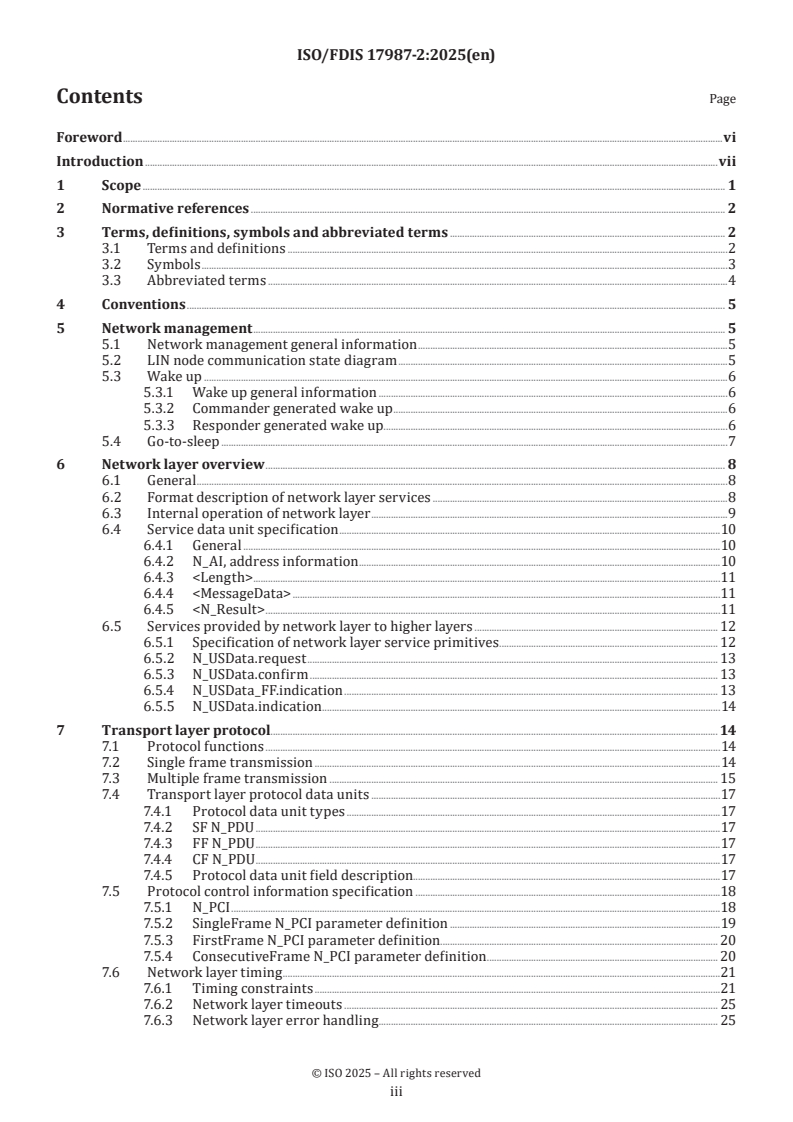
Contents Page
Foreword .vi
Introduction .vii
1 Scope . 1
2 Normative references . 2
3 Terms, definitions, symbols and abbreviated terms . 2
3.1 Terms and definitions .2
3.2 Symbols .3
3.3 Abbreviated terms .4
4 Conventions . 5
5 Network management . 5
5.1 Network management general information .5
5.2 LIN node communication state diagram .5
5.3 Wake up .6
5.3.1 Wake up general information .6
5.3.2 Commander generated wake up .6
5.3.3 Responder generated wake up.6
5.4 Go-to-sleep .7
6 Network layer overview . 8
6.1 General .8
6.2 Format description of network layer services .8
6.3 Internal operation of network layer .9
6.4 Service data unit specification .10
6.4.1 General .10
6.4.2 N_AI, address information .10
6.4.3 .11
6.4.4 .11
6.4.5 .11
6.5 Services provided by network layer to higher layers . 12
6.5.1 Specification of network layer service primitives . 12
6.5.2 N_USData.request . 13
6.5.3 N_USData.confirm . 13
6.5.4 N_USData_FF.indication . 13
6.5.5 N_USData.indication .14
7 Transport layer protocol. 14
7.1 Protocol functions .14
7.2 Single frame transmission .14
7.3 Multiple frame transmission . 15
7.4 Transport layer protocol data units .17
7.4.1 Protocol data unit types .17
7.4.2 SF N_PDU .17
7.4.3 FF N_PDU .17
7.4.4 CF N_PDU .17
7.4.5 Protocol data unit field description.17
7.5 Protocol control information specification .18
7.5.1 N_PCI .18
7.5.2 SingleFrame N_PCI parameter definition .19
7.5.3 FirstFrame N_PCI parameter definition. 20
7.5.4 ConsecutiveFrame N_PCI parameter definition . 20
7.6 Network layer timing .21
7.6.1 Timing constraints .21
7.6.2 Network layer timeouts . 25
7.6.3 Network layer error handling . . 25
iii
7.6.4 Unexpected arrival of N_PDU. 26
8 Data link layer usage .27
8.1 General .27
8.2 Data link layer service parameters .27
8.3 Data link layer interface services . 28
8.3.1 L_Data.request . 28
8.3.2 L_Data.confirm . 28
8.3.3 L_Data.indication . 28
8.4 Mapping of the N_PDU fields . 28
8.5 Transport layer PDU structure and communication . 29
8.5.1 PDU structure .
...
Date: 2024-12
ISO/TC 22/SC 31/WG 31
Secretariat: DIN
Date: 2025-02-21
Road vehicles — Local Interconnect Network (LIN) —
Part 2:
Transport protocol and network layer services
Véhicules routierroutiers — Réseau Internet Locallocal (LIN) —
Partie 2: Protocole de transport et couches de services réseau
FDIS stage
MUST BE USED
FOR FINAL
All rights reserved. Unless otherwise specified, or required in the context of its implementation, no part of this publication
may be reproduced or utilized otherwise in any form or by any means, electronic or mechanical, including photocopying,
or posting on the internet or an intranet, without prior written permission. Permission can be requested from either ISO
at the address below or ISO’s member body in the country of the requester.
ISO copyright office
CP 401 • Ch. de Blandonnet 8 • CP 401
CH-1214 Vernier, Geneva, Switzerland
Tel.Phone: + 41 22 749 01 11
Fax + 41 22 749 09 47
E-mail: copyright@iso.org
Website: www.iso.org
Published in Switzerland
ii
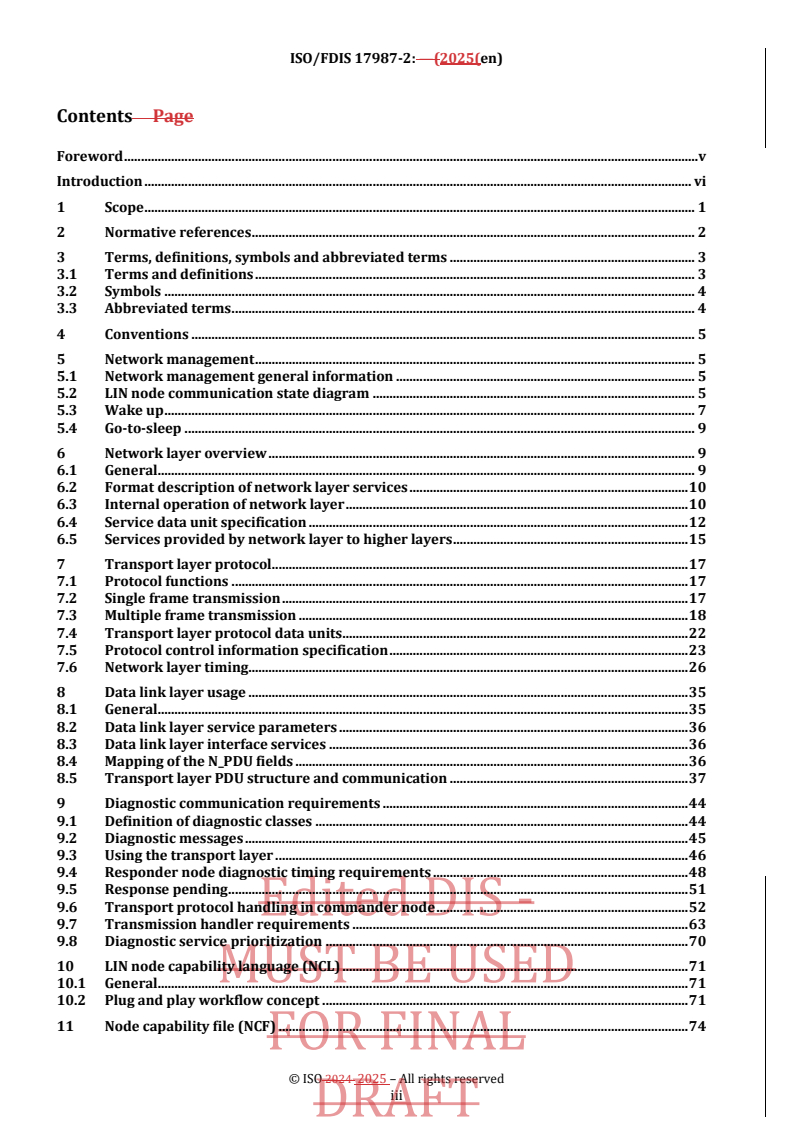
Contents Page
Foreword . v
Introduction . vi
1 Scope . 1
2 Normative references . 2
3 Terms, definitions, symbols and abbreviated terms . 3
3.1 Terms and definitions . 3
3.2 Symbols . 4
3.3 Abbreviated terms . 4
4 Conventions . 5
5 Network management . 5
5.1 Network management general information . 5
5.2 LIN node communication state diagram . 5
5.3 Wake up . 7
5.4 Go-to-sleep . 9
6 Network layer overview . 9
6.1 General. 9
6.2 Format description of network layer services . 10
6.3 Internal operation of network layer . 10
6.4 Service data unit specification . 12
6.5 Services provided by network layer to higher layers . 15
7 Transport layer protocol . 17
7.1 Protocol functions . 17
7.2 Single frame transmission . 17
7.3 Multiple frame transmission . 18
7.4 Transport layer protocol data units . 22
7.5 Protocol control information specification . 23
7.6 Network layer timing. 26
8 Data link layer usage . 35
8.1 General. 35
8.2 Data link layer service parameters . 36
8.3 Data link layer interface services . 36
8.4 Mapping of the N_PDU fields . 36
8.5 Transport layer PDU structure and communication . 37
9 Diagnostic communication requirements . 44
9.1 Definition of diagnostic classes . 44
9.2 Diagnostic messages . 45
9.3 Using the transport layer . 46
9.4 Responder node diagnostic timing requirements . 48
9.5 Response pending . 51
9.6 Transport protocol handling in commander node . 52
9.7 Transmission handler requirements . 63
9.8 Diagnostic service prioritization . 70
10 LIN node capability language (NCL) . 71
MUST BE USED
10.1 General. 71
10.2 Plug and play workflow concept . 71
11 Node capability file (NCF) . 74
FOR FINAL
iii
11.1 General. 74
11.2 Overview of NCF syntax . 74
11.3 Global structure definition . 75
11.4 Node definition . 76
11.5 NCF example . 81
12 LIN description file (LDF) . 82
12.1 General. 82
12.2 Overview of LDF syntax . 83
12.3 LDF definition . 83
12.4 LDF example . 101
Bibliography . 105
iv
Foreword
ISO (the International Organization for Standardization) is a worldwide federation of national standards
bodies (ISO member bodies). The work of preparing International Standards is normally carried out through
ISO technical committees. Each member body interested in a subject for which a technical committee has been
established has the right to be represented on that committee. International organizations, governmental and
non-governmental, in liaison with ISO, also take part in the work. ISO collaborates closely with the
International Electrotechnical Commission (IEC) on all matters of electrotechnical standardization.
The procedures used to develop this document and those intended for its further maintenance are described
in the ISO/IEC Directives, Part 1. In particular, the different approval criteria needed for the different types of
ISO documents should be noted. This document was drafted in accordance with the editorial rules of the
ISO/IEC Directives, Part 2 (see www.iso.org/directives).
ISO draws attention to the possibility that the implementation of this document may involve the use of (a)
patent(s). ISO takes no position concerning the evidence, validity or applicability of any claimed patent rights
in respect thereof. As of the date of publication of this document, ISO had not received notice of (a) patent(s)
which may be required to implement this document. However, implementers are cautioned that this may not
represent the latest information, which may be obtained from the patent database available at
www.iso.org/patents. ISO shall not be held responsible for identifying any or all such patent rights.
Any trade name used in this document is information given for the convenience of users and does not
constitute an endorsement.
For an explanation of the voluntary nature of standards, the meaning of ISO specific terms and expressions
related to conformity assessment, as well as information about ISO's adherence to the World Trade
Organization (WTO) principles in the Technical Barriers to Trade (TBT), see www.iso.org/iso/foreword.html.
This document was prepared by Technical Committee ISO/TC 22, Road vehicles, Subcommittee SC 31, Data
communication.
This second edition cancels and replaces the first edition (ISO 17987-2:2016), which has been technically
revised.
The main changes are as follows:
— — master and slave terms used for the LIN node types in the ISO 17987 series are replaced within this
document with inclusive language terms commander and responder. This also applies for abbreviations
and file formats NCF and LDF;
— — updates in the network layer error handling (7.6.3(7.6.3););
— — LDF and NCF format are adapted and extended to cover the same functional scope and allowing a
lossless format transition for responder nodes;
— — editorial updates and several statements improved to avoid ambiguities.
A list of all parts in the ISO 17987 series can be found on the ISO website.
Any feedback or questions on this document should be directed to the user’s national standards body. A
complete listing of these bodies can be found at www.iso.org/members.html.
MUST BE USED
FOR FINAL
v
Introduction
The LIN protocol as proposed is an automotive focused low speed universal asynchronous receiver
transmitter (UART) based network. Some of the key characteristics of the LIN protocol are signal based
communication, schedule table-based frame transfer, commander/responder communication with error
detection, node configuration and diagnostic service transportation.
The LIN protocol is for low-cost automotive control applications as, for example, door module and air
conditioning systems. It serves as a communication infrastructure for low-speed control applications in
vehicles by providing:
— — signal based communication to exchange information between applications in different nodes;
— — bitrate support from 1 kbit/s to 20 kbit/s;
— — deterministic schedule table-based frame communication;
— — network management that wakes up and puts the LIN cluster into sleep mode in a controlled manner;
— — status management that provides error handling and error signalling;
— — transport layer that allows large amount of data to be transported (such as diagnostic services);
— — specification of
...
Questions, Comments and Discussion
Ask us and Technical Secretary will try to provide an answer. You can facilitate discussion about the standard in here.