

ISO 23795-2:2024
(Main)Intelligent transport systems — Extracting trip data using nomadic and mobile devices for estimating CO2 emissions — Part 2: Information provision for eco-friendly driving behaviour
General Information
- Abstract
This document defines the extraction of vehicle trip data via nomadic devices to measure CO2 emissions in relation to driving behaviours. The extracted data can then be analysed and provided to drivers to serve as eco-friendly driving guidance. In this document the following items are defined: — use cases for different events (speeding, long speeding, sudden start and stop, sudden acceleration and deceleration, idling, fuel-cut, economical driving); — functional requirements for collecting data for driving behaviour pattern analysis; — data sets for each use case for measuring vehicle emissions (CO2) and for being provided to drivers via nomadic devices. Vehicle types such as passenger cars, vans, utility vehicles, etc. are concerned in this document
- Status
- Published
- Publication Date
- 01-Feb-2024
- Technical Committee
- ISO/TC 204 - Intelligent transport systems
- Drafting Committee
- ISO/TC 204/WG 17 - Nomadic Devices in ITS Systems
- Current Stage
- 6060 - International Standard published
- Start Date
- 02-Feb-2024
- Due Date
- 02-Sep-2023
- Completion Date
- 02-Feb-2024
Buy Documents
ISO 23795-2:2024 - Intelligent transport systems — Extracting trip data using nomadic and mobile devices for estimating CO2 emissions — Part 2: Information provision for eco-friendly driving behaviour Released:2. 02. 2024
Overview
Standard Reference: ISO 23795-2:2024
Title: Intelligent transport systems - Extracting trip data using nomadic and mobile devices for estimating CO2 emissions - Part 2: Information provision for eco-friendly driving behaviour
ISO 23795-2:2024 defines how vehicle trip data are extracted via nomadic devices (NDs) and mobile devices to measure and communicate CO2 emissions related to driving behaviour. The document specifies use cases, functional requirements and the datasets needed to analyse driving events (e.g., speeding, idling, sudden acceleration) and to provide actionable eco-driving guidance to drivers via nomadic devices and cloud services.
Key topics and technical requirements
- Use cases (UC1–UC9): Standardised event definitions including Speeding, Long Speeding, Sudden Acceleration, Sudden Start, Sudden Deceleration, Sudden Stop, Idling, Fuel-cut, and Economical Driving.
- Functional requirements for nomadic devices:
- Reliable, consistent connection between ND and vehicle ITS station.
- ND must receive vehicle status data (vehicle speed, RPM, fuel injection amount, etc.) and transfer it to cloud servers.
- Power supply interfaces for stable ND operation.
- Datasets and data types: Per-use-case data items required for CO2 estimation and driver feedback. Examples include:
- Trip ID and ND ID
- Vehicle speed and driving time
- Fuel injection amount and RPM
- GNSS coordinates (longitude, latitude, altitude)
- Event-specific counters (e.g., speeding duration, number of sudden stops)
- Interoperability elements: Definitions reference nomadic device identification (ND ID), UVIP (unified vehicle interface protocol), and short/long range communications (cellular 3G/4G/5G, IEEE 802.11x).
Practical applications
- Driver feedback and eco-driving apps: Provide real-time or post-trip coaching to reduce CO2 through reduced speeding, smoother acceleration/deceleration, and minimized idling.
- Fleet management: Quantify fleet CO2 emissions tied to driving behaviour for fuel efficiency programs and emissions reporting.
- Mobility service providers & telematics vendors: Implement standardised data extraction and event detection to support cloud analytics and user-facing eco-driving services.
- Policy & sustainability programmes: Support greenhouse-gas quantification aligned with national ETS / regulatory requirements and carbon reduction targets.
Who should use this standard
- Automotive OEMs and suppliers (infotainment, telematics)
- Mobile app developers and ITS solution providers
- Fleet operators and logistics companies
- Urban mobility planners, regulators and researchers focused on transport emissions
Related standards
- Other parts of the ISO 23795 series (for related extraction and measurement guidance)
- ISO/TC 204 outputs on Intelligent Transport Systems and ITS data interoperability
This standard helps ensure consistent, interoperable extraction of trip data from nomadic and mobile devices to reliably estimate CO2 linked to driving behaviour and to deliver effective eco-driving information.
Relations
- Effective Date
- 19-Nov-2022
Buy Documents
ISO 23795-2:2024 - Intelligent transport systems — Extracting trip data using nomadic and mobile devices for estimating CO2 emissions — Part 2: Information provision for eco-friendly driving behaviour Released:2. 02. 2024
Get Certified
Connect with accredited certification bodies for this standard

BSI Group
BSI (British Standards Institution) is the business standards company that helps organizations make excellence a habit.

TÜV Rheinland
TÜV Rheinland is a leading international provider of technical services.

TÜV SÜD
TÜV SÜD is a trusted partner of choice for safety, security and sustainability solutions.
Sponsored listings
Frequently Asked Questions
ISO 23795-2:2024 is a standard published by the International Organization for Standardization (ISO). Its full title is "Intelligent transport systems — Extracting trip data using nomadic and mobile devices for estimating CO2 emissions — Part 2: Information provision for eco-friendly driving behaviour". This standard covers: This document defines the extraction of vehicle trip data via nomadic devices to measure CO2 emissions in relation to driving behaviours. The extracted data can then be analysed and provided to drivers to serve as eco-friendly driving guidance. In this document the following items are defined: — use cases for different events (speeding, long speeding, sudden start and stop, sudden acceleration and deceleration, idling, fuel-cut, economical driving); — functional requirements for collecting data for driving behaviour pattern analysis; — data sets for each use case for measuring vehicle emissions (CO2) and for being provided to drivers via nomadic devices. Vehicle types such as passenger cars, vans, utility vehicles, etc. are concerned in this document
This document defines the extraction of vehicle trip data via nomadic devices to measure CO2 emissions in relation to driving behaviours. The extracted data can then be analysed and provided to drivers to serve as eco-friendly driving guidance. In this document the following items are defined: — use cases for different events (speeding, long speeding, sudden start and stop, sudden acceleration and deceleration, idling, fuel-cut, economical driving); — functional requirements for collecting data for driving behaviour pattern analysis; — data sets for each use case for measuring vehicle emissions (CO2) and for being provided to drivers via nomadic devices. Vehicle types such as passenger cars, vans, utility vehicles, etc. are concerned in this document
ISO 23795-2:2024 is classified under the following ICS (International Classification for Standards) categories: 13.020.40 - Pollution, pollution control and conservation; 13.040.50 - Transport exhaust emissions; 35.240.60 - IT applications in transport; 43.040.15 - Car informatics. On board computer systems. The ICS classification helps identify the subject area and facilitates finding related standards.
ISO 23795-2:2024 has the following relationships with other standards: It is inter standard links to ISO 13341:2025. Understanding these relationships helps ensure you are using the most current and applicable version of the standard.
ISO 23795-2:2024 is available in PDF format for immediate download after purchase. The document can be added to your cart and obtained through the secure checkout process. Digital delivery ensures instant access to the complete standard document.
Standards Content (Sample)
International
Standard
ISO 23795-2
First edition
Intelligent transport systems
2024-02
— Extracting trip data using
nomadic and mobile devices for
estimating CO emissions —
Part 2:
Information provision for eco-
friendly driving behaviour
Systèmes de transport intelligents — Extraction de données de
trajet à l'aide de dispositifs nomades et mobiles pour
l'estimation des émissions de CO —
Partie 2: Fourniture d'informations pour un comportement de
conduite respectueux de l'environnement
Reference number
© ISO 2024
All rights reserved. Unless otherwise specified, or required in the context of its implementation, no part of this publication may
be reproduced or utilized otherwise in any form or by any means, electronic or mechanical, including photocopying, or posting on
the internet or an intranet, without prior written permission. Permission can be requested from either ISO at the address below
or ISO’s member body in the country of the requester.
ISO copyright office
CP 401 • Ch. de Blandonnet 8
CH-1214 Vernier, Geneva
Phone: +41 22 749 01 11
Email: copyright@iso.org
Website: www.iso.org
Published in Switzerland
ii
Contents Page
Foreword .iv
Introduction .v
1 Scope . 1
2 Normative references . 1
3 Terms, definitions and abbreviated terms . 1
3.1 Terms and definitions .1
3.2 Abbreviated terms .2
4 General information . 2
4.1 Purpose of information provision for eco-friendly driving behaviour .2
4.2 Overview of use cases .3
4.3 Functional requirement .3
5 Use cases definitions . 3
5.1 Overview .3
5.2 UC 1: Speeding.3
5.3 UC 2: Long speeding .4
5.4 UC 3: Sudden acceleration .5
5.5 UC 4: Sudden start .5
5.6 UC 5: Sudden deceleration .6
5.7 UC 6: Sudden stop .7
5.8 UC 7: Idling .7
5.9 UC 8: Fuel-cut .8
5.10 UC 9: Economical driving .9
6 Datasets definitions . 10
6.1 Overview .10
6.2 Data type .10
6.3 Datasets definitions in use cases .10
6.3.1 UC 1: Speeding .10
6.3.2 UC 2: Long speeding .10
6.3.3 UC 3: Sudden acceleration .11
6.3.4 UC 4: Sudden start .11
6.3.5 UC 5: Sudden deceleration . 12
6.3.6 UC 6: Sudden stop . 12
6.3.7 UC 7: Idling . 13
6.3.8 UC 8: Fuel-cut . . 13
6.3.9 UC 9: Economical driving .14
Bibliography .15
iii
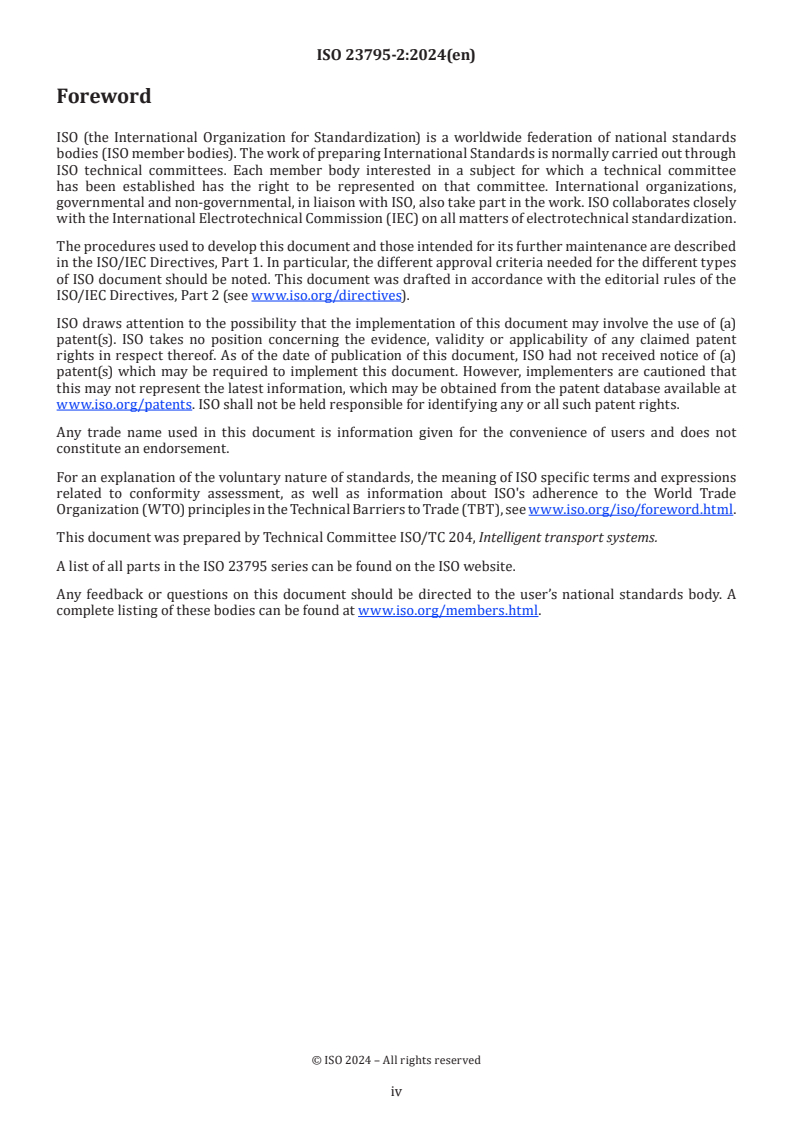
Foreword
ISO (the International Organization for Standardization) is a worldwide federation of national standards
bodies (ISO member bodies). The work of preparing International Standards is normally carried out through
ISO technical committees. Each member body interested in a subject for which a technical committee
has been established has the right to be represented on that committee. International organizations,
governmental and non-governmental, in liaison with ISO, also take part in the work. ISO collaborates closely
with the International Electrotechnical Commission (IEC) on all matters of electrotechnical standardization.
The procedures used to develop this document and those intended for its further maintenance are described
in the ISO/IEC Directives, Part 1. In particular, the different approval criteria needed for the different types
of ISO document should be noted. This document was drafted in accordance with the editorial rules of the
ISO/IEC Directives, Part 2 (see www.iso.org/directives).
ISO draws attention to the possibility that the implementation of this document may involve the use of (a)
patent(s). ISO takes no position concerning the evidence, validity or applicability of any claimed patent
rights in respect thereof. As of the date of publication of this document, ISO had not received notice of (a)
patent(s) which may be required to implement this document. However, implementers are cautioned that
this may not represent the latest information, which may be obtained from the patent database available at
www.iso.org/patents. ISO shall not be held responsible for identifying any or all such patent rights.
Any trade name used in this document is information given for the convenience of users and does not
constitute an endorsement.
For an explanation of the voluntary nature of standards, the meaning of ISO specific terms and expressions
related to conformity assessment, as well as information about ISO's adherence to the World Trade
Organization (WTO) principles in the Technical Barriers to Trade (TBT), see www.iso.org/iso/foreword.html.
This document was prepared by Technical Committee ISO/TC 204, Intelligent transport systems.
A list of all parts in the ISO 23795 series can be found on the ISO website.
Any feedback or questions on this document should be directed to the user’s national standards body. A
complete listing of these bodies can be found at www.iso.org/members.html.
iv
Introduction
Vehicle emission has become a main air pollution contributor, producing carbon dioxide and greenhouse
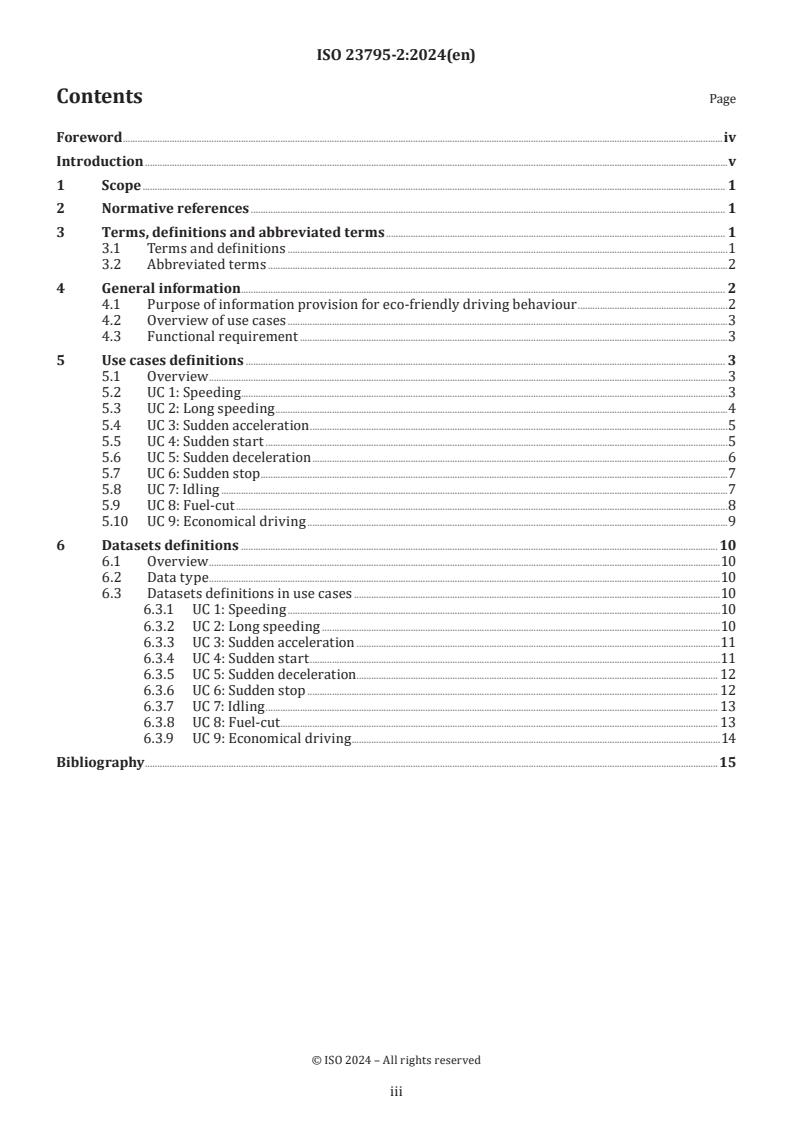
gases. This document has been established to define criteria for measuring carbon dioxide emissions in
relation to driving behaviours.
[1][2][3][4][5][6]
The international community has been actively pursuing greenhouse gas reduction policies
etc. since the Paris Agreement adopted by the CMA(Conference of the parties serving as the Meeting of the
parties to Paris Agreement) as a comprehensive policy direction to cope with climate change.
In addition, the U.S., Europe and Asia are implementing a greenhouse gas ETS(emission trading system) to
boost it.
In particular, greenhouse gases emitted from the transportation sector for greenhouse gas emission trading
need to be quantified according to national policies. This standard is a basic document that can support the
quantification of greenhouse gases emitted from vehicles.
The document aims to extract driving information based on driving patterns of drivers needed to provide
eco-friendly driving behaviour services as part of achieving goals related to global carbon reduction policies.
It is intended to be used as a basis for interaction between vehicles, nomadic devices and cloud servers.
Carbon dioxide emission measurement in relation to driving behaviours is determined by different events:
speeding, long speeding, sudden acceleration/deceleration, sudden start/stop, idling, fuel-cut, economical
driving, etc.
This document provides all documents and references required to support the implementation of the
requirements related to standardized access to nomadic device service for estimating carbon dioxide
emissions. The document contains functional requirements and datasets required by use cases.
v
International Standard ISO 23795-2:2024(en)
Intelligent transport systems — Extracting trip data
using nomadic and mobile devices for estimating CO
emissions —
Part 2:
Information provision for eco-friendly driving behaviour
1 Scope
This document defines the extraction of vehicle trip data via nomadic devices to measure CO emissions in
relation to driving behaviours. The extracted data can then be analysed and provided to drivers to serve as
eco-friendly driving guidance. In this document the following items are defined:
— use cases for different events (speeding, long speeding, sudden start and stop, sudden acceleration and
deceleration, idling, fuel-cut, economical driving);
— functional requirements for collecting data for driving behaviour pattern analysis;
— data sets for each use case for measuring vehicle emissions (CO ) and for being provided to drivers via
nomadic devices.
Vehicle types such as passenger cars, vans, utility vehicles, etc. are concerned in this document.
2 Normative references
There are no normative references in this document.
3 Terms, definitions and abbreviated terms
3.1 Terms and definitions
For the purposes of this document, the following terms and definitions apply.
ISO and IEC maintain terminology databases for use in standardization at the following addresses:
— ISO Online browsing platform: available at https:// www. iso. org/o bp
— IEC Electropedia: available at https:// www.e lectropedia. org/
3.1.1
nomadic device
ND
implementation of a personal ITS station which provides communication connectivity via portable
equipment such as cellular telephones, wireless communication network (3G, 4G and 5G), mobile wireless
broadband (WIMAX, HC-SDMA, etc.), etc. and includes short range links, such as IEEE 802.11x, etc. to connect
portable devices to the motor vehicle communications system network
3.1.2
nomadic device identification
ND ID
unique identifier assigned to nomadic device by the nomadic device’s manufacturer
3.2 Abbreviated terms
ID identification
UVIP unified vehicle interface protocol
RPM revolutions per minute
GNSS global navigation satellite system
cc cubic centimetres (cm )
uint8_t unsigned character
uint16_t unsigned short integer
uint32_t unsigned integer
uint64_t unsigned long integer
4 General information
4.1 Purpose of information provision for eco-friendly driving behaviour
The main purpose of providing information on eco-friendly driving behaviour is to give eco-friendly driving
behaviour guidance to drivers so that they can reduce their carbon dioxide emissions from vehicles. In order
to meet this aim, it is necessary to conduct driving behaviour analysis by monitoring data gathered from the
ND in a vehicle. Figure 1 provides an overview of this process.
Key
1 vehicle data (speed, RPM, etc)
2 wireless communication(3G, LTE, 5G, etc.)
3 nomadic device
4 cloud server
5 driving behaviour information
6 short-range wireless communication (IEEE 802.11x series)
7 UVIP
Figure 1 — Service system overview
The carbon emissions produced by a vehicle are proportional to the speed, sudden acceleration, sudden
deceleration, idling, etc. of that vehicle. Driving behaviours are therefore categorized by driving events
such as speeding, long speeding, sudden start/stop, sudden acceleration/deceleration, idling, fuel-cut, and
economical driving.
4.2 Overview of use cases
For the purpose stated in 4.1, various use cases are defined as follows:
— UC1: Speeding – Act of driving faster than is legally allowed;
— UC2: Long speeding – Act of driving faster than is legally allowed for a long duration;
— UC3: Sudden acceleration – Acceleration in a brief time;
— UC4: Sudden start – Acceleration from a stop position in a brief time;
— UC5: Sudden deceleration – Deceleration in a brief time;
— UC6: Sudden stop – Deceleration to stop in a brief time;
— UC7: Idling – Running a vehicle’s engine in a stop position;
— UC8: Fuel-cut – Maintain RPM without stepping on a pedal;
— UC9: Economical driving – Maintaining speed in the specified range of speed allowed.
4.3 Functional requirement
This document defines functional requirement for providing driving behaviour information using an ND.
The functional requirements of an ND are as follows:
— the ND shall be reliably and consistently connected with a vehicle in order to gather trip information;
— the ND shall receive vehicle status data such as vehicle speed, fuel injection amount, RPM, etc., which is
collected through vehicle ITS station, and shall transfer it to a cloud server;
— the ND shall be reliably and consistently connected with a vehicle;
— the ND shall provide power supply interfaces for stable nomadic device operation.
5 Use cases definitions
5.1 Overview
This clause defines all use cases for providing a driver's driving habit information through an ND. There are
nine use cases in total, shown in Tables 1 to 10.
5.2 UC 1: Speeding
Speeding is a case where the vehicle has been driven at more than 20 km/h above the legal road speed limit,
for a duration of 2 min or less.
Table 1 — Use case 1: Speeding
Use case name Vehicle information provision service for speeding
Actor(s) Vehicle, driver, ND
Goal Providing vehicle speeding information to driver
Use case input Automatic request by ND
Use case output Vehicle speeding data displayed on ND
Brief description This use case defines basic data for providing the driver with information on speeding of the
vehicle driver via the ND. This information can be used for calculating CO emissions and
eco-friendly driving habits.
Data required a) Trip ID
b) ND ID
c) Vehicle speed
d) Fuel injection amount
e) GNSS (longitude, latitude, altitude) values
f) Vehicle driving time
g) Speeding driving time
h) Number of times for speeding defined in 5.2 during driving
5.3 UC 2: Long speeding
Long speeding is a case where the vehicle has been driven at more than 20 km/h above the legal road speed
limit, and for a duration of 2 min or longer.
Table 2 — Use cas
...