


ISO/PAS 45007
(Main)Occupational health and safety management - Risks arising from climate change and climate change action - Guidance for organizations
Occupational health and safety management - Risks arising from climate change and climate change action - Guidance for organizations
Management de la santé et de la sécurité au travail — Risques dus aux changements climatiques et action contre le changement climatique — Recommandations pour les organisations
General Information
- Status
- Not Published
- Technical Committee
- ISO/TC 283 - Occupational health and safety management
- Drafting Committee
- ISO/TC 283 - Occupational health and safety management
- Current Stage
- 6000 - International Standard under publication
- Start Date
- 13-Nov-2025
- Completion Date
- 10-Jan-2026
Overview
ISO/PAS 45007 (ISO/DPAS 45007:2025(en)) is a Publicly Available Specification (final draft) from ISO/TC 283 that provides guidance for managing occupational health and safety (OH&S) risks arising from climate change and climate change action. The document helps organizations - including SMEs and those without a formal OH&S system - to identify, assess and control health and safety risks from climate impacts, adaptation measures and mitigation activities, and to seize related safety improvement opportunities.
Key topics
- Framework and PDCA approach: Guidance aligns with a Plan–Do–Check–Act cycle and supports integration into existing OH&S management systems (for example, ISO 45001).
- Context, leadership and participation: How to consider internal/external context, leadership commitment and worker participation in climate-related OH&S planning.
- Management of change & emergency preparedness: Addressing changes from adaptation/mitigation actions and preparing for climate-driven emergencies.
- Planning elements: OH&S objectives, business continuity, infrastructure and community dependencies, supply chain impacts, and legal/other requirements.
- Risk assessment methodologies: Approaches for identifying and evaluating OH&S risks from climate hazards, adaptation projects and mitigation measures.
- Vulnerability and exposure: Identifying who or what is most vulnerable (work activities, worker groups, locations) and how vulnerability changes over time and place.
- Support, communication and competence: Training, awareness, advocacy and stakeholder communication to implement protective measures.
- Performance evaluation: Systematic evaluation and monitoring of OH&S performance related to climate risks.
- Informative annexes: Relationship between climate impacts/adaptation and OH&S, plus case studies (Annex A & B).
Practical applications
- Integrating climate-related OH&S risk management into existing EHS/OSH systems and management reviews.
- Updating business continuity and emergency response plans to account for extreme weather and long-term climate trends.
- Assessing OH&S implications of adaptation measures (e.g., infrastructure upgrades) and mitigation projects (e.g., new technologies, process changes).
- Designing training, communication and worker-participation programs focused on heat, storms, air quality, supply chain disruption and other climate-driven hazards.
- Informing procurement and supply-chain resilience decisions to limit downstream OH&S impacts.
Who should use it
- OH&S / EHS managers and practitioners
- Sustainability, resilience and risk managers
- Facilities and operations leaders planning adaptation or mitigation projects
- SMEs seeking proportionate guidance on climate-related workplace safety
- Regulators and auditors looking for guidance to interpret OH&S impacts of climate actions
Related standards
- ISO 45001 (Occupational health and safety management systems) - for integration with formal OH&S management.
- ISO guidance on climate topics (e.g., ISO 14080, ISO 14090) referenced for terminology and climate concepts.
Keywords: ISO/PAS 45007, occupational health and safety, climate change risks, climate change action, OH&S management, PDCA, risk assessment, business continuity, ISO 45001, workplace resilience.

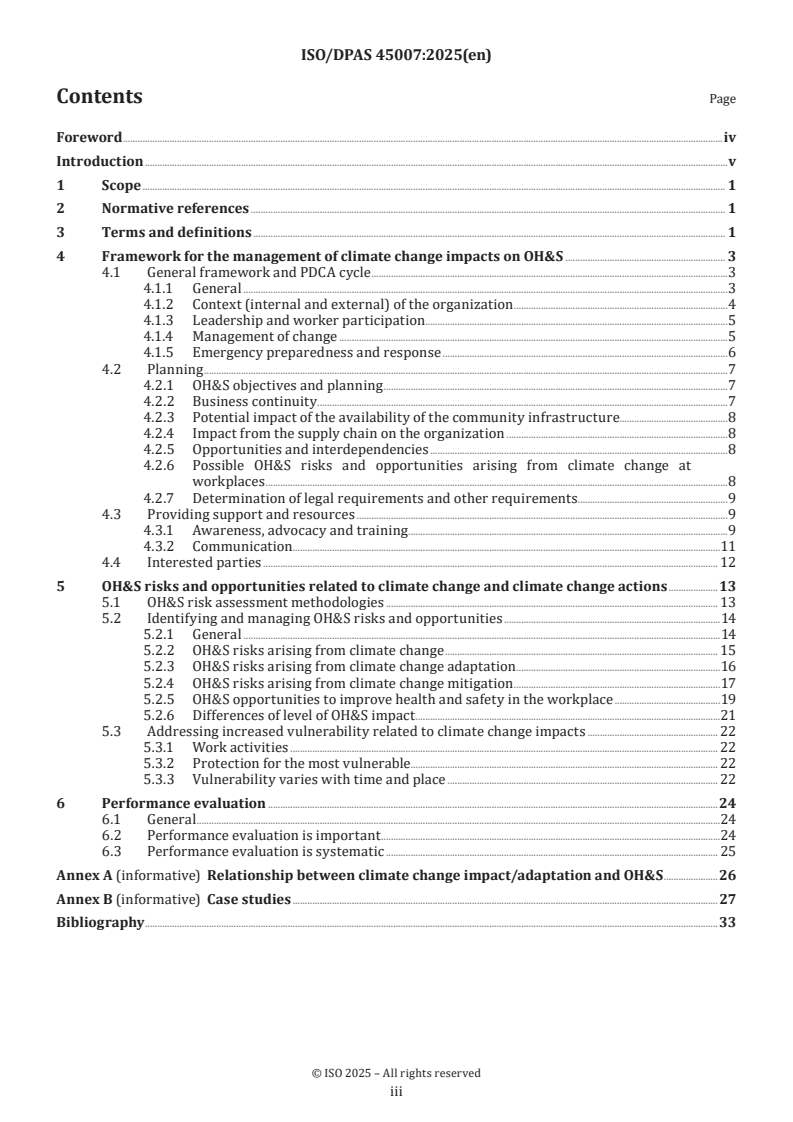
ISO/DPAS 45007 - Occupational health and safety management — Risks arising from climate change and climate change action — Guidance for organizations Released:3. 09. 2025
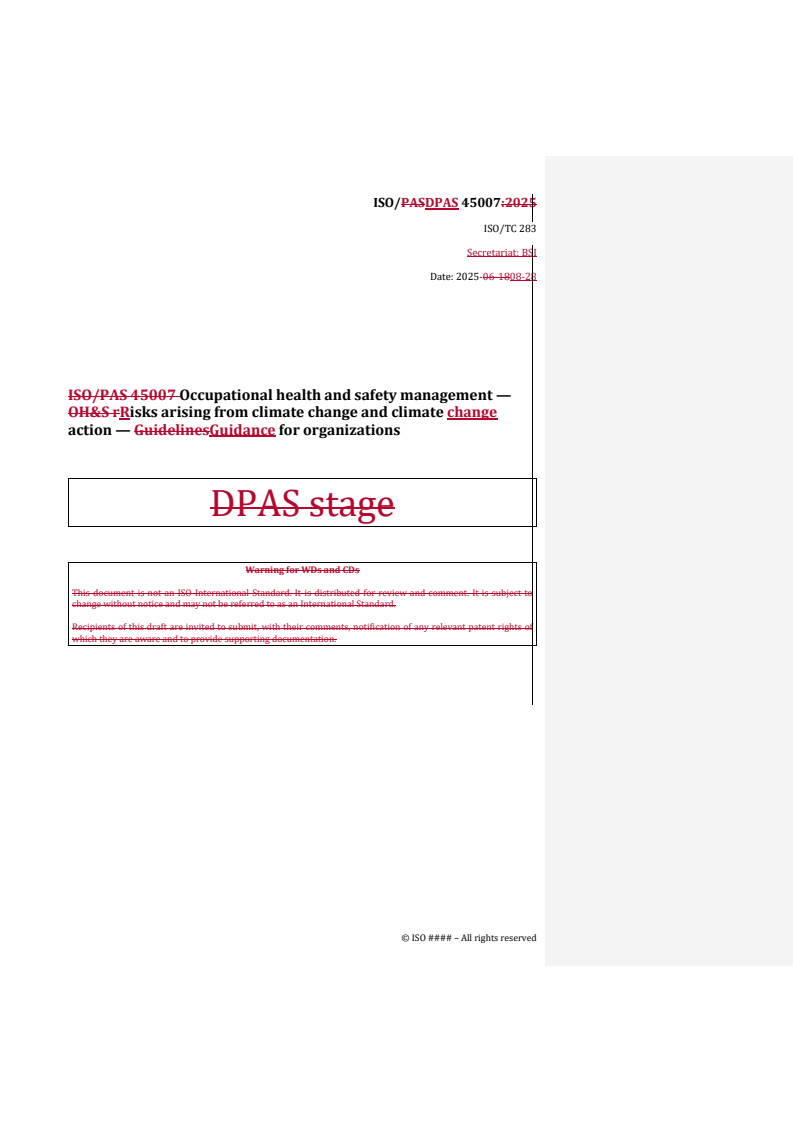
REDLINE ISO/DPAS 45007 - Occupational health and safety management — Risks arising from climate change and climate change action — Guidance for organizations Released:3. 09. 2025
Frequently Asked Questions
ISO/PAS 45007 is a draft published by the International Organization for Standardization (ISO). Its full title is "Occupational health and safety management - Risks arising from climate change and climate change action - Guidance for organizations". This standard covers: Occupational health and safety management - Risks arising from climate change and climate change action - Guidance for organizations
Occupational health and safety management - Risks arising from climate change and climate change action - Guidance for organizations
ISO/PAS 45007 is classified under the following ICS (International Classification for Standards) categories: 13.100 - Occupational safety. Industrial hygiene. The ICS classification helps identify the subject area and facilitates finding related standards.
ISO/PAS 45007 is available in PDF format for immediate download after purchase. The document can be added to your cart and obtained through the secure checkout process. Digital delivery ensures instant access to the complete standard document.
Standards Content (Sample)
FINAL DRAFT
Publicly
Available
Specification
ISO/DPAS 45007
ISO/TC 283
Occupational health and safety
Secretariat: BSI
management — Risks arising
Voting begins on:
from climate change and climate
2025-09-17
change action — Guidance for
Voting terminates on:
organizations
2025-11-12
RECIPIENTS OF THIS DRAFT ARE INVITED TO SUBMIT,
WITH THEIR COMMENTS, NOTIFICATION OF ANY
RELEVANT PATENT RIGHTS OF WHICH THEY ARE AWARE
AND TO PROVIDE SUPPOR TING DOCUMENTATION.
IN ADDITION TO THEIR EVALUATION AS
BEING ACCEPTABLE FOR INDUSTRIAL, TECHNO
LOGICAL, COMMERCIAL AND USER PURPOSES, DRAFT
INTERNATIONAL STANDARDS MAY ON OCCASION HAVE
TO BE CONSIDERED IN THE LIGHT OF THEIR POTENTIAL
TO BECOME STAN DARDS TO WHICH REFERENCE MAY BE
MADE IN NATIONAL REGULATIONS.
Reference number
ISO/DPAS 45007:2025(en) © ISO 2025
FINAL DRAFT
ISO/DPAS 45007:2025(en)
Publicly
Available
Specification
ISO/DPAS 45007
ISO/TC 283
Occupational health and safety
Secretariat: BSI
management — Risks arising
Voting begins on:
from climate change and climate
change action — Guidance for
Voting terminates on:
organizations
RECIPIENTS OF THIS DRAFT ARE INVITED TO SUBMIT,
WITH THEIR COMMENTS, NOTIFICATION OF ANY
RELEVANT PATENT RIGHTS OF WHICH THEY ARE AWARE
AND TO PROVIDE SUPPOR TING DOCUMENTATION.
© ISO 2025
IN ADDITION TO THEIR EVALUATION AS
All rights reserved. Unless otherwise specified, or required in the context of its implementation, no part of this publication may
BEING ACCEPTABLE FOR INDUSTRIAL, TECHNO
LOGICAL, COMMERCIAL AND USER PURPOSES, DRAFT
be reproduced or utilized otherwise in any form or by any means, electronic or mechanical, including photocopying, or posting on
INTERNATIONAL STANDARDS MAY ON OCCASION HAVE
the internet or an intranet, without prior written permission. Permission can be requested from either ISO at the address below
TO BE CONSIDERED IN THE LIGHT OF THEIR POTENTIAL
or ISO’s member body in the country of the requester.
TO BECOME STAN DARDS TO WHICH REFERENCE MAY BE
MADE IN NATIONAL REGULATIONS.
ISO copyright office
CP 401 • Ch. de Blandonnet 8
CH-1214 Vernier, Geneva
Phone: +41 22 749 01 11
Email: copyright@iso.org
Website: www.iso.org
Published in Switzerland Reference number
ISO/DPAS 45007:2025(en) © ISO 2025
ii
ISO/DPAS 45007:2025(en)
Contents Page
Foreword .iv
Introduction .v
1 Scope . 1
2 Normative references . 1
3 Terms and definitions . 1
4 Framework for the management of climate change impacts on OH&S . 3
4.1 General framework and PDCA cycle .3
4.1.1 General .3
4.1.2 Context (internal and external) of the organization .4
4.1.3 Leadership and worker participation .5
4.1.4 Management of change .5
4.1.5 Emergency preparedness and response .6
4.2 Planning .7
4.2.1 OH&S objectives and planning .7
4.2.2 Business continuity .7
4.2.3 Potential impact of the availability of the community infrastructure.8
4.2.4 Impact from the supply chain on the organization .8
4.2.5 Opportunities and interdependencies .8
4.2.6 Possible OH&S risks and opportunities arising from climate change at
workplaces .8
4.2.7 Determination of legal requirements and other requirements .9
4.3 Providing support and resources .9
4.3.1 Awareness, advocacy and training . .9
4.3.2 Communication.11
4.4 Interested parties . 12
5 OH&S risks and opportunities related to climate change and climate change actions .13
5.1 OH&S risk assessment methodologies . 13
5.2 Identifying and managing OH&S risks and opportunities .14
5.2.1 General .14
5.2.2 OH&S risks arising from climate change . 15
5.2.3 OH&S risks arising from climate change adaptation .16
5.2.4 OH&S risks arising from climate change mitigation .17
5.2.5 OH&S opportunities to improve health and safety in the workplace .19
5.2.6 Differences of level of OH&S impact .21
5.3 Addressing increased vulnerability related to climate change impacts . 22
5.3.1 Work activities . 22
5.3.2 Protection for the most vulnerable. 22
5.3.3 Vulnerability varies with time and place . 22
6 Performance evaluation .24
6.1 General .24
6.2 Performance evaluation is important .24
6.3 Performance evaluation is systematic . 25
Annex A (informative) Relationship between climate change impact/adaptation and OH&S .26
Annex B (informative) Case studies .27
Bibliography .33
iii
ISO/DPAS 45007:2025(en)
Foreword
ISO (the International Organization for Standardization) is a worldwide federation of national standards
bodies (ISO member bodies). The work of preparing International Standards is normally carried out through
ISO technical committees. Each member body interested in a subject for which a technical committee
has been established has the right to be represented on that committee. International organizations,
governmental and non-governmental, in liaison with ISO, also take part in the work. ISO collaborates closely
with the International Electrotechnical Commission (IEC) on all matters of electrotechnical standardization.
The procedures used to develop this document and those intended for its further maintenance are described
in the ISO/IEC Directives, Part 1. In particular, the different approval criteria needed for the different types
of ISO document should be noted. This document was drafted in accordance with the editorial rules of the
ISO/IEC Directives, Part 2 (see www.iso.org/directives).
ISO draws attention to the possibility that the implementation of this document may involve the use of (a)
patent(s). ISO takes no position concerning the evidence, validity or applicability of any claimed patent
rights in respect thereof. As of the date of publication of this document, ISO had not received notice of (a)
patent(s) which may be required to implement this document. However, implementers are cautioned that
this may not represent the latest information, which may be obtained from the patent database available at
www.iso.org/patents. ISO shall not be held responsible for identifying any or all such patent rights.
Any trade name used in this document is information given for the convenience of users and does not
constitute an endorsement.
For an explanation of the voluntary nature of standards, the meaning of ISO specific terms and expressions
related to conformity assessment, as well as information about ISO’s adherence to the World Trade
Organization (WTO) principles in the Technical Barriers to Trade (TBT), see www.iso.org/iso/foreword.html.
This document was prepared by Technical Committee ISO/TC 283, Occupational health and safety
management.
Any feedback or questions on this document should be directed to the user’s national standards body. A
complete listing of these bodies can be found at www.iso.org/members.html.
iv
ISO/DPAS 45007:2025(en)
Introduction
Climate change poses significant challenges to organizations worldwide, impacting not only the environment
but also occupational health and safety (OH&S), meaning that it is important that organizations proactively
address the OH&S challenges arising from climate change and climate change actions. This document
provides comprehensive guidance for organizations to manage these risks and opportunities effectively.
This document is intended for all organizations, whether or not they have implemented informal or formal
OH&S management system such as ISO 45001. Such a management system includes the relevant elements
of a Plan-Do-Check-Act (PDCA) system. Taking a systems approach facilitates the coordination of resources
and efforts, which is important in managing climate change.
This document will assist organizations to better understand the impacts of climate change and climate
change actions on OH&S and to create resilient and sustainable work environments that protect the health
and safety of workers.
It encompasses OH&S risks resulting from climate change itself, as well as those arising from climate change
adaptation efforts, such as changes in work processes or infrastructure upgrades, and those associated
with climate change mitigation efforts aimed at reducing greenhouse gas (GHG) effects or an organization’s
carbon footprint.
It also highlights the opportunities to enhance workplace health and safety through proactive measures.
Due to the nature of the subject, many definitions and concepts have been imported from the fields of climate
change science and adapted to the context of OH&S risk identification, assessment and control, with focus on
both health and safety impacts and opportunities.
v
FINAL DRAFT Publicly Available Specification ISO/DPAS 45007:2025(en)
Occupational health and safety management — Risks arising
from climate change and climate change action — Guidance
for organizations
1 Scope
This document gives guidance to organizations on planning for and addressing occupational health and
safety (OH&S) risks arising from climate change and climate change action, including:
— OH&S risks which arise as a result of climate change adaptation efforts, including changing ways of
working and work processes, and infrastructure upgrades;
— OH&S risks arising from climate change mitigation actions;
— OH&S opportunities arising from both climate change adaptation and mitigation actions.
This document is applicable to all organizations taking a systematic approach to addressing OH&S risks
arising from climate change. It is applicable to organizations of all sizes including small and medium-sized
enterprises (SMEs).
2 Normative references
There are no normative references in this document.
3 Terms and definitions
For the purposes of this document, the following terms and definitions apply.
ISO and IEC maintain terminology databases for use in standardization at the following addresses:
— ISO Online browsing platform: available at https:// www .iso .org/ obp
— IEC Electropedia: available at https:// www .electropedia .org/
3.1
climate
statistical description of weather in terms of the mean and variability of relevant quantities over a period of
time ranging from months to thousands or millions of years
Note 1 to entry: The usual period for considering these variables is 30 years, as defined by the World Meteorological
Organization.
Note 2 to entry: The relevant quantities are most often near-surface variables such as temperature, precipitation and wind.
[SOURCE: ISO 14090:2019, 3.4]
3.2
climate change
change in climate (3.1) that persists for an extended period, typically decades or longer
Note 1 to entry: Change in climate can be identified (e.g. by using statistical tests) by changes in the mean and/or the
variability of its properties.
ISO/DPAS 45007:2025(en)
Note 2 to entry: Climate change can be due to natural processes, internal to the climate system, or external forces such
as modulations of the solar cycles, volcanic eruptions, and persistent anthropogenic changes in the composition of the
atmosphere or in land use.
[SOURCE: ISO Guide 84:2020, 3.1.2]
3.3
climate change action
initiative to achieve climate change measures or goals based on mitigation and/or adaptation priorities
under climate change policies
Note 1 to entry: Climate change action intends to a) reduce or prevent emissions or enhance removals, and b) reduce
vulnerability, maintain and increase the resilience, and increase adaptive capacity of human and ecological systems
from adverse climate change impacts (3.5).
[SOURCE: ISO 14080:2018, 3.1.1.1, modified — “change” added to the term.]
3.4
climate change adaptation
process of adjustment to actual or expected climate (3.1) and its effects
Note 1 to entry: In human systems, adaptation seeks to moderate or avoid harm or exploit beneficial opportunities.
Note 2 to entry: In some natural systems, human intervention can facilitate adjustment to expected climate and its
effects.
[SOURCE: ISO 14090:2019, 3.1, modified — “climate change adaptation” replaced “adaptation to climate
change” as the preferred term.]
3.5
climate change impact
effect on natural and human systems of extreme weather and climate events and of climate change (3.2)
Note 1 to entry: Impacts generally refer to effects on lives, livelihoods, health, ecosystems, economies, societies,
cultures, services and infrastructure due to the interaction of climate change or hazardous climate events occurring
within a specific time period and the vulnerability of an exposed society or system. Impacts are also referred to as
consequences and outcomes. The impacts of climate change on geophysical systems, including floods, droughts and
sea level rise, are a subset of impacts called “physical impacts”.
[SOURCE: ISO 14090:2019, 3.8, modified — “climate change” added to the term. “of extreme weather and
climate events and of climate change” added to the definition. “In the context of climate change” deleted
from Note 1 to entry.]
3.6
climate change mitigation
human intervention to reduce greenhouse gas (GHG) emissions or enhance GHG removals
[SOURCE: ISO 14080:2018, 3.1.2.1, modified — “to reduce greenhouse gas (GHG) emissions or enhance
GHG removals” replaced “to reduce the sources or enhance the sinks of greenhouse gases (GHGs)” in the
definition.]
3.7
climate change risk
risk of negative climate change impacts (3.5) that reflects the interaction among vulnerability, exposure
and hazard
Note 1 to entry: A risk assessment can include the consideration of vulnerabilities, exposure and climate change
hazards, or the consideration of likelihoods and consequences.
[SOURCE: ISO Guide 84:2020, 3.1.6]
ISO/DPAS 45007:2025(en)
3.8
extreme weather event
event that is significantly different from typical weather patterns or occurrences
Note 1 to entry: What is considered extreme can change based on location and can change over time.
3.9
impact chain
analytical approach that enables understanding of how given hazards generate direct and indirect impacts
which propagate through a system at risk
3.10
organization
person or group of people that has its own functions with responsibilities, authorities and relationships to
achieve its objectives
Note 1 to entry: The concept of organization includes, but is not limited to, sole-trader, company, corporation, firm,
enterprise, authority, partnership, charity or institution, or part or combination thereof, whether incorporated or not,
public or private.
3.11
occupational health and safety risk
OH&S risk
combination of the likelihood of occurrence of a work-related hazardous event(s) or exposure(s) and the
severity of injury and ill health that can be caused by the event(s) or exposure(s)
Note 1 to entry: In this document, referring to “OH&S risk” means OH&S risks and risks to the OH&S management system.
Note 2 to entry: OH&S risk includes the “cause – effect” relationship of cascading risks (chain of events) in the context
of climate change (3.2), for both existing and new/emerging risks.
[SOURCE: ISO 45001:2018, 3.21, modified — Notes 1 and 2 to entry added.]
4 Framework for the management of climate change impacts on OH&S
4.1 General framework and PDCA cycle
4.1.1 General
An informal or formal system to manage OH&S risks and opportunities outlines the need for an organization
to identify issues that can affect its ability to achieve the intended result(s). A formal management system
includes the relevant elements of a PDCA system (see Figure 1). Climate change is an external issue (see the
examples given in Annex B) which poses OH&S risks (and opportunities) and can require the organization to
adapt its OH&S management system, due to changes in context, risks, availability of technologies and other
aspects related to OH&S management.
It is crucial that the organization analyses its context before adopting relevant changes in production, work
organization, introduction of technologies and other actions.
Actions to address the effects of climate change by introducing new work systems and technologies can create
new OH&S risks and opportunities. The risks can impact workers’ mental and physical health and safety.
Regardless of the framework adopted, it is important that processes and arrangements are tailored to
reflect the organization and its context. This includes tailoring to reflect the demands on the organization’s
management of OH&S risk(s) that arise from climate change. This clause highlights some of the key areas for
attention.
ISO/DPAS 45007:2025(en)
Figure 1 — Framework of this document and its relationship to PDCA
4.1.2 Context (internal and external) of the organization
The organization should determine internal and external issues that affect its ability to address the OH&S-
related effects, where applicable, of climate change and the needs and expectations of interested parties
(e.g. contractors, insurance companies) in relation to these effects. The organization should consider how
these issues affect its OH&S risks and opportunities, and how they are managed.
Examples of internal issues that can affect the organization’s management of the OH&S impacts, some
broader and others more specific to climate change, include:
— issues raised by workers and other interested parties that can impact the organization’s internal
activities;
— internal requirements, including policies and practices, mission, vision, values, objectives, strategies,
agreements and guidelines;
— organization structure and governance model, work scope, work shifts, roles, functions and
responsibilities;
— processes, products and services, including the location of premises in geographical zones with higher
climate change impacts and frequent travels of workers due to their work activity, including zones with
specific impacts of climate change (e.g. extreme temperatures);
— differences in vulnerability due to demographic characteristics of workers (e.g. gender, age, disabilities);
ISO/DPAS 45007:2025(en)
— proficiency in languages, literacy and education levels;
— financial, human (availability, competence, etc.) and technological (availability and conditions of
equipment, products, facilities, systems and workplaces) resources and distribution of resources.
Examples of external issues that can affect the organization’s management of the OH&S impacts, some
broader and others more specific to climate change, include:
— legal requirements and other requirements, including legislation, sectoral agreements, conventions and
voluntary agreements subscribed to by the organization;
— local authorities that plan to cope with specific climate change impacts and/or possible impacts of
climate change on supplies such as water or electricity, or emergency response;
— local transport services and infrastructure, potentially affecting the organization’s ability to effect
significant changes to working hours, or shift patterns (e.g. to avoid the hottest times of day);
— dependence upon supplied products and services, utilities and external services (e.g. emergency response
and medical services) and the resilience of these in relation to climate change;
— influence of economic, financial, political factors, national or international conflict on local resources
and delivery (e.g. disaster relief delivery);
— influence of climate change impacts (e.g. loss of crops producing economic conflict) on economic,
financial, political stability in a region where operations are conducted;
— technological innovations, equipment, products and systems evolution, and more specifically those
intended to reduce OH&S risks as a result of climate change mitigation or adaptation (e.g. cooling vest
against extreme heat for construction workers);
— the geographical location of the organization relative to natural or human-originated disasters and
associated climate change impacts.
4.1.3 Leadership and worker participation
Top management should engage in, promote, communicate and monitor the performance and effectiveness
of the organization in addressing the OH&S-related impacts of climate change, and in minimizing OH&S
harm from climate change mitigation and adaptation. How this can be applied depends on various factors,
such as the size and complexity of the organization, its management style and organizational culture.
In addition to providing direction to the organization, top management should also ensure that the
organization provides the necessary physical and financial resources to enable it to effectively address the
OH&S-related effects of climate change.
Top management should encourage worker participation by:
— communicating the importance of the organization’s efforts to address the impacts of climate change on
OH&S and encouraging workers to support them;
— ensuring the organization establishes processes for consultation and participation of workers, and their
representatives when they exist, and removing barriers that limit worker participation;
— ensuring that workers are protected from reprisals when they report climate-change-related OH&S
issues and concerns by ensuring the organization identifies or establishes processes for investigating
and resolving relevant concerns and complaints, as well as a whistleblowing system and policy.
4.1.4 Management of change
The organization should include in its process(es) for the management of change the new aspects arising
from climate change and its OH&S-related impacts.
ISO/DPAS 45007:2025(en)
Changes made to the organization’s operations to mitigate and/or adapt to the effects of climate change
should be managed to avoid adverse OH&S impacts on workers. This should include consultation with
affected workers.
NOTE Changes can result in OH&S risks and opportunities.
4.1.5 Emergency preparedness and response
The focus of this subclause is to provide specific guidance on emergency preparedness and response of the
organization arising from:
— OH&S-related emergency situations resulting from climate change (e.g. such as heatwaves, tornados,
flooding);
— climate change effects on the organization’s emergency management (e.g. lack of access to water, limited
external emergency services response).
The emergency management processes can include the use of information provided by the early warning
system (EWS).
NOTE EWS refers to a system or mechanism that provides advance notice of a serious or dangerous event that is
about to happen. It can be used in various contexts, such as detecting enemy attacks, predicting natural disasters or
identifying potential health problems.
Therefore, to effectively address OH&S risk arising from climate change, the organization should consider
establishing vigorous and robust emergency management processes.
The organization should make efforts to enhance its preparedness, coordination and response strategies to
effectively mitigate the health and safety risks associated with climate-change-related emergencies, by:
— incorporating climate change considerations into its OH&S risk assessments;
— determining how climate change can create risks to the OH&S management system and OH&S
opportunities;
— developing adaptive/dynamic/resilient response plans;
— promoting collaboration between emergency teams/establishments, public health agencies and other
relevant interested parties.
The organization should review how relevant climate change events/disasters at the workplaces can
adversely affect the effectiveness of its emergency preparedness and response. Climate change events/
disasters can lead to:
a) exposure to new hazards;
b) exposing emergency response workers to new OH&S risks;
c) the increasing likelihood or severity, or both, of previously identified OH&S risks (related to a lack of
understanding of the severity of emergency situations including disasters, underestimating the size and
scale, and failing to keep up to date with local and regional climate-change-related emergency tiers/
levels such as civil defence agencies, fire departments and healthcare agencies);
d) limitation of the interested party’s capability to respond to emergencies (e.g. vulnerability of supply
chain, regulatory and voluntary agreement issues).
The organization should consider inclusiveness when planning for emergency preparedness and response to
climate change events/disasters.
ISO/DPAS 45007:2025(en)
4.2 Planning
4.2.1 OH&S objectives and planning
The organization should establish clear objectives regarding risks, opportunities and impacts resulting from
climate change, its adaptations and climate change actions, and determine whether it needs to establish new
processes, procure new technologies or other actions.
The organization should determine specific objectives and expected results for continuing operations,
addressing climate-change-related problems including supply chains and protecting vulnerable groups or
individuals.
EXAMPLE Storms, floods, blackouts, reduced work performance due to heat-related issues.
The organization should regularly review its OH&S objectives to ensure:
a) if they are still valid;
b) if some objectives need to be revised;
c) if objectives need to be added or removed.
NOTE In some countries, operational risk assessment and the derivation of measures is a legal obligation.
4.2.2 Business continuity
Business continuity refers to the capability of an organization to continue its critical functions during and
after a disruptive incident or crisis, minimizing adverse impact on the organization, its interested parties
and society as a whole.
Organizations should include OH&S considerations when analysing the situations arising from climate
change consequences that can challenge business continuity.
The organization should consider the following key aspects (using the case of flooding as an example):
— risk management;
EXAMPLE 1 Identifying and assessing the increasing likelihood and possible impact of flooding due to extreme
precipitation on business continuity and the safety of workers, and taking preventive measures such as adequate
flood defences so that work can continue safely. Considering accessing past and present weather data from EWS
organizations, aimed at enabling early action to save and protect lives, livelihoods and assets of people at risk.
— incident management;
EXAMPLE 2 Allocating appropriate resources to address adverse effects of extreme or prolonged precipitation,
ensuring safe spaces and access to basic needs such as potable water and food.
— incident preparedness and response;
EXAMPLE 3 Establishing and circulating plans to prepare for and respond to incidents, such as safe evacuation
after flooding.
— communication and training;
EXAMPLE 4 Developing communication plans (see 4.3.2 for details) to ensure that all workers are aware of the
emergency protocols and are trained by means of periodic evacuation drills.
— workplace recovery;
EXAMPLE 5 Outlining a process for returning to full operation following eventual flooding, while restoring or
even improving the health and safety of the workplace (building back better).
— continual improvement;
ISO/DPAS 45007:2025(en)
EXAMPLE 6 Regularly reviewing and updating business continuity as well as emergency plans, and drawing
lessons from climate-change-related incidents to better protect the health and safety of workers in case of new
incidents.
— reviewing policies that encourage remote (home) working, which can increase the social isolation of
workers and cause psychological harm.
4.2.3 Potential impact of the availability of the community infrastructure
The organization should engage with local interested parties and decision-makers to:
— understand the likely effects of climate change on local community infrastructure;
— consider the potential for mutual support among interested parties;
— collaborate in the development of any community emergency plans that will involve or impact the
organization;
The increased frequency and scale of demand upon local emergency response agencies can lead to the
development of local policies to establish priorities for emergency response, to optimize the available
response capability. Where such policies limit the support that agencies can provide in response to incidents;
this can increase OH&S risks to workers (e.g. by extending response times or by creating the need for greater
involvement by workers themselves in dealing with incidents).
EXAMPLE 1 Transport infrastructure and utility supplies are subject to more frequent or prolonged disruption.
EXAMPLE 2 Access to, and the support available from, community emergency responders and local medical
facilities are affected by extreme weather events, or by the demands arising from large-scale events (e.g. storms)
affecting the whole community.
4.2.4 Impact from the supply chain on the organization
The impact of climate change on the supply chain presents specific OH&S risks to workers that should be
taken into account. The organization’s planning should consider the limits of the organization’s influence,
its interfaces, and the effects of disruption, incorrect or late deliveries, from an OH&S perspective. This
provides opportunities for improvement to reduce health and safety risks.
4.2.5 Opportunities and interdependencies
When planning to address its climate related OH&S risks, the organization should also consider
opportunities to improve OH&S. For example, if operations are relocated to a different location, there can be
the opportunity to provide a better working environment in terms of layout, lighting or climate control (air
conditioning, ventilation), or to introduce more flexible working.
4.2.6 Possible OH&S risks and opportunities arising from climate change at workplaces
OH&S risks arising from the climate change can result from three different situations:
a) direct impacts of climate change on OH&S;
b) actions to adapt to climate change;
c) actions to mitigate climate change.
A non-exhaustive list of impacts can be found in 5.2, and specifically in 5.2.2, 5.2.3 and 5.2.4.
Climate change impacts can modify the type and level of risks existing at the workplace. The organization
should review its risk assessment as well as actions derived from it and control measures.
For specific risk assessments, other standards are available:
— for infectious diseases, see ISO 45006:2023;
ISO/DPAS 45007:2025(en)
— for hot environments, see ISO 8025:2024;
— for cold environments, see ISO 28803:2012;
— for assessing the ergonomics of the thermal environment, see ISO 7243:2017.
4.2.7 Determination of legal requirements and other requirements
The organization should establish, implement and maintain a process or processes to:
a) determine and have access to up-to-date legal requirements and other requirements that are applicable
to its hazards and OH&S risks, including those from public health and environmental authorities, related
to climate change;
b) determine how these legal requirements and other requirements apply to the organization and what
needs to be communicated;
c) take these legal requirements and other requirements into account when establishing, implementing,
maintaining and continually improving its management of OH&S.
The organization should maintain and retain documented information on its legal requirements and other
requirements and should ensure that it is updated to reflect any changes.
4.3 Providing support and resources
4.3.1 Awareness, advocacy and training
4.3.1.1 Principle
The organization can effectively address OH&S risks arising from climate change by providing all workers
with the knowledge, skills and ability needed to effectively mitigate and respond to these risks. This
proactive approach improves resilience, minimizes disruptions and promotes a culture of sustainability
that directly supports a culture of safety throughout the organization.
The organization should provide awareness, advocacy and training so that it can:
— address climate change risks in a comprehensive and holistic way, especially if the organization has
strategic level climate change risk management work (based on Task Force on Climate-Related Financial
Disclosures (TCFD) or other sustainability/environmental, social and governance (ESG) requirements);
— provide the necessary resources;
— provide workers with the knowledge, skills, and ability needed to effectively signal/identify heat related
OH&S risks to management and adapt, mitigate and respond to OH&S risks arising from climate change.
These measures support a proactive approach to risk management, rather than a reactive one.
The organization should ensure that all workers:
— are aware that climate change can affect the workplace and its OH&S management system;
— understand how climate change can affect them when they perform their work and work-related
activities (hazards and OH&S risks related to climate change);
— have access to a mechanism to raise their concerns and provide feedback related to OH&S risks arising
from climate change.
4.3.1.2 Design
In developing awareness, advocacy and training programmes, the organization should consider:
— context (e.g. geographical location, industry sector, operational vulnerabilities);
ISO/DPAS 45007:2025(en)
— results of risks and opportunities identification related to climate change impacts on the OH&S
management system;
NOTE Climate change can have impacts on an organization’s workforce and its internal and external
infrastructure that it heavily depends on for the effectiveness of the OH&S management system, access to supply
chain, etc.).
— results of its OH&S risk assessment;
— results of gap analysis and training gaps related to climate change;
— specific needs for different levels and functions in the organization.
When designing and implementing awareness, advocacy and training programmes, the organization should
consider:
— the level of depth and comprehensiveness required related to the understanding of climate change
risks and their implications for the organization’s operations, public and worker health and safety, and
emergency response;
— addressing the needs of different worker groups, such as executives, managers, supervisors and frontline
workers, including temporary workers and self-employed contract workers;
— providing training that is relevant to roles (training can cover topics such as basic climate change,
identification of climate-change-related hazards and OH&S risks, including how it affects OH&S risk
assessment, local and regional climate forecasts, emergency response procedures, adaptation and
mitigation strategies, and specific training such as how workers can perform their role in mitigating and
responding to OH&S risks arising from climate change);
— avoiding a one-size-fits-all approach (each level/function can have specific designs, different roles within
the organization can have specific responsibilities and requirements related to climate change risks).
The organization should take into account the diversity of its workers and interested parties when designing
the training, by:
— enabling workers to understand the relevance of climate change risks to the organization’s specific
industry, operations and local context;
— using a variety of training methods to cater to different learning styles and preferences;
— incorporating case studies and real-life examples, to highlight successful adaptation and response
strategies.
4.3.1.3 Outcome
The organization should monitor and evaluate the effectiveness of training, by:
— evaluating the effectiveness of awareness and training programmes to ensure that they meet the
intended objectives;
— assessing competency (as relevant and necessary) such as knowledge retention, behaviour change and
the application of these new learned concepts in the workplace;
— using feedback mechanisms, assessments and indicators to identify areas for improvement;
— including it in OH&S internal audits;
— improving training programmes by making necessary adjustments to the training content and delivery
methods.
ISO/DPAS 45007:2025(en)
Top management should ensure that its OH&S management system is resilient in addressing OH&S risks
arising from climate change. Top management can demonstrate this by advocating for:
— policies or decisions that encourage workers to understand the connections between their daily activities
and climate change risks/impacts;
— climate change related to health and safety considerations to be integrated into existing OH&S awareness
and environmental awareness initiatives to reinforce the importance of addressing these risks jointly;
— the promotion of a culture of climate change awareness throughout the organization;
— the involvement and feedback from workers, workers representatives and other interested parties (to
address their inputs and ideas to improve the organization’s climate change adaptation, mitigation and
emergency response efforts);
— monitoring and evaluation of the effectiveness of the organization’s OH&S responses to climate change
to ensure that they meet the intended objectives (resiliency).
4.3.2 Communication
4.3.2.1 General
In the context of climate change, communication is important to ensure that the organization is aware of the
risks associated with climate change and takes appropriate measures to protect worker health and safety,
which can also extend to the community it operates within.
Additionally, effective communication plays an important role in provoking a response to climate change, by
raising awareness and making people feel involved and ultimately take action.
Framing OH&S risks as a worker and a public health and safety threat together with recommendati
...
ISO/PASDPAS 45007:2025
ISO/TC 283
Secretariat: BSI
Date: 2025-06-1808-28
OH&S rRisks arising from climate change and climate change
action — GuidelinesGuidance for organizations
DPAS stage
Warning for WDs and CDs
This document is not an ISO International Standard. It is distributed for review and comment. It is subject to
change without notice and may not be referred to as an International Standard.
Recipients of this draft are invited to submit, with their comments, notification of any relevant patent rights of
which they are aware and to provide supporting documentation.
© ISO #### – All rights reserved
ISO/DPAS 45007:(en)
All rights reserved. Unless otherwise specified, or required in the context of its implementation, no part of this publication
may be reproduced or utilized otherwise in any form or by any means, electronic or mechanical, including photocopying,
or posting on the internet or an intranet, without prior written permission. Permission can be requested from either ISO
at the address below or ISO’s member body in the country of the requester.
ISO copyright office
CP 401 • Ch. de Blandonnet 8
CH-1214 Vernier, Geneva
Phone: + 41 22 749 01 11
E-mail: copyright@iso.org
Website: www.iso.org
Field Code Changed
Published in Switzerland
ii
ISO/DPAS 45007:(en)
Contents
Foreword . iv
Introduction . v
1 Scope . 1
2 Normative references . 1
3 Terms and definitions . 1
4 Framework for the management of climate change impacts on OH&S . 4
4.1 General framework and PDCA cycle . 4
4.2 Planning . 9
4.3 Providing support and resources . 12
4.4 Interested parties . 15
5 OH&S risks and opportunities related to climate change and climate change actions . 16
5.1 OH&S risk assessment methodologies . 16
5.2 Identifying and managing OH&S risks and opportunities . 17
5.3 Addressing increased vulnerability related to climate change impacts . 28
6 Performance evaluation . 31
6.1 General . 31
6.2 Performance evaluation is important. 31
6.3 Performance evaluation is systematic . 31
Annex A (informative) Relationship between climate change impact/adaptation and OH&S . 33
Annex B (informative) Case studies . 35
Bibliography . 42
iii
ISO/DPAS 45007:(en)
Foreword
ISO (the International Organization for Standardization) is a worldwide federation of national standards
bodies (ISO member bodies). The work of preparing International Standards is normally carried out through
ISO technical committees. Each member body interested in a subject for which a technical committee has been
established has the right to be represented on that committee. International organizations, governmental and
non-governmental, in liaison with ISO, also take part in the work. ISO collaborates closely with the
International Electrotechnical Commission (IEC) on all matters of electrotechnical standardization.
The procedures used to develop this document and those intended for its further maintenance are described
in the ISO/IEC Directives, Part 1. In particular, the different approval criteria needed for the different types of
ISO documentsdocument should be noted. This document was drafted in accordance with the editorial rules
of the ISO/IEC Directives, Part 2 (see www.iso.org/directives).
ISO draws attention to the possibility that the implementation of this document may involve the use of (a)
patent(s). ISO takes no position concerning the evidence, validity or applicability of any claimed patent rights
in respect thereof. As of the date of publication of this document, ISO [had/had not] received notice of (a)
patent(s) which may be required to implement this document. However, implementers are cautioned that this
may not represent the latest information, which may be obtained from the patent database available at
www.iso.org/patents. ISO shall not be held responsible for identifying any or all such patent rights.
Any trade name used in this document is information given for the convenience of users and does not
constitute an endorsement.
For an explanation of the voluntary nature of standards, the meaning of ISO specific terms and expressions
related to conformity assessment, as well as information about ISO’s adherence to the World Trade
Organization (WTO) principles in the Technical Barriers to Trade (TBT), see www.iso.org/iso/foreword.html.
This document was prepared by Technical Committee ISO/TC 283, Occupational Healthhealth and Safety
Managementsafety management.
Any feedback or questions on this document should be directed to the user’s national standards body. A
complete listing of these bodies can be found at www.iso.org/members.html.
iv
ISO/DPAS 45007:(en)
Introduction
Climate change poses significant challenges to organizations worldwide, impacting not only the environment
but also occupational health and safety (OH&S), meaning that it is important that organizations must
proactively address the OH&S challenges arising from climate change and climate change actions. This
document, ISO/PAS 45007:2025, provides a comprehensive guidelineguidance for organizations to manage
these risks and opportunities effectively.
These guidelines areThis document is intended for all organizations, whether or not they have implemented
informal or formal OH&S management system such as ISO 45001. Such a management system includes the
relevant elements of a PDCA – Plan-Do-Check-Act (PDCA) system. Taking a systems approach facilitates the
coordination of resources and efforts that, which is important in managing climate change.
These guidelines are therefore toThis document will assist organizations to better understand the impacts of
climate change and climate change actions on occupational health and safetyOH&S and to create resilient and
sustainable work environments that protect the health and safety of workers.
It encompasses OH&S risks resulting from climate change itself, as well as those arising from climate change
adaptation efforts, such as changes in work processes or infrastructure upgrades, and those associated with
climate change mitigation efforts aimed at reducing greenhouse gas (GHG) effects or an
organizations’organization’s carbon footprint.
It also highlights the opportunities to enhance workplace health and safety through proactive measures.
Due to the nature of the subject, many definitions and concepts have been imported from the fields of climate
change science and adapted to the context of OH&S risk identification, assessment and control, with focus on
both health and safety impacts and opportunities.
v
ISO/DPAS 45007:(en)
Occupational health and safety management — OH&S rRisks arising
from climate change and climate change action — GuidelinesGuidance
for organizations
1 Scope
This document provides guidelines for gives guidance to organizations to planon planning for and address
addressing occupational health and safety (OH&S) risks arising from climate change and climate change
action, including:
— OH&S risks which arise as a result of climate change adaptation efforts, including changing ways of
working, of and work processes, and infrastructure upgrades. ;
— OH&S risks arising from climate change mitigation actions. ;
— OH&S opportunities arising from both climate change adaptation and mitigation actions.
These guidelines apply This document is applicable to all organizations taking a systematic approach
to addressing OH&S risks arising from climate change and are suitable for. It is applicable to organizations of
all sizes including small and medium-sized enterprises (SMEs).
2 Normative references
There are no normative references in this document.
3 Terms and definitions
For the purposes of this document, the following terms and definitions apply.
ISO and IEC maintain terminology databases for use in standardization at the following addresses:
— ISO Online browsing platform: available at https://www.iso.org/obp
— IEC Electropedia: available at https://www.electropedia.org/
3.1
climate
statistical description of weather in terms of the mean and variability of relevant quantities over a period of
time ranging from months to thousands or millions of years
Note 1 to entry: The usual period for considering these variables is 30 years, as defined by the World Meteorological
Organization.
Note 2 to entry: The relevant quantities are most often near-surface variables such as temperature, precipitation and
wind.
[SOURCE: ISO 14090:2019, 3.4]
3.2
climate change
change in climate (3.1) that persists for an extended period, typically decades or longer.
ISO/DPAS 45007:(en)
Note 1 to entry: Change in climate can be identified (e.g.,. by using statistical tests) by changes in the mean and/or the
variability of its properties.
Note 2 to entry: Climate change mightcan be due to natural processes, internal to the climate system, or external forces
such as modulations of the solar cycles, volcanic eruptions, and persistent anthropogenic changes in the composition of
the atmosphere or in land use.
[SOURCE: ISO 14090:2019, 3.5, modified — Note 1 to entry has been modified./ISO Guide 84:2020, 3.1.2]
3.3
climate (change) action
initiative to achieve climate change measures or goals based on mitigation and/or adaptation priorities under
climate change policies
Note 1 to entry: Climate change action intends to a) reduce or prevent emissions or enhance removals, and b) reduce
vulnerability, maintain and increase the resilience, and increase adaptive capacity of human and ecological systems from
adverse climate change impacts (3.5.).
[SOURCE: ISO 14080:2018(en),, 3.1.1.1, modified — “change” added to the term.]
3.4
climate (change) adaptation
process of adjustment to actual or expected climate (3.1) and its effects
Note 1 to entry: In human systems, adaptation seeks to moderate or avoid harm or exploit beneficial opportunities.
Note 2 to entry: In some natural systems, human intervention can facilitate adjustment to expected climate and its effects.
[SOURCE: ISO 14090:2019, 3.1, modified — “In the context of adaptation” replaced “adaptation to climate
change,” as the preferred term "impact" is used primarily to refer to the effects.]
3.5
climate (change)impact
In the context of climate change, the term "impact" is used primarily to refer to the effects effect on natural
and human systems of extreme weather and climate events and of climate change (3.2).
Note 1 to entry: Impacts generally refer to effects on lives, livelihoods, health, ecosystems, economies, societies, cultures,
services and infrastructure due to the interaction of climate change or hazardous climate events occurring within a
specific time period and the vulnerability of an exposed society or system. Impacts are also referred to as consequences
and outcomes. The impacts of climate change on geophysical systems, including floods, droughts and sea level rise, are a
subset of impacts called “physical impacts”.
[adapted from: ISO 14090:2019][SOURCE: ISO 14090:2019, 3.8, modified — “climate change” added to the term.
“of extreme weather and climate events and of climate change” added to the definition. “In the context of
climate change” deleted from Note 1 to entry.]
3.6
climate (change) mitigation
mitigation
human intervention to reduce greenhouse gas (GHG) emissions (3.1.13) or enhance GHG removals (3.1.14)
[SOURCE: ISO 14080:2018, 3.1.2.1, modified — The preferred term “mitigation” has been added, and the words “to
reduce greenhouse gas (GHG) emissions or enhance GHG removals” replaced “to reduce the sources or
enhance the sinks of greenhouse gases (GHGs)” have been replaced with “to reduce GHG emissions or enhance GHG
removals” in the definition.]
ISO/DPAS 45007:(en)
3.7
climate (change) risk
risk of negative climate change impacts (3.5) that reflects the interaction among, and vulnerability, exposure
and hazard
Note 1 to entry: A risk assessment can include the consideration of vulnerabilities, exposure and climate change hazards,
or the consideration of and . likelihoods and consequences.
[SOURCE: ISO 14080:2018, 3.1.3.3, modified — The preferred term has been changed from “climate risk” to “climate
change risk”, the words “potential of negative impacts of climate change” have been replaced with “risk of negative
climate change impacts”, and the original Note 1 to entry has been replaced.]
ISO Guide 84:2020(en), 3.1.6[SOURCE: ISO Guide 84:2020, 3.1.6]
3.8
Extreme Weather Eventsextreme weather event
Extreme weather events are outliers that can arise from climate change. These events are becoming more
frequent and more intense. Events include record-breaking heat waves on land and in the ocean, torrential
rain, severe floods, years-long droughts, extreme wildfires, and widespread flooding during hurricanes. event
that is significantly different from typical weather patterns or occurrences
Note 1 to entry: What is considered extreme can change based on location and can change over time.
3.9
impact chain
analytical approach that enables understanding of how given hazards (3.8) generate direct and indirect
impacts (3.14) which propagate through a system (3.3) at risk (3.13)
3.10
Organization organization
person or group of people that has its own functions with responsibilities, authorities and relationships to
achieve its objectives.
Note 1 to entry: The concept of organization includes, but is not limited to, sole-trader, company, corporation, firm,
enterprise, authority, partnership, charity or institution, or part or combination thereof, whether incorporated or not,
public or private.
3.11
occupational health and safety risk
OH&S risk
combination of the likelihood of occurrence of a work-related hazardous event(s) or exposure(s) and the
severity of injury and ill health that can be caused by the event(s) or exposure(s)
ISO 45001:2018(en), 3.21
Note 1 to entry: In this document, referring to “OH&S risk” means OH&S risks and risks to the OH&S management system.
Note 2 to entry: OH&S risk includes the “cause – effect” relationship of cascading risks (chain of events) in the context of
climate change (3.2), for both existing and new/emerging risks.
[SOURCE: ISO 45001:2018, 3.21, modified — Notes 1 and 2 to entry added.]
3.12
Vulnerability
Propensity or predisposition to be adversely affected by climate variability or change.
ISO/DPAS 45007:(en)
Note 1 to entry: Climate change vulnerability is the degree to which an ecological, social and economic system is
susceptible to, or unable to cope with, adverse climate change impacts, including climate variability and extremes.
Note 2 to entry: Health conditions, stage of life, cultural-religious background and other characteristics of individual or
group may make them more sensitive or susceptible to climate change impact.
[adapted from ISO 14080:2018(en), 3.1.3.8]
104 Framework for the management of climate change impacts on OH&S
10.14.1 General framework and PDCA cycle
4.1.1 General
An informal or formal system to manage OH&S risks and opportunities outlines the need for an organization
to identify issues that can affect its ability to achieve the intended result(s). A formal management system
includes the relevant elements of a PDCA system (see Figure 1). Climate change is an external issue (see the
examples given in Annex BAnnex) which poses OH&S risks (and opportunities) and could give rise to the need
forcan require the organization to adapt all its OH&S Management Systemmanagement system, due to changes
in the context, in risks, availability of technologies, and other aspects related to OH&S management.
It is crucial that the organization analyses its context before adopting relevant changes in production, work
organization, introduction of technologies, and other actions.
Actions to address the effects of climate change by introducing new work systems and technologies can create
new OH&S risks and opportunities. The risks can impact workers’ mental and physical health and safety.
Regardless of the framework adopted, it is important that processes and arrangements are tailored to reflect
the organization and its context. This includes tailoring to reflect the demands on the organization’s
management of OH&S risk(s) that arise from climate change. Section 4. Framework for the managementThis
clause highlights some of the key areas for attention.
ISO/DPAS 45007:(en)
ISO/DPAS 45007:(en)
Figure 1 — The frameworkFramework of this document and its relationsrelationship to PDCA
10.1.14.1.2 Context (internal and external) of the organization
The organization should determine internal and external issues that affect its ability to address the OH&S-
related effects, where applicable, of climate change and the needs and expectations of interested parties (e.g.
contractors, insurance companies) in relation to these effects. The organization should consider how these
issues affect its OH&S risks and opportunities, and how they are managed.
Examples of internal issues that can affect the organization’s management of the OH&S impacts, some broader
and others more specific to climate change, include:
— issues raised by workers and other interested parties that can impact the organization’s internal
activities.;
— internal requirements, including policies and practices, mission, vision, values, objectives, strategies,
agreements and guidelines.;
— organization structure and governance model, work scope, work shifts, roles, functions and
responsibilities.;
• processes, products and services.
— , including the location of premises in geographical zones with higher climate change impacts; and
frequent travels of workers due to their work activity, including zones with specific impacts of climate
change (e.g.,. extreme temperatures));
ISO/DPAS 45007:(en)
— differences in vulnerability due to demographic characteristics of workers (e.g. gender, age, disabilities).);
— proficiency in languages, literacy and education levels.;
— financial, human (availability, competence, etc.) and technological (availability and conditions of
equipment, products, facilities, systems and workplaces) resources and distribution of resources.
Examples of external issues that can affect the organization’s management of the OH&S impacts, some broader
and others more specific to climate change, include:
— legal requirements and other requirements, including legislation, sectoral agreements, conventions, and
voluntary agreements subscribed to by the organization. ;
— local authorities that plan to cope with specific climate change impacts and/or possible impacts of climate
change on supplies such as water or electricity, or emergency response….;
— local transport services and infrastructure –, potentially affecting the organization’s ability to effect
significant changes to working hours, or shift patterns, for example (e.g. to avoid the hottest times of day.);
— dependence upon supplied products and services, utilities, and external services (e.g.,. emergency
response and medical services) and the resilience of these in relation to climate change. ;
— Influenceinfluence of economic, financial, political factors, national or international conflict on local
resources and delivery (e.g.,. disaster relief delivery.);
— influence of climate change impacts (e.g.,. loss of crops producing economic conflict) on economic,
financial, political stability in a region where operations are conducted;
— technological innovations, equipment, products and systems evolution, and more specifically those
intended to reduce OH&S risks as a result of climate change mitigation or adaptation (e.g.,. cooling vest
against extreme heat for construction workers). ;);
— the geographical location of the companyorganization relative to natural or man-made disasterhuman-
originated disasters and associated climate change impacts.
10.1.24.1.3 Leadership and worker participation
Top management should engage in, promote, communicate and monitor the performance and effectiveness of
the organization in addressing the OH&S-related impacts of climate change, and in minimisingminimizing
OH&S harm from climate change mitigation and adaptation. How this can be applied depends on various
factors, such as the size and complexity of the organization, its management style and organizational culture.
As well asIn addition to providing direction to the organization, top management should also ensure that the
organization provides the necessary physical and financial resources to enable the organizationit to effectively
address the OH&S-related effects of climate change.
Top management should encourage worker participation by:
— communicating the importance of the organization’s efforts to address the impacts of climate change on
OH&S and encouraging workers to support them.;
— ensuring the organization establishes processes for consultation and participation of workers, and their
representatives when they exist, and removing barriers that limit worker participation. ;
ISO/DPAS 45007:(en)
— ensuring that workers are protected from reprisals when they report climate-change-related OH&S issues
and concerns by ensuring the organization identifies or establishes processes for investigating and
resolving relevant concerns and complaints, as well as a whistleblowing system and policy.
10.1.34.1.4 Management of change
The organization should include in its process(es) for the management of change the new aspects arising from
climate change and its OH&S-related impacts.
Changes made to the organization’s operations to mitigate and/or adapt to the effects of climate change should
be managed to avoid adverse OH&S impacts on workers. This should include consultation with affected
workers.
NOTE Changes can result in OH&S risks and opportunities.
10.1.44.1.5 Emergency preparedness and response
The focus of this sectionsubclause is specifically to provide specific guidance on emergency preparedness and
response of the organization arising from:
— OH&S-related emergency situations resulting from climate change (e.g. such as heat wavesheatwaves,
tornados, flooding.);
— Climateclimate change effects on the organization’s emergency management, such as (e.g. lack of access to
water or, limited external emergency services response).
The emergency management processes can include the use of information provided by the early warning
system (EWS “Early Warning System".).
Note: NOTE EWS refers to a system or mechanism that provides advance notice of a serious or dangerous event that
is about to happen. It can be used in various contexts, such as detecting enemy attacks, predicting natural disasters, or
identifying potential health problems.
Therefore, to effectively address OH&S risk arising from climate change, the organization should consider
establishing vigorous and robust emergency management processes.
The organization should make efforts to enhance theirits preparedness, coordination, and response strategies
to effectively mitigate the health and safety risks associated with climate-change-related emergencies, by:
— incorporating climate change considerations into its OH&S risk assessments.;
— determining how climate change can create risks to the OHSMSOH&S management system and OH&S
opportunities.;;
— developing adaptive/dynamic/resilient response plans.;
— promoting collaboration between emergency teams/establishments, public health agencies, and other
relevant stakeholdersinterested parties.
The organization should review how relevant climate change events/disasters at the workplaces can
adversely affect the effectiveness of its emergency preparedness and response. Climate change
events/disasters couldcan lead to:
a) exposure to new hazards;
b) exposing emergency response workers to new OH&S risks;
ISO/DPAS 45007:(en)
c) the increasing likelihood or severity, or both, of previously identified OH&S risks (related to a lack of
understanding of the severity of emergency situations including disasterdisasters, underestimating the
size and scale, and failing to keep updatedup to date with local, and regional climate-change-related
emergency tiers/levels such as civil defences agencydefence agencies, fire department, departments and
healthcare agencies));
d) limitation of stakeholder’sthe interested party’s capability to respond to emergencies, such as (e.g.
vulnerability of supply chain or, regulatory and voluntary agreementsagreement issues.).
The organization should consider inclusiveness when planning for emergency preparedness and response
to Climate climate change events/disasters.
10.24.2 Planning
10.2.14.2.1 OH&S Objectivesobjectives and Planning planning
The organization should establish clear objectives regarding risks, opportunities and impacts resulting from
climate change, its adaptations and climate change actions, and determine whether it needs to establish new
processprocesses, procure new technologytechnologies or other actions.
The organization should determine specific objectives and expected results for continuing operations,
addressing climate-change-related problems including supply chains and protecting vulnerable groups or
individuals.
Examples: stormsEXAMPLE Storms, floods, blackouts, reduced work performance due to heat-related issues.
The organization should regularly review its OH&S objectives to ensure:
a. If
a) if they are still valid.
b. If;
b) if some objectives need to be revised.
c. If;
a)c) if objectives haveneed to be added or removed.
Note: NOTE In some countries, operational risk assessment and the derivation of measures is a legal obligation.
10.2.24.2.2 Business continuity
Business continuity meansrefers to the capability of an organization to continue its critical functions during
and after a disruptive incident or crisis, minimizing adverse impact on the organization, its
stakeholders,interested parties and society as a whole.
Organizations need toshould include OH&S considerations when analysing the situations arising from climate
change consequences that maycan challenge business continuity.
The organization should consider the following key aspects, (using the case forof flooding as an example:):
— Riskrisk management: e.g identify;
EXAMPLE 1 Identifying and assessassessing the increasing likelihood and possible impact of flooding due to
extreme precipitation on business continuity and the safety of workers, and taketaking preventive measures such
as adequate flood defences so that work maycan continue safely. ConsiderConsidering accessing to past and present
ISO/DPAS 45007:(en)
weather data from Early Warning Systems EWS organizations, aimed at enabling early action to save and protect
lives, livelihoods and assets of people at risk.
— Incidentincident management: e.g. allocate;
EXAMPLE 2 Allocating appropriate resources to address adverse effects of extreme or prolonged precipitation,
ensuring safe spaces and access to basic needs such as potable water and food.
— Incidentincident preparedness and response: e.g. establish;
EXAMPLE 3 Establishing and circulatecirculating plans to prepare for and respond to incidents, such as safe
evacuation after flooding.
— Communication communication and training: e.g. develop;
EXAMPLE 4 Developing communication plans (see 4.3.24.4.2 for details) to ensure that all workers are aware of
the emergency protocols and are trained by means of periodic evacuation drills.
— Workplaceworkplace recovery: e.g. outline;
EXAMPLE 5 Outlining a process for the returning to full operation following eventual flooding, while restoring
or even improving the health and safety of the workplace (building back better).
— Continualcontinual improvement: regularly review ;
EXAMPLE 6 Regularly reviewing and updateupdating business continuity as well as emergency plans, and
drawdrawing lessons from climate-change-related incidents to better protect the health and safety of workers in
case of new incidents.
— Consider reviewing policies whichthat encourage remote (home) working that, which can increase the
social isolation of workers and cause psychological harm.
10.2.34.2.3 Potential impact of the availability of the community infrastructure
The organization should engage with local stakeholdersinterested parties and decision-makers to:
— understand the likely effects of climate change on local community infrastructure, ;
— consider the potential for mutual support amongst stakeholders and among interested parties;
— collaborate in the development of any community emergency plans that will involve or impact the
organization. ;
The increased frequency and scale of demand upon local emergency response agencies maycan lead to the
development of local policies to establish priorities for emergency response, to optimiseoptimize the available
response capability. Where such policies limit the support that agencies can provide in response to incidents;
this maycan increase OH&S risks to workers (e.g. by extending response times, or by creating the need for
greater involvement by workers themselves in dealing with incidents. ).
For example, transportEXAMPLE 1 Transport infrastructure and utility supplies may beare subject to
more frequent or prolonged disruption.
EXAMPLE 2 Access to, and the support available from, community emergency responders and local medical facilities
may beare affected by extreme weather events, or by the demands arising from large-scale events, such as (e.g. storms,)
affecting the whole community.
ISO/DPAS 45007:(en)
10.2.44.2.4 Impact from the supply chain on the organization.
The impact of climate change on the supply chain presents specific OH&S risks to workers that should be taken
into account. The organization’s planning should consider the limits of the organization’s influence, its
interfaces, and the effects of disruption, incorrect or late deliveries, from an occupational health and
safetyOH&S perspective. This provides opportunities for improvement to reduce health and safety risks.
10.2.54.2.5 Opportunities and interdependencies
When planning to address its climate related OH&S risks, the organization should also consider opportunities
to improve OH&S. For example, if operations are relocated to a different location, there maycan be the
opportunity to provide a better working environment in terms of layout, lighting or climate control (air
conditioning, ventilation), or to introduce more flexible working.
10.2.64.2.6 Possible OH&S risks and opportunities arising from climate change at workplaces
OH&S risks arising from the climate change maycan result from three different situations:
a) Directdirect impacts of Climateclimate change on OH&S;
b) Actionsactions to adapt to Climateclimate change;
c) Actionsactions to mitigate Climateclimate change.
A non-exhaustive list of impacts can be found in 5.2Section 5.2,, and specifically in 5.2.2, 5.2.3 and 5.2.4.
Climate change impacts maycan modify the type and level of risks existing at the workplace. The organization
should review its risk assessment as well as controls measures and actions derived from it. and control
measures.
For specific risk assessments, other ISO guides or standards are available:
— Forfor infectious diseases, ISO has developed its guidelinessee ISO 45006:2023;
— Forfor hot environments, ISO has developedsee ISO 8025:2024(en) Ergonomics of the thermal
environment — Management of working conditions in hot environments ;
— Forfor cold environments, ISO has developedsee ISO 28803:2012(en) Ergonomics of the physical
environment — Application of International Standards to people with special requirements ;
— Forfor assessing Ergonomicthe ergonomics of the thermal environment-Assessment of heat stress using
the WBT (Wet Bulb Globe Temperature) Index, see ISO 7243:2017.
10.2.74.2.7 Determination of legal requirements and other requirements
The organization should establish, implement and maintain a process(es) or processes to:
a) determine and have access to up-to-date legal requirements and other requirements that are applicable
to its hazards and OH&S risks, including those from public health and environmental authorities, related
to climate change.;
b) determine how these legal requirements and other requirements apply to the organization and what
needs to be communicated.;
c) take these legal requirements and other requirements into account when establishing, implementing,
maintaining and continually improving its management of OH&S.
ISO/DPAS 45007:(en)
The organization should maintain and retain documented information on its legal requirements and other
requirements and should ensure that it is updated to reflect any changes.
10.34.3 Providing support and resources
10.3.14.3.1 Awareness, advocacy and training
10.3.1.14.3.1.1 Principle
The organization can effectively address OH&S risks arising from climate change by providing all workers
with the knowledge, skills and ability needed to effectively mitigate and respond to these risks. This proactive
approach improves resilience, minimizes disruptions, and promotes a culture of sustainability that directly
supportsupports a culture of safety throughout the organization.
The organization should provide awareness, advocacy and training so that it can:
— address climate change risks in a comprehensive and holistic way, especially if the organization has
strategic level climate change risk management work (based on Task Force on Climate-Related Financial
Disclosures- (TCFD,) or other sustainability/Environmental, Socialenvironmental, social and Governance-
governance (ESG requirement) requirements);
— provide the necessary resources;
— provide workers with the knowledge, skills, and ability needed to effectively signal/identify heat related
OH&S risks to management and adapt, mitigate and respond to OH&S risks arising from climate change
demonstrate. These measures support a proactive approach to risk management, rather than a reactive
one.
The organization should ensure that all workers:
— are aware that climate change can affect the workplace and its OHSMS.OH&S management system;
— understand how climate change can affect them when they perform their work and work-related activities
(hazardhazards and OH&S risks related to climate change).);
— have access to a mechanism to raise their concerns and provide feedback related to OH&S risks arising
from climate change.
10.3.1.24.3.1.2 Design
In developing awareness, advocacy and training programsprogrammes, the organization should consider:
— context (such ase.g. geographical location, industry sector, operational vulnerabilities).);
— results of riskrisks and opportunities identification related to climate change impacts to OHSMS
(climateon the OH&S management system;
NOTE Climate change maycan have impacts to itson an organization’s workforce, and its internal and external
infrastructure that theyit heavily dependdepends on for OHSMSthe effectiveness of the OH&S management system,
access to supply chain, etc.).
— results of its OH&S risk assessment.;
— results of gap analysis and training gaps related to climate change.;
— specific needs for different levels and functions in the organization.
ISO/DPAS 45007:(en)
When designing and implementing awareness, advocacy and training programsprogrammes, the organization
should consider:
— the level of depth and comprehensiveness required related to the understanding of climate change risks
and their implications for the company'sorganization’s operations, public and worker health and safety,
and emergency response.;
— addressing the needs of different worker groups, such as executives, managers, supervisors, and frontline
workers, including temporary workers and self-employed contract workers.;
— providing training that is relevant to roles (training couldcan cover topics such as basic climate change,
identification of climate-change-related hazards and OH&S risks, including how it affectaffects OH&S risk
assessment, local and regional climate forecasts, emergency response procedures, adaptation and
mitigation strategies, and specific training such as how workers can perform their role in mitigating and
responding to OH&S risks arising from climate change.);
— avoiding a one-size-fits-all approach (specifically design for each level/function can have specific designs,
different roles within the company mayorganization can have specific responsibilities and requirements
related to climate change risks).
The organization should take into account the diversity of its workers and stakeholdersinterested parties
when designing the training, by:
— enabling workers to understand the relevance of climate change risks to the organization’s specific
industry, operations, and local context.;
— using a variety of training methods to cater to different learning styles and preferences.;
— incorporating case studies and real-life examples, to highlight successful adaptation and response
strategies.
10.3.1.34.3.1.3 Outcome
The organization should monitor and evaluate the effectiveness of training, by:
— evaluating the effectiveness of awareness and training programsprogrammes to ensure that they meet the
intended objectives.;
— assessing competency (as relevant and necessary) such as knowledge retention, behaviour change, and
the application of these new learned concepts in the workplace.;
— using feedback mechanisms, assessments and indicators to identify areas for improvement.;
— including it in OH&S internal audits.;
— improving training programmes by making necessary adjustments to the training content and delivery
methods.
Top management should ensure that its OHSMSOH&S management system is resilient in addressing OH&S
risks arising from climate change. Top management can demonstrate this by advocating for:
— policies or decisions that encourage workers to understand the connections between their daily activities
and climate change risks/impacts.;
— climate change related to health and safety considerations to be integrated into existing OH&S awareness
and environmental awareness initiatives to reinforce the importance of addressing these risks jointly.;
ISO/DPAS 45007:(en)
— the promotion of a culture of climate change awareness throughout the organization. ;
— the involvement and feedback from workers, workers representatives and other stakeholders (interested
parties (to address their inputs and ideas to improve the organization’s climate change adaptation,
mitigation and emergency response efforts);
— monitoring and evaluation of the effectiveness of the organization’s OH&S responses to climate change to
ensure that they meet the intended objectives (resiliency).
10.3.24.3.2 Communication
4.3.2.1 General
In the context of climate change, communication is important to ensure that the organization is aware of the
risks associated with climate change and takes appropriate measures to protect workers’worker health and
safety, which can also extend to the community it operates within.
Additionally, effective communication plays an important role in provoking a response to climate change, by
raising awareness and making people feel involved and ultimately take action.
Framing OH&S risks as a worker and a public health and safety threat together with recommendations will
make the communication message more effective.
Additional guidance on communication with respect to OH&S and OHSMSOH&S management systems can be
found in ISO 45001:2018 and ISO 45002:2023, clause 7.4. It, which can help organizations establish and
implement a process to communicate internally and externally about the risks associated with climate change.
10.3.2.14.3.2.2 Initial communication
The organization can address climate change impacts and engage in risk communication through its OH&S
policy. Workers’ representatives should be consulted and should participate in the drafting of the policy,
whether new or updated, which. The OH&S policy should be shared with workers and other affected
stakeholdersinterested parties.
The organization should also communicate its arrangements for addressing OH&S risks arising from climate
change actions in its risk assessment, operational control, business continuity plan, emergency preparedness
plan or any other climate-change-specific risk plans, protocols, or procedures.
10.3.2.24.3.2.3 Ongoing communication
An ongoingOngoing communication ensures that the organization is effective and efficient in managing OH&S
risks and improving its performance. This can be done by establishing, implementing, and maintaining a
process for regular internal and external communication, including the identification of interested parties and
their requirements.
Regular updates on the
...
Questions, Comments and Discussion
Ask us and Technical Secretary will try to provide an answer. You can facilitate discussion about the standard in here.
Loading comments...