

ISO 657-19:1980
(Main)Hot-rolled steel sections — Part 19: Bulb flats (metric series) — Dimensions, sectional properties and tolerances
General Information
- Abstract
- Status
- Published
- Publication Date
- 31-Jan-1980
- Technical Committee
- ISO/TC 17/SC 3 - Steels for structural purposes
- Drafting Committee
- ISO/TC 17/SC 3 - Steels for structural purposes
- Current Stage
- 9093 - International Standard confirmed
- Start Date
- 08-Nov-2023
- Completion Date
- 29-Aug-2026
Buy Documents
ISO 657-19:1980 - Hot-rolled steel sections — Part 19: Bulb flats (metric series) — Dimensions, sectional properties and tolerances Released:2/1/1980
ISO 657-19:1980 - Profilés en acier laminés a chaud — Partie 19: Plats a boudin (série métrique) — Dimensions, caractéristiques rapportées aux axes et tolérances Released:2/1/1980
ISO 657-19:1980 - Profilés en acier laminés a chaud — Partie 19: Plats a boudin (série métrique) — Dimensions, caractéristiques rapportées aux axes et tolérances Released:2/1/1980
Overview
ISO 657-19:1980 - "Hot-rolled steel sections - Part 19: Bulb flats (metric series) - Dimensions, sectional properties and tolerances" - specifies the geometry, sectional properties and production tolerances for metric-series bulb flats produced by hot rolling. The standard defines designation rules, tabulated dimensions and sectional data (mass, area, centroids, moments of inertia and section moduli) and the acceptable dimensional tolerances and shape limits used for design, procurement and quality control.
Key topics
- Designation: Bulb flats are identified by width x thickness (example: 200 x 10).
- Dimensions and sectional properties: A comprehensive table lists standard widths, thicknesses and corresponding mass per metre, cross-sectional area, centroid positions, moments of inertia (Ix) and section modulus (zx) for each nominal size.
- Dimensional tolerances: The standard gives tolerances on width (b) and thickness (t) in tabulated form according to size ranges-used to control manufacturing and acceptance.
- Corner radius (r2): Maximum permitted corner radii are specified by thickness ranges (for example: t ≤ 6 mm → r2 up to 1.5 mm; >6–9 mm → about 2.0 mm; >9–13 mm → 3.0 mm; >13–17 mm → 4.0 mm).
- Camber: Maximum allowable camber (bow) is 0.35% of the total length.
- Length and mass: Cutting tolerances on length are provided; reduced length tolerances can be agreed between buyer and supplier. If a tolerance on linear mass is preferred instead of thickness tolerance, that arrangement should be recorded in the applicable national standard.
Applications
- Structural design and analysis where bulb flats are used as load-bearing elements, stiffeners or connection plates.
- Steel manufacturers and rolling mills for production planning, section tooling and quality control.
- Fabricators and detailers for accurate part specification, cutting and fit-up.
- Procurement and inspection: purchase specifications and acceptance checks use the standard’s designation, dimensions and tolerances.
- BIM libraries and engineering databases that require standardized section properties for calculations and documentation.
Who uses this standard
- Structural and civil engineers, detailers and fabricators
- Hot-rolling steel producers and quality control engineers
- Procurement officers and materials inspectors
- Standards bodies and national committees aligning steel section specifications
Related standards
- ISO 657 (other parts) - the broader series covering hot-rolled steel section types and metrics
- National and regional steel-shape standards (for alignment or substitution where needed)
Keywords: ISO 657-19:1980, bulb flats, hot-rolled steel sections, dimensions, sectional properties, tolerances, metric series, steel profile, camber, corner radius.
Buy Documents
ISO 657-19:1980 - Hot-rolled steel sections — Part 19: Bulb flats (metric series) — Dimensions, sectional properties and tolerances Released:2/1/1980
ISO 657-19:1980 - Profilés en acier laminés a chaud — Partie 19: Plats a boudin (série métrique) — Dimensions, caractéristiques rapportées aux axes et tolérances Released:2/1/1980
ISO 657-19:1980 - Profilés en acier laminés a chaud — Partie 19: Plats a boudin (série métrique) — Dimensions, caractéristiques rapportées aux axes et tolérances Released:2/1/1980
Get Certified
Connect with accredited certification bodies for this standard

Element Materials Technology
Materials testing and product certification.

Inštitut za kovinske materiale in tehnologije
Institute of Metals and Technology. Materials testing, metallurgical analysis, NDT.
Sponsored listings
Frequently Asked Questions
ISO 657-19:1980 is a standard published by the International Organization for Standardization (ISO). Its full title is "Hot-rolled steel sections — Part 19: Bulb flats (metric series) — Dimensions, sectional properties and tolerances". This standard covers: Hot-rolled steel sections — Part 19: Bulb flats (metric series) — Dimensions, sectional properties and tolerances
Hot-rolled steel sections — Part 19: Bulb flats (metric series) — Dimensions, sectional properties and tolerances
ISO 657-19:1980 is classified under the following ICS (International Classification for Standards) categories: 77.140.70 - Steel profiles. The ICS classification helps identify the subject area and facilitates finding related standards.
ISO 657-19:1980 is available in PDF format for immediate download after purchase. The document can be added to your cart and obtained through the secure checkout process. Digital delivery ensures instant access to the complete standard document.
Standards Content (Sample)
International Standard 657/19
iNTERNATIONAL ORGANIZATION FOR STANDARDIZATlONWElK,l.lYHAPO~HAR OPTAHkl3A~blR IlO CTAH~APTM3AL&lM.ORGANlSATlON INTERNATIONALE DE 6lORMALISATION
Hot-rolled steel sections -
Part 19 I Bulb flats (metric series) - Dimensions,
sectional properties and tolerances
ProfiEs en acier laminks ;i chaud - Partie 79 : Plats ;i boudin (she m&rique) -
Dimensions, caractkristiques rapport&es aux
axes et tolkances
First edition - 1980-02-01
U DC 669.14-422.2 Ref. No. IS0 657/19-1980 (E)
Descriptors : metal sections, steel products, hot rolled products, sectional properties, dimensions, dimensional tolerances.
Price based on 3 pages
IS0 (the International Organization for Standardization) is a worldwide federation
of national standards institutes (IS0 member bodies). The work of developing
International Standards is carried out through IS0 technical committees. Every
member body interested in a subject for which a technical committee has been set
up has the right to be represented on that committee. International organizations,
governmental and non-governmental, in liaison with ISO, also take part in the work.
Draft International Standards adopted by the technical committees are circulated
to the member bodies for approval before their acceptance as International
Standards by the IS0 Council.
International Standard IS0 657/19 (formerly ISO/DlS 4974) was developed by
Technical Committee ISO/TC 17, Steel, and was circulated to the member bodies
in January 1978.
It has been approved by the member bodies of the following countries :
Poland
Australia India
Belgium Iran Romania
Bulgaria Ireland South Africa, Rep. of
Canada Italy Spain
Czechoslovakia Korea, Dem. P. Rep. of Sweden
Denmark Korea, Rep. of Switzerland
Egypt, Arab Rep. of Mexico Turkey
Finland Netherlands United Kingdom
France New Zealand USSR
Germany, F.R. Norway
The member bodies of the following countries expressed disapproval of the
document on technical grounds
Japan
USA
0 International Organization for Standardization, 1980 l
Printed in Switzerland
INTERNATIONAL STANDARD IS0 657/19-1980 (E)
Hot-rolled steel sections -
Part 19 I Bulb flats (metric series) - Dimensions,
sectional properties and tolerances
1 SCOPE AND FIELD OF APPLICATION
This International Standard specifies dimensions, sectional properties and dimensional tolerances for metric series hot-rolled
steel bulb flats.
2 DESIGNATION
Hot-rolled steel bulb flats shall be designated by the width, 6, and thickness, t.
Example : 200 x 10
3 DIMENSIONS
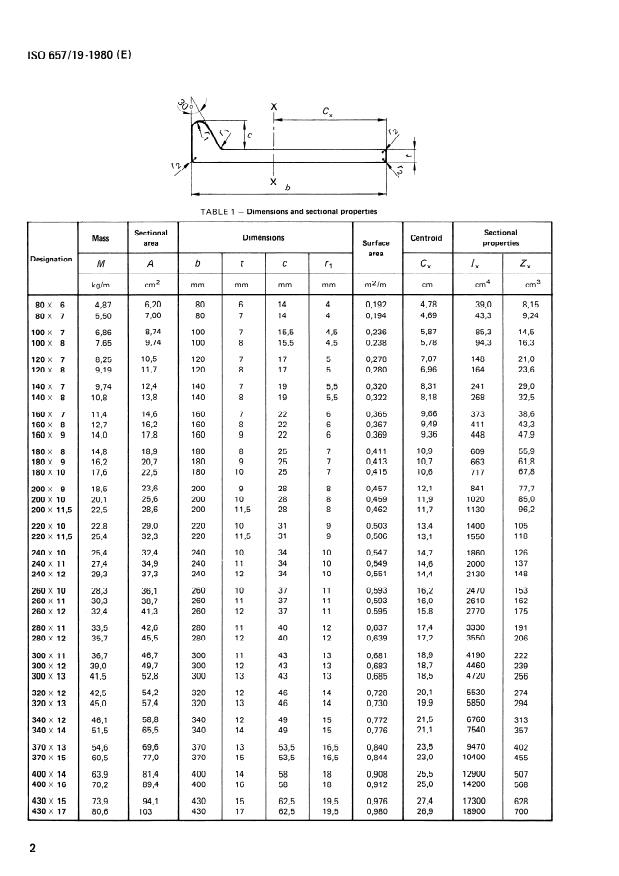
The dimensions of bulb flats shall be as given in table 1.
IS0 657/19-1980 (E)
‘b
-t
-
TABLE 1 - Dimensions and sectional properties
Sectional Sectional
Mass Dimensions Centroid
area Surface properties
T T T
area
Designation
iv A b t C
rl zx
2 3
cm mm mm mm mm m2/m cm cm cm
kg/m
6,20 80 6 14 4 0,192 4,78 39,0 8,15
80x 6 4,87
7,00 80 7 14 4 0,194 4,69 43,3 9,24
80X 7 5,50
8,74 100 7 15,5 0,236 5,87 85,3 14,5
100x 7 6,86 4,5
9,74 100 8 15,5 0,238 5,78 94,3 16,3
100x 8 7,65 4,5
IO,5 120 7 17 5 0,278 7,07 148 21;o
120x 7 8,25
120x 8 11,7 120 8 17 5 0,280 6,96 164 23,6
9,19
12,4 140 7 19 0,320 8,31 241 29
...
Norme internationale
657/ 19
INTERNATIONAL ORGANIZATION FOR STANDARDIZATION*MEIK,QYHAPO~HAR OPTAHH3AlWlfl il0 CTAH~APTH3A~HH.ORGANISATION INTERNATIONALE DE NORMALISATION
Profilés en acier laminés à chaud -.
Partie 19 : Plats à boudin (série métrique) - Dimensions,
caractéristiques rapportées aux axes et tolérances
Ho t-rolled steel sections - Part 79 : Bulb flats (metric series) - Dimensions, sectional properties and tolerances
Première édition - 1980-02-01
CDU 669.14-422.2 Réf. no : ISO 657/19-1980 (F)
Descripteurs : profilé métallique, produit en acier, produit laminé à chaud, caractéristique rapportée aux axes, dimension, tolérance de dimension.
dimension.
Prix basé sur 3 pages
AVANT-PROPOS
L’ISO (Organisation internationale de normalisation) est une fédération mondiale
d’organismes nationaux de normalisation (comités membresde I’ISO). L’élaboration
des Normes internationales est confiée aux comités techniques de I’ISO. Chaque
comité membre intéressé par une étude a le droit de faire partie du comité technique
correspondant. Les organisations internationales, gouvernementales et non
gouvernementales, en liaison avec I’ISO, participent également aux travaux.
Les projets de Normes internationales adoptés par les comités techniques sont
soumis aux comités membres pour approbation, avant leur acceptation comme
Normes internationales par le Conseil de I’ISO.
La Norme internationale ISO 657/19 (anciennement lSO/DIS 4974) a été élaborée
par le comité technique lSO/TC 17, Acier, et a été soumise aux comités membres
en janvier 1978.
Les comités membres des pays suivants l’ont approuvée :
Afrique du Sud, Rép. d’ Espagne Pays-Bas
Allemagne, R.F. Finlande Pologne
Australie France Roumanie
Royaume-Uni
Belgique Inde
Suède
Bulgarie Iran
I r-lande Suisse
Canada
Corée, Rép. dém. p. de Italie Tchécoslovaquie
Mexique Turquie
Corée, Rép. de
Norvège
Danemark URSS
Nouvelle-Zélande
Egypte, Rép. arabe d’
membres des pays suivants l’ont désapprouvée pour des raisons
Les comités
techniques :
Japon
USA
0 Organisation internationale de normalisation, 1980 l
Imprimé en Suisse
NORME INTERNATIONALE
ISO 657/19-1980 (F)
Profilés en acier laminés à chaud y
Partie 19 : Plats à boudin (série métrique) - Dimensions,
caractéristiques rapportées aux axes et tolérances
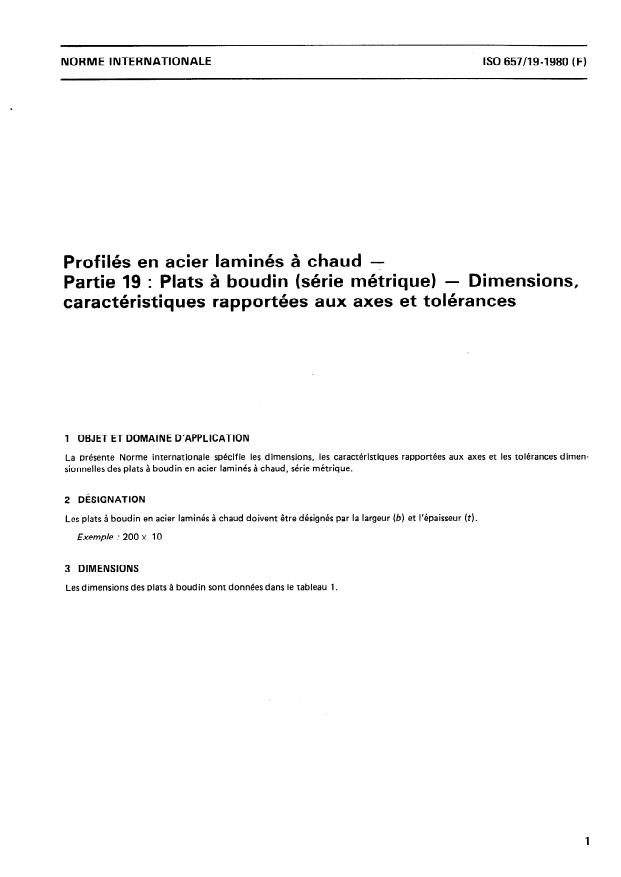
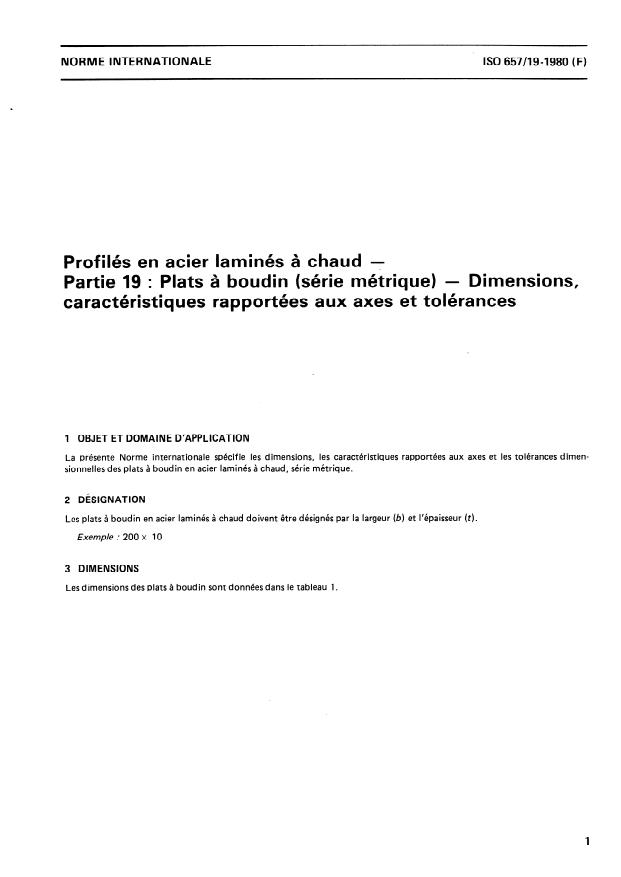
1 OBJET ET DOMAINE D’APPLICATION
La présente Norme internationale spécifie les dimensions, les caractéristiques rapportées aux axes et les tolérances dimen-
sionnelles des plats à boudin en acier laminés à chaud, série métrique.
2 DÉSIGNATION
Les plats à boudin en acier laminés à chaud doivent être désignés par la largeur (b) et l’épaisseur (t).
Exemple : 200 x 10
3 DIMENSIONS
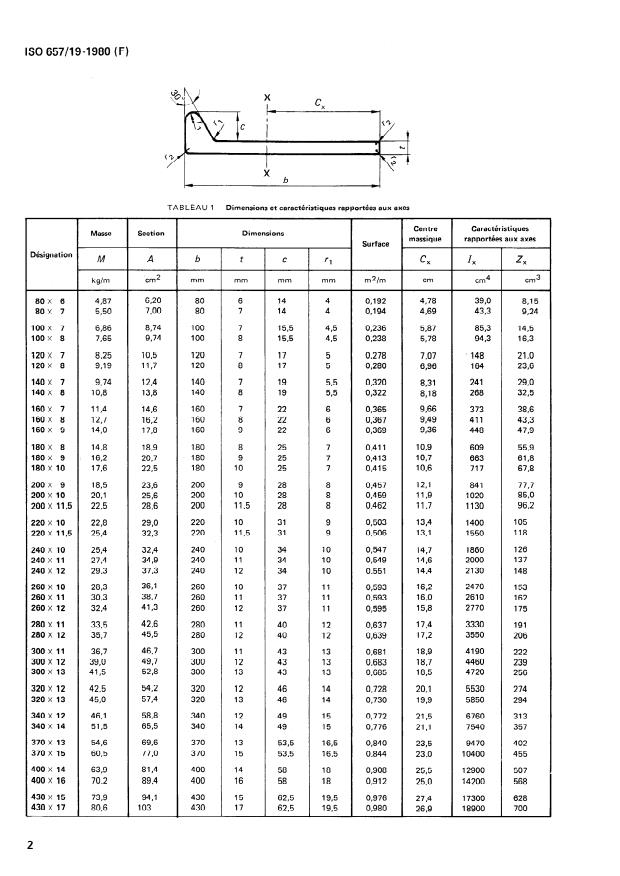
Les dimensions des plats à boudin sont données dans le tableau 1.
ISO 657/19-1980 (F)
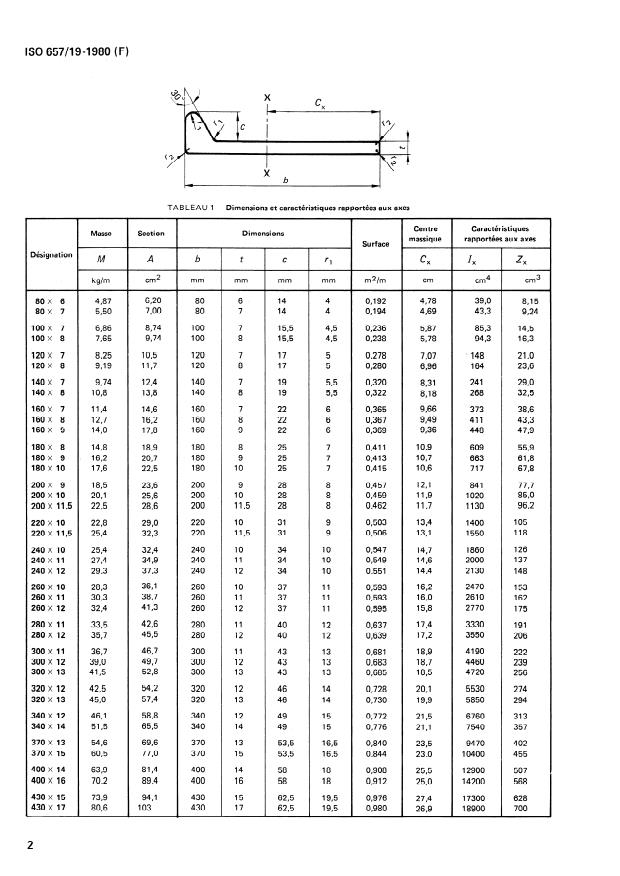
TABLEAU 1 - Dimensions et caractéristiques rapportées aux axes
.
Centre Caractéristiques
Section Dimensions
Masse
massique rapportées aux axes
Surface
Désignation
M A b t c
rl cx Ix zx
CM 3
kgh CM 2 4
CM
MM MM MM MM M2/M CM
80x 6 4,87 ' 6,20 80 6 14 4 0,192 4,78 39,0 8,15
80x 7 5,50 7,00 80 7 14 4 0,194 4,69 43,3 9,24
100x 7 6,86 8,74 100 7 15,5 4,5 0,236 5,87 85,3 14,5
16,3
100x 8 7,65 9,74 100 8 15,5 4,5 0,238 5,78 94,3
21,0
120x 7 8,25 10,5 120 7 17 5 0,278 7,07 ‘148
23,6
120x 8 9,19 Il,7 120 8
...
Norme internationale
657/ 19
INTERNATIONAL ORGANIZATION FOR STANDARDIZATION*MEIK,QYHAPO~HAR OPTAHH3AlWlfl il0 CTAH~APTH3A~HH.ORGANISATION INTERNATIONALE DE NORMALISATION
Profilés en acier laminés à chaud -.
Partie 19 : Plats à boudin (série métrique) - Dimensions,
caractéristiques rapportées aux axes et tolérances
Ho t-rolled steel sections - Part 79 : Bulb flats (metric series) - Dimensions, sectional properties and tolerances
Première édition - 1980-02-01
CDU 669.14-422.2 Réf. no : ISO 657/19-1980 (F)
Descripteurs : profilé métallique, produit en acier, produit laminé à chaud, caractéristique rapportée aux axes, dimension, tolérance de dimension.
dimension.
Prix basé sur 3 pages
AVANT-PROPOS
L’ISO (Organisation internationale de normalisation) est une fédération mondiale
d’organismes nationaux de normalisation (comités membresde I’ISO). L’élaboration
des Normes internationales est confiée aux comités techniques de I’ISO. Chaque
comité membre intéressé par une étude a le droit de faire partie du comité technique
correspondant. Les organisations internationales, gouvernementales et non
gouvernementales, en liaison avec I’ISO, participent également aux travaux.
Les projets de Normes internationales adoptés par les comités techniques sont
soumis aux comités membres pour approbation, avant leur acceptation comme
Normes internationales par le Conseil de I’ISO.
La Norme internationale ISO 657/19 (anciennement lSO/DIS 4974) a été élaborée
par le comité technique lSO/TC 17, Acier, et a été soumise aux comités membres
en janvier 1978.
Les comités membres des pays suivants l’ont approuvée :
Afrique du Sud, Rép. d’ Espagne Pays-Bas
Allemagne, R.F. Finlande Pologne
Australie France Roumanie
Royaume-Uni
Belgique Inde
Suède
Bulgarie Iran
I r-lande Suisse
Canada
Corée, Rép. dém. p. de Italie Tchécoslovaquie
Mexique Turquie
Corée, Rép. de
Norvège
Danemark URSS
Nouvelle-Zélande
Egypte, Rép. arabe d’
membres des pays suivants l’ont désapprouvée pour des raisons
Les comités
techniques :
Japon
USA
0 Organisation internationale de normalisation, 1980 l
Imprimé en Suisse
NORME INTERNATIONALE
ISO 657/19-1980 (F)
Profilés en acier laminés à chaud y
Partie 19 : Plats à boudin (série métrique) - Dimensions,
caractéristiques rapportées aux axes et tolérances
1 OBJET ET DOMAINE D’APPLICATION
La présente Norme internationale spécifie les dimensions, les caractéristiques rapportées aux axes et les tolérances dimen-
sionnelles des plats à boudin en acier laminés à chaud, série métrique.
2 DÉSIGNATION
Les plats à boudin en acier laminés à chaud doivent être désignés par la largeur (b) et l’épaisseur (t).
Exemple : 200 x 10
3 DIMENSIONS
Les dimensions des plats à boudin sont données dans le tableau 1.
ISO 657/19-1980 (F)
TABLEAU 1 - Dimensions et caractéristiques rapportées aux axes
.
Centre Caractéristiques
Section Dimensions
Masse
massique rapportées aux axes
Surface
Désignation
M A b t c
rl cx Ix zx
CM 3
kgh CM 2 4
CM
MM MM MM MM M2/M CM
80x 6 4,87 ' 6,20 80 6 14 4 0,192 4,78 39,0 8,15
80x 7 5,50 7,00 80 7 14 4 0,194 4,69 43,3 9,24
100x 7 6,86 8,74 100 7 15,5 4,5 0,236 5,87 85,3 14,5
16,3
100x 8 7,65 9,74 100 8 15,5 4,5 0,238 5,78 94,3
21,0
120x 7 8,25 10,5 120 7 17 5 0,278 7,07 ‘148
23,6
120x 8 9,19 Il,7 120 8
...