

ISO 24996:2026
(Main)Traditional Chinese medicine — General requirements and recommendations for the basic safety and essential performance of the transcutaneous electrical acupoint stimulators
- Abstract
This document specifies general requirements for the basic safety and essential performance of transcutaneous electrical acupoint stimulators (TEAS) with a focus on devices intended to stimulate acupoints on the human body. It applies to all types of TEAS specifically designed for acupoint-related therapeutic usage, only in the context of professional traditional Chinese medicine (TCM) healthcare services. It is not applicable to invasive electro-acupuncture stimulators for the application of electric currents via acupuncture needles inserted into the body.
- Status
- Published
- Publication Date
- 17-Sep-2026
- Technical Committee
- ISO/TC 249 - Traditional Chinese medicine
- Current Stage
- 6060 - International Standard published
- Start Date
- 18-Sep-2026
- Due Date
- 17-Apr-2027
- Completion Date
- 18-Sep-2026
ISO 24996:2026 is an International Standard from ISO for transcutaneous electrical acupoint stimulators (TEAS). It specifies general requirements and recommendations for the basic safety and essential performance of devices used to stimulate acupoints on the human body in professional traditional Chinese medicine (TCM) healthcare services. It excludes invasive electro-acupuncture stimulators that deliver current through inserted acupuncture needles.
What does ISO 24996:2026 specify?
ISO 24996:2026 sets the safety and performance framework for TEAS used on intact skin in professional TCM care. The document is organized into clauses 1 to 17, plus informative Annex A and a bibliography.
| Annex | What it covers |
|---|---|
| Annex A | Rationale for key output parameter limits of TEAS |
In practice, this means the standard is not just about the device output. It also covers marking, instructions for use, construction, fault conditions, electrical protection, and compatibility with the medical electrical equipment framework.
What are the key requirements of ISO 24996:2026?
ISO 24996:2026 builds on the IEC 60601 medical electrical equipment structure and then adds TEAS-specific requirements. For a manufacturer, test lab or buyer, the most important points are the output limits, the electrode design rules, and the safety checks tied to the intended body location.
Safety framework and classification
Clauses 4 to 6 apply the IEC 60601-1 requirements for general safety, testing and classification. Clauses 8 to 11, 13, 14, 16 and 17 extend that same framework to electrical, mechanical, radiation, temperature, programmable system and EMC topics. In practice, TEAS is handled as medical electrical equipment, so the usual safety, verification and EMC processes apply.
Output limits and hazard control
Clause 12 sets the main TEAS-specific performance limits. It covers pulse width, frequency, current intensity and current density, and it distinguishes between cranial, auricular, upper-extremity and other body sites. The practical point is that TEAS must be set and checked by body location, because smaller or more sensitive areas need tighter control.
Clause 12.3 also requires protection against hazardous outputs, including supply voltage fluctuations, output interlock and output indication. The waveform must match the nominal design and avoid unwanted distortion, overshoot spikes and ringing. For users, this means the device should not produce unexpected pulses or unclear output status.
Marking and instructions for use
Clause 7 covers identification, marking and accompanying documents. ISO 24996:2026 requires the instructions for use to state applicable acupoints and the pulse width, frequency and intensity ranges for different disorders or diseases. For pediatric use, it adds supervision and fitting guidance, including proper auricle fit and oversight by an instructed adult.
Construction and electrodes
Clause 15 focuses on construction, especially electrodes, clips and leads. The standard requires particular electrodes and clips for precise stimulation of acupoints, and it distinguishes between electrode area with and without adhesive plaster. It also gives special rules for auricular electrodes and clips, including shape and fit by auricular region. In practice, the attachment hardware is part of the safety function, not just an accessory.
Clause 15.3 adds lead testing, and clause 15.4 requires operation under open-circuit and short-circuit fault conditions before other tests. That matters because the cable and output stage must remain safe under stress and fault conditions.
What terms does ISO 24996:2026 define?
- Acupoint - a small body region used for applying stimulus in acupuncture for diagnostic or therapeutic purposes.
- Auricular acupoint - an acupoint or area on the external ear, or auricle.
- Transcutaneous electrical acupoint stimulator (TEAS) - a non-invasive electrical medical device that stimulates acupoints through current applied to the skin surface.
- Electrical acupoint stimulation - transmission of electric current to acupoints.
- Meridian and collateral - the channel system in traditional Chinese medicine through which qi and blood circulate.
- Electrode - an electrical conductor applied to a body target to transmit an electrical signal on intact skin.
Who uses ISO 24996:2026?
ISO 24996:2026 is used by TEAS manufacturers, design engineers, test laboratories, quality managers, buyers and regulators who need to assess safety, labeling, performance and EMC. It is also relevant to professional TCM healthcare services that use TEAS on patients, because the document ties device design to clinical use on specific body regions and acupoints.
Which standards are used with ISO 24996:2026?
ISO 24996:2026 refers to three IEC 60601 documents as its core technical framework:
- IEC 60601-1:2005+AMD1:2012+AMD2:2020 - general requirements for basic safety and essential performance.
- IEC 60601-1-2:2014+AMD1:2020 - electromagnetic disturbances, requirements and tests.
- IEC 60601-2-10:2012+AMD1:2016+AMD2:2023 - particular requirements for nerve and muscle stimulators.
The bibliography also points to ISO 16843-1:2025, ISO/TS 16843-4:2017 and ISO 8600-6:2020 for acupuncture point representation, meridian and collateral channels, and related vocabulary.
What does the ISO 24996:2026 document contain?
ISO 24996:2026 contains clause-by-clause requirements for safety, testing, marking, output control, construction and EMC for TEAS. It includes body-location-specific output limits, electrode-area recommendations, auricular electrode guidance, lead tests, and a fault-condition operation test. Annex A explains why the key output parameter limits were chosen.
Get Certified
Connect with accredited certification bodies for this standard

BSI Group
BSI (British Standards Institution) is the business standards company that helps organizations make excellence a habit.

TÜV Rheinland
TÜV Rheinland is a leading international provider of technical services.

TÜV SÜD
TÜV SÜD is a trusted partner of choice for safety, security and sustainability solutions.
Sponsored listings
Frequently Asked Questions
ISO 24996:2026 is a standard published by the International Organization for Standardization (ISO). Its full title is "Traditional Chinese medicine — General requirements and recommendations for the basic safety and essential performance of the transcutaneous electrical acupoint stimulators". This standard covers: This document specifies general requirements for the basic safety and essential performance of transcutaneous electrical acupoint stimulators (TEAS) with a focus on devices intended to stimulate acupoints on the human body. It applies to all types of TEAS specifically designed for acupoint-related therapeutic usage, only in the context of professional traditional Chinese medicine (TCM) healthcare services. It is not applicable to invasive electro-acupuncture stimulators for the application of electric currents via acupuncture needles inserted into the body.
This document specifies general requirements for the basic safety and essential performance of transcutaneous electrical acupoint stimulators (TEAS) with a focus on devices intended to stimulate acupoints on the human body. It applies to all types of TEAS specifically designed for acupoint-related therapeutic usage, only in the context of professional traditional Chinese medicine (TCM) healthcare services. It is not applicable to invasive electro-acupuncture stimulators for the application of electric currents via acupuncture needles inserted into the body.
ISO 24996:2026 is classified under the following ICS (International Classification for Standards) categories: 11.040.60 - Therapy equipment. The ICS classification helps identify the subject area and facilitates finding related standards.
ISO 24996:2026 is available in PDF format for immediate download after purchase. The document can be added to your cart and obtained through the secure checkout process. Digital delivery ensures instant access to the complete standard document.
Standards Content (Sample)
International
Standard
ISO 24996
First edition
Traditional Chinese medicine —
2026-09
General requirements and
recommendations for the basic
safety and essential performance
of the transcutaneous electrical
acupoint stimulators
Médecine traditionnelle chinoise — Exigences générales et
recommandations pour la sécurité de base et les performances
essentielles des stimulateurs électriques transcutanés d'acupoints
Reference number
© ISO 2026
All rights reserved. Unless otherwise specified, or required in the context of its implementation, no part of this publication may
be reproduced or utilized otherwise in any form or by any means, electronic or mechanical, including photocopying, or posting on
the internet or an intranet, without prior written permission. Permission can be requested from either ISO at the address below
or ISO’s member body in the country of the requester.
ISO copyright office
CP 401 • Ch. de Blandonnet 8
CH-1214 Vernier, Geneva
Phone: +41 22 749 01 11
Email: copyright@iso.org
Website: www.iso.org
Published in Switzerland
ii
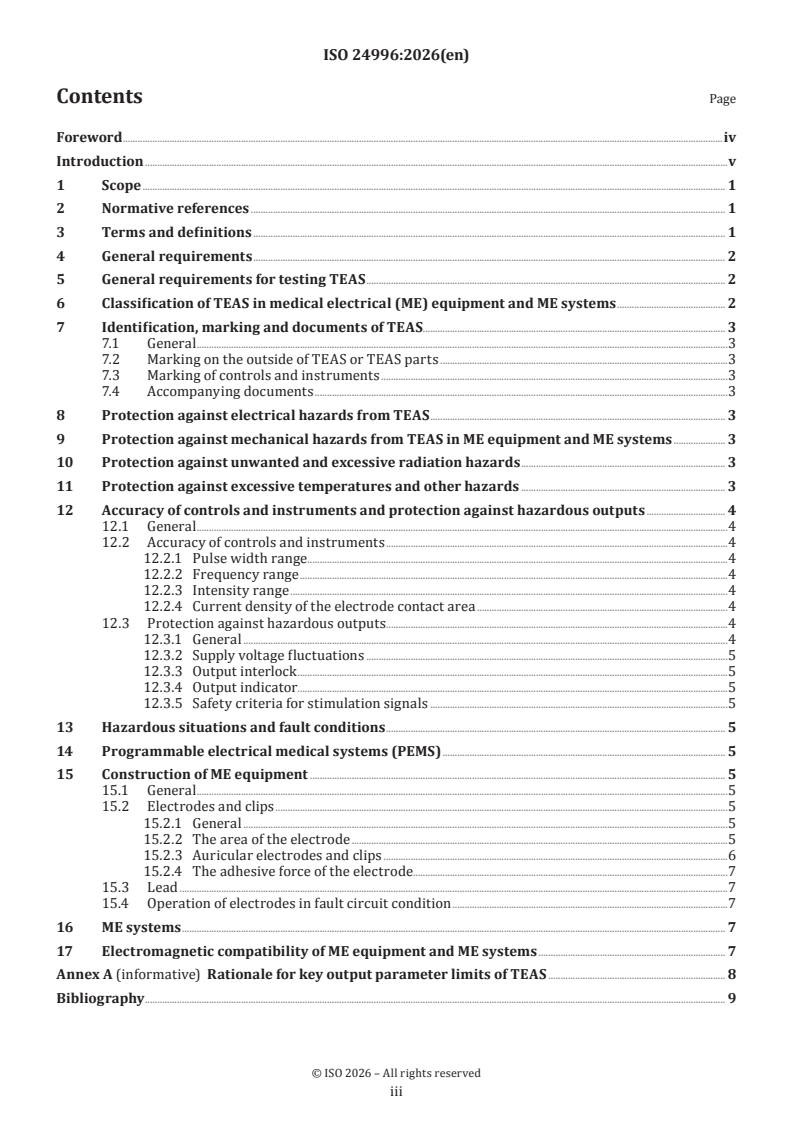
Contents Page
Foreword .iv
Introduction .v
1 Scope . 1
2 Normative references . 1
3 Terms and definitions . 1
4 General requirements . 2
5 General requirements for testing TEAS . 2
6 Classification of TEAS in medical electrical (ME) equipment and ME systems . 2
7 Identification, marking and documents of TEAS. 3
7.1 General .3
7.2 Marking on the outside of TEAS or TEAS parts .3
7.3 Marking of controls and instruments .3
7.4 Accompanying documents .3
8 Protection against electrical hazards from TEAS . 3
9 Protection against mechanical hazards from TEAS in ME equipment and ME systems . 3
10 Protection against unwanted and excessive radiation hazards . 3
11 Protection against excessive temperatures and other hazards . 3
12 Accuracy of controls and instruments and protection against hazardous outputs . 4
12.1 General .4
12.2 Accuracy of controls and instruments .4
12.2.1 Pulse width range.4
12.2.2 Frequency range .4
12.2.3 Intensity range .4
12.2.4 Current density of the electrode contact area .4
12.3 Protection against hazardous outputs.4
12.3.1 General .4
12.3.2 Supply voltage fluctuations .5
12.3.3 Output interlock .5
12.3.4 Output indicator.5
12.3.5 Safety criteria for stimulation signals .5
13 Hazardous situations and fault conditions . 5
14 Programmable electrical medical systems (PEMS) . 5
15 Construction of ME equipment . 5
15.1 General .5
15.2 Electrodes and clips .5
15.2.1 General .5
15.2.2 The area of the electrode .5
15.2.3 Auricular electrodes and clips .6
15.2.4 The adhesive force of the electrode.7
15.3 Lead .7
15.4 Operation of electrodes in fault circuit condition .7
16 ME systems . 7
17 Electromagnetic compatibility of ME equipment and ME systems . 7
Annex A (informative) Rationale for key output parameter limits of TEAS . 8
Bibliography . 9
iii
Foreword
ISO (the International Organization for Standardization) is a worldwide federation of national standards
bodies (ISO member bodies). The work of preparing International Standards is normally carried out through
ISO technical committees. Each member body interested in a subject for which a technical committee
has been established has the right to be represented on that committee. International organizations,
governmental and non-governmental, in liaison with ISO, also take part in the work. ISO collaborates closely
with the International Electrotechnical Commission (IEC) on all matters of electrotechnical standardization.
The procedures used to develop this document and those intended for its further maintenance are described
in the ISO/IEC Directives, Part 1. In particular, the different approval criteria needed for the different types
of ISO document should be noted. This document was drafted in accordance with the editorial rules of the
ISO/IEC Directives, Part 2 (see www.iso.org/directives).
ISO draws attention to the possibility that the implementation of this document may involve the use of (a)
patent(s). ISO takes no position concerning the evidence, validity or applicability of any claimed patent
rights in respect thereof. As of the date of publication of this document, ISO had not received notice of (a)
patent(s) which may be required to implement this document. However, implementers are cautioned that
this may not represent the latest information, which may be obtained from the patent database available at
www.iso.org/patents. ISO shall not be held responsible for identifying any or all such patent rights.
Any trade name used in this document is information given for the convenience of users and does not
constitute an endorsement.
For an explanation of the voluntary nature of standards, the meaning of ISO specific terms and expressions
related to conformity assessment, as well as information about ISO's adherence to the World Trade
Organization (WTO) principles in the Technical Barriers to Trade (TBT), see www.iso.org/iso/foreword.html.
This document was prepared by Technical Committee ISO/TC 249, Traditional medicine, Subcommittee SC 1,
Traditional Chinese medicine.
Any feedback or questions on this document should be directed to the user’s national standards body. A
complete listing of these bodies can be found at www.iso.org/members.html.
iv
Introduction
Acupuncture is the vanguard in the internationalization of traditional Chinese medicine. It has been adopted
and practiced in 196 countries or regions around the world. Transcutaneous electrical acupoint stimulation
is a non-invasive acupuncture application.
Transcutaneous electrical acupoint stimulators (TEAS) have been produced to meet the need of this
non-invasive acupuncture technique. Currently, many TEAS are available on the market. However, most
manufacturers did not indicate the output parameters comprehensively. There are no international
standards guiding the manufacture and processing to ensure safety and performance. The growing interest
and increasing use of TEAS, combined with increasing patients’ expectations and concerns about the safety
and performance of transcutaneous electrical acupoint stimulation, have given rise to the need to improve
the safety and performance through implementation of an International Standard.
It is extensively accepted that the output parameters are significant to ensuring the basic safety and
essential performance of the TEAS.
v
International Standard ISO 24996:2026(en)
Traditional Chinese medicine — General requirements
and recommendations for the basic safety and essential
performance of the transcutaneous electrical acupoint
stimulators
1 Scope
This document specifies general requirements for the basic safety and essential performance of
transcutaneous electrical acupoint stimulators (TEAS) with a focus on devices intended to stimulate
acupoints on the human body.
It applies to all types of TEAS specifically designed for acupoint-related therapeutic usage, only in the context
of professional traditional Chinese medicine (TCM) healthcare services.
It is not applicable to invasive electro-acupuncture stimulators for the application of electric currents via
acupuncture needles inserted into the body.
2 Normative references
The following documents are referred to in the text in such a way that some or all of their content constitutes
requirements of this document. For dated references, only the edition cited applies. For undated references,
the latest edition of the referenced document (including any amendments) applies.
IEC 60601-1:2005+AMD1: 2012, Medical electrical equipment—Part 1: General requirements for basic safety
and essential performance
IEC 60601-1-2:2014+AMD1: 2020, Medical electrical equipment—Part 1-2: General requirements for basic safety
and essential performance—Collateral Standard: Electromagnetic disturbances—Requirements and tests
IEC 60601-2-10:2012+AMD1: 2016, Medical electrical equipment—Part 2-10: Particular requirements for the
basic safety and essential performance of nerve and muscle stimulators
3 Terms and definitions
For the purposes of this document, the following terms and definitions apply.
ISO and IEC maintain terminology databases for use in standardization at the following addresses:
— ISO Online browsing platform: available at https:// www .iso .org/ obp
— IEC Electropedia: available at https:// www .electropedia
...