

ISO/TS 25393:2026
(Main)Fasteners — Coating system assessment — Complementary and additional aspects to CQI-11
- Abstract
This document deals with electroplating process evaluation for fasteners, including fastener expected coating properties. This document is a complement to CQI-11 in order to deal with fastener specific aspects not fully covered by CQI-11, and to clarify some questions/items when they are not fully suitable for fasteners. This document is applicable to all parties involved in the supply chain for coated fasteners, i.e. fastener manufacturers, chemical suppliers, electroplaters and purchasers. The requirements for electroplating fasteners specified in this document are essentially based on ISO 4042, ISO/TR 20491 and ISO 16047. NOTE Requirements for electroplating fasteners are also given in ASTM F1941/F1941M.
- Status
- Published
- Publication Date
- 06-Oct-2026
- Technical Committee
- ISO/TC 2/SC 14 - Surface coatings
- Drafting Committee
- ISO/TC 2/SC 14 - Surface coatings
- Current Stage
- 6060 - International Standard published
- Start Date
- 07-Oct-2026
- Completion Date
- 07-Oct-2026
Buy Documents


ISO/TS 25393:2026 - Fasteners — Coating system assessment — Complementary and additional aspects to CQI-11
ISO/TS 25393:2026 - Fixations — Évaluation des systèmes de revêtement électrolytiques — Aspects complémentaires et additionnels au CQI-11
ISO/TS 25393:2026 is an ISO Technical Specification for assessing electroplating coating systems on fasteners. It complements CQI-11 by adding fastener-specific guidance on coating properties, hydrogen embrittlement prevention, and the checks used by fastener manufacturers, chemical suppliers, electroplaters, and purchasers.
What does ISO/TS 25393:2026 specify?
ISO/TS 25393:2026 specifies how CQI-11 should be applied to coated fasteners and where fastener-specific additions are needed. It is aimed at electroplating process evaluation for fasteners, with emphasis on the coating properties expected of the finished part.
The document is organized into five clauses plus four informative annexes. Its structure is practical: clauses 1 to 3 set the scope, references, and terms; clause 4 adapts CQI-11 for fasteners; clause 5 adds fastener topics that CQI-11 does not cover well; the annexes give supporting guidance for testing and documentation.
| Annex | What it covers |
|---|---|
| Annex A | Chemical composition and coating thickness |
| Annex B | Gaugeability and assemblability |
| Annex C | Torque/clamp force testing |
| Annex D | Corrosion tests |
What are the key requirements of ISO/TS 25393:2026?
ISO/TS 25393:2026 turns CQI-11 into a fastener-focused assessment tool. The most important requirements are in clause 4, with additional checks in clause 5 and the annexes.
Applying CQI-11 to fasteners
Clause 4.1 gives a key for reading CQI-11 items in a fastener context. AD means an additional question, SUB means a CQI-11 item is replaced by a fastener-specific version, and NA means the CQI-11 item is not suitable as written and must be handled with the fastener version instead.
In practice, this means users should not copy CQI-11 blindly into a fastener audit. They need to decide whether each question is kept, replaced, or added, so the review matches the actual plated fastener process.
Preventing internal hydrogen embrittlement
Clause 4.2 is the core technical part of the document. ISO/TS 25393:2026 requires that measures related to internal hydrogen embrittlement (IHE) for steel fasteners be considered and documented where relevant, including baking, supplemental process verification, and product testing.
The document distinguishes by fastener type and condition, such as steel fasteners, nuts, washers, and case-hardened screws. In practice, this means the supplier needs a documented control plan that fits the fastener design and mechanical condition rather than a single generic baking rule.
The document also links IHE control to process timing. Acid pickling time, the time between hydrogen-introducing treatment and baking, and the baking duration itself should be recorded. For plant users, this makes time control part of quality control, not just an operating detail.
Controlling the baking operation
ISO/TS 25393:2026 requires the baking process to be controlled so hydrogen can escape and does not return to the steel. The oven should be checked by thermal mapping, the temperature should be continuously recorded by zone, and the loading method should be documented.
The document also points to practical equipment control. It says thermocouples do not have to be mandatory in every case and that Pt100 probes should be considered; when Pt100 probes are used, they should be checked at least yearly. For the reader, this means oven qualification, monitoring, and maintenance all matter to hydrogen relief performance.
Recording and verification
Clause 4.2 also emphasizes records. Baking conditions should be automatically recorded, and verification should be done before shipment by the operator or by an independent person, depending on the case.
This matters because a plated fastener is only as credible as its traceability. If a customer asks how hydrogen risk was managed, the supplier needs records of the times, temperatures, and checks, not only a statement that the parts were baked.
Rework after coating removal
ISO/TS 25393:2026 treats rework as a controlled action: remove the coating system and process it again. If coating is removed and the part is replated, each baking step should be recorded and verified.
For users, this is important when nonconforming parts are stripped and returned to process. The standard ties rework back to the same hydrogen-control logic used for initial plating.
Additional fastener checks outside CQI-11
Clause 5 adds fastener topics that CQI-11 does not cover directly. These include coating composition and thickness, gaugeability, assemblability, torque/clamp force testing, and corrosion testing.
A practical point in clause 5 is that if cleaning is needed to meet cleanliness requirements, corrosion testing and torque/clamp force testing should be done after cleaning, because cleaning can change the result. That matters when a cleaning step is added late in the process flow.
What terms does ISO/TS 25393:2026 define?
- Rework - Removing a coating system and processing the targeted coating again, usually after stripping.
- CQI-11 - The AIAG plating system assessment that ISO/TS 25393:2026 uses as its base method for fasteners.
- Internal hydrogen embrittlement (IHE) - A hydrogen-related failure risk in steel fasteners that the document controls through timing, baking, and verification.
- Baking - The heat treatment used after hydrogen-introducing steps to drive hydrogen out of the fastener.
- Gaugeability - The ability of a threaded fastener to be checked with the correct gauges before or after coating.
- Assemblability - The ability of a coated fastener to still fit and function with its mating feature or drive.
- Torque/clamp force - The relationship between applied torque and achieved clamp load, used to judge how a fastener performs in use.
Who uses ISO/TS 25393:2026?
ISO/TS 25393:2026 is used by fastener manufacturers, chemical suppliers, electroplaters, and purchasers in the coated fastener supply chain. It is also useful to quality managers, process engineers, laboratory staff, and buyer-side technical reviewers who need to audit plating processes or confirm customer requirements.
In practice, they use it to review plating process controls, write or check IHE controls, set up sampling plans, choose thickness or composition methods, and document gaugeability, torque/clamp force, and corrosion testing.
Which standards are used with ISO/TS 25393:2026?
- ISO 1891-2 - Provides fastener terminology for coatings, so the document uses a common vocabulary.
- ISO 4042:2022 - The main technical basis for electroplated coating systems on fasteners and the primary reference throughout the document.
- ISO/TR 20491 - Gives background on hydrogen embrittlement in steel fasteners, which supports the IHE controls in clause 4.
- ISO 16047 - Provides the torque/clamp force testing method used in Annex C.
- ISO 1502 - Supports gauge selection and gauge wear checks in Annex B.
- ISO 2178 and ISO 3497 - Support coating thickness measurement by magnetic and X-ray methods in Annex A.
- ISO 9227 - Supports the salt spray corrosion tests in Annex D.
- ISO 3269 - Used where acceptance inspection or dispute handling is needed for sampling and agreement.
- ASTM F1941/F1941M, ASTM B633, and ASTM B117/B568 - Named as related specifications and methods in the document and annex examples.
What does the ISO/TS 25393:2026 document contain?
ISO/TS 25393:2026 contains a CQI-11 adaptation for fasteners, a hydrogen-embrittlement control section, and four informative annexes that turn the topic into checkable shop and laboratory practices. Annex A shows what to document for coating composition and thickness, including method choice and test reports. Annex B sets out what to record for gauges, thread checking, and assemblability. Annex C covers the test setup and records for torque/clamp force work. Annex D covers corrosion-test planning, cabinet control, operating conditions, and reporting.
Relations
- Consolidates
ISO 340:2022 - Conveyor belts — Laboratory scale flammability characteristics — Requirements and test method - Effective Date
- 07-Jan-2025
Buy Documents
ISO/TS 25393:2026 - Fasteners — Coating system assessment — Complementary and additional aspects to CQI-11
ISO/TS 25393:2026 - Fixations — Évaluation des systèmes de revêtement électrolytiques — Aspects complémentaires et additionnels au CQI-11
Frequently Asked Questions
ISO/TS 25393:2026 is a technical specification published by the International Organization for Standardization (ISO). Its full title is "Fasteners — Coating system assessment — Complementary and additional aspects to CQI-11". This standard covers: This document deals with electroplating process evaluation for fasteners, including fastener expected coating properties. This document is a complement to CQI-11 in order to deal with fastener specific aspects not fully covered by CQI-11, and to clarify some questions/items when they are not fully suitable for fasteners. This document is applicable to all parties involved in the supply chain for coated fasteners, i.e. fastener manufacturers, chemical suppliers, electroplaters and purchasers. The requirements for electroplating fasteners specified in this document are essentially based on ISO 4042, ISO/TR 20491 and ISO 16047. NOTE Requirements for electroplating fasteners are also given in ASTM F1941/F1941M.
This document deals with electroplating process evaluation for fasteners, including fastener expected coating properties. This document is a complement to CQI-11 in order to deal with fastener specific aspects not fully covered by CQI-11, and to clarify some questions/items when they are not fully suitable for fasteners. This document is applicable to all parties involved in the supply chain for coated fasteners, i.e. fastener manufacturers, chemical suppliers, electroplaters and purchasers. The requirements for electroplating fasteners specified in this document are essentially based on ISO 4042, ISO/TR 20491 and ISO 16047. NOTE Requirements for electroplating fasteners are also given in ASTM F1941/F1941M.
ISO/TS 25393:2026 is classified under the following ICS (International Classification for Standards) categories: 21.060.01 - Fasteners in general. The ICS classification helps identify the subject area and facilitates finding related standards.
ISO/TS 25393:2026 has the following relationships with other standards: It is inter standard links to ISO 340:2022. Understanding these relationships helps ensure you are using the most current and applicable version of the standard.
ISO/TS 25393:2026 is available in PDF format for immediate download after purchase. The document can be added to your cart and obtained through the secure checkout process. Digital delivery ensures instant access to the complete standard document.
Standards Content (Sample)
Technical
Specification
ISO/TS 25393
First edition
Fasteners — Coating system
2026-10
assessment — Complementary and
additional aspects to CQI-11
Fixations — Évaluation des systèmes de revêtement
électrolytiques — Aspects complémentaires et additionnels au
CQI-11
Reference number
© ISO 2026
All rights reserved.
This ISO publication is protected by copyright and is owned by ISO and/or its licensors.
The content of this ISO publication is provided under licence, not sold. Use is subject to the applicable licence terms issued by ISO,
an ISO member body, or an authorized third-party distributor.
Except as required for implementation or expressly permitted by a separate licence, no part of this ISO publication may be
reproduced, distributed, modified, used, or made available in any form or by any means – electronic or mechanical, including
photocopying, scanning, recording, or posting on internal or external digital platforms.
Any use beyond the scope of the granted rights is prohibited and may result in legal action.
ISO copyright office
CP 401 • CH-1214 Vernier, Geneva
Phone: +41 22 749 01 11
Email: copyright@iso.org
Website: www.iso.org
Published in Switzerland
ii
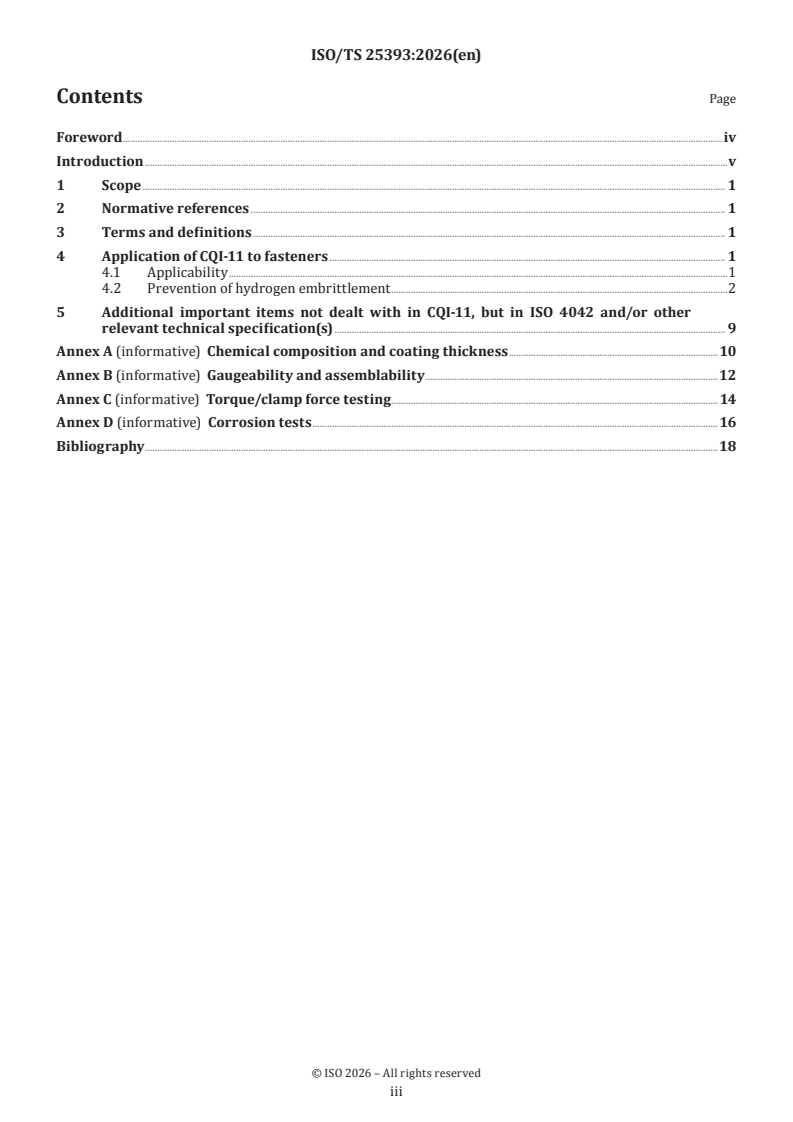
Contents Page
Foreword .iv
Introduction .v
1 Scope . 1
2 Normative references . 1
3 Terms and definitions . 1
4 Application of CQI-11 to fasteners . 1
4.1 Applicability .1
4.2 Prevention of hydrogen embrittlement .2
5 Additional important items not dealt with in CQI-11, but in ISO 4042 and/or other
relevant technical specification(s) . 9
Annex A (informative) Chemical composition and coating thickness .10
Annex B (informative) Gaugeability and assemblability .12
Annex C (informative) Torque/clamp force testing. 14
Annex D (informative) Corrosion tests . 16
Bibliography .18
iii
Foreword
ISO (the International Organization for Standardization) is a worldwide federation of national standards
bodies (ISO member bodies). The work of preparing International Standards is normally carried out through
ISO technical committees. Each member body interested in a subject for which a technical committee
has been established has the right to be represented on that committee. International organizations,
governmental and non-governmental, in liaison with ISO, also take part in the work. ISO collaborates closely
with the International Electrotechnical Commission (IEC) on all matters of electrotechnical standardization.
The procedures used to develop this document and those intended for its further maintenance are described
in the ISO/IEC Directives, Part 1. In particular, the different approval criteria needed for the different types
of ISO document should be noted. This document was drafted in accordance with the editorial rules of the
ISO/IEC Directives, Part 2 (see www.iso.org/directives).
ISO draws attention to the possibility that the implementation of this document may involve the use of (a)
patent(s). ISO takes no position concerning the evidence, validity or applicability of any claimed patent
rights in respect thereof. As of the date of publication of this document, ISO had not received notice of (a)
patent(s) which may be required to implement this document. However, implementers are cautioned that
this may not represent the latest information, which may be obtained from the patent database available at
www.iso.org/patents. ISO shall not be held responsible for identifying any or all such patent rights.
Any trade name used in this document is information given for the convenience of users and does not
constitute an endorsement.
For an explanation of the voluntary nature of standards, the meaning of ISO specific terms and expressions
related to conformity assessment, as well as information about ISO's adherence to the World Trade
Organization (WTO) principles in the Technical Barriers to Trade (TBT), see www.iso.org/iso/foreword.html.
This document was prepared by Technical Committee ISO/TC 2, Fasteners, Subcommittee SC 14, Surface
coatings, in collaboration with the European Committee for Standardization (CEN) Technical Committee
CEN/TC 185, Fasteners, in accordance with the Agreement on technical cooperation between ISO and CEN
(Vienna Agreement).
Any feedback or questions on this document should be directed to the user’s national standards body. A
complete listing of these bodies can be found at www.iso.org/members.html.
iv
Introduction
rd
Plating system assessment (CQI-11) 3 edition was developed by AIAG (Automotive Industry Action Group)
with the intent to help better evaluation of the quality systems in place at plating shops supplying OEM
automotive coatings such as zinc and zinc alloy electrodeposits, decorative plating applied to metal or
plastic substrates, and hard chromium deposits, as well as electroless nickel and electropolishing processes.
The objective of the 3rd edition of CQI-11 was to update as needed, improve document clarity, and include
the ISO 9001 and IATF 16949:2016 Quality Management System concepts of “Process Approach” and “Risk
Management”.
The Automotive Industry Action Group (AIAG) was founded in 1982 by representatives of the three largest
North American automotive manufacturers: Ford, General Motors and Chrysler. It was originally created
to develop recommendations and a framework for the improvement of quality in the North-American
automotive industry. Among others, the AIAG publishes automotive industry standards, including
Production Part Approval Process (PPAP) quality specifications. These documents have become a de facto
quality standard in North America that have to be complied with by all Tier 1 suppliers. Increasingly, these
suppliers are now requiring complete compliance from their suppliers, so that many Tier 2 and 3 automotive
suppliers now shall also comply.
rd
CQI-11 is intended to be a self-Assessment auditing tool for electroplating processes, and its 3 edition
was published by AIAG in 2019; its goal is that “… all customer engineering design record and specification
requirements are properly understood by the supplier and that the process has the potential to produce product
consistently meeting these requirements during an actual production run at the quoted production rate." CQI-11
is used in the automotive supply chain to establish confidence in component suppliers and their production
processes.
However, CQI-11 remains a general system assessment for plating automotive parts. For the purpose of
fastener coating and in order to achieve the expected functional properties of the fasteners as specified in
ISO 4042, some specific modulus should also be considered additionally to CQI-11 and/or some “questions/
items” need to be completed.
The purpose of this document is to specifically address fastener-specific aspects not fully covered by CQI-11,
and to clarify some questions/items when its content is not applicable or not suitable for fasteners.
This document should be used as guidance by the electroplaters additionally to CQI-11, for the appropriate
application to fasteners.
This document is primarily established from the following basic documents:
— ISO 4042, Fasteners — Electroplated coating systems;
— ISO/TR 20491, Fasteners — Fundamentals of hydrogen embrittlement in steel fasteners;
— ISO 16047, Fasteners — Torque/clamp force testing.
It is consistent with ASTM F1941/F1941M and ASTM B633.
v
Technical Specification ISO/TS 25393:2026(en)
Fasteners — Coating system assessment — Complementary
and additional aspects to CQI-11
1 Scope
This document deals with electroplating process evaluation for fasteners, including fastener expected
coating properties.
This document is a complement to CQI-11 in order to deal with fastener specific aspects not fully covered by
CQI-11, and to clarify some questions/items when they are not fully suitable for fasteners.
This document is applicable to all parties involved in the supply chain for coated fasteners, i.e. fastener
manufacturers, chemical suppliers, electroplaters and purchasers.
The requirements for electroplating fasteners specified in this document are essentially based on ISO 4042,
ISO/TR 20491 and ISO 16047.
NOTE Requirements for electroplating fasteners are also given in ASTM F1941/F1941M.
2 Normative references
The following documents are referred to in the text in such a way that some or all of their content constitutes
requirements of this document. For dated references, only the edition cited applies. For undated references,
the latest edition of the referenced document (including any amendments) applies.
ISO 1891-2, Fasteners — Terminology — Part 2: Vocabulary and definitions for coatings
ISO 4042:2022, Fasteners — Electroplated coating systems
3 Terms and definitions
For the purposes of this document, the terms and definitions given in ISO 1891-2 and the following apply.
ISO and IEC maintain terminology databases for use in standardization at the following addresses:
— ISO Online browsing platform: available at https:// www .iso .org/ obp
— IEC Electropedia: available at https:// www .electropedia .org/
3.1
rework
action to remove a coating system and to reprocess the targeted coating system
Note 1 to entry: The removal of the initially electrolytically applied coating is usually performed through a stripping
step, using an acid solution.
4 Application of CQI-11 to fasteners
4.1 Applicability
The applicability of CQI-11 requirements to fasteners are as specified in Table 1.
Table 1 — Key for Items/Questions in Table 2
AD ADditional item/question not included in CQI-11
SUB Item/question of CQI-11 applicable in principle, but SUBstituted as follows for the purpose of fasteners
NA Item/question of CQI-11 Not Applicable to fasteners, to be replaced by the appropriate question
4.2 Prevention of hydrogen embrittlement
Items specified in Table 2 shall be considered for fasteners.
Table 2 — Requirements related to the prevention of Internal Hydrogen Embrittlement (IHE)
CQI-11
Ref. No Item/Question IHE – Requirements for fasteners and comments, if any
(2019)
--- AD2.1 Measures related to internal hydrogen embrittlement ISO 4042:2022, 4.4
for steel fasteners (if any) shall be documented.
Only steel fasteners with a martensitic structure are concerned. For fasteners with a
bainitic structure, a written agreement between the supplier and the purchaser with
regard to IHE is necessary.
--- AD2.2 Baking process for fasteners (if any) shall be document- ISO 4042:2022, 4.4 and 4.5
ed.
Supplemental process verification (if any) shall be doc-
umented with regards to IHE.
Product testing (if any) shall be documented with
regards to IHE.
--- AD2.2.1 Steel fasteners with ISO metric external thread Extract of ISO 4042:2022
Table 3 — Measures related to IHE for fasteners in accordance with ISO 898 1
Property class <10.9 10.9 12.9/12.9
A B C
No supplemen- Supplemental Supplemental
tal process process process
verification or verification verification and/
product and/or product or product
testing with testing with testing with re-
regard to IHE regard to IHE gard to IHE
Measures related
AND OR AND
to IHE
No baking nec-
a, b
Baking Baking
essary
At the choice
— of the fastener —
manufacturer
See 4.4.3 and
See 4.4.2 See 4.4.4 and B.6
B.6
a
For alkaline zinc-nickel electroplatings with nickel content of
12 % to 16 %, the decision to not carry out baking shall be based on test-
ing (see B.6) and be agreed between the supplier and the purchaser.
b
For baking temperature and duration, see B.4.
--- AD2.2.2 Steel nuts Extract of ISO 4042:2022
Table 4 — Measures related to IHE for nuts in accordance with ISO 898-2
Table 2 (continued)
CQI-11
Ref. No Item/Question IHE – Requirements for fasteners and comments, if any
(2019)
Property class ≤12
A
No supplemental process verification
or product testing with regard to IHE
Measures related
to IHE AND
a, b
No baking necessary
See 4.4.2
a
Investigations have shown that tensile stress in critical areas of
nuts (including nuts with flange) is always lower than tensile stress in the
thread of the mating bolts, screws or studs with corresponding property
class (see measures related to IHE in Table 3); nuts in accordance with
ISO 898-2 (all property classes) always have a hardness less than 390 HV,
therefore baking is not necessary.
b
For all-metal prevailing torque nuts of property classes 10 and 12,
supplemental process verification or baking is required, at the choice of
the manufacturer.
For non-flat washers with hardness above 300 HV, a written agreement between the
supplier and the purchaser with regard to IHE is necessary.
--- AD2.2.3 Steel washers Extract of ISO 4042:2022
Table 5 — Measures related to IHE for flat washers in accordance with ISO 898-3
Property class ≤300 HV 380 HV
A B
No supplemental Supplemental process
process verifica- verification and/or product
tion testing with regard to IHE
or product testing
with regard to IHE
Measures related
AND OR
to IHE
b
No baking neces- Baking
a
sary
At the choice of the
—
fastener manufacturer
See 4.4.2 See 4.4.3
Table 2 (continued)
CQI-11
Ref. No Item/Question IHE – Requirements for fasteners and comments, if any
(2019)
a
When flat washers of property class 300 HV are to be used in
special applications (e.g. enlarged or slotted holes) where bending stress
may be present, baking may be necessary and shall be required by the
purchaser at the time of the order. For baking temperature and duration,
see B.4.
a
When flat washers of property class 380 HV are to be used in spe-
cial applications (e.g. enlarged or slotted holes) where bending stress may
be present, baking is necessary and shall be required by the purchaser at
the time of the order. For baking temperature and duration, see B.4.
--- AD2.2.4 Case hardened screws not designed for high clamp Extract of ISO 4042:2022
force
(e.g. tapping screws, thread-forming, self-drilling Table 6 — Measures related to IHE for case-hardened screws
screws, screws for soft materials such as plastic or typically not designed for high clamp force
wood, etc.)
Core >360 HV and
≤360 HV >390 HV
hardness ≤390 HV
Supplemental
Supplemental Supplemental
process
process process
verification
verification with verification with
with regard to
regard to IHE regard to IHE
IHE
OR AND
a
Product testing Baking
Measures related
to IHE
OR AND
Product test-
Product testing
ing
for each
and/or baking
Baking
manufacturing
b
lot
At the choice of the fastener manu-
—
facturer
a
For baking temperature and duration, see B.4.
b
For alkaline zinc-nickel electroplatings with nickel content of 12 %
to 16 %, product testing shall be considered as part of in-process control (not
mandatory for each manufacturing lot).
Table 2 (continued)
CQI-11
Ref. No Item/Question IHE – Requirements for fasteners and comments, if any
(2019)
--- AD2.2.5 Case hardened screws intended to be preloaded Extract of ISO 4042:2022
(e.g. screws forming their ISO metric mating threads Table 7 — Measures related to IHE for case-hardened and tempered screws
according to ISO 965-1, thread-forming or self-drilling intended to be preloaded
screws, screws designed for timber construction)
Core >360 HV and
≤360 HV >390 HV
hardness ≤390 HV
Supplemental
Supplemental Supplemental
process
process process
verification
verification with verification with
with regard to
regard to IHE regard to IHE
IHE
OR AND AND
a a
Product testing Baking Baking
Measures related
OR AND
to IHE
Product testing
for each
Baking
manufacturing
b
lot
Product test-
At the choice of
ing solely at
the fastener man- —
the manufac-
ufacturer
turer’s choice
a
For baking temperature and duration, see B.4.
b
For alkaline zinc-nickel electroplatings with nickel content of
12 % to 16 %, product testing shall be considered as part of in-process
control (not mandatory for each manufacturing lot).
H1.1 2.3 “Process must be in place that limits the acid immer- Applicable.
sion time in the plating process”.
Reprinted from CQI-11 with permission of AIAG
(Automotive Industry Action Group)
Table 2 (continued)
CQI-11
Ref. No Item/Question IHE – Requirements for fasteners and comments, if any
(2019)
H1.1 SUB2.4 Pickling duration SUB2.4 (see ISO 4042:2022, B.3)
A.2.4 NOT APPLICABLE: “Requirement: no more than 10 min.
If more than 10 min, parts need to be quarantined and
NA
follow customer reaction plan”
Reprinted from CQI-11 with permission of AI
...
Spécification
technique
ISO/TS 25393
Première édition
Fixations — Évaluation des
2026-10
systèmes de revêtement
électrolytiques — Aspects
complémentaires et additionnels au
CQI-11
Fasteners — Coating system assessment — Complementary and
additional aspects to CQI-11
Numéro de référence
DOCUMENT PROTÉGÉ PAR COPYRIGHT
© ISO 2026
Tous droits réservés.
La présente publication de l’ISO est protégée par le droit d’auteur et demeure la propriété de l’ISO et/ou de ses concédants de
licence.
Le contenu de la présente publication de l’ISO est fourni sous licence, et n’est pas vendu. Son utilisation est soumise aux conditions
de licence applicables définies par l’ISO, un organisme membre de l’ISO, ou un distributeur tiers agréé.
Sous réserve des besoins liés à sa mise en œuvre ou d’une autorisation expresse prévue aux termes d’une licence distincte, aucune
partie de la présente publication de l’ISO ne peut être reproduite, distribuée, modifiée, utilisée ou mise à disposition sous quelque
forme ou par quelque moyen que ce soit – électronique ou mécanique, y compris la photocopie, la numérisation, l’enregistrement
ou la publication sur des plateformes numériques internes ou externes.
Toute utilisation hors du champ d’application des droits accordés est interdite et peut donner lieu à des poursuites judiciaires.
ISO copyright office
Case postale 401 • CH-1214 Vernier, Genève
Tél.: +41 22 749 01 11
E-mail: copyright@iso.org
Web: www.iso.org
Publié en Suisse
ii
Sommaire Page
Avant-propos .iv
Introduction .v
1 Domaine d'application . 1
2 Références normatives . 1
3 Termes et définitions . 1
4 Application du CQI-11 aux fixations . 2
4.1 Champ d’application .2
4.2 Prévention de la fragilisation par l'hydrogène .2
5 Points importants additionnels non traités dans le CQI-11, mais dans l'ISO 4042 et/ou
une ou plusieurs autres spécifications techniques pertinentes .10
Annexe A (informative) Composition chimique et épaisseur du revêtement .11
Annexe B (informative) Aptitude au contrôle par calibre du filetage et aptitude à l'assemblage .13
Annexe C (informative) Essais couple/tension .15
Annexe D (informative) Essais de corrosion . . 17
Bibliographie . 19
iii
Avant-propos
L'ISO (Organisation internationale de normalisation) est une fédération mondiale d'organismes nationaux
de normalisation (comités membres de l'ISO). L'élaboration des Normes internationales est en général
confiée aux comités techniques de l'ISO. Chaque comité membre intéressé par une étude a le droit de
faire partie du comité technique créé à cet effet. Les organisations internationales, gouvernementales
et non gouvernementales, en liaison avec l'ISO participent également aux travaux. L'ISO collabore
étroitement avec la Commission électrotechnique internationale (IEC) en ce qui concerne la normalisation
électrotechnique.
Les procédures utilisées pour élaborer le présent document et celles destinées à sa mise à jour sont
décrites dans les Directives ISO/IEC, Partie 1. Il convient, en particulier, de prendre note des différents
critères d'approbation requis pour les différents types de documents ISO. Le présent document a
été rédigé conformément aux règles de rédaction données dans les Directives ISO/IEC, Partie 2 (voir
www.iso.org/directives).
L’ISO attire l’attention sur le fait que la mise en application du présent document peut entraîner l’utilisation
d’un ou de plusieurs brevets. L'ISO ne prend pas position quant à la preuve, à la validité et à l'applicabilité de
tout droit de propriété revendiqué à cet égard. À la date de publication du présent document, l'ISO n'avait pas
reçu notification qu'un ou plusieurs brevets pouvaient être nécessaires à sa mise en application. Toutefois,
il y a lieu d’avertir les responsables de la mise en application du présent document que des informations
plus récentes sont susceptibles de figurer dans la base de données de brevets, disponible à l'adresse
www.iso.org/brevets. L’ISO ne saurait être tenue pour responsable de ne pas avoir identifié tout ou partie de
tels droits de brevet.
Les appellations commerciales éventuellement mentionnées dans le présent document sont données pour
information, par souci de commodité, à l'intention des utilisateurs et ne sauraient constituer un engagement.
Pour une explication de la nature volontaire des normes, la signification des termes et expressions
spécifiques de l'ISO liés à l'évaluation de la conformité, ou pour toute information au sujet de l'adhésion de
l'ISO aux principes de l'Organisation mondiale du commerce (OMC) concernant les obstacles techniques au
commerce (OTC), voirwww.iso.org/avant-propos.
Le présent document a été élaboré par le Comité technique ISO/TC 2, Fixations, sous-comité SC 14,
Revêtements de surface, en collaboration avec le Comité technique CEN/TC 185, Fixations, du Comité européen
de normalisation (CEN), conformément à l'Accord de coopération technique entre l'ISO et le CEN (Accord de
Vienne).
Il convient que l'utilisateur adresse tout retour d'information ou toute question concernant le présent
document à l'organisme national de normalisation de son pays. Une liste exhaustive desdits organismes se
trouve à l'adresse www.iso.org/members.html.
iv
Introduction
e
La 3 édition de l'évaluation des systèmes de revêtement électrolytiques (CQI-11) a été élaborée par l'AIAG
(Automotive Industry Action Group) dans l'intention de contribuer à une meilleure évaluation des systèmes
qualité en place dans les ateliers de revêtements électrolytiques fournissant des revêtements de pièces
automobiles d'origine, tels que les dépôts électrolytiques de zinc et d'alliages de zinc, les revêtements
décoratifs appliqués sur des substrats métalliques ou plastiques, et les dépôts de chrome dur, ainsi que
e
les procédés de nickel chimique et d’électropolissage. L'objectif de la 3 édition du CQI-11 était de mettre
à jour si nécessaire, d'améliorer la clarté du document, et d'inclure les concepts d'« Approche processus »
et de «Management du risque», rattachés aux Systèmes de management de la qualité de l'ISO 9001 et de
l'IATF 16949:2016.
L'Automotive Industry Action Group (AIAG) a été fondé en 1982 par des représentants des trois plus grands
constructeurs automobiles nord-américains: Ford, General Motors et Chrysler. Il a été créé à l'origine
pour formuler des recommandations et établir un référentiel visant à améliorer la qualité dans l'industrie
automobile nord-américaine. L'AIAG publie, entre autres, des normes pour l'industrie automobile, et
notamment les spécifications de qualité du processus d'homologation des pièces de production (Production
Part Approval Process - PPAP). Ces documents sont devenus des normes de qualité de facto en Amérique
du Nord, auxquelles tous les fournisseurs de rang 1 doivent se conformer. De plus en plus, ces fournisseurs
exigent désormais une conformité complète de la part de leurs propres fournisseurs, de sorte que de
nombreux fournisseurs automobiles de Rang 2 et 3 doivent désormais également s'y conformer.
Le CQI-11 est conçu pour servir d’outil d'audit et d'auto-évaluation pour les procédés de galvanoplastie, et
e
sa 3 édition a été publiée par l'AIAG en 2019; son but est que «… toutes les exigences relatives aux dossiers
de conception et aux spécifications du client soient correctement comprises par le fournisseur et que le procédé
permette de fabriquer un produit répondant systématiquement à ces exigences au cours d'un cycle de production
réel et au rythme de production spécifié». Le CQI-11 est utilisé dans la chaîne d'approvisionnement automobile
afin d'établir un niveau de confiance envers les fournisseurs de composants et leurs procédés de production.
Toutefois, le CQI-11 demeure une procédure d'évaluation générale des systèmes de revêtements
électrolytiques des pièces automobiles. Pour les besoins de revêtement des fixations et afin d'obtenir les
caractéristiques fonctionnelles attendues des fixations telles que spécifiées dans l'ISO 4042, il convient
également de prendre en compte certains modules spécifiques en plus du CQI-11 et/ou de traiter un certain
nombre de «questions/points» nécessaires.
L'objet du présent document est de traiter spécifiquement les aspects propres aux fixations qui ne sont pas
entièrement couverts par le CQI-11, et de clarifier certaines questions/certains points lorsque leur contenu
ne s'applique pas ou n'est pas adapté aux fixations.
Il convient que le présent document serve de recommandation aux applicateurs de revêtements
électrolytiques en complément du CQI-11, pour l'application appropriée sur des fixations.
Le présent document est principalement élaboré à partir des documents de base suivants:
— ISO 4042, Fixations — Systèmes de revêtements électrolytiques;
— ISO/TR 20491, Fixations — Principes de la fragilisation par l'hydrogène pour les fixations en acier;
— ISO 16047, Éléments de fixation — Essais couple/tension.
Il est cohérent avec les ASTM F1941/F1941M et ASTM B633.
v
Spécification technique ISO/TS 25393:2026(fr)
Fixations — Évaluation des systèmes de revêtement
électrolytiques — Aspects complémentaires et additionnels
au CQI-11
1 Domaine d'application
Le présent document traite de l'évaluation des procédés de galvanoplastie pour les fixations, y compris les
caractéristiques attendues des revêtements des fixations.
Le présent document vient en complément du CQI-11 afin de traiter d'aspects propres aux fixations qui ne
sont pas entièrement couverts par le CQI-11, et de clarifier certaines questions / certains points lorsqu'ils ne
sont pas parfaitement adaptés aux fixations.
Le présent document est applicable à toutes les parties de la chaîne d'approvisionnement pour des fixations
revêtues, c’est-à-dire les fabricants de fixations, les fournisseurs de produits chimiques, les applicateurs de
revêtements électrolytiques et les acheteurs.
Les exigences relatives à la galvanoplastie de fixations spécifiées dans le présent document sont
essentiellement basées sur l'ISO 4042, l'ISO/TR 20491 et l'ISO 16047.
NOTE Les exigences relatives à la galvanoplastie de fixations sont également données dans l'ASTM F1941/
F1941M.
2 Références normatives
Les documents suivants sont cités dans le texte de sorte qu'ils constituent, pour tout ou partie de leur
contenu, des exigences du présent document. Pour les références datées, seule l'édition citée s'applique. Pour
les références non datées, la dernière édition du document de référence s'applique (y compris les éventuels
amendements).
ISO 1891-2, Fixations — Terminologie — Partie 2: Vocabulaire et définitions pour les revêtements
ISO 4042:2022, Fixations — Systèmes de revêtements électrolytiques
3 Termes et définitions
Pour les besoins du présent document, les termes et définitions donnés dans l'ISO 1891-2 ainsi que les
suivants s'appliquent.
L'ISO et l'IEC tiennent à jour des bases de données terminologiques destinées à être utilisées en normalisation,
consultables aux adresses suivantes:
— ISO Online browsing platform: disponible à l'adresse https:// www .iso .org/ obp
— IEC Electropedia: disponible à l'adresse https:// www .electropedia .org/
3.1
retouche
action permettant de retirer un système de revêtement et de réappliquer le système de revêtement souhaité
Note 1 à l'article: Le retrait du revêtement initialement appliqué par procédé électrolytique est généralement effectué
au cours d'une étape de décapage à l'aide d'une solution acide.
4 Application du CQI-11 aux fixations
4.1 Champ d’application
Les exigences du champ d’application du CQI-11 aux fixations sont telles que spécifiées dans le Tableau 1.
Tableau 1 — Légende pour les points/questions figurant dans le Tableau 2
AD Point/question ADditionnel non inclus dans le CQI-11
SUB Point/question du CQI-11 applicable en principe, mais remplacé (en anglais, «SUBstituted ») comme suit
pour les besoins des fixations
NA Point/question du CQI-11 Non Applicable aux fixations, devant être remplacé par la question appropriée
4.2 Prévention de la fragilisation par l'hydrogène
Les points spécifiés dans le Tableau 2 doivent être pris en considération pour les fixations.
Tableau 2 — Exigences relatives à la prévention de la Fragilisation par l'hydrogène interne (IHE)
CQI-11
N° réf. Point/Question IHE – Exigences relatives aux fixations et commentaires, le cas échéant
(2019)
--- AD2.1 Les mesures relatives à la fragilisation par l'hydrogène ISO 4042:2022, 4.4
interne pour les fixations en acier (le cas échéant) doivent
Seules les fixations en acier avec une structure martensitique sont concernées. Pour les
être documentées.
fixations présentant une structure bainitique, un accord écrit est nécessaire entre le client
et le fournisseur par rapport à l'IHE.
--- AD2.2 Le procédé de dégazage pour les fixations (le cas échéant) ISO 4042:2022, 4.4 et 4.5
doit être documenté.
La vérification supplémentaire du procédé (le cas échéant)
doit être documentée par rapport à l'IHE.
L'essai produit (le cas échéant) doit être documenté par
rapport à l'IHE.
--- AD2.2.1 Fixations en acier à filetage extérieur métrique ISO Extrait de l'ISO 4042:2022
Tableau 3 — Mesures relatives à l'IHE pour les fixations conformes à l'ISO 898-1
Classe de qualité < 10.9 10.9 12.9/12.9
A B C
Aucune vérifi-
Vérification sup-
cation supplé- Vérification sup-
plémentaire
mentaire du plémentaire
du procédé et/
procédé ou du procédé et/ou
ou essai produit
essai produit essai produit
par rapport à
par rapport à par rapport à l'IHE
l'IHE
l'IHE
Mesures relatives
à l'IHE
ET OU ET
Aucun déga-
a, b
Dégazage Dégazage
zage nécessaire
Au choix du
— fabricant de —
fixations
Voir 4.4.2 Voir 4.4.3 et B.6 Voir 4.4.4 et B.6
a
Pour les revêtements électrolytiques de zinc-nickel alcalin (de teneur
en nickel de 12 % à 16 %), la décision de ne pas effectuer le dégazage doit
être basée sur des essais (voir B.6) et doit faire l'objet d'un accord entre le
client et le fournisseur.
b
Pour la température et la durée de dégazage, voir B.4.
--- AD2.2.2 Écrous en acier Extrait de l'ISO 4042:2022
Tableau 2 (suite)
CQI-11
N° réf. Point/Question IHE – Exigences relatives aux fixations et commentaires, le cas échéant
(2019)
Tableau 4 — Mesures relatives à l'IHE pour les écrous conformes à l'ISO 898-2
Classe de qualité ≤ 12
A
Aucune vérification supplémentaire du procédé
ou essai produit par rapport à l'IHE
Mesures relatives
à l'IHE ET
a, b
Aucun dégazage nécessaire
Voir 4.4.2
a
Des études ont montré que les contraintes de traction dans les zones
critiques des écrous (y compris les écrous à embase) sont toujours inférieures
aux contraintes de traction dans le filetage des vis, goujons ou tiges filetées
associés de classe de qualité correspondante (voir les mesures relatives à
l'IHE dans le Tableau 3); les écrous conformes à l'ISO 898-2 (toutes classes
de qualité) ont toujours une dureté inférieure à 390 HV, par conséquent le
dégazage n'est pas nécessaire.
b
Pour les écrous autofreinés tout métal de classes de qualité 10 et 12,
une vérification supplémentaire du procédé ou un dégazage est exigé, au
choix du fabricant.
Pour les rondelles de forme non plane avec une dureté supérieure à 300 HV, un accord
écrit est nécessaire entre le client et le fournisseur par rapport à l'IHE.
--- AD2.2.3 Rondelles en acier Extrait de l'ISO 4042:2022
Tableau 5 — Mesures relatives à l'IHE pour les rondelles de forme plane
conformes à l'ISO 898-3
Classe de qualité ≤ 300 HV 380 HV
Tableau 2 (suite)
CQI-11
N° réf. Point/Question IHE – Exigences relatives aux fixations et commentaires, le cas échéant
(2019)
A B
Aucune vérifica- Vérification supplémentaire
tion supplémen- du procédé et/ou essai produit
taire par rapport à l'IHE
du procédé ou
essai produit
Mesures relatives par rapport à l'IHE
à l'IHE
ET OU
b
Aucun dégazage Dégazage
a
nécessaire
Au choix du fabricant
—
de fixations
Voir 4.4.2 Voir 4.4.3
a
Lorsque des rondelles de forme plane de classe de qualité 300HV
doivent être utilisées dans des applications spéciales où des contraintes de
flexion peuvent être présentes (par exemple, sur des trous élargis ou oblongs),
le dégazage peut être nécessaire et doit être exigé par le client au moment
de la commande. Pour la température et la durée de dégazage, voir B.4.
b
Lorsque des rondelles de forme plane de classe de qualité 380HV
doivent être utilisées dans des applications spéciales où des contraintes de
flexion peuvent être présentes (par exemple, sur des trous élargis ou oblongs),
le dégazage est nécessaire et doit être exigé par le client au moment de la
commande. Pour la température et la durée de dégazage, voir B.4.
--- AD2.2.4 Vis cémentées non conçues pour une tension élevée Extrait de l'ISO 4042:2022
(par exemple, vis à tôle, vis qui forment leur propre Tableau 6 — Mesures relatives à l'IHE pour les vis cémentées non conçues par
filetage, vis autoperceuses, vis pour matériaux tendres nature pour une tension élevée
tels que le plastique ou le bois, etc.)
Dureté > 360 HV
≤ 360 HV > 390 HV
à cœur et ≤ 390 HV
Tableau 2 (suite)
CQI-11
N° réf. Point/Question IHE – Exigences relatives aux fixations et commentaires, le cas échéant
(2019)
Vérification
Vérification sup-
Vérification sup- supplémen-
plémentaire du
plémentaire du taire du pro-
procédé
procédé cédé
par rapport à
par rapport à l'IHE par rapport à
l'IHE
l'IHE
OU ET
Mesures relatives
a
Essai produit Dégazage
à l'IHE
OU ET
Essai produit
Essai produit
et/ou déga-
pour chaque
zage
Dégazage
lot de fabrica-
b
tion
Au choix du fabricant de fixations —
a
Pour la température et la durée de dégazage, voir B.4.
b
Pour les revêtements électrolytiques de zinc-nickel alcalin d'une
teneur en nickel de 12 % à 16 %, l'essai produit doit être considéré comme
faisant partie du contrôle en cours de fabrication (non obligatoire pour chaque
lot de fabrication).
--- AD2.2.5 Vis cémentées prévues pour être mises sous tension Extrait de l'ISO 4042:2022
(par exemple, vis formant leurs filetages métriques ISO Tableau 7 — Mesures relatives à l'IHE pour les vis cémentées et revenues prévues
selon l'ISO 965-1, vis autoformeuses ou autoperceuses, pour être mises sous tension
vis destinées à la construction en bois)
Dureté > 360 HV
≤ 360 HV > 390 HV
à cœur et ≤ 390 HV
Tableau 2 (suite)
CQI-11
N° réf. Point/Question IHE – Exigences relatives aux fixations et commentaires, le cas échéant
(2019)
Vérification
Vérification sup-
Vérification sup- supplémen-
plémentaire du
plémentaire du taire du pro-
procédé
procédé cédé
par rapport à
par rapport à l'IHE par rapport à
l'IHE
l'IHE
OU ET ET
a a
Essai produit Dégazage Dégazage
Mesures relatives
OU ET
à l'IHE
Essai produit
pour chaque
Dégazage
lot de fabrica-
b
tion
Essai produit
Au choix du fabri- uniquement
—
cant de fixations au choix du
fabricant
a
Pour la température et la durée de dégazage, voir B.4.
b
Pour les revêtements électrolytiques de zinc-nickel alcalin d'une
teneur en nickel de 12 % à 16 %, l'essai produit doit être considéré comme
faisant partie du contrôle en cours de fabrication (non obligatoire pour chaque
lot de fabrication).
H1.1 2.3 «Un procédé doit être en place qui limite le temps d'im- Applicable.
mersion dans l'acide durant le procédé de revêtement».
Reproduit à partir du CQI-11 avec l'autorisation de l'AIAG
(Automotive Industry Action Group)
H1.1 SUB2.4 Durée du décapage chimique SUB2.4 (voir l'ISO 4042:2022, B.3)
A.2.4 NON APPLICABLE: «Exigence: pas plus de 10 min. Si la
durée est supérieure à 10 min, il est nécessaire que les
NA
pièces soient mises en quarantaine et suivent un plan
de réaction établi par le client.»
Reproduit à partir du CQI-11 avec l'autorisation de l'AIAG La durée du décapage chimique à l'acide, le cas échéant, ne doit pas dépasser le temps
(Automotive Industry Action Group) exigé pour une préparation adéquate de la surface.
Il convient que la durée du décapage chimique à l'acide soit enregistrée.
À remplacer par SUB2.4 pour les fixations
Un inhibiteur approprié doit être utilisé, et il convient que l'efficacité de l'inhibition soit
contrôlée.
Tableau 2 (suite)
CQI-11
N° réf. Point/Question IHE – Exigences relatives aux fixations et commentaires, le cas échéant
(2019)
H1.2 SUB2.5 NON APPLICABLE: «Toutes les pièces devant
...