

ISO/IEC DTS 25005-3
(Main)Information technology — Data use in smart cities — Part 3: Measurement, evaluation and reporting
- Abstract
This document provides indicators, indicators descriptions, measurement, evaluation and reporting concerns about data use in smart cities. The document is intended for those who are responsible for mapping, building, and operating, assessing and continuous improvement of data use in ICT development and applications, investment, procurement, monitoring, auditing and performance assessment city wide.
- Status
- Not Published
- Technical Committee
- ISO/IEC JTC 1 - Information technology
- Drafting Committee
- ISO/IEC JTC 1/WG 11 - Smart cities
- Current Stage
- 5020 - FDIS ballot initiated: 2 months. Proof sent to secretariat
- Start Date
- 04-Sep-2026
- Completion Date
- 04-Sep-2026
Buy Documents
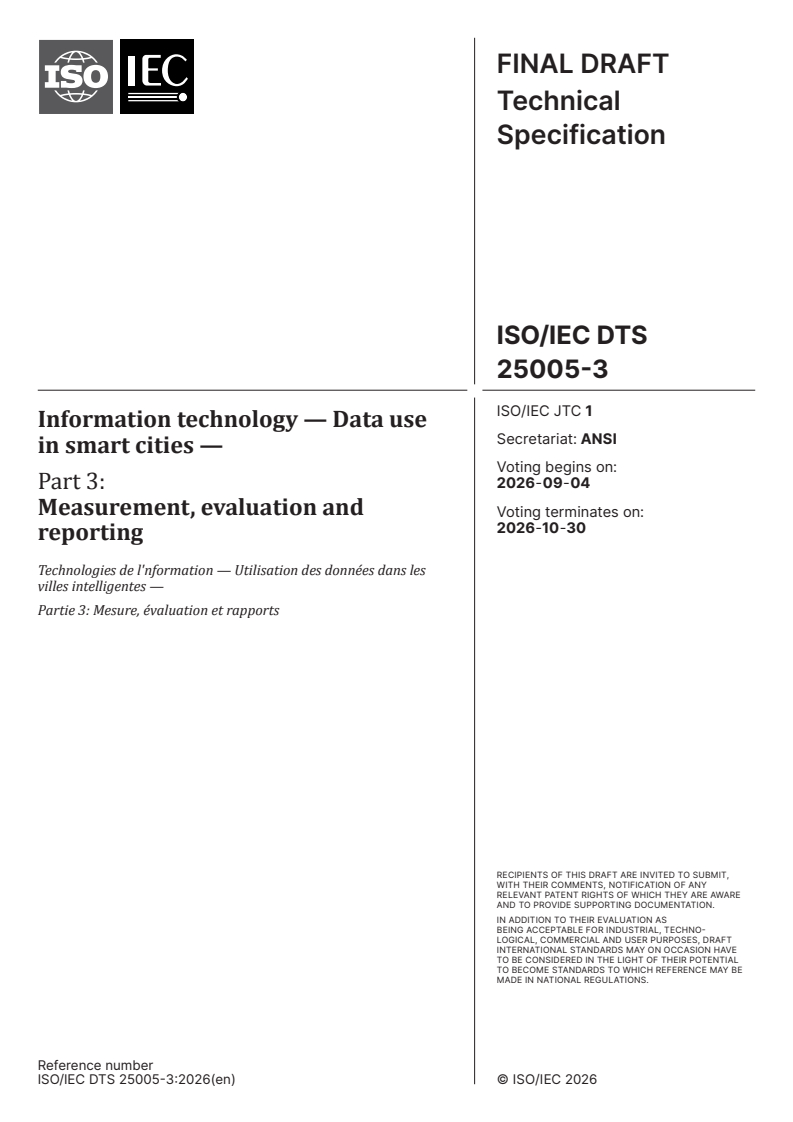

ISO/IEC DTS 25005-3 - Information technology — Data use in smart cities — Part 3: Measurement, evaluation and reporting

REDLINE ISO/IEC DTS 25005-3 - Information technology — Data use in smart cities — Part 3: Measurement, evaluation and reporting
ISO/IEC DTS 25005-3 is an ISO/IEC draft technical specification for information technology on data use in smart cities. It specifies indicators, measurement methods, evaluation, and reporting for people who plan, build, operate, assess, procure, monitor, audit, and improve city-wide data use in ICT development and applications.
What does ISO/IEC DTS 25005-3 specify?
ISO/IEC DTS 25005-3 specifies how to measure, evaluate, and report data use in smart cities. The document is organized from scope and references through terms, abbreviations, general principles, indicator groups, evaluation, and reporting, then informative annexes with maturity and process models.
| Annex | What it covers |
|---|---|
| Annex A | Reference measurement maturity models in smart cities |
| Annex B | Reference table for particular process assessment models |
| Annex C | Processes for evaluation of data use in smart cities |
Clause 1 defines the intended users and city-wide applications. Clause 2 points to the framework part of the series. Clauses 3 and 4 set the vocabulary and abbreviations. Clauses 5 to 8 cover indicator principles, measurement, evaluation, and reporting.
What are the key requirements of ISO/IEC DTS 25005-3?
ISO/IEC DTS 25005-3 focuses on a practical indicator set and on how to score, evaluate, and report it in ways that can be compared across time, places, and scenarios. The document is written for city-wide use, so the measurement methods need to work for planning, investment, procurement, monitoring, auditing, and performance assessment.
Indicator principles and structure
Clause 5 says the indicators should be comparable, comprehensive, adaptable, inclusive, and operational. In practice, that means the measures should reflect common smart city data-use characteristics, cover the whole data-use problem space, stay usable as city needs change, include different stakeholders, and be observable and auditable.
Clause 6.1 organizes the content into five dimensional indicator groups and 31 sub-dimensional indicators. The five groups are data availability, data quality assurance, ease of data use, data use security, and data-enabled innovation. For a reader, this means the standard is not just about technical quality of data - it also covers access, governance, security, and whether data actually supports better city action.
Measurement methods
Clause 6.2 says the document uses ordinal, interval, and ratio measurement. That matters because not every indicator needs the same kind of numeric treatment: some are ranked, some are compared by difference, and some support proportional calculations. The city chooses the method according to the characteristic being measured and the data available.
Clause 6.3 links measurement to methodological models and points to Annex A, Annex B, and Annex C. Annex A gives maturity models, Annex B provides process assessment model references, and Annex C shows how process evaluation can be carried out. In practice, this lets a city choose between simple maturity ratings and more formal process-based assessment.
Indicator groups in Clauses 6.4 to 6.8
Clause 6.4 gives examples for data availability. The examples cover network infrastructure accessibility, inclusiveness, data accessibility, coverage of city administration data holdings, government contribution, government-enterprise cooperation, government-citizen cooperation, enterprise-citizen cooperation, and data laws, regulations, and policies. This helps a city check not only whether data exists, but whether it can actually be reached, shared, and governed.
Clause 6.5 covers data quality assurance with examples for completeness, authenticity, timeliness, accuracy, consistency, traceability, and service impact. In practice, this means a city can connect data quality problems to real service failures, not just to abstract quality scores.
Clause 6.6 covers ease of data use through data sharing measures, data opening measures, interoperability, linkability, user experience of convenience, and user satisfaction. The examples point to open data portals, open APIs, portable formats, metadata, single sign-in, and user feedback mechanisms. For implementers, this means usability and reuse are part of data governance, not an afterthought.
Clause 6.7 covers data use security with authentication control, security and privacy control schemes, monitoring and early warning, personal data operation schemes, and consent sovereignty and revocability. The examples include rights handling such as rectification and erasure, plus revocation processes that avoid hidden barriers. That is important when cities want secure data use without making citizens’ rights hard to exercise.
Clause 6.8 covers data-enabled innovation: monitoring applications, early warning and prediction applications, intelligent decision-making applications, and responsible data-driven innovation. The examples show a progression from manual tracking to integrated, adaptive city-wide systems. In practice, this helps a city assess whether data use is only descriptive or is actually improving prediction and decision-making.
Evaluation and reporting
Clause 7 says evaluation targets should be assessed periodically according to city needs. The evaluation procedure compares current data-use characteristics with targeted values, and the checklist checks alignment with the framework part of the series. For users, this means the standard supports recurring review rather than one-time scoring.
Clause 8 explains why reporting matters: it tracks realization status, degree, and impact of data value in city-wide use. The applications table ties reporting to planning, economic analysis, project approval, procurement, project acceptance, operation and maintenance, monitoring, performance assessment, improvement planning, and audit. In practice, the report becomes evidence for decisions, not just a record.
What terms does ISO/IEC DTS 25005-3 define?
ISO/IEC DTS 25005-3 defines a small set of core terms and then uses abbreviations for common technical phrases.
- Data availability - the property of being accessible and usable on demand by an authorized entity.
- Data quality - the degree to which inherent characteristics of data meet requirements.
- Data security - the preservation of data to ensure availability, confidentiality, and integrity.
- API - application programming interface, used in the document for data provision and exchange.
- ICT - information and communication technology, the city systems and applications addressed by the standard.
- IoT - internet of things, used in the monitoring examples for connected sensing and alerts.
- OM - operation and maintenance, used for the city system lifecycle and reporting uses.
- IDC - international data corporation, named in one of the maturity model references.
Who uses ISO/IEC DTS 25005-3?
ISO/IEC DTS 25005-3 is intended for people responsible for planning, building, operating, assessing, and continuously improving data use in smart cities. It is also used for investment, procurement, monitoring, auditing, and performance assessment.
Typical users include:
- city planners and smart city program teams
- ICT project owners and implementers
- data owners, custodians, providers, users, and managers
- procurement and tender teams
- financial reviewers and investment evaluators
- operation and maintenance teams
- audit organizations and performance assessors
- public-sector teams managing city data resources
In practice, these roles use the standard to set indicators, compare options, justify projects, check service impacts, and report whether data use is improving.
Which standards are used with ISO/IEC DTS 25005-3?
ISO/IEC DTS 25005-3 relies on and cites several related standards.
- ISO/IEC DIS 25005-1 - the framework part of the series; it provides the core characteristics and sub-characteristics that the indicators align with.
- ISO/IEC TR 25005-2:2025 - the use-case analysis and common considerations part; it supports the broader set of data-use considerations.
- ISO/IEC 30146:2019 - gives smart city ICT indicators and is cited as a companion context for indicator development.
- ISO 37166:2022 - provides the source definition used for data availability.
- ISO/IEC 25024:2015 - provides the source definition used for data quality.
- ISO/IEC 29182-2:2013 - provides the source definition used for data security.
- ISO 8000-63:2019 - supports the process assessment and process measurement models used in Annex B and Annex C.
- ISO 37122:2019 - is cited as a source for example indicators in the measurement tables.
What does the ISO/IEC DTS 25005-3 document contain?
ISO/IEC DTS 25005-3 contains measurement tables, evaluation guidance, reporting applications, and informative annexes that support different assessment styles. The body of the document includes example indicator tables for data availability, data quality assurance, ease of data use, data use security, and data-enabled innovation.
The document also includes an evaluation checklist and a reporting section that links results to lifecycle decisions such as planning, approval, procurement, operation, and audit. Annex A contains three maturity model references, Annex B maps process assessment models, and Annex C shows how process evaluation relates to an inspection plan, a maturity model, and the assessed process.
The figures, tables, and formulas are used to turn broad smart city data-use goals into assessable criteria. That makes the document useful for benchmarking, internal review, and evidence-based reporting without turning it into a simple score sheet.
Buy Documents
ISO/IEC DTS 25005-3 - Information technology — Data use in smart cities — Part 3: Measurement, evaluation and reporting
REDLINE ISO/IEC DTS 25005-3 - Information technology — Data use in smart cities — Part 3: Measurement, evaluation and reporting
Get Certified
Connect with accredited certification bodies for this standard

BSI Group
BSI (British Standards Institution) is the business standards company that helps organizations make excellence a habit.

Bureau Veritas
Bureau Veritas is a world leader in laboratory testing, inspection and certification services.

DNV
DNV is an independent assurance and risk management provider.
Sponsored listings
Frequently Asked Questions
ISO/IEC DTS 25005-3 is a draft published by the International Organization for Standardization (ISO). Its full title is "Information technology — Data use in smart cities — Part 3: Measurement, evaluation and reporting". This standard covers: This document provides indicators, indicators descriptions, measurement, evaluation and reporting concerns about data use in smart cities. The document is intended for those who are responsible for mapping, building, and operating, assessing and continuous improvement of data use in ICT development and applications, investment, procurement, monitoring, auditing and performance assessment city wide.
This document provides indicators, indicators descriptions, measurement, evaluation and reporting concerns about data use in smart cities. The document is intended for those who are responsible for mapping, building, and operating, assessing and continuous improvement of data use in ICT development and applications, investment, procurement, monitoring, auditing and performance assessment city wide.
ISO/IEC DTS 25005-3 is classified under the following ICS (International Classification for Standards) categories: 13.020.20 - Environmental economics. Sustainability; 35.240.01 - Application of information technology in general. The ICS classification helps identify the subject area and facilitates finding related standards.
ISO/IEC DTS 25005-3 is available in PDF format for immediate download after purchase. The document can be added to your cart and obtained through the secure checkout process. Digital delivery ensures instant access to the complete standard document.
Standards Content (Sample)
FINAL DRAFT
Technical
Specification
ISO/IEC DTS
25005-3
ISO/IEC JTC 1
Information technology — Data use
Secretariat: ANSI
in smart cities —
Voting begins on:
2026-09-04
Part 3:
Measurement, evaluation and
Voting terminates on:
2026-10-30
reporting
Technologies de l'nformation — Utilisation des données dans les
villes intelligentes —
Partie 3: Mesure, évaluation et rapports
RECIPIENTS OF THIS DRAFT ARE INVITED TO SUBMIT,
WITH THEIR COMMENTS, NOTIFICATION OF ANY
RELEVANT PATENT RIGHTS OF WHICH THEY ARE AWARE
AND TO PROVIDE SUPPOR TING DOCUMENTATION.
IN ADDITION TO THEIR EVALUATION AS
BEING ACCEPTABLE FOR INDUSTRIAL, TECHNO-
LOGICAL, COMMERCIAL AND USER PURPOSES, DRAFT
INTERNATIONAL STANDARDS MAY ON OCCASION HAVE
TO BE CONSIDERED IN THE LIGHT OF THEIR POTENTIAL
TO BECOME STAN DARDS TO WHICH REFERENCE MAY BE
MADE IN NATIONAL REGULATIONS.
Reference number
FINAL DRAFT
Technical
Specification
ISO/IEC DTS
25005-3
ISO/IEC JTC 1
Information technology — Data use
Secretariat: ANSI
in smart cities —
Voting begins on:
Part 3:
Measurement, evaluation and
Voting terminates on:
reporting
Technologies de l'nformation — Utilisation des données dans les
villes intelligentes —
Partie 3: Mesure, évaluation et rapports
RECIPIENTS OF THIS DRAFT ARE INVITED TO SUBMIT,
WITH THEIR COMMENTS, NOTIFICATION OF ANY
RELEVANT PATENT RIGHTS OF WHICH THEY ARE AWARE
AND TO PROVIDE SUPPOR TING DOCUMENTATION.
© ISO/IEC 2026
IN ADDITION TO THEIR EVALUATION AS
All rights reserved. Unless otherwise specified, or required in the context of its implementation, no part of this publication may
BEING ACCEPTABLE FOR INDUSTRIAL, TECHNO-
LOGICAL, COMMERCIAL AND USER PURPOSES, DRAFT
be reproduced or utilized otherwise in any form or by any means, electronic or mechanical, including photocopying, or posting on
INTERNATIONAL STANDARDS MAY ON OCCASION HAVE
the internet or an intranet, without prior written permission. Permission can be requested from either ISO at the address below
TO BE CONSIDERED IN THE LIGHT OF THEIR POTENTIAL
or ISO’s member body in the country of the requester.
TO BECOME STAN DARDS TO WHICH REFERENCE MAY BE
MADE IN NATIONAL REGULATIONS.
ISO copyright office
CP 401 • Ch. de Blandonnet 8
CH-1214 Vernier, Geneva
Phone: +41 22 749 01 11
Email: copyright@iso.org
Website: www.iso.org
Published in Switzerland Reference number
© ISO/IEC 2026 – All rights reserved
ii
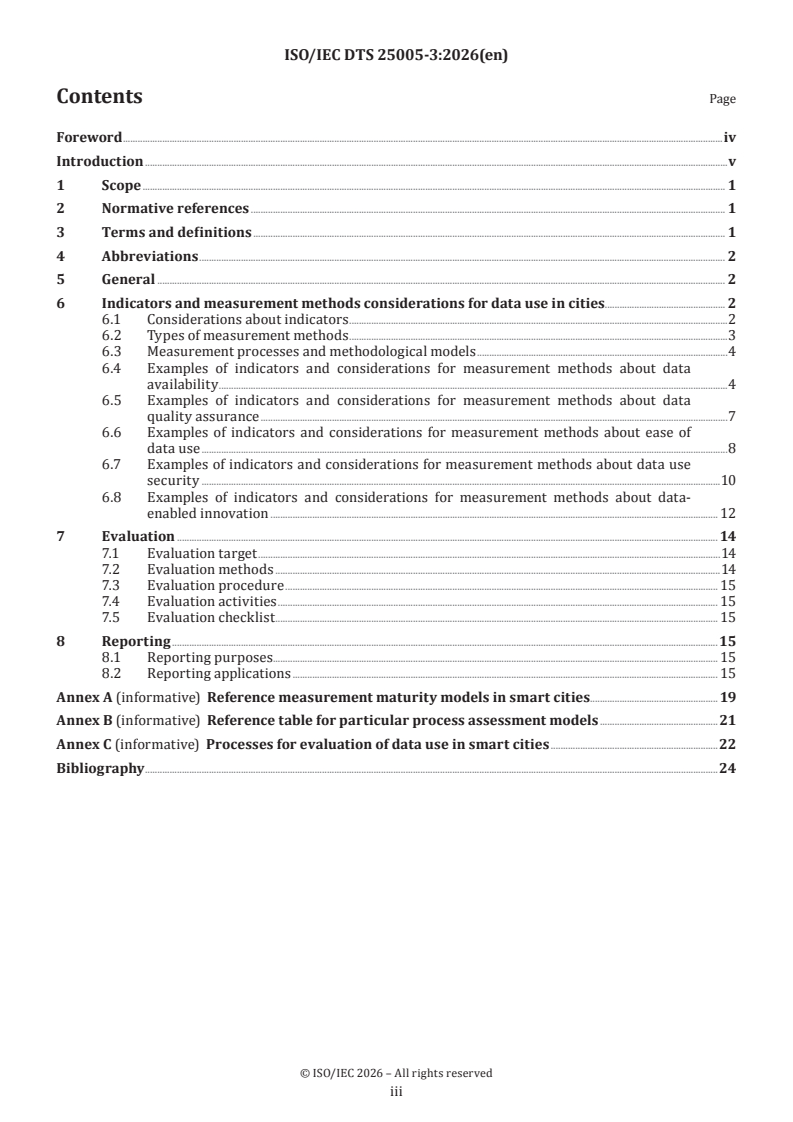
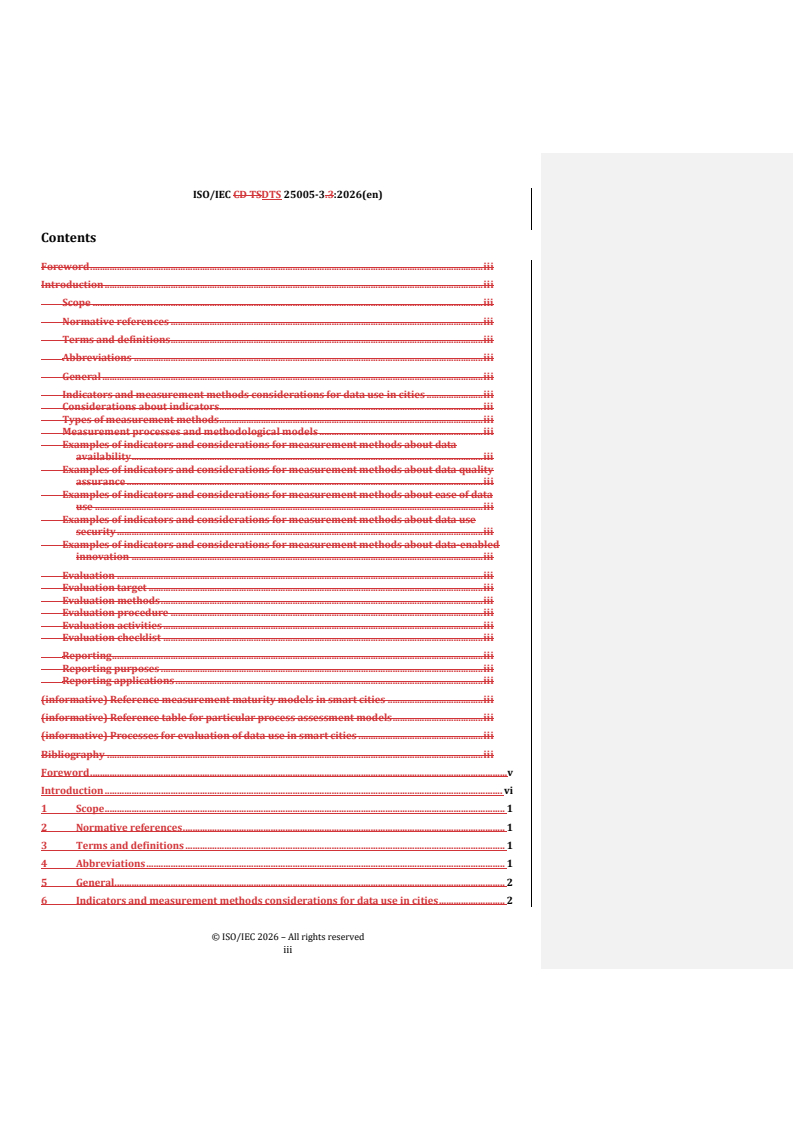
Contents Page
Foreword .iv
Introduction .v
1 Scope . 1
2 Normative references . 1
3 Terms and definitions . 1
4 Abbreviations . 2
5 General . 2
6 Indicators and measurement methods considerations for data use in cities. 2
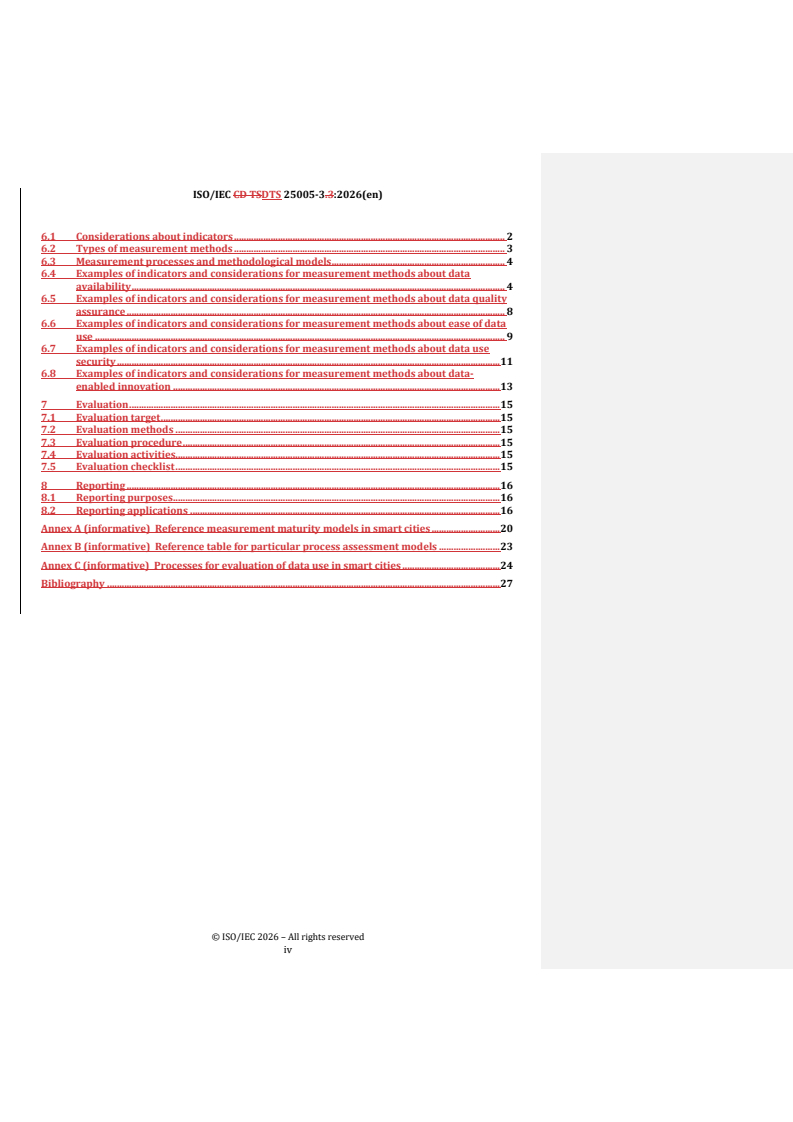
6.1 Considerations about indicators .2
6.2 Types of measurement methods .3
6.3 Measurement processes and methodological models .4
6.4 Examples of indicators and considerations for measurement methods about data
availability .4
6.5 Examples of indicators and considerations for measurement methods about data
quality assurance .7
6.6 Examples of indicators and considerations for measurement methods about ease of
data use .8
6.7 Examples of indicators and considerations for measurement methods about data use
security .10
6.8 Examples of indicators and considerations for measurement methods about data-
enabled innovation . 12
7 Evaluation . 14
7.1 Evaluation target .14
7.2 Evaluation methods .14
7.3 Evaluation procedure . 15
7.4 Evaluation activities . 15
7.5 Evaluation checklist . 15
8 Reporting .15
8.1 Reporting purposes. 15
8.2 Reporting applications . 15
Annex A (informative) Reference measurement maturity models in smart cities . 19
Annex B (informative) Reference table for particular process assessment models .21
Annex C (informative) Processes for evaluation of data use in smart cities .22
Bibliography .24
© ISO/IEC 2026 – All rights reserved
iii
Foreword
ISO (the International Organization for Standardization) and IEC (the International Electrotechnical
Commission) form the specialized system for worldwide standardization. National bodies that are
members of ISO or IEC participate in the development of International Standards through technical
committees established by the respective organization to deal with particular fields of technical activity.
ISO and IEC technical committees collaborate in fields of mutual interest. Other international organizations,
governmental and non-governmental, in liaison with ISO and IEC, also take part in the work.
The procedures used to develop this document and those intended for its further maintenance are described
in the ISO/IEC Directives, Part 1. In particular, the different approval criteria needed for the different types
of document should be noted. This document was drafted in accordance with the editorial rules of the ISO/
IEC Directives, Part 2 (see www.iso.org/directives or www.iec.ch/members_experts/refdocs).
ISO and IEC draw attention to the possibility that the implementation of this document may involve the
use of (a) patent(s). ISO and IEC take no position concerning the evidence, validity or applicability of any
claimed patent rights in respect thereof. As of the date of publication of this document, ISO and IEC had not
received notice of (a) patent(s) which may be required to implement this document. However, implementers
are cautioned that this may not represent the latest information, which may be obtained from the patent
database available at www.iso.org/patents and https://patents.iec.ch. ISO and IEC shall not be held
responsible for identifying any or all such patent rights.
Any trade name used in this document is information given for the convenience of users and does not
constitute an endorsement.
For an explanation of the voluntary nature of standards, the meaning of ISO specific terms and expressions
related to conformity assessment, as well as information about ISO's adherence to the World Trade
Organization (WTO) principles in the Technical Barriers to Trade (TBT) see www.iso.org/iso/foreword.html.
In the IEC, see www.iec.ch/understanding-standards.
This document was prepared by Joint Technical Committee ISO/IEC JTC 1, Information technology.
A list of all parts in the ISO 25005 series can be found on the ISO website.
Any feedback or questions on this document should be directed to the user’s national standards body. A
complete listing of these bodies can be found atwww.iso.org/members.html.
© ISO/IEC 2026 – All rights reserved
iv
Introduction
This document fills in the gaps in standards collaboration to measurement, evaluation and reporting of data
[1]
use in the ICT development and applications in smart cities, and it is complementary to ISO/IEC 30146 that
provides guiding principles for the development of ICT indicators for smart cities. This document provides
alternative indicators on data use in smart cities.
This document can also be applied for planning, building, operating, assessing and continuous improvement
of data use in smart cities applications, investment, procurement, monitoring, auditing and performance
assessment in smart city.
Data use in smart cities standard series consists of three parts. This document is the part 3 of data use in
[2]
smart cities standard series, which is in alignment with ISO/IEC 25005-1 , regarding data as strategic
resources and asset of city from many views and various dimensions, bringing multiple stakeholders
interests and considerations about demands for data use together as a complementary whole to deal with
problems in data use including data are not available, data are not useful, data are not easy to use, data
are not used securely, data are not used for enabling intelligent predictions and actions due to lack of
comprehensive guarantees about data use in data management and governance. Special attentions are paid
to demands for standardization collaboration to enable comprehensive data use to guarantee the data-based,
data-driven and data-enabled city-wide ICT development and applications in smart cities to enable data that
are available, data that are useful, data that are easy to use, data that are used securely, and data that are
used for enabling intelligent predictions and actions. Figure 1 provides the relations among ISO/IEC 25005-1
[2] [3] [4]
, ISO/IEC TR 25005-2 and ISO/IEC DTS 25005-3 , describing guiding principles for data use in smart
cities, core issues and considerations of data use in smart cities which are the basis for data use in smart
cities standard series.
Figure 1 — Data use in smart cities standard series
This document brings existing considerations about indicators, indicator description, measurement,
evaluation and reporting of data use together for continuous improvement of total capabilities of data use
in smart cities to support data-based, data-driven, and data-enabled ICT development and applications in
smart cities.
The evaluation methods depend on different interests of stakeholders for different purposes, a variety of
evaluation methods like maturity models are listed in Annex A, Annex B, and Annex C for references.
© ISO/IEC 2026 – All rights reserved
v
FINAL DRAFT Technical Specification ISO/IEC DTS 25005-3:2026(en)
Information technology — Data use in smart cities —
Part 3:
Measurement, evaluation and reporting
1 Scope
This document provides indicators, measurement, evaluation, and reporting about data use in smart cities.
The document is intended for those who are responsible for planning, building, and operating, assessing
and continuous improvement of data use in smart cities applications, as well as for related investment,
procurement, monitoring, auditing and performance assessment.
2 Normative references
The following documents are referred to in the text in such a way that some or all of their content constitutes
requirements of this document. For dated references, only the edition cited applies. For undated references,
the latest edition of the referenced document (including any amendments) applies.
ISO/IEC DIS 25005-1, Information technology — Data use in smart cities — Part 1: Framework
3 Terms and definitions
For the purposes of this document, the terms and definitions given in the ISO/IEC 25005-1 and the following
apply.
ISO and IEC maintain terminological databases for use in standardization at the following addresses:
— IEC Electropedia: available at http:// www .electropedia .org/
— ISO Online browsing platform: available at http:// www .iso .org/ obp
3.1
data availability
property of being accessible and usable upon demand by an authorized entity
[5]
[SOURCE: ISO 37166:2022 , 3.2]
3.2
data quality
degree to which a set of inherent characteristics of data fulfil requirements
[6]
[SOURCE: ISO/IEC 25024:2015 , 4.11]
3.3
data security
preservation of data to guarantee availability, confidentiality and data integrity
[7]
[SOURCE: ISO/IEC 29182-2:2013 , 2.6.6]
© ISO/IEC 2026 – All rights reserved
4 Abbreviations
API Application programming interface
ICT Information and communication technology
IDC International data corporation
IoT Internet of things
OM Operation and maintenance
5 General
The general principles of considerations about indicators, measurement, evaluation and reporting of data
[2]
use in smart cities are provided in and associated with ISO/IEC 25005-1 :
a) Comparable
1) The indicators should reflect the common characteristics of the data use in smart cities.
2) The indicators should be defined in a way that data use can be comparable over time, space and
event.
b) Comprehensive
1) The indicators cover all the core considerations of the data use in smart cities identified in iso: proj:
88765ISO/ IEC FDIS 25005-1.
c) Adaptable
1) The indicators should be continuously updated adaptable to scenarios of data use in smart cities.
d) Inclusiveness
1) The indicators are comprehensive to reflect the multiple stakeholders’ considerations about data
use.
e) Operational
1) The indicators should be easily observable, measurable and auditable.
2) The historic and current data should be either available or easy to collect to connect past to present
and present to future.
6 Indicators and measurement methods considerations for data use in cities
6.1 Considerations about indicators
This document identifies five dimensional indicators and thirty one sub-dimensional indicators. The
selection considerations are as follows:
a) Applicable to multiple scenarios of measurement of data use citywide. The selected indicators should
take into account the use of multiple scenarios in smart cities. For example, it can be used for investment,
procurement, monitoring, auditing, and performance assessment of ICT projects, it can also be used for
the conceptual design of smart city infrastructure, and it can also be used for measuring and auditing
data-driven smart city services.
b) Cover the entire process of data processing, management and governance as well as its conditions and
regulatory environments e.g. time, places, events and scenarios.
© ISO/IEC 2026 – All rights reserved
c) The interests of different stakeholders from many and various types of demands along data value chain
and data ecosystem are taken into account, e.g. data owners, data custodians, data providers, data users,
data managers, data products and service producers, data administrative monitors in smart cities.
d) Indicators relevant to data use from existing standards are taken into account and brought together for
harmonized, consistent, coherent and standardized use.
e) Consider appropriate technological foresight. The indicators should cover the measurement and
evaluation of structured data as well as multimodal data such as text, audio, video, and images data. The
indicators should cover artificial intelligence scenarios such as large models that will be widely used in
the future.
The five dimensional indicator groups and their thirty one sub-dimensional indicators are as following:
f) The indicators about data availability, including nine sub-dimensional indicators, namely network
infrastructure accessibility, inclusiveness, data accessibility, coverage of data use in city administration
data resources holdings, the contribution of government in data use, government-enterprise cooperation
on data opening and use, government-citizen cooperation on data opening and use, enterprise-citizen
cooperation on data opening and use, data laws, regulations and policies;
g) The indicators about data quality assurance, including seven sub-dimensional indicators, namely
completeness, authenticity, reliability, timeliness, accuracy, consistency, traceability, and service impact;
h) The indicators about ease of data use, including six sub-dimensional indicators, namely data sharing
measures, data opening measures, interoperability, linkability, user experience of convenience and user
satisfaction;
i) The indicators about data use security, including five sub-dimensional indicators, namely data use
authentication control schemes, data use security and privacy control schemes, data use monitoring and
early warning schemes, personal data operation schemes, and consent sovereignty and revocability.
j) The indicators about data-enabled innovation, including three sub-dimensional indicators, namely data-
enabled monitoring applications, data-enabled early warning and prediction applications, data-enabled
intelligent decision-making applications and responsible data-driven innovation.
6.2 Types of measurement methods
The methods of measurement primarily encompass three categories: ordinal measurement, interval
measurement, and ratio measurement. The selection of methods of measurement for data use citywide
depends on city needs and characteristics of considerations and sub-considerations about data use identified
[2]
in ISO/IEC 25005-1 that can be observed and measured.
a) Ordinal measurement, not only classifies but also ranks objects in a logical order, indicating their grade
or sequence without permitting arithmetic operations, e.g. Interoperability.
b) Interval measurement further allows for the determination of intervals and quantitative differences
between categories, enabling addition and subtraction but not multiplication or division. The zero point
in interval measurement is arbitrary rather than absolute; a common example is time (timeliness),
where a zero value does not represent the complete absence of the measured attribute but merely a
conventional reference point.
c) Ratio measurement, the highest level, incorporates all properties of the previous two scales, it permits
all arithmetic operations (addition, subtraction, multiplication, and division) and providing results with
meaningful practical interpretation. A defining feature is that its zero point represents an absolute
zero—meaning a complete absence of the attribute being measured. Using accuracy as an example, a
zero value indicates no accuracy at all (i.e. completely incorrect or no correct results), which allows for
meaningful ratio comparisons such as “one measurement is twice as accurate as another.”
© ISO/IEC 2026 – All rights reserved
6.3 Measurement processes and methodological models
Measurement processes and the tools are different according to different purposes for measurement,
evaluation and reporting. This document provides following references:
Annex A provides examples of reference measurement maturity models for measuring performance of data
use in smart cities.
Clause A.1 provides a five-level maturity model for measuring data use performance in smart cites which
covers: level 1: informal, level 2: documented, Level 3: planned, Level 4: deployed, Level 5: impact.
Clause A.2 provides TM Forum Smart City Maturity and Benchmark Model which gives common rating
criteria, including 0: Not started, 2. Documented, 3 Planned, 4. Deployed, 5. Measurable impact.
Clause A.3 provides IDC Government Insights’ Smart City Model which defines key characteristics, goals and
outcomes of Ad Hoc, Opportunistic, Repeatable, Managed, Optimized.
[8]
Annex B provides examples of process assessment models specified in ISO 8000-63 which gives different
considerations about indicators, metric, measured indicator value and converted indicator value in different
standards and scenarios.
[8]
Annex C provides example processes for different process assessment models in ISO 8000-63 .
6.4 Examples of indicators and considerations for measurement methods about data
availability
Examples of indicators and measurement methods for data availability are provided in Table 1. These
indicators are aligned with the sub-characteristics of data use considerations defined in ISO/IEC 25005-1:2026
[9]
, 6.2.
NOTE “L1.8 Enterprise-citizen cooperation on data opening and use” is newly added with considerations of
national bodies consulting recommendations.
Examples can be varied from citiy to citiy, according to intended purposes of data use.
The measurement methods provided in Table 1 represent typical calculation formulas. Users may apply
alternative mathematical models or data sources provided they maintain consistency with the indicator’s
objective.
Table 1 — Examples of indicators and considerations for measurement methods about data
availability
Indicator Description Example measurement methods
a) Percentage of the city population a) (Number of people in the city with
with access to pre-defined fast broad- access to sufficiently fast broadband /
band. city's total population) ×100%.
[10]
[SOURCE: ISO 37122:2019 , 18.1,
modified Change "sufficiently" to
"pre-defined"]
L1.1 Network infrastructure accessi-
b) Percentage of the city area covered b) (Land area of the city serviced
bility
by municipally provided Internet with Internet connectivity in square
connectivity. kilometres /city's total land area in
square kilometres)×100%.
c) Percentage of department facilities c) (Number of department facilities
connected to city service provisions that are connected with city service
provisions/total number of depart-
ment facilities) ×100%.
© ISO/IEC 2026 – All rights reserved
TTabablele 1 1 ((ccoonnttiinnueuedd))
a) Percentage of e-record coverage for a) (Number of low-income house-
low-income households. holds with e-records/total number of
[11]
low-income households) × 100%.
[SOURCE: ISO/IEC 30146:2019 , L
1.8.1]
b) Performance of Internet accessibil- b) (Number of municipal government
L1.2 Inclusiveness
ity for disabled people. main portals that provide Internet
[11]
accessibility for disabled people in
[SOURCE: ISO/IEC 30146:2019 , L
smart cities / total number of munici-
1.8.2]
pal government main portals in smart
cities) × 100%.
a) Existence of central portal access. a) (Yes/no) whether there is a cen-
tral/federal open government data
portal.
b) Accessibility of digital public b) Percentage of digital smart-city
services beyond government portals, services meeting internationally rec-
including mobile applications, dash- ognized accessibility standards.
boards and real-time information
services.
c) Existence of requirements to pro- c) (Yes/no) whether there are re-
vide data in open, reusable formats. quirements on machine-readable and
open formats.
d) Existence of service free of charge d) (Yes/no) whether there are re-
or with open license. quirements to provide open data free
of charge and with open license.
e) Existence of requirements to e) (Yes/no) whether there are re-
provide data through Application quirements to provide data through
Programming Interfaces (s). standard APIs.
L1.3 Data accessibility
f) Usability of data portals, including f) User-centered accessibility and
clarity of structure and ease of find- navigation evaluation using measura-
ing high-value datasets. ble indicators, such as:
— task completion rate for key user
journeys,
— average time-on-task for finding
high-value datasets,
— number of navigation errors per
task,
— proportion of accessibility
criteria met (e.g. WCAG
compliance),
— user satisfaction ratings from
structured usability tests.
© ISO/IEC 2026 – All rights reserved
TTabablele 1 1 ((ccoonnttiinnueuedd))
a) Public information resources open- a) (Number of city administration
ness ratio. data sets open to public according to
the local policy/total number of city
administration data required to open
to public according to local policy) ×
100%.
b) Information sharing ratio among b) (Number of city administration
government sectors. data resources shared across govern-
ment sectors according to the local
L1.4 Coverage of data use in city ad-
policy/total number of city adminis-
ministration data resources holdings
tration data required to share across
government sectors according to local
policy) × 100%.
c) Percentage of high value datasets c) (Number of High value datasets
that are available as open data. that are available as open data
according to the local policy / total
number of city administration data
resources open to public according to
the local policy) × 100%.
a) Data use promotion initiatives in a) (Yes/no) whether there are specific
smart cities. events (e.g. information sessions,
co-creation events) organized by
government to support data use in
smart cities.
L1.5 Contribution of government in
b) Data use literacy programmes in b) (Yes/no) whether there are train-
data use
smart cities. ing events to improve data awareness
and support data use in smart cities.
c) Monitoring impact of data use in c) (Yes/no) whether there is a mon-
smart cities. itoring impact of data use in smart
cities conducted by the government.
a) Consultations on data opening and a) (Yes/no) whether enterprises were
data use with enterprises. consulted to identify data opening
and data use demands.
b) Existence of formal partnerships. b) (Yes/no) whether there is a formal
partnership between the government
and enterprises to promote data use
L1.6 Government-enterprise coopera-
in smart cities.
tion on data opening and use
c) Service or application made by en- c) (Yes/no) whether there are servic-
terprises with government data. es or applications made by enterpris-
es with government data.
d) Service or application made by the d) (Yes/no) whether there are ser-
government with enterprise data. vices or applications made by the
government with enterprise data.
a) Consultations on data opening and a) (Yes/no) whether citizens were
data use with citizens. consulted to identify data opening
and data use demands.
L1.7 Government-citizen cooperation
b) Citizen Engagement for city use b) (Yes/no) where there are channels
on data opening and use
services. provided by government for citizens
to provide an opinion on city data use
services.
© ISO/IEC 2026 – All rights reserved
TTabablele 1 1 ((ccoonnttiinnueuedd))
a) Completeness of the data govern- a) (yes/no) whether businesses (util-
ance ecosystem. ities, telecommunications, fintech,
logistics, etc) as custodians of vast
volume of personal and collective
data are in cooperation with citizens
to build transparency and trust on
data opening and use for cities.
b) Social responsibility and business b) (yes/no) Whether the business
ethics in the digital age. can provide documented information
L1.8 Enterprise-citizen cooperation
regarding its social responsibilities,
on data opening and use
including the ethical governance of
data, the protection of citizens’ digital
rights (privacy, data portability, right
to rectification, non-discrimination,
and avoidance of unwanted bias), and
commitments to business models
that prioritize informed consent,
auditability, and the collective public
good over the unilateral extraction of
value.
a) Coordinated state and condition a) (Yes/no) whether there are coor-
of good practice of data use, e.g. dinated good practices of data use,
leadership, awarding and punishment e.g. leadership, regulation, standard-
approaches to promote data use and ization, champaign, awarding and
reuse for better city services. punishment approaches to promote
the data use and reuse for better city
services.
b) Existence of laws, regulations, and b) (Yes/no) whether there are laws,
policies on data governance, data regulations, and policies on data
opening, data use, security protec- governance, data opening, data use,
tion, data copyright and ownership. security protection, data copyright
L1.9 Data laws, regulations, and
and ownership.
policies
c) Policies incorporating principles c) Existence of documented pro-
for responsible data management, cedures demonstrating consistent
such as clarity of purposes and application of responsible data man-
minimization of unnecessary data agement principles.
collection.
d) Assessment mechanism for imple- d) (Yes/no) whether there is an as-
mentation of laws, regulations, and sessment mechanism for implementa-
policies. tion of laws, regulations, and policies
on data governance, data opening,
data use, security protection; data
copyright and ownership.
6.5 Examples of indicators and considerations for measurement methods about data
quality assurance
Examples of indicators and measurement methods for data quality assurance are provided in Table 2 . These
indicators are aligned with sub-characteristics of data use considerations defined in ISO/IEC 25005-1:2026
[9]
, 6.3.
NOTE “Reliability” in ISO/IEC 25005-1 is deleted and “L2.7 Service impact” is newly added for measurable
considerations and consulting recommendations from national bodies.
Examples can be varied from citiy to city, according to intended purpose of data use.
The measurement methods provided in Table 2 represent typical calculation formulas. Users may apply
alternative mathematical models or data sources provided they maintain consistency with the indicator’s
objective.
© ISO/IEC 2026 – All rights reserved
Table 2 — Examples of indicators and considerations for measurement methods about data quality
assurance
Indicator Description Example measurement methods
The necessary data fields or features (Number of data with populated and
required for urban information valid value specified by the user for
L2.1 Completeness
services specified by the user for an an intended purpose / Total number
intended purpose of data) × 100%.
The data are sent by the source busi- (Number of data with verifiable
L2.2 Authenticity ness unit or sent with the authoriza- sources and processing / Total num-
tion of the source business unit. ber of data) × 100%
The frequency and speed of data up- (Number of data updated meeting
L2.3 Timeliness dates meet business requirements. business requirements / Total num-
ber of data) × 100%
The degree to which a set of data (Number of data values matching the
correctly reflects the real-world required checklist / Total number of
L2.4 Accuracy
phenomenon, object, or event it is data) × 100%
intended to represent.
Ensure that data values are identical a) (Yes/No) Whether data follows uni-
across all instances of an application form business rules and is logically
within the same system or across self-consistent within a single system.
different systems.
b) (Number of designated data with
identical values within a system /
L2.5 Consistency Total number of designated data) ×
100%.
c) (Number of designated data with
identical values across different
systems / Total number of designated
data) × 100%.
The ability to track and verify the his- a) (Yes/No) Whether the origins of
tory and application of data through- data, the process of data and the
out its entire life cycle. application of data can be traced
through tools or documented infor-
L2.6 Traceability
mation.
b) (Yes/No) Whether data source has
clear metadata about its administra-
tion history.
a) Data-related errors affecting public a) Number and severity of citizen-fac-
services (e.g. incorrect routing, out- ing incidents attributable to data
dated information, misclassification) errors.
b) Service interruptions or degraded b) Frequency of service corrections
L2.7 Service impact
performance caused by incomplete or triggered by data quality issues or
inconsistent data. volume of citizen reports or com-
plaints linked to data-related service
failures.
6.6 Examples of indicators and considerations for measurement methods about ease of
data use
Examples of indicators and considerations measurement methods about ease of data use are provided
in Table 3. These indicators are aligned with sub-characteristics of data use considerations defined in
[9]
ISO/IEC 25005-1:2026 , 6.4.
Examples can be varied from city to city, according to intended purpose of data use.
The measurement methods provided in Table 3 represent typical calculation formulas. Users may apply
alternative mathematical models or data sources provided they maintain consistency with the indicator’s
objective.
© ISO/IEC 2026 – All rights reserved
Table 3 — Examples of indicators and considerations for measurement methods about ease of data
use
Indicator Description Example measurement methods
a) Conditions and ways in which data a) (Yes or No) Whether the city
are shared fundamentally influenc- has data sharing plans. (Yes or No)
es the available controls and the Whether the city has data sharing
statements needed in a data sharing catalogues.
L3.1 Data sharing measures
agreement.
b) Information sharing information b) (Yes or No) Whether the city has
infrastructure across government a data sharing systems, platforms or
sectors. services across government sectors.
a) Conditions and ways that facilitate a) (Yes or No) Whether the city has
data availability and visibility to data opening plans. (Yes or No)
others and that can be freely used, re- Whether the city has data opening
used, re-published and redistributed catalogues.
L3.2 Data opening measures
by anyone.
b) Public information resources open- b) (Yes or No) Whether the city has a
ness ratio. data opening systems, platforms or
services for public.
a) Data use associated interoperabili- a) (Yes or No) Whether the city has
ty issues (policy, behaviour, Semantic data format consistent checking pro-
Data, Syntactic, transport) have been cess and document information.
considered to enable diverse systems
b) (Yes or No) Whether the city has
and organizations to work together
data definition and description for
seamlessly, facilitating the exchange
master data.
of information and services without
NOTE Master data: Data held by an
compatibility issues. As a fundamen-
organization to describe the entities that
tal requirement to eliminate technical
are both independent and fundamental
barriers, the implementation of
for that organization, and referenced in
documented Open APIs is established,
order to perform its transactions.
ensuring that local developers and
[12]
Source: ISO 8000-2:2022 example and
open-source software communities
L3.3 Interoperability
note has been deleted.
can integrate services and consume
information effectively, fostering a c) (Yes or No) Whether the city has
collaborative and accessible digital established a checking process in
ecosystem. alignment with data definition and
description.
b) Ability of systems to export or ex- d) Percentage of services supporting
change data using standardized, open standardized and portable data for-
and portable formats. mats (e.g. CSV, JSON, API-based export
according to open standards).
e) Availability of documentation
describing export and interchange
formats.
© ISO/IEC 2026 – All rights reserved
TTabablele 3 3 ((ccoonnttiinnueuedd))
Indicator Description Example measurement methods
a) The correspondence between a) (Yes or No) Whether the dataset
entities and entity attributes among has a unified identifier.
different systems is established.
b) The degree to which the corre- b) (Yes or No) Whether the dataset
spondence between entities and their has labels for description of its con-
attributes is established between tents and characteristics.
different systems to ensure informa-
tion consistency.
c) Use of open metadata schemas to c) (Yes or No) Whether the dataset
define relationships between data- has a key for associated relationships
L3.4 Linkability bases. for cross reference.
d) Implementation of public ontol- d) Semantic independence audit:
ogies that allow management to Verification that data dictionaries and
maintain semantic understanding relationship schemas are interpreta-
and control of its information without ble and editable independently of the
depending on proprietary "black box" technology provider.
algorithms.
e) Standards review: Evaluation
of whether the metadata follows
non-proprietary international stand-
ards that facilitate portability and
long-term understanding.
a) Percentage of government services a) (number of government services
which can be solved via single sign in. which can be accessed via single web
The design of the system has taken portal/total number of government
into account the needs of special services) ×100%.
groups. A user feels the convenience
b) the percentage of age-friendly
of the city service without repeated
system in city.
filling various types of forms.
L3.5 User experience of convenience
c) User data may be shared across
associated systems with user explicit
consent.
b) Service interfaces designed with d) User testing results assessing
simplified, accessible user paths. clarity, usability and accessibility of
service interaction flows.
There is a mechanism for collecting a) (Yes or No) Whether there’s user
user feedback on service usage. There satisfaction feedback collection pro-
is a mechanism for updating the sys- cess for data services provided.
L3.6
tem based on user feedback.
b) (Yes or No) Whether there’s pro-
User satisfaction
cess for improving the performance
of information systems based on user
demands.
6.7 Examples of indicators and considerations for measurement methods about data use
security
Examples of indicators and considerations measurement methods about data use security are provided
in Table 4 . These indicators are aligned with sub-characteristics of data use considerations defined in
[9]
ISO/IEC 25005-1:2026 , 6.5.
NOTE “L4.5 Consent sovereignty and revocability” is newly added with considerations of national bodies
consulting recommendations.
Examples can be varied from city to city, according to intended purpose of data use.
The measurement methods provided in Table 4 represent typical calculation formulas. Users may apply
alternative mathematical models or data sources provided they maintain consistency with the indicator’s
objective.
© ISO/IEC 2026 – All rights reserved
Table 4 — Examples of indicators and considerations for measurement methods about data use
security
Considerations for measurement
Indicator Description
methods
Ensures that data are accessed only (Yes/no) Whether there are authenti-
by authorized users and that all ac- cation plans for data use.
cess is strictly controlled.
If yes, (yes/no) whether there is au-
Often paired with data encryption thentication operation arrangement
for data use.
(confidentiality) to form a compre-
hensive security framework.
L4.1 Data use authentication control
schemes
Implementation of electronic or digi-
tal signature.
The user authentication mechanism
is used.
The access control mechanism is
used.
a) Security guidelines for data classi- a) (Yes/no) Whether there are data
fication and protection activities. use classification plans for data use
L4.2 Data use security and privacy
security. If yes, (yes/no) whether
control schemes
there is classification operation ar-
rangement for data use security.
b) Assessment of proportionality of b) Existence of procedures for evalu-
security measures across different ating necessity and proportionality of
data-use scenarios. security controls.
c) Privacy guidelines for sensitivity c) (Yes/no) Whether there are data
classification and protection activi- use classification plans for data pri-
ties. vacy. If yes, (yes/no) whether there
are data use classification operation
arrangement for data privacy.
Set of protocols, processes, and tech- a) (Yes/no) Whether there are data
nologies based on the public warning use monitoring plans or arrangement.
L4.3 Data use monitoring and early
policy to deliver and alert messages in
b) (Yes/no) Whether there are data
warning schemes
a developing emergency situ
...
ISO/IEC JTC 1
ISO/IEC CD TS 25005-3.3(en)
Secretariat: ANSI
Date: 2026-08-21
Information technology — Data use in smart cities —
Part 3:
Measurement, evaluation and reporting
Technologies de l'nformation — Utilisation des données dans les villes intelligentes —
Partie 3: Mesure, évaluation et rapports
FDIS stage
ISO/IEC CD TSDTS 25005-3.3:2026(en)
All rights reserved. Unless otherwise specified, or required in the context of its implementation, no part of this publication
may be reproduced or utilized otherwise in any form or by any means, electronic or mechanical, including photocopying,
or posting on the internet or an intranet, without prior written permission. Permission can be requested from either ISO
at the address below or ISO’s member body in the country of the requester.
ISO copyright office
CP 401 • Ch. de Blandonnet 8
CH-1214 Vernier, Geneva
Phone: + 41 22 749 01 11
E-mail: copyright@iso.org
Website: www.iso.org
Published in Switzerland
© ISO/IEC 2026 – All rights reserved
ii
ISO/IEC CD TSDTS 25005-3.3:2026(en)
Contents
Foreword . iii
Introduction . iii
Scope . iii
Normative references . iii
Terms and definitions . iii
Abbreviations . iii
General . iii
Indicators and measurement methods considerations for data use in cities . iii
Considerations about indicators . iii
Types of measurement methods . iii
Measurement processes and methodological models . iii
Examples of indicators and considerations for measurement methods about data
availability . iii
Examples of indicators and considerations for measurement methods about data quality
assurance . iii
Examples of indicators and considerations for measurement methods about ease of data
use . iii
Examples of indicators and considerations for measurement methods about data use
security . iii
Examples of indicators and considerations for measurement methods about data-enabled
innovation . iii
Evaluation . iii
Evaluation target . iii
Evaluation methods . iii
Evaluation procedure . iii
Evaluation activities . iii
Evaluation checklist . iii
Reporting . iii
Reporting purposes . iii
Reporting applications . iii
(informative) Reference measurement maturity models in smart cities . iii
(informative) Reference table for particular process assessment models . iii
(informative) Processes for evaluation of data use in smart cities . iii
Bibliography . iii
Foreword . v
Introduction . vi
1 Scope . 1
2 Normative references . 1
3 Terms and definitions . 1
4 Abbreviations . 1
5 General . 2
6 Indicators and measurement methods considerations for data use in cities . 2
© ISO/IEC 2026 – All rights reserved
iii
ISO/IEC CD TSDTS 25005-3.3:2026(en)
6.1 Considerations about indicators . 2
6.2 Types of measurement methods . 3
6.3 Measurement processes and methodological models . 4
6.4 Examples of indicators and considerations for measurement methods about data
availability . 4
6.5 Examples of indicators and considerations for measurement methods about data quality
assurance . 8
6.6 Examples of indicators and considerations for measurement methods about ease of data
use . 9
6.7 Examples of indicators and considerations for measurement methods about data use
security . 11
6.8 Examples of indicators and considerations for measurement methods about data-
enabled innovation . 13
7 Evaluation . 15
7.1 Evaluation target . 15
7.2 Evaluation methods . 15
7.3 Evaluation procedure . 15
7.4 Evaluation activities. 15
7.5 Evaluation checklist . 15
8 Reporting . 16
8.1 Reporting purposes . 16
8.2 Reporting applications . 16
Annex A (informative) Reference measurement maturity models in smart cities . 20
Annex B (informative) Reference table for particular process assessment models . 23
Annex C (informative) Processes for evaluation of data use in smart cities . 24
Bibliography . 27
© ISO/IEC 2026 – All rights reserved
iv
ISO/IEC CD TSDTS 25005-3.3:2026(en)
Foreword
ISO (the International Organization for Standardization) is a and IEC (the International Electrotechnical
Commission) form the specialized system for worldwide federation of national standardsstandardization.
National bodies (that are members of ISO member bodies). The workor IEC participate in the development of
preparing International Standards is normally carried out through ISO technical committees. Each member
body interested in a subject for which a technical committee has been established has the right to be
represented on that committee. Internationalby the respective organization to deal with particular fields of
technical activity. ISO and IEC technical committees collaborate in fields of mutual interest. Other international
organizations, governmental and non-governmental, in liaison with ISO and IEC, also take part in the work.
ISO collaborates closely with the International Electrotechnical Commission (IEC) on all matters of
electrotechnical standardization.
The procedures used to develop this document and those intended for its further maintenance are described
in the ISO/IEC Directives, Part 1. In particular, the different approval criteria needed for the different types
of ISO documents document should be noted. This document was drafted in accordance with the editorial
rules of the ISO/IEC Directives, Part 2 (see www.iso.org/directiveswww.iso.org/directives or
www.iec.ch/members_experts/refdocs).
Attention is drawnISO and IEC draw attention to the possibility that some of the elementsimplementation of
this document may beinvolve the subjectuse of (a) patent rights. ISO(s). ISO and IEC take no position
concerning the evidence, validity or applicability of any claimed patent rights in respect thereof. As of the date
of publication of this document, ISO and IEC had not received notice of (a) patent(s) which may be required to
implement this document. However, implementers are cautioned that this may not represent the latest
information, which may be obtained from the patent database available at www.iso.org/patents and
https://patents.iec.ch. ISO and IEC shall not be held responsible for identifying any or all such patent rights.
Details of any patent rights identified during the development of the document will be in the Introduction
and/or on the ISO list of patent declarations received (see www.iso.org/patents).
Any trade name used in this document is information given for the convenience of users and does not
constitute an endorsement.
For an explanation onof the voluntary nature of standards, the meaning of ISO specific terms and expressions
related to conformity assessment, as well as information about ISO's adherence to the World Trade
Organization (WTO) principles in the Technical Barriers to Trade (TBT) see the following URL:
www.iso.org/iso/foreword.htmlwww.iso.org/iso/foreword.html. In the IEC, see www.iec.ch/understanding-
standards.
This document was prepared by Joint Technical Committee ISO/IEC JTC 1, Information technology.
A list of all parts in the ISO 25005 series can be found on the ISO website.
Any feedback or questions on this document should be directed to the user’s national standards body. A
complete listing of these bodies can be found atwww.iso.org/members.html.
© ISO/IEC 2026 – All rights reserved
v
ISO/IEC CD TSDTS 25005-3.3:2026(en)
Introduction
This document fills in the gaps in standards collaboration to measurement, evaluation and reporting of data
use in the ICT development and applications in smart cities, and it is complementary to ISO/IEC
[11]
30146:2019ISO/IEC 30146 that provides guiding principles for the development of ICT indicators for
smart cities. This document provides alternative indicators on data use in smart cities.
This document can also be applied for planning, building, operating, assessing and continuous improvement
of data use in smart cities applications, investment, procurement, monitoring, auditing and performance
assessment in smart city.
Data use in smart cities standard series consists of three parts. This document is the part 3 of data use in smart
[9]
cities standard series, which is in alignment with ISO/IEC FDIS 25005-1,ISO/IEC 25005-1 , regarding data as
strategic resources and asset of city from many views and various dimensions, bringing multiple stakeholders
interests and considerations about demands for data use together as a complementary whole to deal with
problems in data use including data are not available, data are not useful, data are not easy to use, data are
not used securely, data are not used for enabling intelligent predictions and actions due to lack of
comprehensive guarantees about data use in data management and governance. Special attentions are paid to
demands for standardization collaboration to enable comprehensive data use to guarantee the data-based,
data-driven and data-enabled city-wide ICT development and applications in smart cities to enable data that
are available, data that are useful, data that are easy to use, data that are used securely, and data that are used
for enabling intelligent predictions and actions. Figure 1 provides the relations among ISO/IEC FDIS 25005-1
[9] [3]
, ISO/IEC TR 25005-2:2025ISO/IEC 25005-1 , ISO/IEC TR 25005-2 and ISO/IEC TS 25005-3,ISO/IEC DTS
[4]
25005-3 , describing guiding principles for data use in smart cities, core issues and considerations of data
use in smart cities which are the basis for data use in smart cities standard series.
© ISO/IEC 2026 – All rights reserved
vi
ISO/IEC CD TSDTS 25005-3.3:2026(en)
Figure 1 — Data use in smart cities standard series
Formatted: Default Paragraph Font
This document brings existing considerations about indicators, indicator description, measurement,
evaluation and reporting of data use together for continuous improvement of total capabilities of data use in
smart cities to support data-based, data-driven, and data-enabled ICT development and applications in smart
cities.
The evaluation methods depend on different interests of stakeholders for different purposes, a variety of
evaluation methods like maturity models are listed in Annex A, Annex B, and Annex C for references.
© ISO/IEC 2026 – All rights reserved
vii
ISO/IEC CD TSDTS 25005-3.3:2026(en)
Information technology — Data use in smart cities —
Part 3:
Measurement, evaluation and reporting
1 Scope
This document provides indicators, measurement, evaluation, and reporting about data use in smart cities.
The document is intended for those who are responsible for planning, building, and operating, assessing and
continuous improvement of data use in smart cities applications, as well as for related investment,
procurement, monitoring, auditing and performance assessment.
2 Normative references
The following documents are referred to in the text in such a way that some or all of their content constitutes
requirements of this document. For dated references, only the edition cited applies. For undated references,
the latest edition of the referenced document (including any amendments) applies.
ISO/IEC DIS 25005-1, Information technology — Data use in smart cities — Part 1: Framework
3 Terms and definitions
For the purposes of this document, the terms and definitions given in the ISO/IEC FDIS 25005-1 and the
following apply.
ISO and IEC maintain terminological databases for use in standardization at the following addresses:
— IEC Electropedia: available at http://www.electropedia.org/
— ISO Online browsing platform: available at http://www.iso.org/obp
3.1
data availability
Formatted: Default Paragraph Font
property of being accessible and usable upon. demand by an authorized entity
[5]
[SOURCE: ISO 37166:2022,ISO 37166:2022 , 3.2]
3.2
data quality
degree to which a set of inherent characteristics of data fulfil requirements
[6]
[SOURCE: ISO/IEC 25024:2015 ,ISO/IEC 25024:2015 , 4.11]
3.3
data security
preservation of data to guarantee availability, confidentiality and data integrity
[7]
[SOURCE: ISO/IEC 29182-2:2013,ISO/IEC 29182-2:2013 , 2.6.6]
4 Abbreviations
API applicationApplication programming interface
© ISO/IEC 2026 – All rights reserved
ISO/IEC CD TSDTS 25005-3.3:2026(en)
ICT informationInformation and communication technology
IDC internationalInternational data corporation
IoT internetInternet of things
OM operationOperation and maintenance
5 General
The general principles of considerations about indicators, measurement, evaluation and reporting of data use
[9]
in smart cities are provided in and associated with ISO/IEC FDIS 25005-1:ISO/IEC 25005-1 :
a) Comparable
1) ⎯ The indicators should reflect the common characteristics of the data use in smart cities.
2) ⎯ The indicators should be defined in a way that data use can be comparable over time, space
and event.
b) Comprehensive
1) ⎯ The indicators cover all the core considerations of the data use in smart cities identified in
ISOiso:proj:88765ISO/IEC FDIS 25005-1 and ISO/IEC TR 25005-2:2025 .
c) Adaptable
1) ⎯ The indicators should be continuously updated adaptable to scenarios of data use in smart
cities.
d) Inclusiveness
1) ⎯ The indicators are comprehensive to reflect the multiple stakeholders’ considerations about
data use.
e) Operational
1) ⎯ The indicators should be easily observable, measurable and auditable.
2) ⎯ The historic and current data should be either available or easy to collect to connect past to
present and present to future.
6 Indicators and measurement methods considerations for data use in cities
6.1 Considerations about indicators
This document identifies five dimensional indicators and thirty one sub-dimensional indicators. The selection
considerations are as follows:
a) a) Applicable to multiple scenarios of measurement of data use citywide. The selected indicators should
take into account the use of multiple scenarios in smart cities. For example, it can be used for investment,
procurement, monitoring, auditing, and performance assessment of ICTICT projects, it can also be used
© ISO/IEC 2026 – All rights reserved
ISO/IEC CD TSDTS 25005-3.3:2026(en)
for the conceptual design of smart city infrastructure, and it can also be used for measuring and auditing
data-driven smart city services.
b) b) Cover the entire process of data processing, management and governance as well as its conditions and
regulatory environments e.g. time, places, events and scenarios.
c) c) The interests of different stakeholders from many and various types of demands along data value chain
and data ecosystem are taken into account, e.g. data owners, data custodians, data providers, data users,
data managers, data products and service producers, data administrative monitors in smart cities.
d) d) Indicators relevant to data use from existing standards are taken into account and brought together for
harmonized, consistent, coherent and standardized use.
e) e) Consider appropriate technological foresight. The indicators should cover the measurement and
evaluation of structured data as well as multimodal data such as text, audio, video, and images data. The
indicators should cover artificial intelligence scenarios such as large models that will be widely used in
the future.
The five dimensional indicator groups and their thirty one sub-dimensional indicators are as following:
f) f) The indicators about data availability, including nine sub-dimensional indicators, namely network
infrastructure accessibility, inclusiveness, data accessibility, coverage of data use in city administration
data resources holdings, the contribution of government in data use, government-enterprise cooperation
on data opening and use, government-citizen cooperation on data opening and use, enterprise-citizen
cooperation on data opening and use, data laws, regulations and policies;
g) g) The indicators about data quality assurance, including seven sub-dimensional indicators, namely
completeness, authenticity, reliability, timeliness, accuracy, consistency, traceability, and service impact;
h) h) The indicators about ease of data use, including six sub-dimensional indicators, namely data sharing
measures, data opening measures, interoperability, linkability, user experience of convenience and user
satisfaction;
i) i) The indicators about data use security, including five sub-dimensional indicators, namely data use
authentication control schemes, data use security and privacy control schemes, data use monitoring and
early warning schemes, personal data operation schemes, and consent sovereignty and revocability.
j) j) The indicators about data-enabled innovation, including three sub-dimensional indicators, namely data-
enabled monitoring applications, data-enabled early warning and prediction applications, data-enabled
intelligent decision-making applications and responsible data-driven innovation.
6.2 Types of measurement methods
The methods of measurement primarily encompass three categories: ordinal measurement, interval
measurement, and ratio measurement. The selection of methods of measurement for data use citywide
depends on city needs and characteristics of considerations and sub-considerations about data use identified
[9]
in ISO/IEC FDIS 25005-1ISO/IEC 25005-1 that can be observed and measured.
a) Ordinal measurement, not only classifies but also ranks objects in a logical order, indicating their grade
or sequence without permitting arithmetic operations, e.g. Interoperability.
b) Interval measurement further allows for the determination of intervals and quantitative differences
between categories, enabling addition and subtraction but not multiplication or division. The zero point
in interval measurement is arbitrary rather than absolute; a common example is time (timeliness), where
© ISO/IEC 2026 – All rights reserved
ISO/IEC CD TSDTS 25005-3.3:2026(en)
a zero value does not represent the complete absence of the measured attribute but merely a conventional
reference point.
c) Ratio measurement, the highest level, incorporates all properties of the previous two scales, it permits all
arithmetic operations (addition, subtraction, multiplication, and division) and providing results with
meaningful practical interpretation. A defining feature is that its zero point represents an absolute zero—
meaning a complete absence of the attribute being measured. Using accuracy as an example, a zero value
indicates no accuracy at all (i.e. completely incorrect or no correct results), which allows for meaningful
ratio comparisons such as “one measurement is twice as accurate as another.”
6.3 Measurement processes and methodological models
Measurement processes and the tools are different according to different purposes for measurement,
evaluation and reporting. This document provides following references:
Annex A provides examples of reference measurement maturity models for measuring performance of data
use in smart cities.
Annex A.1Clause A.1 provides a five-level maturity model for measuring data use performance in smart cites
which covers: level 1: informal, level 2: documented, Level 3: planned, Level 4: deployed, Level 5: impact.
Annex A.2Clause A.2 provides TM Forum Smart City Maturity and Benchmark Model which gives common
rating criteria, including 0: Not started, 2. Documented, 3 Planned, 4. Deployed, 5. Measurable impact.
Annex A.3 provides IDCClause A.3 provides IDC Government Insights’ Smart City Model which defines key
characteristics, goals and outcomes of Ad Hoc, Opportunistic, Repeatable, Managed, Optimized.
[13]
Annex B provides examples of process assessment models specified in ISO 8000-63:2019ISO 8000-63
which gives different considerations about indicators, metric, measured indicator value and converted
indicator value in different standards and scenarios.
Annex C provides example processes for different process assessment models in ISO 8000-63:2019 .ISO 8000-
[13]
63 .
6.4 Examples of indicators and considerations for measurement methods about data
availability
Examples of indicators and measurement methods for data availability are provided in Table 1 . These
indicators are aligned with the sub-characteristics of data use considerations defined in ISO/IEC FDIS 25005-
[9]
1 ClauseISO/IEC 25005-1:2026 , 6.2.
NOTE “L1.8 Enterprise-citizen cooperation on data opening and use” is newly added with considerations of national
bodies consulting recommendations.
Examples can be varied from citiescitiy to citiescitiy, according to intended purposes of data use.
The measurement methods provided in Table 1 represent typical calculation formulas. Users may apply
alternative mathematical models or data sources provided they maintain consistency with the indicator’s
objective.
Table 1 — Examples of indicators and considerations for measurement methods about data
availability
Example measurement
Indicator Description
methods
© ISO/IEC 2026 – All rights reserved
ISO/IEC CD TSDTS 25005-3.3:2026(en)
a) Percentage of the city population a) (Number of people in the city with
with access to pre-defined fast access to sufficiently fast broadband
broadband. /city's total population) ×100%.
[SOURCE: ISO 37122:2019,ISO
[10]
37122:2019 , 18.1, modified
Change "sufficiently" to "pre-
defined"]
L1.1 Network infrastructure
b) Percentage of the city area b) (Land area of the city serviced
accessibility
covered by municipally provided with Internet connectivity in square
Internet connectivity. kilometres /city's total land area in
square kilometres)×100%.
c) Percentage of department c) (Number of department facilities
facilities connected to city service that are connected with city service
provisions provisions/total number of
department facilities) ×100%.
a) Percentage of e-record coverage a) (Number of low-income
for low-income households. households with e-records/total
number of low-income households)
[SOURCE: ISO/IEC
[11] × 100%.
30146:2019ISO/IEC 30146:2019
, L 1.8.1]
L1.2 Inclusiveness
b) Performance of Internet b) (Number of municipal
accessibility for disabled people. government main portals that
provide Internet accessibility for
[SOURCE: ISO/IEC
disabled people in smart cities / total
[11]
30146:2019ISO/IEC 30146:2019
number of municipal government
, L 1.8.2]
main portals in smart cities) × 100%.
a) Existence of central portal access. a) (Yes/no) whether there is a
central/federal open government
data portal.
b) Accessibility of digital public b) Percentage of digital smart-city
services beyond government portals, services meeting internationally
including mobile applications, recognized accessibility standards.
dashboards and real-time
information services.
c) Existence of requirements to c) (Yes/no) whether there are
provide data in open, reusable requirements on machine-readable
formats. and open formats.
d) Existence of service free of charge d) (Yes/no) whether there are
or with open license. requirements to provide open data
L1.3 Data accessibility
free of charge and with open license.
e) Existence of requirements to e) (Yes/no) whether there are
provide data through Application requirements to provide data
Programming Interfaces (APIs). through standard APIs.
f) Usability of data portals, including f) User-centered accessibility and
clarity of structure and ease of navigation evaluation using
finding high-value datasets. measurable indicators, such as:
— task completion rate for key user
journeys,
— average time-on-task for finding
high-value datasets,
© ISO/IEC 2026 – All rights reserved
ISO/IEC CD TSDTS 25005-3.3:2026(en)
— number of navigation errors per
task,
— proportion of accessibility
criteria met (e.g. WCAG
compliance),
— user satisfaction ratings from
structured usability tests.
a) Public information resources a) (Number of city administration
openness ratio. data sets open to public according to
the local policy/total number of city
administration data required to open
to public according to local policy) ×
100%.
b) Information sharing ratio among b) (Number of city administration
government sectors. data resources shared across
L1.4 Coverage of data use in city government sectors according to the
administration data resources local policy/total number of city
holdings administration data required to
share across government sectors
according to local policy) × 100%.
c) Percentage of high value datasets c) (Number of High value datasets
that are available as open data. that are available as open data
according to the local policy / total
number of city administration data
resources open to public according
to the local policy) × 100%.
a) Data use promotion initiatives in a) (Yes/no) whether there are
smart cities. specific events (e.g. information
sessions, co-creation events)
organized by government to support
data use in smart cities.
b) Data use literacy programmes in b) (Yes/no) whether there are
L1.5 Contribution of government in
smart cities. training events to improve data
data use
awareness and support data use in
smart cities.
c) Monitoring impact of data use in c) (Yes/no) whether there is a
smart cities. monitoring impact of data use in
smart cities conducted by the
government.
a) Consultations on data opening and a) (Yes/no) whether enterprises
data use with enterprises. were consulted to identify data
opening and data use demands.
b) Existence of formal partnerships. b) (Yes/no) whether there is a
L1.6 Government-enterprise formal partnership between the
cooperation on data opening and use government and enterprises to
promote data use in smart cities.
c) Service or application made by c) (Yes/no) whether there are
enterprises with government data. services or applications made by
enterprises with government data.
© ISO/IEC 2026 – All rights reserved
ISO/IEC CD TSDTS 25005-3.3:2026(en)
d) Service or application made by d) (Yes/no) whether there are
the government with enterprise services or applications made by the
data. government with enterprise data.
a) Consultations on data opening and a) (Yes/no) whether citizens were
data use with citizens. consulted to identify data opening
and data use demands.
L1.7 Government-citizen
b) Citizen Engagement for city use b) (Yes/no) where there are
cooperation on data opening and use
services. channels provided by government
for citizens to provide an opinion on
city data use services.
a) Completeness of the data a) (yes/no) whether businesses
governance ecosystem. (utilities, telecommunications,
fintech, logistics, etc) as custodians
of vast volume of personal and
collective data are in cooperation
with citizens to build transparency
and trust on data opening and use
for cities.
b) Social responsibility and business b) (yes/no) Whether the business
ethics in the digital age. can provide documented
L1.8 Enterprise-citizen cooperation
information regarding its social
on data opening and use
responsibilities, including the ethical
governance of data, the protection of
citizens’ digital rights (privacy, data
portability, right to rectification,
non-discrimination, and avoidance of
unwanted bias), and commitments
to business models that prioritize
informed consent, auditability, and
the collective public good over the
unilateral extraction of value.
a) Coordinated state and condition of a) (Yes/no) whether there are
good practice of data use, e.g. coordinated good practices of data
leadership, awarding and use, e.g. leadership, regulation,
punishment approaches to promote standardization, champaign,
data use and reuse for better city awarding and punishment
services. approaches to promote the data use
and reuse for better city services.
b) Existence of laws, regulations, and b) (Yes/no) whether there are laws,
policies on data governance, data regulations, and policies on data
opening, data use, security governance, data opening, data use,
protection, data copyright and security protection, data copyright
ownership. and ownership.
L1.9 Data laws, regulations, and
policies
c) Policies incorporating principles c) Existence of documented
for responsible data management, procedures demonstrating
such as clarity of purposes and consistent application of responsible
minimization of unnecessary data data management principles.
collection.
d) Assessment mechanism for d) (Yes/no) whether there is an
implementation of laws, regulations, assessment mechanism for
and policies. implementation of laws, regulations,
and policies on data governance,
data opening, data use, security
protection; data copyright and
ownership.
© ISO/IEC 2026 – All rights reserved
ISO/IEC CD TSDTS 25005-3.3:2026(en)
6.5 Examples of indicators and considerations for measurement methods about data
quality assurance
Examples of indicators and measurement methods for data quality assurance are provided in Table 2 . These
indicators are aligned with sub-characteristics of data use considerations defined in ISO/IEC FDIS 25005-1
[9]
ClauseISO/IEC 25005-1:2026 , 6.3.
NOTE “Reliability” in ISO/IEC 25005-1 is deleted and “L2.7 Service impact” is newly added for measurable
considerations and consulting recommendations from national bodies.
Examples can be varied from citiescitiy to citiescity, according to intended purpose of data use.
The measurement methods provided in Table 2 represent typical calculation formulas. Users may apply
alternative mathematical models or data sources provided they maintain consistency with the indicator’s
objective.
Table 2 — Examples of indicators and considerations for measurement methods about data quality
assurance
Example measurement
Indicator Description
Formatted Table
methods
The necessary data fields or features (Number of data with populated and
required for urban information valid value specified by the user for
L2.1 Completeness
Formatted: Table header
services specified by the user for an an intended purpose / Total number
intended purpose of data) × 100%.
The data are sent by the source (Number of data with verifiable
business unit or sent with the sources and processing / Total
L2.2 Authenticity
authorization of the source business number of data) × 100%
unit.
The frequency and speed of data (Number of data updated meeting
L2.3 Timeliness updates meet business business requirements / Total
requirements. number of data) × 100%
The degree to which a set of data (Number of data values matching the
correctly reflects the real-world required checklist / Total number of
L2.4 Accuracy
phenomenon, object, or event it is data) × 100%
intended to represent.
Ensure that data values are identical a) (Yes/No) Whether data follows
across all instances of an application uniform business rules and is
within the same system or across logically self-consistent within a
different systems. single system.
b) (Number of designated data with
identical values within a system /
L2.5 Consistency
Total number of designated data) ×
100%.
c) (Number of designated data with
identical values across different
systems / Total number of
designated data) × 100%.
The ability to track and verify the a) (Yes/No) Whether the origins of
history and application of data data, the process of data and the
L2.6 Traceability throughout its entire life cycle. application of data can be traced
through tools or documented
information.
© ISO/IEC 2026 – All rights reserved
ISO/IEC CD TSDTS 25005-3.3:2026(en)
Example measurement
Indicator Description
Formatted Table
methods
The necessary data fields or features (Number of data with populated and
required for urban information valid value specified by the user for
L2.1 Completeness
Formatted: Table header
services specified by the user for an an intended purpose / Total number
intended purpose of data) × 100%.
b) (Yes/No) Whether data source
has clear metadata about its
administration history.
a) Data-related errors affecting
a) Number and severity of
public services (e.g. incorrect citizen-facing incidents attributable
routing, outdated information, to data errors.
misclassification)
L2.7 Service impact
b) Service interruptions or degraded b) Frequency of service corrections
performance caused by incomplete triggered by data quality issues or
or inconsistent data. volume of citizen reports or
complaints linked to data-related
service failures.
6.6 Examples of indicators and considerations for measurement methods about ease of
data use
Examples of indicators and considerations measurement methods about ease of data use are provided in Table
3. These indicators are aligned with sub-characteristics of data use considerations defined in ISO/IEC FDIS
[9]
25005-1 ClauseISO/IEC 25005-1:2026 , 6.4.
Examples can be varied from citiescity to citiescity, according to intended purpose of data use.
The measurement methods provided in Table 3 represent typical calculation formulas. Users may apply
alternative mathematical models or data sources provided they maintain consistency with the indicator’s
objective.
Table 3 — Examples of indicators and considerations for measurement methods about ease of data
use
Example measurement
Indicator Description
methods
a) Conditions and ways in which a) (Yes or No) Whether the city has
data are shared fundamentally data sharing plans. (Yes or No)
influences the available controls and Whether the city has data sharing
the statements needed in a data catalogues.
L3.1 Data sharing measures
sharing agreement.
b) Information sharing information b) (Yes or No) Whether the city has a
infrastructure across government data sharing systems, platforms or
sectors. services across government sectors.
a) Conditions and ways that facilitate a) (Yes or No) Whether the city has
data availability and visibility to data opening plans. (Yes or No)
others and that can be freely used, Whether the city has data opening
re-used, re-published and catalogues.
L3.2 Data opening measures
redistributed by anyone.
b) Public information resources b) (Yes or No) Whether the city has a
openness ratio. data opening systems, platforms or
services for public.
© ISO/IEC 2026 – All rights reserved
ISO/IEC CD TSDTS 25005-3.3:2026(en)
Example measurement
Indicator Description
methods
a) Data use associated a) (Yes or No) Whether the city has
interoperability issues (policy, data format consistent checking
behaviour, Semantic Data, Syntactic,
process and document information.
transport) have been considered to
b) (Yes or No) Whether the city has
enable diverse systems and
data definition and description for
organizations to work together
master data.
seamlessly, facilitating the exchange
NOTENOTENOTE Master data: Data held
of information and services without
by an organization to describe the entities
compatibility issues. As a
that are both independent and
fundamental requirement to
fundamental for that organization, and
eliminate technical barriers, the
referenced in order to perform its
implementation of documented
transactions.
Open APIs is established, ensuring
that local developers and open-
Source: ISO 8000-2:2022ISO 8000-
source software communities can
[12]
L3.3 Interoperability 2:2022 example and note has been
integrate services and consume
deleted.
information effectively, fostering a
collaborative and accessible digital
c) (Yes or No) Whether the city has
ecosystem.
established a checking process in
alignment with data definition and
description.
b) Ability of systems to export or d) Percentage of services supporting
exchange data using standardized, standardized and portable data
open and portable formats. formats (e.g. CSV, JSON, API-based
export according to open standards).
e) Availability of documentation
describing export and interchange
formats.
a) The correspondence between a) (Yes or No) Whether the dataset
entities and entity attributes among has a unified identifier.
different systems is established.
b) The degree to which the b) (Yes or No) Whether the dataset
correspondence between entities has labels for description of its
and their attributes is established contents and characteristics.
between different systems to ensure
information consistency.
c) Use of open metadata schemas to c) (Yes or No) Whether the dataset
define relationships between has a key for associated
databases. relationships for cross reference.
L3.4 Linkability
d) Implementation of public d) Semantic independence audit:
ontologies that allow management to Verification that data dic
...