

IEC/DTS 63526
(Main)Gap Analysis on Standards Related to City Information Modelling and Urban Digital Twins
- Abstract
The Technical Specification provides gap analysis on standards related to City Information Modelling and Urban Digital Twins. This Technical Specification: • defines concepts of City Information Modelling and Urban Digital Twins; • collects the case studies how cities are using City Information Modelling and Digital Twin technologies; • identifies the standards being used; • scopes out the requirements for new standards and for possible revision of existing standards; and provides recommendations for Standard Development Organizations (SDOs).
- Status
- Not Published
- Technical Committee
- ISO/IEC JTC 1 - Information technology
- Drafting Committee
- ISO/IEC JTC 1 - Information technology
- Current Stage
- 3099 - CD approved for registration as DIS
- Start Date
- 02-Oct-2026
- Completion Date
- 10-Oct-2026

IEC/DTS 63526 is a Technical Specification from IEC, prepared with ISO/IEC JTC 1, on gap analysis for standards related to City Information Modelling (CIM) and Urban Digital Twins (UDT). It defines the main concepts, reviews how cities are using CIM and UDT, identifies standards already in use, and points to gaps that may require new standards or revisions for Standard Development Organizations (SDOs) and project teams.
What does IEC/DTS 63526 specify?
IEC/DTS 63526 specifies a standards gap analysis for CIM, UDT and similar initiatives. It covers the concepts behind these technologies, a global survey of real city projects, the standards used in practice, and recommendations for future standards work.
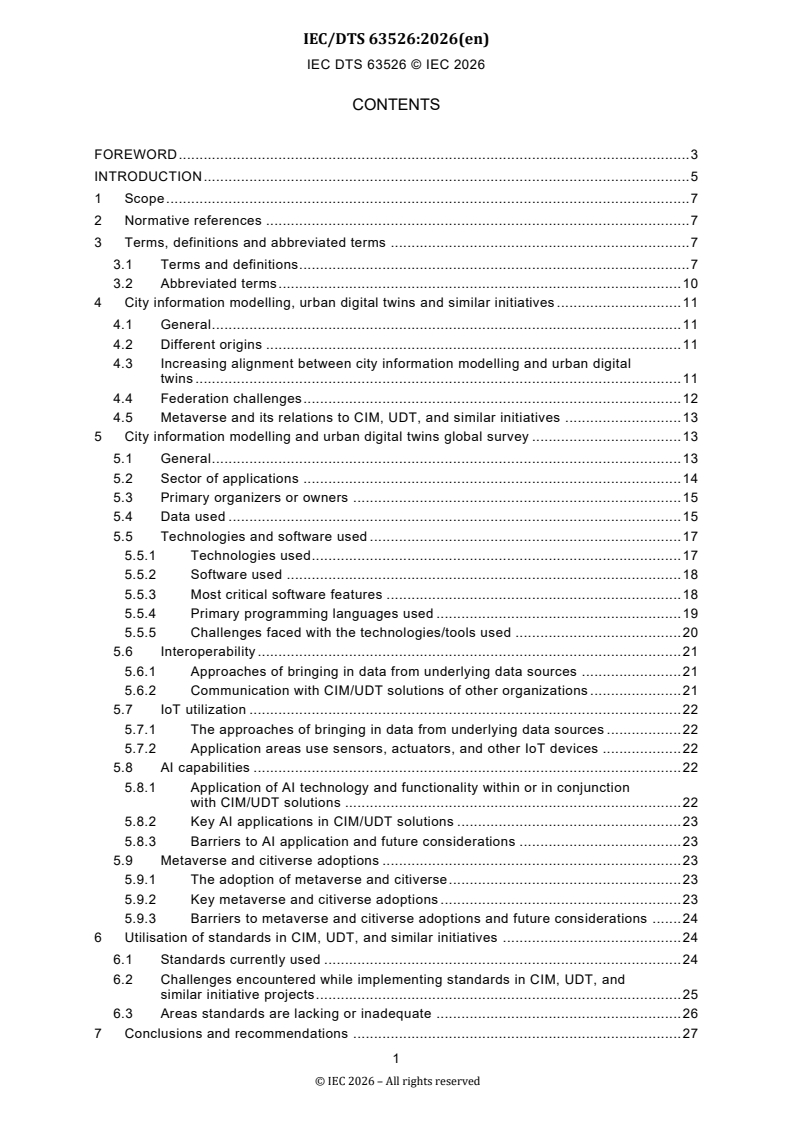
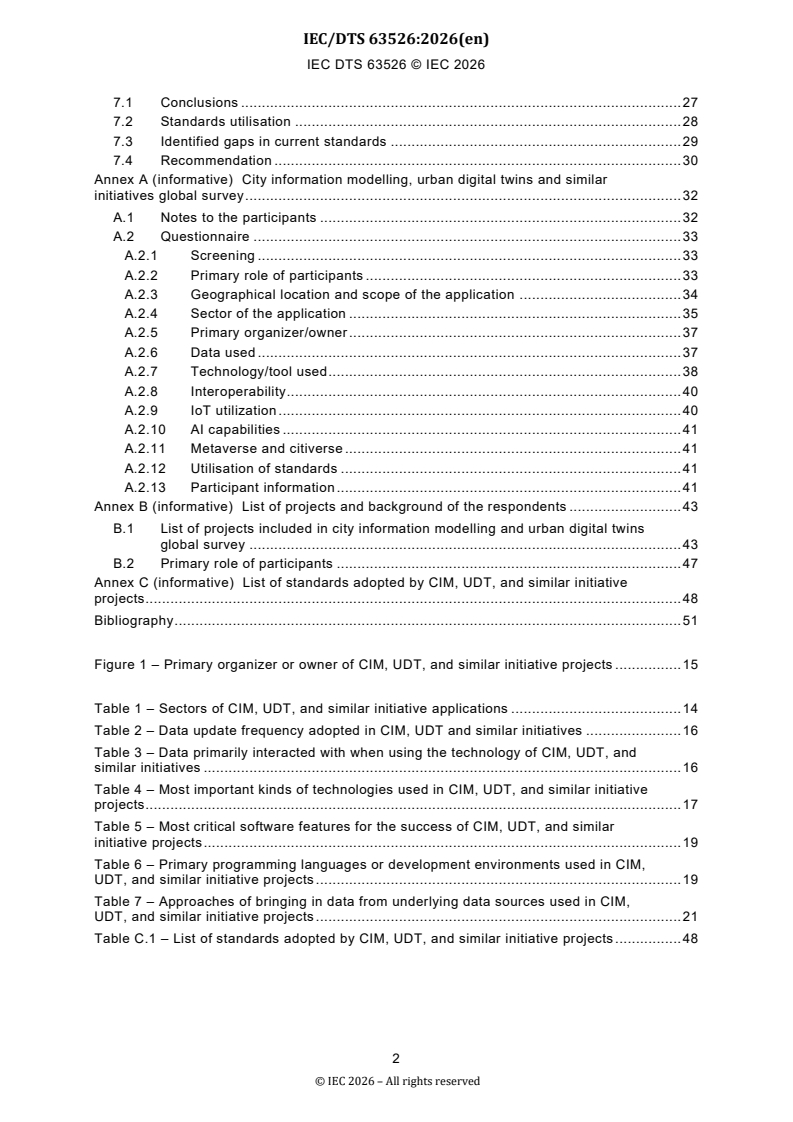
The document is organized into seven clauses, with Clause 1 on scope, Clause 2 on normative references, Clause 3 on terms and abbreviations, Clause 4 on the relationship between CIM, UDT and related initiatives, Clause 5 on the global survey, Clause 6 on standards use and gaps, and Clause 7 on conclusions and recommendations. It also has three informative annexes.
| Annex | What it covers |
|---|---|
| Annex A | Informative global survey on CIM, UDT and similar initiatives, including the questionnaire and participant notes |
| Annex B | Informative list of projects included in the survey and background of respondents |
| Annex C | Informative list of standards adopted by CIM, UDT and similar initiative projects |
In practice, this structure matters because the document is not a requirements standard for one product or system. It is a survey-based review that helps readers see where current standards already support city-scale digital modelling, and where the gaps remain.
What are the key requirements of IEC/DTS 63526?
IEC/DTS 63526 is mainly a gap-analysis document, so its key outputs are analytical and advisory rather than prescriptive. Its core task is to turn current practice into a map of what standards exist, what is missing, and what SDOs should do next.
1) It defines the scope around CIM, UDT and similar initiatives
Clause 1 states that IEC/DTS 63526 defines CIM and UDT concepts, collects city case studies, identifies standards in use, and scopes out needs for new standards or revisions. For readers, that means the document is meant to support standards planning, not to prescribe a single implementation method.
2) It relies on companion use-case documents
Clause 2 makes IEC SRD 63273-1:2023 and IEC SRD 63273-2:2024 normative references. These provide the high-level and use-case analysis base that this Technical Specification builds on, so implementers should read them together.
3) It explains how CIM and UDT relate, and why federation matters
Clause 4 shows that CIM comes from BIM at urban scale, while UDT comes from digital twin technology applied to cities. It also explains that many cities will not build one all-encompassing model, but multiple linked twins, so federation, interoperability, and secure data sharing are practical concerns.
4) It treats metaverse and citiverse developments as relevant to city modelling
Clause 4.5 links CIM and UDT to metaverse-style virtual worlds and notes that current software is often not interoperable. For practitioners, this means immersive 3D and virtual-world tools may already be part of city modelling work, but standards are needed if those tools must connect cleanly with each other and with real-world data.
5) It reports a global survey of current practice
Clause 5 is based on a global online survey, with 33 valid responses from 12 countries. It summarizes the sectors of use, the types of data handled, the organizations involved, and the technologies in use. In practice, this gives standards bodies evidence about where CIM and UDT are already mature and where they are still experimental.
6) It highlights interoperability, IoT, AI and data issues
Clause 5 and Clause 6 show that CIM and UDT projects commonly work with geospatial, urban infrastructure, environmental and IoT data, while interoperability remains a major challenge. The document also notes growing interest in AI, metaverse and citiverse applications. For users, this means the standards gap is not only about geometry or maps - it also covers data exchange, semantics, security and emerging tools.
7) It identifies the standards currently used in practice
Clause 6 and Annex C show that current projects draw on a mix of ISO, IEC, OGC, W3C, EU and national standards. That matters because CIM and UDT implementations usually combine standards from several domains rather than relying on one standard family.
8) It ends with recommendations for future standards work
Clause 7 recommends a unified reference architecture, better semantic and technical interoperability, attention to AI and citiverse, more vertical application-specific standards, stronger guidance for simulation and modelling, cross-border coordination, stakeholder capacity building, and faster standardization processes. For buyers and project leaders, this is the most useful part when deciding whether a current solution is likely to fit a city-scale program or whether additional standardization work will be needed.
What terms does IEC/DTS 63526 define?
- City information modelling (CIM) - development of digital representations and simulations of a city using large amounts of geospatial data, often with real-time inputs, to improve city planning and management.
- Urban digital twin (UDT) - digital twin technologies applied at urban scale to transform how cities are planned, built and managed.
- Digital twin (DTw) - a digital representation of a target entity with data connections that keep the physical and digital states aligned at an appropriate rate.
- Building information modelling (BIM) - the use of a shared digital representation of a built object to support design, construction and operation decisions.
- Geographic information system (GIS) - an information system for data about phenomena associated with location on Earth.
- Internet of things (IoT) - interconnected entities, people, systems and information resources that process and react to information from the physical and virtual world.
- Standard Development Organizations (SDOs) - the organizations that develop and maintain standards, and that are explicitly addressed in the recommendations.
- Artificial intelligence (AI) - the capability of an engineered system to acquire, process and apply knowledge and skills.
Who uses IEC/DTS 63526?
IEC/DTS 63526 is used by SDOs, city administrations, researchers, commercial CIM/UDT solution providers, consultants, planners and digital transformation teams. The survey behind the document also shows participation from universities, public-private partnerships, government agencies and city projects.
In practice, these users use the document to compare standards families, plan interoperable city platforms, select relevant companion standards, and identify where local or sector-specific extensions are still needed. It is especially relevant where a project must connect BIM, GIS, IoT, data governance and 3D visualization.
Which standards are used with IEC/DTS 63526?
IEC/DTS 63526 is intended to be used with:
- IEC SRD 63273-1:2023 - provides the high-level analysis of CIM use cases.
- IEC SRD 63273-2:2024 - provides the detailed use-case analysis for CIM.
These two documents supply the use-case foundation for the gap analysis in IEC/DTS 63526.
What does the IEC/DTS 63526 document contain?
IEC/DTS 63526 contains a narrative analysis of CIM, UDT and related initiatives, a global survey summary, and a standards-gap assessment. Clause 4 explains origins, overlap, federation challenges, and links to the metaverse.
Clause 5 reports the survey results and uses Tables 1 to 7 and Figure 1 to summarize sectors, owners, data update frequency, data types, technologies, software features, programming languages and data-integration approaches. Annex A gives the questionnaire and participant notes, Annex B lists the surveyed projects and respondent background, and Annex C lists standards already adopted in real projects.
The document therefore serves as a practical map of the current CIM/UDT standards landscape. It is useful when a team needs to understand what is already standardized, what is still fragmented, and where future standardization work is being directed.
Get Certified
Connect with accredited certification bodies for this standard

BSI Group
BSI (British Standards Institution) is the business standards company that helps organizations make excellence a habit.

Bureau Veritas
Bureau Veritas is a world leader in laboratory testing, inspection and certification services.

DNV
DNV is an independent assurance and risk management provider.
Sponsored listings
Frequently Asked Questions
IEC/DTS 63526 is a draft published by the International Organization for Standardization (ISO). Its full title is "Gap Analysis on Standards Related to City Information Modelling and Urban Digital Twins". This standard covers: The Technical Specification provides gap analysis on standards related to City Information Modelling and Urban Digital Twins. This Technical Specification: • defines concepts of City Information Modelling and Urban Digital Twins; • collects the case studies how cities are using City Information Modelling and Digital Twin technologies; • identifies the standards being used; • scopes out the requirements for new standards and for possible revision of existing standards; and provides recommendations for Standard Development Organizations (SDOs).
The Technical Specification provides gap analysis on standards related to City Information Modelling and Urban Digital Twins. This Technical Specification: • defines concepts of City Information Modelling and Urban Digital Twins; • collects the case studies how cities are using City Information Modelling and Digital Twin technologies; • identifies the standards being used; • scopes out the requirements for new standards and for possible revision of existing standards; and provides recommendations for Standard Development Organizations (SDOs).
IEC/DTS 63526 is classified under the following ICS (International Classification for Standards) categories: 13.020.20 - Environmental economics. Sustainability; 35.240.01 - Application of information technology in general. The ICS classification helps identify the subject area and facilitates finding related standards.
IEC/DTS 63526 is available in PDF format for immediate download after purchase. The document can be added to your cart and obtained through the secure checkout process. Digital delivery ensures instant access to the complete standard document.
Standards Content (Sample)
FINAL DRAFT
Technical
Specification
ISO/IEC JTC 1
Gap Analysis on Standards Related
Secretariat: ANSI
to City Information Modelling and
Voting begins on:
Urban Digital Twins
2026-10-09
Voting terminates on:
2026-12-04
RECIPIENTS OF THIS DRAFT ARE INVITED TO SUBMIT,
WITH THEIR COMMENTS, NOTIFICATION OF ANY
RELEVANT PATENT RIGHTS OF WHICH THEY ARE AWARE
AND TO PROVIDE SUPPOR TING DOCUMENTATION.
IN ADDITION TO THEIR EVALUATION AS
BEING ACCEPTABLE FOR INDUSTRIAL, TECHNO
LOGICAL, COMMERCIAL AND USER PURPOSES, DRAFT
This draft is submitted to a parallel vote in ISO and in IEC.
INTERNATIONAL STANDARDS MAY ON OCCASION HAVE
TO BE CONSIDERED IN THE LIGHT OF THEIR POTENTIAL
TO BECOME STAN DARDS TO WHICH REFERENCE MAY BE
MADE IN NATIONAL REGULATIONS.
Reference number
FINAL DRAFT
Technical
Specification
ISO/IEC JTC 1
Gap Analysis on Standards Related
Secretariat: ANSI
to City Information Modelling and
Voting begins on:
Urban Digital Twins
2026-10-09
Voting terminates on:
2026-12-04
RECIPIENTS OF THIS DRAFT ARE INVITED TO SUBMIT,
WITH THEIR COMMENTS, NOTIFICATION OF ANY
RELEVANT PATENT RIGHTS OF WHICH THEY ARE AWARE
AND TO PROVIDE SUPPOR TING DOCUMENTATION.
IN ADDITION TO THEIR EVALUATION AS
BEING ACCEPTABLE FOR INDUSTRIAL, TECHNO
LOGICAL, COMMERCIAL AND USER PURPOSES, DRAFT
This draft is submitted to a parallel vote in ISO and in IEC.
INTERNATIONAL STANDARDS MAY ON OCCASION HAVE
TO BE CONSIDERED IN THE LIGHT OF THEIR POTENTIAL
TO BECOME STAN DARDS TO WHICH REFERENCE MAY BE
MADE IN NATIONAL REGULATIONS.
Reference number
© IEC 2026 – All rights reserved
ii
IEC DTS 63526 © IEC 2026
CONTENTS
FOREWORD . 3
INTRODUCTION . 5
1 Scope . 7
2 Normative references . 7
3 Terms, definitions and abbreviated terms . 7
3.1 Terms and definitions. 7
3.2 Abbreviated terms . 10
4 City information modelling, urban digital twins and similar initiatives . 11
4.1 General . 11
4.2 Different origins . 11
4.3 Increasing alignment between city information modelling and urban digital
twins . 11
4.4 Federation challenges . 12
4.5 Metaverse and its relations to CIM, UDT, and similar initiatives . 13
5 City information modelling and urban digital twins global survey . 13
5.1 General . 13
5.2 Sector of applications . 14
5.3 Primary organizers or owners . 15
5.4 Data used . 15
5.5 Technologies and software used . 17
5.5.1 Technologies used. 17
5.5.2 Software used . 18
5.5.3 Most critical software features . 18
5.5.4 Primary programming languages used . 19
5.5.5 Challenges faced with the technologies/tools used . 20
5.6 Interoperability . 21
5.6.1 Approaches of bringing in data from underlying data sources . 21
5.6.2 Communication with CIM/UDT solutions of other organizations . 21
5.7 IoT utilization . 22
5.7.1 The approaches of bringing in data from underlying data sources . 22
5.7.2 Application areas use sensors, actuators, and other IoT devices . 22
5.8 AI capabilities . 22
5.8.1 Application of AI technology and functionality within or in conjunction
with CIM/UDT solutions . 22
5.8.2 Key AI applications in CIM/UDT solutions . 23
5.8.3 Barriers to AI application and future considerations . 23
5.9 Metaverse and citiverse adoptions . 23
5.9.1 The adoption of metaverse and citiverse . 23
5.9.2 Key metaverse and citiverse adoptions . 23
5.9.3 Barriers to metaverse and citiverse adoptions and future considerations . 24
6 Utilisation of standards in CIM, UDT, and similar initiatives . 24
6.1 Standards currently used . 24
6.2 Challenges encountered while implementing standards in CIM, UDT, and
similar initiative projects . 25
6.3 Areas standards are lacking or inadequate . 26
7 Conclusions and recommendations . 27
© IEC 2026 – All rights reserved
IEC DTS 63526 © IEC 2026
7.1 Conclusions . 27
7.2 Standards utilisation . 28
7.3 Identified gaps in current standards . 29
7.4 Recommendation . 30
Annex A (informative) City information modelling, urban digital twins and similar
initiatives global survey . 32
A.1 Notes to the participants . 32
A.2 Questionnaire . 33
A.2.1 Screening . 33
A.2.2 Primary role of participants . 33
A.2.3 Geographical location and scope of the application . 34
A.2.4 Sector of the application . 35
A.2.5 Primary organizer/owner . 37
A.2.6 Data used . 37
A.2.7 Technology/tool used . 38
A.2.8 Interoperability. 40
A.2.9 IoT utilization . 40
A.2.10 AI capabilities . 41
A.2.11 Metaverse and citiverse . 41
A.2.12 Utilisation of standards . 41
A.2.13 Participant information . 41
Annex B (informative) List of projects and background of the respondents . 43
B.1 List of projects included in city information modelling and urban digital twins
global survey . 43
B.2 Primary role of participants . 47
Annex C (informative) List of standards adopted by CIM, UDT, and similar initiative
projects . 48
Bibliography . 51
Figure 1 – Primary organizer or owner of CIM, UDT, and similar initiative projects . 15
Table 1 – Sectors of CIM, UDT, and similar initiative applications . 14
Table 2 – Data update frequency adopted in CIM, UDT and similar initiatives . 16
Table 3 – Data primarily interacted with when using the technology of CIM, UDT, and
similar initiatives . 16
Table 4 – Most important kinds of technologies used in CIM, UDT, and similar initiative
projects . 17
Table 5 – Most critical software features for the success of CIM, UDT, and similar
initiative projects . 19
Table 6 – Primary programming languages or development environments used in CIM,
UDT, and similar initiative projects . 19
Table 7 – Approaches of bringing in data from underlying data sources used in CIM,
UDT, and similar initiative projects . 21
Table C.1 – List of standards adopted by CIM, UDT, and similar initiative projects. 48
© IEC 2026 – All rights reserved
IEC DTS 63526 © IEC 2026
INTERNATIONAL ELECTROTECHNICAL COMMISSION
____________
Gap analysis on standards related to city information
modelling and urban digital twins
FOREWORD
1) The International Electrotechnical Commission (IEC) is a worldwide organization for standardization comprising
all national electrotechnical committees (IEC National Committees). The object of IEC is to promote international
co-operation on all questions concerning standardization in the electrical and electronic fields. To this end and
in addition to other activities, IEC publishes International Standards, Technical Specifications, Technical Reports,
Publicly Available Specifications (PAS) and Guides (hereafter referred to as "IEC Publication(s)"). Their
preparation is entrusted to technical committees; any IEC National Committee interested in the subject dealt with
may participate in this preparatory work. International, governmental and non-governmental organizations liaising
with the IEC also participate in this preparation. IEC collaborates closely with the International Organization for
Standardization (ISO) in accordance with conditions determined by agreement between the two organizations.
2) The formal decisions or agreements of IEC on technical matters express, as nearly as possible, an international
consensus of opinion on the relevant subjects since each technical committee has representation from all
interested IEC National Committees.
3) IEC Publications have the form of recommendations for international use and are accepted by IEC National
Committees in that sense. While all reasonable efforts are made to ensure that the technical content of IEC
Publications is accurate, IEC cannot be held responsible for the way in which they are used or for any
misinterpretation by any end user.
4) In order to promote international uniformity, IEC National Committees undertake to apply IEC Publications
transparently to the maximum extent possible in their national and regional publications. Any divergence between
any IEC Publication and the corresponding national or regional publication shall be clearly indicated in the latter.
5) IEC itself does not provide any attestation of conformity. Independent certification bodies provide conformity
assessment services and, in some areas, access to IEC marks of conformity. IEC is not responsible for any
services carried out by independent certification bodies.
6) All users should ensure that they have the latest edition of this publication.
7) No liability shall attach to IEC or its directors, employees, servants or agents including individual experts and
members of its technical committees and IEC National Committees for any personal injury, property damage or
other damage of any nature whatsoever, whether direct or indirect, or for costs (including legal fees) and
expenses arising out of the publication, use of, or reliance upon, this IEC Publication or any other IEC
Publications.
8) Attention is drawn to the Normative references cited in this publication. Use of the referenced publications is
indispensable for the correct application of this publication.
9) IEC and ISO draw attention to the possibility that the implementation of this document may involve the use of
(a)patent(s). IEC and ISO take no position concerning the evidence, validity or applicability of any claimed patent
rights in respect thereof. As of the date of publication of this document, IEC and ISO had not received notice of
(a) patent(s), which may be required to implement this document. However, implementers are cautioned that this
may not represent the latest information, which may be obtained from the patent database available at
https://patents.iec.ch and www.iso.org/patents. IEC and ISO shall not be held responsible for identifying any or
all such patent rights.
IEC TS 63526 has been prepared by the Joint Working Group of City Information Modelling and
Urban Digital Twins, co-managed by IEC Systems Committee Smart Cities: Electrotechnical
aspects of smart cities and ISO/IEC JTC1: Information Technology. It is a Technical
Specification.
It is published as a double logo standard.
The text of this Technical Specification is based on the following documents of IEC:
Draft Report on voting
SyCSmartCities/XXX/DTS SyCSmartCities/XXX/RVDTS
Full information on the voting for its approval can be found in the report on voting indicated in
the above table.
© IEC 2026 – All rights reserved
IEC DTS 63526 © IEC 2026
The language used for the development of this Technical Specification is English.
This document was drafted in accordance with ISO/IEC Directives, Part 2, and developed in
accordance with ISO/IEC Directives, Part 1 and ISO/IEC Directives, IEC Supplement, available
at www.iec.ch/members_experts/refdocs. The main document types developed by IEC are
described in greater detail at www.iec.ch/publications.
This document is intended to be used in conjunction with IEC SRD 63273-1:2023 and
IEC SRD 63273-2:2024.
The committee has decided that the contents of this document will remain unchanged until the
stability date indicated on the IEC website under webstore.iec.ch in the data related to the
specific document. At this date, the document will be
– reconfirmed,
– withdrawn, or
– revised.
© IEC 2026 – All rights reserved
IEC DTS 63526 © IEC 2026
INTRODUCTION
The development and delivery of smart cities involve many different systems, types of data,
and sets of information. This complexity, and the dynamic interaction between the large
numbers of stakeholders and city systems, make planning and managing cities a great
challenge. Without a tangible operational model to combine cross-sector data and information,
the holistic, cross-boundary planning of regions, cities, districts and neighbourhoods remains
constrained. Therefore, it is important to use new and effective tools to enable the delivery of
better services for citizens and to make the urban environment more liveable, inclusive, safe,
resilient, and sustainable.
City information modelling (CIM) and urban digital twins (UDT) are two developing technologies
for smart cities that aim to provide such tools. Sometimes, other terms are used for UDT, such
as city digital twins, spatial digital twins, local digital twins, etc. City information modelling
applies building information modelling at the urban scale, while urban digital twins and similar
initiatives apply digital twin (DTw) technology to cities. These all provide solutions for data
processing, urban analysis, design, simulation, and modelling. They connect all the
stakeholders and actors to collaboratively deliver the vision of smart cities and communities: a
sustainable, inclusive, healthy, prosperous, and participative society. They provide solutions
for smart cities and communities based on open standards and a multiscale database covering
different time frames that integrates a wide range of data sources, presenting the full range of
smart urban features, systems, and processes. The customers and users of such intelligent
technology solutions include, but are not limited to, local government, the public sector,
businesses, academia, investors, and citizens.
Work on both CIM and UDT is still at an early stage. They face common challenges and
questions for their future development, which include the data silos, the usability and usefulness
of applications for stakeholders, integration, openness, regulation, and the development of the
necessary skills and education. Models, data, and software are important components for both
CIM and UDT, and it is essential that both address the issues of data collection, data
interoperability, data management, and security. Moreover, there are many similar initiatives,
such as local digital twins and citiverse. We still lack unified standards to help manage these.
Standards are essential to ensure that data can freely circulate between various systems that
comprise a city or community. Interoperability between software or platform interfaces,
federation/linkages among digital twins/CIM platforms covering different city systems and
issues, benchmarks for data quality, cloud computing, data analytics, geospatial and 3D
modelling, privacy protection, and data security are all areas where International Standards can
play a significant role and useful part.
CIM and UDT are increasingly being deployed to augment the visibility and control of critical
infrastructures, such as water, electricity, gas, and telecommunications. Increasing regulatory
control can extend to these systems, where CIM and UDT standards can play a significant role in
mapping relevant standards as a framework for their secure operation and management.
Both CIM and UDT products and services are in use today, from piloting to city and state-wide
coverage. Standards are essential to support data exchanges to share and visualise data for
informed design and decision making, and for increased investment and accelerated use on a
national and global scale.
Before the standard work, a gap analysis of standards related to CIM and UDT is essential.
Therefore, this document aims to examine the most up-to-date practice of how cities are using
CIM and UDT technologies and scope out their needs in standards by collecting multiple case
studies from the front-line practitioners from different regions in the world, covering diverse
aspects of city management.
© IEC 2026 – All rights reserved
IEC DTS 63526 © IEC 2026
Furthermore, this document tackles numerous sustainable development goals (SDGs).
Specifically, it addresses SDG 6 (clean water and sanitation), SDG 7 (affordable and clean
energy), SDG 9 (industry, infrastructure and innovation), SDG 11 (sustainable cities and
communities), and SDG 13 (climate action). This is achieved through the application of the
digital transformation strategy by CIM and UDT for enhanced urban planning and city
management. The broad scope of the project encompasses areas such as water management,
energy efficiency, community development, and climate action initiatives. The digital
transformation strategy does not only include technological integration but also cultural change
and process innovation.
© IEC 2026 – All rights reserved
IEC DTS 63526 © IEC 2026
1 Scope
This document, which is a Technical Specification, provides gap analysis on standards related
to city information modelling and urban digital twins. This document:
– defines concepts of city information modelling and urban digital twins,
– collects the case studies of how cities are using city information modelling and digital twin
technologies,
– identifies the standards being used,
– scopes out the requirements for new standards and for possible revision of existing
standards, and
provides recommendations for Standard Development Organizations (SDOs).
2 Normative references
The following documents are referred to in the text in such a way that some or all of their content
constitutes requirements of this document. For dated references, only the edition cited applies.
For undated references, the latest edition of the referenced document (including any
amendments) applies.
IEC SRD 63273-1:2023, Smart city use case collection and analysis - City information
modelling - Part 1: High-level analysis
IEC SRD 63273-2:2024, Smart city use case collection and analysis - City information
modelling - Part 2: Use case analysis
3 Terms, definitions and abbreviated terms
For the purposes of this document, the terms, definitions and abbreviated terms given in
IEC SRD 63273-1:2023 and IEC SRD 63273-2:2024 and the following apply.
ISO and IEC maintain terminological databases for use in standardization at the following
addresses:
– IEC Electropedia: available at https://www.electropedia.org/
– ISO Online browsing platform: available at https://www.iso.org/obp/ui
3.1 Terms and definitions
3.1.1
artificial intelligence
AI
capability of an engineered system to acquire, process and apply knowledge and skills
Note 1 to entry: Knowledge are facts, information, and skills acquired through experience or education.
[SOURCE: IEC 60050-171:2019, 171-09-17, modified – The definition has been adapted to an
engineered system and simplified. The note to entry has been added.]
© IEC 2026 – All rights reserved
IEC DTS 63526 © IEC 2026
3.1.2
big data
extensive datasets – primarily in the data characteristics of volume, variety, velocity, and/or
variability – that require a scalable technology for efficient storage, manipulation, management,
and analysis
Note 1 to entry: Big data is commonly used in many different ways, for example as the name of the scalable
technology used to handle big data extensive datasets.
[SOURCE: ISO/IEC 20546:2019, 3.1.2]
3.1.3
building information modelling
BIM
use of a shared digital representation of a built object (including buildings, bridges, roads,
process plants, etc.) to facilitate design, construction and operation processes to form a reliable
basis for decisions
Note 1 to entry: The acronym BIM also stands for the shared digital representation of the physical and functional
characteristics of any construction works.
Note 2 to entry: See ISO 29481-1:2025.
3.1.4
case study
detailed examination of how a specific subject is solved or implemented in its specific real-world
context
3.1.5
city information modelling
CIM
development of digital representations and simulations of a city made up of large quantities of
geospatial data, often including real-time data, which enable better city planning and
management
Note 1 to entry: The geospatial data is provided using an integration of building information modelling (BIM) and
geographic information systems (GIS).
Note 2 to entry: The real-time data is obtained through extensive use of IoT sensors within the city.
Note 3 to entry: City information modelling involves handling large amounts of big data, which is generally brought
together using cloud computing.
Note 4 to entry: Artificial intelligence is often used to generate and evaluate different scenarios using city
information modelling data to help manage the city better.
[SOURCE: IEC SRD 63273-1:2023, 3.1.1]
3.1.6
cloud computing
paradigm for enabling network access to a scalable and elastic pool of shareable physical or
virtual resources with self-service provisioning and administration on-demand
Note 1 to entry: Examples of resources include servers, operating systems, networks, software, applications, and
storage equipment.
[SOURCE: ISO/IEC 17788:2014, 3.2.5]
© IEC 2026 – All rights reserved
IEC DTS 63526 © IEC 2026
3.1.7
concern
matter of relevance or importance to a stakeholder
Note 1 to entry: Concerns can be identified with regards to an entity of interest or independently, such as with
regards to environment, scenario, situation or use case of that entity.
Note 2 to entry: In this document, interest in an entity is intended to encompass interest in that entity’s environment,
life cycle, architecture, requirements, design, implementation and operation. Such interests are captured via aspects,
concerns and stakeholder perspectives.
Note 3 to entry: The identification of a concern is often the result of prior knowledge, experience and praxis in the
domain to which the concern applies.
[SOURCE: ISO/IEC/IEEE 42010:2022, 3.10, modified – Note 4 to entry has been removed.]
3.1.8
digital transformation
process of profound and radical change through digital technologies (including big data,
blockchain, cloud computing, internet of things, artificial intelligence, analytics, cognitive
solutions, etc.) that orients an organization in a new direction and takes it to an entirely different
level of effectiveness, which is based on analytics of data
[SOURCE: ISO/IEC TS 30105-9:2023, 3.4]
3.1.9
digital twin
DTw
digital representation of a target entity with data connections that enable convergence between
the physical and digital states at an appropriate rate of synchronization
Note 1 to entry: Digital twin has some or all of the capabilities of connection, integration, analysis, simulation,
visualization, optimization, collaboration, etc.
Note 2 to entry: Digital twin can provide an integrated view throughout the life cycle of the target entity.
[SOURCE: ISO/IEC 30173:2023, 3.1.1]
3.1.10
environment
context of surrounding things, conditions, or influences upon an entity
Note 1 to entry: The environment of an entity of interest includes external entities that can have various influences
upon an entity, such as developmental, technological, business, operational, organizational, political, economic,
legal, regulatory, ecological and social influences as well as external physical effects such as electromagnetic
radiation, charged particles, gravitational effects, and electric and magnetic fields.
Note 2 to entry: A label attached as a qualifier to the term environment identifies a particular context within another
context, such as development environment, test environment, and operational environment.
[SOURCE: ISO/IEC/IEEE 42010:2022,3.13]
3.1.11
geographic information system
GIS
information system dealing with information concerning phenomena associated with location
relative to the earth
[SOURCE: ISO 19101-1:2014, 4.1.20]
© IEC 2026 – All rights reserved
IEC DTS 63526 © IEC 2026
3.1.12
Internet of things
IoT
infrastructure of interconnected entities, people, systems and information resources together
with services which processes and reacts to information from the physical world and virtual
world
[SOURCE: ISO/IEC 20924:2024, 3.2.8]
3.1.13
stakeholder
role, position, individual, organization, or classes thereof, having an interest, right, share, or
claim, in an entity of interest
[SOURCE: ISO/IEC/IEEE 42010:2022, 3.17, modified – The example has been removed.]
3.1.14
urban digital twin
UDT
digital twin technologies applied at the urban scale deployed to enable the transformation of
how cities are planned, built and managed in order to deliver better services to make the urban
environment more liveable, inclusive, safe, resilient and sustainable
3.1.15
use case
specification of a set of actions performed by a system, which yields an observable result that
is, typically, of value for one or more actors or other stakeholders of the system
[SOURCE: ISO/IEC 19505-2:2012, 16.3.6]
3.2 Abbreviated terms
3D three dimensional
AI artificial intelligence
AR augmented reality
BIM building information modelling
CIM city information modelling
DLT distributed ledger technology
DTw digital twin
GIS geographic information system
EU European Union
IoT Internet of Things
JWG Joint Working Group
NeRF neural radiance fields
SDOs standard development organizations
TS Technical Specification
UDT urban digital twins
VR virtual reality
XR extended reality
© IEC 2026 – All rights reserved
IEC DTS 63526 © IEC 2026
4 City information modelling, urban digital twins and similar initiatives
4.1 General
City information modelling (CIM) and urban digital twins (UDT), also called city digital twin, local
digital twin, etc., are two emerging and closely linked technologies for smart cities. Both provide
intelligent solutions for the development of smart cities. While they have different origins, they
have many overlaps, even though they have some differences with each other.
4.2 Different origins
CIM has arisen from building information modelling (BIM) as foundational data in the modelling
and development of city data management. BIM describes an approach to the construction and
ongoing management of built environment assets (buildings, roads, dams, etc.) that uses data
and 3D geometry modelling to improve the design, construction, and overall performance of
those assets during their entire life cycle, and therefore to generate significant savings and
productivity returns. It uses an integrated suite of technologies and processes, centred around
a component-based 3D representation of each element of the built environment asset. CIM
takes BIM one step further by aggregating data from individual buildings or campuses to allow
new neighbourhoods to be better designed and existing ones to be better managed.
The concept of digital twins (DTw) originated in mechanical engineering and the finite element
method. Digital twin traces its origins to product development and discrete simulations of
physical objects. It emerged from manufacturing and single asset prototyping, such as those
conducted by National Aeronautics and Space Administration and Formula One racing cars.
These digital twins facilitated rapid prototyping and testing, and this groundwork formed the
initial modelling concepts. The application of digital twins provides an accurate representation
of complex objects while enabling interaction between them. They look the same, behave the
same, and the digital twin can provide simulations and predictions. That relationship requires
modelling, for example, modelling a digital twin of a motor vehicle onto the digital twin of the
racetrack. It is this expansion of the modelling environment for relationship contextualization
that led to the move towards UDT, topics explored in depth in 4.3. Moving outside of an isolated
digital twin object, we can examine how an object bears relevance to the digital twinning of the
environment in which it operates, and the impact and influences of the contextual environment
on the object. Therefore, this expansion of the modelling environment for the purposes of
relationship contextualization caused the move towards the UDT.
UDT is the digital twin at the urban scale. UDT can be seen in their composition as discrete
ecosystems that can be linked, which reflects the origins of technology within product and
facility twinning. It acts as a distributed ecosystem that is looking to be interconnected and
interoperable.
4.3 Increasing alignment between city information modelling and urban digital twins
Even though there are different origins, both CIM and UDT share overlaps in aims, scope,
functions, data, technology support, and benefits.
– Aims: Both CIM and UDT aim to enable better urban planning and city management
(maintenance, monitoring, and modelling the city and urban environment) by using data and
smart technologies.
– Scope: Their scope includes but is not limited to a) data integration; b) geo-visualisation; c)
synchronisation; d) simulation; e) data exchange; and required data security.
– Functions: Both CIM and UDT comprehensibly model city infrastructure digitally, trace the
physical object in the city, monitor and simulate the object in virtual spaces, progress
through physical to digital transformation activities, and monitor the interaction between the
digital and physical worlds.
– Data: Both CIM and UDT integrate multiple data from different sources and involve different
formats and different levels (micro, meso, and macro).
© IEC 2026 – All rights reserved
IEC DTS 63526 © IEC 2026
– Technology support: Both CIM and UDT are reliant on developing technologies, such as
cyber security (middleware and access control), GIS, IoT, metadata, big data, quantum and
cloud computing, machine learning, artificial intelligence (AI), and automation.
– Benefits: Both CIM and UDT provide highly efficient, multi-functional and integrated
management tools for all the stakeholders in cities. They respond to a vast spectrum of
needs, values and uses in diverse areas such as urban planning, property management,
maintenance of heritage and disaster management.
4.4 Federation challenges
Many cities use digital twin technology to help manage different city systems or deal with
specific city challenges, rather than attempting to model the city as a whole or develop a single
city digital twin covering every aspect of the city.
In any city, it is common to find many detailed digital twins already being developed by different
stakeholders to deal with specific systems and challenges. These generally use different
standards and approaches but can often be very mature and can provide a good foundation for
using digital twin technologies to help manage cities.
Many cities are also starting their CIM/UDT journey by developing digital twins that focus on
tackling specific city challenges, such as transport management. In fact, for some purposes,
simple models can provide quick and useful results. For instance, when modelling traffic flows
to understand the impact of road closures, digital twins based on simple 2D maps with data
related to a limited set of issues is likely to be sufficient. By developing single-purpose digital
twins in a city, there will be immediate benefit for the effort and resources expended, and the
use of digital twin technology in the city can grow organically.
For these cities, the challenge is how to link together many different digital twins, or models of
different aspects of the city, to enable a federated city digital twin to allow the city to be managed
as a whole.
These can include a federation of twins
– of different city systems and infrastructures, linking together digital twins of railway stations,
electricity supply systems, airports, metro systems, and so on,
– tackling various city issues, such as air quality, flooding, or logistics,
– at various levels of scale, linking together twins of neighbourhoods, cities, city regions,
provinces, and the nation,
– at various levels of detail, from being based on simple 2D maps, through basic 3D
diagrammatic twins, to being based on fully detailed 3D models, and
– sharing data securely, frictionless, and with high levels of fidelity, where granting of data
access and use is embedded in the attributes a registered user has from an organisation
that has brokered access via a federation broker or operator.
While such a federation model is sometimes more challenging to manage, there are several
benefits that can come from developing a federated digital twin.
One challenge of developing a single digital twin of every aspect of the city is that the closer
that different systems are linked together, the greater the vulnerability to cyber-attack or system
failure. By federating digital twins of different aspects of the city, these are kept mostly isolated
from each other, with only the data needed to answer specific questions being shared. This
makes them much less vulnerable.
Digital twin federation is also valuable because too much complexity can be counterproductive.
Models that try to incorporate every possible piece of information are usually poor at making
predictions. Predictive models of traffic flow along a major highway are much more accurate
when made by linking twins of individual types of vehicles and of driver behaviour, of small
sections of road, and of road junctions, than when working off a twin of the whole system.
© IEC 2026 – All rights reserved
IEC DTS 63526 © IEC 2026
Finally, to gain value quickly from investment, it would make sense to start by building digital
twins to solve urgent and important city challenges and then find ways to link these together.
4.5 Metaverse and its relations to CIM, UDT, and similar initiatives
One key influence on the development of digital representations of the city comes from work
related to the concept of the metaverse. Over the last thirty years or more, many different
companies have been building and hosting virtual worlds where people can meet up with friends
and colleagues to play games, collaborate on work projects, or learn. These are increasingly
becoming a common part of people’s lives, aided by the increasing sophistication of virtual or
augmented reality technologies. Many software packages have been developed that enable
detailed and realistic 3D environments to be built online in a way that allows users to move
through them, interact with others, and accomplish various tasks together.
Some of these software packages have been used to support collaborative design of real-world
environments and are being used by a number of cities around the world. These can be very
useful because they build on the experience of many millions of users to offer a high-quality
and reliable way of rendering interactive city environments. The challenge is that these are not
based on standards, and so the different packages are not interoperable with each other.
The idea of the new emphasis on the metaverse is about allowing it to move seamlessly
between these different virtual worlds. Like the internet, the metaverse will help people connect
with each other when they are not physically in the same place. This can include virtual
representations of the real world for work, entertainment, and interacting with friends – as well
as within imaginary worlds for gaming and fun.
To implement a metaverse that can link all these different virtual worlds together will necessitate
the development and use of interoperability standards and the identification of ways of linking
these virtual worlds more closely with the real world.
The case studies collected as part of this document indicates how many cities are using
software originally developed for virtual worlds to help with city planning and to identify the
value and challenges of doing this. What emerges also is that it would be necessary to take
account of efforts by commercial companies to support new standards to enable these virtual
worlds to become linked together within the metaverse and any implications there might be for
CIM, UDT and similar initiatives.
5 City information modelling and urban digital twins global survey
5.1 General
A global online survey was adopted to conduct the case study to understand the gaps in the
standards of CIM, UDT, and similar initiatives. From July to August 2024, three pilot surveys
were conducted – one from Germany and two from China – to refine the questionnaire before
th
the full survey launch (see Annex A). The main survey period ran from 29 September 2024 to
st
31 March 2025, gathering 42 completed responses, of which 33 were valid (9 were excluded
due to incompleteness). The responses spanned 12 countries, highlighting the global interest
in CIM, UDT and similar initiative adoptions. China led with 11 submissions, followed by Sweden
(5), Germany (3), and Italy (3), while Australia (2), Canada (1), Japan (1), Ireland (1) and South
Korea (1) contributed one or two responses each. Notably, five projects had international
applications, such as a project covering the application in Spain, Germany, Finland, Estonia,
and the United Kingdom, and a project covering the application in Athens in Greece, and Vienna
in Austria. See Annex B for additional information.
© IEC 2026 – All rights reserved
IEC DTS 63526 © IEC 2026
5.2 Sector of applications
The applications of CIM, UDT, and similar initiatives focus on urban development, visualisation,
and predictive modelling, while niche areas like robotics and climate adaptation remain less
explored (Table 1). The most prominent sector was simulation, prediction, and verification
(69,7 %, N = 23), followed by 3D visualisation of property and land administration (60,6 %,
n = 20) and urban/new town planning (48,5 %, N = 16). Other notable applications included
safety, security, resilience, and defense (42,4 %, N = 14), city management using city brain
(39,4 %, N = 13), and project management during construction (39,4 %, N = 13). In contrast,
sectors with minimal ad
...