

ISO 18957
(Main)Plastics — Determination of the aerobic biodegradation of plastic materials exposed to seawater using accelerated conditions in laboratory
General Information
- Abstract
This document describes a laboratory test method to determine the aerobic biodegradation of plastic materials exposed to seawater using accelerated conditions. It describes the general requirements of the apparatus and the procedures for using this test method. This test method is designed to give an early indication of the potential biodegradability of plastic materials in marine environment. For the purpose of promoting the development of biodegradable plastics, this document also provides a method for measuring the biomass components produced by metabolizing the test material before it is completely mineralized to CO2, that enables to evaluate the potential biodegradability considered by carbon flow by the sum of the degree of biodegradation based on O2 or CO2 analysis and the degree of conversion to biomass in much shorter period of time than full mineralization. This method is not suitable to assess the degree of disintegration of plastic materials caused by abiotic factors like heat or UV radiation.
- Status
- Not Published
- Technical Committee
- ISO/TC 61/SC 14 - Environmental aspects
- Drafting Committee
- ISO/TC 61/SC 14 - Environmental aspects
- Current Stage
- 6000 - International Standard under publication
- Start Date
- 03-Sep-2026
- Completion Date
- 03-Oct-2026
Buy Documents
ISO/FDIS 18957 - Plastics — Determination of the aerobic biodegradation of plastic materials exposed to seawater using accelerated conditions in laboratory
REDLINE ISO/FDIS 18957 - Plastics — Determination of the aerobic biodegradation of plastic materials exposed to seawater using accelerated conditions in laboratory
Overview
ISO 18957: Plastics - Determination of the aerobic biodegradation of plastic materials exposed to seawater using accelerated conditions in laboratory is an international standard developed by ISO. It establishes a laboratory test method to determine the aerobic biodegradation of plastics when exposed to seawater under accelerated conditions. This method provides a quicker assessment of plastic biodegradability in marine environments, making it a valuable tool for researchers, manufacturers, and regulatory bodies focusing on environmental responsibility and the development of biodegradable plastics.
ISO 18957 outlines general apparatus requirements and standardized procedures to produce reliable, reproducible results. It is not intended for evaluating plastic disintegration due to non-biological factors such as heat or UV radiation.
Key Topics
- Aerobic Biodegradation Testing: The standard details how to evaluate the biodegradation of plastics in seawater using laboratory-controlled accelerated conditions, such as enhanced microbial activity and optimized nutrient availability.
- Test Principle: Measurement of oxygen consumption (BOD) and/or evolved carbon dioxide (CO₂) in closed respirometers allows quantification of aerobic biodegradation.
- Carbon Flow Assessment: ISO 18957 includes an optional method that estimates the total biodegradation by considering both mineralization (conversion to CO₂) and conversion of the plastic’s carbon to biomass. Carbon flow tracking offers a more comprehensive view of potential biodegradability in a shorter timeframe than full mineralization.
- Apparatus and Setup: Requirements for respirometers, CO₂ analysis equipment, and analytical balances are specified. There are guidelines for seawater preparation, enrichment with nutrients, and the concentration of microorganisms to ensure accelerated biodegradation.
- Procedure and Calculation: The document lays out steps from test material and reference material handling, through test setup, to calculation and interpretation of results, covering both standard and optional advanced analyses.
- Result Expression and Reporting: Defines how to calculate biodegradation degree and carbon flow and standardizes reporting for consistent communication of findings.
- Exclusions: The method is specifically unsuitable for assessing abiotic plastic disintegration caused by factors like UV exposure or heat.
Applications
ISO 18957 supports a range of practical applications related to environmental testing and product development in the plastics industry:
- Development of Biodegradable Plastics: Manufacturers can use ISO 18957 to screen new plastic materials for marine biodegradability, helping to design products that reduce long-term marine pollution.
- Comparative Biodegradability Evaluation: The standard allows laboratories and regulatory organizations to compare the biodegradation rates of different materials in consistent, accelerated test conditions.
- Regulatory Compliance: Plastic producers seeking eco-labels or compliance with directives on marine pollution can utilize results from this method to substantiate environmental claims.
- Academic and Industrial Research: Researchers can utilize the standard's robust framework to investigate degradation processes, solution variables (e.g., nutrient enhancements), and the role of different microorganisms in biodegradation.
- Quality and Environmental Impact Assessment: Provides an accelerated yet scientifically sound protocol to assess the potential impact of plastic products likely to enter the marine environment.
Related Standards
To ensure comprehensive evaluation and testing, ISO 18957 refers to and complements other international standards, including:
- ISO 472: Plastics - Vocabulary
- ISO 8245: Water quality - Guidelines for the determination of total organic carbon (TOC) and dissolved organic carbon (DOC)
- ISO 10210: Plastics - Methods for preparation of samples for biodegradation testing
- ISO 10523: Water quality - Determination of pH
- ISO 11261: Soil quality - Determination of total nitrogen (Modified Kjeldahl method)
- ISO 23977-1: Plastics - Determination of aerobic biodegradation of plastics in seawater - Method by analysis of evolved carbon dioxide
- ASTM D1141-98: Standard Practice for Preparation of Substitute Ocean Water
These references are crucial for laboratories looking to implement ISO 18957 while maintaining compatibility with global best practices in biodegradation and environmental testing.
Keywords: ISO 18957, plastics biodegradation, accelerated laboratory conditions, seawater, aerobic biodegradation, carbon flow, marine environment, biodegradable plastics, environmental testing, international standard.
Buy Documents
ISO/FDIS 18957 - Plastics — Determination of the aerobic biodegradation of plastic materials exposed to seawater using accelerated conditions in laboratory
REDLINE ISO/FDIS 18957 - Plastics — Determination of the aerobic biodegradation of plastic materials exposed to seawater using accelerated conditions in laboratory
Get Certified
Connect with accredited certification bodies for this standard

DIN CERTCO
DIN Group product certification.

Smithers Quality Assessments
US management systems and product certification.
Sponsored listings
Frequently Asked Questions
ISO 18957 is a draft published by the International Organization for Standardization (ISO). Its full title is "Plastics — Determination of the aerobic biodegradation of plastic materials exposed to seawater using accelerated conditions in laboratory". This standard covers: This document describes a laboratory test method to determine the aerobic biodegradation of plastic materials exposed to seawater using accelerated conditions. It describes the general requirements of the apparatus and the procedures for using this test method. This test method is designed to give an early indication of the potential biodegradability of plastic materials in marine environment. For the purpose of promoting the development of biodegradable plastics, this document also provides a method for measuring the biomass components produced by metabolizing the test material before it is completely mineralized to CO2, that enables to evaluate the potential biodegradability considered by carbon flow by the sum of the degree of biodegradation based on O2 or CO2 analysis and the degree of conversion to biomass in much shorter period of time than full mineralization. This method is not suitable to assess the degree of disintegration of plastic materials caused by abiotic factors like heat or UV radiation.
This document describes a laboratory test method to determine the aerobic biodegradation of plastic materials exposed to seawater using accelerated conditions. It describes the general requirements of the apparatus and the procedures for using this test method. This test method is designed to give an early indication of the potential biodegradability of plastic materials in marine environment. For the purpose of promoting the development of biodegradable plastics, this document also provides a method for measuring the biomass components produced by metabolizing the test material before it is completely mineralized to CO2, that enables to evaluate the potential biodegradability considered by carbon flow by the sum of the degree of biodegradation based on O2 or CO2 analysis and the degree of conversion to biomass in much shorter period of time than full mineralization. This method is not suitable to assess the degree of disintegration of plastic materials caused by abiotic factors like heat or UV radiation.
ISO 18957 is classified under the following ICS (International Classification for Standards) categories: 83.080.01 - Plastics in general. The ICS classification helps identify the subject area and facilitates finding related standards.
ISO 18957 is available in PDF format for immediate download after purchase. The document can be added to your cart and obtained through the secure checkout process. Digital delivery ensures instant access to the complete standard document.
Standards Content (Sample)
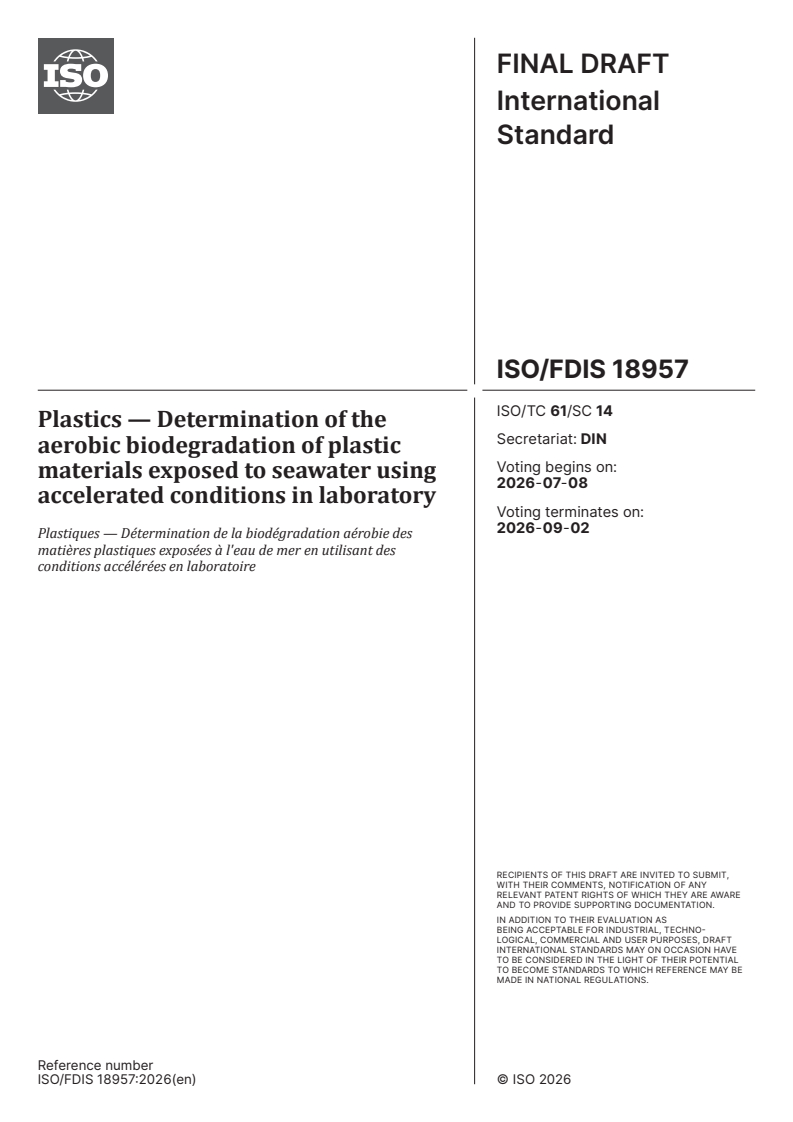
FINAL DRAFT
International
Standard
ISO/FDIS 18957
ISO/TC 61/SC 14
Plastics — Determination of the
Secretariat: DIN
aerobic biodegradation of plastic
Voting begins on:
materials exposed to seawater using
2026-07-08
accelerated conditions in laboratory
Voting terminates on:
2026-09-02
Plastiques — Détermination de la biodégradation aérobie des
matières plastiques exposées à l'eau de mer en utilisant des
conditions accélérées en laboratoire
RECIPIENTS OF THIS DRAFT ARE INVITED TO SUBMIT,
WITH THEIR COMMENTS, NOTIFICATION OF ANY
RELEVANT PATENT RIGHTS OF WHICH THEY ARE AWARE
AND TO PROVIDE SUPPOR TING DOCUMENTATION.
IN ADDITION TO THEIR EVALUATION AS
BEING ACCEPTABLE FOR INDUSTRIAL, TECHNO
LOGICAL, COMMERCIAL AND USER PURPOSES, DRAFT
INTERNATIONAL STANDARDS MAY ON OCCASION HAVE
TO BE CONSIDERED IN THE LIGHT OF THEIR POTENTIAL
TO BECOME STAN DARDS TO WHICH REFERENCE MAY BE
MADE IN NATIONAL REGULATIONS.
Reference number
ISO/FDIS 18957:2026(en) © ISO 2026
FINAL DRAFT
ISO/FDIS 18957:2026(en)
International
Standard
ISO/FDIS 18957
ISO/TC 61/SC 14
Plastics — Determination of the
Secretariat: DIN
aerobic biodegradation of plastic
Voting begins on:
materials exposed to seawater using
accelerated conditions in laboratory
Voting terminates on:
Plastiques — Détermination de la biodégradation aérobie des
matières plastiques exposées à l'eau de mer en utilisant des
conditions accélérées en laboratoire
RECIPIENTS OF THIS DRAFT ARE INVITED TO SUBMIT,
WITH THEIR COMMENTS, NOTIFICATION OF ANY
RELEVANT PATENT RIGHTS OF WHICH THEY ARE AWARE
AND TO PROVIDE SUPPOR TING DOCUMENTATION.
© ISO 2026
IN ADDITION TO THEIR EVALUATION AS
All rights reserved. Unless otherwise specified, or required in the context of its implementation, no part of this publication may
BEING ACCEPTABLE FOR INDUSTRIAL, TECHNO
LOGICAL, COMMERCIAL AND USER PURPOSES, DRAFT
be reproduced or utilized otherwise in any form or by any means, electronic or mechanical, including photocopying, or posting on
INTERNATIONAL STANDARDS MAY ON OCCASION HAVE
the internet or an intranet, without prior written permission. Permission can be requested from either ISO at the address below
TO BE CONSIDERED IN THE LIGHT OF THEIR POTENTIAL
or ISO’s member body in the country of the requester.
TO BECOME STAN DARDS TO WHICH REFERENCE MAY BE
MADE IN NATIONAL REGULATIONS.
ISO copyright office
CP 401 • Ch. de Blandonnet 8
CH-1214 Vernier, Geneva
Phone: +41 22 749 01 11
Email: copyright@iso.org
Website: www.iso.org
Published in Switzerland Reference number
ISO/FDIS 18957:2026(en) © ISO 2026
ii
ISO/FDIS 18957:2026(en)
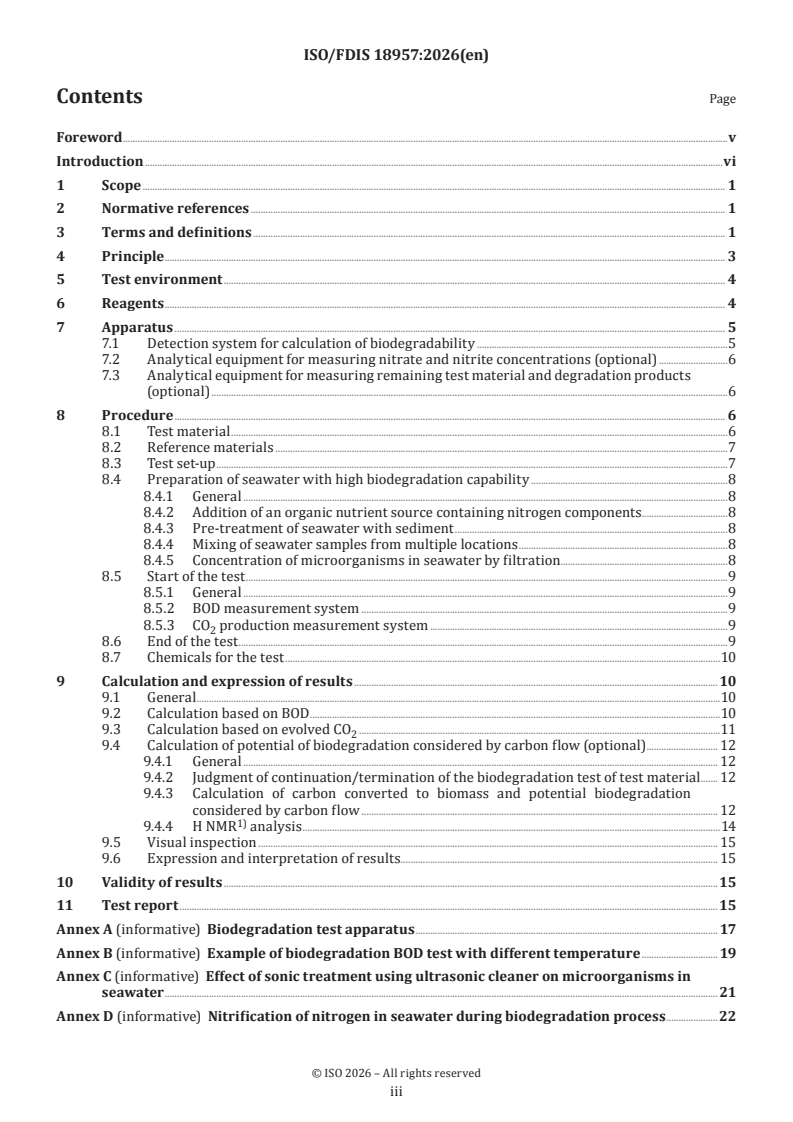
Contents Page
Foreword .v
Introduction .vi
1 Scope . 1
2 Normative references . 1
3 Terms and definitions . 1
4 Principle . 3
5 Test environment . 4
6 Reagents . 4
7 Apparatus . 5
7.1 Detection system for calculation of biodegradability .5
7.2 Analytical equipment for measuring nitrate and nitrite concentrations (optional) .6
7.3 Analytical equipment for measuring remaining test material and degradation products
(optional) .6
8 Procedure . 6
8.1 Test material .6
8.2 Reference materials .7
8.3 Test set-up .7
8.4 Preparation of seawater with high biodegradation capability .8
8.4.1 General .8
8.4.2 Addition of an organic nutrient source containing nitrogen components.8
8.4.3 Pre-treatment of seawater with sediment .8
8.4.4 Mixing of seawater samples from multiple locations .8
8.4.5 Concentration of microorganisms in seawater by filtration .8
8.5 Start of the test .9
8.5.1 General .9
8.5.2 BOD measurement system .9
8.5.3 CO production measurement system .9
8.6 End of the test .9
8.7 Chemicals for the test .10
9 Calculation and expression of results . 10
9.1 General .10
9.2 Calculation based on BOD .10
9.3 Calculation based on evolved CO .11
9.4 Calculation of potential of biodegradation considered by carbon flow (optional) . 12
9.4.1 General . 12
9.4.2 Judgment of continuation/termination of the biodegradation test of test material . 12
9.4.3 Calculation of carbon converted to biomass and potential biodegradation
considered by carbon flow . 12
1)
9.4.4 H NMR analysis .14
9.5 Visual inspection . 15
9.6 Expression and interpretation of results. 15
10 Validity of results .15
11 Test report .15
Annex A (informative) Biodegradation test apparatus . 17
Annex B (informative) Example of biodegradation BOD test with different temperature . 19
Annex C (informative) Effect of sonic treatment using ultrasonic cleaner on microorganisms in
seawater .21
Annex D (informative) Nitrification of nitrogen in seawater during biodegradation process .22
iii
ISO/FDIS 18957:2026(en)
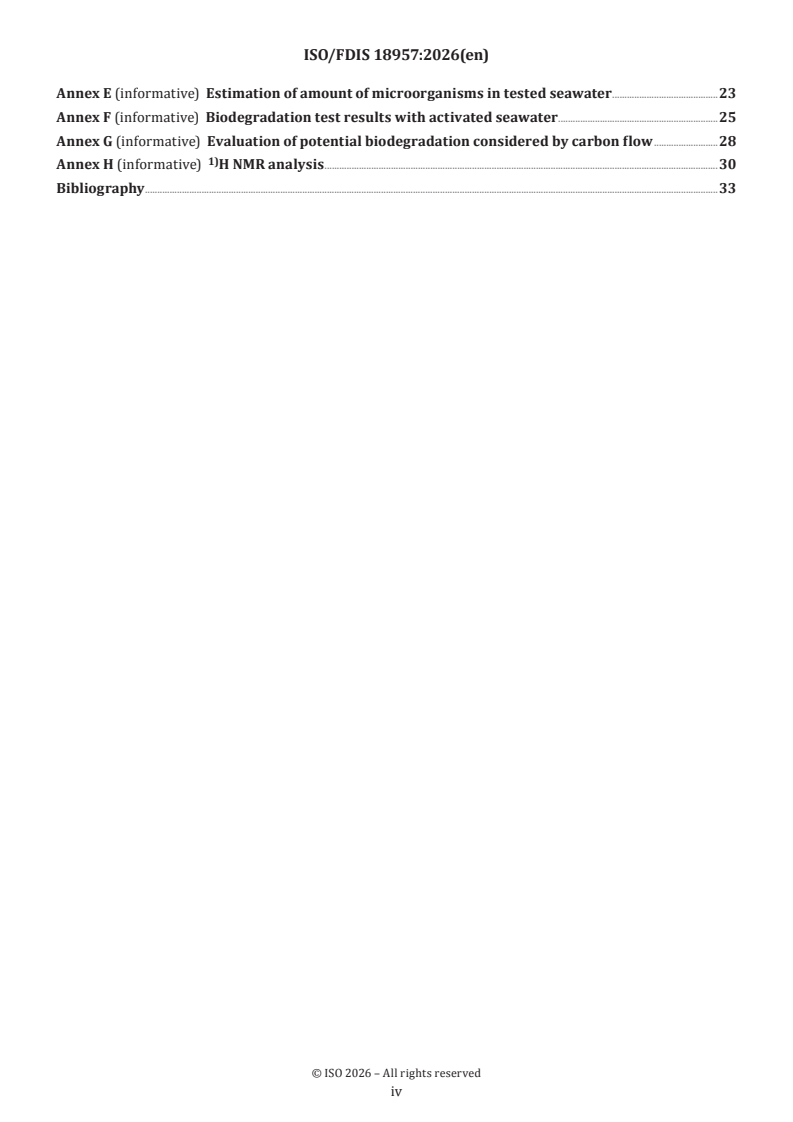
Annex E (informative) Estimation of amount of microorganisms in tested seawater .23
Annex F (informative) Biodegradation test results with activated seawater .25
Annex G (informative) Evaluation of potential biodegradation considered by carbon flow .28
1)
Annex H (informative) H NMR analysis .30
Bibliography .33
iv
ISO/FDIS 18957:2026(en)
Foreword
ISO (the International Organization for Standardization) is a worldwide federation of national standards
bodies (ISO member bodies). The work of preparing International Standards is normally carried out through
ISO technical committees. Each member body interested in a subject for which a technical committee
has been established has the right to be represented on that committee. International organizations,
governmental and non-governmental, in liaison with ISO, also take part in the work. ISO collaborates closely
with the International Electrotechnical Commission (IEC) on all matters of electrotechnical standardization.
The procedures used to develop this document and those intended for its further maintenance are described
in the ISO/IEC Directives, Part 1. In particular, the different approval criteria needed for the different types
of ISO document should be noted. This document was drafted in accordance with the editorial rules of the
ISO/IEC Directives, Part 2 (see www.iso.org/directives).
ISO draws attention to the possibility that the implementation of this document may involve the use of (a)
patent(s). ISO takes no position concerning the evidence, validity or applicability of any claimed patent
rights in respect thereof. As of the date of publication of this document, ISO had not received notice of (a)
patent(s) which may be required to implement this document. However, implementers are cautioned that
this may not represent the latest information, which may be obtained from the patent database available at
www.iso.org/patents. ISO shall not be held responsible for identifying any or all such patent rights.
Any trade name used in this document is information given for the convenience of users and does not
constitute an endorsement.
For an explanation of the voluntary nature of standards, the meaning of ISO specific terms and expressions
related to conformity assessment, as well as information about ISO's adherence to the World Trade
Organization (WTO) principles in the Technical Barriers to Trade (TBT), see www.iso.org/iso/foreword.html.
This document was prepared by Technical Committee ISO/TC 61, Plastics, Subcommittee SC 14, Environmental
aspects.
Any feedback or questions on this document should be directed to the user’s national standards body. A
complete listing of these bodies can be found at www.iso.org/members.html.
v
ISO/FDIS 18957:2026(en)
Introduction
Plastics have been used in various fields because of their highly durable characteristics. Plastics are also
used intentionally in the environment or in applications where unintentional loss to the environment is
unavoidable. The degree of biodegradation of plastics in natural environment is of interest in order to better
characterize the behaviour of plastics in these very particular environments. Thus, the test methods to
measure the degree and rate of biodegradation are of major interest to obtain an indication of the potential
biodegradability of plastic materials when exposed to different marine habitats.
The biodegradability of plastics is defined in laboratory tests, for example ISO 18830, ISO 19679, ISO 23977-1
and ISO 23977-2, but these test methods in a laboratory basically use only seawater and sediment.
Since existing test methods are not intended to shorten the test period, the test period often extends to one
year and it is sometimes difficult to assess the degree of biodegradability of the sample in a short period of
time.
This document provides an accelerated test method for determining the biodegradation level of plastics
exposed to seawater in laboratory in shorter time by increasing the number of microorganisms in seawater
and enriching the flora, by adding nutrients, pre-treatment by sediment, and condensation of seawater.
The degree of biodegradation is calculated based on measurement of the oxygen (O ) demand in a closed
respirometer or carbon dioxide (CO ) evolution.
Test material is taken up by microorganisms, metabolized, and the contained carbon finally mineralized to
CO . Part of the carbon originating from the test material is temporarily converted to biomass. The biomass
cannot be detected unless the bacteria die and undergo self-digestion. It takes a longer period of time than
the conversion to biomass and it may require a long test period to complete the mineralization of the test
material. On the other hand, since biomass components are produced by the microbial activity, the total
biodegradation considered by carbon flow can be estimated by the sum of the degree of biodegradation
based on O and/or CO analysis and the degree of conversion to biomass. Therefore, for the purpose of
2 2
promoting the development of biodegradable plastics, this document also provides a method for measuring
the biomass components produced by metabolizing the test material before it is completely mineralized
to CO , that enables to evaluate the potential biodegradability considered by carbon flow in much shorter
period of time than full mineralization.
vi
FINAL DRAFT International Standard ISO/FDIS 18957:2026(en)
Plastics — Determination of the aerobic biodegradation
of plastic materials exposed to seawater using accelerated
conditions in laboratory
1 Scope
This document describes a laboratory test method to determine the aerobic biodegradation of plastic
materials exposed to seawater using accelerated conditions. It describes the general requirements of the
apparatus and the procedures for using this test method.
This test method is designed to give an early indication of the potential biodegradability of plastic materials
in marine environment.
For the purpose of promoting the development of biodegradable plastics, this document also provides
a method for measuring the biomass components produced by metabolizing the test material before it is
completely mineralized to CO , that enables to evaluate the potential biodegradability considered by carbon
flow by the sum of the degree of biodegradation based on O or CO analysis and the degree of conversion to
2 2
biomass in much shorter period of time than full mineralization.
This method is not suitable to assess the degree of disintegration of plastic materials caused by abiotic
factors like heat or UV radiation.
2 Normative references
The following documents are referred to in the text in such a way that some or all of their content constitutes
requirements of this document. For dated references, only the edition cited applies. For undated references,
the latest edition of the referenced document (including any amendments) applies.
ISO 472, Plastics — Vocabulary
ISO 8245, Water quality — Guidelines for the determination of total organic carbon (TOC) and dissolved organic
carbon (DOC)
ISO 10210, Plastics — Methods for the preparation of samples for biodegradation testing of plastic materials
ISO 10523, Water quality — Determination of pH
ISO 11261, Soil quality — Determination of total nitrogen — Modified Kjeldahl method
ISO 23977-1, Plastics — Determination of the aerobic biodegradation of plastic materials exposed to seawater
— Part 1: Method by analysis of evolved carbon dioxide
ASTM D1141-98, Standard Practice for Preparation of Substitute Ocean Water
3 Terms and definitions
For the purposes of this document, the terms and definitions given in ISO 472 and the following apply.
ISO and IEC maintain terminology databases for use in standardization at the following addresses:
— ISO Online browsing platform: available at https:// www .iso .org/ obp
— IEC Electropedia: available at https:// www .electropedia .org/
ISO/FDIS 18957:2026(en)
3.1
carbon flow
series of compounds produced from carbon derived from plastics during biodegradation
Note 1 to entry: The series of compounds includes polymers with reduced molecular weight, water-soluble oligomers,
compounds in the process of biochemical metabolism, organic matter that makes up bacterial cells, and carbon dioxide
that is produced when plastics are completely biodegraded.
3.2
1)
H NMR
proton NMR
nuclear magnetic resonance using proton as the observed nucleus
3.3
pelagic seawater
pelagic zone
water body above the seafloor
Note 1 to entry: It is also referred to as the open water or the water column.
Note 2 to entry: The surface of the pelagic zone is moved by wind-driven waves, is in contact with the atmosphere and
exposed to sunlight. With increasing depth pressure increases, temperature decreases, and light and surface wave
energy are attenuated.
[SOURCE: ISO 22766:2020,3.4]
3.4
lag phase
time from the start of a test until adaptation and/or selection of the degrading microorganisms is achieved
and the degree of biodegradation of a chemical compound or organic matter has increased to about 10 % of
the maximum level of biodegradation (3.11)
Note 1 to entry: It is measured in days.
[SOURCE: ISO 14852:2021,3.8]
3.5
biochemical oxygen demand
BOD
mass concentration of the dissolved oxygen consumed under specified conditions by the aerobic biological
oxidation of a chemical compound or organic matter in water
Note 1 to entry: It is expressed as milligrams of oxygen uptake per milligram or gram of test compound.
[SOURCE: ISO 18830:2016, 3.1]
3.6
theoretical oxygen demand
ThOD
theoretical maximum amount of oxygen required to oxidize a chemical compound completely, calculated
from the molecular formula
Note 1 to entry: It is expressed as milligrams of oxygen uptake per milligram or gram of test compound.
[SOURCE: ISO 18830:2016,3.2]
3.7
total organic carbon
TOC
amount of carbon bound in an organic compound
Note 1 to entry: It is expressed as milligrams of carbon per 100 mg of the compound.
ISO/FDIS 18957:2026(en)
[SOURCE: ISO 17556:2019, 3.14]
3.8
dissolved organic carbon
DOC
part of the organic carbon in water which cannot be removed by specified phase separation
−2
Note 1 to entry: Phase separation can be achieved for example by centrifugation at 40 000 m⋅s for 15 min or by
membrane filtration using membranes with pores of 0,2 μm to 0,45 μm diameter.
[SOURCE: ISO 14852:2021,3.7]
3.9
theoretical amount of evolved carbon dioxide
ThCO
maximum theoretical amount of carbon dioxide evolved after completely oxidizing a chemical compound,
calculated from the molecular formula
[SOURCE: ISO 23977-1:2020, 3.3, modified – Note 1 to entry was removed.]
3.10
biodegradation phase
time from the end of the lag phase (3.7) of a test until the plateau phase has been reached
Note 1 to entry: It is measured in days.
[SOURCE: ISO 14852:2021,3.10]
3.11
maximum level of biodegradation
degree of biodegradation of a chemical compound or organic matter in a test, above which no further
biodegradation takes place during the test
Note 1 to entry: It is measured in per cent.
[SOURCE: ISO 14852:2021,3.9]
3.12
plateau phase
time from the end of the biodegradation phase (3.8) until the end of a test
Note 1 to entry: It is measured in days.
[SOURCE: ISO 14852:2021, 3.11]
4 Principle
This document describes a test method for determination of the aerobic biodegradation of plastic materials
exposed in seawater using accelerated conditions in laboratory. The biodegradation is determined
by measuring the oxygen demand in a closed respirometer or by measuring the CO evolved during
mineralization of the plastic materials by microorganisms in the seawater.
The biochemical oxygen demand (BOD) is determined by consumption of oxygen, for example, by measuring
the amount of oxygen required to maintain a constant volume of gas in the respirometer flasks, or by
measuring the change in volume or pressure (or a combination of the two) either automatically or manually.
The level of biodegradation is calculated by dividing the BOD by the theoretical oxygen demand (ThOD)
and is expressed in percentage. The influence of possible nitrification processes on the BOD shall be
considered. The test result is the maximum level of biodegradation determined from the plateau phase of
the biodegradation curve.
ISO/FDIS 18957:2026(en)
To accelerate the biodegradation test using seawater, different methods are applied, such as adding nutrients
to the seawater, changing the incubation temperature, washing the seawater with marine sediment, and
concentrating the microorganisms via a filtration-based protocol.
In general, the smaller the test material/seawater ratio, the higher the biodegradation rate. To prevent a
limitation of the aerobic biodegradation rate of the test material due to low metabolic rates of microorganisms,
it is important to guarantee sufficient oxygen transfer into the seawater phase. The larger the surface area
of the sample, the faster the biodegradation. In addition, at higher test temperatures chemical reactions and
biological processes are faster, often resulting in higher biodegradation rates. However, the test temperature
should not exceed 31 °C since the bacterial strain composition in seawater might be negatively affected with
regard to biodegradation capability. See Annex B for examples of biodegradation BOD test with different
temperature.
Increase the capability of seawater microorganisms for plastic biodegradation is mainly achieved by
increasing the number of microorganisms in seawater and increasing diversity. However, even if the
microorganisms are enriched, their capability to degrade plastic materials might be limited, e.g. by nutrient
limitations in the seawater, which should be addressed by maintaining a minimum amount of inorganic
nutrients.
Since oxygen consumption and CO generation basically correspond to each other, the amount of CO evolved
2 2
may be measured instead of the BOD test.
Test material is taken up by microorganisms, metabolized, and the contained carbon finally mineralized to
CO . Part of the carbon originating from the test material is temporarily converted to biomass. The biomass
cannot be detected unless the bacteria die and undergo self-digestion, and it takes longer period of time
than the conversion to biomass and it may require long test period to complete the mineralization of the
test material. On the other hand, since biomass components are produced by the microbial activity, the total
biodegradation considered by carbon flow can be estimated by the sum of the degree of biodegradation
based on O and/or CO analysis and the degree of conversion to biomass.
2 2
For material development it is highly important to understand if a material is fully biodegradable.
Therefore, it is important to understand where the carbon goes if it cannot be detected by sole CO evolution
measurement. This document also provides a method for measuring the biomass components produced
by metabolizing the test material before it is completely mineralized to CO , that enables to evaluate the
potential biodegradability considered by carbon flow in much shorter period of time than full mineralization.
5 Test environment
Incubation shall take place in the dark or in diffused light, and which is maintained at a constant mesophilic
temperature. The temperature shall be between 15 °C to 31 °C, preferably at 27 °C to an accuracy of ±1 °C
and shall be monitored through a data logger and clearly indicated in the test report.
NOTE Test results are obtained for temperatures that can be different from real conditions in marine environment.
6 Reagents
Use only reagents of recognized analytical grade.
6.1 Water, distilled or deionized, free of toxic substances and containing less than 2 mg/l of TOC.
6.2 Natural seawater/sediment
The seawater sample shall be used for testing preferably on the day the water is collected, or it can be stored
in dark between 4 °C to 13 °C and be used for testing within 3 days. If the seawater is kept at 4 °C, it can be
used for testing for 2 weeks. Sediment can also be stored if it is kept at 4 °C and regularly mixed and aerated
to avoid anaerobic conditions.
Prior to use, remove coarse particles from the seawater and, if applicable, from the sediment by appropriate
means, e.g., by sieving with a mesh of 3 mm opening. The procedure used shall be reported.
ISO/FDIS 18957:2026(en)
1)
Seawater can be filtered using a laboratory filter paper having particle retention between 1 µm to 5 µm to
remove particles.
Measure TOC, pH and nitrogen content of seawater and, if applicable, of sediment samples in accordance
with ISO 8245, ISO 10523 and ISO 11261, respectively, and measure salinity (PSU) by means of, for example,
refractometer-type and electrical conductivity-type salinity meter.
If the TOC content of the seawater sample is found to exceed about 20 % of the theoretical TOC after the
addition of the test item, the seawater should not be used, or be diluted with artificial seawater.
If artificial seawater is used, it shall be prepared in accordance with ASTM D1141-98.
Provide the following information on the seawater, and, if applicable, on the sediment sample itself:
— date of collection;
— depth of collection (m);
— appearance of sample – turbid, clear, etc.;
— temperature at the time of collection (°C);
— salinity (PSU);
— total organic carbon (TOC; mg/l);
— nitrogen (total-N; mg/l);
— pH;
)
— description of the pre-conditioning process, including location and storage, if applicable.1
7 Apparatus
Ensure that all glassware shall be thoroughly cleaned and dry, in particular, free from organic or toxic
matter. Required is usual laboratory equipment, plus the following.
7.1 Detection system for calculation of biodegradability
7.1.1 General
In the case of using BOD measurement for calculation of biodegradability, a closed respirometer (7.1.2) is
used. In the case of using CO production measurement for calculation of biodegradability, a CO production
2 2
measurement system (7.1.3) is used.
7.1.2 Closed respirometer for static BOD measurement
Flasks of the volume of about 300 ml to 500 ml are appropriate. The vessels shall be located in a constant
temperature room or in an apparatus fitted with a thermostat (e.g. water-bath).
Flasks with higher or lower volumes can be used, if it satisfies the volume condition specified in (see 8.1) and
the experimental conditions in the flask are not affected.
A suitable apparatus is shown in Annex A, Figure A.1.
Any closed respirometer able to determine with sufficient accuracy the biochemical oxygen demand is
suitable, preferably an apparatus which measures and replaces automatically and continuously the oxygen
consumed so that no oxygen deficiency and no inhibition of the microbial activity occurs during the
TM TM
1) Filter paper Whatman No. 42 and ADVANTEC No. 5C have been found satisfactory for this purpose and are
examples of suitable products available commercially. This information is given for the convenience of users of this
document and does not constitute an endorsement by ISO of these products.
ISO/FDIS 18957:2026(en)
degradation process. Analytical equipment to measure total organic carbon (TOC) and dissolved organic
carbon (DOC) is given in ISO 8245.
7.1.3 Analytical equipment for determining producing carbon dioxide
Any test flask able to determine with sufficient accuracy the biochemical evolution of carbon dioxide is
suitable in accordance with ISO 14852, or ISO 23977-1, or ISO 19679. The evolved CO can be quantitatively
measured also using other suitable methods such as those based on infrared CO -analysers or those based
on TOC analysers equipped with an infrared photometer or on gravimetric analysis.
7.1.4 Analytical balance, which shall have a sensitivity of at least 0,1 mg.
7.1.5 Magnetic stirrer, which shape, and size are described in Annex A as example.
7.1.6 pH meter.
7.2 Analytical equipment for measuring nitrate and nitrite concentrations (optional)
In case the test material contains nitrogen, a quantitative test to determine nitrate/nitrite in the medium
before and after the test is recommended by means of ion chromatography in accordance with ISO 10304-1.
7.3 Analytical equipment for measuring remaining test material and degradation products
(optional)
To calculate potential of biodegradation considered by carbon flow (9.4), a quantitative test to determine
remaining test material and degradation products in the medium after the test is recommended by means
1) 1
of H NMR which carrier frequency for proton ( H) should be 300 MHz or more in accordance with JIS K
0138:2018.
8 Procedure
8.1 Test material
The test material shall be of known mass and contain sufficient carbon to yield a BOD that can be adequately
measured by the chosen system [closed respirometer (7.1)].
Use a test material concentration of at least 75 mg/l up to 300 mg/l of seawater. The mass of test material
should correspond to a ThOD of about 126 mg/l or a TOC of about 45 mg/l. The headspace of the flask should
be 100 ml and more per 10 mg sample to ensure that air is adequately supplied to the sample.
The ThOD (see ISO 14851:2019, Annex A) and the TOC (using ISO 8245, ISO 10694 or from the chemical
formula or determine by elemental analysis) shall be calculated.
Add KH PO (11,0 mg/l) and NH Cl (9,55 mg/l) to seawater at the beginning of a test.
2 4 4
If necessary, KH PO can be added up to 100 mg/l and NH Cl can be added up to 50 mg/l. However, when
2 4 4
ammonium chloride is added at a high concentration, the oxygen consumption due to nitrification may differ
between the blank and the test system, so after the test, NO and NO ions shall be analysed then corrected
2 3
as mentioned in 9.2 for BOD measurement.
An experimental example of the production of NOx ions after biodegradation in the presence of ammonium
chloride is shown in Annex D.
Following ratio of the test material is recommended:
ISO/FDIS 18957:2026(en)
— Seawater 200 ml
— Head space 300 ml or more
— Test material 15 mg ~ 60 mg (corresponding 75 mg/l ~ 300 mg/l of seawater)
(in a typical case, 30 mg of test sample and 200 ml of seawater)
— KH PO 2,2 mg (corresponding 11,0 mg/l of seawater)
2 4
— NH Cl 1,91 mg (corresponding 9,55 mg/l of seawater)
— Test flask 500 ml or more
The test material is added to a test flask, either as powder or in the form of a film. If the test material is
used in the form of powder, particles of known, narrow size distribution should be used. A particle-size
distribution with a maximum diameter of 250 μm is recommended. The preparation of powder shall be
performed in accordance with ISO 10210. If the test material is used in the form of a film, it can be added as
small square pieces (0,5 cm × 0,5 cm) with 10 µm to 100 μm of thickness.
The form and shape of the test material can influence its biodegradability. Similar particle sizes of powder
should preferably be used in the test. Similar shapes and thicknesses of the films should preferably be used if
different kinds of plastic materials are to be compared.
After the addition of the test material, mixing with a magnetic stirring bar for more than 10 min is
recommended to homogenously blend the test material. Adjust the stirring speed so that the powder sample
does not scatter above the liquid level. If the biodegradation rate of the sample is expected to be affected by
mechanical disintegration, it is recommended to adjust the stirring speed or to cover the sample with non-
biodegradable plastic mesh not to disintegrate the sample.
When powder or film pieces stick on the inner wall of the test flask above the seawater, a slight manual
shaking of the bottle is recommended to regain the powder or film pieces back to the seawater.
8.2 Reference materials
Poly(3-hydroxybutyrate-co-3-hydroxyhexanoate), poly(3-hydroxybutyrate), poly(ε-caprolactone),
2)
microcrystalline cellulose or ashless cellulose filters should be used as a reference material . If possible,
weight, form, and size should be comparable to that of the test material. It is recommended to use a reference
polymer with a number average molecular weight (Mn) greater than 30 000 to eliminate molecular weight
effects.
As a negative control, a non-biodegradable polymer (e.g. polyethylene) in the same form as the test material
can be used.
Details of reference materials such as supplier, grade shall be reported. When possible, composition, and
molecular weight, are reported. If a commercially available product was used, describe to the extent of
available information.
8.3 Test set-up
Provide several flasks, so that the test includes at least the following:
a) three flasks for the test material (symbol F );
T
b) three flasks for the blank (symbol F );
B
2) Poly(3-hydroxybutyrate-co-3-hydroxyhexanoate), PHBH (CAS No. 147398-31-0) produced by Kaneka,
poly(3-hydroxybutyrate), P3HB (CAS No. 26063-0-3) produced by Sigma-Aldrich, poly(ε-caprolactone) (Mn = 80 000),
PCL (CAS No. 24980-41-4) produced by Sigma-Aldrich, microcrystalline cellulose (CAS No. 9004-34-6) "Avicel" produced
by Merck or Laboratory filter paper Whatman n° 42 have been found satisfactory for this purpose and are examples of
suitable products available commercially. This information is given for the convenience of users of this document and
does not constitute an endorsement by ISO of these products.
ISO/FDIS 18957:2026(en)
c) three flasks for reference material (symbol F ).
C
In addition, if biodegradation is expected to take longer than 3 months, it is recommended that a negative
control is included:
d) three flasks for negative control (symbol F ).
N
8.4 Preparation of seawater with high biodegradation capability
8.4.1 General
For the purpose of increasing the biodegradation capability of natural seawater sample or for the purpose
of adding microorganisms to artificial seawater, the following methods shall be performed alone or in
combination (8.4.2, 8.4.3, 8.4.4 and/or 8.4.5).
8.4.2 Addition of an organic nutrient source containing nitrogen components
For the purpose of increasing the number of microorganisms in the seawater, 8 mg/kg peptone, yeast extract
3)
or nutrient broth are added to the blank flasks (only seawater), control flasks and test material flasks at
the beginning of the test. Although the addition of an organic nutrient source leads to an increased oxygen
consumption by microorganisms, the calculation of the biodegradation rate based on consumed oxygen is
not affected after correction using the oxygen consumption measured in the blank flask.
8.4.3 Pre-treatment of seawater with sediment
The following method can be used to add microorganisms adhering to the sediment to seawater in order
to enrich the microbial diversity and to increase the number of microorganisms. Approximately a mass
fraction of 10 % to 20 % of sediment is added to seawater, applied sonication by using ultrasonic cleaner at
28 ~ 100 kHz for 10 s to 30 s, and then allowed to stand for 30 min to achieve settling of sediment particles
and to obtain an enriched supernatant seawater. An enriched seawater can also be obtained by filtering
using a 10 µm. The sonication may be performed up to three times with an interval of 3 min or more on
the same seawater if necessary. Notably, the increase in the DOC value of seawater by sonication should
not exceed 20 mg/kg. The diversity index of the bacterial flora is recommended to measure and record
before and after the pre-treatment with sediment to evaluate whether microbial diversity has increased.
The diversity index of the bacterial flora can be calculated based on microbial community analysis targeting
the 16S ribosomal RNA (rRNA) gene as phylogenetic biomarker. The obtained sequence data are processed
in the QIIME2 platform to calculate the diversity indexes, including observed features, Chao1, Shannon’s H’,
and Simpson’s D. Record the mass of the sediment added to the seawater.
The effect of sonic treatment using ultrasonic cleaner on microorganisms in seawater is shown in Annex C.
8.4.4 Mixing of seawater samples from multiple locations
In order to diversify the microorganisms in the test seawater, seawater that is expected to have different
bacterial flora structures, such as estuary of different rivers and different points of ocean currents, can be
collected and mixed in each equal quantity.
8.4.5 Concentration of microorganisms in seawater by filtration
The number of microorganisms can be increased by collecting microorganisms by filtration and adding
them to the original seawater. A certain amount of seawater from which contaminants have been
removed through a 10 μm filter is passed through a filter of pore size between 0,2 μm to 0,45 μm, and the
microorganisms on the filter are added to the original seawater. Adding the microorganisms obtained from
filtering of 1 l of seawater to another 1 l of (unfiltered) seawater will result in doubling of the concentration
of microorganisms compared to the initial seawater sample. The concentration rate should be recorded.
TM TM
3) Difco Marine Broth2216 peptone, Bacto yeast extract and tryptic soy broth nutrient broth have been found
satisfactory for this purpose and are examples of suitable products available commercially. This information is given for
the convenience of users of this document and does not constitute an endorsement by ISO of these products.
ISO/FDIS 18957:2026(en)
In order to add the filtered microorganisms to the original seawater, the original seawater is divided into
three sterile beakers, and all the filter papers used are placed in the first beaker and applied sonication for
30 s. The filter papers are then placed in a second beaker and sonicated again for 30 s. This operation is also
carried out in a third beaker, a total of three times sonication. The seawater of the three beakers to which
the filtered microorganisms have been added is combined into one and subjected to testing.
Alternatively, tangential flow filtration can be used for concentration of microorganisms. The procedure
and the concentration rate shall be recorded.
3 4
For these methods, a concentration of microbes of minimally 1×10 cfu/ml, ideally more than 5×10 cfu/
ml, is recommended. Methods, e.g. based on the determination of colony-forming units (cfu), fluorescence
staining, or PCR are recommended for measuring the concentration of microorganisms.
Record details of the preparation procedure of seawater with high biodegradation activity.
Example of evaluation of amount of microorganisms in tested seawater is shown in Annex E.
8.5 Start of the test
8.5.1 General
Biodegradability is calculated either by BOD measurement (8.5.2) or CO production measurement (8.5.2).
8.5.2 BOD measurement system
Use the apparatus described in (7.1.2). The test is performed in batch using a test flask with a volume
preferably 500 ml with either 200 ml of natural seawater or the activated seawater described in (8.4) and
the test material according to the concentration specified in (8.1) at the temperature for the test.
Add 2 times the equivalent or more compared to the test sample of carbon dioxide absorber such as Ca(OH)
and KOH to the absorber compartments of the test flask (see ISO 14851:2019, Annex C). Place t
...
Formatted
...
Style Definition
...
Style Definition
...
Style Definition
...
Style Definition
...
ISO/FDIS 18957:2026(en)
Style Definition
...
ISO /TC 61/SC 14/WG 2 Style Definition
...
Style Definition
...
Secretariat: DIN
Style Definition
...
Date: 2026-05-2006-24
Style Definition
...
Style Definition
...
Style Definition
...
Style Definition
...
Style Definition
...
Style Definition
...
Plastics — Determination of the aerobic biodegradation of plastic
Style Definition
...
materials exposed to seawater using accelerated conditions in
Style Definition
...
laboratory
Style Definition
...
Plastiques — Détermination de la biodégradation aérobie des matières plastiques exposées à l'eau de mer en Style Definition
...
utilisant des conditions accélérées en laboratoire
Style Definition
...
Style Definition
...
Style Definition
...
Style Definition
...
Style Definition
...
Style Definition
...
Style Definition
...
Style Definition
...
FDIS stage
Style Definition
...
Style Definition
...
Style Definition
...
Style Definition
...
Style Definition
...
Style Definition
...
Style Definition
...
Style Definition
...
Style Definition
...
Style Definition
...
Style Definition
...
Style Definition
...
Style Definition
...
Style Definition
...
Style Definition
...
Style Definition
...
Style Definition
...
Style Definition
...
Style Definition
...
Style Definition
...
Style Definition
...
Style Definition
...
Style Definition
...
Style Definition
...
Style Definition
...
Style Definition
...
Style Definition
...
Style Definition
...
Style Definition
...
Style Definition
...
St l D fi iti
ISO/DIS FDIS 18957:2024(E2026(en) Formatted: Font: 11 pt, Bold
Formatted: Font: 11 pt, Bold
Formatted: Font: 11 pt, Bold
Formatted: HeaderCentered, Space After: 0 pt, Line
spacing: single
All rights reserved. Unless otherwise specified, or required in the context of its implementation, no part of this publication
may be reproduced or utilized otherwise in any form or by any means, electronic or mechanical, including photocopying, Formatted: Default Paragraph Font
or posting on the internet or an intranet, without prior written permission. Permission can be requested from either ISO
Formatted: Default Paragraph Font
at the address below or ISO’s member body in the country of the requester.
Formatted: Indent: Left: 0 cm, Right: 0 cm, Space
Before: 0 pt, No page break before, Adjust space
ISO copyright office
between Latin and Asian text, Adjust space between
CP 401 • Ch. de Blandonnet 8
Asian text and numbers
CH-1214 Vernier, Geneva
Phone: + 41 22 749 01 11
Formatted: Right: 1.5 cm, Bottom: 1 cm, Gutter: 0 cm,
EmailE-mail: copyright@iso.org
Header distance from edge: 1.27 cm, Footer distance
Website: www.iso.orgwww.iso.org
from edge: 0.5 cm
Formatted: French (France)
Published in Switzerland
Formatted: French (France)
Formatted: French (France)
Formatted: English (United Kingdom)
Formatted: English (United Kingdom)
Formatted: Font: 10 pt
Formatted: Font: 10 pt
Formatted: Font: 11 pt
Formatted: FooterPageRomanNumber, Space After: 0
pt, Line spacing: single
ii © ISO 2024 2026 – All rights reserved
ii
ISO/FDIS 18957:2026(en)
Formatted: Font: 11 pt
Formatted: HeaderCentered, Left, Space After: 0 pt,
Line spacing: single, Tab stops: Not at 0.71 cm
Contents
Formatted: Adjust space between Latin and Asian text,
Adjust space between Asian text and numbers
Foreword . vii
Introduction . viii
1 Scope . 1
2 Normative references . 1
3 Terms and definitions . 2
4 Principle . 4
5 Test environment . 5
6 Reagents . 5
7 Apparatus . 6
7.1 Detection system for calculation of biodegradability . 6
7.2 Analytical equipment for measuring nitrate and nitrite concentrations (optional) . 7
7.3 Analytical equipment for measuring remaining test material and degradation products
(optional) . 7
8 Procedure . 7
8.1 Test material . 7
8.2 Reference materials . 8
8.3 Test set-up . 9
8.4 Preparation of seawater with high biodegradation capability . 9
8.5 Start of the test . 10
8.6 End of the test . 11
8.7 Chemicals for the test . 11
9 Calculation and expression of results . 12
9.1 General. 12
9.2 Calculation based on BOD . 12
9.3 Calculation based on evolved CO . 13
9.4 Calculation of potential of biodegradation considered by carbon flow (optional) . 14
9.5 Visual inspection . 17
9.6 Expression and interpretation of results . 17
10 Validity of results . 17
11 Test report . 18
Annex A (informative) Biodegradation test apparatus . 19
Annex B (informative) Example of biodegradation BOD test with different temperature . 22
Annex C (informative) Effect of sonic treatment using ultrasonic cleaner on microorganisms in
seawater . 24
Annex D (informative) Nitrification of nitrogen in seawater during biodegradation process . 26
Annex E (informative) Estimation of amount of microorganisms in tested seawater . 27
Annex F (informative) Biodegradation test results with activated seawater . 29
Formatted: Font: 10 pt
Annex G (informative) Evaluation of potential biodegradation considered by carbon flow . 35
Formatted: FooterCentered, Left, Space Before: 0 pt,
1)
Annex H (informative) H NMR analysis . 37
Tab stops: Not at 17.2 cm
Bibliography . 41
Formatted: Font: 11 pt
Formatted: FooterPageRomanNumber, Left, Space
After: 0 pt, Tab stops: Not at 17.2 cm
iii
ISO/DIS FDIS 18957:2024(E2026(en) Formatted: Font: 11 pt, Bold
Formatted: Font: 11 pt, Bold
Formatted: Font: 11 pt, Bold
Foreword . vi
Formatted: HeaderCentered, Space After: 0 pt, Line
Introduction . vii
spacing: single
1 Scope . 1
2 Normative references . 1
3 Terms and definitions . 2
4 Principle . 4
5 Test environment . 5
6 Reagents . 5
6.1 Water . 5
6.2 Natural seawater/sediment . 5
7 Apparatus . 6
7.1 Detection system for calculation of biodegradability . 6
7.1.1 General. 6
7.1.2 Closed respirometer for static BOD measurement . 6
7.1.3 Analytical equipment for determining producing carbon dioxide . 6
7.1.4 Analytical balance, which shall have a sensitivity of at least 0,1 mg. . 6
7.1.5 Magnetic stirrer, which shape, and size are described in Annex A as example. . 6
7.1.6 pH meter. . 6
7.2 Analytical equipment for measuring nitrate and nitrite concentrations (optional) . 6
7.3 Analytical equipment for measuring remaining test material and degradation products
(optional) . 7
8 Procedure . 7
8.1 Test material . 7
8.2 Reference materials . 8
8.3 Test set-up . 8
8.4 Preparation of seawater with high biodegradation capability . 8
8.4.1 General. 8
8.4.2 Addition of an organic nutrient source containing nitrogen components . 8
8.4.3 Pre-treatment of seawater with sediment . 9
8.4.4 Mixing of seawater samples from multiple locations . 9
8.4.5 Concentration of microorganisms in seawater by filtration . 9
8.5 Start of the test . 10
8.5.1 General. 10
8.5.2 BOD measurement system . 10
8.5.3 CO production measurement system . 10
8.6 End of the test . 10
8.7 Chemicals for the test . 11
8.7.1 Chemicals for BOD and CO production measurement . 11
8.7.2 Chemicals for calculation of carbon converted to biomass and potential biodegradation
considered by carbon flow (optional) (9.4) . 11
9 Calculation and expression of results . 11
9.1 General. 11
9.2 Calculation based on BOD . 11
9.3 Calculation based on evolved CO . 12
9.4 Calculation of potential of biodegradation considered by carbon flow (optional) . 13
Formatted: Font: 10 pt
9.4.1 General. 13
Formatted: Font: 10 pt
9.4.2 Judgment of continuation/termination of the biodegradation test of test material . 13
Formatted: Font: 11 pt
9.4.3 Calculation of carbon converted to biomass and potential biodegradation considered by
carbon flow. 13
Formatted: FooterPageRomanNumber, Space After: 0
9.4.4 H NMR analysis . 15
pt, Line spacing: single
iv © ISO 2024 2026 – All rights reserved
iv
ISO/FDIS 18957:2026(en)
Formatted: Font: 11 pt
Formatted: HeaderCentered, Left, Space After: 0 pt,
Line spacing: single, Tab stops: Not at 0.71 cm
9.5 Visual inspection . 15
9.6 Expression and interpretation of results . 15
10 Validity of results . 16
11 Test report . 16
Annex A (informative) Biodegradation test apparatus . 18
A.1 Biodegradation test apparatus . 18
Figure A.1 — Biodegradation test apparatus . 18
A.2 Magnetic stirrer bar . 18
A.2.1 General. 18
A.2.2 Stirring speed . 19
Table A.1 — Examples of size of magnetic stirrer bar and stirring speed . 19
Figure A.2 — Control of stirring speed before and during test . 19
Figure A.3 — Film sample for biodegradation test protected by mesh . 19
Annex B (informative) Example of biodegradation BOD test with different temperature . 20
Figure B.1 — Biodegradation results of P3HB powder using seawater without any additives
after 20 days. . 20
Figure B.2 — Biodegradation results of P3HB powder using seawater without any additives
after 20 days. . 21
Annex C (informative) Effect of sonic treatment using ultrasonic cleaner on microorganisms in
seawater . 22
Figure C.1 — Sonication procedure of seawater . 22
Figure C.2 — Microorganism population of a seawater after sonication (28kHz) . 22
Annex D (informative) Nitrification of nitrogen in seawater during biodegradation process . 23
Table D.1 — Production of NOx ion after 4-week biodegradation of P3HB in the presence of
ammonium chloride . 23
Annex E (informative) Estimation of amount of microorganisms in tested seawater . 24
E.1 Microbial counts in sea water . 24
E.1.1 General. 24
E.1.2 Measurement of the number of visible colonies on serial dilution–agar plates . 24
E.1.3 Assessment of concentration of microbial cells by counting the number in a known
volume . 24
E.1.4 Estimation of total microbial content by using Quantitative real-time PCR amplification 24
E.2 Determination of carbon content of microorganisms in the tested seawater . 24
Table E.1 — Ratio of carbon contained in microbial colonies . 25
Annex F (informative) Biodegradation test results with activated seawater . 26
Formatted: Font: 10 pt
F.1 Biodegradation test results by measuring the oxygen demand . 26
Formatted: FooterCentered, Left, Space Before: 0 pt,
Figure F.1 — Biodegradation test results with activated seawater . 26
Tab stops: Not at 17.2 cm
F.2 Biodegradation test results by measuring evolved carbon dioxide . 27
Formatted: Font: 11 pt
F.2.1 Preparation of seawater with high biodegradation capability . 27 Formatted: FooterPageRomanNumber, Left, Space
After: 0 pt, Tab stops: Not at 17.2 cm
v
ISO/DIS FDIS 18957:2024(E2026(en) Formatted: Font: 11 pt, Bold
Formatted: Font: 11 pt, Bold
Formatted: Font: 11 pt, Bold
Biodegradation calculated based on evolved CO . 27
F.2.2 2
Formatted: HeaderCentered, Space After: 0 pt, Line
Figure F.2 — Biodegradation test results of cellulose and poly(ε-caprolactone) in original
spacing: single
seawater and activated seawater, analysed based on evolved carbon dioxide. . 27
F.2.3 Estimation of amount of microorganisms in seawater . 27
Table F.1 — Microbial analyses of seawater . 28
F.3 Effect of added nitrogen and phosphorus on biodegradability test . 28
Figure F.3 — Biodegradation test results of P3HB powder using natural seawater with varying
amounts of added ammonium chloride and potassium dihydrogen phosphate. . 28
Annex G (informative) Evaluation of potential biodegradation considered by carbon flow . 29
Figure G.1 — Flow of analysis of test seawater after biodegradation test . 29
Table G1 — Example of carbon flow analysis results after biodegradation test . 29
Annex H (informative) H NMR analysis . 31
H.1 Residual polymer analysis . 31
Figure H.1 — H NMR spectra of extracted components from P3HB biodegradation test residue
using CDCl / d -trifluoroethanol (CAS No. 75-89-8) (9/1) as a NMR solvent (16 scans).
3 3
The signals indicated by arrows are those derived from the polymer. . 31
Figure H.2 — H NMR spectra of extracted components from PCL biodegradation test residue
using CDCl as a NMR solvent (16 scans). The signals indicated by arrows are those
derived from the polymer. . 32
H.2 Analysis of water-soluble intermediates . 32
Figure H.3 — H NMR spectra of filtrate of seawater after P3HB biodegradation test using DSS
(3-(Trimethylsilyl)-1-propanesulfonic acid sodium salt) (CAS No. 24493-21-8) as an
internal standard (12,000 scans). 33
Figure H.4 — H NMR spectra of filtrate of seawater after PCL biodegradation test using DSS as
an internal standard (12,000 scans). . 33
Bibliography . 34
Formatted: Font: 10 pt
Formatted: Font: 10 pt
Formatted: Font: 11 pt
Formatted: FooterPageRomanNumber, Space After: 0
pt, Line spacing: single
vi © ISO 2024 2026 – All rights reserved
vi
ISO/FDIS 18957:2026(en)
Formatted: Font: 11 pt
Formatted: HeaderCentered, Left, Space After: 0 pt,
Line spacing: single, Tab stops: Not at 0.71 cm
Foreword
ISO (the International Organization for Standardization) is a worldwide federation of national standards
bodies (ISO member bodies). The work of preparing International Standards is normally carried out through
ISO technical committees. Each member body interested in a subject for which a technical committee has been
established has the right to be represented on that committee. International organizations, governmental and
non-governmental, in liaison with ISO, also take part in the work. ISO collaborates closely with the
International Electrotechnical Commission (IEC) on all matters of electrotechnical standardization.
The procedures used to develop this document and those intended for its further maintenance are described
in the ISO/IEC Directives, Part 1. In particular, the different approval criteria needed for the different types of
ISO document should be noted. This document was drafted in accordance with the editorial rules of the
ISO/IEC Directives, Part 2 (see www.iso.org/directives).
Formatted: English (United Kingdom)
ISO draws attention to the possibility that the implementation of this document may involve the use of (a)
patent(s). ISO takes no position concerning the evidence, validity or applicability of any claimed patent rights
in respect thereof. As of the date of publication of this document, ISO had not received notice of (a) patent(s)
which may be required to implement this document. However, implementers are cautioned that this may not
represent the latest information, which may be obtained from the patent database available at
www.iso.org/patents.www.iso.org/patents. ISO shall not be held responsible for identifying any or all such
patent rights.
Any trade name used in this document is information given for the convenience of users and does not
constitute an endorsement.
For an explanation of the voluntary nature of standards, the meaning of ISO specific terms and expressions
related to conformity assessment, as well as information about ISO's adherence to the World Trade
Organization (WTO) principles in the Technical Barriers to Trade (TBT), see
www.iso.org/iso/foreword.htmlwww.iso.org/iso/foreword.html.
Formatted: English (United Kingdom)
This document was prepared by Technical Committee ISO/TC 61, Plastics, Subcommittee SC 14,
Formatted: Adjust space between Latin and Asian text,
Environmental aspects. Adjust space between Asian text and numbers
Any feedback or questions on this document should be directed to the user’s national standards body. A
complete listing of these bodies can be found at www.iso.org/members.htmlwww.iso.org/members.html.
Formatted: Font: 10 pt
Formatted: FooterCentered, Left, Space Before: 0 pt,
Tab stops: Not at 17.2 cm
Formatted: Font: 11 pt
Formatted: FooterPageRomanNumber, Left, Space
After: 0 pt, Tab stops: Not at 17.2 cm
vii
ISO/DIS FDIS 18957:2024(E2026(en) Formatted: Font: 11 pt, Bold
Formatted: Font: 11 pt, Bold
Formatted: Font: 11 pt, Bold
Introduction
Formatted: HeaderCentered, Space After: 0 pt, Line
spacing: single
Plastics have been used in various fields because of their highly durable characteristics. Plastics are also used
intentionally in the environment or in applications where unintentional loss to the environment is
unavoidable. The degree of biodegradation of plastics in natural environment is of interest in order to better
characterize the behaviour of plastics in these very particular environments. Thus, the test methods to
measure the degree and rate of biodegradation are of major interest to obtain an indication of the potential
biodegradability of plastic materials when exposed to different marine habitats.
The biodegradability of plastics is defined in laboratory tests, for example ISO 18830, ISO 19679, ISO 23977--
Formatted: Default Paragraph Font
1 and ISO 23977--2, but these test methods in a laboratory basically use only seawater and sediment.
Formatted: Default Paragraph Font
Formatted: Default Paragraph Font
Since existing test methods are not intended to shorten the test period, the test period often extends to one
year and it is sometimes difficult to assess the degree of biodegradability of the sample in a short period of
Formatted: Default Paragraph Font
time.
Formatted: Default Paragraph Font
This document provides an accelerated test method for determining the biodegradation level of plastics Formatted: Default Paragraph Font
exposed to seawater in laboratory in shorter time by increasing the number of microorganisms in seawater
Formatted: Default Paragraph Font
and enriching the flora, by adding nutrients, pre-treatment by sediment, and condensation of seawater. The
Formatted: Default Paragraph Font
degree of biodegradation is calculated based on measurement of the oxygen (O ) demand in a closed
respirometer or carbon dioxide (CO ) evolution.
2 Formatted: Default Paragraph Font
Formatted: Default Paragraph Font
Test material is taken up by microorganisms, metabolized, and the contained carbon finally mineralized to
CO2. Part of the carbon originating from the test material is temporarily converted to biomass. The biomass
Formatted: Subscript
cannot be detected unless the bacteria die and undergo self-digestion. It takes a longer period of time than the
conversion to biomass and it may require a long test period to complete the mineralization of the test material.
On the other hand, since biomass components are produced by the microbial activity, the total biodegradation
considered by carbon flow can be estimated by the sum of the degree of biodegradation based on O and/or
CO2 analysis and the degree of conversion to biomass. Therefore, for the purpose of promoting the
development of biodegradable plastics, this document also provides a method for measuring the biomass
components produced by metabolizing the test material before it is completely mineralized to CO , that
2 Formatted: Subscript
enables to evaluate the potential biodegradability considered by carbon flow in much shorter period of time
than full mineralization.
Formatted: Font: 10 pt
Formatted: Font: 10 pt
Formatted: Font: 11 pt
Formatted: FooterPageRomanNumber, Space After: 0
pt, Line spacing: single
viii © ISO 2024 2026 – All rights reserved
viii
DRAFT International Standard ISO/DIS 18957:2024(en)
Formatted: Left
Formatted: Main Title 1, Space After: 0 pt, Adjust
Plastics — Determination of the aerobic biodegradation of plastic
space between Latin and Asian text, Adjust space
materials exposed to seawater using accelerated conditions in
between Asian text and numbers
laboratory
Formatted: Right: 1.5 cm, Bottom: 1 cm, Gutter: 0 cm,
Section start: New page, Header distance from edge:
1 Scope
1.27 cm, Footer distance from edge: 0.5 cm
This document describes a laboratory test method to determine the aerobic biodegradation of plastic
Formatted: Adjust space between Latin and Asian text,
materials exposed to seawater using accelerated conditions. It describes the general requirements of the Adjust space between Asian text and numbers
apparatus and the procedures for using this test method.
Formatted: Adjust space between Latin and Asian text,
Adjust space between Asian text and numbers
Furthermore, this document describes the general requirements of the apparatus and the procedures for using
Formatted: Default Paragraph Font
this test method.
Formatted: Default Paragraph Font
This test method is designed to give an early indication of the potential biodegradability of plastic materials
Formatted: Default Paragraph Font
in marine environment.
Formatted: Adjust space between Latin and Asian text,
Adjust space between Asian text and numbers, Tab
For the purpose of promoting the development of biodegradable plastics, this document also provides a
stops: Not at 0.7 cm + 1.4 cm + 2.1 cm + 2.8 cm +
method for measuring the biomass components produced by metabolizing the test material before it is
3.5 cm + 4.2 cm + 4.9 cm + 5.6 cm + 6.3 cm + 7 cm
completely mineralized to CO , that enables to evaluate the potential biodegradability considered by carbon
flow by the sum of the degree of biodegradation based on O or CO analysis and the degree of conversion to Formatted: Default Paragraph Font
2 2
biomass in much shorter period of time than full mineralization.
Formatted: Default Paragraph Font
Formatted: Default Paragraph Font
This method is not suitable to assess the degree of disintegration of plastic materials caused by abiotic factors
like heat or UV radiation.
Formatted: Default Paragraph Font
Formatted: Default Paragraph Font
2 Normative references
Formatted: Default Paragraph Font
The following documents are referred to in the text in such a way that some or all of their content constitutes
Formatted: Default Paragraph Font
requirements of this document. For dated references, only the edition cited applies. For undated references,
Formatted: Default Paragraph Font
the latest edition of the referenced document (including any amendments) applies.
Formatted: Default Paragraph Font
ISO 472, Plastics — Vocabulary
Formatted: Default Paragraph Font
Formatted: Default Paragraph Font
ISO 8245, Water quality — Guidelines for the determination of total organic carbon (TOC) and dissolved
organic carbon (DOC) Formatted: Default Paragraph Font
Formatted: Default Paragraph Font
ISO 10210, Plastics — Methods for the preparation of samples for biodegradation testing of plastic materials
Formatted: Default Paragraph Font
ISO 10523, Water quality — Determination of pH
Formatted: Default Paragraph Font
Formatted: Default Paragraph Font
ISO 11261, Soil quality — Determination of total nitrogen — Modified Kjeldahl method
Formatted: Default Paragraph Font
ISO 23977--1, Plastics — Determination of the aerobic biodegradation of plastic materials exposed to
Formatted: Default Paragraph Font
seawater — Part 1: Method by analysis of evolved carbon dioxide
Formatted: Default Paragraph Font, Font: Not Italic
ASTM D1141--98, Standard Practice for Preparation of Substitute Ocean Water
Formatted: Default Paragraph Font
Formatted: Font: 11 pt
Formatted: Footer, Left, Space After: 0 pt, Line
spacing: single, Tab stops: Not at 17.2 cm
ISO/DIS FDIS 18957:2024(E2026(en) Formatted: Font: 11 pt, Bold
Formatted: Font: 11 pt, Bold
Formatted: Font: 11 pt, Bold
3 Terms and definitions
Formatted: HeaderCentered, Space After: 0 pt, Line
spacing: single
For the purposes of this document, the terms and definitions given in ISO 472 and the following apply.
Formatted: Adjust space between Latin and Asian text,
ISO and IEC maintain terminology databases for use in standardization at the following addresses: Adjust space between Asian text and numbers
— — ISO Online browsing platform: available at https://www.iso.org/obphttps://www.iso.org/obp
Formatted: Adjust space between Latin and Asian text,
Adjust space between Asian text and numbers, Tab
— — IEC Electropedia: available at https://www.electropedia.org/https://www.electropedia.org/
stops: Not at 0.7 cm + 1.4 cm + 2.1 cm + 2.8 cm +
3.5 cm + 4.2 cm + 4.9 cm + 5.6 cm + 6.3 cm + 7 cm
3.1 3.1
Formatted: TermNum2
carbon flow
a series of compounds produced from carbon derived from plastics during biodegradation.
Note 1 to entry: The series of compounds includes polymers with reduced molecular weight, water-soluble oligomers,
Formatted: Note
compounds in the process of biochemical metabolism, organic matter that makes up bacterial cells, and carbon dioxide
that is produced when plastics are completely biodegraded.
Formatted: Font: Not Bold
3.2
Formatted: Adjust space between Latin and Asian text,
3.2 H Adjust space between Asian text and numbers
1)
H NMR
Formatted: Adjust space between Latin and Asian text,
proton NMR
Adjust space between Asian text and numbers
nuclear magnetic resonance using proton as the observed nucleus
Formatted: Adjust space between Latin and Asian text,
Adjust space between Asian text and numbers, Tab
3.3
stops: Not at 0.7 cm + 1.4 cm + 2.1 cm + 2.8 cm +
3.3
3.5 cm + 4.2 cm + 4.9 cm + 5.6 cm + 6.3 cm + 7 cm
pelagic seawater
Formatted: Default Paragraph Font
pelagic zone
Formatted: Default Paragraph Font
water body above the seafloor
Formatted: Default Paragraph Font
Note 1 to entry: It is also referred to as the open water or the water column.
Formatted: Default Paragraph Font
Note 2 to entry: The surface of the pelagic zone is moved by wind-driven waves, is in contact with the atmosphere and
Formatted: Adjust space between Latin and Asian text,
exposed to sunlight. With increasing depth pressure increases, temperature decreases, and light and surface wave energy
Adjust space between Asian text and numbers
are attenuated.
Formatted: Adjust space between Latin and Asian text,
Adjust space between Asian text and numbers, Tab
[SOURCE: ISO 22766:2020, 3.4]
stops: Not at 0.7 cm + 1.4 cm + 2.1 cm + 2.8 cm +
3.5 cm + 4.2 cm + 4.9 cm + 5.6 cm + 6.3 cm + 7 cm
3.4 3.4
Formatted: Default Paragraph Font
lag phase
time from the start of a test until adaptation and/or selection of the degrading microorganisms is achieved
Formatted: Default Paragraph Font
and the degree of biodegradation of a chemical compound or organic matter has increased to about 10 % of
Formatted: Default Paragraph Font
the maximum level of biodegradation (3.11) (3.11)
Formatted: Default Paragraph Font
Note 1 to entry: It is measured in days.
Formatted: Adjust space between Latin and Asian text,
Adjust space between Asian text and numbers
[SOURCE: ISO 14852:2021, 3.8]
Formatted: Adjust space between Latin and Asian text,
Adjust space between Asian text and numbers, Tab
3.5 3.5
stops: Not at 0.7 cm + 1.4 cm + 2.1 cm + 2.8 cm +
biochemical oxygen demand
3.5 cm + 4.2 cm + 4.9 cm + 5.6 cm + 6.3 cm + 7 cm
BOD
mass concentration of the dissolved oxygen consumed under specified conditions by the aerobic biological
Formatted: Font: 10 pt
oxidation of a chemical compound or organic matter in water
Formatted: Font: 10 pt
Formatted: Font: 11 pt
Note 1 to entry: It is expressed as milligrams of oxygen uptake per milligram or gram of test compound.
Formatted
...
2 © ISO 2024 2026 – All rights reserved
Formatted
...
Formatted
...
ISO/FDIS 18957:2026(en)
Formatted
...
Formatted
...
Formatted
...
[SOURCE: ISO 18830:2016, 3.1]
Formatted
...
3.6 3.6
Formatted
...
theoretical oxygen demand
Formatted
ThOD .
theoretical maximum amount of oxygen required to oxidize a chemical compound completely, calculated from
Formatted
...
the molecular formula
Formatted
...
Note 1 to entry: It is expressed as milligrams of oxygen uptake per milligram or gram of test compound. Formatted
...
Formatted
...
[SOURCE: ISO 18830:2016, 3.2]
Formatted
...
3.7 3.7
Formatted
...
total organic carbon
Formatted
...
TOC
Formatted
amount of carbon bound in an organic compound
...
Formatted
...
Note 1 to entry: It is expressed as milligrams of carbon per 100 mg of the compound.
Formatted
...
[SOURCE: ISO 17556:2019, 3.14]
Formatted
...
Formatted
...
3.8 3.8
dissolved organic carbon Formatted
...
DOC
Formatted
...
part of the organic carbon in water which cannot be removed by specified phase separation
Formatted
...
−2
Note 1 to entry: Phase separation can be achieved for example by centrifugation at 40 000 m⋅s for 15 min or by
Formatted
...
membrane filtration using membranes with pores of 0,2 μm to 0,45 μm diameter.
Formatted
...
[SOURCE: ISO 14852:2021, 3.7] Formatted
...
Formatted
...
3.9 3.9
Formatted
theoretical amount of evolved carbon dioxide .
ThCO2
Formatted
...
maximum theoretical amount of carbon dioxide evolved after completely oxidizing a chemical compound,
Formatted
...
calculated from the molecular formula
Formatted
...
[SOURCE: ISO 23977-1:2020, 3.3, modified – Note 1 to entry was removed.]
Formatted
...
Formatted
...
3.10 3.10
biodegradation phase Formatted
...
time from the end of the lag phase (3.7) (3.7) of a test until the plateau phase has been reached
Formatted
...
Note 1 to entry: It is measured in days. Formatted
...
Formatted
...
[SOURCE: ISO 14852:2021, 3.10]
Formatted
...
3.11 3.11
Formatted
...
maximum level of biodegradation
Formatted
...
degree of biodegradation of a chemical compound or organic matter in a test, above which no further
Formatted
biodegradation takes place during the test .
Formatted
...
Note 1 to entry: It is measured in per cent.
Formatted
...
[SOURCE: ISO 14852:2021, 3.9]
Formatted
...
Formatted
...
Formatted
...
Formatted
...
ISO/DIS FDIS 18957:2024(E2026(en) Formatted: Font: 11 pt, Bold
Formatted: Font: 11 pt, Bold
Formatted: Font: 11 pt, Bold
3.12 3.12
Formatted: HeaderCentered, Space After: 0 pt, Line
plateau phase
spacing: single
time from the end of the biodegradation phase (3.8) (3.8) until the end of a test
Note 1 to entry: It is measured in days.
Formatted: Adjust space between Latin and Asian text,
Adjust space between Asian text and numbers, Tab
[SOURCE: ISO 14852:2021, 3.11]3.11]
stops: Not at 0.7 cm + 1.4 cm + 2.1 cm + 2.8 cm +
3.5 cm + 4.2 cm + 4.9 cm + 5.6 cm + 6.3 cm + 7 cm
4 Principle
Formatted: Default Paragraph Font
Formatted: Default Paragraph Font
This document describes a test method for determination of the aerobic biodegradation of plastic materials
exposed in seawater using accelerated conditions in laboratory. The biodegradation is determined by
Formatted: Default Paragraph Font
meas
...