


ISO/ASTM FDIS 52941
(Main)Additive manufacturing for aerospace — System performance and reliability tests for laser metal powder-bed fusion machines for metallic materials
Additive manufacturing for aerospace — System performance and reliability tests for laser metal powder-bed fusion machines for metallic materials
This document specifies requirements and test methods for the qualification and re-qualification of laser beam machines for metal powder bed fusion additive manufacturing for aerospace applications. It can also be used to verify machine features during periodic inspections or following maintenance and repair activities.
Fabrication additive pour l'aérospatiale — Essais de performance et de fiabilité du système pour machines de fusion laser sur lit de poudre pour les matériaux métalliques
Le présent document spécifie les exigences et les méthodes d'essai pour la qualification et la requalification des machines à faisceau laser pour la fabrication additive par fusion sur lit de poudre métallique dans les applications aérospatiales. Il peut également être utilisé pour vérifier les fonctionnalités de la machine lors des inspections périodiques ou à la suite d'activités de maintenance ou de réparation.
General Information
- Status
- Not Published
- Technical Committee
- ISO/TC 261 - Additive manufacturing
- Drafting Committee
- ISO/TC 261 - Additive manufacturing
- Current Stage
- 5020 - FDIS ballot initiated: 2 months. Proof sent to secretariat
- Start Date
- 21-May-2026
- Completion Date
- 21-May-2026
Buy Documents
ISO/ASTM FDIS 52941 - Additive manufacturing for aerospace — System performance and reliability tests for laser metal powder-bed fusion machines for metallic materials
REDLINE ISO/ASTM FDIS 52941 - Additive manufacturing for aerospace — System performance and reliability tests for laser metal powder-bed fusion machines for metallic materials
ISO/ASTM FDIS 52941 - Fabrication additive pour l'aérospatiale — Essais de performance et de fiabilité du système pour machines de fusion laser sur lit de poudre pour les matériaux métalliques
Relations
- Effective Date
- 12-Feb-2026
- Effective Date
- 29-Apr-2023
- Effective Date
- 15-Apr-2023
Overview
ISO/ASTM FDIS 52941:2026 specifies comprehensive requirements and test methods for the qualification and re-qualification of laser beam powder bed fusion (PBF-LB) machines used in additive manufacturing for aerospace applications. This international standard provides guidelines for verifying the system performance and reliability of these machines, supporting both initial machine qualification, and periodic testing after maintenance, repair, or operational changes. The document is also relevant for non-aerospace applications by contractual agreement.
With the increasing adoption of metal additive manufacturing in aerospace for components with demanding safety and performance requirements, ensuring machine capability and consistency is critical. ISO/ASTM FDIS 52941 sets out a framework for facility operators, quality assurance teams, and manufacturers to establish confidence in the additive process.
Key Topics
Qualification and Re-qualification Procedures
- Methods and tests to ensure machines are fit for producing aerospace-grade components
- Requalification procedures following key component changes or significant maintenance
Laser System Testing
- Laser power measurement and stability
- Spot size, beam profile, and symmetry assessments according to ISO standards
- Trajectory accuracy and scanning speed verification
Mechanical and Environmental Checks
- Build platform movement accuracy and repeatability
- Powder feed and spreading device inspection
- Verification of heating systems and process gas environment
Operational Safety and Data Recording
- Safety system validation in accordance with laser and machine safety standards
- Data recording and traceability requirements for quality assurance
Test Reporting
- Comprehensive documentation guidelines for qualification tests, including machine parameters, results, and reviewer sign-off
Applications
This standard is essential for any organization engaged in the additive manufacturing of aerospace parts using laser powder-bed fusion with metallic materials. Typical practical applications include:
- New Machine Acceptance: Vendors and buyers use the defined qualification tests to approve new PBF-LB machines before serial production.
- In-Process Verification: Periodic testing during routine operations or following maintenance ensures ongoing compliance with required performance standards.
- Post-Maintenance Checks: After repairs or component replacements, requalification ensures machines continue to meet process and reliability benchmarks.
- Contractual Quality Assurance: The standard can be extended by agreement to cover non-aerospace applications, supporting broader industry adoption of quality controls for metal 3D printing.
By following ISO/ASTM FDIS 52941, aerospace manufacturers and their supply chain partners can reduce risks, assure customers of product quality, and meet regulatory as well as contractual requirements.
Related Standards
Organizations implementing ISO/ASTM FDIS 52941 should also consider related international standards for a holistic approach to additive manufacturing quality:
- ISO/ASTM 52900 – General principles and vocabulary for additive manufacturing
- ISO/ASTM 52902 – Test artefacts for geometric capability assessment
- ISO 11146 (all parts) – Laser-related equipment - Testing laser beam widths and propagation
- ISO 11554 – Lasers - Measurement of laser power and energy characteristics
- ISO 17295 – General principles for part positioning and orientation
- EN 60204-1 – Safety of machinery - Electrical equipment requirements
- EN 60825-1 – Safety of laser products
Adopting ISO/ASTM FDIS 52941:2026 supports robust, repeatable, and safe additive manufacturing operations in highly regulated sectors such as aerospace, enabling consistent quality and process transparency from machine qualification to part verification.
Buy Documents
ISO/ASTM FDIS 52941 - Additive manufacturing for aerospace — System performance and reliability tests for laser metal powder-bed fusion machines for metallic materials
REDLINE ISO/ASTM FDIS 52941 - Additive manufacturing for aerospace — System performance and reliability tests for laser metal powder-bed fusion machines for metallic materials
ISO/ASTM FDIS 52941 - Fabrication additive pour l'aérospatiale — Essais de performance et de fiabilité du système pour machines de fusion laser sur lit de poudre pour les matériaux métalliques
Get Certified
Connect with accredited certification bodies for this standard

DVS-ZERT GmbH
German welding certification society.
CARES (UK Certification Authority for Reinforcing Steels)
UK certification for reinforcing steels and construction.
EWF/IIW (European/International Welding Federation)
International welding personnel certification.
Sponsored listings
Frequently Asked Questions
ISO/ASTM FDIS 52941 is a draft published by the International Organization for Standardization (ISO). Its full title is "Additive manufacturing for aerospace — System performance and reliability tests for laser metal powder-bed fusion machines for metallic materials". This standard covers: This document specifies requirements and test methods for the qualification and re-qualification of laser beam machines for metal powder bed fusion additive manufacturing for aerospace applications. It can also be used to verify machine features during periodic inspections or following maintenance and repair activities.
This document specifies requirements and test methods for the qualification and re-qualification of laser beam machines for metal powder bed fusion additive manufacturing for aerospace applications. It can also be used to verify machine features during periodic inspections or following maintenance and repair activities.
ISO/ASTM FDIS 52941 is classified under the following ICS (International Classification for Standards) categories: 25.030 - Additive manufacturing. The ICS classification helps identify the subject area and facilitates finding related standards.
ISO/ASTM FDIS 52941 has the following relationships with other standards: It is inter standard links to FprEN ISO/ASTM 52941, ISO 21806-13:2021, ISO/ASTM 52941:2020. Understanding these relationships helps ensure you are using the most current and applicable version of the standard.
ISO/ASTM FDIS 52941 is available in PDF format for immediate download after purchase. The document can be added to your cart and obtained through the secure checkout process. Digital delivery ensures instant access to the complete standard document.
Standards Content (Sample)
FINAL DRAFT
International
Standard
ISO/ASTM
FDIS
ISO/TC 261
Additive manufacturing for
Secretariat: DIN
aerospace — System performance
Voting begins on:
and reliability tests for laser metal
2026-05-21
powder-bed fusion machines for
Voting terminates on:
metallic materials
2026-07-16
Fabrication additive pour l'aérospatiale — Essais de performance
du système et de fiabilité pour les machines de fusion laser sur lit
de poudre pour les matériaux métalliques
RECIPIENTS OF THIS DRAFT ARE INVITED TO SUBMIT,
WITH THEIR COMMENTS, NOTIFICATION OF ANY
RELEVANT PATENT RIGHTS OF WHICH THEY ARE AWARE
AND TO PROVIDE SUPPOR TING DOCUMENTATION.
IN ADDITION TO THEIR EVALUATION AS
BEING ACCEPTABLE FOR INDUSTRIAL, TECHNO
ISO/CEN PARALLEL PROCESSING LOGICAL, COMMERCIAL AND USER PURPOSES, DRAFT
INTERNATIONAL STANDARDS MAY ON OCCASION HAVE
TO BE CONSIDERED IN THE LIGHT OF THEIR POTENTIAL
TO BECOME STAN DARDS TO WHICH REFERENCE MAY BE
MADE IN NATIONAL REGULATIONS.
Reference number
FINAL DRAFT
International
Standard
ISO/ASTM
FDIS
ISO/TC 261
Additive manufacturing for
Secretariat: DIN
aerospace — System performance
Voting begins on:
and reliability tests for laser metal
powder-bed fusion machines for
Voting terminates on:
metallic materials
Fabrication additive pour l'aérospatiale — Essais de performance
du système et de fiabilité pour les machines de fusion laser sur lit
de poudre pour les matériaux métalliques
RECIPIENTS OF THIS DRAFT ARE INVITED TO SUBMIT,
WITH THEIR COMMENTS, NOTIFICATION OF ANY
RELEVANT PATENT RIGHTS OF WHICH THEY ARE AWARE
© ISO/ASTM International 2026
AND TO PROVIDE SUPPOR TING DOCUMENTATION.
All rights reserved. Unless otherwise specified, or required in the context of its implementation, no part of this publication may
IN ADDITION TO THEIR EVALUATION AS
be reproduced or utilized otherwise in any form or by any means, electronic or mechanical, including photocopying, or posting on
BEING ACCEPTABLE FOR INDUSTRIAL, TECHNO
ISO/CEN PARALLEL PROCESSING
LOGICAL, COMMERCIAL AND USER PURPOSES, DRAFT
the internet or an intranet, without prior written permission. Permission can be requested from either ISO at the address below
INTERNATIONAL STANDARDS MAY ON OCCASION HAVE
or ISO’s member body in the country of the requester. In the United States, such requests should be sent to ASTM International.
TO BE CONSIDERED IN THE LIGHT OF THEIR POTENTIAL
ISO copyright office ASTM International TO BECOME STAN DARDS TO WHICH REFERENCE MAY BE
MADE IN NATIONAL REGULATIONS.
CP 401 • Ch. de Blandonnet 8 100 Barr Harbor Drive, PO Box C700
CH-1214 Vernier, Geneva West Conshohocken, PA 19428-2959, USA
Phone: +41 22 749 01 11 Phone: +610 832 9634
Fax: +610 832 9635
Email: copyright@iso.org Email: khooper@astm.org
Website: www.iso.org Website: www.astm.org
Published in Switzerland Reference number
© ISO/ASTM International 2026 – All rights reserved
ii
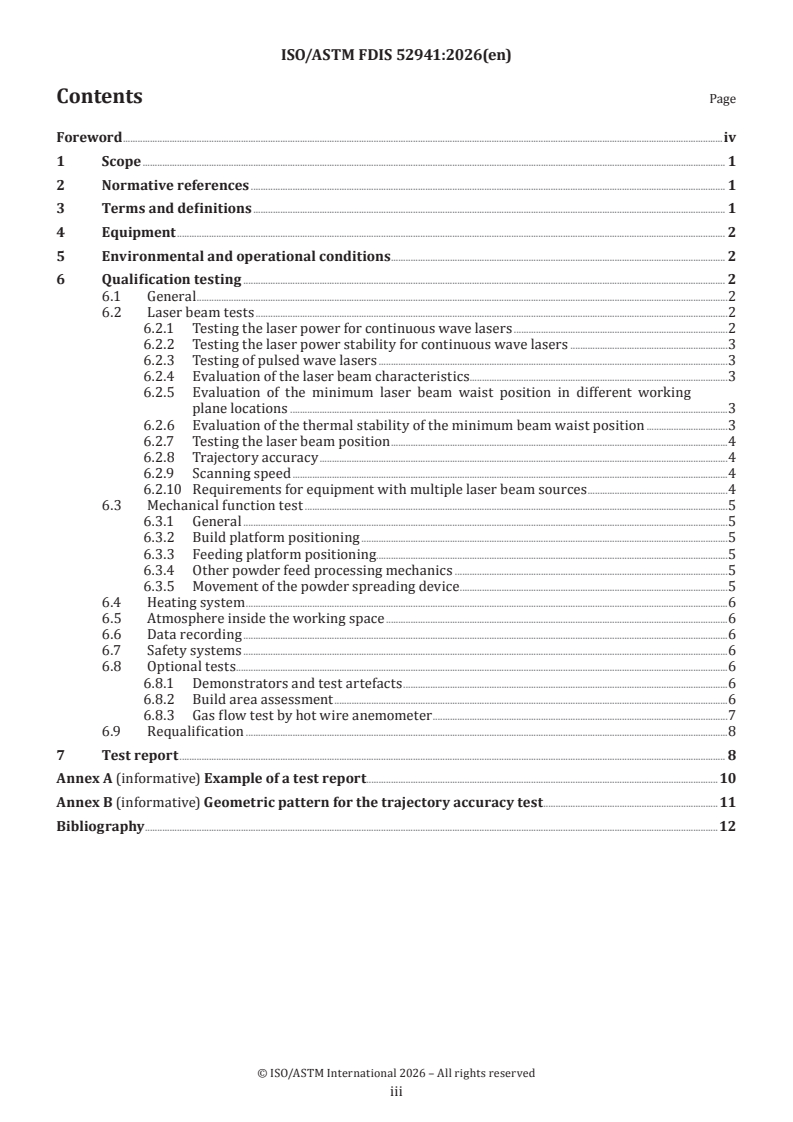
Contents Page
Foreword .iv
1 Scope . 1
2 Normative references . 1
3 Terms and definitions . 1
4 Equipment . 2
5 Environmental and operational conditions . 2
6 Qualification testing . 2
6.1 General .2
6.2 Laser beam tests .2
6.2.1 Testing the laser power for continuous wave lasers .2
6.2.2 Testing the laser power stability for continuous wave lasers .3
6.2.3 Testing of pulsed wave lasers .3
6.2.4 Evaluation of the laser beam characteristics.3
6.2.5 Evaluation of the minimum laser beam waist position in different working
plane locations .3
6.2.6 Evaluation of the thermal stability of the minimum beam waist position .3
6.2.7 Testing the laser beam position .4
6.2.8 Trajectory accuracy .4
6.2.9 Scanning speed .4
6.2.10 Requirements for equipment with multiple laser beam sources .4
6.3 Mechanical function test .5
6.3.1 General .5
6.3.2 Build platform positioning .5
6.3.3 Feeding platform positioning.5
6.3.4 Other powder feed processing mechanics .5
6.3.5 Movement of the powder spreading device .5
6.4 Heating system .6
6.5 Atmosphere inside the working space .6
6.6 Data recording .6
6.7 Safety systems .6
6.8 Optional tests .6
6.8.1 Demonstrators and test artefacts .6
6.8.2 Build area assessment .6
6.8.3 Gas flow test by hot wire anemometer .7
6.9 Requalification .8
7 Test report . 8
Annex A (informative) Example of a test report. 10
Annex B (informative) Geometric pattern for the trajectory accuracy test .11
Bibliography .12
© ISO/ASTM International 2026 – All rights reserved
iii
Foreword
ISO (the International Organization for Standardization) is a worldwide federation of national standards
bodies (ISO member bodies). The work of preparing International Standards is normally carried out through
ISO technical committees. Each member body interested in a subject for which a technical committee
has been established has the right to be represented on that committee. International organizations,
governmental and non-governmental, in liaison with ISO, also take part in the work. ISO collaborates closely
with the International Electrotechnical Commission (IEC) on all matters of electrotechnical standardization.
The procedures used to develop this document and those intended for its further maintenance are described
in the ISO/IEC Directives, Part 1. In particular, the different approval criteria needed for the different types
of ISO document should be noted. This document was drafted in accordance with the editorial rules of the
ISO/IEC Directives, Part 2 (see www.iso.org/directives).
ISO draws attention to the possibility that the implementation of this document may involve the use of (a)
patent(s). ISO takes no position concerning the evidence, validity or applicability of any claimed patent
rights in respect thereof. As of the date of publication of this document, ISO had not received notice of (a)
patent(s) which may be required to implement this document. However, implementers are cautioned that
this may not represent the latest information, which may be obtained from the patent database available at
www.iso.org/patents. ISO shall not be held responsible for identifying any or all such patent rights.
Any trade name used in this document is information given for the convenience of users and does not
constitute an endorsement.
For an explanation of the voluntary nature of standards, the meaning of ISO specific terms and expressions
related to conformity assessment, as well as information about ISO's adherence to the World Trade
Organization (WTO) principles in the Technical Barriers to Trade (TBT), see www.iso.org/iso/foreword.html.
This document was prepared by ISO/TC 261, Additive manufacturing, in cooperation with ASTM F 42, Additive
Manufacturing Technologies, on the basis of a partnership agreement between ISO and ASTM International
with the aim to create a common set of ISO/ASTM standards on additive manufacturing, in collaboration
with the European Committee for Standardization (CEN) Technical Committee CEN/TC 438, Additive
manufacturing, in accordance with the Agreement on technical cooperation between ISO and CEN (Vienna
Agreement).
This second edition cancels and replaces the first edition (ISO/ASTM 52941:2020), which has been
technically revised.
The main changes are as follows:
— title changed from “Additive manufacturing — System performance and reliability — Acceptance tests
for laser metal powder-bed fusion machines for metallic materials for aerospace application” to “Additive
manufacturing for aerospace — System performance and reliability tests for laser metal powder-bed fusion
machines for metallic materials”;
— extension of the scope of application to non-aerospace applications if this is part of a contract;
— mormative references has been updated;
— 6.2 has been revised;
— test report has been revised;
— example of a test report in Annex A slightly revised;
— editorial changes.
Any feedback or questions on this document should be directed to the user’s national standards body. A
complete listing of these bodies can be found at www.iso.org/members.html.
© ISO/ASTM International 2026 – All rights reserved
iv
FINAL DRAFT International Standard ISO/ASTM FDIS 52941:2026(en)
Additive manufacturing for aerospace — System performance
and reliability tests for laser metal powder-bed fusion
machines for metallic materials
1 Scope
This document specifies requirements and test methods for the qualification and re-qualification of laser
beam machines for metal powder bed fusion additive manufacturing for aerospace applications.
This document can also be applied to non-aerospace applications if this is part of a contract.
It can also be used to verify machine features during periodic inspections or following maintenance and
repair activities.
2 Normative references
The following documents are referred to in the text in such a way that some or all of their content constitutes
requirements of this document. For dated references, only the edition cited applies. For undated references,
the latest edition of the referenced document (including any amendments) applies.
ISO 11146 (all parts), Lasers and laser-related equipment — Test methods for laser beam widths, divergence
angles and beam propagation ratios
ISO 11554, Optics and photonics — Lasers and laser-related equipment — Test methods for laser beam radiant
power, radiant energy and temporal characteristics
ISO 17295, Additive manufacturing — General principles — Part positioning, coordinates and orientation
ISO/ASTM 52900, Additive manufacturing — General principles — Fundamentals and vocabulary
3 Terms and definitions
For the purposes of this document, the terms and definitions given in ISO/ASTM 52900, ISO 17295 and the
following apply.
ISO and IEC maintain terminological databases for use in standardization at the following addresses:
— ISO Online browsing platform: available at https:// www .iso .org/ obp
— IEC Electropedia: available at https:// www .electropedia .org/
3.1
scanning speed
relative linear speed of the laser beam movement in the plane of the build surface
Note 1 to entry: For powder bed fusion processes, unless otherwise designated by the machine manufacturer the
plane of the build surface is identical to the XY plane.
3.2
warm-up time
time from switching on the machine until the required temperature has been reached such that the build
cycle can be started
© ISO/ASTM International 2026 – All rights reserved
3.3
feeding platform
platform that moves incrementally to supply powder to the powder spreading device (3.4)
3.4
powder spreading device
powder supply mechanism, which distributes the powder to form a new layer in the powder bed
3.5
rated laser power
maximum power capability as specified by the laser manufacturer
3.6
minimum beam waist position
focal spot location at which the beam has the most concentrated energy and the smallest cross-sectional
area
4 Equipment
Equipment shall be installed, operated and maintained according to the documented instructions.
5 Environmental and operational conditions
The environmental and operational conditions during qualification testing shall meet the requirement
ranges if specified by the machine manufacturer and shall conform to the conditions which are specified by
a machine user during
...
2026-04-06
ISO/TC 261
Secretariat: DIN
Date: 2026-xx
Additive manufacturing for aerospace — System performance and
reliability tests for laser metal powder-bed fusion machines for
metallic materials
Fabrication additive pour l’aéronautique l'aérospatiale — Essais de performance du système et de fiabilité pour
les machines de fusion laser sur lit de poudre métallique destinées auxpour les matériaux métalliques
FDIS stage
TThhisis drdraafftt iiss susubbmmiitttteed d ttoo aa ppaarraallellel l vvoottee i inn IISSOO,, CCEEN.N.
© ISO/ASTM 2026
All rights reserved. Unless otherwise specified, or required in the context of its implementation, no part of this publication
may be reproduced or utilized otherwise in any form or by any means, electronic or mechanical, including photocopying,
or posting on the internet or an intranet, without prior written permission. Permission can be requested from either ISO
at the address below or ISO’s member body in the country of the requester. In the United States, such requests should be
sent to ASTM International.
ISO copyright office ASTM International
CP 401 • Ch. de Blandonnet 8 100 Barr Harbor Drive, PO Box C700
CH-1214 Vernier, Geneva West Conshohocken, PA 19428-2959, USA
Phone: + 41 22 749 01 11 Phone: +610 832 9634
Fax: +41 22 749 09 47 Fax: +610 832 9635
Email: Email: khooper@astmE-mail: copyright@iso.org
Website: www.iso.org Website:
Published in Switzerland
© ISO/ASTM 2026 – All rights reserved
ii
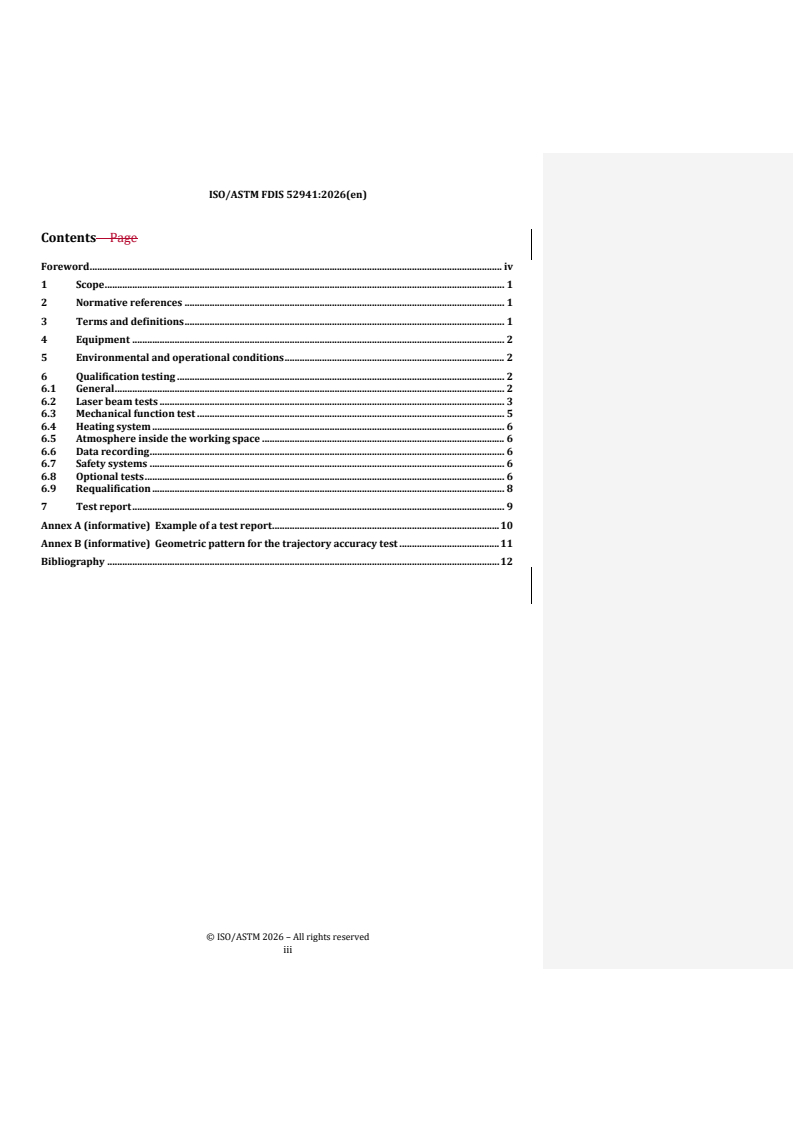
Contents Page
Foreword . iv
1 Scope . 1
2 Normative references . 1
3 Terms and definitions . 1
4 Equipment . 2
5 Environmental and operational conditions . 2
6 Qualification testing . 2
6.1 General . 2
6.2 Laser beam tests . 3
6.3 Mechanical function test . 5
6.4 Heating system . 6
6.5 Atmosphere inside the working space . 6
6.6 Data recording . 6
6.7 Safety systems . 6
6.8 Optional tests . 6
6.9 Requalification . 8
7 Test report . 9
Annex A (informative) Example of a test report . 10
Annex B (informative) Geometric pattern for the trajectory accuracy test . 11
Bibliography . 12
© ISO/ASTM 2026 – All rights reserved
iii
Foreword
ISO (the International Organization for Standardization) is a worldwide federation of national standards
bodies (ISO member bodies). The work of preparing International Standards is normally carried out through
ISO technical committees. Each member body interested in a subject for which a technical committee has been
established has the right to be represented on that committee. International organizations, governmental and
non-governmental, in liaison with ISO, also take part in the work. ISO collaborates closely with the
International Electrotechnical Commission (IEC) on all matters of electrotechnical standardization.
The procedures used to develop this document and those intended for its further maintenance are described
in the ISO/IEC Directives, Part 1. In particular, the different approval criteria needed for the different types of
ISO document should be noted. This document was drafted in accordance with the editorial rules of the
ISO/IEC Directives, Part 2 (see www.iso.org/directives).
ISO draws attention to the possibility that the implementation of this document may involve the use of (a)
patent(s). ISO takes no position concerning the evidence, validity or applicability of any claimed patent rights
in respect thereof. As of the date of publication of this document, ISO had not received notice of (a) patent(s)
which may be required to implement this document. However, implementers are cautioned that this may not
represent the latest information, which may be obtained from the patent database available at
www.iso.org/patents. ISO shall not be held responsible for identifying any or all such patent rights.
Any trade name used in this document is information given for the convenience of users and does not
constitute an endorsement.
For an explanation of the voluntary nature of standards, the meaning of ISO specific terms and expressions
related to conformity assessment, as well as information about ISO's adherence to the World Trade
Organization (WTO) principles in the Technical Barriers to Trade (TBT), see www.iso.org/iso/foreword.html.
This document was prepared by ISO/TC 261, Additive manufacturing, in cooperation with ASTM F 42, Additive
Manufacturing Technologies, on the basis of a partnership agreement between ISO and ASTM International
with the aim to create a common set of ISO/ASTM standards on additive manufacturing, in collaboration with
the European Committee for Standardization (CEN) Technical Committee CEN/TC 438, Additive
manufacturing, in accordance with the Agreement on technical cooperation between ISO and CEN (Vienna
Agreement).
This second edition cancels and replaces the first edition (ISO/ASTM 52941:2020), which has been technically
revised.
The main changes are as follows:
— — title changed from “Additive manufacturing — System performance and reliability — Acceptance tests
for laser metal powder-bed fusion machines for metallic materials for aerospace application” to “Additive
manufacturing for aerospace — System performance and reliability tests for laser metal powder-bed fusion
machines for metallic materials”;
— — extension of the scope of application to non-aerospace applications if this is part of a contract;
— — mormative references has been updated;
— 6.2— subclause 6.2 has been revised;
— — test report has been revised;
— — example of a test report in Annex AAnnex A slightly revised;
© ISO/ASTM 2026 – All rights reserved
iv
— — editorial changes.
Any feedback or questions on this document should be directed to the user’s national standards body. A
complete listing of these bodies can be found at www.iso.org/members.html.
© ISO/ASTM 2026 – All rights reserved
v
Additive manufacturing for aerospace — System performance and
reliability tests for laser metal powder-bed fusion machines for
metallic materials
1 Scope
This document specifies requirements and test methods for the qualification and re-qualification of laser beam
machines for metal powder bed fusion additive manufacturing for aerospace applications.
This document can also be applied to non-aerospace applications if this is part of a contract.
It can also be used to verify machine features during periodic inspections or following maintenance and repair
activities.
2 Normative references
The following documents are referred to in the text in such a way that some or all of their content constitutes
requirements of this document. For dated references, only the edition cited applies. For undated references,
the latest edition of the referenced document (including any amendments) applies.
ISO 11146 (all parts), Lasers and laser-related equipment — Test methods for laser beam widths, divergence
angles and beam propagation ratios
ISO 11554, Optics and photonics — Lasers and laser-related equipment — Test methods for laser beam radiant
power, radiant energy and temporal characteristics
ISO/ASTM 52900, Additive manufacturing — General principles — Fundamentals and vocabulary
ISO 17295, Additive manufacturing — General principles — Part positioning, coordinates and orientation
ISO/ASTM 52900, Additive manufacturing — General principles — Fundamentals and vocabulary
3 Terms and definitions
For the purposes of this document, the terms and definitions given in ISO/ASTM 52900, ISO 17295 and the
following apply.
ISO and IEC maintain terminological databases for use in standardization at the following addresses:
— — ISO Online browsing platform: available at https://www.iso.org/obp
— — IEC Electropedia: available at https://www.electropedia.org/
3.1 3.1
scanning speed
relative linear speed of the laser beam movement in the plane of the build surface
Note 1 to entry: For powder bed fusion processes, unless otherwise designated by the machine manufacturer the plane
of the build surface is identical to the x-yXY plane.
© ISO/ASTM 2026 – All rights reserved
3.2 3.2
warm-up time
time from switching on the machine until the required temperature has been reached such that the build cycle
can be started
3.3 3.3
feeding platform
platform that moves incrementally to supply powder to the powder spreading device (3.4(3.4))
3.4 3.4
powder spreading device
powder supply mechanism, which distributes the powder to form a new layer in the powder bed
3.5 3.5
rated laser power
maximum power capability as specified by the laser manufacturer
3.6 3.6
minimum beam waist position
focal spot location at which the beam has the most concentrated energy and the smallest cross-sectional area
4 Equipment
Equipment shall be installed, operated and maintained according to the documented instructions.
5 Environmental and operational conditions
The environmental and operational conditions during qualification testing shall meet the requirement ranges
if specified by the machine manufacturer and shall conform to the conditions which are specified by a machine
user during production, as examples the following:
a) a) temperature;
b) b) humidity;
c) c) services/utilities (e.g. supply of electrical power, compressed air, shielding gas, water);
d) d) shocks/vibrations;
e) e) chamber pressure;
f) f) process gas purity.
Health and safety measures relating to laser radiation and to fire and explosion protection shall be observed.
6 Qualification testing
6.1 General
The qualification testing of laser beam machines for metal powder bed fusion additive manufacturing shall
include, at a minimum, the requirements specified in 6.26.2 to 6.76.7.
The measurement shall be performed with a calibrated measuring instrument according to the measuring
instrument instructions.
© ISO/ASTM 2026 – All rights reserved
6.2 Laser beam tests
6.2.1 Testing the laser power for continuous wave lasers
The laser power shall be measured. The measurement should be performed according to ISO 11554, as
applicable.
The nominal machine power settings shall be compared with the actual values. The measurement shall be
performed with a calibrated measuring instrument at the point of use (i.e. inside the build chamber). The
instrument shall be capable of accurate measurement of the actual laser power range.
The laser power measurement shall conform to the requirements of production by covering the typical power
range. If this range is unknown or not specified by the machine manufacturer, it is recommended to measure
at a minimum of three points including 30 % and 90 % of the maximum rated laser power.
If specified by the machine manufacturer, a warm-up time shall be applied.
6.2.2 Testing the laser power stability for continuous wave lasers
The laser power stability should be measured according to ISO 11554, if applicable. If ISO 11554 is not
applicable the following procedure should be applied. If a warm-up time is specified, the stability
measurements shall start immediately after the warm-up time is completed.
Unless otherwise agreed by the contracting parties, demonstrate laser power stability by making the following
power measurements after all optical elements, with suitable instrumentation:
a) a) maximum rated laser power after specified warm-up time of the machine;
b) b) the machine to be held at maximum rated-laser power for a minimum of 15 min;
c) c) power reading should then be taken less than 2 min after this period of 15 min has elapsed;
d) d) Variation between the two measurements shall not exceed ±5 %.
NOTE See 3.53.5 for the definition of rated laser power.
6.2.3 Testing of pulsed wave lasers
The characteristics shall be measured according toin accordance with ISO 11554. The requirements shall be
agreed by the contracting parties.
6.2.4 Evaluation of the laser beam characteristics
The laser beam characteristics (spot size, profile and symmetry) shall be determined with suitable test
equipment at the working plane with the laser beam in a vertical d
...
PROJET FINAL
Norme
internationale
ISO/ASTM
FDIS
ISO/TC 261
Fabrication additive pour
Secrétariat: DIN
l'aérospatiale — Essais de
Début de vote:
performance et de fiabilité du
2026-05-21
système pour machines de fusion
Vote clos le:
laser sur lit de poudre pour les
2026-07-16
matériaux métalliques
Additive manufacturing for aerospace — System performance
and reliability tests for laser metal powder-bed fusion machines
for metallic materials
LES DESTINATAIRES DU PRÉSENT PROJET SONT
INVITÉS À PRÉSENTER, AVEC LEURS OBSERVATIONS,
NOTIFICATION DES DROITS DE PROPRIÉTÉ DONT ILS
AURAIENT ÉVENTUELLEMENT CONNAISSANCE ET À
FOURNIR UNE DOCUMENTATION EXPLICATIVE.
OUTRE LE FAIT D’ÊTRE EXAMINÉS POUR
ÉTABLIR S’ILS SONT ACCEPTABLES À DES FINS
INDUSTRIELLES, TECHNOLOGIQUES ET COM-MERCIALES,
AINSI QUE DU POINT DE VUE DES UTILISATEURS, LES
PROJETS DE NORMES
TRAITEMENT PARALLÈLE ISO/CEN
INTERNATIONALES DOIVENT PARFOIS ÊTRE CONSIDÉRÉS
DU POINT DE VUE DE LEUR POSSI BILITÉ DE DEVENIR DES
NORMES POUVANT
SERVIR DE RÉFÉRENCE DANS LA RÉGLEMENTATION
NATIONALE.
Numéro de référence
PROJET FINAL
Norme
internationale
ISO/ASTM
FDIS
ISO/TC 261
Fabrication additive pour
Secrétariat: DIN
l'aérospatiale — Essais de
Début de vote:
performance et de fiabilité du
2026-05-21
système pour machines de fusion
Vote clos le:
laser sur lit de poudre pour les
2026-07-16
matériaux métalliques
Additive manufacturing for aerospace — System performance
and reliability tests for laser metal powder-bed fusion machines
for metallic materials
LES DESTINATAIRES DU PRÉSENT PROJET SONT
INVITÉS À PRÉSENTER, AVEC LEURS OBSERVATIONS,
NOTIFICATION DES DROITS DE PROPRIÉTÉ DONT ILS
DOCUMENT PROTÉGÉ PAR COPYRIGHT
AURAIENT ÉVENTUELLEMENT CONNAISSANCE ET À
FOURNIR UNE DOCUMENTATION EXPLICATIVE.
© ISO/ASTM International 2026
OUTRE LE FAIT D’ÊTRE EXAMINÉS POUR
ÉTABLIR S’ILS SONT ACCEPTABLES À DES FINS
Tous droits réservés. Sauf prescription différente ou nécessité dans le contexte de sa mise en œuvre, aucune partie de cette
INDUSTRIELLES, TECHNOLOGIQUES ET COM-MERCIALES,
publication ne peut être reproduite ni utilisée sous quelque forme que ce soit et par aucun procédé, électronique ou mécanique,
AINSI QUE DU POINT DE VUE DES UTILISATEURS, LES
y compris la photocopie, ou la diffusion sur l’internet ou un intranet, sans autorisation écrite soit de l’ISO à l’adresse ci-après,
PROJETS DE NORMES
TRAITEMENT PARALLÈLE ISO/CEN
INTERNATIONALES DOIVENT PARFOIS ÊTRE CONSIDÉRÉS
soit d’un organisme membre de l’ISO dans le pays du demandeur. Aux États-Unis, les demandes doivent être adressées à ASTM
DU POINT DE VUE DE LEUR POSSI BILITÉ DE DEVENIR DES
International.
NORMES POUVANT
ISO copyright office ASTM International SERVIR DE RÉFÉRENCE DANS LA RÉGLEMENTATION
NATIONALE.
Case postale 401 • Ch. de Blandonnet 8 100 Barr Harbor Drive, PO Box C700
CH-1214 Vernier, Genève West Conshohocken, PA 19428-2959, USA
Tél.: +41 22 749 01 11 Tél.: +610 832 9634
Fax: +610 832 9635
E-mail: copyright@iso.org E-mail: khooper@astm.org
Web: www.iso.org Web: www.astm.org
Publié en Suisse Numéro de référence
© ISO/ASTM International 2026 – Tous droits réservés
ii
Sommaire Page
Avant-propos .iv
1 Domaine d'application . 1
2 Références normatives . 1
3 Termes et définitions . 1
4 Équipement . 2
5 Conditions environnementales et opérationnelles . 2
6 Essais de qualification . 2
6.1 Généralités .2
6.2 Essais de faisceau laser .3
6.2.1 Essais de puissance laser pour les lasers à ondes entretenues .3
6.2.2 Essais de stabilité de la puissance laser pour les lasers à ondes entretenues .3
6.2.3 Essais des lasers à impulsion .3
6.2.4 Évaluation des caractéristiques du faisceau laser .3
6.2.5 Évaluation de la position minimale du col du faisceau laser en différents
endroits du plan de travail .4
6.2.6 Évaluation de la stabilité thermique de la position minimale du col du faisceau .4
6.2.7 Essais de la position du faisceau laser .4
6.2.8 Exactitude de la trajectoire .4
6.2.9 Vitesse de balayage .5
6.2.10 Exigences pour les équipements ayant des sources de faisceau laser multiples .5
6.3 Essai de fonction mécanique .5
6.3.1 Généralités .5
6.3.2 Positionnement de la plateforme de fabrication .5
6.3.3 Positionnement de la plateforme d’alimentation.6
6.3.4 Autres procédés d’alimentation en poudre .6
6.3.5 Mouvement du dispositif d’étalement de la poudre .6
6.4 Système de chauffage .6
6.5 Atmosphère à l'intérieur de l’espace de travail .6
6.6 Enregistrement des données .6
6.7 Systèmes de sécurité .6
6.8 Essais facultatifs .7
6.8.1 Démonstrateurs et pièces types d’essai .7
6.8.2 Évaluation de la zone de fabrication .7
6.8.3 Essai de débit de gaz avec anémomètre à fil chaud .8
6.9 Requalification .8
7 Rapport d’essai . 9
Annexe A (informative) Exemple d’un rapport d'essai . 10
Annexe B (informative) Motif géométrique de l’essai d’exactitude de la trajectoire .11
Bibliographie .12
© ISO/ASTM International 2026 – Tous droits réservés
iii
Avant-propos
L'ISO (Organisation internationale de normalisation) est une fédération mondiale d'organismes nationaux
de normalisation (comités membres de l'ISO). L'élaboration des Normes internationales est en général
confiée aux comités techniques de l'ISO. Chaque comité membre intéressé par une étude a le droit de faire
partie du comité technique créé à cet effet. Les organisations internationales, gouvernementales et non
gouvernementales, en liaison avec l'ISO participent également aux travaux. L'ISO collabore étroitement avec
la Commission électrotechnique internationale (IEC) en ce qui concerne la normalisation électrotechnique.
Les procédures utilisées pour élaborer le présent document et celles destinées à sa mise à jour sont
décrites dans les Directives ISO/IEC, Partie 1. Il convient, en particulier de prendre note des différents
critères d'approbation requis pour les différents types de documents ISO. Le présent document
a été rédigé conformément aux règles de rédaction données dans les Directives ISO/IEC, Partie 2
(voir www.iso.org/directives).
L’ISO attire l’attention sur le fait que la mise en application du présent document peut entraîner l’utilisation
d’un ou de plusieurs brevets. L’ISO ne prend pas position quant à la preuve, à la validité et à l’applicabilité de
tout droit de propriété revendiqué à cet égard. À la date de publication du présent document, l’ISO n'avait pas
reçu notification qu’un ou plusieurs brevets pouvaient être nécessaires à sa mise en application. Toutefois,
il y a lieu d’avertir les responsables de la mise en application du présent document que des informations
plus récentes sont susceptibles de figurer dans la base de données de brevets, disponible à l'adresse
www.iso.org/brevets. L’ISO ne saurait être tenue pour responsable de ne pas avoir identifié tout ou partie de
tels droits de propriété.
Les appellations commerciales éventuellement mentionnées dans le présent document sont données pour
information, par souci de commodité, à l’intention des utilisateurs et ne sauraient constituer un engagement.
Pour une explication de la nature volontaire des normes, la signification des termes et expressions
spécifiques de l'ISO liés à l'évaluation de la conformité, ou pour toute information au sujet de l'adhésion de
l'ISO aux principes de l’Organisation mondiale du commerce (OMC) concernant les obstacles techniques au
commerce (OTC), voir le lien suivant: www.iso.org/iso/fr/avant-propos.html.
Le présent document a été élaboré par le comité technique ISO/TC 261, Fabrication additive, en coopération
avec le comité ASTM F42, Technologies de fabrication additive, dans le cadre d’un accord de partenariat
entre l’ISO et ASTM International dans le but de créer un ensemble commun de normes ISO/ASTM sur la
fabrication additive et en collaboration avec le Comité Européen de Normalisation (CEN), Comité technique
CEN/TC 438, Fabrication additive, conformément à l’Accord de coopération technique entre l’ISO et le CEN
(Accord de Vienne).
Cette deuxième édition annule et remplace la première édition (ISO/ASTM 52941:2020), qui a fait l'objet
d'une révision technique.
Les principales modifications par rapport à l'édition précédente sont les suivantes:
— Le titre a été modifié de “Fabrication additive — Performance et fiabilité du système — Essais de réception
pour machines de fusion laser sur lit de poudre pour les matériaux métalliques pour l'application aérospatiale”
à “Fabrication additive pour l'aérospatiale — Essais de performance et fiabilité du système pour les machines
de fusion sur lit de poudre pour les matériaux métalliques”;
— le domaine d'application a été élargi aux applications non-aérospatiales si cela est prévu dans un contrat;
— les références normatives ont été mises à jour;
— 6.2 a été révisé;
— le rapport d'essai a été révisé;
— l'exemple de rapport d'essai dans l'Annexe A a été légèrement révisé;
— des modifications éditoriales.
© ISO/ASTM International 2026 – Tous droits réservés
iv
Il convient que tout retour d’information ou questions sur le présent document soit adressé à l'organisme
national de normalisation de l'utilisateur. Une liste complète de ces organismes peut être consultée à
l'adresse www.iso.org/members.html.
© ISO/ASTM International 2026 – Tous droits réservés
v
PROJET FINAL Norme internationale ISO/ASTM FDIS 52941:2026(fr)
Fabrication additive pour l'aérospatiale — Essais de
performance et de fiabilité du système pour machines de
fusion laser sur lit de poudre pour les matériaux métalliques
1 Domaine d'application
Le présent document spécifie les exigences et les méthodes d’essai pour la qualification et la requalification
des machines à faisceau laser pour la fabrication additive par fusion sur lit de poudre métallique dans les
applications aérospatiales.
Le présent document peut également s'appliquer à des applications non-aérospatiales si cela est prévu dans
un contrat.
Il peut également être utilisé pour vérifier les fonctionnalités de la machine lors des inspections périodiques
ou à la suite d’activités de maintenance ou de réparation.
2 Références normatives
Les documents suivants cités dans le texte constituent, pour tout ou partie de leur contenu, des exigences du
présent document. Pour les références datées, seule l’édition citée s’applique. Pour les références non datées,
la dernière édition du document de référence s’applique (y compris les éventuels amendements).
ISO 11146 (toutes les parties), Lasers et équipements associés aux lasers — Méthodes d’essai des largeurs du
faisceau, angles de divergence et facteurs de limite de diffraction
ISO 11554, Optique et photonique — Lasers et équipements associés aux lasers — Méthodes d'essai de la
puissance rayonnante, de l'énergie rayonnante et des caractéristiques temporelles des faisceaux lasers
ISO 17295, Fabrication additive — Principes généraux — Positionnement, coordonnées et orientation de la pièce
ISO/ASTM 52900, Fabrication additive — Principes généraux — Fondamentaux et vocabulaire
3 Termes et définitions
Pour les besoins du présent document, les termes et définitions donnés dans l’ISO/ASTM 52900, l’ISO 17295,
ainsi que les suivants, s’appliquent.
L’ISO et l’IEC tiennent à jour des bases de données terminologiques destinées à être utilisées en normalisation,
consultables aux adresses suivantes:
— Plateforme de navigation ISO en ligne: disponible sur https:// www .iso .org/ obp
— Electropedia de l’IEC: disponible sur https:// www .electropedia .org/
3.1
vitesse de balayage
vitesse linéaire relative du mouvement du faisceau laser dans le plan de la surface de de fabrication
Note 1 à l'article: Pour les procédés de fusion sur lit de poudre, sauf désignation contraire du fabricant de la machine, le
plan de la surface de fabrication est identique à plan XY.
© ISO/ASTM International 2026 – Tous droits réservés
3.2
temps de préchauffage
temps écoulé depuis la mise en marche de la machine jusqu’à ce que la température requise ait été atteinte
que façon à ce que le cycle de fabrication puisse être démarré
3.3
plateforme d’alimentation
plateforme qui se déplace par incréments pour alimenter en poudre le dispositif d’étalement de la poudre (3.4)
3.4
dispositif d’étalement de la poudre
mécanisme d'alimentation en poudre, qui distribue la poudre pour former une nouvelle couche sur le lit de
poudre
3.5
puissance nominale du laser
capacité maximale de puissance telle que spécifiée par le fabricant du laser
3.6
position minimale du col du faisceau
point focal d’un endroit où le faisceau a l'énergie la plus concentrée et la plus petite surface de section
transversale
4 Équipement
L’équipement doit être installé, mis en fonctionnement et maintenu conformément aux instructions
documentées.
5 Conditions environnementales et opérationnelles
Les conditions environnementales et opérationnelles pendant les essais de qualification doivent satisfaire
aux gammes d’exigences si elles sont spécifiées par le fabricant de la machine et doivent être conformes aux
conditions qui sont spécifiées par un utilisateur de la machine pendant la production, comme exemples les
suivantes:
a) température;
b) humidité;
c) services/réseaux (par exemple, alimentation électrique, air comprimé, gaz de protection, eau);
d) chocs/vibrations;
e) pression de la chambre;
f) pureté du gaz de procédé.
Les mesures de santé et de sécurité relatives à la protection contre le rayonnement laser et contre l'incendie
et l’explosion doivent être observées.
6 Essais de qualification
6.1 Généralités
Les essais de qualification des machines à faisceau laser pour la fabrication additive par fusion sur lit de
poudre métallique doivent inclure, au minimum, les exigences spécifiées de 6.2 à 6.7.
La mesure doit être effectuée avec un instrument de mesure étalonné conformément aux instr
...