

ISO 834-8:2002
(Main)Fire-resistance tests — Elements of building construction — Part 8: Specific requirements for non-loadbearing vertical separating elements
General Information
- Abstract
ISO 834-8:2002 specifies the procedures to be followed for determining the fire resistance of non-loadbearing vertical separating elements when exposed to heating on one face. This test is neither appropriate for the evaluation of curtain walls (non-loadbearing external walls suspended from the ends of floor slabs) nor for walls containing doors or glazing. For tests of walls containing doors refer to ISO 3008. For tests of walls containing glazing refer to ISO 3009. The application of this test to other untested forms of construction is acceptable when the construction complies with the direct field of application as given in ISO 834-8:2002 or when it is subjected to a field of extended application analysis in accordance with ISO/TR 12470.
- Status
- Published
- Publication Date
- 21-Oct-2002
- Technical Committee
- ISO/TC 92/SC 2 - Fire containment
- Drafting Committee
- ISO/TC 92/SC 2/WG 1 - General requirements
- Current Stage
- 9020 - International Standard under periodical review
- Start Date
- 15-Jul-2026
- Completion Date
- 15-Jul-2026

Overview - ISO 834-8:2002 (fire-resistance tests for non-loadbearing walls)
ISO 834-8:2002 defines specific procedures for determining the fire resistance of non-loadbearing vertical separating elements (walls) exposed to heating on one face. It supplements the general requirements of ISO 834-1 and is intended for test use where the wall is representative of in-service construction. The standard excludes curtain walls and walls containing doors or glazing (see ISO 3008 and ISO 3009). Application to other untested constructions is possible only within the direct field of application or after an extended application analysis per ISO/TR 12470.
Key topics and technical requirements
- Scope and exclusions: Applies only to non-loadbearing vertical separating elements; curtain walls, doors and glazed walls are handled by other standards.
- Specimen design and size: Test specimens must be fully representative or designed for wide applicability. Dimensions ≤ 3 m are tested full-size; any dimension > 3 m must be tested at no less than 3 m.
- Supporting construction & restraint: Guidance for installing smaller specimens in a furnace opening; one vertical edge may be left unrestrained with a 25–50 mm gap packed with resilient non-combustible material.
- Test frame rigidity: Increase in internal frame dimension must not exceed 5 mm under a 25 kN applied force.
- Instrumentation:
- Furnace plate thermometers (minimum of four) distributed across the exposed face.
- Unexposed-face thermocouples located not closer than 100 mm to any edge at specified positions.
- Deflection measurement instrumentation to record movements greater than 5 mm at centre and near free edge.
- Performance criteria: Judged against integrity and insulation criteria defined in ISO 834-1.
- Validity & reporting: Test validity requires compliance with equipment, conditions, specimen preparation, instrumentation and procedure limits. Results and test reports follow ISO 834-1 formats.
- Safety: The standard emphasizes hazard assessment (toxic smoke, mechanical risks) and requires written safety instructions and training.
Practical applications and users
Who uses ISO 834-8:2002:
- Fire-test laboratories conducting fire-resistance tests
- Building product manufacturers (non-loadbearing partition systems)
- Fire engineers and consultants performing performance assessments and extended application analyses
- Building code authorities and certification bodies evaluating fire compartmentation solutions
Typical uses:
- Certification and performance verification of partition walls
- Providing data for fire compartmentation design and regulatory compliance
- Supporting extended field-of-application studies for similar constructions
Related standards
- ISO 834-1 - General requirements (test conditions, criteria, reporting)
- ISO 3008 - Tests for walls containing doors
- ISO 3009 - Tests for walls containing glazing
- ISO/TR 12470 - Extended application analysis guidance
- ISO 13943 - Fire safety vocabulary
Keywords: ISO 834-8:2002, fire-resistance tests, non-loadbearing vertical separating elements, fire resistance, test procedure, furnace, integrity, insulation, ISO 834-1.
Relations
- Effective Date
- 25-Aug-2026
- Effective Date
- 10-Feb-2026
Get Certified
Connect with accredited certification bodies for this standard

CIS Institut d.o.o.
Personal Protective Equipment (PPE) certification body. Notified Body NB-2890 for EU Regulation 2016/425 PPE.

Kiwa BDA Testing
Building and construction product certification.
Kmetijski inštitut Slovenije
Agricultural Institute of Slovenia. Soil testing, plant health, agricultural product analysis.
Sponsored listings
Frequently Asked Questions
ISO 834-8:2002 is a standard published by the International Organization for Standardization (ISO). Its full title is "Fire-resistance tests — Elements of building construction — Part 8: Specific requirements for non-loadbearing vertical separating elements". This standard covers: ISO 834-8:2002 specifies the procedures to be followed for determining the fire resistance of non-loadbearing vertical separating elements when exposed to heating on one face. This test is neither appropriate for the evaluation of curtain walls (non-loadbearing external walls suspended from the ends of floor slabs) nor for walls containing doors or glazing. For tests of walls containing doors refer to ISO 3008. For tests of walls containing glazing refer to ISO 3009. The application of this test to other untested forms of construction is acceptable when the construction complies with the direct field of application as given in ISO 834-8:2002 or when it is subjected to a field of extended application analysis in accordance with ISO/TR 12470.
ISO 834-8:2002 specifies the procedures to be followed for determining the fire resistance of non-loadbearing vertical separating elements when exposed to heating on one face. This test is neither appropriate for the evaluation of curtain walls (non-loadbearing external walls suspended from the ends of floor slabs) nor for walls containing doors or glazing. For tests of walls containing doors refer to ISO 3008. For tests of walls containing glazing refer to ISO 3009. The application of this test to other untested forms of construction is acceptable when the construction complies with the direct field of application as given in ISO 834-8:2002 or when it is subjected to a field of extended application analysis in accordance with ISO/TR 12470.
ISO 834-8:2002 is classified under the following ICS (International Classification for Standards) categories: 13.220.50 - Fire-resistance of building materials and elements. The ICS classification helps identify the subject area and facilitates finding related standards.
ISO 834-8:2002 has the following relationships with other standards: It is inter standard links to EN ISO 20257-1:2020, HD 60364-5-52:2011. Understanding these relationships helps ensure you are using the most current and applicable version of the standard.
ISO 834-8:2002 is available in PDF format for immediate download after purchase. The document can be added to your cart and obtained through the secure checkout process. Digital delivery ensures instant access to the complete standard document.
Standards Content (Sample)
INTERNATIONAL ISO
STANDARD 834-8
First edition
2002-10-01
Fire-resistance tests — Elements of
building construction —
Part 8:
Specific requirements for non-loadbearing
vertical separating elements
Essais de résistance au feu — Éléments de construction —
Partie 8: Exigences spécifiques relatives aux éléments verticaux de
séparation non porteurs
Reference number
PDF disclaimer
This PDF file may contain embedded typefaces. In accordance with Adobe's licensing policy, this file may be printed or viewed but shall not be
edited unless the typefaces which are embedded are licensed to and installed on the computer performing the editing. In downloading this file,
parties accept therein the responsibility of not infringing Adobe's licensing policy. The ISO Central Secretariat accepts no liability in this area.
Adobe is a trademark of Adobe Systems Incorporated.
Details of the software products used to create this PDF file can be found in the General Info relative to the file; the PDF-creation parameters
were optimized for printing. Every care has been taken to ensure that the file is suitable for use by ISO member bodies. In the unlikely event
that a problem relating to it is found, please inform the Central Secretariat at the address given below.
All rights reserved. Unless otherwise specified, no part of this publication may be reproduced or utilized in any form or by any means,
electronic or mechanical, including photocopying and microfilm, without permission in writing from either ISO at the address below or ISO's
member body in the country of the requester.
ISO copyright office
Case postale 56 CH-1211 Geneva 20
Tel. + 41 22 749 01 11
Fax + 41 22 749 09 47
E-mail copyright@iso.ch
Web www.iso.ch
Printed in Switzerland
©
ii ISO 2002 – All rights reserved
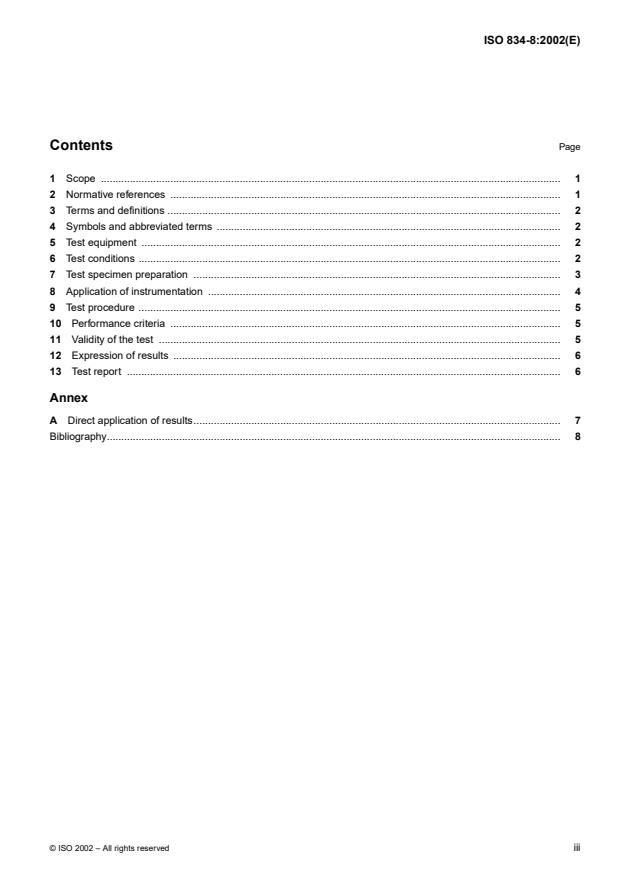
Contents Page
1 Scope . 1
2 Normative references . 1
3 Terms and definitions . 2
4 Symbols and abbreviated terms . 2
5 Test equipment . 2
6 Test conditions . 2
7 Test specimen preparation . 3
8 Application of instrumentation . 4
9 Test procedure . 5
10 Performance criteria . 5
11 Validity of the test . 5
12 Expression of results . 6
13 Test report . 6
Annex
A Direct application of results. 7
Bibliography. 8
©
ISO 2002 – All rights reserved iii
Foreword
ISO (the International Organization for Standardization) is a worldwide federation of national standards bodies (ISO
member bodies). The work of preparing International Standards is normally carried out through ISO technical
committees. Each member body interested in a subject for which a technical committee has been established has
the right to be represented on that committee. International organizations, governmental and non-governmental, in
liaison with ISO, also take part in the work. ISO collaborates closely with the International Electrotechnical
Commission (IEC) on all matters of electrotechnical standardization.
International Standards are drafted in accordance with the rules given in the ISO/IEC Directives, Part 3.
Draft International Standards adopted by the technical committees are circulated to the member bodies for voting.
Publication as an International Standard requires approval by at least 75 % of the member bodies casting a vote.
Attention is drawn to the possibility that some of the elements of this part of ISO 834 may be the subject of patent
rights. ISO shall not be held responsible for identifying any or all such patent rights.
International Standard ISO 834-8 was prepared by Technical Committee ISO/TC 92, Fire safety, Subcommittee
SC 2, Fire containment.
ISO834 consists of the following parts, under the general title Fire-resistance tests — Elements of building
construction:
— Part 1: General requirements
— Part 3: Commentary on test method and test data application
— Part 4: Specific requirements for loadbearing vertical separating elements
— Part 5: Specific requirements for loadbearing horizontal separating elements
— Part 6: Specific requirements for beams
— Part 7: Specific requirements for columns
— Part 8: Specific requirements for non-loadbearing vertical separating elements
— Part 9: Specific requirements for non-loadbearing ceiling elements
Annex A of this part of ISO 834 is for information only.
©
iv ISO 2002 – All rights reserved
Introduction
This document contains specific requirements for fire resistance testing which are unique to the elements of building
construction described as vertical separating non-loadbearing elements. The requirements for these non-
loadbearing elements are intended to be applied in appropriate conjunction with the detailed and general
requirements contained in Part 1 of this International Standard (ISO 834-1).
©
ISO 2002 – All rights reserved v
INTERNATIONAL STANDARD ISO 834-8:2002(E)
Fire-resistance tests — Elements of building construction —
Part 8:
Specific requirements for non-loadbearing vertical separating
elements
CAUTION — The attention of all persons concerned with managing and carrying out this fire resistance test
is drawn to the fact that fire testing may be hazardous and that there is a possibility that toxic and/or harmful
smoke and gases may be evolved during the test. Mechanical and operational hazards may also arise during
the construction of the test elements or structures, their testing and disposal of test residues.
An assessment of all potential hazards and risks to health shall be made and safety precautions shall be
identified and provided. Written safety instructions shall be issued. Appropriate training shall be given to
relevant personnel. Laboratory personnel shall ensure that they follow written safety instructions at all
times.
1 Scope
This part of ISO 834 specifies the procedures to be followed for determining the fire resistance of non-loadbearing
vertical separating elements when exposed to heating on one face.
The test is neither appropriate for the evaluation of curtain walls (non-loadbearing external walls suspended from the
[2]
ends of floor slabs) nor for walls containing doors or glazing. For tests of walls containing doors refer to ISO 3008 .
[3]
For tests of walls containing glazing refer to ISO 3009 .
The application of this test to other untested forms of construction is acceptable when the construction complies with
the direct field of application as given in this document or when it is subjected to a field of extended application
[4]
analysis in accordance with ISO/TR 12470 .
NOTE Since ISO/TR 12470 gives only general guidelines, specific extended application analyses are to be performed only by
persons expert in fire resistant constructions.
2 Normative references
The following normative documents contain provisions which, through reference in this text, constitute provisions of
this part of ISO 834. For dated references, subsequent amendments to, or revisions of, any of these publications do
not apply. However, parties to agreements based on this part of ISO 834 are encouraged to investigate the possibility
of applying the most recent editions of the normative documents indicated below. For undated references, the latest
edition of the normative document referred to applies. Members of ISO and IEC maintain registers of currently valid
International Standards.
ISO 834-1, Fire-resistance tests — Elements of building construction — Part 1: General requirements
ISO 13943, Fire safety — Vocabulary
©
ISO 2002 – All rights reserved 1
3 Terms and definitions
For the purposes of this part of ISO 834, the terms and definitions given in ISO 834-1, ISO 13943 and the following
apply.
3.1
vertical separating elements
vertically oriented building elements, such as walls, which are required to act as fire separations or fire barriers,
divide buildings into fire compartments or fire zones, or separate a building from adjoining buildings, in order to resist
the spread of fire to or from adjoining compartments or buildings
3.2
non-loadbearing wall
separating element designed not to be subject to any load other than its own mass
3.3
insulated non-loadbearing wall
separating element, which satisfies both the integri
...