

ISO 13315-4:2017
(Main)Environmental management for concrete and concrete structures — Part 4: Environmental design of concrete structures
General Information
- Abstract
ISO 13315-4:2017 provides the general framework, principles and requirements for carrying out an environmental design of concrete structures, based on a lifecycle assessment (LCA) method or other appropriate methods. ISO 13315-4:2017 is applicable to single concrete structures, as well as concrete structure complexes.
- Status
- Published
- Publication Date
- 22-Mar-2017
- Current Stage
- 9093 - International Standard confirmed
- Start Date
- 20-Jun-2022
- Completion Date
- 29-Aug-2026
Buy Documents
ISO 13315-4:2017 - Environmental management for concrete and concrete structures
ISO 13315-4:2017 - Environmental management for concrete and concrete structures — Part 4: Environmental design of concrete structures/23/2017
Overview
ISO 13315-4:2017 - Environmental management for concrete and concrete structures - Part 4: Environmental design of concrete structures - defines a practical framework for integrating environmental design into the design of concrete structures. The standard prescribes principles and requirements for carrying out an environmental design based primarily on life cycle assessment (LCA) or other appropriate methods. It applies to both single concrete structures and complex structure systems and emphasizes integration with structural and durability design.
Key topics and requirements
- Framework and scope: Establishes the environmental design process as part of overall structural design - from client briefing through design, estimation, verification and documentation.
- Client briefing & performance requirements: Requires documenting client needs, context and environmental performance goals (including life-cycle cost (LCC) and regulatory compliance). Environmental aspects can be specified at differing levels (inventory indicators, impact categories, category endpoints, objects of protection).
- LCA-based estimation: Calls for retained environmental performance to be estimated using LCA in accordance with ISO 14040 and system boundaries/inventory data per ISO 13315-2. Inventory analysis is used for quantification.
- Design measures: Specifies that designers must consider constituents, concrete mix proportions and structural details (member dimensions, reinforcement) to meet environmental performance requirements. Annex B lists example mitigation or optimization measures (e.g., use of blended cements, recycled aggregates, optimizing material quantities).
- Verification: Verification is required to confirm that the designed retained environmental performance meets the specified requirements; failure triggers redesign or reassessment of requirements.
- Documentation & records: All environmental design information must be recorded and retained for the service life of the structure; annexes provide example inventory structures and verification case studies (including a CO2 reduction example).
Practical applications and users
ISO 13315-4 is intended for:
- Structural engineers and concrete designers integrating sustainability and environmental performance targets
- LCA practitioners and sustainability consultants working on infrastructure and buildings
- Project owners, clients and asset managers defining environmental performance requirements
- Contractors and material suppliers advising on mix design, supplementary cementitious materials and recycled aggregates Practical uses include specifying environmental criteria in procurement, guiding mix-design choices to reduce embodied impacts, and documenting verification for regulatory or certification purposes.
Related standards
- ISO 13315-1 (principles for concrete environmental management)
- ISO 13315-2 (system boundary & inventory data for concrete LCAs)
- ISO 14040 / ISO 14044 (LCA principles and framework)
- ISO 14050 (environmental management - vocabulary)
Keywords: ISO 13315-4, environmental design, concrete structures, LCA, life cycle assessment, sustainability, environmental performance, design verification.
Buy Documents
ISO 13315-4:2017 - Environmental management for concrete and concrete structures
ISO 13315-4:2017 - Environmental management for concrete and concrete structures — Part 4: Environmental design of concrete structures/23/2017
Get Certified
Connect with accredited certification bodies for this standard

BSI Group
BSI (British Standards Institution) is the business standards company that helps organizations make excellence a habit.

Bureau Veritas
Bureau Veritas is a world leader in laboratory testing, inspection and certification services.

DNV
DNV is an independent assurance and risk management provider.
Sponsored listings
Frequently Asked Questions
ISO 13315-4:2017 is a standard published by the International Organization for Standardization (ISO). Its full title is "Environmental management for concrete and concrete structures — Part 4: Environmental design of concrete structures". This standard covers: ISO 13315-4:2017 provides the general framework, principles and requirements for carrying out an environmental design of concrete structures, based on a lifecycle assessment (LCA) method or other appropriate methods. ISO 13315-4:2017 is applicable to single concrete structures, as well as concrete structure complexes.
ISO 13315-4:2017 provides the general framework, principles and requirements for carrying out an environmental design of concrete structures, based on a lifecycle assessment (LCA) method or other appropriate methods. ISO 13315-4:2017 is applicable to single concrete structures, as well as concrete structure complexes.
ISO 13315-4:2017 is classified under the following ICS (International Classification for Standards) categories: 13.020.10 - Environmental management; 91.080.40 - Concrete structures; 91.100.30 - Concrete and concrete products. The ICS classification helps identify the subject area and facilitates finding related standards.
ISO 13315-4:2017 is available in PDF format for immediate download after purchase. The document can be added to your cart and obtained through the secure checkout process. Digital delivery ensures instant access to the complete standard document.
Standards Content (Sample)
INTERNATIONAL ISO
STANDARD 13315-4
First edition
2017-03
Environmental management for
concrete and concrete structures —
Part 4:
Environmental design of concrete
structures
Management environnemental du béton et des structures en béton —
Partie 4: Conception environnementale des structures en béton
Reference number
©
ISO 2017
© ISO 2017, Published in Switzerland
All rights reserved. Unless otherwise specified, no part of this publication may be reproduced or utilized otherwise in any form
or by any means, electronic or mechanical, including photocopying, or posting on the internet or an intranet, without prior
written permission. Permission can be requested from either ISO at the address below or ISO’s member body in the country of
the requester.
ISO copyright office
Ch. de Blandonnet 8 • CP 401
CH-1214 Vernier, Geneva, Switzerland
Tel. +41 22 749 01 11
Fax +41 22 749 09 47
copyright@iso.org
www.iso.org
ii © ISO 2017 – All rights reserved
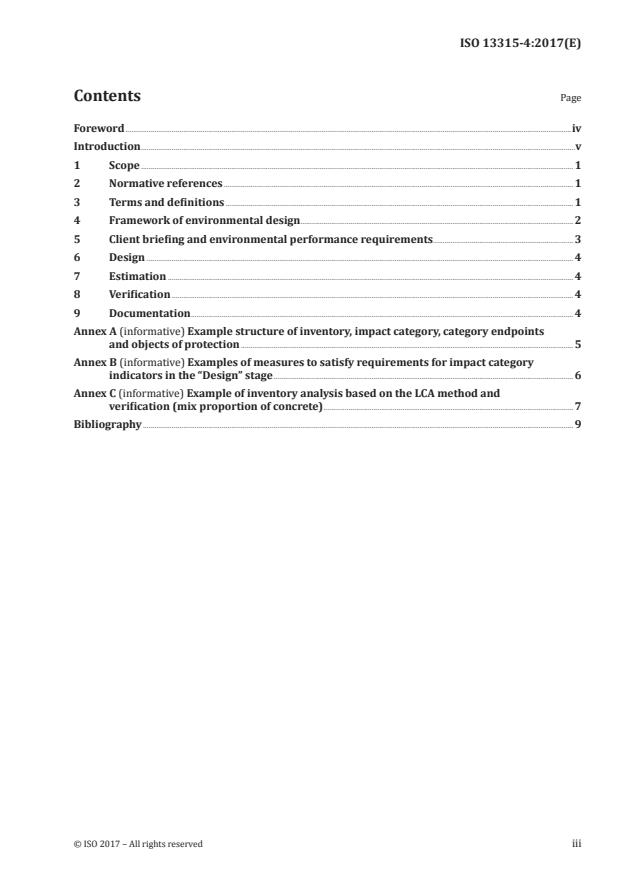
Contents Page
Foreword .iv
Introduction .v
1 Scope . 1
2 Normative references . 1
3 Terms and definitions . 1
4 Framework of environmental design . 2
5 Client briefing and environmental performance requirements . 3
6 Design . 4
7 Estimation . 4
8 Verification . 4
9 Documentation . 4
Annex A (informative) Example structure of inventory, impact category, category endpoints
and objects of protection . 5
Annex B (informative) Examples of measures to satisfy requirements for impact category
indicators in the “Design” stage . 6
Annex C (informative) Example of inventory analysis based on the LCA method and
verification (mix proportion of concrete) . 7
Bibliography . 9
Foreword
ISO (the International Organization for Standardization) is a worldwide federation of national standards
bodies (ISO member bodies). The work of preparing International Standards is normally carried out
through ISO technical committees. Each member body interested in a subject for which a technical
committee has been established has the right to be represented on that committee. International
organizations, governmental and non-governmental, in liaison with ISO, also take part in the work.
ISO collaborates closely with the International Electrotechnical Commission (IEC) on all matters of
electrotechnical standardization.
The procedures used to develop this document and those intended for its further maintenance are
described in the ISO/IEC Directives, Part 1. In particular the different approval criteria needed for the
different types of ISO documents should be noted. This document was drafted in accordance with the
editorial rules of the ISO/IEC Directives, Part 2 (see www .iso .org/ directives).
Attention is drawn to the possibility that some of the elements of this document may be the subject of
patent rights. ISO shall not be held responsible for identifying any or all such patent rights. Details of
any patent rights identified during the development of the document will be in the Introduction and/or
on the ISO list of patent declarations received (see www .iso .org/ patents).
Any trade name used in this document is information given for the convenience of users and does not
constitute an endorsement.
For an explanation on the voluntary nature of standards, the meaning of ISO specific terms and
expressions related to conformity assessment, as well as information about ISO’s adherence to the
World Trade Organization (WTO) principles in the Technical Barriers to Trade (TBT) see the following
URL: w w w . i s o .org/ iso/ foreword .html.
The committee responsible for this document is Technical Committee ISO/TC 71, Concrete, reinforced
concrete and pre-stressed concrete, Subcommittee SC 8, Environmental management for concrete and
concrete structures.
A list of all the parts in the ISO 13315 series can be found on the ISO website.
iv © ISO 2017 – All rights reserved
Introduction
Environmental management is essential for properly estimating the negative and positive
environmental impacts brought about by a construction project in order to reduce the environmental
burden and create environmental benefits. Environmental considerations for a structure, in particular,
are to be carried out at the design stage and be integrated with conventional structural design and
durability design. To this end, standardization of the design procedure for environmental design
becomes a necessity.
ISO 14040 stipulates the principles and framework of lifecycle assessment (LCA) for the environmental
management of products and services. However, it is somewhat difficult to apply this to structures with
extremely long lifecycles, such as infrastructures and building structures.
The use of concrete, a key construction material, accounts for a particularly large part of the
environmental impacts related to construction projects. If the environmental impacts related to
a concrete structure are accurately dealt with to achieve environmental design, this can enable a
dramatic reduction in the environmental burden for the construction project as a whole and increase
the environmental benefits. Therefore, a method of environmental design specifically for concrete
structures is essential and led to the development of this document.
In the environmental design of a concrete structure, appropriate specifications for materials and
structural details are established based on LCA. ISO 13315-1 stipulates the principles of environmental
consideration for concrete and concrete structures while ISO 13315-2 stipulates the system boundaries
necessary for carrying out LCA and the inventory data to be acquired.
INTERNATIONAL STANDARD ISO 13315-4:2017(E)
Environmental management for concrete and concrete
structures —
Part 4:
Environmental design of concrete structures
1 Scope
This document provides the general framework, principles and requirements for carrying out an
environmental design of concrete structures, based on a lifecycle assessment (LCA) method or other
appropriate methods.
This document is applicable to single concrete structures, as well as concrete structure complexes.
2 Normative references
The following documents are referred to in the text in such a way that some or all of their content
constitutes requirements of this document. For dated references, only the edition cited applies. For
undated references, the latest edition of the referenced document (including any amendments) applies.
ISO 13315-2, Environmental management for concrete and concrete structures — Part 2: System boundary
and inventory data
ISO 14040, Environmental management — Life cycle assessment — Principles and framework
3 Terms and definitions
For the purposes of this document, the terms and definitions given in ISO 13315-1, ISO 13315-2,
ISO 14040 and ISO 14050, and the following apply.
ISO and IEC maintain terminological databases for use in standardization at the following addresses:
— IEC Electropedia: available at http:// www .electropedia .org/
— ISO Online browsing platform: available at http:// www .iso .org/ obp
3.1
client briefing
document which specifies at any point in time the relevant needs, aims and resources of the client and
user, the context of the project and any appropriate design requirements
3.2
durability design
design of a structure in which durability is considered
3.3
environmental design
design of a structure in which environmental impacts are considered
[SOURCE: ISO 13315-1:2012, 3.6]
3.4
structural design
design of a structure in which structural performances including safety, serviceability, restorability,
structural integrity and robustness are considered
4 Framework of environmental design
Figure 1 illustrates the positioning of environmental design in the entire design of concrete structures.
The environmental design of a concrete structure shall be carried out integrally with structural design
and durability design and be in harmony with the landscape and surrounding environment.
Environmental design includes client briefing, setting of environmental performance requirements,
design, estimation of retained environmental performances, verification and documentation.
Figure 1 — Environmental design of concrete structures
2 © ISO 2017 – All rights reserved
5 Client briefing and environmental performance requirements
A client’s brief on the environmental aspects of a project shall be prepared with consideration of
...
INTERNATIONAL ISO
STANDARD 13315-4
First edition
2017-03
Environmental management for
concrete and concrete structures —
Part 4:
Environmental design of concrete
structures
Management environnemental du béton et des structures en béton —
Partie 4: Conception environnementale des structures en béton
Reference number
©
ISO 2017
© ISO 2017, Published in Switzerland
All rights reserved. Unless otherwise specified, no part of this publication may be reproduced or utilized otherwise in any form
or by any means, electronic or mechanical, including photocopying, or posting on the internet or an intranet, without prior
written permission. Permission can be requested from either ISO at the address below or ISO’s member body in the country of
the requester.
ISO copyright office
Ch. de Blandonnet 8 • CP 401
CH-1214 Vernier, Geneva, Switzerland
Tel. +41 22 749 01 11
Fax +41 22 749 09 47
copyright@iso.org
www.iso.org
ii © ISO 2017 – All rights reserved
Contents Page
Foreword .iv
Introduction .v
1 Scope . 1
2 Normative references . 1
3 Terms and definitions . 1
4 Framework of environmental design . 2
5 Client briefing and environmental performance requirements . 3
6 Design . 4
7 Estimation . 4
8 Verification . 4
9 Documentation . 4
Annex A (informative) Example structure of inventory, impact category, category endpoints
and objects of protection . 5
Annex B (informative) Examples of measures to satisfy requirements for impact category
indicators in the “Design” stage . 6
Annex C (informative) Example of inventory analysis based on the LCA method and
verification (mix proportion of concrete) . 7
Bibliography . 9
Foreword
ISO (the International Organization for Standardization) is a worldwide federation of national standards
bodies (ISO member bodies). The work of preparing International Standards is normally carried out
through ISO technical committees. Each member body interested in a subject for which a technical
committee has been established has the right to be represented on that committee. International
organizations, governmental and non-governmental, in liaison with ISO, also take part in the work.
ISO collaborates closely with the International Electrotechnical Commission (IEC) on all matters of
electrotechnical standardization.
The procedures used to develop this document and those intended for its further maintenance are
described in the ISO/IEC Directives, Part 1. In particular the different approval criteria needed for the
different types of ISO documents should be noted. This document was drafted in accordance with the
editorial rules of the ISO/IEC Directives, Part 2 (see www .iso .org/ directives).
Attention is drawn to the possibility that some of the elements of this document may be the subject of
patent rights. ISO shall not be held responsible for identifying any or all such patent rights. Details of
any patent rights identified during the development of the document will be in the Introduction and/or
on the ISO list of patent declarations received (see www .iso .org/ patents).
Any trade name used in this document is information given for the convenience of users and does not
constitute an endorsement.
For an explanation on the voluntary nature of standards, the meaning of ISO specific terms and
expressions related to conformity assessment, as well as information about ISO’s adherence to the
World Trade Organization (WTO) principles in the Technical Barriers to Trade (TBT) see the following
URL: w w w . i s o .org/ iso/ foreword .html.
The committee responsible for this document is Technical Committee ISO/TC 71, Concrete, reinforced
concrete and pre-stressed concrete, Subcommittee SC 8, Environmental management for concrete and
concrete structures.
A list of all the parts in the ISO 13315 series can be found on the ISO website.
iv © ISO 2017 – All rights reserved
Introduction
Environmental management is essential for properly estimating the negative and positive
environmental impacts brought about by a construction project in order to reduce the environmental
burden and create environmental benefits. Environmental considerations for a structure, in particular,
are to be carried out at the design stage and be integrated with conventional structural design and
durability design. To this end, standardization of the design procedure for environmental design
becomes a necessity.
ISO 14040 stipulates the principles and framework of lifecycle assessment (LCA) for the environmental
management of products and services. However, it is somewhat difficult to apply this to structures with
extremely long lifecycles, such as infrastructures and building structures.
The use of concrete, a key construction material, accounts for a particularly large part of the
environmental impacts related to construction projects. If the environmental impacts related to
a concrete structure are accurately dealt with to achieve environmental design, this can enable a
dramatic reduction in the environmental burden for the construction project as a whole and increase
the environmental benefits. Therefore, a method of environmental design specifically for concrete
structures is essential and led to the development of this document.
In the environmental design of a concrete structure, appropriate specifications for materials and
structural details are established based on LCA. ISO 13315-1 stipulates the principles of environmental
consideration for concrete and concrete structures while ISO 13315-2 stipulates the system boundaries
necessary for carrying out LCA and the inventory data to be acquired.
INTERNATIONAL STANDARD ISO 13315-4:2017(E)
Environmental management for concrete and concrete
structures —
Part 4:
Environmental design of concrete structures
1 Scope
This document provides the general framework, principles and requirements for carrying out an
environmental design of concrete structures, based on a lifecycle assessment (LCA) method or other
appropriate methods.
This document is applicable to single concrete structures, as well as concrete structure complexes.
2 Normative references
The following documents are referred to in the text in such a way that some or all of their content
constitutes requirements of this document. For dated references, only the edition cited applies. For
undated references, the latest edition of the referenced document (including any amendments) applies.
ISO 13315-2, Environmental management for concrete and concrete structures — Part 2: System boundary
and inventory data
ISO 14040, Environmental management — Life cycle assessment — Principles and framework
3 Terms and definitions
For the purposes of this document, the terms and definitions given in ISO 13315-1, ISO 13315-2,
ISO 14040 and ISO 14050, and the following apply.
ISO and IEC maintain terminological databases for use in standardization at the following addresses:
— IEC Electropedia: available at http:// www .electropedia .org/
— ISO Online browsing platform: available at http:// www .iso .org/ obp
3.1
client briefing
document which specifies at any point in time the relevant needs, aims and resources of the client and
user, the context of the project and any appropriate design requirements
3.2
durability design
design of a structure in which durability is considered
3.3
environmental design
design of a structure in which environmental impacts are considered
[SOURCE: ISO 13315-1:2012, 3.6]
3.4
structural design
design of a structure in which structural performances including safety, serviceability, restorability,
structural integrity and robustness are considered
4 Framework of environmental design
Figure 1 illustrates the positioning of environmental design in the entire design of concrete structures.
The environmental design of a concrete structure shall be carried out integrally with structural design
and durability design and be in harmony with the landscape and surrounding environment.
Environmental design includes client briefing, setting of environmental performance requirements,
design, estimation of retained environmental performances, verification and documentation.
Figure 1 — Environmental design of concrete structures
2 © ISO 2017 – All rights reserved
5 Client briefing and environmental performance requirements
A client’s brief on the environmental aspects of a project shall be prepared with consideration of
...