


ISO 1233:1975
(Main)Plastics — Determination of viscosity number of methyl methacrylate polymers and copolymers in dilute solution
Plastics — Determination of viscosity number of methyl methacrylate polymers and copolymers in dilute solution
Matières plastiques — Détermination de l'indice de viscosité des polymères et copolymères du méthacrylate de méthyle en solution diluée
General Information
- Status
- Withdrawn
- Publication Date
- 31-Aug-1975
- Withdrawal Date
- 31-Aug-1975
- Technical Committee
- ISO/TC 61 - Plastics
- Drafting Committee
- ISO/TC 61 - Plastics
- Current Stage
- 9599 - Withdrawal of International Standard
- Start Date
- 01-Jan-1990
- Completion Date
- 12-Feb-2026
Relations
- Effective Date
- 12-May-2008
- Effective Date
- 15-Apr-2008
ISO 1233:1975 - Plastics -- Determination of viscosity number of methyl methacrylate polymers and copolymers in dilute solution
ISO 1233:1975 - Plastics — Determination of viscosity number of methyl methacrylate polymers and copolymers in dilute solution Released:9/1/1975
Get Certified
Connect with accredited certification bodies for this standard

Smithers Quality Assessments
US management systems and product certification.

DIN CERTCO
DIN Group product certification.
Sponsored listings
Frequently Asked Questions
ISO 1233:1975 is a standard published by the International Organization for Standardization (ISO). Its full title is "Plastics — Determination of viscosity number of methyl methacrylate polymers and copolymers in dilute solution". This standard covers: Plastics — Determination of viscosity number of methyl methacrylate polymers and copolymers in dilute solution
Plastics — Determination of viscosity number of methyl methacrylate polymers and copolymers in dilute solution
ISO 1233:1975 is classified under the following ICS (International Classification for Standards) categories: 83.080.01 - Plastics in general. The ICS classification helps identify the subject area and facilitates finding related standards.
ISO 1233:1975 has the following relationships with other standards: It is inter standard links to SIST ISO 1628-6:1996, ISO 1628-6:1990. Understanding these relationships helps ensure you are using the most current and applicable version of the standard.
ISO 1233:1975 is available in PDF format for immediate download after purchase. The document can be added to your cart and obtained through the secure checkout process. Digital delivery ensures instant access to the complete standard document.
Standards Content (Sample)
@ 1233
INTERNATIONAL STANDARD
'*Z!
iY~ERN4~10txdL ORG4hIZATION FOR STAND4RDlZATION .\It A.1, HAPOIHAR OPr4H1134UMR no CTAH2APTM3AUMM.ORGANIçATlON INTERNATIONALE DE NORMALISATION
L
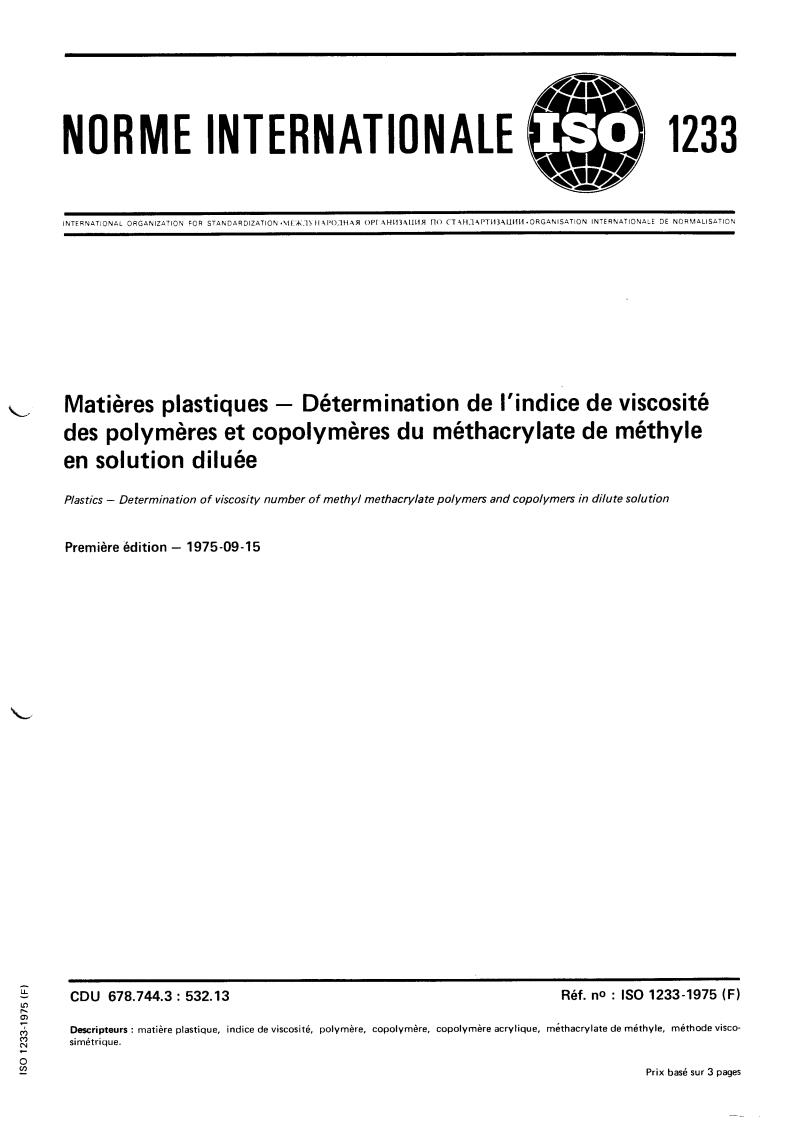
Plastics - Determination of viscosity number of
methyl methacrylate polymers and copolymers
in dilute solution
Matières plastiques - Détermination de l'indice de viscosité des polymères et copolymères
du méthacrylate de méthyle en solution diluée
First edition - 1975-09-15
Lu
-
UDC 678.744.3 : 532.13 Ref. No. IS0 1233-1975 (E)
h
Descriptors : plastics, viscosity index, polymers, copolymers, acrylic copolymers, methyl methacrylate, viscosimetric analysis.
ri
m
f N
U
Price based on 3 pages
FO R EWO RD
IS0 (the International Organization for Standardization) is a worldwide federation
of national standards institutes (IS0 Member Bodies). The work of developing
International Standards is carried out through IS0 Technical Committees. Every
Member Body interested in a subject for which a Technical Committee has been set
up has the right to be represented on that Committee, International organizations,
governmental and non-governmental, in liaison with ISO, also take part in the work.
Draft International Standards adopted by the Technical Committees are circulated
to the Member Bodies for approval before their acceptance as International
Standards by the IS0 Council.
International Standard IS0 1233 (originally draft International Standard
ISO/DIS 824) was drawn up by Technical Committee ISO/TC 61, Plastics, and
circulated to the Member Bodies in August 1969.
It has been approved by the Member Bodies of the following countries :
Belgium Italy Sweden
Canada Japan Switzerland
France Netherlands Turkey
Germany New Zealand United Kingdom
Greece Poland U.S.A.
Hungary Romania U.S.S.R.
Israel South Africa, Rep. of
No Member Body expressed disapproval of the document.
O International Organization for Standardization, 1975
Printed in Switzerland
c-
INTERNATIONAL STANDARD IS0 1233-1975 (E)
Plastics - Determination of viscosity number of
methyl methacrylate polymers and copolymers
in dilute solution
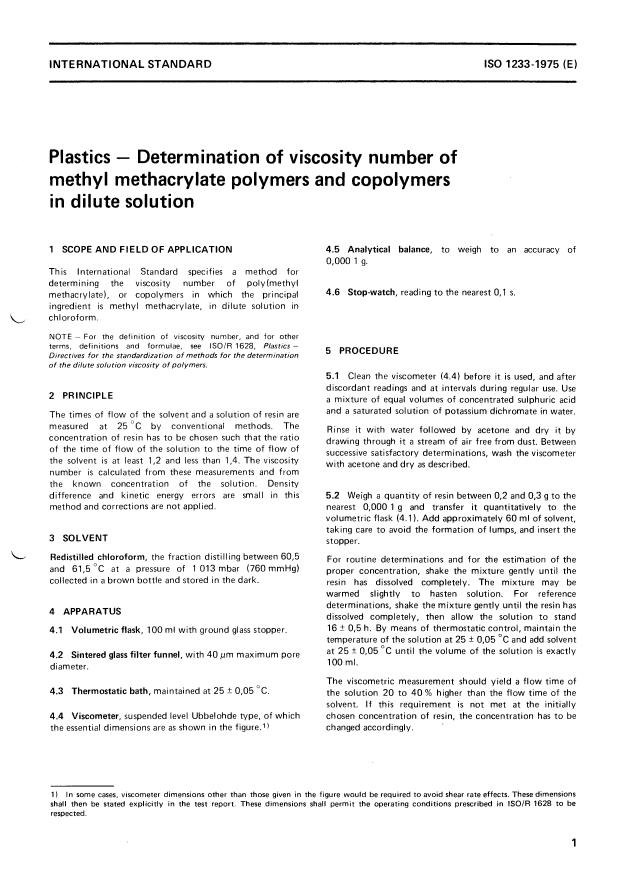
4.5 Analytical balance, to weigh to an accuracy of
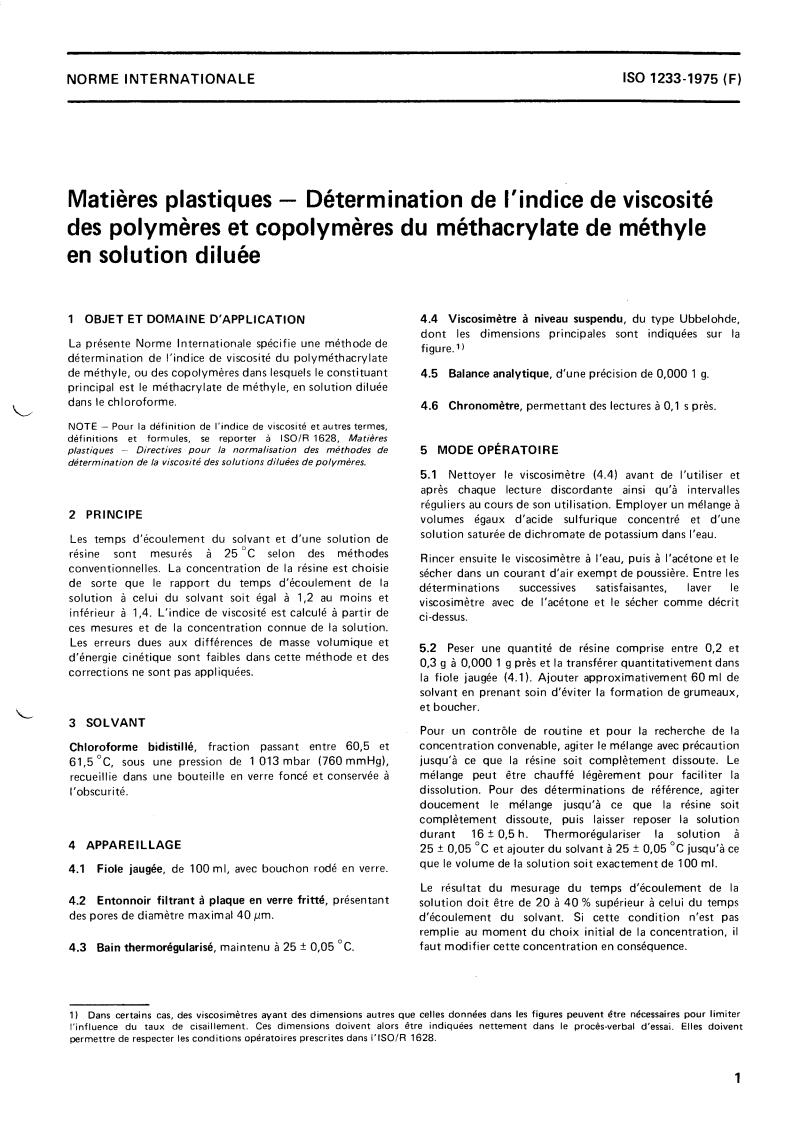
1 SCOPE AND FIELD OF APPLICATION
0,000 1 g.
This International Standard specifies a method for
determining the viscosity number of poly(methy1
4.6 Stop-watch, reading to the nearest 0,l s.
methacrylate), or copolymers in which the principal
ingredient is methyl methacrylate, in dilute solution in
L chloroform.
NOTE - For the definition of viscosity number, and for other
terms, definitions and formulae, see IÇOiR 1628, Plastics -
5 PROCEDURE
Directives for the standardization of methods for the determination
of the dilute solution viscosity of polymers.
5.1 Clean the viscometer (4.4) before it is used, and after
discordant readings and at intervals during regular use. Use
2 PRINCIPLE
a mixture of equal volumes of concentrated sulphuric acid
a saturated solution of potassium dichromate in water.
and
The times of flow of the solvent and a solution of resin are
measured at 25 "C by conventional methods. The
Rinse it with water followed by acetone and dry it by
concentration of resin has to be chosen such that the ratio
drawing through it a stream of air free from dust. Between
of the time of flow of the solution to the time of flow of
successive satisfactory determinations, wash the viscometer
the solvent is at least 1,2 and less than 1,4. The viscosity
with acetone and dry as described.
number is calculated from these measurements and from
the known concentration of the solution. Density
difference and kinetic energy errors are small in this 5.2 Weigh a quantity of resin between 0,2 and 0.3 g to the
method and corrections are not applied.
nearest 0,000 1 g and transfer it quantitatively to the
volumetric flask (4.1 1. Add approximately 60 ml of solvent,
taking care to avoid the formation of lumps, and insert the
3 SOLVENT
stopper.
L
Redistilled chloroform, the fraction distilling between 60,5
For routine determinations and for the estimation of the
and 61,5"C at a pressure of 1013 mbar (760mmHg)
proper concentration, shake the mixture gently until the
collected in a brown bottle and stored in the dark.
resin has dissolved completely. The mixture may be
warmed slightly to hasten solution. For reference
determinations, shake the mixture gently until the resin has
4 APPARATUS
dissolved completely, then allow the solution to stand
16 ?r 0,5 h. By means of thermostatic control, maintain the
4.1 Volumetric flask, 100 mi with ground glass stopper.
temperature of the solution at 25 f 0,05 "C and add solvent
at 25 f 0.05 "C until the volume of the solution is exactly
4.2 Sintered glass filter funnel, w
...
NORME INTERNATIONALE @ 1233
‘ai!!
INTERN4TIONAL ORGANIZATION FOR STANDARDIZATION .\It A 1) t191’0.1ti411 OP1 4H11341111R no CTit1.14PT1134U1fi1 .ORG4NISATION INTERNATIONALE DE NORMALISATION
Matières plastiques - Détermination de l‘indice de viscosité
des polymères et copolymères du méthacrylate de méthyle
en solution diluée
Plastics - Determination of viscosity number of methyl methacrylate polymers and copolymers in dilute solution
Première édition - 1975-09-15
Réf. no : IS0 1233-1975 (FI
CDU 678.744.3 : 532.13
Descripteurs : matière plastique, indice de viscosité, polymère, copolymére, copolymère acrylique, méthacrylate de méthyle, méthode visco-
simétrique.
Prix basé sur 3 pages
-.
AVANT-PROPOS
IS0 (Organisation Internationale de Normalisation) est une fédération mondiale
d’organismes nationaux de normalisation (Comités Membres IÇO). L’élaboration de
Normes Internationales est confiée aux Comités Techniques ISO. Chaque Comité
Membre intéressé par une étude a le droit de faire partie du Comité Technique
correspondant. Les organisations internationales, gouvernementales et non
gouvernementales, en liaison avec I’ISO, participent également aux travaux.
Les Projets de Normes Internationales adoptés par les Comités Techniques sont
soumis aux Comités Membres pour approbation, avant leur acceptation comme
Normes Internationales par le Conseil de I‘ISO.
La Norme Internationale IS0 1233 (précédemment ISO/DIS 824) a été établie
le Comité Technique ISO/TC 61, Plastiques, et soumise aux Comités Membres
par
en août 1969.
Elle a été approuvée par les Comités Membres des pays suivants :
Afrique du Sud, Rép. d’ Israel Royaume Uni
AI lemagne Italie Suède
Belgique
Japon Suisse
Canada
Nouvel le-Zélande Turquie
France
Pays-Bas U.R.S.S.
Grèce U.S.A.
Pologne
Hongrie
Roumanie
--
Aucun Comité Membre n’a désapprouvé le document.
Imprimé en Suisse
NORME INTERNATIONALE IS0 1233-1975 (F)
Matières plastiques - Détermination de l'indice de viscosité
et copolymères du méthacrylate de méthyle
des polymères
en solution diluée
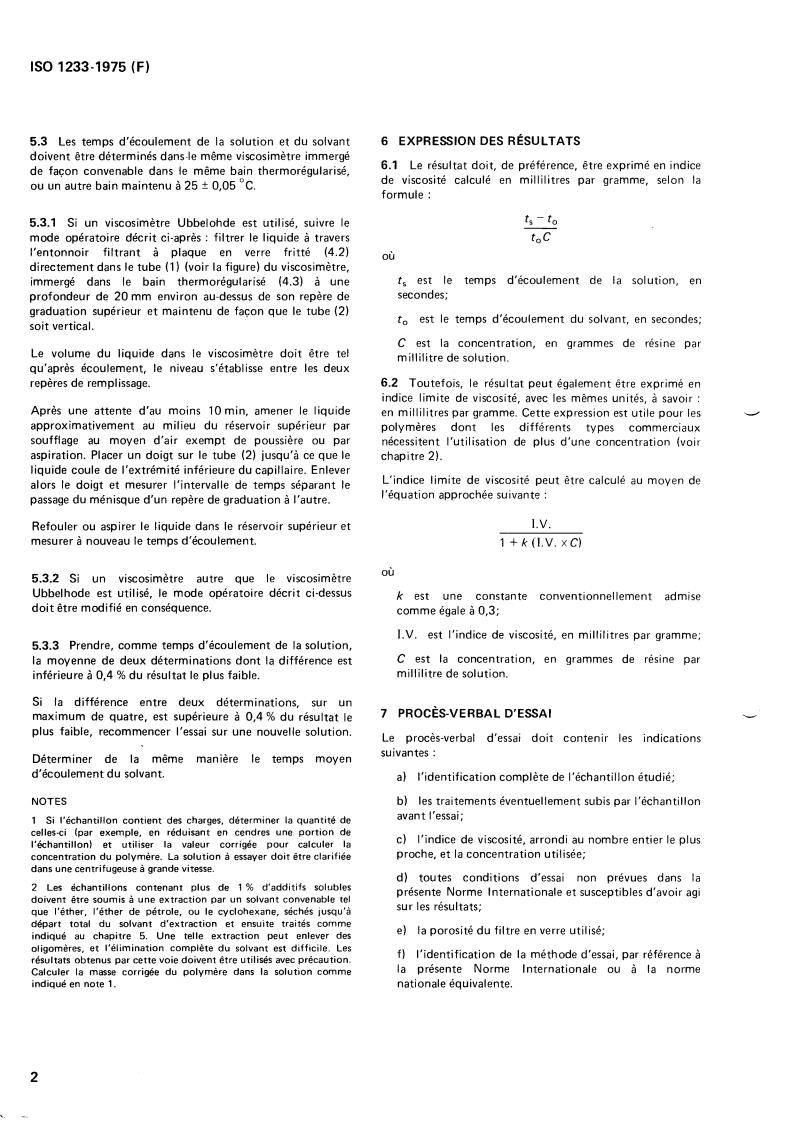
1 OBJET ET DOMAINE D'APPLICATION 4.4 Viscosimètre à niveau suspendu, du type Ubbelohde,
dont les dimensions principales sont indiquées sur la
La présente Norme Internationale spécifie une méthode de
figure. 1 )
détermination de l'indice de viscosité du polyméthacrylate
de méthyle, ou des copolymères dans lesquels le constituant
4.5 Balance analytique, d'une précision de 0,000 1 g.
principal est le méthacrylate de méthyle, en solution diluée
dans le chloroforme.
4.6 Chronomètre, permettant des lectures à 0,l s près.
c
NOTE - Pour la définition de l'indice de viscosité et autres termes,
définitions et formules, se reporter à ISO/R 1628, Matières
plastiques - Directives pour la normalisation des méthodes de
5 MODE OPÉRATOIRE
détermination de la viscosité des solutions diluées de polymères.
5.1 Nettoyer le viscosimètre (4.4) avant de l'utiliser et
après chaque lecture discordante ainsi qu'à intervalles
réguliers au cours de son utilisation. Employer un mélange à
2 PRINCIPE
volumes égaux d'acide sulfurique concentré et d'une
solution saturée de dichromate de potassium dans l'eau.
Les temps d'écoulement du solvant et d'une solution de
résine sont mesurés à 25 "C selon des méthodes
Rincer ensuite le viscosimètre à l'eau, puis à l'acétone et le
conventionnelles. La concentration de la résine est choisie
sécher dans un courant d'air exempt de poussière. Entre les
de sorte que le rapport du temps d'écoulement de la
déterminations successives satisfaisantes, laver le
solution à celui du solvant soit égal à 1,2 au moins et
viscosimètre avec de l'acétone et le sécher comme décrit
inférieur à 1,4. L'indice de viscosité est calculé à partir de
ci-dessus.
ces mesures et de la concentration connue de la solution.
Les erreurs dues aux différences de masse volumique et
5.2 Peser une quantité de résine comprise entre 0.2 et
d'énergie cinétique sont faibles dans cette méthode et des
0,3 g à 0,000 1 g près et la transférer quantitativement dans
corrections ne sont pas appliquées.
la fiole jaugée (4.1 ). Ajouter approximativement 60 ml de
solvant en prenant soin d'éviter la formation de grumeaux,
et boucher.
L, 3 SOLVANT
Pour un contrôle de routine et pour la recherche de la
concentration convenable, agiter le mélange avec précaution
Chloroforme bidistillé, fraction passant entre 60,5 et
jusqu'à ce que la résine soit complètement dissoute. Le
61.5 OC, SOUS une pression de 1 013 mbar (760 mmHg),
mélange peut être chauffé légèrement pour faciliter la
recueillie dans une bouteille en verre foncé et conservée à
dissolution. Pour des déterminations de référence, agiter
I'obscuri té.
doucement le mélange jusqu'à ce que la résine soit
complètement dissoute, puis laisser reposer la solution
durant 16 ? 0,5 h. Thermorégulariser la solution à
4 APPAREILLAGE
25 f 0,05 "C et ajouter du solvant à 25 f 0.05 "C jusqu'à ce
que le volume de la solution soit exactement de 100 ml.
Fiole jaugée, de 100ml, avec bouchon rodé en verre.
4.1
Le résultat du mesurage du temps d'écoulement de la
4.2 Entonnoir filtrant à plaque en verre fritté, présentant
solution doit être de 20 à 40 % su
...
Questions, Comments and Discussion
Ask us and Technical Secretary will try to provide an answer. You can facilitate discussion about the standard in here.
Loading comments...