

ISO/FDIS 11798
(Main)Information and documentation — Permanence and durability of writing, printing and copying on paper — Requirements and test methods
- Abstract
This document specifies requirements and test methods for evaluation of the permanence and durability of writing, printing and copying on paper stored in libraries, archives, and other protected environments for long periods of time, in which the information recorded on paper must be retained but not necessarily the full artistic quality. It is applicable to: — images on white permanent paper according to ISO 9706 or ISO 11108; — recording obtained from pens, stamps, copying machines and printers (that can produce monocoloured and/or multicoloured images). It does not apply to: — documents stored under harmful conditions, such as high humidity that promotes microbiological attack, excessive heat, radiation (e.g. light), high levels of pollutants, or the risk of water damage (or water contact). Since documents might be kept in non-protected environments before being transferred to protected environments, resistance to water and light is, however, of importance; — legal documents, e.g. banking documents, where the authenticity is of primary interest; — documents where the information contents are influenced by small colour changes; — documents within the scope of ISO/TC 42, Photography.
- Status
- Not Published
- Current Stage
- 5020 - FDIS ballot initiated: 2 months. Proof sent to secretariat
- Start Date
- 25-Aug-2026
- Completion Date
- 25-Aug-2026
Buy Documents

ISO/FDIS 11798 - Information and documentation — Permanence and durability of writing, printing and copying on paper — Requirements and test methods
REDLINE ISO/FDIS 11798 - Information and documentation — Permanence and durability of writing, printing and copying on paper — Requirements and test methods
ISO/FDIS 11798 is an ISO document for evaluating the permanence and durability of writing, printing and copying on paper. It specifies requirements and test methods for records on paper used in libraries, archives and other protected environments, where the information must stay legible and stable over long periods rather than preserve full artistic quality.
What does ISO/FDIS 11798 specify?
ISO/FDIS 11798 specifies how to prepare specimens, how to test recorded paper, and how to judge whether the recording meets the document’s permanence and durability requirements. It applies to images on white permanent paper according to ISO 9706 or ISO 11108, and to recordings made by pens, stamps, copying machines and printers, including devices that produce monochrome or multicoloured images.
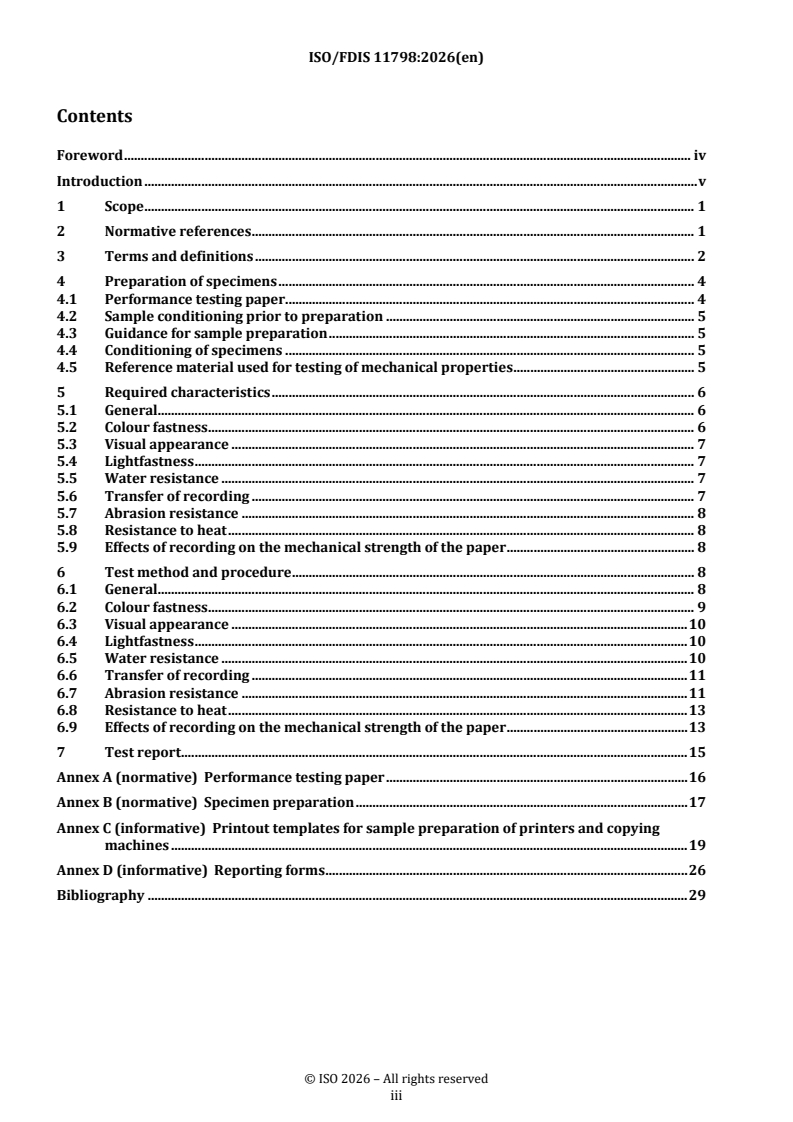
The document is organized into Scope, normative references, terms and definitions, specimen preparation, required characteristics, test methods and procedures, and the test report. It is supported by Annexes A and B, which are normative, and Annexes C and D, which provide templates and reporting forms.
| Annex | What it covers |
|---|---|
| Annex A | Performance testing paper |
| Annex B | Specimen preparation |
| Annex C | Printout templates for sample preparation of printers and copying machines |
| Annex D | Reporting forms |
The scope excludes use in harmful storage conditions such as high humidity, excessive heat, radiation, high pollutant levels, or water contact risk. It also excludes legal documents where authenticity is the main concern, documents where small colour changes matter to the content, and documents within ISO/TC 42, Photography.
What are the key requirements of ISO/FDIS 11798?
ISO/FDIS 11798 sets out a complete test regime for recording on paper. The key point in practice is that a specimen must pass visual, colour, water, light, abrasion, heat and mechanical-strength checks after being prepared and conditioned in a controlled way.
Specimen preparation and conditioning
Clause 4 requires performance testing paper that meets Annex A, and specimen preparation that follows the manufacturer’s instructions and Annex B. Paper and specimens are conditioned at controlled temperature and relative humidity, and printed specimens are dried or cured before testing.
This matters because the same recording can behave differently if the paper, ink or climate is changed. The document therefore ties the test result to a defined paper, defined recording equipment, and defined conditioning.
Clause 4 also requires that, for some tests on archival paper, test pieces are taken from areas free of watermarks. For printers, print settings such as paper setting, driver setting, colour mode and printing speed are to be noted when they affect the result.
Colour, appearance and damage resistance
Clause 5.2 requires colour fastness limits based on CIELAB lightness and colour shift. For printers and other machines, the standard checks individual primary colours, including CMYK, and spot colours separately; for pens and stamps, it uses lightness shift. In practice, this means each colour used in the real document must be checked, not just one representative patch.
Clause 5.3 requires recorded images to remain clearly defined and legible, with even colour strength and no visible feathering or strike-through. It also treats unwanted traces outside the intended area as a failure when they interfere with the information content.
Clauses 5.4 to 5.8 require the recording to survive light, water, transfer under pressure, abrasion and heat. The practical message is that a recording must still be readable after exposure to light, water immersion, stacking pressure, rubbing and elevated temperature.
The document gives specific pass levels, including abrasion resistance of at least 60 % for printer images and at least 50 % for pen and stamp images. It also requires only slight paper discolouration after water exposure, and the recorded image must still satisfy the colour fastness and visual appearance requirements.
Mechanical effects on the paper
Clause 5.9 checks whether the recording process weakens the paper itself. It uses comparative testing against blank reference specimens from the same batch, looking at tensile energy absorption and folding endurance in machine- and cross-directions.
This matters for archival use because a recording process can damage the paper even when the image looks acceptable. The requirements limit the loss in tensile energy absorption and folding endurance relative to the unrecorded reference paper, before and after accelerated ageing.
Test methods and report
Clause 6 turns the requirements into nine test methods, including colour fastness, visual appearance, lightfastness, water resistance, transfer of recording, abrasion resistance, resistance to heat, and two mechanical-property tests. Clause 7 then requires the report to identify the equipment and paper used, the settings, the number of test pieces, the preparation method, the results, any deviations, and the pass/fail conclusion.
What terms does ISO/FDIS 11798 define?
- Permanence - the ability to remain chemically and physically stable over long periods of time.
- Durability - the ability to resist physical stress such as wear, pressure or damage during recurrent use.
- Recording - the image created by writing, printing or copying on paper.
- Permanent paper - paper of high permanence in accordance with ISO 9706.
- Archival paper - paper of high permanence and high durability in accordance with ISO 11108.
- Performance testing paper - the permanent paper or archival paper used to prepare specimens for testing.
- CIELAB lightness and colour shift - the measured change in L*, a* and b* between the condition before and after a test.
- Degree of abrasion resistance - the percentage measure used to show how much image tone remains after abrasion.
Who uses ISO/FDIS 11798?
ISO/FDIS 11798 is used by laboratories, paper and print suppliers, document-conservation specialists, and manufacturers of pens, stamps, printers and copying machines. Libraries, archives and records-management teams use it when they need to specify or check recorded paper for long-term retention.
It is also useful for quality and procurement staff who need a testable way to compare inks, toners, pens, stamps and paper combinations. In practice, it supports product selection, product qualification and documentation of test results for long-term paper records.
What changed in ISO/FDIS 11798 from the previous edition?
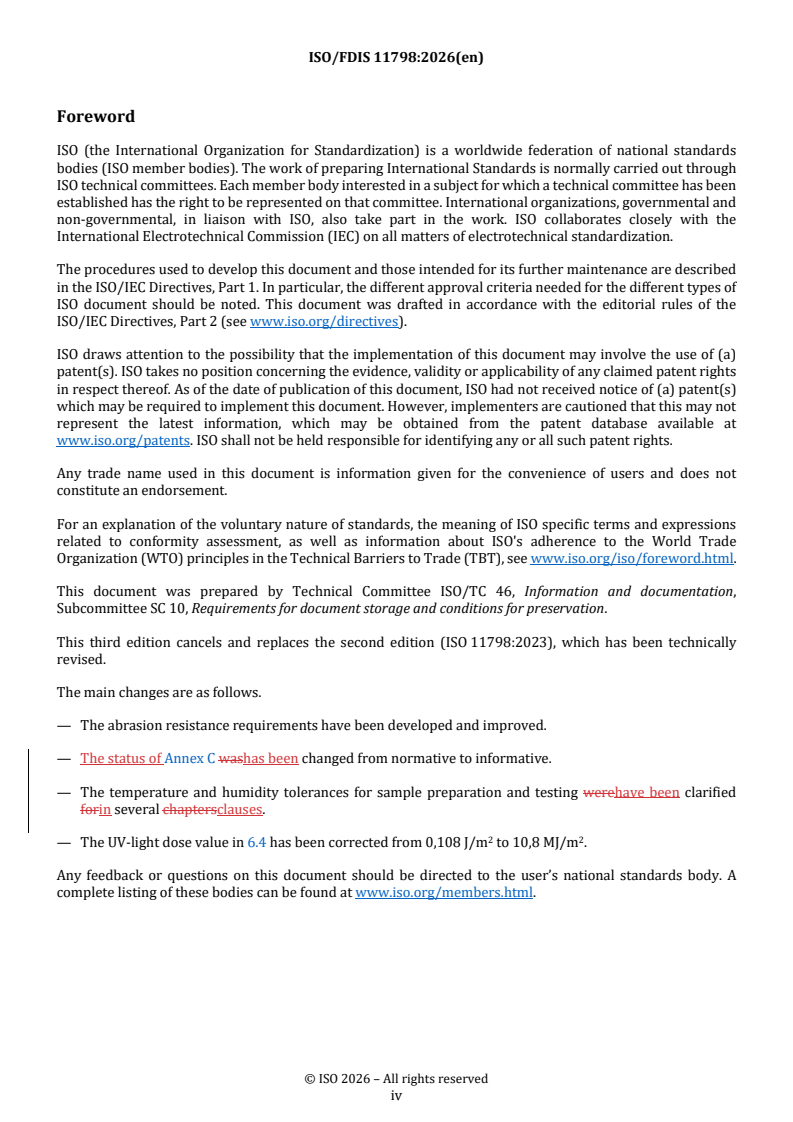
ISO/FDIS 11798 cancels and replaces ISO 11798:2023. The foreword states that the third edition is technically revised.
The listed changes are:
- the abrasion resistance requirements were developed and improved
- Annex C changed from normative to informative
- temperature and humidity tolerances for sample preparation and testing were clarified in several clauses
- the UV-light dose value in 6.4 was corrected
Which standards are used with ISO/FDIS 11798?
ISO/FDIS 11798 relies on several companion standards for the paper, the measurements and the test equipment.
- ISO 536 - gives the grammage determination used for performance testing paper.
- ISO 1924-2 - gives the tensile test method used in the mechanical-strength comparison.
- ISO 2470-1 - gives ISO brightness measurement for performance testing paper.
- ISO 4892-2 - gives the xenon-arc light exposure method used for lightfastness.
- ISO 5626 - gives the folding endurance method used in the mechanical-strength comparison.
- ISO 9352 - gives the abrasion test machine basis used for abrasion resistance.
- ISO 9706 and ISO 11108 - define the paper types used as permanent paper and archival paper.
- ISO 12757-1, ISO 14145-1 and ISO 27668-1 - provide writing-condition references for ballpoint, roller ball and gel ink pens.
- ISO 13655 - gives the spectral measurement and colorimetric computation used for CIELAB values.
What does the ISO/FDIS 11798 document contain?
ISO/FDIS 11798 contains the full test workflow from specimen preparation to reporting. It provides formulas for CIELAB colour shifts, a formula for calculating degree of abrasion resistance, and step-by-step procedures for light exposure, water immersion, stacking under load, abrasion, heat exposure and mechanical testing.
The annexes add practical tools for laboratory work. Annex C supplies printout templates for printers and copying machines, and Annex D supplies reporting forms for recording appearance, colour shift, tensile energy absorption and folding endurance.
The document also includes figures and tables that define what to print or write on the specimens and how many pieces to prepare for each test. In practice, those templates and forms help laboratories produce repeatable samples and report results in a consistent way.
Relations
- Effective Date
- 25-Jan-2025
Buy Documents
ISO/FDIS 11798 - Information and documentation — Permanence and durability of writing, printing and copying on paper — Requirements and test methods
REDLINE ISO/FDIS 11798 - Information and documentation — Permanence and durability of writing, printing and copying on paper — Requirements and test methods
Frequently Asked Questions
ISO/FDIS 11798 is a draft published by the International Organization for Standardization (ISO). Its full title is "Information and documentation — Permanence and durability of writing, printing and copying on paper — Requirements and test methods". This standard covers: This document specifies requirements and test methods for evaluation of the permanence and durability of writing, printing and copying on paper stored in libraries, archives, and other protected environments for long periods of time, in which the information recorded on paper must be retained but not necessarily the full artistic quality. It is applicable to: — images on white permanent paper according to ISO 9706 or ISO 11108; — recording obtained from pens, stamps, copying machines and printers (that can produce monocoloured and/or multicoloured images). It does not apply to: — documents stored under harmful conditions, such as high humidity that promotes microbiological attack, excessive heat, radiation (e.g. light), high levels of pollutants, or the risk of water damage (or water contact). Since documents might be kept in non-protected environments before being transferred to protected environments, resistance to water and light is, however, of importance; — legal documents, e.g. banking documents, where the authenticity is of primary interest; — documents where the information contents are influenced by small colour changes; — documents within the scope of ISO/TC 42, Photography.
This document specifies requirements and test methods for evaluation of the permanence and durability of writing, printing and copying on paper stored in libraries, archives, and other protected environments for long periods of time, in which the information recorded on paper must be retained but not necessarily the full artistic quality. It is applicable to: — images on white permanent paper according to ISO 9706 or ISO 11108; — recording obtained from pens, stamps, copying machines and printers (that can produce monocoloured and/or multicoloured images). It does not apply to: — documents stored under harmful conditions, such as high humidity that promotes microbiological attack, excessive heat, radiation (e.g. light), high levels of pollutants, or the risk of water damage (or water contact). Since documents might be kept in non-protected environments before being transferred to protected environments, resistance to water and light is, however, of importance; — legal documents, e.g. banking documents, where the authenticity is of primary interest; — documents where the information contents are influenced by small colour changes; — documents within the scope of ISO/TC 42, Photography.
ISO/FDIS 11798 is classified under the following ICS (International Classification for Standards) categories: 01.140.20 - Information sciences. The ICS classification helps identify the subject area and facilitates finding related standards.
ISO/FDIS 11798 has the following relationships with other standards: It is inter standard links to ISO 11798:2023. Understanding these relationships helps ensure you are using the most current and applicable version of the standard.
ISO/FDIS 11798 is available in PDF format for immediate download after purchase. The document can be added to your cart and obtained through the secure checkout process. Digital delivery ensures instant access to the complete standard document.
Standards Content (Sample)
FINAL DRAFT
International
Standard
ISO/TC 46/SC 10
Information and documentation —
Secretariat: SIS
Permanence and durability of
Voting begins on:
writing, printing and copying on
2026-08-25
paper — Requirements and test
Voting terminates on:
methods
2026-10-20
Information et documentation — Permanence et durabilité
de l'écriture, de l'impression et de la reprographie sur des
documents papier — Prescriptions et méthodes d'essai
RECIPIENTS OF THIS DRAFT ARE INVITED TO SUBMIT,
WITH THEIR COMMENTS, NOTIFICATION OF ANY
RELEVANT PATENT RIGHTS OF WHICH THEY ARE AWARE
AND TO PROVIDE SUPPOR TING DOCUMENTATION.
IN ADDITION TO THEIR EVALUATION AS
BEING ACCEPTABLE FOR INDUSTRIAL, TECHNO
LOGICAL, COMMERCIAL AND USER PURPOSES, DRAFT
INTERNATIONAL STANDARDS MAY ON OCCASION HAVE
TO BE CONSIDERED IN THE LIGHT OF THEIR POTENTIAL
TO BECOME STAN DARDS TO WHICH REFERENCE MAY BE
MADE IN NATIONAL REGULATIONS.
Reference number
FINAL DRAFT
International
Standard
ISO/TC 46/SC 10
Information and documentation —
Secretariat: SIS
Permanence and durability of
Voting begins on:
writing, printing and copying on
paper — Requirements and test
Voting terminates on:
methods
Information et documentation — Permanence et durabilité
de l'écriture, de l'impression et de la reprographie sur des
documents papier — Prescriptions et méthodes d'essai
RECIPIENTS OF THIS DRAFT ARE INVITED TO SUBMIT,
WITH THEIR COMMENTS, NOTIFICATION OF ANY
RELEVANT PATENT RIGHTS OF WHICH THEY ARE AWARE
AND TO PROVIDE SUPPOR TING DOCUMENTATION.
© ISO 2026
IN ADDITION TO THEIR EVALUATION AS
All rights reserved. Unless otherwise specified, or required in the context of its implementation, no part of this publication may
BEING ACCEPTABLE FOR INDUSTRIAL, TECHNO
LOGICAL, COMMERCIAL AND USER PURPOSES, DRAFT
be reproduced or utilized otherwise in any form or by any means, electronic or mechanical, including photocopying, or posting on
INTERNATIONAL STANDARDS MAY ON OCCASION HAVE
the internet or an intranet, without prior written permission. Permission can be requested from either ISO at the address below
TO BE CONSIDERED IN THE LIGHT OF THEIR POTENTIAL
or ISO’s member body in the country of the requester.
TO BECOME STAN DARDS TO WHICH REFERENCE MAY BE
MADE IN NATIONAL REGULATIONS.
ISO copyright office
CP 401 • Ch. de Blandonnet 8
CH-1214 Vernier, Geneva
Phone: +41 22 749 01 11
Email: copyright@iso.org
Website: www.iso.org
Published in Switzerland Reference number
ii
Contents Page
Foreword .iv
Introduction .v
1 Scope . 1
2 Normative references . 1
3 Terms and definitions . 2
4 Preparation of specimens . 4
4.1 Performance testing paper .4
4.2 Sample conditioning prior to preparation .4
4.3 Guidance for sample preparation .4
4.4 Conditioning of specimens .5
4.5 Reference material used for testing of mechanical properties .5
5 Required characteristics . 5
5.1 General .5
5.2 Colour fastness .6
5.3 Visual appearance .6
5.4 Lightfastness .7
5.5 Water resistance .7
5.6 Transfer of recording .7
5.7 Abrasion resistance . . .7
5.8 Resistance to heat .7
5.9 Effects of recording on the mechanical strength of the paper .7
5.9.1 General .7
5.9.2 Tensile energy absorption.8
5.9.3 Folding endurance . . .8
6 Test method and procedure . 8
6.1 General .8
6.2 Colour fastness .8
6.3 Visual appearance .9
6.4 Lightfastness .9
6.5 Water resistance .10
6.6 Transfer of recording .10
6.7 Abrasion resistance . . .11
6.7.1 General .11
6.7.2 Degree of abrasion resistance .11
6.7.3 Partial deletions, flaking and voids . 12
6.8 Resistance to heat . 12
6.9 Effects of recording on the mechanical strength of the paper . 12
6.9.1 General . 12
6.9.2 Tensile energy absorption. 12
6.9.3 Folding endurance . . . 13
7 Test report . 14
Annex A (normative) Performance testing paper .15
Annex B (normative) Specimen preparation .16
Annex C (informative) Printout templates for sample preparation of printers and copying
machines .18
Annex D (informative) Reporting forms .22
Bibliography .25
iii
Foreword
ISO (the International Organization for Standardization) is a worldwide federation of national standards
bodies (ISO member bodies). The work of preparing International Standards is normally carried out through
ISO technical committees. Each member body interested in a subject for which a technical committee
has been established has the right to be represented on that committee. International organizations,
governmental and non-governmental, in liaison with ISO, also take part in the work. ISO collaborates closely
with the International Electrotechnical Commission (IEC) on all matters of electrotechnical standardization.
The procedures used to develop this document and those intended for its further maintenance are described
in the ISO/IEC Directives, Part 1. In particular, the different approval criteria needed for the different types
of ISO document should be noted. This document was drafted in accordance with the editorial rules of the
ISO/IEC Directives, Part 2 (see www.iso.org/directives).
ISO draws attention to the possibility that the implementation of this document may involve the use of (a)
patent(s). ISO takes no position concerning the evidence, validity or applicability of any claimed patent
rights in respect thereof. As of the date of publication of this document, ISO had not received notice of (a)
patent(s) which may be required to implement this document. However, implementers are cautioned that
this may not represent the latest information, which may be obtained from the patent database available at
www.iso.org/patents. ISO shall not be held responsible for identifying any or all such patent rights.
Any trade name used in this document is information given for the convenience of users and does not
constitute an endorsement.
For an explanation of the voluntary nature of standards, the meaning of ISO specific terms and expressions
related to conformity assessment, as well as information about ISO's adherence to the World Trade
Organization (WTO) principles in the Technical Barriers to Trade (TBT), see www.iso.org/iso/foreword.html.
This document was prepared by Technical Committee ISO/TC 46, Information and documentation,
Subcommittee SC 10, Requirements for document storage and conditions for preservation.
This third edition cancels and replaces the second edition (ISO 11798:2023), which has been technically
revised.
The main changes are as follows.
— The abrasion resistance requirements have been developed and improved.
— The status of Annex C has been changed from normative to informative.
— The temperature and humidity tolerances for sample preparation and testing have been clarified in
several clauses.
2 2
— The UV-light dose value in 6.4 has been corrected from 0,108 J/m to 10,8 MJ/m .
Any feedback or questions on this document should be directed to the user’s national standards body. A
complete listing of these bodies can be found at www.iso.org/members.html.
iv
Introduction
For specific archival documents, it is of great importance that writing, printing and copying (recording) on
paper which, during long-term storage in libraries, archives, and other protected environments, undergo
little or no change in properties that affects their use. The documents must preserve their information
content and, thus, enable information storage and information supply for the future. Accordingly, it is
important to study the permanence and durability of recording on paper.
Writing materials and printing equipment meeting the requirements given in this document can be used
in the preparation of paper documents intended for long-term storage and recurrent use. Such documents
contain permanent and durable images, i.e., images likely to be stable and thus undergo little or no change
in properties that influence legibility and the possibility of copying or converting the paper documents to
other information carriers.
This document specifies requirements and testing methods for evaluation of the permanence and durability
of recording on paper. It is primarily intended for images on writing, printing, and photo-copying papers
[1] [2]
according to ISO 9706 (permanent paper) or ISO 11108 (archival paper).
Permanent paper and archival paper, used in the preparation of documents, may differ widely in properties
of importance for the quality and permanence of the image. Some properties of an image, such as abrasion
resistance, depend on the combination of the image and the paper. The testing conditions of this document
are chosen so that results representative of most papers on the market to be used for a particular imaging
process, shall be obtained.
In this document, the requirements are given in the following attributes:
— visual image colour strength and appearance;
— lightfastness;
— water resistance;
— transfer of recording;
— abrasion resistance;
— resistance to heat;
— effect of recording, or the recording process, on the mechanical strength of the paper.
Experience has shown that images written with carbon black ink as well as printed images using commercial
printing inks have proved to be consistently reliable. There are, however, many documents where acidic
inks have affected the paper to such an extent that the paper has degraded. Images produced from dry or
liquid toner are also susceptible to ageing problems.
Images printed with modern material and machinery are often completely different from old images with
respect to composition and properties. The rapid development of new printing techniques makes this testing
very important. One printing technology may be replaced by a newer technology within a few years on the
market. Therefore, conclusions based on studies of old documents in libraries and archives are of limited use
when discussing the permanence of modern documents.
Strictly speaking, the only way to test the permanence and durability of recording on paper is to handle
documents and store them under the relevant conditions for long periods of time. In practice, one can only
rely on the observations made on documents kept for a few decades and evaluate the effect of factors known
to influence the permanence and durability of the image. Therefore, the testing according to this document
does not correlate to lifetime of documents, but rather the documents that satisfy the requirements can be
stored for a long time in the future in archives and protected environments, probably for several hundred
years.
v
FINAL DRAFT International Standard ISO/FDIS 11798:2026(en)
Information and documentation — Permanence and
durability of writing, printing and copying on paper —
Requirements and test methods
1 Scope
This document specifies requirements and test methods for evaluation of the permanence and durability of
writing, printing and copying on paper stored in libraries, archives, and other protected environments for
long periods of time, in which the information recorded on paper must be retained but not necessarily the
full artistic quality.
It is applicable to:
[1] [2]
— images on white permanent paper according to ISO 9706 or ISO 11108 ;
— recording obtained from pens, stamps, copying machines and printers (that can produce monocoloured
and/or multicoloured images).
It does not apply to:
— documents stored under harmful conditions, such as high humidity that promotes microbiological
attack, excessive heat, radiation (e.g. light), high levels of pollutants, or the risk of water damage (or
water contact). Since documents might be kept in non-protected environments before being transferred
to protected environments, resistance to water and light is, however, of importance;
— legal documents, e.g. banking documents, where the authenticity is of primary interest;
— documents where the information contents are influenced by small colour shifts;
— documents within the scope of ISO/TC 42, Photography;
— permanence and durability of books, but if permanent or archival paper is used in combination with
recording that meets the requirements of this document, the book content will most likely become
permanent; however, book bindings and covers are not included.
2 Normative references
The following documents are referred to in the text in such a way that some or all of their content constitutes
requirements of this document. For dated references, only the edition cited applies. For undated references,
the latest edition of the referenced document (including any amendments) applies.
ISO 536, Paper and board — Determination of grammage
ISO 1924-2, Paper and board — Determination of tensile properties — Part 2: Constant rate of elongation
method (20 mm/min)
ISO 2470-1, Paper, board and pulps — Measurement of diffuse blue reflectance factor — Part 1: Indoor daylight
conditions (ISO brightness)
ISO 4892-2, Plastics — Methods of exposure to laboratory light sources — Part 2: Xenon-arc lamps
ISO 5626, Paper — Determination of folding endurance
ISO 9352, Plastics — Determination of resistance to wear by abrasive wheels
ISO 9706, Information and documentation — Paper for documents — Requirements for permanence
ISO 11108, Information and documentation — Archival paper — Requirements for permanence and durability
ISO 12757-1, Ball point pens and refills — Part 1: General use
ISO 13655, Graphic technology — Spectral measurement and colorimetric computation for graphic arts images
ISO 14145-1, Roller ball pens and refills — Part 1: General use
ISO 27668-1, Gel ink ball pens and refills — Part 1: General use
3 Terms and definitions
For the purposes of this document, the following terms and definitions apply.
ISO and IEC maintain terminology databases for use in standardization at the following addresses:
— ISO Online browsing platform: available at https:// www .iso .org/ obp
— IEC Electropedia: available at https:// www .electropedia .org/
3.1
abrasion resistance, noun
rub resistance, noun
characteristic of a document with recording (3.14) against losses of image (3.7) or text from the action of
abrasion (i.e., the ability of materials and structures to withstand mechanical wear or rubbing by means of
friction)
Note 1 to entry: Abrasion resistance is measured in this document as the degree of abrasion resistance (3.4).
3.2
archival paper, noun
paper of high permanence (3.11) and high durability (3.6) in accordance with ISO 11108
3.3
CIELAB lightness and colour shift, noun
lightness difference ( ) and colour differences ( and ) measured between two coordinates in the
CIELAB colour space
Note 1 to entry: CIELAB colour space is a three-dimensional, approximately uniform colour space, produced by
plotting, in rectangular coordinates L*, a*, b*. It was defined by the International Commission on Illumination (CIE) in
1976 (Synonymously referred to as CIE 1976 L*a*b*, CIELAB colour space or CIELAB values.).
Note 2 to entry: The quantity L* is a measure of the lightness, where L* = 0 corresponds to black and L* = 100
corresponds to the perfect reflecting diffuser. Visually, the quantities a* and b* represent respectively the red-green
and yellow-blue axes in colour space, such that:
— +a* is a measure of the degree of redness;
— −a* is a measure of the degree of greenness;
— +b* is a measure of the degree of yellowness;
— −b* is a measure of the degree of blueness.
If both a* and b* are equal to zero, the test piece is white, grey or black depending on L*.
[3]
Note 3 to entry: Adapted from ISO 5631-2:2022 , 3.6.
3.4
degree of abrasion resistance, noun
R , noun
a
measure of the magnitude of retain of images (3.7), or text, on paper because of abrasion (or wear, or rubbing)
Note 1 to entry: Degree of abrasion resistance is evaluated by measuring the % of changes in L* of a printed image or
[4]
text prior to and after the abrasion test, measured in accordance with ISO 13655 , and is calculated in accordance
with Formula (6) in 6.7.2.
3.5
document, noun
information on paper obtained from a recording (3.14) process which can be treated as a unit in a
documentation process
[5]
[SOURCE: ISO 5127:2017 , 3.1.1.38, modified — "material object" and Notes to entry have been deleted
from the definition.]
3.6
durability, noun
ability to resist the effect of physical stress, such as wear and tear, pressure, or damage during recurrent use
3.7
image, noun
visual representation with colourants (such as dyes or pigments) distributed on paper as text characters,
lines, colour patches or other visually identifiable patterns
3.8
monochromatic image, noun
image (3.7) created with a recording (3.14) process uniformly in one colour
Note 1 to entry: Images produced in one colour from a black and white printer, or any colour from a printer that can
produce other colours, such as black, cyan, magenta and yellow.
3.9
multicoloured image, noun
image (3.7) created with a recording (3.14) process in more than one colour, where the colours constitute
part of the information contents
Note 1 to entry: It can be separated into different primary colours (e.g., black, cyan, magenta, and yellow).
Note 2 to entry: Not to be confused with a coloured image. In this document, a coloured image is referred to as an
image in any colour as a monochromatic image (3.8).
3.10
performance testing paper, noun
permanent paper (3.13) or archival paper (3.2) used for sample preparation
Note 1 to entry: The performance testing paper shall be handled in accordance with 4.1 and meet the requirements of
Annex A.
3.11
permanence, noun
ability to remain chemically and physically stable over long periods of time
3.12
permanent image, noun
image (3.7) that, when stored over long periods in libraries, archives, or other controlled environments,
exhibits minimal or no alteration in characteristics that influence its usability
3.13
permanent paper, noun
[1]
paper of high permanence (3.11) in accordance with ISO 9706
3.14
recording, noun
image (3.7) created by the process of writing, printing and copying on paper
Note 1 to entry: Recording can be obtained from pens, stamps, copying machines and printers.
3.15
spot colour image, noun
image (3.7) created with a recording (3.14) process using specialized ink mixes to create a specific
predetermined uniform colour in commercial printing
3.16
sample, noun
aggregate of all the specimen (3.17) taken to be representative of a lot
[6]
[SOURCE: ISO 4046-5:2016 , 5.100]
3.17
specimen, noun
portion of a paper or board sample (in this context performance testing paper with recording from the
tested writing, printing, or copying equipment) sufficient in size so that test pieces (3.18) can be obtained
from it
[6]
[SOURCE: ISO 4046-5:2016 , 5.106, modified — text in brackets has been added.]
3.18
test piece, noun
piece or pieces of paper specimen (3.17) on which the measurement is carried out in accordance with the
stipulations of the method of test
[6]
[SOURCE: ISO 4046-5:2016 , 5.118, modified — Note to entry has been omitted.]
4 Preparation of specimens
4.1 Performance testing paper
The paper used for production of specimens shall meet the requirements of Annex A.
When using archival paper (in accordance with ISO 11108) as performance testing paper, watermarks can
be present on various spots throughout the specimens. Such imprints are basically attenuations of the paper
and indicate authenticity. To avoid misleading test results, test pieces shall be prepared from areas of the
paper specimens that are free of watermarks when testing is performed in accordance with 6.2, 6.4, 6.5, 6.7,
6.8 and 6.9.
4.2 Sample conditioning prior to preparation
Material (including paper) should be conditioned for at least 15 h at (23 ± 2) °C and (50 ± 5) % RH before
the recording process. The recording process should be performed in the same atmosphere. If this is not
possible, instructions from the manufacturer of the recording equipment to be tested shall be followed.
4.3 Guidance for sample preparation
Specimens for testing purposes shall be prepared in accordance with the instructions of the manufacturer
of the recording equipment.
The test patterns shall conform to Clause 6 using the same writing, printing, and copying methods, using
identical combinations of ink, toner, and paper as those intended for the final application or use case.
Characters, spacing, etc. shall represent normal use of the recording equipment intended for testing.
Specimen preparation shall also meet the requirements of Annex B.
Three example printout templates and the number of specimens that can be used for sample preparation of
printers are given in Table C.1 of Annex C.
Print adjustments and settings are very important parameters to acknowledge, since different settings
on a printer can have significant impact on the quality of printed images. Thus, adjusting the settings can
drastically change the the printing and impact its permanence. Accordingly, for printers and other recording
equipment, in addition to their manufacturer/brand, model number and serial number, note and report the
print adjustment and settings (such as paper setting, driver setting, colour mode and printing speed used), if
specific print adjustments are to be made.
4.4 Conditioning of specimens
Printed specimens shall be dried or cured and conditioned to the level of the intended use prior to testing.
The specimens shall be kept at (23 ± 2) °C and (50 ± 5) % RH for at least 24 h (depending on the type of
printing method) prior to further test piece preparation and testing. Inks that must evaporate or cure, such
as water-based inkjet-printed specimens, shall be conditioned at least 7 days prior to the testing.
An environment of (23 ± 2) °C and (50 ± 5) % RH is also valid for all testing except when testing the
mechanical properties. When testing the mechanical strength of the paper in accordance with ISO 1924-2
and ISO 5626 (see 6.9), the testing atmosphere shall be (23 ± 1) °C and (50 ± 3) % RH (i.e., not in accordance
[7]
with ISO 187 as described in those International Standards).
The specimens shall not be touched with bare hands.
NOTE Testing of mechanical properties in accordance with this document is comparative in nature, involving
papers with recording evaluated against papers without recording, all handled in the same manner in accordance
with this document. As all samples and reference materials are conditioned and tested within the same environment,
they are exposed to identical climate conditions and share the same conditioning history.
Consequently, requirements for mechanical properties are not expressed as absolute values; instead, the mechanical
assessment is based on the difference in strength between the samples and the reference papers. Under these
[7]
conditions, less stringent climate tolerances than those specified in ISO 187 can be applied without adversely
affecting the quality of the results.
4.5 Reference material used for testing of mechanical properties
Tensile energy absorption (see 6.9.2) and folding endurance (see 6.9.3) are both comparative tests between
test specimens (performance testing paper with recording) and reference specimens (performance testing
paper without recording). Accordingly, to ensure reliable comparison, all performance testing paper (used
for both test and reference specimens) shall originate from the same batch and also from the same section
of the paper roll (i.e., sorted paper). In addition, paper is a sensitive material and is strongly affected by the
surrounding environment, so the reference specimens shall be handled and stored in a similar manner as
the test specimens prior to testing. Due to such unique handling, the reference specimens are restricted to
the corresponding test specimens and cannot be used for other comparative tests.
If test specimens are prepared using recording equipment located outside the laboratory, such as a printer,
the reference specimens shall be brought to all environments where the test specimens are produced. Prior
to the preparation of test pieces in the laboratory, both test and reference specimens should be stored
together, preferably in the same box.
5 Required characteristics
5.1 General
Paper documents conforming to this document shall meet the following requirements. Specimens for testing
shall be prepared as described in Clause 4 and tested in accordance with Clause 6.
5.2 Colour fastness
The colour fastness is evaluated as CIELAB colour shift measured before and after each test when tested in
accordance with 6.4, 6.5 and 6.8, and measured in accordance with 6.2.
Monochromatic images obtained from printing devices shall not exceed the maximum CIELAB lightness
and colour shifts specified in Table 1. For printing devices that can produce multicoloured images (from
e.g. toners or inks), all the primary colours such as cyan, magenta, yellow and black (CMYK), shall be tested
individually to cover all sets of chemical compositions of the multicolour. For spot colour images, each spot
colour shall individually be tested.
The colour tone of the image may change visually but it shall still be recognizable as being of the same colour
as before the treatment.
Table 1 — Maximum CIELAB lightness and colour shifts for printers and other machines
Test property
a b c
5.4 , 5.5 and 5.8 ±8 ±8 ±8 ≤10
All colours except yellow
a b c
5.4 , 5.5 and 5.8 ±8 ±8 ±15 ≤15
Yellow
a
Lightfastness.
b
Water resistance.
c
Resistance to heat.
NOTE 1 is lightness shift and and are colour shifts. is calculated based on both lightness shift and colour
shifts.
NOTE 2 The presented maximum changes are valid for uniform colours, such as cyan, magenta, yellow and black (CMYK).
Images obtained from pens and stamps shall not exceed the maximum CIELAB lightness shifts specified in
Table 2.
For pen writing with blue ink, the colour may shift from blue to green when testing lightfastness and
resistance to heat. This is acceptable if the requirement in Table 2 is met.
Table 2 — Maximum CIELAB lightness shifts for pens and stamps
Test property
a
5.4 ±15
b c
5.5 and 5.8 ±10
a
Lightfastness.
b
Water resistance.
c
Resistance to heat.
Multicoloured images (where colours constitute parts of the information content)
are not possible to produce from pens and stamps, and thus, only lightness shift
is required to measure.
5.3 Visual appearance
5.3.1 Each element of the specimen images shall be clearly defined and easily legible when inspected as
described in 6.3. The colour strength shall be visually even, i.e. no mottling shall be visible. The print density
and colour intensity shall be satisfactory by eye for each colour that is tested. Text characters shall be easily
legible. Feathering or strike-through shall not be visible without magnification.
5.3.2 For printing or copying on paper, if traces of characters are detected outside the intended area on the
paper specimens, anywhere on the white sections of the paper, and the assessment is that this appearance
can interfere with the information content of the document, those specimens shall be regarded as failed.
Such an incident is referred to as ghosting.
5.3.3 For printing devices that can produce multicolours, this visual appearance requirement shall be met
for each primary colour (and spot colour if any).
5.4 Lightfastness
After illumination in accordance with 6.4, images shall meet the requirements of colour fastness in 5.2.
5.5 Water resistance
After treatment with water in accordance with 6.5, images shall meet the requirements of colour fastness in
5.2.
NOTE Resistance to forgery by chemicals can be important for some types of documents, such as banking
[8] [9]
documents. ISO 12757-2 and ISO 14145-2 contain requirements for resistance to chemicals other than water.
The image shall also meet the requirements of 5.3.1 when inspected visually as described in 6.3. However,
noticeable traces of characters can occur on the white adjacent paper loaded against the test piece. This
is acceptable if the image on the test piece meets the requirements stated in the first sentence of this
paragraph.
Only a slight discolouration of the paper is accepted, < 5, when determined in accordance with
6.5.
5.6 Transfer of recording
Test pieces kept in a stack under pressure as described in 6.6 shall show no evidence of blocking (sticking) or
damage to the images after separation. No characters, or parts of characters, shall be visible on the adjacent
paper, but traces of transfer in the form of small dots are acceptable if the image on the test piece meets the
requirements stated in the first sentence of this paragraph.
For printing devices that can produce multicolours, this requirement shall be met for each primary colour
(and spot colour if any).
5.7 Abrasion resistance
When testing abrasion resistance of the image as specified in 6.7, the degree of abrasion resistance, as
specified in 6.7.2, shall be ≥ 60 % for all colours in images produced by printers, and ≥ 50 % for images
produced by pens and stamps.
The abraded surface will be affected by the abrasion procedure, and when inspected visually, smaller fibres
of uniform size can be found, but larger fibres shall not be found.
Flaking of part of the image, causing partial deletions or voids, shall not occur on the test pieces containing
alphabetical characters when abraded as specified in 6.7.3, steps a and b.
5.8 Resistance to heat
Images that have been exposed to heat in accordance with 6.8 shall meet the requirements of colour fastness
in 5.2. The image shall also meet the requirements of 5.3.1 when inspected visually as described in 6.3.
5.9 Effects of recording on the mechanical strength of the paper
5.9.1 General
The mechanical strength of the paper may be negatively affected by the recording process, including heat,
radiation, and chemical agents, which can cause its degradation.
For paper documents prepared by recording equipment that involves processes which can cause degradation
of the paper, the requirements of 5.9.2 and 5.9.3 shall be met in both machine- and cross-directions of the
paper. For paper documents prepared by recording equipment where no such processing occurs, only the
requirements of 5.9.2 shall be met in both machine- and cross-direction of the paper. Where specimens
are normally obtainable only in one direction, for example by pens, testing in one direction of the paper is
accepted.
5.9.2 Tensile energy absorption
The tensile energy absorption of the test pieces with recording shall not be lowered by more than 10 % as
compared to the reference pieces (blank paper), when tested as described in 6.9.2. This requirement applies
to both the unaged test pieces as well as to the aged test pieces in accordance with the accelerated ageing
conditions described in 6.8.
5.9.3 Folding endurance
The folding endurance of the test pieces with recording shall not be lowered by more than 0,1 as compared
to the reference pieces (blank paper), when tested as described in 6.9.3. This requirement applies to both
the unaged test pieces as well as to the aged test pieces in accordance with the accelerated ageing conditions
described in 6.8.
6 Test method and procedure
6.1 General
To conform with this document, nine test methods are required. These test methods evaluate how well
recordings on paper withstand various types of stress, including environmental conditions during storage
or display, as well as everyday wear and tear from regular use.
For the testing, prepare specimens as described in each test method and in accordance with Clause 4 and
Annex B.
6.2 Colour fastness
This test examines the colour fastness of recording and is a measure which is used to evaluate the tests of
lightfastness (see 6.4), water resistance (see 6.5) and resistance to heat (see 6.8).
To produce specimens for colour fastness from printing devices, use the printout template with colour
patches attached in Clause C.3 and use the printout template 2, Figure C.4 and Figure C.5. Specimens from
pens and stamps shall be prepared in accordance with Clause B.4 and Clause B.5.
From the specimens, prepare test pieces with colour patches of uniform colour that are appropriate in size
for the intended spectrophotometer. Perform measurements on the colour patches and determine the
CIELAB lightness and colour coordinates L*, a*, b* in accordance with ISO 13655prior to exposure (coordinate
) and after exposure (coordinate ) of each test as described in 6.4, 6.5 and 6.8. Measurement
condition M1 (D50/2°) shall be used with the same paper (without recording) used as background. For
reliable measurement results, multiple test pieces shall be measured in accordance with 6.4, 6.5 and 6.8.
Measurement instruments shall be calibrated in accordance with the manufacturer’s instructions.
For printing devices that can produce multicoloured images, identify each primary colour and perform
measurements on each colour individually, such as cyan, magenta, yellow and black (CMYK). If spot colours
are used, measurements shall be performed on each spot colour with the same procedure. Process colours
shall not be used for the measurements. However, if there are difficulties in producing specimens with
completely pure colours for each primary colour, exceptions can be made.
For pens and stamps, only the lightness shift shall be calculated using Formula (1). For printing devices
and other machines, make calculations of CIELAB lightness and colour shifts , , and as
follows:
— Calculate the lightness shift as shown in Formula (1);
(1)
where
is the lightness coordinate after exposure;
is the lightness coordinate prior to exposure.
— Calculate the colour shifts and as shown in Formula (2) and Formula (3):
(2)
(3)
where
, are the coordinates after exposure;
, are the coordinates prior to exposure.
— Calculate (Euclidean distance between two points) as shown in Formula (4):
(4)
NOTE There are 4 conditions relating illumination spectra specifications in ISO 13655. M0 corresponds to the CIE
[10]
illuminant A, as specified in ISO 5-3 for density measurements, in which UV spectra are not specified. M1 matches
the CIE Illuminant D50, which includes UV spectra equivalent to D50. M2 matches the CIE D50 spectra in the visual
range but excludes UV spectra to remove the effect of fluorescence caused by UV illumination. M3 is the illumination
condition through a polarizer to suppress the influence of surface reflection on the colour coordinates. M1 is used in
this document to measure colour coordinates and their changes which correlate well with colour appearance under
the D50 illuminant determined by colourants and paper properties, and their changes, i.e. degradation of optical
brightener in papers in addition to colourant caused by light exposure.
6.3 Visual appearance
This test examines the appearance of recording, i.e. the readability of images and information on a document
obtained by a recording process.
Prepare at least 5 specimens with lines, alphabetical characters and patches of uniform colour included (for
printing devices, use the printout templates in Clause C.3 and Clause C.4, and for pens and stamps, prepare
specimens in accordance with Clause
...
ISO/DISFDIS 11798
ISO/TC 46/SC 10
Secretariat: SIS
Date: 2026-07-1008-11
Information and documentation — Permanence and durability of
writing, printing and copying on paper — Requirements and test
methods
Information et documentation — Permanence et durabilité de l'écriture, de l'impression et de la reprographie
sur des documents papier — Prescriptions et méthodes d'essai
DISFDIS stage
VVototiinngg b beeggiinnss on on:: 22002255--1111--1188
VVootintingg te termrmiinnaatetess o onn:: 2 2002266--0022--1100
All rights reserved. Unless otherwise specified, or required in the context of its implementation, no part of this publication
may be reproduced or utilized otherwise in any form or by any means, electronic or mechanical, including photocopying,
or posting on the internet or an intranet, without prior written permission. Permission can be requested from either ISO
at the address below or ISO’s member body in the country of the requester.
ISO copyright office
CP 401 • Ch. de Blandonnet 8
CH-1214 Vernier, Geneva
Phone: + 41 22 749 01 11
E-mail: copyright@iso.org
Website: www.iso.org
Published in Switzerland
ii
Contents
Foreword . iv
Introduction . v
1 Scope . 1
2 Normative references . 1
3 Terms and definitions . 2
4 Preparation of specimens . 4
4.1 Performance testing paper . 4
4.2 Sample conditioning prior to preparation . 5
4.3 Guidance for sample preparation . 5
4.4 Conditioning of specimens . 5
4.5 Reference material used for testing of mechanical properties . 5
5 Required characteristics . 6
5.1 General. 6
5.2 Colour fastness . 6
5.3 Visual appearance . 7
5.4 Lightfastness . 7
5.5 Water resistance . 7
5.6 Transfer of recording . 7
5.7 Abrasion resistance . 8
5.8 Resistance to heat . 8
5.9 Effects of recording on the mechanical strength of the paper . 8
6 Test method and procedure . 8
6.1 General. 8
6.2 Colour fastness . 9
6.3 Visual appearance . 10
6.4 Lightfastness . 10
6.5 Water resistance . 10
6.6 Transfer of recording . 11
6.7 Abrasion resistance . 11
6.8 Resistance to heat . 13
6.9 Effects of recording on the mechanical strength of the paper . 13
7 Test report . 15
Annex A (normative) Performance testing paper . 16
Annex B (normative) Specimen preparation . 17
Annex C (informative) Printout templates for sample preparation of printers and copying
machines . 19
Annex D (informative) Reporting forms . 26
Bibliography . 29
iii
Foreword
ISO (the International Organization for Standardization) is a worldwide federation of national standards
bodies (ISO member bodies). The work of preparing International Standards is normally carried out through
ISO technical committees. Each member body interested in a subject for which a technical committee has been
established has the right to be represented on that committee. International organizations, governmental and
non-governmental, in liaison with ISO, also take part in the work. ISO collaborates closely with the
International Electrotechnical Commission (IEC) on all matters of electrotechnical standardization.
The procedures used to develop this document and those intended for its further maintenance are described
in the ISO/IEC Directives, Part 1. In particular, the different approval criteria needed for the different types of
ISO document should be noted. This document was drafted in accordance with the editorial rules of the
ISO/IEC Directives, Part 2 (see www.iso.org/directives).
ISO draws attention to the possibility that the implementation of this document may involve the use of (a)
patent(s). ISO takes no position concerning the evidence, validity or applicability of any claimed patent rights
in respect thereof. As of the date of publication of this document, ISO had not received notice of (a) patent(s)
which may be required to implement this document. However, implementers are cautioned that this may not
represent the latest information, which may be obtained from the patent database available at
www.iso.org/patents. ISO shall not be held responsible for identifying any or all such patent rights.
Any trade name used in this document is information given for the convenience of users and does not
constitute an endorsement.
For an explanation of the voluntary nature of standards, the meaning of ISO specific terms and expressions
related to conformity assessment, as well as information about ISO's adherence to the World Trade
Organization (WTO) principles in the Technical Barriers to Trade (TBT), see www.iso.org/iso/foreword.html.
This document was prepared by Technical Committee ISO/TC 46, Information and documentation,
Subcommittee SC 10, Requirements for document storage and conditions for preservation.
This third edition cancels and replaces the second edition (ISO 11798:2023), which has been technically
revised.
The main changes are as follows.
— The abrasion resistance requirements have been developed and improved.
— The status of Annex C washas been changed from normative to informative.
— The temperature and humidity tolerances for sample preparation and testing werehave been clarified
forin several chaptersclauses.
2 2
— The UV-light dose value in 6.4 has been corrected from 0,108 J/m to 10,8 MJ/m .
Any feedback or questions on this document should be directed to the user’s national standards body. A
complete listing of these bodies can be found at www.iso.org/members.html.
iv
Introduction
For specific archival documents, it is of great importance that writing, printing and copying (recording) on
paper which, during long-term storage in libraries, archives, and other protected environments, undergo little
or no change in properties that affects their use. The documents must preserve their information content and,
thus, enable information storage and information supply for the future. Accordingly, it is important to study
the permanence and durability of recording on paper.
Writing materials and printing equipment meeting the requirements given in this document can be used in
the preparation of paper documents intended for long-term storage and recurrent use. Such documents
contain permanent and durable images, i.e., images likely to be stable and thus undergo little or no change in
properties that influence legibility and the possibility of copying or converting the paper documents to other
information carriers.
This document specifies requirements and testing methods for evaluation of the permanence and durability
of recording on paper. It is primarily intended for images on writing, printing, and photo-copying papers in
[1] [2]
accordance with ISO 9706according to ISO 9706 (permanent paper) or ISO 11108 ISO 11108 (archival
paper).
Permanent paper and archival paper, used in the preparation of documents, may differ widely in properties
of importance for the quality and permanence of the image. Some properties of an image, such as abrasion
resistance, depend on the combination of the image and the paper. The testing conditions of this document
are chosen so that results representative of most papers on the market to be used for a particular imaging
process, shall be obtained.
In this document, the requirements are given in the following attributes:
— visual image colour strength and appearance;
— lightfastness;
— water resistance;
— transfer of recording;
— abrasion resistance;
— resistance to heat;
— effect of recording, or the recording process, on the mechanical strength of the paper.
Experience has shown that images written with carbon black ink as well as printed images using commercial
printing inks have proved to be consistently reliable. There are, however, many documents where acidic inks
have affected the paper to such an extent that the paper has degraded. Images produced from dry or liquid
toner are also susceptible to ageing problems.
Images printed with modern material and machinery are often completely different from old images with
respect to composition and properties. The rapid development of new printing techniques makes this testing
very important. One printing technology may be replaced by a newer technology within a few years on the
market. Therefore, conclusions based on studies of old documents in libraries and archives are of limited use
when discussing the permanence of modern documents.
Strictly speaking, the only way to test the permanence and durability of recording on paper is to handle
documents and store them under the relevant conditions for long periods of time. In practice, one can only
rely on the observations made on documents kept for a few decades and evaluate the effect of factors known
v
to influence the permanence and durability of the image. Therefore, the testing according to this document
does not correlate to lifetime of documents, but rather the documents that satisfy the requirements can be
stored for a long time in the future in archives and protected environments, probably for several hundred
years.
vi
Information and documentation — Permanence and durability of
writing, printing and copying on paper — Requirements and test
methods
1 Scope
This document specifies requirements and test methods for evaluation of the permanence and durability of
writing, printing and copying on paper stored in libraries, archives, and other protected environments for long
periods of time, in which the information recorded on paper must be retained but not necessarily the full
artistic quality.
It is applicable to:
[1] [2]
— images on white permanent paper according to ISO 9706 or ISO 11108 in accordance with ISO 9706
or ISO 11108;;
— recording obtained from pens, stamps, copying machines and printers (that can produce monocoloured
and/or multicoloured images).
It does not apply to:
— documents stored under harmful conditions, such as high humidity that promotes microbiological attack,
excessive heat, radiation (e.g.,. light), high levels of pollutants, or the risk of water damage (or water
contact). Since documents might be kept in non-protected environments before being transferred to
protected environments, resistance to water and light is, however, of importance;
— legal documents, e.g. banking documents, where the authenticity is of primary interest;
— documents where the information contents are influenced by small colour shifts;
— documents within the scope of ISO/TC 42, Photography.;
— permanence and durability of books, but if permanent or archival paper is used in combination with
recording that meets the requirements of this document, the book content will most likely become
permanent; however, book bindings and covers are not included.
2 Normative references
The following documents are referred to in the text in such a way that some or all of their content constitutes
requirements of this document. For dated references, only the edition cited applies. For undated references,
the latest edition of the referenced document (including any amendments) applies.
ISO 536, Paper and board — Determination of grammage
ISO 1924-2, Paper and board — Determination of tensile properties — Part 2: Constant rate of elongation
method (20 mm/min)
ISO 2470-1, Paper, board and pulps — Measurement of diffuse blue reflectance factor — Part 1: Indoor daylight
conditions (ISO brightness)
ISO 4892-2, Plastics — Methods of exposure to laboratory light sources — Part 2: Xenon-arc lamps
ISO 5626, Paper — Determination of folding endurance
ISO 9352, Plastics — Determination of resistance to wear by abrasive wheels
ISO 9706, Information and documentation — Paper for documents — Requirements for permanence
ISO 11108, Information and documentation — Archival paper — Requirements for permanence and durability
ISO 12757-1, Ball point pens and refills — Part 1: General use
ISO 13655, Graphic technology — Spectral measurement and colorimetric computation for graphic arts images
ISO 14145-1, Roller ball pens and refills — Part 1: General use
ISO 27668-1, Gel ink ball pens and refills — Part 1: General use
3 Terms and definitions
For the purposes of this document, the following terms and definitions apply.
ISO and IEC maintain terminology databases for use in standardization at the following addresses:
— ISO Online browsing platform: available at https://www.iso.org/obphttps://www.iso.org/obp
— IEC Electropedia: available at https://www.electropedia.org/https://www.electropedia.org/
3.1
abrasion resistance, noun
rub resistance, noun
characteristic of a document with recording (3.14) against losses of image (3.7) or text from the action of
abrasion (i.e., the ability of materials and structures to withstand mechanical wear or rubbing by means of
friction)
Note 1 to entry: Abrasion resistance is measured in this document as the degree of abrasion resistance (3.4).
3.2
archival paper, noun
paper of high permanence (3.11) and high durability (3.6) in accordance with ISO 11108
3.3
CIELAB lightness and colour shift, noun
∗ ∗ ∗
lightness difference (𝛥𝛥Δ𝐿𝐿 ) and colour differences (𝛥𝛥Δ𝑎𝑎 and 𝛥𝛥Δ𝑏𝑏 ) measured between two coordinates in the
CIELAB colour space
Note 1 to entry: CIELAB colour space is a three-dimensional, approximately uniform colour space, produced by plotting,
in rectangular coordinates L*, a*, b*. It was defined by the International Commission on Illumination (CIE) in 1976
(Synonymously referred to as CIE 1976 L*a*b*, CIELAB colour space or CIELAB values.).
Note 2 to entry: The quantity L* is a measure of the lightness, where L* = 0 corresponds to black and L* = 100 corresponds
to the perfect reflecting diffuser. Visually, the quantities a* and b* represent respectively the red-green and yellow-blue
axes in colour space, such that:
— +a* is a measure of the degree of redness;
— −a* is a measure of the degree of greenness;
— +b* is a measure of the degree of yellowness;
— −b* is a measure of the degree of blueness.
If both a* and b* are equal to zero, the test piece is white, grey or black depending on L*.
[3]
[SOURCE: Note 3 to entry: Adapted from ISO 5631-2:2022 , 3.6].
3.4
degree of abrasion resistance, noun
R , noun
a
measure of the magnitude of retain of images (3.7), or text, on paper because of abrasion (or wear, or rubbing)
Note 1 to entry: Degree of abrasion resistance is evaluated by measuring the % of changes in L* of a printed image or text
[4]
prior to and after the abrasion test, measured in accordance with ISO 13655 , and is calculated in accordance with
Formula (6) in 6.7.2.
3.5
document, noun
information on paper obtained from a recording (3.14) process which can be treated as a unit in a
documentation process
[5]
[SOURCE: ISO 5127:2017 ISO 5127:2017,, 3.1.1.38, modified — "material object" and Notes to entry have
been deleted from the definition.]
3.6
durability, noun
ability to resist the effect of physical stress, such as wear and tear, pressure, or damage during recurrent use
3.7
image, noun
visual representation with colourants (such as dyes or pigments) distributed on paper as text characters, lines,
colour patches or other visually identifiable patterns
3.8
monochromatic image, noun
image (3.7) created with a recording (3.14) process uniformly in one colour
Note 1 to entry: Images produced in one colour from a black and white printer, or any colour from a printer that can
produce other colours, such as black, cyan, magenta and yellow.
3.9
multicoloured image, noun
image (3.7) created with a recording (3.14) process in more than one colour, where the colours constitute part
of the information contents
Note 1 to entry: It can be separated into different primary colours (e.g., black, cyan, magenta, and yellow).
Note 2 to entry: Not to be confused with a coloured image. In this document, a coloured image is referred to as an image
in any colour as a monochromatic image (3.8).
3.10
performance testing paper, noun
permanent paper (3.13) or archival paper (3.2) used for sample preparation
Note 1 to entry: The performance testing paper shall be handled in accordance with 4.1 and meet the requirements of
Annex A.
3.11
permanence, noun
ability to remain chemically and physically stable over long periods of time
3.12
permanent image, noun
image (3.7) that, when stored over long periods in libraries, archives, or other controlled environments,
exhibits minimal or no alteration in characteristics that influence its usability
3.13
permanent paper, noun
[1]
paper of high permanence (3.11) in accordance with ISO 9706 ISO 9706
3.14
recording, noun
image (3.7) created by the process of writing, printing and copying on paper
Note 1 to entry: Recording can be obtained from pens, stamps, copying machines and printers.
3.15
spot colour image, noun
image (3.7) created with a recording (3.14) process using specialized ink mixes to create a specific
predetermined uniform colour in commercial printing
3.16
sample, noun
aggregate of all the specimen (3.17) taken to be representative of a lot
[6]
[SOURCE: ISO 4046-5:2016 ISO 4046-5:2016,, 5.100]
3.17
specimen, noun
portion of a paper or board sample (in this context performance testing paper with recording from the tested
writing, printing, or copying equipment) sufficient in size so that test pieces (3.18) can be obtained from it
[6]
[SOURCE: ISO 4046-5:2016 ISO 4046-5:2016,, 5.106, modified — text in brackets has been added.]
3.18
test piece, noun
piece or pieces of paper specimen (3.17) on which the measurement is carried out in accordance with the
stipulations of the method of test
[6]
[SOURCE: ISO 4046-5:2016 ISO 4046-5:2016,, 5.118, modified — Note to entry has been omitted.]
4 Preparation of specimens
4.1 Performance testing paper
The paper used for production of specimens shall meet the requirements of Annex A.
When using archival paper (in accordance with ISO 11108) as performance testing paper, watermarks can be
present on various spots throughout the specimens. Such imprints are basically attenuations of the paper and
indicate authenticity. To avoid misleading test results, test pieces shall be prepared from areas of the paper
specimens that are free of watermarks when testing is performed in accordance with 6.2, 6.4, 6.5, 6.7, 6.8 and
6.9.
4.2 Sample conditioning prior to preparation
Material (including paper) should be conditioned for at least 15 h at (23 ± 2) °C and (50 ± 5) % RH before the
recording process. The recording process should be performed in the same atmosphere. If this is not possible,
instructions from the manufacturer of the recording equipment to be tested shall be followed.
4.3 Guidance for sample preparation
Specimens for testing purposes shall be prepared in accordance with the instructions of the manufacturer of
the recording equipment.
The test patterns shall conform to Clause 6 using the same writing, printing, and copying methods, using
identical combinations of ink, toner, and paper as those intended for the final application or use case.
Characters, spacing, etc. shall represent normal use of the recording equipment intended for testing. Specimen
preparation shall also meet the requirements of Annex B.
Three example printout templates and the number of specimens that can be used for sample preparation of
printers are given in Table C.1 of Annex C.
Print adjustments and settings are very important parameters to acknowledge, since different settings on a
printer can have significant impact on the quality of printed images. Thus, adjusting the settings can drastically
change the the printing and impact its permanence. Accordingly, for printers and other recording equipment,
in addition to their manufacturer/brand, model number and serial number, note and report the print
adjustment and settings (such as paper setting, driver setting, colour mode and printing speed used), if specific
print adjustments are to be made.
4.4 Conditioning of specimens
Printed specimens shall be dried or cured and conditioned to the level of the intended use prior to testing. The
specimens shall be kept at (23 ± 2) °C and (50 ± 5) % RH for at least 24 h (depending on the type of printing
method) prior to further test piece preparation and testing. Inks that must evaporate or cure, such as water-
based inkjet-printed specimens, shall be conditioned at least 7 days prior to the testing.
An environment of (23 ± 2) °C and (50 ± 5) % RH is also valid for all testing except when testing the mechanical
properties. When testing the mechanical strength of the paper in accordance with ISO 1924-2and2 and ISO
5626 (see 6.9), the testing atmosphere shall be (23 ± 1) °C and (50 ± 3) % RH (i.e., not in accordance with ISO
[7]
187 ISO 187 as described in those International Standards).
The specimens shall not be touched with bare hands.
NOTE Testing of mechanical properties in accordance with ISO 11798this document is comparative in nature,
involving papers with recording evaluated against papers without recording, all handled in the same manner in
accordance with this document. As all samples and reference materials are conditioned and tested within the same
environment, they are exposed to identical climate conditions and share the same conditioning history.
Consequently, requirements for mechanical properties are not expressed as absolute values; instead, the mechanical
assessment is based on the difference in strength between the samples and the reference papers. Under these conditions,
[7]
less stringent climate tolerances than those specified in ISO 187 ISO 187 may can be applied without adversely affecting
the quality of the results.
4.5 Reference material used for testing of mechanical properties
Tensile energy absorption (see 6.9.2) and folding endurance (see 6.9.3) are both comparative tests between
test specimens (performance testing paper with recording) and reference specimens (performance testing
paper without recording). Accordingly, to ensure reliable comparison, all performance testing paper (used for
both test and reference specimens) shall originate from the same batch and also from the same section of the
paper roll (i.e., sorted paper). In addition, paper is a sensitive material and is strongly affected by the
surrounding environment, so the reference specimens shall be handled and stored in a similar manner as the
test specimens prior to testing. Due to such unique handling, the reference specimens are restricted to the
corresponding test specimens and cannot be used for other comparative tests.
If test specimens are prepared using recording equipment located outside the laboratory, such as a printer,
the reference specimens shall be brought to all environments where the test specimens are produced. Prior
to the preparation of test pieces in the laboratory, both test and reference specimens should be stored
together, preferably in the same box.
5 Required characteristics
5.1 General
Paper documents conforming to this document shall meet the following requirements. Specimens for testing
shall be prepared as described in Clause 4 and tested in accordance with Clause 6.
5.2 Colour fastness
The colour fastness is evaluated as CIELAB colour shift measured before and after each test when tested in
accordance with 6.4, 6.5 and 6.8, and measured in accordance with 6.2.
Monochromatic images obtained from printing devices shall not exceed the maximum CIELAB lightness and
colour shifts specified in Table 1. For printing devices that can produce multicoloured images (from e.g. toners
or inks), all the primary colours such as cyan, magenta, yellow and black (CMYK), shall be tested individually
to cover all sets of chemical compositions of the multicolour. For spot colour images, each spot colour shall
individually be tested.
The colour tone of the image may change visually but it shall still be recognizable as being of the same colour
as before the treatment.
Table 1 — Maximum CIELAB lightness and colour shifts for printers and other machines
∗ ∗ ∗ ∗
Test property 𝛥𝛥𝐿𝐿 𝛥𝛥𝑎𝑎 𝛥𝛥𝑏𝑏 𝛥𝛥𝐸𝐸
𝑎𝑎𝑎𝑎
a b c
5.4 , 5.5 and 5.8 ±8 ±8 ±8 ≤10
All colours except yellow
a b c
5.4 , 5.5 and 5.8 ±8 ±8 ±15 ≤15
Yellow
a
Lightfastness.
b
Water resistance.
c
Resistance to heat.
* * * *
NOTE 1 𝛥𝛥Δ𝐿𝐿 is lightness shift and 𝛥𝛥Δ𝑎𝑎 and 𝛥𝛥Δ𝑏𝑏 are colour shifts. 𝛥𝛥Δ𝐸𝐸 is calculated based on both lightness shift and colour
𝑎𝑎𝑎𝑎
shifts.
NOTE 2NOTE 2 The presented maximum changes are valid for uniform colours, such as cyan, magenta, yellow and black (CMYK).
Images obtained from pens and stamps shall not exceed the maximum CIELAB lightness shifts specified in
Table 2.
For pen writing with blue ink, the colour may shift from blue to green when testing lightfastness and resistance
to heat. This is acceptable if the requirement in Table 2 is met.
Table 2 — Maximum CIELAB lightness shifts for pens and stamps
∗
Test property 𝛥𝛥Δ𝐿𝐿
a
5.4 ±15
b c
5.5 and 5.8 ±10
a
Lightfastness.
b
Water resistance.
c
Resistance to heat.
Multicoloured images (where colours constitute parts of the information content) are
*
not possible to produce from pens and stamps, and thus, only lightness shift 𝛥𝛥Δ𝐿𝐿 is
required to measure.
5.3 Visual appearance
5.3.1 Each element of the specimen images shall be clearly defined and easily legible when inspected as
described in 6.3. The colour strength shall be visually even, i.e.,. no mottling shall be visible. The print density
and colour intensity shall be satisfactory by eye for each colour that is tested. Text characters shall be easily
legible. Feathering or strike-through shall not be visible without magnification.
5.3.2 For printing or copying on paper, if traces of characters are detected outside the intended area on the
paper specimens, anywhere on the white sections of the paper, and the assessment is that this appearance can
interfere with the information content of the document, those specimens shall be regarded as failed. Such an
incident is referred to as ghosting.
5.3.3 For printing devices that can produce multicolours, this visual appearance requirement shall be met
for each primary colour (and spot colour if any).
5.4 Lightfastness
After illumination in accordance with 6.4, images shall meet the requirements of colour fastness in 5.2.
5.5 Water resistance
After treatment with water in accordance with 6.5, images shall meet the requirements of colour fastness in
5.2.
NOTE Resistance to forgery by chemicals maycan be important for some types of documents, such as banking
[8] [9]
documents. ISO 12757-2 ISO 12757-2 and ISO 14145-2 ISO 14145-2 contain requirements for resistance to chemicals
other than water.
The image shall also meet the requirements of 5.3.1 when inspected visually as described in 6.3. However,
noticeable traces of characters can occur on the white adjacent paper loaded against the test piece. This is
acceptable if the image on the test piece meets the requirements stated in the first sentence of this paragraph.
Only a slight discolouration of the paper is accepted, 𝛥𝛥𝐸𝐸 Δ𝐸𝐸 < 5, when determined in
𝑎𝑎𝑎𝑎𝑏𝑏𝑏𝑏𝑏𝑏𝑏𝑏𝑏𝑏𝑏𝑏𝑏𝑏𝑏𝑏 background
accordance with 6.5.
5.6 Transfer of recording
Test pieces kept in a stack under pressure as described in 6.6 shall show no evidence of blocking (sticking) or
damage to the images after separation. No characters, or parts of characters, shall be visible on the adjacent
paper, but traces of transfer in the form of small dots are acceptable if the image on the test piece meets the
requirements stated in the first sentence of this paragraph.
For printing devices that can produce multicolours, this requirement shall be met for each primary colour
(and spot colour if any).
5.7 Abrasion resistance
When testing abrasion resistance of the image as specified in 6.7, the degree of abrasion resistance, as specified
in 6.7.2, shall be ≥ 60 % for all colours in images produced by printers, and ≥ 50 % for images produced by
pens and stamps.
The abraded surface will be affected by the abrasion procedure, and when inspected visually, smaller fibres of
uniform size can be found, but larger fibres shall not be found.
Flaking of part of the image, causing partial deletions or voids, shall not occur on the test pieces containing
alphabetical characters when abraded as specified in 6.7.3, steps a and b.
5.8 Resistance to heat
Images that have been exposed to heat in accordance with 6.8 shall meet the requirements of colour fastness
in 5.2. The image shall also meet the requirements of 5.3.1 when inspected visually as described in 6.3.
5.9 Effects of recording on the mechanical strength of the paper
5.9.1 General
The mechanical strength of the paper may be negatively affected by the recording process, including heat,
radiation, and chemical agents, which can cause its degradation.
For paper documents prepared by recording equipment that involves processes which maycan cause
degradation of the paper, the requirements of 5.9.2 and 5.9.3 shall be met in both machine- and cross-
directions of the paper. For paper documents prepared by recording equipment where no such processing
occurs, only the requirements of 5.9.2 shall be met in both machine- and cross-direction of the paper. Where
specimens are normally obtainable only in one direction, for example by pens, testing in one direction of the
paper is accepted.
5.9.2 Tensile energy absorption
The tensile energy absorption of the test pieces with recording shall not be lowered by more than 10 % as
compared to the reference pieces (blank paper), when tested as described in 6.9.2. This requirement applies
to both the unaged test pieces as well as to the aged test pieces in accordance with the accelerated ageing
conditions described in 6.8.
5.9.3 Folding endurance
The folding endurance of the test pieces with recording shall not be lowered by more than 0,1 as compared to
the reference pieces (blank paper), when tested as described in 6.9.3. This requirement applies to both the
unaged test pieces as well as to the aged test pieces in accordance with the accelerated ageing conditions
described in 6.8.
6 Test method and procedure
6.1 General
To complyconform with this document, nine test methods are required. These test methods evaluate how well
recordings on paper withstand various types of stress, including environmental conditions during storage or
display, as well as everyday wear and tear from regular use.
For the testing, prepare specimens as described in each test method and in accordance with Clause 4 and
Annex B.
6.2 Colour fastness
This test examines the colour fastness of recording and is a measure which is used to evaluate the tests of
lightfastness (see 6.4), water resistance (see 6.5) and resistance to heat (see 6.8).
To produce specimens for colour fastness from printing devices, use the printout template with colour patches
attached in Clause C.3 and use the printout template 2, Figure C.4 and Figure C.5. Specimens from pens and
stamps shall be prepared in accordance with Clause B.4 and Clause B.5.
From the specimens, prepare test pieces with colour patches of uniform colour that are appropriate in size for
the intended spectrophotometer. Perform measurements on the colour patches and determine the CIELAB
∗ ∗
, 𝑎𝑎 ,
lightness and colour coordinates L*, a*, b* in accordance with ISO 13655prior to exposure (coordinate 𝐿𝐿
0 0
∗ ∗ ∗ ∗
𝑏𝑏 ) and after exposure (coordinate 𝐿𝐿 , 𝑎𝑎 , 𝑏𝑏 ) of each test as described in 6.4, 6.5 and 6.8. Measurement
0 1 1 1
condition M1 (D50/2°) shall be used with the same paper (without recording) used as background. For
reliable measurement results, multiple test pieces shall be measured in accordance with 6.4, 6.5 and 6.8.
Measurement instruments shall be calibrated in accordance with the manufacturer’s instructions.
For printing devices that can produce multicoloured images, identify each primary colour and perform
measurements on each colour individually, such as cyan, magenta, yellow and black (CMYK). If spot colours
are used, measurements shall be performed on each spot colour with the same procedure. Process colours
shall not be used for the measurements. However, if there are difficulties in producing specimens with
completely pure colours for each primary colour, exceptions can be made.
∗
For pens and stamps, only the lightness shift 𝛥𝛥Δ𝐿𝐿 shall be calculated using Formula (1). For printing devices
∗ ∗ ∗ ∗
and other machines, make calculations of CIELAB lightness and colour shifts 𝛥𝛥Δ𝐿𝐿 , 𝛥𝛥Δ𝑎𝑎 , 𝛥𝛥Δ𝑏𝑏 and 𝛥𝛥Δ𝐸𝐸 as
𝑎𝑎𝑎𝑎
follows:
*
— Calculate the lightness shift 𝛥𝛥Δ𝐿𝐿 as shown in Formula (1);
* * *
𝛥𝛥Δ𝐿𝐿 =𝐿𝐿 −𝐿𝐿 (1)
1 0
where
*
𝐿𝐿 is the lightness coordinate after exposure;
*
𝐿𝐿 is the lightness coordinate prior to exposure.
* *
— Calculate the colour shifts 𝛥𝛥Δ𝑎𝑎 and 𝛥𝛥Δ𝑏𝑏 as shown in Formula (2) and Formula (3):
* * *
𝛥𝛥Δ𝑎𝑎 =𝑎𝑎 −𝑎𝑎 (2)
1 0
* * *
𝛥𝛥Δ𝑏𝑏 =𝑏𝑏 −𝑏𝑏 (3)
1 0
where
* *
𝑎𝑎 , 𝑏𝑏 are the coordinates after exposure;
1 1
* *
𝑎𝑎 , 𝑏𝑏 are the coordinates prior to exposure.
0 0
*
— Calculate 𝛥𝛥Δ𝐸𝐸 (Euclidean distance between two points) as shown in Formula (4):
𝑎𝑎𝑎𝑎
∗ ∗ 2 ∗ 2 ∗ 2 1⁄2 ∗ 2 ∗ 2 ∗ 2 1⁄2
𝛥𝛥Δ𝐸𝐸 = [(𝛥𝛥𝐿𝐿 ) +(𝛥𝛥𝑎𝑎 ) +(𝛥𝛥𝑏𝑏 ) ] [(Δ𝐿𝐿 ) +(Δ𝑎𝑎 ) +(Δ𝑏𝑏 ) ] (4)
𝑎𝑎𝑎𝑎
NOTE There are 4 conditions relating illumination spectra specifications in ISO 13655. M0 corresponds to the CIE
[10]
illuminant A, as specified in ISO 5-3 ISO 5-3 for density measurements, in which UV spectra are not specified. M1
matches the CIE Illuminant D50, which includes UV spectra equivalent to D50. M2 matches the CIE D50 spectra in the
visual range but excludes UV spectra to remove the effect of fluorescence caused by UV illumination. M3 is the
illumination condition through a polarizer to suppress the influence of surface reflection on the colour coordinates. M1
is used in this document to measure colour coordinates and their changes which correlate well with colour appearance
under the D50 illuminant determined by colourants and paper properties, and their changes, i.e. degradation of optical
brightener in papers in addition to colourant caused by light exposure.
6.3 Visual appearance
This test examines the appearance of recording, i.e.,. the readability of images and information on a document
obtained by a recording process.
Prepare at least 5 specimens with lines, alphabetical characters and patches of uniform colour included (for
printing devices, use the printout templates in Clause C.3 and Clause C.4, and for pens and stamps, prepare
specimens in accordance with Clause B.4 and Clause B.5).
Inspect each specimen visually for defects, such as voids or broken characters, bad edge definition, uneven
colour, and others like traces of image characters outside the intended area. In addition, inspect the specimens
with a magnifying glass or an equivalent device at 8X magnification. Evaluate the density, legibility and colour
intensity of the recording. Inspect for feathering or strike-through. Specimens from each colour shall be
inspected individually.
6.4 Lightfastness
This test examines if daylight through a window or strong indoor light has negative impact on a recording.
Lightfastness is a measure of the ability of images to withstand strong light exposure with minimal change in
colour tone. The colour shift is calculated based on CIELAB measurements performed before and after
exposure to light.
For each colour to be tested, prepare test pieces as strips, so that measurements can be made on three colour
patches, in accordance with 6.2.
Illuminate the test pieces with a xenon arc lamp through window glass filters in accordance with method B of
ISO 4892-2. Expose the test pieces for 60 h to achieve the UV-light dose of 10,8 MJ/m using an irradiance
50 W/m at broadband 300 nm to 400 nm. The black panel temperature shall be controlled within (60 ± 3) °C
and the humidity shall be controlled within (50 ± 5) % RH.
Determine the CIELAB lightness and colour shifts for images as specified in 6.2. Calculate the average values
based on measurements of the three test pieces.
6.5 Water resistance
This test examines whether water contact, which can occur in the event of for example a water leakage in an
archive, has a negative impact on a recording. Water resistance is a measure of the ability of images to
withstand water damage with minimal change in colour tone. The colour shift is calculated based on CIELAB
measurements performed before and after exposure to water.
For each colour to be tested, prepare specimens with approximately 10 % image coverage and prepare test
pieces as strips so that measurements can be made on two colour patches in accordance with 6.2. One colour
patch per strip. Leave an area of the test piece free from image and, if needed, use this area for determination
of the colour shift of the background.
Completely immerse the test pieces in glass tubes with deionized water for 24 h, with one tube for each test
piece. Lift the test pieces carefully onto a performance testing paper (see Annex A). Place a piece of the
performance testing paper on top of the test pieces and load with a pressure of 7 kPa. Remove the paper and
the load after 10 min. Leave the test pieces to dry.
Inspect the dry test pieces visually as described in 6.3. Determine the CIELAB lightness and colour shifts for
images as specified in 6.2. Calculate average values based on the measurements of two test pieces.
If a discolouration of the test piece is visually observed on the white parts of the paper, determine the lightness
*
and colour shift of the paper background (𝛥𝛥𝐸𝐸 )(Δ𝐸𝐸 ) by measuring the difference in 𝛥𝛥Δ𝐸𝐸
𝑎𝑎𝑎𝑎𝑏𝑏𝑏𝑏𝑏𝑏𝑏𝑏𝑏𝑏𝑏𝑏𝑏𝑏𝑏𝑏 background 𝑎𝑎𝑎𝑎
between a performance testing paper and the discoloured area on the test piece.
6.6 Transfer of recording
This test examines if recording on paper kept in a stack has negative impact on the ability of images to remain
intact on the paper substrate without being transferred to an adjacent paper. The transfer of the recording is
assessed by separating test pieces that have been stacked and subjec
...