


ISO 3326:2013
(Main)Hardmetals — Determination of (the magnetization) coercivity
Hardmetals — Determination of (the magnetization) coercivity
ISO 3326:2013 specifies a method of determining (the magnetization) coercivity of hardmetals containing not less than 3 % of a ferromagnetic binder by mass.
Métaux-durs — Détermination de la coercitivité (d'aimantation)
L'ISO 3326:2013 spécifie une méthode de détermination de la coercitivité (d'aimantation) des métaux-durs qui contiennent au moins 3 % en masse de liant ferromagnétique.
General Information
- Status
- Withdrawn
- Publication Date
- 03-Jul-2013
- Withdrawal Date
- 03-Jul-2013
- Technical Committee
- ISO/TC 119/SC 4 - Sampling and testing methods for hardmetals
- Drafting Committee
- ISO/TC 119/SC 4 - Sampling and testing methods for hardmetals
- Current Stage
- 9599 - Withdrawal of International Standard
- Start Date
- 13-Aug-2014
- Completion Date
- 12-Feb-2026
Relations
- Consolidates
EN ISO 3326:2013 - Hardmetals - Determination of (the magnetization) coercivity (ISO 3326:2013) - Effective Date
- 12-Feb-2026
- Effective Date
- 31-Dec-2011
Get Certified
Connect with accredited certification bodies for this standard

Element Materials Technology
Materials testing and product certification.

Inštitut za kovinske materiale in tehnologije
Institute of Metals and Technology. Materials testing, metallurgical analysis, NDT.
Sponsored listings
Frequently Asked Questions
ISO 3326:2013 is a standard published by the International Organization for Standardization (ISO). Its full title is "Hardmetals — Determination of (the magnetization) coercivity". This standard covers: ISO 3326:2013 specifies a method of determining (the magnetization) coercivity of hardmetals containing not less than 3 % of a ferromagnetic binder by mass.
ISO 3326:2013 specifies a method of determining (the magnetization) coercivity of hardmetals containing not less than 3 % of a ferromagnetic binder by mass.
ISO 3326:2013 is classified under the following ICS (International Classification for Standards) categories: 77.040.99 - Other methods of testing of metals; 77.160 - Powder metallurgy. The ICS classification helps identify the subject area and facilitates finding related standards.
ISO 3326:2013 has the following relationships with other standards: It is inter standard links to EN ISO 3326:2013, ISO 3326:1975. Understanding these relationships helps ensure you are using the most current and applicable version of the standard.
ISO 3326:2013 is available in PDF format for immediate download after purchase. The document can be added to your cart and obtained through the secure checkout process. Digital delivery ensures instant access to the complete standard document.
Standards Content (Sample)
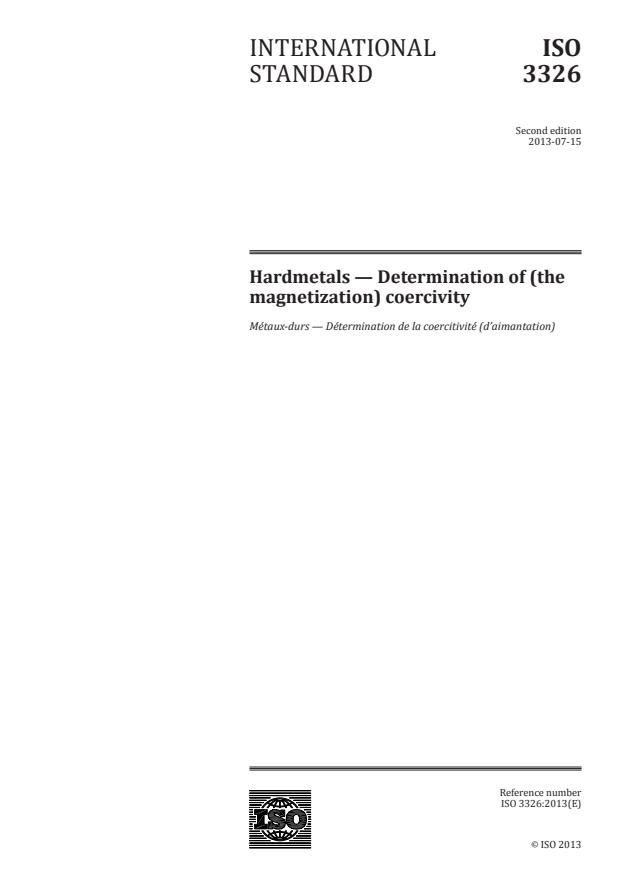
INTERNATIONAL ISO
STANDARD 3326
Second edition
2013-07-15
Hardmetals — Determination of (the
magnetization) coercivity
Métaux-durs — Détermination de la coercitivité (d’aimantation)
Reference number
©
ISO 2013
© ISO 2013
All rights reserved. Unless otherwise specified, no part of this publication may be reproduced or utilized otherwise in any form
or by any means, electronic or mechanical, including photocopying, or posting on the internet or an intranet, without prior
written permission. Permission can be requested from either ISO at the address below or ISO’s member body in the country of
the requester.
ISO copyright office
Case postale 56 • CH-1211 Geneva 20
Tel. + 41 22 749 01 11
Fax + 41 22 749 09 47
E-mail copyright@iso.org
Web www.iso.org
Published in Switzerland
ii © ISO 2013 – All rights reserved
Contents Page
Foreword .iv
1 Scope . 1
2 Principle . 1
3 Symbols and designations . 1
4 Apparatus . 2
5 Procedure. 2
6 Expression of results . 2
7 Test report . 2
Foreword
ISO (the International Organization for Standardization) is a worldwide federation of national standards
bodies (ISO member bodies). The work of preparing International Standards is normally carried out
through ISO technical committees. Each member body interested in a subject for which a technical
committee has been established has the right to be represented on that committee. International
organizations, governmental and non-governmental, in liaison with ISO, also take part in the work.
ISO collaborates closely with the International Electrotechnical Commission (IEC) on all matters of
electrotechnical standardization.
International Standards are drafted in accordance w
...
NORME ISO
INTERNATIONALE 3326
Deuxième édition
2013-07-15
Métaux-durs — Détermination de la
coercitivité (d’aimantation)
Hardmetals — Determination of (the magnetization) coercivity
Numéro de référence
©
ISO 2013
DOCUMENT PROTÉGÉ PAR COPYRIGHT
© ISO 2013
Droits de reproduction réservés. Sauf indication contraire, aucune partie de cette publication ne peut être reproduite ni utilisée
sous quelque forme que ce soit et par aucun procédé, électronique ou mécanique, y compris la photocopie, l’affichage sur
l’internet ou sur un Intranet, sans autorisation écrite préalable. Les demandes d’autorisation peuvent être adressées à l’ISO à
l’adresse ci-après ou au comité membre de l’ISO dans le pays du demandeur.
ISO copyright office
Case postale 56 • CH-1211 Geneva 20
Tel. + 41 22 749 01 11
Fax + 41 22 749 09 47
E-mail copyright@iso.org
Web www.iso.org
Publié en Suisse
ii © ISO 2013 – Tous droits réservés
Sommaire Page
Avant-propos .iv
1 Domaine d’application . 1
2 Principe . 1
3 Symboles et désignations . 1
4 Appareillage . 2
5 Mode opératoire. 2
6 Expression des résultats. 2
7 Rapport d’essai . 2
Avant-propos
L’ISO (Organisation internationale de normalisation) est une fédération mondiale d’organismes
nationaux de normalisation (comités membres de l’ISO). L’élaboration des Normes internationales est
en général confiée aux comités techniques de l’ISO. Chaque comité membre intéressé par une étude
a le droit de faire partie du comité technique créé à cet effet. Les organisations internationales,
gouvernementales et non gouvernementales, en liaison avec l’ISO participent également aux travaux.
L’ISO collabore étroitement avec la Commission électrotechnique internationale (CEI) en ce qui concerne
la normalisation électrotechnique.
Les Normes internationales sont rédigées conformément aux règles données dans les Directives
ISO/CEI, Partie 2.
La tâche principale des comités techniques est d’élaborer les Normes internationales. Les projets de
Norme
...
Questions, Comments and Discussion
Ask us and Technical Secretary will try to provide an answer. You can facilitate discussion about the standard in here.
Loading comments...